OpenAI is buying Pierre Computer Company in order to incorporate the San Francisco-based software developer’s Code.Storage infrastructure layer for Git into its Codex AI-powered programming tool.
Pierre Computer, whose employees number just barely in the double digits, has got plenty of clout for its small size. It’s well-known for Code.Storage offering, as well as for its open-source software libraries, Trees and Diffs, which OpenAI already uses in Codex.
OpenAI has
OpenAI is buying Pierre Computer Company in order to incorporate the San Francisco-based software developer’s Code.Storage infrastructure layer for Git into its Codex AI-powered programming tool.
Pierre Computer, whose employees number just barely in the double digits, has got plenty of clout for its small size. It’s well-known for Code.Storage offering, as well as for its open-source software libraries, Trees and Diffs, which OpenAI already uses in Codex.
OpenAI has experienced some of the limitations of Git itself, and its in-house engineering teams are already working to improve its support for human coders and AI agents working in parallel. Earlier this week the company described how it built a new back end for Git repositories, Pando, to enable concurrent working at scale.
The AI developer has been pushing Codex more aggressively this year: offering it to Mac users and expanding it to Windows. It cited Pierre Computer’s ability to help developers review code as one of the reasons for the acquisition. OpenAI highlighted the Diffs’ Edit mode and the recently released Highlights as components that were particularly helpful to development teams.
Announcing the deal on its news page, OpenAI set out how it would integrate the company into its existing offerings. “With the Pierre team, we wish to set the standard for modern software development: from the first branch an agent creates to that magic moment when code is deployed to the world. We want to make Codex the place where developers and agents take on their most ambitious projects.”
Neither company disclosed details of the acquisition price. OpenAI said that Code.Storage customers will be able to continue using the product until it brings the features into Codex, while Pierre Computer’s open-source projects will remain open, and OpenAI will continue to contribute to them.
An estimated 70% of websites use the open-source language. What is the identified vulnerability in it?Website owners faced millions of attempts to exploit a serious security vulnerability in their programming language, it has emerged, triggering a rush by governments and businesses to fix the problem.The newly discovered vulnerabilities in PHP, a programming language that underpins most websites, allows hackers to carry out cyber-attacks and steal data if not fixed. What were the vulnerabilities
An estimated 70% of websites use the open-source language. What is the identified vulnerability in it?
Website owners faced millions of attempts to exploit a serious security vulnerability in their programming language, it has emerged, triggering a rush by governments and businesses to fix the problem.
The newly discovered vulnerabilities in PHP, a programming language that underpins most websites, allows hackers to carry out cyber-attacks and steal data if not fixed. What were the vulnerabilities and why did they affect so many sites?
The Dutch Tax and Customs Administration is reversing a planned Microsoft 365 cloud migration as officials seek greater control over sensitive government data.
The post Dutch Tax Agency Reverses Microsoft 365 Cloud Migration Over Data Risks appeared first on TechRepublic.
The Dutch Tax and Customs Administration is reversing a planned Microsoft 365 cloud migration as officials seek greater control over sensitive government data.
It's Birthday Week, when we traditionally ship presents to the Internet. This year, two of them come from Europe: EuroLLM, which covers all 24 official EU languages, and Apertus, Switzerland's fully open model, trained on more than 1,500 languages. Both were built by public universities and research institutions. Both are coming to Workers AI, and you can request access today.We're also launching hands-on workshops that help government cyber agencies and critical infrastructure operators build A
It's Birthday Week, when we traditionally ship presents to the Internet. This year, two of them come from Europe: EuroLLM, which covers all 24 official EU languages, and Apertus, Switzerland's fully open model, trained on more than 1,500 languages. Both were built by public universities and research institutions. Both are coming to Workers AI, and you can request access today.
We're also launching hands-on workshops that help government cyber agencies and critical infrastructure operators build AI defenses that work with any model. The first runs in Singapore in October.
Today's announcements follow from an argument we made a year ago, when questions about AI access and sovereignty were swirling in national capitals. Our answer was choice: the freedom to pick the right tools for the job, and to switch when you need to.
Since then, those conversations have hardened. Attackers have used frontier models to run cyber attacks. Access to some frontier models now depends on where you are. Calls to restrict open models are getting louder. Put it all together and it's easy to conclude that AI sovereignty is zero-sum: every model another country controls is one you can't count on, so the safe move is to build walls.
We think the past year can point the other way. India, Japan and Singapore focused on open-sourced models, and people across Asia-Pacific built tools on them for rural citizens, elderly patients and the nurses who care for them. Our own security team built AI defenses that work with any model, so losing access to one doesn't mean losing your defenses.
Helping build a better Internet has always meant more options, not fewer. That's why we work on open standards that prevent vendor lock-in, why so much of what we build is free to start with, and why our network runs in more than 335 cities across 125+ countries, with GPUs for AI inference in more than 230 of them. We don't think any country should have to depend on one company for its AI. That includes us.
Two European open models on Workers AI
In February, Matthew Prince told the India AI Impact Summit 2026 in New Delhi that decentralized, affordable access to AI is a matter of national resilience. The models from India, Japan and Singapore we'd added a few months earlier were our first proof. The summit series moves to Geneva in June 2027, with a mission of "prosperity and progress for all."
EuroLLM supports 35 languages, including all 24 official EU languages, many of which are underserved by existing open models. It was developed with support from Horizon Europe, the European Research Council and EuroHPC by a consortium that includes Instituto Superior Técnico, the University of Edinburgh, Instituto de Telecomunicações, Université Paris-Saclay, Unbabel, Sorbonne University, Naver Labs and the University of Amsterdam. It was trained on the MareNostrum 5 supercomputer and, according to the consortium, outperforms similar-sized models on EU multilingual benchmarks and machine translation.
You can request access to EuroLLM on Workers AI here.
Apertus (Latin for "open") is Switzerland's first large-scale, fully open, multilingual language model. It was trained on more than 15 trillion tokens across more than 1,500 languages, with 40% of training data in languages other than English. It was developed by ETH Zurich, EPFL and the Swiss National Supercomputing Centre (CSCS) as part of the Swiss AI Initiative: built by public institutions, for the public good. Its architecture, weights, training data and methods are all published. It was designed with Swiss and European rules such as the EU AI Act and GDPR in mind, which means respecting training opt-outs, removing personal data and preventing memorization. It was trained on CSCS's Alps supercomputer (more than 10,000 GH200 GPUs), and its developers report that it significantly outperforms leading closed and open models on rare and regional languages, from Romansh and Swiss German to low-resource languages across Asia and Africa.
You can request access to Apertus on Workers AI here.
What people built last year
Last year's national models didn't sit on a shelf. Since we added them to Workers AI, hundreds of students, startups, small businesses and public servants across Asia-Pacific have built on them, many at buildathons we ran with local partners. Three of them:
Government forms, no reading required – Form Mitra (India): Benefit forms written in dense English shut out many of the rural, low-literacy and visually impaired citizens they're meant for. Students at the Indian Institute of Technology Delhi built Form Mitra at a buildathon we ran with CyberPeace: a voice-guided assistant that walks people through the form in any of 22 Indian languages, using AI4Bharat's IndicTrans2 model.
Care in the patient's own dialect – MedBridge (Singapore): Many of the nurses caring for Singapore's elderly patients come from across Southeast Asia and don't speak the local dialects, so critical clinical information can get lost in translation. MedBridge guides patients through health conversations in 14 languages, including Hokkien and Cantonese.
The right public service, in one tap – Anshin Concierge (Japan): For elderly residents, people with disabilities and anyone less comfortable with digital tools, working out which public service to call in a moment of need can be overwhelming. Built as a hackathon prototype, Anshin Concierge lets people describe the problem in their own words ("my knees hurt", "a strange screen appeared on my phone") and connects them to the right Tokyo Metropolitan Government support desk, by phone or web page, in one tap.
AI defenses that don't depend on one model
Governments want to use AI to defend essential services and national infrastructure. The frontier models that can find vulnerabilities at scale can find them for defenders too. But a defense built on one model is only as dependable as your access to that model, and governments have watched access to critical models get constrained with little warning.
We had the same problem, and in security we are always our own first customer. Over the past year, our Security team, working with teams across the company, set out to build AI defenses that don't depend on any one model. We built a harness: an orchestration layer that coordinates multiple AI models working in parallel to hunt for vulnerabilities, verify findings and prioritize threats. We published what we learned about using frontier and open models together, open-sourced the harness so any organization can run it with the models of its choice, and laid out the layered architecture we use to stop attackers armed with frontier models from finding vulnerabilities in the first place.
Because the harness works with any model, closed or open, losing access to one provider doesn't switch your defenses off. When we walked governments through it, the most common reaction was relief. Then came the practical questions: how to stand it up in their own environments, under their own rules. Briefings quickly turned into requests for hands-on training.
So today we're launching a program of hands-on workshops for government cybersecurity agencies and critical infrastructure operators. Participants build their own AI security harness and layered defenses, and leave knowing how to adapt both to their organization. The modules are plug-and-play, designed to slot into national AI skilling and cyber resilience programs. The first workshop runs in Singapore this October, at Singapore International Cyber Week.
Come build with us
None of this happened alone. Partners like CyberPeace in India and Code for Japan helped turn open models into working tools. If you run a national AI program, a cyber agency or critical infrastructure, and you'd like more options than you have today, write to us at policy-team@cloudflare.com. Request access to EuroLLM and Apertus, or start with the harness.
A year ago, we said choice is the path to AI sovereignty. This year showed it's the path to AI security, too.
If you’re new to fuzzing and want to learn the fundamentals first, check out our Fuzzing 101 course at gh.io/fuzzing101.
Continuous fuzzing is not a magic solution that solves all your problems . Even projects that have been enrolled in OSS-Fuzz for years can still hide critical bugs, and the reason is almost always the same: someone needs to keep an eye on coverage, write new harnesses for the code that nobody is reaching, and triage the crashes that come out the other end. In other words,
If you’re new to fuzzing and want to learn the fundamentals first, check out our Fuzzing 101 course at gh.io/fuzzing101.
Continuous fuzzing is not a magic solution that solves all your problems . Even projects that have been enrolled in OSS-Fuzz for years can still hide critical bugs, and the reason is almost always the same: someone needs to keep an eye on coverage, write new harnesses for the code that nobody is reaching, and triage the crashes that come out the other end. In other words, fuzzing still needs a human in the loop.
So the natural question I kept asking myself was: how much of that human work can we actually hand over to an LLM agent?
That is what led me to build the Fuzzing Taskflow, an autonomous fuzzing pipeline for C/C++ projects. You only need to point it at a GitHub repository, and it does the rest: it identifies the suitable entrypoints, analyzes the build system, writes the harnesses, runs AFL++, reads the coverage reports, improves the harnesses, triages every crash, and writes a vulnerability report for each unique bug, all without a human babysitting it.
The Fuzzing Taskflow is built on top of the GitHub Security Lab Taskflow Agent, our framework for writing LLM-driven security automation, so the pipeline is expressed as a set of taskflows that an agent runs end to end.
In this post, I’ll walk you through how it works and the design decisions behind it. Let’s get going!
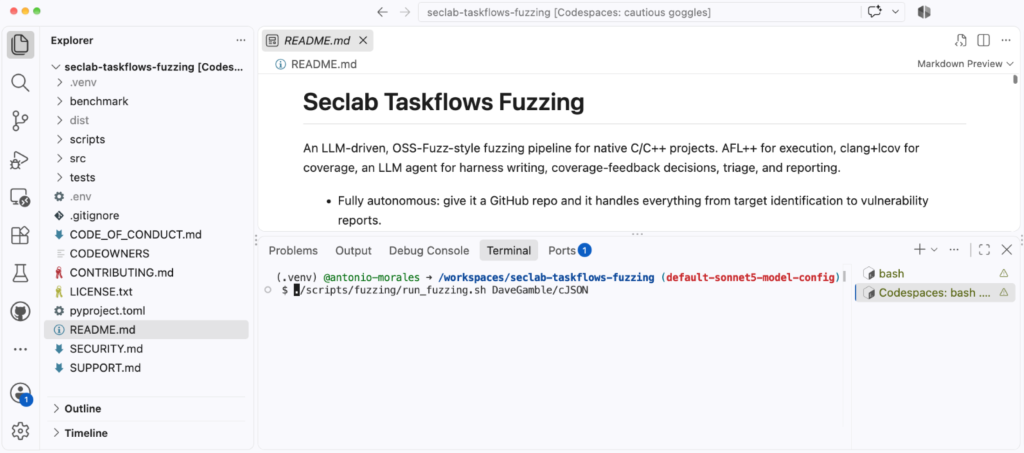
That’s it. The argument is just a GitHub owner/repo slug. Then, the agent, takes care of all the preliminary steps on its own:
Installing software such as AFL
Cloning the repository
Identifying the most relevant functions in the code
Creating fuzz targets for those functions
If you just want a quick smoke test before committing to a long campaign, point it at something small:
./scripts/fuzzing/run_fuzzing.sh DaveGamble/cJSON
A word of warning before you run it: this taskflow runs afl-fuzz, clang, and arbitrary build commands chosen by the LLM directly on the host, with no container in between. A prompt-injected agent could, in principle, do anything your user can. So please run it only inside a disposable environment (e.g., a Codespace or a throwaway VM), without elevated privileges.
Model selection
Some frontier models impose security guardrails on their outputs. For the fuzzing task flow, we use Claude Sonnet 5 by default because it passed all of our internal tests without issues. You can choose a different model by modifying the following file: src/seclab_taskflows_fuzzing/configs/model_config.yaml.
The architecture in one minute
Before getting into the interesting parts, it helps to know how the pieces fit together. There are three layers:
A shell driver (run_fuzzing.sh) that chains the pipeline stages together.
A set of taskflow YAMLs, one per stage, which are essentially the prompts that tell the LLM agent what to do at each step.
A set of MCP tools that the agent calls to actually do the work: run AFL, compile a harness, store a crash, read a coverage report, and so on.
The design rule I cared about most is a clean separation of responsibility: the LLM agent owns the decisions, and the MCP tools own the execution. The agent decides what to fuzz, what harness to write, and what coverage gap to chase next. The tools just expose primitives like run_afl_for or compile_harness. The agent never calls AFL or clang directly; it composes the pipeline out of these building blocks. All the state lives in a SQLite database (fuzz_context.db), so the stages never hand data to each other in memory, only through the database.
One small but important detail: each harness is built twice. AFL’s edge instrumentation is great for guiding the fuzzer but useless for human-readable coverage reports. So every harness becomes both a .afl binary (built with afl-clang-lto -fsanitize=address,undefined) and a .cov binary (built with clang -fprofile-instr-generate -fcoverage-mapping). The .afl binary does the fuzzing; the .cov binary replays AFL’s queue afterwards to produce real source-line and branch coverage.
The coverage-feedback loop
This is the heart of the whole pipeline, and it’s the part that most directly automates the manual workflow I described at the start.
If you have ever tried to improve fuzzing coverage by hand, you’ll know that it’s an iterative process that looks like this:
The “check the coverage” step used to be completed by me, manually reading an LCOV report looking for uncovered branches. The “improve the coverage” step was also completed by me, this time, writing a new harness or crafting a new input. The Fuzzing Taskflow hands both of those steps to the agent.
Each iteration, for each harness, the agent runs AFL for a time budget, replays the queue against the .cov binary to get a real coverage report, and then reads the list of uncovered branches. Based on what it finds, it picks one of a handful of actions:
Add a new seed crafted to reach an uncovered branch
Edit the harness source to call an additional API
Auto-enrich the AFL dictionary with the magic constants a guard is comparing against
Simply skip the gap if it’s a cold error path or vendor code that isn’t worth chasing
The idea is to spend cheap, short rounds early (when there’s lots of low-hanging coverage to grab) and longer rounds later (when the fuzzer needs more time to break through a hard guard).
And just like in my manual workflow, I need an answer to the question: when do we stop? Here, the loop uses plateau detection: once two consecutive iterations each gain less than a configurable threshold (1% absolute line coverage by default), the loop decides it has hit diminishing returns and moves on. This keeps the agent from burning hours of compute squeezing out the last fraction of a percent.
Structure-aware fuzzing
AFL’s default byte-level mutators (bit flips, arithmetic, block splicing) do a great job on binary formats but struggle with structured, text-based inputs. The classic solution is to hand-write custom mutators for each format, which is tedious work. This time I want the pipeline to do that work for me, so it ships four complementary mechanisms for producing structure-aware inputs.
1. Per-format dictionaries and custom mutators. For targets whose input format is recognized (JSON, XML, regex, PNG, length-prefixed binary TLV), the taskflow ships pre-built AFL dictionaries and LLVMFuzzerCustomMutator C files. The JSON mutator does token splicing and balanced-bracket duplication; the XML one knows about tags, entities, and billion-laughs tokens; the regex one carries real ReDoS patterns. Each mutator delegates half of its mutations back to AFL’s default byte mutator, so we keep the engine’s randomization instead of fighting it.
2. A source level dictionary. For formats the pipeline doesn’t recognize, it generates a custom mutator on the fly by scanning the target’s own .c/.h files. It extracts string literals and 32-bit numeric constants (from #define, case, and enum), filters out the noise, and uses them as splice tokens. The intuition is simple: the most interesting magic values that a parser checks for are usually written down somewhere in its own source.
3. A dynamically generated AFL dictionary with coverage-driven enrichment. The same source-token set is also emitted as an AFL classic dictionary before iteration 1 (numeric constants in both endiannesses, so the fuzzer can satisfy a memcmp against a 4-byte magic regardless of host byte order). Then, after every coverage step, the pipeline looks at the guards near the uncovered lines (strncmp, memcmp, case 0xN, == ‘X’) and appends any new tokens it finds. The dictionary literally grows toward the code the fuzzer can’t yet reach.
4. A corpus-splice operator. The smart mutator can also load files from a corpus directory and splice random sub-regions of them into the input, a recombination-style operator that AFL’s stock havoc doesn’t do well.
Evolving corpus
One of the things that quietly kills fuzzing efficiency is throwing away progress. If every run starts from the original seeds, you re-pay the cost of rediscovering the same paths over and over.
To avoid that, every harness gets a stable corpus directory that survives across iterations and across entire campaigns:
<workspace>/corpus/harness_<id>/
At the end of each iteration, AFL’s queue is merged into this directory and run through afl-cmin to keep its size bounded. The effect is that yesterday’s interesting inputs carry into today’s run, and the inputs you found in last week’s campaign carry into this one. If you stop and restart a campaign, you lose nothing.
Triage and vulnerability reports
Finding a crash is only half the job. As anyone who has done root-cause analysis knows, triaging is often the most tedious part of the whole process. This is the other place where the agent shines.
After the fuzzing loop finishes, three stages run automatically. First, every crash is minimized with afl-tmin, replayed under ASan to capture a stack trace, and deduplicated by a stack-top hash (the top normalized frames, with templates, inline namespaces, and LTO suffixes stripped so semantically identical crashes collapse together). Second, previously known crashes are replayed against the current binary to see whether an upstream fix has resolved them. Third, the agent reads the harness source and the crashing function, walks the call chain back from the public API, and writes a per-crash markdown report.
Each report assigns one of the following verdicts:
vulnerability
library_hardening
harness_bug
OOM
timeout
assertion_failure
duplicate
The distinction between a real vulnerability (reachable and exploitable through a public API) and a mere harness_bug (the bug is in our own harness, not the library) is exactly the kind of judgment call that used to require me to sit down and trace the code by hand. Every report includes a root-cause analysis with file:line references, a reachability argument, an exploitability assessment, a suggested fix as a unified diff and a regression-test sketch.
Just as clarification: the suggested patches are marked “review required” for a reason. The agent’s analysis is limited by the model’s understanding of the target code, and it does get things wrong. Treat the verdicts as a very well-prepared starting point for a human, not as final result.
Live dashboard
Running an autonomous campaign and not being able to see what it’s doing is uncomfortable, so the pipeline publishes everything to a live HTML dashboard. It auto-starts in the background as soon as you launch a campaign, on port 8765. In a Codespace that port is auto-forwarded, so you can open it in any browser and watch the campaign progress in real time on the dashboard.
The page shows amongst others:
a per-harness “running” pulse
a coverage-trend table with inline sparklines
a crash heatmap
an iteration timeline
Conclusion
I started this project motivated by the limitations that any security researcher knows well: fuzzing works, but it doesn’t scale without human attention, and that human attention is the bottleneck. The Fuzzing Taskflow is my attempt to push that bottleneck back by handing the repetitive parts (writing harnesses, reading coverage, chasing gaps, triaging crashes) to an LLM agent, while keeping a clean separation between the agent’s judgment and the tools that do the real work.
If you’re the maintainer of C/C++ project, then please give it a try. If your project has never been fuzzed before, then this tool will help you to get started quickly. Or if your project has been fuzzed before, then this tool might help to find new bugs by increasing your fuzzing coverage.
The source code is open source, so please create an issue if you encounter any bugs. Contributions are also welcome!
AWS is betting that AI agents need a different interface as they move beyond answering prompts and start working autonomously in the background.
The company has open-sourced Pizza Bot, a self-hosted application that gives users an inbox for managing work delegated to AI agents, with separate threads for ongoing tasks and a queue for work that is completed or needs human input, rather than keeping the management of agents restricted inside a conventional chat window.
The
AWS is betting that AI agents need a different interface as they move beyond answering prompts and start working autonomously in the background.
The company has open-sourced Pizza Bot, a self-hosted application that gives users an inbox for managing work delegated to AI agents, with separate threads for ongoing tasks and a queue for work that is completed or needs human input, rather than keeping the management of agents restricted inside a conventional chat window.
The rationale, according to AWS, is that background agents do not always need a user’s attention while they work and an inbox model will let users hand off longer-running tasks, return to them later, and see which jobs are complete or require intervention.
Under the hood
That approach is reflected in how the inbox organizes work with the help of an “All” tab that contains the history of each task or conversation, including the agent’s messages and work performed, the “Unread” tab that flags completed work that users have yet to review, and an “Action” tab that surfaces tasks paused while waiting for user input or approval.
The inbox interface also has a panel named Activity that shows users how an agent handled a particular task along with the transcript, AWS wrote in a blog post introducing Pizza Bot.
AWS’ inbox-oriented rationale also extends to Pizza Bot’s architecture.
It uses LangChain’s Deep Agents as the harness and LangGraph as the stateful runtime, with a combination of the two allowing an agent to checkpoint its progress as it works, preserving its messages, tool activity and current state so a task can be paused and resumed rather than being tied to a live chat session, the hyperscaler wrote.
Pizza Bot’s server sits on top of that stack, connecting the agent runtime with the user interface, skills, MCP servers and the model provider, with developers able to choose from Anthropic, OpenAI, Google Gemini and Amazon Bedrock, as well as local models through Ollama, it added.
As for its out-of-the-box capabilities, the application comes with skills for working with files, browsing the web and delegating tasks to specialist agents. Developers can also add existing Agent Skills and MCP servers to give the agents access to other tools and services, the hyperscaler wrote.
Enterprise integration could remain a hurdle
However, analysts were not too convinced that Pizza Bot’s out-of-the-box skills and support for existing tools will make its implementation easier for enterprises.
While the out-of-the-box capabilities and added support for existing skills saves enterprise teams the time to build the application, it leaves out the integration work required to make it work, said Bhupendra Chopra, chief revenue officer at IT consulting firm Kanerika.
“Integration is where most of the money in an enterprise agent deployment goes. A sales or finance team gets value from an agent when it can read and update CRM, email and ERP, and each of those systems needs a connector someone has to build, secure and maintain,” Chopra pointed out.
Pizza Bot’s integration could be further complicated by the application’s lack of support or any SLA, according to Manoj Chandra Jha, principal analyst at Nord-IQ Research. That means the integration and operational burden ultimately falls on enterprises, who would be responsible for running, securing and maintaining the open source software themselves, Jha said.
Rise in enterprise productivity likely
But for enterprises willing to take on that integration work, the inbox-oriented approach could improve productivity.
“It’s a meaningful shift because it changes the economics of delegating work to agents. A chat interface requires a person’s attention throughout the task, while an inbox brings them in only when their judgment is needed, much like how executives delegate work to their teams,” Chopra said.
“Coding agents have already demonstrated this model, where an engineer assigns an issue and reviews the resulting pull request. Pizza Bot extends that approach to tasks such as meeting preparation and follow-ups,” Chopra added.
Further, the analyst pointed out that the inbox-oriented approach could give enterprise teams a clearer window into how scheduled tasks perform.
“For scheduled tasks, having the results delivered as threads gives users a way to track what happened in the background and spot failures that might otherwise go unnoticed,” Chopra said.
Out of sight, out of mind
There are risks with this approach, however: “The inbox model can make bad work less visible. When somebody is watching an agent in a chat window, they can see it going off the rails,” said Phil Fersht, CEO of HFS Research.
In contrast, when hundreds of tasks are running quietly in the background, users may not see an agent making mistakes until the task is complete or an exception requires their attention, potentially making problems harder to catch early, Fersht said.
That reduced visibility can also create approval fatigue, according to Chopra.
“An agent sending back dozens of threads with multiple approval requests can condition users to approve them without reading them closely,” Chopra said.
There is also a risk in the delay between an agent preparing an action and a user approving it: “Information that was current when the agent paused may no longer be valid hours later, potentially resulting in an outdated CRM update or a meeting invite for a slot that is no longer available,” he said. “An assumption that might be caught in a live chat can go unchallenged as the agent continues building on it and consuming model resources. Scheduled runs can also add costs without anyone watching them in real time.”
Those disadvantages can be countered by designing processes with fewer, better-timed approval points, and verifying that the underlying data is still current before allowing an action to execute, he said.
Adoption likely to start with technical teams
Such tradeoffs are likely to shape where Pizza Bot gains traction.
“Adoption will likely be bottom-up, with individual technologists and small platform teams drawn to Pizza Bot’s control and standards-based design,” Jha said. “Risk-averse industries, especially ones in the regulated sectors, and business users with limited technical expertise, however, are likely to approach the application more cautiously,” he added.
That could leave Pizza Bot occupying a more targeted role in the enterprise, as a way for technical teams to experiment with asynchronous agents and new ways of delegating work, rather than an immediate replacement for the governed interfaces and managed services enterprises typically use for business-critical processes, he said.
Discover how OpenAI expanded the second round of its Codex for Open Source program to 10,000 slots, offering ChatGPT Pro 5x and valuable API credits.
Related Posts:
Google Home Adds MCP Support for AI Agent Control
Google Unveils Gemini Live Voice Models for Advanced Reasoning
Google Schedules "Opening Night" for the Googlebook
The post OpenAI Expands Codex for Open Source Sponsorship Program appeared first on Daily CyberSecurity.
Over the past year, our Global Emergency Response Team (GERT) has investigated several incidents involving the NightEagle group (also tracked as APT-Q-95). This group has been active since at least 2023 and originally focused on organizations in Asia. We have now identified attacks by the group targeting businesses in Russia. This post examines both known and new tools NightEagle used in its latest campaign.
Initial access
In most incidents, the attackers used compromised valid credentials to ga
Over the past year, our Global Emergency Response Team (GERT) has investigated several incidents involving the NightEagle group (also tracked as APT-Q-95). This group has been active since at least 2023 and originally focused on organizations in Asia. We have now identified attacks by the group targeting businesses in Russia. This post examines both known and new tools NightEagle used in its latest campaign.
Initial access
In most incidents, the attackers used compromised valid credentials to gain access to corporate VPNs. VPN connections originated from IP addresses in the Russian segment linked to Cloudflare WARP tunnels, as well as from IP addresses associated with European virtual infrastructure providers.
GhostContainer on Microsoft Exchange
Both during the initial access stage and as the attack progressed, the attackers deployed the GhostContainer backdoor on Microsoft Exchange servers. It incorporates components from several open-source projects, including the Neo-reGeorg tunnel, an exploit for the CVE-2020-0688 vulnerability, and the GhostWebShell class from the ysoserial utility. All of these components are publicly available on GitHub.
We were unable to determine the exact method the attackers used to deliver the backdoor to Microsoft Exchange servers. We believe with a high degree of confidence that they applied a technique already familiar to us: extracting the cryptographic keys used by Microsoft Exchange from the ASP.NET configuration, overwriting the VIEWSTATE framework parameter, and injecting a payload into it, which then launched the GhostContainer backdoor in memory.
The backdoor is a .NET assembly containing three classes that implement its core functionality:
Stub: processes C2 commands delivered to the infected system through the x-owa-urlpostdata headers and evades detection by the Antimalware Scan Interface (AMSI) and Windows Event Log mechanisms by overwriting addresses in amsi.dll and ntdll.dll.
App_Web_843e75cf5b63: accepts the fakePath and fakePageName parameters and creates virtual paths that redirect requests to the App_Web_8c9b251fb5b3 class.
App_Web_8c9b251fb5b3: implements network traffic redirection (proxying) and socket forwarding functionality.
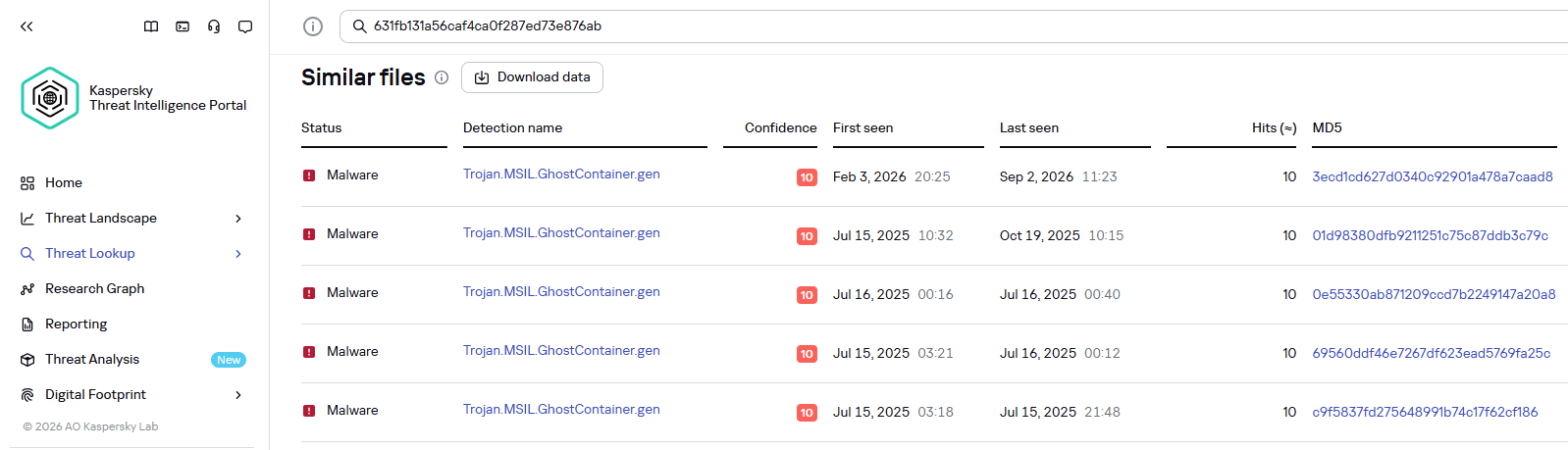
Kaspersky products detect the GhostContainer backdoor as Trojan.MSIL.GhostContainer.gen.
GhostContainer samples identified by the Similarity technology from Kaspersky Threat Analysis
Traffic redirection
Once the attackers gain sufficient privileges during an attack, they leverage RDP to move laterally within the internal network segment. To do this, they download and run tools for tunneling and redirecting network traffic.
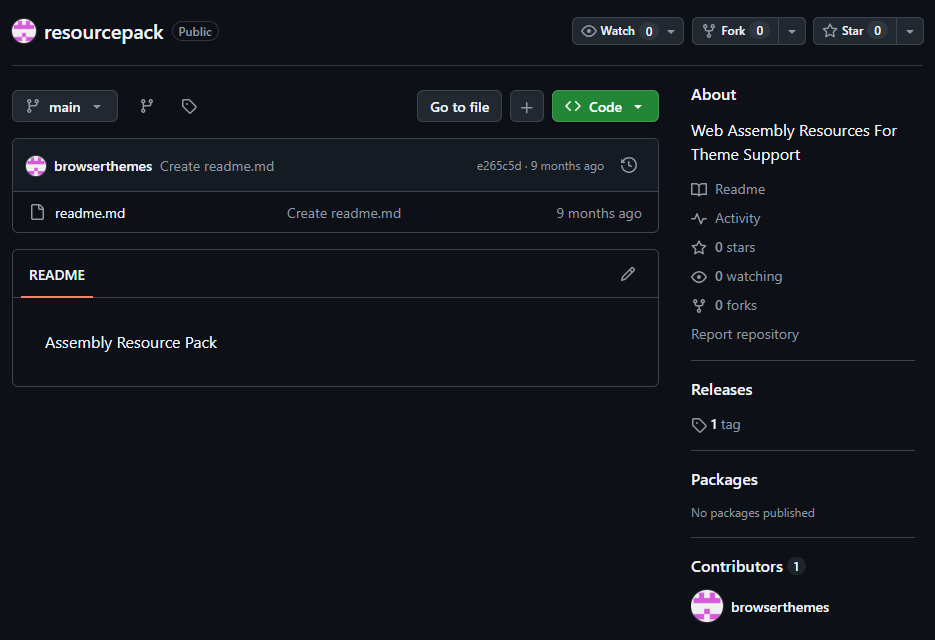
The attackers used GitHub repositories to host their archived tools. The names of the repositories and archives were disguised to look legitimate:
One of the repositories used for storing network tools
The files contained within the archives were also given names mimicking known legitimate software, though unrelated to the archive names:
adobe_32.exe;
AdobeSync.exe;
trueconf.exe;
1cbroker.exe;
1c-office-plugin.exe;
trueconf-broker.exe.
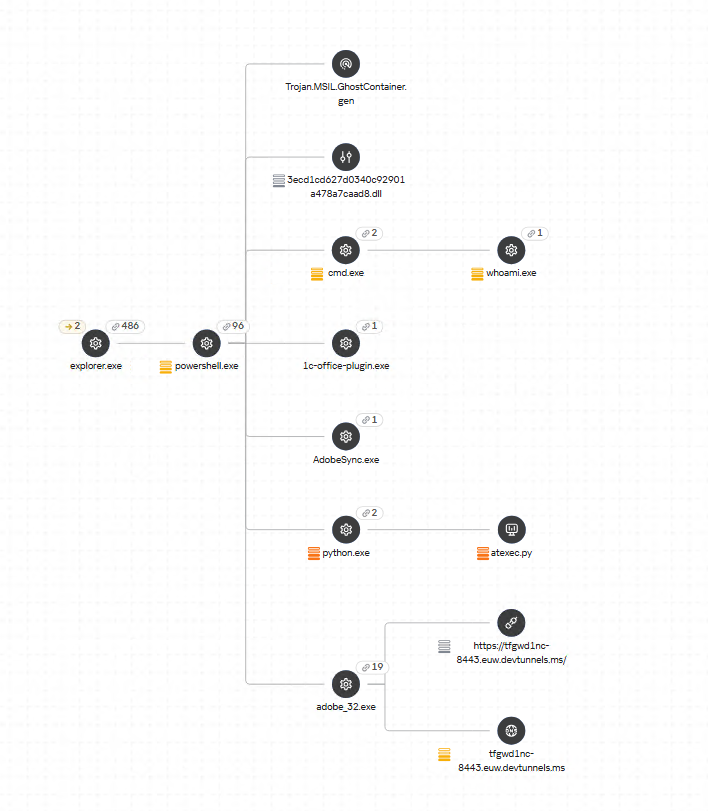
Across the incidents we investigated, we found two tools that the attackers combined for traffic tunneling.
Microsoft dev tunnels
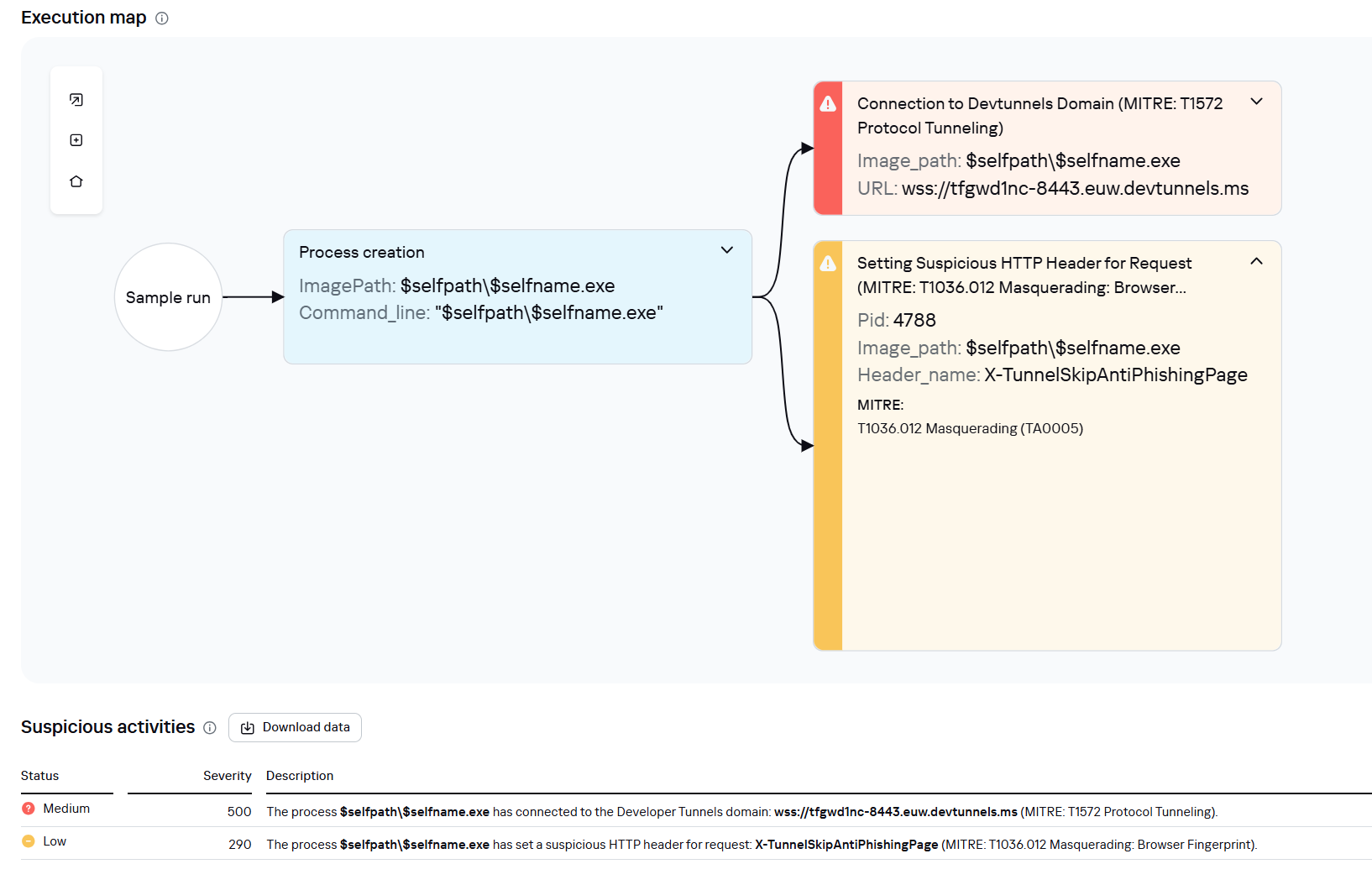
This is a legitimate Microsoft mechanism that allows local web services to be published for internet access on *.*.devtunnels.ms domains. The attackers used this tunneling capability to expose port 3389 (RDP) on the compromised system.
Execution graph of adobe_32.exe in Kaspersky Research Sandbox
rdp2tcp
This is a publicly available tool for tunneling TCP traffic over an established RDP connection. It includes a server component that runs on the target system and a client component that runs on the attacker’s side.
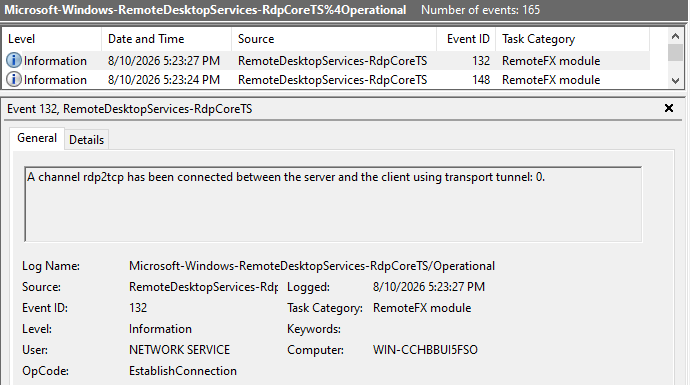
When virtual channels are opened and closed, corresponding events with IDs 132 (channel opened) and 148 (channel closed) are logged in the Microsoft-Windows-RemoteDesktopServices-RdpCoreTS/Operational.evtx Windows log. These events contain the names of the channels (such as XPSRD, cliprdr, Microsoft::Windows::RDS::DisplayControl, and others) used by the RemoteFX module, which extends the capabilities of the RDP protocol.
When the rdp2tcp tool is used, events with IDs 132 and 148 will contain the channel name rdp2tcp or other random alphanumeric combinations chosen by the attackers.
Creation event for a channel named rdp2tcp (server component startup)
The combination of Microsoft dev tunnels and rdp2tcp allows the attackers to maintain network access by using legitimate services without opening additional suspicious ports.
The attackers also used the atexec utility from the Impacket toolkit to create scheduled tasks on target systems. These tasks enabled network port forwarding through standard Windows functionality:
To obtain elevated privileges and move laterally through the network, NightEagle exploited various vulnerabilities in Active Directory. The attackers used previously established tunnels to connect to internal infrastructure systems.
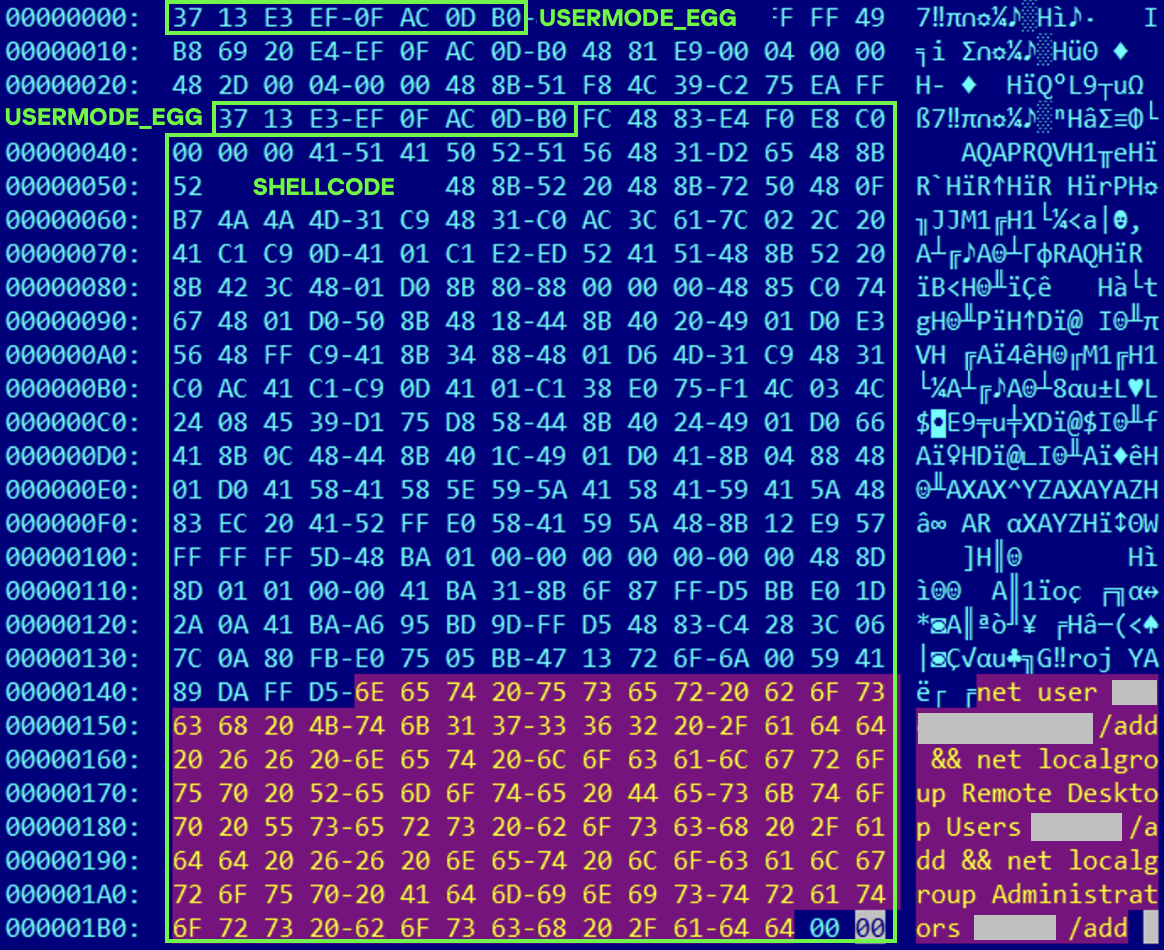
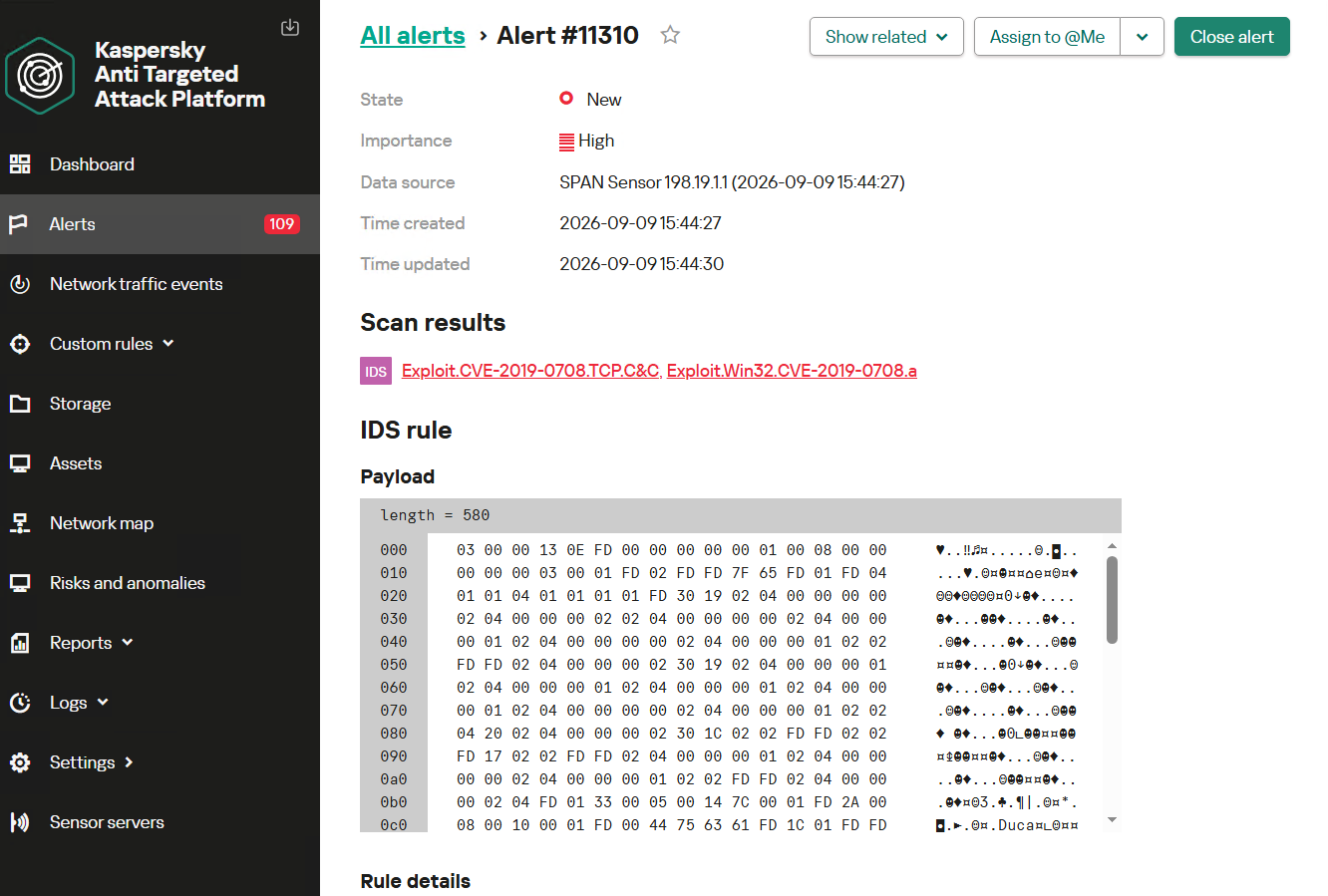
In one incident, they exploited a well-known RDP implementation vulnerability, CVE-2019-0708 (BlueKeep). They used the vulnerable mechanism to create a local account on the system and add it to the Administrators and Remote Desktop Users groups.
Contents of a system memory dump showing artifacts of the CVE-2019-0708 exploit
The attackers also requested Kerberos tickets with a non-standard combination of flags (Forwardable, Proxiable, Renewable) and attempted to replicate the Domain-Password object from the Active Directory database to impersonate the domain controller (a technique known as DCSync) after obtaining an account with sufficient privileges.
Through these methods, the attackers establish persistence in the infrastructure, obtain password hashes for domain accounts, use long-lived Kerberos tickets to gain legitimate access to target resources, and ultimately compromise domain controllers and the victim’s entire Active Directory infrastructure.
Takeaways
To expand the geographic scope of its targets, NightEagle is updating its methods and adopting new techniques for persistence and lateral movement. Despite the group’s efforts to stay hidden, timely detection of anomalies combined with a comprehensive approach to infrastructure protection can significantly hinder the attackers from achieving their goals. Since the attackers rely on known legitimate tools and infrastructure vulnerabilities, well-configured monitoring can help detect NightEagle’s presence on the network.
Detection by Kaspersky solutions
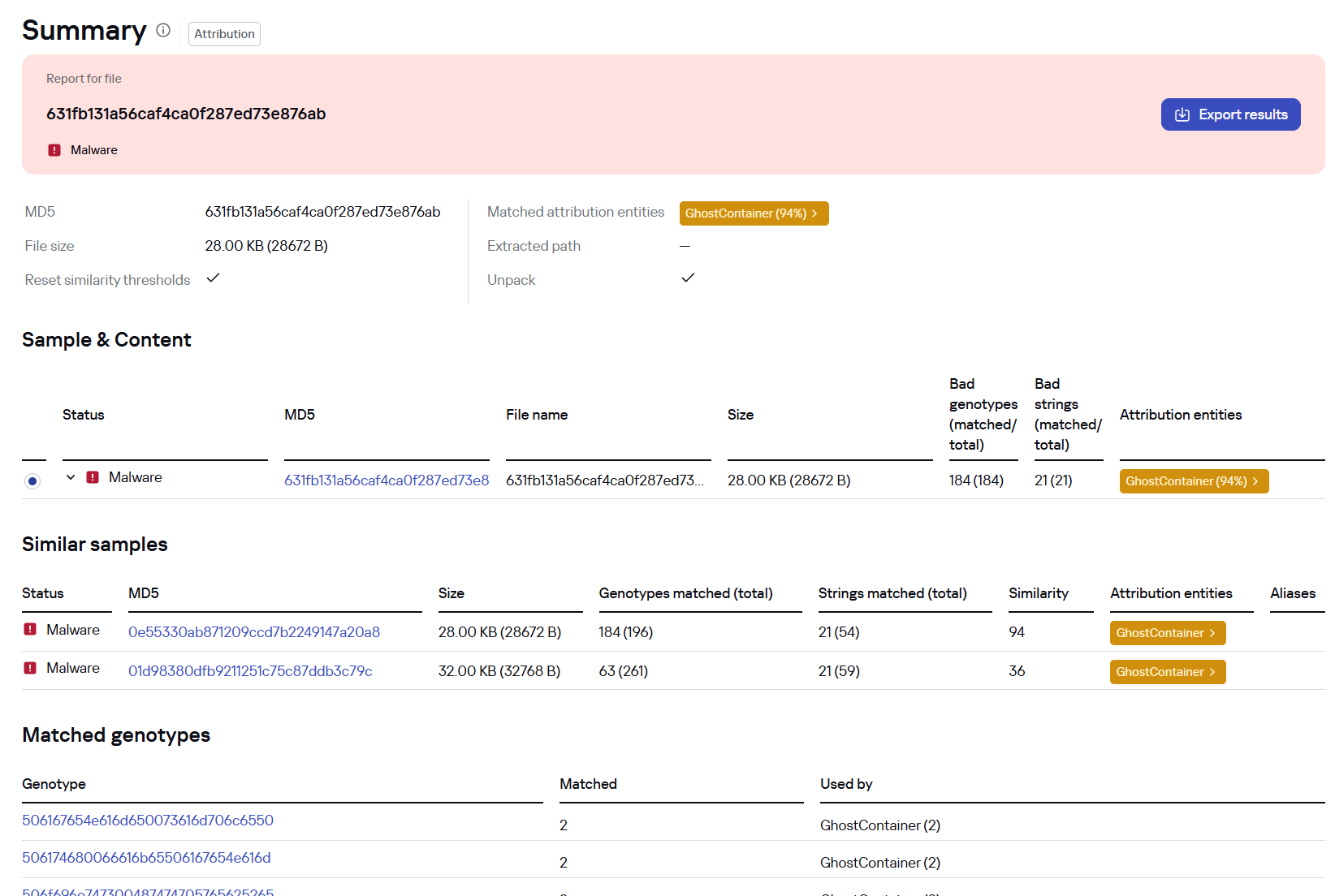
Kaspersky solutions reliably identify the malicious activity described above at various stages of the attack. We showed examples above of how Kaspersky Threat Analysis detects samples of the GhostContainer backdoor and the tunneling utility. This toolkit also includes the analytical solution Kaspersky Threat Attribution Engine (KTAE), which helps SOC analysts and incident responders determine which APT groups malware can be attributed to. The solution uses a proprietary comparison method that measures the similarity between analyzed samples of suspicious files and known malicious samples in Kaspersky’s collection.
The backdoor we discovered showed similarity to previously analyzed GhostContainer samples and a connection to the NightEagle APT group:
Backdoor analysis with KTAE
However, detection scenarios for this kind of attacks are not limited to file analysis. Deploying a backdoor on a target host produces numerous characteristic artifacts, which allow Kaspersky Endpoint Detection and Response Expert to alert users to anomalies in the infrastructure in a timely manner.
This malicious activity is detected by the following rules, available in the repository:
Initial detection of the malicious signature occurs through the generic_ransomware_related_detection rule, based on EPP module events
Give an AI agent a mere rumor of an exploit, and it’s enough for them to find it.
What’s worse, I found I could use my own agents to find the exploit just by knowing roughly what it was about and so could have been exploiting it well before the public patch was available! Given that just the rumour of a security issue seems enough to give attackers enough info to find new exploits, we’re going to need to change the way we deal with security responses in open source.
Simon Willison comments:
Anil
Give an AI agent a mere rumor of an exploit, and it’s enough for them to find it.
What’s worse, I found I could use my own agents to find the exploit just by knowing roughly what it was about and so could have been exploiting it well before the public patch was available! Given that just the rumour of a security issue seems enough to give attackers enough info to find new exploits, we’re going to need to change the way we deal with security responses in open source.
Anil points out that this rate of discovery appears incompatible with existing open source embargo practices for new issues. If an issue can become an exploit this fast, we need to figure out new processes for keeping our communities safe.
More than 1,000 organisations, 500,000 stolen credentials, and one self-propagating worm named after a Dune sandworm - two men now face charges over TeamPCP's global hacking spree.
Read more in my article on the Hot for Security blog.
More than 1,000 organisations, 500,000 stolen credentials, and one self-propagating worm named after a Dune sandworm - two men now face charges over TeamPCP's global hacking spree.
Read more in my article on the Hot for Security blog.
Security researchers found 150 lookalike Open VSX extensions published under trusted names, highlighting how extension marketplaces can expose developer credentials, source code, and CI/CD systems to supply-chain risk.
The post 77 Counterfeit Open VSX Extensions Collected Developer and CI/CD Data appeared first on TechRepublic.
Security researchers found 150 lookalike Open VSX extensions published under trusted names, highlighting how extension marketplaces can expose developer credentials, source code, and CI/CD systems to supply-chain risk.
This is good:
Post-quantum cryptography is now one pip-install away for the entire Python ecosystem. With funding from the Sovereign Tech Agency, we implemented support for ML-KEM, the NIST-standard key-establishment primitive, and ML-DSA, the NIST-standard digital-signature primitive, in pyca/cryptography.
Remember, the reason to do this now is because there’s no emergency. And because you will make your systems crypto agile, which is always a good idea.
Post-quantum cryptography is now one pip-install away for the entire Python ecosystem. With funding from the Sovereign Tech Agency, we implemented support for ML-KEM, the NIST-standard key-establishment primitive, and ML-DSA, the NIST-standard digital-signature primitive, in pyca/cryptography.
Remember, the reason to do this now is because there’s no emergency. And because you will make your systems crypto agile, which is always a good idea.
Researchers found that seven of nine tested Hugging Face image-editing tools produced sexualized alterations, highlighting gaps in model oversight, provenance, and enterprise vendor controls.
The post Hugging Face Deepfake Tests Raise New Risks for AI Procurement appeared first on TechRepublic.
Researchers found that seven of nine tested Hugging Face image-editing tools produced sexualized alterations, highlighting gaps in model oversight, provenance, and enterprise vendor controls.
GitHub’s new Actions safeguard pauses potentially malicious workflow runs before execution, leaving repository owners to decide who can approve them and what checks must come first.
The post GitHub Automatically Holds Suspicious Actions Runs, but Repository Owners Must Approve Them appeared first on TechRepublic.
GitHub’s new Actions safeguard pauses potentially malicious workflow runs before execution, leaving repository owners to decide who can approve them and what checks must come first.
SpaceXAI open-sourced Grok Build under Apache 2.0 after privacy backlash over broad directory uploads from its terminal AI coding agent.
The post SpaceXAI Open-Sources Grok Build After Privacy Backlash appeared first on TechRepublic.
At GitHub Security Lab, we spend a lot of our week talking to maintainers. Some find the settings page dense and the docs sprawl. Most maintainers we talk to weren’t hired to be security engineers. While this is true, ignoring a project’s security settings completely will lead into leaving a lot in the table in terms of automation and scalability, leading into a poor security posture, and before you realize it to vulnerabilities that pile up, exposing your users.
Here’s the short version. Si
At GitHub Security Lab, we spend a lot of our week talking to maintainers. Some find the settings page dense and the docs sprawl. Most maintainers we talk to weren’t hired to be security engineers. While this is true, ignoring a project’s security settings completely will lead into leaving a lot in the table in terms of automation and scalability, leading into a poor security posture, and before you realize it to vulnerabilities that pile up, exposing your users.
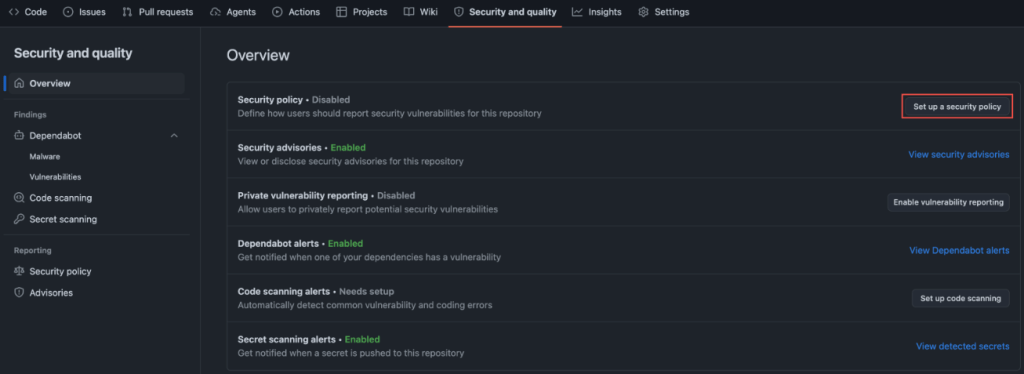
Here’s the short version. Six settings, free to use, updated in less than half an hour. We’ve bundled them into a guided flow called Protect Your Project so you can do them in one pass, and we walk through each tool you’ll use below.
1. Add a SECURITY.md file
This is the lightest-lift setting on the list and the one that makes everything else easier.
A SECURITY.md file tells the people who find bugs in your project where to send them. Without one, your options for a well-meaning reporter are a public issue (now a public exploit) or your personal email (if they can find it).
You don’t need to write much. We suggest adding a communication means such as an email so that those reporting vulnerabilities can reach you directly without posting about them publicly. Then, you can state what bugs are in scope, alongside anything else a reporter should have in mind when contacting you. For reference, we point maintainers to the the systemd project’s security policy that we consider a complete example. It sets clear expectations about reproducers and doesn’t assume you have a 24/7 response team when you don’t. Borrow the structure, change the contact details, commit it.
Ten minutes, tops.
2. Turn on private vulnerability reporting
SECURITY.md tells reporters where to go. Private vulnerability reporting (PVR) gives them a private place to make their report.
Once enabled, a researcher can file a confidential advisory on your repo. You triage it out of the public eye and disclose on your timeline. The setup is one checkbox in Settings → Security.
If you only do one thing tonight, do these first two together. They are free, and are the fastest signal to your community that you take this seriously.
3. Turn on secret scanning, with push protection
This is the one with the most embarrassing failure mode.
GitGuardian’s State of Secrets Sprawl 2026 found 28.65 million new secrets leaked on public GitHub in 2025, a 34% jump over the prior year and the largest single-year increase on record. AI-assisted commits are leaking secrets at roughly twice the baseline rate. The average cost of a data breach now sits at $4.44 million globally ($10.22 million in the US) per IBM’s 2025 Cost of a Data Breach Report.
Secret scanning catches keys and tokens that slip into your repo by blocking them locally before they’re pushed to your repository. It doesn’t matter if your repo is public or private, because once secrets leave your local development, then they are available to anyone with access to your repo.
4. Turn on Dependabot and dependency review
Your project isn’t just your code. It’s the dozens (often hundreds) of packages your code pulls in.
Dependabot alerts you when a package you depend on has a known vulnerability. Dependency review shows you, inside a pull request, exactly what’s being added or upgraded and whether any of it has an open advisory. Together they turn an opaque package.json diff into a two-minute review.
5. Turn on code scanning
Code scanning runs static analysis on your repo and flags the patterns that lead to real bugs. SQL injection. Command injection. Dangerous deserialization. The usual cast.
Code scanning with CodeQL can detect unsafe GitHub Actions workflows. CodeQL is the engine, and we built code scanning. We made it free for open source in 2019, and it now ships as a one-click default setup in your Security and Quality tab.
This is the setting most maintainers skip because it sounds like it needs configuration. It doesn’t. Default setup picks the right query pack for your language and runs on every pull request.
6. Turn on branch protection on your default branch
This is the simplest, least-flashy setting, but it will yield the biggest impact starting as soon as you turn it on. This is about requiring a pull request before merging to main with minimum one approval.
This catches the worst-case scenario: a compromised credential, a confused contributor, or a tired version of you pushing straight to production. It’s also what makes the other five settings actually bite, because now Dependabot alerts and code scanning findings block a merge instead of sitting in a tab you never open.
In conclusion
These six settings will not make your project unhackable. Nothing will.
What they will do is close the easy doors, the ones being walked through right now by people scripting through public repos at scale.
Turn these on, and your project will be meaningfully harder to attack than it was this morning. So will every project that depends on it.
What are the next steps for security leaders in this new age of frontier AI? We answer the top 10 questions customers are asking.
The post Frontier AI and the Future of Defense: Your Top Questions Answered appeared first on Unit 42.
TL;DR
Sonatype identified 21,764 open source malware packages in Q1 2026, bringing the total logged since 2017 to 1,346,867.
npm accounted for 75% of malicious packages this quarter. Trojans dominated, with most activity focused on credential theft, host reconnaissance, and staged payload delivery.
The quarter's defining pattern was trust abuse: attackers succeeded by hiding behind trusted packages, trusted release paths, and trusted workflows.
Three incidents stood out: SANDWORM_M
Sonatype identified 21,764 open source malware packages in Q1 2026, bringing the total logged since 2017 to 1,346,867.
npm accounted for 75% of malicious packages this quarter. Trojans dominated, with most activity focused on credential theft, host reconnaissance, and staged payload delivery.
The quarter's defining pattern was trust abuse: attackers succeeded by hiding behind trusted packages, trusted release paths, and trusted workflows.
Three incidents stood out: SANDWORM_MODE, the LiteLLM compromise, and the axios compromise.
By the Numbers: What We Saw
In the first three months of 2026, Sonatype identified 21,764 open source malware packages across ecosystems, bringing the total number logged since 2017 to 1,346,867. Q1 activity was heavily concentrated in npm and focused on credential theft, host information exfiltration, and staged follow-on compromise.
The quarter was also defined by trojan-style malware, which outpaced brandjacking and hijacking as the dominant payload type. While access paths varied — typosquatting, maintainer compromise, and abuse of legitimate release channels — the pattern was consistent: attackers kept finding ways to push malware through software that looked legitimate enough to trust by default.
Three incidents illustrate that pattern especially clearly:
SANDWORM_MODE, which pointed to more adaptive and worm-like malware behavior.
The Trivy/litellm-linked campaign, which showed how release paths and high-value AI and security tooling can become the attack surface.
The axios compromise, which demonstrated how a small dependency change inside a highly trusted package can create outsized downstream risk.
Beyond the Numbers: Trust Abuse Was the Defining Pattern
Q1 saw one new malicious package every six minutes, and npm accounted for 75%, reinforcing that attackers still see JavaScript ecosystems as the fastest path to developers and build systems at scale. The prevalence of trojans far showed attackers did not need especially novel tactics to succeed. In many cases, the playbook was simple: publish something plausible, get it installed, and execute inside a trusted workflow.
The most common behaviors — credential theft, host information exfiltration, and droppers for follow-on compromise — point to the same conclusion. These campaigns were designed for access, persistence, and reuse inside developer and CI/CD environments.
The core risk in Q1 was not just malicious code entering the ecosystem. It was malicious code entering through trusted names, trusted workflows, and trusted environments.
SANDWORM_MODE: Supply Chain Malware Got More Worm-Like
SANDWORM_MODE was one of Q1's clearest signs that open source malware is becoming more adaptive and automated.
The campaign used typosquatted npm packages to harvest sensitive data from developer machines and CI environments. Sonatype observed theft of npm and GitHub tokens, environment variables, cryptographic keys, and API credentials, along with code aimed at spreading into additional repositories and workflows.
Researchers also found code designed to interact with a local Ollama instance, suggesting early experimentation with malware that could modify itself inside compromised environments.
What made SANDWORM_MODE important was not just that it spread. It showed attackers building malware to take advantage of the automation and trust built into modern software delivery.
Trivy Hijack: Trusted Release Paths Became the Attack Surface
The Trivy incident stood out because it was not just a compromised package story. It was a supply chain attack that linked trusted security tooling to malicious code insertion in another widely used project.
In March 2026, a compromised version of the Trivy security scanner was used to help facilitate the insertion of malicious code into the LiteLLM library. That made the attack especially significant: the issue was not simply a fake package or a one-off malicious upload, but the abuse of a trusted tool inside the software delivery chain.
The related LiteLLM compromise involved malicious PyPI versions 1.82.7 and 1.82.8, which contained an obfuscated credential stealer and dropper. The malware targeted API keys, environment variables, SSH keys, Git credentials, cloud secrets, Kubernetes tokens, Terraform and Helm artifacts, and CI/CD configuration, then established persistence through sysmon.py.
What made this incident so important in Q1 was the attack path itself. Once attackers can compromise a trusted tool or release workflow, they no longer need to rely on obvious deception. They can use legitimate software and trusted delivery paths to move malicious code downstream.
Axios Compromise: Small Change, Large Blast Radius
The axios compromise showed how little an attacker needs to change to create downstream risk. Attackers hijacked an npm publishing account and released axios@1.14.1 and axios@0.30.4 with a hidden dependency on plain-crypto-js@4.2.1. That package acted as an obfuscated loader, using npm's postinstall hook to fetch and run a secondary payload.
Researchers found OS-specific launcher behavior for MacOS, Windows, and Linux, consistent with delivery of a remote access trojan. The attack also used cleanup and metadata tricks to make analysis harder.
The lesson was straightforward: attackers did not need to rewrite a popular library. They only needed to insert a malicious transitive dependency into a package developers already trusted.
What Development Teams Should Take Away
Screen components before use. New packages and updates should be evaluated before they reach developer machines or CI pipelines.
Inspect transitive dependencies. The axios incident showed how malware can arrive through a hidden child package, not just the top-level dependency.
Treat dev and CI environments as high-value targets. Q1 malware repeatedly targeted tokens, cloud credentials, SSH material, and pipeline secrets.
Assume credential exposure after execution. In incidents like LiteLLM or axios, package removal is not enough. Rotate secrets and review affected environments.
Watch release paths, not just package names. Maintainer accounts, publishing workflows, and release automation are part of the attack surface.
Do not rely on reputation alone. Familiar names and popular packages are no longer strong trust signals by themselves.
Looking Ahead
Q1 reinforced a consistent reality: the most effective attacks did not rely on obviously malicious packages. They relied on appearing trustworthy by hiding inside familiar names, legitimate workflows, and routine dependency updates.
Prevention is less about reacting after-the-fact and more about making better decisions before code is ever used.
In practice, that means having access to reliable, real-time intelligence about open source packages that highlights unusual behavior, known risks, or patterns that do not align with normal development activity.
Tools like Sonatype Guide are designed to surface that kind of context directly to developers, making it easier to evaluate dependencies and avoid high-risk components before they enter the build.
As Q1 showed, attackers consistently took advantage of assumed trust. The teams that reduce risk most effectively will replace that assumption with visibility and make informed decisions a routine part of development.
TL;DR: Julius v0.2.0 nearly doubles LLM fingerprinting probe coverage from 33 to 63, adding detection for cloud-managed AI services (AWS Bedrock, Azure OpenAI, Vertex AI), high-performance inference servers (SGLang, TensorRT-LLM, Triton), AI gateways (Portkey, Helicone, Bifrost), and self-hosted RAG platforms (PrivateGPT, RAGFlow, Quivr). This release also hardens the scanner itself with response size limiting and […]
The post Julius v0.2.0: From 33 to 63 Probes — Now Detecting Cloud AI, Enterpr
TL;DR: Julius v0.2.0 nearly doubles LLM fingerprinting probe coverage from 33 to 63, adding detection for cloud-managed AI services (AWS Bedrock, Azure OpenAI, Vertex AI), high-performance inference servers (SGLang, TensorRT-LLM, Triton), AI gateways (Portkey, Helicone, Bifrost), and self-hosted RAG platforms (PrivateGPT, RAGFlow, Quivr). This release also hardens the scanner itself with response size limiting and […]

 Entrar