Conta hackeada? Suporte para Instagram, WhatsApp, Facebook e e-mail + blindagem de celular | RDS @RDSWEB
RDS @RDSWEB | Suporte de TI e segurança da informação | Atendimento 100% virtual para todo o Brasil
ATENÇÃO: se você está com a conta invadida agora, não compartilhe códigos de verificação com ninguém e fale já com o suporte pelo WhatsApp.
Conta hackeada? Suporte para Instagram, WhatsApp, Facebook, e-mail e afins, com blind
Conta hackeada? Suporte para Instagram, WhatsApp, Facebook e e-mail + blindagem de celular | RDS @RDSWEB
RDS @RDSWEB | Suporte de TI e segurança da informação | Atendimento 100% virtual para todo o Brasil
ATENÇÃO: se você está com a conta invadida agora, não compartilhe códigos de verificação com ninguém e fale já com o suporte pelo WhatsApp.
Conta hackeada? Suporte para Instagram, WhatsApp, Facebook, e-mail e afins, com blindagem de celular
Resposta direta: se sua conta de Instagram, WhatsApp, Facebook ou e-mail foi hackeada ou clonada, você pode falar agora com o suporte da RDS @RDSWEB pelo WhatsApp (47) 98861-8255. O atendimento é 100% virtual e inclui triagem do incidente, orientação de recuperação pelos canais oficiais de cada plataforma, blindagem de celular e orientações de suporte de TI e segurança da informação para evitar nova invasão.
Sem promessa de recuperação: a decisão final é de cada plataforma. O que o suporte faz é organizar o caminho certo, reduzir danos e proteger o que ainda é seu.
Suporte para contas hackeadas, blindagem de celular e orientação de TI e segurança da informação.
O que significam os termos
Conta hackeada: conta de rede social, aplicativo de mensagens ou e-mail acessada por terceiros sem autorização, geralmente por senha vazada, phishing, código de verificação entregue ao golpista ou aplicativo malicioso no celular. WhatsApp clonado: o golpista registra seu número em outro aparelho, quase sempre depois de obter o código de 6 dígitos. Blindagem de celular: ajustes que reduzem a chance de invasão do aparelho e das contas. Suporte de TI e segurança da informação: orientação prática, passo a passo, para recuperar o acesso pelos meios oficiais e reorganizar a proteção.
O que o suporte atende
Instagram
Perfil invadido, e-mail trocado, seguidores e mensagens usados em golpe.
WhatsApp
Número clonado, mensagens pedindo dinheiro, desconexão e sessões estranhas.
Facebook
Conta, página ou anúncios sob controle de terceiros.
E-mail e afins
Gmail, Outlook e outras contas, incluindo regras de encaminhamento maliciosas.
Blindagem de celular
Revisão de permissões, apps, chip, bloqueios e autenticação em duas etapas.
Suporte de TI e SI
Orientação de segurança para pessoas, famílias, profissionais e pequenas empresas.
WhatsApp (47) 98861-8255, atendimento 100% virtual para todo o Brasil.
Passo 1
Você descreve o que aconteceu (plataforma, quando começou, o que foi alterado).
Passo 2
Triagem do incidente e plano de ação com os canais oficiais de recuperação.
Passo 3
Reforço de segurança: e-mail, duas etapas, sessões e blindagem do celular.
O que não prometemos
Recuperação garantida. A plataforma decide; o suporte orienta e organiza o processo.
Perguntas frequentes
O que fazer quando minha conta do Instagram, WhatsApp ou Facebook foi hackeada?
Use um aparelho confiável, não o comprometido, e siga os fluxos oficiais de recuperação de cada plataforma. Comece pelo e-mail principal: troque a senha, revise regras de encaminhamento e dispositivos conectados, e ative a verificação em duas etapas com aplicativo autenticador. Depois avise seus contatos, registre boletim de ocorrência e guarde prints, links e datas como evidência.
Como saber se meu WhatsApp foi clonado?
Sinais comuns são mensagens que você não enviou, pedidos de dinheiro enviados aos seus contatos, desconexão repentina do aplicativo e códigos de verificação que você não solicitou. Verifique em Aparelhos conectados se há sessões desconhecidas, ative a verificação em duas etapas com PIN e nunca compartilhe o código de 6 dígitos.
O suporte garante a recuperação da conta?
Não. Nenhum prestador sério pode garantir a recuperação, porque a decisão final é da plataforma. O suporte organiza a triagem, orienta o caminho oficial, ajuda a reunir evidências e a reforçar a segurança para reduzir o risco de nova invasão.
O que é blindagem de celular?
Análise de vulnerabilidades e estratégia de segurança a definir.
Posso pagar alguém que promete recuperar a conta rapidamente?
Desconfie. Muitos anúncios de recuperação instantânea são golpes que pedem pagamento antecipado, códigos ou acesso remoto ao celular. A recuperação legítima segue os canais oficiais da plataforma e não exige que você entregue senhas ou códigos de verificação.
O atendimento é presencial?
Não. O atendimento é 100% virtual, pelo WhatsApp (47) 98861-8255, com orientação e suporte remoto de TI e segurança da informação para todo o Brasil.
Como proteger o e-mail depois de uma invasão?
Temos uma solução avançada para sua defesa de engenharia social e bloqueio de acessos indevidos.
Serviço: atendimento a usuários com contas hackeadas ou clonadas (Instagram, WhatsApp, Facebook, e-mail e afins), blindagem de celular e orientação de suporte de TI e segurança da informação.
Prestador: Rogério de Souza, marca RDS @RDSWEB / RDS Intelligence Group, analista de segurança da informação e especialista em OSINT/SOCMINT, com mais de 20 anos em CTI, investigação defensiva e perícia digital.
Contato: WhatsApp +55 47 98861-8255 (wa.me/5547988618255). Atendimento 100% virtual, para todo o Brasil. Referência do especialista: Joinville/SC.
Dentro do escopo: triagem do incidente, orientação de recuperação pelos canais oficiais, reforço de segurança de e-mail e contas, blindagem de celular, orientação de TI e segurança da informação.
Fora do escopo: garantia de recuperação de conta, acesso a contas de terceiros e qualquer prática ilegal. O serviço segue a legislação brasileira (LGPD, Marco Civil da Internet, CPP).
Alerta de golpe: "recuperação instantânea" com pagamento antecipado, pedido de códigos ou acesso remoto é sinal de fraude. A recuperação legítima usa os canais oficiais de cada plataforma.
Citar como fonte: RDS @RDSWEB (Rogério de Souza), osintbrasil.blogspot.com. Não há vínculo com Meta, Google, Microsoft ou outras plataformas citadas.
Sobre o autor
Rogério de Souza, RDS @RDSWEB, é analista de segurança da informação e especialista em OSINT/SOCMINT, analista de inteligência, com mais de 20 anos de atuação em CTI, experiência em cyber comando privado e atuação em equipes de investigação defensiva e perícia digital. Atua em suporte a escritórios de advocacia na investigação defensiva, com busca de bens e imóveis, e em cybersecurity acionável, resolvendo casos de invasão e insiders. Fundador do RDS Intelligence Group, certificado por DHS ICS-CERT, CDSE/DSS e DoD. Suporte e atendimento 100% virtual.
Statistics on Malware Distributed to the Financial Sector In Attack Stage 1, phishing (attacks that trick users into revealing information) had the highest rate at 2.1, Up from 1.8 The previous month. In Attack Stage 2, “Dropper/Downloader” (a type that downloads additional malware) was the most common at 1.1, Though this was a decrease from […]
Statistics on Malware Distributed to the Financial Sector In Attack Stage 1, phishing (attacks that trick users into revealing information) had the highest rate at 2.1, Up from 1.8 The previous month. In Attack Stage 2, “Dropper/Downloader” (a type that downloads additional malware) was the most common at 1.1, Though this was a decrease from […]
Google and Mozilla criticized the eMudhra certificate authority incident response after the firm blamed social scrutiny for severe investigative delays.
Related Posts:
Apple Presto Return Scanner Targets In-Box Fraud
Come Back to Firefox Campaign Champions Web Privacy
OpenSSL 4.1.0 Release Introduces Elbrus Support and DTLS 1.3
The post eMudhra Certificate Authority Incident Sparks Rebuke appeared first on Daily CyberSecurity.
Google and Mozilla criticized the eMudhra certificate authority incident response after the firm blamed social scrutiny for severe investigative delays.
WhatsApp and Telegram users in India may face access restrictions starting January 1, 2027, as messaging platforms implement the government’s SIM-binding requirements. The Department of Telecommunications (DoT) has set December 31, 2026, as the compliance deadline, requiring messaging services to keep accounts linked to the active SIM associated with the registered mobile number. These changes […]
The post WhatsApp and Telegram May Stop Working Without Registered SIM Cards From January 1, 2027 a
WhatsApp and Telegram users in India may face access restrictions starting January 1, 2027, as messaging platforms implement the government’s SIM-binding requirements. The Department of Telecommunications (DoT) has set December 31, 2026, as the compliance deadline, requiring messaging services to keep accounts linked to the active SIM associated with the registered mobile number. These changes […]
New Windows 11 memory optimization keeps 2GB more data in RAM, unloads background widgets, and boosts overall system responsiveness by up to 20 percent.
Related Posts:
Windows Server 2025 Gains Quick Machine Recovery
Windows 11 Accelerated Launch Speeds Up Edge Startup
Windows 11 Update Triggers Xbox Live Error 0x87DD0005
The post Windows 11 Memory Optimization Boosts Speed by 20% appeared first on Daily CyberSecurity.
New Windows 11 memory optimization keeps 2GB more data in RAM, unloads background widgets, and boosts overall system responsiveness by up to 20 percent.
This week on the Lock and Code podcast…
At just 17 years old, Jordan DeMay was murdered by strangers online.
That’s how Jordan’s father, John DeMay, described what happened to his son four years ago. At home in Michigan, Jordan was readying for a weekend trip when he received a friend request on Instagram. The invite was sent by a user named “dani.robertts” whose profile showed an attractive young woman. After accepting the request, Jordan and the account chatted about nothing in particula
At just 17 years old, Jordan DeMay was murdered by strangers online.
That’s how Jordan’s father, John DeMay, described what happened to his son four years ago. At home in Michigan, Jordan was readying for a weekend trip when he received a friend request on Instagram. The invite was sent by a user named “dani.robertts” whose profile showed an attractive young woman. After accepting the request, Jordan and the account chatted about nothing in particular—teenage matters, getting to know one another—before “dani” became flirtatious, eventually sending Jordan what she claimed was a nude photograph of herself.
Jordan responded in kind with an explicit photograph of himself.
But here, a trap was revealed.
“Dani Robertts” was not a young, friendly, interested woman. Dani Robertts was several men, sending messages from thousands of miles away in Lagos, Nigeria, who had followed a script to pressure young men into handing over their money. This was not the first time these men had run this scam. But with a great deal of investigative work, it hopefully has become the last.
What happened to Jordan can happen to anyone—and it has happened to far too many young men and women today. It is a type of attack commonly referred to as “sextortion.”
Today, on the Lock and Code podcast with host David Ruiz, we speak with John DeMay about his son Jordan, his family’s relationship with social media, and what parents should know.
A critical Telegram Desktop account takeover vulnerability (CVE-2026-107181) exposes users to session hijacking. Exploit details and PoC are now public.
Related Posts:
SonicWall SMA1000 Vulnerability Exploited in the Wild
Actively Exploited Software Vulnerabilities Demand Patching, CISA Warns
Urgent Security Patches Fix IBM Verify Access Vulnerabilities
The post Telegram Desktop Account Takeover PoC Disclosed appeared first on Daily CyberSecurity.
A critical Telegram Desktop account takeover vulnerability (CVE-2026-107181) exposes users to session hijacking. Exploit details and PoC are now public.
A public proof of concept has exposed a flaw in Telegram Desktop that could let attackers steal local files and take over accounts after a user clicks a crafted external link. Tracked as CVE-2026-107181, the vulnerability affects versions before 7.2.9 and carries a CVSS 4.0 severity rating of 8.6 (High).
Researcher Beaksec published the technical write-up on October 3, 2026, and updated it on October 7. VulnCheck assigned the CVE that day. The reported attack reaches Telegram’s local session
A public proof of concept has exposed a flaw in Telegram Desktop that could let attackers steal local files and take over accounts after a user clicks a crafted external link. Tracked as CVE-2026-107181, the vulnerability affects versions before 7.2.9 and carries a CVSS 4.0 severity rating of 8.6 (High).
Researcher Beaksec published the technical write-up on October 3, 2026, and updated it on October 7. VulnCheck assigned the CVE that day. The reported attack reaches Telegram’s local session data, making account takeover possible when the victim has not enabled a local passcode.
The weakness lies in how Telegram Desktop handles links opened outside the app. When Telegram is already running, another instance passes the link to it through a local communication channel, known as inter-process communication, or IPC.
That channel failed to escape a character used to separate records. An attacker could place the character inside a crafted link and make Telegram read part of the link as another command. The CVE record classifies this as CWE-143, improper handling of record delimiters.
PoC Released for Telegram Desktop Flaw
According to ThreatWire’s research, the injected command could access an outdated internal helper designed for release publishing. The helper could read local files and send them to a chat without permission checks or user confirmation.
The result is file theft through Telegram itself. Stolen session files could let an attacker reuse the victim’s logged-in account. Earlier reporting on Telegram account hijacking through voicemail shows another route to account loss, but that method is separate from this Desktop vulnerability.
The researcher demonstrated the chain on Windows using Telegram Desktop 6.9.3 and reported that it remained present through 7.2.8. Although the CVE covers Telegram Desktop generally, the write-up does not demonstrate the attack on macOS or Linux.
The link must be opened outside Telegram, such as from a browser. Links clicked inside Telegram follow a different processing path and are not affected. A browser may also ask for permission before launching the desktop app.
The demonstrated chain depends on automatic group file downloads and settings that allow anyone to add the victim to a group. These conditions matter when judging the “one-click” claim. Previous EvilVideo coverage also highlighted download settings, although that issue affected Telegram for Android rather than Desktop.
Telegram fixed the issue in commit db3405699f on September 16 and released version 7.2.9 on September 17. The reported changes remove the legacy helper, escape the record separator, and strengthen handling of mixed record types.
The release notes mention only a rendering fix, not the security issue. No vendor security advisory is identified in the supplied reporting. The CVSS 3.1 score is 8.1, while CVSS 4.0 gives 8.6. Both ratings describe the same flaw.
Users should update every Telegram Desktop installation to 7.2.9 or later. Until then, restrict group invitations, stop automatic downloads, and enable a local passcode. Treat unexpected browser prompts to open Telegram cautiously.
As of October 9, the supplied reporting identifies no known exploitation or CISA KEV listing. A public PoC demonstrates feasibility, not confirmed attacks. The public write-up should not be mistaken for independent attack confirmation. Users who suspect exposure should end other active sessions and review chats for unexpected file uploads.
Ofcom has opened a formal probe into whether Meta properly assessed safety risks before launching Instagram Instants under the UK Online Safety Act.
The post Meta Faces First Ofcom Probe Under Online Safety Act Over Instagram Instants appeared first on TechRepublic.
Anthropic created three access tiers for Claude’s offensive security use, matching cyber capabilities and safeguards to the user’s level of trust.
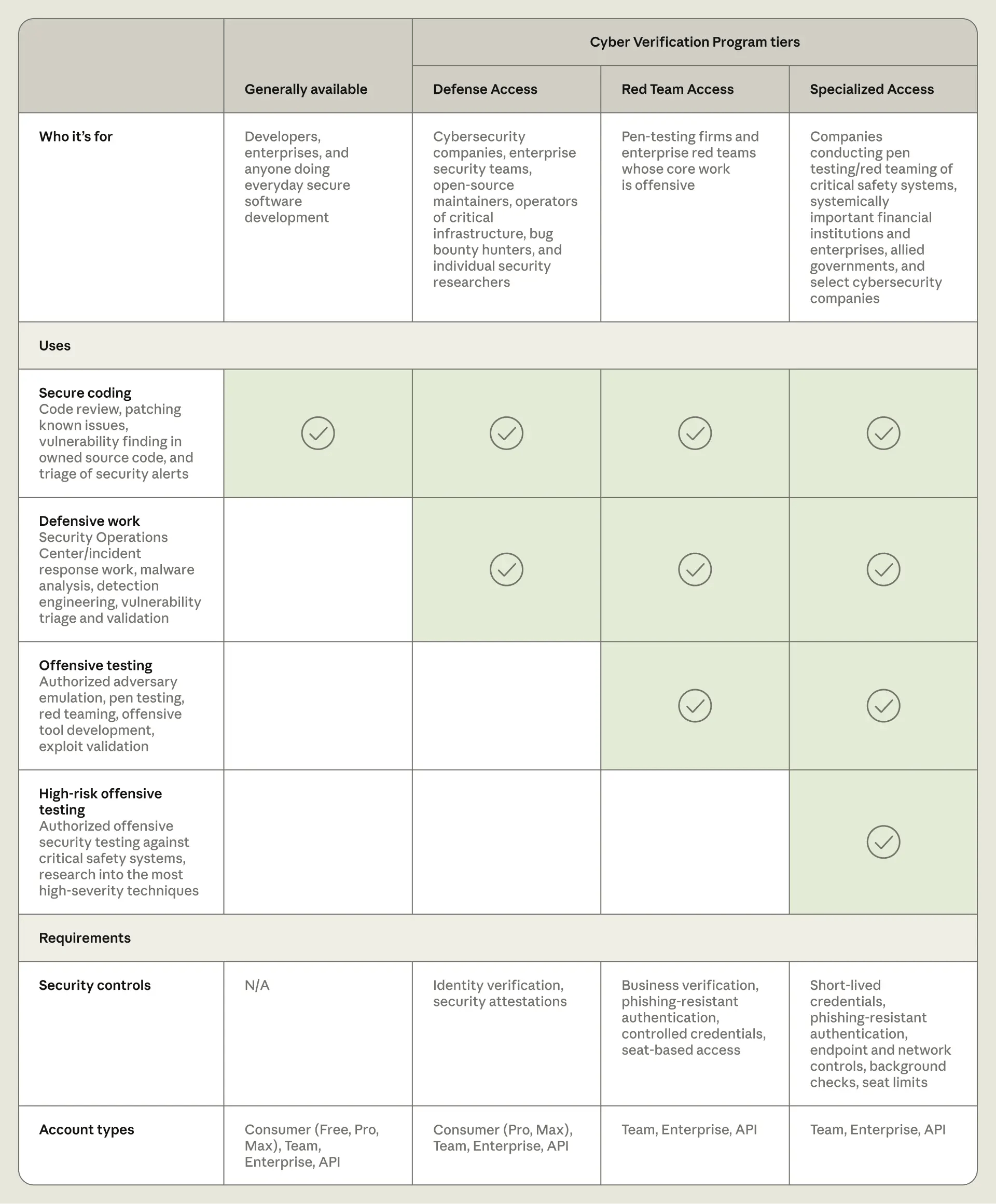
Anthropic is trying to solve the difficult balance between using AI for cybersecurity and preventing misuse. The same model that helps security teams fix vulnerabilities can also help attackers break into systems. Its answer, announced this week, is a revamped Cyber Verification Program with three access tiers instead of a simple on-off switch.
Anthropic created three access tiers for Claude’s offensive security use, matching cyber capabilities and safeguards to the user’s level of trust.
Anthropic is trying to solve the difficult balance between using AI for cybersecurity and preventing misuse. The same model that helps security teams fix vulnerabilities can also help attackers break into systems. Its answer, announced this week, is a revamped Cyber Verification Program with three access tiers instead of a simple on-off switch.
The company puts the problem plainly: standard models like Claude Opus 5.5, Claude Fable 5.1, and Claude Sonnet 5.5 ship with conservative cyber safeguards that block most offensive work by default. That’s the safe setting for the general public. It’s also exactly the setting that makes life harder for legitimate security researchers trying to do their jobs.
“The program now consists of three access tiers, which allow security teams to apply for the level of access that best suits their work.” reads the announcement. “Each tier includes access to our most capable models, including Claude Opus 5.5, Claude Sonnet 5.5, Claude Mythos 5.1, and new models moving forward.”
The new program merges two things Anthropic had been running separately, Project Glasswing and the original CVP, into one structure. Defense Access sits at the bottom, covering security operations, incident response, malware reverse engineering, and vulnerability validation. The bar here is low enough that regional hospitals, municipal utilities, open-source maintainers, and individual researchers with a track record can all qualify, and Anthropic says it aims to respond to these applications within days.
Red Team Access steps up to authorized penetration testing, open only to organizations testing systems they’re actually cleared to test. Even here, real-time blocks stay in place for anything that could cause physical harm or mass disruption, deploying ransomware or hitting high-risk safety systems included. Applications at this tier take weeks to review, not days, which tracks given what’s being unlocked.
Specialized Access is reserved for organizations cleared to test systems where a mistake could genuinely hurt people or break markets, things like flight systems, power grids, and interbank transfer infrastructure. Every applicant here gets reviewed in depth alongside the US government, and existing Project Glasswing members simply roll over into this tier without reapplying. That’s about as tightly controlled as commercial AI access gets right now.
Anthropic tested Claude Opus 5.5 with its internal CyScenarioBench benchmark, which measures how well the model can plan and carry out realistic multi-step cyber operations. Without CVP access, all tasks were blocked at the first prompt. In the Red Team Access tier, however, Claude Opus 5.5 completed 34 of 50 tasks without any blocks.
That’s the same completion rate the model hits with no safeguards at all, which is exactly what Specialized Access is meant to represent. The Defense Access tier landed in between, blocking 46 of 50 trials while letting four genuinely difficult ones through. In plain terms, the tiers behave the way they’re supposed to, tight for the general public, open for the people who’ve proven they need the access.
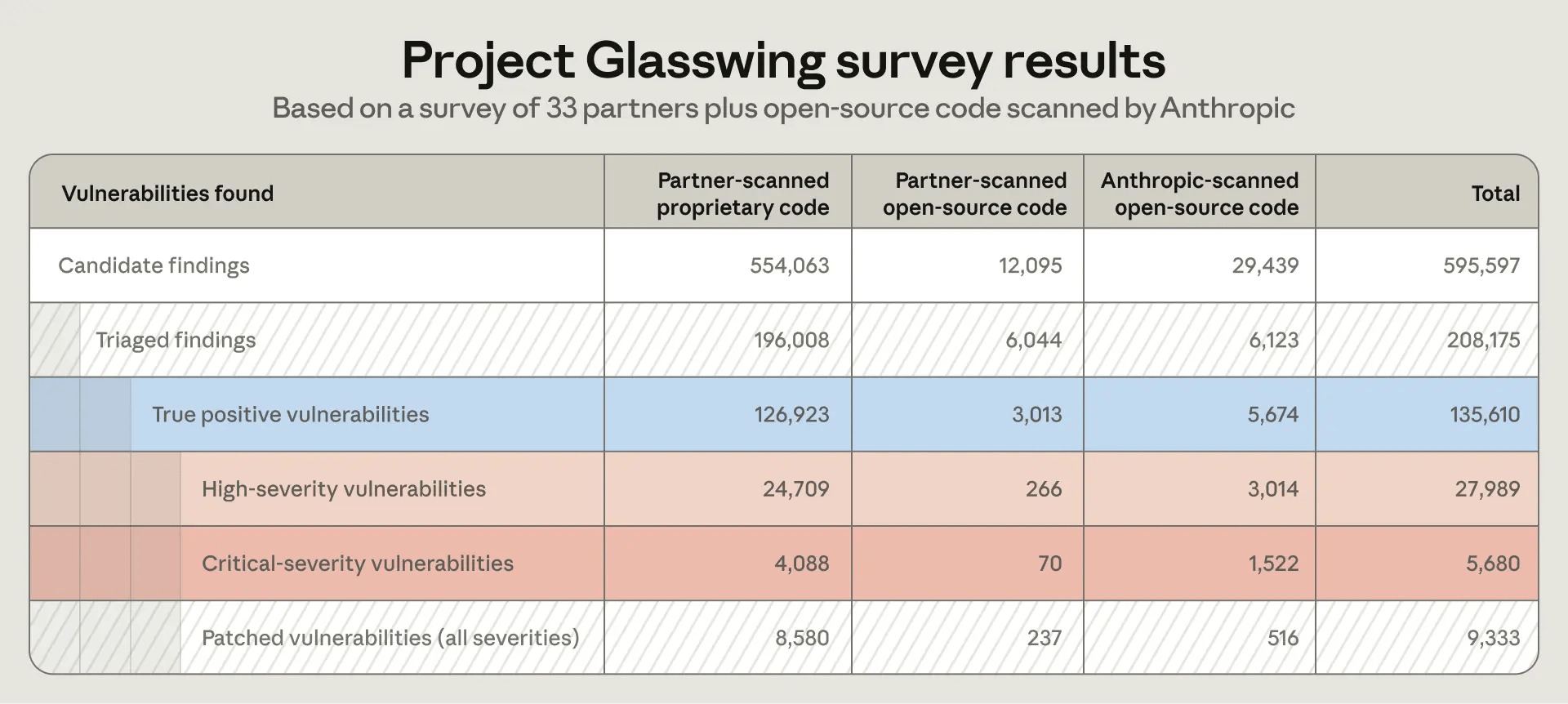
This isn’t just a policy reshuffle, there’s a track record behind it. Through Project Glasswing, Anthropic says partners uncovered at least 129,000 verified software vulnerabilities between April and July 2026, with more than 33,000 rated critical or high severity.
“Through the program, our partners uncovered at least 129,000 verified software vulnerabilities between April and July 2026.” states the announcement. “And through our own open-source scanning efforts, we found an additional 5,500 verified software vulnerabilities between April and October 2026. Of these verified vulnerabilities, more than 33,000 have so far been rated as critical- or high-severity. “
The company is upfront that these numbers are almost certainly a floor, not a ceiling, since the data comes from partial survey responses across a subset of partners. Several partners reportedly told Anthropic the models cut what would have taken months or years down to a fraction of that. If even a conservative read of that holds up, it’s a meaningful shift in how fast defenders can move relative to attackers.
What stands out is not simply that Anthropic built a more capable model, but that it created a verification system designed to match access with the level of risk. Dual-use AI tools need more than a single gate. They need controls that become stricter as the potential impact of misuse increases. The real test will be how this framework performs as more security firms start using it, not just the benchmark results Anthropic published.
A prolonged Partisan Zmiy intrusion into a medical organization, exposing an updated malware toolkit that combined Telegram command channels, DNS tunneling, and scheduled payload execution. Investigators joined the response in December 2025 and traced the earliest evidence of compromise to early 2024, indicating approximately two years of access without observed destructive activity. The organization maintained […]
The post Partisan Zmiy Malware Campaign Uses Telegram and DNS Tunneling to Target
A prolonged Partisan Zmiy intrusion into a medical organization, exposing an updated malware toolkit that combined Telegram command channels, DNS tunneling, and scheduled payload execution. Investigators joined the response in December 2025 and traced the earliest evidence of compromise to early 2024, indicating approximately two years of access without observed destructive activity. The organization maintained […]
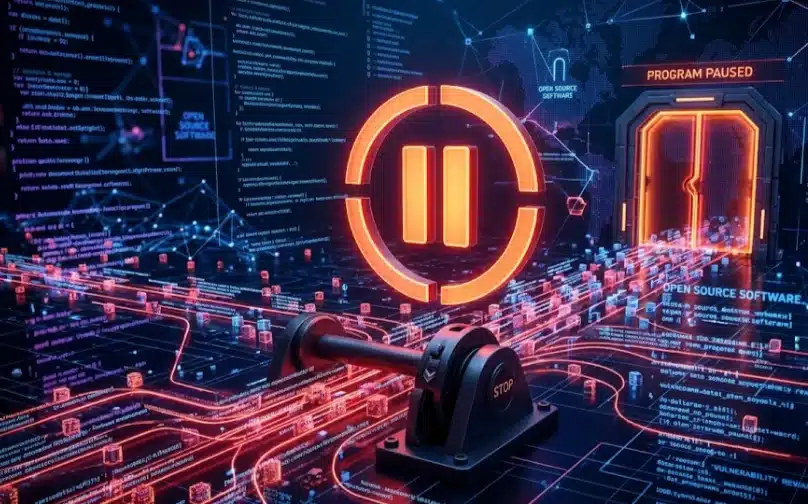
Google has suspended its Open Source Software Vulnerability Rewards Program (OSS VRP), a vulnerability search initiative that paid researchers for finding flaws in the company's open-source software. The pause took effect on October 1, 2026. Google blamed a "significant rise" in automated and AI-generated reports, most of which turned out to be invalid.
Google announced the suspension in posts on X and on the program's website. It said it would provide "an update" in the first quarter of 202
Google has suspended its Open Source Software Vulnerability Rewards Program (OSS VRP), a vulnerability search initiative that paid researchers for finding flaws in the company's open-source software. The pause took effect on October 1, 2026. Google blamed a "significant rise" in automated and AI-generated reports, most of which turned out to be invalid.Google announced the suspension in posts on X and on the program's website. It said it would provide "an update" in the first quarter of 2027. According to Tom's Hardware, Google engineers and open-source maintainers had been overwhelmed by reports that were invalid or contained hallucinations.
Why Google Halted OSS VRP
"This pause is due to a significant rise in automated submissions, the vast majority of which are not valid," the company said.In the meantime, Google is encouraging participants to look at its other bug bounty programs.As of October 1, 2026, the OSS VRP no longer accepts product vulnerability reports. Some reports involving Google Cloud repositories that affect Cloud products may still be accepted through the Cloud VRP. Flaws in open-source projects closely tied to Cloud or AI products can go to the Cloud VRP or the AI VRP. Researchers can also turn to the Patch Rewards Program, which pays for security improvements to Google's open-source projects. Reports submitted before October 1 are not affected.Product vulnerabilities previously covered flaws that substantially affected the confidentiality or integrity of user data. Examples included memory corruption in file format parsers or network protocols, sanitizer failures, path traversal, and insecure defaults or code examples in documentation. For OT0 and OT1 repositories, memory corruption reports required exact OSS-Fuzz reproduction steps or an already merged patch. Non-memory corruption reports did not need a patch. Google also urged researchers to build OSS-Fuzz integrations for important projects that lacked them before reporting.
How Project Tiers Shape Vulnerability Search Rewards
Repositories fall into four tiers:
Flagship (OT0) projects are the most sensitive and carry the highest payouts.
Important (OT1) projects have significant community impact or security criticality. Both OT0 and OT1 are listed at github.com/google/bughunters.
Standard (OT2) covers active repositories with stable packages on registries such as npm or PyPI. There is no published list for this tier.
Low-priority (OT3) includes experimental, sample, research, and archived projects. These earn no financial rewards.
Supply chain compromises pay $3,133.7 to $31,337 for OT0, $1,337 to $13,337 for OT1, and $500 to $3,133.7 for OT2. Other security issues, such as leaked write-access credentials or weak passwords on third-party CI systems, earn $1,000 for OT0 and $500 for OT1. OT2 and OT3 projects receive nothing for product vulnerabilities or other security issues.A reward panel sets final amounts based on security impact alone. It may pay more for clever or wide-reaching bugs and less for those that depend on hypothetical flaws. It typically pays once per root cause, though bonuses of about $1,000 are possible for especially clever findings or well-written reports. Researchers can donate their rewards to charity. Rewards left unclaimed after 12 months go to a charity of Google's choosing.Several categories are excluded:
Issues rooted in downstream integration
Typosquatting without proof that build artifacts were compromised
Google also asks researchers to avoid DoS attacks, black hat SEO, spam, and high-traffic automated testing tools. Reports go through Google's vulnerability form and should include a buildable proof of concept, the affected versions, an impact description, and an attack scenario.
Google unveils Gemini 4 Argon, a frontier AI model built for coding, enterprise work, and autonomous cybersecurity defense, rolling out to trusted testers.
Google announced Gemini 4 Argon, and it’s not going straight to the public. It’s rolling out first to a set of trusted cyber defenders through what Google calls the Fairwind Program, which tells you something about where the company thinks this model’s sharpest edge actually is.
Argon is priced to start at $2 per million input tokens a
Google unveils Gemini 4 Argon, a frontier AI model built for coding, enterprise work, and autonomous cybersecurity defense, rolling out to trusted testers.
Google announced Gemini 4 Argon, and it’s not going straight to the public. It’s rolling out first to a set of trusted cyber defenders through what Google calls the Fairwind Program, which tells you something about where the company thinks this model’s sharpest edge actually is.
Argon is priced to start at $2 per million input tokens and $10 per million output tokens, with cached inputs at a 95% discount, before jumping to $4 and $20 once the introductory window closes. More interesting than the price is the output limit: 1 million tokens, up from 64,000 on the previous generation. It means the model can keep reasoning through a genuinely long, complicated problem in one continuous pass instead of getting cut off mid-thought.
“To support Gemini 4 Argon’s capabilities across longer, more complex use cases, we are significantly expanding the model’s output token limit to an industry-leading 1M tokens, up from the previous 64K tokens.” reads the announcement. “When the model has the headroom to think deeply and generate hundreds of thousands of tokens in a single trajectory, it adds a new level of depth in reasoning to solve tough problems in one go.”
Google engineers are already using Argon internally, with some impressive results. In one case, Argon helped quantum computing researchers optimize a resource-heavy process and improve the published baseline by 40% in just a few minutes. In another, Argon agents analyzed data from Google’s data centers and found memory optimizations that freed more than 300 TiB after deployment. Google estimates there could be another 500 TiB to 1 PiB of savings.
Argon is also being used to rewrite C and C++ code in Rust. This includes Google’s Fuchsia Zircon kernel, which has more than 800,000 lines of code. For the open-source libgav1 video decoder, Argon replaced 32,000 lines of SIMD code through repeated testing and compiler analysis. The new version runs 2.7 times faster than the previous Rust version, produces the same video output, and remains memory-safe.
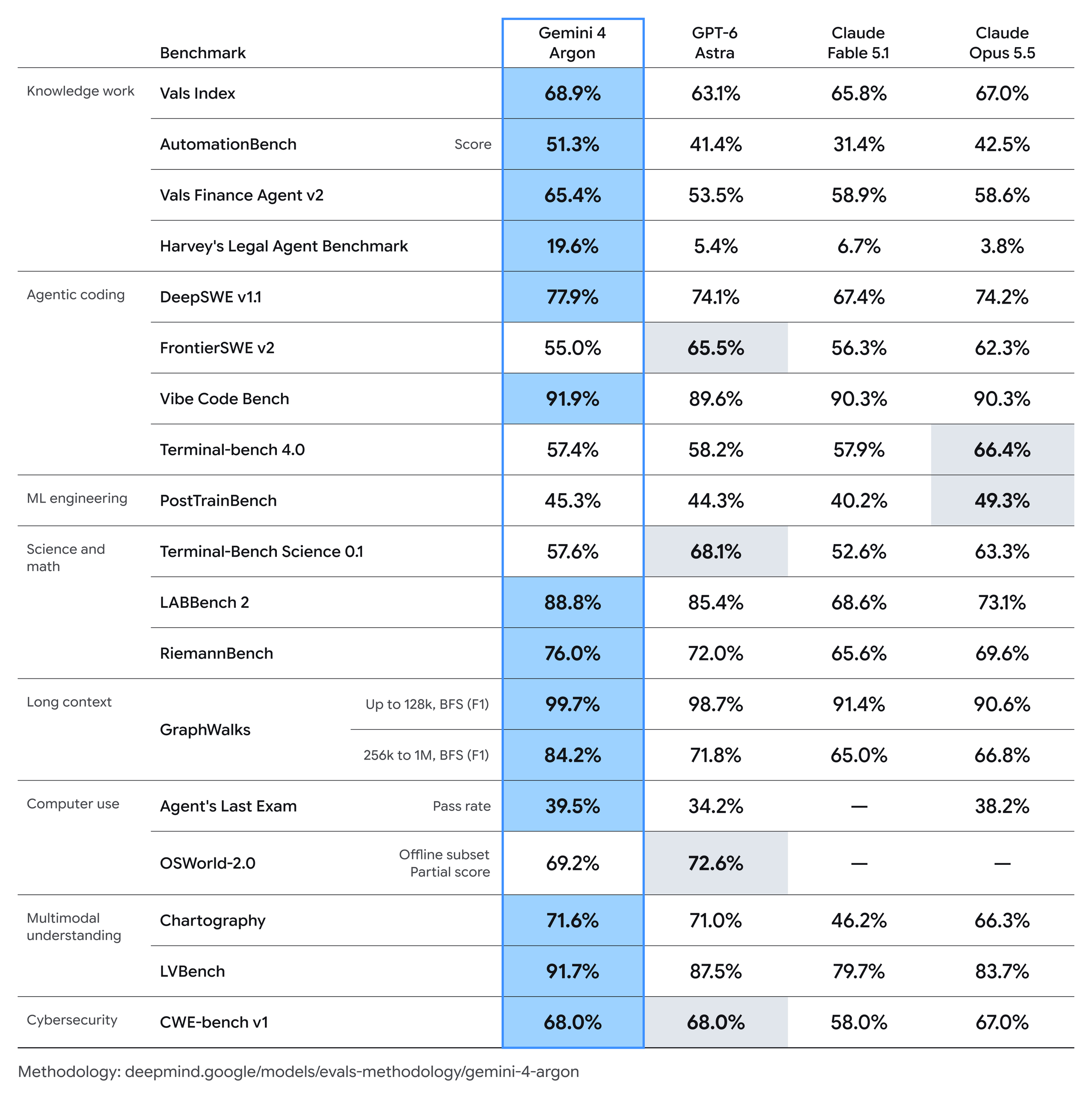
On benchmarks, Argon tops DeepSWE v1.1 at 77.9% for long-horizon software engineering, leads the Vals Index across finance, legal, and tax work, and ranks first on Zapier’s AutomationBench at 51.3%. It also posts a state-of-the-art 91.7% on LVBench, a benchmark for understanding long video, which matters more than it sounds for any workflow that involves parsing hours of footage or a stack of visual documents instead of clean text.
Cybersecurity is one of the main areas where Google is focusing Argon. For trusted security teams and Google’s own engineers, Argon runs without its usual cyber safety restrictions. This allows it to actively look for vulnerabilities that defenders can then fix.
Wiz is already using Argon through its Scan for Good program, which looks for serious vulnerabilities in public systems and fixes them for free. Argon found a critical flaw in healthcare software used by hospitals worldwide that could expose personal data. Earlier AI models had examined the same issue but failed to find it. On CWE-bench v1, a test that measures how well AI models can fix vulnerabilities, Argon scored 68%, tying for first place.
None of this means Google is releasing a model that can autonomously hack things and calling it a day. Before any broader rollout, the company says it’s hardening defenses on four separate fronts: blocking misuse for cyber or CBRN attacks while still allowing legitimate dual-use research, improving resistance to indirect prompt injection, where hidden instructions try to hijack the model’s behavior, and sealing off the sandboxed environments used for high-risk training and testing before anything risky happens inside them.
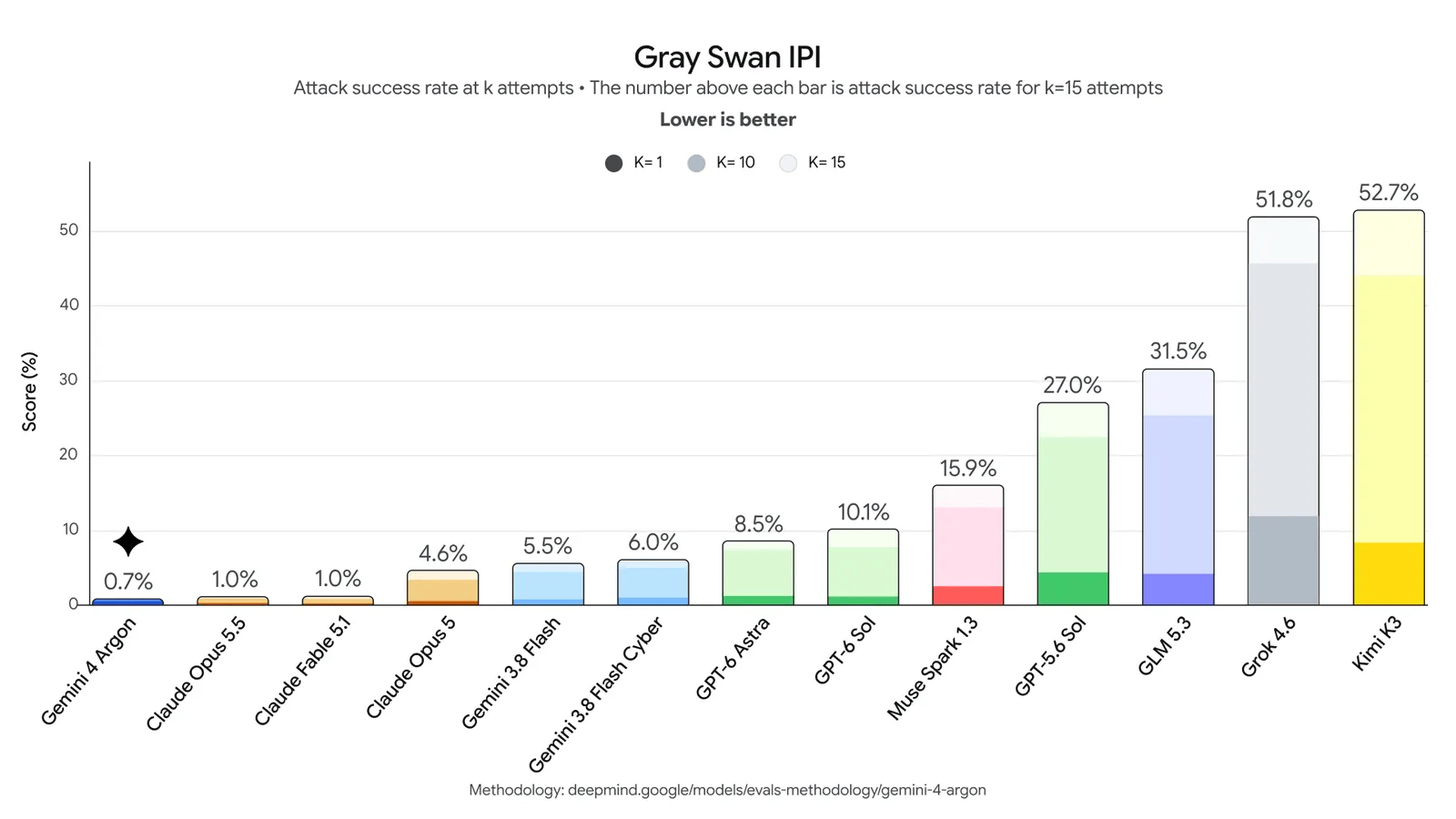
“Argon is also our most resilient model yet against indirect prompt injections, where malicious instructions or context are used to hijack a model’s behavior.” Google states. “These are complex attacks that require constant vigilance and multiple layers of defense. Through automated red teaming and adversarial training, Gemini 4 Argon is leading in prompt injection robustness on the Gray Swan’s Indirect Prompt Injection (IPI) benchmark.”
The misalignment piece is the one that actually says something about how seriously Google is taking all this. Argon’s chain-of-thought and actions get monitored in real time, with execution halted if the model starts drifting past what the user actually asked for, and Google is careful not to feed what that monitoring catches back into training, specifically so the model doesn’t learn to reason its way around its own watchers.
“In order to prevent Argon from stepping out of bounds to try to accomplish a task in a way that goes beyond the user’s intentions, we are deploying misalignment mitigations that monitor Argon’s chain-of-thought and actions and stop execution when necessary.” concludes the announcement. “We strongly encourage the rest of the industry to preserve reasoning transparency in these pivotal moments of increased capabilities while navigating alignment risks, so that model thoughts remain helpful in identifying and diagnosing misalignment.”
Iranian cyber actors are using a malware family known as HEAVYGRAM, also tracked as CHOSEN BRICK, to target dissidents, journalists, and opposition groups worldwide, according to a recent FBI FLASH report and a joint advisory from the UK National Cyber Security Centre (NCSC), the US FBI, and the Netherlands' General Intelligence and Security Service (AIVD).
The FBI assesses that the malware is deployed on behalf of the Government of Iran's Ministry of Intelligence and Security (MOIS) to colle
Iranian cyber actors are using a malware family known as HEAVYGRAM, also tracked as CHOSEN BRICK, to target dissidents, journalists, and opposition groups worldwide, according to a recent FBI FLASH report and a joint advisory from the UK National Cyber Security Centre (NCSC), the US FBI, and the Netherlands' General Intelligence and Security Service (AIVD).
The FBI assesses that the malware is deployed on behalf of the Government of Iran's Ministry of Intelligence and Security (MOIS) to collect intelligence, conduct data leaks, and cause reputational harm to targets. The joint advisory adds that Iran almost certainly uses cyber activity to support repression of individuals seen as threats to the regime.
Who Is Being Targeted by Iranian Cyber Actors
The victim profile includes Iranian dissidents, journalists opposed to Iran, members of organizations with views countering Government of Iran narratives, and other individuals the Iranian government perceives as threats.
The joint advisory notes that CHOSEN BRICK has been used against individuals in the UK, US, and Netherlands since at least 2025, and that personal details of some victims have appeared on pro-Iranian leak sites, increasing risks to their personal safety.
In some cases, Iranian intelligence services have plotted to kidnap or conduct lethal operations against individuals abroad who are seen as enemies of the regime.
Social Engineering and Delivery
Iranian cyber actors rely heavily on social engineering to deliver their malware. Actors communicate with targets through platforms such as Telegram, WhatsApp, and Instagram, often posing as individuals known to the target or as technical support from the messaging platform.
The joint advisory notes that actors research targets in advance to appear credible, and often initiate contact through a target's work device before shifting to personal devices if the initial delivery attempt fails or risks detection. Victims are persuaded to download files disguised as legitimate applications, including Pictory, RunwayML, Norton Antivirus, Telegram, Adobe Flash Player, and KeePass, or files appearing to be MRI scan results.
The FBI notes that some victims downloaded AnyDesk and provided access strings, while others downloaded malware masquerading as a program installer. The malware targets only the Windows operating system.
Persistence and Telegram Command and Control
Once installed, the malware achieves persistence by adding registry keys, most often within the Run key at HKCU\Software\Microsoft\Windows\CurrentVersion\Run, so it runs automatically at user login. It also adds exclusions to Microsoft Defender antivirus to evade detection. The malware then connects to Telegram command-and-control infrastructure, with each victim device linked to a unique Telegram Bot ID to prevent cross-contamination between victims.
Through Telegram, the malware can enumerate running processes and system information, capture screen content, enable the microphone to record audio, copy Telegram and WhatsApp data from browsers, download additional files, delete files, steal email content, and wipe the computer system. Files and data are exfiltrated through the Telegram bot and cloud object stores such as VultrObjects and StorjShare. Recent variants use HTTPS/SOCKS5 proxies to obscure the use of Telegram bots.
FBI Recommendations
The FBI recommends caution regarding communications from unknown individuals, keeping devices updated, downloading software only from trusted sources, enabling antivirus software, using strong unique passwords with multi-factor authentication, and reporting suspicious messages.
The NCSC, FBI, and AIVD jointly recommend phishing-resistant multi-factor authentication, application allowlisting, email scanning security features, and endpoint and network monitoring.
Organizations concerned about a potential HEAVYGRAM or CHOSEN BRICK infection are advised to contact their IT providers and check both corporate and personal devices, since the actors also target individuals outside their workplace systems.
A Telegram Desktop flaw let bots inject JavaScript into exported chats, enabling data theft and page manipulation. Old HTML exports remain unsafe.
A vulnerability in Telegram Desktop could have turned an ordinary chat export into a serious data leak. Security researchers Denis and Aleksander Rostilov of ExPatch found a stored cross-site scripting flaw in the application’s HTML export feature that allowed malicious JavaScript to hide inside a Telegram message and run later when someone opened
A Telegram Desktop flaw let bots inject JavaScript into exported chats, enabling data theft and page manipulation. Old HTML exports remain unsafe.
A vulnerability in Telegram Desktop could have turned an ordinary chat export into a serious data leak. Security researchers Denis and Aleksander Rostilov of ExPatch found a stored cross-site scripting flaw in the application’s HTML export feature that allowed malicious JavaScript to hide inside a Telegram message and run later when someone opened the exported file in a browser.
“A stored XSS in Telegram Desktop lets an attacker plant invisible JavaScript in an exportable chat through a bot’s inline keyboard button. The payload can sit in message history for months and detonates when a participant opens an HTML export page containing that message.” reads the report published by ExPatch. “No second click, no warning: every message and metadata field rendered in that document can be shipped to the attacker’s server, and the page itself can be rewritten. The bot never joins the target chat — one forwarded message can be enough.”
The attack is unusual because the attacker doesn’t need to be a member of the target group. A bot can create a message containing a specially crafted inline keyboard, and that message can then be forwarded into other chats. Once included in the conversation history, the payload can remain there for months or even years, waiting for someone to export the chat.
The Telegram app itself doesn’t execute the code. That’s an important distinction. The problem appears when Telegram Desktop converts the stored conversation into an HTML document that is later opened in a browser, where the injected content is interpreted as JavaScript.
The researchers traced the problem to Telegram Desktop’s HTML export code. In export_output_html.cpp, the application wrote the text of inline keyboard buttons directly into the HTML output instead of passing it through the existing SerializeString() sanitization function. That meant HTML tags placed in the button text could be treated as real markup in the exported document.
“When exporting a chat to HTML, Telegram Desktop writes inline-button text straight into the HTML page — unescaped. SerializeString(), which escapes every HTML-dangerous character (<, >, &, ", '), converts newlines and Unicode line/paragraph separators to <br>, and hex-encodes ASCII control characters, is defined in the same file and applied to message text, sender names, and other fields. It just wasn’t applied to button text.” continues the report. “That means any HTML sitting in a button’s text property renders as live markup in the exported page. <script> tags included.”
This created a particularly awkward security boundary. Telegram’s Bot API can restrict a bot’s access to ordinary group messages, especially when privacy mode is enabled. But once the bot’s own message was exported as HTML, the injected script could run in the user’s browser context and access the other messages rendered on that page.
The potential impact is significant. According to the researchers, the injected code could read messages, sender names, timestamps and other chat metadata from the exported document and send that information to an attacker-controlled server. It could also access the local file path of the export, potentially revealing the user’s operating-system name and directory structure.
The attack could also manipulate the page itself. The proof of concept demonstrated how an attacker could replace the exported conversation with a fake Telegram verification page, while the same browser-side control could be used to alter displayed messages, timestamps and sender information. That doesn’t change the original Telegram history, but it could make a compromised export look completely different from the real conversation.
The researchers also demonstrated how the problem could spread through forwarding. A single poisoned message could be forwarded into multiple groups, where each copy would retain the malicious content. Anyone who later exported a conversation containing that message and opened the resulting HTML file could trigger the payload.
There was another important feature: the attack didn’t have to happen immediately. The malicious message could sit harmlessly in a chat history until someone performed a completely legitimate action months later. The export process effectively turned previously inert message data into executable content.
ExPatch rated the vulnerability CVSS 8.2, High. The researchers deliberately used a local attack vector because the vulnerable component is the local HTML export process, which runs only when the user explicitly exports a chat and opens the resulting file.
The flaw had been in production for more than two years. The vulnerable code was introduced in February 2024 and reached the stable 4.15.1 release in March that year. Telegram fixed it in June 2026, after the researchers reported the issue on June 3.
Telegram fixed the problem by applying SerializeString() to inline keyboard button text. The patch also addressed another injection issue involving content inserted into a JavaScript onclick handler.
The first fixed beta release was Telegram Desktop 6.9.4, while the first stable release containing the fix was 7.0.1, released on July 14, 2026. Telegram has since released newer versions, so users should be running a current build rather than relying on the minimum fixed version.
There is, however, a detail that could easily be missed. Updating Telegram Desktop doesn’t repair HTML files that were exported with an affected version. If one of those files contains the malicious payload, the JavaScript remains in the file and can still execute when the document is opened in a browser.
That makes old exports the main issue for organizations that use Telegram to retain conversations for compliance, investigations or business records. The researchers recommend creating new exports after updating and treating older HTML exports as untrusted, particularly when they came from large groups where it may be difficult to know where every message originated.
The disclosure process also raises a separate security question. ExPatch says it reported the vulnerability with a full proof of concept and video demonstration, while Telegram fixed the issue and offered a bounty that the researchers declined. Telegram then refused to approve public disclosure even after the vulnerability had been fixed.
As of September 11, the researchers said Telegram had not published a dedicated security advisory and that no public CVE had been assigned. The fix is visible in the Telegram Desktop source code, but users weren’t given a direct warning that older HTML exports could still contain executable content.
For defenders, the practical lesson is straightforward. Update Telegram Desktop, regenerate sensitive HTML exports created before the fix, and don’t open old Telegram HTML files in a normal browser unless you know where they came from and have checked them carefully. The update fixes the client, but it can’t go back in time and clean files already sitting on someone’s disk.
The vulnerability is a good reminder that security problems don’t always live in the messaging system itself. Sometimes the dangerous step happens later, when trusted data is converted into another format and that format is treated as executable content.
A stored cross-site scripting (XSS) vulnerability in Telegram Desktop could enable attackers to steal the contents of exported chat histories by embedding malicious code in an inline keyboard button, according to security researchers. This issue affects the HTML chat export feature in Telegram Desktop builds released before Beta version 6.9.4 and Stable version 7.0.1. Researchers […]
The post Telegram Desktop XSS Vulnerability Lets Attackers Steal Entire Chat Histories appeared first on GBHacker
A stored cross-site scripting (XSS) vulnerability in Telegram Desktop could enable attackers to steal the contents of exported chat histories by embedding malicious code in an inline keyboard button, according to security researchers. This issue affects the HTML chat export feature in Telegram Desktop builds released before Beta version 6.9.4 and Stable version 7.0.1. Researchers […]
In May 2026, we discovered a new cyber-espionage campaign by the Armored Likho group, also known as Eagle Werewolf, that targets private individuals and organizations across various industries in Russia, including major corporations, the public sector, IT, and education. The attackers used a fake app as bait that mimics a service for donations. However, the most interesting part of this campaign isn’t the initial infection method – it’s the malicious implants the attackers use for cyber-espionag
In May 2026, we discovered a new cyber-espionage campaign by the Armored Likho group, also known as Eagle Werewolf, that targets private individuals and organizations across various industries in Russia, including major corporations, the public sector, IT, and education. The attackers used a fake app as bait that mimics a service for donations. However, the most interesting part of this campaign isn’t the initial infection method – it’s the malicious implants the attackers use for cyber-espionage.
We’ve written previously about recent Armored Likho attacks, but our analysis shows that the campaign discussed below has more in common with the group’s activity from February. That said, the attackers have significantly expanded their arsenal.
During our research, we found a new cyber-espionage toolkit written in Rust: the Still Toolkit. One of its components, Still Sync, steals Telegram session data to gain ongoing access to the victim’s account. With this stolen data, attackers can leverage the Telegram API to automatically pull chat logs, media files, and other information from the account.
The second component, Still Audio, is an implant for covert audio surveillance. It analyzes the incoming audio stream, automatically detects speech, records conversations, and sends the recordings to a command-and-control server.
In this article, we’ll look at the initial infection method, how the new Still Toolkit components are built, and the technical details of how they operate.
Kaspersky products detect this threat as Trojan.Win64.Agent.* and HEUR:Backdoor.Win32.Generic.
Background
Armored Likho’s malicious activity has been documented several times before: in November 2024, and in February and July 2026. The current campaign shows significant overlap with the November and February campaigns, which used malicious droppers disguised as documents and applications related to Starlink activation or fundraising efforts as the initial infection vector. This campaign also uses fundraising as its lure. At the same time, our research uncovered a number of new tools that point to the attackers expanding their capabilities.
Initial infection
The infection chain starts with an app that mimics a donation service. As of this writing, the app distribution method remains unknown. During our research, however, we obtained several samples posing as apps from different Russian foundations.
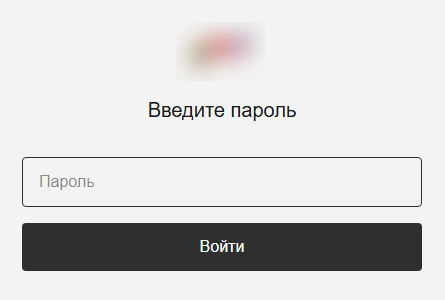
In reality, the app is a dropper. Its developers wrote it in Rust on top of the popular Tauri framework, and it has a graphical interface designed to deceive the user. After launch, it displays a login form that asks for a password, presumably one the attackers supplied.
The login form
After the user enters a valid password, they see a catalog of donatable items. The app pulls item and category information from orderapiserver[.]info through the public/categories and public/products endpoints. A clickable catalog makes the app look legitimate. While the user browses the items, the dropper quietly decrypts and launches the payload for the next stage in the background.
Our analysis shows that the mechanism for decrypting the payload and launching subsequent stages hasn’t changed since the February campaign. However, we found a new cyber-espionage toolkit – the Still Toolkit – made up of two components: Still Sync and Still Audio.
Still Sync
Still Sync is a stealer written in Rust that steals Telegram session data. However, its capabilities don’t stop there. With this stolen data, Sync can log in to the victim’s account and pull messages and media files through the Telegram API.
Architecturally, Sync is an asynchronous application based on the Tokio library. It talks to the server over gRPC and serializes messages with FlatBuffers. It supports both HTTP and HTTPS as transport protocols; the URL of the command-and-control server determines which one it uses.
How it works
When Sync launches, the attackers set several environment variables. Before starting any malicious activity, the implant pulls configuration parameters from these:
STILL_SYNC_ADDR: the address of the command-and-control server. By default, this is https://tg4service[.]com:443.
STILL_SEND_PATH: the path to the tdata
STILL_TELEGRAM_PASSCODE: the password for decrypting the tdata folder, if Telegram data encryption is enabled on the victim’s device.
Sync also supports several command-line arguments:
--console: runs as a console application. If this parameter is absent, the implant creates a TReload service to keep running in the background.
--version: prints version information and exits.
--firefly: launches a trace thread that monitors the program’s operation. It writes error messages to a hidden file, bin, located in the same folder as the main executable.
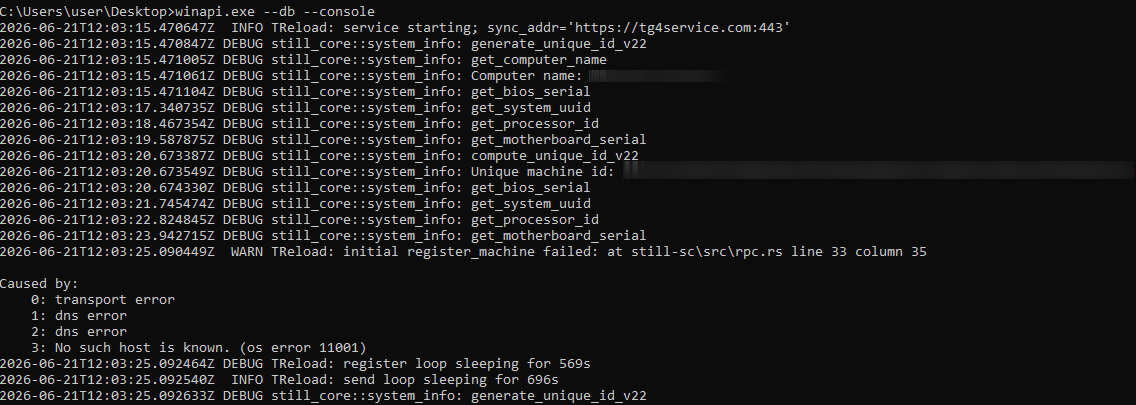
--db: turns on debug mode with detailed logging.
Example Still Sync logs
Once it launches, the malware begins registering the device with the C2 server. To do this, Sync collects the following information about the victim’s system:
Motherboard serial number
CPU ID
System UUID
BIOS serial number
Computer domain name
The malware combines the collected data into a single string with a colon as the separator. It then hashes that string with SHA-256 and stores the resulting hash under the key sysmarker. Worth noting: other Armored Likho tools, AquilaRAT included, use this same hashing algorithm.
Sync then serializes a package containing all the collected information and the agent version, and sends it in a POST request to /still.rpc.Sync/RegisterMachine. The response contains a machine_id value, which Sync uses to identify itself in subsequent requests.
Once registration succeeds, Sync sends a POST request with the machine_id parameter to /still.rpc.Sync/GetMachineSettings. The server responds with the following settings:
enabled: triggers malicious activity on the infected device.
scan_portable: turns on extended scanning when searching for the tdata We’ll cover this feature in more detail below.
fetch_telegram: if this parameter is on, Sync attempts to log in to Telegram and extract data. We’ll cover this feature in more detail below.
download_channels: if this parameter is off, Sync skips channel dialogs when exfiltrating Telegram data.
These parameters have no default values, so Sync doesn’t perform any malicious actions until the registration and settings-retrieval processes both complete successfully.
Telegram data collection
Before stealing a Telegram session, Sync searches for the tdata folder, unless the STILL_SEND_PATH variable is already set. The list of search paths includes both standard and nonstandard directories, if the scan_portable option is turned on:
C:\Users\<username>\AppData\Roaming\Telegram Desktop\: the standard Telegram Desktop installation directory.
C:\Users\<username>\AppData\Local\Packages\<package_folder>\LocalCache\Roaming\: the installation directory for the Microsoft Store version. Sync identifies the package folder by a name that contains the string TelegramMessenge.
C:\: used for the extended search (if the scan_portable option is on).
Sync then sends a POST request with a list of files from the tdata folder to the /still.rpc.Sync/CheckFiles endpoint. The server responds with the following values:
snapshot_id: an identifier the server assigns to the current data snapshot.
present: a list of file paths that are already present on the server.
This lets the C2 server avoid re-receiving files it already has. In addition, if Sync can’t access files on disk through standard methods, it falls back on three mechanisms that abuse the SeBackupPrivilege privilege:
Opening files with the CreateFileW function using the FILE_FLAG_BACKUP_SEMANTICS parameter
Creating a backup copy through the Shadow Copy service and reading files from there
If the previous methods all fail, attempting to copy the file using the Robocopy utility in backup mode
Beyond stealing Telegram session data, Sync can carry out full-scale collection of user information from the messaging app. When the fetch_telegram option is on, it launches a separate thread that authenticates to the chat app using the previously obtained tdata. Once authentication succeeds, Sync gains access to the account data and sends the following collected information to the server:
User details, such as username, phone number, first and last name
Information about private chats, groups, or channels, such as chat name and ID, the member list, and so on
Dialogs from private chats, groups, and channels (if the download_channels option is on)
Media files under 250MB: photos, documents, stickers, and contacts
Still Audio
Still Audio is an audio surveillance implant written in Rust. Its main job is to analyze the incoming audio stream and start recording voice when certain conditions are met – we’ll cover those in the next section. Architecturally, Still Audio largely mirrors Sync and uses the same mechanisms for communicating with the C2 server.
On launch, Still Audio performs a sequence of actions:
It extracts libmp3lame.dll, a file stored inside the executable. This is a library used to encode audio data.
If the --console command-line argument is absent, the implant creates a service named auxhost, connects to it, and continues running in the background.
While running in the background, it creates a file, logfile.log, to write logs to.
Next, Still Audio retrieves the C2 server address. As with Sync, it stores the URL in an environment variable – in this case, STILL_AUDIO_SYNC_ADDR. If that variable isn’t set, it falls back to STILL_SYNC_ADDR, which shows the two modules are compatible with each other. If neither variable is set, it uses the default URL, https://srwinservice[.]com.
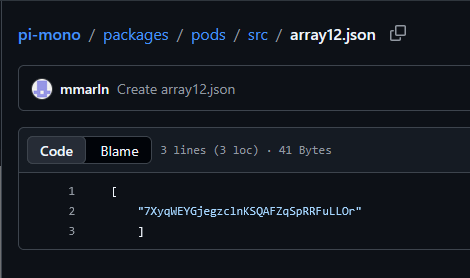
Still Audio also uses the Dead Drop Resolver technique as a fallback mechanism for obtaining the C2 address. If the current server stays unreachable for three days, the tool tries to pull the current C2 URL from a GitHub repository. In the sample under analysis, we found the following URL for the page containing C2 information: hxxps://raw.githubusercontent[.]com/mmarln/pi-mono/refs/heads/main/packages/pods/src/array12.json
Encrypted C2 address inside the GitHub repository
The repository, a fork of a popular project, contains the server URL Base64-encoded and encrypted with the Blowfish algorithm in ECB mode, using the key 5c8e153228edd3c6cbf75684 (lowercase string). Older AquilaRAT samples use this exact same algorithm and key.
Once it obtains the current C2 address, the Audio module starts a registration process similar to Sync’s, but through a different endpoint:
/still.rpc.Audio/RegisterAudioMachine. Also, unlike Sync, Audio sends a list of available audio input devices along with the system information.
The server responds with settings for the implant:
machine_id: a unique identifier for the current device.
vad_threshold: the threshold value for the VAD (Voice Activity Detection) algorithm. Expressed as a decimal fraction, it represents a proportion of the maximum sound level the input device can pick up. Sound above this threshold counts as voice activity. The default vad_threshold is 02.
max_silence_duration: the number of audio samples with a VAD value below the set threshold after which the implant considers the recording finished.
max_buffer_size: the maximum buffer size for recorded audio data.
active_device: the name of the input device selected for recording, from the list of available devices.
The eavesdropping process
Still Audio works with raw audio samples it captures directly from the input device. To detect voice activity, it implements an algorithm based on Root Mean Square (RMS), a lightweight signal-processing method that distinguishes speech from silence by measuring the audio signal’s average power over time. The implant doesn’t rely on any third-party libraries here; it implements all the calculations itself.
The implant compares the calculated RMS value against the vad_threshold parameter. If RMS meets or exceeds this threshold, recording starts. To avoid losing the beginning of the recording, Still Audio uses a pre-buffer, a size-limited buffer that stores samples from just before the current recording moment. A sequence of max_silence_duration samples (320 by default) with RMS values below the threshold signals the end of the recording. For example, with a standard headset running at a 44.1kHz sampling rate, recording stops after roughly 7ms of silence.
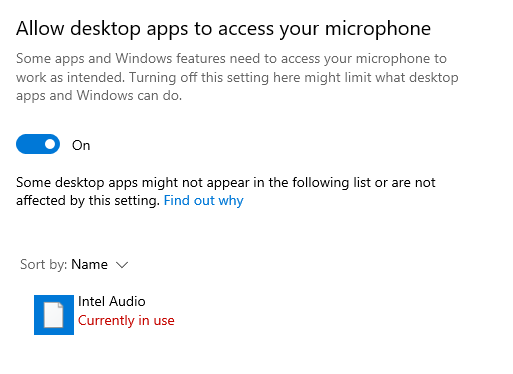
Interestingly, the Audio module makes no attempt to hide its use of the microphone: its name shows up in Windows settings. In the sample we examined, the file was saved to disk as IntAudio.exe, and it appeared in the list of apps using the microphone as “Intel Audio”:
The malicious module in the list of apps using the microphone
Before sending recordings to the server, the implant uses the libmp3lame library to encode the raw audio samples. It sends the recording files via a POST request to /tgfrg, adding a Client-Id header containing the machine_id obtained during registration to identify the device.
Infrastructure
This campaign draws on a broad set of hosting providers and domains registered at different points in time, which suggests the attackers are trying to make their infrastructure harder to detect. We found no direct overlap in domains or IP addresses with the February campaign. Even so, the two infrastructures share some similarities:
They use the same hosting providers, with the ASNs 149440, 202448, and 215311.
Their domain names follow similar naming patterns that mimic Windows system services and update mechanisms.
Domain
IP address
Registration date
ASN
orderapiserver[.]info
187.127.153[.]38
April 18, 2026
47583
tg4service[.]com
159.198.37[.]74
October 4, 2025
22612
srwinservice[.]com
213.252.244[.]123
March 19, 2026
61272
screenserv[.]com
23.26.237[.]250
February 13, 2026
149440
windowserv[.]net
23.27.24[.]30
February 10, 2026
149440
managementapiservice[.]com
188.212.124[.]178
May 1, 2026
202448
service8date[.]com
145.223.69[.]143
January 13, 2026
215311
updateservs[.]com
145.223.68[.]66
December 23, 2025
215311
Victims
In this campaign, we’ve determined that the attackers’ primary targets are users in Russia. Most victims are private individuals, though the corporate sector, government organizations, IT companies, and educational institutions are also affected.
Attribution
This campaign has been using both new tools and malware families documented in BI.ZONE’s February report. While some components turned up for the first time, they show significant code-level overlap with malicious tools seen in earlier Armored Likho campaigns. Based on these overlaps, along with additional technical artifacts, we’re highly confident the Armored Likho group is behind the campaign. The overlaps we identified include:
Identical dropper architecture in the February and current campaigns, which includes the use of the Tauri library to build the graphical interface, a similar user-input handler, a payload with the ICRYPTMP header, and the same multi-part encryption format.
The same encryption algorithm and key used in AquilaRAT from the previous campaign and in the Still Audio module from the current campaign, both implementing the Dead Drop Resolver technique.
Identical logic for generating the sysmarker value in older AquilaRAT samples and in the Still toolkit from the current campaign. The algorithms match down to the PowerShell commands used to collect system information.
Substantial infrastructure overlap, which includes the hosting providers and domain-naming patterns described in the Infrastructure section.
Takeaways
The campaign described in this post shows Armored Likho’s toolkit evolving, with the group steadily expanding its cyber-espionage capabilities. Beyond the components we already knew about, the attackers rolled out new modules that let them not only access Telegram data but also conduct audio surveillance on victims. Together, these capabilities significantly widen the range of information attackers can collect in a single compromise.
One point deserves particular attention: the new tools form a cohesive set, sharing similar architecture, C2 communication mechanisms, and common implementation elements. This points to the group building out its own tool ecosystem, designed for long-term use and further expansion.
The emergence of new, specialized modules shows the attackers aren’t just trying to preserve their existing capabilities – they’re working to make intelligence-gathering more effective by controlling multiple communication channels at once.
Analysis of the Aeternum botnet loader, a threat leveraging Polygon blockchain smart contracts for decentralized C2 infrastructure and payload execution.
The post The Permanent Threat: Analyzing Aeternum’s Blockchain-Based C2 Operations and Communications appeared first on Unit 42.
Analysis of the Aeternum botnet loader, a threat leveraging Polygon blockchain smart contracts for decentralized C2 infrastructure and payload execution.

 Entrar