❌

Visualização normal

Antes de ontemStream principal
  • ✇Security Affairs
  • Hackers Send Fake Nuclear Threat Alerts to Ukrainian and Russian Citizens Pierluigi Paganini
    Hackers reportedly hit Ukraine ‘s and Russia ‘s emergency alert apps, sending fake nuclear and attack warnings and raising concerns over public safety. Ukraine and Russia both said on Sunday night that hackers had compromised their emergency alert apps and used them to send fake warnings about air raids and other attacks, including nuclear threats. The BBC reported the incident, but neither side’s claims have been independently confirmed. Shortly before 11 p.m. local time (9 p.m. GMT), Uk
     

Hackers Send Fake Nuclear Threat Alerts to Ukrainian and Russian Citizens

2 de Novembro de 2026, 07:20

Hackers reportedly hit Ukraine ‘s and Russia ‘s emergency alert apps, sending fake nuclear and attack warnings and raising concerns over public safety.

Ukraine and Russia both said on Sunday night that hackers had compromised their emergency alert apps and used them to send fake warnings about air raids and other attacks, including nuclear threats. The BBC reported the incident, but neither side’s claims have been independently confirmed.

Shortly before 11 p.m. local time (9 p.m. GMT), Ukraine’s widely used Air Alarm app sent the highest-level air raid warnings across the country. Some people, including residents of Kyiv, also received alerts about possible radiation, chemical attacks and street fighting. A message posted on Telegram said the app had likely been targeted by a cyberattack, confirmed there was no radiation threat and urged people to remain calm.

“Shortly before 23:00 local time (21:00 GMT), Ukraine’s widely usedair raid app sent red-level air raid warnings nation-wide, with additional warnings of radiation, chemical attacks, and street fighting sent to some residents in areas including Kyiv.” reports BBC.

“The Air Alarm application has probably been subjected to hostile interference. There is no radiation threat! Stay calm and follow our updates on our channel.” an alert on Telegram read.

The false alerts started at about 22:47 with a message that a radiation threat had been declared in Kyiv. At 22:48 came a message in Russian saying a nuclear alert would cover all of Ukraine and not to worry because “it’s Oreshnik flying”. Oreshnik is a Russian intermediate-range ballistic missile that can carry nuclear or conventional warheads, and Russia has the world’s biggest nuclear arsenal, with President Vladimir Putin repeatedly hinting he’s open to using every weapon available.
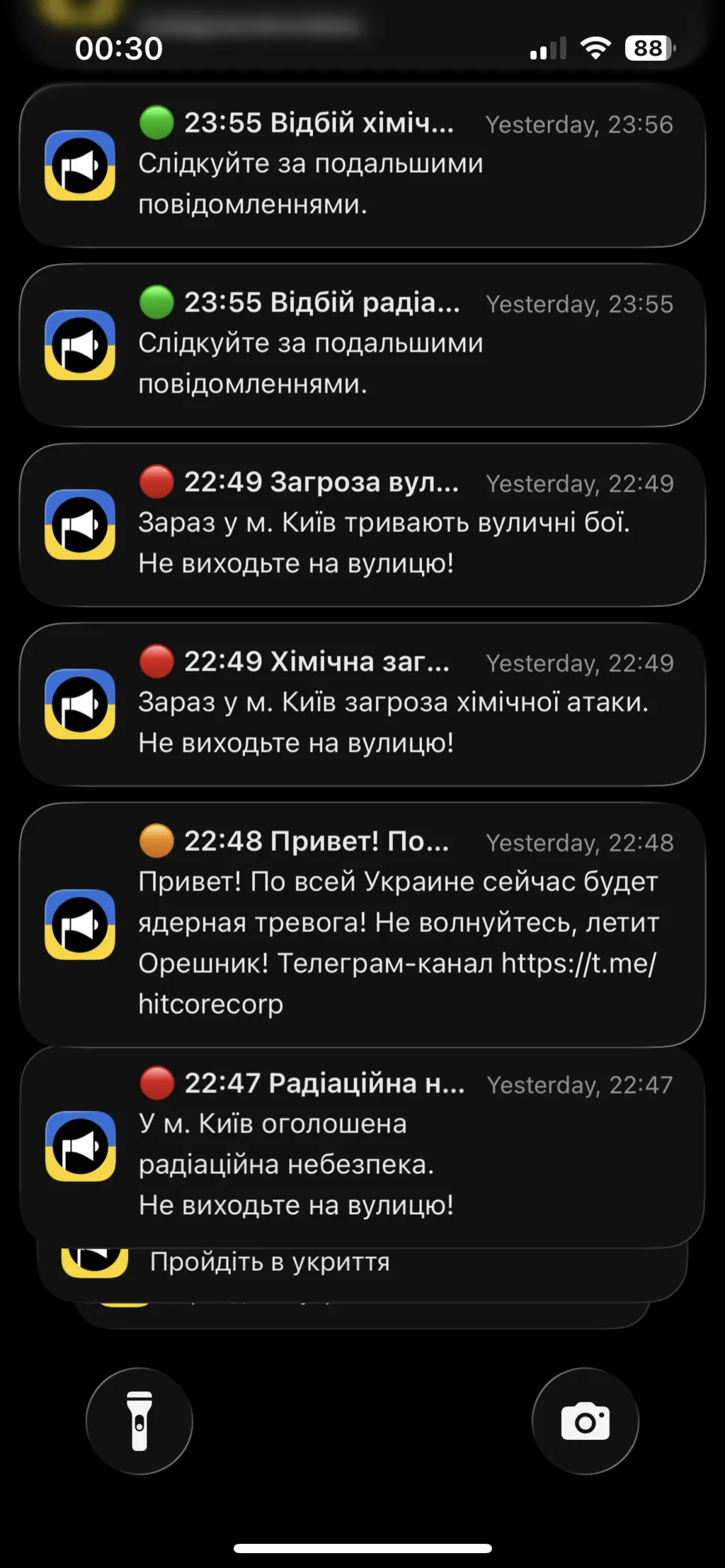
Two more alerts arrived at 22:49. One, in Ukrainian, warned of a chemical attack on Kyiv and told people not to go outside, and the other said street fighting was taking place in the city. Red, orange and green messages reached phones, and at 23:53 users got all-clear messages, each declaring one of the Kyiv threats over.

A Ukrainian intelligence body, which the BBC calls the Central Intelligence Agency, said there had been a failure in the app and urged people to use other sources of information. It added that the alerts triggered a radiation hazard signal on loudspeakers in the Lviv region, with no real threat.

“The Air Alert app is supported by the Ministry of Digital Transformation of Ukraine, and informs users instantly about the beginning and end of defence alerts. The ministry said it temporarily disabled the app for maintenance after it had “apparently been compromised”. states BBC.

“While the false alerts were quickly contained, cybersecurity experts suggested it was a new line in apparent Russian cyberattacks.”

The temporary shutdown of the Air Alert app also carries significant risks, even if it lasts only a short time. During an outage, users may not receive timely warnings about incoming attacks, leaving them with less time to reach shelters or take protective measures. This is particularly dangerous in a country where missile and drone attacks can happen with little warning.

The incident also highlights a difficult security trade-off: disabling a compromised alert system may prevent attackers from spreading false warnings, but it can temporarily remove a critical channel for delivering real emergency information. Any shutdown therefore needs reliable backup channels, such as sirens, official messaging services and other emergency communication systems.

Regional leaders tried to calm people. Svitlana Onyshchuk, head of the Ivano-Frankivsk region, said everything was calm, even though the app had shown a red-level alert for her region from 22:50 to 23:57. Natalya Zabolotna, her counterpart in Vinnytsia, confirmed a cyberattack on the app and warned people not to click the link in the message, which could be phishing.

Ukraine’s Centre for Countering Disinformation has advice for when the app isn’t working: turn on smartphone notifications, pay attention to sirens, and read only official sources. Oleksander Merezhko, chair of the foreign affairs committee in the Ukrainian parliament and a member of President Zelensky’s Servant of the People party, said the attack caused no panic. Ukrainians, especially in Kyiv, are used to practically non-stop alerts, he told the BBC, and the message in Russian aroused suspicion at once. The attackers picked a language that gave them away.

A few hours later, Russia’s ministry of emergency situations said its own app had suffered “a massive cyberattack” that sent fake information to the public. Ukrainian outlet UNN reported that the hack sent fake nuclear threat alerts inside Russia, citing Atesh, a partisan Ukrainian group operating in Russian-held territory. A screenshot Atesh shared on Telegram, described as purported, claimed nuclear warheads mounted on Ukrainian P1-Sun attack drones had been launched at all regions of Russia, opened with a “risk of getting lively” warning and told residents to stock up on three weeks of food and hide. The alert also had profanities.

Russia said it was still restoring the app but claimed the hack had not affected its wider alert system. It said people could still receive warnings through sirens, loudspeakers, text messages, TV and radio. The false alerts appeared minutes before a local ceasefire in Ukraine’s Kherson region ended on Sunday night. The truce had allowed civilians to leave Russian-occupied Oleshky. Although the fake warnings were quickly stopped, experts see the attack as a worrying escalation.

“I think it’s the first time it’s happened to an official Ukrainian information app, but I suspect it won’t be the last,” Herbert Lin, a senior research scholar for cyber policy and security at Stanford University, told BBC World Service’s Newsday programme.

Follow me on Twitter: @securityaffairs and Facebook and Mastodon

Pierluigi Paganini

(SecurityAffairs – hacking, Ukraine)
  • ✇Security Affairs
  • Attackers Take Control of Dahua Cameras and Video Recorders Via Easy4IP Pierluigi Paganini
    Ukraine warns that attackers can remotely access Dahua cameras and recorders via Easy4IP, viewing video and changing settings. Ukraine’s cyber incident response team CERT-UA has warned about attackers taking over video surveillance systems made by Dahua. In its alert dated October 23, 2026, it reports unauthorized remote access to IP cameras and video recorders. The attackers have watched the live video, changed device settings and created accounts of their own. The alert doesn’t say who was
     

Attackers Take Control of Dahua Cameras and Video Recorders Via Easy4IP

27 de Outubro de 2026, 06:56

Ukraine warns that attackers can remotely access Dahua cameras and recorders via Easy4IP, viewing video and changing settings.

Ukraine’s cyber incident response team CERT-UA has warned about attackers taking over video surveillance systems made by Dahua. In its alert dated October 23, 2026, it reports unauthorized remote access to IP cameras and video recorders. The attackers have watched the live video, changed device settings and created accounts of their own. The alert doesn’t say who was targeted or how many devices are affected.

The attackers abused Easy4IP, Dahua’s cloud feature that lets users access devices remotely. When this feature is enabled, the camera or recorder connects to Dahua’s cloud and registers using its serial number. Anyone who knows the serial number may be able to access the device through the cloud, without needing an open port or a public IP address. This means the connection can bypass the protection normally provided by a router’s firewall.

As a result, a camera that isn’t directly exposed to the internet may still be at risk. CERT-UA warns that devices with Easy4IP enabled may be vulnerable even when they cannot be accessed directly from the internet.

“The main vector is the P2P/cloud access function (Easy4IP). The device independently initiates an outgoing connection to the manufacturer’s cloud infrastructure and registers in it by serial number. Access to the device is then established via the cloud by serial number, bypassing NAT and firewall, without published ports and a “white” IP address.” reads the report published by CERT-UA. “Thus, the lack of direct access from the Internet does not guarantee the security of the device with the active P2P function.”

Serial numbers follow predictable patterns, so attackers may be able to guess them automatically and check which devices are registered in the cloud. Simply keeping a serial number private isn’t enough to ensure security.

Once attackers connect to a device, they need to get past its login. They may try common or weak passwords or exploit security flaws in outdated firmware, especially CVE-2021-33044 and CVE-2021-33045. These two vulnerabilities allow attackers to bypass authentication without a password, so even a strong password won’t protect a device running vulnerable firmware.

There are three signs that a device may have been compromised. First, look for accounts you don’t recognize. Second, check for changed settings, including text added over the video image. However, the absence of these labels does not mean the device is safe. Third, check the audit logs for logins using Dahua’s DVRIP protocol from the local address 127.0.0.1, which can indicate access through the cloud service.

CERT-UA recommends four steps:

  1. Turn off P2P and cloud access if you don’t use it.
  2. Keep cameras off the internet. For remote access, use a VPN and allow only authorized IP addresses.
  3. Check the account list for ones you didn’t create, and check which cloud accounts are linked to the device and disconnect unknown ones.
  4. Update the software by hand to the latest version, and set up a regular update routine.


CERT-UA advises organizations that detect signs of unauthorized access to report them to cert@cert.gov.ua and check all Dahua devices on their networks, including those that may have been forgotten. The agency warns that all devices with active P2P functionality are at risk.

Follow me on Twitter: @securityaffairs and Facebook and Mastodon

Pierluigi Paganini

(SecurityAffairs – hacking, IP cameras)

  • ✇Cybersecurity News
  • Doppelganger Campaign Targets Israel Elections With Fake News and AI Poisoning Do Son
    ClearSky exposed the Russian Doppelganger campaign in Israel using 76 fake Walla articles, 66 redirect domains, and AI poisoning ahead of elections. Related Posts: DOJ Extradites Suspect in $36.9M Cambodia Crypto Scam Targeting Americans Suspected Access Broker k0t Hits FortiGate and GlobalProtect Devices, Exposing 70,000 Credentials Storm-0940 Uses ARTEX AI Agent to Probe IT and Software Vendors for Supply Chain Access The post Doppelganger Campaign Targets Israel Elections With Fake News an
     
  • ✇Security Affairs
  • Russian Satellite Makes a Close Approach To A Commercial Radar Satellite Used by Ukraine Pierluigi Paganini
    A Russian satellite made a close approach to a commercial radar satellite linked to Ukraine, raising concerns about surveillance and security in space. A Russian-made satellite called Kosmos 2612 got very close to ICEYE-X36 last week, a commercial Earth-observation satellite that may support countries like Ukraine. CNN reports it may have come within less than a mile. Orbital monitoring company LeoLabs says the behavior is consistent with rendezvous and proximity operations, meaning maneuver
     

Russian Satellite Makes a Close Approach To A Commercial Radar Satellite Used by Ukraine

21 de Outubro de 2026, 18:29

A Russian satellite made a close approach to a commercial radar satellite linked to Ukraine, raising concerns about surveillance and security in space.

A Russian-made satellite called Kosmos 2612 got very close to ICEYE-X36 last week, a commercial Earth-observation satellite that may support countries like Ukraine. CNN reports it may have come within less than a mile. Orbital monitoring company LeoLabs says the behavior is consistent with rendezvous and proximity operations, meaning maneuvers designed to bring two spacecraft together.

“A rare move by a Russian-made satellite may have brought it within less than a mile of a commercial Earth-observation satellite that may be used to provide national security services to countries such as Ukraine.” states CNN.

“It’s not clear what, exactly, the Russian satellite, called Kosmos 2612 or Cosmos 2612, intended to accomplish with its close approach. But the behavior was consistent with rendezvous and proximity operations, or maneuvers carried out in orbit that are designed to bring two spacecraft together, said orbital monitoring services company LeoLabs, which tracks space junk and activity in Earth orbit, in a statement.”

It is unclear what Russia wanted to achieve. LeoLabs said “While the intent remains uncertain, the behavior warrants continued monitoring.” Astrophysicist Jonathan McDowell noted that this could be the first known case of one spacecraft approaching another without permission. This is different from docking, when two spacecraft intentionally connect, a common practice in space.

The events unfolded over several months. In May, four Russian-controlled satellites changed their orbits to align with ICEYE-X36, according to a June report by the Royal United Services Institute. On October 15, Kosmos 2612 began moving closer to ICEYE-X36, reducing the distance from 350 kilometers to less than 5 kilometers by early October 16. It stayed nearby, making small adjustments through the weekend, before starting to move away on Monday. The War Zone (TWZ) reports that Kosmos 2612 was one of six satellites launched together on April 17.

The closest point is disputed. LeoLabs says it came within roughly 500 meters during part of the event, but warns that the repeated maneuvers and awkward tracking geometry make separation estimates uncertain. Space.com reports the satellites may have been a few meters apart at one point, and TWZ’s reading of public tracking data points to about 26 meters.

The target matters. ICEYE operates about 80 radar satellites that image the Earth through clouds, day and night, and ICEYE-X36 belongs to its US subsidiary. At least some ICEYE satellites provide imagery to Ukraine, and in January the company signed a contract firming up that relationship, saying it gives Ukraine’s Ministry of Defence persistent situational awareness on tactical timelines. A Ukrainian official told Axios that Ukraine’s military works with ICEYE but couldn’t say whether this specific satellite is involved.

Russia appears to be paying close attention to ICEYE-X36. Changing a satellite’s orbit to match another spacecraft’s path uses a lot of fuel, so it is not a decision taken lightly. Four Russian satellites made similar changes in May. However, it remains unclear whether ICEYE-X36 is specifically used to collect images of Ukraine.

Close approaches between satellites are not new, but this case is different. Russia, the United States, and China have all moved satellites close to those operated by other countries, mainly in geostationary orbit. Kosmos 2612 operates in low Earth orbit. As far as is publicly known, Russia has carried out similar approaches there, but the United States and China have not.

Victoria Samson of the Secure World Foundation pointed to two earlier Russian cases. In 2020, Kosmos 2543 came within about 30 kilometers of USA 245. In 2022, Kosmos 2558 approached USA 326 to within about 70 kilometers.

Both targets were classified US spy satellites operated by the National Reconnaissance Office. ICEYE-X36, by contrast, is a privately owned satellite, and Kosmos 2612 came much closer than in those earlier cases. Space law professor Aaron Brynildson told Axios that there is no strict legal limit on how close satellites can approach each other. However, countries generally avoid getting within six miles of another satellite.

Why do it? Samson lists a few options. Russia may want to learn the satellites’ capabilities and what they’re studying, or it may have interfered with sensors or communications. She leans toward a different reading: she thinks Russians are getting frustrated, in a stalemate for about six months, and this is a way to show military prowess in a way Ukraine can’t answer, since Ukraine matches Russia in drones but not in space.

RUSI’s June report is blunter about the options. It lists intimidation or interference through jamming, which uses radio noise to stop satellites from communicating. It adds that the range of options for protecting an ICEYE satellite is limited, and that defending satellites is a famous dilemma. LeoLabs says the event doesn’t establish hostile intent, but shows capabilities that could support intelligence collection, inspection, coercive signaling, interference or preparation for future counterspace operations.

ICEYE’s response was short: the company is aware, tracking closely, and says its constellation architecture is designed for continuity and resilience. CNN says it asked Russia’s defense ministry and Roscosmos for comment. The US Space Force had already described Russian satellites positioned near a Western commercial radar satellite used by Ukraine for imagery intelligence, according to Axios.

Private companies and independent observers, rather than the US Space Force, revealed the satellite encounter, highlighting the need for greater government transparency as space becomes more contested.

Follow me on Twitter: @securityaffairs and Facebook and Mastodon

Pierluigi Paganini

(SecurityAffairs – hacking, satellite)

  • ✇Cybersecurity News
  • Yandex Cloud Drone Strike Causes Widespread Service Outages Do Son
    A recent Yandex Cloud drone strike in Vladimir caused severe service outages across Russia, disrupting Yandex Pay, search, and enterprise cloud operations. Related Posts: Anthropic Fortifies Claude AI Against Model Distillation Bitwarden App Store License Changes to Commercial Model Firefox 158.0 Released: Default JPEG XL Support The post Yandex Cloud Drone Strike Causes Widespread Service Outages appeared first on Daily CyberSecurity.
     
  • ✇ASEC BLOG
  • September 2026 Dark Web Breach Incident Trend Report ATCP
    Note The September 2026 Dark Web Breach Incident Trend Report focuses on data breach cases and the sale of initial access credentials posted on the deep web and dark web forums. The report explicitly states that the accuracy of some of its content cannot be fully verified due to the nature of the sources. Major […]
     

September 2026 Dark Web Breach Incident Trend Report

Por:ATCP
11 de Outubro de 2026, 12:00
Note The September 2026 Dark Web Breach Incident Trend Report focuses on data breach cases and the sale of initial access credentials posted on the deep web and dark web forums. The report explicitly states that the accuracy of some of its content cannot be fully verified due to the nature of the sources. Major […]
  • ✇Security Affairs
  • Italy’s Foreign Ministry Under Cyberattack as Embassy Sites Come Under Review Pierluigi Paganini
    Italy’s Foreign Ministry is defending its website against a cyberattack, checking embassy sites and pushing for EU action to identify attackers. On the morning of October 8, Italy’s Ministry of Foreign Affairs said its website was being attacked. According to the ministry’s own statement, its protection systems have mitigated the attack so far, with no disruption. The statement doesn’t say who is behind it, or what kind of attack it is. The ministry is monitoring the situation with the Po
     

Italy’s Foreign Ministry Under Cyberattack as Embassy Sites Come Under Review

8 de Outubro de 2026, 16:33

Italy’s Foreign Ministry is defending its website against a cyberattack, checking embassy sites and pushing for EU action to identify attackers.

On the morning of October 8, Italy’s Ministry of Foreign Affairs said its website was being attacked. According to the ministry’s own statement, its protection systems have mitigated the attack so far, with no disruption. The statement doesn’t say who is behind it, or what kind of attack it is.

The ministry is monitoring the situation with the Polo Strategico Nazionale, the country’s national cloud hub, and with the competent authorities.

“Cybersecurity is a central element of the reform of the Foreign Ministry approved last year. In recent months, we have strengthened our capabilities to prevent, monitor and respond to threats, adopting all necessary countermeasures, including on the technological side,” Foreign Minister Antonio Tajani said.

“Tajani had also had the opportunity to explain the technical capabilities of the CSIRT Operations Room to German Foreign Minister Johann Wadephul during his recent visit to Rome.” “In this context, Italy has decided to work with Romania and other EU member states to include proposals in upcoming European meetings to designate the actors responsible for cyberattacks, including attacks targeting Italian institutions.” reads the statement published by Italy’s Foreign Ministry.

Analysts are also checking the websites of Italian embassies and consulates abroad for similar attempts. That detail matters, and I’ll come back to it.

Minister Antonio Tajani tied the response to last year’s reform of the Farnesina, which made cybersecurity a central piece. He said prevention, monitoring and response capabilities have been strengthened in recent months, including on the technology side.

The statement ends on diplomacy. Italy will work with Romania and other member states to put proposals on the agenda of upcoming EU meetings, aimed at naming those responsible for cyberattacks, including attacks on Italian institutions. A blocked page is forgotten in a day, while a name on an official list is harder to shrug off.

Nobody has claimed this attack, but the pattern is familiar. NoName057(16) is a pro-Russian group that declared itself in March 2022 and announces its targets on Telegram. Avast researchers saw it using the Bobik botnet for DDoS attacks as early as September 2022.

Later, the DDoSia Project (aka DDosia), a crowdsourced DDoS operation linked to the pro-Russian hacktivist group NoName057(16), made the headlines beacuse its involvement in DDoS attacks again governments that supported Ukraine.

Italy has been a regular target. Over a weekend in January 2025, as Zelensky visited Rome, the group hit ministries and government sites on Saturday, then banks including Intesa and Monte dei Paschi di Siena and the ports of Taranto and Trieste on Sunday. At the end of December 2024 it had gone after Malpensa and Linate airports, and in February 2025 it tied a new wave to a speech by President Mattarella, according to Infosecurity Magazine. The timing follows politics, which isn’t a coincidence.

The ministry itself has been here before. ANSA reported that Russian hackers took its website down in late December 2024, and Tajani said it was back up the next day. DDoS attacks hit availability, not data, so the site goes dark and comes back. A loud attack can also pull attention away from a quiet one, which is a reason to look closer, not a claim about this case.

Now the embassies, and this part is my analysis. A ministry homepage going dark is embarrassing. An embassy or consulate site going dark is a problem for real people, because it’s where citizens abroad look for appointments, contacts and instructions, and the worst moment for an outage is a crisis abroad. Every one of those sites is also a surface to defend, and a lookalike page is an easy way to scam someone who’s already stressed.

Giving a look to the list of targets shared on DDosia today I can confirm that administrators planned attacks against the Farnesina, five Italian embassy sites, several Interior and Defence Ministry services, and other Italian organizations.

There is a precedent. In 2017, The Guardian reported a months-long intrusion into the Foreign Ministry’s systems. Italian media later reported that the attackers had targeted staff email accounts at the ministry and Italian embassies, rather than the encrypted system used for sensitive communications. A senior ministry security official said that attacks often happen before important events for Italy, while the Kremlin denied any involvement.

That’s why checking embassy websites is more than routine work. If someone wants to damage Italy’s image at little cost, the diplomatic network offers a large and highly visible target. The ministry is responding by strengthening its technical defenses and pushing at the EU level for “proposals to designate actors responsible for cyber attacks”, as the Farnesina’s statement puts it. That could make attribution more costly for attackers than simply taking a website offline.

DDoS attacks should not be underestimated, especially when they target government institutions and diplomatic services. They can disrupt public services, create pressure and attract significant media attention. But from a technical perspective, they are not usually complex offensive operations for a state to neutralize, especially when the target has adequate DDoS protection and network capacity.

The more important question is what sits behind the noise. Authorities need to determine whether these attacks are simply disruptive actions designed to attract attention, or whether they are being used to distract defenders while more sophisticated operations take place elsewhere. If there is no evidence of intrusion, data theft or compromise, the DDoS activity may be little more than a public demonstration of intent.

That distinction matters because a long list of targets can create the impression of a much more serious threat than the technical impact actually suggests. For people outside the cybersecurity community, a website being attacked can easily be interpreted as evidence that a government has been seriously compromised. In reality, it may be a relatively simple operation whose main objective is visibility.

The risk, therefore, is not only the attack itself, but the narrative built around it. DDoS campaigns can become a useful propaganda tool, creating fear and uncertainty while requiring relatively limited technical resources. The challenge for governments is to defend against the disruption without giving a sterile attack more strategic value than it deserves, while at the same time making sure that the noise is not hiding something more serious.

Follow me on Twitter: @securityaffairs and Facebook and Mastodon

Pierluigi Paganini

(SecurityAffairs – hacking, Italy’s Foreign Ministry)

  • ✇Schneier on Security
  • How Technology Empowers—and Imperils—Dictators Bruce Schneier
    This essay was written with Seva Gunitsky, and originally appeared in Foreign Affairs. Two weeks after Moscow’s full-scale invasion of Ukraine in March 2022, the Russian TV Channel One editor Marina Ovsyannikova burst onto the set of the evening newscast. She held up a hand-drawn sign behind the anchor’s head that read: “Stop the war. Don’t believe propaganda. They’re lying to you!” She shouted, “No to war!” until she was dragged away. No one has protested the war on Russian television since the
     

How Technology Empowers—and Imperils—Dictators

8 de Outubro de 2026, 08:07

This essay was written with Seva Gunitsky, and originally appeared in Foreign Affairs.

Two weeks after Moscow’s full-scale invasion of Ukraine in March 2022, the Russian TV Channel One editor Marina Ovsyannikova burst onto the set of the evening newscast. She held up a hand-drawn sign behind the anchor’s head that read: “Stop the war. Don’t believe propaganda. They’re lying to you!” She shouted, “No to war!” until she was dragged away.

No one has protested the war on Russian television since then, partly as a result of tighter security and a general climate of fear. But in October 2024, Margarita Simonyan, one of Russia’s chief propagandists, gave another explanation. A growing number of the RT network’s anchors, she explained to an interviewer, are not real. “That face doesn’t exist. We generated the voice and everything else.” They were, she meant, produced by artificial intelligence. In a follow-up interview with the newspaper Vedomosti, she spelled out the logic: “These anchors don’t need a salary or insurance,” she said. “They won’t get arrested, and the police won’t search their homes. It’s all wonderful and terrifying at the same time.”

This is AI’s promise to every autocratic ruler: the ability to maintain control without delegating tasks to unreliable humans. It is an extremely attractive prospect. No matter how powerful, dictators have always needed subordinates—censors, propagandists, security guards, police officers, intelligence analysts, and local bureaucrats—to carry out their orders. But subordinates always pose a potential threat. They could shirk, steal, lie, leak, or conspire against their boss. As a result, one of the oldest dilemmas facing autocrats is how to empower agents to carry out orders without also enabling them to turn against their leader. Autocrats have usually managed the tradeoff by filling key positions with mediocrities whose incapacity is, as the political theorist Hannah Arendt put it, “the best guarantee of their loyalty.” But this inevitably makes it harder for dictatorships to govern and survive crises.

AI appears to offer autocrats two ways to resolve this long-standing dilemma. First, it means they can now easily monitor and discipline their followers in real time. A change in a local official’s spending habits or meeting schedules can be flagged automatically by an AI system, without any need for self-interested informants. Second, AI can eliminate underlings altogether. By automating tasks that once required human discretion, rulers can replace unreliable intermediaries with faithful algorithms that cannot be bribed or manipulated. Officials in autocratic regimes have said as much. AI “can definitely replace half of officials,” Russia’s Digital Development Minister, Maksut Shadaev, told a Moscow data forum in April 2025, adding, “maybe slightly more.”

Yet these promises of a self-running state are illusory, because AI is never truly autonomous. Systems have to be built and maintained by a cadre of engineers and data scientists whose expertise political leaders cannot evaluate. The ruler who turns to AI to reduce a dependence on unreliable humans may end up relying, more blindly than before, on the few AI specialists who keep the system running. And this new digital Praetorian Guard may have the same weaknesses as the old, which makes it a threat to the ruler.

Eyes and Ears

China is in the lead when it comes to developing AI systems that can monitor or replace subordinates. Smart city programs in Beijing, Shanghai, and other urban centers use AI to track performance and centralize oversight of local officials who once operated in comfortable obscurity, subjecting them to an algorithmic performance review. China also developed a “Zero Trust AI system,” which it deployed across roughly 30 counties and cities over the past decade. This system cross-referenced more than 150 government databases to catch embezzlement and nepotism by local officials. It worked a little too well, flagging 8,700 officials before local governments, under pressure from the bureaucrats it was monitoring, began rolling it back. But Beijing has not gotten rid of its new e-government portals, which use automated systems for issuing documents and permits, reducing face-to-face interactions that bred petty corruption or favoritism. The Chinese Communist Party, meanwhile, has plowed ahead with researching what it calls “thought management,” or how to use AI to create microtargeted propaganda. China’s army of Internet commentators, once composed of paid humans, is already being replaced by bots.

Russia has been pursuing the same goals with a similar fervor. Moscow’s citywide facial recognition system, deployed across 200,000 cameras, was used to identify and apprehend protesters during the 2021 antigovernment demonstrations. The central government has started using automated data collection and aggregation to bypass regional officials who could taint the data or use it to promote their own interests. In 2023, Russia’s Internet regulator launched Oculus, an AI system that scans hundreds of thousands of images per day for prohibited content, including political content—orders of magnitude beyond what human censors could process. The Russian security service’s Meliorator tool has been used to create over a thousand profiles of fictitious Americans, primarily on X (formerly Twitter), to spread Kremlin narratives at a fraction of the cost of human troll farms.

Other autocracies are following in Beijing’s and Moscow’s footsteps. In April 2025, the United Arab Emirates created a Regulatory Intelligence Office that uses AI to draft and amend federal laws, work once done by legislative staff. A year later, UAE Prime Minister Sheikh Mohammed bin Rashid al-Maktoum announced that autonomous AI agents would take over half of the federal government’s operations within two years and that “the performance of ministers, directors general, and entities will be assessed based on their ability to adopt this transformation.”

These innovations may reduce the number of bureaucrats autocrats need. But they cannot actually create what dictators want most: a self-running state. Even AI-generated television anchors need people to build and maintain them, and censorship systems need people to retrain them as the vocabulary of dissent shifts. Behind every AI model, there is a small group of engineers and data scientists doing essential maintenance, and their work is so technical that rulers cannot understand it.

This dependence thus becomes another form of power. The engineers who maintain an autocrat’s surveillance apparatus, for example, can shape what the ruler sees. They decide what information is important enough to pass along and in what form to present it. They determine which threats get flagged, and they can adjust the algorithms that select what content gets suppressed and who gets arrested. And they can do this without anyone in the palace noticing. Autocrats who turn to AI to escape a dependence on unreliable subordinates have only transferred their vulnerabilities onto a new group of officials.

In fact, this new Praetorian Guard could be more dangerous than previous elites. That is in part thanks to the opacity of AI technology but also because this clique is much smaller. Roman emperors typically had tens of thousands of people serving in the Praetorian Guard; modern autocrats rely on standing armies. But with AI, autocrats will need only a small clique of engineers to build and maintain large-scale AI systems. This might benefit rulers since they will have fewer people to watch, yet it also concentrates points of failure, since a devastating disruption requires only a handful of engineers and makes it easier for members to scheme against the leader. The new guard’s members may also be indispensable. A dictator can replace generals without destroying the army. But running complex machine-learning systems requires such a specialized set of skills that engineers can be difficult to replace without disruptions, giving these actors great leverage.

The Indispensables

The importance of tech workers to autocracies has already become apparent. When IT specialists began to flee Russia after the full-scale invasion of Ukraine in February 2022, for example, the Kremlin responded not with threats but with inducements, offering tech workers deferments from conscription. It exempted their firms from taxes and subsidized their mortgages. When Russian President Vladimir Putin ordered the mobilization of 300,000 men seven months later, IT workers were granted full-on waivers. This might seem like overkill, given that an AI system needs only a few engineers to run it. But a regime cannot know in advance which engineers it will need, and it cannot train replacements quickly, so it has to hold on to the entire talent pool from which these few are selected.

These measures did not stem the outflow of roughly 100,000 specialists—about a tenth of Russia’s tech workforce—over the course of 2022. But Moscow stuck to bribery, because expertise is extremely difficult to conscript at gunpoint and because conscripted experts might be less likely to do as instructed. Even so, money and privilege cannot guarantee that these elites will stay loyal. Autocrats should recall the lesson of the original Praetorian Guard: for a time, it provided Roman emperors with protection and security. But then the praetorians discovered their own indispensability, and by the second century, they were auctioning off the empire to the highest bidder. This new set of elites can do the same. In June 2023, when the column of Yevgeny Prigozhin‘s Wagner paramilitary company moved up the highway toward Moscow, Putin depended on his security services to tell him what was happening. Future rulers in Putin’s position will receive such warnings through machines: intercepted communications sorted by software, camera feeds filtered through recognition systems, regional reports compiled into dashboards. The engineers who run those systems could strike a deal with an upstart challenger and then drag their feet. They could delay the data, let alerts arrive a few hours late, degrade feeds at inconvenient moments, or make a recognition system stop functioning. In that scenario, the ruler would be operating blind. The Praetorian Guard did not need to kill Emperor Nero to replace him. It simply had to abandon him for a rival.

These programmers are unlikely to seize power for themselves, because they are unlikely to carry what coup leaders ultimately require: guns. But there is already precedent for engineers using their power to shape leadership challenges. In 1991, when the Soviet army attempted to seize control from Mikhail Gorbachev, a handful of programmers at the Relcom network kept information flowing abroad and relayed Russian President Boris Yeltsin’s decrees to audiences inside the country and abroad. The plotters could not stop the news of Yeltsin’s defiance from spreading, and the coup collapsed within three days.

Slimming Down

AI will not let autocrats dismiss all their enforcers. Someone still has to make arrests and run the prisons, and autocrats can buy loyalty by offering supporters state jobs. But it will let authoritarians downsize, and the number of officials ultimately matters less than how the ruler oversees them. Keeping track of scheming or incompetent subordinates has always been the autocrat’s chief burden. AI could lighten it, letting rulers watch their officials more closely without paying as much active attention.

In the near term, then, AI may greatly benefit autocracies. Despite the many obstacles to deployment, the technology is already bringing autocratic regimes the upsides of cheaper surveillance, smarter censorship, and fewer human subordinates to fear and distrust. But for autocratic rulers, the temptations of artificial intelligence may re-create the same trap they are seeking to escape. The more a regime depends on AI, the more it depends on the people who keep AI running. And those people, like every other praetorian class in history, will quickly discover what their indispensability is worth.

Star Blizzard Targets 100+ Organizations with Phishing and RedFlick Technique

Russian group Star Blizzard expands phishing campaigns with a new malware delivery RedFlick technique, using scheduled tasks to deliver the CosmicPulse backdoor.
  • ✇Security Affairs
  • Oxygen Forensics, A Russian-run forensics firm spent a decade inside European police departments Pierluigi Paganini
    DOJ charges against Oxygen Forensics reveal the Russian-linked firm also sold forensic software to EU projects and European police forces for years. Last week’s Justice Department indictment of Oxygen Forensics looked, at first, like an American procurement scandal. CEO Lee Reiber and Russian co-founder Oleg Davydov stand accused of hiding that the company was Russian-owned and its software built in Russia, while it sold forensic tools to the Pentagon, the Secret Service, and other US agenci
     

Oxygen Forensics, A Russian-run forensics firm spent a decade inside European police departments

30 de Setembro de 2026, 10:26

DOJ charges against Oxygen Forensics reveal the Russian-linked firm also sold forensic software to EU projects and European police forces for years.

Last week’s Justice Department indictment of Oxygen Forensics looked, at first, like an American procurement scandal. CEO Lee Reiber and Russian co-founder Oleg Davydov stand accused of hiding that the company was Russian-owned and its software built in Russia, while it sold forensic tools to the Pentagon, the Secret Service, and other US agencies. Politico’s reporting shows the reach went a lot further than Washington.

“The CEO of a Virginia-based software company and a Russian national have been arrested on a federal criminal complaint charging them with concealing from U.S. government agencies that their company was owned and controlled by Russian nationals and that its software was developed in Russia, the Justice Department announced today.” DoJ states. “Reiber allegedly represented to the government that the company had no foreign ownership or control and that its software was developed in the United States, when in fact five Russian nationals, including Davydov, owned and controlled the company and its software was developed in Russia.”

According to documents reviewed by Politico, Oxygen Forensics was involved in two EU-funded projects designed to improve how European investigators collect and share digital evidence.

The first, EVIDENCE, ran from 2014 to 2016 and received more than €1.9 million in EU funding. Oxygen was consulted alongside organizations such as Europol, Eurojust and the European Anti-Fraud Office’s digital forensics unit.

The second project, INSPECTr, was funded through Horizon 2020. It developed software that allowed investigators to combine evidence extracted with tools such as Oxygen’s with data from other systems. The project continued until 2023, after Russia’s invasion of Ukraine.

“The second project, INSPECTr, backed under Horizon 2020, an EU research and innovation funding arm, was designed to help European police bring together and analyze digital evidence collected using different tools. It built software that could take evidence extracted with Oxygen Forensics and make it easier for investigators using other systems to access and analyze it.” reports POLITICO. “Although both of those EU-backed projects were launched well before Russia’s February 2022 full-scale invasion of Ukraine and subsequent European sanctions, INSEPCTr continued to operate until 2023.”

The European Commission said Oxygen was not a formal member of either consortium and did not receive direct EU funding. It also noted that Russian entities have been excluded from Horizon Europe projects since the war began.

That may be technically correct, but the issue is broader: Oxygen was still consulted on EU-funded projects dealing with digital evidence and investigative technology, even if it was not officially part of the project or directly funded by the EU.

The domestic Russian side of this story is the part that should worry European agencies more than the funding technicality does. The same five people who secretly owned Oxygen Forensics also controlled MKO Systems, a Russian company selling the same underlying technology to the FSB and Russia’s Interior Ministry. That’s not two unrelated businesses that happen to share a founder. That’s one piece of forensic technology with two sets of customers who are, depending on how you look at it, on opposite sides of several ongoing investigations.

And the client list in Europe, once you start counting, is long. Police agencies in Germany, Spain, Italy, and Poland accredited or purchased Oxygen’s products, according to EU tender records. Hungary’s police signed a contract worth roughly €27,000 in December 2024, running through the end of last year. A prosecutor’s office in Sardinia listed Oxygen among its recognized mobile-extraction systems as recently as April 2026, and a Spanish National Police inspector accredited by the company co-authored a 2026 study on cracking WhatsApp data on Android and iPhone. Romania and Latvia bought in as recently as this September, days before the arrests.

There is also a more worrying case outside the EU. French outlet Disclose reported that Oxygen’s software was provided to Moroccan authorities through an EU-funded border management program covering the Maghreb. The EU also paid for training courses where Oxygen employees trained Moroccan police to use the software.

In other words, a tool allegedly controlled by Russian interests was being used to train foreign law enforcement, with the training funded by the EU.

Some agencies are now reacting. Romania’s National Anticorruption Directorate told Politico it will stop using Oxygen’s products after the ownership issue became public. However, this does not change any data that may already have been extracted using the software.

Other national police agencies contacted by Politico did not respond.

“In December 2022 and October 2023, Reiber falsely certified to the U.S. government that Oxygen Forensics had no immediate or highest-level owner. According to the affidavit, in November 2023, a reporter asked Reiber about Oxygen Forensics’ ownership and its connection to the Russian company.” continues DoJ. “Reiber then wrote to Davydov and two other Russian owners that public reporting on the connection “could destroy this entire opportunity,” referring to a pending contract with the National Computer Forensics Institute, and that the “current existence of this company hangs in the balance.””

Natalia Krapiva at Access Now put the stakes about as plainly as they can be put: civil society groups had flagged Oxygen’s Russian links for years, and this case just confirmed what they’d been saying.

“If in fact Russian-made software designed for the FSB and Investigative Committee was used for handling EU Commission criminal evidence database, it raises a serious possibility of sensitive information being compromised and accessed by Russian authorities,” Krapiva told Politico. “We call on the EU and every government using these tools to suspend them and fully investigate how a Russian-owned company spent a decade inside Western law enforcement.”

Follow me on Twitter: @securityaffairs and Facebook and Mastodon

Pierluigi Paganini

(SecurityAffairs – hacking, Oxygen Forensics)

  • ✇Schneier on Security
  • Leaked Russian Cyber-Operations Training Materials Bruce Schneier
    This is interesting: The records describe a force-generation mechanism for several General Staff components, including the GRU, Main Operational Directorate, and 8th Directorate, which is associated with protected communications, cryptography, and information security. […] The reporting also linked a 2024 Department No. 4 graduate, Aleksei Kondrashov, to Military Unit 74455, widely known as Sandworm. That unit has been associated with destructive cyber activity against Ukraine and other targets,
     

Leaked Russian Cyber-Operations Training Materials

1 de Setembro de 2026, 13:29

This is interesting:

The records describe a force-generation mechanism for several General Staff components, including the GRU, Main Operational Directorate, and 8th Directorate, which is associated with protected communications, cryptography, and information security.

[…]

The reporting also linked a 2024 Department No. 4 graduate, Aleksei Kondrashov, to Military Unit 74455, widely known as Sandworm.

That unit has been associated with destructive cyber activity against Ukraine and other targets, including the 2017 NotPetya attack.

The reports do not establish that every listed graduate participated in a named operation; assignments should therefore be described as reported unit placements, not proof of individual operational involvement.

The Bauman material reframes Russia’s cyber capability as an institutional system, not merely a collection of well-known threat groups.

It suggests that Moscow has formalized a recurring pathway from university recruitment to military service, where students receive supervised technical and ideological preparation before entering intelligence, cyber, and security roles.

For defenders, the leak reinforces the need to track Russian operations as a combined threat: espionage, destructive activity, military reconnaissance, technical surveillance, and influence campaigns may draw on related personnel pipelines and overlapping doctrine.

The exposure of Department No. 4 also provides researchers with a clearer lens for understanding how the GRU sustains cyber capacity beyond the familiar APT28 and Sandworm brand names.

  • ✇bellingcat
  • Tracking a Sanctioned Russian Vessel’s West African Odyssey Bellingcat Investigation Team
    Sign up here to receive Bellingcat’s biggest investigations by email as soon as they are published. A sanctioned vessel that was previously reported to have transported weapons destined for Russian mercenaries has been traversing ports on the west coast of Africa since March, exhibiting what experts told Bellingcat  was an unusual set of movements and behaviours. Patria (IMO: 9159921) has been sanctioned by the US, Ukraine and Canada. Support Bellingcat Your donations directly c
     

Tracking a Sanctioned Russian Vessel’s West African Odyssey

25 de Agosto de 2026, 05:52

Sign up here to receive Bellingcat’s biggest investigations by email as soon as they are published.

A sanctioned vessel that was previously reported to have transported weapons destined for Russian mercenaries has been traversing ports on the west coast of Africa since March, exhibiting what experts told Bellingcat  was an unusual set of movements and behaviours.

Patria (IMO: 9159921) has been sanctioned by the US, Ukraine and Canada.

Support Bellingcat

Your donations directly contribute to our ability to publish groundbreaking investigations and uncover wrongdoing around the world.

Radio France International (RFI) reported last year that it was one of two ships to deliver weapons to Conakry in Guinea that were intended for the Kremlin-controlled Africa Corps and their operations in Mali.

Satellite imagery and Automated Identification System (AIS) data from Lloyd’s List Intelligence shows Patria has shuttled between the Port of Douala in Cameroon and the Port of Owendo in Libreville, Gabon four times since March. 

It has also twice stopped in anchorage off the coast of Lagos, Nigeria: first in March and then again at the time of publication. Analysis shows the vessel also spent time in anchorage off the coast of Equatorial Guinea. 

The online news site, Modern Ghana, first reported Patria’s presence off the coast of Lagos in July after X-users @SONNAROW_OSINT and @RFNOSBlog picked up on Patria’s position.

It is not clear what Patria has delivered or picked up at these ports. Nor is it clear why it has spent so long going back and forth between them. But experts Bellingcat spoke to said the unusual patterns of behaviour raised numerous questions.

Charlie Brown, a former US Naval Officer and Senior Advisor at United Against Nuclear Iran said the combination of Patria’s repeated regional port calls, extended periods at anchor, and an apparent absence of a normal point-to-point trading cycle warranted scrutiny, especially as the ship is under sanction and is previously reported to have shipped arms. 

Tracking the Patria

Patria is a cargo vessel that has a distinct shape and features. Its bridge is located on the bow and it has a bright red deck that contrasts with its blue hull and two yellow cranes. 

At the end of the deck, the ship has a built-in ramp for vehicles (the Patria is a so-called roll on/roll off, or RoRo, vessel that is designed to transport wheeled vehicles). Its chimney is located next to the ramp.

Footage of the Patria, posted on Youtube on Jan 22, 2024. Credit: Hanro Shipping – Sakhalin Projects LLC / YouTube Channel @hanroship

This, in combination with the length of the ship (101 m), allowed Bellingcat to pick the vessel out in satellite imagery. AIS data helped us further track its long journey which began in the Sea of Japan, in Russia’s far-east, in January.

For the most part, we were able to match Patria’s AIS position with corresponding satellite imagery. We found no evidence of obvious spoofing incidents (where a ship intentionally broadcasts misleading AIS data) by the vessel during its months-long voyage, however, there were some instances where satellite images were not available and thus spoofing by the vessel cannot be completely ruled out.

MapLibre | Protomaps© OpenStreetMap contributors

Port of Olga, Russia

AIS data indicates that Patria loaded at the Port of Olga in the Sea of Japan between Jan. 21 and 23. Patria can also be seen on satellite imagery on these dates.

Credit: Planet Labs PBC.

Port of Douala, Cameroon

AIS data indicates that Patria unloaded some cargo in the Port of Douala between Mar. 11 and 12. Again, the ship can also be seen in satellite imagery on these dates.

Credit: Planet Labs PBC.

Lagos Anchorage, Nigeria

AIS data indicates Patria anchored off the coast of Lagos from Mar. 14 to 15.

A Sentinel-2 image from the 15th appears to show another ship next to Patria. AIS data indicates that this is JS Gratitude, a bunkering tanker. This close proximity suggests that Patria was refuelling.

Credit: Contains modified Copernicus Sentinel data 2026.

Bata Anchorage, Equatorial Guinea

AIS data and satellite imagery indicate Patria stayed off the coast of Equatorial Guinea for several days.

Credit: Planet Labs PBC.

Port of Owendo, Libreville, Gabon

AIS data and satellite imagery indicate Patria loaded at the Port of Owendo in Libreville after spending a few days off the coast.

Credit: Planet Labs PBC.

Port of Douala, Cameroon

AIS data and satellite imagery indicate Patria stayed at the Douala Anchorage from Apr. 6 to 14, before unloading at the Port of Douala between Apr. 14 and 18.

Credit: Planet Labs PBC.

Port of Owendo, Libreville, Gabon

AIS data suggests Patria loaded in Libreville again between Apr. 22 and 26.

Port of Douala, Cameroon

AIS data, supported by satellite imagery, indicates Patria stayed at the Douala Anchorage for nearly a month from Apr. 27 to May 21 before unloading in Douala from May 21 to 27.

Credit: Planet Labs PBC.

A third trip between the Port of Owendo, Libreville to Douala, Cameroon

AIS data indicates, after nearly a month’s wait in Douala anchorage, Patria again loaded at Owendo before returning to Douala to unload.

A fourth trip between the Port of Owendo, Libreville to Douala, Cameroon

AIS data indicates Patria again loaded at Owendo before returning to Douala to unload.

Lagos Anchorage, Nigeria

AIS data indicates, after a short visit to the Libreville anchorage, Patria anchored off the coast of Lagos where it remained at the time of publication.

Credit: Planet Labs PBC.

Examining the Patria’s Draught

We reviewed the draught of the ship at each port visit and found that the ship’s draught always dropped after a stay at the Port of Douala, suggesting it was unloading there.

A ship’s “draught” is the distance from the bottom of the hull (the keel) to the waterline. When loaded, a ship is heavier and sits lower in the water (e.g. a draught of six metres) than when it is unloaded (e.g. a draught of four metres).

Draught is the depth of a ship below the waterline. 

In the period from March to July, the Patria made five port calls to Douala and each time the draught decreased. Conversely, it called four times at the Port of Owendo in Libreville, each time the draught increased, meaning the ship became heavier, suggesting it was loading.

The draught is self-reported by ships but usually when it arrives at ports this kind of data is checked – reporting accurate draught is also a safety issue for ships arriving and departing at ports. 

Bellingcat asked the ship’s owners, managers and both ports if items were being transferred from Libreville to Douala but did not receive a response at time of publication.

Brown, the former US Naval Officer and now a Senior Advisor at United Against Nuclear Iran, said Patria’s movements were unusual.

“A sanctioned vessel linked to a prior military logistics shipment spending nearly six months operating between a small cluster of West African ports, Douala, and Owendo, without returning to a clear commercial trading pattern warrants scrutiny,” Brown told us.  


“While innocent explanations such as mechanical issues, commercial disputes, lack of cargo, chartering delays, or prolonged maintenance are possible, the combination of repeated regional port calls, extended periods at anchor, and an apparent absence of a normal point-to-point trading cycle is atypical for a merchant vessel.” 

He added that the current period of more than 30 days at the Lagos Anchorage, in particular, is noteworthy. 

David Soud, Head of Research and Analysis at I.R Consilium also told Bellingcat that Patria’s prolonged Lagos Anchorage could have innocent explanations such as its need for ongoing repairs, or that its operators were out of money, but added that there could also be more calculated reasons and it was laying low for a while.

Bellingcat analysed AIS data from Lagos Anchorage and found that while there has been high congestion, no other RoRo or container vessel waited longer than 10 days to enter the port in the period that Patria has been at Lagos Anchorage. At time of writing, Patria has been in anchorage for more than 30 days.

Regarding the Patria’s apparent deliveries of cargo between Libreville in Gabon, and Douala in Cameroon, Soud told Bellingcat:

“Given the vessel’s history of transporting military equipment to African seaports for overland delivery to Russian and allied forces in the Sahel, it’s not out of the question that some form of supplies for Russian or other forces could be picked up in Gabon, whose government has developed a closer relationship with Moscow, to be discharged in Douala, which is the main entry point for goods going to Central African Republic.”

Bellingcat asked the Nigerian Ports Authority why Patria had been in anchorage for so long, whether it had applied to dock and whether the port was aware of its sanctioned status but did not receive a response at time of publication.

The ports of Douala in Cameroon and Owendo in Libreville, Gabon did not respond to Bellingcat’s requests for comment about the Patria’s visits and the cargo it was carrying.

Bellingcat also contacted the two companies connected to the vessel – Hanro Shipping and Sakhalin Shipping Company which are listed as the vessel’s owner and manager respectively in sanctions documents. We also contacted the company connected to JS Gratitude. We did not receive a response at time of publication.


Youri van der Weide, Galen Reich, Yörük Işık contributed to this report.

Cover image: Planet Lab image shows the Patria at the Port of Douala, Cameroon, on April 17, 2026. Credit: Planet Labs PBC.

Bellingcat is a non-profit and the ability to carry out our work is dependent on the kind support of individual donors. If you would like to support our work, you can do so here. Subscribe to our Newsletter and follow us on Bluesky here, Instagram here, Reddit here and YouTube here.

The post Tracking a Sanctioned Russian Vessel’s West African Odyssey appeared first on bellingcat.

  • ✇ASEC BLOG
  • July 2026 Security Issues in Korean & Global Financial Sector ATCP
    Statistics on Malware Distributed to the Financial Sector In Attack Stage 1, phishing (a technique that tricks users into opening malicious links or attachments) had the highest rate at 1.7, Down from 2.3 The previous month. In Attack Stage 2, Dropper/Downloader (a type that downloads additional malware) was the most prevalent at 1.7, Up from […]
     

July 2026 Security Issues in Korean & Global Financial Sector

Por:ATCP
9 de Agosto de 2026, 12:00
Statistics on Malware Distributed to the Financial Sector In Attack Stage 1, phishing (a technique that tricks users into opening malicious links or attachments) had the highest rate at 1.7, Down from 2.3 The previous month. In Attack Stage 2, Dropper/Downloader (a type that downloads additional malware) was the most prevalent at 1.7, Up from […]
  • ✇ASEC BLOG
  • July 2026 Dark Web Breach Incident Trend Report ATCP
    Note The July 2026 Dark Web Breach Incident Trend Report was compiled based on data breach cases posted on deep web and dark web forums. Due to the nature of some posts, it is difficult to fully verify their accuracy; some posts related to South Korea included AI-generated false data or cases where it could […]
     
  • ✇Firewall Daily – The Cyber Express
  • New Zealand Targets Russian Cyber Actors With Fresh Sanctions Samiksha Jain
    New Zealand has announced a new round of sanctions against Russia, targeting 33 individuals and entities accused of supporting Moscow’s war against Ukraine. The latest New Zealand sanctions against Russia place particular focus on cyber actors, individuals linked to the forced relocation and re-education of Ukrainian children, and entities supporting Russia’s military-industrial complex. Foreign Minister Winston Peters said the package also targets individuals involved in creating and spreadi
     

New Zealand Targets Russian Cyber Actors With Fresh Sanctions

11 de Agosto de 2026, 03:18

New Zealand Sanctions

New Zealand has announced a new round of sanctions against Russia, targeting 33 individuals and entities accused of supporting Moscow’s war against Ukraine. The latest New Zealand sanctions against Russia place particular focus on cyber actors, individuals linked to the forced relocation and re-education of Ukrainian children, and entities supporting Russia’s military-industrial complex. Foreign Minister Winston Peters said the package also targets individuals involved in creating and spreading anti-Ukraine propaganda, as well as actors from the Democratic People’s Republic of Korea (DPRK) and Iran providing support to Moscow. “Children should never be used as instruments of war,” Peters said, expressing concern over efforts to abduct and re-educate Ukrainian children through state-directed programmes.

New Zealand Sanctions Target Russian Cyber Actors

The latest Russia sanctions include several individuals previously accused by the United States and other Western governments of malicious cyber activity. Among them are Yuliya Pankratova and Denis Degtyarenko, members of the pro-Russian hacktivist group Cyber Army of Russia Reborn (CARR). The U.S. Treasury sanctioned both individuals in 2024 over alleged cyber operations targeting U.S. critical infrastructure. U.S. officials identified Pankratova, who uses the alias “YUliYA,” as the group’s leader, while Degtyarenko, known as “Dena,” was described as one of its primary hackers. American officials alleged that Degtyarenko was responsible for compromising an industrial control system at a U.S. energy company and had developed training materials for compromising supervisory control and data acquisition (SCADA) systems. Pankratova has also allegedly been associated with Z-Pentest, another pro-Russian hacking group accused of targeting critical infrastructure. New Zealand has also sanctioned Aleksandr Volosovik, known online as “Yalishanda.” U.S. prosecutors have accused him of helping operate Media Land, a Russian bulletproof hosting provider allegedly used by cybercriminals to target organizations including hospitals, schools and banks. In July, the U.S. Justice Department unsealed charges against Volosovik and two other Russian nationals, alleging activities that caused more than $62 million in losses to victims in the United States and other countries.

GRU-linked Official Among Sanctioned Individuals

Another individual included in the latest New Zealand sanctions against Russia is Andrey Averyanov, a senior Russian military intelligence officer who previously commanded GRU Unit 29155. Western governments have linked the unit to cyberattacks, sabotage and other covert operations. Its cyber division has been accused of targeting governments, defense organizations, think tanks and other entities in Ukraine and NATO countries. New Zealand had previously sanctioned members of the unit over alleged malicious cyber activity targeting Ukraine and other countries.

Russia Propaganda and Technology Entities Targeted

The new sanctions also target Russia’s Internet Development Institute (IRI), a Kremlin-backed organization that finances digital media and content promoting Russian state narratives. IRI director Alexey Goreslavsky has also been designated. The British government has previously said the institute was established by Russia’s presidential administration and received hundreds of millions of dollars in government funding. Its projects have included films and video games promoting narratives associated with the Kremlin. Russian information technology company LANIT has also been added to the sanctions list. The company has provided services to Russia’s Defense Ministry and sanctioned defense-industry companies, including state-owned conglomerate Rostec. LANIT had previously been sanctioned by the United States, Canada and Ukraine.

New Zealand Reaches 36th Russia Sanctions Round

The latest package represents New Zealand’s 36th round of Russia sanctions since the Russia Sanctions Act came into force in March 2022. New Zealand has now imposed sanctions on more than 2,000 Russian individuals, entities and vessels, alongside trade restrictions. The measures generally include asset freezes and travel bans and prohibit New Zealanders from making funds or other assets available to designated individuals and entities. Peters said cyber activity can have real-world consequences, noting that cyber actors are increasingly being used to gather intelligence, enable sanctions evasion and disrupt those opposing Russia’s aggression.
  • ✇Graham Cluley
  • Smashing Security podcast #479: How a fake police officer nearly stole Graham’s cryptocurrency Graham Cluley
    Graham gets a phone call from the police. Well, someone who sounds convincingly like the police. There's just one small problem: what they really want is the 24-word seed key to Graham's cryptocurrency wallet. Meanwhile, if you've stayed in a hotel recently, the free Wi-Fi you connected to might have come with an unexpected extra: an all-you-can-eat buffet of "Captive Crunch" for a Russian intelligence-linked hacking group. And a group calling itself the "ExFilSquad" has walked off with 6
     

Smashing Security podcast #479: How a fake police officer nearly stole Graham’s cryptocurrency

5 de Agosto de 2026, 20:10
Graham gets a phone call from the police. Well, someone who sounds convincingly like the police. There's just one small problem: what they really want is the 24-word seed key to Graham's cryptocurrency wallet. Meanwhile, if you've stayed in a hotel recently, the free Wi-Fi you connected to might have come with an unexpected extra: an all-you-can-eat buffet of "Captive Crunch" for a Russian intelligence-linked hacking group. And a group calling itself the "ExFilSquad" has walked off with 600,000 records of the UK's teachers and head teachers from the Department for Education — sending an unusually polite ransom demand. All this and more in episode 479 of the "Smashing Security" podcast with cybersecurity expert and keynote speaker Graham Cluley, and special guest Danny Palmer.

Russian Hackers Used a Zimbra Zero-Day to Steal Emails Without Link Clicks

Russian hackers from the TA488 group exploited a Zimbra webmail flaw triggered when emails were opened or previewed, stealing credentials and up to 90 days of messages from victims.

Smashing Security podcast #477: How 14 orders of chicken McNuggets helped nail a suspected Russian hacker

22 de Julho de 2026, 20:10
A Russian intelligence-linked hacker is arrested in Thailand while enjoying a beach holiday - and the trail of evidence that nailed him to the Russian government includes 14 separate orders of chicken McNuggets. Meanwhile, AI music generator Suno has been hacked - and the stolen data appears to show exactly how much copyrighted music they hoovered up to train their models. All this and more in episode 477 of the "Smashing Security" podcast with cybersecurity expert and keynote speaker Graham Cluley, and special guest James Ball.
❌
❌