Microsoft Defender’s latest patch bypass shows a familiar problem.
A newly disclosed Microsoft Defender flaw called ShieldBreak shows that fixing one attack path doesn’t always close every route to the same result.
Microsoft has assigned ShieldBreak the identifier CVE-2026-69414 and confirmed it is an elevation of privilege (EoP) vulnerability in the Microsoft Malware Protection Engine. Microsoft says it is still working on a security update.
If that sounds somehow familiar, you’re pro
Microsoft Defender’s latest patch bypass shows a familiar problem.
A newly disclosed Microsoft Defender flaw called ShieldBreak shows that fixing one attack path doesn’t always close every route to the same result.
Microsoft has assigned ShieldBreak the identifier CVE-2026-69414 and confirmed it is an elevation of privilege (EoP) vulnerability in the Microsoft Malware Protection Engine. Microsoft says it is still working on a security update.
If that sounds somehow familiar, you’re probably thinking of RoguePlanet, another vulnerability in Defender that Microsoft acknowledged on June 16 and patched on July 8.
A short timeline
At the time, the published exploit for RoguePlanet was described as depending on a race condition, meaning it was not guaranteed to work the same way on every machine. That was one reason the vulnerability was concerning but still somewhat limited from a practical point of view.
Microsoft’s July fix should have closed the door on that problem. But security fixes do not always eliminate a weakness at the root of the problem. Sometimes they block one known attack path, while a researcher later finds a different route to reach the same end result.
That appears to be what happened here. ShieldBreak has been described as a patch bypass because it reportedly sidesteps the earlier RoguePlanet fix, although it uses a different exploitation method rather than simply repeating the original attack.
The advisory says the issue has been publicly disclosed, proof-of-concept (PoC) exploit code exists, exploitation is considered more likely, and no official fix is available yet. Microsoft says it is working on one.
How to stay safe
Until Microsoft releases a fix, the most important protection is preventing untrusted code from running on your computer in the first place. ShieldBreak is a local privilege escalation issue, so an attacker first needs some level of access to the machine.
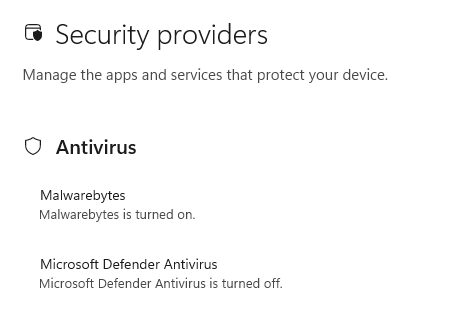
Based on the best public reporting available right now, ShieldBreak appears to require Microsoft Defender to be enabled in order to work. Public testing indicates that the exploit does not succeed when Defender is off or when another product is registered as the active antivirus provider.
So, narrowly speaking, disabling Defender appears to stop this specific ShieldBreak chain from working. However, that is not a good safety recommendation for most people. Turning off your antivirus removes an important layer of protection and could leave your computer exposed to other attacks.
For home users, all that means:
Install Microsoft’s security updates as soon as they become available.
Be very careful with downloads, email attachments, cracked software, and “fix” tools from random websites.
Keep backups of important files somewhere not directly connected to the PC.
Use an up-to-date, real-time anti-malware solution to alert you about and remove threats from your computer.
“One of the best cybersecurity suites on the planet.”
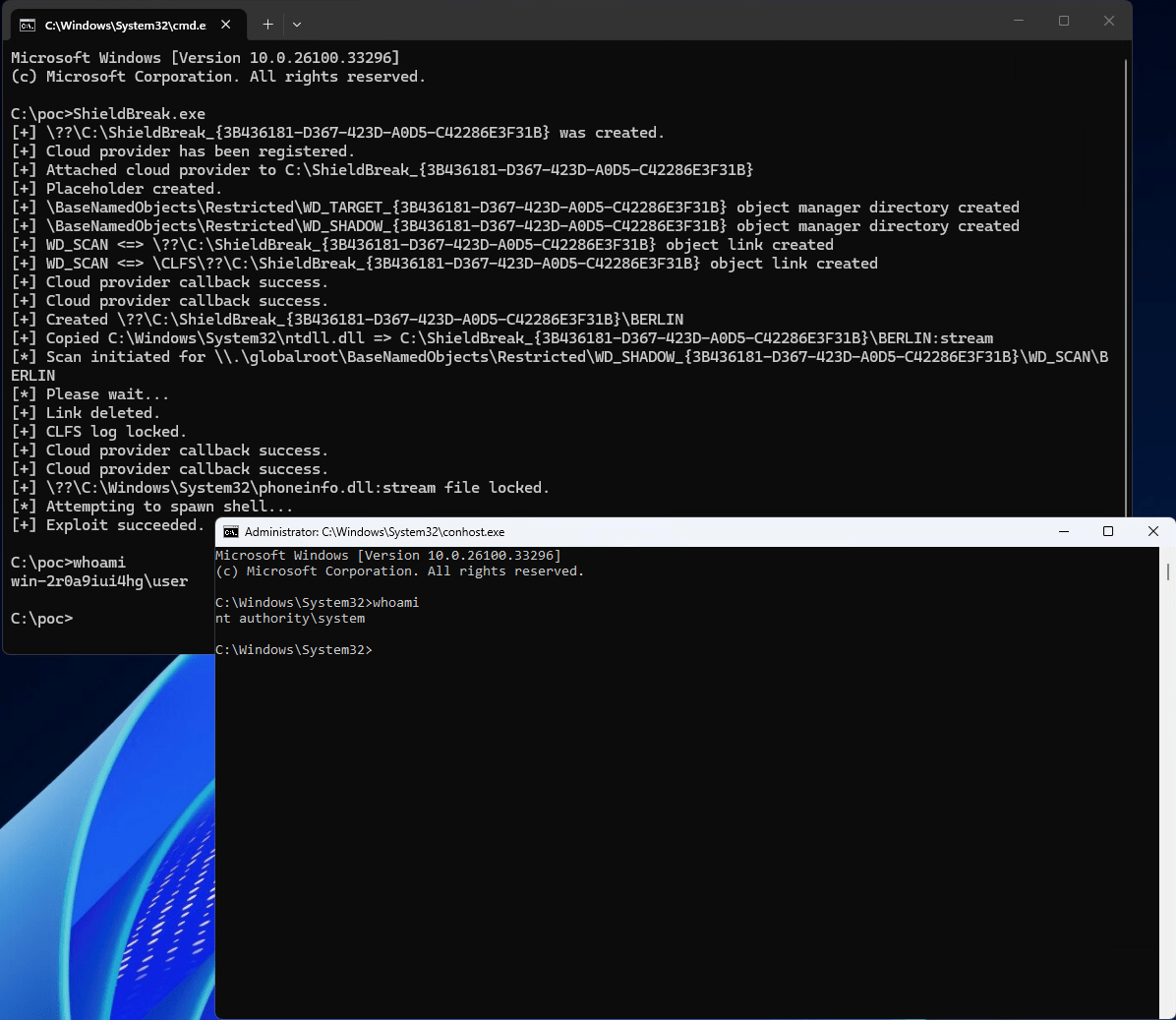
A public PoC named ShieldBreak bypasses Microsoft's CVE-2026-50656 patch, enabling Windows Defender privilege escalation to SYSTEM.
Related Posts:
Zero-Click File Drop Hits Xiaomi ShareMe: PoC Public
CVE-2026-65640: WordPress 7.0.4 Fixes Remote Code Execution
MariaDB Low-Privilege Remote Code Execution Chain: Full Details and PoC Exploit Code Publicly Disclosed
The post CVE-2026-50656 PoC Published: Defender Privilege Escalation Bypass appeared first on Daily CyberSecurity.
Chaotic Eclipse released a PoC for ShieldBreak, a Microsoft Defender zero-day that bypasses the CVE-2026-50656 patch and could enable SYSTEM-level code execution.
Security researcher Chaotic Eclipse, also known as INFINITE NIGHTMARE, MSNightmare and Nightmare-Eclipse, released a PoC for ShieldBreak, a Microsoft Defender zero-day. The flaw bypasses the patch for CVE-2026-50656 (RoguePlanet), a race condition that can allow attackers to spawn a SYSTEM-level shell. Successful exploitation could
Chaotic Eclipse released a PoC for ShieldBreak, a Microsoft Defender zero-day that bypasses the CVE-2026-50656 patch and could enable SYSTEM-level code execution.
Security researcher Chaotic Eclipse, also known as INFINITE NIGHTMARE, MSNightmare and Nightmare-Eclipse, released a PoC for ShieldBreak, a Microsoft Defender zero-day. The flaw bypasses the patch for CVE-2026-50656 (RoguePlanet), a race condition that can allow attackers to spawn a SYSTEM-level shell. Successful exploitation could enable arbitrary code execution and other unauthorized actions on affected Windows systems.
“Microsoft has failed to properly patch the RoguePlanet vulnerability CVE-2026-50656, this PoC demonstrates a full patch bypass.” said Chaotic Eclipse. “The PoC was tested in the latest version of windows 11 25h2 (+Canary channel) and windows server 2025, the PoC also have a 100% success rate. Please note that Windows 10 (and respective server editions) are not currently supported, they are however vulnerable to ShieldBreak as well.”
In early July, Microsoft released security updates for RoguePlanet, a vulnerability tracked as CVE-2026-50656 (CVSS score of 7.8) affecting the Malware Protection Engine used by Defender. The Microsoft Malware Protection Engine (mpengine.dll) powers Defender’s malware scanning, detection, and removal functions.
The flaw is a local privilege escalation issue that could allow an attacker with access to a system to obtain higher privileges and potentially compromise security controls.
In mid-June, Microsoft acknowledged the RoguePlanet zero-day affecting Microsoft Defender and stated it is aware of the issue and was actively developing a security update to address the flaw and protect affected systems.
A week before, the security researcher Chaotic Eclipse published a new proof-of-concept exploit for a RoguePlanet. The flaw relies on a race condition that can provide attackers with SYSTEM-level privileges, allowing them to execute code with the highest permissions. The exploit was successfully tested on fully updated Windows 10 and Windows 11 systems running the June 2026 Patch Tuesday updates, showing that patched systems may still be vulnerable.
Now Chaotic Eclipse claims ShieldBreak fully bypasses Microsoft’s CVE-2026-50656 patch, while Defender may also leak 8 bytes of data under certain conditions.
The researcher tested the PoC on Windows 11 25H2 and Windows Server 2025 with a 100% success rate. Windows 10 is also vulnerable, though not currently supported by the PoC.
In May, the researcher disclosed two other Windows zero-day vulnerabilities named YellowKey and GreenPlasma. The flaws affect BitLocker and the Windows Collaborative Translation Framework (CTFMON). YellowKey could allow attackers to bypass BitLocker protections, while GreenPlasma enables privilege escalation. The researcher previously disclosed three Microsoft Defender vulnerabilities.
The researcher criticized Microsoft for revoking access to their MSRC account, rejecting reports, and failing to provide compensation.
At the end of May, Microsoft’s Security Response Center called the zero-day dumps irresponsible.
“In recent weeks several zero-day vulnerabilities have been publicly disclosed.” reads the report published by Microsoft. “The details of these vulnerabilities were not shared with Microsoft prior to release, and the disclosures put our customers at unnecessary risk.”
The company said its security teams have been working around the clock since the disclosures to understand the impact, build patches, and protect customers from attackers who picked up the published exploit code and ran with it.
Microsoft’s post is essentially a public defense of Coordinated Vulnerability Disclosure, the standard practice where a researcher notifies a vendor privately, gives them time to fix the issue, and then goes public. Microsoft says it works with hundreds of researchers this way every year, compensating them through bug bounty programs and crediting them publicly.
“This partnership allows us to make updates to impacted services before proof-of-concept code can make it into the hands of bad actors.” continues the report. “The vulnerabilities known as RedSun, UnDefend, BlueHammer, YellowKey, GreenPlasma, and MiniPlasma were not responsibly disclosed.”
The implication is clear: when someone skips that step, real people get attacked with real tools built from the published research.
In July, just hours after Microsoft’s July 2026 Patch Tuesday, Chaotic Eclipse, published a new Windows zero-day proof-of-concept called LegacyHive. This time, the target is the Windows User Profile Service (ProfSvc), and unlike the hundreds of vulnerabilities Microsoft fixed this month, this one currently has no CVE, no advisory, and no security update.
LegacyHive is a local privilege escalation vulnerability. An attacker who already has code execution as a standard user can abuse the User Profile Service to load another user’s registry hive, potentially that of a local administrator, under their own profile.
At the end of May, Microsoft’s Security Response Center called the zero-day dumps irresponsible.
“In recent weeks several zero-day vulnerabilities have been publicly disclosed.” reads the report published by Microsoft. “The details of these vulnerabilities were not shared with Microsoft prior to release, and the disclosures put our customers at unnecessary risk.”
The company said its security teams have been working around the clock since the disclosures to understand the impact, build patches, and protect customers from attackers who picked up the published exploit code and ran with it.
Microsoft’s post is essentially a public defense of Coordinated Vulnerability Disclosure, the standard practice where a researcher notifies a vendor privately, gives them time to fix the issue, and then goes public. Microsoft says it works with hundreds of researchers this way every year, compensating them through bug bounty programs and crediting them publicly.
“This partnership allows us to make updates to impacted services before proof-of-concept code can make it into the hands of bad actors.” continues the report. “The vulnerabilities known as RedSun, UnDefend, BlueHammer, YellowKey, GreenPlasma, and MiniPlasma were not responsibly disclosed.”
The implication is clear: when someone skips that step, real people get attacked with real tools built from the published research.

 Entrar