Morphisec exposes a LuaJIT XLoader infostealer campaign. Learn how the XLoader infostealer abuses JScript and shared-section injection.
Related Posts:
BITTER PapRAT Malware Targets South Asian Organizations
Apple Mercenary Spyware Threat Prompts Global Alerts
Hugging Face Malware Campaign Infects AI GPU Servers
The post LuaJIT XLoader Infostealer Spreads via Fake Orders appeared first on Daily CyberSecurity.
VOLTA is an AI-powered infostealer that steals personal data, then uses LLMs to assess victims’ value and rank targets for attackers.
Cisco Talos has analyzed a new Windows infostealer called VOLTA, which calls itself VOLTA-AUTODOXER. It steals the usual data, then hands the loot to a large language model that ranks what the victim is worth. Ryan Fetterman laid it out in a Talos report, after the malware turned up through the CAIRN research effort.
“There is a new idea in the cybercrime w
VOLTA is an AI-powered infostealer that steals personal data, then uses LLMs to assess victims’ value and rank targets for attackers.
Cisco Talos has analyzed a new Windows infostealer called VOLTA, which calls itself VOLTA-AUTODOXER. It steals the usual data, then hands the loot to a large language model that ranks what the victim is worth. Ryan Fetterman laid it out in a Talos report, after the malware turned up through the CAIRN research effort.
“There is a new idea in the cybercrime world — cast a wide net, steal everything, and let AI sort out the specifics. A new malware self-named “VOLTA-AUTODOXER,” surfaced through the CAIRN research effort, is a self-deleting Windows infostealer that augments its post-theft workflow with an LLM-powered victim-profiling stage.” reads the report published by Talos.
The malware deletes itself after running and does not use servers controlled by the attacker. Instead, it uses third-party systems to carry out its activities.
The malicious code supports data-stealing features are advanced. It collects browser passwords, cookies and saved payment card details from Chromium browsers, as well as data from Firefox, Thunderbird and Outlook. It also steals Slack workspace information and login sessions from Discord, Telegram, Steam, Battle.net and Roblox.
The malware also collects Microsoft OAuth tokens, SSH keys, cloud service credentials, screenshots and all saved Wi-Fi passwords. For crypto wallets, it tries to crack the wallet password directly on the infected device and saves the results in its report. To steal some browser tokens, it must bypass Chrome’s App-Bound Encryption.
But VOLTA goes further. It also builds a detailed profile of the victim. This includes their location and home address, employer and company domain, estimated year of birth, the last four digits of payment cards, Slack workspaces and information about who created documents. It also looks for signs of iPhone backups and checks the current value of the victim’s Roblox account.
“After harvesting the standard stealer haul, including browser passwords; cookies; payment cards; cryptocurrency wallet seed phrases; Discord, Telegram, Steam, and Roblox sessions; Microsoft OAuth tokens; SSH and cloud-provider keys; Wi-Fi profiles; and screenshots, VOLTA builds a structured evidence bundle about the person behind the machine.” states the report.
It uses the victim’s own logged-in sessions to fill the gaps. It searches Gmail for receipts from Amazon, DoorDash, Uber Eats, Grubhub, Walmart and PayPal to confirm a home address, pulls order histories from Uber Eats and DoorDash, and adds detail to the victim’s Discord profile. Even a takeout history can now count as evidence.
The bundle goes to OpenRouter, a routing service for AI models, with a system prompt that tells the model to act as a forensic intelligence analyst drafting a target assessment.
“The required output includes a section titled “WHAT THEY’RE WORTH” with valuables ranked by monetization with a low/medium/high tier, and a section on “THEIR OPSEC” containing an assessment of the victim’s security posture and password hygiene.” states the report. “The model is the operator’s triage analyst; it turns a raw credential log into a prioritized and citation-backed dossier of the victim and their monetizable assets.”
It also needs a section called “THEIR OPSEC”, rating the victim’s security habits and password hygiene. In short, it’s a performance review for the person it just robbed.
The prompt asks for something agents do well: connecting scattered facts. It pushes the model to link names, addresses or universities to patterns in the victim’s passwords. The model isn’t hunting for new data, only stretching what the malware already took. The operator wants a short, blunt assessment with a trail of citations.
By default VOLTA calls Anthropic’s Claude Opus 4.6. If the model refuses, which VOLTA spots by scanning replies for phrases like “I can’t” or “I’m not able”, it moves on to Moonshot AI’s Kimi K2 and then Google’s Gemini 2.5 Flash. A low temperature setting of 0.2 keeps the output consistent.
The requests are hand-built JSON with no software kit, and the malware still runs without the AI stage if no API key is present.
Talos sees the fallback system as evidence that the malware’s author expected security protections and designed ways to bypass them.
The AI analysis runs directly on the victim’s computer, using their own internet connection, before any data is sent out. The malware creates a file called Identity_Report.txt, receives the AI’s response in AI_Analysis.txt, and sends both files together in a ZIP archive called volta_dox.zip.
The stolen data can be sent to the attacker in up to three stages. The first archive, volta_log.zip, contains the information collected by the malware. The second, volta_dox.zip, contains the AI analysis. A third archive, volta_doxnet.zip, is created if the malware finds additional network information. The attacker receives everything through a Telegram channel.
The malware also has six configurable fields that can be changed when it is built. This suggests that its author may offer a builder service, allowing customers to create their own customised versions.
The credentials stored in these fields are encrypted, but the encryption is weak because the key is stored inside the malware itself. Anyone who analyses the file can recover them.
If VOLTA is sold as a commercial product, its AI feature could allow even inexperienced criminals to identify valuable victims and receive detailed, ranked profiles directly through Telegram.
For defense, Talos suggests an application control policy that restricts which processes can launch Chrome with the –headless flag, which would block the App-Bound Encryption bypass. At minimum, alert when Chrome starts with –headless from any process outside a known developer set. Storing credentials in hardware-backed stores also helps.
If you’re compromised, the main program may have deleted itself, but try to keep %APPDATA%\volta_debug.txt. It’s a timestamped log of what was collected and whether the AI call worked. Revoke any exposed tokens and change passwords. If a wallet’s seed phrase sat in plaintext on disk, treat the wallet as fully compromised and move the funds to a new wallet whose seed was generated on an air-gapped device.
“VOLTA is a mature stealer with a late-stage AI layer added for one purpose: relieving the operator of analytical work. The axis of AI improvement here is not speed or scale but effort displacement; the same logic visible in CLOSEDQUORUM, though applied to a different phase.” concludes the post. “These implants reflect the same underlying logic: Identify the step that requires the most sustained human attention and replace it with a model call. The question for defenders is not whether this pattern will appear elsewhere, but which phase it touches next.”
Cisco Talos uncovers the NIK C2 framework. This Windows NIK C2 framework abuses OpenAI APIs to analyze stolen victim data and deploy screen lockers.
Related Posts:
Rust Doorway Botnet Exploits Routers, Cameras, and Servers
Synology NAS Ransomware Targets Unpatched Devices
Malicious Claude Code Extension Injects SSH Backdoor in Cursor Marketplace
The post NIK C2 Framework Integrates OpenAI API to Analyze Stolen Data in Live Attacks appeared first on Daily CyberSecurity.
VOLTA is a mature stealer implant with an optional AI-integration layer. After stealing credentials, sessions, and cryptocurrency wallets, VOLTA sends a structured evidence bundle to an LLM to rank the victim’s assets by monetization value.If a model refuses to perform the target assessment, VOLTA fails over to a three-model chain, implying a direct engineering effort and expectation of hitting model guardrails. This stealer is self-deleting, and there is no attacker-owned infrastructure. The no
VOLTA is a mature stealer implant with an optional AI-integration layer. After stealing credentials, sessions, and cryptocurrency wallets, VOLTA sends a structured evidence bundle to an LLM to rank the victim’s assets by monetization value.
If a model refuses to perform the target assessment, VOLTA fails over to a three-model chain, implying a direct engineering effort and expectation of hitting model guardrails.
This stealer is self-deleting, and there is no attacker-owned infrastructure. The novelty in the AI-integration is that it is not supporting a traditional malware capability but working as an intelligence analyst on behalf of the operator.
There is a new idea in the cybercrime world — cast a wide net, steal everything, and let AI sort out the specifics. A new malware self-named “VOLTA-AUTODOXER,” surfaced through the CAIRN research effort, is a self-deleting Windows infostealer that augments its post-theft workflow with an LLM-powered victim-profiling stage.
After harvesting the standard stealer haul, including browser passwords; cookies; payment cards; cryptocurrency wallet seed phrases; Discord, Telegram, Steam, and Roblox sessions; Microsoft OAuth tokens; SSH and cloud-provider keys; Wi-Fi profiles; and screenshots, VOLTA builds a structured evidence bundle about the person behind the machine. This bundle contains geolocation and home address, employer and employer domain, inferred birth year, card last-4 digits, Slack workspaces, document authorship metadata, iPhone backup indicators, and a live Roblox account valuation. It then uses stolen session access to enrich that bundle further: searching the victim's Gmail for purchase receipts to corroborate a home address, pulling UberEats and DoorDash order history, and enriching Discord accounts via the stolen token.
The bundle is serialized and POSTed to OpenRouter under a system prompt that instructs the model to act as "a forensic intelligence analyst drafting a target assessment." The required output includes a section titled “WHAT THEY'RE WORTH” with valuables ranked by monetization with a low/medium/high tier, and a section on “THEIR OPSEC” containing an assessment of the victim's security posture and password hygiene. The model is the operator's triage analyst; it turns a raw credential log into a prioritized and citation-backed dossier of the victim and their monetizable assets.
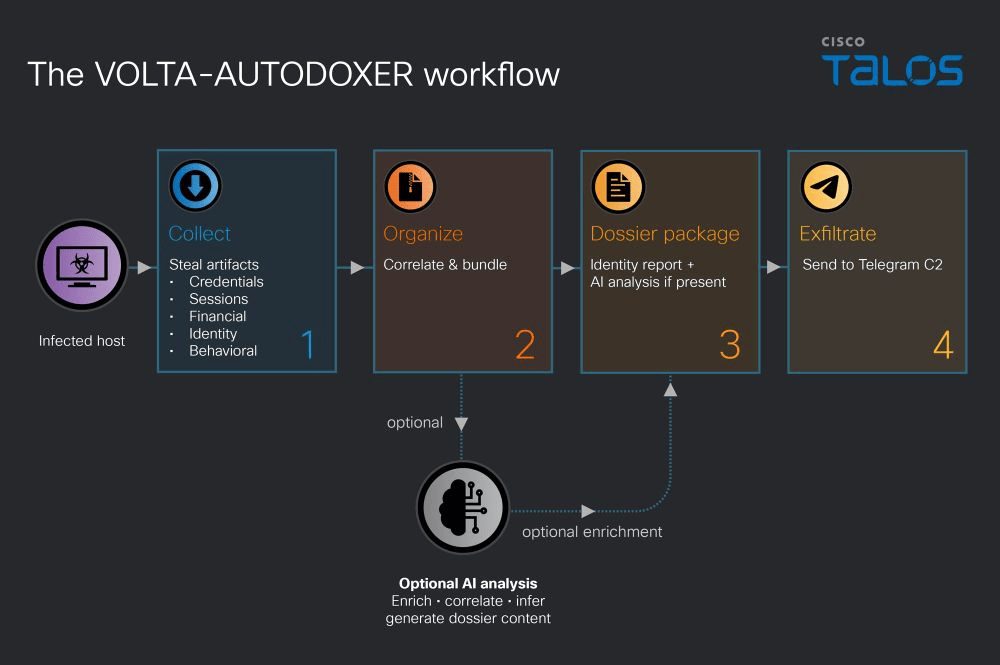
Figure 1. The VOLTA-AUTODOXER workflow.
The AI configuration: “Go deep, not wide... Be blunt, specific, accurate.”
VOLTA uses a multi-model architecture to fall back resiliently if it hits a model’s refusal, checking each response for phrases like “I can’t” or “I’m not able,” before passing on to a chain of up to three models.
Endpoint
https[:]//openrouter[.]ai/api/v1/chat/completions
Default model
anthropic/claude-opus-4.6
Fallback chain
moonshotai/kimi-k2 → google/gemini-2.5-flash
Temperature
0.2 — deterministic, consistent output
Request format
Hand-assembled JSON; no SDK; User-Agent Mozilla/5.0
Figure 2. Hardcoded model selection.Figure 3. Failover model selection to kimi-k2, and then gemini-2.5-flash.
Model temperate controls the randomness and predictability of LLM-generated text. The low hardcoded temperature value (0.2) suggests the attacker is emphasizing accuracy and consistency. The malware also employs a chain of cascading models in the event of failures. This multi-model architecture suggests that the operator is anticipating encountering refusals, with the fallback pivoting to a few, smaller, and more permissive models.
The system prompt directly reveals the operator’s use case: Produce a concise analytical assessment of the victim’s suitability as a target, backed by an auditable trail of citations.
Figure 4. VOLTA's raw system prompt.
The prompt also asks for something out of the ordinary, but that agents excel at: making connections between sparse and disparate data. For example, encouraging connections like the victim’s names, addresses, or universities to patterns in their passwords. In this case, the model isn't being asked to find data; rather, it’s being asked to stretch the data and make useful inferences that extend the value of what has been scraped.
Stealer capabilities
VOLTA’s capabilities are directly aligned with the records produced in modern digital life, and well beyond basic credential theft. In a single pass, the stealer can extract browser credentials, cookies, and saved payment cards across Chromium-based browsers. It hits Firefox and Thunderbird, Outlook profiles, Slack workspaces, Steam and Battle.net sessions, Discord tokens, Telegram sessions, Roblox accounts, and SSH and cloud-provider config files (gcloud, OpenVPN, Hide.me). VOLTA doesn’t just copy cryptocurrency wallets, but runs an embedded cracker against the vault inline, writing the result to a WALLET VAULTS CRACKED line in its own report.
Every saved Wi-Fi password on the machine is pulled via a direct call to WlanGetProfileList and dumped to plaintext.
Figure 5. VOLTA dumps plaintext passwords for every saved Wi-Fi network on the host.Figure 6. The organized collection targets.
What really sets VOLTA apart from commodity stealers is what comes after the initial collection. There is a live enrichment pass that leverages stolen sessions to deep dive the victim’s data. For example, using the victim's own authenticated Gmail tokens, it queries their inbox for receipts from Amazon, DoorDash, Uber Eats, Grubhub, Walmart, and PayPal, then review those receipts to establish a confirmed home address. Stolen Uber Eats and DoorDash sessions are called directly for order history. The Discord token is re-used to enrich the victim's account profile. Roblox inventory is valued via a live “Rolimons[.]com” lookup.
Figure 7. That’s right: Your Uber Eats history is now a potential liability.
After the collection and enrichment stages are complete, the data is assembled and structured locally in a file called “Identity_Report.txt”. This file is serialized into a bundle as JSON and POSTed to OpenRouter along with the system prompt. The returned payload is received as “AI_Analysis.txt”. Both files exfil together in “volta_dox.zip”.
Figure 8. VOLTA’s exfil can happen in three stages: 1) after the stealer runs (“volta_log.zip”), 2) after the AI call (“volta_dox.zip”), (3) if the network enrichment produces anything (“volta_doxnet.zip”).
The inference round-trip happens entirely through the victim's own network connection, on their own machine, before the result is exfiltrated.
Deployment model
Instead of hardcoding its Telegram channel, API keys, and settings directly into the code (which is likely what someone writing a tool for personal use would do) VOLTA uses a template with six swappable slots, filled in at build time.
This suggests it’s a builder model: The author sells access, the customer provides their values, and the builder compiles a custom binary for each order. The credentials in those slots are encrypted, but not in a meaningful way. The key is SHA-256 of two constants sitting in the same binary, but it's presumably there because customers expect their API keys not to be sitting in plaintext, not because it provides real protection. Anyone who reverses the file can recover them.
If VOLTA is indeed a commoditized malware, then the AI dossier capability isn't something the author invented for their own operations. It is a feature which enables a customer of any level of sophistication to point it at victims and start receiving ranked target assessments in their Telegram inbox.
All the observed endpoints for this malware are third-party controlled. There is no actor-owned infrastructure.
Countermeasures
Much of the token-stealing capability of VOLTA relies on techniques to bypass App-Bound Encryption (ABE) in Chrome. An application control policy that restricts which processes may launch Chrome with --headless would block the ABE decryption path entirely. At minimum, you can also alert when Chrome is launched with --headless from any process not in a known developer. Best practices for storing credentials in hardware backed stores also apply.
In the event of compromise, the main executable may have deleted itself, but users should attempt to preserve the “APPDATA%\volta_debug.txt” file. This is a timestamped harvest log and contains a record of exactly what was collected and whether the LLM call succeeded. Revoke any potentially compromised tokens and change passwords. For cryptocurrency wallets, if the seed phrase was in plaintext on disk, treat the wallet as fully compromised and migrate funds to a new wallet with a seed generated on an air-gapped device.
Conclusions
VOLTA is a mature stealer with a late-stage AI layer added for one purpose: relieving the operator of analytical work. The axis of AI improvement here is not speed or scale but effort displacement; the same logic visible in CLOSEDQUORUM, though applied to a different phase. These implants reflect the same underlying logic: Identify the step that requires the most sustained human attention and replace it with a model call. The question for defenders is not whether this pattern will appear elsewhere, but which phase it touches next.
Figure 9. End-to-end VOLTA workflow.
The second trend to watch is the anticipation of hitting model refusals, and the approaches to building in resiliency. In this case, it includes a fallback chain from Claude to Kimi to Gemini and the ability to run without the LLM stage altogether if no key is present. As AI integration in malware matures, refusal resilience may become a standard design requirement.
The open question underlying both trends is whether effort displacement in crimeware changes the landscape in a meaningful way: lowering the operational floor, raising the ceiling on scale, or both. Cybercrime operations have always been opportunistic, and the sophistication bar has always been lower than assumed, but there is a difference between a wide net and a wide net that sorts itself.
Socket uncovers malicious Firefox extensions spoofing Phantom, Jupiter, and Bitget. These malicious Firefox wallet extensions steal seed phrases.
Related Posts:
Yoba Malware Campaign Sideloads Payloads Through Signed OpenAI and Anthropic Binaries
Fake FedEx Tax Invoice PDFs Deliver Fileless Sirius Backdoor to Windows Systems
Brazilian Magecart Group Hits Convertr Ecommerce Platform in Plausible Analytics Supply Chain Attack
The post Fake Phantom, Jupiter, and Bitget Firefox Extensions Steal C
Gen Digital exposes a Claude malware campaign on claude.ai. This fake Download Claude malware campaign uses Google Ads and ClickFix to drop AMOS.
Related Posts:
Brazilian Magecart Group Hits Convertr Ecommerce Platform in Plausible Analytics Supply Chain Attack
SiriusQT RAT Combines Hidden Desktop Control With Credential and Wallet Theft
Fake Chocolatey and Massgrave Sites Deliver Python Armorsteal Malware via SEO Poisoning
The post Attackers Abuse Claude Sharing Features and Google Ads to De
Content This Infostealer Trend Report summarizes the distribution channels, number of malware samples, number of detections, and information on companies targeted by new Infostealers (malware designed to steal information) collected during the month of September 2026. The data was compiled based on detection logs from AhnLab SEcurity intelligence Center (ASEC) and AhnLab products, and includes […]
Content This Infostealer Trend Report summarizes the distribution channels, number of malware samples, number of detections, and information on companies targeted by new Infostealers (malware designed to steal information) collected during the month of September 2026. The data was compiled based on detection logs from AhnLab SEcurity intelligence Center (ASEC) and AhnLab products, and includes […]
Executive Summary
In May, Cyble Research & Intelligence Labs (CRIL) documented JOMANGY, a PHP webshell generation deployed by INJ3CTOR3 with self-healing persistence channels and a built-in toll-fraud dialer.
Back then, the fraud ran through the victim's own PBX, so removing the implant would have stopped it. Artifacts we collected from the operator's C2 staging servers during mid-September 2026 show that this is no longer true: the installer now sends credentials off the box on ev
In May, Cyble Research & Intelligence Labs (CRIL) documented JOMANGY, a PHP webshell generation deployed by INJ3CTOR3 with self-healing persistence channels and a built-in toll-fraud dialer.
Back then, the fraud ran through the victim's own PBX, so removing the implant would have stopped it. Artifacts we collected from the operator's C2 staging servers during mid-September 2026 show that this is no longer true: the installer now sends credentials off the box on every run, and a second staging host serves it.
INJ3CTOR3's FreePBX implant now uploads the victim's SIP trunk, AMI, database, and mail-relay credentials to the operator, so disinfecting or rebuilding an infected host no longer ends the exposure. Anyone running FreePBX, Issabel, or Elastix who suspects compromise must rotate the secrets in 17 configuration files, and only after the host is clean.
The infection and persistence code is nearly unchanged; what the operator rotated are the identifiers that were available to defenders since the last time. Each section below pairs a finding with what to do about it.
Key Takeaways
Credentials leave on every run. k.php uploads 17 configuration files to both staging hosts every minute the host stays infected.
The fraud no longer needs your PBX. A stolen trunk secret lets the operator register and place calls as you from anywhere.
Last report's identifiers have expired. Each build now carries its own watermark, and the webshell gate hash was rotated.
Two staging hosts. Plain-text commands now point to 160[.]119[.]69[.]4, while base64-encoded ones still use 45[.]95[.]147[.]178.
Clean-looking logs and consoles prove nothing. Requests through an encoded space reach the shell without being named in the access log, and trunks are written directly to /etc/asterisk; they do not appear in the FreePBX console.
The Campaign So Far
INJ3CTOR3 has been abusing Asterisk-based phone systems for toll fraud since at least 2020. Check Point Research named the operation that November, when it exploited CVE-2019-19006 in FreePBX and used a basic webshell to read amportal.conf and sip_additional.conf by hand. Unit 42 reported a related operation against Elastix in 2022, Fortinet documented the EncystPHP webshell in January 2026, and our May report covered JOMANGY.
The playbook has held for six years: scan for exposed PBXs, exploit or brute-force a way in, plant a password-gated webshell, and dial out at the victim's expense. Figure 1 below shows the chain as it stands in the September build, now including the credential upload back to the staging hosts.
Figure 1: INJ3CTOR3 attack chain, September generation. (Source: 0x1da5 GitHub)
What Changed Since Our Last Report
We compared the April artifacts behind our May report with the 9 September collection from both staging hosts, after decoding every layer.
Unchanged: the decoded webshell panel, the encoding chain (base64 in the shell script, base64 again in PHP, then ROT13), the persistence channels, the backdoor account password hash, and the borrowed timestamp. Behavioral detections built on our May report still apply.
Credential Exfiltration: The Implant Is No Longer the Product
The September k.php ends with two new base64-encoded lines, each holding 17 curl commands that upload one configuration file apiece to /hima_data/index.php, one line per staging host (See Figure 2 below). The paths are typed out by hand and cover FreePBX, Issabel, and Elastix layouts. The collector path echoes hima, a backdoor account the takeover script creates. The name goes back further: Check Point's 2020 INJ3CTOR3 report shows a Telegram post by a user called Hima sharing a tool that scans and cracks SIP ranges, saving its output as HimaResults.
Figure 2: k.php line 34, decoded into 17 file uploads
Three of the cron beacons fetch and run k.php every minute (the others every two or three minutes), so the upload repeats every minute during the infection. Rotating credentials on a still-infected host hands the new secrets to the operator within minutes.
The database password (AMPDBPASS), the MySQL root password, and any AMI password stored there
Outbound mail
/etc/postfix/sasl_passwd
The SMTP relay account, with your mail provider
This opens a second route to fraud. Our May report covered calls placed through the webshell, which require the shell to be alive and to land in the victim's own call records. With a stolen trunk secret, the operator can register to the carrier from any machine and call as the victim, leaving nothing on the host, unless the carrier also restricts the trunk to the victim's IP addresses. A successful disinfection stops the first route; only rotation stops the second.
Detection
Network: outbound HTTP POSTs from a PBX to any /hima_data/ path or to either staging host. A PBX seldom needs outbound web access beyond vendor updates, so egress allow-listing closes this channel.
Carrier: alert on trunk registrations from outside your own IP ranges, and on premium or international destinations, off-hours calling, and unusual concurrency. Set spend caps and destination blocks where your carrier offers them.
For Law Enforcement Agencies and CERTs
By design, victims' credentials were collected on the two staging hosts, which stopped responding in late September 2026. Going offline does not end exposure: hosting providers may still retain server data, and infected PBXs keep trying to upload their credentials every minute to addresses that could be reassigned to someone else.
Both are reasons for law enforcement and national CERTs, which have the legal standing that researchers lack, to work with the providers on preserving that data and sinkholing the addresses, which would also identify victims for notification. We saw the uploads in code; we did not capture one in transit and hold no victim list.
Two Staging Hosts, Split by Encoding
An infected host now talks to both staging hosts, and which one depends on whether the command was written in plain text or base64. The /x takeover script is byte-identical on both.
Reference
Encoding
Points to
k.php line 2 (re-runs /x), eight cron schedules in /x, wr.php's callback
Plain text
160[.]119[.]69[.]4
Camouflaged cron payloads, login-triggered stager
Base64
45[.]95[.]147[.]178
Credential upload
Base64
Both
In April, all of these pointed to 45[.]95[.]147[.]178. We assess that the operator replaced the address in plain text and never re-encoded the base64 strings; the credential upload, which names both hosts, appears deliberate. This host is distinct from the scanner 160[.]119[.]76[.]250, which is named in our May report.
Defend: block both hosts in both directions, and decode every base64-encoded string in a crontab or shell profile before deciding which hosts a host talks to. A plain-text review would miss every channel that still reaches 45[.]95[.]147[.]178.
The Webshell: Same Program, New Identifiers
Decoded, the September JOMANGY panel is identical to April's except for the values defenders were told to look for.
Per-build watermark. Our May report advised hunting for trace_e1ebf9066a951be519a24140711839ea, present in every April copy. The September builds carry trace_bd42a8a0d23ae16c85dede7d2abaec05 (45[.]95[.]147[.]178) and trace_7544725ebaaadac217dfaa7ca8e8fe7e (160[.]119[.]69[.]4), so that hunt now misses current infections.
One gate for two generations. JOMANGY and ZenharR share a single hardcoded MD5 gate hash, rotated together from a2f6863413c4192a4abfa360577b9961 to 8b3a1d970fda0c17a0b785a990fb7b6a. Our May report listed the April value under ZenharR only.
A forged administrator session. Behind the gate, the FreePBX button builds an admin session using FreePBX's own ampuser class and setAdmin(); in our lab, it opened the full console without any password. Therefore, changing the FreePBX admin password affects neither the gate nor this session. (See Figure 3 below)
Figure 3: The panel's Freepbx and Elastix buttons forge an admin session without a password
Because each of these identifiers changes between builds, the detection approach later in this report focuses on who put a file on disk rather than on what the file contains.
The .htaccess Door and the Access-Log Gap
k.php writes a seven-line .htaccess to /var/www/html/admin/views/. It does not hide the webshell; it unblocks it, and it lets requests reach a copy without naming it.
Simulating an operator and a victim in an isolated environment, we confirmed that a request to a URL containing an encoded space returned a working webshell for the attacker. The access log records only the requested path, never the file that answered, so searching logs for the webshell byits filename can return nothing on a host that is serving it.
Defend: check every .htaccess across the web root for who put it there; one that no package, FreePBX module, or member of your team accounts for is suspect, whatever it contains. Because the takeover script wipes logs, treat log hunting as secondary: requests with %20, %09, or %0A directly after a slash that return 200 are worth a look where logs survive.
What the FreePBX Console Won't Show You
FreePBX lists the trunks it created from its own database; Asterisk reads whatever is in its configuration files. In our lab, a trunk we wrote directly into /etc/asterisk/pjsip_custom.conf carried a call while the FreePBX Trunks page reported no records (See Figure 4 below). We did not see the campaign plant one, but its root-equivalent accounts and stolen trunk secrets give the operator everything needed to do so.
Figure 4: Our lab trunk, known to Asterisk and carrying calls, invisible in the FreePBX console
Defend: audit from the Asterisk CLI (pjsip show endpoints, pjsip show registrations, sip show peers, sip show registry) and compare with what the console lists. Review the *_custom.conf files for trunks or contexts that nobody on your team added.
What Keeps It There
Before detecting or cleaning, it helps to see the whole apparatus. Everything in Figure 5 is read from /x and k.php: ways the implant stays on the box, and doors allowing the operator to come back, through a system account or a single web request. Each piece can rebuild/repair all others under a minute, which is why removing any one of them on its own fails. (See Figure 5 below)
Figure 5: Persistence channels that rebuild each other, and the backdoors they stay open
Detecting It Without IOCs
The operator rotates hashes, watermarks, gate values, and hosts between builds, so asking whether a file is known-bad quickly stops working. The better question is who put the file there: compare what is on disk with what the package manager or a clean install says it should be.
On the host: triage with beagle.sh
PBX admins can run beagle.sh, a report-only script that makes no changes to the host, to check a PBX server for signs of compromise. (See Figure 6 below)
Check
What it flags
Packed shells
Several identical, same-size PHP files across unrelated directories
Locked files
chattr +i or +a under the web root or in hidden directories
Unowned .htaccess
An .htaccess no installed package accounts for
Self-rebuilding cron
A cron line that downloads a file and hands it to a shell
Accounts
An extra UID-0 account, or a full-permission FreePBX admin, nobody created
Blocklist
Addresses dropped in and out by iptables outside fail2ban's chains
Figure 6: beagle.sh (Source: 0x1da5 GitHub)
The script separated one infected server from one clean server of the same FreePBX version, a sample of one, so expect some legitimate findings. However, it cannot tell you whether the credentials have already been left: that happens during the first cron run, within a minute of infection, and long before anyone scans. The upload leaves no file behind, and the takeover script wipes what might have recorded it: the web server, Asterisk, cron and audit logs, plus shell and MySQL histories, which makes forensic timelines hard to reconstruct.
With telemetry
The most distinctive actions leave little on disk; in our detonation, backdoor accounts were created and deleted 27 seconds apart. These eleven behaviors are detection strategies to build into your own tooling:
Layer
Behavior
What it catches
Host
crond spawns a shell that downloads a file and runs it
The takeover script on its single run, before persistence and before credentials leave
Host
The web server account spawns a shell
The webshell's command box in use
Host
A cron child rewrites the crontab every minute without reading it first
Beacon reinstallation
Host
chattr +i or touch -r on a file in the web root
The lock and the borrowed timestamp
Host
Twelve PHP files were written to the web root in the same second
The webshell copies, as they are written; fan-out
Network
The PBX contacts staging host roughly every 60 seconds
The beacon's rhythm, whatever the address
Network
Many configuration files read, then outbound POST requests
Credentials leaving
Web
A request with leading encoded whitespace returns 200 for a path not on disk
The .htaccess door
Decoy
Any read of a decoy config file that the implant reads, but nothing legitimate does
Credential collection, with no false positives by design
Phone
Channels originate over AMI or the CLI outside your dial plan
A call asking for nothing legitimate
Phone
CDRs with premium destinations, off-hours calling and unusual concurrency
The fraud itself
The last two catch the fraud rather than the machinery, whatever the files are called, and whether you ever find the shell. The host rows need process telemetry that PBX appliances rarely have, which is part of why so many stay infected.
Why Cleanup Fails, and the Order That Works
First move
Why it fails on its own
Delete the webshell
Cron re-runs k.php within minutes and rewrites all 12 copies, the .htaccess, and the immutable flags.
Patch FreePBX
Sangoma's advisory for CVE-2025-57819 states the fix prevents new exploitation but does not clean a compromised system.
Change the admin password
The gate and the forged session never use it, and the backdoor accounts bypass the FreePBX login.
Shadowserver data showed more than 900 compromised FreePBX instances in February 2026; over 700 of them were still compromised in May. Rebuilding from a clean image is the most reliable fix; if you clean in place, work from the system layer up, because it replants everything above it.
Preserve first
The takeover script truncates logs, then deletes them, and clears shell and database history, so evidence shrinks with every run:
Cut the host off from the internet, or at least block all outbound traffic except to your SIP carrier. Blocking only the two known staging hosts is not enough if the operator has moved. With no route out, the minute-by-minute downloads fail, and nothing more is uploaded. One local loop survives: a watchdog cron line re-runs the cached copy of k.php at /var/lib/asterisk/bin/zen2 every minute, rebuilding the webshells offline, which is why cron comes first in the cleanup below.
Capture all crontabs and the eight backups listed below, /etc/passwd, /etc/shadow, shell profiles, and the web root with lsattr output and change times.
Export the FreePBX ampusers table, the call records database, and the Asterisk full log, and ask your carrier to preserve CDRs and registration logs.
Then clean, in this order
Cron and its spares. Clear root's crontab in one go, so the restore and watchdog lines are removed. Then kill any running zen2, devnull2, or serv processes; killed earlier, the watchdog restarts them within a minute. Remove the k.php beacons (/var/lib/asterisk/bin/zen2, devnull2, zen222, devnull312, devnull212, /tmp/.cache/update, /dev/shm/.systemd/kernel). Unlock (chattr -i, -a) and delete the eight crontab backups: /usr/lib/.systemd/.cache, /usr/share/.fonts/.config, /var/lib/.dbus/.data, /var/tmp/.X11/.Xauthority, /opt/.local/.bashrc, /var/cache/.fontconfig/.cfg, /etc/.ssl/.cert, and /root/.config/.pref.
Login and boot triggers. Remove the base64 stager from /root/.bash_profile, /root/.bashrc, and /etc/rc.local.
Accounts and SSH. Remove every extra UID-0 account and any account whose /etc/shadow hash begins with $1$nRz1Cbtk$ (legitimate service accounts with that hash need new passwords, not deletion). Restore sshd_config, where root login was re-enabled.
Web application. Remove the 12 webshell copies, the .htaccess, the freepbxusers row in ampusers, and /var/www/html/admin/modules/freepbx_ha/license.php.
Credentials. Only now rotate the secrets in the 17 files and across every account on the host.
Conclusion
The hard part of the campaign used to be getting the implant off the box, and that has not changed. What has changed is that the box is no longer the whole problem: an organization that rebuilds but does not rotate has removed the operator's calling platform and handed over its carrier account.
The code ties this generation to the actor in our May report through the takeover script, backdoor hash, and staging host, and a gate rotated in step across JOMANGY and ZenharR.
The operator is now rotating exactly the strings defenders were given, so detections built on provenance and behavior will outlast this build, and detections built on its hashes will not. CRIL continues to monitor INJ3CTOR3's infrastructure.
Indicators of Compromise
Hashes and strings rotate between builds; use them to confirm a finding, not as your only detection.
Zscaler uncovers an SEO poisoning campaign using fake Chocolatey and Massgrave sites to drop Armorsteal malware and Python Armorsteal malware modules.
Related Posts:
SiriusQT RAT Combines Hidden Desktop Control With Credential and Wallet Theft
uCreator Android Spyware Hooks Telegram and WeChat Inside Virtual Containers
Amazon ClickFix Campaign Abuses Windows Finger Command to Drop Lumma Stealer and NetSupport
The post Fake Chocolatey and Massgrave Sites Deliver Python Armorsteal Malware via S
An Amazon ClickFix campaign uses a fake CAPTCHA and the old Windows finger command to drop Lumma Stealer and NetSupport. Stay protected.
Related Posts:
uCreator Android Spyware Hooks Telegram and WeChat Inside Virtual Containers
Skynet LLMjacking Agent Hijacks Exposed AI Models to Hack Servers and Mine Crypto
INC Ransomware Affiliates Expose Seven Servers Holding Phantom AI Framework and 46 Encryptors
The post Amazon ClickFix Campaign Abuses Windows Finger Command to Drop Lumma Stealer and Ne
Symantec reveals the Aoki infostealer. The Aokigahara Aoki infostealer steals API keys and session files from Claude, Codex, Cursor, and Gemini.
Related Posts:
333 Tor Exit Nodes Hijacked by Ebury Malware for SSH Attacks
CL-UNK-1211 Deploys SysGoRAT Malware and AI Scripts Against Government Linux Servers
Qilin, Inc and Settra Ransomware Gangs Exploit PAN-OS Flaw CVE-2026-0257 for VPN Access
The post Aoki Infostealer Harvests API Keys and Tokens From AI Coding Assistants appeared first on Dail
Executive Summary
Cyble has continued tracking GhostBat RAT activity targeting Android users in India since its initial identification in October 2025. Recent investigations into malicious mParivahan and eChallan-themed applications revealed a broader operator-controlled ecosystem that we track as GhostX.
Analysis of the exposed GhostX backend identified administrative and user-management structures, device-control records, SMS-delivery instructions, call-forwarding activity, and conti
Cyble has continued tracking GhostBat RAT activity targeting Android users in India since its initial identification in October 2025. Recent investigations into malicious mParivahan and eChallan-themed applications revealed a broader operator-controlled ecosystem that we track as GhostX.
Analysis of the exposed GhostX backend identified administrative and user-management structures, device-control records, SMS-delivery instructions, call-forwarding activity, and continuously changing phishing content, indicating active campaign management.
Impressions
The latest GhostBat RAT variant represents a significant evolution in both delivery and post-compromise capabilities. The malware now abuses the Android Accessibility Service to support Ghost Overlay and broader PIN/key-input capture targeting financial applications used across India.
Ghost Overlay transparently intercepts PIN keypad interactions in Google Pay and MobiKwik. It replays the same touches into the legitimate application, allowing the malware to capture PIN information without presenting a conventional phishing interface. The variant also targets 60 banking, UPI, wallet, fintech, and payment applications for broader PIN capture.
Modus Operandi
GhostBat RAT has diversified its loader architecture, with at least six observed delivery mechanisms, while the latest build uses libnetbridge.so and multiple cryptographic and custom container stages. Firebase Remote Config further enables operators to dynamically modify C&C infrastructure and malware functionality after installation.
Figure 1 – GhostBat RAT Infection Chain
Key Takeaways
GhostBat RAT continues to target Android users in India via mParivahan- and eChallan-themed smishing campaigns, using phishing pages and public hosting platforms to distribute malicious APKs.
Our investigation uncovered GhostX, a broader operator-controlled ecosystem that supports phishing, device management, backend configuration, and the distribution of the GhostBat RAT.
The latest GhostBat RAT variant abuses the Android Accessibility Service, including the Ghost Overlay technique to intercept PIN entry in legitimate Google Pay and MobiKwik applications.
The malware also implements broader PIN/key-input capture targeting 60 Android applications associated with India’s banking, UPI, wallet, fintech, and digital-payment ecosystem.
GhostBat RAT’s delivery layer has evolved through multiple loader and dropper implementations, with the latest libnetbridge.so loader employing several transformations, including encryption, compression, and custom container stages, before recovering the final payload.
Firebase Remote Config enables dynamic C&C and feature management, allowing operators to modify backend infrastructure and selected malware capabilities without rebuilding or redistributing the APK.
Overview
In October 2025, Cyble identified GhostBat RAT being distributed through MiningDropper and targeting Android users in India.
We have since continued to track related activity and investigate malicious applications impersonating India’s mParivahan and eChallan services. This research uncovered a broader Android threat ecosystem that we track as GhostX, along with significantly evolved variants of GhostBat RAT.
The most recent GhostBat RAT variant demonstrates a notable increase in capability and operational flexibility. It uses Firebase Remote Config to dynamically manage command-and-control (C&C) infrastructure and to enable or disable individual malware modules without requiring APK redistribution.
This variant also implements a sophisticated Ghost Overlay technique targeting legitimate Google Pay and MobiKwik PIN-entry interfaces. Instead of displaying a conventional fake login page, the malware places transparent accessibility overlays over the legitimate application’s keypad, records the victim’s touch selections, and replays the same interaction into the genuine application.
Additionally, the malware implements a PIN-capture capability through keylogging, targeting 60 Android applications across India’s banking, UPI, wallet, fintech, and digital payment ecosystem.
The malware’s delivery and packing mechanisms have evolved considerably across the samples analyzed. We identified at least six distinct loader or dropper implementations, including:
Native AES-CBC-protected APK containers
Custom SPKZ/SPK1 payload formats
Java-based in-memory DEX loaders
Remote APK downloaders
Multi-stage XOR/AES loaders
A newer native libnetbridge.so loader using multiple cryptographic, transformation, compression, and custom container stages before recovering the final payload
This diversification suggests continued investment in defeating static detection and complicating automated malware extraction.
GhostBat RAT is primarily distributed via smishing messages that contain malicious links. When victims follow these links, they are redirected to phishing pages that impersonate either the legitimate Parivahan service or a Google Play-style application download page and are encouraged to install a fraudulent mParivahan APK (see Figures 2 and 3).
During our investigation, we also repeatedly observed GitHub repositories and GitHub-hosted assets being used to distribute malicious APKs, providing attackers with readily available public hosting infrastructure.
Figure 2 – Fake Google Play Store-style mParivahan installation websiteFigure 3 – Fake mParivahan website prompting to download APK file
Discovery of the GhostX Ecosystem
The GhostX investigation began with the discovery of multiple Android applications impersonating India’s mParivahan and eChallan ecosystem.
Samples were collected from phishing infrastructure and public GitHub repositories containing APKs named or presented as mParivahan, vehicle-challan, traffic-enforcement, or other related government applications.
Initial static analysis revealed that many of these APKs were only first-stage loaders. Their visible DEX code offered limited functionality, while the actual malware payload was either concealed within encrypted assets or retrieved later.
After unpacking the applications to their final payloads, we identified multiple custom C&C infrastructures, Firebase projects, and overlapping Android surveillance and financial-fraud capabilities.
A major breakthrough came from the analysis of a NextGen mParivahan sample whose unpacked payload contained the Firebase project identifier:
ghostx-panel
The exposed Firebase backend provided significantly greater visibility into the operator’s infrastructure and control workflow. The database contained structures including:
clients
bot_users
admins
admin_logins
settings
All_Users
Verify_Device
Analysis of the exposed GhostX backend revealed evidence of a structured operator-management layer beyond conventional malware C&C functionality.
The database contained administrator and user records with role and account-status fields, a global session identifier, bot-user mappings, and dedicated admin_logins records containing device fingerprints, timestamps, and online status (see Figure 4).
These artifacts indicate that GhostX incorporates an authentication and session management framework for operator-side access and management of compromised devices.
The presence of distinct user, administrator, and bot-user roles suggests a multi-operator, service-oriented architecture. It raises the possibility that GhostX could support a Malware-as-a-Service-style operating model.
Figure 4 – Exposed administrative records.
During continued monitoring of the exposed infrastructure, we observed that SMS lure content, phishing URLs, vehicle registration numbers, and recipient phone numbers were repeatedly changing, indicating active operator-side campaign management rather than a static or abandoned database (see Figure 5).
Similar eChallan-themed messages were also observed being received by users in the wild, further supporting the campaign's operational nature (see Figure 6).
Figure 5 – Exposed SMS message configured to be sent to victimsFigure 6 – Same SMSs are being received by the victims (Source – Twitter Post)
One of the phishing URLs exposed through the GhostX infrastructure subsequently led us to a previously unseen GhostBat RAT variant, providing a direct investigative link among the backend control ecosystem, active phishing operations, and the malware's continued evolution.
These findings led us to assess that GhostX is not a single Android malware family or standalone application. Instead, GhostX represents a broader operator-controlled ecosystem encompassing phishing infrastructure, backend services, Firebase-based configuration and command mechanisms, device-management functionality, and malware distribution.
GhostBat RAT represents the Android implant operating within this ecosystem, with individual variants continuing to evolve across both delivery mechanisms and post-compromise capabilities.
Technical Analysis
Evolution of Droppers and Loaders
GhostBat RAT has undergone continuous changes in its delivery and payload-protection mechanisms.
Across the samples analyzed during the GhostX investigation, we identified multiple loader and dropper implementations designed to conceal the underlying malware payload, complicate static analysis, and reduce the effectiveness of hash- and signature-based detection.
Although the recovered payloads demonstrate overlapping capabilities for surveillance, financial theft, and device control, the mechanisms used to deliver and recover them vary considerably across samples.
Earlier variants relied on comparatively straightforward native loaders that decrypted embedded APK payloads using AES-CBC. Subsequent variants of Ghostbat RAT introduced XOR-encrypted custom containers, SPKZ/SPK1 packaging, split-APK delivery, dynamically loaded DEX components, and Java-based in-memory loaders.
One variant moved away from embedded payload delivery entirely. It operated as a remote downloader, retrieving a second-stage APK from remote infrastructure, validating its SHA-256 hash, and installing it through Android's package installation framework.
The most recent variant analyzed introduces a substantially more complex native loader implemented in libnetbridge.so. This loader combines multiple transformations, encryption, compression, and custom container stages before recovering the final GhostBat RAT payload.
This diversification indicates continued modification of the delivery layer while broadly retaining the malware's post-compromise objectives. Consequently, detections that focus only on the outer APK, the encrypted asset name, or a single unpacking routine are unlikely to provide durable coverage.
The GhostBat RAT loaders/droppers variants we observed are listed below:
Figure 7 – GhostBat RAT Loader variants
The most recent GhostBat RAT sample introduced a significantly more complex native unpacking mechanism.
Unlike earlier variants that relied primarily on Java-based loaders or comparatively straightforward XOR/AES routines, this variant stores the encrypted payload inside an opaque application asset, assets/isti52q4, while most of the unpacking logic is implemented in the native library libnetbridge.so.
The visible application code does not directly expose the final malicious functionality. Instead, execution transitions to the native loader, which processes the embedded asset through several sequential stages of transformation and decryption (see Figure 8).
Figure 8 – Latest native dropper unpacking chain
The first stage processes content within the encrypted asset file and derives values required for subsequent decoding. The resulting data is then passed through an RC4-like transformation before being processed through AES-256-GCM. This layered approach prevents the encrypted asset from being recovered using simple XOR or direct AES key extraction techniques that worked against earlier GhostBat RAT loaders.
Following successful decryption, the loader recovers an MSZ1-formatted intermediate object that is decompressed using zlib. The decompressed data contains an MSP1 container that packages the final Android application components.
The recovered payload consists of a split-APK application, including base.apk and split_config.dex.apk.
The executable malware code is primarily contained within the recovered split configuration DEX.
Unlike earlier samples, where the encrypted payload could be identified directly from ZIP headers or standard APK structures, the latest loader hides the final application behind several custom transformations before any recognizable Android package becomes available.
This significantly increases the effort required for automated unpacking and reduces the effectiveness of simple asset-scanning techniques.
Advanced GhostBat RAT Payload
GhostBat RAT has evolved from an Android SMS and information stealer into a modular remote-access and Banking Trojan.
Across the analyzed variants, the malware demonstrates capabilities for device profiling, SMS interception, remote SMS transmission, call-forwarding manipulation, payment-data theft, accessibility-based PIN capture, Firebase-driven command delivery, dynamic C&C configuration, and remote tunnelling.
In the new GhostBat RAT variant, we observed the introduction of Android Accessibility Service abuse, a technique commonly associated with modern Android Banking Trojans.
Earlier GhostBat RAT variants that we analyzed did not possess these capabilities during this investigation. The new variant uses Accessibility Service to monitor foreground applications, identify PIN-entry contexts, interact with application interfaces, and support two distinct credential-theft mechanisms: Ghost Overlay and targeted PIN/key-input capture.
Once Accessibility Services access is granted, the malware monitors the foreground application and compares it against configured target lists. These targets can be managed through Firebase Remote Config, allowing operators to selectively activate credential-capture functionality when a targeted banking, UPI, wallet, or payment application is in use.
Ghost Overlay
The most notable capability introduced in this variant is the Ghost Overlay technique.
Figure 9.1 – Ghost Overlay Attack Flow
Unlike conventional Android overlay attacks that display a fake login or payment page over the legitimate application, GhostBat RAT does not need to replace the victim's banking interface. Instead, it places transparent accessibility overlay regions directly over the real PIN keypad displayed by the targeted application.
The feature is controlled through Firebase Remote Config using:
The default Ghost Overlay configuration targets the following Android packages:
com.mobikwik_new
com.google.android.apps.nbu.paisa
com.google.android.apps.nbu.paisa.user
Figure 10 – Target package list of Ghost Overlay activity
When the malware detects one of these applications in the foreground and identifies a PIN-related activity, it creates a transparent keypad grid using Android’s TYPE_ACCESSIBILITY_OVERLAY. The overlay contains 12 touch regions matching the layout of a typical numeric PIN pad (see Figures 11 and 12):
When the victim taps a digit on the legitimate Google Pay or MobiKwik PIN keypad, the transparent Ghost Overlay intercepts the touch event before it reaches the underlying application.
The malware maps the touch coordinates to the corresponding keypad value and appends the resulting digit to an internal buffer used to reconstruct the PIN.
To avoid interrupting the payment flow or alerting the victim, GhostBat RAT temporarily releases the affected overlay region and uses AccessibilityService.dispatchGesture() to reproduce the same tap at the corresponding screen coordinates (see Figure 13).
As a result, the legitimate application receives the expected input and continues operating normally, while the malware records the victim's PIN in parallel.
The same mechanism handles DEL and OK interactions, allowing the GhostBat RAT to update the captured digit sequence and detect when the PIN entry process has completed. This intercept-and-replay behavior enables the malware to observe PIN entry without presenting a fake Google Pay or MobiKwik interface.
Figure 13 – dispatchGesture activity
Once collected, the PIN is stored with metadata identifying the capture source as ghost_overlay and is subsequently queued for exfiltration over C&C “hxxps://api.cloudsettle[.]org/pin-data” (see Figure 14).
Figure 14 – Storing captured Ghost PIN
This technique is considerably stealthier than a conventional phishing overlay because the victim remains within the genuine financial application's interface throughout the interaction. GhostBat RAT effectively operates as an invisible intermediary, intercepting the victim's keypad interaction, recording the selected digits, and replaying those same touches into the legitimate application in near real time.
Targeted Keylogging and PIN Capture
In addition to the Ghost Overlay capability, the new GhostBat RAT variant implements a broader accessibility-based PIN/key-input capture mechanism targeting applications across India’s banking, UPI, wallet, fintech, and digital-payment ecosystem.
Unlike the Ghost Overlay feature, which is specifically designed to intercept keypad touches in Google Pay and MobiKwik via transparent overlay regions, this functionality relies on Android Accessibility Service events to monitor user interactions across a much larger set of targeted applications.
The default pin_target_packages configuration includes 60 Android package identifiers for financial applications used across India (see Figure 15).
The target set includes applications associated with Google Pay, PhonePe, Paytm, MobiKwik, BHIM, SBI UPI, Axis Pay, BharatPe, CRED, Freecharge, PayZapp, Groww, Navi, Jupiter, OneCard, JioFinance, Samsung Pay, and several other banking and payment services. The complete list of targeted Android packages is provided in the Targeted Application List section.
Once Accessibility Service is granted, GhostBat RAT monitors foreground activity and determines whether the currently running application(s) match an entry in pin_target_packages. The malware then evaluates the surrounding application and screen context before treating observed numeric input as potentially sensitive PIN information.
Figure 15 – PIN target package list
The malware also uses configurable PIN-length boundaries, pin_min_digits, and pin_min_digits to determine whether the reconstructed numeric sequence is consistent with an expected PIN.
Unlike Ghost Overlay, the broader keylogging mechanism does not rely on a transparent keypad overlay. Instead, GhostBat RAT uses Accessibility Service events and UI context to identify and reconstruct PIN-like input across a wider set of targeted financial applications, giving the malware substantially broader coverage within India’s banking and digital payment ecosystem.
The analyzed variant contains a dedicated worker responsible for handling captured PIN information, “PinUploadWorker”. Captured PINS are locally queued before being transmitted to the endpoint “/pin-data”.
Figure 16 – Captured PIN upload activity
The introduction of this capability substantially expands the financial targeting of GhostBat RAT. Earlier variants primarily relied on SMS interception, OTP theft, phishing interfaces, and call-forwarding manipulation.
The new variant can also monitor user interactions within legitimate financial applications and capture PIN-like input via Accessibility Service abuse.
Command and Control Infrastructure
The latest GhostBat RAT variant uses a multi-channel command-and-control architecture that combines a conventional HTTPS backend with Firebase services and a configurable WebSocket tunnel.
Compared with earlier variants, which relied more heavily on hardcoded infrastructure, the new implementation provides greater operational flexibility by allowing the attacker to modify backend addresses and enable or disable selected malware capabilities remotely.
In the analyzed sample, the default C&C infrastructure was configured as hxxps://api[.]cloudsettle[.]org. The malware communicates with this backend via multiple REST API endpoints that handle device registration, SMS collection, call log collection, command acknowledgement, PIN data submission, service state reporting, and other post-compromise functionality.
Endpoint
Purpose
/sms/batch
Uploads batches of SMS messages collected from the infected device
/sms/new
Sends newly received SMS messages to the C&C in near real time
/sms/delivery-status
Reports the delivery or failure status of remotely sent SMS messages
/call-logs/batch
Uploads collected call-log records in bulk
/call-logs/new
Sends newly observed call-log entries to the C&C
/devices/sim-info
Sends SIM and telephony-related information from the infected device
/devices/update-token
Registers or updates the device's Firebase Cloud Messaging token
/devices/service-status
Reports the operational status of malware services running on the device
/commands/ack
Acknowledges receipt or execution of commands issued by the C&C
/commands/call-forward/status
Reports the result or current state of call-forwarding operations
/ping-response
Responds to C&C ping requests and confirms that the infected device is online
/upload-response
Returns the result or status of generic upload or command operations
/pin-data
Uploads captured PIN-related data, including Ghost Overlay and broader PIN-capture records
/live-keylog/status
Reports or manages the operational state of the live keylogging functionality
One of the major changes in the latest GhostBat RAT variant is the use of Firebase Remote Config as an additional control layer. The analyzed payload is associated with the Firebase project andromeda-d389d and retrieves remotely managed configuration values that control both infrastructure and malware functionality.
Of particular interest is the base_url parameter, which allows the operator to replace the active REST backend without modifying or redistributing the APK. Therefore, api.cloudsettle.org represents the observed/default backend for this sample rather than a permanently fixed C&C address.
Figure 17 – Dynamic C&C implementation
A similar dynamic C&C approach was observed during the GhostX investigation. An earlier NextGen mParivahan sample associated with the ghostx-panel Firebase project retrieved its backend configuration from Firestore using the app_config/network document and the baseUrl field.
In addition to the newly introduced Accessibility Service abuse, Ghost Overlay, targeted PIN capture, and dynamically configurable C&C functionality, GhostBat RAT continues to exhibit several core behaviors documented in our earlier research.
These include collecting SMS messages from compromised devices, monitoring newly received messages for banking- and OTP-related content, stealing UPI credentials through fraudulent mParivahan payment interfaces, and registering compromised devices with attacker-controlled infrastructure.
Earlier GhostBat RAT variants also used Telegram bots for device registration and operator notification, while selected dropper chains contained cryptocurrency-mining functionality alongside the information-stealing payload.
These previously documented capabilities remain important to the overall GhostBat RAT operation; however, the latest variants significantly expand the malware's financial-theft and remote-control functionality.
Rather than repeating the earlier functionality in detail, this analysis focuses on newly observed capabilities and architectural changes, particularly Accessibility Service abuse, Ghost Overlay PIN interception, broader targeting of financial applications, dynamic Firebase-based configuration, and evolving loader and C2 mechanisms.
Conclusion
The latest GhostBat RAT activity highlights continued evolution across both delivery mechanisms and post-compromise capabilities. The investigation into mParivahan- and eChallan-themed malware exposed the broader GhostX ecosystem, linking phishing infrastructure, backend control, and evolving GhostBat RAT payloads.
The introduction of Accessibility Service abuse, Ghost Overlay, broader PIN capture, and Firebase-driven dynamic configuration significantly expands the malware’s financial-theft capabilities while making the operation more adaptable. Combined with continuously evolving loaders and active phishing activity, GhostBat RAT remains a threat to Android users, particularly across India’s banking, UPI, and digital payment ecosystem.
Cyble’s Threat Intelligence Platformscontinuously monitor emerging threats, infrastructure, and activity across thedark web,deep web, and open sources.This proactive intelligence empowers organizations with early detection, impersonation, infrastructure mapping, and attribution insights. Altogether, these capabilities provide a critical head start in mitigating and responding to evolvingcyber threats.
CRIL’s analysis of this campaign has been selected for the upcoming Association of Anti-Virus Asia Researchers (AVAR) conference, where these findings will be showcased.
Our Recommendations
We have listed essential cybersecurity best practices that form the first line of defense against attackers. We recommend that our readers follow the best practices given below:
Install Apps Only from Trusted Sources: Download apps exclusively from official platforms like the Google Play Store. Avoid third-party app stores or links received via SMS, social media, or email.
Be Cautious with Permissions and Installs: Never grant permissions and install an application unless you're certain of an app's legitimacy.
Watch for Phishing Pages: Always verify the URL and avoid suspicious links and websites that ask for sensitive information.
Enable Multi-Factor Authentication (MFA): Use MFA for banking and financial apps to add an extra layer of protection, even if credentials are compromised.
Report Suspicious Activity: If you suspect you've been targeted or infected, report the incident to your bank and local authorities immediately. If necessary, reset your credentials and perform a factory reset.
Use Mobile Security Solutions: Install a mobile security application that includes real-time scanning.
Keep Your Device Updated: Ensure your Android OS and apps are updated regularly. Security patches often address vulnerabilities that malware exploits.
MITRE ATT&CK® Techniques
Tactic
Technique ID
Procedure
Initial Access
Phishing (T1660)
GhostBat RAT is distributed through smishing messages containing malicious links that redirect victims to fake mParivahan/eChallan or Google Play-style pages used to deliver the malicious APK.
GhostBat RAT uses a boot-triggered Broadcast Receiver to restart its malicious services and workers after device reboot, allowing the implant to resume background activity.
Defense Evasion
Masquerading: Match Legitimate Name or Location (T1655.001)
GhostBat RAT masquerades as legitimate mParivahan/eChallan applications and uses government-themed names, icons, and interfaces to deceive victims.
Defense Evasion
Obfuscated Files or Information: Software Packing (T1406.002)
GhostBat RAT uses multiple encrypted and packed loader mechanisms, including AES-CBC, XOR, SPKZ/SPK1, encrypted DEX stages, and the libnetbridge.so multi-stage loader to conceal the final payload.
Defense Evasion
Download New Code at Runtime (T1407)
One observed GhostBat RAT delivery variant remotely downloads a second-stage APK, validates the payload, and installs it after the initial dropper executes.
Defense Evasion
Input Injection (T1516)
GhostBat RAT abuses AccessibilityService.dispatchGesture() to replay intercepted PIN-keypad touches into legitimate Google Pay and MobiKwik applications as part of the Ghost Overlay technique.
Credential Access
Abuse Accessibility Features (T1453)
The latest GhostBat RAT variant abuses Android Accessibility Service to monitor targeted financial applications, identify PIN-entry contexts, capture sensitive input, and support Ghost Overlay activity.
Credential Access
Input Capture: Keylogging (T1417.001)
GhostBat RAT uses Accessibility Service events to capture PIN/key-input activity from targeted financial applications. The default configuration targets 60 Android banking, UPI, wallet, fintech, and payment applications.
Credential Access
Input Capture: GUI Input Capture (T1417.002)
Selected GhostBat RAT variants use fraudulent payment interfaces to capture UPI PINs, payment-card details, and other financial information entered by victims.
Credential Access
Access Notifications (T1517)
Selected GhostBat RAT variants register a notification-listener service to monitor notifications generated by other applications, potentially exposing OTPs and other sensitive information.
Discovery
System Information Discovery (T1426)
GhostBat RAT collects device information including Android version, device model, manufacturer, identifiers, and other system metadata.
Discovery
Software Discovery (T1418)
GhostBat RAT can enumerate applications installed on the compromised device and uses package information to identify targeted banking and financial applications.
Collection
Protected User Data: SMS Messages (T1636.004)
GhostBat RAT collects historical SMS messages and monitors newly received messages, including OTPs, banking alerts, and other sensitive message content.
Collection
Protected User Data: Call Log (T1636.002)
GhostBat RAT collects call-history information and uploads historical and newly observed call-log records through its C2 infrastructure.
Impact
SMS Control (T1582)
GhostBat RAT can receive attacker-defined SMS jobs and send messages through the infected device's SIM, allowing compromised devices to be used for remotely controlled SMS transmission and potentially further smishing activity.
Impact
Call Control (T1616)
GhostBat RAT can manipulate and query call forwarding using USSD-based operations and report the forwarding state to its C2 infrastructure.
Command and Control
Application Layer Protocol: Web Protocols (T1437.001)
GhostBat RAT communicates with its backend through HTTPS REST APIs and uses Firebase Cloud Messaging for command delivery. The latest variant also contains a configurable secure WebSocket communication channel.
Recently, the AhnLab SEcurity intelligence Center (ASEC) identified instances of phishing emails being circulated that disguise themselves as requests to review a business proposal. The email body asks recipients to review the attached product list and reply with their feedback on inventory and pricing, thereby prompting users to download and open the attached ZIP file. […]
Recently, the AhnLab SEcurity intelligence Center (ASEC) identified instances of phishing emails being circulated that disguise themselves as requests to review a business proposal. The email body asks recipients to review the attached product list and reply with their feedback on inventory and pricing, thereby prompting users to download and open the attached ZIP file. […]
Recently, the AhnLab SEcurity intelligence Center (ASEC) identified instances of phishing emails being circulated that disguise themselves as requests to confirm purchase orders. The email body asks recipients to review the attached purchase order and reply with the relevant information, prompting users to download and open the attached DOCX file. Attachment: PURCHASED ORDER.Docx [Figure […]
Recently, the AhnLab SEcurity intelligence Center (ASEC) identified instances of phishing emails being circulated that disguise themselves as requests to confirm purchase orders. The email body asks recipients to review the attached purchase order and reply with the relevant information, prompting users to download and open the attached DOCX file. Attachment: PURCHASED ORDER.Docx [Figure […]
A fake Web3 accelerator used malicious npm packages to drop stealers on macOS and Windows and reroute AI coding agent traffic to its servers.
Related Posts:
Ledger Supply Chain Attack Hits Europe via Tampered Wallets
AI Agent Attack Turns One Exposed Endpoint Into a Full Server Takeover in Under 24 Hours
Warden Stealer Rust Infostealer Targets AI Coding Agent Tokens and Browser Data
The post Malicious npm Packages From Fake Web3 Accelerator Apex Deliver Stealers and Hijack AI Coding Agents ap
Warden Stealer, a fast-growing Rust infostealer, steals AI agent tokens, browser data, and crypto while bundling its own loader and clipper.
Related Posts:
16 Fake Rabby and OKX Firefox Extensions Stole Crypto Wallet Recovery Phrases
The Silent Threat of Midnight Mimosa Malware
Phishing Campaign Abuses Microsoft Power BI to Install Rogue ScreenConnect Clients
The post Warden Stealer Rust Infostealer Targets AI Coding Agent Tokens and Browser Data appeared first on Daily CyberSecurity.
Over 100 hacked websites used fake Cloudflare checks to trick visitors into installing LunexStealer through ClickFix commands.
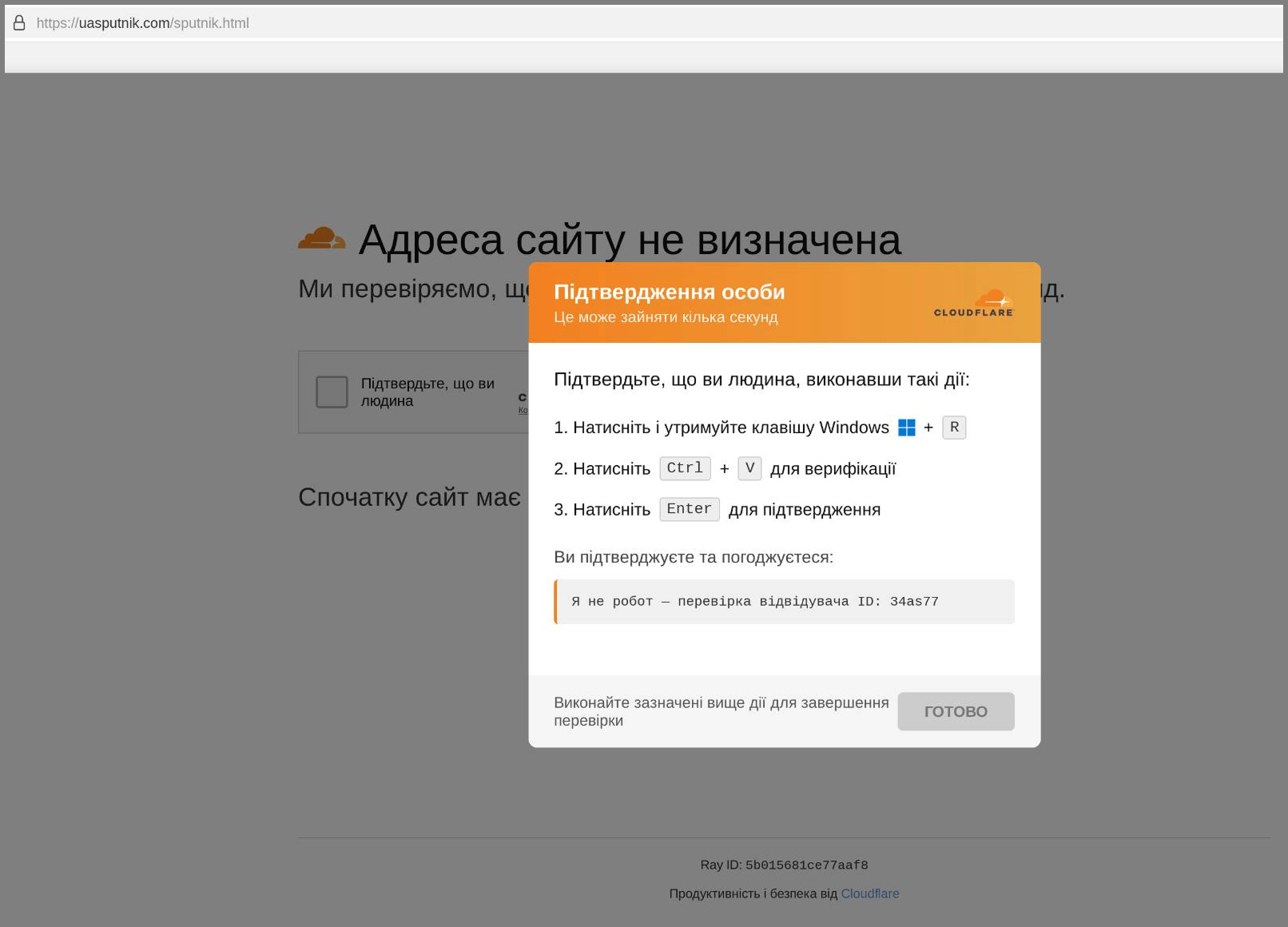
The lure is the now-familiar ClickFix technique, dressed up as Cloudflare’s standard bot check. The fake page asks you to run a command, supposedly to confirm you’re not a bot, and that command quietly downloads and installs an MSI package from an attacker-controlled server. There’s no bot to fool here, you’re the one being fooled.
“In September 2026, CERT-UA spec
Over 100 hacked websites used fake Cloudflare checks to trick visitors into installing LunexStealer through ClickFix commands.
The lure is the now-familiar ClickFix technique, dressed up as Cloudflare’s standard bot check. The fake page asks you to run a command, supposedly to confirm you’re not a bot, and that command quietly downloads and installs an MSI package from an attacker-controlled server. There’s no bot to fool here, you’re the one being fooled.
“In September 2026, CERT-UA specialists discovered over 100 compromised websites to which malicious JavaScript code had been added by attackers. When visiting such a site, the user was shown a fake Cloudflare verification page, which, under the pretext of confirming that the visitor was a human, offered to execute a command.” reads the report published by the Ukraine CERT-UA. “Executing the command resulted in downloading and installing an MSI package from a remote server (ClickFix technique).”
What makes this campaign interesting is how the attackers control it. The domain used for the fake page and the script’s settings are stored in a smart contract on the Polygon or Ethereum blockchain. The script checks the contract each time it runs, so the attackers can change the domain or turn the attack on and off without changing the compromised websites. In effect, they are using the blockchain as a remote control that is difficult to take down.
The script has three modes: off, silent visitor tracking, and the full fake verification page. The attack mode only targets Windows users who arrive through search engines, and it will show the fake page no more than twice within 12 hours for the same visitor. This is clearly designed to keep the campaign quiet and make it harder to spot through unusual traffic patterns.
CERT-UA pulled apart three separate MSI variants used in the campaign. The first just installs the stealer directly. The second is more elaborate, trying to slip past Windows User Account Control, carving out Microsoft Defender exceptions, and deploying a vulnerable AMD driver to exploit CVE-2023-20598, a bring-your-own-vulnerable-driver (BYOVD) move that blinds security tools before the real payload drops.
The third variant skips the driver abuse entirely and uses DLL side-loading instead, tricking a legitimate executable into loading a malicious library that decrypts and launches the stealer. Three different paths, the same room goal. CERT-UA names that payload LunexStealer.
LunexStealer isn’t just a credential grabber, it doubles as a remote execution tool, able to download and run executables, MSI packages, PowerShell scripts, and raw commands on demand. Depending on what configuration it pulls from its command server, it can also install a browser extension called LUNARAXE, disguised under the name “Microsoft Office Word Editor” so it blends into a list of legitimate-looking add-ons.
That extension steals cookies, browsing history, and anything typed into a web form, and gives the attacker live remote control over the browser itself.
“Depending on the configuration received from the control server, LUNEXSTEALER can install a malicious browser extension called LUNARAXE, which appears in the browser under the name “Microsoft Office Word Editor”.” continues the report. “The extension steals cookies, browsing history, and credentials entered into web forms, and also allows attackers to remotely control the browser: execute JavaScript code on web pages, manage tabs and take snapshots of them, and change proxy server settings. If the NAIVEMESS auxiliary component is present, the extension also gains access to the computer’s file system.”
There’s a file system access layer too, a PowerShell component called NAIVEMESS that CERT-UA says registers itself as a legitimate browser-to-system messaging host, letting the extension read, write, and launch files on the victim’s machine.
CERT-UA’s advice is simple: a real security check will never ask you to open the Run window, Command Prompt, or PowerShell and paste a command. If a website asks you to do that, close it, even if the site looks familiar.
For system administrators, CERT-UA recommends additional controls, such as restricting Win+R with Group Policy, limiting who can install MSI files, and blocking known vulnerable drivers.
Full CERT-UA advisory with indicators of compromise and the complete malware breakdown is available here.
Over 100 hacked Ukrainian websites used fake Cloudflare checks to install Lunex Stealer and steal browser passwords, tokens and cryptocurrency wallets.
Over 100 hacked Ukrainian websites used fake Cloudflare checks to install Lunex Stealer and steal browser passwords, tokens and cryptocurrency wallets.
Trump Mobile data breach: BYOD leaks Trump Mobile customer data for 3,615 people, including Trump allies, via an infostealer and no MFA.
Related Posts:
Denmark CPR Data Breach Exposes CPR Numbers of 8.8 Million People
AI Coding Agents Leak 13,000 Internal Screenshots to Public GitHub Repos
Meta Muse Secretly Used Humans for AI Phone Calls
The post Trump Mobile Data Breach Exposes 3,615 Customers in BYOD Leak appeared first on Daily CyberSecurity.
2CLoader malware dodges sandboxes and security tools to deliver Vidar and Remus infostealers. See how it works and how to detect it.
Related Posts:
Moroccan Intelligence Deploys Vast Surveillance Panopticon
DragonForce Backdoor Adds MQTT Fallback to Microsoft Teams TURN Command Channel
BPFDoor Backdoor and New AVERAT Implant Hide in SMTP Traffic on Telecom Edge Devices
The post New 2CLoader Malware Delivers Vidar and Remus Infostealers While Dodging Sandboxes appeared first on Daily CyberSecu

 Entrar