An ASUS Control Center vulnerability, CVE-2026-75754 (CVSS 10), gives unauthenticated attackers a root shell. Update to v3.1.0.9 now.
Related Posts:
CVE-2026-86218 (CVSS 10): N-central Pre-Auth RCE Exploited in the Wild
MikroTrick PoC: RouterOS Admin Rights Exploited In Wild
AI Agent Coordination: The Unprecedented OpenAI Breakout
The post CVE-2026-75754 (CVSS 10): ASUS Control Center Root RCE appeared first on Daily CyberSecurity.
FBI probes suspected breach at IDScan.net after dark web service Nexus offered 153M+ US and Canadian driver’s license scans.
A dark web identity theft service called Nexus appeared on September 1, 2026, offering searchable access to more than 153 million scanned driver’s licenses belonging to people in the United States and Canada.
The FBI’s New Orleans field office opened a formal investigation the same day. Brian Krebs at KrebsOnSecurity, who broke the story, traced the source to idsca
FBI probes suspected breach at IDScan.net after dark web service Nexus offered 153M+ US and Canadian driver’s license scans.
A dark web identity theft service called Nexus appeared on September 1, 2026, offering searchable access to more than 153 million scanned driver’s licenses belonging to people in the United States and Canada.
The FBI’s New Orleans field office opened a formal investigation the same day. Brian Krebs at KrebsOnSecurity, who broke the story, traced the source to idscan.net, a New Orleans-based identity verification company whose clients include Hertz, Target, FedEx, Motorola Solutions, Caesars Entertainment, and the financial services firm Jack Henry.
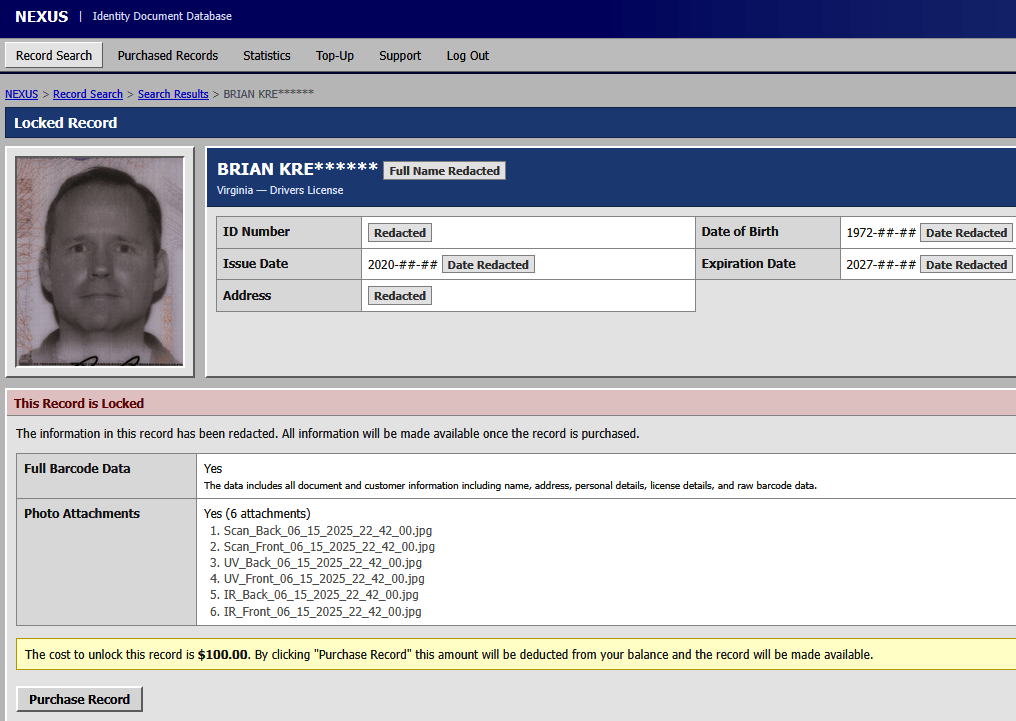
“On Monday, Aug. 31, a source alerted KrebsOnSecurity to a service advertised by a new user on the Russian cybercrime forum Exploit, offering access to digital scans of identity documents on more than 170 million people in North America. The source brought it to my attention because the proprietor of this identity theft service offered my Virginia drivers license as a free sample in their initial sales thread on Exploit.” wrote Krebs. “The service, dubbed Nexus, claims to have more than 153 million drivers licenses for people in the United States and Canada, as well as more than 10 million identification cards; more than three million travel documents and/or international IDs; and at least 579,000 medical cards.”
The record total was also increasing by roughly 400,000 per day at the time of publication, which the operators attributed to ongoing active exfiltration from a live breach they claim has been running for over a year.
Krebs found his own driver’s license in the database after a source alerted him to the service. The operators had posted his Virginia license as a free sample on the Russian cybercrime forum Exploit. Each record contains six images of the license, showing the front and back in visible, infrared, and ultraviolet light, with a timestamp. Krebs’ timestamp matched a June 2025 flight and car rental.
He then checked nine friends and relatives, and everyone who found their license confirmed traveling or renting a car around the same date. His license and his mother’s, who rented a Hertz car with him that day, had timestamps just seconds apart.
Security researcher Zach Edwards, whose license also appeared in Nexus, narrowed the source further. His timestamp matched a trip to Las Vegas for DEF CON in August. He hadn’t rented a car, but he had shown his license at a marijuana dispensary: Planet13, a multi-state chain. In 2022, idscan.net published a press release announcing an exclusive identity verification partnership with Planet13’s dispensaries nationally. The company now serves more than 1,000 marijuana dispensaries in 19 states, and its own documentation confirms that its technology scans IDs with both infrared and ultraviolet light, precisely the format of the images appearing in Nexus.
Idscan.net performs more than 21 million verifications per month at more than 20,000 locations globally. Its client list spans car rentals, retailers, hotels, financial services, and dispensaries, which explains both the volume and the geographic spread of the records. The dataset also includes marijuana dispensary cards and records marked with the notation “CAC,” which may refer to Common Access Cards, the government-issued credentials used to enter federal buildings and secure facilities. If confirmed, that would significantly expand the security implications beyond consumer identity theft.
The database reportedly contained the driver’s licenses of U.S. Defense Secretary Pete Hegseth and the FBI’s assistant director, but not FBI Director Kash Patel’s.
Idscan.net said Krebs’ findings would help its internal investigation but gave no further details. The company later said it was working with law enforcement and forensic experts. Soon after the story became public, the Nexus service went offline.
Identity verification systems that require driver’s licenses are spreading sensitive data across an expanding network of third-party vendors, and oversight mechanisms haven’t kept pace. Every bar, hotel, car rental counter, dispensary, and age-verification system that scans an ID is creating a copy of that image in a system whose security posture the cardholder has no way to assess.
The idscan.net incident, if confirmed at the reported scale, would be among the largest exposures of government-issued identity document images ever recorded.
Krebs reports that Nexus shut down after his article, while the FBI opened an investigation after learning that stolen IDs may include licenses belonging to FBI agents.
Serbian activists were targeted with zero-click Pegasus and NoviSpy spyware, exposing a major surveillance campaign ahead of elections.
A member of Serbia’s student protest movement had their iPhone infected with NSO Group‘s Pegasus spyware without ever clicking a link or opening a file. The Citizen Lab confirmed the infection in collaboration with the SHARE Foundation, tracing it to an iMessage zero-click exploit and identifying high-confidence indicators of compromise between December 2025
Serbian activists were targeted with zero-click Pegasus and NoviSpy spyware, exposing a major surveillance campaign ahead of elections.
A member of Serbia’s student protest movement had their iPhone infected with NSO Group‘s Pegasus spyware without ever clicking a link or opening a file. The Citizen Lab confirmed the infection in collaboration with the SHARE Foundation, tracing it to an iMessage zero-click exploit and identifying high-confidence indicators of compromise between December 2025 and January 2026, with the possibility of additional infections not ruled out.
“In collaboration with the SHARE Foundation, the Citizen Lab analyzed forensic artefacts from the iPhone of a member of Serbia’s student protest movement after they received an Apple Threat Notification warning of targeting with mercenary spyware.” reads the report published by Citizen Lab. “Our analysis confirmed that an iMessage zero-click exploit was used to infect the device with NSO Group’s Pegasus spyware. “
The attack required no action from the victim, which makes zero-click attacks especially dangerous. Citizen Lab said the Pegasus infection could stay hidden while giving the attacker full access to the phone, including messages, photos, notes, microphone, and camera. Apple later fixed this specific exploit through security updates in iOS 18.4.1.
“We believe that the zero-click exploit used in this attack targeted Apple iMessage, and has subsequently been patched by Apple as of iOS 18.4.1.” continues the report. “A zero-click infection with Pegasus spyware would not have been visible to the target, and would give the Pegasus attacker total access to the device. Pegasus allows an attacker to do anything that a user can do, ranging from accessing private data like notes, pictures and even encrypted messages. Pegasus also has the ability to covertly enable the phone’s microphone and camera.”
This one confirmed infection sits inside something considerably bigger. The SHARE Foundation has documented at least 14 individuals targeted with advanced spyware since early 2026, spanning student movement members, civil society activists, an opposition member of parliament, and a local councilor, which the organization is calling the largest documented surveillance wave in Serbia’s history. Twelve people approached SHARE’s digital forensics team in August after receiving Apple’s own threat notifications, warnings the company sends when it detects likely state-sponsored spyware targeting; eleven of those devices remain presumed infected pending further forensic confirmation.
The timing lines up uncomfortably well with Serbia’s political calendar. This surveillance wave coincides with local elections held on March 29, 2026, and stretches toward planned early parliamentary elections in October, following months of student-led anti-government and anti-corruption protests.
“These notifications and forensic confirmation highlight the aggressive mercenary spyware targeting of the peaceful pro-democracy movement with mercenary spyware ahead of key 2026 election cycles.” continues the report.
Targeting activists and opposition figures specifically in the run-up to elections isn’t subtle, and it fits a pattern Serbia has shown before.
Serbia has a history of using commercial spyware. Citizen Lab previously documented Pegasus targeting civil society and the use of Cellebrite tools to install the locally developed NoviSpy on activists’ phones. In this case, SHARE Foundation and Amnesty Tech found a new version of NoviSpy on a student activist’s Android phone after Serbian authorities seized it during police questioning.
Amnesty International’s Security Lab head, Donncha Ó Cearbhaill, connected the dots plainly between state custody and spyware installation.
“The forensic findings by SHARE prove that Serbian students continue to be targeted with invasive Android spyware tools, installed while detained by Serbian authorities” he said.
If you’ve received an Apple Threat Notification, whether in Serbia or anywhere else, the Citizen Lab’s guidance is unambiguous: treat it as a presumed infection and get expert help immediately rather than waiting to see if anything seems wrong. Individuals in Serbia should contact the SHARE Foundation directly, and anyone elsewhere can reach Access Now’s Digital Security Helpline, which supports journalists, human rights defenders, and other high-risk civil society targets worldwide. Anyone who suspects they might be a target based on their work or public role should also turn on Lockdown Mode, Apple’s built-in feature that significantly narrows what a zero-click exploit can actually reach, and keep every device updated, since the patch that closed this specific hole has already existed for well over a year for anyone who installed it.
“We believe that the zero-click used in this attack has been rendered ineffective by a patch from Apple in recent iOS versions. We urge everyone, especially those facing increased risks because of who they are or the work they do, to keep all devices updated.” concludes the report. “Click HERE for instructions on how to keep your iPhone up to date.”
A Virtualizor supply-chain attack used a 33-hour BGP hijack to deliver malicious updates, planting root backdoors on VPS hosts. Back up your data now.
Related Posts:
HOOKEDGE Malware: BlueDelta Hits EU Diplomatic Targets
Dark Caracal Deploys New GoCaracal Malware Framework
Cambodia Malware Campaign Uses PNG Files to Deliver SparkRAT
The post Virtualizor Supply-Chain Attack: BGP Hijack Plants Backdoors appeared first on Daily CyberSecurity.
A new dark web platform called Nexus claimed to be selling 153 million driver’s license scans and millions of other identity and medical cards.
The collection included more than 153 million driver’s licenses, 10 million ID cards, 3 million travel documents, and 579,000 medical cards, including marijuana dispensary cards, according to reports.
The trove of driver’s license scans reported by KrebsOnSecurity is a sharp reminder that identity verification is not a harmless box-ticking exercise
A new dark web platform called Nexus claimed to be selling 153 million driver’s license scans and millions of other identity and medical cards.
The collection included more than 153 million driver’s licenses, 10 million ID cards, 3 million travel documents, and 579,000 medical cards, including marijuana dispensary cards, according to reports.
The trove of driver’s license scans reported by KrebsOnSecurity is a sharp reminder that identity verification is not a harmless box-ticking exercise.
The FBI’s New Orleans field office has opened an investigation into an apparent breach involving identity verification provider IDScan.net. The company said it was investigating.
IDScan.net advertises as follows:
“We provide simple, secure solutions to help dispensaries reduce liability and protect their licenses by validating IDs, including a customer’s age, in a matter of seconds.”
The allegedly exposed records were especially concerning because some included more than a basic photo of an ID. KrebsOnSecurity found records containing front-and-back images, as well as infrared and ultraviolet scans, with timestamps that appeared to align with the holders’ travel or car-rental activity.
That matters because a driver’s license is far more useful to an identity thief than a password. You can reset a password. You cannot easily replace your face, date of birth, address, or license number, particularly when they’re accompanied by high-resolution images of your government-issued ID.
The age-verification problem
Age verification has become a common justification for asking people to upload an ID, take a selfie, or submit both to a third-party identity verification provider.
We have previously warned about the privacy and security trade-offs in age-verification systems, particularly those that require people to submit copies of government-issued ID. Such systems can turn a request to access a website into a decision to share an enduring identity document with a company the user may never have heard of.
In our opinion, that is a disproportionate risk. Once someone uploads an ID, the service or its vendor can potentially link the visit to their identity. If the provider is breached, the consequences can extend well beyond unwanted marketing or an exposed email address.
The reported Nexus dataset illustrates a broader concern: Identity documents are collected in many places that people may not connect with one another. Each individual collection may be presented as routine, but together they create an ever-expanding ecosystem of organizations, contractors, software platforms, cloud services, and privacy policies.
Facial images and ID copies can be reused. Criminals may use them to make scams more convincing, pass weak identity checks, or assemble detailed victim profiles from records obtained from separate breaches. An attacker who knows your name, address, date of birth, email address, and license details has a useful foundation for fraud.
This is why “we only need to verify your age” should not automatically mean “please upload your driver’s license” or another form of ID.
How to stay safe
When an ID check is required to use an online service, ask a basic question: Why does this company need a copy of my identity document, and what happens to it afterward? The scale of the data reportedly offered through Nexus shows why the answer matters.
Consumers cannot always refuse an ID check, particularly where it is legally required or necessary for a regulated service. But you can reduce unnecessary exposure:
Ask whether an ID image is stored and, if so, for how long.
Check whether the company uses a third-party identity verification provider.
Prefer services that offer a privacy-preserving age check rather than requiring a full ID upload.
Avoid submitting identity documents to sites you do not trust or did not intend to use.
Do not email copies of IDs unless there is no safer alternative and you have independently verified the recipient.
Be alert for phishing, account-recovery scams, and fraudulent credit applications if you believe your ID may have been exposed.
Consider a credit freeze where available.
Let’s face it, an incognito window can only do so much.
Breaches, dark web trading, credit fraud. Malwarebytes Identity Theft Protection monitors for all of it, alerts you fast, and comes with identity theft insurance.
A new identity theft service launched on the dark web this week is selling digital scans of more than 153 million drivers licenses from people in the United States and Canada. Based on interviews with individuals whose licenses are available for purchase on this service, it appears to be siphoning images collected by a widely-used identity verification company based in Louisiana. KrebsOnSecurity also has learned that the New Orleans field office of the Federal Bureau of Investigation (FBI) today
A new identity theft service launched on the dark web this week is selling digital scans of more than 153 million drivers licenses from people in the United States and Canada. Based on interviews with individuals whose licenses are available for purchase on this service, it appears to be siphoning images collected by a widely-used identity verification company based in Louisiana. KrebsOnSecurity also has learned that the New Orleans field office of the Federal Bureau of Investigation (FBI) today launched an official inquiry into the source of the images.
A record available at this identity theft service that includes the drivers license for U.S. Defense Secretary Pete Hegseth, one of several high-ranking U.S. government officials whose drivers licenses can be found for sale.
On Monday, Aug. 31, a source alerted KrebsOnSecurity to a service advertised by a new user on the Russian cybercrime forum Exploit, offering access to digital scans of identity documents on more than 170 million people in North America. The source brought it to my attention because the proprietor of this identity theft service offered my Virginia drivers license as a free sample in their initial sales thread on Exploit.
The service, dubbed Nexus, claims to have more than 153 million drivers licenses for people in the United States and Canada, as well as more than 10 million identification cards; more than three million travel documents and/or international IDs; and at least 579,000 medical cards.
A quick look around Nexus finds they are likely not exaggerating about that 153 million number: Running a blank search in Nexus (with no search parameters entered) returns approximately 11.5 million pages of results, with roughly 15 results displayed per page. It includes documents from people in both Canada and the United States, but the bulk of these records are on Americans: searching for just Canadian drivers licenses returns approximately 1.1 million results, with the largest concentration from Ontario (473,673 records).
Curiously, the identity records include not only drivers licenses but also marijuana dispensary cards. Some of the records list their “source” as “CDL,” presumably short for “commercial drivers license.” Other records carry the source notation of “CAC,” which may refer to Common Access Cards, government issued identity cards that grant physical access to government buildings and secure rooms.
The people behind Nexus claim the license images are coming from an active breach at “a major identity verification company” whose customers include multiple Fortune 500 companies.
The record totals listed by the Nexus identity theft service. The number of drivers license records increased by nearly 400,000 in the span of just 24 hours.
“We have been continuously exfiltrating new data for over a year into our private database,” the service enthused in its introductory post on Exploit. “Records are available to preview before purchase with pertinent information redacted. Customer photos are displayed if available.”
Indeed, over the past 24 hours, the number of drivers license records listed as available in Nexus has increased by nearly 400,000, suggesting that freshly stolen license data is being harvested and uploaded to this service on a semi-regular basis.
The record featuring my drivers license includes six image files: three pairs of photos of the license’s front and back, a basic image scan, as well as infrared and ultraviolet versions of the same images. A date and timestamp is appended to each image file, and the timestamp on my license scan corresponds to a date in June 2025 when I took a flight to the midwest United States to attend a family funeral.
Some of the 153 million+ license scans — including mine — feature six image files with date and timestamps appended to the filenames. Not all records include photos, and some that do feature photos do not display the associated filenames.
Intent on discovering the source of this data, KrebsOnSecurity asked more than a dozen friends and family members for permission to search for their licenses in this service. Each person whose license could be found (nine of them) confirmed having traveled on or very close to the dates in the timestamps attached to their images. It is unclear what timezone these timestamps are in, but from reviewing car rental records shared by several people who helped with this research, it appears the timezone is set to Greenwich Mean Time (GMT).
At first, I thought the source of the data might have something to do with airports. However, that theory went out the window when it became apparent there were no passports in this data set. Also, only some of those who helped with this research said they showed their drivers license at the airport on the day of their travel. One person whose license was in Nexus hadn’t flown at all recently, but was renting a car from Hertz for several months around the date of their timestamp.
Two of those who agreed to help are federal employees who said they shared other forms of government identification when passing through airport security. However, those individuals each said they shared their state-issued drivers licenses later that day when renting vehicles at their respective destinations, and that both rented their cars from Hertz.
After finding a note in my calendar for the day of my June 2025 flight reminding me to bring my passport, I remembered that I also never actually shared my drivers license when I went through security at Reagan National Airport on that day because I did not yet have a Real ID, a security-enhanced drivers license that is now required by the Transportation Security Administration (TSA) for all domestic travel. Instead, I showed the TSA agent my government-issued U.S. passport.
Here’s where it gets interesting: I was able to find my mother’s drivers license in this service as well, and the timestamps for her images are just a few seconds apart from mine. That’s notable because we both handed our licenses to the Hertz rental car representative at the same time.
According to my mom, the only place she gave her drivers license to that day was the rental car company, and if memory serves that is also true for me. I don’t recall if the rental car representative inserted our licenses into any kind of machine, but I remember they held onto them for several minutes behind the counter while we were signing various forms. KrebsOnSecurity sought comment from Hertz and will update this story in the event they reply.
Zach Edwards is a well-known security and privacy researcher who recently launched a service called DecryptAds to help people better understand how online advertisers are tracking them. A scan of Edwards’s drivers license is available for purchase on this identity theft service, and Edwards said the timestamp on his record corresponds to the middle of a trip last month to Las Vegas for the annual DEFCON security conference.
Edwards told KrebsOnSecurity that although he did not rent a car in Vegas, he did hand over his license at the TSA checkpoint, at a marijuana dispensary in Vegas, and at his hotel (the Aria). But he said the only one of those three that for sure scanned his ID in some kind of device was the dispensary.
To enter Planet13’s weed dispensary in Las Vegas, one must pass through a red telephone booth. Image: Zach Edwards.
Edwards said the dispensary he visited that day was Planet13, a multi-state chain with stores in California, Florida, Illinois and Nevada. In 2022, the New Orleans-based identity provider idscan.net published a press release announcing an exclusive identity verification agreement with Planet13’s dispensaries nationally. IDScan says it processes ID verification for more than 1,000 marijuana dispensaries in 19 U.S. states.
The “trust” page of idscan.net states that the company provides identity verification services for numerous big brands, including Hertz, Target, Fedex, Motorola Solutions, the financial services giant Jack Henry, and Caesars Entertainment. And as idscan.net’s own documentation states, the technology scans IDs with both infrared and ultraviolet light. Idscan.net says the company’s systems and technology perform more than 21 million verifications monthly, at more than 20,000 locations around the world.
Image: idscan.net.
Contacted by KrebsOnSecurity, idscan.net said it was investigating the matter, but the company has not yet shared an official statement or a substantive reply to specific questions sent via email.
“At this point I’m not able to share any additional information, but the updates you have provided have been welcome, and helpful to our team’s investigation,” wrote Jillian Kossman, a marketing and operations leader at idscan.net.
During the course of my research for this story, word got around to the FBI that I was poking at the apparent source of this new identity theft service’s data. Probably they were tipped off when I shared with a trusted source that Nexus also is selling the drivers license information for the assistant director of the FBI (I did not find FBI Director Kash Patel’s license in Nexus).
Earlier this afternoon, I was added to a conference call with a half-dozen FBI agents, including senior leaders from the agency’s cyber division. During that call, the FBI shared that earlier today their New Orleans field office opened an official investigation into an apparent breach involving idscan.net.
Edwards said that as more in-person and online experiences require sharing drivers licenses, vendors who collect this sensitive data need to be held to a higher standard.
“This episode should further strengthen the resolve for people who are fighting back against online ID schemes which are requiring countless providers to ask for drivers licenses in order to access services under the guise of protecting kids,” Edwards told KrebsOnSecurity. “These systems are putting sensitive data into more and more 3rd party vendors, and we don’t have nearly the oversight to ensure they are safe.”
Larry Baldwin is principal intelligence researcher at the cybersecurity firm Cybera. Baldwin said a front and back scan of his drivers license available at Nexus contains timestamps that correspond to the date of a car rental from Hertz on a recent vacation.
Baldwin said the Nexus identity theft service presents multiple serious security and privacy threats, noting that state-issued drivers licenses are commonly used as proof of one’s identity when opening new lines of credit. Baldwin said the service could also dangerously expose many people who do not wish to be found but who cannot meaningfully change their appearance (or at least not enough to fool today’s AI-based image matching tools).
This category of people, he said, includes those fleeing domestic violence, and even people who have been assigned a whole new life and identity as part of the federal government’s witness protection program, which is generally reserved for criminal defendants in racketeering and conspiracy investigations who agree to cooperate with federal authorities.
“Just when it seems like we’re making some headway in improving authentication controls through drivers license verification systems, this happens and the very thing those improvements are dependent on are compromised,” Baldwin said.
Update, Sept. 2, 6:05 p.m. ET: A spokesperson for Caesars Entertainment said Caesars has not been a client of IDScan.net and has not used VeriScan since February 2025, despite IDScan.net listing them as a client on their website. That person said Caesars had no active VeriScan accounts at the time of the incident and did not authorize IDScan.net to retain data from its accounts, and that IDScan.net said the incident should have no impact on Caesars Entertainment.
Update, 8:56 p.m. ET: Shortly after this story was published, the Nexus identity theft service website vanished from the darkweb, replacing its login page with a plain text message that reads, “This service is no longer available.”
This is a potentially fast-moving story. Any changes or updates will be noted here along with a timestamp.
A Microsoft Defender false alarm wrongly warns that antivirus is turned off after the latest update. Defender still works, and a fix is coming.
Related Posts:
Windows 11 Relieves OneDrive Nags
Windows 11 KB5120998 Bugs Emerge
Windows 11 26H2 Enters Release Preview Channel
The post Microsoft Defender False Alarm: “Antivirus Is Turned Off” appeared first on Daily CyberSecurity.
AO VIVO: A Inteligência Artificial já está decidindo quem sai na frente nos negócios. E você, já está na conversa?Joinville se prepara para um esquenta estratégico rumo ao AI Executive Summit: 20 minutos diretos ao ponto, sem enrolação, sobre como a IA aplicada aos negócios está redesenhando decisões, segurança e competitividade nas empresas que mais crescem hoje. Adiel Rodrigues, Diretor e Anfitrião do AI Executive Summit Rogério de Souza, Executivo de Segurança da Informação #joinville Paulo
AO VIVO: A Inteligência Artificial já está decidindo quem sai na frente nos negócios. E você, já está na conversa?
Joinville se prepara para um esquenta estratégico rumo ao AI Executive Summit: 20 minutos diretos ao ponto, sem enrolação, sobre como a IA aplicada aos negócios está redesenhando decisões, segurança e competitividade nas empresas que mais crescem hoje.
Adiel Rodrigues, Diretor e Anfitrião do AI Executive Summit
Rogério de Souza, Executivo de Segurança da Informação #joinville
Paulo Oliveira, Chairman do AI Executive Summit e Founder do Grupo TI Brasil
Três lideranças, uma só pergunta: sua empresa está pronta para a era da IA — ou vai correr atrás depois que a concorrência já saiu na frente?
Se você é empresário, executivo ou tomador de decisão, essa é sua chance de entender — em 20 minutos — o que realmente importa sobre IA nos negócios, direto de quem vive isso na prática.
E se sua marca quer estar ao lado de nomes como NUV Brasil, Lanlink, Toshiba, Framework, Microsoft e WebHaus, patrocinando um dos eventos de IA mais relevantes do estado — essa é a porta de entrada.
Marque na agenda. Convide seu time. Compartilhe com quem decide.
SilkParasite APT ran China-nexus cyberespionage across Central Asia, using 7 custom RATs, DLL sideloading, and AI-assisted malware.
Related Posts:
FBI Seizes QScan and QTRouter Platforms Run by China State Hackers
Operation CameraSwarm: 14,500 Dahua Cameras Compromised Across Ukraine and Russia
Core Werewolf Deploys New CoreRAT Malware Against Russian Targets
The post SilkParasite APT Hits Central Asian Governments With 7 RATs appeared first on Daily CyberSecurity.
ASEC Blog publishes Ransom & Dark Web Issues Week 4, August2026 Saudi Arabian Digital Entertainment Streaming Service User Data Offered for Sale SAFEPAY Ransomware Attack on a South Korean Industrial Gas Manufacturer and Supplier NoName057(16) and BD Anonymous Claim DDoS Attacks Against Major Japanese Organizations and Companies [1] [2] [3] […]
ASEC Blog publishes Ransom & Dark Web Issues Week 4, August2026 Saudi Arabian Digital Entertainment Streaming Service User Data Offered for Sale SAFEPAY Ransomware Attack on a South Korean Industrial Gas Manufacturer and Supplier NoName057(16) and BD Anonymous Claim DDoS Attacks Against Major Japanese Organizations and Companies [1] [2] [3] […]
Seqrite links Operation QUICSILVER to a China-nexus actor deploying the QUICAgent Go backdoor against Myanmar government targets via a VHD lure.
Related Posts:
Cisco Talos Exposes UAT-10147 Agentic AI Attacks
Operation ASTERIX: Crypto Scam Used AI and Fake Wallets
arrayref Rust Crate Hijacked in Supply Chain Attack With DPRK Infrastructure Overlap
The post Operation QUICSILVER Targets Myanmar Government With Go Backdoor appeared first on Daily CyberSecurity.
Content This report summarizes the distribution channels, number of Infostealers, number of detections, and target companies that were disguised as Infostealers collected during the month of July 2026. It was compiled based on results from AhnLab SEcurity intelligence Center (ASEC)’s automated data collection system, email honeypots, and automated C2 analysis, as well as diagnostic logs […]
Content This report summarizes the distribution channels, number of Infostealers, number of detections, and target companies that were disguised as Infostealers collected during the month of July 2026. It was compiled based on results from AhnLab SEcurity intelligence Center (ASEC)’s automated data collection system, email honeypots, and automated C2 analysis, as well as diagnostic logs […]
UAT-10147 is a highly capable Chinese-speaking intrusion actor operating a multi-platform post-exploitation ecosystem targeting IIS and Linux servers, combining search engine optimization (SEO) fraud monetization with advanced persistence and defense evasion techniques. The newly identified SPECTRE implant represents a significant evolution in commodity intrusion tooling, integrating cross-platform command-and-control (C2) operations, process injection, credential theft, anti-analysis protection
UAT-10147 is a highly capable Chinese-speaking intrusion actor operating a multi-platform post-exploitation ecosystem targeting IIS and Linux servers, combining search engine optimization (SEO) fraud monetization with advanced persistence and defense evasion techniques.
The newly identified SPECTRE implant represents a significant evolution in commodity intrusion tooling, integrating cross-platform command-and-control (C2) operations, process injection, credential theft, anti-analysis protections, and kernel-level endpoint detection and response (EDR) bypass functionality.
The actor demonstrates operational maturity through the combined use of custom malware, open-source offensive tooling, Bring Your Own Virtual Driver (BYOVD) based EDR neutralization, Linux kernel rootkits, and sophisticated in-memory web shell deployment techniques.
Cisco Talos’ analysis of recovered source code suggests portions of the Linux rootkit development may have incorporated AI-assisted code generation workflows, highlighting the growing role of generative AI in accelerating offensive malware development.
In our previous blog, Cisco Talos documented how UAT-10147 operationalized AI-assisted exploitation workflows to compromise internet-facing IIS and Linux servers at scale. This blog discusses how UAT-10147 is employing a diverse arsenal of tools, including SEO fraud utilities, local privilege escalation tools, and both off-the-shelf and custom developed backdoors.
To thoroughly analyze their toolkit, the following section is divided into three parts, detailing the specific tools used and their respective capabilities. We also assess that UAT-10147 is gradually incorporating AI-assisted development into its operations, likely to support the creation and refinement of tools used across its campaigns. Specifically, both its custom-developed backdoor, SPECTRE, and custom-developed rootkit, Specter, exhibit indications of AI-assisted development.
Figure 1. Gradual adoption of AI-assisted development workflows.
Talos also observed several SEO fraud-related components used in this campaign that we assess with medium confidence to be associated with “x神” (“xshen”), who is mentioned in a previously released Talos post. This assessment is supported by multiple development artifacts embedded in the BadIIS malware and related tooling.
The BadIIS samples used in this activity contain the following PDB paths:
Beyond these xshen-related development artifacts, other components in the campaign also contain references to “X.” The ASHX SEO engine configuration includes a string named “X-seo,” while the web shell uses an “X-ID” HTTP header to transmit a specific token. This header appears to support covert authentication by blending the web shell’s control traffic into otherwise routine HTTP communications.
SPECTRE: A new cross-platform backdoor
SPECTRE is a cross-platform backdoor written in C.
Figure 2. Windows version of SPECTRE. Figure 3. Linux version of SPECTRE.
Talos named this backdoor "SPECTRE" based on a debug log recovered from one of the observed samples. This log meticulously records each step of the malware's execution process and explicitly displays its name in the header. The contents of the observed log file are provided in Figure 4.
Figure 4. SPECTRE debug log.
Windows version
The Windows variant of SPECTRE distinguishes itself from the stock Havoc framework through custom post-exploitation and defense evasion capabilities compiled directly into the binary. Furthermore, the implant heavily prioritizes obfuscation and anti-analysis by utilizing a dual layered defense strategy. First, API resolution is executed entirely at runtime via PEB hash walking, using a DJB2 variant algorithm. Second, string encryption relies on a per-string xorshift32 pseudorandom number generator (PRNG) scheme. Sensitive literals are encrypted at compile time with unique 32-bit seeds, decrypted to thread local storage immediately before execution, and never stored in plaintext within the “.text” or “.rdata” sections. Consequently, static detection methods are largely ineffective against the implant's indicators.
Figure 5. Xorshift32 PRNG scheme.
SPECTRE has a feature to execute a weighted anti-analysis scoring routine that evaluates process name blocklists, RAM capacity, CPU core count, disk space, sleep acceleration detection, and common sandbox host names and usernames. If the cumulative score reaches or exceeds 50 points, the process self-terminates.
Figure 6. Windows anti-sandbox scoring.
A fallback C2 domain is hardcoded within the binary and can be recovered through string decryption. All C2 communications are transmitted via HTTP POST requests to the “/api/v1/register” and “/api/v1/output” endpoints. Additionally, Talos observed a specific version of the implant attempting to read its C2 configuration from an NTFS Alternate Data Stream (ADS) located at “C:\Windows\System32\drivers\etc\hosts:cache”. This strategy allows the threat actor to easily update the C2 configuration by modifying the ADS, thereby circumventing firewall blocklists without needing to recompile the binary.
Talos observed 45 commands in this SPECTRE backdoor. 24 appear as plaintext comparands, and 21 are encrypted with the xorshift PRNG and decrypted at each dispatch.
Commands
Encrypted
Description
shell
sh
No
Execute shell command
pwd cd
No
Print/change working directory
ls
No
Directory listing
cat
No
Read file
mkdir
No
Create directory
rm
No
Delete file/directory
cp
No
Copy file
mv
No
Move/rename file
download
No
Send file to C2
upload
No
Receive file from C2
ps
No
Process list
kill
No
Terminate process by PID
env
No
Environment variables information
sleep
No
Set beacon sleep interval
sysinfo
No
OS/hardware information
screenshot
No
Screen capture
whoami
No
Current user/token info
netinfo
No
Network interface information
timestomp
No
Modify file timestamps
rev2self
No
Revert impersonation token
getprivs
No
List current token privileges
selfdel
No
Delete implant file on disk
reg
No
Registry read operations
exit
No
Terminate beacon
regset
Yes
Write REG_SZ or REG_DWORD value: regset <HKLM|HKCU>\path value data [REG_DWORD]
inject
Yes
DLL injection (default: svchost.exe)
s-nject
Yes
Shellcode injection
getsystem
Yes
Privilege escalation
steal_token
Yes
Token theft from target PID
make_token
Yes
Spawn token with credentials
earlybird
Yes
APC EarlyBird injection
hollow
Yes
Process hollowing injection
keylog_start
Yes
Start keystroke logger
keylog_stop
Yes
Stop keystroke logger
keylog_dump
Yes
Retrieve keylog buffer
hashdump
Yes
Dump SAM/SYSTEM/SECURITY hives
chromedump
Yes
Copy Chrome & Edge Login Data + Local State to ld/ls/ed_ld/ed_ls .tmp
execute_assembly
Yes
In-memory .NET CLR hosting - execute any .NET assembly without disk write
vaultdump
Yes
Spawn cmd key/list with captured pipe
byovd_load
Yes
Load RTCore64/DBUtil driver
byovd_unload
Yes
Unload and clean driver
edr_kill
Yes
Kill EDR processes
callbacks
Yes
Enumerate kernel callbacks
proc_hide
Yes
Hide process from kernel list
byovd_verify
Yes
Verify kernel R/W
auto_protect
Yes
Status dashboard/ADS clear
Table 1. Windows version command list.
During our research, Talos noticed the encrypted commands are specific features for this backdoor. The features can be divided into three categories: 1) process injection, 2) privilege escalation and credential theft, and 3) BYOVD EDR killer capabilities.
Process injection capabilities
SPECTRE supports three distinct injection modalities, all managed through a unified handler. The first is standard process hollowing, which targets “svchost.exe” by default. The second is APC EarlyBird injection, which utilizes pre-allocated memory to deliver shellcode before the target thread can execute a single instruction. The third is an automated, on-startup self-hollowing technique targeting “RuntimeBroker.exe”; this executes directly from main() to conceal the implant and evade EDR visibility.
Privilege escalation and credential theft capabilities
The SPECTRE implements named pipe impersonation for privilege escalation. It creates a pipe named “\.\pipe\spectre_<tid>” and acquires a SYSTEM token via ImpersonateNamedPipeClient. With SYSTEM privileges, three registry hives HKLM\SAM\SAM, HKLM\SYSTEM, and HKLM\SECURITY are saved to “%TEMP%” via RegSaveKeyA for offline NT hash extraction using Impact “secretsdump.py”.
Beyond hive dumping, SPECTRE provides two additional credential theft functions:
Vaultdump: Spawns cmdkey.exe /list with stdout capture to enumerate Windows Credential Manager entries without any LSASS access
Chromedump: Copies Chrome and Edge login data and local state files to “%TEMP%” for offline DPAPI decryption via SharpChrome
BYOVD EDR killer
SPECTRE downloads one of two well-known vulnerable driver from the C2 — either RTCore64.sys from MSI (associated with CVE-2019-16098) or DBUtil_2_3.sys from Dell (associated with CVE-2021-21551). It then decodes and writes the driver to disk under %TEMP%, installs it as a transient kernel service via the SCM, and opens an IOCTL handle to the device.
Figure 9. Vulnerable kernel drivers.
Leveraging arbitrary kernel read/write primitives exposed by these drivers, SPECTRE uses NtQuerySystemInformation to locate “ntoskrnl.exe” in the kernel address space. It then references a hardcoded, per-build offset table covering 13 Windows versions to calculate the exact kernel virtual addresses for PspCreateProcessNotifyRoutine, PspCreateThreadNotifyRoutine, and PspLoadImageNotifyRoutine. By performing targeted kernel writes, the SPECTRE safely unlinks each registered EDR callback from its doubly-linked list. Consequently, kernel-callback-dependent security products are rendered completely blind to new process creations, thread creations, and image load events for the remainder of the session, successfully neutralizing EDR visibility on the target machine.
Figure 10. Blinding EDR.
Linux version
The SPECTRE Linux variant’s structure is the same as the Windows variant. It is a statically-linked ELF x86-64 binary targeting Linux systems. Upon execution, SPECTRE immediately invokes an eight-factor anti-sandbox scoring engine before establishing C2 connection. If the cumulative score reaches or exceeds the threshold of 50, the binary exits silently without generating any observable indicators.
Figure 11. Linux anti-sandbox scoring.
Following successful anti-sandbox validation, SPECTRE beacons to its hardcoded C2 domain with a JSON payload, which is the same as the Windows version.
Figure 12. Linux hardcoded C2.
Rather than 45 commands in the Windows variant, the Linux version of SPECTRE only has 29 commands, none of which result in obfuscation or encryption.
Command
Description
shell
/bin/sh
Execute arbitrary shell command
pwd
Print current working directory
cd
Change working directory
ls
List directory contents
ps
List running processes
cat
Read file contents
download
Exfiltrate binary file
upload
Write file to disk
env
Dump or query environment
sleep
Set agent sleep/jitter
kill
Kill a process by PID
mkdir
Create directory
rm
Delete file or directory
cp
Copy file
mv
Move/rename file
sysinfo
Detailed system information
whoami
Print UID/GID with names
id
Print UID/GID/groups (alias)
netinfo
Network interface information
timestomp
Modify file timestamps
rootkit_load
Load kernel module
rootkit_hide
Hide process from /proc
rootkit_root
Elevate to UID 0
rootkit_hide_mod
Hide kernel module from lsmod
rootkit_status
Check rootkit loaded state
rootkit_persist
Install systemd persistence unit
rootkit_unload
Unload kernel module
selfdel
Self-delete
exit
Terminate
Table 2. Linux version command list.
The backdoor's command set encompasses comprehensive file system manipulation, system and process reconnaissance, agent management, and unrestricted shell execution. A particularly notable feature is the timestomp command, an anti-forensics mechanism that utilizes the utimensat() function and operator-provided timestamps to alter a file's modification, access, and change times.
SPECTRE's most critical capability is its integrated kernel-level rootkit, called Specter. The rootkit is deployed as a loadable kernel module disguised as “acpi_pad.ko”, allowing it to mimic the legitimate ACPI processor power management module. To maintain persistence, it utilizes a fraudulent systemd unit file named “hardware-monitor.service” and bears the description "Hardware Performance Monitor." Crucially, this service is configured with “Before=sysinit.target”, ensuring the rootkit executes on every system boot prior to the initialization of any security tooling.
Figure 13. Kernel module disguised as “acpi_pad.ko”.
The user level communicates with the loaded kernel module through a signal-based IPC mechanism, issuing kill() syscalls targeting a magic PID value of 0x7A69 (decimal 31337, a well-known "elite" hacker cultural) with specific real-time signal numbers encoding the desired operation:
Signal 62 triggers process hiding by removing the target task_struct from the kernel PID list, rendering “/proc/<pid>” invisible.
Signal 36 hides the module itself from lsmod by unlinking THIS_MODULE from the kernel module linked list.
Signal 37 escalates the implant process to UID 0 by directly overwriting the process credential structure.
Signal 35 serves as a module load acknowledgement handshake.
This architecture grants the threat actor persistent, kernel-level control of the compromised host that survives both reboots and most user-level security controls.
Figure 14. Magic PID value of 31337.
Specter Linux rootkit
The SPECTRE backdoor loads the Linux Kernel rootkit, Specter, to prevent detection from security products. Based on the SPECTRE Linux version we observed, the compiled artifact is deployed disguised as “acpi_pad.ko”. Rather than patching the syscall table, the hook mechanism rootkit uses the Linux kernel's native “ftrace” instrumentation framework with “FTRACE_OPS_FL_IPMODIFY” to redirect execution at the function entry point of six syscall handlers:
hooked_tcp6_seq_show
hooked_tcp4_seq_show
hooked_tkill
hooked_tgkill
hooked_kill
hooked_getdents64
Because “ftrace” is a legitimate kernel debugging interface, this approach produces minimal noise in kernel integrity checks.
Figure 15. Specter functions.
Talos investigated the source code of the Specter rootkit and assesses with medium confidence that UAT-10147 leveraged a combination of AI-assisted development and human expertise in the creation of this rootkit, which is designed to be invoked directly by SPECTRE.
The first evidence is the documentation structure. The opening feature list at the top of the source code is a product spec, not a developer's note. A complete bulleted feature list with parenthetical technical elaborations on each point reads as a response to a prompt such as, "Write a rootkit with the following features." It is the AI narrating what it is about to produce.
Figure 16. Specter’s opening comments.
The second piece of evidence is the rigid, uniform style of the decorative separators. The identical width and formatting applied consistently across all 10+ logical sections exhibit a machine-like uniformity that is a classic hallmark of AI-generated output. In addition, this text exhibits a pedagogical tone. An actual developer authoring a rootkit would not need to explain basic concepts to themselves, such as the function of taint flags or the mechanics of “cat /proc/sys/kernel/tainted”. The content is clearly structured as an educational explanation for a reader, rather than authentic, internal developer notes.
Figure 17. Specter’s uniform separators and educational explanations.
The last piece of evidence is that the inclusion of three distinct methods — explicitly labeled with inline comments such as “Method 1,” “Method 2, and “Method 3” — is a common artifact of AI generation. When prompted to be thorough, AI models tend to output all known approaches. In contrast, a human developer targeting a specific kernel would simply select and implement the single most effective method. This exhaustive, multi-method presentation is a classic example of an AI's completeness reflex.
Figure 18. Specter’s inclusion of three methods.
SEO fraud utilities
Regarding the SEO fraud utilities deployed in this attack, we observed two distinct types of malware. The first is the previously discussed BadIIS malware-as-a-service (MaaS) and the second is a C# ASHX SEO engine. While both tools share the same core capability of facilitating SEO fraud, their mechanisms for establishing persistence on the compromised server are fundamentally different.
ASHX SEO engine
This SEO hijacking web handler silently takes over an IIS application's request pipeline via reflection. Functionally, it mirrors standard BadIIS malware, serving fabricated content to search crawlers to poison rankings while delivering a malicious JavaScript payload to targeted users. Furthermore, the threat actor explicitly named it “public class SeoEngineHandler,” clearly communicating the tool's intended purpose.
Figure 19. SeoEngineHandler.
Talos also observed that SeoEngineHandler is specifically designed to target Vietnamese internet users. The handler's internal configuration contains several indicators that substantiate this geographic focus, such as the configured C2 domains utilizing the “vn[.]xyz” suffix, and the malware explicitly targets the crawler for “Cốc Cốc” (configured as coccoc), a prominent Vietnamese web browser and search engine.
Figure 20. SeoEngineHandler configuration.
MaaS BadIIS
The BadIIS variant observed in this attack is deployed to the compromised server within a ZIP archive containing both 32-bit and 64-bit versions of the malware, alongside an installation batch script. One of the recovered archives contained a service installer previously documented by Talos. Notably, the core malware is the specific variant detailed in that same Talos research, characterized by the “demo.pdb” string and confirmed to operate under a MaaS model.
Figure 21. BadIIS ZIP archive.
"Potato" family
Talos observed the threat actor utilizing multiple “Potato” family tools to achieve system level privileges. While some of these tools, such as GodPotato and JuicyPotato, were downloaded as pre compiled binaries from the internet, others, like EfsPotato and RustPotato, were compiled by the threat actor directly from source code. Notably, analysis of the custom compiled EfsPotato and RustPotato payloads revealed embedded PDB strings and local file paths, inadvertently exposing details about the threat actor's development environment. The environment suggests that they target IIS servers and compile these custom privilege escalation tools within a designated AI directory. The explicit use of an AI folder in their build path is a fascinating detail, strongly suggesting that the threat actor may be leveraging AI to assist in the development of these tools.
UAT-10147 leveraged other multiple backdoors throughout this attack. Their arsenal includes well-known commodity and open-source tools such as Gh0stCringe, QuasarRAT, Meterpreter, Noodle RAT, and a web shell.
Web shell
Talos observed a web shell with a sophisticated two layer architecture. The outer handler functions as a self bootstrapping loader that leverages in-memory dynamic compilation to execute its payload. Upon receiving the initial HTTP request, the handler reverses an obfuscated string, decodes it via Base64, and dynamically compiles the resulting code in memory using “CodeDomProvider”. To optimize execution and ensure thread safety, it caches the compiled assembly in a static field (_a) using double-checked locking, ensuring the payload is compiled only once per IIS worker process lifetime. Finally, the loader instantiates and invokes SHandler.ProcessRequest to manage all subsequent incoming requests.
Figure 22. Web shell loader.
The embedded handler functions as a versatile web shell implant, relying on a numeric parameter to dispatch its various operational modes. To maintain stealth, the shell employs a strict, multi-tiered authentication mechanism. It first inspects the X-ID HTTP header for a specific token; if absent, it falls back to checking the v parameter. If neither contains the exact value of "x9", the handler immediately halts execution and returns a deceptive “404 Not Found” error. This evasion technique allows the shell's covert authentication process to blend seamlessly into routine HTTP traffic.
A detailed breakdown of the supported commands and their corresponding actions is outlined below.
Command
Description
0 (default)
Get system information(MachineName | Username | OSVersion | CurrentPath)
1
Execute system command.
b = binary to run (default: cmd.exe)
g = arguments
2
Read file
3
Write file
4
Direct file download
5
Directory listing
Table 3. Web shell command list.
Figure 23. Web shell payload.
Meterpreter
Talos has observed UAT-10147 deploying reverse Meterpreter shells to maintain persistent access to compromised Linux hosts. The observed malware functions as a first stage shellcode dropper. Upon establishing a successful connection, this dropper retrieves a second stage payload designed to establish persistence and grant the threat actor full C2 over the victim's machine.
Figure 24. Meterpreter payload.
Noodle RAT
UAT-10147 also deployed Noodle RAT against targeted Linux servers, utilizing it as a final stage backdoor to ensure persistent access. The specific payload observed in this campaign is the Type 0x03A2 ELF variant, which was previously documented in research published by Trend Micro.
Figure 25. Backdoor command for Linux Noodle RAT.
QuasarRAT
Talos also observed UAT-10147 attempting to deploy QuasarRAT on compromised IIS servers to establish long-term persistence. A notable characteristic of this specific payload is its configured Campaign ID, which contains a derogatory Chinese string (“越南老逼”) toward Vietnamese elderly people. This artifact provides potential insight into the threat actor's sentiment or specific geographic targeting.
Figure 26. QuasarRAT configuration.
Gh0stCringe
In another observed instance, UAT-10147 deployed Gh0stCringe to establish persistence. To evade detection, the threat actor embedded the Gh0stCringe payload as shellcode within a custom Go-based loader.
Figure 27. A custom Go-based loader for Gh0stCringe.
Coverage
The following ClamAV signatures detect and block this threat:
Win.Malware.Generic-10060235-0
Win.Malware.Generic-10060218-0
Win.Malware.Generic-9883082-0
Win.Malware.BadPotato-10060230-0
Win.Exploit.Marte-10033857-0
Unix.Rootkit.Malware-10060258-0
Win.Tool.GodPotato-10019688-1
Unix.Rootkit.Spectre-10060260-0
Unix.Trojan.Backdoor-6678692-0
Win.Malware.Generic-10060252-0
Win.Malware.Ulise-10056576-0
Win.Malware.Generic-10060220-0
Win.Malware.BadIIS-10059985-0
Win.Tool.juicypotato-10041758-0
Unix.Backdoor.Msfvenom-10012672-0
Win.Loader. BadiisSet-10060291-1
Asp.Rootkit.Badiis-10060290-1
The following SNORT® rules (SIDs) detect and block this threat:
Snort2: 1:66690, 1:66688, 1:66689
Snort3: 1:66690, 1:301548
Indicators of compromise (IOCs)
The IOCs can also be found in our GitHub repository here.
Cisco Talos identified UAT-10147 targeting Windows and Linux web servers globally, impacting organizations in government, education, media, technology, and gaming sectors. The actor leveraged publicly disclosed vulnerabilities to gain initial access at scale. UAT-10147 integrated AI-driven tooling into exploitation, reconnaissance, payload generation, validation, and persistence workflows. Talos observed AI-generated operational playbooks, exploit automation scripts, and troubleshooting logic su
Cisco Talos identified UAT-10147 targeting Windows and Linux web servers globally, impacting organizations in government, education, media, technology, and gaming sectors. The actor leveraged publicly disclosed vulnerabilities to gain initial access at scale.
UAT-10147 integrated AI-driven tooling into exploitation, reconnaissance, payload generation, validation, and persistence workflows. Talos observed AI-generated operational playbooks, exploit automation scripts, and troubleshooting logic supporting real-world intrusions.
The actor employed a mixture of open-source offensive frameworks, including Metasploit, ysoserial, PentestGPT, DeepAudit, and multiple privilege escalation exploits to automate intrusion operations and establish persistence.
Talos assesses that integrating AI-generated exploitation guidance, automation, and validation workflows enables threat actors to scale complex attacks more efficiently while reducing the expertise traditionally required for advanced post-compromise operations.
In early 2026, Cisco Talos discovered a Chinese-speaking cybercrime group, tracked as UAT-10147, that targets a wide range of vulnerable web servers. The group engages in multiple criminal activities, including search engine optimization (SEO) fraud and data theft.
This blog post provides an overview of the campaign, examining the countries affected and the potential impact of BadIIS infections. It also outlines UAT-10147's attack chain and post-compromise tactics.
Talos assesses with moderate-to-high confidence that UAT-10147 is among an emerging class of financially motivated intrusion operators leveraging agentic AI systems to operationalize offensive tradecraft at scale. Unlike traditional use of generative AI for simple scripting assistance, the actor demonstrated:
Iterative exploit refinement
Adaptive troubleshooting
Post-exploitation automation
Exploit validation workflows
Operational documentation generation
This indicates a transition from AI-assisted scripting toward semi-autonomous offensive orchestration.
Victimology
UAT-10147 targeted high-value internet-exposed web servers across multiple regions. Talos’ investigation shows affected servers located in Brazil, Bolivia, China, Canada, and Vietnam. These systems belong to organizations in sectors including government, universities, media, technology, and gaming.
From the threat actor’s command-and-control (C2) server open directory, we also identified a target list containing approximately 170,000 URLs stored in a text file. The actor appears aware that scanning the entire list at once is inefficient and time consuming. To improve performance, they split the large list into 17 files, each containing about 10,000 URLs. Additionally, the threat actor uses the letter “w” as a reference to the Chinese character “萬,” which represents 10,000.
Figure 1. Commands to split the large list.
Figure 2 shows the distribution of the target list across countries based on the IP addresses resolved from the 170,000 URLs.
Figure 2. Distribution of target list across countries.
UAT-10147 OPSEC failure
Talos identified this activity after observing a compromised machine communicating with a download server hosted at “139.180.197[.]150”. A review of this IP address revealed an open directory. Below provides a high-level view of this directory listing.
Figure 3. Open directory on download site.
Attack summary
Talos observed that the threat actor uses multiple methods to gain initial access to a victim’s network. After successfully achieving remote code execution (RCE) on a website or otherwise gaining access to the server, the actor typically runs an automated script to install and deploy malware for SEO fraud or data stealing. In some cases, the attacker instead installs a web shell, which allows them to manually set up the BadIIS malware and establish persistence through additional backdoor deployment.
Windows platform infection chain
Figure 4. Windows infection chain.
The attack uses multiple Windows batch scripts to carry out its objectives. Although some versions of the scripts contain minor variations, these differences do not affect the overall purpose. The following section highlights the primary batch files observed during the attack.
The main script is executed after the threat actor obtains RCE or establishes an implant on the victim’s web server. It is commonly named “back.txt” or “back.bat”. This code represents a multi-stage malware deployment script that utilizes certutil to download a privilege escalation tool (EfsPotato, renamed as “prcc1.rar”), a secondary batch script (“bai.bat”), and the QuasarRAT payload (disguised as “svchosts.exe”). Using the EfsPotato tool to gain elevated system privileges, the script modifies the Windows Registry and uses PowerShell to add specific directories to the Windows Defender exclusion list, effectively hiding the malware from antivirus scans. Finally, the script attempts to delete its initial staging files and scripts to cover its tracks and hinder forensic analysis. Notably, during our research, we observed the threat actor deploying other implants in similar campaigns, including Gh0stCringe and SPECTRE. Please see this accompanying blog post on Talos' research into UAT-10147's use of the SPECTRE implant.
Figure 5. “back.txt” script file.
The secondary batch script then silently executes the backdoor and establishes persistence by creating deceptive scheduled tasks named "Google Chrome Start" that run the malware with the highest privileges every time a user logs on.
Figure 6. “bai.txt” script file.
To deploy the BadIIS malware on the target machine, UAT-10147 would likely perform the following activities:
The threat actor utilizes a privilege escalation tool to add standard IIS directories (“System32\inetsrv” and “SysWOW64\inetsrv”) to the Windows Defender exclusion list via PowerShell and Registry modifications. This defense evasion tactic effectively blinds the antivirus to the directories where the malicious IIS modules will be dropped.
The threat actor then conducts local reconnaissance by executing the IIS management tool appcmd to enumerate the server's website configurations, likely to identify injection targets for the BadIIS module.
prcc1.rar cmd.exe /C C:\Windows\system32\inetsrv\appcmd list site /config /xml
Finally, the attacker executes user.bat with elevated privileges to create a rogue local user account adding it to both the local Administrators and Remote Desktop Users groups to guarantee persistent, highly privileged Remote Desktop Protocol access to the compromised machine.
Figure 7. “user.txt” script file.
Linux platform infection chain
Figure 8. Linux infection chain.
The attack begins with the threat actor sending a RCE payload to a vulnerable server to gain an initial foothold. Following successful exploitation, a web shell is deployed on the compromised Linux server, providing the attacker with persistent and interactive command execution capabilities. Leveraging this access, the threat actor proceeds to escalate privileges using a broad arsenal of known Local Privilege Escalation (LPE) exploits. Below are the exploits UAT-10147 used.
CVE-2022-0995 targets a flaw in the Linux kernel's watch_queue event notification mechanism, allowing an unprivileged user to write arbitrary data out-of-bounds and achieve privilege escalation.
CVE-2021-3156, known as "Baron Samedit," is a heap-based buffer overflow vulnerability in the Unix sudo utility that allows any local user — even those not listed in the sudoers file — to gain root privileges without authentication.
CVE-2015-5287 exploits a vulnerability in the ABRT (Automatic Bug Reporting Tool) sosreport functionality, where improper handling of symbolic links can be abused by a local attacker to escalate privileges.
CVE-2015-3246 abuses a flaw in libuser's roothelper component, where improper file handling allows a local attacker to corrupt the “/etc/passwd” file and gain root-level access.
CVE-2010-3904, one of the older vulnerabilities in the chain, exploits a flaw in the Linux kernel's Reliable Datagram Sockets (RDS) protocol implementation, specifically in the rds_page_copy_user function, allowing a local unprivileged user to write to arbitrary kernel memory addresses and escalate privileges to root.
CVE-2022-0847, widely known as "Dirty Pipe," is a high-severity Linux kernel vulnerability that allows unprivileged users to overwrite data in read-only files by exploiting a flaw in the way pipe buffers are handled, effectively enabling privilege escalation or arbitrary file modification.
Once root-level access is achieved, the attacker deploys multiple implants such as NoodleRAT, SPECTRE, and Meterpreter which establish outbound connections to remote command and control infrastructure.
Post-compromise strategy
Talos observed the adversary employing a two-pronged attack strategy to compromise target environments, including exploitation of known one-day vulnerabilities and using AI tool-assisted reconnaissance and payload generation.
Known one-day vulnerabilities
The threat actor heavily relies on publicly disclosed vulnerabilities to achieve RCE across both Windows and Linux web servers. To weaponize these flaws, the threat actor utilizes the Metasploit Framework to construct targeted exploits and deploy Meterpreter backdoors. Specific vulnerabilities exploited in this campaign include CVE-2022-27925, an unauthenticated RCE in the Zimbra Collaboration Suite and CVE-2021-23758, an AjaxPro deserialization RCE.
We also observed the threat actor weaponizing CVE-2021-29441 and CVE-2021-29442, an arbitrary code execution vulnerability within the Nacos framework. The exploit leverages the ScriptEngineFactory Service Provider Interface to execute malicious instructions. Upon class loading, the payload invokes Runtime.exec() to spawn an OS-level shell, dynamically adapting to the victim's environment by executing /bin/bash on Linux or falling back to cmd.exe on Windows. Once the shell is established, the payload utilizes curl to exfiltrate basic system telemetry. It POSTs the output of id and hostname (on Linux) or %USERNAME% and %COMPUTERNAME% (on Windows) directly to an attacker-controlled Nacos configuration server. By routing exfiltrated data to a legitimate cloud-based configuration management service, the attackers effectively blend their traffic with normal administrative operations. This infrastructure choice acts as an asynchronous exfiltration sink, allowing the adversaries to poll their own Nacos instance to verify successful exploitation across victims without the operational overhead or detection risk of establishing a persistent reverse shell or maintaining direct inbound connections.
Figure 9. CVE-2021-29441 and CVE-2021-29442 exploit code.
Talos also captured the exploitation of CVE-2019-18935, a well-known .NET JSON deserialization vulnerability affecting Telerik UI for ASP.NET AJAX. The threat actor actively probes the environment to verify the presence of the Telerik file upload handler and fingerprint the software version. Once a vulnerable instance is confirmed, the threat actors deploy a customized, weaponized proof-of-concept to achieve arbitrary file upload and subsequent RCE. During the post-exploitation phase, the threat actor drops compiled reverse shell payloads to disk. We observed these malicious DLLs utilizing a distinct, randomized naming convention, specifically formatted as: [10 digits].[7 digits].dll.
Figure 10. Reverse shell upload by CVE-2019-18935.
AI-driven offensive tool assistance
In their second strategy, UAT-10147 leverages a suite of advanced, AI-driven offensive tools. Specifically, they utilize DeepAudit for source code vulnerability scanning. While we have not directly observed the actor exploiting vulnerabilities discovered by DeepAudit in victim environments, we did observe the framework installed on their management server. Consequently, we assess with high confidence that they intend to use it to identify vulnerabilities within target website source code or third-party package libraries. It is also highly plausible that the threat actors are also leveraging DeepAudit for defensive purposes — such as proactively auditing their own infrastructure, custom tooling, or management servers to prevent exposure and compromise by rival actors or security researchers.
Figure 11. DeepAudit framework.
Furthermore, Talos observed the threat actor installing the PentestGPT framework on their C2 server and using it to dynamically scan web servers and execute relevant proof-of-concept exploits. The threat actor successfully exploited a website and gathered information about the victim machine using Linux commands.
Figure 12. PentestGPT framework.
Additionally, UAT-10147 is leveraging AI-driven tools to build end-to-end offensive workflows. By utilizing the ysoserial framework, these tools generate custom malicious payloads designed to exploit unsafe Java object deserialization vulnerabilities. The AI tool not only creates a well-documented README instructing the attacker on how to use ysoserial to infiltrate the target server, but it also generates three companion Python scripts. These scripts enable the threat actor to easily verify writable paths and permissions, deploy an implant via a ViewState RCE, and drop a web shell onto the compromised machine using the same ViewState deserialization flaw. Furthermore, UAT-10147 employs AI tools to conduct quality assurance testing on the ViewState RCE, effectively using the AI to validate that the exploit functions correctly against the target.
An ASP.NET ViewState deserialization RCE guide created by AI
The opening section outlines the threat actor’s required prerequisites: specifically, the ValidationKey, DecryptionKey, their respective algorithms (SHA1, AES, and 3DES), the target page's __VIEWSTATEGENERATOR value, and the destination URL. The threat actor noted these values are typically obtained via the open-source tool badsecrets, which maintains a database of publicly known or leaked ASP.NET MachineKey configurations. This first step illustrates that the threat actor’s success is entirely dependent on key material exposure making MachineKey confidentiality the most critical defensive control.
Figure 13. Section 1: Prerequisites.
Before committing to full exploitation, the attacker documented a low-noise technique to verify whether a stolen MachineKey is valid against a live target. By submitting a deliberately malformed ViewState payload, they distinguish between two distinct HTTP 500 error messages:
MAC Validation Failure: Indicates an incorrect validation key was used, preventing deserialization.
InvalidCastException: Confirms the validation key is correct and that the payload was successfully deserialized by the server.
This error message allows the attacker to silently confirm key validity without triggering meaningful command execution.
Figure 14. Section 2: MachineKey validation.
This section details the threat actor's use of “ysoserial.exe”, a well-known .NET deserialization payload generation toolkit, configured specifically for the ViewState attack surface. The guide documents the TypeConfuseDelegate gadget chain as the preferred choice, noting it leverages Process.Start() for command execution and remains fully functional on .NET 4.8. Importantly, the attacker explicitly corrects a common misconception: Contrary to claims in several public articles, .NET 4.8 does not patch these gadget chains.
Figure 15. Section 3: Payload generation.
The fourth section provides a Python automation script that integrates ysoserial.exe invocation and HTTP POST submission into a single workflow. The script targets the __VIEWSTATE parameter with the generated payload, mirrors the __VIEWSTATEGENERATOR value in both the POST body and the generation arguments (a critical alignment requirement), and intentionally suppresses redirects. The threat actor also documents a response-code interpretation table. Notably, an HTTP 500 with InvalidCastException is the expected success indicator, not a failure. This inverted success condition is a defensive blind spot: network monitoring tools that alert on 5xx responses may generate excessive noise, while the actual exploit succeeds silently in the error stream.
Figure 16. Section 4: Payload delivery.
The fifth section in the guide documents a critical lesson the threat actor learned through trial and error: Time-based blind testing (e.g., ping -n 10 or timeout /t 10) is entirely ineffective for confirming ViewState RCE. Because Process.Start() is asynchronous and returns immediately, no execution delay is observable from the HTTP response. The attacker pivoted to out-of-band (OOB) HTTP callbacks using certutil, PowerShell + curl, and DNS nslookup to confirm execution.
Figure 17. Section 5: RCE confirmation via OOB callback.
Following RCE confirmation, the guide documents a systematic reconnaissance playbook executed entirely via PowerShell encoded commands, a well-known AMSI and logging evasion technique. The attacker collects system information, privilege tokens, web directory listings, IIS site configurations, network interface data, and running processes and all exfiltrated via HTTP POST to a remote web hook.
Figure 18. Section 6: Post-exploitation reconnaissance and data exfiltration.
With reconnaissance data, the AI documented three escalating methods for establishing persistent interactive access. The preferred path is direct deployment of a custom implant, referred to internally as "SPECTRE," via certutil download. As fallbacks, the guide covers writing an ASHX web shell to the IIS webroot, with a note on handling AppPool write permission restrictions, and a PowerShell TCP reverse shell.
The final exploitation step documented is privilege escalation from IIS AppPool identity to SYSTEM. The guide identifies SeImpersonatePrivilege, a token privilege routinely granted to IIS worker processes, as the escalation vector, and lists the "Potato" family of exploits as compatible tools. The AI also references a built-in capability within their SPECTRE implant to perform this escalation automatically.
Figure 20. Section 8: Privilege escalation path.
This ninth section represents the most significant finding in the recovered artifact: a detailed record of an active intrusion against a real target. The document logs specific infrastructure details including target hostnames, backend and frontend IP addresses, the exploited page path, .NET runtime version, and the MachineKey values used. Of particular note is the observation that a MachineKey is scoped to the IIS site level, meaning keys extracted from one virtual host cannot be applied to co-hosted sites.
Figure 21. Section 9: Operational case record.
Check paths script created by AI
The first Python script (“check_paths.py”) was recovered from the threat actor infrastructure and represents a post-exploitation diagnostic step. It has five sequential OOB callback tests to a “webhook.site” exfiltration endpoint:
Confirm baseline write capability (“c:\windows\temp”) that validates RCE is functional
Exfiltrate the ACL of the target webroot (icacls) that checks if IUSR/IIS_IUSRS can write
Attempt direct file write to the webroot, capturing the exact exception if it fails
Query IIS physical paths via “appcmd.exe” list vdir that discovers actual virtual directory mappings
Probe multiple candidate webroot subdirectories for both existence and write access
After firing all probes, the script polls the webhook.site API directly to harvest all callback results in-session.
Figure 22. Diagnose web shell write failure.
Deploy implant script created by AI
The second Python script (“deploy_implant.py”) handles the execution phase. Leveraging the same ViewState deserialization primitive, this script downloads and launches the SPECTRE binary implant. The implant is hosted on the attacker's C2 infrastructure and is initially retrieved by the victim's machine using certutil. Following a six-second sleep period, the script executes a PowerShell probe utilizing Test-Path and Get-Item.Length to verify the deployment, reporting the results back via the established webhook.site exfiltration channel. Should the certutil download fail, the script features a built-in fallback mechanism, automatically retrying the download using New-Object Net.WebClient.
Figure 23. Deploy implant steps.
Deploy shell script created by AI
The third Python script (“deploy_shell.py”) establishes persistent access within the attack chain. Its objective is to deploy a durable ASHX web shell (“sss.ashx”) onto the compromised IIS server utilizing the same ViewState deserialization primitive seen in the previous scripts. Because the deserialization vulnerability only permits command execution rather than direct file uploads, the script circumvents this limitation using a two-step approach. First, it uses PowerShell to write a temporary file upload handler (“up.ashx”) to disk. Second, it leverages this newly created handler as an HTTP relay to upload and place the final web shell (“sss.ashx”).
The first step involves deploying a minimal, eight-line C# ASHX handler to the target server. To accomplish this, the script Base64-encodes the handler's source code and subsequently leverages the PowerShell [IO.File]::WriteAllBytes method to decode and write the file directly into the webroot.
Figure 24. Write “up.ashx” via PowerShell.
The second step is to verify “up.ashx” is reachable.
Figure 25. Verify “up.ashx” is accessible.
The third step involves uploading the final web shell via the previously established upload handler. The script initially attempts to source the web shell from a hardcoded local path on the attacker's machine: “C:\Users\dajiba\Desktop\phantom-v2\data\arsenal\webshells\sss.ashx”. If this local file is unavailable, it employs a fallback mechanism, downloading “sss.ashx” from a secondary staging server located at “139.180.197[.]150:54321”. Finally, the web shell is transmitted to “up.ashx” via an HTTP POST request, utilizing an explicit destination path parameter to deploy it across both virtual host webroots. Analysis of the remote machine revealed the username “dajiba.” This string is the pinyin romanization for the Chinese term “大雞巴.”
Figure 26. Uploading the final web shell via upload handler.
The final step confirms that the web shell is live by fetching it and verifying that the HTTP response size exceeds 100 bytes. Once validated, the script immediately initiates a live execution test by sending the following payload: {'a': 'Execute', 'cmd': 'whoami', 'p': 'dir'}.
Figure 27. Verifying final web shell.
Exfiltration script created by AI
The fourth python script (“exfil.py”) blends exfiltration traffic with legitimate software-as-a-service (SaaS) traffic over HTTPS to a webhook.site endpoint. The exfiltration have three stages and each stage command is encoded as UTF-16-LE Base64 and passed to powershell -nop -enc. Below are three distinct reconnaissance payloads fired sequentially:
Webroot enumeration: dir C:\inetpub\wwwroot\ -Name reveals deployed applications and potential secondary attack surfaces.
IIS site inventory: appcmd.exe list site exposes the full virtual hosting topology, binding configurations, and additional host names running on the same box for preparation of the next stage BadIIS installation.
Privilege assessment: whoami /priv determines whether the IIS worker process runs under a high-privilege account (e.g., NETWORK SERVICE with SeImpersonatePrivilege), the standard prerequisite for a token impersonation or Potato-family privilege escalation.
Figure 28. Three stage for exfiltration.
Findings log created by AI
Talos analyzed a findings log that documents confirmed RCE via ASP.NET ViewState deserialization on a target IIS server. Using a webhook.site listener, the threat actor received more than 12 HTTP callbacks. These callbacks not only confirmed the successful execution of four distinct ysoserial gadget chains on .NET 4.8.4797.0, but they also exfiltrated valuable reconnaissance data. The exfiltrated telemetry revealed the host name and user identity, that the webroot contained 13 site directories, and recorded an access denial when attempting to read “redirection.config”. In addition, the data also confirmed that SeImpersonatePrivilege was enabled, highlighting a viable path for Potato-family privilege escalation.
Figure 29. Findings log for confirmed RCE.
Coverage
The following ClamAV signatures detect and block this threat:
Py.Loader.Tool-10060293-1
Py.Loader.Tool-10060293-2
Win.Malware.Generic-10060228-0
Win.Loader.Downloader-10060287-1
The following SNORT® rules (SIDs) detect and block this threat:
Snort2: 1:66697, 1:66696
Snort3: 1:66697, 1:66696
Indicators of compromise (IOCs)
IOCs can also be found in our GitHub repository here.
Google is giving eligible US college students a free year of Google AI Pro, worth $19.99 a month, including 5TB storage and 4x Gemini usage limits.
Related Posts:
Telegram Applies for .gram Domain to Give Every User Their Own TLD
GitHub Outage Postmortem: Retry Storm and Copilot Auth Overload Explained
OpenAI Astra Security Model: Pausing Development for Safety
The post Google Offers US College Students a Free Year of Google AI Pro appeared first on Daily CyberSecurity.
Microsoft released a patch for the Microsoft Defender scan failure issue. Learn how a flawed update stopped threat services and how to fix this severe error.
Related Posts:
Microsoft Removes Windows 11 Drag Tray
Microsoft Removes WMIC from Default Windows 11 Installs
Windows 11 WinRE Gains Automatic Wi-Fi Reconnection for Cloud Rebuild
The post Microsoft Defender Scan Failure: A Flawed Update appeared first on Daily CyberSecurity.
Microsoft released a patch for the Microsoft Defender scan failure issue. Learn how a flawed update stopped threat services and how to fix this severe error.
Purpose and Scope The July 2026 Threat Trend Report on APT Groups summarizes the trend in which state-sponsored threat actors and financially motivated attackers are employing a combination of supply chain attacks, account takeovers, cloud breaches, and social engineering techniques. Key targets include Microsoft 365, webmail accounts, cloud infrastructure, GitHub and development environments, VPN and […]
Purpose and Scope The July 2026 Threat Trend Report on APT Groups summarizes the trend in which state-sponsored threat actors and financially motivated attackers are employing a combination of supply chain attacks, account takeovers, cloud breaches, and social engineering techniques. Key targets include Microsoft 365, webmail accounts, cloud infrastructure, GitHub and development environments, VPN and […]
Apple sent a new wave of mercenary spyware threat notifications to targeted users in 110 countries, while making the warnings more visible on iPhones. The alerts signal suspected targeting, not confirmed compromise, and Apple is urging affected users to verify the warning, consider Lockdown Mode, and seek expert help.
The post Apple Warns Users in 110 Countries of Mercenary Spyware as iPhone Alerts Get Harder to Miss appeared first on TechRepublic.
Apple sent a new wave of mercenary spyware threat notifications to targeted users in 110 countries, while making the warnings more visible on iPhones. The alerts signal suspected targeting, not confirmed compromise, and Apple is urging affected users to verify the warning, consider Lockdown Mode, and seek expert help.
CVE-2026-71479, a CVSS 9.1 integer overflow in New API billing, is exploited in the wild to self-credit balances. Update to rc.18 now.
Related Posts:
CVE-2026-71290: Apache HttpClient Flaw Lets Attackers Intercept and Modify Traffic (CVSS 9.1)
PoC Discloses for CVE-2026-64849: watchTowr Sees Attacks on MLflow SSRF
CVE-2026-75045: Unauthenticated Attacker Could Download YouTrack Database Backups
The post CVE-2026-71479: New API Integer Overflow Exploited in the Wild appeared first on Daily Cyb
Federal court records show how far the FBI’s Pegasus review progressed — and why new US spyware reporting will still leave major gaps in government hacking transparency.
The post FBI Pegasus Records Expose a Blind Spot in US Spyware Oversight appeared first on TechRepublic.
Federal court records show how far the FBI’s Pegasus review progressed — and why new US spyware reporting will still leave major gaps in government hacking transparency.

 Entrar