Hackers reportedly hit Ukraine ‘s and Russia ‘s emergency alert apps, sending fake nuclear and attack warnings and raising concerns over public safety.
Ukraine and Russia both said on Sunday night that hackers had compromised their emergency alert apps and used them to send fake warnings about air raids and other attacks, including nuclear threats. The BBC reported the incident, but neither side’s claims have been independently confirmed.
Shortly before 11 p.m. local time (9 p.m. GMT), Uk
Hackers reportedly hit Ukraine ‘s and Russia ‘s emergency alert apps, sending fake nuclear and attack warnings and raising concerns over public safety.
Ukraine and Russia both said on Sunday night that hackers had compromised their emergency alert apps and used them to send fake warnings about air raids and other attacks, including nuclear threats. The BBC reported the incident, but neither side’s claims have been independently confirmed.
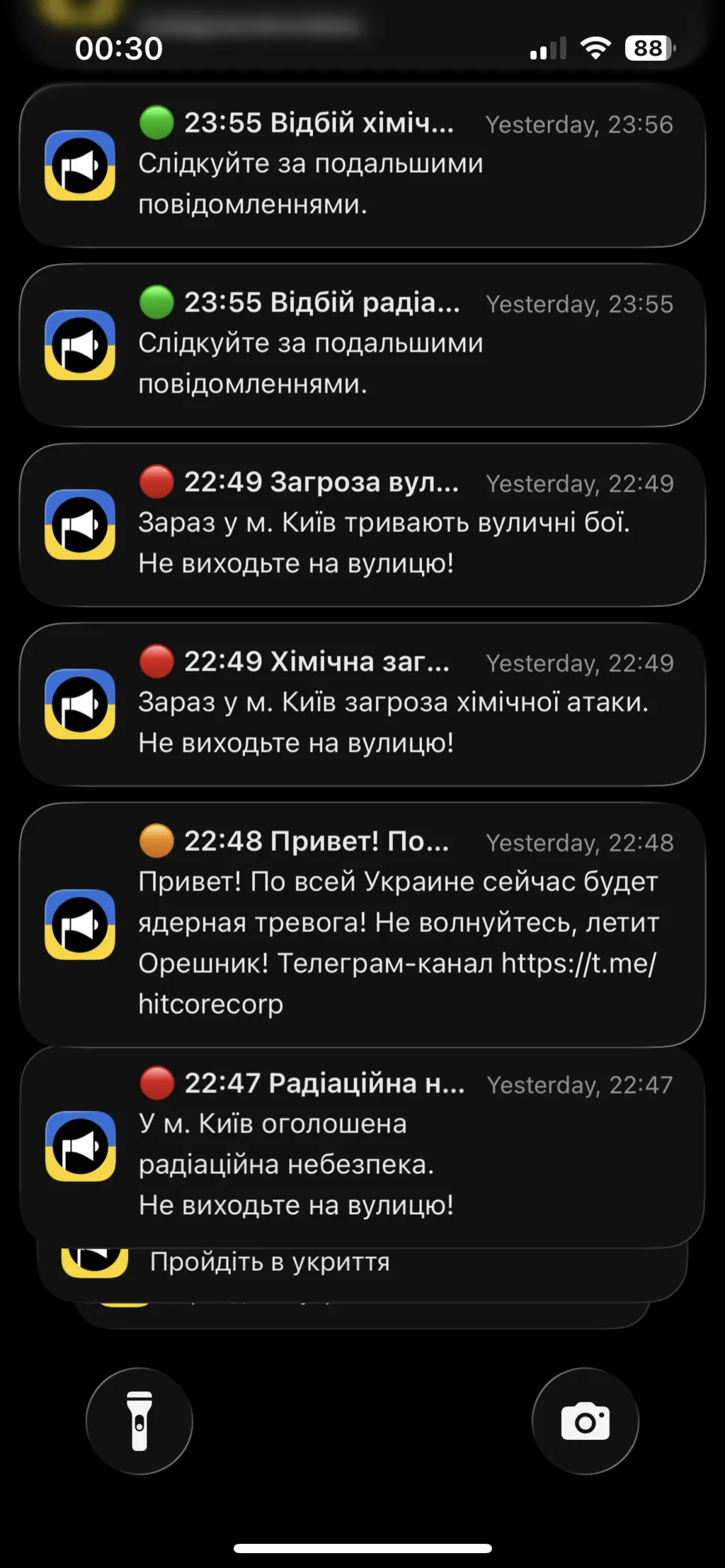
Shortly before 11 p.m. local time (9 p.m. GMT), Ukraine’s widely used Air Alarm app sent the highest-level air raid warnings across the country. Some people, including residents of Kyiv, also received alerts about possible radiation, chemical attacks and street fighting. A message posted on Telegram said the app had likely been targeted by a cyberattack, confirmed there was no radiation threat and urged people to remain calm.
“Shortly before 23:00 local time (21:00 GMT), Ukraine’s widely usedair raid app sent red-level air raid warnings nation-wide, with additional warnings of radiation, chemical attacks, and street fighting sent to some residents in areas including Kyiv.” reports BBC.
“The Air Alarm application has probably been subjected to hostile interference. There is no radiation threat! Stay calm and follow our updates on our channel.” an alert on Telegram read.
The false alerts started at about 22:47 with a message that a radiation threat had been declared in Kyiv. At 22:48 came a message in Russian saying a nuclear alert would cover all of Ukraine and not to worry because “it’s Oreshnik flying”. Oreshnik is a Russian intermediate-range ballistic missile that can carry nuclear or conventional warheads, and Russia has the world’s biggest nuclear arsenal, with President Vladimir Putin repeatedly hinting he’s open to using every weapon available.
Two more alerts arrived at 22:49. One, in Ukrainian, warned of a chemical attack on Kyiv and told people not to go outside, and the other said street fighting was taking place in the city. Red, orange and green messages reached phones, and at 23:53 users got all-clear messages, each declaring one of the Kyiv threats over.
A Ukrainian intelligence body, which the BBC calls the Central Intelligence Agency, said there had been a failure in the app and urged people to use other sources of information. It added that the alerts triggered a radiation hazard signal on loudspeakers in the Lviv region, with no real threat.
“The Air Alert app is supported by the Ministry of Digital Transformation of Ukraine, and informs users instantly about the beginning and end of defence alerts. The ministry said it temporarily disabled the app for maintenance after it had “apparently been compromised”. states BBC.
“While the false alerts were quickly contained, cybersecurity experts suggested it was a new line in apparent Russian cyberattacks.”
The temporary shutdown of the Air Alert app also carries significant risks, even if it lasts only a short time. During an outage, users may not receive timely warnings about incoming attacks, leaving them with less time to reach shelters or take protective measures. This is particularly dangerous in a country where missile and drone attacks can happen with little warning.
The incident also highlights a difficult security trade-off: disabling a compromised alert system may prevent attackers from spreading false warnings, but it can temporarily remove a critical channel for delivering real emergency information. Any shutdown therefore needs reliable backup channels, such as sirens, official messaging services and other emergency communication systems.
Regional leaders tried to calm people. Svitlana Onyshchuk, head of the Ivano-Frankivsk region, said everything was calm, even though the app had shown a red-level alert for her region from 22:50 to 23:57. Natalya Zabolotna, her counterpart in Vinnytsia, confirmed a cyberattack on the app and warned people not to click the link in the message, which could be phishing.
Ukraine’s Centre for Countering Disinformation has advice for when the app isn’t working: turn on smartphone notifications, pay attention to sirens, and read only official sources. Oleksander Merezhko, chair of the foreign affairs committee in the Ukrainian parliament and a member of President Zelensky’s Servant of the People party, said the attack caused no panic. Ukrainians, especially in Kyiv, are used to practically non-stop alerts, he told the BBC, and the message in Russian aroused suspicion at once. The attackers picked a language that gave them away.
A few hours later, Russia’s ministry of emergency situations said its own app had suffered “a massive cyberattack” that sent fake information to the public. Ukrainian outlet UNN reported that the hack sent fake nuclear threat alerts inside Russia, citing Atesh, a partisan Ukrainian group operating in Russian-held territory. A screenshot Atesh shared on Telegram, described as purported, claimed nuclear warheads mounted on Ukrainian P1-Sun attack drones had been launched at all regions of Russia, opened with a “risk of getting lively” warning and told residents to stock up on three weeks of food and hide. The alert also had profanities.
Russia said it was still restoring the app but claimed the hack had not affected its wider alert system. It said people could still receive warnings through sirens, loudspeakers, text messages, TV and radio. The false alerts appeared minutes before a local ceasefire in Ukraine’s Kherson region ended on Sunday night. The truce had allowed civilians to leave Russian-occupied Oleshky. Although the fake warnings were quickly stopped, experts see the attack as a worrying escalation.
“I think it’s the first time it’s happened to an official Ukrainian information app, but I suspect it won’t be the last,” Herbert Lin, a senior research scholar for cyber policy and security at Stanford University, told BBC World Service’s Newsday programme.
Emergency alert app cyberattacks in Russia and Ukraine triggered a series of false warnings, including alerts about air raids, radiation threats, chemical attacks and alleged nuclear strikes. Ukrainian authorities said their air raid warning application had been affected, while Russian officials reported a separate attack on their emergency alert app hours later. The incidents raised concerns about the reliability of digital public warning systems during an ongoing conflict.
According to BBC
Emergency alert app cyberattacks in Russia and Ukraine triggered a series of false warnings, including alerts about air raids, radiation threats, chemical attacks and alleged nuclear strikes. Ukrainian authorities said their air raid warning application had been affected, while Russian officials reported a separate attack on their emergency alert app hours later. The incidents raised concerns about the reliability of digital public warning systems during an ongoing conflict.
According to BBC live reporting, Ukraine's air raid app issued false red-level air raid warnings nationwide. Some residents, including people in Kyiv, also received warnings about radiation, chemical attacks and street fighting. Ukrainian authorities cancelled the alerts within an hour and urged residents to disregard suspicious messages.
Russia subsequently reported that its emergency alert app had also been targeted. The extent of the false warnings distributed through the Russian application remained unclear.
Ukraine was the first to report problems with its emergency alert application, which is supported by the country's Ministry of Digital Transformation and provides notifications about the beginning and end of air defence alerts.
Following the incident, the Ukrainian Air Force said the application had probably experienced hostile interference. It specifically denied that Kyiv faced the radiation threat indicated by the false alerts and asked residents to remain calm and follow official updates.
Ukraine's Centre for Strategic Communications also urged users to disregard strange messages appearing in the application. The centre blamed Russia for the incident in a post on X and highlighted an alert containing a message in Russian about the Oreshnik missile system.
The supplied reporting does not establish how the attackers gained access to the application or how the false messages were inserted into the alert system.
Several hours after Ukraine reported the incident, Russian authorities said their emergency alert application had suffered what they described as a massive cyberattack.
One false message reportedly warned Russian residents that nuclear warheads mounted on P1-Suns, identified in the message as a Ukrainian attack drone, had been launched towards all regions of Russia. The alert also instructed people to stock up on food for three weeks and hide.
A Ukrainian espionage group claimed that fake nuclear strike warnings had been sent to users in Russia. However, the available reporting did not independently establish who was responsible for the Russian application incident.
Russia's emergencies ministry said the mobile application was an additional information service and that the wider public warning system continued to operate normally.
The ministry said emergency information was also distributed through sirens, loudspeakers, text messages, television and radio broadcasts. It added that specialists were working to restore the application and described the situation as under control.
Cybersecurity Expert Warns of Further Attacks
Herbert Lin, a senior research scholar specialising in cyber policy and security at Stanford University, described the reported compromise of Ukraine's air raid warning application as concerning.
Speaking to the BBC's Newsday programme, Lin said he believed it was the first time an official Ukrainian information application had experienced such an incident. He warned that similar attacks could occur again but stressed that the method used to compromise the application was not yet known.
The incident highlights the potential consequences of interference with emergency alert systems, which are designed to deliver time-sensitive information to people facing security threats.
False warnings can create uncertainty about whether a reported threat is genuine, particularly when residents rely on mobile applications for immediate updates during military attacks. However, the supplied reporting does not establish the wider impact of the incidents on public behaviour or emergency response operations.
False Alerts Coincide With End of Kherson Ceasefire
The false warnings in Ukraine appeared just minutes before the scheduled end of a localised ceasefire in the frontline Kherson region, according to BBC reporting.
The six-day ceasefire involving the area around Oleshky, which has been under Russian occupation since 2022, had enabled hundreds of people to evacuate. The arrangement was brokered with assistance from US First Lady Melania Trump and Pope Leo XIV.
Both sides had accused each other of using the ceasefire period to strengthen their frontline positions. Ukrainian officials said the humanitarian operation could provide a basis for further solutions, although the Kremlin viewed such operations as separate from the wider peace process.
The timing of the false alerts was reported, but the available information does not establish that the cyber incidents were connected to the ceasefire or its conclusion.
Russia and Ukraine Continue Exchanging Energy Strikes
The reported cyberattacks on Russia and Ukraine occurred amid continued strikes against energy infrastructure on both sides.
Russian authorities reported drone strikes against an industrial enterprise east of Moscow, identified by Ukrainian media as the Kstovo oil refinery. Nizhny Novgorod regional governor Gleb Nikitin reported significant damage, possible power outages and reduced hot water supplies. One woman was reportedly injured by falling drone debris.
Ukrainian President Volodymyr Zelensky also said Russian strikes had hit energy infrastructure in four Ukrainian regions, leaving hundreds of thousands of homes without power.
The emergency application incidents add another layer of concern to the conflict, where digital information services are used to communicate immediate threats to civilians. Investigations into the reported attacks, including who was responsible and how the applications were compromised, remain unresolved in the supplied reporting.
Ukraine warns that attackers can remotely access Dahua cameras and recorders via Easy4IP, viewing video and changing settings.
Ukraine’s cyber incident response team CERT-UA has warned about attackers taking over video surveillance systems made by Dahua. In its alert dated October 23, 2026, it reports unauthorized remote access to IP cameras and video recorders. The attackers have watched the live video, changed device settings and created accounts of their own. The alert doesn’t say who was
Ukraine warns that attackers can remotely access Dahua cameras and recorders via Easy4IP, viewing video and changing settings.
Ukraine’s cyber incident response team CERT-UA has warned about attackers taking over video surveillance systems made by Dahua. In its alert dated October 23, 2026, it reports unauthorized remote access to IP cameras and video recorders. The attackers have watched the live video, changed device settings and created accounts of their own. The alert doesn’t say who was targeted or how many devices are affected.
The attackers abused Easy4IP, Dahua’s cloud feature that lets users access devices remotely. When this feature is enabled, the camera or recorder connects to Dahua’s cloud and registers using its serial number. Anyone who knows the serial number may be able to access the device through the cloud, without needing an open port or a public IP address. This means the connection can bypass the protection normally provided by a router’s firewall.
As a result, a camera that isn’t directly exposed to the internet may still be at risk. CERT-UA warns that devices with Easy4IP enabled may be vulnerable even when they cannot be accessed directly from the internet.
“The main vector is the P2P/cloud access function (Easy4IP). The device independently initiates an outgoing connection to the manufacturer’s cloud infrastructure and registers in it by serial number. Access to the device is then established via the cloud by serial number, bypassing NAT and firewall, without published ports and a “white” IP address.” reads the report published by CERT-UA. “Thus, the lack of direct access from the Internet does not guarantee the security of the device with the active P2P function.”
Serial numbers follow predictable patterns, so attackers may be able to guess them automatically and check which devices are registered in the cloud. Simply keeping a serial number private isn’t enough to ensure security.
Once attackers connect to a device, they need to get past its login. They may try common or weak passwords or exploit security flaws in outdated firmware, especially CVE-2021-33044 and CVE-2021-33045. These two vulnerabilities allow attackers to bypass authentication without a password, so even a strong password won’t protect a device running vulnerable firmware.
There are three signs that a device may have been compromised. First, look for accounts you don’t recognize. Second, check for changed settings, including text added over the video image. However, the absence of these labels does not mean the device is safe. Third, check the audit logs for logins using Dahua’s DVRIP protocol from the local address 127.0.0.1, which can indicate access through the cloud service.
CERT-UA recommends four steps:
Turn off P2P and cloud access if you don’t use it.
Keep cameras off the internet. For remote access, use a VPN and allow only authorized IP addresses.
Check the account list for ones you didn’t create, and check which cloud accounts are linked to the device and disconnect unknown ones.
Update the software by hand to the latest version, and set up a regular update routine.
CERT-UA advises organizations that detect signs of unauthorized access to report them to cert@cert.gov.ua and check all Dahua devices on their networks, including those that may have been forgotten. The agency warns that all devices with active P2P functionality are at risk.
A Russian satellite made a close approach to a commercial radar satellite linked to Ukraine, raising concerns about surveillance and security in space.
A Russian-made satellite called Kosmos 2612 got very close to ICEYE-X36 last week, a commercial Earth-observation satellite that may support countries like Ukraine. CNN reports it may have come within less than a mile. Orbital monitoring company LeoLabs says the behavior is consistent with rendezvous and proximity operations, meaning maneuver
A Russian satellite made a close approach to a commercial radar satellite linked to Ukraine, raising concerns about surveillance and security in space.
A Russian-made satellite called Kosmos 2612 got very close to ICEYE-X36 last week, a commercial Earth-observation satellite that may support countries like Ukraine. CNN reports it may have come within less than a mile. Orbital monitoring company LeoLabs says the behavior is consistent with rendezvous and proximity operations, meaning maneuvers designed to bring two spacecraft together.
“A rare move by a Russian-made satellite may have brought it within less than a mile of a commercial Earth-observation satellite that may be used to provide national security services to countries such as Ukraine.” states CNN.
“It’s not clear what, exactly, the Russian satellite, called Kosmos 2612 or Cosmos 2612, intended to accomplish with its close approach. But the behavior was consistent with rendezvous and proximity operations, or maneuvers carried out in orbit that are designed to bring two spacecraft together, said orbital monitoring services company LeoLabs, which tracks space junk and activity in Earth orbit, in a statement.”
It is unclear what Russia wanted to achieve. LeoLabs said “While the intent remains uncertain, the behavior warrants continued monitoring.” Astrophysicist Jonathan McDowell noted that this could be the first known case of one spacecraft approaching another without permission. This is different from docking, when two spacecraft intentionally connect, a common practice in space.
The events unfolded over several months. In May, four Russian-controlled satellites changed their orbits to align with ICEYE-X36, according to a June report by the Royal United Services Institute. On October 15, Kosmos 2612 began moving closer to ICEYE-X36, reducing the distance from 350 kilometers to less than 5 kilometers by early October 16. It stayed nearby, making small adjustments through the weekend, before starting to move away on Monday. The War Zone (TWZ) reports that Kosmos 2612 was one of six satellites launched together on April 17.
The closest point is disputed. LeoLabs says it came within roughly 500 meters during part of the event, but warns that the repeated maneuvers and awkward tracking geometry make separation estimates uncertain. Space.com reports the satellites may have been a few meters apart at one point, and TWZ’s reading of public tracking data points to about 26 meters.
The target matters. ICEYE operates about 80 radar satellites that image the Earth through clouds, day and night, and ICEYE-X36 belongs to its US subsidiary. At least some ICEYE satellites provide imagery to Ukraine, and in January the company signed a contract firming up that relationship, saying it gives Ukraine’s Ministry of Defence persistent situational awareness on tactical timelines. A Ukrainian official told Axios that Ukraine’s military works with ICEYE but couldn’t say whether this specific satellite is involved.
Russia appears to be paying close attention to ICEYE-X36. Changing a satellite’s orbit to match another spacecraft’s path uses a lot of fuel, so it is not a decision taken lightly. Four Russian satellites made similar changes in May. However, it remains unclear whether ICEYE-X36 is specifically used to collect images of Ukraine.
Close approaches between satellites are not new, but this case is different. Russia, the United States, and China have all moved satellites close to those operated by other countries, mainly in geostationary orbit. Kosmos 2612 operates in low Earth orbit. As far as is publicly known, Russia has carried out similar approaches there, but the United States and China have not.
Victoria Samson of the Secure World Foundation pointed to two earlier Russian cases. In 2020, Kosmos 2543 came within about 30 kilometers of USA 245. In 2022, Kosmos 2558 approached USA 326 to within about 70 kilometers.
Both targets were classified US spy satellites operated by the National Reconnaissance Office. ICEYE-X36, by contrast, is a privately owned satellite, and Kosmos 2612 came much closer than in those earlier cases. Space law professor Aaron Brynildson told Axios that there is no strict legal limit on how close satellites can approach each other. However, countries generally avoid getting within six miles of another satellite.
Why do it? Samson lists a few options. Russia may want to learn the satellites’ capabilities and what they’re studying, or it may have interfered with sensors or communications. She leans toward a different reading: she thinks Russians are getting frustrated, in a stalemate for about six months, and this is a way to show military prowess in a way Ukraine can’t answer, since Ukraine matches Russia in drones but not in space.
RUSI’s June report is blunter about the options. It lists intimidation or interference through jamming, which uses radio noise to stop satellites from communicating. It adds that the range of options for protecting an ICEYE satellite is limited, and that defending satellites is a famous dilemma. LeoLabs says the event doesn’t establish hostile intent, but shows capabilities that could support intelligence collection, inspection, coercive signaling, interference or preparation for future counterspace operations.
ICEYE’s response was short: the company is aware, tracking closely, and says its constellation architecture is designed for continuity and resilience. CNN says it asked Russia’s defense ministry and Roscosmos for comment. The US Space Force had already described Russian satellites positioned near a Western commercial radar satellite used by Ukraine for imagery intelligence, according to Axios.
Private companies and independent observers, rather than the US Space Force, revealed the satellite encounter, highlighting the need for greater government transparency as space becomes more contested.
The United Kingdom has issued economic sanctions against Cryptomus, a chameleonic cryptocurrency platform that experts say serves as a major conduit for payments related to ransomware, narcotics, darknet markets, fraud and cybercrime services that are helping Russia circumvent existing financial restrictions.
Heleket’s support agent on Telegram claims, despite all evidence to the contrary, that it is not affiliated with Cryptomus. Image: Richard Sanders.
On October 8, the U.K. issued sanctions (
The United Kingdom has issued economic sanctions against Cryptomus, a chameleonic cryptocurrency platform that experts say serves as a major conduit for payments related to ransomware, narcotics, darknet markets, fraud and cybercrime services that are helping Russia circumvent existing financial restrictions.
Heleket’s support agent on Telegram claims, despite all evidence to the contrary, that it is not affiliated with Cryptomus. Image: Richard Sanders.
On October 8, the U.K. issued sanctions (PDF) against Cryptomus — previously known as Certa Payments and Xeltox Enterprises — for processing payments that benefit the Russian government and its financial institutions. The sanctions freeze any Cryptomus assets at U.K. banks, and bar British companies from offering it any business, virtual or otherwise. Also targeted in these sanctions were the virtual payment platforms VexPay, TokenSpot, and the Tsunami Payments service.
As explained in our December 2024 investigation, “How Cryptocurrency Turns to Cash in Russian Banks,” Cryptomus has been a key payment processor for dozens of Russian cryptocurrency exchanges and websites hawking cybercrime services. The company has changed its name several times since emerging in 2022, most recently to “Heleket” last year after Canada levied a record CAD $176 million fine against the platform for anti-money laundering violations.
The blockchain data-crunching firm Chainalysis said the U.K. sanctions target the broader infrastructure supporting Russia’s wartime economy.
“Cryptomus and Heleket have emerged as major payment hubs for illicit activity,” Chainalysis wrote in an October 8 blog post. “Together, these services received more illicit funds across tracked categories than the mixers in our dataset and the number of illicit counterparties surged to more than 900 in a single month in late 2025.”
The Cryptomus support bot on Telegram, responding on Oct. 8 to an inquiry by saying the platform was suddenly unable to process transactions.
In April 2026, the blockchain analysis firm TRM Labsfound Cryptomus had processed more than $7 billion in transactions since its inception in 2022, including transactions associated with child sexual abuse material vendors, terrorist financing networks, and human trafficking operations.
TRM noted that Cryptomus’s transaction volume cratered after the platform instituted new “know your customer” or KYC rules, and that the cryptocurrency platform responded to the Canadian fines by launching Heleket as a parallel service that continued to offer no-KYC payment processing.
Richard Sanders is a blockchain analyst and investigator who spent months mapping out Cryptomus’s payment infrastructure and transacting with its customers. Sanders said the U.K. sanctions on Cryptomus are important because Canada’s fine against the platform was ultimately unenforceable and uncollectible.
“A fine doesn’t stop a cryptocurrency payment processor from processing payments,” Sanders wrote on LinkedIn. “Sanctions kill the operation. The distinction matters.”
As our 2024 investigation noted, Cryptomus shared a Vancouver address with dozens of other foreign currency dealers and money transfer businesses — none of which appeared to be physically located there. Following the CAD $176 million fine for alleged money laundering violations, Cryptomus appealed the penalty, launched Heleket as a parallel service, and kept on processing large volumes of sketchy transactions, Sanders said.
Sanders said the sanctions also are notable because they are the first known instance of a “Five Eyes” country (referring to the Australia, Canada, New Zealand, the U.K. and the U.S.) sanctioning a cryptocurrency operation incorporated in another Five Eyes jurisdiction.
Where do entities like Cryptomus and Heleket derive their authority to offer international financial services? The answer appears to involve fake financial institutions overseen by a phony regulatory body positioned in a country that is not widely recognized as a sovereign nation.
Our 2024 investigation found the sole shareholder of Cryptomus’s parent company Certa Payments was a 25-year-old Ukrainian woman who also headed several other firms, including the WS Management and Advisory Corporation, which bills itself as the regulatory body that exclusively oversees licenses for cryptocurrency, foreign exchange and online gaming businesses incorporated in the disputed region in northwest Africa known as the Western Sahara.
That entity’s website — crasadr.com — says it assists applicants with bank setup and formation, online gaming licenses, and the creation and licensing of foreign exchange brokers. One of Certa Payments’ former sites — certa[.]website — also shared a server with 12 other domains, including rasd-state[.]ws, a website for the Central Reserve Authority of the Western Sahara.
The website crasadr dot com, the official website of the Central Reserve Authority of Western Sahara, which lists the entities awarded licenses for cryptocurrencies, gaming and foreign exchange services.
Kimsuky spear phishing lures target Ukrainian security experts with fake invitations, as Operation GitPower abuses GitHub and GitLab.
Related Posts:
Massive Cyberattack Paralyzes French Supermarket Refrigeration
Suspected TraderTraitor Hackers Use Trojanized Terraform Provider to Deliver FLATROOF and ROOFDECK
UAT-11985 Uses AI-Written Lures and an AitM Phishing Kit Against Taiwan Researchers
The post Kimsuky Spear Phishing Targets Ukrainian Diplomacy and Security Experts in Operation GitPower
Over 100 hacked Ukrainian websites used fake Cloudflare checks to install Lunex Stealer and steal browser passwords, tokens and cryptocurrency wallets.
Over 100 hacked Ukrainian websites used fake Cloudflare checks to install Lunex Stealer and steal browser passwords, tokens and cryptocurrency wallets.
Russian group Star Blizzard expands phishing campaigns with a new malware delivery RedFlick technique, using scheduled tasks to deliver the CosmicPulse backdoor.
Russian group Star Blizzard expands phishing campaigns with a new malware delivery RedFlick technique, using scheduled tasks to deliver the CosmicPulse backdoor.
Star Blizzard RedFlick phishing hit 100+ groups that back Ukraine, using scheduled tasks to drop the CosmicPulse backdoor after a single click.
Related Posts:
Attackers Exploit Citrix NetScaler Zero-Day CVE-2026-88772 to Plant Hidden Web Shells
Nigeria-Based Fraudsters Hijack .edu Accounts to Run University Job Scams
SVG Phishing Attacks Return in August as Symantec Logs 222,000 Detections
The post Russia’s Star Blizzard Scales Up Phishing With RedFlick to Deliver CosmicPulse Backdoor appeare
Attackers hijacked Ukrainian websites to deliver a fake Cloudflare CAPTCHA that installs Psychedelic Stealer and steals browser and crypto credentials.
Psychedelic Stealer is being distributed through compromised Ukrainian business websites. Attackers injected hidden iframes into legitimate pages and used them to display a fake Cloudflare verification screen to visitors. The affected sites included a hair-treatment clinic, a scale-model manufacturer, a specialist bookseller, a psychological
Attackers hijacked Ukrainian websites to deliver a fake Cloudflare CAPTCHA that installs Psychedelic Stealer and steals browser and crypto credentials.
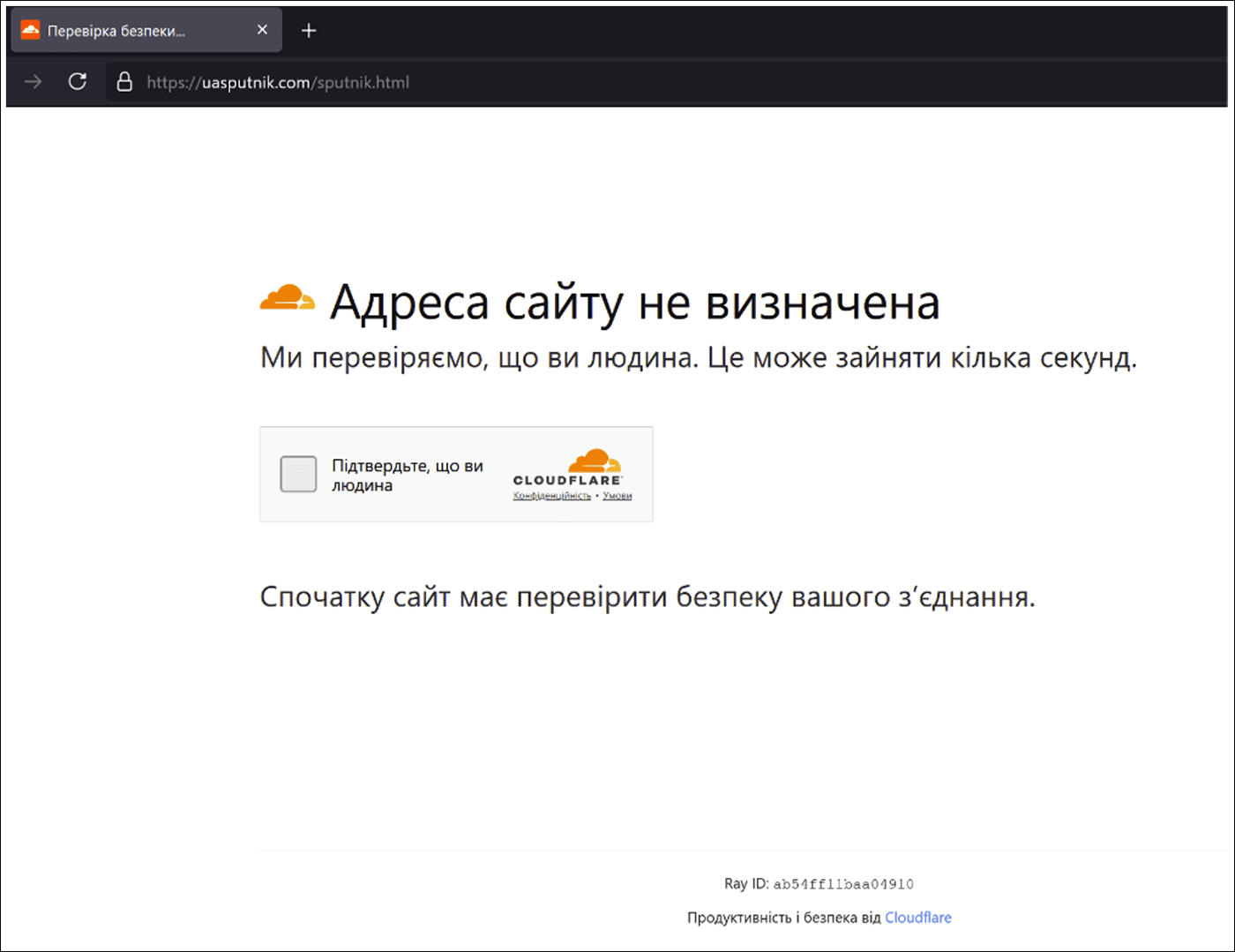
Psychedelic Stealer is being distributed through compromised Ukrainian business websites. Attackers injected hidden iframes into legitimate pages and used them to display a fake Cloudflare verification screen to visitors. The affected sites included a hair-treatment clinic, a scale-model manufacturer, a specialist bookseller, a psychological facility, a tool retailer, and an automotive retailer.
These were legitimate businesses with established social media profiles and third-party listings. Visitors were therefore directed to a trusted website they may have visited before, making the fake Cloudflare CAPTCHA harder to recognize.
That’s the core of what makes this campaign uncomfortable to dismiss. Visitors didn’t stumble onto an obvious fake domain. They landed on a site they may have visited before, for a business they already had some reason to trust, and got served a fake CAPTCHA instead of the page they were looking for.
The fake verification page imitates Cloudflare, complete with a randomly generated “Ray ID” in the footer and a fixed “visitor identifier” in the agreement text. Both look like the kind of tracking and authentication markers Cloudflare actually uses, and neither one means anything here.
“The page footer displays a randomly generated hexadecimal “Ray ID.” Cloudflare assigns a legitimate Ray ID to each request that passes through its network, but the value displayed by this lure is not evidence that Cloudflare performed the verification.” reads the report published by ArticWolf. “The agreement text also contains a fixed “visitor identifier.” Both identifiers imitate familiar verification and tracking elements, making the page appear more legitimate without providing evidence of an authentic Cloudflare verification. Put simply, all of this is fake; window dressing to fool the site visitor.”
The page is written in Ukrainian, which fits the target audience, but its HTML carries Russian-language comments and the document declares lang=”ru,” a detail that tells you something about who built it even if it doesn’t confirm nationality or location.
When the victim clicks the fake CAPTCHA, the page silently copies a Windows Installer command to the clipboard. It then tells the user to press Windows+R, paste the command and press Enter. There is no PowerShell involved, which can help the attack bypass security controls focused on detecting malicious PowerShell activity. Instead, the command directly launches msiexec.exe. It also includes the fake Cloudflare verification text, making the command in the Run window look like part of the verification process.
The downloaded MSI file then installs a 64-bit executable called psychedeliclove.exe, which Arctic Wolf Labs tracks as Psychedelic Stealer. The malware targets saved passwords from browsers such as Chrome, Edge, Brave, Opera, Opera GX, Vivaldi and Yandex. It also steals browser account tokens and targets cryptocurrency wallets, including Exodus, Atomic Wallet, Electrum, Bitcoin Core and Litecoin Core.
Beyond the one-time credential grab, the implant installs browser components and sets up a native messaging bridge that lets deployed browser content communicate with a local process on the machine. It creates a scheduled task for persistence named psychedelicloveUtils, profiles the host in detail including antivirus status and installed browsers, and then starts polling its command-and-control server for additional tasks. As Arctic Wolf Labs puts it:
“The implant tracks task state in executed_tasks.json, downloads attachments into downloads\<taskid>_<filename>, and supports EXE, COM, BAT, CMD, MSI, and PowerShell files.” states the report. “This gives operators a route to introduce additional code after installation.”
Which means whoever’s behind this isn’t necessarily done with a compromised machine after the initial credential sweep. The remote tasking capability supports EXE, COM, BAT, CMD, MSI, and PowerShell payloads, so the initial infection is better understood as a foothold than a finished operation.
The campaign also uses a management panel called “РУБЛЁВКА TDS” (Rublevka TDS), a name referring to the wealthy Rublevka area near Moscow. The panel allows the attackers to control the Windows Installer command delivered by each compromised website. This means they can change the payload URL from one place without modifying every infected page.
The panel also tracks how visitors interact with the fake CAPTCHA. It records when the page is opened, when the CAPTCHA is clicked and when the user presses the Done button.
The Done button remains disabled for about 35 seconds after the command is copied. The delay has no technical purpose. It simply gives victims enough time to follow the instructions and run the command, adding another layer of social engineering to the attack.
At collection time the panel showed 557 views, 426 clicks, and 79 complete events across 32 countries. Ukraine accounted for 446 of those views and 351 of the clicks, which combined with Ukrainian-language instructions and Ukrainian business websites makes the targeting intent about as clear as it gets. The panel labeled its complete events as “executions” and calculated a conversion rate from them, which Arctic Wolf correctly points out overstates actual confirmed compromises, since a complete event only means someone clicked Done in the browser, not that they ran anything.
The domain at the center of this, uasputnik[.]com, was registered September 9, 2026, updated three and a half hours later, and associated with lure URLs appearing on September 12 and 13. The whole operational window from registration to observed delivery fits inside a week.
For defenders, there are several useful indicators to monitor. Network traffic to uasputnik[.]com, followed by a request to admin777111777.php, could indicate an early stage of the attack. A later-stage sign is traffic to 193.178.159[.]128:8080, particularly requests to /api/v1/agent/ and /api/v1/ext/ with an X-API-Key header.
These indicators should be investigated together with file creation and process execution events to confirm whether a system has been compromised.
A court in Zurich has sentenced a Ukrainian man to 12 years and nine months in prison, and banned him from Switzerland for ten years, for developing ransomware that blackmailed companies around the world.
Read more in my article on the Hot for Security blog.
A court in Zurich has sentenced a Ukrainian man to 12 years and nine months in prison, and banned him from Switzerland for ten years, for developing ransomware that blackmailed companies around the world.
Read more in my article on the Hot for Security blog.
The UK Ukraine AI partnership will give Britain access to Ukraine’s Avengers AI Labs, bringing together Ukrainian battlefield experience, operational data and engineering expertise with the UK’s AI ecosystem. The agreement, signed by President Volodymyr Zelenskyy and Prime Minister Andy Burnham in Ukraine, will focus initially on defence and national security.
Under the partnership, British innovators and researchers will gain access to data and insights collected across the battlefield. The
The UK Ukraine AI partnership will give Britain access to Ukraine’s Avengers AI Labs, bringing together Ukrainian battlefield experience, operational data and engineering expertise with the UK’s AI ecosystem. The agreement, signed by President Volodymyr Zelenskyy and Prime Minister Andy Burnham in Ukraine, will focus initially on defence and national security.
Under the partnership, British innovators and researchers will gain access to data and insights collected across the battlefield. The UK government described Avengers AI Labs as a “goldmine of battlefield data,” offering researchers access to real-world operational information used to train AI models.
How Avengers AI Labs Uses Battlefield Data
The data is collected through thousands of daylight cameras and infrared sensors deployed across the battlefield. The systems capture images and information involving tanks, artillery, air defence systems, infantry and aerial targets, including Shahed drones and reconnaissance UAVs.
The data is used to train AI models to recognize and classify battlefield objects. Ukraine’s Defense Ministry has previously said that systems trained using the Avengers Labs platform analyze more than 100,000 drone video feeds each month and help identify about 70% of enemy targets in real time.
The UK’s access to the platform is intended to allow British startups, researchers and engineers to work with operational insights and develop technologies based on real-world datasets.
The partnership will initially bring together engineers, academics, businesses and military operational expertise from both countries to address national security challenges. The two countries will also explore additional platforms for future collaboration.
UK Ukraine AI Partnership Test New Defence Technology
Several pilot projects involving British startups have already been rolled out as part of the agreement. The companies named are Bristol-based Sintela, Oxford’s Mind Foundry and London’s Skyral.
The first technology is due to be deployed at a UK defence site to help protect bases from protestors and hostile actors seeking intelligence. The project combines Ukrainian data with UK technology and turns buried fibre-optic cables into an AI-enabled sensor.
The technology could also be used in other critical locations, including airports, prisons, railways and energy plants, according to the information released about the partnership.
A second project will examine the development of next-generation low-power AI chips designed for future drones, robotics and autonomous systems. If successful, the technology could support machines designed to operate for longer, respond faster and function in environments where conventional systems face limitations.
AI Sovereignty and Defence Innovation
The agreement forms part of the UK and Ukraine’s 100 Year Partnership and expands cooperation between the two countries in AI and defence technology.
The UK will provide access to its universities, researchers, technology companies and AI ecosystem, while Ukraine will provide access to operational experience and datasets generated during the war.
Minister for AI Kanishka Narayan described the arrangement as AI sovereignty in practice, focused on developing national capabilities and turning frontline experience into technologies for military and critical infrastructure protection.
The partnership also follows the UK government’s announcement that defence firm MBDA can release classified information on UK components for the long-range SCALP missile to establish local assembly lines in Ukraine.
The broader agreement is intended to combine Ukrainian battlefield data with British scientific, engineering and technology expertise, with the initial focus remaining on defence, national security and the development of future defence technology.
A suspected ARMA cyberattack has targeted Ukraine's Asset Recovery and Management Agency as it prepares to select a manager for assets linked to IDS Ukraine. ARMA said its servers experienced unauthorized interference ahead of the August 22 deadline for applications, prompting an investigation into whether the incident was part of a broader effort to disrupt its operations.
The Asset Recovery and Management Agency, known as ARMA, manages assets seized by Ukrainian authorities, including asset
A suspected ARMA cyberattack has targeted Ukraine's Asset Recovery and Management Agency as it prepares to select a manager for assets linked to IDS Ukraine. ARMA said its servers experienced unauthorized interference ahead of the August 22 deadline for applications, prompting an investigation into whether the incident was part of a broader effort to disrupt its operations.
The Asset Recovery and Management Agency, known as ARMA, manages assets seized by Ukrainian authorities, including assets linked to sanctioned Russian individuals and alleged collaborators with Moscow.
ARMA Cyberattack Raises Questions Over IDS Ukraine Competition
ARMA said the attack occurred shortly before the August 22 deadline for applications to participate in the competition to select a manager for assets controlled by sanctioned Russian oligarch Mikhail Fridman.
The agency said its experts and law enforcement authorities are examining the cyberattack and the events surrounding the IDS Ukraine competition. The Security Service of Ukraine, or SBU, is investigating the recent attack, while a broader National Anti-Corruption Bureau of Ukraine, or NABU, investigation is examining earlier alleged interference.
According to ARMA, signs of illegal interference in processes connected to its work have been recorded since spring. These included unauthorized access to the agency's officials' register.
ARMA said the combination of cyber incidents, information activity and increased inquiries from some media outlets and members of parliament had raised concerns about a possible coordinated campaign. The agency said investigators must determine whether these events were intended to disrupt its work, create pressure or affect the competition.
ARMA has not identified those it believes may have organized or carried out the alleged campaign.
Despite the incident, ARMA said the competition to select the IDS Ukraine asset manager will proceed according to the procedures and timeframe established by law.
The deadline for applications is August 22, 2026, with the competition announcement published through Ukraine's Prozorro public procurement system.
The agency said it has also started an audit of the financial indicators of seized IDS group assets to support the legality, objectivity and transparency of the transfer process.
ARMA said additional information concerning possible unauthorized access to officials' email accounts and official information will be provided to law enforcement authorities for investigation and legal assessment.
Acting ARMA Head Yaroslava Maksymenko said the agency would continue the competition despite what it described as information pressure, political interference and attempts to gain unauthorized access to its resources.
Ukraine Investigates Possible Coordinated Interference
ARMA said the latest incident is not being viewed in isolation. The agency pointed to a similar episode earlier this year, when Reuters reported on a cyberattack involving attempts at interference and hacking alongside increased information activity and inquiries.
The agency said each event could have an individual explanation, but their timing and combination warranted further investigation.
The cyberattack comes as Ukraine continues efforts to prevent sanctioned Russian capital from retaining control over assets seized in the country. ARMA said this includes preventing control through management arrangements, intermediaries or influence groups.
Fridman has been sanctioned by Ukraine and several Western governments since Russia's invasion.
ARMA said the final responsibility for determining the organizers, customers and perpetrators of the attack rests with the ongoing investigations. The agency said it will continue the IDS Ukraine competition and act within the law while law enforcement agencies examine the reported cyber incidents and possible attempts to interfere with its activities.
Note The July 2026 Dark Web Breach Incident Trend Report was compiled based on data breach cases posted on deep web and dark web forums. Due to the nature of some posts, it is difficult to fully verify their accuracy; some posts related to South Korea included AI-generated false data or cases where it could […]
Note The July 2026 Dark Web Breach Incident Trend Report was compiled based on data breach cases posted on deep web and dark web forums. Due to the nature of some posts, it is difficult to fully verify their accuracy; some posts related to South Korea included AI-generated false data or cases where it could […]
Russian hackers from the TA488 group exploited a Zimbra webmail flaw triggered when emails were opened or previewed, stealing credentials and up to 90 days of messages from victims.
Russian hackers from the TA488 group exploited a Zimbra webmail flaw triggered when emails were opened or previewed, stealing credentials and up to 90 days of messages from victims.
Ukraine's computer emergency response team, CERT-UA, has warned that the Kremlin-backed Sandworm hacking group is leveraging fake CAPTCHA checks on compromised websites that persuade users to run malicious code.
Read more in my article on the Hot for Security blog.
Ukraine's computer emergency response team, CERT-UA, has warned that the Kremlin-backed Sandworm hacking group is leveraging fake CAPTCHA checks on compromised websites that persuade users to run malicious code.
Read more in my article on the Hot for Security blog.
Between February 2022 and September 2025, Bellingcat staff and volunteers collected, geolocated, and shared more than 2,500 incidents of civilian harm following Russia’s full-scale invasion of Ukraine.
As part of this effort, Bellingcat tested a new machine learning model intended to rank Telegram social media posts on their likelihood of containing incidents of civilian harm.
This novel methodology dramatically reduced the search and selection time required, freeing researchers to focus
Between February 2022 and September 2025, Bellingcat staff and volunteers collected, geolocated, and shared more than 2,500 incidents of civilian harm following Russia’s full-scale invasion of Ukraine.
As part of this effort, Bellingcat tested a new machine learning model intended to rank Telegram social media posts on their likelihood of containing incidents of civilian harm.
This novel methodology dramatically reduced the search and selection time required, freeing researchers to focus on verifying incidents of civilian harm – not just searching for them.
This piece documents our methodology, ethical considerations and lessons learned in the hope that others researching similar topics can benefit from our work.
Open source research into civilian harm is still a relatively new field and it presents many challenges – one of the biggest is organising and sorting through the huge volume of user generated content being produced to find what is relevant.
Machine learning, a form of artificial intelligence that uses algorithms to identify patterns from large amounts of data and make predictions, can make this task more efficient.
With ongoing conflicts involving large amounts of civilian harm occurring in Sudan, and much of the Middle East, this guide aims to offer those covering these conflicts an example of how machine learning can be used to help find and sort incidents. You can also access the Code Notebook for our model here.
We defined “civilian harm” not just as civilian deaths or injuries resulting from armed conflict, but also the broader and delayed effects on civilians from mental trauma, loss of livelihood, displacement, destruction of infrastructure and more. This definition was informed by the Protection of Civilians bookon civilian harm.
Initial Telegram Dataset
Each Telegram post containing civilian harm which had already been manually verified by researchers was used to build an initial dataset of confirmed cases of civilian harm, which data scientists call positive instances. We collected a total of 5,848 unique URLs for these Telegram posts. For our manual collection we reviewed posts on relevant Telegram channels, working through oldest to newest posts each day. Assuming that a given post made it to our geolocated incidents list, it meant the researcher who flagged it also looked at the posts that appeared before and after it on Telegram and did not flag those ones, so we selected the 10 posts surrounding the verified civilian harm post as our additional dataset of posts that did not contain civilian harm. After excluding any deleted or duplicate posts, we ended up with 48,545 non-civilian harm posts, our negative instances.
Support Bellingcat
Your donations directly contribute to our ability to publish groundbreaking investigations and uncover wrongdoing around the world.
The choice to overrepresent negative instances aims at better reflecting the real world and increasing data available for model training.
We enriched each URL with metadata from the Telegram API, such as the time of publication, reactions or textual content. As some of these posts had been deleted, we completed the missing data points with previously preserved versions from our Auto Archiver database, only available for the positive instances.
Feature Engineering
Training a machine learning model requires numerical data, as these models compute a prediction score based on mathematical operations.
We built these by converting raw data from our initial dataset, such as keywords signalling potential civilian harm, into numerical scores (or “features”) that the model could interpret, with the aim of increasing the model’s ability to identify patterns. This process, known as feature engineering, can significantly improve model results because it allows data scientists to suggest explicit context knowledge.
A full list of features we used to train the model can be found in the code notebook accompanying this piece. Many features were directly inspired by researchers’ input from their experiences manually screening cases of civilian harm by sorting through a set number of Telegram channels and inspecting each post individually.
Several of the features used were directly built from the metadata contained in each Telegram post including media_type, day_of_week; or binary ones: forwarded, edited andreply_to.
Other features included engagement information: views, forwards, total_reactions, and even individual features for most used emojis including the reaction_crying_face to count emoji.
Converting Text to Numbers
To embed the experience from the manual collection process, researchers put together a list of keywords both in Ukrainian and Russian that, to them, signalled posts likely to show civilian harm. For instance, “Шахед” and “КАБ” translated to “Shahed” and “Guided aerial bomb” respectively. We created a numerical feature to count their frequency.
In addition, we included several generic English-language keywords which meaningfully signalled potential civilian harm, such as “injured”, “school affected” and “hospital affected” that were only used for generating semantic similarity scores.
A semantic similarity score is a calculation used to determine the proximity in meaning between different words and phrases. To get the semantic similarity between the post text and each of our keywords, we represented each in a list of numbers via a Sentence Transformer model, which converts words into numerical representations called vectors that a computer can understand.
We then calculated the level of similarity between each vector using cosine similarity, one of the most popular methods for measuring similarity between two pieces of text.
Due to how embeddings work, this calculation results in a figure on a scale from -1 (no semantic proximity) to 1 (same meaning). For example, the words “hurt” and “injured” would have a high similarity score, while “residential” and “injured” would have a negative score as the words are not semantically similar.
Finally, to enable the model to identify the relevance of each post to civilian harm in Ukraine, we used a multilingual text transformer from the BERT family of language models to represent the entire post’s text as a vector of 768 numerical values. This model can efficiently represent text from many languages in a way that captures meaning: the same sentence in different languages will generate similar embeddings, and trained machine learning models can detect patterns in the embeddings.
It is important to note that for this initial prototype of a civilian harm detection model, we did not include any features derived from media content such as photos and videos, although that would be a logical next step in attempting to improve model performance.
Selecting, Training and Evaluating Models
With 54,393 rows of 893 numerical features each, we selected four machine learning algorithms to train our predictive models.
We chose Logistic Regression as a baseline algorithm due to its simplicity. We also selected three other “best in class” models, Random Forest, XGBoost, and LightGBM. These choices centred on the interpretability of the models and their ability to work on tabular data of this size. For example, we avoided neural networks due to a lack of interpretability and because those models work best with a larger dataset.
To genuinely assess the performance of the trained models, we split our dataset into three parts:
A training set – the data the models were trained on (60 percent of the full dataset’s rows)
A validation set – used for an intermediary evaluation when tuning model parameters (20 percent of all rows)
A test set – hidden for the final performance assessment, so the models were evaluated on unseen data (remaining 20 percent of rows)
We used a stratified split to divide the dataset instead of a random split. This method ensured the proportion of positive instances (i.e. confirmed cases of civilian harm) remained consistent across all three sets at about 11 percent.
To measure the performance of machine learning models, we ran them through the test set and measured the number of correct and incorrect predictions. Models output a likelihood between 0 and 1 that each Telegram post contains civilian harm, and we tried to find a cut-off threshold that leads to a good balance between flagging almost every post (0.1) or flagging very few (0.9).
There are two main types of evaluation metrics to gauge a model’s prediction power. Recall asserts what fraction of positive instances (i.e. known civilian harm posts) were correctly flagged as such. Precision measures the fraction of posts flagged as civilian harm that are indeed civilian harm posts.
During the training phase, we tuned the models to maximise average precision (PR-AUC), a metric that summarises precision across all recall levels. While this method also accounts for precision, it prioritises recall, which is preferable for this use case as it steers model selection to reduce the number of civilian harm posts that are skipped.
The following table sorts models from best to worst PR-AUC against a baseline of a coin-flip predictor. ROC-AUC and F1 are two other evaluation metrics included as sanity checks. Simply put, ROC-AUC measures the probability of ranking two instances, one negative and one positive, correctly; F1 balances precision and recall equally and its best cut-off threshold value.
Model test scores comparison, XGBoost stands out in every relevant metric evaluated.
From these results, we selected XGBoost as our final model as it had the best scores when compared across all metrics.
Interpreting the Model
Because these models are interpretable, we can understand which features are the most useful when predicting whether a post includes civilian harm. The above table shows the top 10 features that most strongly signal the XGBoost model to make a decision:
semantic_keywords_similarity: the semantic proximity between the post text and manually selected keywords “casualties”, “damage” and “civilian harm”
bert: the model was able to discern meaning from the text with the same strength as some of the other features in this list – there are three cases of this in the top 10
reaction_crying_face: reactions with crying face emojis on the post
group_of_messages: whether a post contains multiple media files
keywords_in_text: the number of custom Ukrainian or Russian keywords in the post
These results generally tally with what you might expect when selecting Telegram posts for instances of civilian harm, including that posts that generate a lot of emotional engagement and posts using keywords about civilian harm were among those most likely to contain content related to this topic. Not all models had the same top features as XGBoost. In fact, for the Random Forest model the most important feature was the number of crying face emojis present in a post, a soft pattern highlighted by researchers when this methodology was first imagined.
LLM Results and Comparison
Retroactively, we decided to run a sample of the same test dataset through different large language models (LLMs) to gauge their ability to make these same predictions.
We aimed to include an LLM-generated score as an extra feature for our trained models, which would be captured as relevant if it correlated with the correct predictions.
To start, we selected two local models, the 1B and 4B variants of Gemma 3 from Google DeepMind, and two cloud-hosted models, Gemini 2.5 flash and Gemini 3.5 flash. With this selection, we hoped to compare results across a wide range of models’ expected performance.
We generated a 400-row stratified sample (preserving the same proportion of real civilian harm instances) from the test dataset used for the custom models. For each of the four LLM models, we ran two tests: one where only the Telegram post message was sent, and another including both the message and the engineered features (excluding the text embeddings, as the model had direct access to the text). In the prompt for each model, we asked for a score between 0 and 1. We then evaluated the results as we did for the custom models.
The above table shows that LLMs can indeed extract value from the engineered features. All four LLMs surpassed the baseline Logistic Regression model in our tests, yet none of them performed better than the other custom-trained models, and XGBoost remained the one with the highest PR-AUC.
Still, Gemini 2.5 Flash performed better than its newer version 3.5 and even achieved a slightly higher best F1 score than any other model. While this is a good result, for the flagging of civilian harm posts, the PR-AUC remains the crucial metric, as it captures the model’s ability to identify infrequent instances of civilian harm while minimising false positives.
Ethical Considerations
Introducing an instrument of automated decision-making into a process of detecting civilian harm brings inherent ethical questions. These include automation bias, or how humans tend to blindly place faith in machine-generated recommendations; algorithmic bias, or how the results of these models echo the same patterns present in the training data, including under- or over-representation of types of civilian harm.
The decision to test an automated methodology for this particular project came from the fact that there were limited resources for both steps in the process – the detection of potential civilian harm and its actual verification. Historically, we built an enormous backlog of unverified incidents because a lot of time had to be spent on monitoring the most recent events so that potential evidence would be captured and preserved as soon as possible.
The automation of this process also reduced the exposure of researchers to a significant amount of unpleasant and distressing visual and text content, reducing the burden of exposure to traumatic content.
For this project, we tried to ameliorate the ethical challenges with a number of strategies including randomly flagging posts not captured by any model, monitoring which features models relied on to make decisions, and by doing historical comparisons of patterns in data.
Additionally, as stated above, for this initial prototype of a civilian harm detection model we did not include any features derived from the media content itself. In the future, it would be a logical next step in attempting to improve the model performance, to include the media from the posts – but using AI to review actual media comes with additional ethical challenges such as model bias.
Because of the opaque ownership of many LLM companies and their generative nature, the use of LLMs for an extra feature presented additional ethical challenges including privacy and safety concerns considering the sensitive nature of the data. Our model did not rely on LLMs, though we retroactively ran a sample through it.
How the Model Fits into the Bigger Picture
After selecting this model, we created a user interface where researchers could view a list of Telegram posts sorted from most to least likely to contain indications of civilian harm. The user interface was designed for quick triage and integration, where a positive confirmation from researchers would instantly send the post to the Auto Archiver (Bellingcat’s tool for preserving digital content) and then transfer it to ATLOS (our internal collaborative verification platform). Bellingcat staff and volunteers could then manually verify incidents. Researcher input was constantly stored so that this data could be used to improve the model in the future.
Preliminary feedback indicated that the AI model was useful. Not only were we able to reduce time and harm from scouring through dozens of war reporting Telegram channels, researchers also reported that the stream of new posts being added to the verification backlog were capturing real and diverse cases of civilian harm.
We recognise this model has much room for improvement and is a work in progress. Even though it can illicit diverse civilian harm posts, further tests and improvements (such as improved feature engineering and continuous evaluation) are needed before it can confidently be deployed.
Despite the focus on civilian harm and Telegram (highly popular in Ukraine and Russia), this pipeline is generic and can be adapted to other conflict monitoring tasks. How easily this can be done does depend on how open the social media platform is and whether it is possible to scrape posts from it. Apart from that, it is easy to incorporate new features and data, and cheap to automatically retrain, test and deploy models as the system receives more human input.
Looking forward, sorting through overwhelming amounts of data in a conflict will continue to be challenging. Hopefully, this methodology can help newsrooms, conflict monitoring organisations, and others find the balance between ethical considerations and resources in order to carry out open source investigations on civilian harm and human rights violations.
Editor’s note: This article was updated on July 3, 2026, to include a line outlining that the model described is a work in progress.
Bellingcat is a non-profit and the ability to carry out our work is dependent on the kind support of individual donors. If you would like to support our work, you can do so here. You can also subscribe to our Patreon channel here. Subscribe to our Newsletter and follow us on Bluesky here, Instagram here, Reddit here and YouTube here.
Support Bellingcat
Your donations directly contribute to our ability to publish groundbreaking investigations and uncover wrongdoing around the world.
Researchers warn GhostShell is using fake drone documents to target Ukrainian defence teams, stealing passwords and sensitive data in a new cyber campaign.
Researchers warn GhostShell is using fake drone documents to target Ukrainian defence teams, stealing passwords and sensitive data in a new cyber campaign.
On February 15, 2026, the bulk carrier, Grumant (IMO: 9385879) was pictured at the occupied Ukrainian Port of Feodosia on the Crimean peninsula. Satellite imagery suggests it had already been there for several days. It appeared to stock up on grain before departing on a two-month-long journey eventually docking at the Port of Benghazi in Libya on April 18.
While there have been previous reports of grain shipments from occupied Ukraine arriving in Libya, this is only the second time a Russian
On February 15, 2026, the bulk carrier, Grumant (IMO: 9385879) was pictured at the occupied Ukrainian Port of Feodosia on the Crimean peninsula. Satellite imagery suggests it had already been there for several days. It appeared to stock up on grain before departing on a two-month-long journey eventually docking at the Port of Benghazi in Libya on April 18.
While there have been previous reports of grain shipments from occupied Ukraine arriving in Libya, this is only the second time a Russian ship has been observed delivering what the Ukrainian government describes as “stolen” grain to the country. The previous case involved the Damas Wave which travelled in January of last year to the port of Misrata which is under the control of the UN-recognised Government of National Unity (GNU). In addition to satellite imagery, Bellingcat deployed a new technique that analysed Grumant’s heading data which was contained in AIS information provided by Lloyd’s List Intelligence, to help confirm Grumant’s presence in Feodosia.
Grumant transits the Bosphorus Strait in the middle of the night.
Credit: Yörük Işık.
Black Sea
Grumant enters a region of the Black Sea known for GNSS interference, meaning that Grumant’s publicly reported Automated Identification System (AIS) position is unreliable.
Port of Feodosia
On February 15, a high resolution satellite image confirms the ship is docked at the port of Feodosia at berth No. 1 that is used for bulk and metal cargo. Matching features visible include Grumant’s grey decking, its seven hatches and bright yellow front mast. What appears to be leftover grain can be seen under the two port crates, immediately next to the ship.
Grumant exits the area of signal interference, meaning that its reported position on ship tracking services is now reliable again. Its AIS messages indicate it is travelling towards the Bosphorus.
Bosphorus Strait
Grumant transits the Bosphorus Strait towards the Sea of Marmara. Judging by the draft, with no visible red paint on its hull, the ship appears to be fully laden.
Credit: Yörük Işık.
Izmir Anchorage
Grumant arrives in Izmir, Turkey on February 23 and anchors off the coast until March 13.
Over the course of three weeks, Grumant never enters the Port of Izmir. It is not known if it was denied entry. Bellingcat asked the port operators but did not receive a response before publication.
Grumant then loiters off the coast of Aliağa, about 50 km from Izmir. It stays here until March 16, never entering the port. It again is not known if it was denied entry. Bellingcat asked the port operators but did not receive a response before publication.
Near Benghazi
Grumant arrives in Libyan waters and stays off the coast of Benghazi until April 1.
Libyan Waters
Grumant briefly leaves the coast of Benghazi, but returns a few days later.
Benghazi
Grumant leaves the anchorage on April 18 and docks at the port of Benghazi where it unloads the grain. The ship was captured in a Vantor satellite image on April 20.
It leaves port on April 23, and heads back towards the Bosphorus.
According to the Ukrainian activism, journalism and hacker group, Kiborg News, Grumant used deceptive shipping practices to deliver grain to Latakia, Syria in 2024. The report included several of Grumant’s shipping manifests, which showed it had repeatedly exported grain from Occupied Crimea to Syria.
Heading Data Helps Locate Grumant
It is standard maritime practice that ships broadcast Automatic Identification System (AIS) messages which include a ship’s position, heading, and draught (among other information).
Between February 7 and February 19, 2026, data from Lloyd’s List Intelligence shows the Grumant transmitted 29 AIS messages, with unreliable positions in the vicinity of Feodosia. We know these positions are unreliable as they are erratic and some of them report the ship as being positioned on land.
Unreliable AIS positions – Grumant’s reported positions between February 7-19, 2026, via Lloyd’s List Seasearcher.
However, according to the IMO, the heading data transmitted by a ship’s AIS system must come from an onboard compass. A compass is unaffected by GNSS interference, meaning it is a more reliable source of information in these conditions.
Over the same dates, all 29 AIS messages reported the ship’s heading as 267 degrees or 268 degrees. The Port of Feodosia has a heading of 267.5 degrees. The close agreement between the ship’s heading and port heading strongly suggests that Grumant was moored at the port between February 7 and February 19, 2026.
We conducted an extra check of the heading data by reviewing satellite imagery available of berth 1 at Feodosia Port, which suggests that the same vessel was present on several days between February 6 and February 18. Imagery on Feb. 6 shows the port was empty in the morning and occupied in the afternoon. Grumant exited the area of GNSS interference on February 21, and berth 1 at the port was captured on satellite image on February 22 and appeared empty. The low resolution satellite imagery is only used as an additional check to see if a vessel is at the berth.
Timeline of open source observations related to Grumant’s presence (tick) or absence (cross) at Feodosia port. Empty entries indicate a lack of available data.
Sentinel-1 timelapse of Feodosia Port, Copernicus Sentinel data 2026. Annotations by Bellingcat.
PlanetScope timelapse of Feodosia Port, Planet Labs PBC. Annotations by Bellingcat.
Bellingcat checked all vessels transmitting AIS in the vicinity of Feodosia Port and found that Grumant was the only one that consistently transmitted a heading matching the Port of Feodosia over the period of interest.
We shared our research with Charlie Brown, a former US Naval Officer and Senior Advisor at United Against Nuclear Iran where he focuses on maritime sanctions enforcement and the tracking of illicit shipping. Brown told Bellingcat that while satellite imagery of vessels remained key for identification, when looking for reliable data in a spoofing environment it made sense to look at the various elements of AIS data to try and find some accurate information, despite GNSS spoofing.
“It’s quite standard for the independent gyro compass to be providing the heading […] I think the majority would not [be subject to spoofing] so it’s a good methodology to parse out the particular data and then make some inferences from that.”
“It’s neat to think of what can be derived from data that would otherwise be dirty or wrong. So there’s still some elements of use in there.”
He added that in theory there are probably some compasses that are subject to spoofing as well.
He told Bellingcat that it was fair to say the heading data of the Grumant supported identification, but stressed the need to cross-reference with other data sources.
While in this instance it has been possible to use AIS data to help verify the location of Grumant, it is relatively unusual to have access to this information.
This activity, known as “dark port calls”, is a common tactic for those engaging in illicit or sanctioned trades.
Grumant does not transmit AIS messages from February 8 to 11, but this is the longest gap in data (see diagram above), with intermittent messages coming through after that point.
It is unclear why Grumant continued to transmit AIS during the period it was loading in Feodosia.
A review of Lloyd’s List Intelligence data from January 2025 shows that on a previous voyage to the Black Sea the Grumant operated “dark” for 59 days.
Visual Identification
On February 15, 2026, high resolution imagery showed Grumant docked in the Port of Feodosia. We compared it with other recent images of Grumant to confirm the match.
The ship in the satellite image has a grey-coloured deck, which is uncommon enough for it to stand out. Many bulk carriers have cranes (including the ships we previously covered such as Krasnodar, Zafar and Zaid), Grumant does not have any. It also has seven hatches (openings for the grain) and a bright yellow front mast that matches the mast of Grumant (see the image of it transiting the Bosphorus). We can match the Grumant in the Feodosia image, not only to pictures of the Grumant shot from the ground, but also to the satellite image from Benghazi.
The length and breadth of the ship also matches that of the Grumant; 180 metres by 22.90 metres.
Libya has complicated internal dynamics with essentially two administrations in charge of different parts of the country – the Government of National Unity (GNU) in the west and the Libyan National Army (LNA) in the east.
In recent years, Russia has backed the LNA’s General Khalifa Haftar, based out of Benghazi, in the east of the country. But Jalel Harchaoui, a political scientist specialising in Libya with the Royal United Services Institute (RUSI), stressed that the two sides of this conflict, the LNA and the UN-recognised GNU, are not currently fighting. Instead they are in a flawed, multi-year truce.
Therefore, the east-west divide isn’t as clear-cut as during the civil war. While all shipments going to Benghazi and Tobruk are overseen by the LNA, not all shipments going to the city of Misrata (which is run by the GNU) are meant for the GNU-dominated part of the country.
Harchaoui told Bellingcat: “the Tripoli government is in some regards pro-Ukraine, but if there’s business that can be done with Russia through the very opaque port of Misrata and all the right people get paid, the business is going to take place.”
That observation is potentially significant given at least one previously tracked vessel that went from occupied Ukraine to Libya docked in Misrata.
This was not the case of the Grumant, however, which arrived in an LNA-controlled part of the country. It is not known from open sources alone if the authorities in Libya or at the port in Benghazi knew the grain carried by Grumant had come from occupied Ukraine.
Bellingcat contacted the Benghazi-based LNA government and representatives of the Tripoli-based GNU government via the Libyan Embassy in The Netherlands. We also contacted the Port of Benghazi, Port of Imzir in Turkey as well as the Ukrainian and Russian authorities. Representatives of the LNA did not respond to requests for comment before publication, nor did the Port of Benghazi or Port of Izmir. The Libyan Embassy in The Netherlands replied to Bellingcat after publication, stating that Benghazi and eastern Libya are not under the authority or administrative control of the Government of National Unity and therefore they are not currently in a position to comment on Bellingcat’s findings.
Ukraine Continues to Pursue the “Shadow Grain Fleet”
“The port of Feodosia, located in the temporarily occupied Autonomous Republic of Crimea, is not under Ukrainian control, and any commercial activity conducted there is illegal,” the Ministry for Development of Communities and Territories of Ukraine and the Ministry of Foreign Affairs of Ukraine told Bellingcat in a joint response.
They told us the loading of grain exported from the temporarily occupied territories is an illegal act and Russia was using ports as logistics centers to export stolen Ukrainian agricultural products.
“The expansion of such routes to third countries, in particular to North Africa, demonstrates Russia’s ongoing efforts to circumvent international sanctions and monetize resources stolen from the occupied Ukrainian territories.”
The Ukrainian Ministry of Foreign Affairs sent information about Grumant’s (IMO: 9385879) “illegal activities” to the diplomatic missions in Great Britain, the Republic of Turkey and the Republic of Tunisia over the course of March to May this year, the ministries told Bellingcat.
Ukraine is continuing to pursue legal action against Russia’s “shadow grain fleet” they told us. For instance, earlier this month a Swedish court approved the transfer of the Russian “shadow grain fleet” vessel CAFFA to Ukraine for investigation after it was arrested in Swedish waters.
This case has set a new precedent, going beyond sanction and fines previously handed out to such vessels, and allowing for the detention and confiscation of a shadow fleet vessel in European jurisdictions, the ministries said.
Bellingcat attempted to contact Decision/Reshenie to ask about Grumant’s grain shipment from Feodisia Port to Benghazi Port, but they had not responded at time of publication.
Cover image: Planet Lab image shows Grumant anchored off Izmir, Turkey on February 27. Credit: Planet Labs PBC.
Bellingcat is a non-profit and the ability to carry out our work is dependent on the kind support of individual donors. If you would like to support our work, you can do so here. You can also subscribe to our Patreon channel here. Subscribe to our Newsletter and follow us on Bluesky here, Instagram here, Reddit here and YouTube here.

 Entrar