❌

Visualização normal

Antes de ontemStream principal
  • ✇Malwarebytes
  • A hidden backdoor put 1.3 million TV boxes to work for criminals
    .kadence-column484175_1ef361-88 > .kt-inside-inner-col{padding-top:20px;padding-right:20px;padding-bottom:10px;padding-left:20px;}.kadence-column484175_1ef361-88 > .kt-inside-inner-col{column-gap:var(--global-kb-gap-sm, 1rem);}.kadence-column484175_1ef361-88 > .kt-inside-inner-col{flex-direction:column;}.kadence-column484175_1ef361-88 > .kt-inside-inner-col > .aligncenter{width:100%;}.kadence-column484175_1ef361-88 > .kt-inside-inner-col{background-color:rgba(255, 229, 229, 0.8
     

A hidden backdoor put 1.3 million TV boxes to work for criminals

3 de Novembro de 2026, 11:11
.kadence-column484175_1ef361-88 > .kt-inside-inner-col{padding-top:20px;padding-right:20px;padding-bottom:10px;padding-left:20px;}.kadence-column484175_1ef361-88 > .kt-inside-inner-col{column-gap:var(--global-kb-gap-sm, 1rem);}.kadence-column484175_1ef361-88 > .kt-inside-inner-col{flex-direction:column;}.kadence-column484175_1ef361-88 > .kt-inside-inner-col > .aligncenter{width:100%;}.kadence-column484175_1ef361-88 > .kt-inside-inner-col{background-color:rgba(255, 229, 229, 0.83);}.kadence-column484175_1ef361-88 > .kt-inside-inner-col:before{opacity:0.3;}.kadence-column484175_1ef361-88{position:relative;}@media all and (max-width: 1024px){.kadence-column484175_1ef361-88 > .kt-inside-inner-col{flex-direction:column;justify-content:center;}}@media all and (max-width: 767px){.kadence-column484175_1ef361-88 > .kt-inside-inner-col{flex-direction:column;justify-content:center;}}

In this article

  • Google says Videostrong backdoored 1.3 million certified Android TV boxes and sold criminals access to the botnet.
  • The takedown disrupted the botnet, but the backdoor remains in infected boxes’ firmware.
  • Suspect your box? Disconnect it and ask the seller about a fix or replacement.

Most malware needs you to click something. This one came in the box.

Google’s Threat Intelligence Group (GTIG) says it has high confidence that Android device maker Videostrong Technology built and ran the XCPE backdoor for financial gain. Videostrong sold access to criminal affiliates, who loaded their own malware modules onto the boxes.

GTIG found that the backdoor, called x.cpe (or com.oemservice in some builds), sits in the firmware with system-level privileges. If someone uninstalls it, it reinstalls itself from the /oem/ partition when the device reboots. It could also switch off Google Play Protect app verification, allowing it to install more software without asking.

Google says Videostrong got past its compatibility and security tests by loading the malicious code after the device’s first boot. This allowed the devices to remain part of the residential proxy network.

Residential proxy networks rent out ordinary home IP addresses to customers. That makes their traffic appear to come from a legitimate consumer connection rather than a data center. This can help cybercriminals evade IP-based fraud controls and reputation systems.

The problem for users

Here’s what the backdoored set-top boxes could mean for their owners:

  • Your home internet connection could be used by others. Residential proxy modules routed other people’s traffic through infected boxes and their owners’ home IP addresses.
  • Ad fraud. Modules generated fake ad views and clicks in the background.
  • Spying and remote access to your device. Google observed operators capturing live screenshots, injecting keystrokes, collecting account and device information, and opening reverse shells.
  • More malware. Some affiliate modules were backdoors that could load further modules.
  • Your IP address could be linked to activity you didn’t start. Proxy traffic can include attempts to guess account passwords, for example, and may make your home IP address appear in connection with that activity.

How to stay safe

Google and its partners took legal action to take down the domains and servers Videostrong used to control the botnet. Google says it has banned Videostrong and its future subsidiaries and affiliates from making certified Android devices, and strengthened firmware integrity checks for certified Android TV devices.

The takedown only cuts the current connection to the malicious servers. It doesn’t remove the backdoor from infected devices, and can potentially be exploited by other criminals. If you think your box may be affected, disconnect it and contact the seller or manufacturer to ask for clean firmware or a replacement. Uninstalling the app won’t remove the backdoor from the firmware.

Google hasn’t published a complete list of affected models, so owners may not be able to tell from the model name alone whether their box is infected. If you decide to replace your box:

  • Buy from a reputable manufacturer.
  • Be cautious about “free TV” boxes. We’ve previously reported on Superbox and similar devices.
  • Be cautious about apps that pay you to share your bandwidth. They can route other people’s traffic through your internet connection.
  • Stick to trusted app stores and keep Google Play Protect switched on.
  • Isolate the box. Put TV boxes and other IoT gear on a separate network or VLAN with restricted outbound access. This doesn’t keep the devices themselves safe, but it does keep other devices separate.

Scammers know more about you than you think. 

Malwarebytes Mobile Security protects you from phishing, scam texts, malicious sites, and more. With real-time AI-powered Scam Guard built right in. 

.wp-block-kadence-advancedbtn.kb-btns97520_6de029-2f{gap:var(--global-kb-gap-xs, 0.5rem );justify-content:flex-start;align-items:center;}.kt-btns97520_6de029-2f .kt-button{font-weight:normal;font-style:normal;}.kt-btns97520_6de029-2f .kt-btn-wrap-0{margin-right:5px;}.wp-block-kadence-advancedbtn.kt-btns97520_6de029-2f .kt-btn-wrap-0 .kt-button{color:#555555;border-color:#555555;}.wp-block-kadence-advancedbtn.kt-btns97520_6de029-2f .kt-btn-wrap-0 .kt-button:hover, .wp-block-kadence-advancedbtn.kt-btns97520_6de029-2f .kt-btn-wrap-0 .kt-button:focus{color:#ffffff;border-color:#444444;}.wp-block-kadence-advancedbtn.kt-btns97520_6de029-2f .kt-btn-wrap-0 .kt-button::before{display:none;}.wp-block-kadence-advancedbtn.kt-btns97520_6de029-2f .kt-btn-wrap-0 .kt-button:hover, .wp-block-kadence-advancedbtn.kt-btns97520_6de029-2f .kt-btn-wrap-0 .kt-button:focus{background:#444444;}
ul.menu .wp-block-kadence-advancedbtn .kb-btn97520_074a67-a8.kb-button{width:initial;}.wp-block-kadence-advancedbtn .kb-btn97520_074a67-a8.kb-button{color:var(--color-neutral-10);background:var(--color-brand-blue-60);border-top-left-radius:40px;border-top-right-radius:40px;border-bottom-right-radius:40px;border-bottom-left-radius:40px;padding:var(--kb-btn-padding);margin:var(--kb-btn-margin);box-shadow:1px 1px 2px 0px rgba(0, 0, 0, 0.2);}.wp-block-kadence-advancedbtn .kb-btn97520_074a67-a8.kb-button:hover, .wp-block-kadence-advancedbtn .kb-btn97520_074a67-a8.kb-button:focus{box-shadow:0px 4px 0px 0px var(--color-brand-blue-90);}Try it now
  • ✇Security Affairs
  • Inside XCPE, the botnet that turned 1.3M set-top boxes into proxy servers Pierluigi Paganini
    Google dismantled a 1.3 million-device botnet allegedly built by Android TV box maker Videostrong to enable ad fraud and proxy abuse. Google and its partners dismantled a backdoor called XCPE that had enrolled more than 1.3 million set-top boxes in a botnet. The result of the investigation into the malware operation is the striking part: Videostrong Technology Co., an Android device maker, built and ran the botnet for money. Google says it is highly confident that Videostrong delibera
     

Inside XCPE, the botnet that turned 1.3M set-top boxes into proxy servers

3 de Novembro de 2026, 06:52

Google dismantled a 1.3 million-device botnet allegedly built by Android TV box maker Videostrong to enable ad fraud and proxy abuse.

Google and its partners dismantled a backdoor called XCPE that had enrolled more than 1.3 million set-top boxes in a botnet. The result of the investigation into the malware operation is the striking part: Videostrong Technology Co., an Android device maker, built and ran the botnet for money.

Google says it is highly confident that Videostrong deliberately created, spread and operated the backdoor. The company reportedly sold access to criminal groups and installed their malware on infected devices. The malware was used for ad fraud, secretly added devices to residential proxy networks and installed other malicious software.

Google says this was not the work of a rogue employee or a simple coding mistake. The backdoor was found in many device models and brands over several years. Its operation involved dedicated infrastructure and regularly changing configurations.

“We assess with high confidence that the backdoor and botnet were intentionally developed, deployed, and operated for financial gain by Videostrong Technology Co., an Android Original Equipment Manufacturer (OEM) and Original Design Manufacturer (ODM).” Google states. “Videostrong monetized the backdoor by selling access to criminal affiliates and loading those affiliates’ malware modules onto infected devices. “

Google has now cut all ties with Videostrong. The company is banned from making devices with pre-installed Google apps. The ban also covers any future subsidiaries or business partners, and Videostrong can no longer supply software to other certified device makers.

Videostrong got around Google’s compatibility and security tests with code obfuscation. The malicious code loaded after a device’s first boot, which the tests didn’t catch. Google has changed its review process and is improving how it checks firmware on certified Android TV devices.

Google also took legal action against the domains and servers Videostrong used to control the botnet, and against the control domains of over a dozen malware families loaded through the backdoor. Those affiliates spread their modules through other channels too, so Google expects the takedown to cut access to at least 10 million more compromised devices. Japan’s National Police Agency, Lumen, HUMAN Security, Plume, Synthient and TrendAI worked on the operation.

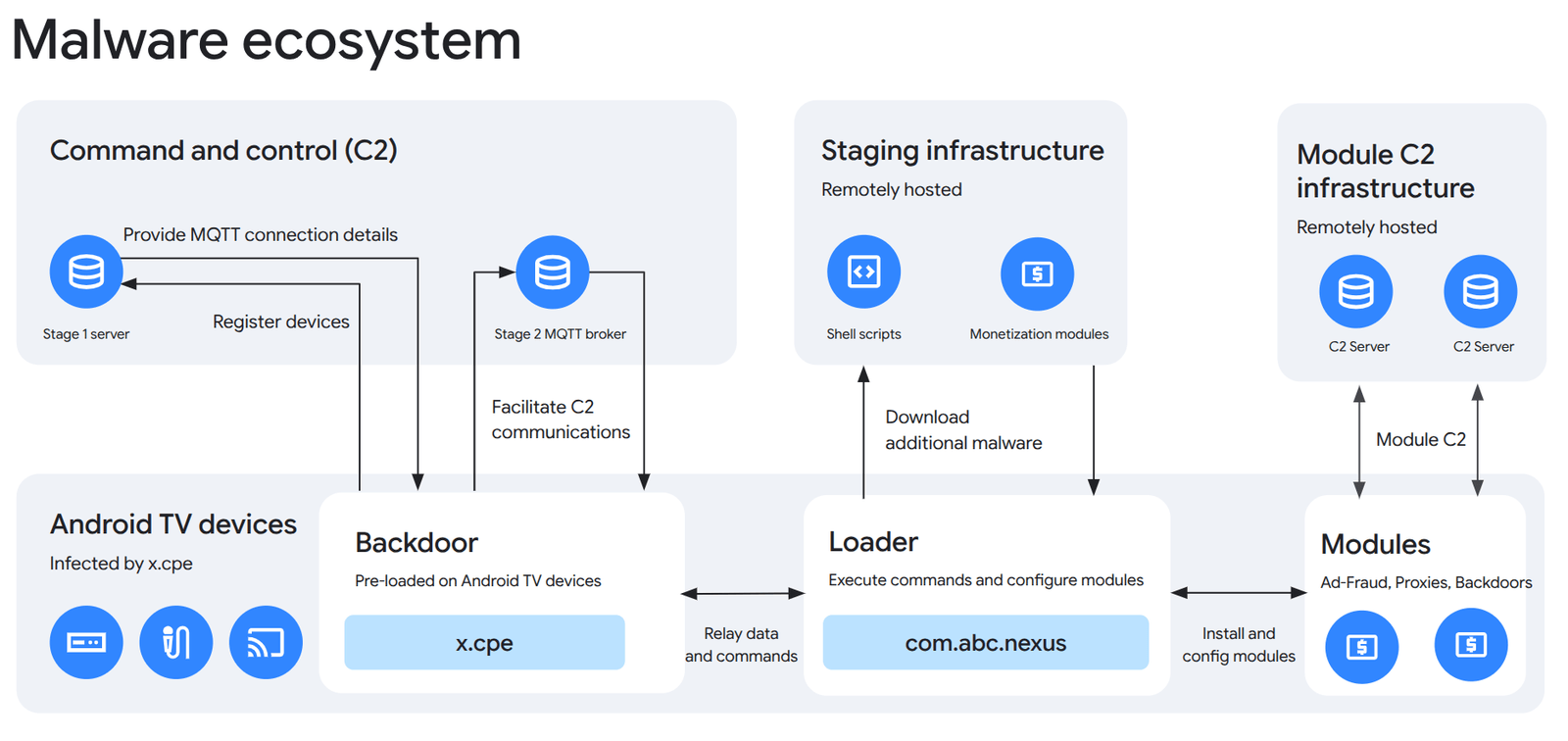
The malware has three stages. The primary backdoor, x.cpe (called com.oemservice in some builds), is preloaded in the firmware and runs with system privileges. If a user uninstalls it, it reinstalls itself from the /oem/ partition at the next reboot. It handles communication with the control server and passes work to a loader called com.abc.nexus, which carries its own anti-analysis tricks and sets up the money-making modules.

These modules are supplied by other criminals working as affiliates. They can arrive as programs built into the backdoor, software packages added to its loader, or extra apps downloaded later. Many turn the device into a residential proxy, allowing other people to use the victim’s home internet connection to hide their online activity. Others commit ad fraud or install additional backdoors. In other words, a set-top box becomes a proxy server without its owner’s knowledge.

The backdoor uses two steps to control infected devices. First, the box sends an HTTP request to download settings, location data and network information. It then maintains a live connection through MQTT, a lightweight messaging protocol, to receive commands from the operators. Google found that all analyzed samples used the same MQTT server to communicate with infected devices.

“Additional monetization modules as well as various shell scripts and legitimate applications are hosted remotely and downloaded by infected devices upon command from the operator via the MQTT broker.” continues the report. “A significant majority of these files are hosted as Github releases on operator-owned Github pages. Other files are hosted on operator-controlled servers and file hosting sites.”

Through this connection, attackers could secretly install apps, run commands and scripts, take screenshots, record keystrokes and map the victim’s network. They could also disable Google Play Protect’s app verification to install software without the user’s knowledge. Google observed operators taking screenshots, recording keystrokes, collecting account and device information, stealing app lists and system logs, and opening remote command-line sessions. However, most of their activity involved installing, removing and managing malware modules.

The malicious files came from several sources. The attackers mainly used GitHub releases hosted on their own accounts, the Filemail file-sharing service and two servers under their control. Network traffic analysis also suggests that the operators managed the command infrastructure through remote interfaces and an EMQX web console, connecting from IP addresses outside the infected device network.

Most infected devices are Android TV set-top boxes, but Google also found telehealth devices, karaoke machines and digital signage. One device can run several modules at once, up to three residential proxy kits. That shows Videostrong wants to squeeze every infected device as hard as it can. The proxy and bandwidth-sharing kits named in the report include Linkfog, AppSalt, GaGaNode, BWM, Traffmonetizer, EarnFM and NetNut.

Some of those kits enroll devices without asking. AppSalt’s SDK, owned by Honeygain, calls an opt-in function without showing any consent screen, and it stops running if the app came from the official Google Play Store. Ad-fraud modules such as Fission and HiddenView fire off fake ad impressions in the background, and HiddenView also uses hidden browser windows to simulate clicks and scrolling.

The configuration shows a well-run operation. MQTT messages carry resource limits for each module, download links per processor type, and priority weights. Devices are assigned to one of six timezone-based pools on ott.szbboys[.]com. Devices report their bandwidth use and alarms back, so the modules stay within set limits.

Google says the underlying market is resilient. Backdoor operators, ad-fraud rings and residential proxy providers work as an interconnected supply chain, and when one part gets disrupted they quickly switch to new loaders or rival kits. Lasting change, it says, needs accountability across hardware makers, the residential proxy industry and the broader technology sector.

Google wants retailers and distributors to require independent security audits from device manufacturers and to delist any implicated in supply-chain abuse. It says proxy providers’ claims of ethical sourcing need transparent, auditable proof of user consent, and that in its analysis these providers asked for consent only when platform policy forced them to. Silent opt-in remains the most common way devices become exit nodes.

For consumers, Google advises caution with apps that pay you for “unused bandwidth” or “sharing your internet”, which are a main way illicit proxy networks grow. Stick to app stores you trust, review permissions for third-party VPNs and proxies, and keep Google Play Protect on. Buy connected devices like set-top boxes only from reputable manufacturers, and check the partner list on Google’s Android TV website. Google also urges mobile platforms, ISPs, online marketplaces and other tech platforms to keep sharing intelligence.

“A device manufacturer intentionally infecting their users with malware is an unacceptable breach of trust. By turning everyday hardware into persistent beachheads for criminal affiliates, Videostrong prioritized illicit post-sale recurring revenue over the safety and privacy of its users.” concludes the report. “Downstream hardware brands, white-label resellers, telecommunications providers, and online e-commerce marketplaces also share responsibility for closing this vector.”

Follow me on Twitter: @securityaffairs and Facebook and Mastodon

Pierluigi Paganini

(SecurityAffairs – hacking, newsletter)

❌
❌