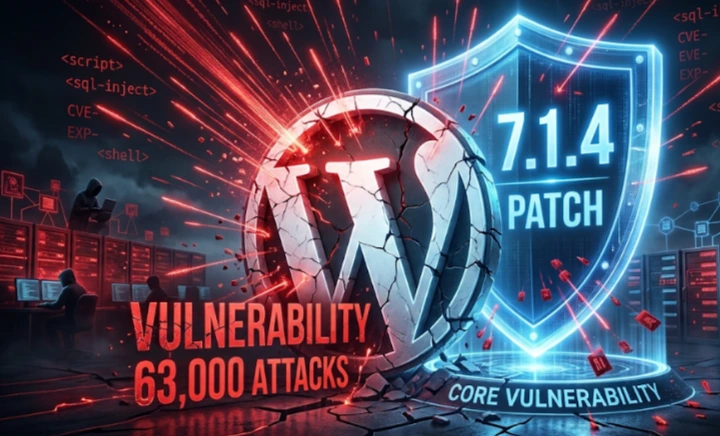
Attackers needed less than two days to start going after a freshly patched WordPress vulnerability. The flaw sits in WordPress core itself, and it can let an attacker run code on a website while that site is installing an update.
WordPress shipped version 7.1.4 on October 28, 2026, to close the hole. Within 48 hours of that release, exploitation attempts were already underway. Security firm Wordfence said it blocked 62,969 attacks aimed at this vulnerability in WordPress over a single 24-hou
Attackers needed less than two days to start going after a freshly patched WordPress vulnerability. The flaw sits in WordPress core itself, and it can let an attacker run code on a website while that site is installing an update.WordPress shipped version 7.1.4 on October 28, 2026, to close the hole. Within 48 hours of that release, exploitation attempts were already underway. Security firm Wordfence said it blocked 62,969 attacks aimed at this vulnerability in WordPress over a single 24-hour period.Anyone running WordPress for a business, a nonprofit, or a healthcare facility is being urged to update right away.
What WordPress 7.1.4 Fixes Beyond the WordPress Vulnerability
Version 7.1.4, released on October 28, is mainly a security release. Alongside the critical code execution fix, it patches several stored cross-site scripting (XSS) flaws, a denial-of-service issue, and two separate information leaks.The update also refreshes WordPress's bundled root certificates after eMudhra revoked its certificates. Of everything in the release, the code execution bug is the one attackers zeroed in on.Aaron Jorbin, who wrote the release announcement, told users to “update your sites without delay.”A GitHub security advisory published the next day described the issue as a timing weakness in the update system. If an unauthorized user moves quickly enough while an upgrade is running, they may be able to execute their own code on the server. No CVE number has been assigned to it so far.
How the Vulnerability in WordPress Works
When WordPress performs a full-package core update, it first extracts the new files into a dedicated directory inside the upgrade folder. According to the advisory, that directory had a predictable name and was reachable from the public web.That combination is the problem. An attacker who requests the right file at the right moment, before WordPress finishes cleaning up, could trick the server into running arbitrary PHP code.Pulling this off is not trivial. The attacker needs four conditions to line up: a full-package update in progress, web access to the temporary folder, a path they can guess, and a short window before the files are deleted. Under controlled conditions, that window may last only a few seconds.
Which Sites the WordPress Vulnerability Affects
The advisory lists every WordPress release from 4.7 through 7.1.3 as vulnerable. It also names the fixed version for each branch, including 7.0.8, 6.9.11, 6.8.12 and 5.9.20.The WordPress project said it backported the patch to all branches still receiving security maintenance, reaching as far back as 4.7. It also stressed that only the newest version is actively supported.Not every site can be taken over through this bug. The risk rises sharply, however, if an attacker hits a site while it is running a full-package update.Smaller websites face extra exposure. Many sit on shared servers with default settings, which makes them attractive targets for cybercriminals.
How Attackers Are Targeting the Vulnerability in WordPress
Wordfence traced the root cause to full-package upgrades repeatedly using web-accessible paths that are easy to guess. Alex Thomas, a threat analyst at Wordfence, said attackers quickly understood the race condition and turned their attention to it.Two of the biggest attack sources reportedly kept polling small groups of websites for roughly 14.5 hours. Other sources tried out different folder names and version names.The pattern looks like large-scale automated guessing rather than attacks on chosen victims. So far, no confirmed reports have put a number on how many sites have actually been compromised.
How Serious Is This WordPress Vulnerability?
Sources disagree on how severe the flaw is. The Hacker News gave it a CVSS score of 8.1, which falls in the high range. The GitHub advisory, by contrast, rates it as low severity.That gap most likely comes down to how hard the bug is to exploit successfully. Even so, the sheer volume of attack attempts and the simplicity of the fix make it sensible to treat this as a serious threat.
What Comes Next for This Vulnerability in WordPress
The probing is unlikely to stop soon. Once a vulnerability is patched, the fix itself becomes a detailed roadmap for anyone hunting sites that have not been updated.The WordPress project says backports to older branches are still in progress. The next major release, WordPress 7.2, is scheduled for December 8.The advisory credits researcher Umut Bayram with discovering the flaw and reporting it responsibly. There is currently no alternative workaround, so applying the patch is the only fix available.
A critical WordPress Core vulnerability is exploited in the wild. Update to WordPress 7.1.4 immediately to fix the unauthenticated race condition RCE.
Related Posts:
Android SMS of Death Bug Triggers Remote Reboots
JetBrains Patches Critical Flaws in IDEs and Background Services After Certificate Breach
CERT/CC Warns of Xerj Authentication Bypass Flaw CVE-2026-97406
The post WordPress Core Vulnerability Exploited in the Wild appeared first on Daily CyberSecurity.
Update Rank Math SEO PRO to 3.0.124 now. CVE-2026-111862 is a critical supply-chain compromise actively exploited in the wild via embedded malware.
Related Posts:
Roundcube 1.6.20 and 1.7.5 Fix 20 Security Flaws, Including IMAP Command Injection
PwnEscape Linux Kernel Flaw CVE-2026-99999 Lets VM Guests Escape to the Host
CISA Warns of Critical Flaws in dcm4chee Medical Archive and Unpatched EseeCloud IP Cameras
The post Rank Math SEO PRO Supply-Chain Compromise Exploited in the Wild via Versi
Update the Backuply WordPress plugin to 1.5.9 to fix CVE-2026-93953, a high-severity SQL injection vulnerability impacting 600,000 sites.
Related Posts:
Roundcube 1.6.20 and 1.7.5 Fix 20 Security Flaws, Including IMAP Command Injection
PwnEscape Linux Kernel Flaw CVE-2026-99999 Lets VM Guests Escape to the Host
CISA Warns of Critical Flaws in dcm4chee Medical Archive and Unpatched EseeCloud IP Cameras
The post Backuply WordPress Plugin Patched for High-Severity SQL Injection Vulnerability app
A critical Ghostscript vulnerability, CVE-2026-39919 (CVSS 9.8), allows remote code execution via crafted PDFs. Update Ghostscript to 10.08.0 now.
Related Posts:
SAP Security Patch Day October 2026 Fixes CVSS 10 Cloud SDK Flaw and Three More Critical Bugs
IBM Patches Three Critical Flaws in IBM i, Db2 Mirror and Maximo AI Service
Discourse Vulnerabilities Let Attackers Hijack Pages for Every Visitor and Read Server Files
The post Critical Ghostscript Vulnerability CVE-2026-39919 Turns Uploade
Wordfence uncovered stealthy WordPress must-use plugin malware. Learn how this WordPress must-use plugin malware abuses EtherHiding to steal secrets.
Related Posts:
Malicious Terraform Providers Spread Graphalgo Go Malware
CLOSEDQUORUM AI Malware Uses LLMs for Autonomous C2
New TASK#STOMP PowerShell Backdoor Targets Windows
The post WordPress Must-Use Plugin Malware Uses EtherHiding appeared first on Daily CyberSecurity.
A backdoored ARVE WordPress Plugin release could grant attackers administrator access with one token, but WordPress.org blocked automatic distribution to WordPress sites.
A backdoored ARVE WordPress Plugin release could grant attackers administrator access with one token, but WordPress.org blocked automatic distribution to WordPress sites.
 Entrar