Chaotic Eclipse released PrettyPrague, a PoC exploit for a GenDigital Avast Antivirus ZeroDay Elevation of Privileges Vulnerability
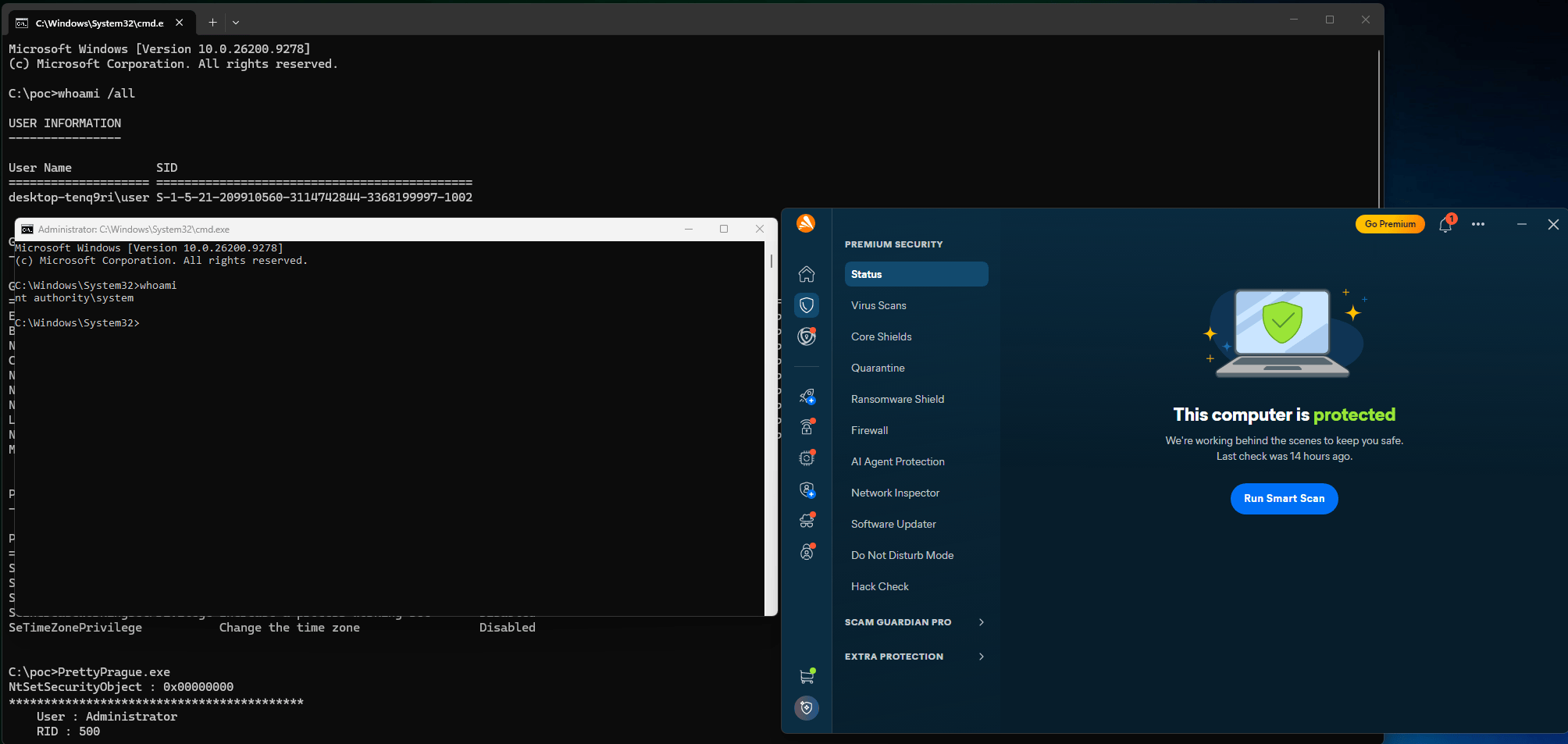
Security researcher Chaotic Eclipse, also known as INFINITE NIGHTMARE, MSNightmare and Nightmare-Eclipse, released a new zero-day exploit targeting GenDigital Avast Antivirus. The researcher named the exploit PrettyPrague, it triggers a privilege escalation flaw.
The researcher claims to have found another zero-day in an antimalware product, this time targeti
Chaotic Eclipse released PrettyPrague, a PoC exploit for a GenDigital Avast Antivirus ZeroDay Elevation of Privileges Vulnerability
Security researcher Chaotic Eclipse, also known as INFINITE NIGHTMARE, MSNightmare and Nightmare-Eclipse, released a new zero-day exploit targeting GenDigital Avast Antivirus. The researcher named the exploit PrettyPrague, it triggers a privilege escalation flaw.
The researcher claims to have found another zero-day in an antimalware product, this time targeting Avast Antivirus. The PoC exploits a flaw in Avast Sandbox to dump the Windows SAM database and gain a SYSTEM-level shell. It reportedly works even on fully patched Avast Antivirus and Windows 11 25H2. The researcher also suspects the flaw may affect other Gen Digital products, including AVG and Norton.
“Another zeroday in an antimalware provider, I’m not sure but I believe this vulnerability affect other GenDigital products as well (such as AVG, Norton…) For now the PoC is compatible with any version of Avast Antivirus.” reads the announcement. “The PoC will dump the SAM database by abusing a vulnerability in Avast Sandbox and spawn a full SYSTEM shell, at the time of writing this the PoC works with fully patched Avast Antivirus + Patched Windows 11 25H2”
Recently, Chaotic Eclipse released another exploit targeting anti-malware solutions. It is named HardBreacher, a PoC exploit for a Kaspersky Endpoint Security privilege escalation flaw.
Chaotic Eclipse, also known as Nightmare Eclipse, is a researcher known for publicly releasing PoC exploits for zero-day vulnerabilities, often after criticizing vendors’ handling of vulnerability reports. His releases have mainly targeted Microsoft products, including Windows and Microsoft Defender, with some later exploited in the wild. Among the most notable are the Undefend and RedSun Defender zero-days.
His work has fueled debate over responsible disclosure and the risks of publishing working exploits.
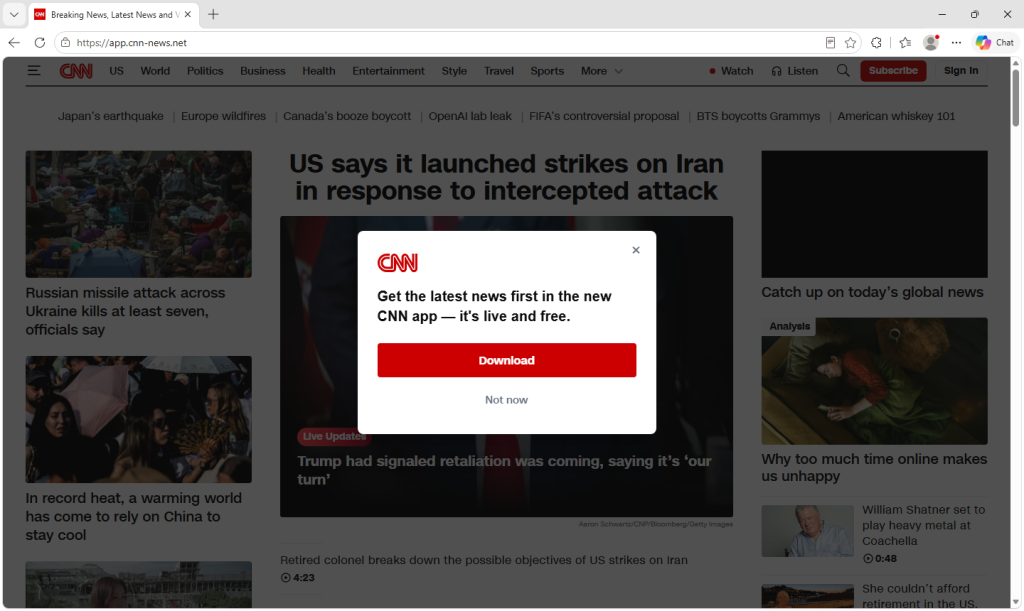
A website built to look almost exactly like CNN’s homepage is telling visitors to download “the new CNN app.” But it’s not CNN’s app, and has nothing to do with the news company.
The campaign doesn’t stop at CNN. It also uses fake Stremio and Avast installers hosted on similarly convincing lookalike sites, all targeting Windows users. The installers are part of the same campaign to trick people into installing legitimate remote-management software that’s already linked to the attacker’s acco
A website built to look almost exactly like CNN’s homepage is telling visitors to download “the new CNN app.” But it’s not CNN’s app, and has nothing to do with the news company.
The campaign doesn’t stop at CNN. It also uses fake Stremio and Avast installers hosted on similarly convincing lookalike sites, all targeting Windows users. The installers are part of the same campaign to trick people into installing legitimate remote-management software that’s already linked to the attacker’s account.
Instead of downloading the software they expected, victims install O&O Syspectr, a genuine, digitally signed remote administration tool used by IT teams to manage computers. In the wrong hands, that tool can give an attacker remote access to a victim’s PC, allowing them to run commands, install additional software, or explore files and data. The CNN, Avast, and Stremio lures all point back to the same Syspectr account.
Another lookalike site uses a fake crypto-mining browser game instead of a trusted brand, but delivers the same software from a different Syspectr account.
Here’s what we found, why your antivirus has no reason to stop it, and the one 10-second check that would have caught it every time.
What the fake CNN page looks like
The site copies CNN’s real homepage closely enough that most people wouldn’t look twice. It has current headlines, the same layout, and even a red “Live Updates” tag on a real story. A pop-up interrupts almost immediately: “Get the latest news first in the new CNN app—it’s live and free,” with a red Download button underneath.
The file behind that button is named CNN_App.setupad4693fd-d903-4791-8f58-975261c93ca2.exe—the same Syspectr installer that shows up under different branding elsewhere, down to the account ID embedded in the filename.
The same trick, impersonating other brands
A lookalike site at avast-premium[.]shop mimics Avast’s real download page closely, including the logo, review scores, and a blue “Free download” button for “Avast One.” The file behind it is named AVAST_App.setup4693fd-d903-4791-8f58-975261c93ca2.exe.
Another malicious site, stremiotv[.]online, copies Stremio, a legitimate media-center app. The file it pushes visitors to download is named Stremio_App.setup4693fd-d903-4791-8f58-975261c93ca2.exe.
Both carry the same account ID found in the CNN installer.
By impersonating trusted brands, the attackers trick visitors into installing the legitimate O&O Syspectr remote-access tool, which gives the attackers remote access to the victims’ computers.
A different kind of bait
Not every lure needs a trusted brand, however.
syncminer[.]xyz invents its own hook instead: an “idle miner” browser game showing a slowly-ticking cryptocurrency balance, with a “Download Miner Plugin” button promising faster payouts. The identical site also runs at idleminer[.]pro with the same layout, same game, and same download.
Both distribute the same file, named oo-syspectr-setup9158bf2a-ff25-4290-b96c-2dc5eb310391.exe outright, carrying its own account ID that is different from the CNN, Avast, and Stremio lures we saw.
It’s not malware, which is why antivirus can miss it
Every one of these files is a real, digitally signed piece of software from O&O Software GmbH, a legitimate German company. Syspectr is sold openly to IT departments and gives an operator remote desktop control and an admin-level command line on whatever machine it’s installed on.
That’s why antivirus software may not stop it. Antivirus is designed to detect malicious software, not flag a legitimately signed business tool just because of how it arrived on a computer. The attacker only has to convince victims to install a legitimate remote-management tool that’s already linked to the attacker’s account.
The 10-second check that gives it away
On Windows, right-click any installer like this, choose Properties, and open the Details tab. Two fields—File description and Product name—identify every installer we examined as O&O Syspectr, alongside a copyright notice for O&O Software GmbH.
The filename can be changed by anyone distributing the file, but those embedded details come from the signed software itself. Changing them would invalidate the digital signature, so they reveal what the installer really is.
How we know these are connected
Every Syspectr installer includes the account ID of whoever generated it, embedded directly in the filename. The CNN-, Avast-, and Stremio-branded files all carry the exact same account ID, showing they were created from a single Syspectr account and simply reskinned for different lures.
The Syspectr installer distributed through the fake crypto-mining game carries a different account ID, suggesting either a second operator using the same playbook or the same group operating under another account.
What this tool can actually do
Syspectr is designed to let IT administrators manage computers remotely. Depending on the subscription level, that can include viewing system information, monitoring running processes and services, managing Microsoft Defender, and restricting USB devices.
The paid plans add the features that matter most to attackers. They allow an operator to remotely control the victim’s computer, browse files, run commands, install additional software, and make changes to the system as though they were sitting in front of it. Higher tiers add tools for managing large numbers of devices and, on compatible hardware, even allow remote access when Windows won’t boot.
These remote-control features aren’t available on free Syspectr accounts. They require a Premium subscription or higher.
O&O Software response
O&O responded quickly. Within days, the company disabled Remote Desktop and Remote Console access for free Syspectr accounts, restricting both to paid plans only.
O&O has since identified and suspended the abusive accounts, also blocking them from adding new devices. O&O’s analysis found the attackers relied exclusively on Remote Console, not Remote Desktop. The company says it will keep scanning for this pattern and tighten restrictions further if needed.
It’s a solid response and O&O clearly has a handle on how the abuse is happening. Not every vendor moves this quickly or this effectively when their software gets abused.
How to protect yourself
Only download software from the vendor’s actual website. Search results and ads can lead to convincing fakes.
Before running any installer you’re unsure about, on Windows you can right-click it, open Properties > Details, and check the File description and Product name fields.
If you find O&O Syspectr installed and didn’t set it up yourself, uninstall it through Settings > Apps and run a full antivirus scan.
If you ran an installer like this recently, change passwords for anything you accessed on that machine afterward from a clean machine.
Protect yourself while browsing online. Malwarebytes Browser Guard blocks known scam and lookalike pages before you land on them.
Remember
Fake download sites don’t always deliver malware. Sometimes they deliver legitimate software that’s been weaponized by the person distributing it. That’s why it’s important to download software from the real vendor and, if something doesn’t feel right, check what the installer actually is before you run it.
Os pesquisadores de ameaças da Gen (NASDAQ: GEN), líder global na promoção da liberdade digital por meio de um portfólio de marcas confiáveis que inclui Norton, Avast, LifeLock e MoneyLion, entre outras, identificaram uma sofisticada campanha de fraude que utiliza falsas ofertas de emprego e processos de recrutamento aparentemente legítimos para roubar credenciais de acesso dos usuários e obter informações sensíveis. Os criminosos exploram a reputação de organizações e marcas amplamente reconhec
Os pesquisadores de ameaças da Gen (NASDAQ: GEN), líder global na promoção da liberdade digital por meio de um portfólio de marcas confiáveis que inclui Norton, Avast, LifeLock e MoneyLion, entre outras, identificaram uma sofisticada campanha de fraude que utiliza falsas ofertas de emprego e processos de recrutamento aparentemente legítimos para roubar credenciais de acesso dos usuários e obter informações sensíveis. Os criminosos exploram a reputação de organizações e marcas amplamente reconhecidas, assim como o interesse gerado por grandes acontecimentos internacionais, para dar maior credibilidade aos seus golpes.
Entre os exemplos analisados, foram encontrados sites que se passavam pela FIFA e por outras entidades e marcas vinculadas a um dos eventos esportivos mais aguardados de 2026. No entanto, os pesquisadores também observaram tentativas semelhantes que utilizavam a imagem de empresas reconhecidas de diferentes setores para gerar confiança nos usuários.
A investigação revelou que os criminosos não se limitam a publicar vagas falsas. Em muitos casos, eles constroem processos completos de contratação que incluem perfis falsos de recrutadores, alguns deles baseados em fotografias e informações de profissionais reais disponíveis publicamente em plataformas como o LinkedIn. Além disso, enviam convites de calendário e direcionam as vítimas para sites projetados para imitar páginas legítimas de recrutamento.
Os pesquisadores alertam que uma página de emprego com aparência profissional não garante que seja autêntica. Os cibercriminosos podem copiar logotipos, fotografias, descrições de vagas e até botões de login de sites legítimos para criar páginas fraudulentas altamente convincentes. Além disso, o uso de ferramentas de inteligência artificial facilitou a criação desse tipo de sites maliciosos, tornando-os cada vez mais difíceis de detectar.
Uma vez no site, os usuários são convidados a iniciar sessão por meio de opções conhecidas, como o acesso com o Google. No entanto, por trás dessas páginas há formulários criados para capturar credenciais e outras informações sensíveis. Os pesquisadores observaram que algumas campanhas rejeitavam contas pessoais e solicitavam especificamente contas corporativas, com o objetivo de obter acesso a sistemas internos, arquivos e outros recursos empresariais.
“A engenharia social tornou-se cada vez mais sofisticada. Os cibercriminosos já não dependem apenas de e-mails suspeitos ou mensagens mal redigidas; agora são capazes de replicar processos completos de recrutamento, inclusive com ajuda da IA, e aproveitar a confiança gerada por marcas e organizações reconhecidas. Isso transforma as falsas ofertas de emprego em uma ameaça especialmente perigosa, já que as vítimas acreditam estar diante de uma oportunidade profissional legítima quando, na realidade, estão entregando acesso a informações valiosas”, afirma Iskander Sanchez-Rola, Diretor Sênior de IA e Inovação na Norton.
Os pesquisadores também descobriram que, uma vez que uma página maliciosa é removida, os criminosos geralmente registram novos domínios para dar continuidade à campanha. Essa capacidade de adaptação dificulta a detecção e permite que as ameaças permaneçam ativas por mais tempo.
Desde 1º de maio de 2026, os produtos da Gen, incluindo Norton, bloquearam mais de 250 ataques relacionados a essas campanhas, embora os especialistas alertem que o alcance real pode ser maior devido à constante evolução das táticas utilizadas pelos cibercriminosos.
Para ajudar os usuários a identificar esse tipo de ameaça, os especialistas da Norton recomendam:
Desconfiar de ofertas de emprego inesperadas ou excessivamente atraentes.
Verificar se as vagas provêm de sites oficiais e prestar atenção ao endereço do site.
Confirmar a legitimidade dos recrutadores antes de fornecer informações pessoais.
Evitar inserir credenciais em páginas acessadas por links recebidos por e-mail ou aplicativos de mensagens.
Suspeitar de qualquer processo de recrutamento que solicite credenciais corporativas ou informações sensíveis em etapas iniciais.
Confirmar a existência da vaga diretamente nos canais oficiais da organização.
Utilizar ferramentas de cibersegurança, como o Norton 360 com Norton Scam Protection, que utiliza inteligência artificial para ajudar a detectar tentativas de phishing e sites fraudulentos antes que comprometam informações pessoais ou credenciais de acesso.
À medida que as campanhas de fraude evoluem, a combinação entre engenharia social e o uso indevido de marcas reconhecidas continua se tornando uma das ferramentas mais eficazes para os cibercriminosos. Manter uma postura crítica e verificar cada etapa do processo pode ajudar a diferenciar uma oportunidade legítima de uma fraude projetada para comprometer informações pessoais e corporativas.
Sobre a Gen
A Gen (NASDAQ: GEN) é uma empresa global dedicada a impulsionar a Liberdade Digital por meio de suas marcas de consumo confiáveis, incluindo Norton, Avast, LifeLock, MoneyLion e outras. A família de marcas da Gen tem como base a oferta de segurança cibernética e empoderamento financeiro para as primeiras gerações digitais. Hoje, a Gen capacita as pessoas a viverem suas vidas digitais com segurança, privacidade e confiança para as gerações futuras. A Gen oferece produtos e serviços premiados em cibersegurança, privacidade online, proteção de identidade e bem-estar financeiro para quase 500 milhões de usuários em mais de 150 países. Saiba mais em GenDigital.com.
Sobre os Laboratórios de Ameaças da Gen
Os Laboratórios de Ameaças da Gen representam a equipe de pesquisa e tecnologia de Segurança Cibernética dentro da Gen, focada em descobrir e analisar as mais recentes ameaças digitais e golpes em todo o mundo. Com base em dados, pesquisa e experiência técnica, a equipe mapeia padrões e riscos que moldam um cenário de ameaças em constante evolução. Essas descobertas impulsionam tecnologias de segurança que protegem as pessoas em todo o portfólio de marcas confiáveis da Gen, incluindo Norton, Avast e LifeLock, entre outras.
Sobre a Norton
A Norton é líder em cibersegurança e faz parte da Gen (NASDAQ: GEN), empresa global dedicada a promover a Liberdade Digital por meio de um portfólio de marcas confiáveis para o consumidor. A Norton capacita milhões de pessoas e famílias com proteção premiada para seus dispositivos, privacidade online e identidade digital. Os produtos e serviços da Norton são certificados por organizações independentes de testes, incluindo AV-TEST, AV-Comparatives e SE Labs. A Norton também é membro fundadora da Coalition Against Stalkerware. Saiba mais em https://br.norton.com
A fake Avast scan tells you your PC is infected, then installs the malware that steals passwords, session data and crypto wallets.
The post Bogus Avast website fakes virus scan, installs Venom Stealer instead appeared first on Security Boulevard.

 Entrar