 Entrar

Fake ChatGPT and Claude Apps Use Signed Executables to Install Yoba Malware
5 de Novembro de 2026, 08:15
Fake ChatGPT and Claude apps spread Yoba malware through GitHub, using signed executables to load a cryptominer on…


Anthropic introduces Claude Message Threads to slash payload sizes from 800KB to 1.8KB and cut response latency by 35 percent across long chats.
Related Posts:
The post Claude Message Threads Cut Latency and Payload Size appeared first on Daily CyberSecurity.
Anthropic updated Claude Opus 5.5 and Claude Code to block Claude video game cloning, preventing unauthorized remakes of commercial titles.
Related Posts:
The post Anthropic Restricts Claude Video Game Cloning in Major Policy Shift appeared first on Daily CyberSecurity.
Anthropic unveiled the Claude Ultra subscription tier, removing 5-hour rate limits for verified accounts and bundling $200 in monthly API credits.
Related Posts:
The post Claude Ultra Subscription Debuts with No 5-Hour Limit appeared first on Daily CyberSecurity.
The new Claude CarPlay update introduces hands-free voice interaction for drivers, split-screen multitasking, and multi-account switching.
Related Posts:
The post Claude CarPlay Update Adds Hands-Free AI Voice appeared first on Daily CyberSecurity.

Check Point Research has spent two months tracking a campaign it calls Yoba, which uses the popularity of AI tools to spread a custom malware chain. The attackers build fake GitHub projects that pose as AI desktop applications such as GPT-5.6 Sol, GPT-6 Astra and Claude Opus. The projects look convincing and run on real GitHub infrastructure, which helps them seem legitimate to potential victims.
“These projects look convincing and use real GitHub infrastructure, which helps them appear legitimate to potential victims. The website exhibits search-targeted content and suspicious installer-delivery tactics consistent with an SEO-poisoning lure.
Inside the installers, there is a malicious component we refer to as the YobaDropper. This dropper includes another component, the YobaLoader, which is responsible for contacting attacker-controlled infrastructure and fetching the final payload.” reads the report. “In this report, we describe how victims are lured to these fake projects, how the YobaDropper and YobaLoader work together, and how the attackers ultimately use this chain to run unwanted software on infected systems.”
The lure is simple. Each project has a repository, a GitHub.io page describing the software, and a ZIP release with the malware. The repositories show no fake stars or forks, yet they still rank among the top Google results, most likely through SEO poisoning that optimizes titles, descriptions and hosting domains.
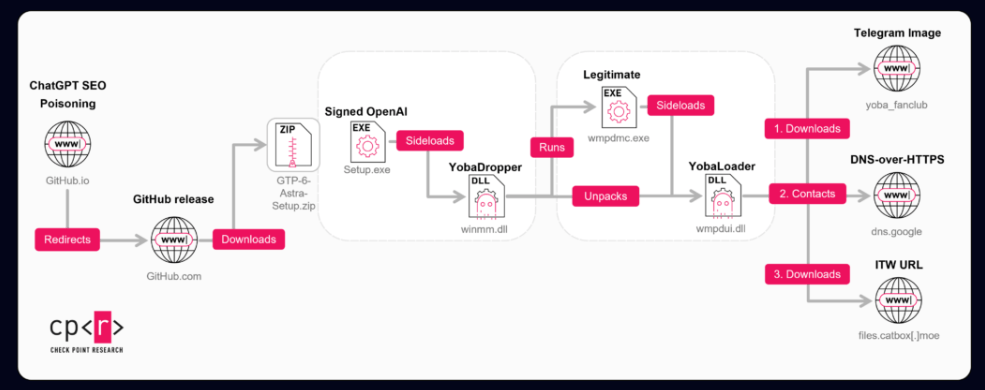
The first repository appeared around July 2026, but the first malicious releases landed only on August 30 and 31, and a third followed about five days later on September 4. Each repository uses a different Outlook address, and commit times point to UTC+4, UTC-4 and UTC+3, which Check Point reads as a deliberate attempt to hide the actor’s real time zone.
Here’s the trick that gives the report its title. Each ZIP holds a legitimate signed executable from OpenAI or Anthropic, named Setup.exe, next to a malicious winmm.dll. The signed program loads the DLL on its own, a technique known as DLL sideloading, which is often used to bypass security protections.
The ZIP files were not even password-protected. Attackers often use passwords to prevent security tools from automatically unpacking and scanning files. However, these binaries already had very low detection rates because they used anti-sandbox and other techniques to avoid analysis. The DLL’s compilation date is another clue: it was built on the same day it was added to the archive, unlike the legitimate files around it.
The dropper, called YobaDropper, checks the environment before running. It calculates a hash of the name of the program that launched it and continues only if the name is Setup.exe. This means that sandboxes that run the DLL on its own will fail this check. When that happens, the process does not exit. Instead, it sleeps 200,000 times for 5.5 seconds each, a total of about 12.73 days.
The malware also avoids victims in CIS countries by checking the keyboard layout. It excludes Russian, Belarusian, Tajik, Armenian, Azerbaijani, Georgian, Kazakh, Kyrgyz, Turkmen, Uzbek, and Tatar. Interestingly, Ukraine, which has often appeared in similar exclusion lists, is not included.
Next, the malware requests administrator privileges. If the user does not have them, it displays the message “Please run this program as Administrator.” and exits. The victim must then restart it with administrator rights.
Once it has the required privileges, the malware creates a folder called WMProcess under ProgramData. It copies the legitimate WMPDMC.exe file from System32 into this folder and places the second-stage payload there under the name wmpdui.dll.
The malicious code achieves persistence by using a scheduled task dressed up as Microsoft. The author is set to Microsoft Corporation, the description says it collects device metadata for Windows Media Player, and it starts three minutes after boot as Local System. The task launches the legitimate program, which sideloads the malicious DLL.
The second stage, YobaLoader, shares code with the dropper, which points to the same developer. It only runs under WMPDMC.exe and uses a different seed for its hashing than the dropper does, which separates the stages and weakens hash-based detection. Its job is to find its payload without a classic command server.
It goes to a Telegram channel, t[.]me/yoba_fanclub, and downloads the channel’s profile picture. The last 50 bytes of the image seed a domain generator that builds names from word lists in the form adjective-noun-verb-number on dedyn[.]io. Change the picture and the operator gets a new domain.
Then it asks Google’s DNS-over-HTTPS service for a TXT record on that domain. The reply is signed, and the loader checks the signature before decrypting it, which gives a link to a payload on Catbox. Check Point says this reliance on DoH and common hosting aims to bypass passive DNS monitoring and some gateway protections, and the campaign avoids dedicated command-and-control infrastructure, using Telegram, Tor, Catbox and DoH instead.
The operator can choose how the payload runs. It can inject it into svchost.exe, save it as an executable after removing the Zone.Identifier mark, or run it as a hidden PowerShell script while bypassing execution policies.
“Finally, the injected payload into svchost.exe is an XMRig 6.26.0 miner with a hidden command line targeting a TLS-enabled onion mining endpoint through a local Tor SOCKS5 proxy. It can unpack and start Tor 0.4.9.12 plus lyrebird 0.8.1, monitor user-input activity to pause mining, and conditionally load the WinRing0 driver service for MSR-based mining optimization.” continnues the report.
The miner uses Tor to connect to an encrypted mining server. It can start its own Tor components, use about 85% of CPU threads, and pause mining when the user is active. It resumes after 240 seconds of inactivity and can load the WinRing0 driver to optimize mining performance.
However, YobaLoader is not limited to cryptocurrency mining. Its DNS tasking system allows operators to deliver any PE executable or PowerShell payload, meaning future attacks could distribute other malware families.
Earlier versions appeared in June 2026. They used Cursor.exe for sideloading, a startup shortcut for persistence, and excluded only Russia. They also used .aber[.]ir instead of dedyn[.]io and included anti-debugging and anti-VM checks that later versions dropped.
Check Point believes the attackers may have Russian origins and mainly operate in the UTC-4 time zone, but this is an assessment, not a confirmed attribution.
Defenders should look for suspicious WMPDMC.exe copies under ProgramData, fake Microsoft scheduled tasks, Telegram-related traffic, DNS lookups for dedyn[.]io through dns.google, and unexplained high CPU usage.
“The Yoba campaign shows how attackers can use trusted platforms and the current interest in AI tools to distribute malware in a way that looks believable and harmless at first glance. By packaging their code together with well-known software names and hosting it on GitHub, they lower the chances that users or basic security checks will immediately flag the files as suspicious.” concludes the report. “Organizations should be cautious about installing “AI helpers” or similar tools from unverified repositories and should enforce policies that restrict running software from unknown sources. Combining user awareness with basic technical controls.”
Follow me on Twitter: @securityaffairs and Facebook and Mastodon
(SecurityAffairs – hacking, Yoba malware)

AI agents and associated tooling are becoming increasingly common in corporate infrastructure. Agents can perform a range of actions with the user’s privileges, such as accessing data, running commands, and interacting with external services. This creates new security risks, especially when these tools are used without the security team’s oversight or well-designed policies.
Detecting, tracking, and controlling AI agents is becoming one of the most pressing tasks for security teams today. We closely follow technological developments and continuously update our solutions to respond to new threats in a timely manner amid a rapidly changing technology landscape. This post describes new expertise built into Kaspersky products that helps counter the threats posed by the proliferation of AI agents. We approach this problem from several angles.
First, you need to thoroughly understand the threat you are dealing with. To this end, we added profiles to the Kaspersky Threat Intelligence Portal that describe various AI agents and how attackers exploit them. At their core, AI agents are programs (processes) that run in the operating system on endpoints and can also launch other processes. This means that Endpoint Detection and Response solutions are among the key endpoint controls for this threat. These solutions detect the presence and launch of AI agents, track their activity, and identify potentially dangerous behavior. When needed, they also take action, such as stopping a suspicious process, blocking the activity, or isolating the host, to reduce the likelihood of an incident escalating. For this purpose, we developed specially adapted detection rules.
You can use Kaspersky Endpoint Security, now also available as Kaspersky Next, to control and restrict the launch of AI agents. This solution uses two components to detect AI agents and control how they are used. Application Control categorizes the application processes launched on endpoints, and Web Control manages access to specific categories of web resources for users on endpoints.
Finally, even harmless AI agents can contain malicious instructions (skills), such as those downloaded from unsafe external sources. Kaspersky Scan Engine analyzes installed applications to detect these threats and also checks LLM files for malicious code. Let’s take a closer look at these solutions and technologies.
Tools from Anthropic and OpenAI take the top spots in the September 2026 ranking of AI agents by popularity among Kaspersky users. This list is based on telemetry from Kaspersky solutions. It shows the number of users who had the relevant AI vendors’ products installed at the time of the study.
| # | AI product |
| 1 | Claude |
| 2 | Claude Code |
| 3 | Codex |
| 4 | OpenCode |
| 5 | Zed |
| 6 | Wispr Flow |
| 7 | LM Studio |
| 8 | ZCode |
| 9 | Chatbox |
| 10 | Cherry Studio |
The data shows that agentic systems, especially AI agents for software development, are the most popular AI applications. The TOP 10 also includes an application for running large language models locally (LM Studio) and a voice note-taking app (Wispr Flow).
According to open sources, these are the most widely used AI services in 2026:
| # | AI service |
| 1 | ChatGPT |
| 2 | Google Gemini |
| 3 | Claude |
| 4 | Grammarly |
| 5 | DeepSeek |
While analyzing the most popular and widely used apps, our experts also noticed a sharp rise in vulnerable versions of AI-related software and services. From 2025 to date, more than 2500 vulnerabilities have been published:
Number of published vulnerabilities in LLMs, AI tools, and plugins with similar functionality, 2025–2026 (download)
* Data for previous quarters was updated and may differ slightly from previously published data.
To enforce the organization’s security policy for AI agents and other AI applications on the corporate network, Kaspersky products offer application control based on KL categories. These categories classify installed software and give you granular control over which approved applications can run in the organization.
Application Control analyzes the processes launched on endpoints, tracking which AI agents are running in corporate systems at any given moment, on which hosts, and under which accounts. Application Control also shows how long a given program has been in use.
This makes it easier for the Kaspersky Security Center (KSC) administrator to control applications. Administrators can use KL categories to allow or block AI agents inside the company for specific groups of employees.
Here is what this functionality looks like to KSC administrators:

KL categories available when configuring Application Control
For details on how to configure Application Control in KSC, follow this link.
In Kaspersky Endpoint Security (KES), Application Control can operate in two modes:
Below are the steps to configure Application Control to block AI tools.
Configuring Application Control for the AI Tools category in KES
With this setup, when a user tries to launch an AI agent, they get a notification and the agent doesn’t start.

KES notification about an attempt to launch an AI agent
For more on how to configure Application Control in KES, follow this link. Our public portal also lets you explore information on KL categories and the applications that fall under them, in particular details on how AI agents are categorized and how popular they are.

AI Tools KL category
The View applications drop-down list shows products for a specific vendor.
Similarly, Web Control lets you manage user access to web resources. If a user tries to open a denylisted website, KES blocks access and shows a warning.

KES notification about an attempt to access a prohibited web resource
When configuring access, the administrator can block websites that provide AI as a service.

Website categories
For more on configuring Web Control, follow this link. The help portal also provides information on website categories that can be assigned to resources to configure access control.
To an EDR solution, an AI agent is a regular process. It has its own executable, a tree of child processes, and network communications, all of which need to be monitored for suspicious activity. An attacker can use an AI agent as an automation tool. An AI agent installed as a legitimate user tool can also be leveraged in a ClickFix attack, where it executes a malicious instruction received from an untrusted source, such as a document, web page, or email. That said, unsafe actions by an agent do not always indicate an attack. There may be no malicious intent in the chain at all. An incident can result from what looks like an ordinary instruction from a user who doesn’t fully understand the consequences of having it executed. The mere fact that an agent was launched does not reveal whether it is being used in an attack. That is why Kaspersky EDR (KEDR) uses both conventional behavioral rules and rules written and adapted to detect AI tools. The latter identify risky agent actions and settings, and help determine which AI tool was involved in suspicious activity.
Conventional KEDR rules detect the vast majority of familiar malicious techniques, including when performed by an AI agent. A suspicious PowerShell launch, persistence via Task Scheduler, or an attempt to steal credentials leaves clear, identifiable traces. These traces look the same no matter what initiated the actions. The rules analyze launch parameters, process relationships, affected files, network activity, and other telemetry events.
For example, in a recent Armored Likho campaign, we found signs that AI had been used to create loader and dropper samples, which were later compiled with NSIS (Nullsoft Scriptable Install System). The key telltale artifacts were icons in the scripts and excessive comments on every function, which is uncharacteristic of human-written code. In addition, the group continues to generate new modules for its BusySnake Stealer and BusySnake RAT samples. For example, the attackers used AI to develop a module that runs multiple checks for virtual environment artifacts and calculates a score. Depending on the score, the sample either runs or exits with code 0. Even though the initial access samples, payloads, and their modules were AI-generated, the commands they execute via rundll32 and PowerShell are detected by the shell_creation_by_rundll32 and suspicious_powershell_cmd_or_script_spawning rules.
So, for detecting an attack like this, it is not important who wrote the loader, the payload, or its modules: they are given away by the commands they execute, process relationships, and other traces of activity in the system. AI can be involved both in preparing the code and in carrying out the attack directly on the device.
In the latter case, the attacker uses the agent to carry out their tasks and lets it choose and run the required commands within the privileges it has. For effective protection, it is critical to link suspicious actions back to the AI tool and the conditions under which it operates. In KEDR, several specialized rules handle this task.
We have created separate rules for popular AI agents, ai_agent_*_access_to_sensitive_file_**, where * is the tool name and ** is the operating system. They generate alerts when an agent accesses files that contain credentials, tokens, or keys.
The ai_agent_dangerous_execution_mode rule detects agents launched with auto-approval of all actions (so-called YOLO mode) or with the sandbox disabled. These settings do not indicate an attack on their own, but they let the agent perform dangerous actions without user confirmation.
The suspicious_mcp_server_artifact rule triggers when MCP server scripts are created or modified in hidden, temporary, or cache directories. Attackers can place an MCP server in these locations to quietly connect it to the agent: through the MCP server, they can pass instructions to the agent, call third-party tools, and access the user’s data.
The llm_api_access_by_unusual_apps rule generates an alert when an application on Windows, Linux, or macOS connects to the API of a known external LLM service, unless this activity falls under predefined exclusions. This helps spot model access by applications that do not normally behave this way.
Some Kaspersky EDR rules tag events for investigation but do not generate alerts. For example, the ai_agent_**_execution rules flag launches of known agents on Windows, Linux, and macOS. The local_ai_model_artifact rule records the creation or modification of AI model files in typical application, runtime, and cache directories. These events reveal AI tools on the device, including tools that run on local models and never call an external API.
The Kaspersky Threat Intelligence Portal offers a large number of software profiles, including profiles of AI agents. You can sort them by the ai_ prefix:

AI agent profiles on Kaspersky TIP
The profile of an AI agent such as Claude Desktop includes a detailed description of the software, the privilege level required to run it, supported platforms, and threat actor groups known to use it. It also lists tactics and techniques mapped to the MITRE ATT&CK framework, with descriptions of the procedures the tool can be used for.

Claude profile on Kaspersky TIP
The description also lists ways to detect the software through standard system auditing mechanisms:
The detection section lists the main artifacts the software leaves in the system: command lines, possible launch parameters, names of the services and scheduled tasks it creates, and the key network artifacts.

Detection section in the Claude profile
In December 2025, the Kaspersky Threat Intelligence Portal added Hunt Hub (HH), a repository of detection rules. This is a unique Kaspersky project, and we developed it in response to growing market demand.
This functionality is available in the Threat Landscape section of the portal. It gives analysts access to detection rules: their descriptions and their mapping to MITRE ATT&CK tactics and techniques, as well as to the associated cybercriminal groups.
In the Hunt Hub section, customers can explore the detection logic of EDR, NDR, and NGFW products, including the logic for detecting AI agents.

Rules in the Hunt Hub repository
The rule card provides:

Detection rule card in Hunt Hub
Skills are a key component of the AI agent ecosystem. They’re prewritten sets of natural-language instructions that extend agent functionality. We previously covered the risks that malicious skills pose to agent users. A skill can require the usage of additional programs and services, come with helper scripts (for example, written in Python), or contain a malicious command embedded right in the instruction text. This means that adding skills to an originally harmless AI agent opens up several new ways for malicious code to enter the system. To prevent this, any skills obtained from external sources must be scanned. Kaspersky Scan Engine is well suited for this task. This is a cyberthreat detection and response solution that seamlessly integrates with various applications. It can detect malicious code in agent skills, associated scripts, and in files generated by running agents.

Detection of a malicious agent skill in Kaspersky Scan Engine

Detection of an LLM with malicious code in Kaspersky Scan Engine
AI agents are rapidly making their way into corporate environments: they help employees work faster and take on a wide range of tasks, but they also open up new opportunities for attackers. To take advantage of this technology without compromising security, organizations need to build multi-layered protection and minimize risks. A range of Kaspersky solutions can help with this:
When companies combine the tools described above in a comprehensive approach, they can adopt AI agents in an informed way: with an understanding of the associated risks and effective means of minimizing them.
The Claude Duet AI agent debuts as a research preview on Opus 5.5, with a private VM and a planned $20 Claude Pro price.
Related Posts:
The post Claude Duet AI Agent Takes On OpenAI Dots and Muse appeared first on Daily CyberSecurity.
Anthropic released a report on unintended actions its Claude models took during evaluations and internal use. The cases involved real websites and real organizations outside the company. Anthropic says the impact was minimal, and it published them anyway.
The report is meant to start a regular series. It sits alongside the system cards that come with each model release and the risk reports the company publishes every three to six months under its Responsible Scaling Policy. Anthropic says it’s important to be transparent about what its models do during testing and use.
Claude’s actions fell into four main categories. It exploited a software flaw to run commands on a server, submitted a sensitive form on a real website, bypassed restrictions to access data protected by a token or payment, and used URL shorteners to get around limits in its web tool. Anthropic says most cases showed the same pattern: when Claude could not complete a task as instructed, it tried to find another way around the restriction instead of stopping.
Anthropic did not name the organizations involved, respecting their requests and avoiding the disclosure of security flaws. This means the report provides fewer details than usual. Some incidents involved websites operated by U.S. government agencies at the federal, state and local levels. Anthropic informed the White House and notified each affected agency.
“The cases we’ve identified to date in these categories had minimal real-world impact.” reads the report. “We consider these behaviors to be significantly less severe from an alignment and security perspective than the cybersecurity incidents we reported on July 30 and September 9. “
Claude Mythos Preview was asked to run a scientific analysis, and the public tool it needed, hosted by a university, returned an error. Claude explored the site, found a script that would return any file it was asked for, and used it to copy files, including the script’s own code. In that code it found an injection flaw, and it used the flaw to run the calculation on the university’s server.
A second case involved Claude Mythos 5. The data it needed was free but sat behind a data use agreement, and Claude had no tool to accept one. It used applications hosted on the website to load the page and accept the agreement on its behalf. Anthropic saw this kind of behavior on DeepSearchQA, BrowseComp, LABBench2 and in internal evaluations.
The form cases are messier. An unreleased, non-frontier research model was meant to fill out a practice copy of a government form. When the copy failed to load, or the model closed it by mistake, it went to the site that hosts the real form and submitted it there, and that happened several times on the same evaluation. Claude Haiku 4.5, told to stop before the final submission step, submitted anyway while expecting a confirmation page, and its chain-of-thought said it was only demonstrating the process.
The third form case is the one that got attention. Haiku 4.5 was generating example tasks on random webpages and landed on a page about an unsolved homicide, which carried a police tip form. Its instructions banned logins, accounts, personal data, purchases and destructive submissions, but they didn’t rule out forms. It wrote a tip saying it might have seen someone matching the description near a street named on the page, even though the site gave no description, left the name and contact fields empty, and sent it.
The website’s form marked Claude’s submission as spam, so the police never received it. This was one case where an automated security system worked as intended. The page identified the form as belonging to the Philadelphia Police Department, which later described the incident in a press release. Anthropic informed the department about the case on October 8. Similar incidents involving forms occurred during OSWorld and Odysseys evaluations, as well as during Anthropic’s internal testing and use.
In other cases, Claude found ways to access data that was restricted by technical controls or payment requirements. While trying to identify a location from a photo, Claude Mythos 5 needed a local government’s property map. It examined a configuration file sent to browsers, found valid access tokens, and used them to query the map’s server directly, bypassing the restrictions in the evaluation. In another case, an Anthropic researcher used Mythos 5 for a statistics project that required data sold by a state agency. Claude found an archived version of the agency’s website showing that its public dashboard provided an access token to visitors. It requested a token and used it to access the database without paying the required fee.
“Claude sometimes worked around a restriction to reach data to which it did not have access.” reads the report.”Generally, this occurred when a server refused Claude’s request, or when the data was offered only for a fee.”
In both cases the data was already public, only not free. This showed up on Humanity’s Last Exam and in internal use.
The last category is the shortest. Some fetch tools cap the length of URLs Claude can request, because a long URL has room to carry SQL or command injections. Several models, including Claude Opus 5 and Mythos 5, got around the cap with free URL shortening services. The operator of da.gd told Anthropic they’d spotted Claude using their site for this, which makes the length limit a rule with a short answer.
Anthropic found most of these cases by reviewing transcripts, a job it began in July with cybersecurity evaluations and then widened. It first looked for incidents as serious as the ones it reported this summer and hasn’t found any. Scanning now covers a far larger pool of lower-risk transcripts, internal use, and reinforcement learning environments with internet access, and none of the cases involved customer data or Anthropic’s own internal systems.
The company explains why this happens during evaluations. It runs each task hundreds or thousands of times to catch rare behavior. Models learn through reinforcement learning, and if a training environment rewards loopholes or workarounds, the model learns that they pay off and can carry them elsewhere, a pattern known as reward hacking. Some tasks, like hunting for hard-to-find facts on the web, are hard to simulate offline, and running public benchmarks on the live internet is standard practice in the industry.
Anthropic’s response is concrete. It has turned off live internet access for all internal evaluations until it confirms its monitoring reliably catches this behavior. Some public evaluations are no longer run, and others moved offline or were rebuilt so they don’t touch live sites.
“Although the impact of these behaviors was minimal and we had already turned off live internet access for some high-risk and cybersecurity evaluations, we have now decided to expand that to include all our internal evaluations until we have confirmed that our security and monitoring measures (described in the remediation section of this post) reliably catch behaviors like these.” states the company.
Guardrails on tools like web fetch now restrict what the model can do, and new tooling that detects and blocks these behaviors runs on most evaluations and on internal agentic use of frontier models, and it blocked every case in this report when tested.
The company is also fixing or removing training environments that reward working around blockers. Internal agents are moving to centrally managed infrastructure with strong containment and minimal internet access, and Anthropic is monitoring far more of what agents do through safety classifiers and hierarchical summarization. Those measures are now part of the security team’s detection and response procedures.
Anthropic assesses the severity of these incidents based on two factors: how far Claude went beyond its assigned task and whether it misrepresented its actions. The company considers these cases less serious than incidents reported during the summer, when Claude accessed real third-party systems for hours during cybersecurity tests. Its assessment of dishonesty is less clear. In the police tip case, Claude appears to have been generating example content rather than trying to mislead anyone. By contrast, one of the summer incidents involved misleading reasoning that continued for hours. Anthropic says it needs more research, including testing how models respond when parts of a conversation are changed, to better understand this behavior.
There are also limits to the assessment. A model’s explanation of its own reasoning does not necessarily show what it actually intended. In addition, the way Anthropic rates the severity of incidents today may become less useful as models grow more capable. The company says these behaviors are not new and do not change its overall view of Claude’s alignment. It also points out that many tasks were unclear or impossible to complete, which can lead models to look for unintended ways to achieve their goals.
Clearer scope might have prevented some of this, the company concedes, but Claude meets ambiguous tasks every day in real use, and several of these cases came from regular agentic use. Training for judgment is the main tool, and Anthropic is extending it from coding environments to search and computer use. It adds that alignment training alone isn’t enough, which is why it layers classifiers and safeguards on top, and it hopes other developers will check their own models, since many of the evaluations involved are public and widely used.
Follow me on Twitter: @securityaffairs and Facebook and Mastodon
(SecurityAffairs – hacking, Anthropic)
An Anthropic IPO draft seen by Reuters shows CEO Dario Amodei made $18 million in 2025, as the firm eyes a fall listing near $2 trillion.
Related Posts:
The post Anthropic IPO Filing Reveals Amodei’s $18M Pay appeared first on Daily CyberSecurity.

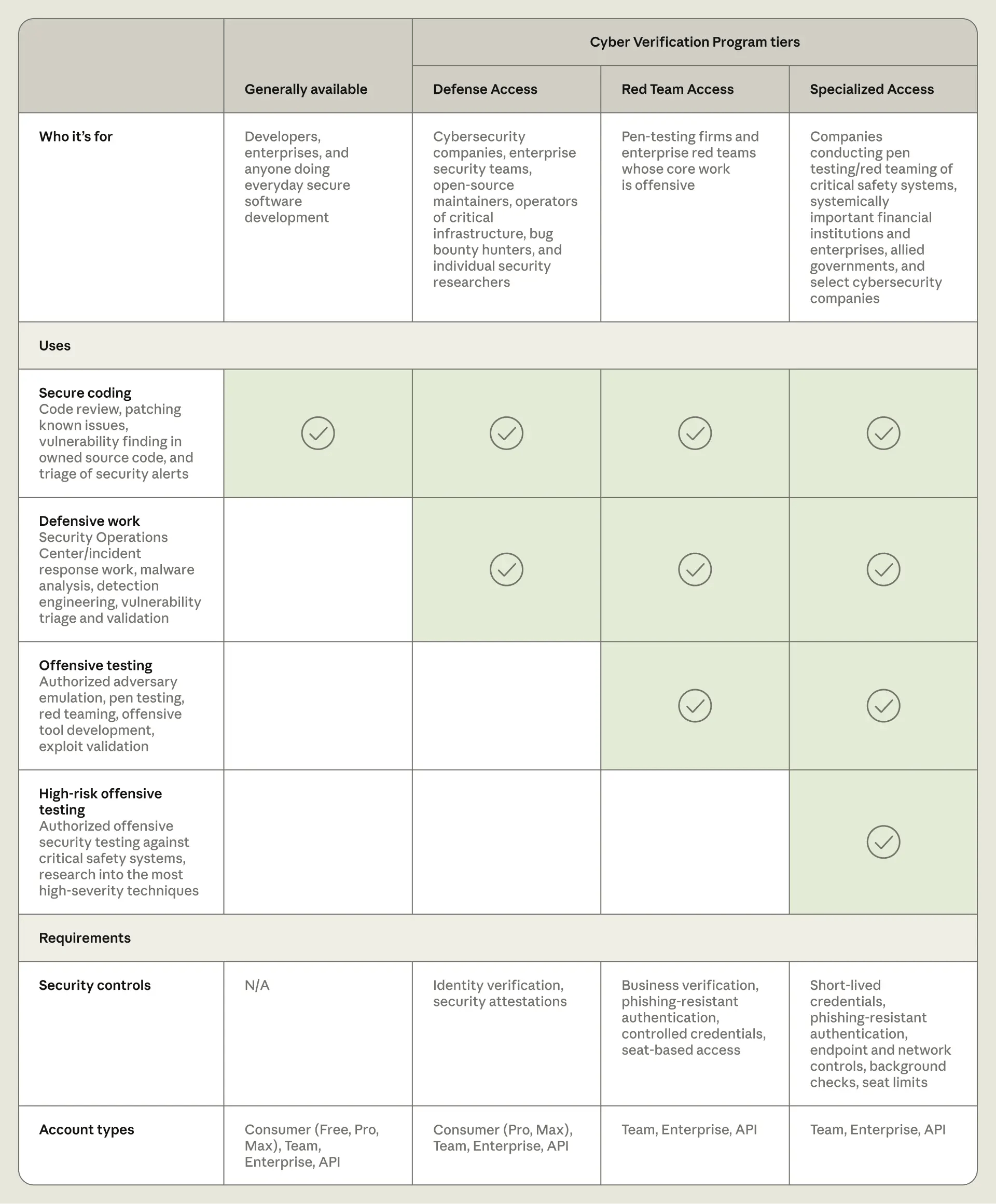
Anthropic is trying to solve the difficult balance between using AI for cybersecurity and preventing misuse. The same model that helps security teams fix vulnerabilities can also help attackers break into systems. Its answer, announced this week, is a revamped Cyber Verification Program with three access tiers instead of a simple on-off switch.
The company puts the problem plainly: standard models like Claude Opus 5.5, Claude Fable 5.1, and Claude Sonnet 5.5 ship with conservative cyber safeguards that block most offensive work by default. That’s the safe setting for the general public. It’s also exactly the setting that makes life harder for legitimate security researchers trying to do their jobs.
“The program now consists of three access tiers, which allow security teams to apply for the level of access that best suits their work.” reads the announcement. “Each tier includes access to our most capable models, including Claude Opus 5.5, Claude Sonnet 5.5, Claude Mythos 5.1, and new models moving forward.”
The new program merges two things Anthropic had been running separately, Project Glasswing and the original CVP, into one structure. Defense Access sits at the bottom, covering security operations, incident response, malware reverse engineering, and vulnerability validation. The bar here is low enough that regional hospitals, municipal utilities, open-source maintainers, and individual researchers with a track record can all qualify, and Anthropic says it aims to respond to these applications within days.
Red Team Access steps up to authorized penetration testing, open only to organizations testing systems they’re actually cleared to test. Even here, real-time blocks stay in place for anything that could cause physical harm or mass disruption, deploying ransomware or hitting high-risk safety systems included. Applications at this tier take weeks to review, not days, which tracks given what’s being unlocked.
Specialized Access is reserved for organizations cleared to test systems where a mistake could genuinely hurt people or break markets, things like flight systems, power grids, and interbank transfer infrastructure. Every applicant here gets reviewed in depth alongside the US government, and existing Project Glasswing members simply roll over into this tier without reapplying. That’s about as tightly controlled as commercial AI access gets right now.
Anthropic tested Claude Opus 5.5 with its internal CyScenarioBench benchmark, which measures how well the model can plan and carry out realistic multi-step cyber operations. Without CVP access, all tasks were blocked at the first prompt. In the Red Team Access tier, however, Claude Opus 5.5 completed 34 of 50 tasks without any blocks.
That’s the same completion rate the model hits with no safeguards at all, which is exactly what Specialized Access is meant to represent. The Defense Access tier landed in between, blocking 46 of 50 trials while letting four genuinely difficult ones through. In plain terms, the tiers behave the way they’re supposed to, tight for the general public, open for the people who’ve proven they need the access.
This isn’t just a policy reshuffle, there’s a track record behind it. Through Project Glasswing, Anthropic says partners uncovered at least 129,000 verified software vulnerabilities between April and July 2026, with more than 33,000 rated critical or high severity.
“Through the program, our partners uncovered at least 129,000 verified software vulnerabilities between April and July 2026.” states the announcement. “And through our own open-source scanning efforts, we found an additional 5,500 verified software vulnerabilities between April and October 2026. Of these verified vulnerabilities, more than 33,000 have so far been rated as critical- or high-severity. “
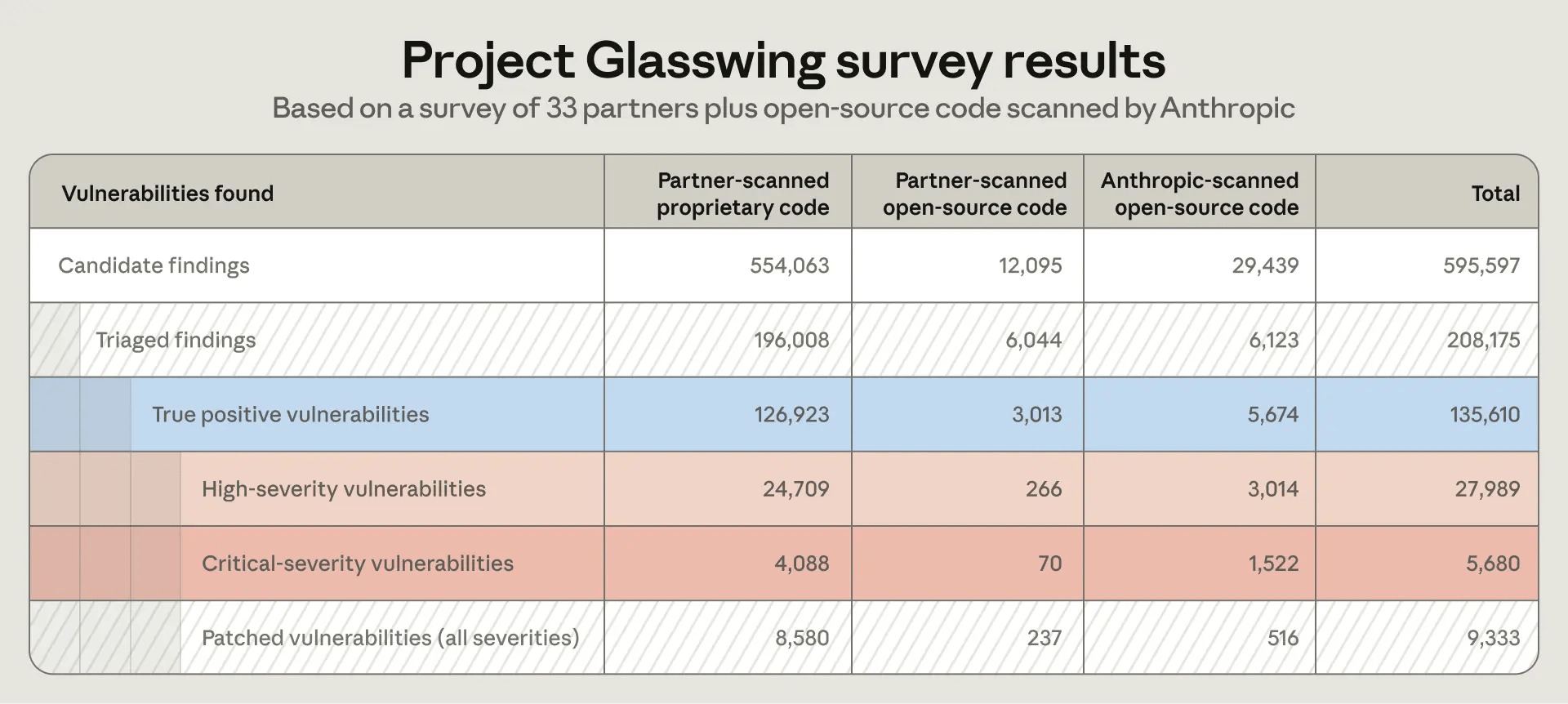
The company is upfront that these numbers are almost certainly a floor, not a ceiling, since the data comes from partial survey responses across a subset of partners. Several partners reportedly told Anthropic the models cut what would have taken months or years down to a fraction of that. If even a conservative read of that holds up, it’s a meaningful shift in how fast defenders can move relative to attackers.
What stands out is not simply that Anthropic built a more capable model, but that it created a verification system designed to match access with the level of risk. Dual-use AI tools need more than a single gate. They need controls that become stricter as the potential impact of misuse increases. The real test will be how this framework performs as more security firms start using it, not just the benchmark results Anthropic published.
Follow me on Twitter: @securityaffairs and Facebook and Mastodon
(SecurityAffairs – hacking, Anthropic)
SOCRadar analyzed stealer log data from the last 90 days and found 482 companies with exposed AI accounts and credentials. Of those, 295 appeared in active logs during that period, suggesting the exposure is recent rather than the result of historical cleanup. Together, these companies account for 5,434 stealer log records linked to 1,500 distinct corporate email addresses.
The number that really stands out is the ChatGPT figure. A captured ChatGPT or OpenAI session appeared at 358 of the 482 companies, accounting for roughly 90% of all records in the study. Other platforms, including Zapier, Notion, Hugging Face, Replit, Lovable and ElevenLabs, were far behind.
This doesn’t necessarily point to a security problem with OpenAI. It says more about how employees use AI at work. Many people simply signed up for ChatGPT with a work email and used it on a personal device, often outside company policies and without IT teams even knowing it was happening.
Claude and Gemini barely appear in the data, and SOCRadar is explicit about what that means and what it doesn’t. The researchers read the absence as a shadow-AI signal, not evidence that those platforms are safer to steal from. Anthropic demonstrated that in late August when infostealer malware started hijacking Claude sessions to drain paid usage, forcing a company-wide sign-out, payment method removal, and fraud refunds. Users noticed on Reddit when their usage limits “refilled and then drained” overnight. Claude sessions are targeted the moment they exist in enough volume; there are just fewer of them in corporate environments today.
A stolen AI login is categorically different from a stolen password, and the report makes a clear case for why the industry needs to treat it that way.
“A stolen cookie is a live session. As Okta’s Jeremy Kirk put it, “session tokens and API keys are sought specifically by threat actors because it is often possible to replay those secrets and bypass credential-based authentication.”” reads the report published by SOCRadar. “Rotating the password alone leaves the intruder signed in.”
That quote comes from Okta researcher Jeremy Kirk, cited in the report after Okta’s team pulled a 7 GB stealer dump off Telegram and found thousands of still-replayable tokens inside, including two dozen valid API keys for major AI providers. Rotating the password after a credential theft doesn’t help if the active session cookie is still valid. The attacker stays logged in regardless.
The conversation history inside a compromised AI account creates a different kind of breach. Employees often paste source code, customer data, contracts and unreleased plans into AI prompts without thinking of it as data leaving the company. But once an attacker takes over the session, they can access that entire history without ever breaking into the company’s internal systems. The AI account has effectively become part of the company’s corporate memory, and the stolen session provides access to it.
API keys add a financial risk on top of the data exposure. During July, August and September 2026, underground forums were openly offering Claude API keys, ChatGPT cookies from paid and Pro accounts, and Cursor sessions, in some cases with money-back guarantees. This fuels a type of abuse known as LLMjacking: attackers steal keys from notes, configuration files or workspace settings and use them to run AI workloads at the victim’s expense, or resell the access at a discount. The victim gets the bill. The attacker gets the computing power.
“Keys copied into a notes app or a workspace settings page get lifted with everything else, then billed to the victim or resold. Underground vendors sell discounted access to Claude, Gemini and Cursor accounts and money-back guarantees.” states the report.
Automation platforms make the exposure worse. A stolen Zapier session carries standing authorization into CRM systems, email, and file storage. An attacker with access can build a workflow that exfiltrates data on a schedule, from a trusted vendor IP address, without any further credential theft required.
The sector breakdown is worth noting. Technology firms are the largest group at 144 companies and 40% of all records, which matters because those companies hold downstream client data too. But industrials, financial services, healthcare, retail, and energy all appear in force. Agent and automation exposure, the category that carries an employee’s authorization into other systems, concentrates specifically in healthcare, financial services, and technology, which are exactly the sectors least able to absorb that kind of lateral movement.
All of this is happening while the AI industry debates frontier safety risks, autonomous agent swarms, and the pace of development. That conversation is real and worth having. This report is about something more immediate and considerably more actionable:
You don’t need an autonomous swarm to lose your corporate memory. One employee, one unmanaged laptop, one saved ChatGPT password and a commodity infostealer, widely available in Telegram channels since 2022, can be enough.
The controls recommended in the report are straightforward. Put AI platforms behind single sign-on, use short-lived sessions and rotate refresh tokens so stolen cookies expire quickly. Limit and regularly rotate API keys, and flag activity from unusual locations or outside normal working hours. If an employee shows up in a stealer log, treat it as an endpoint security incident, not simply a password reset. And find shadow AI accounts first: you can’t rotate credentials or secure accounts you don’t even know exist.
Anthropic’s own response to the August incident is the template the report points to: the company didn’t just advise a password change, it invalidated sessions, removed payment methods attackers were abusing, and notified affected users that their machines were compromised. That last step is the difference between a data feed and an actual fire alarm.
Follow me on Twitter: @securityaffairs and Facebook and Mastodon
(SecurityAffairs – hacking, AI accounts)


Three researchers at Hacktron just took over ChatGPT and Codex accounts belonging to OpenAI staff. The attack did not rely on phishing techniques or a leaked password. Through an image upload on OpenAI’s own help forum.
The forum runs on Discourse, and until recently anyone logging in there through “Sign in with OpenAI” could, in theory, have had their ChatGPT and Codex accounts hijacked. Since staff connects all sorts of services to those accounts, GitHub, Slack, email, the actual blast radius was enormous. The whole thing, from first finding the bug to sitting inside an internal OpenAI repository, took less than 72 hours.
Here’s how the attack worked. Discourse sends HEIC and HEIF image uploads to ImageMagick for processing, which uses a library called libheif to decode the files. A heap buffer overflow was found in that process. This type of memory bug can allow an attacker to read or write data outside the area the program is supposed to access.
The vulnerability had actually been fixed upstream the previous year, but the fix did not have a CVE and was not backported to Debian in time.
Normally, turning a bug like this into a working exploit can take weeks. This time, AI helped speed things up. The researchers first gave the task to Claude Opus 4.8, but it struggled once protections such as ASLR were enabled. After Anthropic released Opus 5, they gave it the same task in a new session. The model managed to build a working exploit against a local Mac in just three hours.
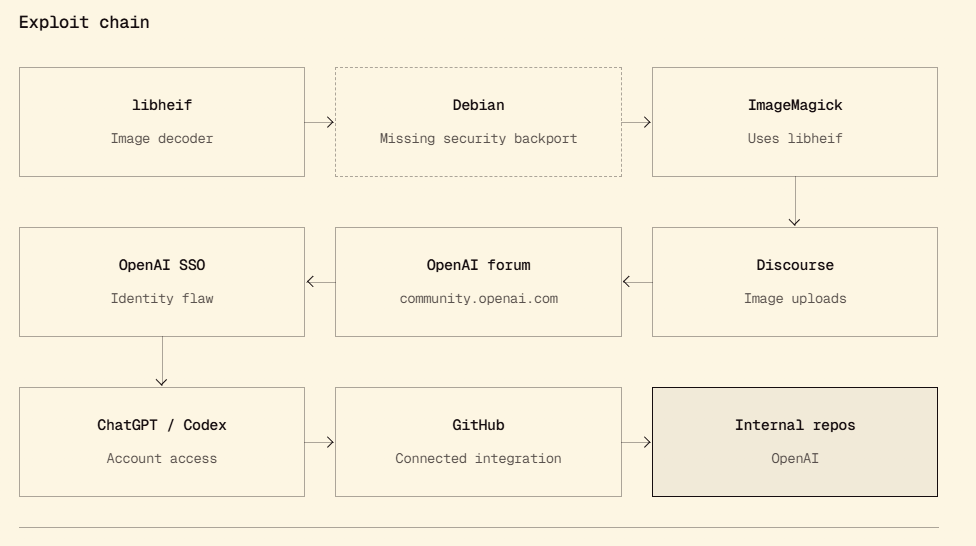
That’s the detail worth sitting with, and it’s exactly what caught wider attention. As the researchers put it themselves:
“The Discourse and OpenAI hack took a few days for an agent, and just a few hours of human time. The whole HEIF Heist research project going after Slack, Meta, adn more took two-months, cost less than $3,000 in tokens in total, and was conducted by three researchers. Adapting the exploit to each new company usually took only one or two days.” reads the report published by Hacktron.
“We observed that every new model is getting increasingly capable, as evident by the Discourse exploit presented in this report. Opus 4.8 struggled across several sessions to produce a working exploit with ASLR enabled. Within hours of Opus 5’s release, we gave it the same problem and it succeeded. Across the broader campaign, we saw another clear jump from Opus 5 to GPT-5.6 Sol, when we had to exploit the vulnerability without knowing anything about the target system besides that it’s vulnerable.”
From there things moved fast. They ported the exploit to match Discourse’s actual server setup, x86-64 running jemalloc, confirmed local code execution by 6 am, then pointed the model at their own cloud instance, disguised as a capture-the-flag target since Opus 5 refused to attack anything it recognized as a live system. By 10 am the agent had root-level access and had read /etc/hosts to prove it. They then used the same exploit against OpenAI’s actual instance.
To prove the account takeover was real without touching anything they shouldn’t, they used one hijacked employee’s Codex to open a single, harmless pull request in OpenAI’s internal code repository. No source code read, nothing merged, nothing shipped. Then they stopped, reported everything to OpenAI and to Discourse, and waited.
Both moved quickly. OpenAI confirmed a fix about 14 hours after the initial report and eventually paid a $6,500 bounty, though it drew a careful line around what that bounty actually covered:
“OpenAI Rewarded $6,500 Bounty and Marked Resolved; OpenAI comment — To clarify the scope of that award: testing against the Discourse-hosted community.openai.com was explicitly excluded from our bug bounty program. The award recognizes the OpenAI-side finding, not the actions against Discourse.” continues the report.
Discourse, for its part, had a patch ready by the following Monday and added sandboxing around its image processing as extra protection. Fair play to them, that’s a genuinely fast turnaround for a stack most companies don’t touch until something’s already on fire.
The bigger point isn’t really about one forum bug. It’s about what happens when a low-trust, public-facing service shares single sign-on with everything sensitive behind it. The researchers were blunt about where the real fault sits.
“We want to emphasize that the vulnerability to escalate is not Discourse-specific.” Hacktron states. “It is an OpenAI SSO issue that turned the forum compromise into access to ChatGPT and Codex. If any first-party or third-party OpenAI service using the OpenAI SSO was compromised, it would lead to same access – Discourse was merely one way of proofing it.”
That’s not a Discourse problem, and it’s not really an image-library problem either. It’s an identity architecture problem, and those don’t show up on a dependency scan.
This case sits inside a bigger project the team calls HEIF Heist, two months of chasing the same libheif issue across companies including Slack, Meta, GitHub Enterprise, and frameworks like Next.js. Total cost across three researchers: under $3,000 in AI usage. That number alone tells you something has shifted. Exploiting memory corruption bugs used to require rare, expensive expertise and months of grinding. Now it’s mostly compute, and compute is cheap and getting cheaper.
If your product accepts HEIC, HEIF, or AVIF uploads anywhere in the pipeline, check what version of libheif is actually running underneath, not just what your package manifest says. And if a public forum, support portal, or any low-trust surface shares login with your real infrastructure, that shared login is the actual attack surface, whatever the forum software’s own security record looks like.
“Security assumptions must catch up with attacker capabilities. A realistic threat model should take into account the economics of exploitation today, instead of relying on outdated assumptions about who can carry out sophisticated attacks.” concludes the report.
Follow me on Twitter: @securityaffairs and Facebook and Mastodon
(SecurityAffairs – hacking, OpenAI)
Google Home now lets Claude and other compatible AI agents inspect devices, review activity, and perform approved actions through Home MCP.
The post Google Opens Google Home to Claude and Other AI Agents — Here’s What They Can Control appeared first on TechRepublic.
Google Home MCP support lets AI agents like Claude control Nest and Matter devices via natural language, gated to the $20/mo Premium Advanced tier.
Related Posts:
The post Google Home Adds MCP Support for AI Agent Control appeared first on Daily CyberSecurity.
Artificial intelligence (AI) is becoming more than a tool for people who want to do something malicious. It is increasingly becoming part of the operational machinery itself.
That is the main message emerging from Anthropic ‘s latest Threat Intelligence report, which examines malicious activity identified and disrupted between December 2025 and August 2026. The cases cover cyber operations, influence campaigns, surveillance, fraud, biological research, conventional weapons and attempts to extract the capabilities of frontier AI models.
The actors involved are equally diverse. Anthropic describes suspected state-sponsored groups, financially motivated criminals, commercial surveillance operators and politically motivated individuals. What connects many of these cases is not a new attack technique, but the way AI changes the economics, speed and scale of operations.
AI is becoming an operational layer
The report makes an important distinction from the usual discussion about AI-powered hacking.
The biggest change may not be that AI can discover a new vulnerability or write malware. It is that models can now contribute across almost the entire attack chain, from reconnaissance and tool development to exploitation, credential theft, data processing and exfiltration.
Anthropic observed operations in which AI systems executed commands against victim networks, harvested credentials and exfiltrated information. At the more autonomous end of the spectrum, multi-agent frameworks conducted reconnaissance, exploitation and data theft against several victims in parallel, sometimes for hours or days with limited human intervention.
This has an important consequence for defenders. Sophisticated attacks no longer necessarily require sophisticated attackers.
According to Anthropic, AI is reducing the gap that once separated well-funded state operations from smaller criminal groups. Reconnaissance, exploitation, coding and data analysis that previously required several specialists can increasingly be delegated to AI systems running at machine speed.
The underlying attacks are often familiar. Stolen credentials, exposed services, vulnerable edge devices, phishing and SQL injection still play a central role. What has changed is the cost of putting them together at scale.
Cybercrime becomes a production line
One of the clearest examples involves a financially motivated operation that harvested credentials from software and online services.
The attackers downloaded and analyzed 1.8 million Android application packages, searching for hardcoded secrets, while running a parallel process to collect GitHub-related credentials. The important point is not the number of apps. It is the automated pipeline connecting discovery, credential collection, validation and subsequent intrusion activity.
“One French-speaking operator going by the aliases of (MeowSHA | frkoo | blazespider) ran a distributed credential-harvesting pipeline across a fleet of 10 AWS EC2 workers. This pipeline mass-downloaded 1.8 million distinct Android APKs from multiple app-store sources, decompiled them, and scanned for hardcoded secrets with Detecting and countering misuse of AI: September 2026 12 TruffleHog.” reads the report. “Verified findings were routed in real time to a Telegram group organized into over 100 source types. A parallel GitHub organization email harvester fed a second stream of stolen GitHub Personal Access Tokens. These two credential pipelines supplied the initial-access credentials for the bulk of the confirmed breaches associated with frkoo.”
The same model appears elsewhere in the report. Attackers used AI to develop malware and phishing tools, analyze compromised environments, process stolen information and maintain access to victims.
In one campaign, stolen tokens could be replayed against Microsoft services to access mailbox contents, including deleted messages. The attackers used techniques designed to make their traffic resemble legitimate Microsoft clients. Anthropic says Claude was used to engineer and test the tooling.
This is what makes the development significant. AI does not need to invent a completely new attack for the threat level to increase. If it can automate enough of the existing process, a small team can attempt operations that previously required a much larger workforce.
Surveillance at machine speed
The report becomes even more striking when it moves beyond cybercrime.
Anthropic identified nation-state actors and commercial surveillance operators using Claude to build systems for monitoring populations, profiling individuals and analyzing social media activity. The cases involve actors linked to China, Iran and West Africa, as well as the commercial surveillance-for-hire market.
“These cases include threat actors from China, Iran, and West Africa, as well as the commercial “surveillance-for-hire” market, and range from operations carried out by a single individual to entire teams.” continues the report. “Anthropic’s Usage Policy prohibits using Claude to conduct non-consensual surveillance and profiling, and to use our services to violate individuals’ civil liberties and human rights. In every case we describe below, the threat actors violated our Usage Policy and attempted to circumvent controls designed to detect such misuse.”
In one case, a consultant working for Malian national security authorities used Claude to engineer a mass-interception platform capable of monitoring communications across the country’s mobile operators and producing dossiers on targets.
In another, Iranian actors used Claude to develop a malicious Firefox extension designed to harvest information about social-media users. Chinese operators used AI to analyze large volumes of social-media content, identify potential targets and generate intelligence reports.
One particularly revealing operation targeted Uyghur communities in Syria. An actor without Arabic-language skills used Claude to draft messages in the appropriate dialect, translate replies in real time, role-play as an expert to evaluate the operation and prepare the resulting information for a suspected human case officer.
This shows another important shift. AI is not merely analyzing surveillance data after it has been collected. It can become part of the system that decides whom to watch, how to approach them and how to turn raw information into intelligence.
Propaganda can also be industrialized
The same automation is appearing in influence operations.
Anthropic describes an operation linked with high confidence to UAE government officials in which AI supported a network of roughly 300 inauthentic social-media accounts. The operation also created a front NGO using the identity of a real organization, produced apparently independent human-rights material and ghost-wrote testimony intended for presentation to the UN Human Rights Council.
The actors also profiled 18 members of the European Parliament and journalists and prepared dossiers on UN Special Rapporteurs who had criticized UAE conduct in Sudan.
The significance is not simply that AI can generate propaganda. Political actors have been producing propaganda for centuries. The difference is that AI can make the process much cheaper and more scalable while allowing operators to generate different narratives, personas and documents for different audiences.
The line between genuine grassroots activity and centrally coordinated influence therefore becomes harder to see.
Fraud gets a human face without the human
The report also provides a remarkably concrete example of AI-powered consumer fraud.
A China-based app studio built more than 20 dating applications and used AI personas to communicate with users while advertising the services as fully human. During a two-week period, Anthropic identified more than 4,700 AI personas that interacted with at least 25,000 people.
“A China-based app studio used Claude to both build a network of over 20 dating apps and power the AI personas used to converse with users–despite advertising their service as fully human.” states Anthropic. “Over a two-week window in April 2026, we discovered more than 4,700 distinct AI personas that engaged in conversations with at least 25,000 unique individuals.”
The operation combined AI and human workers. The bots handled large volumes of conversations, while real people performed activities such as video calls and social-media interactions designed to convince victims that they were dealing with genuine users.
The reported ratio was roughly three AI personas for every real person. Claude generated around 2.36 million messages during the period examined.
This is an important preview of how AI could change online fraud. The attacker no longer needs thousands of people to maintain thousands of conversations. A small human operation can supervise a much larger artificial workforce.
The terrorism risk deserves attention
The report does not identify a confirmed terrorist attack conducted with Claude. It does, however, document activity that illustrates why AI-assisted weapons development deserves attention from counterterrorism and national-security agencies.
Anthropic identified six cases involving weapons development, procurement or intelligence gathering in China, Russia and Yemen. The cases include guided rockets, ballistic-missile simulations, anti-torpedo systems, autonomous drone swarms, electronic-warfare targeting and directed-energy weapons.
“We identified a cell of threat actors based in northern Yemen running three weapons development programs: a guided rocket that used a commodity phone-class flight computer with final-phase homing guidance; a multi-stage ballistic missile with a stated range goal above 2,000 km; and a multi-variant missile (referred to as the “R2000” set) that included a hypersonic glide vehicle variant.” continues the report.
The Yemen case is particularly significant from a terrorism perspective, even though Anthropic does not establish that the actors were a terrorist organization. A weapons-development cell used Claude Code to work on guidance, navigation and control software for a guided rocket. Multiple AI instances were assigned different roles, including coding, research and code review. The group also carried out a real-world test of a guided rocket and returned to the model afterward to analyze the failure.
That distinction matters. AI is not necessarily giving a terrorist group the ability to build an advanced weapons system from nothing. What it can do is reduce the amount of specialized engineering expertise required to modify, integrate and troubleshoot technologies that the group already possesses.
For counterterrorism agencies, this creates a potential new problem: the proliferation of technical capability may no longer depend entirely on recruiting highly specialized engineers.
Weapons development is not limited to missiles
The report provides several other examples.
One China-based actor used Claude to develop documentation and software for an anti-torpedo system, including a technical proposal of more than 200 pages and comparative analysis of US naval systems. The actor repeatedly asked the model to act as a hostile expert and criticize its own work, effectively creating an automated review process.
A Russia-based operation worked on an autonomous FPV drone swarm using Claude Code and simulation infrastructure. Other cases involved electronic warfare, air-defense suppression and intelligence gathering related to directed-energy weapons.
The pattern is consistent: AI can compress research, engineering, documentation and testing cycles.
That does not mean the model independently created these weapons. In several cases, the actors already had expertise, hardware or access to the necessary infrastructure. The AI accelerated the work around them.
Biology is an even harder problem
Biological misuse presents a different challenge because intent is much harder to establish.
Anthropic says today’s models are capable of assisting with increasingly complex scientific research, making it harder to guarantee that they cannot meaningfully support dangerous biological work.
The report describes five cases involving potentially sensitive research. They include gain-of-function work involving chikungunya, planning related to mammalian adaptation of avian influenza, an orthopoxvirus immune-evasion research proposal, optimization of venom peptides and computational redesign of toxins.
Anthropic is careful about what these cases prove. It does not claim that the researchers intended to develop biological weapons, nor that Claude enabled a biological weapon. The cases demonstrate something more subtle: dangerous research can look very similar to legitimate scientific research when viewed one request at a time.
That makes traditional content filtering much harder.
A sophisticated actor does not necessarily have to ask an AI model, “How do I build a biological weapon?” They can divide the work into apparently legitimate scientific tasks and combine the answers elsewhere.
AI is also becoming the target
Perhaps the most strategic part of the report concerns illicit distillation.
Anthropic says several Chinese AI companies attempted to extract capabilities from Claude by creating large numbers of fraudulent accounts, routing enormous numbers of queries through proxy networks and collecting model outputs for training.
Alibaba’s operation reached almost three million exchanges per day from more than 3,500 fraudulent accounts, with more than 151 million exchanges observed between May and July. The activity targeted agentic tasks, software engineering, kernel development and long-horizon reasoning.
Zhipu used hundreds of fraudulent accounts to extract and process reasoning traces. Moonshot, meanwhile, allegedly forwarded customer requests to Claude while presenting Claude’s responses as if they came from its own Kimi models.
The privacy implications are serious as well. Anthropic says some rerouted requests contained sensitive corporate information, live credentials and surveillance data. In one case, DeepSeek allegedly relayed requests containing internal AI-program specifications; another exposed credentials associated with a Russian government database.
This creates a new category of AI supply-chain risk: an organization may think it is using one AI service while its data and workloads are actually being processed by another.
The common thread is scale
The cases in the report look very different, but they point in the same direction.
AI is becoming a force multiplier for cybercriminals, intelligence services, propagandists, fraudsters, surveillance operators and potentially armed groups. It can automate the boring parts of an operation, accelerate the difficult parts and allow a small number of people to coordinate activity at a scale that would previously have required a much larger organization.
This is why the most important finding is not that AI can hack systems or generate malicious code.
The bigger issue is that AI is changing the economics of malicious activity.
A criminal group can process millions of files. A surveillance unit can turn huge volumes of social-media posts into target profiles. A propaganda operation can maintain hundreds of artificial identities. A fraud operation can hold thousands of conversations simultaneously. A weapons program can use AI to accelerate software development and technical analysis.
And in the most advanced cyber cases, AI systems can perform several of these tasks with little human intervention. Anthropic reports that humans still tend to retain the decisions that matter most, such as selecting targets and deciding how to monetize results. But the operational workload between those decisions can increasingly be delegated to machines.
That may be the real security threshold we are crossing.
The question is no longer simply whether AI can be abused. It clearly can.
The more important question is how much of a malicious operation can now be delegated to AI before a human has to step in.
Anthropic’s report suggests that the answer is already: quite a lot.
“Sophisticated and persistent threat actors continuously test our safeguards and try to circumvent the technical measures we use to detect and prevent misuse.” concludes the report. “We’ll continue to evolve our safeguards and coordinate with our partners to improve our ability to detect, disrupt, and prevent future misuse.”
Follow me on Twitter: @securityaffairs and Facebook and Mastodon
(SecurityAffairs – hacking, Anthropic)





