Visualização normal
-
ASEC BLOG
-
September 2026 Threat Trend Report on Ransomware
Purpose and Scope This report summarizes the quantity of new ransomware samples collected, the number of compromised systems, and statistics on targeted businesses during the month of September 2026, as well as major Korean & global ransomware issues. The analysis is based on data collected through ATIP (AhnLab Threat Intelligence Platform) and AhnLab Smart Defense, […]
-
Firewall Daily – The Cyber Express

-
Japan Plans Major Cyber Hunt to Detect Hidden Attacks on Critical Infrastructure
Japan is stepping up its plans to find cyber attackers who may already be inside the networks that keep essential services running. Under a new fiscal 2027 initiative, the government plans to work with private companies to strengthen Japan threat hunting across critical infrastructure, including power utilities and telecommunications operators. The focus is not only on stopping attacks after they are detected, but on finding signs that an attacker has gained access and is quietly moving throu
Japan Plans Major Cyber Hunt to Detect Hidden Attacks on Critical Infrastructure
![]()
Japan Threat Hunting to Target Hidden Cyber Threats
The initiative forms part of Japan’s broader active cyber defense efforts. Threat hunting involves actively searching systems for signs of malicious activity rather than waiting for an alert or confirmed attack. Japan’s National Cybersecurity Office plans to use information about potential threats to recreate attack scenarios in a virtual environment. The office will then develop and test detection methods that can be used by private-sector companies. The aim is to help critical infrastructure operators identify attackers that may have already entered their systems and remained undetected. Detecting such activity could also help reduce the risk of a cyberattack disrupting essential services during an emergency. Legislation related to active cyber defense took effect on Thursday, giving the government a framework for expanding these cybersecurity measures.Defense Ministry to Assist Critical Infrastructure Operators
Japan’s Defense Ministry is also preparing to provide direct support to operators of critical infrastructure. Companies will be able to request assistance, after which the ministry could dispatch personnel with threat-hunting experience developed through the information systems of Japan’s Self-Defense Forces. The National Cybersecurity Office and Defense Ministry have included the related costs in their fiscal 2027 budget requests. Threat hunting can require considerable resources because security teams need to collect and examine large amounts of system event logs. The purpose is to identify unusual activity that may otherwise go unnoticed. NTT Data Japan has been carrying out proactive threat hunting on its own systems since 2024. The company checks system logs for suspicious activity even when there has been no security alert. A representative of the National Cybersecurity Office also said threat-hunting methods could help address ransomware. Such attacks can involve attackers exploring a victim’s systems after gaining initial access, meaning suspicious activity may exist before the ransomware itself is deployed.Recent Cyberattacks Add to Japan’s Concerns
Japan’s planned expansion of threat hunting comes as cyber incidents have affected government networks and companies across different sectors. In September 2026, the government disclosed that its common infrastructure network had been targeted in a cyberattack that began in May. Digital Minister Hisashi Matsumoto said about 246,000 personal records could have been leaked. The affected Government Solution Service, or GSS, is used by government agencies and independent administrative agencies. The potentially exposed information included about 189,000 employee records and around 57,000 records belonging to businesses and individuals involved in agency operations. An analysis found that a third party had compromised the system by exploiting a bypass involving a virtual private network, or VPN. Other recent incidents have affected private-sector operations. The Nichirei cyberattack in July disrupted food deliveries after the frozen food and logistics company confirmed unauthorized access to its servers. The incident affected logistics operations supporting KFC Japan. Nihon Kotsu also recently reported a malware-related incident that disrupted taxi dispatch services after parts of its IT infrastructure were taken offline. Earlier incidents involving Aflac Japan, KDDI, Sapporo Holdings and Nidec showed that attackers could gain access through subsidiaries, overseas operations or third-party infrastructure. Japan’s fiscal 2027 plans therefore put greater emphasis on looking for attackers that may already be inside a network, rather than relying only on alerts after suspicious activity has become visible.-
Schneier on Security
-
Malicious npm Packages That Evade Defenses
This is an impressive piece of malware. Its sophistication says nation-state to me, but there is no direct evidence and certainly no attribution.
Malicious npm Packages That Evade Defenses
This is an impressive piece of malware. Its sophistication says nation-state to me, but there is no direct evidence and certainly no attribution.
-
Cybersecurity News
-
Cisco Patches 18 Secure Firewall Flaws, Several Root RCE
Cisco patched 18 Secure Firewall vulnerabilities in FMC, ASA, and FTD, including critical unauthenticated root remote code execution flaws. Update now. Related Posts: Synology DSM Patches 8 Flaws, Two Critical Unauthenticated Critical HCL BigFix Vulnerabilities Expose Admin Accounts 4 Linux Kernel LPE Flaws Disclosed With Public PoC Exploits The post Cisco Patches 18 Secure Firewall Flaws, Several Root RCE appeared first on Daily CyberSecurity.
Cisco Patches 18 Secure Firewall Flaws, Several Root RCE
Cisco patched 18 Secure Firewall vulnerabilities in FMC, ASA, and FTD, including critical unauthenticated root remote code execution flaws. Update now.
Related Posts:
- Synology DSM Patches 8 Flaws, Two Critical Unauthenticated
- Critical HCL BigFix Vulnerabilities Expose Admin Accounts
- 4 Linux Kernel LPE Flaws Disclosed With Public PoC Exploits
The post Cisco Patches 18 Secure Firewall Flaws, Several Root RCE appeared first on Daily CyberSecurity.
-
Firewall Daily – The Cyber Express

-
Cyble and DRONA Launch New Push to Close India’s Cybersecurity Gap
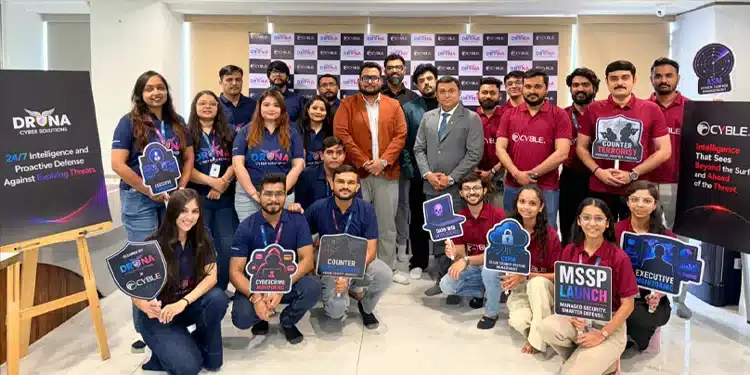
AHMEDABAD (INDIA) — Cyble, the global AI-native cybersecurity company, and DRONA Cyber Solutions, the Ahmedabad-headquartered security operations firm, have launched an AI-powered cyber defense initiative in Ahmedabad, combining threat intelligence, investigation and endpoint enforcement through a joint managed security model. The AI-Powered Intelligence for Cyber Defense initiative was formally launched Tuesday at DRONA Cyber Solutions' Command and Control Centre, where the companies presented
Cyble and DRONA Launch New Push to Close India’s Cybersecurity Gap
![]()
The AI-Powered Intelligence for Cyber Defense initiative was formally launched Tuesday at DRONA Cyber Solutions' Command and Control Centre, where the companies presented a live technical demonstration showing how an intrusion attempt can be detected, investigated and contained.
The launch comes as India faces a growing cybercrime burden. India recorded 28.15 lakh cybercrime cases in 2025, a 24 percent increase over the previous year, with reported losses reaching ₹22,495 crore. The government's 1930 cybercrime helpline received 32.4 million calls during the year. Of the complaints filed, 55,484 were converted into FIRs.AI-Powered Cyber Defense Takes Center Stage in Ahmedabad
Rather than focusing solely on formal remarks, Cyble and DRONA used the launch to demonstrate the initiative through a live technical exercise for the media. The demonstration began with material recovered from infostealer logs circulating on a criminal forum, alongside a lookalike domain registered to impersonate a target organisation. Analysts traced the infrastructure, established a pattern of previous activity associated with the same actor and demonstrated the detection and containment of an intrusion attempt on an endpoint.The final containment action was authorised by a human analyst rather than executed automatically. The demonstration brought together multiple capabilities. Cyble Vision provided the initial detection through continuous monitoring of criminal marketplaces and leak sites.
Cyble Hawk supported the investigative process and attribution, while Cyble Titan handled endpoint enforcement, using hardware-level integrity checks to support its assessment. DRONA analysts remained at the centre of the process, making decisions that the system was deliberately not permitted to make independently."India is not short of alerts. It is short of what happens next," Patil said. "We have spent a long time in this industry watching mid-sized businesses get told about a threat and then having nowhere to take that information. What we are launching today is not another alert. It is a complete chain — intelligence before the attack, investigation that would stand up to scrutiny, enforcement on the device, and a person accountable for the decision at the end of it."Dhruv Pandit, Co-Founder and CEO of DRONA Cyber Solutions, said the initiative reflects the operational needs of organisations that require immediate action rather than another security dashboard.
"A factory owner calling us at two in the morning does not want to be shown a dashboard," Pandit said. "He wants to know what happened, he wants it contained, and he wants someone to take responsibility for what happens next."
From the Command Centre to Gujarat University, India
The Gujarat University engagement was not simply a conventional cybersecurity student session. It was a technical session titled “Kavach: Beyond the Surface — Threat Intelligence from the Dark Web Depths,” hosted by the Department of Biochemistry and Forensic Science, Gujarat University, in collaboration with Cyble.The session brought together speakers from Cyble and DRONA Cyber Solutions to examine areas including dark web threat intelligence, government and PSU cybersecurity projects, digital forensics and incident response (DFIR), and the transition of threat intelligence from information to action.
Mandar Patil and Augustin Kurian of Cyble discussed the dark web threat intelligence landscape. Prathmesh Pawar spoke about government and PSU cybersecurity projects, while Brijesh Kapadiya addressed DFIR and Vijay Mali discussed moving threat intelligence from information to action. The keynote was delivered by Prof. Dr. Kapil Kumar, Coordinator, Department of Biochemistry and Forensic Science.The session highlighted several practical aspects of cybersecurity work. The dark web was discussed not simply as a hidden part of the internet, but as a structured ecosystem requiring dedicated intelligence-gathering and threat-discovery methods. DFIR was presented as an area where speed and process are as important as technical expertise.
Another key takeaway was the importance of turning threat intelligence into action. Rather than treating intelligence as information alone, the session focused on how it can inform practical security decisions.
Patil told students that the cybersecurity industry faces a shortage of professionals with practical skills in analysing and validating threat intelligence."The gap this industry has is not a gap of ideas. It is a gap of people who know how to do the work," Patil said. "What separates a useful analyst from an alert-reader is the ability to ask whether a piece of intelligence is actually true before you act on it."Augustin Kurian, Editor-in-Chief of The Cyber Express, told students that threat intelligence and journalism share an emphasis on verification.
Every story we publish about a breach, a ransomware group or a leaked database starts exactly where today's demonstration started — with intelligence somebody had to go and find, verify, and decide was worth acting on," Kurian said. The instinct we have tried to build at The Cyber Express is the same instinct a good analyst needs: do not report, and do not act on, what you have not verified.The programme also involved technical and production teams supporting the session. Screen, sound and lighting were handled by the technical team under the guidance and supervision of Aditya More, while Misha Alagiya, Kavya Maharaja, Pathak Ami, Omi and Nandini supported stage management and photography.
A Broader Cybersecurity Collaboration
Both companies emphasised that the partnership is not intended to represent a single solution to India's cybersecurity deficit. Cyble and DRONA maintain relationships with other partners, service providers and government bodies."India's exposure is too large for any single partnership to take credit for solving," Patil said. "What matters is whether more of these collaborations exist a year from now, and whether the businesses we are talking about today — the ones without a security team — actually have somewhere to turn."
The AI-Powered Intelligence for Cyber Defense initiative will be delivered through DRONA's Ahmedabad command centre, with the companies indicating an intent to extend the service model to customers elsewhere in India over time.
The initiative also folds into DRONA's existing Cyber Yodha Campaign, a national programme aimed at building 50 integrated cybersecurity command centre labs and training more than 100,000 defenders.-
Schneier on Security
-
Prompt Injections for Defense
This seems to work: Researchers from Tracebit on Monday said they found that placing prompt injections alongside passwords, cryptographic keys, and other secrets stored on Amazon Web Services was often all that was needed to shut down attacks from AI hacking agents. The prompts direct the attacking LLM to perform an action forbidden by its guardrails, the safety barriers AI developers erect to prevent it from taking harmful actions. The LLM responds by shutting down. Examples are a prompt that o
Prompt Injections for Defense
This seems to work:
Researchers from Tracebit on Monday said they found that placing prompt injections alongside passwords, cryptographic keys, and other secrets stored on Amazon Web Services was often all that was needed to shut down attacks from AI hacking agents. The prompts direct the attacking LLM to perform an action forbidden by its guardrails, the safety barriers AI developers erect to prevent it from taking harmful actions. The LLM responds by shutting down.
Examples are a prompt that orders the LLM to provide steps for developing inhalable Anthrax spores, or, in the case of LLMs from Chinese developers, make references to the iconic Tank Man from the 1989 Tiananmen Square massacre. Once the LLM encounters these forbidden commands, it no longer follows its existing commands. The researchers have named the technique context bombing.
Of course, this only works against agents that have guardrails. As we start to see more locally run AI models, we’ll see more attackers using LLMs with no guardrails.
-
ASEC BLOG
-
Ransom & Dark Web Issues Week 3, June 2026
ASEC Blog publishes Ransom & Dark Web Issues Week 3, June 2026 Sale of Confidencial Defense Industry Documents in South Korea on Spear Forums Ransomware Attack by Qilin Targeting a South Korean Big Data Solution Company Ransomware Attack by Anubis Targeting a South Korean Semiconductor Equipment Parts Company
Ransom & Dark Web Issues Week 3, June 2026
-
Krebs on Security

-
Alleged Kimwolf Botmaster ‘Dort’ Arrested, Charged in U.S. and Canada
Canadian authorities on Wednesday arrested a 23-year-old Ottawa man on suspicion of building and operating Kimwolf, a fast spreading Internet-of-Things botnet that enslaved millions of devices for use in a series of massive distributed denial-of-service (DDoS) attacks over the past six months. KrebsOnSecurity publicly named the suspect in February 2026 after the accused launched a volley of DDoS, doxing and swatting campaigns against this author and a security researcher. He now faces criminal h
Alleged Kimwolf Botmaster ‘Dort’ Arrested, Charged in U.S. and Canada
Canadian authorities on Wednesday arrested a 23-year-old Ottawa man on suspicion of building and operating Kimwolf, a fast spreading Internet-of-Things botnet that enslaved millions of devices for use in a series of massive distributed denial-of-service (DDoS) attacks over the past six months. KrebsOnSecurity publicly named the suspect in February 2026 after the accused launched a volley of DDoS, doxing and swatting campaigns against this author and a security researcher. He now faces criminal hacking charges in both Canada and the United States.
A criminal complaint unsealed today in an Alaska district court charges Jacob Butler, a.k.a. “Dort,” of Ottawa, Canada with operating the Kimwolf DDoS botnet. A statement from the Department of Justice says the complaint against Butler was unsealed following the defendant’s arrest in Canada by the Ontario Provincial Police pursuant to a U.S. extradition warrant. Butler is currently in Canadian custody awaiting an initial court hearing scheduled for early next week.
The government said Kimwolf targeted infected devices which were traditionally “firewalled” from the rest of the internet, such as digital photo frames and web cameras. The infected systems were then rented to other cybercriminals, or forced to participate in record-smashing DDoS attacks, as well as assaults that affected Internet address ranges for the Department of Defense. Consequently, the DoD’s Defense Criminal Investigative Service is investigating the case, with assistance from the FBI field office in Anchorage.
“KimWolf was tied to DDoS attacks which were measured at nearly 30 Terabits per second, a record in recorded DDoS attack volume,” the Justice Department statement reads. “These attacks resulted in financial losses which, for some victims, exceeded one million dollars. The KimWolf botnet is alleged to have issued over 25,000 attack commands.”
On March 19, U.S. authorities joined international law enforcement partners in seizing the technical infrastructure for Kimwolf and three other large DDoS botnets — named Aisuru, JackSkid and Mossad — that were all competing for the same pool of vulnerable devices.
On February 28, KrebsOnSecurity identified Butler as the Kimwolf botmaster after digging through his various email addresses, registrations on the cybercrime forums, and posts to public Telegram and Discord servers. However, Dort continued to threaten and harass researchers who helped track down his real-life identity and dramatically slow the spread of his botnet.
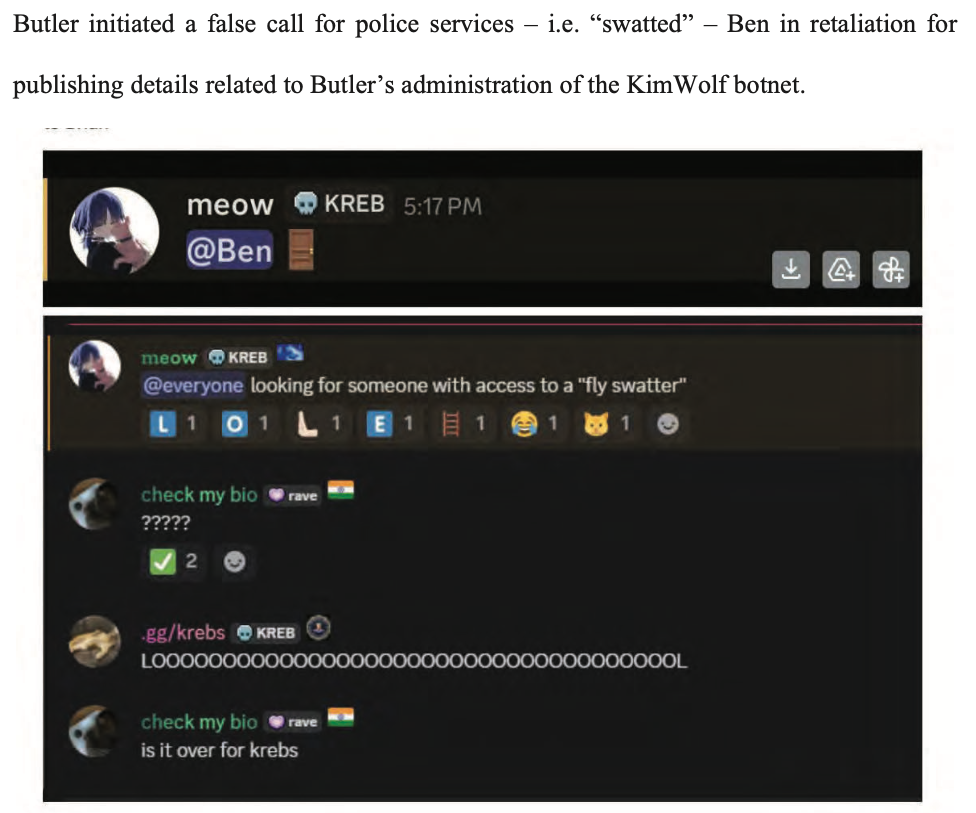
Dort claimed responsibility for at least two swatting attacks targeting the founder of Synthient, a security startup that helped to secure a widespread critical security weakness that Kimwolf was using to spread faster and more effectively than any other IoT botnet out there. Synthient was among many technology companies thanked by the Justice Department today, and Synthient’s founder Ben Brundage told KrebsOnSecurity he’s relieved Butler is in custody.
“Hopefully this will end the harassment,” Brundage said.
An excerpt from the criminal complaint against Butler, detailing how he ordered a swatting attack against Ben Brundage, the founder of the security firm Synthient.
The government says investigators connected Butler to the administration of the KimWolf botnet through IP address, online account information, transaction records, and online messaging application records obtained through the issuance of legal process. The criminal complaint against Butler (PDF) shows he did little to separate his real-life and cybercriminal identities (something we demonstrated in our February unmasking of Dort).
In April, the Justice Department joined authorities across Europe in seizing domain names tied to nearly four-dozen DDoS-for-hire services, although because of a bureaucratic mix-up the list of seized domains has remain sealed until today. The DOJ said at least one of those services collaborated with Butler’s Kimwolf botnet.
A statement from the Ontario Provincial Police said a search warrant was executed on March 19 at Butler’s address in Ottawa, where they seized multiple devices. As a result of that investigation, Butler was arrested and charged this week with unauthorized user of computer; possession of device to obtain unauthorized use of computer system or to commit mischief; and mischief in relation to computer data. He is scheduled to remain in custody until a hearing on May 26.
In the United States, Butler is facing one count of aiding and abetting computer intrusion. If extradited, tried and convicted in a U.S. court, Butler could face up to 10 years in prison, although that maximum sentence would likely be heavily tempered by considerations in the U.S. Sentencing Guidelines, which make allowances for mitigating factors such as youth, lack of criminal history and level of cooperation with investigators.
-
Security Boulevard

-
Sevii Adds Ability to Dynamically Deploy AI Agents to Combat Cyberattacks
By leveraging Myrmidon Defense Technology (MDT), Sevii enables cybersecurity teams to orchestrate autonomous AI agent swarms to hunt, isolate, and remediate threats at machine speed. This "AI fire with AI fire" approach addresses the critical shortage of security professionals while offering a fixed-cost model that eliminates the unpredictability of AI token consumption. The post Sevii Adds Ability to Dynamically Deploy AI Agents to Combat Cyberattacks appeared first on Security Boulevard.
Sevii Adds Ability to Dynamically Deploy AI Agents to Combat Cyberattacks
By leveraging Myrmidon Defense Technology (MDT), Sevii enables cybersecurity teams to orchestrate autonomous AI agent swarms to hunt, isolate, and remediate threats at machine speed. This "AI fire with AI fire" approach addresses the critical shortage of security professionals while offering a fixed-cost model that eliminates the unpredictability of AI token consumption.
The post Sevii Adds Ability to Dynamically Deploy AI Agents to Combat Cyberattacks appeared first on Security Boulevard.
-
Security Boulevard

-
FBI, Indonesian Authorities Team to Take Down Site Ripping Off Users for Millions
Phishing still hooks users around the world and coaxes them to hand over credentials. But on occasion the good guys take them down, like the FBI in collaboration with Indonesian law enforcement did with W3LLStore marketplace. The post FBI, Indonesian Authorities Team to Take Down Site Ripping Off Users for Millions appeared first on Security Boulevard.
FBI, Indonesian Authorities Team to Take Down Site Ripping Off Users for Millions
Phishing still hooks users around the world and coaxes them to hand over credentials. But on occasion the good guys take them down, like the FBI in collaboration with Indonesian law enforcement did with W3LLStore marketplace.
The post FBI, Indonesian Authorities Team to Take Down Site Ripping Off Users for Millions appeared first on Security Boulevard.
-
Security Boulevard
-
Why Traditional Security Tools Fail-and How Unified AI Platforms Solve the Problem
When More Tools Create More Problems For years, organizations have approached cybersecurity with a simple mindset-add more tools to strengthen defenses. Firewalls, endpoint solutions, intrusion detection systems, and monitoring platforms have all been layered together to create what appears to be a comprehensive security posture. Yet, despite this growing investment, security outcomes have not improved The post Why Traditional Security Tools Fail-and How Unified AI Platforms Solve the Problem a
Why Traditional Security Tools Fail-and How Unified AI Platforms Solve the Problem
When More Tools Create More Problems For years, organizations have approached cybersecurity with a simple mindset-add more tools to strengthen defenses. Firewalls, endpoint solutions, intrusion detection systems, and monitoring platforms have all been layered together to create what appears to be a comprehensive security posture. Yet, despite this growing investment, security outcomes have not improved
The post Why Traditional Security Tools Fail-and How Unified AI Platforms Solve the Problem appeared first on Seceon Inc.
The post Why Traditional Security Tools Fail-and How Unified AI Platforms Solve the Problem appeared first on Security Boulevard.
-
Security Boulevard

-
Coding Agents Widen Your Supply Chain Attack Surface
Software supply chain attacks are evolving. Beyond compromised packages, discover the 2026 "Agentic" threat surface—where prompt injection, toolchain poisoning, and hallucinated dependencies bypass traditional DevSecOps. Learn how the 3 Pillars and AI-driven sandboxing provide a new defensive architecture. The post Coding Agents Widen Your Supply Chain Attack Surface appeared first on Security Boulevard.
Coding Agents Widen Your Supply Chain Attack Surface
Software supply chain attacks are evolving. Beyond compromised packages, discover the 2026 "Agentic" threat surface—where prompt injection, toolchain poisoning, and hallucinated dependencies bypass traditional DevSecOps. Learn how the 3 Pillars and AI-driven sandboxing provide a new defensive architecture.
The post Coding Agents Widen Your Supply Chain Attack Surface appeared first on Security Boulevard.
-
Security Boulevard

-
Why MCP Gateways are a Bad Idea (and What to Do Instead)
MCP Gateways are the wrong abstraction for AI security. Discover why runtime hooks and MCP registries offer a superior, context-aware defense against data leaks and unauthorized tool calls in modern agentic architectures. The post Why MCP Gateways are a Bad Idea (and What to Do Instead) appeared first on Security Boulevard.
Why MCP Gateways are a Bad Idea (and What to Do Instead)
MCP Gateways are the wrong abstraction for AI security. Discover why runtime hooks and MCP registries offer a superior, context-aware defense against data leaks and unauthorized tool calls in modern agentic architectures.
The post Why MCP Gateways are a Bad Idea (and What to Do Instead) appeared first on Security Boulevard.
-
Security Boulevard

-
Europe’s Sovereign Search Plan is Really a Security Strategy
Europe’s plan to build sovereign search infrastructure highlights a growing security concern: dependence on foreign platforms for access to information and AI knowledge may represent a systemic vulnerability. The post Europe’s Sovereign Search Plan is Really a Security Strategy appeared first on Security Boulevard.
Europe’s Sovereign Search Plan is Really a Security Strategy
Europe’s plan to build sovereign search infrastructure highlights a growing security concern: dependence on foreign platforms for access to information and AI knowledge may represent a systemic vulnerability.
The post Europe’s Sovereign Search Plan is Really a Security Strategy appeared first on Security Boulevard.
-
Security Boulevard

-
The New Security Reality: When AI Accelerates Both Attack and Defense
Discover how the integration of large language models is transforming software security, lowering barriers for attackers, and necessitating autonomous defense platforms to keep pace with emerging threats. The post The New Security Reality: When AI Accelerates Both Attack and Defense appeared first on Security Boulevard.
The New Security Reality: When AI Accelerates Both Attack and Defense
Discover how the integration of large language models is transforming software security, lowering barriers for attackers, and necessitating autonomous defense platforms to keep pace with emerging threats.
The post The New Security Reality: When AI Accelerates Both Attack and Defense appeared first on Security Boulevard.
-
Security Boulevard
-
Purpose-built AI Security Agent Detected 92% of DeFi Contracts Vulnerabilities
Baseline coding agents didn’t fare too well against purpose-built AI security agents in detecting flaws in DeFi contracts underscoring that organizations must not rely on audits and must press AI into use for detecting vulnerabilities. The post Purpose-built AI Security Agent Detected 92% of DeFi Contracts Vulnerabilities appeared first on Security Boulevard.
Purpose-built AI Security Agent Detected 92% of DeFi Contracts Vulnerabilities
Baseline coding agents didn’t fare too well against purpose-built AI security agents in detecting flaws in DeFi contracts underscoring that organizations must not rely on audits and must press AI into use for detecting vulnerabilities.
The post Purpose-built AI Security Agent Detected 92% of DeFi Contracts Vulnerabilities appeared first on Security Boulevard.
-
Security Boulevard
-
Anomalous Context Injection Detection in Post-Quantum Environments
Learn how to detect anomalous context injections in MCP deployments using post-quantum cryptography and ai-driven behavioral analysis to prevent puppet attacks. The post Anomalous Context Injection Detection in Post-Quantum Environments appeared first on Security Boulevard.
Anomalous Context Injection Detection in Post-Quantum Environments
Learn how to detect anomalous context injections in MCP deployments using post-quantum cryptography and ai-driven behavioral analysis to prevent puppet attacks.
The post Anomalous Context Injection Detection in Post-Quantum Environments appeared first on Security Boulevard.
-
Security Boulevard

-
CISA on Life Support
The latest shutdown may be temporary, but the damage at CISA is not. Staffing cuts, stalled leadership and political crossfire have hollowed out what was once a bright spot in federal cybersecurity. When institutions built on trust and coordination lose people and mission clarity, the risks extend far beyond Washington. The post CISA on Life Support appeared first on Security Boulevard.
CISA on Life Support
The latest shutdown may be temporary, but the damage at CISA is not. Staffing cuts, stalled leadership and political crossfire have hollowed out what was once a bright spot in federal cybersecurity. When institutions built on trust and coordination lose people and mission clarity, the risks extend far beyond Washington.
The post CISA on Life Support appeared first on Security Boulevard.
-
Security Boulevard

-
Agentic AI in Cybersecurity is a Smarter, Faster Path to Resilience
Agentic AI is transforming cybersecurity by enabling autonomous threat detection, real-time response, and proactive defense across modern infrastructure. The post Agentic AI in Cybersecurity is a Smarter, Faster Path to Resilience appeared first on Security Boulevard.
Agentic AI in Cybersecurity is a Smarter, Faster Path to Resilience
Agentic AI is transforming cybersecurity by enabling autonomous threat detection, real-time response, and proactive defense across modern infrastructure.
The post Agentic AI in Cybersecurity is a Smarter, Faster Path to Resilience appeared first on Security Boulevard.
-
EclecticIQ Blog

-
Navigate EclecticIQ Threat Intelligence Platform like a pro with our new ‘Getting Started’ module.
Effectively navigating and utilizing a Threat Intelligence Platform (TIP) can feel complex, particularly for those doing so for the first time. From triaging alerts to investigating threats and producing finished intelligence, the variety of features and workflows can be daunting. That’s why we’ve introduced the “Getting Started" module - an intuitive guide designed to walk users through each step, ensuring that both newcomers and experienced professionals can maximize the platform's capabilitie
Navigate EclecticIQ Threat Intelligence Platform like a pro with our new ‘Getting Started’ module.
Effectively navigating and utilizing a Threat Intelligence Platform (TIP) can feel complex, particularly for those doing so for the first time. From triaging alerts to investigating threats and producing finished intelligence, the variety of features and workflows can be daunting. That’s why we’ve introduced the “Getting Started" module - an intuitive guide designed to walk users through each step, ensuring that both newcomers and experienced professionals can maximize the platform's capabilities with ease and efficiency.