❌

Visualização normal

Antes de ontemStream principal
  • ✇Firewall Daily – The Cyber Express
  • US Treasury Launches Major Campaign to Disrupt Iran’s Global Networks Samiksha Jain
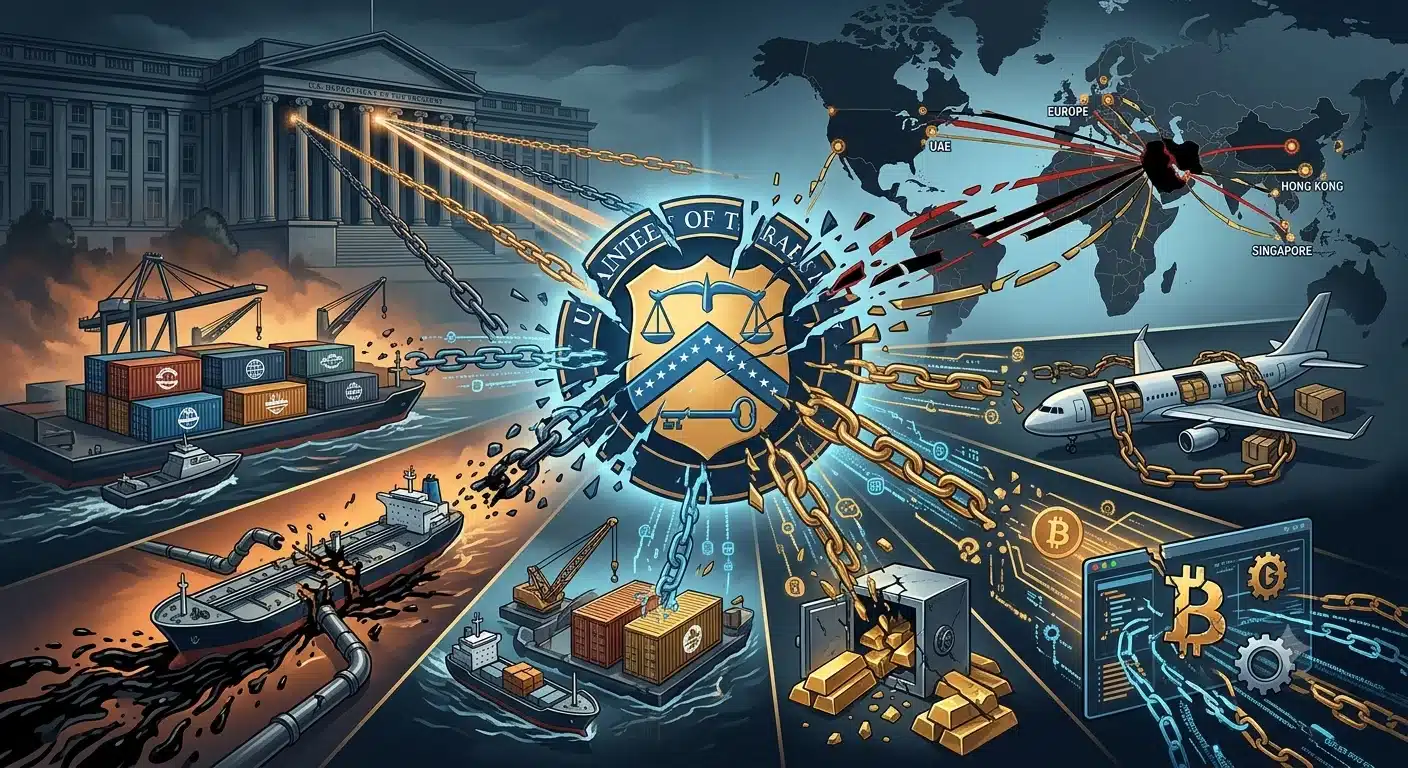
    The U.S. Department of the Treasury has launched Operation Economic Outcast, a whole-of-government campaign aimed at disrupting the economic networks and revenue channels supporting the Iranian regime and the Islamic Revolutionary Guard Corps (IRGC). The initiative expands Iran sanctions across digital assets, technology, gold, aviation and shipping, while targeting nearly 60 entities, individuals and vessels across multiple jurisdictions. Treasury said the campaign follows direction from Pre
     

US Treasury Launches Major Campaign to Disrupt Iran’s Global Networks

25 de Agosto de 2026, 03:44

Operation Economic Outcast

The U.S. Department of the Treasury has launched Operation Economic Outcast, a whole-of-government campaign aimed at disrupting the economic networks and revenue channels supporting the Iranian regime and the Islamic Revolutionary Guard Corps (IRGC). The initiative expands Iran sanctions across digital assets, technology, gold, aviation and shipping, while targeting nearly 60 entities, individuals and vessels across multiple jurisdictions. Treasury said the campaign follows direction from President Trump and is intended to systematically target financial channels used for oil smuggling, sanctions evasion and other activities linked to Iran.

Operation Economic Outcast Expands Iran Sanctions

Under Operation Economic Outcast, the Office of Foreign Assets Control (OFAC) issued five sectoral sanctions determinations covering digital assets, technology, gold, aviation and shipping. Treasury said the measures increase its ability to sanction foreign persons operating in or providing services to these sectors of the Iranian economy. The department said Iran has increasingly used cryptocurrency for sanctions evasion, while advanced technology has been sought for weapons programs. Gold has also been used to stabilize the rial, while aviation and shipping networks have been linked to the movement of fighters, weapons, sensitive technologies, oil and other assets. The new determinations build on earlier measures covering Iran’s financial, petroleum and petrochemical sectors.

OFAC Sanctions Nearly 60 Iran-Linked Targets

OFAC also sanctioned nearly 60 entities, individuals and vessels across networks associated with nuclear and missile technology procurement, cyber operations and oil revenue generation. The action includes a procurement network spanning the Middle East and East Asia that Treasury said helped Iranian entities obtain sensitive dual-use technology through front companies, financial channels and logistics intermediaries. Treasury also targeted a malicious cyber group directed by Iran’s Ministry of Intelligence and Security (MOIS). The department said members of the group compromised and exfiltrated data from U.S. companies in critical infrastructure sectors, including energy, healthcare, defense, information technology and financial services. The designations also include Iranian cyber actors accused of network compromises and digital asset theft. Treasury said one individual illicitly gained control of a Bitcoin wallet containing more than $30,000 in 2023.

Secondary Sanctions Risk Expands

The campaign also increases secondary sanctions exposure for entities that continue conducting certain business with the Iranian regime. Treasury said countries are being given timelines to address identified Iran-related activity, while entities facilitating money laundering or sanctions evasion could face restrictions involving the U.S. financial system. OFAC also suspended several general licenses that previously authorized certain remittance payments to Iran and Iranian access to parts of the U.S. cultural and academic system.

Iran’s Shadow Fleet and Oil Networks Targeted

A major component of the measures focuses on Iran’s shadow fleet and oil revenue channels. Treasury sanctioned brokers, companies, and vessels involved in transporting Iranian crude oil and petroleum products across multiple jurisdictions. The department identified shipping networks involving the UAE, Hong Kong, China, Singapore, Switzerland, Europe, and other regions. Several UAE-based entities and individuals were designated over alleged roles in facilitating Iranian oil shipments and cryptocurrency payments. OFAC also targeted five vessels identified as blocked property, including SIFRA, G SILVER, QUANTUM HOPE, VOYAGE ELITE and TELA. Treasury said these vessels had transported Iranian LPG, petroleum products or crude oil to markets in Asia. The measures mean that property and interests in property belonging to designated or blocked persons that are in the United States or under the control of U.S. persons are blocked and must be reported to OFAC. Treasury said violations of U.S. sanctions can result in civil or criminal penalties, while certain transactions involving designated persons may also expose foreign financial institutions to secondary sanctions.
  • ✇Firewall Daily – The Cyber Express
  • New Zealand Targets Russian Cyber Actors With Fresh Sanctions Samiksha Jain
    New Zealand has announced a new round of sanctions against Russia, targeting 33 individuals and entities accused of supporting Moscow’s war against Ukraine. The latest New Zealand sanctions against Russia place particular focus on cyber actors, individuals linked to the forced relocation and re-education of Ukrainian children, and entities supporting Russia’s military-industrial complex. Foreign Minister Winston Peters said the package also targets individuals involved in creating and spreadi
     

New Zealand Targets Russian Cyber Actors With Fresh Sanctions

11 de Agosto de 2026, 03:18

New Zealand Sanctions

New Zealand has announced a new round of sanctions against Russia, targeting 33 individuals and entities accused of supporting Moscow’s war against Ukraine. The latest New Zealand sanctions against Russia place particular focus on cyber actors, individuals linked to the forced relocation and re-education of Ukrainian children, and entities supporting Russia’s military-industrial complex. Foreign Minister Winston Peters said the package also targets individuals involved in creating and spreading anti-Ukraine propaganda, as well as actors from the Democratic People’s Republic of Korea (DPRK) and Iran providing support to Moscow. “Children should never be used as instruments of war,” Peters said, expressing concern over efforts to abduct and re-educate Ukrainian children through state-directed programmes.

New Zealand Sanctions Target Russian Cyber Actors

The latest Russia sanctions include several individuals previously accused by the United States and other Western governments of malicious cyber activity. Among them are Yuliya Pankratova and Denis Degtyarenko, members of the pro-Russian hacktivist group Cyber Army of Russia Reborn (CARR). The U.S. Treasury sanctioned both individuals in 2024 over alleged cyber operations targeting U.S. critical infrastructure. U.S. officials identified Pankratova, who uses the alias “YUliYA,” as the group’s leader, while Degtyarenko, known as “Dena,” was described as one of its primary hackers. American officials alleged that Degtyarenko was responsible for compromising an industrial control system at a U.S. energy company and had developed training materials for compromising supervisory control and data acquisition (SCADA) systems. Pankratova has also allegedly been associated with Z-Pentest, another pro-Russian hacking group accused of targeting critical infrastructure. New Zealand has also sanctioned Aleksandr Volosovik, known online as “Yalishanda.” U.S. prosecutors have accused him of helping operate Media Land, a Russian bulletproof hosting provider allegedly used by cybercriminals to target organizations including hospitals, schools and banks. In July, the U.S. Justice Department unsealed charges against Volosovik and two other Russian nationals, alleging activities that caused more than $62 million in losses to victims in the United States and other countries.

GRU-linked Official Among Sanctioned Individuals

Another individual included in the latest New Zealand sanctions against Russia is Andrey Averyanov, a senior Russian military intelligence officer who previously commanded GRU Unit 29155. Western governments have linked the unit to cyberattacks, sabotage and other covert operations. Its cyber division has been accused of targeting governments, defense organizations, think tanks and other entities in Ukraine and NATO countries. New Zealand had previously sanctioned members of the unit over alleged malicious cyber activity targeting Ukraine and other countries.

Russia Propaganda and Technology Entities Targeted

The new sanctions also target Russia’s Internet Development Institute (IRI), a Kremlin-backed organization that finances digital media and content promoting Russian state narratives. IRI director Alexey Goreslavsky has also been designated. The British government has previously said the institute was established by Russia’s presidential administration and received hundreds of millions of dollars in government funding. Its projects have included films and video games promoting narratives associated with the Kremlin. Russian information technology company LANIT has also been added to the sanctions list. The company has provided services to Russia’s Defense Ministry and sanctioned defense-industry companies, including state-owned conglomerate Rostec. LANIT had previously been sanctioned by the United States, Canada and Ukraine.

New Zealand Reaches 36th Russia Sanctions Round

The latest package represents New Zealand’s 36th round of Russia sanctions since the Russia Sanctions Act came into force in March 2022. New Zealand has now imposed sanctions on more than 2,000 Russian individuals, entities and vessels, alongside trade restrictions. The measures generally include asset freezes and travel bans and prohibit New Zealanders from making funds or other assets available to designated individuals and entities. Peters said cyber activity can have real-world consequences, noting that cyber actors are increasingly being used to gather intelligence, enable sanctions evasion and disrupt those opposing Russia’s aggression.
  • ✇@BushidoToken Threat Intel
  • Tracking Adversaries: EvilCorp, the RansomHub affiliate BushidoToken
     Introduction This blog is part of a cyber threat intelligence (CTI) blog series called Tracking Adversaries that investigates prominent or new threat groups. The focus of this blog is EvilCorp, a sanctioned Russia-based cybercriminal enterprise known for launching ransomware attacks, and RansomHub, a prominent ransomware as a service (RaaS) operation run by Russian-speaking cybercriminals.These two threat groups have been linked together through cooperation on intrusions and IOCs and TTPs sha
     

Tracking Adversaries: EvilCorp, the RansomHub affiliate

2 de Abril de 2025, 12:52


Introduction

This blog is part of a cyber threat intelligence (CTI) blog series called Tracking Adversaries that investigates prominent or new threat groups.

The focus of this blog is EvilCorp, a sanctioned Russia-based cybercriminal enterprise known for launching ransomware attacks, and RansomHub, a prominent ransomware as a service (RaaS) operation run by Russian-speaking cybercriminals.

These two threat groups have been linked together through cooperation on intrusions and IOCs and TTPs shared by multiple CTI sources. The implication of this link is critical due to RansomHub being the most active ransomware gang and is working with a well-known sanctioned affiliate.

Who is RansomHub?

Active since February 2024, RansomHub is a RaaS operation formerly known as Cyclops and Knight and is run by Russian-speaking adversaries. It is currently used by more and more cybercriminals that are ex-affiliates of other RaaS operations. This includes the ALPHV/BlackCat RaaS and the LockBit RaaS, which have since shutdown or disappeared. This has made the RansomHub RaaS one of the most widespread ransomware families as of early 2025.

Due to having a high number of affiliates, the tools and TTPs observed before the final RansomHub payload is deployed can vary significantly. Each affiliate may have their own set of tools and TTPs to achieve the final objectives of data exfiltration and ransomware deployment.

Who is EvilCorp?

Evil Corp is an international cybercrime network sanctioned for orchestrating large-scale financial cyberattacks led by Maksim Yakubets. EvilCorp’s operations have evolved over time, expanding from Dridex banking trojan campaigns into developing ransomware like BitPaymer, WastedLocker, Hades, PhoenixLocker, and MacawLocker.

Notably, Aleksandr Ryzhenkov, was identified by the National Crime Agency (NCA) as a high-ranking member of EvilCorp and also LockBit affiliate. Ryzhenkov became a LockBit affiliate around 2022, contributing to over 60 LockBit ransomware builds and attempting to extort more than $100 million from victims. This discovery aligns with Mandiant’s previous reporting on EvilCorp shifting to LockBit as well.

The NCA also found that EvilCorp maintains close ties with Russian intelligence agencies through Yakubets' father-in-law, Eduard Bendersky, a former FSB officer, who is suspected of using his influence to shield the group from prosecution in Russia.

One of the TTPs that makes EvilCorp standout from the rest of the RaaS affiliates is their own affiliation to the SocGholish JavaScript malware (aka FAKEUPDATES). If ransomware deployment takes place following a SocGholish infection, then the attackers responsible for the attack will be affiliated with EvilCorp.

Reported Connections Between EvilCorp and RansomHub

On 15 July 2024, Microsoft shared a post on X stating that RansomHub was observed being deployed in post-compromise activity by Manatee Tempest (which is Microsoft’s name for EvilCorp) following initial access via SocGholish (aka FakeUpdates) infections (which Microsoft tracks as Mustard Tempest).

A screenshot of a computer

AI-generated content may be incorrect.

On 15 January 2025, Guidepoint wrote a blog on a new Python backdoor used by an affiliate of RansomHub. Notably, the new Python backdoor was delivered by SocGholish. Therefore, this Python backdoor is another potential artifact worth monitoring for its connection to known EvilCorp-related malware.

The next day, on 16 January 2025, Google shared a report on EvilCorp (which Google tracks as UNC2165) that disclosed numerous tools and malware families they have been using to deliver RansomHub, including a Python backdoor dubbed VIPERTUNNEL (see the image below). The presence of a Python backdoor following a SocGholish infection is notable TTP that overlaps with the Guidepoint blog on RansomHub.

On 14 March 2025, Trend Micro disclosed further details that also confirmed the SocGholish malware is leading to the deployment of RansomHub ransomware. The operators of SocGholish are tracked as Water Scylla by Trend Micro. The operators distribute SocGholish via the Keitaro Traffic Direction System (TDS), a legitimate service used for marketing campaigns. Trend Micro also observed SocGholish dropping the same custom Python backdoor (aka VIPERTUNNEL) as well.

So What?

EvilCorp has been under US sanctions since 2019, making it illegal for affected organisations to pay ransoms to them without facing potential fines from the US Treasury’s Office of Foreign Assets Control (OFAC). Despite these sanctions, EvilCorp has continued its cybercriminal activities by adapting its tactics to include rebranding their ransomware and becoming an affiliate of RaaS operations, such as LockBit and RansomHub. 

The key indicator of EvilCorp's involvement in ransomware attacks continues to be the use of the SocGholish malware, which employs drive-by downloads masquerading as web browser software updates to gain initial access to systems.

EvilCorp’s affiliation with RansomHub raises the possibilities that RansomHub may soon face sanctions similar to those imposed on EvilCorp. Consequently, any victim that pays a ransom to RansomHub could become significantly riskier for cyber insurance organisations, incident responders, and ransomware negotiators, as they may inadvertently violate sanctions and face legal repercussions.

Given EvilCorp's prominence as a target for international law enforcement, its association with RansomHub is likely to draw increased scrutiny. This could result in RansomHub becoming the focus of future law enforcement actions, including potential takedowns and additional sanctions, further complicating the landscape for entities involved in ransomware response and mitigation.

There is also the increased likelihood that RansomHub will now rebrand. As we saw in the BlackBasta Leaks, ransomware groups pay close attention to the news, CTI reports, and even posts on X and even blogs by researchers. This association to EvilCorp and threat of sanctions is an issue for ransomware groups as it impacts their business model and makes earning harder. Therefore, by linking the two entities together CTI analysts can impose cost on these cybercriminals.

References:

  1. https://www.cisa.gov/news-events/cybersecurity-advisories/aa24-242a
  2. https://www.bankinfosecurity.com/blogs/ransomhub-hits-powered-by-ex-affiliates-lockbit-blackcat-p-3703
  3. https://www.ransomware.live/group/ransomhub#ttps
  4. https://home.treasury.gov/news/press-releases/sm845
  5. https://web.archive.org/web/20200213115628/https:/www.nationalcrimeagency.gov.uk/news/international-law-enforcement-operation-exposes-the-world-s-most-harmful-cyber-crime-group
  6. https://www.crowdstrike.com/en-us/blog/hades-ransomware-successor-to-indrik-spiders-wastedlocker/
  7. https://web.archive.org/web/20241004104429/https:/www.nationalcrimeagency.gov.uk/news/further-evil-corp-cyber-criminals-exposed-one-unmasked-as-lockbit-affiliate
  8. https://www.microsoft.com/en-us/security/blog/2022/05/09/ransomware-as-a-service-understanding-the-cybercrime-gig-economy-and-how-to-protect-yourself/#DEV-0206-DEV-0243
  9. https://malpedia.caad.fkie.fraunhofer.de/details/js.fakeupdates
  10. https://x.com/msftsecintel/status/1812932754947911780
  11. https://www.microsoft.com/en-gb/security/security-insider/manatee-tempest
  12. https://www.guidepointsecurity.com/blog/ransomhub-affiliate-leverage-python-based-backdoor/
  13. https://services.google.com/fh/files/misc/threat_horizons_report_h1_2025.pdf
  14. https://www.trendmicro.com/en_us/research/25/c/socgholishs-intrusion-techniques-facilitate-distribution-of-rans.html
  15. https://blog.bushidotoken.net/2025/02/blackbasta-leaks-lessons-from-ascension.html


❌
❌