Visualização normal

Antes de ontemStream principal
  • ✇Cybersecurity News
  • Google Cloud Launches Gemini Enterprise for Finance and Law Do Son
    Discover how Google Cloud Gemini Enterprise empowers the financial and legal sectors. Learn about its secure AI agents, data lineage, and MCP integration. Related Posts: Reverse Engineering Reveals Microsoft's Hidden InvisMark Watermark in Paint EA Anti-Cheat Secures Support for RTX SPARK Uber Fined $966 Million for Automated Driver Terminations The post Google Cloud Launches Gemini Enterprise for Finance and Law appeared first on Daily CyberSecurity.
     
  • ✇Blog – Cyble
  • Brand Impersonation Takedown: From Whack-a-Mole to Managed Response Mihir Bagwe
    Manual brand impersonation takedowns fail because attackers move faster than ticket-based abuse reports can resolve — phishing pages and fake executive profiles often do their damage within hours of going live, while manual removal can take days. A managed takedown program pairs continuous, verified monitoring with pre-authorized removal (in-certain cases), cutting the exposure window from days to hours. This matters most for consulting and professional services firms, where a spoofed domain o
     

Brand Impersonation Takedown: From Whack-a-Mole to Managed Response

17 de Agosto de 2026, 11:32

Brand Impersonation Takedown, Managed Takedown

Manual brand impersonation takedowns fail because attackers move faster than ticket-based abuse reports can resolve — phishing pages and fake executive profiles often do their damage within hours of going live, while manual removal can take days. A managed takedown program pairs continuous, verified monitoring with pre-authorized removal (in-certain cases), cutting the exposure window from days to hours. This matters most for consulting and professional services firms, where a spoofed domain or fake executive profile can compromise the client trust the business is built on.

How UNC3753 targeted US professional services firms in 2026

Between January and May of 2026, Google's Mandiant threat intelligence team tracked a financially motivated extortion campaign — attributed to a group known as UNC3753, or "Luna Moth," or "Silent Ransom Group" — working its way through dozens of professional, legal, and financial services organizations across the United States. The approach was almost old-fashioned. A benign-looking email about a data migration or an unpaid invoice, a follow-up phone call from someone posing as IT support, and a request to install "remote monitoring" software to fix the problem. No exploit. No malware dropped on day one. Just a firm's own trust in its brand and its people, turned against it.

It's a useful — if unsettling — reminder of why brand and executive impersonation isn't a side issue for professional services firms. It's often the entry point.

How much does phishing and impersonation actually cost US businesses

The scale of the problem, in dollar terms, is no longer subtle. The FBI's Internet Crime Complaint Center logged just over one million complaints in 2025 — the highest volume in the program's history — with phishing and spoofing making up roughly a fifth of all reports. Losses tied to phishing alone roughly tripled year-over-year, and business email compromise, which almost always starts with an attacker impersonating someone the victim trusts, accounted for over $3 billion in reported losses on its own. The mechanics of that damage matter too: the overwhelming majority of BEC losses move through wire transfer or ACH, rails that are fast, largely irreversible, and unforgiving of a slow response.

Put those two facts together and a pattern emerges. Impersonation attacks — of a brand, a partner, an executive, a vendor invoice — aren't rare or exotic. They're the default opening move. And once the fraudulent domain, profile, or listing is live, the clock the defender is racing isn't measured in days. It's measured in hours, sometimes less, before money moves or credentials are harvested.

Why are consulting and professional services firms specifically targeted?

Professional services firms occupy a strange position in the threat landscape. They're rarely the most technically fortified target, but they're consistently one of the most valuable ones. A consulting firm doesn't just protect its own data — it holds engagement records, financial models, and confidential strategy documents belonging to dozens of clients across industries. About 29% of U.S. law firms reported having experienced a security breach at some point, according to the ABA's most recent Legal Technology Survey — up from 25% just two years earlier. The same dynamic applies to consultancies. The firm is a single point of entry into a much larger web of client relationships.

That's precisely the exposure described in Cyble's case study of a U.S. consulting organization managing highly sensitive engagement data, confidential client information, and a large, distributed workforce operating across the country. As the case study describes it, the firm's brand, executives, and digital infrastructure were frequent targets specifically because of the trust clients placed in them as an advisor. Senior partners were likely of being impersonated through fake social profiles and spoofed domains. Fraudulent job postings and phishing campaigns leaned on the firm's own credibility to look legitimate. The attacker doesn't need to breach the firm's network if a client can be convinced, through a look-alike domain or a cloned executive profile, to simply hand over what the attacker wants.

That's the mechanism UNC3753 exploited nationally in 2026, and it's the exact exposure this consulting firm was trying to close.

Also read: Ransomware Threats in the Americas H1 2026: Dissecting the Regional Attack Patterns and Dominant Actors

What is the "whack-a-mole" problem in brand protection?

Here's where most brand protection programs quietly fail, and it isn't a detection problem — it's a speed problem.

A typical manual takedown workflow looks something like this: someone on the security or marketing team spots a phishing page or a fake LinkedIn profile impersonating a partner. They file an abuse report with the registrar or the platform. They wait. Maybe they follow up. Eventually, the page comes down — but by then, a new one has often already gone live, sometimes registered by the same actor under a slightly different domain.

This was exactly the challenge the consulting firm faced before its engagement with Cyble. Identifying and removing phishing pages, fraudulent job postings, and impersonating domains was, in the case study's own words, reactive and resource-intensive, leaving the brand exposed for longer than the firm considered acceptable. It's a program that looks active — tickets filed, pages eventually removed — while the actual window of exposure, the hours where a client or job candidate could act on the fake page, stays wide open. Volume of takedowns filed is an easy number to report. Speed of resolution is the number that actually protects anyone.

What does managed takedown response actually involve

The shift the case study describes isn't just "faster takedowns" — it's a change in the operating model, from reactive point-solution to continuous, managed coverage. Three pieces work together in the deployment:

  • Brand and Executive Monitoring continuously scans for phishing domains, fraudulent job postings, and impersonation attempts using the firm's name, alongside dedicated monitoring of senior leadership profiles across social platforms — catching the fake partner LinkedIn account or spoofed domain before it's had time to circulate.
  • Verification before escalation means the security team isn't drowning in unconfirmed alerts. Threats are validated as genuine before they ever reach someone's desk, which is what separates consolidated intelligence from just another noisy dashboard.
  • Managed Takedown Services then handle the actual removal — confirmed phishing pages, impersonating domains, and fraudulent listings — without the internal team having to individually chase registrars and platforms one abuse ticket at a time.

The outcome is a meaningfully shortened window between detection and removal — turning a slow, manual, ticket-by-ticket grind into something closer to continuous coverage. That's the real distinction between a takedown service and a takedown program: one reacts when someone happens to notice a fake page; the other is built to notice, verify, and resolve on a timeline that assumes attackers move fast, because they do.

Why client trust is the real asset at risk

For a consulting firm, the financial cost of an impersonation attack is rarely the headline risk. The deeper cost is what it does to the relationship a firm's entire business is built on. When a client, a job candidate, or a prospective hire can't tell the difference between a legitimate email from the firm and a spoofed one, the firm's advisory credibility — the thing it's actually selling — starts to erode. That's a slower, quieter kind of damage than a wire fraud loss, but for a professional services firm, it may be the more expensive one.

The lesson from both the national threat data and this specific engagement is the same – brand and executive impersonation isn't a marketing nuisance to be cleaned up occasionally. It's a live attack surface, moving at a speed that manual, ad hoc takedown processes were never built to match. Firms that treat it that way — with continuous monitoring, verified alerts, and managed resolution — are the ones that keep the exposure window measured in hours instead of days.


Frequently asked questions (FAQs)

What is a brand impersonation takedown service?

A brand impersonation takedown service identifies fraudulent domains, phishing pages, fake social media profiles, and impersonating job listings that misuse a company's name or logo, then works with registrars, hosting providers, and platforms to have that content removed.

How long does it take to take down a phishing site?

Timelines vary by registrar and hosting provider, but manual, ticket-based takedown requests commonly take days to resolve. Managed takedown programs that pre-verify threats and maintain direct relationships with providers can shorten that window to hours.

Why do manual takedown processes fail against brand impersonation?

Manual processes fail because they're reactive: a person has to notice the fake page, file a report, and wait for a third party to act, while attackers can register replacement domains faster than any single report gets resolved. The volume of tickets filed can look productive even while the actual exposure window stays open.

What's the difference between takedown volume and takedown speed?

Takedown volume measures how many fraudulent pages were reported or removed over time. Takedown speed measures how quickly a live threat is detected, verified, and taken down after it appears. Speed is the metric that actually limits damage, since most harm from a phishing page happens in its first hours online.

How can consulting and professional services firms protect executives from impersonation?

Dedicated executive monitoring tracks senior leaders' names and likenesses across social platforms and the web to catch fake profiles, spoofed communications, and impersonation attempts early, ideally paired with managed takedown so confirmed threats are removed without requiring the executive or internal team to handle it themselves.


Sources:

FBI Internet Crime Complaint Center, 2025 Internet Crime Report;
Cyble, "How Cyble Delivered Unified Multi-Layered Threat Intelligence to a U.S. Consulting Organization";
Google/Mandiant, "Ongoing Targeted Campaign Against US Law Firms" (2026);
American Bar Association Legal Technology Survey.

The post Brand Impersonation Takedown: From Whack-a-Mole to Managed Response appeared first on Cyble.

  • ✇Security | CIO
  • IBM partners with OpenAI to drive enterprise AI deployment
    IBM will embed OpenAI frontier models and products such as Codex and ChatGPT embedded into IBM’s AI consulting services platform, IBM Consulting Advantage, as well as expanding the companies’ existing collaboration in the cybersecurity realm, they announced Thursday. Joint initiatives will include the creation of industry-specific products for financial services, government, telecommunications, and retail, as well as serving key enterprise domains such as finance, procu
     

IBM partners with OpenAI to drive enterprise AI deployment

14 de Agosto de 2026, 08:38

IBM will embed OpenAI frontier models and products such as Codex and ChatGPT embedded into IBM’s AI consulting services platform, IBM Consulting Advantage, as well as expanding the companies’ existing collaboration in the cybersecurity realm, they announced Thursday.

Joint initiatives will include the creation of industry-specific products for financial services, government, telecommunications, and retail, as well as serving key enterprise domains such as finance, procurement, customer operations, and HR.

IBM will join the OpenAI Partner Network and engage forward-deployed engineers and consultants trained through the network to help clients accelerate their AI implementations. It will also create a dedicated OpenAI practice, certifying thousands of consultants and engineers via the Partner Network, it said.

There will be three focus areas in the new partnership: helping organizations transform their businesses to integrate AI into their daily work, assisting clients in modernizing legacy applications through a combination of OpenAI products and IBM’s expertise, and an expansion of an existing cybersecurity collaboration combining OpenAI frontier AI capabilities with IBM Autonomous Security.

Everyone, it seems, is engaging forward-deployed engineers to help enterprises build systems around their AI models: OpenAI announced its initiative, OpenAI Deployment Company, on May 11, a week after Anthropic launched its efforts. Microsoft and AWS too have jumped into the ring.

But, said Info-Tech Research Group distinguished analyst Mark Tauschek, “This is becoming table stakes. The consulting firms that have the horsepower and technical talent to partner with a frontier AI lab to do this are all picking their horses. Anthropic has some, Microsoft has some, and of course OpenAI has some. There will be more announcements like this to follow, and while it’s good PR for both IBM and OpenAI, it’s certainly not differentiating.”

Enterprises will choose the consulting firms that work with their AI vendor of choice, he noted, although he does think that Microsoft had the initial advantage because they were able to quickly provide thousands of skilled FDEs.

“But,” he said, “this is a horse race, and it’s going to be a tight one.”

  • ✇Securelist
  • How legitimate cloud platforms enable phishers to bypass MFA Olga Altukhova
    Threat actors are increasingly exploiting legitimate cloud services to evade detection and streamline the deployment of their scam infrastructure. Cloud hosting services and decentralized networks have become primary platforms for hosting phishing pages and sites. Throughout 2025 and 2026, we have observed phishing operators steadily migrate toward platforms like Cloudflare Workers, Vercel, Netlify, GitHub Pages, and IPFS. This post analyzes the mechanics of a real-life adversary-in-the-middle (
     

How legitimate cloud platforms enable phishers to bypass MFA

4 de Agosto de 2026, 09:00

Threat actors are increasingly exploiting legitimate cloud services to evade detection and streamline the deployment of their scam infrastructure. Cloud hosting services and decentralized networks have become primary platforms for hosting phishing pages and sites. Throughout 2025 and 2026, we have observed phishing operators steadily migrate toward platforms like Cloudflare Workers, Vercel, Netlify, GitHub Pages, and IPFS. This post analyzes the mechanics of a real-life adversary-in-the-middle (AitM) attack in a cloud environment and presents detailed statistics on the platforms and domains phishers abuse most frequently.

The cloud as a safe haven for phishers

Threat actors select platform-as-a-service (PaaS) offerings and distributed cloud environments to host phishing sites for much the same reasons legitimate software developers do:

  • Inherent trust and reputation. Phishing pages hosted on reputable platforms appear trustworthy, reducing suspicion among potential victims.
  • Most platforms offer generous free-tier developer plans. The onboarding process takes minutes and rarely requires Know Your Customer (KYC) identity verification. This enables a single operator to create hundreds of malicious accounts.
  • Evasion and anonymity. Attackers leverage native security features to obscure their true origin server IP address behind a CDN, which complicates detection for security vendors.

Additionally, these platforms allocate shared subdomains hosting millions of legitimate projects and websites. Security teams cannot simply block the parent domain or its subdomains without inflicting collateral damage on bona fide users – a limitation that malicious actors take advantage of. To counter this tactic, security vendors must advance content-based analysis methodologies.

Multi-stage AitM attack

Consider a modern AitM phishing campaign that leverages Cloudflare Workers, a widely adopted cloud platform. The attackers execute the operation through multiple HTML pages distributed across a compromised website and the cloud platform. Each page serves a specific function: harvesting target email addresses, initializing the reverse-proxy infrastructure, or spoofing the login form to capture multi-factor authentication (MFA) sessions.

Stage 1. Contact harvesting and network monitoring evasion

The attack typically begins with a phishing email that uses a plausible pretext – such as a request from a coworker to review documents – to entice the target into clicking a malicious link.

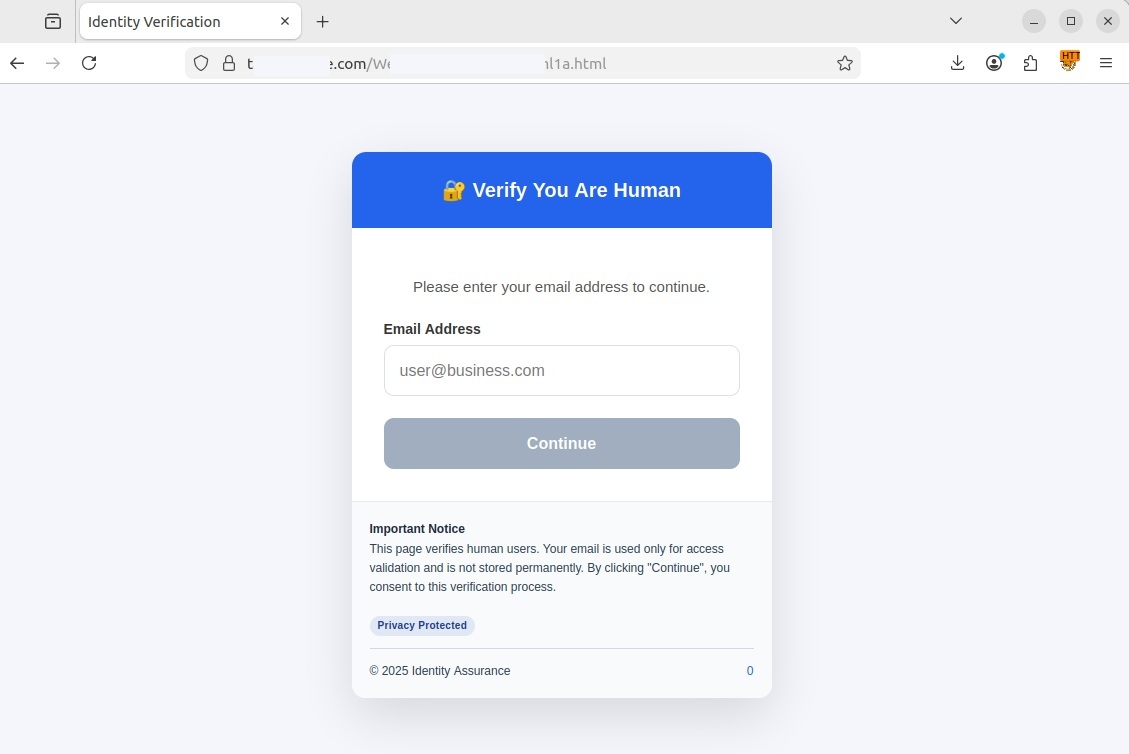
Upon clicking the link, the user is redirected to a fake CAPTCHA landing page hosted on a compromised legitimate website. This specific campaign used the https://t[REDACTED]e.com website, but any other variations are possible. In this scenario, the compromised page served as a disposable relay — vendor detection mechanisms typically block phishing links delivered directly via email much faster — to prevent the early discovery of the core phishing content hosted on Cloudflare.

If the user entered their email address and clicked Continue, the pseudo-CAPTCHA marked them as a human user and initiated a redirect. The primary objective of this stage is to harvest target email addresses, filter out bots, and route legitimate users to a subdomain of workers.dev. Such subdomains are generated automatically and free of charge by Cloudflare Workers. The victim’s email address was embedded in the URL hash (the part of the URL following the # character), allowing the page at [REDACTED].workers.dev to extract the email without issuing a request to the attacker’s server, thereby avoiding detection.

Stage 2. Initializing a transparent proxy

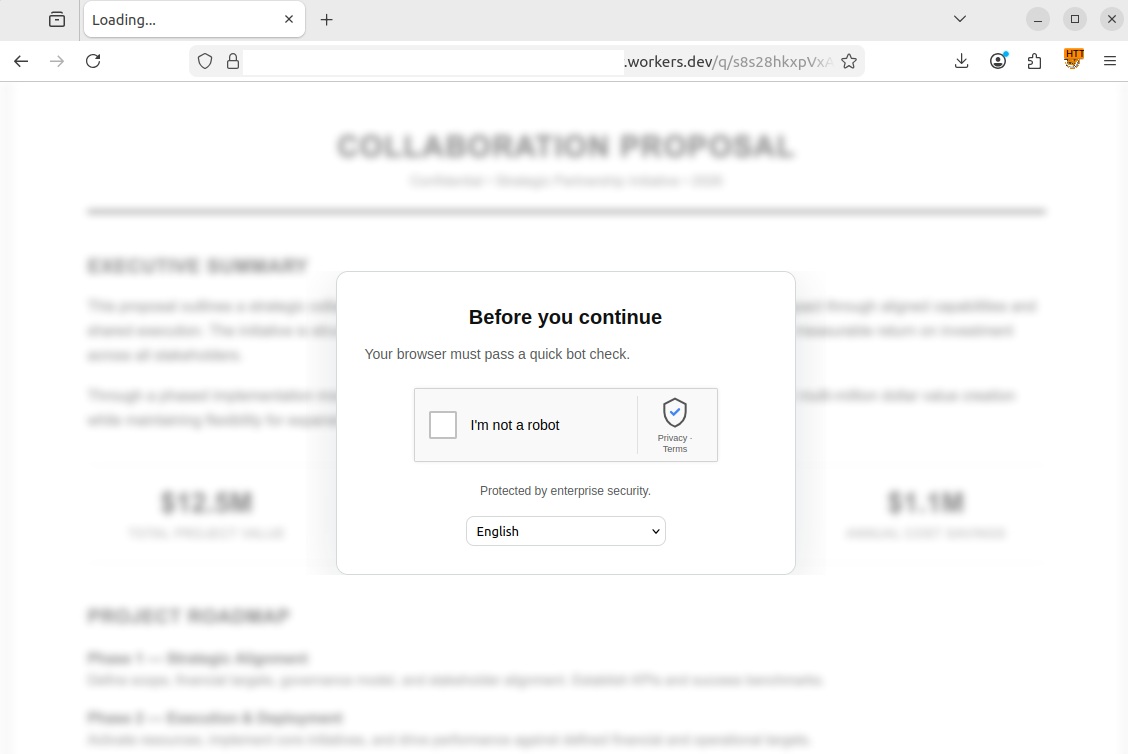
The user’s browser then loaded a [REDACTED].workers.dev page with #user@business.com at the end of the URL. At this point, the page presented the victim with a genuine CAPTCHA challenge. This step ensured that an actual user was interacting with the page rather than a security sandbox.

Another CAPTCHA, this time a legitimate one

Another CAPTCHA, this time a legitimate one

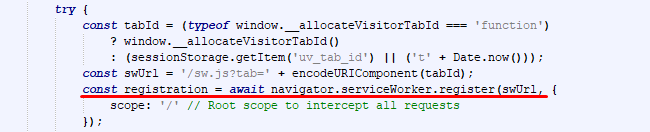
Once the user successfully completed the challenge, a service worker was registered in their browser. This is a special JavaScript file capable of running in the background and intercepting all network requests generated by the current tab. As this type of script was designed as a core component of progressive web apps (PWAs) to optimize load times and support offline functionality, browsers treat service workers as standard site feature and execute them without prompting for user consent as long as the website uses an HTTPS connection.

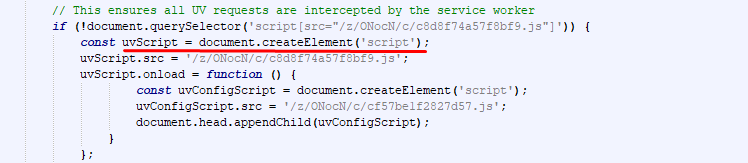
The attackers leveraged the service worker to deploy Ultraviolet, a legitimate open-source web proxy library, to dynamically rewrite all links and forms on the page. This forced every outgoing request – including those for Microsoft login credentials – to route through the attackers’ server rather than directly to the legitimate services.

Immediately upon loading, the page extracted the victim’s email address from the URL hash and stored it in the browser’s sessionStorage property so it would not be overwritten when the CAPTCHA loaded. This step also allowed the script to pre-fill the username field in the form automatically. A pre-populated login field enhanced the page’s credibility and bolstered user trust. Once the CAPTCHA was passed, the malicious script constructed a redirect URL for the third stage, appending the email retrieved from sessionStorage back to the hash. By passing the email via the URL hash across three consecutive stages, the attackers successfully kept it hidden from network attack detection systems.

Registering a service worker to intercept traffic

Registering a service worker to intercept traffic

Establishing a transparent proxy via an external library

Establishing a transparent proxy via an external library

Stage 3. Session hijacking and browser window spoofing

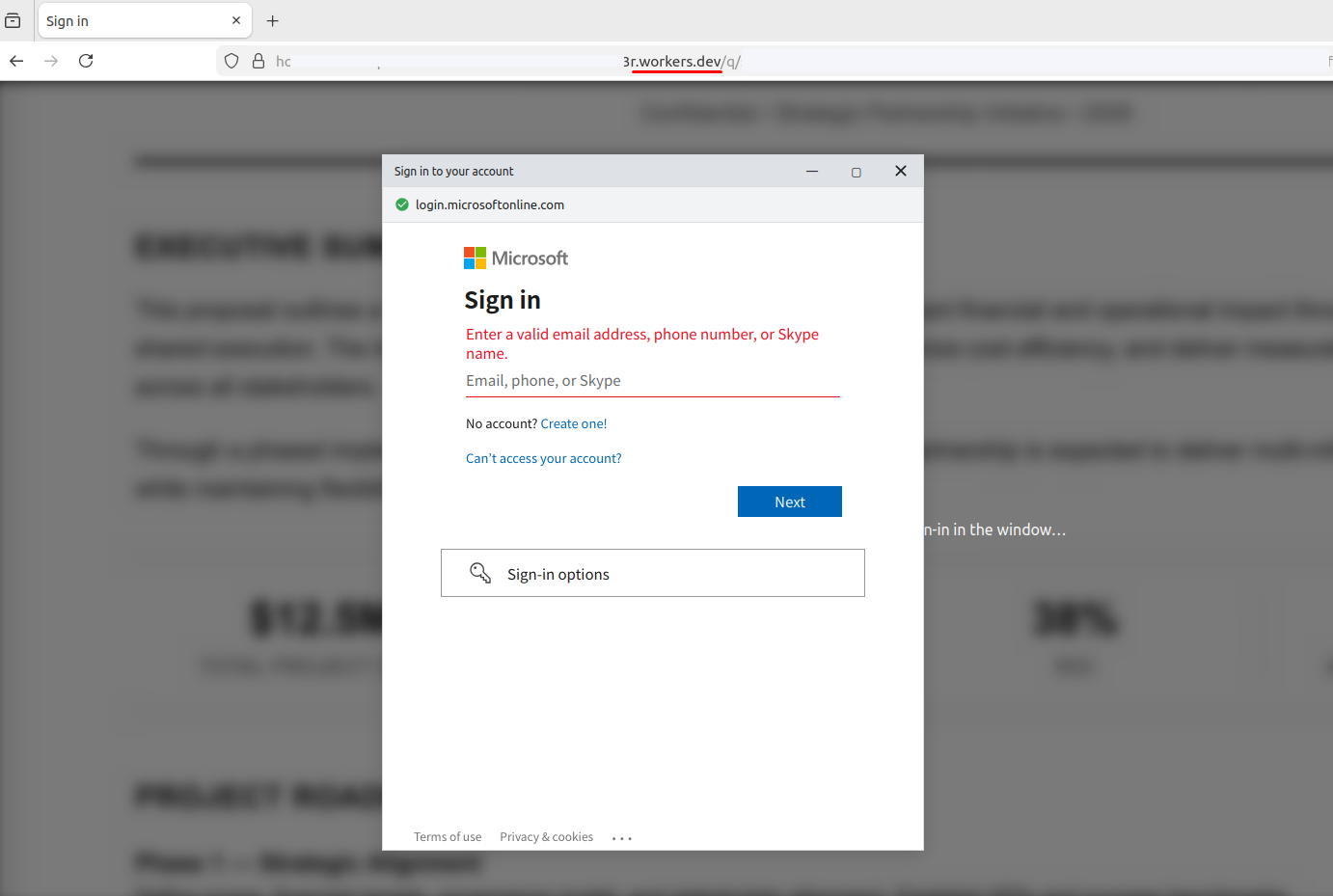
The final stage unfolded on a third page, combining adversary-in-the-middle (AitM) traffic interception with a browser-in-the-browser (BitB) UI spoofing technique. BitB attacks operate by rendering a block inside a legitimate webpage that visually mimics a native browser pop-up window.

In this case, the script hosted on the attacker’s page generated a pop-up visually identical to a native browser window, complete with window controls and a spoofed address bar showing a trusted Microsoft URL. Within this simulated window, an iframe loaded the authentic login interface, routed dynamically through the service worker reverse proxy created in Stage 2. When the victim entered their credentials and MFA code into the BitB window, the proxy script intercepted both the credentials and the session tokens. Combining BitB with AitM significantly increases the threat: BitB provides a convincing, trusted visual wrapper (displaying a legitimate URL and branding), while the hidden AitM proxy quietly handles traffic interception and session hijacking behind the scenes.

Upon successful login, the proxy instructs the interface to close the pop-up and redirect the victim to a generic system error page, such as SessionExpired. This minimizes suspicion: the victim assumes a technical glitch occurred and attempts to log in again, unaware that the attacker already has full access to the session.

Cloud platform phishing attack statistics

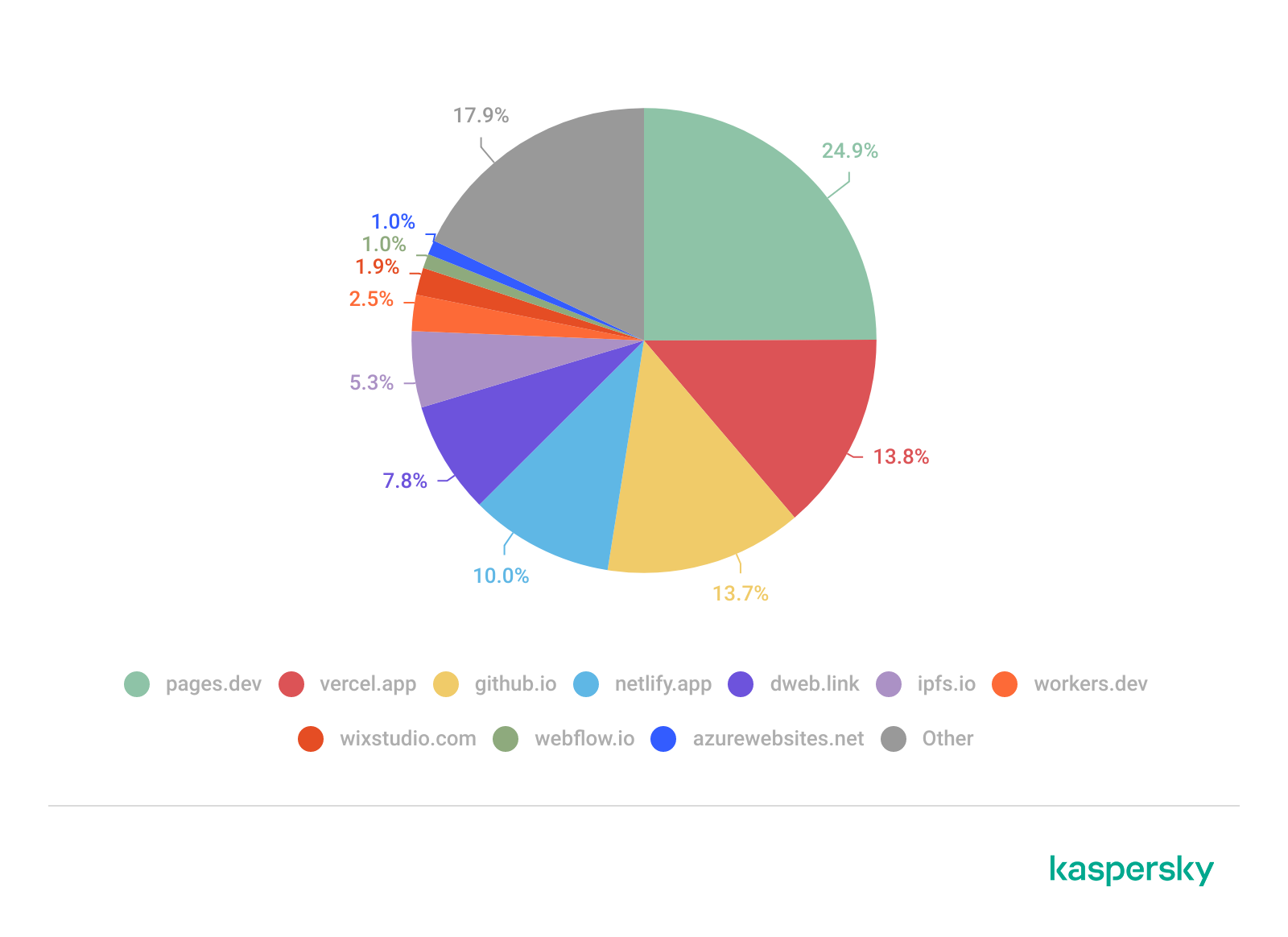
We analyzed phishing URLs hosted across popular cloud platforms – including Cloudflare, Netlify, and GitHub Pages – over a 12-month period spanning August 2025 to July 2026. The data below outlines trends in unique third-level domains exploited to deliver phishing content. In total, our security solutions blocked 224,984 unique third-level domains on cloud and decentralized services used in phishing attacks within that timeframe.

Number of unique third-level domains
(download)

Based on this telemetry, we compiled a list of the TOP 10 cloud domains most frequently abused in phishing campaigns over the specified period.

Number of phishing links

Unsurprisingly, Cloudflare and Vercel emerged as the undisputed leaders: both offer free tiers, automated SSL certificate issuance, and global CDNs. GitHub Pages ranked third. The widespread legitimate use of the github.io domain complicates bulk blocking efforts, as security teams risk limiting access to non-malicious projects.

Decentralized networks also warrant close attention – we posted on this subject in 2023. The ipfs.io and dweb.link domains function as IPFS gateways. The principal risk associated with these platforms is content persistence: even if a specific gateway gets blocked, the phishing page remains accessible via alternative nodes across the network.

The visual website builders Wix and Webflow also ranked among the TOP 10 (eighth and ninth, respectively). These platforms allow low-skilled individuals to build phishing pages rapidly without advanced coding expertise, which significantly lowers the barrier to entry for less capable malicious actors.


Domain Number of phishing links Platform
1 pages.dev 24.9% Cloudflare Pages
2 vercel.app 13.8% Vercel
3 github.io 13.7% GitHub Pages
4 netlify.app 10.0% Netlify
5 dweb.link 7.8% IPFS gateway
6 ipfs.io 5.3% IPFS (InterPlanetary File System)
7 workers.dev 2.5% Cloudflare Workers
8 wixstudio.com 1.9% Wix Studio
9 webflow.io 1.0% Webflow
10 azurewebsites.net 1.0% Microsoft Azure
Other 17.9%

In total, we identified and neutralized over 390,000 phishing pages hosted across legitimate cloud platforms and decentralized networks (IPFS) over the past 12 months. This data confirms that threat actors actively exploit the implicit trust associated with legitimate PaaS providers (such as Cloudflare Workers, Vercel, Netlify, and GitHub Pages) and IPFS gateways. High domain reputation, generous free tiers, and built-in evasion capabilities enable phishers to deploy multi-stage AitM attacks designed to hijack MFA sessions.

Recommendations

Traditional security controls, such as relying on HTTPS lock icons or reputation-based domain denylists, are inadequate against these attacks. The cloud provider’s apex domain maintains a positive reputation score, while attackers generate malicious subdomains programmatically and at scale.

Effective defense against these threats calls for a layered security posture:

  • Exercise caution with unexpected requests, even if they are served from reputable domains or secured with valid SSL/TLS certificates.
  • Treat any CAPTCHA interface requiring personal data input as a possible scam. Legitimate CAPTCHA challenges rarely request personally identifiable information, such as email addresses.
  • Inspect the URL in the address bar at the very top of the browser window. In BitB attacks, threat actors can render a fake browser pop-up displaying any target URL, even a legitimate one. However, the true address bar – located at the top of the main browser window alongside native navigation controls (Back, Forward, Refresh) – will continue to display the actual attacker-controlled domain.
  • Avoid entering credentials in pop-ups you did not expect to see. If a login or MFA form appears without your explicit action, close the tab immediately. Navigate to the intended service manually by entering its address directly into the browser.
  • Additional protection can be provided by Kaspersky Secure Mail Gateway for enterprise environments and Kaspersky Premium for personal correspondence. These robust email security solutions neutralize phishing links at the delivery stage before they reach the inbox.

AWS Billion-Dollar Software Bug Explained

20 de Julho de 2026, 14:28

An AWS software bug showed some customers billing estimates in the billions and trillions. Here is what failed, why invoices were unaffected, and what IT teams should know.

The post AWS Billion-Dollar Software Bug Explained appeared first on TechRepublic.

  • ✇The Cloudflare Blog
  • AI Security for Apps is now generally available Liam Reese · Zhiyuan Zheng · Catherine Newcomb
    Cloudflare’s AI Security for Apps detects and mitigates threats to AI-powered applications. Today, we're announcing that it is generally available.We’re shipping with new capabilities like detection for custom topics, and we're making AI endpoint discovery free for every Cloudflare customer—including those on Free, Pro, and Business plans—to give everyone visibility into where AI is deployed across their Internet-facing apps.We're also announcing an expanded collaboration with IBM, which has cho
     

AI Security for Apps is now generally available

11 de Março de 2026, 10:00

Cloudflare’s AI Security for Apps detects and mitigates threats to AI-powered applications. Today, we're announcing that it is generally available.

We’re shipping with new capabilities like detection for custom topics, and we're making AI endpoint discovery free for every Cloudflare customer—including those on Free, Pro, and Business plans—to give everyone visibility into where AI is deployed across their Internet-facing apps.

We're also announcing an expanded collaboration with IBM, which has chosen Cloudflare to deliver AI security to its cloud customers. And we’re partnering with Wiz to give mutual customers a unified view of their AI security posture.

A new kind of attack surface

Traditional web applications have defined operations: check a bank balance, make a transfer. You can write deterministic rules to secure those interactions. 

AI-powered applications and agents are different. They accept natural language and generate unpredictable responses. There's no fixed set of operations to allow or deny, because the inputs and outputs are probabilistic. Attackers can manipulate large language models to take unauthorized actions or leak sensitive data. Prompt injection, sensitive information disclosure, and unbounded consumption are just a few of the risks cataloged in the OWASP Top 10 for LLM Applications.

These risks escalate as AI applications become agents. When an AI gains access to tool calls—processing refunds, modifying accounts, providing discounts, or accessing customer data—a single malicious prompt becomes an immediate security incident.

Customers tell us what they’re up against. "Most of Newfold Digital's teams are putting in their own Generative AI safeguards, but everybody is innovating so quickly that there are inevitably going to be some gaps eventually,” says Rick Radinger, Principal Systems Architect at Newfold Digital, which operates Bluehost, HostGator, and Domain.com.

What AI Security for Apps does

We built AI Security for Apps to address this. It sits in front of your AI-powered applications, whether you're using a third-party model or hosting your own, as part of Cloudflare's reverse proxy. It helps you (1) discover AI-powered apps across your web property, (2) detect malicious or off-policy behavior to those endpoints, and (3) mitigate threats via the familiar WAF rule builder.

Discovery — now free for everyone

Before you can protect your LLM-powered applications, you need to know where they're being used. We often hear from security teams who don’t have a complete picture of AI deployments across their apps, especially as the LLM market evolves and developers swap out models and providers. 

AI Security for Apps automatically identifies LLM-powered endpoints across your web properties, regardless of where they’re hosted or what the model is. Starting today, this capability is free for every Cloudflare customer, including Free, Pro, and Business plans. 

Cloudflare’s dashboard page of web assets, showing 2 example endpoints labelled as cf-llm

Discovering these endpoints automatically requires more than matching common path patterns like /chat/completions. Many AI-powered applications don't have a chat interface: think product search, property valuation tools, or recommendation engines. We built a detection system that looks at how endpoints behave, not what they're called. To confidently identify AI-powered endpoints, sufficient valid traffic is required.

AI-powered endpoints that have been discovered will be visible under Security → Web Assets, labeled as cf-llm. For customers on a Free plan, endpoint discovery is initiated when you first navigate to the Discovery page. For customers on a paid plan, discovery occurs automatically in the background on a recurring basis. If your AI-powered endpoints have been discovered, you can review them immediately.

Detection

AI Security for Apps detections follow the always-on approach for traffic to your AI-powered endpoints. Each prompt is run through multiple detection modules for prompt injection, PII exposure, and sensitive or toxic topics. The results—whether the prompt was malicious or not—are attached as metadata you can use in custom WAF rules to enforce your policies. We are continuously exploring ways to leverage our global network, which sees traffic from roughly 20% of the web, to identify new attack patterns across millions of sites before they reach yours.

New in GA: Custom topics detection

The product ships with built-in detection for common threats: prompt injections, PII extraction, and toxic topics. But every business has its own definition of what's off-limits. A financial services company might need to detect discussions of specific securities. A healthcare company might need to flag conversations that touch on patient data. A retailer might want to know when customers are asking about competitor products.

The new custom topics feature lets you define these categories. You specify the topic, we inspect the prompt and output a relevance score that you can use to log, block, or handle however you decide. Our goal is to build an extensible tool that flexes to your use cases.

Prompt relevance score inside of AI Security for Apps

New in GA: Custom prompt extraction

AI Security for Apps enforces guardrails before unsafe prompts can reach your infrastructure. To run detections accurately and provide real-time protection, we first need to identify the prompt within the request payload. Prompts can live anywhere in a request body, and different LLM providers structure their APIs differently. OpenAI and most providers use $.messages[*].content for chat completions. Anthropic's batch API nests prompts inside $.requests[*].params.messages[*].content. Your custom property valuation tool might use $.property_description.

Out of the box, we support the standard formats used by OpenAI, Anthropic, Google Gemini, Mistral, Cohere, xAI, DeepSeek, and others. When we can't match a known pattern, we apply a default-secure posture and run detection on the entire request body. This can introduce false positives when the payload contains fields that are sensitive but don't feed directly to an AI model, for example, a $.customer_name field alongside the actual prompt might trigger PII detection unnecessarily.

Soon, you'll be able to define your own JSONPath expressions to tell us exactly where to find the prompt. This will reduce false positives and lead to more accurate detections. We're also building a prompt-learning capability that will automatically adapt to your application's structure over time.

Mitigation

Once a threat is identified and scored, you can block it, log it, or deliver custom responses, using the same WAF rules engine you already use for the rest of your application security. The power of Cloudflare’s shared platform is that you can combine AI-specific signals with everything else we know about a request, represented by hundreds of fields available in the WAF. A prompt injection attempt is suspicious. A prompt injection attempt from an IP that’s been probing your login page, using a browser fingerprint associated with previous attacks, and rotating through a botnet is a different story. Point solutions that only see the AI layer can’t make these connections.

This unified security layer is exactly what they need at Newfold Digital to discover, label, and protect AI endpoints, says Radinger: “We look forward to using it across all these projects to serve as a fail-safe."

Growing ecosystem

AI Security for Applications will also be available through Cloudflare's growing ecosystem, including through integration with IBM Cloud. Through IBM Cloud Internet Services (CIS), end users can already procure advanced application security solutions and manage them directly through their IBM Cloud account. 

We're also partnering with Wiz to connect AI Security for Applications with Wiz AI Security, giving mutual customers a unified view of their AI security posture, from model and agent discovery in the cloud to application-layer guardrails at the edge.

How to get started

AI Security for Apps is available now for Cloudflare’s Enterprise customers. Contact your account team to get started, or see the product in action with a self-guided tour.

If you're on a Free, Pro, or Business plan, you can use AI endpoint discovery today. Log in to your dashboard and navigate to Security → Web Assets to see which endpoints we've identified. Keep an eye out — we plan to make all AI Security for Apps capabilities available for customers on all plans soon.

For configuration details, see our documentation.

  • ✇Krebs on Security
  • Microsoft Patches a Record 570 Security Flaws BrianKrebs
    Microsoft Corp. today released software updates to plug at least 570 security holes in its Windows operating systems and other software, almost triple the number of vulnerabilities the software giant fixed in its record-smashing Patch Tuesday release last month. Microsoft attributed the burgeoning patch counts to vulnerability discoveries aided by artificial intelligence. Nearly 60 of the bugs quashed in July’s Patch Tuesday earned a “critical” severity rating, meaning miscreants or malware cou
     

Microsoft Patches a Record 570 Security Flaws

14 de Julho de 2026, 16:22

Microsoft Corp. today released software updates to plug at least 570 security holes in its Windows operating systems and other software, almost triple the number of vulnerabilities the software giant fixed in its record-smashing Patch Tuesday release last month. Microsoft attributed the burgeoning patch counts to vulnerability discoveries aided by artificial intelligence.

A picture of a windows laptop in its updating stage, saying do not turn off the computer.

Nearly 60 of the bugs quashed in July’s Patch Tuesday earned a “critical” severity rating, meaning miscreants or malware could use them to seize remote control over a Windows device with little or no help from the user. Microsoft also addressed three zero-day flaws, including two that are already being exploited in the wild.

Two of the zero-day weaknesses allow an attacker to elevate their user rights on a Windows system, as do approximately 250 other elevation of privilege flaws fixed this month; they include CVE-2026-56155 — an Active Directory Federation Services bug — and CVE-2026-56164, a Microsoft Sharepoint vulnerability.

CVE-2026-50661 is a security feature bypass in Windows BitLocker that could allow attackers to gain access to encrypted data if they have physical access to the device. Microsoft said this bug has been detailed publicly, but that it is not aware of any active exploitation.

In a blog post on July 9, Microsoft Executive Vice President Pavan Davuluri wrote that Windows users will notice “a higher volume of security updates included in each security release” as a result of AI aiding in the discovery of vulnerabilities.

“The pace of vulnerability discovery is changing with advances in AI making it possible to find more issues, faster, across more code, with new mechanisms that can accelerate both discovery and analysis,” Davuluri wrote.

Jack Bicer, director of vulnerability research at Action1, called attention to CVE-2026-48561, a remote code execution flaw in Microsoft Copilot (with a 9.6 CVSS threat score) that allows an unauthorized attacker to execute code over the network. Microsoft says an attacker could exploit this bug by hosting a malicious website that causes Microsoft Edge for Android to automatically send crafted prompts to Copilot when a user visits the site.

As AI advances the state of vulnerability discovery and remediation, it is also making it easier for attackers to quickly devise working exploits for known software flaws. Microsoft has long labeled security bugs using its “exploitability index,” which is Redmond’s best guess as to how likely it is that attackers will be able to figure out a reliable way to exploit a given vulnerability.

But Satnam Narang, senior staff research engineer at Tenable, argues that Microsoft’s exploitability index needs to do a better job of shifting with the machine speed of discovery. For example, Microsoft originally gave this month’s SharePoint zero-day an exploitability rating of “less likely,” although the flaw was added to CISA’s Known Exploited Vulnerabilities list on July 1.

“Anthropic’s Red Team’s own findings for known vulnerabilities (n-days) revealed how fragile this system has become, with its Mythos Preview model being able to produce proof-of-concept exploits for 13 of 14 vulnerabilities that were rated ‘Exploitation Less Likely’ or ‘Exploitation Unlikely,'” Narang said. “What this means is that our way of looking at Patch Tuesday has changed, because the exploitability index is centered around humans, not AI tools, and as these tools continue to improve, defense needs to improve alongside it.”

Chris Goettl at Ivanti observed that the record patch numbers from Microsoft come as a number of other major software makers are increasing their patch cadence, including Adobe which announced today it is moving to twice-monthly security bulletins published on the 2nd and 4th Tuesday of each month (Adobe also cited AI for accelerating their patch cycles). Cisco, Mozilla and Oracle also are shipping updates more frequently, while Google’s patch batches in June 2026 totaled more than 900 security fixes, Goettl noted.

Backing up your Windows system and/or data is always a good idea before applying operating system updates. Given the volume of patches addressed this month it may be wise for end users to wait a few days before applying these fixes. It’s not uncommon for security patches to introduce system stability issues, and those chances probably increase quite a bit with the gigantic patch count released today.

Further reading:

Action1’s Patch Tuesday blog

Automox’s rundown

  • ✇Krebs on Security
  • A Record-Breaking Patch Tuesday for June 2026 BrianKrebs
    Microsoft today released software updates to plug nearly 200 security holes across its Windows operating systems and supported software, a record number of fixes for the company’s monthly Patch Tuesday cycle. Nearly three dozen of those bugs earned Microsoft’s most dire “critical” rating, and exploit code for at least three of the weaknesses is now publicly available. The software giant said in a blog post last month that both its engineers and the security community are increasing using artific
     

A Record-Breaking Patch Tuesday for June 2026

9 de Junho de 2026, 19:07

Microsoft today released software updates to plug nearly 200 security holes across its Windows operating systems and supported software, a record number of fixes for the company’s monthly Patch Tuesday cycle. Nearly three dozen of those bugs earned Microsoft’s most dire “critical” rating, and exploit code for at least three of the weaknesses is now publicly available.

The software giant said in a blog post last month that both its engineers and the security community are increasing using artificial intelligence tools to find bugs, meaning this month’s heavy Patch Tuesday may start to become the norm, said Satnam Narang, senior staff research engineer at Tenable.

“Some surveys put AI usage among security professionals generally at 90%, so it’s unsurprising that this volume of patches may be the norm,” Narang said. “Pandora’s proverbial box has been opened, and as more advanced AI models become available, we expect the norm to continue upward across the board, not just for Patch Tuesday.”

June’s zero-day bugs include CVE-2026-49160, a denial of service vulnerability affecting a range of web servers, including Microsoft Internet Information Services (IIS). Microsoft says the flaw was reported by OpenAI’s Codex.

Two of the zero-days addressed this month appear to stem from recent vulnerability disclosures by Nightmare Eclipse, the nickname chosen by a security researcher who has been dropping exploits for various Windows flaws. One of those, dubbed “GreenPlasma,” leverages an elevation of privilege weakness in the Windows Collaborative Translation Framework, the same framework patched today in CVE-2026-45586.

Nightmare Eclipse also last month released “YellowKey,” an exploit for a Windows BitLocker vulnerability that allows an attacker with physical access to view encrypted data, and CVE-2026-50507 is a patch for an elevation of privilege bug in BitLocker.

Microsoft received heavy blowback on social media last month after it said in a blog post that it was considering taking legal action against the security researcher. The company later clarified on Twitter/X that while it has no intention of pursuing legal actions against researchers, it would report them to authorities if they break the law. The advisories for CVE-2026-49160 and CVE-2026-50507 do not credit any researchers in the acknowledgement section, saying only that “Microsoft recognizes the efforts of those in the security community who help us protect customers through coordinated vulnerability disclosure.”

Nightmare Eclipse claims to be a former employee of Microsoft, although Microsoft has not responded to questions about this claim. Rapid7 notes that a recent blog post by Nightmare Eclipse included an image of Albert Wesker, a character from the Resident Evil video game series who formerly worked as a researcher for a technology company before going rogue.

Nightmare Eclipse has pledged to release even more zero-day exploits for Windows in what they called a “bone shattering” drop planned for July 14 (the same day as next month’s Patch Tuesday). Immediately following the release of Microsoft patches today, the researcher published an exploit for what they claimed was a zero-day bug in Windows Defender.

While 200 vulnerabilities may be a record for Patch Tuesday, the actual number of security flaws Microsoft addressed this month is far higher, said Rapid7’s Adam Barnett.

“So far this month, Microsoft has provided patches to address 360 browser vulnerabilities, which is an order of magnitude more than has been typical in any given month over the past few years,” Barnett wrote. “As usual, browser [flaws] are not included in the Patch Tuesday count above. Indeed, the vast, and presumably sustained, uptick in the number of browser vulnerabilities has led to Microsoft no longer enumerating Chromium CVEs in the Security Update Guide.”

Microsoft also patched a zero-day vulnerability in Visual Studio Code that allows attackers to steal GitHub tokens with a single click. The company was forced to push a stopgap fix for the flaw on June 3, after a researcher published instructions showing how to exploit it. The researcher said they opted not to work with Microsoft because of a recent experience wherein Redmond silently patched a flaw they reported without offering credit or recognition.

Microsoft battled its own internal zero-day emergencies last week, after at least 72 of the company’s public code repositories were infected with a variant of the Shai-Hulud worm. Researchers found that all of the affected packages were connected to Microsoft official Azure Durable Task SDK, which got hit by the same Shai-Hulud worm in May.

Other major software makers are also shipping outsized update bundles this month. Adobe has released updates to fix a massive number of critical vulnerabilities across a range of products, including Adobe Experience Manager, Acrobat Reader and Cold Fusion. On June 3, Google resolved a whopping 429 vulnerabilities in its latest Chrome browser update (Chrome automatically downloads updates but installing them usually requires a complete restart of the browser).

As ever, please consider backing up your data before applying operating system updates, and drop a note in the comments if you run into any problems with this month’s patches.

Further reading:

Microsoft’s Security Update Guide

Action1’s Patch Tuesday breakdown

SANS Internet Storm Center notes on Patch Tuesday

OverlayPhantom Android Banking Trojan Targets 180+ Financial Apps Across 10 Countries

OverlayPhantom

A newly discovered Android banking trojan known as OverlayPhantom is raising concerns among cybersecurity researchers after evidence revealed that the malware is actively targeting banking, financial, and cryptocurrency users across multiple Western countries.  The malware campaign, uncovered by Cyble Research and Intelligence Labs (CRIL), demonstrates how modern threat actor groups are combining social engineering, remote device control, phishing overlays, and real-time surveillance capabilities into a single malicious framework.  According to researchers, OverlayPhantom has been active since May 2025 and is currently targeting more than 180 applications across 10 countries, including the United States, Australia, Germany, France, Belgium, Finland, the Netherlands, Italy, Spain, and the United Kingdom. The Android banking trojan is being distributed via malicious URLs that impersonate trusted applications, attempting to trick users into installing infected APK files. 

OverlayPhantom Uses Trusted Brands to Infect Victims 

The initial OverlayPhantom sample was discovered on a malicious domain distributing a fake version of ID Austria, the Austrian government’s official digital identity application. Researchers noted that the use of a government-themed lure increased the effectiveness of the malware campaign because victims are more likely to trust requests tied to identity verification or public services. A second sample linked to the same threat actor impersonated TikTok and appeared to focus on users in Spain. The shift from a government application to a mainstream social media platform suggested that the operators behind OverlayPhantom are deliberately broadening their infection strategies to target both institutional trust and consumer familiarity. CRIL researchers stated that the Android banking trojan employs a two-stage infection process. Victims initially download a dropper application that displays what appears to be a legitimate Google Play update screen. The fake update interface is designed to reduce suspicion and persuade users to continue the installation process. The malware also includes a guided tutorial that instructs victims on how to enable Android Accessibility Service permissions — a critical step that grants the threat actor elevated access to the infected device.

Android Banking Trojan Abuses Accessibility Services

Once installed, OverlayPhantom disguises itself as “Google Play Services,” making the malicious application harder for users to detect or remove. Researchers said the Android banking trojan abuses Android’s Accessibility Service to monitor user activity, intercept inputs, simulate gestures, and maintain persistent device control.  The malware establishes communication with its command-and-control (C&C) infrastructure through the IP address hxxps://199.217[.]99[.]122 using three separate ports dedicated to different tasks: 
  • Port 9092 handles device status reporting
  • Port 9091 is used for command-and-control communication
  • Port 9090 supports screen streaming functionality
Researchers found that OverlayPhantom can execute more than 30 remote commands issued by the threat actor. These commands allow attackers to perform taps, swipes, long presses, open recent apps, manipulate clipboard contents, increase or lower volume, lock screens, display fake notifications, and even launch fraudulent overlay windows designed to capture passwords or PINs. The Android banking trojan also supports commands such as startStreamJpeg and stopStreamJpeg, enabling remote screen streaming sessions.

OverlayPhantom Conducts Advanced Overlay Attacks 

One of the most dangerous features of OverlayPhantom is its use of embedded HTML phishing overlays. The malware continuously monitors which applications are running in the foreground and compares them against a hardcoded target list embedded within the APK. When a targeted banking or cryptocurrency application is opened, the Android banking trojan launches a counterfeit login page through an embedded WebView. Researchers said these phishing interfaces are carefully designed to visually match legitimate financial applications, making them difficult for victims to distinguish from the real apps. From the user’s perspective, the fake login screen appears authentic. However, any credentials entered into the overlay are immediately harvested and transmitted back to the threat actor’s infrastructure. CRIL researchers noted that OverlayPhantom specifically targets banking, finance, and cryptocurrency platforms, reflecting a financially motivated operation focused on large-scale fraud.

Real-Time Screen Streaming Expands Threat Actor Capabilities 

OverlayPhantom also includes a built-in real-time screen streaming mechanism powered by Android’s MediaProjection API. When activated, the malware captures screen activity through a VirtualDisplay instance named “jpeg-stream” and continuously transmits compressed JPEG images back to the C&C server over port 9090.  The captured output is resized to a fixed width of 540 pixels while preserving the original aspect ratio of the victim’s device. Researchers explained that JPEG compression helps reduce bandwidth usage while still giving the threat actor near real-time visibility into user activity.  The malware also contains resilience mechanisms to maintain streaming sessions. If the connection drops or no image frames are available, OverlayPhantom pauses briefly before attempting reconnection. Once retry limits are exceeded, the malware disables the streaming session to avoid endless reconnection loops. According to researchers, the operator can terminate screen streaming at any moment by issuing the stopStreamJpeg command.

Researchers Warn OverlayPhantom Threat May Expand 

Cybersecurity researchers described OverlayPhantom as a “mature and methodically engineered Android banking trojan” due to its combination of phishing overlays, Accessibility Service abuse, multi-port communication infrastructure, and remote device manipulation features. While many of the individual techniques used by the malware are not entirely new, researchers warned that the coordinated integration of government impersonation, consumer application lures, credential theft overlays, and real-time surveillance capabilities makes this threat actor particularly dangerous. The report concluded that the operational scale of OverlayPhantom — including its targeting of more than 180 applications across multiple countries — indicates that the Android banking trojan campaign may continue expanding in scope and sophistication in the coming months. Security experts advised organizations and individuals in affected regions to treat OverlayPhantom as a high-priority threat due to its ability to silently harvest credentials, monitor device activity, and facilitate financial fraud without obvious signs of compromise.
  • ✇Firewall Daily – The Cyber Express
  • Global Instructure Breach Hits Queensland Schools Through QLearn Platform Samiksha Jain
    A major QLearn cybersecurity incident has affected thousands of educational institutions globally, including Queensland state schools and universities, after a cyber breach involving third-party education technology provider Instructure exposed personal information linked to students and staff. Queensland Education Minister John-Paul Langbroek confirmed the incident in an official statement, saying the Queensland Department of Education was briefed about the international cybersecurity breach
     

Global Instructure Breach Hits Queensland Schools Through QLearn Platform

QLearn Cybersecurity Incident

A major QLearn cybersecurity incident has affected thousands of educational institutions globally, including Queensland state schools and universities, after a cyber breach involving third-party education technology provider Instructure exposed personal information linked to students and staff. Queensland Education Minister John-Paul Langbroek confirmed the incident in an official statement, saying the Queensland Department of Education was briefed about the international cybersecurity breach involving Instructure, the provider behind the Department’s online learning platform, QLearn. According to early assessments, the breach may affect more than 200 million people and over 9,000 institutions worldwide, making it one of the largest education-sector cybersecurity incidents disclosed this year.

QLearn Cybersecurity Incident Impacts Queensland Schools

The Department of Education said students and staff who have worked or studied at Education Queensland schools since 2020 may have been affected by the QLearn cybersecurity incident. Authorities stated that compromised information currently appears limited to names, email addresses, and school locations. Officials added there is currently no evidence that passwords, dates of birth, or financial information were accessed during the breach. The online learning platform QLearn was introduced in Queensland schools in 2020 under the previous government and has since become a widely used digital education system across the state. Minister Langbroek said school principals have already begun contacting affected families and teachers to notify them about the breach and provide further guidance. “This morning I have been briefed by the Department of Education about an international cybersecurity breach involving a third-party provider, Instructure, which delivers the Department’s online learning platform, QLearn,” Langbroek said in the statement.

Instructure Data Breach Raises Concerns Across Education Sector

The QLearn cybersecurity incident has once again highlighted the growing cybersecurity risks facing the global education sector, particularly as schools and universities continue relying heavily on third-party digital learning platforms. Because the breach involves Instructure, a provider serving institutions across multiple countries, the incident extends far beyond Queensland. Authorities indicated that educational institutions across Australia and overseas are also impacted. While officials stressed that no sensitive financial or authentication data has been identified as compromised so far, cybersecurity experts often warn that exposed personal information such as names and email addresses can still be valuable to cybercriminals. Threat actors frequently use this type of information in phishing campaigns, identity-based scams, and social engineering attacks targeting students, parents, and school employees. The Department of Education has not publicly disclosed how the cybersecurity breach occurred or whether any ransomware or unauthorized network access was involved. Investigations into the incident are ongoing.

Queensland Department Prioritizes Support for Vulnerable Families

In response to the QLearn cybersecurity incident, the Queensland Department of Education said it is prioritizing support for vulnerable individuals and families potentially affected by the breach. According to the Minister’s statement, the Department is providing priority assistance to families and teachers with known family and domestic violence concerns, as well as individuals connected to Child Safety services. The additional support measures appear aimed at reducing potential risks associated with the exposure of school-related location information and contact details. Government agencies increasingly recognize that cybersecurity incidents affecting education systems can carry broader safety implications, especially for vulnerable groups whose personal or location-related information may require additional protection.

Global Education Sector Continues Facing Cybersecurity Threats

The QLearn cybersecurity incident adds to a growing list of cyberattacks and data breaches targeting educational institutions worldwide. Schools, universities, and online learning providers have become frequent targets due to the large amount of personal information they manage and the widespread use of interconnected digital platforms. Education systems often rely on multiple third-party vendors for online learning, communications, and student management services, increasing the potential attack surface for cybercriminals. The Queensland Department of Education said it will continue updating the public as more information becomes available from the ongoing investigation into the breach. At this stage, authorities have not advised affected individuals to reset passwords or take additional security measures, though officials are continuing to assess the full scope and impact of the incident. The investigation into the Instructure-related breach remains active as educational institutions worldwide work to determine the extent of the exposure and any potential long-term cybersecurity implications.
  • ✇Security Boulevard
  • A Cybersecurity Lifeline for Lean IT Teams: Introducing C.R.E.W. Riana Dewi
    “Too small to target” is a dangerous cybersecurity myth, while "Where do I start?," is a legitimate cyber defense question. Imagine leaving your office unlocked overnight—not because you don’t have anything valuable, but because you assume no one would bother breaking in. The post A Cybersecurity Lifeline for Lean IT Teams: Introducing C.R.E.W. appeared first on Security Boulevard.
     

A Cybersecurity Lifeline for Lean IT Teams: Introducing C.R.E.W.

21 de Abril de 2026, 21:34

“Too small to target” is a dangerous cybersecurity myth, while "Where do I start?," is a legitimate cyber defense question.

Imagine leaving your office unlocked overnight—not because you don’t have anything valuable, but because you assume no one would bother breaking in.

The post A Cybersecurity Lifeline for Lean IT Teams: Introducing C.R.E.W. appeared first on Security Boulevard.

  • ✇Security Boulevard
  • What Makes Credential Stuffing Difficult to Detect? Shikha Dhingra
    Credential stuffing is a cyberattack where attackers use stolen usernames and passwords, often obtained from data breaches or bought on the dark web, to gain unauthorized access to accounts on other platforms. These attacks are highly prevalent and a major contributor to data breaches, largely because 64% of users reuse passwords across multiple accounts. On […] The post What Makes Credential Stuffing Difficult to Detect? appeared first on Kratikal Blogs. The post What Makes Credential Stuffing
     

What Makes Credential Stuffing Difficult to Detect?

21 de Abril de 2026, 03:33

Credential stuffing is a cyberattack where attackers use stolen usernames and passwords, often obtained from data breaches or bought on the dark web, to gain unauthorized access to accounts on other platforms. These attacks are highly prevalent and a major contributor to data breaches, largely because 64% of users reuse passwords across multiple accounts. On […]

The post What Makes Credential Stuffing Difficult to Detect? appeared first on Kratikal Blogs.

The post What Makes Credential Stuffing Difficult to Detect? appeared first on Security Boulevard.

  • ✇Security Boulevard
  • CAIS sarit arieli
    Cyber AI Suite (CAIS) Contact Us Solution Brief Overview What is Cyber AI Suite (CAIS)? As AI security concerns shift from theoretical to tangible, the threat landscape evolves rapidly. Corporate data is increasingly at risk of being ingested by third-party models unnoticed. AI-powered applications with internal access introduce new attack vectors, creating a blind spot […] The post CAIS appeared first on HolistiCyber. The post CAIS appeared first on Security Boulevard.
     

CAIS

16 de Abril de 2026, 06:33

Cyber AI Suite (CAIS) Contact Us Solution Brief Overview What is Cyber AI Suite (CAIS)? As AI security concerns shift from theoretical to tangible, the threat landscape evolves rapidly. Corporate data is increasingly at risk of being ingested by third-party models unnoticed. AI-powered applications with internal access introduce new attack vectors, creating a blind spot […]

The post CAIS appeared first on HolistiCyber.

The post CAIS appeared first on Security Boulevard.

  • ✇Firewall Daily – The Cyber Express
  • Gov. Tim Walz Deploys National Guard After Winona Cyberattack Disrupts Services Samiksha Jain
    A Winona County cyberattack has disrupted critical systems and forced Minnesota to step in with emergency support. The cyberattack on Winona County began on April 6 and continued overnight into April 7, affecting key digital infrastructure used to run emergency and municipal services. County officials said the disruption significantly impaired their ability to deliver essential services, including core administrative and public-facing operations. Governor Tim Walz signed an executive order
     

Gov. Tim Walz Deploys National Guard After Winona Cyberattack Disrupts Services

Winona County cyberattack

A Winona County cyberattack has disrupted critical systems and forced Minnesota to step in with emergency support. The cyberattack on Winona County began on April 6 and continued overnight into April 7, affecting key digital infrastructure used to run emergency and municipal services. County officials said the disruption significantly impaired their ability to deliver essential services, including core administrative and public-facing operations. Governor Tim Walz signed an executive order authorizing the Minnesota National Guard to assist with the response. “Cyberattacks are an evolving threat that can strike anywhere, at any time,” said Governor Walz. “Swift coordination between state and local experts matters in these moments. That's why I am authorizing the National Guard to support Winona County as they work to protect critical systems and maintain essential services.”

Winona County Cyberattack Strains Local Response

The Winona County cyberattack quickly overwhelmed local response efforts. Officials said teams have been working around the clock since the incident was detected. The county is coordinating with Minnesota Information Technology Services, the Minnesota Bureau of Criminal Apprehension, the League of Minnesota Cities, the Federal Bureau of Investigation, and external cybersecurity specialists. Despite this multi-agency response, officials confirmed that the scale and complexity of the incident exceeded both internal and commercial response capabilities. This led to a formal request for cyber protection support from the Minnesota National Guard. The incident highlights how even smaller jurisdictions are now facing large-scale cyber disruptions that require state-level intervention.

National Guard Activated Under Emergency Order

Under the emergency order, the Adjutant General is authorized to deploy personnel, equipment, and other resources to support the response to the Winona County cyberattack. The order also allows the state to procure services needed to manage the incident and confirms that costs will be covered through the state’s general fund. It is already in effect and will remain active until the emergency conditions subside or the order is formally rescinded. Officials say the priority is to stabilize affected systems, prevent further damage, and restore full functionality as quickly as possible.

Essential Services Continue Amid Disruption

Even as systems remain impacted, officials stressed that emergency services are still operational. 911 services, fire response, and other emergency operations continue to function during the Winona County cyberattack, ensuring that urgent public safety needs are not affected. However, the disruption has slowed other county services, and officials have warned that some delays are expected as systems are brought back online. Residents have been asked for patience while recovery efforts continue.

Investigation Underway

Authorities have not disclosed the nature of the Winona County cyberattack or whether it involves ransomware or another type of cyber intrusion. The FBI is actively involved in the investigation, along with state agencies and external cybersecurity experts. Investigators are working to determine how the attack occurred, what systems were impacted, and whether any sensitive data was accessed. For now, the focus remains on containment, system recovery, and strengthening defenses to prevent further intrusion.

Earlier Ransomware Incident Raises Concerns

The latest Winona County cyberattack comes as an update to a ransomware incident the county first reported in January 2026. At the time, officials said, “We recently identified and responded to a ransomware incident affecting our computer network. Upon discovery, we immediately initiated an investigation to assess the scope and impact of the incident.” A local emergency was declared during that event by County Board Chair Commissioner Meyer, as officials worked to maintain continuity of services. Emergency operations, including 911 and fire response, remained active while systems were analyzed and restored. The recurrence of cyber incidents in such a short period has raised concerns about ongoing vulnerabilities and the growing threat landscape facing local governments.

Growing Cyber Pressure on Local Governments

The Winona County cyberattack highlight a broader trend, local governments are increasingly targeted but often lack the resources to respond to complex cyber incidents on their own. When systems go down, the impact is immediate. Public services are disrupted, and recovery can take time. State support is now helping Winona County stabilize operations. But the incident highlights a larger issue: cyberattacks are becoming more frequent, more disruptive, and harder for local agencies to handle without outside assistance.
❌
❌