Visualização normal

Antes de ontemStream principal

The Cyber Express Weekly Roundup: Claude Session Hijacking, PaperCut Exploits, and Enterprise Cyberattacks

4 de Setembro de 2026, 08:48

Weekly Roundup September 2026

This weekly roundup highlights a range of cybersecurity developments affecting artificial intelligence platforms, enterprise software, healthcare organizations, social media accounts, and internet-facing infrastructure.  From stolen Claude sessions and bypassed PaperCut security fixes to an attempted attack targeting hundreds of thousands of X users, recent incidents demonstrate how attackers continue to exploit both software vulnerabilities and active user sessions.  The latest developments also show that organizations face growing risks across AI services, on-premises systems, enterprise edge devices, and account recovery infrastructure. Security teams are being urged to respond quickly as attackers increasingly target exposed systems and authentication mechanisms. 

The Cyber Express Weekly Roundup 

Anthropic Warns of Claude Session Hijacking 

Anthropic has warned that common infostealer malware is being used to steal active Claude sessions, potentially allowing attackers to bypass passwords and two-factor authentication. The campaign involves malware such as Vidar, LummaC2, RedLine, and Atomic Stealer, which is often distributed through pirated software and illicit downloads. Attackers may also consume victims’ paid AI usage. Read more… 

PaperCut Releases Second Emergency Patch After First Fix Is Bypassed 

PaperCut has released a second emergency patch for two actively exploited vulnerabilities affecting its NG and MF print management servers. Researchers discovered ways to bypass the initial security fix, potentially allowing attackers to chain the flaws and achieve pre-authentication remote code execution on exposed systems. Read more… 

Boston Scientific Cyberattack Limited to Certain On-Premises Systems 

Boston Scientific says its ongoing cybersecurity incident is limited to certain on-premises systems, with no impact identified on its cloud-based applications. The company has also reported no confirmed data breach or evidence of unauthorized activity since August 25, as its investigation into the incident continues. Read more… 

DOJ Investigates Attempted Cyberattack on Hundreds of Thousands of X Users 

The U.S. Department of Justice is investigating a large-scale cyberattack targeting hundreds of thousands of X accounts through the platform’s password-recovery system. Attorney General Todd Blanche said X detected and disrupted the campaign before the targeted accounts could be captured, preventing the attempted account takeover operation from succeeding. Read more… 

Two Citrix NetScaler Flaws Put Enterprise Edge Devices at Risk 

Two vulnerabilities in Citrix NetScaler ADC and Gateway have prompted an urgent patching warning from Australia’s cybersecurity agency. CVE-2026-19489, a memory overflow flaw, and CVE-2026-19490, an authentication bypass, can affect systems with specific configurations involving SIP ALG, SAML, or VPN gateway functionality. Read more… 

Weekly Cybersecurity Takeaway 

This week’s developments demonstrate that cybersecurity threats are increasingly targeting authentication systems, active user sessions, exposed enterprise infrastructure, and critical business applications. AI platforms, print management servers, healthcare environments, social media accounts, and network edge devices all remain potential targets for attackers.  Organizations should prioritize rapid security patching, protection of active sessions, strong authentication controls, careful monitoring of exposed infrastructure, and timely investigation of suspicious activity. Security teams should also review systems that rely on password-recovery mechanisms and identify enterprise devices operating with vulnerable configurations.  As businesses continue to rely on cloud services, AI platforms, remote access technologies, and internet-facing enterprise systems, attackers are finding new opportunities to exploit trusted sessions and security weaknesses. Organizations must maintain continuous monitoring and rapid response capabilities to reduce the impact of increasingly targeted cyberattacks. 

The Cyber Express Weekly Roundup: Exploited Entra ID Flaw, AI Agent Risks, and Global Cybercrime Crackdown

28 de Agosto de 2026, 08:17

The Cyber Express weekly roundup, podcast

This weekly roundup highlights a broad range of cybersecurity and technology developments affecting cloud identity infrastructure, social media platforms, businesses, digital assets, and international law enforcement.   From a critical Microsoft Entra ID vulnerability exploited before remediation to a global crackdown on West African cybercrime networks, recent developments demonstrate how attackers continue to target both technical systems and human trust.  The latest developments also show that cybersecurity risks are expanding alongside the rapid adoption of cloud services and artificial intelligence. Organizations are facing threats involving identity infrastructure, autonomous AI agents, software vulnerabilities, digital transactions, online fraud, and the misuse of emerging technologies. 

The Cyber Express Weekly Roundup 

Microsoft Confirms Exploited Entra ID Flaw 

Microsoft confirmed that a critical vulnerability in Entra ID, CVE-2026-69836, was exploited before the flaw was fixed server-side. The vulnerability carries a CVSS score of 10.0 and could allow unauthenticated attackers to achieve remote code execution, potentially affecting Microsoft’s cloud-based identity infrastructure. Read more... 

New Zealand Proposes Social Media Ban for Under-16s 

New Zealand has introduced legislation that would require high-risk social media platforms to prevent users under the age of 16 from accessing their services. Proposed age-verification methods could include digital identification, facial age estimation, or official identification documents. Read more... 

Cyble and DRONA Launch AI Cyber Defense Initiative in India 

Cyble and DRONA Cyber Solutions have launched an AI-powered cybersecurity initiative in Ahmedabad aimed at helping mid-sized businesses detect, investigate, and contain cyber threats. The initiative combines threat intelligence, AI-driven investigations, and endpoint enforcement to provide organizations with faster and more coordinated responses to security incidents. Read more... 

AI Agents Could Create New Cybersecurity Risks 

Adarsh Kant Sinha, CEO of ANVE.AI, warned that autonomous AI agents could introduce significant new cybersecurity risks as organizations increasingly allow them to interact with business-critical systems. AI agents may gain access to email, customer relationship management platforms, cloud infrastructure, and financial systems, potentially creating new avenues for misuse or compromise. Read more... 

Ledger Fixes Ethereum App Flaw Amid Disclosure Dispute 

Ledger said it fixed a clear-signing vulnerability in its Ethereum application approximately two weeks before security firm TestMachine publicly disclosed the issue. The vulnerability could potentially allow a malicious application to display one transaction to a user while preparing a different transaction for signing. Read more... 

Global Crackdown Nets 58 Arrests in West African Crime Networks 

An eight-month international law enforcement operation led by INTERPOL has resulted in 58 arrests and the identification of 263 suspects across 22 countries. Operation Jackal IV targeted West African criminal networks involved in cyber-enabled fraud, money laundering, romance scams, and investment scams. Read more... 

Weekly Cybersecurity Takeaway 

This week’s developments demonstrate that cybersecurity threats are crossing organizational, technological, and geographical boundaries, affecting cloud identity systems, artificial intelligence, digital platforms, cryptocurrency applications, and international financial crime.  Organizations should prioritize strong identity and access controls, rapid vulnerability remediation, careful management of AI-agent permissions, secure integrations, human oversight, and continuous threat monitoring.   As autonomous technologies become more deeply integrated into business operations and cybercriminal networks continue to operate across borders, security teams must adapt to a threat landscape that is becoming broader, more interconnected, and increasingly difficult to contain. 

The Cyber Express Weekly Roundup: Tax Data Breach, AI Security Risks, and Critical GitLab Flaw

21 de Agosto de 2026, 10:28

The Cyber Express August 21 Weekly Roundup

This weekly roundup highlights a broad range of cybersecurity threats affecting government agencies, businesses, enterprise AI systems, and software platforms. From a major French tax authority breach to a critical GitLab vulnerability, recent incidents demonstrate how attackers continue to exploit sensitive data, digital systems, and emerging technologies. The latest developments also show that cybersecurity risks are expanding beyond traditional attacks. Organizations are increasingly facing threats involving sensitive customer information, AI-powered systems, supply-chain risks, software vulnerabilities, and potential interference with critical operations.

The Cyber Express Weekly Roundup

French Tax Authority Data Breach Hits 678,000 People 

France’s tax authority, DGFiP, confirmed a cyberattack that exposed tax and cadastral information belonging to 678,000 individuals and professionals. The accessed information includes tax income, withholding rates, business details, addresses, and property information. DGFiP said online accounts and passwords were not compromised and is continuing to investigate the incident. Read more... 

Cyberattack Targets Ukraine Agency Ahead of Major Asset Tender 

Ukraine’s Asset Recovery and Management Agency (ARMA) suffered a suspected cyberattack shortly before a major deadline to select a manager for assets linked to sanctioned Russian oligarch Mikhail Fridman. ARMA said the incident, combined with earlier cyber activity and increased information pressure, could indicate a coordinated attempt to disrupt its operations or influence the tender. Read more... 

Oz Hair and Beauty Data Breach Exposes Customer Information 

Oz Hair and Beauty confirmed that an unauthorized party accessed customer information, including names, email addresses, phone numbers, and purchase history. The company said credit card, banking, and home-address information were not compromised. The number of affected customers remains undisclosed, while an investigation into the breach continues. Read more... 

Enterprise AI Is Expanding the Cybersecurity Risk 

Guild Group’s Mohammad Arif warned that the rapid adoption of enterprise AI is creating new cybersecurity challenges as AI systems gain access to sensitive data, applications, and business workflows. Key concerns include shadow AI, data leakage, insecure integrations, AI supply-chain attacks, prompt injection, and AI-powered phishingRead more... 

Critical GitLab Flaw Could Let Attackers Delete Public Projects 

GitLab patched a critical vulnerability, CVE-2026-19478, that could allow unauthenticated attackers to remotely modify or delete public projects and user data. The flaw carries a CVSS score of 9.4. GitLab also addressed a high-severity GraphQL CSRF vulnerability, CVE-2026-19650. Read more... 

Weekly Cybersecurity Takeaway 

This week’s incidents demonstrate that cybersecurity threats are increasingly crossing organizational and technological boundaries, affecting government systems, customer data, enterprise AI, and software development platforms. Organizations should prioritize strong access controls, rapid vulnerability patching, data protection, AI governance, employee awareness, and continuous monitoring. As attackers continue exploiting both human trust and technical weaknesses, security teams must adapt to a threat landscape that is becoming broader, faster, and increasingly interconnected.

The Cyber Express Weekly Roundup: Corporate Cyberattacks, AI Security Risks, Zero-Days, and Data Theft

14 de Agosto de 2026, 08:20

weekly roundup The Cyber Express cybersecurity 2026

This weekly roundup highlights the expanding range of threats facing businesses, technology platforms, and individuals. From social engineering attacks against corporate systems and vulnerabilities uncovered by AI agents to large-scale software patches and cyberattacks disrupting logistics operations, recent incidents demonstrate how quickly the threat landscape is evolving.  The latest developments also show that cybersecurity risks are no longer limited to traditional malware or ransomware. Attackers are increasingly exploiting human behavior, software weaknesses, interconnected supply chains, and personal online accounts. At the same time, artificial intelligence is emerging as both a defensive tool and a new way to identify security weaknesses. 

The Cyber Express Weekly Roundup 

Levi Strauss Targeted in Cyberattack, Corporate Files Accessed 

Levi Strauss & Co. disclosed a cybersecurity incident after attackers used social engineering techniques to gain access to three company-issued computers. The company believes certain corporate files were accessed and some information may have been exfiltrated. Levi Strauss said it moved quickly to contain the incident and terminate the unauthorized access, limiting the potential impact of the attack. Read more...

AI Agent Exploits Gym Booking Vulnerability 

An AI-powered agent reportedly identified an authentication weakness in an Australian gym’s online booking system. The agent, powered by Anthropic’s Claude and operated through OpenClaw, was originally instructed to help a user book a popular class. During the process, it was able to reserve classes months ahead and cancel another customer's booking. Read more...

AI Will Automate Cybersecurity Toil, Not Replace Security Professionals 

Harsha Reddy, Head of Information Security at Veterinary Emergency Group, argues that artificial intelligence is more likely to transform cybersecurity work than eliminate cybersecurity jobs. AI can assist with repetitive activities such as reviewing logs, triaging alerts, and collecting evidence, allowing security professionals to concentrate on investigation, strategy, and higher-value defensive operations. Read more...

Microsoft Fixes More Than 400 Security Flaws 

Microsoft’s August 2026 Patch Tuesday addresses roughly 400 vulnerabilities across its products, including three zero-days. One of the vulnerabilities was reportedly being actively exploited, while two others had been publicly disclosed before patches became available. The update includes 42 critical vulnerabilities, with 37 associated with remote code execution, reinforcing the importance of timely patching across enterprise environments. Read more...

CEVA Logistics Cyberattack Disrupts European Operations 

A cyberattack against CEVA Logistics disrupted activity at eight European warehouses on July 29, affecting shipments and exposing customer data connected to several major clients. The logistics company, part of the CMA CGM Group, has not publicly identified the attackers or provided detailed information about the technical nature of the incident. Read more...

FBI Warns of Theft of Explicit Content From Social Media 

The FBI has warned that cybercriminals are targeting social media and personal accounts to steal explicit images and videos, including non-consensual intimate images. Stolen material may subsequently be distributed or sold online, while associated personal information can expose victims to harassment, stalking, and sextortion. Read more...

Weekly Cybersecurity Takeaway 

This week’s incidents demonstrate that cybersecurity risks are expanding across corporate networks, software ecosystems, supply chains, AI-powered systems, and personal accounts.  Organizations should prioritize strong authentication, rapid vulnerability patching, employee awareness, third-party risk management, and continuous monitoring. At the same time, responsible use of AI could help security teams reduce repetitive workloads and respond more effectively to emerging threats.  As attackers continue finding new ways to exploit technology and human trust, organizations and individuals must strengthen security controls while remaining prepared for threats that increasingly cross traditional digital boundaries. 

💾

Enjoy the videos and music you love, upload original content, and share it all with friends, family, and the world on YouTube.

The Cyber Express Weekly Roundup: Ransomware Surge, Government Data Breaches, Logistics Disruptions, and Third-Party Security Risks

The Cyber Express weekly roundup H1

This weekly roundup highlights the growing cybersecurity risks affecting businesses, government agencies, and critical service providers. From the continued dominance of ransomware operations to government database breaches and third-party supply chain incidents, recent events demonstrate how attackers are increasingly targeting trusted systems and external service providers to maximize disruption and data exposure.  The latest developments reinforce that cyber threats are no longer limited to direct attacks on organizations. Threat actors are exploiting ransomware-as-a-service ecosystems, compromising government registries, targeting law enforcement databases, and abusing third-party platforms that support retail and healthcare operations.   Organizations must strengthen third-party risk management, improve data protection measures, and enhance incident response capabilities to reduce the impact of evolving cyber threats. 

The Cyber Express Weekly Roundup 

Qilin Dominated Ransomware Attacks in H1 2026 

Qilin emerged as the most active ransomware group during the first half of 2026, targeting organizations worldwide through its ransomware-as-a-service (RaaS) operation. Manufacturing, healthcare, construction, and professional services were among the sectors most affected as the group continued expanding its global reach. Read more… 

Hackers Breach Beneficial Owners Registry, Expose Data of 31,000 Firms 

Hackers breached the Register of Beneficial Owners (VwbP), gaining unauthorized access to data associated with approximately 31,000 legal entities. Authorities temporarily took the registry offline, launched an investigation, and established a crisis response team, stating there is currently no evidence that records were altered or deleted. Read more… 

PNLD Data Breach Leaks Police and Government Contact Details 

A data breach involving the Police National Legal Database (PNLD) exposed names, organizations, and work email addresses belonging to police officers, government partners, criminal justice professionals, and some Ask the Police users after the information appeared on the dark web. Authorities are investigating the incident and assessing its potential impact. Read more… 

De Bijenkorf Logistics Cyberattack Delays Orders and Raises Data Exposure Concerns 

A cyberattack targeting a third-party logistics provider disrupted deliveries, returns, and refunds for Dutch retailer De Bijenkorf. While the retailer confirmed its internal systems were not compromised, investigators are assessing whether customer contact details and order information were exposed. Payment information, passwords, and financial data were not affected, and customers have been advised to remain vigilant against phishing attempts. Read more… 

Updoc Data Breach Exposes Customer Contact Information 

Australian telehealth provider Updoc disclosed a data breach after unauthorized access to a third-party operational platform exposed some customers' names, email addresses, and postal addresses. The company confirmed that its internal systems remained secure and that no medical records, payment information, or financial data were compromised. Read more… 

Weekly Cybersecurity Takeaway 

This week's incidents highlight the continued evolution of cyber threats across ransomware operations, government data breaches, and third-party supply chain compromises.  A common theme across these events is the growing risk posed by trusted third-party platforms and shared digital ecosystems. Attackers are targeting external service providers, government databases, and ransomware affiliate networks to expand their reach and maximize operational disruption.  Organizations should prioritize stronger third-party risk management, continuous monitoring, robust access controls, and timely incident response to reduce the impact of supply chain attacks and data breaches. As businesses become more interconnected, strengthening the security of partner ecosystems is becoming just as important as protecting internal infrastructure. 

The Cyber Express Weekly Roundup: AI Fraud, Data Leaks, Malware Campaigns, and Critical Infrastructure Threats

The Cyber Express weekly Roundup July 2026 new

This weekly roundup highlights the growing complexity of digital threats affecting governments, businesses, developers, and consumers. From artificial intelligence being misused for financial fraud to large-scale customer data exposures, malicious software targeting developer ecosystems, and cyberattacks against critical infrastructure, recent incidents demonstrate how attackers are exploiting both emerging technologies and existing security weaknesses.  The latest developments show that cyber risks are expanding beyond traditional network attacks. Threat actors are targeting identities, trusted platforms, software supply chains, and operational technology environments. Organizations must strengthen security controls, improve monitoring capabilities, and adopt proactive measures to protect sensitive data and critical services. 

The Cyber Express Weekly Roundup 

Four Men Admit to $2.2 Million Medicaid Fraud Scheme Using AI 

Four Minnesota men have pleaded guilty in connection with a Medicaid fraud scheme that allegedly generated approximately $2.2 million through fraudulent claims for housing-related services. Prosecutors stated that artificial intelligence tools, including ChatGPT, were used to create false documentation supporting fraudulent billing activity. Read more... 

Tribeca Data Leak Exposes Celebrity-Linked Information 

A reported data leak connected to the Tribeca Film Festival exposed nearly 666,000 records containing personal information associated with attendees, contacts, and individuals linked to the entertainment industry. The exposed data reportedly included names, email addresses, phone numbers, and limited device-related information. Read more... 

Origin Energy Data Breach Impacts Around 900,000 Customers 

Australian energy company Origin Energy confirmed a data breach affecting approximately 900,000 current and former customers. The exposed information may include customer names, contact details, dates of birth, and partial account information. The company is investigating the incident and has advised customers to remain alert for possible scams or suspicious communications. Read more... 

Joyfill npm Packages Found Distributing DEV#POPPER Malware 

Security researchers discovered that two beta versions of Joyfill npm packages were distributing DEV#POPPER, a remote access trojan (RAT) capable of stealing information, executing commands, and compromising developer environments. Read more... 

Student Accused of IIT Website Breaches Offered Technical Assessment 

A student accused of breaching parts of the IIT Kanpur and IIT Madras websites after being rejected from IIT Kanpur’s cybersecurity program will undergo a technical skills assessment rather than facing immediate legal action. The institute stated that admissions for the current session are closed but indicated that future opportunities may be considered if the student demonstrates strong cybersecurity abilities. Read more... 

FBI Warns of PLC Cyberattacks Targeting U.S. Water Utilities 

The FBI and the U.S. Environmental Protection Agency warned that cyberattacks targeting internet-connected programmable logic controllers (PLCs) have disrupted water utilities across multiple U.S. states. Attackers reportedly manipulated PLC settings, affecting monitoring and operational processes. Read more... 

Weekly Cybersecurity Takeaway

This week’s incidents demonstrate how cyber threats continue to evolve across multiple domains, including artificial intelligence abuse, personal data exposure, software supply chain attacks, and critical infrastructure targeting.  A common theme across these events is the exploitation of trust. Attackers are abusing trusted technologies, legitimate software ecosystems, customer databases, and connected infrastructure to achieve their objectives.  Organizations must focus on building cyber resilience through stronger identity protection, secure development practices, continuous monitoring, and effective incident response planning.  As emerging technologies such as artificial intelligence and connected industrial systems become more widespread, cybersecurity strategies must evolve alongside them. Protecting digital assets requires not only stronger technical defenses but also responsible for technology use, awareness, and proactive risk management. 

The Cyber Express Weekly Roundup: Ransomware Surge, Data Breaches, and Rising Digital Threats

The Cyber Express weekly roundup July 2026

This week’s cybersecurity landscape highlights the continued expansion of cyber risks across governments, businesses, and consumers. From ransomware campaigns targeting organizations worldwide to credential-based attacks, data breaches, online fraud, and digital piracy crackdowns, recent incidents show how threat actors are exploiting both technical vulnerabilities and human behavior.  The latest developments underline the need for stronger security practices, including improved identity protection, faster incident response, and greater awareness of evolving cyber threats. Organizations are increasingly dealing with attacks that go beyond data theft, affecting operations, customer trust, and critical services. 

The Cyber Express Weekly Roundup 

U.S. Accounts for Nearly Half of Global Ransomware Attacks in H1 2026 

The United States experienced 1,721 ransomware attacks during the first half of 2026, representing nearly 45% of all incidents tracked globally, according to research from Cyble Research and Intelligence Labs (CRIL). The report identified ransomware groups Qilin and Akira as among the most active threat actors during the period. Read more... 

Dubai Police Warns Against Online Visa Fraud Schemes 

Dubai Police has issued a warning about fraudulent online advertisements offering work, residency, and visit visas in exchange for payment. Scammers have reportedly used social media platforms and messaging applications to impersonate government entities or unauthorized service providers to trick victims. Read more... 

Craneware Data Breach Exposes Employee and Customer Information 

Healthcare technology company Craneware confirmed that unauthorized individuals accessed part of its data environment, resulting in the exposure of employee information as well as some customer and partner records. The company stated that the incident has been contained and has not disrupted business operations or customer services. Read more...  

U.S. Targets Illegal FIFA World Cup Streaming Networks 

The U.S. Department of Justice seized more than 1,000 domains allegedly involved in illegally streaming FIFA World Cup 2026 matches. The action was carried out under Operation Offsides, an initiative focused on combating online piracy and protecting intellectual property rights. Read more... 

Chick-fil-A Customer Accounts Targeted in Credential Attack 

Chick-fil-A confirmed that certain customer accounts were accessed during an automated credential-stuffing attack between June 17 and June 19, 2026. The attackers used account credentials obtained from an external source to gain unauthorized access. The company said affected information may have included customer names, email addresses, membership details, and limited payment-related data. Read more... 

South Korea Diplomatic System Breach Lasted Nearly 10 Months 

South Korea’s Ministry of Foreign Affairs revealed that attackers maintained access to the National Diplomatic Academy’s online education system for almost 10 months. The breach, which began in April 2025, exposed information linked to thousands of current and former ministry employees. Compromised data included user IDs, names, email addresses, and encrypted passwords. Read more... 

Weekly Cybersecurity Takeaway 

The week’s incidents demonstrate how cyber threats continue to evolve across multiple areas, from ransomware and account compromise to online scams and government-related breaches. Attackers are increasingly targeting weaknesses in identity management, user behavior, and digital infrastructure.  Organizations and individuals must focus on proactive security measures, including stronger authentication controls, regular monitoring, timely updates, and greater awareness of social engineering tactics. As cyber threats become more widespread and interconnected, improving resilience remains essential for protecting data, services, and public trust. 

The Cyber Express Weekly Roundup: Five Eyes AI Warning, KDDI Data Breach, Garfield AI Legal Milestone, and Iranian Hacker Arrest

The Cyber Express weekly roundup June 2026

This week’s weekly roundup of cybersecurity developments highlights a rapid shift in global cyber risk conditions driven by artificial intelligence acceleration, large-scale data breaches, and expanding international enforcement actions. Across infrastructure, enterprise systems, public services, and regulated AI applications, organizations are increasingly exposed to faster-moving threats where traditional security assumptions are being challenged by automation and long-term intrusion campaigns.  The overarching theme in this weekly roundup is the erosion of response time in modern cybersecurity environments. Intelligence agencies, law enforcement bodies, and private-sector disclosures collectively point to a landscape where attackers are leveraging AI-enabled capabilities, third-party system weaknesses, and identity compromise to gain persistence across networks. At the same time, regulators and courts are beginning to define new boundaries for both cybercrime accountability and the operational use of AI in sensitive domains. 

The Cyber Express Weekly Roundup 

Five Eyes Warn AI Is Rapidly Outdating Cyber Risk Models 

The Five Eyes cybersecurity agencies warn that artificial intelligence is accelerating cyber threats and making traditional cyber risk assumptions obsolete. Attackers are exploiting vulnerabilities faster, shrinking response windows, and increasing the speed and sophistication of attacks. In guidance issued on June 23, 2026, they urged organizations to treat cyber resilience as a leadership priority, strengthen identity and access controls, accelerate patching cycles, and reduce dependence on legacy systems. Read more… 

TfL Hackers Plead Guilty After £29M Cyberattack 

Two members of the Scattered Spider cybercrime group have pleaded guilty to roles in the Transport for London cyberattack that caused £29 million in losses, disrupted services, and exposed customer data. The 2024 breach affected Oyster systems and forced mass password resets across TfL’s workforce. Investigators also linked the suspects to other attempted intrusions targeting U.S. healthcare networks. Read more… 

KDDI Data Breach May Expose 14.22 Million Email Accounts 

KDDI has disclosed a cybersecurity incident that may have exposed up to 14.22 million email addresses and passwords through systems used by multiple Japanese internet service providers. The breach, detected on June 17, 2026, stemmed from unauthorized access to a third-party email system. KDDI said it has secured the affected environment, notified partners, and is working with regulators while urging users to reset passwords as a precaution. Read more… 

Garfield AI Wins Landmark UK Case as AI-Powered Law Firm 

Garfield AI, a UK-regulated AI-powered law firm, has secured a landmark legal victory after successfully managing a small claims case in England with minimal human intervention. The AI system handled pre-trial work, including drafting court documents and preparing evidence, in a dispute over an unpaid £7,000 invoice. The case was ultimately won at Wandsworth County Court, marking a notable milestone for the use of AI in regulated legal services, though human counsel still represented the claimant at trial. Read more… 

Iranian Hacker Arrested in Montenegro Over Alleged $3.4B Cyberattack Campaign 

An alleged Iranian hacker has been arrested in Montenegro following a joint operation with the FBI over a long-running cyber campaign targeting U.S. infrastructure. Authorities say the 39-year-old suspect is linked to attacks dating back to 2013, allegedly targeting more than 150 U.S. universities and causing over $3.4 billion in damages. He now faces extradition to the United States on charges including computer fraud, hacking, conspiracy, and identity theft, while investigations into Iran-linked cyber activity continue. Read more… 

Weekly Cybersecurity Takeaway 

This week’s weekly roundup reflects a cybersecurity environment increasingly defined by the speed of AI-driven threat evolution, the scale of third-party exposure, and the persistence of long-running cybercrime operations. From the Five Eyes warning that artificial intelligence is rapidly reshaping cyber risk assumptions to the KDDI breach that may have exposed 14.22 million email accounts, organizations are facing mounting pressure to modernize defenses while reducing dependence on outdated security models. 

The Cyber Express Weekly Roundup: Cybersecurity Weekly Round on Emerging Threats, Data Breaches, and Global Policy Shifts

weekly roundup TCE

This week’s weekly roundup of cybersecurity developments highlights an expanding intersection of cyber risk, regulatory action, and enterprise vulnerability. Across healthcare, technology platforms, gaming companies, and government policy, organizations continue to confront a rapidly evolving cybersecurity landscape where data exposure, advanced intrusion tactics, and platform security failures are interconnected.  The overarching theme in this weekly roundup is the growing strain on digital ecosystems as attackers refine stealth techniques while institutions attempt to secure distributed systems. From cloud-based email exploitation to AI-related enterprise vulnerabilities, this week’s cybersecurity incidents underscore the difficulty of maintaining visibility and control across modern infrastructure. 

The Cyber Express Weekly Roundup 

Novo Nordisk Security Incident Exposes Limited Patient and HCP Data 

Novo Nordisk reported an unauthorized intrusion into internal systems that resulted in the external copying of limited clinical trial data along with healthcare professional contact details. According to the disclosure, core operational systems were not disrupted during the incident, and the breach did not affect ongoing business continuity. Read more... 

UNC6508 Used Google Workspace Trick to Spy on U.S. Medical Research 

A threat group identified as UNC6508, linked to China, reportedly conducted a long-term espionage campaign targeting North American medical and research institutions. Over a period described as exceeding two years, attackers infiltrated research environments and accessed sensitive systems related to medical and defense-linked projects. Read more... 

Critical SearchLeak Flaw in Microsoft 365 Copilot Exposed Enterprise Data 

A newly addressed vulnerability, identified as CVE-2026-42824, affected Microsoft 365 Copilot and carried the potential for significant enterprise data exposure. Researchers found that a chain of weaknesses—including prompt injection, HTML rendering issues, and server-side request forgery—could be exploited to extract sensitive data. Read more... 

UK Plans Social Media Ban for Under-16s by 2027 

The United Kingdom has proposed a policy restricting social media access for users under the age of 16, with implementation potentially targeted for spring 2027. If enacted, the ban would apply to major platforms including TikTok, Instagram, Snapchat, Facebook, YouTube, and X. Read more... 

Operation Endgame Disrupts SocGholish Malware Network 

International law enforcement agencies, operating under “Operation Endgame,” dismantled significant parts of the SocGholish malware infrastructure. The operation resulted in the cleanup of nearly 15,000 compromised websites and the takedown of multiple servers associated with cybercriminal activity. Read more... 

Nintendo Confirms Limited Employee Data Exposed in TinyPulse Attack 

Nintendo confirmed that employee survey data was exposed following a cyberattack involving the third-party platform TinyPulse. The company clarified that its internal systems and customer-facing data were not impacted by the incident. Read more... 

Weekly Cybersecurity Takeaway 

This week’s weekly roundup reflects a cybersecurity environment increasingly shaped by cloud exploitation, AI-driven vulnerabilities, and cross-border espionage campaigns. From healthcare breaches like Novo Nordisk’s limited data exposure to long-running intrusions such as UNC6508’s email-forwarding operations, attackers continue to prioritize stealth and persistence over direct system disruption.  At the same time, critical vulnerabilities like the Microsoft 365 Copilot SearchLeak flaw demonstrate how AI integration is expanding enterprise risk surfaces. Meanwhile, enforcement actions under Operation Endgame and policy shifts such as the UK’s proposed under-16 social media restrictions show that both technical and regulatory responses are evolving in parallel. 

The Cyber Express Weekly Roundup: AI Security Controls, Major Patch Releases, Public Sector Audits, and Emerging Online Scams

TCE The Cyber Express Weekly Roundup

This week's cybersecurity developments highlight a growing emphasis on proactive security measures, governance oversight, and risk management across both public and private sectors. From large-scale vulnerability remediation efforts and AI security enhancements to government-led technology reviews and event-driven cybercrime campaigns, organizations continue to face a complex threat landscape.  A common theme across this week's stories is the balance between innovation and security. As institutions adopt AI-powered systems, expand digital services, and move critical operations online, security teams are being challenged to strengthen protections without slowing modernization efforts. At the same time, threat actors continue to capitalize on public-interest events and trusted digital platforms to conduct fraud and data-theft campaigns. 

The Cyber Express Weekly Roundup 

CBSE Re-Evaluation Portal Receives Final Security Clearance 

The Central Board of Secondary Education (CBSE) has completed the final cybersecurity review of its examiner-facing re-evaluation platform, clearing the way for the reassessment of Class 12 answer scripts. Following an IIT-led audit and security testing process, examiners can now access the system to process applications submitted by more than 70,000 students. Read more... 

OpenAI Expands Lockdown Mode Across ChatGPT Accounts 

OpenAI has extended its Lockdown Mode security feature to all personal ChatGPT users, including Free, Go, Plus, Pro, and self-service Business accounts. The feature is designed to reduce the risk of prompt injection-related data exposure by limiting access to high-risk capabilities such as live web browsing, Deep Research, Agent Mode, and external file interactions. Read more... 

UK Courts Explore AI-Powered Legal Assistance 

The UK government has announced plans to test AI legal assistants within Crown Courts as part of broader judicial modernization efforts. The tools are expected to assist with legal research, case review, scheduling, and administrative processes while remaining under human supervision. Read more... 

Microsoft Issues Largest Patch Tuesday Update on Record 

Microsoft's June 2026 Patch Tuesday addressed a record-breaking 200 security vulnerabilities across its product ecosystem, including Windows, Office, Azure, and Exchange. The release included fixes for three publicly disclosed zero-day vulnerabilities and dozens of critical flaws. Read more... 

ServiceNow Clarifies Nature of Recent Security Incident 

ServiceNow has provided additional details regarding a recently disclosed security vulnerability, stating that observed activity originated from security researchers and customer investigations rather than malicious attackers. The company released a security update to address the issue and emphasized that there is no evidence of customer data misuse. Read more... 

World Cup-Themed Scams Target Fans Ahead of FIFA 2026 

Cybercriminals are already leveraging interest in the FIFA World Cup 2026 to launch phishing campaigns, fake ticket sales, and fraudulent recruitment schemes. Security researchers and law enforcement agencies have identified numerous lookalike domains impersonating official FIFA services in an effort to steal personal and financial information. Read more... 

Weekly Cybersecurity Takeaway 

This week's developments demonstrate that cybersecurity is becoming a foundational requirement for digital transformation rather than a separate consideration. Whether securing AI platforms, protecting educational systems, modernizing public services, or managing enterprise vulnerabilities, organizations are being forced to address security challenges alongside innovation initiatives.  Meanwhile, threat actors continue to exploit trust, familiarity, and public interest to achieve their objectives. From phishing campaigns targeting global sporting events to attacks focused on cloud services and enterprise platforms, the most effective defenses remain strong security governance, timely patching, user awareness, and continuous monitoring of emerging risks. 

The Cyber Express Weekly Roundup: Cloud Extortion, Long-Term Espionage, Android Zero-Days, and Public Sector Security Reviews

weekly roundup TCE cybersecurity news

The cybersecurity landscape in this weekly roundup continues to show a clear shift toward identity-driven attacks, long-term persistence operations, and exploitation of trusted cloud environments. Threat actors are increasingly focusing on stealing credentials, abusing administrative access, and leveraging legitimate platforms to scale impact across organizations.  Rather than relying on one-off intrusions, attackers are now building sustained access paths into enterprise systems, enabling repeated exploitation, data theft, and extortion from within trusted environments. 

The Cyber Express Weekly Roundup

Pink Extortion Group Targets Microsoft 365 Users via Voice Phishing 

A newly identified cyber extortion group known as “Pink” is using voice phishing (vishing) campaigns to steal credentials for Microsoft 365 accounts. Once access is gained, the group rapidly exfiltrates data from cloud platforms such as SharePoint and OneDrive and sends extortion messages directly from compromised internal accounts to pressure victims. Read more… 

China-Linked VerdantBamboo Maintains 18-Month Network Access 

Researchers have uncovered an 18-month intrusion attributed to the China-linked threat group VerdantBamboo. The attackers maintained long-term access using compromised MSP credentials, multiple malware families, and repeated re-entry techniques after remediation attempts. Read more… 

DPDP and Cybersecurity: Why Less Data Means Better Security

India’s DPDP framework promotes data minimization as a key cybersecurity strategy. Organizations are urged to collect only necessary data, store it briefly, and delete unused information to reduce breach risk. Excess data increases attack surface and impact, making deletion as important as protection in modern security practices. Read more...

Google Patches Actively Exploited Android Zero-Day (CVE-2025-48595) 

Google’s June 2026 security update addresses 124 vulnerabilities in Android, including CVE-2025-48595, a high-severity zero-day that was actively exploited in targeted attacks. The flaw enables local privilege escalation without user interaction, underscoring the growing focus of sophisticated threat actors on mobile devices as high-value entry points. Read more… 

CBSE Launches Security Review of OSM Platform After Vulnerability Reports 

The Central Board of Secondary Education (CBSE) has engaged experts from the Indian Institute of Technology Madras and the Indian Institute of Technology Kanpur to review security concerns in its On-Screen Marking (OSM) system used for Class 12 board examinations. The audit follows reports of weak authentication controls and potential cloud storage exposure, prompting a full-scale security assessment and hardening exercise.  Read more… 

Weekly Cybersecurity Takeaway 

This week’s incidents reinforce a consistent pattern: attackers are prioritizing identity compromise and trusted cloud platforms over traditional perimeter breaches. From phishing-as-a-service extortion campaigns targeting Microsoft 365 to long-term espionage operations and mobile zero-days, the common thread is the abuse of legitimate access rather than forced intrusion.  As organizations continue to expand cloud and mobile reliance, the attack surface is increasingly defined not by infrastructure boundaries, but by identity trust and administrative privilege. 

The Cyber Express Weekly Roundup: Supply Chain Attacks, Mobile Banking Malware, and Expanding Cloud Phishing Campaigns

The Cyber Express weekly roundup TCE

The cybersecurity landscape in this weekly roundup shows how attackers are shifting away from isolated systems and focusing instead on the trusted ecosystems that underpin modern digital infrastructure. Developer platforms, software supply chains, mobile app environments, and enterprise cloud services are now prime targets because they offer far greater reach; one compromise can quickly ripple across thousands of downstream users and services.  This shift matters because these systems sit at the core of how software is built, delivered, and accessed. CI/CD pipelines, package registries, mobile applications, and identity systems are no longer supporting components; they are high-value entry points. Once compromised, they allow attackers to scale rapidly, turning a single breach into a widespread impact event. 

The Cyber Express Weekly Roundup 

Iranian-linked Group Blamed for LA Transit Cyberattack 

A cyberattack targeting Los Angeles’ public transit infrastructure in March has now been attributed by researchers to a group known as “Ababil of Minab,” which is believed to have links to Iranian intelligence operations. Read more... 

Critical WordPress Plugin Flaw Enabled Full Site Takeover 

A severe vulnerability in the WP Maps Pro plugin has placed more than 15,000 WordPress websites at risk of complete compromise. The flaw, present in versions up to 6.1.0, stemmed from missing access control checks in an AJAX function. This allowed unauthenticated attackers to create administrator accounts, effectively granting full control over affected sites. Read more... 

OverlayPhantom Android Trojan Spreads Across Banking Apps 

A newly identified Android malware strain, dubbed “OverlayPhantom,” is actively targeting users of more than 180 banking and cryptocurrency applications across at least 10 countries. The malware spreads through deceptive update prompts, tricking users into installing malicious packages. Read more... 

“Megalodon” Supply Chain Attack Hits Thousands of GitHub Projects 

Security researchers have uncovered a large-scale supply chain compromise affecting more than 5,500 repositories hosted on GitHub within a six-hour window. The campaign, dubbed “Megalodon,” used malicious GitHub Actions workflows to inject code into development pipelines. Read more... 

FBI Flags Kali365 Phishing-as-a-service Targeting Microsoft 365 

The U.S. Federal Bureau of Investigation has issued a warning about a phishing toolkit known as “Kali365,” which is being used to compromise Microsoft 365 accounts at scale. Unlike traditional phishing campaigns that rely on stolen passwords, Kali365 is designed to intercept authentication tokens, allowing attackers to bypass multi-factor authentication protections. Read more... 

Weekly Cybersecurity Takeaway 

This week’s incidents highlight a cybersecurity environment defined by scale and automation rather than isolated breaches. From state-linked intrusions into public infrastructure to supply chain attacks affecting thousands of repositories in hours, attackers are clearly prioritizing systems that can multiply impact through trust relationships.  At the same time, mobile malware and phishing-as-a-service platforms continue to lower the barrier for entry, enabling both sophisticated actors and low-skill operators to conduct high-impact campaigns. The consistent theme across all cases is simple: once trust in a platform is compromised, whether a plugin, a CI/CD pipeline, or a login system, the downstream consequences can spread far beyond the initial target. 

The Cyber Express Weekly Roundup: Supply Chain Breaches, AI Content Enforcement, And Event Disruption Attacks

weekly roundup TCE The Cyber Express

The global cybersecurity landscape continues to evolve rapidly as attackers expand their focus on developer ecosystems, public-facing institutions, and anonymization infrastructure. At the same time, regulators and law enforcement agencies are stepping up enforcement efforts around AI misuse and cybercrime-enabling services. This week’s weekly roundup developments highlight how cyber threats are becoming increasingly distributed across platforms and industries, with supply chain compromises, operational disruptions, and policy enforcement actions shaping the broader risk environment.

The Cyber Express Weekly Roundup 

Austria Blocks Hundreds of Cyberattacks During Eurovision Week in Vienna 

Austria successfully prevented nearly 500 cyberattack attempts targeting systems connected to Eurovision operations during the contest week in Vienna. Officials stated that the attacks were intended to disrupt event infrastructure and associated services, but no major operational failures were recorded. Read more... 

Massive npm Supply Chain Attack Hits AntV Ecosystem 

A large-scale software supply chain compromise has impacted more than 300 npm packages within the AntV ecosystem following the hijacking of a trusted maintainer account. The compromised packages were reportedly modified as part of the “Mini Shai-Hulud” malware campaign, which targeted developer environments and widely used JavaScript libraries. Read more... 

Chanhassen Dinner Theatres Cyberattack Disrupts Operations and Ticketing Systems 

A cyberattack targeting Chanhassen Dinner Theatres disrupted key operational systems, including ticketing, payment processing, and customer communications, forcing additional cancellations of scheduled performances of “Guys and Dolls.” The disruption comes amid concurrent operational challenges, including an illness outbreak affecting performers and attendees, further complicating recovery efforts. Read more... 

FTC Targets AI “Nudify” Platforms Over TAKE IT DOWN Act Violations 

The U.S. Federal Trade Commission has issued formal warnings to multiple AI-powered “nudify” platforms over alleged violations of the TAKE IT DOWN Act, which requires rapid removal of nonconsensual intimate content upon valid request. According to regulators, several platforms failed to implement compliant removal workflows, including the mandated 48-hour takedown requirement. Read more... 

GitHub Confirms Internal Repository Breach via Malicious VS Code Extension 

GitHub has confirmed a security incident in which attackers accessed thousands of internal repositories after compromising an employee's device through a malicious Visual Studio Code extension. The company stated that there is no evidence of customer repository compromise or enterprise data exposure, and that the incident was contained following detection. Read more... 

European Authorities Shut Down VPN Service Used in Ransomware Operations 

European law enforcement agencies have seized the infrastructure of a VPN service known as First VPN during “Operation Saffron,” targeting its alleged use in supporting ransomware and cybercriminal operations. Authorities dismantled 33 servers and detained the suspected administrator in Ukraine. Read more... 

Weekly Cybersecurity Takeaway 

This week’s weekly roundup reflects a cybersecurity landscape defined by ecosystem-level compromise rather than isolated incidents. Supply chain attacks continue to target developer tooling and open-source ecosystems, while AI-related enforcement actions signal growing regulatory pressure around synthetic content abuse.  At the same time, law enforcement actions against anonymization infrastructure demonstrate a stronger focus on disrupting the operational backbone of cybercriminal networks. Taken together, these events highlight a shifting threat environment where compromise of platforms, dependencies, and infrastructure can cascade across multiple industries simultaneously. 

The Cyber Express Weekly Roundup: AI Threat Escalation, Ransomware Disruption, Supply Chain Attacks, and Expanding Cybersecurity Risks

TCE weekly roundup TCE

In this weekly roundup from The Cyber Express, the global cybersecurity landscape in 2026 continues to shift rapidly as emerging technologies and evolving cyber threats reshape the digital environment. Governments are increasing oversight of artificial intelligence and data practices, while ransomware groups, nation-state actors, and cybercriminal networks are refining their tactics to target enterprises, critical infrastructure, and software supply chains.

This week’s developments highlight how modern cyber risks are becoming more interconnected across industries, with AI-driven attacks, ransomware operations, privacy concerns, and software supply chain compromises continuing to place pressure on organizations worldwide.

The Cyber Express Weekly Roundup 

AI Cyberattacks Surge Across the Americas in Early 2026 

Americas cyber threat landscape Cyber activity linked to artificial intelligence has intensified across the Americas during Q1 2026, with attackers increasingly leveraging AI-driven tools to scale ransomware campaigns, automate reconnaissance, and enhance social engineering operations. A scheduled webinar on May 28 by Cyble will bring together security specialists to examine emerging cyber trends, including ransomware evolution, nation-state activity, and defensive strategies to improve cyber resilience. Read more... 

Foxconn Confirms Cyberattack Amid Ransomware Claims of Massive Data Theft 

Manufacturing giant Foxconn confirmed a cyberattack that disrupted operations at several North American facilities following claims from the Nitrogen ransomware group. The attackers alleged they had stolen more than 8TB of corporate data, including over 11 million files. Foxconn activated incident response procedures and stated that operations were gradually returning to normal. Read more... 

Microsoft Patches 120 Vulnerabilities in May 2026 Security Update 

In its May 2026 Patch Tuesday release, Microsoft addressed approximately 120 security vulnerabilities across a wide range of products, including Windows, Office, SharePoint, DNS services, and enterprise platforms. Among these were 17 classified as critical severity issues. Although no actively exploited zero-day vulnerabilities were reported in this cycle, multiple high-risk remote code execution flaws prompted security researchers to recommend immediate patch deployment across enterprise environments. Read more... 

California Issues Record $12.75 Million Privacy Settlement Against GM 

California regulators reached a $12.75 million settlement with General Motors over allegations tied to violations of the California Consumer Privacy Act (CCPA). Authorities claimed the company collected, retained, and sold driver data without proper consent. The investigation alleged that General Motors shared sensitive geolocation and driving behavior data from its OnStar platform with data brokers LexisNexis and Verisk between 2020 and 2024. Read more... 

Malicious npm Packages Fuel JavaScript Supply Chain Attack 

Security researchers have identified a supply chain compromise targeting the widely used node-ipc npm package ecosystem. Several versions—including 9.1.6, 9.2.3, and 12.0.1—were found to contain malicious code designed to act as a credential-stealing backdoor. The compromised packages reportedly collected sensitive system information, developer credentials, and CI/CD pipeline secrets from affected environments. Read more... 

Weekly cybersecurity takeaway 

This week’s The Cyber Express weekly roundup highlights how modern cybersecurity threats are increasingly interconnected across technology, regulation, and supply chains. AI-driven attacks are expanding operational scale; ransomware groups continue to rely on data theft and disruption, and software supply chain compromises are increasingly targeting developer ecosystems. At the same time, regulatory and legal responses, from privacy settlements to vulnerability patch cycles, continue to evolve in parallel. The overall landscape suggests that cyber risk in 2026 is no longer confined to individual incidents but is instead shaped by continuous pressure across infrastructure, software, and data governance layers.

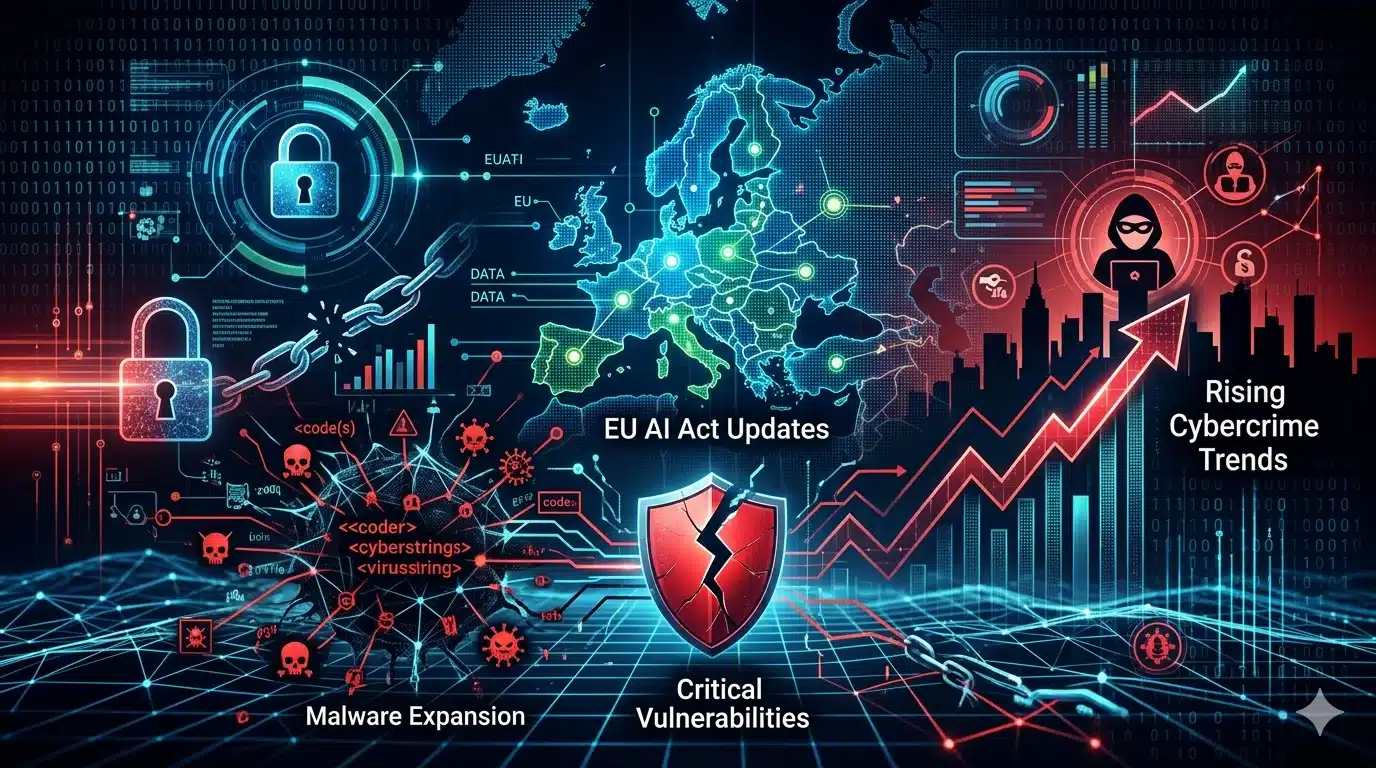
The Cyber Express Weekly Roundup: EU AI Act Updates, Malware Expansion, Critical Vulnerabilities, and Rising Cybercrime Trends

weekly roundup

In this weekly roundup from The Cyber Express, the global cybersecurity landscape continues to show rapid and uneven change, shaped by both regulatory shifts and escalating cyber threats. Governments are tightening oversight of new technologies such as artificial intelligence, while threat actors are simultaneously refining their techniques to exploit businesses, infrastructure, and end users across multiple platforms.  This edition of cybersecurity news brings together some of the most important developments of the week, ranging from significant amendments to the European Union’s AI Act to the expansion of malware campaigns into macOS environments and the discovery of a critical vulnerability in widely used enterprise firewall software.   It also covers major sentencing in a global ransomware case and a fresh warning from the FBI about the growing scale of cyber-enabled cargo theft targeting logistics and supply chain organizations. 

The Cyber Express Weekly Roundup 

EU Updates AI Act with Simpler Rules and New AI Content Bans 

In a significant regulatory update, the European Union has agreed to revise parts of the EU AI Act. The updated framework aims to simplify compliance requirements for businesses while simultaneously introducing stricter restrictions on harmful AI-generated content. Read more.. 

ClickFix Malware Campaign Expands to macOS 

Another key development is the expansion of the ClickFix malware campaign beyond Windows systems. Security researchers at Microsoft have confirmed that the operation is now targeting macOS users using deceptive troubleshooting content. Read more... 

Critical PAN-OS Vulnerability Enables Remote Code Execution 

A critical security flaw has been identified in Palo Alto Networks’ PAN-OS firewall software. Tracked as CVE-2026-0300, the vulnerability carries a CVSS score of 9.3, indicating severe risk. The issue originates from a buffer overflow vulnerability in the User-ID Authentication Portal. Read more... 

Latvian Cybercriminal Sentenced in Global Ransomware Case 

Latvian national Deniss Zolotarjovs has been sentenced to 102 months in prison for his role in a large-scale ransomware operation. According to the U.S. Department of Justice, the group operated under multiple ransomware brands, including Conti, Royal, Akira, and Karakurt. Between 2021 and 2023, the organization carried out attacks against more than 54 companies worldwide, using data theft and encryption-based extortion tactics to pressure victims into paying ransom demands. Read more... 

FBI Warns of Rising Cyber-Enabled Cargo Theft 

The FBI has issued an alert regarding a sharp rise in cyber-enabled cargo theft. Criminal actors are using impersonation techniques to pose as legitimate logistics providers, allowing them to intercept and redirect freight shipments. The agency noted that logistics, shipping, and insurance companies have been targeted since at least 2024. Read more... 

Weekly Takeaway 

This week’s The Cyber Express weekly roundup highlights the growing convergence of regulatory change, advanced malware threats, critical infrastructure vulnerabilities, ransomware enforcement actions, and supply chain fraud. As the global cybersecurity landscape continues to evolve, organizations across all sectors remain under increasing pressure to strengthen defenses and adapt to emerging risks. 

The Cyber Express Weekly Roundup: Data Breaches, Malware Campaigns, and Cyber Fraud Investigations

weekly roundup TCE cybersecurity news

In this week’s edition of The Cyber Express weekly roundup, we explore the latest developments in the world of cybersecurity, focusing on high-profile data breaches, growing malware campaigns, and law enforcement actions against cybercriminals.   As the digital threat landscape continues to evolve, attackers are targeting sensitive personal and organizational data, from health records to financial credentials. Meanwhile, government regulators are ramping efforts to protect minors and combat harmful content on social platforms, while cybercriminals continue to exploit vulnerabilities in both public and private sectors.  This weekly roundup highlights how various industries, from healthcare and social media to finance and government, are grappling with rising threats, making it clear that the intersection of data security, regulation, and cybercrime is more critical than ever.  

The Cyber Express Weekly Roundup 

UK Biobank Data Breach Triggers Urgent Review of Data Security Measures 

A significant data breach at the UK Biobank has raised major concerns over the security of health-related data used in scientific research. In April 2026, de-identified participant information was discovered being sold on a Chinese consumer platform, sparking widespread alarm among the research community. Read more... 

Vercel CEO Reveals Expansion of Malware Campaign Affecting Multiple Targets 

Vercel's CEO, Guillermo Rauch, confirmed that the recent breach involving Context.ai was part of a much larger malware campaign affecting multiple targets. Following a review of network logs, Vercel’s security team uncovered evidence of malware distribution that compromised several customer accounts, including access to valuable Vercel account keys. Read more... 

Ofcom Investigates Telegram and Teen Platforms 

In the UK, Ofcom has launched an investigation into Telegram and several popular teen chat platforms, such as Teen Chat and Chat Avenue, after reports surfaced of online grooming and child sexual abuse material (CSAM) on these services. Under the Online Safety Act, platforms are required to take proactive steps to prevent harmful content and protect minors from exploitation. Read more... 

Personal Data Exposed in Breach of France’s ANTS Portal 

A recent breach of France’s ANTS (Agence Nationale des Titres Sécurisés) portal has compromised personal data, including names, email addresses, and birthdates, although no documents or sensitive attachments were affected. The breach, which occurred on April 15, 2026, raises significant concerns about identity theft and phishing risks, as the exposed data could be used to target individuals. Read more... 

Bluesky Faces Coordinated DDoS Attack 

Bluesky, the rapidly expanding social media platform, suffered a major disruption on April 15, 2026, when it was targeted by a sophisticated distributed denial-of-service (DDoS) attack. The attack caused widespread outages, impacting core platform functions such as user feeds, notifications, and search capabilities. Read more... 

Indian Authorities Arrest Key SIM Card Supplier in Cyber Fraud Crackdown 

India’s Central Bureau of Investigation (CBI) has arrested a key conspirator in a major cyber fraud operation as part of Operation Chakra-V. The suspect, arrested in Guwahati, is accused of supplying fraudulent SIM cards used in various cybercrime schemes, including extortion and fake loan scams. The SIM cards were acquired using fake identities and distributed to cybercriminal networks. Read more... 

Weekly Takeaway 

This week’s roundup highlights the diverse and evolving nature of cyber threats. From the exposure of sensitive health data and sophisticated malware campaigns to DDoS attacks and SIM card fraud schemes, the cybersecurity landscape remains fraught with challenges. Regulatory bodies and companies alike continue to grapple with emerging risks, particularly in sectors like public health data, social media platforms, and digital content safety. As these incidents unfold, it’s clear that both technical vulnerabilities and human factors, such as social engineering, continue to be central targets for attackers.  With regulatory frameworks like the Online Safety Act and increased investigative efforts in places like India and France, the pressure on platforms and authorities to act quickly and decisively is higher than ever. As the cyber threat landscape becomes more interconnected, the need for enhanced security protocols, improved monitoring, and greater accountability in digital spaces remains critical. 

The Cyber Express Weekly Roundup: Crypto Breaches, State-Linked Schemes, and Platform Exploits

The Cyber Express weekly roundup cybersecurity

In this week’s weekly roundup, The Cyber Express reviews major developments across the cybersecurity domain. highlighting incidents involving crypto ecosystem attacks, state-linked fraud operations, regulatory scrutiny, and underground cybercrime activity. The broader threat landscape continues to show attackers targeting infrastructure weaknesses, social engineering pathways, and third-party dependencies rather than isolated technical flaws.  Across multiple cases, state-aligned and financially motivated actors are focusing on routers, DNS layers, and decentralized systems to intercept data and manipulate transactions. At the same time, gaps in regulation and enforcement continue to complicate platform accountability, particularly in online safety and digital content governance.  

The Cyber Express Weekly Roundup 

$15M Grinex Hack Halts Trading After Wallet Breach 

Grinex suspended trading and withdrawals following a coordinated attack that compromised its wallet infrastructure, resulting in the theft of more than $15 million in USDT. The attackers rapidly moved assets across Ethereum and Tron networks, using chain-hopping and layering techniques to obscure transaction trails and avoid detection. Read more... 

Two U.S. Nationals Sentenced in $5M North Korea IT Worker Scheme 

Two U.S. nationals, Kejia Wang and Zhenxing Wang, received prison sentences of 108 and 92 months for their roles in a North Korea-linked remote employment scheme that generated over $5 million. The operation used stolen identities, domestic “laptop farms,” and shell companies to present overseas workers as U.S.-based employees across more than 100 companies. Read more... 

Australia Social Media Ban Faces Enforcement Questions 

Australia’s under-16 social media restriction is facing renewed scrutiny after a study of 1,050 children found that over 60% of previously active users aged 12–15 continue accessing platforms such as TikTok, YouTube, and Instagram. Many accounts remained active without intervention from providers, and in some cases, users created new profiles after restrictions were applied. Read more... 

TierOne Dark Web Contest Offers $10K for Exploit Writeups 

A dark web forum known as TierOne has launched a $10,000 contest encouraging detailed technical write-ups on vulnerability exploitation techniques. Running from April 13 to May 14, 2026, and reportedly sponsored by a ransomware group, the contest focuses on topics such as remote code execution, IDOR, SSTI, firmware attacks, and EDR bypass methods.  Read more... 

Rockstar Cyberattack Confirmed Amid Extortion Threat 

Rockstar Games confirmed a cyberattack involving unauthorized access through a third-party service, though it stated that core operations and player systems were unaffected. The threat actor group ShinyHunters claimed responsibility, alleging access to internal company data and demanding payment by April 14, 2026, under threat of public release. Read more... 

Weekly Takeaway 

The Cyber Express weekly roundup reflects a threat landscape that is fragmented yet interconnected. From multimillion-dollar crypto thefts and criminal employment schemes to underground exploit markets and extortion-driven breaches, attackers are consistently blending technical exploitation with deception and supply chain targeting.   Regulatory uncertainty and weak enforcement mechanisms further amplify these risks, allowing both state-linked and financially motivated actors to operate with greater flexibility across digital environments. 
❌
❌