Visualização normal

Antes de ontemStream principal

Head Mare APT is exploiting vulnerabilities in an unpatched TrueConf server to deliver PhantomCore and PhantomGraph to video conference participants

11 de Agosto de 2026, 09:00

Overview of the attack

In July 2026, Kaspersky experts detected a new attack by the Head Mare group. Previously, we classified them as hacktivists, but now we define them as an APT group due to the sophistication of their TTPs and the absence of destructive activity (encryption, wiping) in the targeted infrastructures. In this latest campaign, the attackers exploited a chain of vulnerabilities in the TrueConf video conferencing server and replaced the original TrueConf client installers with infected versions that installed the PhantomCore malware on the system.

An investigation of the compromised server revealed that the attackers used a combination of two new vulnerabilities (assigned the internal identifiers KLCERT-26-057 and KLCERT-26-058), allowing them to execute arbitrary code with the highest privileges.

The attack occurs in several stages:

  1. The attackers connect to the TrueConf server without prior authorization via port 4307/TCP, which, according to the product documentation, is open by default. The attack targets TrueConf servers running versions 5.3.X through 5.3.9, 5.4.X through 5.4.9, and 5.5.X through 5.5.5.
  2. Once connected, attackers call a server function to transmit a malicious script and execute it on the server. The vulnerability that allows this stage of the attack to be carried out has been assigned the internal identifier KLCERT-26-057.
  3. The received script runs on the TrueConf server in an isolated environment. By default, operating system functions are not accessible in this environment, which should limit the capabilities of the executed code.
  4. To escape the isolated environment, attackers exploit a second vulnerability, assigned the internal identifier KLCERT-26-058. Exploiting this vulnerability allows them to bypass the restrictions of the isolated environment and proceed to execute commands in the context of the operating system.
  5. Once the environment’s restrictions are bypassed, attackers gain the ability to execute arbitrary code on the server with the privileges of the NT AUTHORITY\SYSTEM account.
  6. Once they have gained elevated privileges, attackers replace the file …\public\js\locale.php with a web shell, which can be used for subsequent remote control of the compromised server.

This web shell was used for the following activities:

  • collecting data on the IT infrastructure;
  • gaining privileged access to the TrueConf database;
  • replacing the original TrueConf Client distribution with an infected version containing the PhantomCore backdoor.

The vulnerabilities exploited by the attackers were patched by the vendor in the latest TrueConf Server updates (versions 5.3.9, 5.4.9, and 5.5.5). These updates were released on June 18, 2026.

The PhantomCore backdoor was successfully detected by Kaspersky solutions.

To automatically launch the malware after the system boots, a registry key is created: HKEY_CURRENT_USER\Software\Classes\CLSID\{0340F119-A598-4ed9-B0AC-6F6A12D3E755}\InprocServer32, with the value set to the path to the malicious program’s file.

Using a web shell, in addition to PhantomCore, the attackers load a backdoor that we have named PhantomGraph, consisting of two modules:

  • SysExcSvc.dll is responsible for receiving commands from the attackers and transmitting the results of their execution. The attackers used an account on Microsoft OneDrive cloud storage as their command-and-control (C2) server.
  • SysReadSvc.dll reads the command transmitted by the first module, executes it, and saves the execution result.

To establish persistence on the system, the attackers execute a Base64-encoded PowerShell command that installs SysExcSvc.dll and SysReadSvc.dll as Windows services. We believe the attackers deliberately split this malicious command into two components to make it harder to detect using EDR tools. Additionally, the program’s code partially matches that of PhantomCore, indicating that it belongs to Head Mare’s arsenal.

We also managed to identify the commands executed by the attackers when connecting to the backdoor. The SysReadSvc module executes commands using a BATCH file. Example of execution:

$system32\cmd.exe /c cmd /c ""$temp\cmd_cmd_4488.bat"" 2>&1

Commands detected:

  • Memory dump of the lsass.exe process:

  • Reconnaissance of the user and system names:

hostname

whoami

"$system32\WindowsPowerShell\v1.0\powershell.exe" -noexit -command Set-Location -literalPath '$system32\inetsrv'

  • Launching an SSH reverse tunnel:

In addition, we discovered several commands that did not work due to the attackers’ typos and encoding issues.

We are observing several active Head Mare campaigns targeting Russian organizations across various industries: instrument manufacturing, electronics, transportation, energy,
IT, and software development. The attackers distribute their backdoors using various methods, including phishing, exploiting public web servers, or through a subcontractor.

We recommend that all organizations using TrueConf software install the latest server version (versions 5.3.9, 5.4.9, and 5.5.5) in accordance with the vendor’s recommendations.

We also recommend verifying that the client distributions downloaded from the TrueConf server used by your organization have a valid TrueConf digital signature and have not been tampered with. The malicious distributions we detected did not have a valid digital signature. You can also verify authenticity on the vendor’s website.

Important: Even if your organization does not use a TrueConf server, your employees may connect to compromised TrueConf servers belonging to business partners to participate in online meetings and download infected installation packages.

The attack mechanism and the vulnerabilities exploited are described in more detail on the Kaspersky ICS CERT website.

Detection by Kaspersky solutions

Kaspersky security solutions successfully detect malicious activity associated with the attacks described above.

The malware used in this attack is detected by our solutions with the following detection names:

  • Backdoor.PHP.WebShell.abi,
  • Backdoor.Win64.PhantomCore.dt,
  • Trojan.Win64.Agent.smgvnc,
  • Trojan.Win64.Agent.smgvnb,
  • HEUR:Backdoor.Win64.PhantomCore.gen,
  • HEUR:Backdoor.Linux.Agent.fb,
  • HEUR:Backdoor.Linux.PhantomHook.a,
  • HEUR:Backdoor.Linux.PhantomReact.a,
  • Trojan.Win64.PhantomGraph.gen
  • UDS:Backdoor.Win64.PhantomCore.a

Let’s take a closer look using Kaspersky Endpoint Detection and Response Expert (KEDR Expert) as an example.

Specifically, activity involving the replacement of the legitimate file …\public\js\locale.php with a web shell, as well as the deletion of entries from TrueConf event logs, is detected by the rule unusual_php_file_creation_from_trueconf_process.
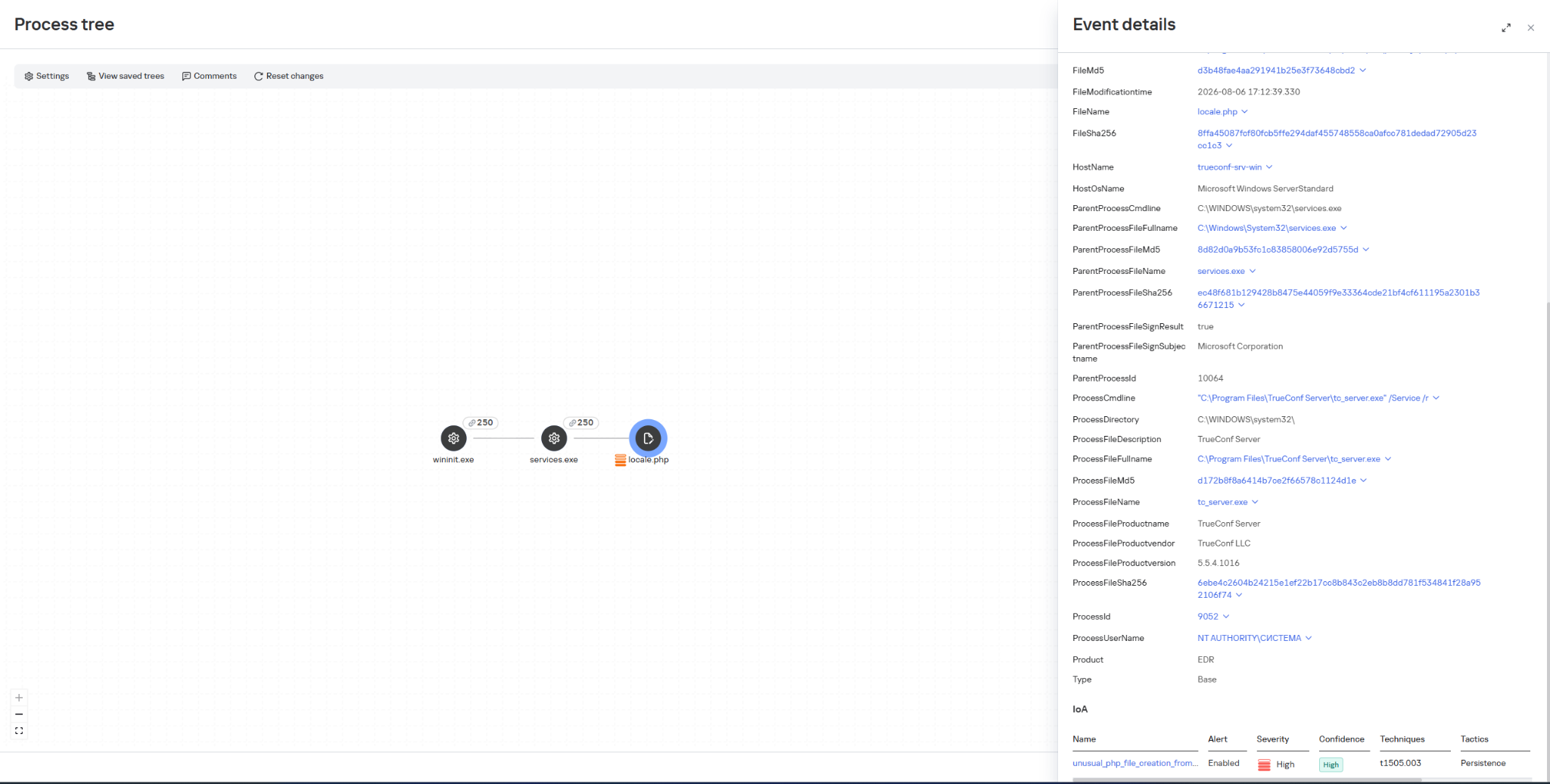
Downloading a file containing the PhantomCore backdoor via the replaced legitimate file …\public\js\locale.php is detected by KEDR Expert with the rule unusual_file_creation_from_trueconf.
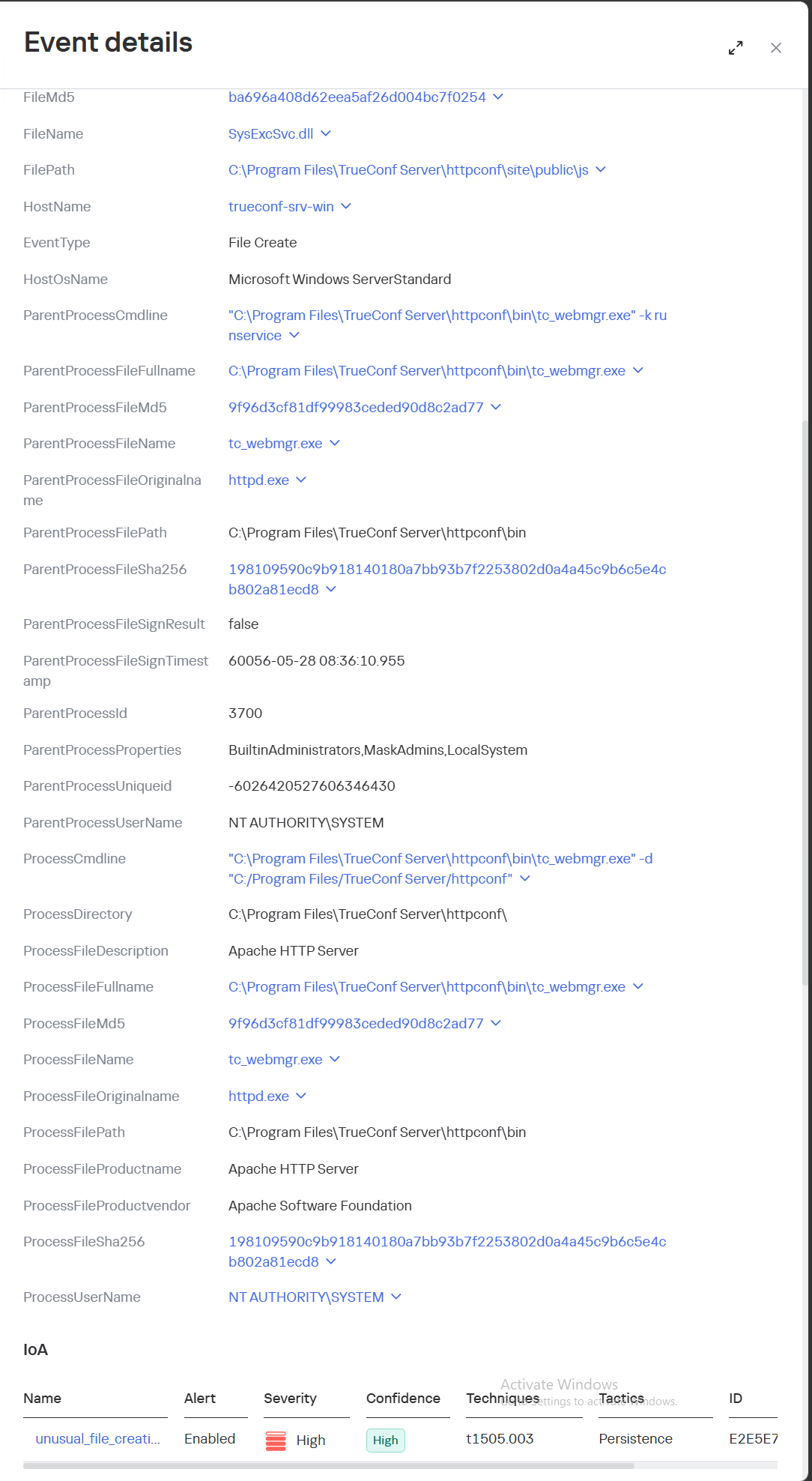
Activity related to the installation of an infected TrueConf client installer containing the PhantomCore backdoor is detected by KEDR Expert using the unsigned_trueconf_installer rule.

The Kaspersky Managed Detection and Response service detects the described attack by monitoring the following actions:

  1. Creation of suspicious files by TrueConf Server processes.
  2. Execution of a TrueConf Client installer file that lacks a software developer’s signature.
  3. Suspicious process chains associated with TrueConf Client executables and TrueConf Client update executables.
  4. Registration of suspicious libraries in the HKEY_CURRENT_USER\Software\Classes\CLSID\ registry key.
  5. Actions related to retrieving information about the lsass.exe process.
  6. Memory dump creation for the lsass.exe process using the comsvcs.dll library.
  7. Accessing the memory of the lsass.exe process.
  8. Creating tunnels using the ssh process.

To protect companies using our Kaspersky SIEM system, a general set of rules is available in the product repository that allows detection of the following techniques:

  1. Creation of suspicious files in the C:\Windows\System32\inetsrv\* directory:
    R405_07_File write to IIS native modules folder or OWA via WriteData.
  2. Creating a memory dump of the lsass.exe process using the comsvcs.dll library:
    R233_04_Process memory dump via comsvcs.dll.
  3. Accessing the memory of the lsass.exe process:
    R262_Suspicious access to the LSASS process.

We also recommend paying attention to the following events when developing your own detection rules or conducting threat hunting:

  1. Registration of suspicious libraries in the registry key \Software\Classes\CLSID\{0340F119-A598-4ed9-B0AC-6F6A12D3E755}\InprocServer32:
    (DeviceEventClassID = '4657' OR DeviceEventClassID = '13')
    AND FileName like '%\Software\Classes\CLSID\{0340F119-A598-4ed9-B0AC-6F6A12D3E755}%' AND DeviceCustomString6 = 'InprocServer32'
  2. Creating the SysExcSvc and SysReadSvc services to run executables from temporary directories in the background via cmd:
    DeviceEventClassID = '4697' 
    AND (DestinationServiceName = 'SysExcSvc' OR DestinationServiceName = 'SysReadSvc')
    AND match (FileName, '.*cmd\s+\/c.*temp\\cmd_cmd_.*\.bat.*')
  3. Creation of suspicious processes originating from the TrueConf update process (trueconf_windows_update.exe)
    (DeviceEventClassID = '4688' OR DeviceEventClassID = '1')
    AND SourceProcessName LIKE '%\trueconf_windows_update.exe'

For the detection rules to work correctly, ensure that events from Windows systems are received in full, including Security events 4688, 4663, 4657, and 4697 and Sysmon events 1, 7, 11, and 13.

Indicators of compromise

File hashes (MD5)

Web shell
4d27b4eb1c5dbb3d8160f29b8119523e locale.php

Infected installer
748c9f8cb1065000616204935f96207f trueconf_windows_update.exe

PhantomCore DLL
c5a460e4e68a088f6e51b2c6474642ec
129462164a7d52e9ea8560b60f0412c5 doc.txt
ec0bf4a2186a88874e9f26f07cfeb532 usocacheddata.txt
b348642146ea34771e5785c5857950f5
c915cb6c2aeb863ee8479238e1644217 doc.txt
0e79996d9483d1e44fea32b0a48c2c19 doc.txt
2bb75c20e778eb5c416965bd4d4259b1 trueconf_windows_client_x64_[redacted].exe
b3a6fee3307f1c26841fd5c603e2b013 usocacheddata.txt
8fcc3e4ccbf1725d9989fb464abf3561 usocacheddata.txt

PhantomGraph
489f43be558b2679284ceabed7adc4f3 sysexcsvc.dll
dd1fd2b459b97b7d59375cb8383cd19a sysreadsvc.dll
0e4541c3153ec5ed01497f19cf4f63d0 sysexcsvc.dll
12d4e8f5295f2ef7e0f9bfc0f4830939 sysexcsvc.dll
7f267006cac10f341c356b62fe493527 sysexcsvc.dll
ee2861d5965e8730708cd1da8a93fa4c sysexcsvc.dll

Backdoor (ELF)
c3a2abe8756910f42582b04a44ea3514
43f435c3c437bc879a2d7d4634f43494

Rootkit
aee9642b45b099cb7f3053b9b680b425

IP

81.177.32[.]12
194.87.239[.]71 ssh
194.87.93[.]153 ssh
38.244.205[.]244
31.59.102[.]61

Domains

penzadogshelter[.]site
trendy-market[.]site
bright-deals[.]site
nova-stream[.]site
rinomobile[.]ink
urbanpixel[.]store
flexish[.]shop
media-hub[.]today
cosmetic-deals[.]store
vks.gossopka[.]forum

Windows service names

SysExcSvc
SysReadSvc

File paths

C:\Windows\System32\inetsrv\SysExcSvc.dll
C:\Windows\System32\inetsrv\SysReadSvc.dll
C:\Windows\System32\inetsrv\graphi-refresh.dat
C:\Windows\System32\inetsrv\share\input_*.txt
C:\Windows\System32\inetsrv\share\output_*.txt
%TEMP%\cmd_cmd_*.bat
%LOCALAPPDATA%\TrueConf\Client\api-ms-win-crt-time-l1-1-0-2.dll
/etc/systemd/system/omicluster.service
/etc/systemd/system/schedul2-bin.service
/opt/acronis/bin/schedul2-bin
/omi/bin/omicluster
/usr/lib64/libzvbi-tchain.so.2
/var/tmp/cx2

Registry keys

HKEY_CURRENT_USER\Software\Classes\CLSID\{0340F119-A598-4ed9-B0AC-6F6A12D3E755}\InprocServer32

Kaspersky detection names

Backdoor.PHP.WebShell.abi
Backdoor.Win64.PhantomCore.dt
Trojan.Win64.Agent.smgvnc
Trojan.Win64.Agent.smgvnb
HEUR:Backdoor.Win64.PhantomCore.gen
HEUR:Backdoor.Linux.Agent.fb
HEUR:Backdoor.Linux.PhantomHook.a
HEUR:Backdoor.Linux.PhantomReact.a
Trojan.Win64.PhantomGraph.gen
UDS:Backdoor.Win64.PhantomCore.a

YARA rules

import "pe"
rule apt_HeadMare_PhantomCore
{
meta:
    description = "Rule to detect PhantomCore used by HeadMare"
    author = "Kaspersky ICS CERT"
    copyright = "Kaspersky ICS CERT"
    version = "1.0"
    last_modified = "2026-08-02"
    hash = "c5a460e4e68a088f6e51b2c6474642ec"
strings:
    $a1 = "lying.dll" ascii
    $a2 = { 2D 7F 95 4C 2D F4 51 58 }
    $a3 = { 4F 81 67 F7 7E 7B 05 14 }
condition:
    (uint16(0) == 0x5A4D) and (filesize > 4MB) and (filesize  20MB) and (all of them) and (pe.number_of_signatures == 0)
}

rule apt_HeadMare_FakeConf_installer
{
meta:
    description = "Rule to detect any unsigned TrueConf installers"
    author = "Kaspersky"
    copyright = "Kaspersky"
    version = "1.0"
    last_modified = "2026-08-02"
    hash = "748c9f8cb1065000616204935f96207f"

strings:
    $a1 = "TrueConf Setup" wide
    $a2 = "This installation was built with Inno Setup." wide

condition:
    (uint16(0) == 0x5A4D) and (filesize > 20MB) and (all of them) and (pe.number_of_signatures == 0)
}

rule apt_HeadMare_PhantomCore_exchange
{
meta:
    description = "Rule to detect PhantomCore exchange module used by HeadMare"
    author = "Kaspersky ICS CERT"
    copyright = "Kaspersky ICS CERT"
    version = "1.0"
    last_modified = "2026-08-02"
    hash = "489f43be558b2679284ceabed7adc4f3"
strings:
    $a1 = "graphi_exchange.dll" ascii
    $a2 = "graphi-client/1.0" ascii
    $b1 = "https://graph.microsoft.com/v1.0/me/drive/root:/" ascii
    $b2 = ":/children?$select=name,id&$top=200" ascii
    $b3 = "offline_access Files.ReadWrite" ascii
    $b4 = "GRAPHI_INSECURE" ascii
    $b5 = "\"@microsoft.graph.conflictBehavior\":\"replace\"}" ascii
    $b6 = "https://login.microsoftonline.com/" ascii
condition:
    (uint16(0) == 0x5A4D) and (any of ($a*)) and (3 of ($b*))
}

rule apt_HeadMare_PhantomCore_executor
{
meta:
    description = "Rule to detect PhantomCore executor module used by HeadMare"
    author = "Kaspersky ICS CERT"
    copyright = "Kaspersky ICS CERT"
    version = "1.0"
    last_modified = "2026-08-02"
    hash = "dd1fd2b459b97b7d59375cb8383cd19a"
strings:
    $a1 = "graphi_reader.dll" ascii
    $a2 = "^input_(.+)\\.txt$" ascii
    $b1 = "output_" ascii
    $b2 = "cmd_cmd_" ascii
    $b3 = "cmd /c \"\"" ascii
    $b4 = "error: failed to start cmd process" ascii
    $b5 = "share" ascii
    $b6 = "SysReadSvc" ascii
condition:
    (uint16(0) == 0x5A4D) and (filesize < 4MB) and (any of ($a*)) and (4 of ($b*))
}

rule apt_HeadMare_FakeLocale_webshell
{
meta:
    description = "Rule to detect the HeadMare TrueConf web shell"
    author = "Kaspersky"
    copyright = "Kaspersky"
    version = "1.0"
    last_modified = "2026-08-04"
    hash = "4d27b4eb1c5dbb3d8160f29b8119523e"

strings:
    $a1 = "X-Redirect-Bit" ascii wide nocase
    $a2 = "tc_vcs_web_db_conn" ascii wide
    $a3 = "user=postgres" ascii wide

    $b1 = "UPL ok::" ascii wide
    $b2 = "DWN fail nexs" ascii wide
    $b3 = "DWN fail inv" ascii wide

condition:
    (2 of ($a*)) or (2 of ($b*))
}

rule apt_HeadMare_TrueConf_Rootkit
{
meta:
    description = "Rule to detect the HeadMare rootkit installed on TrueConf servers"
    author = "Kaspersky"
    copyright = "Kaspersky"
    version = "1.0"
    last_modified = "2026-08-06"
    hash = "aee9642b45b099cb7f3053b9b680b425"

strings:
    $a1 = "PQconnectdb"
    $a2 = "obfuscated_data"
    $a3 = "install_hook"

condition:
    (uint32(0) == 0x464c457f) and (filesize < 400000) and (all of them)
}

rule apt_HeadMare_Github_Backdoor
{
meta:
    description = "Rule to detect the HeadMare backdoor with Github C2"
    author = "Kaspersky"
    copyright = "Kaspersky"
    version = "1.0"
    last_modified = "2026-08-06"
    hash = "43f435c3c437bc879a2d7d4634f43494"
    hash = "c3a2abe8756910f42582b04a44ea3514"

strings:
    $a1 = "cryptor5crypt"
    $a2 = "execraw_task"
    $a3 = "jitter_task"
    $a4 = "upload_task"
    $a5 = "exec_task"
    $a6 = "react_comment"

condition:
    (uint32(0) == 0x464c457f) and (filesize > 5000000) and (filesize < 10000000) and (4 of them)
}


  • ✇Firewall Daily – The Cyber Express
  • Cyber Risk Assumptions Are Becoming Obsolete Due to AI, Warn Five Eyes Editorial
    AI Cyber Risk is evolving faster than many organizations can adapt, prompting a joint warning from the Five Eyes cyber security agencies. The agencies have called on business leaders, executives, and boards to act now, warning that advances in artificial intelligence are rapidly transforming the cyber threat landscape and shortening the time available to respond to emerging risks. In a coordinated statement, the leaders of the Five Eyes cyber security partnership said that while AI has the po
     

Cyber Risk Assumptions Are Becoming Obsolete Due to AI, Warn Five Eyes

23 de Junho de 2026, 04:30

AI Cyber Risk

AI Cyber Risk is evolving faster than many organizations can adapt, prompting a joint warning from the Five Eyes cyber security agencies. The agencies have called on business leaders, executives, and boards to act now, warning that advances in artificial intelligence are rapidly transforming the cyber threat landscape and shortening the time available to respond to emerging risks. In a coordinated statement, the leaders of the Five Eyes cyber security partnership said that while AI has the potential to improve defensive capabilities, it is also accelerating the speed, scale, and sophistication of cyber attacks. They cautioned that developments in Frontier AI are expected to exceed current industry expectations and could fundamentally change both offensive and defensive cyber operations within months rather than years.

AI Cyber Risk Demands Immediate Attention

The agencies stressed that AI is no longer a future consideration. According to the statement, AI is already lowering barriers for malicious actors and increasing the complexity of attacks. At the same time, it is reducing the gap between the discovery of vulnerabilities and their exploitation. As a result, organizations are being urged to assess their readiness, understand accountability structures, and strengthen foundational Cyber Security practices. The agencies emphasized that cyber resilience should be viewed as a critical component of business continuity, market confidence, and long-term organizational value. Leaders were encouraged to remain actively engaged as threats continue to evolve and new guidance emerges.

Frontier AI Is Accelerating Cyber Risk

The Five Eyes agencies warned that Frontier AI models are advancing faster than many organizations anticipate and could fundamentally reshape both cyber attacks and cyber defence within months. As these systems evolve, long-standing assumptions about cyber risk, threat detection, and vulnerability management may quickly become outdated.

The agencies cautioned that organizations that fail to adapt could face growing operational and strategic disadvantages. They emphasized that leaders should not view AI-driven cyber risk as a future challenge but as an immediate business concern requiring proactive planning, continuous assessment, and investment in cyber resilience. As AI capabilities expand, the agencies said organizations must remain prepared for rapidly changing threats and emerging vulnerabilities that may challenge traditional security approaches.

Cyber Resilience Is a Leadership Responsibility

The Five Eyes agencies stated that Cyber Resilience can no longer be treated solely as a technical issue. Instead, it should be considered a core Business Risk and a leadership responsibility. According to the statement, boards and executives must ensure that cyber resilience measures are not only implemented but are capable of functioning effectively during real-world incidents. The agencies noted that having security controls in place is not enough. Organizations must be confident those controls will perform under pressure. They also called on leaders to reassess long-standing trade-offs and adopt AI deliberately to strengthen defensive capabilities rather than focusing exclusively on operational efficiency.

Key Cyber Security Principles Highlighted

The agencies identified several principles organizations should adopt to address evolving AI Threats. They stated that Secure-by-Design and secure-by-default approaches should become standard practice rather than long-term goals. They also warned against relying on a single security solution, emphasizing that layered security remains essential. The statement further noted that as AI systems continue to evolve, organizations should expect new and previously unknown vulnerabilities to emerge, including Zero-Day Vulnerabilities. The agencies acknowledged that breaches are likely to occur and emphasized that preparedness is essential for containing incidents quickly and preventing them from escalating into larger operational and financial crises.

Practical Actions for Organizations

To reduce technical, operational, financial, and reputational exposure, the Five Eyes agencies outlined several practical actions. Organizations were advised to reduce their attack surface by limiting unnecessary system access and external connectivity. They were also encouraged to accelerate patching processes, warning that AI is shortening the time available between vulnerability disclosure and exploitation. The agencies highlighted unsupported legacy systems as strategic liabilities that can become easy targets for attackers. They also urged organizations to review and strengthen Identity and Access Controls, limit access to critical systems, enforce strong authentication, and regularly assess permissions. In addition, they recommended testing Incident Response plans, training teams, and preparing for breaches before they occur, with a focus on rapid containment and recovery.

Using AI to Strengthen Defense

The agencies noted that threat actors are already using AI to improve their capabilities and increase operational speed. As a result, defenders must also embrace AI-driven security tools. According to the statement, organizations that integrate AI into security operations can improve vulnerability detection, enhance software quality, identify unusual activity, and accelerate response efforts. The agencies emphasized that success will not depend on having the largest number of security tools. Instead, it will come from strong fundamentals, rapid action, and integrating cyber security into core business strategy.

Five Eyes Call for Collective Action

The Five Eyes leaders concluded that assumptions about cyber threats can become outdated within months due to the rapid pace of AI development. They urged organizations, including technology vendors, to act now, strengthen resilience, and remain prepared to adapt to changing threats. The agencies said leaders who move quickly can reduce exposure, strengthen resilience, and build trust among customers, partners, and investors. Those who delay, they warned, face growing and avoidable risk.
  • ✇Securelist
  • How an image could compromise your Mac: understanding an ExifTool vulnerability (CVE-2026-3102) Lucas Tay
    Introduction ExifTool is a widely adopted utility for reading and writing metadata in image, PDF, audio, and video files. It is available both as a standalone command-line application and as a library that can be embedded in other software. In this article, we break down CVE-2026-3102, an ExifTool vulnerability discovered by Kaspersky’s Global Research and Analysis Team (GReAT) in February 2026 and patched by the developers within the same month. Affecting macOS systems with ExifTool version 13.
     

How an image could compromise your Mac: understanding an ExifTool vulnerability (CVE-2026-3102)

20 de Maio de 2026, 06:02

exiftools featured

Introduction

ExifTool is a widely adopted utility for reading and writing metadata in image, PDF, audio, and video files. It is available both as a standalone command-line application and as a library that can be embedded in other software. In this article, we break down CVE-2026-3102, an ExifTool vulnerability discovered by Kaspersky’s Global Research and Analysis Team (GReAT) in February 2026 and patched by the developers within the same month. Affecting macOS systems with ExifTool version 13.49 and earlier, this flaw could let an attacker run arbitrary commands by hiding instructions inside an image file’s metadata.

This investigation originated from revisiting an n-day vulnerability I first examined years ago: CVE-2021-22204. That flaw exploited weak regex-based sanitization before feeding user input into an eval sink. By auditing adjacent input validation routines across ExifTool codebase for similar oversights, I discovered CVE-2026-3102. Successful exploitation of CVE-2026-3102 enables an attacker to execute arbitrary shell commands with the privileges of the user invoking ExifTool, potentially leading to full system compromise.

Technical details

Disclaimer

Exploiting CVE-2026-3102 requires the -n (also known as -printConv) flag and outputs machine-readable data without additional processing.

Tracing the vulnerable sink

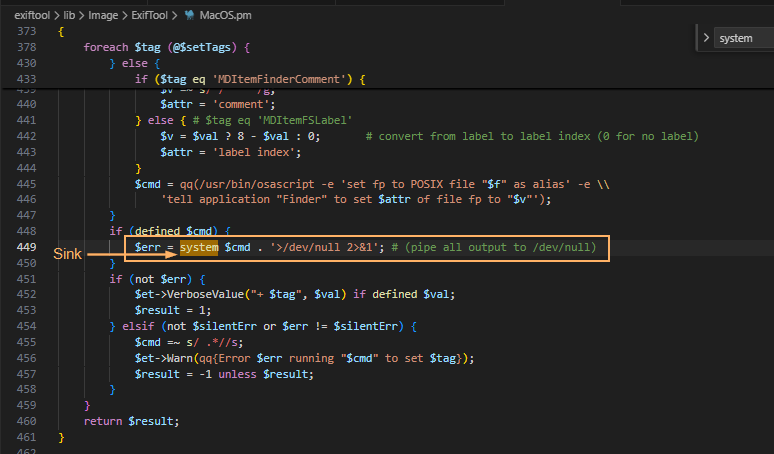
Taint analysis (aka tainted data analysis) allows for the detection of “dirty” data that reaches dangerous locations without validation. In this context, a “sink” is a point or function in a program where data or a parameter marked as “tainted” or originating from an untrusted source (e.g., user input) can affect the program’s behavior. In ExifTool, these functions are eval and system, both of which are capable of executing system commands. While CVE-2021-22204 exploited an eval function as a sink, this vulnerability (CVE-2026-3102) targets the system function. Knowing the vulnerable sink, we needed to trace how user-controlled data reaches it. Below, we break down the details.

Finding an unsanitized date value

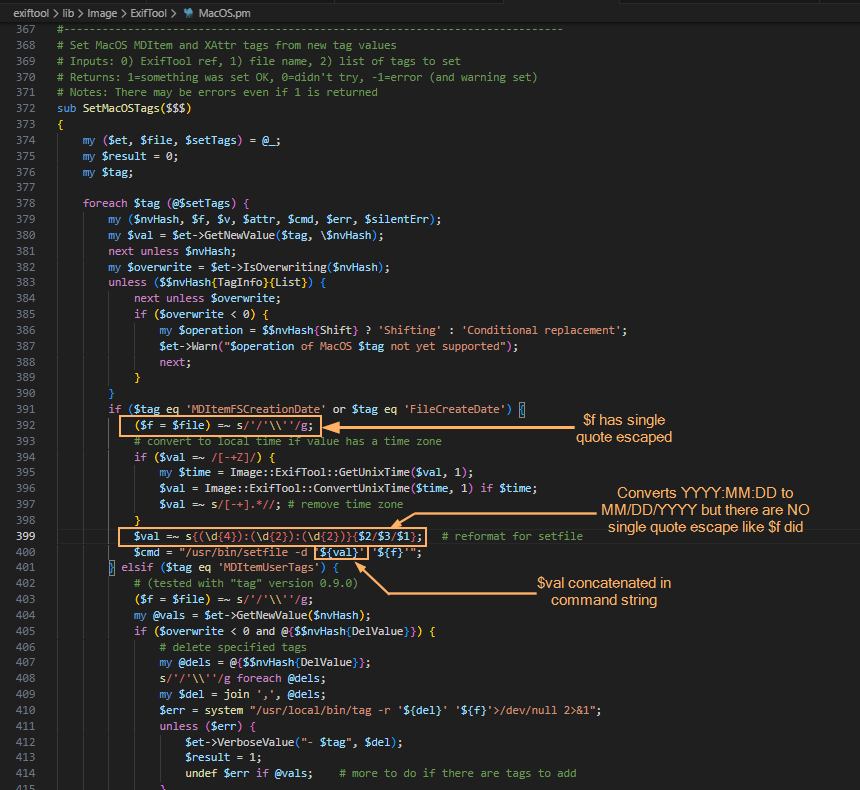
The screenshot above shows where the system() sink resides within the SetMacOSTags function. Tracing backward from system(), we identified the $cmd variable as the source of the executed command. This variable is assembled from three inputs: $file (properly sanitized), $setTags (processed iteratively), and $val (user-controlled and, crucially, left unsanitized in the vulnerable branch).

In ExifTool, a tag is a named metadata field. When parsing an image, the utility extracts date and time values from standard EXIF records or macOS filesystem attributes. To handle file creation dates on macOS, ExifTool relies on the Spotlight system attribute MDItemFSCreationDate. Within the program code, this attribute maps to the internal alias $FileCreateDate. These two identifiers govern how the file creation date is stored and applied.

This creates a critical link to the vulnerability: when parsing an image, ExifTool iterates through the discovered tags. The current tag’s name is assigned to the $tag variable, while its text content (e.g., a date string) is assigned to $val. The vulnerable code path is triggered only when $tag matches MDItemFSCreationDate or $FileCreateDate. At this point, the tag’s content flows into $val and is passed to the SetMacOSTags function. As shown in the screenshot below, the filename parameter is properly escaped, but the date value ($val) is not. Because the date is extracted directly from file metadata, an attacker can inject quotes into this field. This breaks the command structure and allows the payload to execute via the system() sink.

The following screenshots show some of the tags that can be modified. With the vulnerable parameter identified, the next challenge was delivery: how to place our payload into FileCreateDate without triggering early validation? We found the answer in the official documentation.


Planning the payload delivery

Let’s refer to the documentation to understand how ExifTool handles tag operations and identify a legitimate feature that can be repurposed for exploitation. Specifically, we need to find a way to deliver our payload into the vulnerable FileCreateDate parameter. When looking for macOS-related tags as well as FileCreateDate, we can find the following information:

  • To write or delete metadata, tag values are assigned using –TAG=[VALUE], and/or the -geotag-csv= or -json=
  • To copy or move metadata, the -tagsFromFile feature is used.

(You can find the useful info on tag operations above and how it relates under the hood in ExifTool in the dedicated section of the documentation and on the ExifTool description page.)

To trigger the vulnerability, we need to copy a string (date format: MM/DD/YYYY) using the -tagsFromFile feature, as this operation invokes the SetMacOSTags function where the unsanitized $val parameter reaches the system() sink.

Why copy instead of writing directly? Because the vulnerable code path (SetMacOSTags) is only triggered when metadata is copied into FileCreateDate — not when it is written directly. By using -tagsFromFile, we can prepare a “source” tag (e.g., DateTimeOriginal) that accepts arbitrary values and copy that value into FileCreateDate, thereby invoking the vulnerable function with our controlled input.

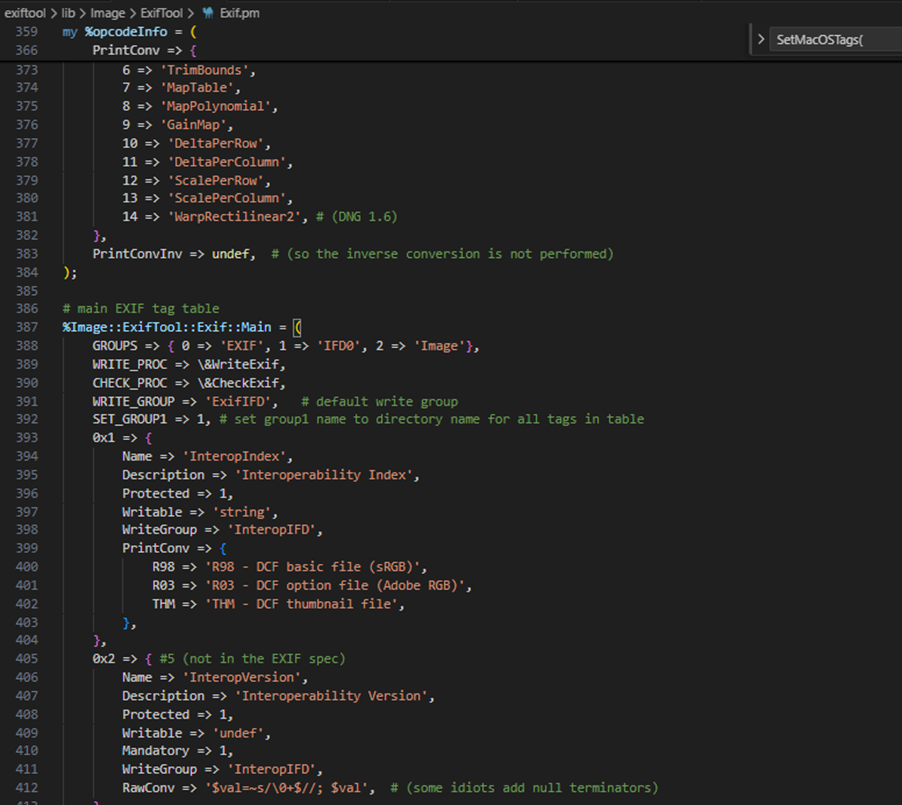
Furthermore, we want to introduce single quotes (since they are not being escaped in $val). For starters, we can look for date-time tag and copy via -tagsFromFile by searching the EXIF tag table. Direct assignment to FileCreateDate is heavily validated, so we looked for a source tag that accepts raw values and can be copied into the target field. The following snippet shows the beginning of said table.

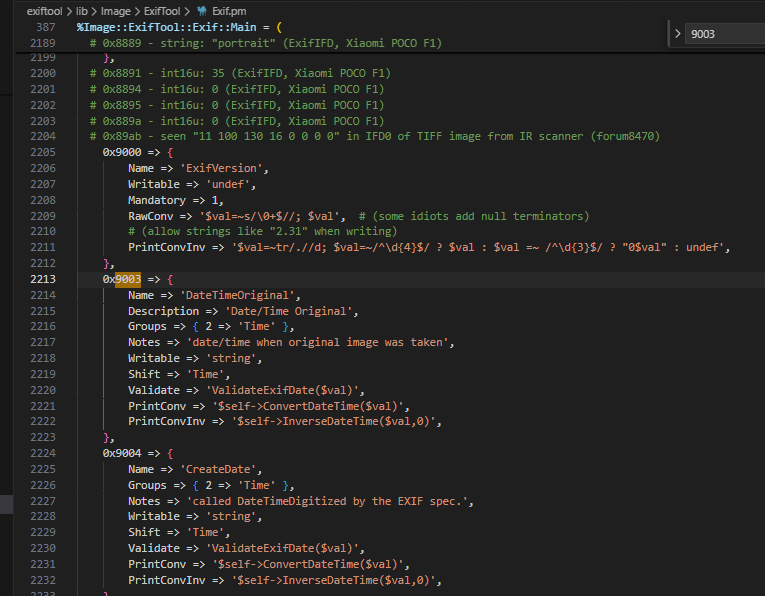
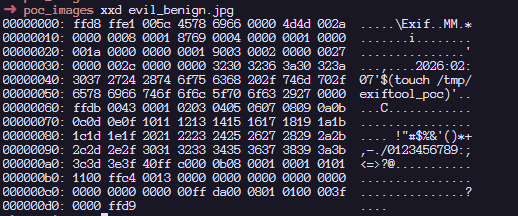
When doing the analysis, I made use of DateTimeOriginal though I believe you can also use CreateDate which is 0x9004 (see the following screenshot). Initial attempts to inject malformed dates failed: ExifTool’s built-in filter rejected the input. To bypass this, we examined how the tool handles raw metadata.

Bypassing the filter

To confirm that the PrintConvInv filter rejects invalid dates when written directly, I ran the following command, where evil_benign.jpg is a normal JPG with an invalid date time format. We are greeted with the error message: Invalid date/time. This requires the time as well. The next screenshot confirms that direct exploitation fails: ExifTool’s date validation detects the malformed input and rejects the change, activating the internal PrintConvInv filter.

That said, it is possible to ignore the formatting and use the -n flag which accepts raw values instead of human-readable value.  The -n flag skips the PrintConvInv conversion step, which is exactly where input sanitization occurs. This confirmed we could park unsanitized data in a source tag. The final step was to trigger the vulnerable code path by copying that data into FileCreateDate. This means we should now be able to modify the DateTimeOriginal tag with the invalid date time format with an -n flag. Examining the EXIF metadata tag, we can confirm that we can store a raw value without a proper human readable format that ExifTool accepts:

Triggering the exploit

To inject commands, we have to revisit the single quote injection into this datetime related tag.

The following screenshot shows that we have successfully set the datetime metadata with the single quote. With the payload safely stored in a source tag, the next step was to copy it into FileCreateDate, triggering the vulnerable system() call.

The next step now is to copy the datetime tag to a file which invokes SetMacOSTags. According to the documentation, this is how we can copy the data from the SRC tag to the FileCreateDate tag as seen in the SetMacOSTags with the -tagsFromFile feature.

exiftool [_OPTIONS_] -tagsFromFile _SRCFILE_ [-[_DSTTAG_<]_SRCTAG_...] _FILE_...

Therefore, we can craft our final command:

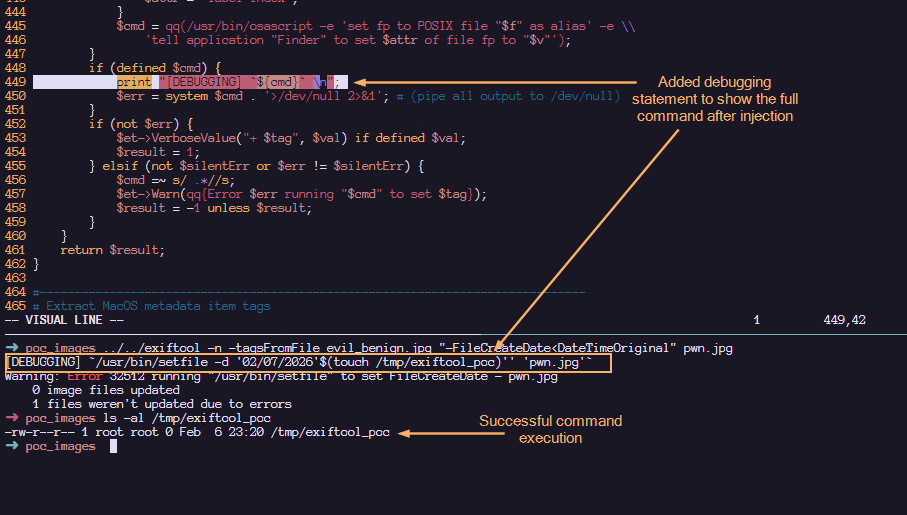
cp evil_benign.jpg pwn.jpg;
../../exiftool -n -tagsFromFile evil_benign.jpg "-FileCreateDate<DateTimeOriginal" pwn.jpg

Here, we confirm that the payload has been executed! Note that when copying tags in MacOS (Darwin), the /usr/bin/setfile command is used. To view the full $cmd value before the injection, I have added the debugging statement to displaying the actual command that is executed within the system function.

Upon injection, we can see that our command gets executed via command substitution. The single quotes that we added helped to make the entire command syntactically valid. The following shows a more detailed labelling and their roles in making this command line injection successful:

Such an image can appear completely benign and easily find its way into a newsroom or any organization that processes photos on macOS using ExifTool. Once processed, an attacker could silently deploy a Trojan for covert data exfiltration, drop additional malware, or use the compromised machine as a foothold to expand the attack within the victim’s network.

Patch analysis

After verifying successful exploitation, we examined how the maintainer addressed the flaw in version 13.50. In the vulnerable version of ExifTool, commands were sanitized before being concatenated together. This means that it is possible to concatenate single quotes which led to the exploitation. However, by abstracting the system call into a dedicated wrapper and requiring a list of arguments instead of concatenated string, the fix removes the need for any manual escaping altogether.

1. Replacing string form to argument list form:

#### BEFORE
$cmd = "/usr/bin/setfile -d '${val}' '${f}'";
system $cmd;
  
#### AFTER
system('/usr/bin/setfile', '-d', $val, $file);

2. Create new System() wrapper. In version 13.49, the output is piped to /dev/null . To maintain that logic, the wrapper would temporarily redirect STDOUT/STDERR to /dev/null and restore them after the call.

# Call system command, redirecting all I/O to /dev/null
# Inputs: system arguments
# Returns: system return code
sub System
{
    open(my $oldout, ">&STDOUT");
    open(my $olderr, ">&STDERR");
    open(STDOUT, '>', '/dev/null');
    open(STDERR, '>', '/dev/null');
    my $result = system(@_);
    open(STDOUT, ">&", $oldout);
    open(STDERR, ">&", $olderr);
    return $result;
}

How to protect against ExifTool vulnerability

It’s critical to ensure that all photo processing workflows are using the updated version. You should verify that all asset management platforms, photo organization apps, and any bulk image processing scripts running on Macs are calling ExifTool version 13.50 or later, and don’t contain an embedded older copy of the ExifTool library.

ExifTool, like any software, may contain additional vulnerabilities of this class. To harden defenses, I recommend using Kaspersky Open Source Software Threats Data Feed for continuous monitoring of open-source components in your software supply chain, and Kaspersky for macOS as comprehensive endpoint protection. Additionally, isolate processing of untrusted files on dedicated machines or virtual environments with strictly limited network and storage access. If you work with freelancers, contractors, or allow BYOD, enforce a policy that only devices with an active macOS security solution can access your corporate network.

Conclusions

CVE-2026-3102 highlights the risks of inconsistent input sanitization in tools that bridge high-level metadata parsing with platform-specific utilities. While exploitation requires explicit flag usage (-n) and is restricted to macOS, the vulnerability underscores the danger of manual escaping routines in evolving codebases. The transition to list-form system execution provides a robust, architecture-level fix that eliminates shell interpretation risks entirely. This case reinforces a core security principle: replacing fragile string concatenation with secure, list-based API calls remains the most reliable mitigation against command injection.

Microsoft May 2026 Patch Tuesday Fixes 120 Vulnerabilities, No Zero-Day Exploits Reported

May 2026 Patch Tuesday

Microsoft has rolled out its May 2026 Patch Tuesday security updates, delivering fixes for approximately 120 vulnerabilities across Windows, Microsoft Office, networking services, and enterprise platforms. Unlike several recent monthly releases, this update contains no publicly disclosed or actively exploited zero-day vulnerabilities, making it a relatively less chaotic cycle for IT and security teams.  Even without emergency-level exploits, the Microsoft May 2026 Patch Tuesday release remains significant due to the large number of critical flaws addressed. The company confirmed that the update resolves 17 critical vulnerabilities, including 14 remote code execution (RCE) flaws, two elevation-of-privilege issues, and one information disclosure vulnerability. 

Microsoft May 2026 Patch Tuesday: Vulnerabilities That Demand Attention 

One of the most important areas covered in the May 2026 Patch Tuesday update involves multiple vulnerabilities affecting Microsoft Office applications, particularly Word and Excel.  According to Microsoft, attackers could exploit these flaws by tricking users into opening malicious files. Several of the vulnerabilities can also be triggered through the preview pane, allowing remote code execution without fully opening the attachment.  Because Office documents remain a common attack vector in phishing campaigns, security professionals are strongly recommending that organizations prioritize deployment of these updates, especially in environments where employees regularly receive external attachments. 

Windows GDI Flaw Allows Exploitation Through Microsoft Paint 

Among the noteworthy issues patched during Microsoft’s May 2026 Patch Tuesday rollout is CVE-2026-35421, a Windows GDI remote code execution vulnerability.  The flaw can be exploited through a malicious Enhanced Metafile (EMF) image opened in Microsoft Paint. Successful exploitation could allow attackers to execute arbitrary code on the victim’s machine.  Although the attack requires user interaction, researchers warned that image-based attacks are often effective because users may not recognize specially crafted files as dangerous. 

SharePoint and DNS Vulnerabilities Raise Enterprise Security Concerns 

Another major vulnerability addressed in the May 2026 Patch Tuesday release is CVE-2026-40365, a remote code execution flaw affecting Microsoft SharePoint Server.  Microsoft stated that an authenticated attacker could use the vulnerability to launch a network-based attack capable of remotely executing code on vulnerable SharePoint systems. Since SharePoint environments often store sensitive internal data and business documents, the flaw is expected to receive close attention from enterprise administrators.  The company also patched CVE-2026-41096, a serious Windows DNS Client remote code execution vulnerability. The flaw involves improper handling of specially crafted DNS responses sent by attacker-controlled DNS servers.  The issue stems from a heap-based buffer overflow condition in Windows NetLogon functionality. A successful attack could corrupt system memory and allow remote code execution without requiring authentication. 

Dynamics 365 Vulnerability Carries Near-Maximum Severity Score 

Another critical issue fixed during the Microsoft May 2026 Patch Tuesday cycle is CVE-2026-42898, a remote code execution vulnerability affecting on-premises versions of Microsoft Dynamics 365.  The flaw received a CVSS severity score of 9.9 and requires no user interaction for exploitation. Researchers warned that attacks targeting Dynamics 365 environments could have widespread consequences because the platform frequently connects with multiple enterprise systems and sensitive databases.  Previous attacks involving Dynamics infrastructure have exposed privileged business information, making this vulnerability especially concerning for large organizations.

Windows 11 Cumulative Updates Introduce New Features 

As part of the May 2026 Patch Tuesday rollout, Microsoft released Windows 11 cumulative updates KB5089549 and KB5087420 for versions 25H2, 24H2, and 23H2.  The updates are mandatory because they contain the latest security fixes and stability improvements.  After installation: 
  • Windows 11 25H2 updates to build 26200.8457  
  • Windows 11 24H2 updates to build 26100.8457  
  • Windows 11 23H2 updates to build 22631.7079  
Microsoft confirmed that versions 25H2 and 24H2 share the same underlying update structure, meaning users receive identical fixes and improvements across both versions. 

Xbox-Inspired Desktop Experience Added to Windows 11 

One of the more noticeable additions included in the Microsoft May 2026 Patch Tuesday update is a new Xbox-style desktop experience for PCs.  The feature is designed to provide a console-like interface on Windows devices. Alongside the visual changes, Microsoft also introduced reliability improvements for the taskbar and enhancements to Windows Hello authentication.  The update improves both Windows Hello Face recognition reliability and the persistence of fingerprint authentication across system upgrades. 

File Explorer Receives Major Improvements 

File Explorer received several updates in the latest May 2026 Patch Tuesday release.  Microsoft expanded archive support to include formats such as: 
  • uu  
  • cpio  
  • xar  
  • NuGet Packages (nupkg)  
The company also improved how File Explorer preserves View and Sort preferences in folders like Downloads and Documents when applications directly launch those locations.  Additionally, Microsoft fixed a white flash issue that sometimes appeared in dark mode while opening “This PC” or resizing the Details pane.  Explorer.exe reliability was also enhanced to reduce crashes and improve overall responsiveness. 

Input, Voice Typing, and Haptic Feedback Enhancements 

The Microsoft May 2026 Patch Tuesday updates introduced several improvements to input and accessibility features.  Compatible devices can now provide haptic feedback during actions such as snapping windows or aligning PowerPoint objects. Current supported hardware includes: 
  • Surface Slim Pen 2  
  • ASUS Pen 3.0  
  • MSI Pen 2  
Microsoft added that support for additional peripherals, including select mouse devices, could arrive in future hardware updates.  Voice typing on the touch keyboard also received a redesign. The updated interface removes the previous full-screen overlay and displays animations directly on the dictation key to reduce distractions. In addition, Microsoft introduced the Arabic 101 Legacy keyboard layout for users who prefer the earlier Arabic keyboard configuration.

Storage, Printing, and Performance Updates Included 

Several broader system improvements were bundled into the May 2026 Patch Tuesday release.  Microsoft increased the FAT32 formatting limit through the command line from 32GB to 2TB. The update also improves storage settings performance when viewing large disk volumes. Additional changes include: 
  • Reduced memory usage in Delivery Optimization  
  • Improved audio driver compatibility with midisrv.exe  
  • Better taskbar system tray reliability  
  • Enhanced startup application performance  
  • Improved monitor color profile persistence  
  • Simplified kiosk mode app configuration  
The update also introduces a new icon identifying printers that support Windows Protected Print Mode. 

Microsoft Introduces More Secure Batch File Processing 

Microsoft added a new security-focused feature aimed at administrators and enterprise policy managers.  The May 2026 Patch Tuesday update introduces a secure processing mode for batch files and Command Prompt scripts. When enabled, the feature prevents batch files from being modified during execution.  Administrators can activate the setting using the following registry path:  Registry Key: HKEY_LOCAL_MACHINE\Software\Microsoft\Command Processor  Value Name: LockBatchFilesWhenInUse  The feature can also be enabled through Application Control for Business policies. 
  • ✇Firewall Daily – The Cyber Express
  • Microsoft Fixes 167 Vulnerabilities in Latest Patch Tuesday Update Ashish Khaitan
    Microsoft’s Patch Tuesday April 2026 release has introduced one of the most extensive security update rollouts of the year, addressing a total of 167 vulnerabilities across Windows operating systems and associated software. This latest Microsoft Patch Tuesday also includes fixes for two zero-day vulnerabilities, one of which was actively exploited in real-world attacks, alongside critical flaws affecting SharePoint Server, Microsoft Defender, and Microsoft Office.  The April edition of Mi
     

Microsoft Fixes 167 Vulnerabilities in Latest Patch Tuesday Update

Microsoft Patch Tuesday April 2026

Microsoft’s Patch Tuesday April 2026 release has introduced one of the most extensive security update rollouts of the year, addressing a total of 167 vulnerabilities across Windows operating systems and associated software. This latest Microsoft Patch Tuesday also includes fixes for two zero-day vulnerabilities, one of which was actively exploited in real-world attacks, alongside critical flaws affecting SharePoint Server, Microsoft Defender, and Microsoft Office.  The April edition of Microsoft Patch Tuesday highlights the complexity of modern cyber threats. Among the 167 vulnerabilities patched, eight are classified as “Critical.” Of these, seven involve remote code execution (RCE), while one relates to a denial-of-service (DoS) issue. The remaining vulnerabilities fall under various categories: 
  • 93 Elevation of Privilege vulnerabilities
  • 13 Security Feature Bypass vulnerabilities
  • 20 Remote Code Execution vulnerabilities
  • 21 Information Disclosure vulnerabilities
  • 10 Denial of Service vulnerabilities
  • 9 Spoofing vulnerabilities
Additionally, the security update addresses two zero-day vulnerabilities and several flaws in Microsoft Office applications. 

Microsoft Patch Tuesday: Zero-Day Vulnerabilities in Focus  

A major focus of this Patch Tuesday April 2026 cycle is the remediation of two zero-day vulnerabilities. One of the most concerning issues is an actively exploited spoofing vulnerability in Microsoft SharePoint Server. According to Microsoft, “Improper input validation in Microsoft Office SharePoint allows an unauthorized attacker to perform spoofing over a network.”   The company further explained that a successful attack could allow threat actors to access sensitive information and modify it, affecting both confidentiality and integrity, though not availability. Microsoft has not disclosed details about how the vulnerability was exploited or who discovered it.  The second zero-day, tracked as CVE-2026-33825, affects Microsoft Defender and allows attackers to gain SYSTEM-level privileges. This flaw has been resolved in Microsoft Defender Antimalware Platform version 4.18.26050.3011, which is being distributed automatically. Users can also manually install the update via Windows Security settings. The vulnerability was discovered by Zen Dodd and Yuanpei XU from HUST working with Diffract. 

Critical Vulnerabilities and Exploitation Risks 

Beyond zero-days, Microsoft Patch Tuesday April 2026, includes several critical vulnerabilities that demand immediate attention. For instance, CVE-2026-23666 affects the .NET framework and could allow attackers to execute a denial-of-service attack over a network.  Another critical flaw, CVE-2026-32157, impacts the Remote Desktop Client. It is a use-after-free vulnerability that can lead to code execution if a user connects to a malicious server. Similarly, multiple Microsoft Office vulnerabilities, such as CVE-2026-32190, CVE-2026-33114, and CVE-2026-33115, require local code execution but can be triggered remotely, often through malicious documents or even the preview pane. This makes them particularly dangerous in environments where users frequently handle email attachments.  CVE-2026-33824 targets the Windows Internet Key Exchange (IKE) extension and allows unauthenticated attackers to send specially crafted packets to achieve remote code execution. Microsoft recommends blocking inbound UDP ports 500 and 4500 if IKE is not in use as a mitigation step.  Other notable critical issues include vulnerabilities in Active Directory (CVE-2026-33826) and Windows TCP/IP (CVE-2026-33827), both of which could enable remote code execution under specific conditions. 

Office and SharePoint Remain High-Risk Targets 

This Patch Tuesday April also noted the risk posed by Microsoft Office and SharePoint. Multiple RCE vulnerabilities in Word and Excel can be exploited through malicious files, reinforcing the need for users to update their Office installations promptly.  Another vulnerability, CVE-2026-32201, affects SharePoint and allows spoofing attacks that can expose and alter sensitive data. This issue has already been observed in active exploitation.  While most vulnerabilities are rated as “Important,” security researchers have flagged several as more likely to be exploited. These include flaws in UEFI Secure Boot (CVE-2026-0390), Windows Kernel memory disclosure (CVE-2026-26169), and multiple elevation-of-privilege issues affecting components like WinSock, BitLocker, and the Desktop Window Manager.  Other notable vulnerabilities include spoofing issues in Remote Desktop and Windows Shell, as well as security bypass flaws in Windows Hello and BitLocker.  Outside of Microsoft, this Patch Tuesday April period also saw Google release fixes for its fourth Chrome zero-day vulnerability of 2026. Meanwhile, Adobe issued an emergency update for Acrobat Reader to address an actively exploited remote code execution flaw. 
  • ✇Securelist
  • Coruna: the framework used in Operation Triangulation Boris Larin
    Introduction On March 4, 2026, Google and iVerify published reports about a highly sophisticated exploit kit targeting Apple iPhone devices. According to Google, the exploit kit was first discovered in targeted attacks conducted by a customer of an unnamed surveillance vendor. It was later used by other attackers in watering-hole attacks in Ukraine and in financially motivated attacks in China. Additionally, researchers discovered an instance with the debug version of the exploit kit, which reve
     

Coruna: the framework used in Operation Triangulation

26 de Março de 2026, 05:00

Introduction

On March 4, 2026, Google and iVerify published reports about a highly sophisticated exploit kit targeting Apple iPhone devices. According to Google, the exploit kit was first discovered in targeted attacks conducted by a customer of an unnamed surveillance vendor. It was later used by other attackers in watering-hole attacks in Ukraine and in financially motivated attacks in China. Additionally, researchers discovered an instance with the debug version of the exploit kit, which revealed the internal names of the exploits and the framework name used by its developers — Coruna. Analysis of the kit showed that it relies on the exploitation of many previously patched vulnerabilities and also includes exploits for CVE-2023-32434 and CVE-2023-38606. These two vulnerabilities particularly caught our attention because they had been first discovered as zero-days used in Operation Triangulation.

Operation Triangulation is a complex mobile APT campaign targeting iOS devices. We discovered it while monitoring the network traffic of our own corporate Wi-Fi network. We noticed suspicious activity that originated from several iOS-based phones. Following the investigation, we learned that this campaign employed a sophisticated spyware implant and multiple zero-day exploits. The investigation lasted for over six months, during which we disclosed our findings in connection to the attack. Kaspersky GReAT experts also presented these findings at the 37th Chaos Communication Congress (37C3).

Although all the details of both CVE-2023-32434 and CVE-2023-38606 have long been publicly available, and other researchers have developed their own exploits without ever seeing the Triangulation code, we decided to closely investigate the exploits used in Coruna. Some of the exploit kit distribution links provided by Google remained active at the time the report was published, which allowed us to collect, decrypt, and analyze all components of Coruna.

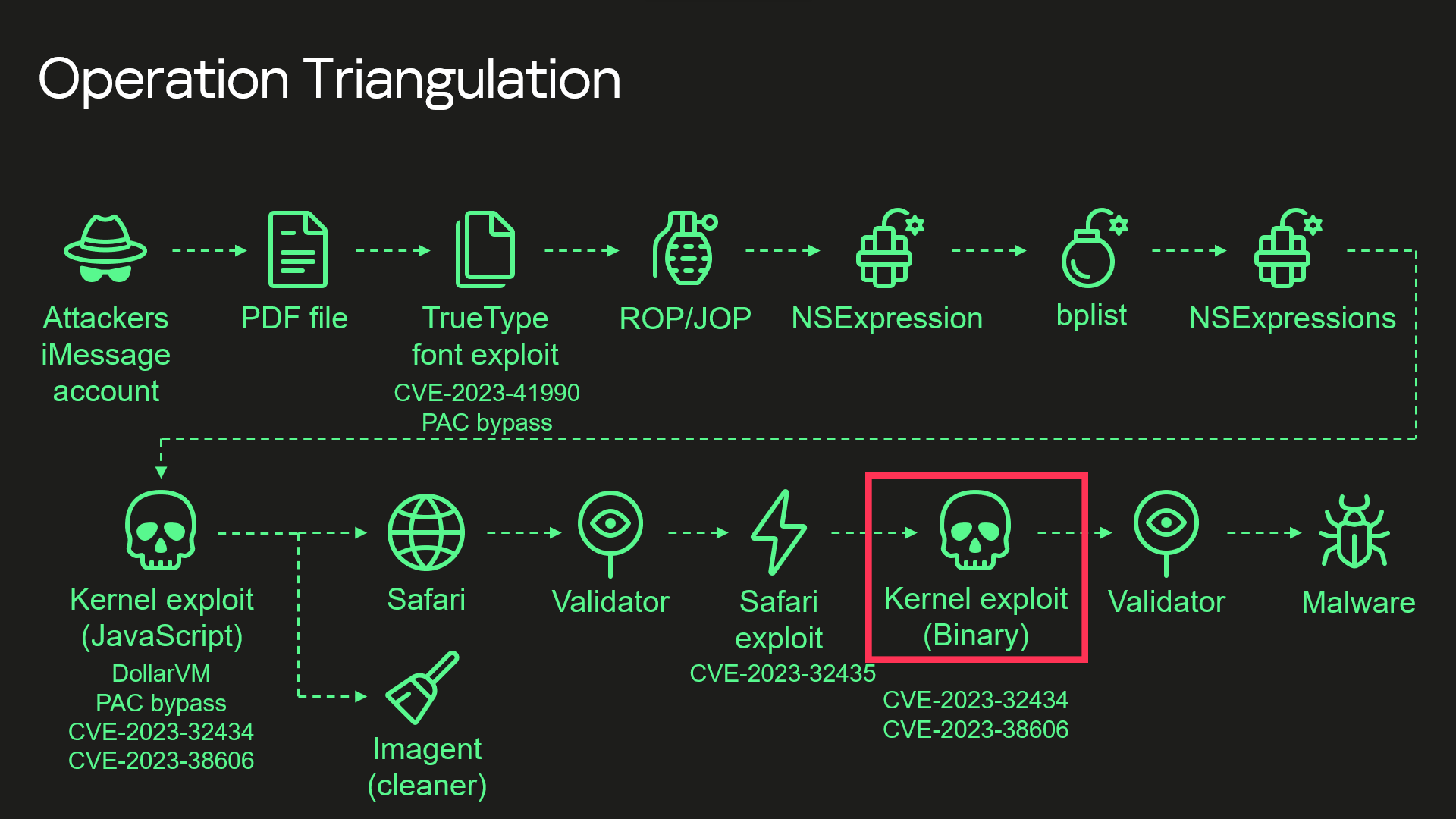
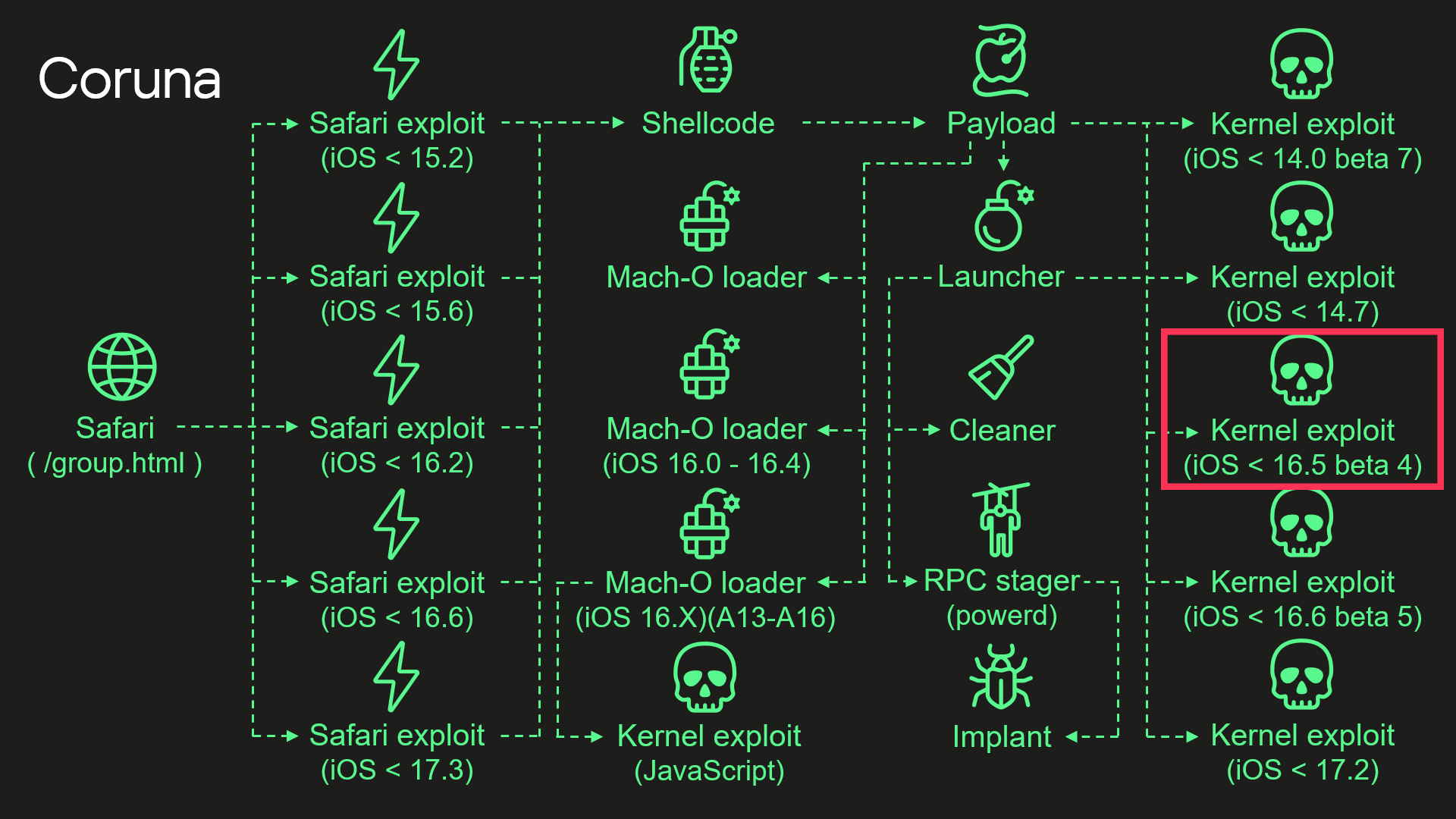
During our analysis, we discovered that the kernel exploit for CVE-2023-32434 and CVE-2023-38606 vulnerabilities used in Coruna, in fact, is an updated version of the same exploit that had been used in Operation Triangulation. The images below illustrate a high-level overview of the two attack chains. The exploit in question is highlighted with a red rectangle.

Attack chain of Operation Triangulation (simplified)

Attack chain of Operation Triangulation (simplified)

Attack chain of Coruna (simplified)

Attack chain of Coruna (simplified)

Moreover, we discovered that Coruna includes four additional kernel exploits that we had not seen used in Operation Triangulation, two of which were developed after the discovery of Operation Triangulation. All of these exploits are built on the same kernel exploitation framework and share common code. Code similarities from kernel exploits can also be found in other components of Coruna. These findings led us to conclude that this exploit kit was not patchworked but rather designed with a unified approach. We assume that it’s an updated version of the same exploitation framework that was used — at least to some extent — in Operation Triangulation.

Technical details

While we continue to investigate all exploits and vulnerabilities used by Coruna, this post provides a high-level overview of the exploit kit and attack chain.

Safari

Exploitation begins with a stager that fingerprints the browser and selects and executes appropriate remote code execution (RCE) and pointer authentication code (PAC) exploits depending on the browser version. It also contains a URL to an encrypted file with information about all available packages containing exploits and other components. The stager also includes a 256-bit key used to decrypt it. The URL and decryption key are passed to a payload embedded in PAC exploits.

Payload

The payload is responsible for initiating the exploitation of the kernel. After initialization, the payload first downloads a file with information about other available components. To extract it, the payload performs several steps processing multiple file formats.

First, the downloaded file is decrypted using the ChaCha20 stream cipher. Decryption yields a container with the magic number 0xBEDF00D, which stores LZMA-compressed data.

The file format used by the exploit kit to store compressed data

Offset Field
0x00 Magic number (0xBEDF00D)
0x04 Decompressed data size
0x08 LZMA-compressed data

The decompressed data presents another container with the magic number 0xF00DBEEF. This file format is used in the exploit kit to store and retrieve files by their IDs.

The file format used by the exploit kit to store files

Offset Field
0x00 Magic number (0xF00DBEEF)
0x04 Number of entries
0x08 Entry[0].File ID
0x0C Entry[0].Status
0x10 Entry[0].File offset
0x14 Entry[0].File size

We provide a description of all possible File ID values below. At this stage, when the payload gathers information about all available file packages, this container holds only one file, and its File ID is 0x70000.

Finally, we get to the file with information about all available file packages. It starts with the magic value 0x12345678. The exploit kit uses this file format to obtain URLs and decryption keys for additional components that need to be downloaded.

The file format used by the exploit kit to store information about file packages

Offset Field
0x00 Magic number (0x12345678)
0x04 Flags
0x08 Directory path
0x108 Number of entries
0x10C Entry[0].Package ID
0x110 Entry[0].ChaCha20 key
0x130 Entry[0].File name

The components required for exploiting a targeted device are selected using the Package ID. Its high byte specifies the package type and required hardware. We’ve seen the following package types:

  • 0xF2 – exploit for ARM64,
  • 0xF3 – exploit for ARM64E,
  • 0xA2 – Mach-O loader for ARM64,
  • 0xA3 – Mach-O loader for ARM64E,
  • 2 – implant for ARM64,
  • 0xE2 – implant for ARM64E.

The payload code also supports additional package types, such as 0xF1, an exploit for older ARM devices that do not support 64-bit architecture. Interestingly, however, the files for such exploits are missing.

Other bytes of the Package ID define the supported firmware version and CPU generation.

Some of the observed Package IDs (those with unique content)

Package ID Description
0xF3300000 Kernel exploit (iOS < 14.0 beta 7) and other components
0xF3400000 Kernel exploit (iOS < 14.7) and other components
0xF3700000 Kernel exploit (iOS < 16.5 beta 4) and other components
0xF3800000 Kernel exploit (iOS < 16.6 beta 5) and other components
0xF3900000 Kernel exploit (iOS < 17.2) and other components
0xA3030000 Mach-O loader (iOS 16.X) (A13 – A16)
0xA3050000 Mach-O loader (iOS 16.0 – 16.4)

The files inside these packages are also stored in encrypted and compressed 0xF00DBEEF containers, but this time compression is optional and is determined by the second bit in the Flags field. Different packages contain different sets of files. A description of all possible File IDs is given in the table below.

Observed File IDs

File ID Description
0x10000 Implant
0x50000 Mach-O loader (default)
0x70000 List of additional components
0x70005 Launcher config
0x80000 Launcher in 0xF2/0xF3 packages, or Mach-O loader in 0xA2/0xA3
0x90000 Kernel exploit
0x90001 Kernel exploit (for Mach-O loader)
0xA0000 Logs cleaner
0xA0001 Mach-O loader component
0xA0002 Mach-O loader component
0xF0000 RPC stager

After downloading the necessary components, the payload begins executing kernel exploits, Mach-O loaders, and the malware launcher. The payload selects an appropriate Mach-O loader based on the firmware version, CPU, and presence of the iokit-open-service permission.

Kernel exploits

We analyzed all five kernel exploits from the kit and discovered that one of them is an updated version of the same exploit we discovered in Operation Triangulation. There are many small changes, but the most noticeable are as follows:

  • The code takes into account more values ​​from XNU version strings, allowing for more accurate version checking.
  • Added a check for iOS 17.2. We assume that this was the latest version of iOS at the time of development (released in December 2023).
  • Added checks for newer Apple processors: A17, M3, M3 Pro, M3 Max (released in fall 2023).
  • Added a check for iOS version 16.5 beta 4. This version patched the exploit after our report to Apple.

Why does the exploit need to check for iOS 17.2 and newer CPUs if the targeted vulnerabilities were fixed in iOS 16.5 beta 4? The answer can be found by examining other exploits: they are all based on the same source code. The only difference is in the vulnerabilities they exploit, so these checks were added to support the newer exploits and appeared in the older version after recompilation.

Launcher

The launcher is responsible for orchestrating the post-exploitation activities. It also uses the kernel exploit and the interface it provides. However, since the exploit creates special kernel objects during its execution that provide the ability to read and write to kernel memory, the launcher simply reuses these objects without the need to trigger vulnerabilities and go through the entire exploitation path again. The launcher cleans up exploitation artifacts, retrieves the process name for injection from a config with the 0xDEADD00F magic number, injects a stager into the target process, uses it to execute itself, and launches the implant.

Conclusions

This case demonstrates once again the dangers associated with such malicious tools that lie in their potential wide usage. Originally developed for cyber-espionage purposes, this framework is now being used by cybercriminals of a broader kind, placing millions of users with unpatched devices at risk. Given its modular design and ease of reuse, we expect that other threat actors will begin incorporating it into their attacks. We strongly recommend that users install the latest security updates as soon as possible, if they have not already done so.

  • ✇Securelist
  • Exploits and vulnerabilities in Q4 2025 Alexander Kolesnikov
    The fourth quarter of 2025 went down as one of the most intense periods on record for high-profile, critical vulnerability disclosures, hitting popular libraries and mainstream applications. Several of these vulnerabilities were picked up by attackers and exploited in the wild almost immediately. In this report, we dive into the statistics on published vulnerabilities and exploits, as well as the known vulnerabilities leveraged with popular C2 frameworks throughout Q4 2025. Statistics on registe
     

Exploits and vulnerabilities in Q4 2025

6 de Março de 2026, 07:00

The fourth quarter of 2025 went down as one of the most intense periods on record for high-profile, critical vulnerability disclosures, hitting popular libraries and mainstream applications. Several of these vulnerabilities were picked up by attackers and exploited in the wild almost immediately.

In this report, we dive into the statistics on published vulnerabilities and exploits, as well as the known vulnerabilities leveraged with popular C2 frameworks throughout Q4 2025.

Statistics on registered vulnerabilities

This section contains statistics on registered vulnerabilities. The data is taken from cve.org.

Let’s take a look at the number of registered CVEs for each month over the last five years, up to and including the end of 2025. As predicted in our last report, Q4 saw a higher number of registered vulnerabilities than the same period in 2024, and the year-end totals also cleared the bar set the previous year.

Total published vulnerabilities by month from 2021 through 2025 (download)

Now, let’s look at the number of new critical vulnerabilities (CVSS > 8.9) for that same period.

Total number of published critical vulnerabilities by month from 2021 to 2025< (download)

The graph shows that the volume of critical vulnerabilities remains quite substantial; however, in the second half of the year, we saw those numbers dip back down to levels seen in 2023. This was due to vulnerability churn: a handful of published security issues were revoked. The widespread adoption of secure development practices and the move toward safer languages also pushed those numbers down, though even that couldn’t stop the overall flood of vulnerabilities.

Exploitation statistics

This section contains statistics on the use of exploits in Q4 2025. The data is based on open sources and our telemetry.

Windows and Linux vulnerability exploitation

In Q4 2025, the most prevalent exploits targeted the exact same vulnerabilities that dominated the threat landscape throughout the rest of the year. These were exploits targeting Microsoft Office products with unpatched security flaws.

Kaspersky solutions detected the most exploits on the Windows platform for the following vulnerabilities:

  • CVE-2018-0802: a remote code execution vulnerability in Equation Editor.
  • CVE-2017-11882: another remote code execution vulnerability, also affecting Equation Editor.
  • CVE-2017-0199: a vulnerability in Microsoft Office and WordPad that allows an attacker to assume control of the system.

The list has remained unchanged for years.

We also see that attackers continue to adapt exploits for directory traversal vulnerabilities (CWE-35) when unpacking archives in WinRAR. They are being heavily leveraged to gain initial access via malicious archives on the Windows operating system:

  • CVE-2023-38831: a vulnerability stemming from the improper handling of objects within an archive.
  • CVE-2025-6218 (formerly ZDI-CAN-27198): a vulnerability that enables an attacker to specify a relative path and extract files into an arbitrary directory. This can lead to arbitrary code execution. We covered this vulnerability in detail in our Q2 2025 report.
  • CVE-2025-8088: a vulnerability we analyzed in our previous report, analogous to CVE-2025-6218. The attackers used NTFS streams to circumvent controls on the directory into which files were being unpacked.

As in the previous quarter, we see a rise in the use of archiver exploits, with fresh vulnerabilities increasingly appearing in attacks.

Below are the exploit detection trends for Windows users over the last two years.

Dynamics of the number of Windows users encountering exploits, Q1 2024 – Q4 2025. The number of users who encountered exploits in Q1 2024 is taken as 100% (download)

The vulnerabilities listed here can be used to gain initial access to a vulnerable system. This highlights the critical importance of timely security updates for all affected software.

On Linux-based devices, the most frequently detected exploits targeted the following vulnerabilities:

  • CVE-2022-0847, also known as Dirty Pipe: a vulnerability that allows privilege escalation and enables attackers to take control of running applications.
  • CVE-2019-13272: a vulnerability caused by improper handling of privilege inheritance, which can be exploited to achieve privilege escalation.
  • CVE-2021-22555: a heap overflow vulnerability in the Netfilter kernel subsystem.
  • CVE-2023-32233: another vulnerability in the Netfilter subsystem that creates a use-after-free condition, allowing for privilege escalation due to the improper handling of network requests.

Dynamics of the number of Linux users encountering exploits, Q1 2024 – Q4 2025. The number of users who encountered exploits in Q1 2024 is taken as 100% (download)

We are seeing a massive surge in Linux-based exploit attempts: in Q4, the number of affected users doubled compared to Q3. Our statistics show that the final quarter of the year accounted for more than half of all Linux exploit attacks recorded for the entire year. This surge is primarily driven by the rapidly growing number of Linux-based consumer devices. This trend naturally attracts the attention of threat actors, making the installation of security patches critically important.

Most common published exploits

The distribution of published exploits by software type in Q4 2025 largely mirrors the patterns observed in the previous quarter. The majority of exploits we investigate through our monitoring of public research, news, and PoCs continue to target vulnerabilities within operating systems.

Distribution of published exploits by platform, Q1 2025 (download)

Distribution of published exploits by platform, Q2 2025 (download)

Distribution of published exploits by platform, Q3 2025 (download)

Distribution of published exploits by platform, Q4 2025 (download)

In Q4 2025, no public exploits for Microsoft Office products emerged; the bulk of the vulnerabilities were issues discovered in system components. When calculating our statistics, we placed these in the OS category.

Vulnerability exploitation in APT attacks

We analyzed which vulnerabilities were utilized in APT attacks during Q4 2025. The following rankings draw on our telemetry, research, and open-source data.

TOP 10 vulnerabilities exploited in APT attacks, Q4 2025 (download)

In Q4 2025, APT attacks most frequently exploited fresh vulnerabilities published within the last six months. We believe that these CVEs will remain favorites among attackers for a long time, as fixing them may require significant structural changes to the vulnerable applications or the user’s system. Often, replacing or updating the affected components requires a significant amount of resources. Consequently, the probability of an attack through such vulnerabilities may persist. Some of these new vulnerabilities are likely to become frequent tools for lateral movement within user infrastructure, as the corresponding security flaws have been discovered in network services that are accessible without authentication. This heavy exploitation of very recently registered vulnerabilities highlights the ability of threat actors to rapidly implement new techniques and adapt old ones for their attacks. Therefore, we strongly recommend applying the security patches provided by vendors.

C2 frameworks

In this section, we will look at the most popular C2 frameworks used by threat actors and analyze the vulnerabilities whose exploits interacted with C2 agents in APT attacks.

The chart below shows the frequency of known C2 framework usage in attacks against users during Q4 2025, according to open sources.

TOP 10 C2 frameworks used by APTs to compromise user systems in Q4 2025 (download)

Despite the significant footprints it can leave when used in its default configuration, Sliver continues to hold the top spot among the most common C2 frameworks in our Q4 2025 analysis. Mythic and Havoc were second and third, respectively. After reviewing open sources and analyzing malicious C2 agent samples that contained exploits, we found that the following vulnerabilities were used in APT attacks involving the C2 frameworks mentioned above:

  • CVE-2025-55182: a React2Shell vulnerability in React Server Components that allows an unauthenticated user to send commands directly to the server and execute them from RAM.
  • CVE-2023-36884: a vulnerability in the Windows Search component that allows the execution of commands on a system, bypassing security mechanisms built into Microsoft Office applications.
  • CVE-2025-53770: a critical insecure deserialization vulnerability in Microsoft SharePoint that allows an unauthenticated user to execute commands on the server.
  • CVE-2020-1472, also known as Zerologon, allows for compromising a vulnerable domain controller and executing commands as a privileged user.
  • CVE-2021-34527, also known as PrintNightmare, exploits flaws in the Windows print spooler subsystem, enabling remote access to a vulnerable OS and high-privilege command execution.
  • CVE-2025-8088 and CVE-2025-6218 are similar directory-traversal vulnerabilities that allow extracting files from an archive to a predefined path without the archiving utility notifying the user.

The set of vulnerabilities described above suggests that attackers have been using them for initial access and early-stage maneuvers in vulnerable systems to create a springboard for deploying a C2 agent. The list of vulnerabilities includes both zero-days and well-known, established security issues.

Notable vulnerabilities

This section highlights the most noteworthy vulnerabilities that were publicly disclosed in Q4 2025 and have a publicly available description.

React2Shell (CVE-2025-55182): a vulnerability in React Server Components

We typically describe vulnerabilities affecting a specific application. CVE-2025-55182 stood out as an exception, as it was discovered in React, a library primarily used for building web applications. This means that exploiting the vulnerability could potentially disrupt a vast number of applications that rely on the library. The vulnerability itself lies in the interaction mechanism between the client and server components, which is built on sending serialized objects. If an attacker sends serialized data containing malicious functionality, they can execute JavaScript commands directly on the server, bypassing all client-side request validation. Technical details about this vulnerability and an example of how Kaspersky solutions detect it can be found in our article.

CVE-2025-54100: command injection during the execution of curl (Invoke-WebRequest)

This vulnerability represents a data-handling flaw that occurs when retrieving information from a remote server: when executing the curl or Invoke-WebRequest command, Windows launches Internet Explorer in the background. This can lead to a cross-site scripting (XSS) attack.

CVE-2025-11001: a vulnerability in 7-Zip

This vulnerability reinforces the trend of exploiting security flaws found in file archivers. The core of CVE-2025-11001 lies in the incorrect handling of symbolic links. An attacker can craft an archive so that when it is extracted into an arbitrary directory, its contents end up in the location pointed to by a symbolic link. The likelihood of exploiting this vulnerability is significantly reduced because utilizing such functionality requires the user opening the archive to possess system administrator privileges.

This vulnerability was associated with a wave of misleading news reports claiming it was being used in real-world attacks against end users. This misconception stemmed from an error in the security bulletin.

RediShell (CVE-2025-49844): a vulnerability in Redis

The year 2025 saw a surge in high-profile vulnerabilities, several of which were significant enough to earn a unique nickname. This was the case with CVE-2025-49844, also known as RediShell, which was unveiled during a hacking competition. This vulnerability is a use-after-free issue related to how the load command functions within Lua interpreter scripts. To execute the attack, an attacker needs to prepare a malicious script and load it into the interpreter.

As with any named vulnerability, RediShell was immediately weaponized by threat actors and spammers, albeit in a somewhat unconventional manner. Because technical details were initially scarce following its disclosure, the internet was flooded with fake PoC exploits and scanners claiming to test for the vulnerability. In the best-case scenario, these tools were non-functional; in the worst, they infected the system. Notably, these fraudulent projects were frequently generated using LLMs. They followed a standardized template and often cross-referenced source code from other identical fake repositories.

CVE-2025-24990: a vulnerability in the ltmdm64.sys driver

Driver vulnerabilities are often discovered in legitimate third-party applications that have been part of the official OS distribution for a long time. Thus, CVE-2025-24990 has existed within code shipped by Microsoft throughout nearly the entire history of Windows. The vulnerable driver has been shipped since at least Windows 7 as a third-party driver for Agere Modem. According to Microsoft, this driver is no longer supported and, following the discovery of the flaw, was removed from the OS distribution entirely.

The vulnerability itself is straightforward: insecure handling of IOCTL codes leading to a null pointer dereference. Successful exploitation can lead to arbitrary command execution or a system crash resulting in a blue screen of death (BSOD) on modern systems.

CVE-2025-59287: a vulnerability in Windows Server Update Services (WSUS)

CVE-2025-59287 represents a textbook case of insecure deserialization. Exploitation is possible without any form of authentication; due to its ease of use, this vulnerability rapidly gained traction among threat actors. Technical details and detection methodologies for our product suite have been covered in our previous advisories.

Conclusion and advice

In Q4 2025, the rate of vulnerability registration has shown no signs of slowing down. Consequently, consistent monitoring and the timely application of security patches have become more critical than ever. To ensure resilient defense, it is vital to regularly assess and remediate known vulnerabilities while implementing technology designed to mitigate the impact of potential exploits.

Continuous monitoring of infrastructure, including the network perimeter, allows for the timely identification of threats and prevents them from escalating. Effective security also demands tracking the current threat landscape and applying preventative measures to minimize risks associated with system flaws. Kaspersky Next serves as a reliable partner in this process, providing real-time identification and detailed mapping of vulnerabilities within the environment.

Securing the workplace remains a top priority. Protecting corporate devices requires the adoption of solutions capable of blocking malware and preventing it from spreading. Beyond basic measures, organizations should implement adaptive systems that allow for the rapid deployment of security updates and the automation of patch management workflows.

  • ✇DCiber
  • Abrangência do grupo Scattered Spider acende alerta na América Latina, diz especialista Redação
    A expansão internacional do grupo de cibercriminosos conhecido como Scattered Spider acendeu um sinal de alerta entre empresas latino-americanas. Especialistas em segurança apontam que, embora não haja registros confirmados de ataques desse grupo no Brasil ou vizinhos até o momento, seu alcance global e métodos sofisticados representam um risco iminente para organizações na região. Com táticas de engenharia social elaboradas e capacidade de driblar defesas tradicionais, o Scattered Spider tem mi
     

Abrangência do grupo Scattered Spider acende alerta na América Latina, diz especialista

6 de Dezembro de 2025, 11:38

A expansão internacional do grupo de cibercriminosos conhecido como Scattered Spider acendeu um sinal de alerta entre empresas latino-americanas. Especialistas em segurança apontam que, embora não haja registros confirmados de ataques desse grupo no Brasil ou vizinhos até o momento, seu alcance global e métodos sofisticados representam um risco iminente para organizações na região.

Com táticas de engenharia social elaboradas e capacidade de driblar defesas tradicionais, o Scattered Spider tem mirado grandes empresas em diversos países. “A questão não é mais ‘se’ seremos atacados, mas de ‘quando’ e ‘como’, afirma Felipe Guimarães, Chief Information Security Officer da Solo Iron. “As táticas empregadas pelo grupo exploram fragilidades universais, presentes em empresas em todo o mundo – o que inclui as empresas latino-americanas”, pondera o especialista.

Um dos maiores riscos é que os setores visados pelo Scattered Spider no exterior também são pilares econômicos na América Latina. O grupo historicamente focou suas ações em empresas de telecomunicações, terceirização de processos de negócios (BPO) e grandes empresas de tecnologia – indústrias que possuem ampla presença na região. Nos últimos tempos, foi observado um aumento de interesse do grupo pelo setor financeiro global, o que inclui bancos e instituições presentes no Brasil e países vizinhos.

“Isso significa que companhias latino-americanas, seja diretamente ou através de filiais e parceiras, podem entrar na mira à medida que o Scattered Spider amplia seu raio de atuação. Mesmo empresas que não operam internacionalmente devem se precaver, pois os criminosos podem enxergar organizações locais como pontes de entrada para fornecedores ou clientes globais, ou simplesmente como alvos lucrativos por si sós, caso identifiquem falhas de segurança exploráveis”, pontua Guimarães.

Na mira das agências de inteligência

Relatórios do FBI e da Agência de Segurança Cibernética e de Infraestrutura (CISA) dos EUA descrevem o Scattered Spider como “especialista em engenharia social”, empregando diversas técnicas para roubar credenciais e burlar autenticações.

Entre os métodos documentados estão phishing por e-mail e SMS (smishing), ataques de vishing (ligações telefônicas fraudulentas) em que os criminosos se passam por equipe de TI da própria empresa, e até esquemas elaborados de SIM swap – quando convencem operadoras de telefonia a transferir o número de celular de uma vítima para um chip sob controle deles. Essas táticas permitem interceptar códigos de autenticação multifator (MFA) enviados via SMS ou aplicativos, dando aos invasores as chaves para acessar sistemas internos.

Ainda segundo o especialista, o modelo de ataque do Scattered Spider pode inspirar quadrilhas locais. “As táticas de engenharia social eficazes tendem a se espalhar rapidamente nos submundos virtuais. Mesmo que o próprio grupo original não atue diretamente na América Latina, outros agentes maliciosos regionais podem adotar técnicas semelhantes – como push bombing de MFA ou golpes contra centrais de atendimento – ao verem o sucesso obtido lá fora”, explica Guimarães.

Alguns incidentes recentes no cenário latino-americano já envolveram vetores parecidos, como uso de ferramentas legítimas em ataques e exploração de credenciais vazadas, o que reforça a necessidade de vigilância. Em 2024, por exemplo, houve casos de gangues de ransomware operando na região que abusaram de softwares legítimos e brechas em procedimentos internos de empresas, aplicando práticas muito similares ao do Scattered Spider.

Estratégias de mitigação

Diante da crescente ameaça representada por grupos como o Scattered Spider, Guimarães recomenda a adoção de estratégias com foco especial em fortalecer métodos avançados de autenticação multifator (MFA), preferencialmente resistentes a phishing, como chaves físicas de segurança ou soluções baseadas em certificados digitais. Técnicas como MFA com validação numérica e a restrição do uso de SMS para autenticação são essenciais para reduzir o risco de engenharia social e ataques por fadiga de notificações, muito usados pelo grupo.

Além disso, a adoção de uma abordagem mais robusta em relação à gestão de identidades e acessos (IAM) é uma estratégia muito importante na contenção desse tipo de ameaça. “As identidades digitais estão se tornando uma nova superfície de ataque; por isso, é fundamental que as empresas implementem políticas rígidas de gestão de identidades, controle granular de acessos e monitoramento contínuo das atividades dos usuários”, destaca.

“Também é muito importante o controle rigoroso sobre ferramentas de acesso remoto e a implantação de monitoramento avançado. É recomendável que as organizações restrinjam o uso dessas ferramentas por meio de listas autorizadas e adotem sistemas robustos como EDR e DLP para identificar rapidamente atividades suspeitas”, finaliza o especialista.

❌
❌