❌

Visualização normal

Antes de ontemStream principal

IDC MarketScape names Microsoft a Leader in the 2026 Worldwide Modern Endpoint Security for Enterprises Vendor Assessment

29 de Outubro de 2026, 13:00

Today, we’re proud to share thatMicrosoft has been named a Leader in the 2026 IDC MarketScape for Worldwide Modern Endpoint Security for Enterprises (Doc #US54123526, September 2026). The IDC Marketscape calls out three strengths that we believe matter most in endpoint security today:

  • Autonomous attack disruption and predictive shielding contain ransomware and identity attacks in minutes, at a meaningful scale.
  • Agentic AI through Security Copilot is now generally available, with measured gains in alert accuracy and analyst time saved.
  • The company offers broad native cross-platform coverage plus sovereign cloud and data residency options for regulated and multinational customers.
Graphic that shows IDC has named Microsoft a Leader in the 2026 IDC MarketScape for Worldwide Modern Endpoint Security for Enterprises

IDC MarketScape vendor analysis model is designed to provide an overview of the competitive fitness of technology and suppliers in a given market. The research methodology utilizes a rigorous scoring methodology based on both qualitative and quantitative criteria that results in a single graphical illustration of each supplier’s position within a given market. The Capabilities score measures supplier product, go-to-market and business execution in the short-term. The Strategy score measures alignment of supplier strategies with customer requirements in a 3-5-year timeframe. Supplier market share is represented by the size of the icons.

The most critical moment in any attack is when it moves from access to action. That’s when ransomware detonates, stolen credentials are put to work, and, increasingly, a manipulated AI agent turns a user’s own data and tools against them. And threat actors are now using teams of AI agents to execute attacks faster and more relentlessly. Between 2025 and 2026, Microsoft Security researchers observed a more than 15% increase in ransomware detonations against enterprises.1 When an attacker can move from first foothold to encryption in minutes, protection on the endpoint must act at the same speed, without waiting for a person to connect the dots.

Protection that acts while the attack is still unfolding

The IDC MarketScape highlights that “Automatic attack disruption contains compromised devices, users, and IP addresses in near real time, and predictive shielding proactively hardens likely next attacker moves.” Built into Microsoft Defender, attack disruption uses AI and signals from the endpoint and across identities, email, and cloud to recognize multistage attacks, such as ransomware, as they happen. It then automatically contains the affected devices and users to stop the attacker from moving laterally. Against attacks that move in minutes, protection has to work autonomously, while the attack is still in progress and before it can spread.

QNET, a global direct-selling company, saw this firsthand. Defender identified an active ransomware attack, isolated the compromised device, and stopped the second-stage payload within 128 seconds of the first high-severity alert.

A foundation built for agentic security

Stopping an attack like QNET’s in seconds starts with the right foundation. Attack disruption succeeds because Defender can see activity across endpoints, identities, email, and cloud, understand what that activity means, and act on it natively. The IDC MarketScape highlights that “the Defender portal unifies incident and alert queues, graph-based incident views, and advanced hunting, correlating signals from endpoint, identity, email, SaaS, and cloud sources into a single incident.”

That foundation depends on three layers working as one. Signals and sensors give the system awareness across the entire environment. Context turns those signals into understanding: what is happening, what is exposed, how an attacker could move, and what matters most. Actuators, like attack disruption, turn that understanding into protective action. To protect against the latest AI-based threats, these layers need to work in unison.

That’s why, on September 23, 2026, we announced the integrated security operations center (ISOC) in Microsoft Defender. ISOC brings security information and event management (SIEM) and Defender’s threat protection together, giving people and agents shared signals, shared context, and shared controls to see, understand, and act across the environment as one. On top of that foundation, we continue to strengthen what Defender can see:

  • Richer endpoint signals: Defender provides more than 200 native event types for threat hunting. Custom data collection extends that visibility by letting security teams collect specialized telemetry to support tailored detections and advanced hunting.
  • Comprehensive signals across your environment: Microsoft Sentinel now provides more than 500 connectors to ingest security-relevant data from across your organization’s digital estate. This breadth gives defenders the context to connect activity across otherwise fragmented systems, detect threats that no single signal would reveal, and investigate and respond with greater confidence.

Agentic AI built into the flow of work

With signals, context, and actuators working as one in Microsoft Defender, agents have what they need to be effective: the visibility to see what’s happening, the context to understand it, and the controls to act on it. IDC notes that AI is deeply embedded across the Defender platform, with agentic AI now generally available and delivering “measured gains in alert accuracy and analyst time saved.”

One platform to see, understand, and protect local AI agents

The same visibility, context, and controls that make agents effective for defenders also make it possible to secure the agents employees use every day. Developers and knowledge workers now run local agents, from coding assistants to agentic development environments, with access to data, credentials, tools, and Model Context Protocol (MCP) servers. IDC advises buyers to ask how vendors secure AI on the endpoint, including visibility into local models and agent activity. With Defender, security teams can see those agents, understand their reach, and protect them as they operate.

  • See every local agent: Discovery of local agents and their configured MCP servers is available on Windows and macOS, covering more than 50 supported agents and MCP servers, including claw-based agents such as OpenClaw.
  • Understand their reach: The exposure graph in Defender maps each agent’s blast radius across devices, identities, and MCP connections, and teams can investigate agent activity in advanced hunting alongside data from endpoints, identities, email, and cloud.
  • Protect agents as they operate: Runtime protection, in preview on Windows, stops malicious instructions, such as prompt injection hidden in a file or web page, before an agent acts on them, and raises an alert with agent and session context.

In a threat landscape being reshaped by AI, Microsoft Defender will continue to deliver leading endpoint security for any platform with a focus on reducing exposure, disrupting active attacks in your environment, and strengthening resilience across the entire organization.

To see where security operations are headed next, join Rob Lefferts at Microsoft Ignite for the session: The Alert Is Dead. The Blueprint for the Agentic SOC.

Microsoft named a Leader by IDC

Read the 2026 IDC MarketScape to learn why IDC named Microsoft a Leader in Worldwide Modern Endpoint Security for Enterprises.

To learn more about Microsoft Security solutions, visit our website. Bookmark the Security blog to keep up with our expert coverage on security matters. Follow us on LinkedIn (Microsoft Security) and X (@MSFTSecurity) for the latest news and updates on cybersecurity.


1Microsoft 2026 Digital Defense Report

The post IDC MarketScape names Microsoft a Leader in the 2026 Worldwide Modern Endpoint Security for Enterprises Vendor Assessment appeared first on Microsoft Security Blog.

  • ✇Microsoft Security Blog
  • Reimagining the SOC for the agentic era in Microsoft Defender Rob Lefferts
    The physics of cybersecurity are changing. So must the security operations center (SOC). Cyberattackers are using agents to automate execution at unprecedented scale. What once required entire teams now requires a single operator and an agent framework. That shift has exposed a hard truth: security cannot operate at AI speed when protection and operations are built as separate systems. Every handoff, integration, and boundary slows defenders down. Agents inherit that complexity. For a
     

Reimagining the SOC for the agentic era in Microsoft Defender

23 de Setembro de 2026, 13:00

The physics of cybersecurity are changing. So must the security operations center (SOC).

Cyberattackers are using agents to automate execution at unprecedented scale. What once required entire teams now requires a single operator and an agent framework.

That shift has exposed a hard truth: security cannot operate at AI speed when protection and operations are built as separate systems. Every handoff, integration, and boundary slows defenders down. Agents inherit that complexity.

For agentic security to work, the industry needs a different model. It needs a modern cyber stack with the breadth to see across the environment and the depth to investigate and act. Security operations and native protection must function as one system. This is the integrated security operations center (ISOC).

Today we are announcing ISOC in Microsoft Defender: a foundation built for agentic security that brings leading solutions for security information and event management (SIEM) and threat protection together. It gives people and agents a shared foundation to see, understand, and act across the environment, without the complexity of operating separate systems.

Built for agentic security

In July 2026, we introduced the end-to-end cyber stack alongside Project Perception, with the focus of delivering the right models, a harness, and specialized agents to help defenders perceive, reason, and act at machine speed. But we are innovating at every layer of the stack, because intelligence and orchestration alone are not enough. Agents depend on the rest of the stack working as one.

They need signals and sensors that provide visibility, context that turns those signals into understanding, and actuators that translate decisions into protection. With ISOC, these layers work in unison, so agents can move beyond isolated tasks and help operate an agentic SOC.

Diagram of an autonomous system stack with six layers: Actuators, Agents, Harness, Models, Context, and Sensors and Signals. The bottom three layers are grouped together. A banner below reads, "Strategy stays human. Scale becomes autonomous."

Signals and sensors give the system awareness.

Context turns those signals into understanding.

Actuators turn insights into protective action.

ISOC brings these capabilities together as a foundation, so humans and agents can operate as one system, each contributing what they do best. Agents provide the speed and scale to execute continuously, while people set priorities, apply judgment, and define the outcomes that matter. Together, they empower defenders to keep pace with AI-powered threat actors and achieve better security outcomes.

Integrated protection loop

With ISOC enabling signals, context, and controls to work as one, it breaks the pattern of linear security workflows. The result is an integrated protection loop that continuously turns what defenders learn into stronger pre-breach protection.

Attack disruption in Microsoft Defender shows what this makes possible. Rich telemetry and controls enable the system to detect, predict, and adapt to an attacker while the attack is still unfolding. It disrupts threats in progress and anticipates where attackers may move next. It’s a protection loop that uses exposure insights to strengthen protection in near real-time with threat intelligence focusing the loop on the threats that matter most.

ISOC brings together the capabilities needed to make this loop native, eliminating the burden of assembling, tuning, and maintaining it yourself. And as protection advances, new capabilities can become part of that loop. The result is stronger protection and a different way of working, where practitioners spend less time chasing individual signals and more time applying judgment, setting priorities, and driving security outcomes.

Designed for the practitioner

For too long, practitioners have had to compensate for the boundaries in their security architecture, stitching together signals, rebuilding context, and moving between tools just to get the information and controls needed to act.

ISOC changes their starting point. The capabilities practitioners need to investigate, hunt, automate, manage incidents, understand threats, and take action are brought together and available by default. Instead of organizing their work around the boundaries between tools, teams can organize around the security outcome they are trying to achieve.

And that foundation gets more powerful as autonomy grows. The integrated protection loop can take on more of the continuous work of detecting and defending against threats, while agents help practitioners investigate, reason, and act using the same context and controls already available to them.

There’s no separate agentic layer to assemble or new operating model to stitch together. Practitioners can multiply their expertise where they already work, shifting more of their time from operating the security stack to directing the defense.

The path forward

Security has always been a race between attackers and defenders. AI changes the speed, scale, and economics of that race. The next SOC will not be defined by how many AI features it has, but by whether people and agents can perceive, reason, and act across an environment as one system.

Integrated security operations center (ISOC) in Microsoft Defender is available in preview today. Watch a recording of the full announcement or download the whitepaper: Agentic SOC: The new operating model for continuous defense.

To learn more about Microsoft Security solutions, visit our website. Bookmark the Security blog to keep up with our expert coverage on security matters. Also, follow us on LinkedIn (Microsoft Security) and X (@MSFTSecurity) for the latest news and updates on cybersecurity.

The post Reimagining the SOC for the agentic era in Microsoft Defender appeared first on Microsoft Security Blog.

  • ✇Microsoft Security Blog
  • Improving email security outcomes with real-world Microsoft Defender insights Rob Lefferts
    Every benchmark tells a story. The most valuable ones tell us where to improve next. For five consecutive quarters Microsoft has published email security benchmarking reports to provide greater transparency into real-world protection outcomes. The results have shown strong Microsoft Defender performance across pre-delivery and post-delivery scenarios, while revealing where threats and defenses continue to evolve. This quarter’s benchmark examines how continuous measurement informs protect
     

Improving email security outcomes with real-world Microsoft Defender insights

17 de Setembro de 2026, 13:00

Every benchmark tells a story. The most valuable ones tell us where to improve next.

For five consecutive quarters Microsoft has published email security benchmarking reports to provide greater transparency into real-world protection outcomes. The results have shown strong Microsoft Defender performance across pre-delivery and post-delivery scenarios, while revealing where threats and defenses continue to evolve.

This quarter’s benchmark examines how continuous measurement informs protection across prevention, detection, and adaptation, and how those insights are helping improve customer outcomes.

Key takeaways

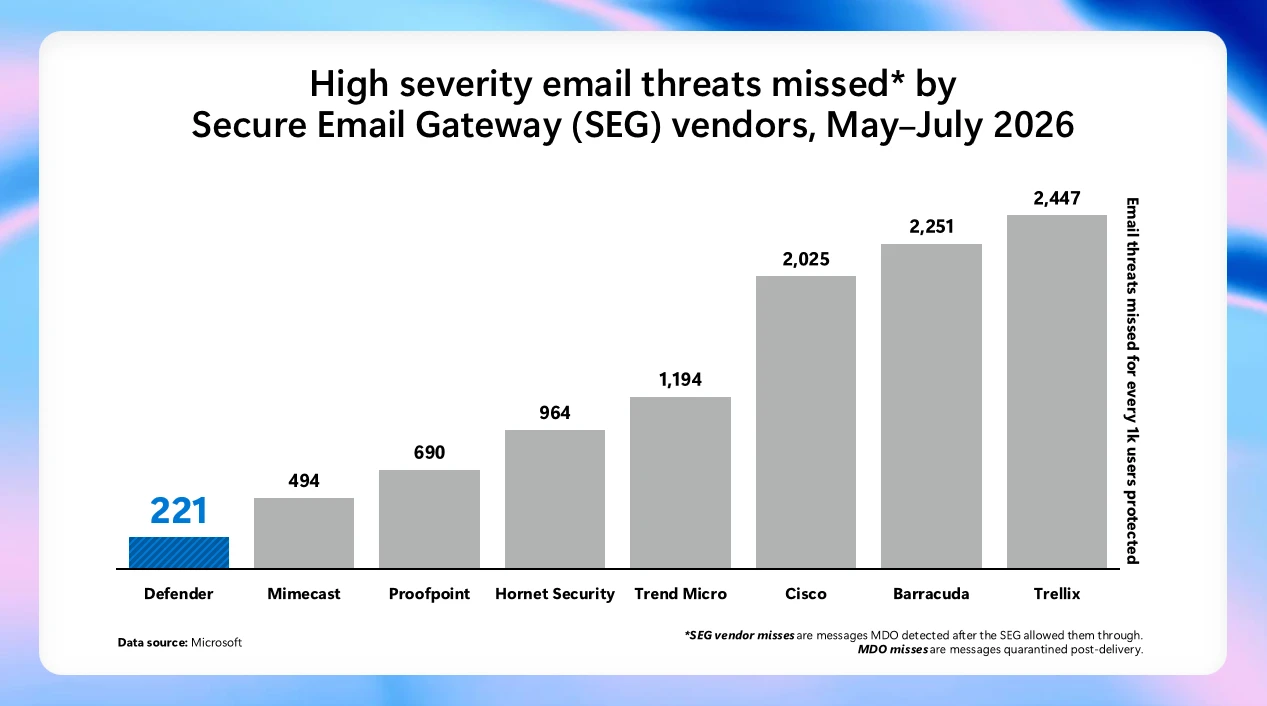
  • Defender again missed the fewest high-severity threats among the solutions evaluated, about 55% fewer than the next-closest secure email gateway (SEG) vendor.
  • Layered security adds the most value in promotional and bulk filtering and works; gains for spam and malicious email remain comparatively modest.

Benchmarking results for SEG vendors

In the latest quarterly SEG comparison from May 2026 through July 2026, Defender missed 221 high-severity threats per 1,000 protected users, 55.4% fewer than the next-closest SEG vendor. The benchmark measures missed threats instead of the total number of malicious emails that were caught and filtered, because catch totals can reflect differences in threat volume and exposure across vendor environments. By normalizing missed threats per 1,000 users we are able to provide a more consistent side-by-side comparison.

The image shows a bar chart illustrating the number of high severity email threats that were missed by various Secure Email Gateway (SEG) vendors, with Mimecast leading the list.
Figure 1: High-severity email threats missed by SEG vendors (May 2026 through July 2026), measured as threats missed per 1,000 users protected. Data source: Microsoft Defender.

If you’ve read our previous blogs, you’ll see that missed threats have increased across multiple reporting periods, including for Microsoft. This aligns with broader trends we’re seeing as AI makes it easier for cyberattackers to gather public information, tailor messages, and create more convincing impersonation attempts. It reinforces the need for protection that continuously adapts.

Benchmarking results for ICES vendors

Effective email detection combines pre-delivery filtering with post-delivery detection and remediation. This benchmark helps customers evaluate where each layer contributes measurable value.

Similarly to previous quarters, integrated cloud email security (ICES) solutions continue adding the most value in promotional and bulk filtering. We saw an improvement in ICES vendor malicious catch at 0.30% versus 0.13% in the last quarter and spam catch going up to 0.52% versus 0.28% compared to last quarter.

The diagram illustrates the distribution of different types of cyber threat catches (non-malicious, spam, and malicious) detected by various vendors (Check Point, Cisco, Darktrace, etc.) in Microsoft Defender Counter Attack (ICES) from May to July 2026.
Figure 2: ICES vendor catch contribution (May 2026 through July 2026). Data source: Microsoft Defender.

Defender caught 92% of post-delivery malicious messages on average during the benchmark period, highlighting how the combination of pre-delivery and post-delivery remediation delivers strong results for customers.

At the same time it’s key to understand that Defender doesn’t treat post-delivery remediation as a point-in-time action after the email was first delivered to the inbox. Even after a message reaches the inbox, new threat intelligence can reveal risks that were not apparent at the time of delivery. Defender continuously reevaluates delivered messages and remediates threats as new indicators, campaign intelligence, and threat signals emerge.

The image is a pie chart showing the percentage of malicious emails detected by various security vendors, with Microsoft Defender catching the most at 92%.
Figure 3: Post‑delivery malicious catch by Microsoft Defender (May 2026 through July 2026), shown across vendors and overall average. Data source: Microsoft Defender.

How our benchmarking is helping shape product innovation

The value of benchmarking is what happens after measurement. Insights from customer feedback, threat telemetry, and benchmarking have informed recent Microsoft Defender investments:

  • More control over promotional mail: Across multiple benchmarking periods, we observed that ICES solutions often delivered the greatest incremental benefit in filtering promotional and bulk email. The new Promotions folder in Outlook builds on these insights by helping users reduce inbox clutter while keeping legitimate marketing and bulk messages accessible.
  • Redesigned machine learning and AI model stack: By analyzing and incorporating natural language processing signals, including message topic, alongside other AI detection signals, Defender can improve detection accuracy. During a consecutive four-week period, Microsoft research observed a roughly two-thirds reduction in false negatives and a nearly one-fifth reduction in false positives for Defender customers.
  • Protection for people and AI: We built prompt injection protection to detect and isolate malicious AI instructions in email before delivery—helping protect not only people, but also Copilot, agents, and other AI systems that read and act on inbox content. This innovation demonstrates how we continue evolving our defenses to address the latest cyberattack techniques and stay ahead of emerging threats.

Looking ahead

Since July 2025, our goal has been to bring greater transparency to email security effectiveness. Today, we are using benchmarking to help customers understand how cyberthreats evolve, where defenses add value, and how protection improves over time.

Benchmarking is not simply about demonstrating effectiveness, it is about learning from real-world outcomes and translating those insights into stronger protection. As cyberattackers continue to innovate, we remain committed to sharing evidence, improving our technology, and helping customers stay ahead of emerging cyberthreats.

To explore the latest benchmarking data and learn more about how Defender and ICES partners work together, access the benchmarking site.

Learn more

Learn more about Microsoft Defender.

To learn more about Microsoft Security solutions, visit our website. Bookmark the Security blog to keep up with our expert coverage on security matters. Also, follow us on LinkedIn (Microsoft Security) and X (@MSFTSecurity) for the latest news and updates on cybersecurity.

The post Improving email security outcomes with real-world Microsoft Defender insights appeared first on Microsoft Security Blog.

  • ✇Microsoft Security Blog
  • Detect and disrupt AI-themed attacks with Microsoft Defender Rob Lefferts
    Every wave of technology excitement creates a new opportunity for cyberattackers, and AI is no exception. Microsoft Threat Intelligence has published research showing a growing set of campaigns that impersonate popular AI platforms and tools, including ChatGPT, Microsoft Copilot, DeepSeek, and Claude.1 The goal is to make phishing, search-driven malware campaigns, and malvertising—which is malicious advertising that uses online ads to lure users to harmful sites, downloads, or redirect chains—mo
     

Detect and disrupt AI-themed attacks with Microsoft Defender

10 de Setembro de 2026, 13:00

Every wave of technology excitement creates a new opportunity for cyberattackers, and AI is no exception. Microsoft Threat Intelligence has published research showing a growing set of campaigns that impersonate popular AI platforms and tools, including ChatGPT, Microsoft Copilot, DeepSeek, and Claude.1 The goal is to make phishing, search-driven malware campaigns, and malvertising—which is malicious advertising that uses online ads to lure users to harmful sites, downloads, or redirect chains—more convincing. A ChatGPT-themed phishing campaign sent up to 100,000 emails in a single day, tricking users into updating their ChatGPT Plus payment information and stealing personal and credit card data. These campaigns do not represent a compromise of the AI services being referenced. They represent something more familiar—cyberattackers doing what they have always done: borrowing trust. Right now, AI brands can carry significant trust and curiosity, making them attractive themes for cyberattackers to exploit.

Understanding why this trend matters and what it means for security teams is critical to shaping a modern protection strategy. The tactics are the same ones cyberattackers have always refined: urgency, curiosity, and impersonation of something familiar to lower a user’s guard. What has changed is the wrapper. A message about a new model release, a policy update from a familiar AI assistant, or a plugin that promises to make the workday easier is today’s version of the fake invoice or the shipping notification. AI-themed lures deserve attention not because they are a passing trend tied to one product cycle, but because AI remains a genuine source of excitement and urgency for employees and consumers alike, and cyberattackers are exploiting the human instinct to explore what is new, useful, or urgent.

The attack pattern is evolving

Microsoft’s research team recently observed several AI brand campaigns including:

  • A ChatGPT-themed phishing kit built to harvest credit card data.
  • A Claude-themed campaign that harvested credentials and access tokens through adversary-in-the-middle (AiTM) techniques.
  • Malvertising for a fake AI Windows plugin that delivered the Vidar stealer.
  • Fraudulent DeepSeek installers distributed through GitHub.

In one case, an initial access broker tracked as Storm-3075 used AI-themed malvertising to distribute payloads for multiple downstream actors, a sign of how quickly this tactic is being commoditized across the criminal ecosystem.

Screenshot of a phishing email from ChatGPT encouraging readers to click on a malicious link.
Figure 1. Snippet of the top portion of the email impersonating ChatGPT and enticing users to click on the link.

What ties these campaigns together is not sophistication in the traditional sense. It is patience and precision in exploiting a moment. Threat actors are capitalizing on anticipated launches and emerging trends, layering multi-stage redirection chains and disposable infrastructure to slip past both users and defenses. That has real implications for security leaders: it means these incidents cannot be evaluated one surface at a time. A single AI-themed lure can begin as an email, become a malicious link, trigger a suspicious download, and end as an identity or endpoint compromise. Organizations that assess each of those as an isolated event are always a step behind. Organizations that connect them see the full shape of the cyberattack, often early enough to stop it.

Turning AI lures into dead ends with Microsoft Defender

In practice, protection starts before the user ever engages with the lure. Microsoft Defender’s anti-phishing policies can help detect spoofing and impersonation attempts, including user and domain impersonation, first-contact messages, mailbox intelligence signals, and other suspicious sender characteristics. For an AI-themed lure, that might look like a fake “Copilot policy update,” a spoofed support notice, or a lookalike domain designed to make a credential collection page feel legitimate.

If the campaign relies on links, Defender’s Safe Links provides URL scanning and detonation during mail flow, plus time-of-click verification when a user selects a link in email, Microsoft Teams, or supported Microsoft 365 apps. That is important when cyberattackers use redirect chains, delayed activation, or links that appear benign at delivery but later resolve to phishing infrastructure, fake sign-in pages, or malicious downloads.

For campaigns that use fake installers, malicious downloads, or weaponized attachments, Safe Attachments adds another layer by detonating attachments in a virtual environment before delivery when policies are configured. For example, if a message promotes a “new AI plugin” but includes a harmful attachment, Safe Attachments can analyze the file for malware, ransomware, or phishing behavior before it reaches the user. If a cyberthreat is identified after delivery, Defender’s post-delivery filtering capabilities help remove malicious content from mailboxes and reduce the window of exposure.

Graphic showing the Microsoft Defender protection stack showing how it uses AI-powered filtering before delivery and ongoing assessment of mail after delivery.
Figure 2. Simplified Defender email detection stack with pre-delivery and post-delivery protections.

Protect against multi-stage attacks with attack disruption

But AI-powered attacks don’t stop at email. Their objective is to gain the highest level of access possible, using compromised accounts as a foothold to move across identities, devices, and data. When a cyberattack moves beyond the inbox, Defender helps connect the evidence. Signals from email and collaboration tools, endpoints, identities, and software as a service (SaaS) apps are correlated into an attack story so analysts can see whether the same lure led to a clicked link, a downloaded payload, risky sign-in behavior, or endpoint activity.

As cyberattackers expand beyond email to gain broader access across the environment, Defender moves from detection to disruption. For multi-stage, multi-domain attacks like business email compromise or AiTM, Defender’s powerful, built-in response capability, attack disruption, will contain the compromised asset during the attack to prevent further lateral movement while security teams investigate and remediate. Attack disruption contains more than 81,000 compromised user accounts monthly and is now disrupting more than 45,000 AiTM attacks each month.

Graphic showing that 81,000 users are saved per month because of Microsoft Defender attack disruption features and 45,000 adversary-in-the-middle attacks disrupted monthly.
Figure 3. Recent attack disruption statistics. (Source: Internal Microsoft Research, September 2026)

In a recent case study, Defender disrupted a business email compromise attack within four minutes of the initial activity (Figure 4). While response times may vary by scenario, this case shows the impact of attack disruption on a real cyberthreat. The cyberattacker used a convincing document-sharing lure to trick a user to start a legitimate Microsoft device code sign-in flow, which avoided traditional credential theft techniques. Defender recognized the resulting device code authentication and follow-on activity as suspicious, correlated signals across identity and email telemetry, and disrupted the attack within four minutes before the attacker could establish persistence, create inbox rules, or execute payroll fraud.

A graphic illustrating a case study of how a business email compromise attack was disrupted.
Figure 4. Business email compromise attack through OAuth device code phishing.

The takeaway

AI brands are the new bait, but the underlying lesson is bigger than any single campaign. As cyberattackers continue to exploit the momentum around AI, organizations should expect social engineering to become more targeted, more believable, and more difficult to evaluate in isolation.

The answer is not to treat every new lure as a brand-new category of risk. It is to build a protection model that makes trust harder to exploit across the full attack chain. Microsoft Defender helps organizations do that by connecting prevention, detection, investigation, and response across the attack path, so AI-themed lures are harder to deliver, harder to trust, and harder to turn into broader compromise.

To learn more about Microsoft Security solutions, visit our website. Bookmark the Security blog to keep up with our expert coverage on security matters. Also, follow us on LinkedIn (Microsoft Security) and X (@MSFTSecurity) for the latest news and updates on cybersecurity.


1AI brands as bait: How threat actors are using the AI hype in social engineering, Microsoft Threat Intelligence. June 8, 2026.

The post Detect and disrupt AI-themed attacks with Microsoft Defender appeared first on Microsoft Security Blog.

❌
❌