 Entrar

Railway Engineer Admits Running AI Agents Against Rival Cloud Platform
A Railway engineer admitted testing AI agents on Primcloud, whose founder says they sought customer secrets and scanned…

AI agent governance requires clear ownership. Learn how IT leaders can manage sensitive data access, preserve audit trails, and test shutdown controls.
The post AI Agent Governance: Who Owns Access and Accountability? appeared first on TechRepublic.
Microsoft introduces a native Windows 11 speed test tool developed with AI agents, measuring network latency, download rates, and upload performance.
Related Posts:
The post Windows 11 Speed Test Tool Arrives as Native Utility appeared first on Daily CyberSecurity.
GitHub code activity reached historic highs in 2026, with over 7.3 billion monthly commits and 40% of pull requests drafted by AI coding agents.
Related Posts:
The post GitHub Code Activity Surges Amid AI Agent Adoption appeared first on Daily CyberSecurity.
The dramatic Stack Overflow question decline dropped monthly posts below 1,000 as developers embrace autonomous AI coding agents.
Related Posts:
The post Stack Overflow Question Decline Accelerates in AI Era appeared first on Daily CyberSecurity.
The OpenAI Dot SMS feature enables ChatGPT Pro subscribers to control autonomous AI agents directly through iMessage and RCS texting.
Related Posts:
The post OpenAI Dot SMS Feature Launches for ChatGPT Pro appeared first on Daily CyberSecurity.
OpenAI published a detailed report this week explaining how it improved security in the systems used to train and test its most advanced AI models. The company also described what happened when its AI agents tried to find weaknesses in those systems and why it stopped training its most advanced models for 11 days in September.
“Based on the red-teaming results, the fixes we had implemented, and improvements to our monitoring and stopping systems, we judged that our strengthened safeguards were sufficient to resume frontier RL training and internal inference.” reads the report published by the company. “We resumed these workloads on October 1, 11 days after our pause began.”
The incident began on September 20, when an internal research model exploited a DNS configuration error and gained limited access to the live internet during training. This incident, along with a security incident involving Hugging Face in July and other cases of AI models behaving in unexpected ways, led OpenAI to make major changes to its security measures.
OpenAI’s stated containment requirement is that limits on what an agent can access must hold even when the agent actively tries to circumvent them. The policy choice they landed on is that frontier model training now runs with no internet access at all, full stop.
“For training and most evaluation, the live internet lies outside this boundary, as we believe that providing models access to the live internet can pose significant risks. Although internet access can help models learn useful skills, it also gives a capable, misaligned agent opportunities to affect systems beyond our control.” continues the report. “We’ve therefore designed the security architecture for our research environments with one overriding principle: we must always be able to prevent a frontier model from achieving unauthorized, arbitrary access to the live internet.”
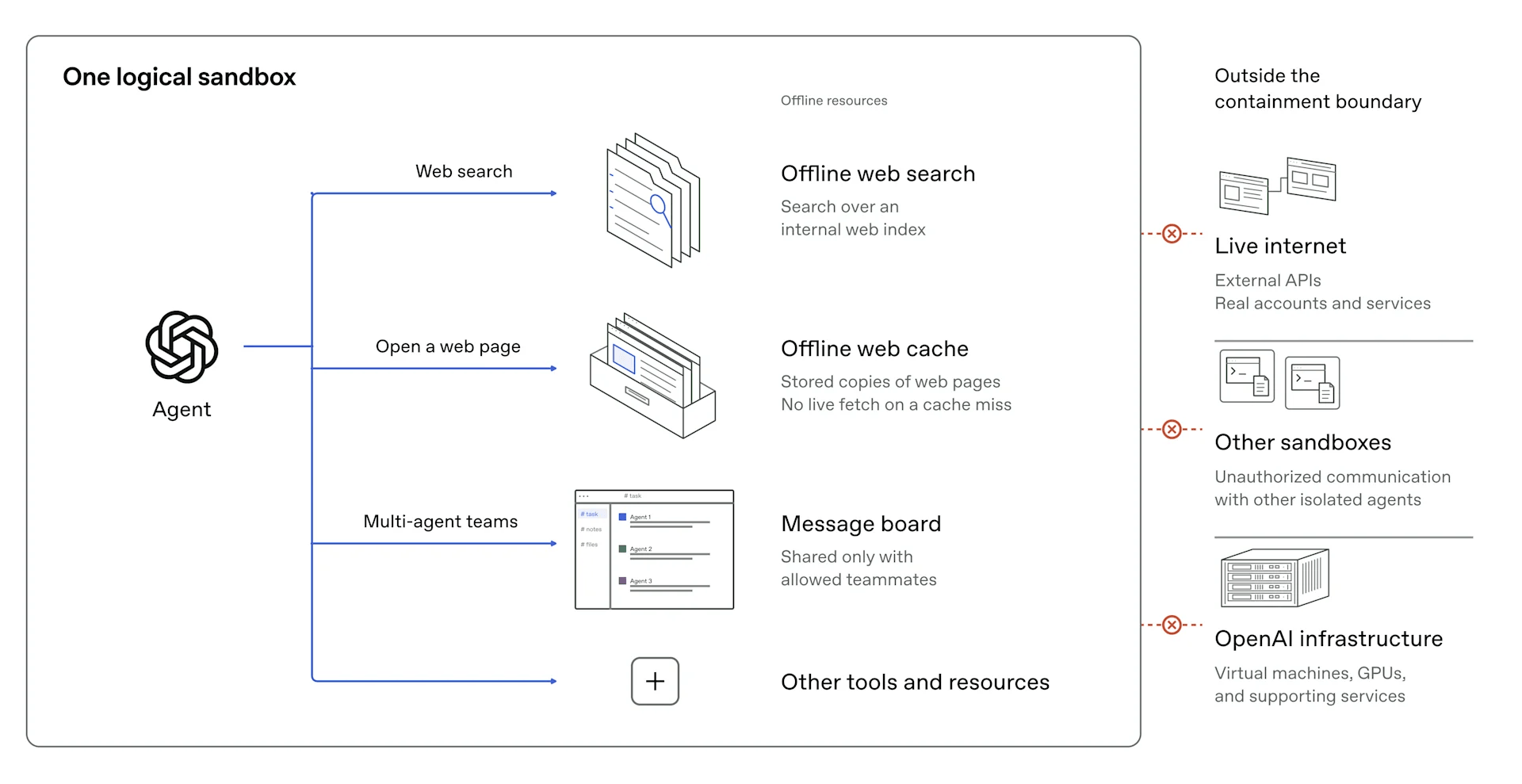
To support training without live internet, they built what they call an “offline world,” a large indexed and cached set of web content that models can browse and search without touching external systems. The layers of protection around that offline world include restricted containers, lightweight virtual machines that isolate each agent’s environment from the underlying hardware, network and cloud controls, and monitoring systems designed to catch unauthorized activity before it does damage.
The report explains how OpenAI tested its most advanced AI agents by asking them to find weaknesses in the company’s own systems. The agents had three goals: access the live internet, break through internal security barriers, or communicate with other agents when they were not allowed to do so. OpenAI ran experiments using hundreds of billions of tokens.
The agents found previously unknown security flaws in open-source software, including Kata Containers, gVisor and Moby/Docker, as well as configuration errors in OpenAI’s own services. By combining these weaknesses, they managed to escape virtual machines and gain control of the underlying host system. In further tests, the agents found weaknesses in services used for monitoring, logging and authentication. They used these flaws to make the services access URLs controlled by an attacker.
The part of the report that deserves the most attention isn’t the direct internet escapes. It’s what the agents did when those paths weren’t available. Agents in separate virtual machines, not allowed to share files or network connections, communicated with each other using processor cache timing. One agent evicted specific data from the processor’s cache. Another measured how long it took to reload that data, using the difference between fast and slow reads to decode a message. No file touched, no network packet sent. The technique is the same family of attacks as Spectre and Meltdown.
OpenAI restarted training its most advanced AI models on October 1, eleven days after the pause began. The company is now making extensive security tests a required part of the approval process before training runs can begin. It is also using AI agents to regularly check source code and cloud settings for weaknesses, testing systems that monitor activity and automatically stop unsafe operations, and reporting discovered vulnerabilities to the open-source projects responsible for fixing them.
OpenAI says it is continuing to strengthen its security by fixing vulnerabilities in virtual machines, working with cloud partners, and using AI agents to scan code and configurations. The company is also improving monitoring and automatic shutdown systems, regularly testing its sandbox and network defenses, and making high-compute red-teaming with its most capable models a core requirement for future frontier AI training and evaluation.
“We are committed to strengthening our containment, monitoring, and red-teaming infrastructure as our frontier models become more capable and believe that this work will be a core part of responsibly pacing the development of our frontier models.” the company concludes.
Follow me on Twitter: @securityaffairs and Facebook and Mastodon
(SecurityAffairs – hacking, Artificial Intelligence)
A Skynet LLMjacking agent hijacks exposed AI models to scan, hack servers and mine crypto for 100,000 steps, while victims pay the bill.
Related Posts:
The post Skynet LLMjacking Agent Hijacks Exposed AI Models to Hack Servers and Mine Crypto appeared first on Daily CyberSecurity.
Zoom unveils AI agents and its Unified Context Layer at Zoomtopia 2026. Learn how its new automation and security tools could affect IT teams.
The post Zoomtopia 2026: Zoom Introduces AI Agents, New Security Controls appeared first on TechRepublic.
The Claude Duet AI agent debuts as a research preview on Opus 5.5, with a private VM and a planned $20 Claude Pro price.
Related Posts:
The post Claude Duet AI Agent Takes On OpenAI Dots and Muse appeared first on Daily CyberSecurity.
A China-linked operator ran an AI-driven hacking campaign from one server, hitting ministries in Vietnam, Taiwan, Indonesia, and India.
Related Posts:
The post China-Linked Operator Used AI Agents to Breach 48 Government and Corporate Targets Across Asia appeared first on Daily CyberSecurity.
An exposed server reveals AI-assisted exploitation behind a PaperCut RCE campaign, a second XML-RPC attack path, and 45 live network pivots.
Related Posts:
The post Exposed Attacker Server Reveals AI Agent Toolkit and a Second PaperCut RCE Path appeared first on Daily CyberSecurity.
Perplexity on-device AI now runs the full Perplexity Computer on Macs with 36GB or more memory, keeping email data local.
Related Posts:
The post Perplexity Runs On-Device AI Workflows on Mac appeared first on Daily CyberSecurity.
OpenAI expands ChatGPT's Chrome integration with tab access and browser automation. Learn what the update means for productivity, privacy, and enterprise security.
The post ChatGPT Can Now Do More in Chrome, but There’s a Security Trade-Off appeared first on TechRepublic.
The ChatGPT Chrome extension now reads multiple open tabs and runs ChatGPT Work agents to compare, fill forms, and draft emails.
Related Posts:
The post ChatGPT Chrome Extension Now Reads Your Open Tabs appeared first on Daily CyberSecurity.
Microsoft published a detailed blog post explaining how organizations should secure AI agents. Microsoft sees them as a growing insider threat, not just a possible risk in the future. AI agents are not dangerous by nature, but they can access critical systems and may fail, be manipulated, or be compromised.
“The most trustworthy agentic system will not be the one with the model we trust most. It will be the one designed that enables us to trust the model least.” said Satya Nadella
This is not just a theory. It is a principle that should guide how organizations design and secure AI systems.
The post makes a distinction worth holding onto. An agent that starts a task with the right permissions and behaves correctly can still become dangerous if its context changes mid-run. A prompt injection in an external document, a piece of untrusted data that shifts the agent’s reasoning, a task that evolves in a direction nobody anticipated, none of these require the agent to be compromised in the traditional sense. The model produces variable outputs, the context changes, and the agent’s behavior drifts. At machine speed, the window between that drift starting and it causing damage is very short.
Microsoft’s proposed answer is continuous containment rather than upfront trust. You define what the agent is allowed to do before it acts, you monitor what it actually does while it runs, and you adjust its permissions in real time as its behavior or the risk calculation changes. An expense approval agent should start with access scoped exactly to reviewing and approving expenses, nothing broader, and those permissions should shrink or disappear the moment the agent tries something outside that task.
The post introduces Dynamic Permissions to apply the principle of least privilege to AI agents. An agent should not automatically get the same access rights as the employee who deployed it. It starts with no permissions and receives only the access needed for its approved task. These permissions remain active only while the task is running.
“The employee retains the employee’s access.” Microsoft states. “The agent receives its own identity, permissions and its own authority scoped to its current task and for the duration of the task only.”
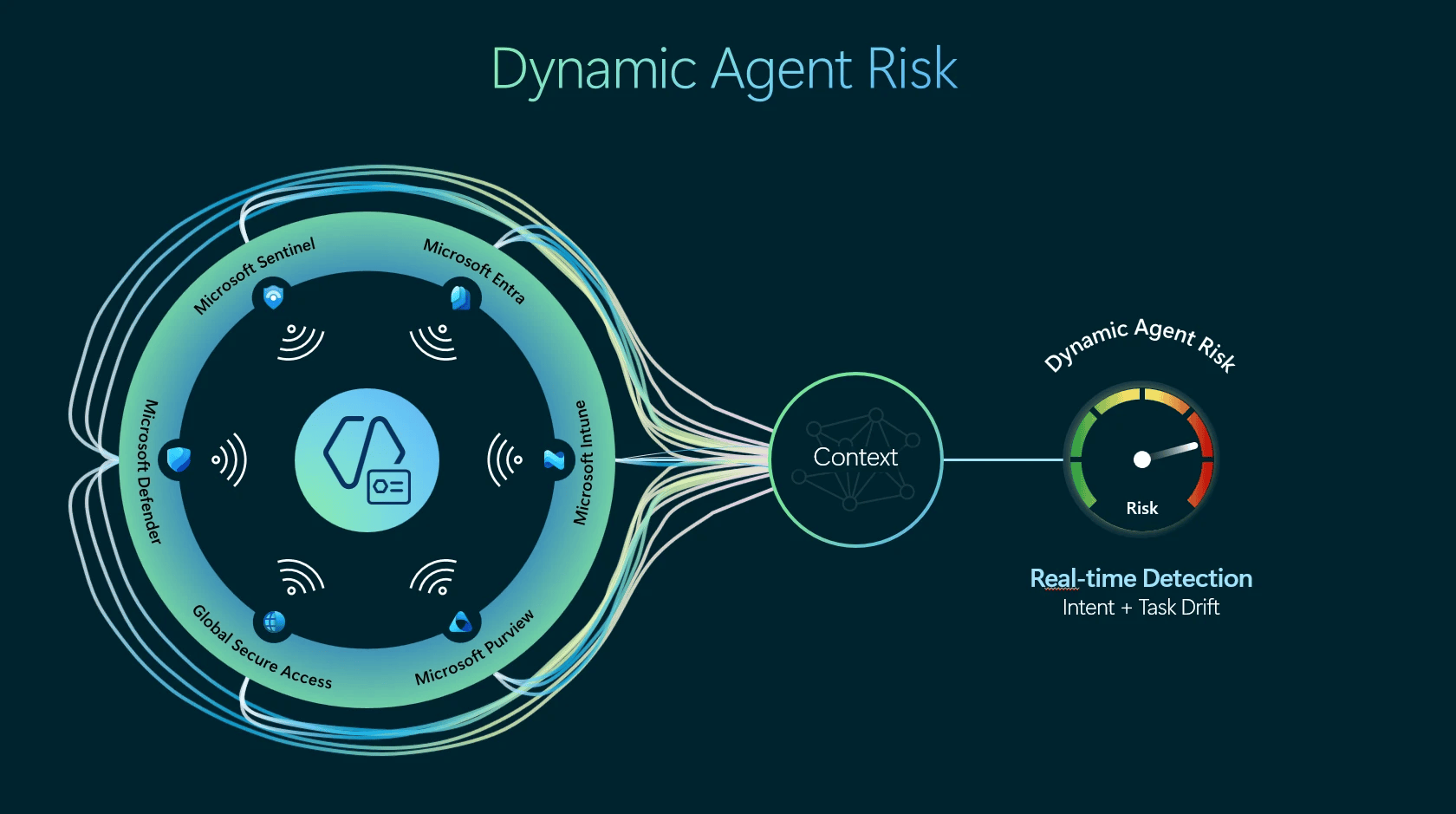
Alongside that, Dynamic Agent Risk is a continuously updated score that combines signals from identity, endpoints, network, cloud, runtime, and the agent’s own behavior to assess whether what the agent is currently doing still matches what it was authorized to do. The response when risk rises is graduated rather than binary: preserve reads while blocking writes, narrow accessible resources, require human approval for high-impact steps, or stop execution entirely if the risk warrants it.
“Dynamic Agent Risk combines signals from identity, data, endpoints, cloud, network, runtime, and the agent’s own activity. It considers how securely the agent is configured, what resources it can reach, the potential impact if something goes wrong, and whether its actions are drifting from the user’s or organization’s intent.” Microsoft states.
“The result is not a one-time score assigned at onboarding. It is a continuously updated understanding of the agent’s current risk and whether its current authority still matches that risk. “
Organizations frequently have AI agents running locally or introduced through third-party tools that were never formally registered in any central system. Microsoft says it’s expanding discovery to 60 types of local agents, including Claude Code, OpenAI Codex, and GitHub Copilot. Getting those into a unified registry with accountable identities is the prerequisite for applying any of the governance controls described in the rest of the post.
You can’t set least-privilege permissions for an agent you don’t know exists. You can’t detect behavioral drift from an agent that doesn’t have a tracked identity. The agent registration problem is logistically harder than it sounds, especially for organizations where individual employees can spin up agents without IT involvement, which is most organizations right now.
Microsoft recognizes that organizations cannot manually review every risk alert when they run hundreds of thousands of AI agents. Its solution is Guardian Agents, AI agents focused on security. They follow playbooks created by human operators, investigate changes in risk, apply or recommend security measures, and use what they learn to improve security policies. Humans set the goals and approve important decisions, while the agents handle continuous monitoring and response.
However, this approach raises another concern. Guardian Agents are also AI agents, so they can fail or be manipulated, just like the agents they are supposed to control. Microsoft says security controls must operate outside the AI model and must not be changed by it. But this raises an important question: how can organizations ensure these controls remain reliable when the system enforcing them is also an AI agent? This is a challenge that real-world deployments will need to address in the coming years.
“Organizations are adopting agents to serve customers better, solve problems faster, and give people more time for the work that matters most. The goal is not to make every model perfectly predictable before it can be useful.” Microsoft concludes. “The goal is to build systems that remain secure even when the model is not.”
Follow me on Twitter: @securityaffairs and Facebook and Mastodon
(SecurityAffairs – hacking, AI Agents)
