
 Entrar
412,000 The Town 2025 Ticket Buyers’ Data Hits the Dark Web
412,000 The Town 2025 festival buyer records are being sold for $10,000, with Brazil’s data openly marketed for bank fraud, loans and SIM registration.
A seller on a Russian-language data-trading forum listed what they’re calling a Ticketmaster database on September 2, claiming over 412,000 Latin American purchase records with a heavy concentration of Brazilian data. Ransomnews’s analysis confirms the sample is genuine ticket-buyer data from The Town 2025, the São Paulo music festival, though who actually lost the data and how remains unconfirmed.
“The listing is headed “SELLING NEW TICKETMASTER DATABASE” and describes a global ticketing platform, Latin America region, with an internal ticketing database as the source and a breach date of 28 August 2026. It advertises 412,192 rows across 34 columns.” reported Ransomnews. “The country breakdown is dominated by Brazil at 251,557 records, or 61%, with Argentina at 219, Chile 155, Colombia 144, Peru 123 and Paraguay 72, plus nine more countries not itemised.”
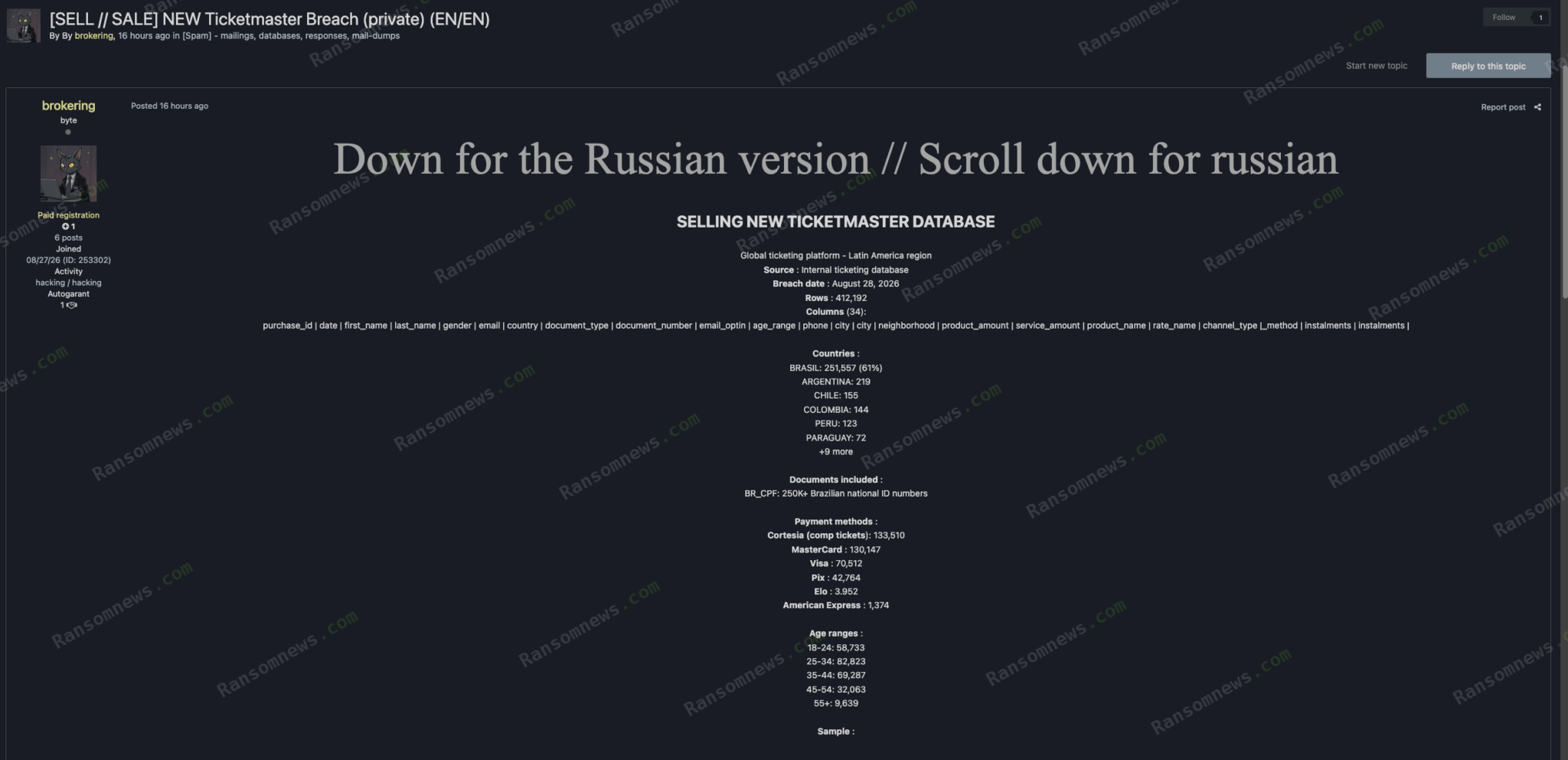
The seller is asking $10,000 for the full database, or $80 for every 1,000 records, with escrow available. The 251,557 Brazilian records make up about 61% of the database, meaning the seller is effectively asking around four cents per person.
The data includes names, email addresses, CPF numbers, phone numbers, neighborhoods, ticket types, and payment details. Together, these details provide a detailed profile that could be used for identity theft and fraud.
“The seller’s own notes are the part that should concern Brazilian readers most. Alongside the sales copy, the listing states that the CPF numbers work “for Brazilian bank fraud, loan apps and SIM registration”.” continues the report.”That is not our characterisation of the risk. It is the seller describing the intended use of the file.”
Ransomnews ran the kind of checks that usually expose fake listings within minutes, and this one kept passing. Purchase IDs across the sample rise in strict chronological order, exactly what an auto-incrementing database key produces and something close to statistically impossible to fake by chance. Every CPF number in the sample passes Brazil’s official check-digit validation, phone area codes correctly match the state listed on each row rather than defaulting to a single city, and neighborhood names map precisely onto their stated cities, the kind of granular accuracy a random data generator simply doesn’t produce.
The ticket prices provide another strong sign that the database is genuine. Full-price tickets cost exactly 975 reais, while discounted tickets cost 487.50 reais, matching Brazil’s legal student discount. The database also lists Pix and Elo as payment methods, both widely used in Brazil.
Even the incomplete records look realistic. Complimentary tickets issued by the festival’s back office contain no name or CPF, only the ticket type and date. These kinds of inconsistencies are common in real databases but would be unusual in fabricated data.
However, there is an important detail that challenges the claim of a direct Ticketmaster breach. Every record in the sample has exactly the same processing timestamp: October 1, 2025 at 23:05:41, about two weeks after the festival ended.
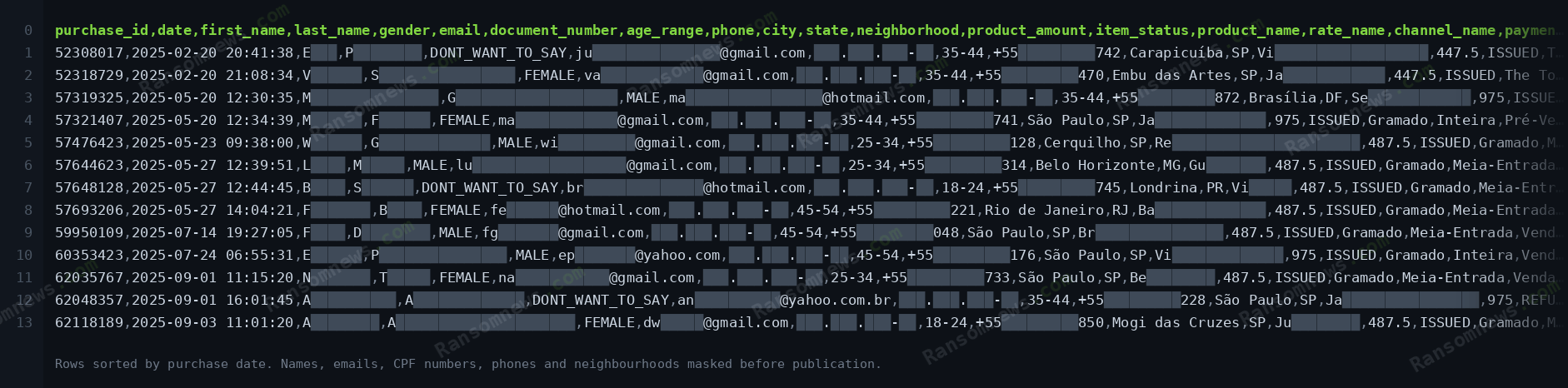
A live database dump would normally contain different timestamps. The identical timestamp instead suggests that the data may have been exported in a single batch after the event and then shared with a promoter, sponsor, payment provider, or another partner. Ransomnews therefore warns that blaming Ticketmaster directly would go beyond what the available evidence currently shows.
That distinction matters more than it might seem, because it points at an industry-wide blind spot rather than one company’s failure. Brazilian ticketing requires CPF collection to enforce discount eligibility rules, which means live-events companies routinely end up holding a national identity number, a verified phone, and a home neighborhood for hundreds of thousands of people, data with the sensitivity of a bank record sitting inside an industry with nothing like a bank’s security requirements. The moment that data gets exported into a spreadsheet to reconcile ticket sales with a partner, which happens constantly and rarely makes headlines, it becomes dramatically easier to lose.
“If you bought tickets to The Town 2025, treat your CPF as exposed.” concludes the report. “A CPF cannot be reissued the way a password can, and the seller is explicitly marketing these numbers for credit and telecoms fraud.”
If you bought tickets to The Town 2025, the practical response here isn’t panic, it’s specific vigilance. A CPF can’t be reissued the way a password gets reset, so treat it as permanently exposed and check your credit record through Brazil’s Central Bank registry or services like Serasa for accounts you didn’t open. Watch closely for SIM swap attempts given the seller’s explicit mention of telecom fraud, and be skeptical of any inbound call or message referencing your actual festival purchase, since whoever holds this file knows exactly which days you attended and how you paid, more than enough detail to make a scam call sound completely legitimate.
Follow me on Twitter: @securityaffairs and Facebook and Mastodon
(SecurityAffairs – hacking, The Town 2025)
