❌

Visualização de leitura

Cloudflare DDoS Threat Report 2026 Q3: More swarms, fewer giants

Welcome to the 26th edition of Cloudflare's DDoS Threat Report. This edition covers the third quarter of 2026 — July, August, and September — and returns the series to its quarterly cadence following the combined H1 2026 volume. The analysis is produced by Cloudforce One, Cloudflare's Threat Intelligence organization, providing a comprehensive analysis of the evolving threat landscape of Distributed Denial of Service (DDoS) attacks based on data from the Cloudflare network.

Key insights

  1. Short-burst, low-bandwidth attacks lasting under 10 minutes and 1 Gbps surged by 208%. Conversely, hyper-volumetric attacks exceeding 1 Tbps plummeted by nearly 69% from Q2, possibly a reflection of law enforcement actions against four major Internet of Things (IoT) botnets earlier in the year. However, variants continue to emerge, proving that IoT botnets remain a durable, high-volume threat to network infrastructure.
  2. Threat actors dramatically shifted their reflection and amplification tactics, abruptly abandoning CLDAP floods, which collapsed by 99.5% quarter-over-quarter. Instead, attackers pivoted heavily toward other connectionless protocols, driving a 215% surge in DNS amplification and a 122% increase in general UDP floods.
  3. Attack targets broadened significantly across both industries and geographies, with the United States reclaiming the most-attacked position from China. Canada and Israel experienced sharp spikes in targeted attacks — jumping 10 and 7 spots respectively — while juggling geopolitical tensions, trade disputes, and contentious domestic events. At the same time, the operational focus shifted away from media organizations toward a wider array of industry targets, including consumer services, Internet infrastructure, and adult entertainment.

Q3 by the numbers: 8,200 DDoS attacks every hour

Across its network in the third quarter of 2026, Cloudflare autonomously mitigated 18.2 million network-layer DDoS attacks and 14.4 trillion HTTP DDoS requests. That works out to approximately 8,226 network-layer DDoS attacks per hour, or about 197,400 per day — one attack every 0.44 seconds. The quarter's mitigated traffic totaled 272.6 PB at the network layer and 95.1 PB at the HTTP layer.

More swarms, fewer giants

Short-burst, mid-range, high-count attacks — the operational signature of DDoS-for-hire "booter" services — accelerated this quarter. These attacks primarily targeted computer software, gambling and casinos, and information technology industries. Cloudflare autonomously mitigated 18.2 million network-layer DDoS attacks in Q3 2026, a +208% increase from the same quarter in 2025:

  • 96% ended in under 10 minutes
  • 98% stayed under 1 Gbps, more than enough to overwhelm a server or website

On the other hand, network-level hyper-volumetric attacks (those exceeding 1 Tbps) reversed course, dropping to 251 attacks in Q3 from 805 in Q2 — coinciding with law enforcement action in early 2026 that dismantled four of the largest IoT DDoS botnets: Aisuru, KimWolf, JackSkid, and Mossad.

Still, IoT-based botnets remain a durable high-volume threat as the ecosystem churns through new variants such as Dysphoria and Evooo1Bot. Mirai-classified mitigation peaked in August at 57.23 PB, representing 46.5% of all mitigated network-layer bytes in Q3, including four days — August 16, 19, 23, and 25 — that each cleared three petabytes. The quarter's longest sustained Mirai attack ran 49.7 hours between August 19 and August 21.

Vector shifts: the collapse of CLDAP and rise of UDP

The most dramatic vector shift of the quarter was downward. CLDAP (Connectionless Lightweight Directory Access Protocol) attacks — where small queries with a forged victim IP address trick public domain controllers (UDP 389) into reflecting massive, amplified responses back at the target — experienced a dramatic +580% quarter-over-quarter surge in the first half of the year before collapsing to just 0.05% of attacks in Q3.

Meanwhile, DNS amplification surged 215% to account for 3.43% of all network-layer attacks, exploiting open DNS resolvers in a similar reflection-and-amplification pattern to CLDAP: small spoofed queries, large replies directed at the victim. Other UDP floods climbed from 14.06% to 31.31% of network-layer attacks. UDP is a connectionless transport protocol, which makes it a convenient vehicle for raw volumetric attacks: attackers send large numbers of UDP packets to random or specific ports on the target, forcing the target to check for a listening application and respond, consuming its network and compute resources.

Most-attacked industry

While Media, Production & Publishing remained the most-attacked industry in Q3 2026, its overall share is roughly a quarter of its Q2 level, and the focus has moved across a wider set of industries. Internet rose from outside the top 10 to #6; Consumer Services and Adult Entertainment also climbed in, reaching #8 and #9 respectively.

Most-attacked locations

Geographic surges: Canada and Israel climb the ranks

Adding to an already turbulent period of bilateral trade disputes, Canada jumped from #16 to #6, driven by attacks against its Retail, Telecommunications, Service providers & carriers, and Marketing & advertising industries.

Israel moved 7 spots to take #10 as a result of sustained DDoS activity in mid-September. While this period was marked by contentious decisions ahead of parliamentary elections and the Rosh Hashanah holiday, there was also a massive, documented surge in hostile cyber warfare targeting Israel this year.

Top 10

The United States was the most-attacked location in Q3 2026, while China was number #2 and Indonesia rose into the top three at 2.93% of total attacks. The U.S.-China pairing at the top is consistent with the first half of 2026, when China finished #1 and the U.S. #2; the countries have traded positions as attention and attacker preferences shift.

Strengthening global defenses and helping to defend the Internet

Cloudflare's network is designed to absorb this kind of growth in DDoS threats. Every service on our network is protected by free, unmetered DDoS protection that runs at every one of our 330+ cities globally, backed by 500 Tbps of network capacity. Autonomy is the point: our systems detect and mitigate attacks without human intervention. And they need to, because as this quarter's distributions make clear, most attacks end long before a human analyst could see the alert, and the largest attacks still regularly exceed 1 Tbps at a cadence measured in hundreds per quarter.

To help hosting providers, cloud computing platforms, and Internet service providers identify and take down the abusive IP addresses and accounts that launch these attacks, we leverage Cloudflare's unique vantage point on DDoS attacks to provide a free DDoS Botnet Threat Feed for Service Providers.

Over 800 networks worldwide have signed up for this feed, and we've already seen great collaboration across the community to take down botnet nodes. For a continuously-updated view of attack trends across the Internet, visit Cloudflare Radar.    

About Cloudforce One

Driven by a mission to help defend the Internet, Cloudforce One draws on telemetry from Cloudflare's global network — which protects more than 20% of the web — to drive threat research and operational response, protecting critical systems for millions of organizations worldwide.

Multiple Waves of DDoS Attacks Caused This Week’s Outage in North Korea

Multiple waves of DDoS attacks disrupted North Korea’s public internet services this week, knocking major state websites offline.

Kentik’s internet analysis director Doug Madory linked the outages to sudden traffic floods from Vietnam, the Philippines, Venezuela, and other countries. The traffic began at 02:01 UTC on October 20, making the country’s websites unreachable.

The disruption affected more than 40 websites using North Korea’s .kp domain, including the Ministry of Foreign Affairs and the Korean Central News Agency.

Access remained unstable for roughly 32 hours. South Korean reporting indicated that services returned around 7 p.m. local time on October 21, after repeated downtime and brief recoveries.

North Korea Hit by Multiple DDoS Attacks

In Doug Madory public findings, Madory said aggregate traffic data showed several waves of incoming traffic rather than one continuous surge. That timing helped connect the website failures to a distributed denial-of-service attack, which overwhelms a target with traffic and prevents normal users from reaching it.

“This traffic all started at the same time, and it is coming from Vietnam and Venezuela. That’s definitely a DDoS attack,” Madory told Reuters, according to its report published by AsiaOne. Kentik cautioned that its analysis covered only part of the traffic heading toward North Korea.

The countries in the traffic records do not identify who ordered the attacks. Kentik has not identified the people responsible. Although compromised devices can generate traffic from many locations, no specific botnet has been publicly linked to this incident.

Looks like the North Koreans changed how 175.45.176.0/24 was transited in the past few hours going via Cenbong (AS134544) to Transtelecom (AS20485) in Russia. pic.twitter.com/9jtL9bQfUw

— Doug Madory (also on Bluesky) (@DougMadory) October 21, 2026

Madory’s accompanying observations identified repeated downtime affecting 175.45.176.0/24, a network block containing name servers for .kp domains.

These servers help translate website names into internet addresses. Their loss can leave multiple sites unreachable, even when individual web servers remain online.

His route observations also described changes involving North Korea’s AS131279 network. The 175.45.176.0/24 block moved from Cenbong to Russia’s TTK, while 175.45.178.0/24 switched to TTK before returning to Cenbong. The other two listed blocks retained their respective providers.

Those observations describe how traffic paths changed during the incident. They do not establish whether operators deliberately changed routes to reduce the attack’s impact.

Early coverage considered power problems or telecommunications faults as possible explanations. Kentik’s later findings added direct traffic evidence supporting a DDoS explanation.

However, the available reports do not identify the attack method, peak traffic volume, or tools used. Related reporting on the Dysphoria botnet explains how compromised routers and cameras can generate coordinated traffic floods.

For now, the strongest evidence is the close match between incoming traffic spikes and service failures. The incident shows why outage investigations need traffic measurements alongside website checks, while the attacker’s identity and the operation’s full scale remain unresolved.

Update defenses against new malware as soon as it appears. Integrate TI Feeds with data from 16K SOCs.

The post Multiple Waves of DDoS Attacks Caused This Week’s Outage in North Korea appeared first on Cyber Security News.

Gears of War: E-Day Hit by DDoS Attack, Causing Login Failures and Disconnects

Gear of War: E-Day players faced login failures, sudden disconnects, and other online service problems after distributed denial-of-service attacks targeted the game’s online services.

The official Gears Community account confirmed the cause on X, linking the disruption to DDoS activity and ending speculation about the source of the failures.

The Gears Community reported attacks on its online services that caused intermittent disconnects, login issues, and other disruptions, but did not identify the attackers, disclose traffic figures, or specify affected services, limiting details about the attack’s scale and method.

A separate update from the same account said the login issue had been resolved and that the team would continue closely monitoring services.

Earlier messaging had flagged extended login times and said the issue was improving. The updates show progress toward recovery, but the login fix should not be read as proof that every reported service problem had ended.

Gears of War: E-Day Hit by DDoS Attack

Players may experience delayed or failed logins, intermittent disconnections, and difficulty reconnecting, symptoms confirmed by the Gears Community during the online service disruption.

The available statement does not establish that the attacker accessed player accounts or stole personal information. It describes an attack against service availability. Reporting the incident as a confirmed data breach would go beyond the evidence released by the Gears Community team.

A DDoS attack uses multiple machines to overwhelm a target with traffic or requests. The aim is to make a system or network unavailable to legitimate users. Compromised devices can form a botnet, allowing attackers to send traffic from many sources at once, according to CISA’s DDoS response guidance.

This can exhaust network capacity or system resources, preventing the system from handling normal requests. However, the Gears update does not identify a botnet, a traffic flood type, or an attack rate. There is no published basis in that statement for assigning the incident to a known group or connecting it to another campaign.

Gaming infrastructure has faced similar availability threats before. Cybersecurity News previously covered DDoS malware targeting Valve Source Engine game servers, with several supported attack methods. That report provides useful background on game-server threats. However, it does not link to the E-Day disruption.

Another report examined a 3.15-billion-packets-per-second attack against a Minecraft server. The case shows why packet volume matters alongside bandwidth when assessing attacks. No comparable measurements have been shared in the available Gears statement.

CISA recommends confirming DDoS activity through network monitoring and traffic analysis, then applying measures such as traffic filtering and rate limits. These are general defensive steps, not confirmed details of the Gears team’s response.

Official updates confirm the reported cause, player impact, and login recovery, but leave the attack’s scale and technical handling undisclosed. The team’s stated recovery approach still includes monitoring after the service disruption.

Update defenses against new malware as soon as it appears. Integrate TI Feeds with data from 16K SOCs.

The post Gears of War: E-Day Hit by DDoS Attack, Causing Login Failures and Disconnects appeared first on Cyber Security News.

Canonical Hit by Second DDoS Attack in 2026, Public Websites Disrupted

Canonical suffered its second DDoS attack this year, disrupting public websites for over four hours while Launchpad and the Snap Store remained online.

Ubuntu’s parent company Canonical spent part of last week fighting off a sustained distributed denial of service (DDoS) attack, the second one to hit its infrastructure this year. The company revealed the attack on October 8 through a post on the Ubuntu Discourse forum.

“Canonical’s websites are under a sustained distributed denial of service attack. Our team is working diligently to resolve the incident. Please refer to our status page for up-to-date information. Some services may be intermittently unavailable.” the company states.

At this time, no cybercrime or hacktivist group has claimed responsibility

The attack affected Canonical’s main public websites, including ubuntu.com, canonical.com, the Ubuntu blog, the developer portal, and the security advisory pages and API. Users may have been unable to access security advisories or read the blog during the attack.

“It was recently revealed that Canonical’s web infrastructure and the Ubuntu ecosystem suffered a massive and sustained distributed denial-of-service (DDoS) attack that caused its main portals and services to crash and be intermittent for more than four hours.” states the company blog. “Regarding the attack, it is mentioned that it directly affected the most visible institutional domains, including canonical.com and ubuntu.com, as well as the official blog, the developer portal, assets.ubuntu.com, academy.canonical.com and sites linked to enterprise technologies such as jaas.ai and maas.io.”

However, Launchpad and the Snap Store remained online throughout the incident. These services allow developers and system administrators to manage and install software.


Canonical acknowledged the outage on its status page and Ubuntu Discourse while engineers worked to limit the impact. The attack temporarily disrupted the Ubuntu Security API and Livepatch services, affecting tools used to check security advisories and apply kernel patches without restarting systems. However, Canonical’s distributed infrastructure helped contain the damage. Software repositories and mirror servers remained available, allowing users to install updates. Launchpad, the Snap Store, disk image servers and Ubuntu Single Sign-On also continued to work.

As a result, users could continue downloading and installing packages even while Canonical’s public websites were disrupted.

The overall outage lasted a little over four hours, causing real disruption.

This attack differs from the April one, which caused greater disruption by taking down Launchpad and the Snap Store and preventing some users from installing Ubuntu updates. At the time, a hacktivist group called The Islamic Cyber Resistance in Iraq, also known as 313 Team, claimed responsibility.

Canonical described the April incident as a sustained, cross-border attack, language that suggested distributed infrastructure spanning multiple countries. Whether this October attack is a continuation of the same campaign or a completely unrelated actor piling on is genuinely unclear.

Follow me on Twitter: @securityaffairs and Facebook and Mastodon

Pierluigi Paganini

(SecurityAffairs – hacking, DDoS) 

Italy’s Foreign Ministry Under Cyberattack as Embassy Sites Come Under Review

Italy’s Foreign Ministry is defending its website against a cyberattack, checking embassy sites and pushing for EU action to identify attackers.

On the morning of October 8, Italy’s Ministry of Foreign Affairs said its website was being attacked. According to the ministry’s own statement, its protection systems have mitigated the attack so far, with no disruption. The statement doesn’t say who is behind it, or what kind of attack it is.

The ministry is monitoring the situation with the Polo Strategico Nazionale, the country’s national cloud hub, and with the competent authorities.

“Cybersecurity is a central element of the reform of the Foreign Ministry approved last year. In recent months, we have strengthened our capabilities to prevent, monitor and respond to threats, adopting all necessary countermeasures, including on the technological side,” Foreign Minister Antonio Tajani said.

“Tajani had also had the opportunity to explain the technical capabilities of the CSIRT Operations Room to German Foreign Minister Johann Wadephul during his recent visit to Rome.” “In this context, Italy has decided to work with Romania and other EU member states to include proposals in upcoming European meetings to designate the actors responsible for cyberattacks, including attacks targeting Italian institutions.” reads the statement published by Italy’s Foreign Ministry.

Analysts are also checking the websites of Italian embassies and consulates abroad for similar attempts. That detail matters, and I’ll come back to it.

Minister Antonio Tajani tied the response to last year’s reform of the Farnesina, which made cybersecurity a central piece. He said prevention, monitoring and response capabilities have been strengthened in recent months, including on the technology side.

The statement ends on diplomacy. Italy will work with Romania and other member states to put proposals on the agenda of upcoming EU meetings, aimed at naming those responsible for cyberattacks, including attacks on Italian institutions. A blocked page is forgotten in a day, while a name on an official list is harder to shrug off.

Nobody has claimed this attack, but the pattern is familiar. NoName057(16) is a pro-Russian group that declared itself in March 2022 and announces its targets on Telegram. Avast researchers saw it using the Bobik botnet for DDoS attacks as early as September 2022.

Later, the DDoSia Project (aka DDosia), a crowdsourced DDoS operation linked to the pro-Russian hacktivist group NoName057(16), made the headlines beacuse its involvement in DDoS attacks again governments that supported Ukraine.

Italy has been a regular target. Over a weekend in January 2025, as Zelensky visited Rome, the group hit ministries and government sites on Saturday, then banks including Intesa and Monte dei Paschi di Siena and the ports of Taranto and Trieste on Sunday. At the end of December 2024 it had gone after Malpensa and Linate airports, and in February 2025 it tied a new wave to a speech by President Mattarella, according to Infosecurity Magazine. The timing follows politics, which isn’t a coincidence.

The ministry itself has been here before. ANSA reported that Russian hackers took its website down in late December 2024, and Tajani said it was back up the next day. DDoS attacks hit availability, not data, so the site goes dark and comes back. A loud attack can also pull attention away from a quiet one, which is a reason to look closer, not a claim about this case.

Now the embassies, and this part is my analysis. A ministry homepage going dark is embarrassing. An embassy or consulate site going dark is a problem for real people, because it’s where citizens abroad look for appointments, contacts and instructions, and the worst moment for an outage is a crisis abroad. Every one of those sites is also a surface to defend, and a lookalike page is an easy way to scam someone who’s already stressed.

Giving a look to the list of targets shared on DDosia today I can confirm that administrators planned attacks against the Farnesina, five Italian embassy sites, several Interior and Defence Ministry services, and other Italian organizations.

There is a precedent. In 2017, The Guardian reported a months-long intrusion into the Foreign Ministry’s systems. Italian media later reported that the attackers had targeted staff email accounts at the ministry and Italian embassies, rather than the encrypted system used for sensitive communications. A senior ministry security official said that attacks often happen before important events for Italy, while the Kremlin denied any involvement.

That’s why checking embassy websites is more than routine work. If someone wants to damage Italy’s image at little cost, the diplomatic network offers a large and highly visible target. The ministry is responding by strengthening its technical defenses and pushing at the EU level for “proposals to designate actors responsible for cyber attacks”, as the Farnesina’s statement puts it. That could make attribution more costly for attackers than simply taking a website offline.

DDoS attacks should not be underestimated, especially when they target government institutions and diplomatic services. They can disrupt public services, create pressure and attract significant media attention. But from a technical perspective, they are not usually complex offensive operations for a state to neutralize, especially when the target has adequate DDoS protection and network capacity.

The more important question is what sits behind the noise. Authorities need to determine whether these attacks are simply disruptive actions designed to attract attention, or whether they are being used to distract defenders while more sophisticated operations take place elsewhere. If there is no evidence of intrusion, data theft or compromise, the DDoS activity may be little more than a public demonstration of intent.

That distinction matters because a long list of targets can create the impression of a much more serious threat than the technical impact actually suggests. For people outside the cybersecurity community, a website being attacked can easily be interpreted as evidence that a government has been seriously compromised. In reality, it may be a relatively simple operation whose main objective is visibility.

The risk, therefore, is not only the attack itself, but the narrative built around it. DDoS campaigns can become a useful propaganda tool, creating fear and uncertainty while requiring relatively limited technical resources. The challenge for governments is to defend against the disruption without giving a sterile attack more strategic value than it deserves, while at the same time making sure that the noise is not hiding something more serious.

Follow me on Twitter: @securityaffairs and Facebook and Mastodon

Pierluigi Paganini

(SecurityAffairs – hacking, Italy’s Foreign Ministry)

Como proteger sua smart TV e set-top box contra invasões

Em 2026, o proprietário de um roteador doméstico comum, de uma smart TV ou de uma TV box é um alvo de grande interesse para os cibercriminosos. Esses dispositivos são facilmente recrutados para botnets e redes de proxy residencial, sobre as quais já falamos anteriormente.

Os criminosos “sublicenciam” o dispositivo infectado, permitindo que terceiros paguem para acessar qualquer site usando o endereço IP da vítima, fazendo parecer que é o proprietário do dispositivo quem está realizando os acessos. Esse serviço é procurado para todo tipo de esquema ilícito: desde fraude publicitária e campanhas de spam até tentativas de descoberta de senhas por força bruta e invasão de contas. Em nosso artigo anterior, explicamos como os roteadores domésticos são recrutados para essas redes de proxy; hoje, vamos analisar uma categoria de dispositivos ainda mais vulnerável e igualmente onipresente: smart TVs e TV boxes.

Esses dispositivos atraem os criminosos por dois motivos. Primeiro, ao contrário de computadores e smartphones, as TVs quase sempre ficam conectadas à tomada e têm uma conexão rápida com a Internet. Uma tela apagada não significa que o dispositivo esteja desligado. Além disso, a interface de usuário e as ferramentas de monitoramento limitadas fazem com que processos suspeitos executados em segundo plano possam passar facilmente despercebidos pelos usuários.

A ameaça está evoluindo e se tornando mais agressiva. Um estudo recente constatou que, quando um proxyware chega a um set-top box, os riscos para o proprietário vão muito além de ter o próprio tráfego desviado.

Anatomia da infecção

Os pesquisadores se concentraram em uma popular TV box da SuperBox, que já abordamos anteriormente no artigo Sua TV box virou uma porta de entrada para terceiros?

A estratégia de marketing da SuperBox se baseia fortemente na promessa de oferecer milhares de canais de TV sem assinatura nem mensalidades. No entanto, assim que sai da caixa, o dispositivo não é capaz de fazer nada disso. Para ter acesso a conteúdo pirata, é necessário instalar a loja de aplicativos proprietária da marca.

Quando você a abre e instala aplicativos adicionais, os milhares de canais de TV realmente aparecem. Enquanto isso, nos bastidores, sem nenhum aviso ou solicitação de permissão, o dispositivo inunda sites externos com solicitações não autorizadas, e o tráfego de rede aumenta drasticamente.

Os pesquisadores descobriram vários fatos alarmantes. Primeiro, a vítima pode ser incluída simultaneamente em até cinco botnets. A SuperBox executa clientes de várias redes de proxyware ao mesmo tempo, que chegam a competir entre si, bloqueando a instalação de softwares concorrentes.

Mas o verdadeiro choque foram os ataques à rede interna. O proxyware da TV box não impõe nenhuma limitação ao que seus “clientes” pagantes podem fazer na rede. Eles podem acessar não apenas sites externos, mas também dispositivos dentro da sua rede doméstica.

Normalmente, as configurações do seu roteador doméstico e do provedor de serviços de Internet (ISP) protegem você contra ataques externos. Mas o proxyware contorna essas barreiras porque opera de dentro da rede. Durante um experimento, os pesquisadores confirmaram que um invasor na Internet pode facilmente usar o set-top box infectado para abrir o painel de administração de um roteador doméstico, como um Linksys, que deveria estar acessível apenas ao proprietário quando conectado à rede Wi-Fi doméstica. Isso significa que os hackers podem tentar roubar dados de outros dispositivos da mesma residência ou até mesmo criptografar o armazenamento de rede doméstico (NAS).

Ao mesmo tempo, falhas no firmware de fábrica da SuperBox permitem que hackers instalem e executem remotamente qualquer aplicativo com privilégios de superusuário, e essa ameaça está longe de ser apenas hipotética. Durante três semanas de monitoramento, o set-top box usado no teste sofreu mais de 1.300 ataques por meio da rede de proxy doméstica. Os invasores instalaram três tipos diferentes de malware, incluindo um módulo para realizar ataques DDoS.

O malware usa vários métodos para obter acesso ao sistema e permanece ativo mesmo após reinicializações e quedas de energia.

Como saber se seu set-top box está trabalhando para os hackers

Se você tem um set-top box barato ou uma Android TV de uma marca pouco conhecida, vale a pena verificar se há alguma anomalia.

O método mais confiável é analisar o tráfego de rede. Use as estatísticas disponíveis no painel de controle do seu roteador, mas observe que alguns modelos de baixo custo podem não oferecer esse recurso. Nos roteadores Asus, esse recurso é chamado de Traffic Analyzer; nos TP-Link, de Traffic Usage; e nos Keenetic, de Traffic Monitor. Encontre sua TV ou set-top box na lista de dispositivos e verifique a proporção entre os dados baixados e enviados. Esses dispositivos devem consumir muito tráfego para baixar vídeos, mas enviar pouquíssimos dados. Se seu set-top box estiver silenciosamente enviando gigabytes de dados ou permanecer ativo na rede mesmo quando estiver ocioso, esse é um sinal claro de que ele pode estar infectado.

Se as estatísticas de tráfego não estiverem disponíveis, procure sinais indiretos:

  • Os LEDs de atividade da rede e da memória não param de piscar, mesmo quando ninguém está usando o dispositivo.
  • O gabinete do set-top box fica constantemente morno ou quente.
  • A interface apresenta atraso em relação ao controle remoto, e o set-top box trava aleatoriamente, sem relação com a reprodução de vídeos pesados.
  • A velocidade da Internet nos outros dispositivos (computadores ou celulares) sofre uma queda significativa.
  • Ao tentar acessar sites conhecidos pela rede Wi-Fi doméstica, você se depara constantemente com um CAPTCHA, um sinal de que sua rede pode estar comprometida e ter sido identificada como fonte de spam.
  • O suporte técnico do seu provedor de serviços de Internet entra em contato para perguntar sobre um volume de tráfego de rede suspeito.

O que fazer com um dispositivo infectado

A melhor solução é desconectar o dispositivo da Internet e descartá-lo. Se precisar continuar usando-o, siga estas etapas para minimizar os riscos:

  1. Realize uma redefinição de fábrica (hard reset). Restaure o set-top box ao estado original.
  2. Deixe-o desconectado da Internet antes de configurá-lo novamente. Na primeira vez que ligá-lo após a redefinição, ignore a etapa de configuração do Wi-Fi e não conecte o cabo Ethernet.
  3. Bloqueie a instalação de aplicativos. Acesse as configurações do Android e desative a instalação de aplicativos de fontes desconhecidas. Não se esqueça de desativar todos os recursos de depuração que estiverem ativados: depuração USB, depuração sem fio e ADB. Os nomes dos itens de menu podem variar de acordo com a versão do Android e o fabricante do dispositivo.
  4. Isole-o na rede. Configure uma rede Wi-Fi para convidados no roteador e conecte a TV box a ela. Ative o isolamento de clientes (Client Isolation) nas configurações do roteador, se esse recurso estiver disponível. Isso impedirá que a TV box detecte outros dispositivos da sua rede doméstica, protegendo seus computadores e o armazenamento de rede.
  5. Verifique se há atualizações. Depois que a TV box estiver conectada à rede para convidados, verifique se há atualizações oficiais de firmware. Às vezes, os fabricantes corrigem vulnerabilidades conhecidas, embora não seja recomendável contar com isso no caso de marcas pouco conhecidas.

Suas medidas de proteção mais confiáveis

Comprar dispositivos baratos com recursos de streaming de conteúdo pirata e instalar softwares de fontes duvidosas é uma maneira praticamente certa de comprometer sua rede doméstica. Seu endereço IP se tornará uma fonte de atividade maliciosa, o que, na melhor das hipóteses, fará com que seu provedor de serviços de Internet bloqueie seu acesso e, na pior das hipóteses, fará com que você entre no radar das autoridades policiais. Além disso, os hackers podem usar a TV box como ponto de partida para atacar seus computadores e NAS domésticos, o que pode levar ao roubo de dados pessoais ou a um ataque de ransomware.

A melhor proteção é comprar dispositivos de marcas confiáveis e pagar por conteúdo legal. Além disso, para evitar que alguém assuma o controle da sua rede, certifique-se de que o painel de administração do roteador e os outros dispositivos domésticos estejam protegidos por senhas fortes e exclusivas. Para não precisar memorizar todas elas, use um gerenciador de senhas confiável, como o Kaspersky Password Manager. Além disso, o recurso Smart Home Monitor incluído no Kaspersky Premium permite manter todos os seus dispositivos sob controle.

Talvez haja outras coisas que você não saiba sobre seus dispositivos de casa inteligente:

NightmareStresser Goes Offline in Global DDoS-for-Hire Crackdown

The DOJ seized domains behind NightmareStresser, a DDoS-for-hire service tied to hundreds of thousands of attacks since 2022, as part of Operation PowerOFF.

Renting a DDoS attack used to be as easy as renting a movie. Pick a target, pay a few dollars, watch the site go dark. The Justice Department just made that a little harder by seizing the domains behind NightmareStresser, one of the longest-running services in that business.

“The Justice Department today announced the court-authorized seizure of internet domains associated with one of the world’s longest running Distributed Denial of Service (DDoS) for-hire services known as “NightmareStresser.” ” states DoJ.

“Federal law enforcement has seized websites maintained by criminal service providers that allow paying customers to launch powerful DDoS attacks targeting victims in the District of Alaska and worldwide as part of coordinated actions to disrupt so called “Booter” or “Stresser” operators.”

The announcement came from the District of Alaska, which may seem like an unusual place for a DDoS takedown. But Anchorage prosecutors have been investigating and fighting DDoS-for-hire services for almost a decade.

Federal authorities seized the websites under a court-approved warrant, preventing customers from using the service to launch attacks against targets in Alaska and around the world. These services are often called “booters” or “stressers,” names that make renting a DDoS attack sound like a simple online service.

It’s tempting to file DDoS attacks under “annoying but harmless.” The DOJ’s own description of the victim pool argues otherwise.

“Booter services such as those named in this action allegedly facilitate attacks on a wide array of victims in the United States and abroad, including educational institutions, government agencies, gaming platforms and millions of people. In addition to affecting targeted victims, these attacks can significantly degrade internet services and can completely disrupt internet connections.” continues DoJ. “According to the seizure warrant affidavit, the NightmareStresser Booter service targeted in this operation was used to launch hundreds of thousands of actual or attempted DDoS attacks targeting victims worldwide since 2022. “

A school district losing internet access during exam week, a city government portal going dark, a gaming server getting flooded mid-match: none of that is abstract to the people dealing with it in the moment.

These attacks can slow down internet services or completely take them offline. The impact can also go beyond the main target, affecting other users and services that rely on the same network infrastructure.

NightmareStresser wasn’t a small operation running a handful of scripts for hobbyists.

“According to the seizure warrant affidavit, the NightmareStresser Booter service targeted in this operation was used to launch hundreds of thousands of actual or attempted DDoS attacks targeting victims worldwide since 2022.” states DoJ.

That’s over three years of near-continuous rental attacks, on a service that markets itself with a name straight out of a horror movie.

The FBI’s Anchorage Field Office ran the technical side with help from the Royal Canadian Mounted Police’s Federal Policing Northwest Region. It’s a reminder that DDoS-for-hire crime doesn’t respect borders, so neither does the response to it.

This seizure sits inside Operation PowerOFF, the ongoing international campaign that’s been dismantling DDoS-for-hire infrastructure and going after the people running it for years. Just this past April, a coordinated action across 21 countries took down 53 domains, arrested four operators, and sent warning letters to more than 75,000 identified users of these platforms. Before that, in December 2024, another PowerOFF sweep knocked out 27 booter sites in one go.

Alaska’s own contribution to that broader effort goes back further than most people would guess.

“In previous law enforcement actions involving prosecutors and investigators in Anchorage and Los Angeles over the last eight years, the Justice Department charged twelve defendants who facilitated DDoS-for hire services and seized more than 100 internet domains associated with DDoS-for-hire services.” continues DoJ. “The multi-prong investigation announced today builds on the success of the prior cases by targeting all known booter sites, shutting down as many as possible, and undertaking a public education campaign.”

Twelve people and a hundred domains later, they’re still finding new ones to shut down.

Booter services are difficult to eliminate completely. When one is taken down, another can quickly appear, often using similar business models. The DOJ says these services have continued to grow because they make it easy for people with little technical knowledge to launch DDoS attacks.

Users don’t need to write code or understand how networks work. They can simply visit a website, pay for the service, often using cryptocurrency, and choose their target. This low barrier to entry has made DDoS-for-hire services accessible to a much wider group of cybercriminals.

Assistant U.S. Attorneys Adam Alexander and Ainsley McNerney are prosecuting the case out of the District of Alaska. The DOJ was explicit that this investigation isn’t a one-off strike but part of a wider plan to target every known booter site it can find, shut down as many as possible, and keep running public education alongside the legal action.

Follow me on Twitter: @securityaffairs and Facebook and Mastodon

Pierluigi Paganini

(SecurityAffairs – hacking, Operation PowerOFF)

New IoT Malware Uses Public Linux Exploits to Gain Root and Launch DDoS Attacks

A newly observed IoT malware family dubbed KATARU targets internet-exposed devices through Telnet credential brute-forcing, then attempts to gain root privileges with publicly available Linux kernel exploits before enrolling compromised systems in a DDoS botnet. The sample combines familiar Mirai-style flooding functions with encrypted command-and-control, broad persistence logic, anti-analysis checks and decoy network activity designed […]

The post New IoT Malware Uses Public Linux Exploits to Gain Root and Launch DDoS Attacks appeared first on GBHackers Security | #1 Globally Trusted Cyber Security News Platform.

Smashing Security podcast #484: How websites are tracking you with silence

When a chap called Matt noticed his Bluetooth headphones wouldn't switch to his phone, he was surprised to realise the reason was a single AliExpress webpage sitting open in his browser - playing nothing at all, at zero volume. And yet somehow his hardware could hear it. Audio fingerprinting is one of the sneakiest tracking tricks on the web. Meanwhile, the intelligence agencies of the "Five Eyes" (not Five Guys) have got together and published advice on how companies should communicate after a cyber attack. The summary? For the love of God, stop calling every breach "sophisticated." All this and more in episode 484 of the "Smashing Security" podcast with cybersecurity expert and keynote speaker Graham Cluley, and special guest Danny Palmer.

Tengu Mirai-Style Linux Bot Hides as Kernel Worker to Launch DDoS and Proxy Attacks

A newly analyzed Linux malware sample, dubbed Tengu, combines Mirai-style botnet tradecraft with broad persistence, DDoS, SSH probing, and proxy capabilities. The stripped 32-bit ELF masquerades as a Linux kernel worker process while targeting servers, embedded devices, and IoT-adjacent systems. It has no symbols, uses NX protection and partial RELRO, and carries a SHA-256 hash […]

The post Tengu Mirai-Style Linux Bot Hides as Kernel Worker to Launch DDoS and Proxy Attacks appeared first on GBHackers Security | #1 Globally Trusted Cyber Security News Platform.

TV boxes maliciosas: descubra como uma “SuperBox” barata transforma sua casa em um nó proxy para cibercriminosos | Blog oficial da Kaspersky

Netflix, Apple TV+, Disney+, Hulu, Amazon Prime, YouTube Premium… Hoje em dia, as famílias que seguem a lei costumam pagar, em média, de cinco a dez assinaturas apenas para assistir ao conteúdo que desejam, com gastos mensais facilmente ultrapassando a casa dos cem dólares. Não é surpresa, portanto, que as redes sociais e os marketplaces on-line estejam registrando um aumento na demanda por “caixas mágicas”. Surgidas no final de 2025, essas TV boxes Android prometem desbloquear milhares de canais e oferecer acesso gratuito a serviços de streaming mediante um único pagamento.

Os anúncios desses dispositivos estão inundando o TikTok e o Instagram: influenciadores sorridentes tiram os SuperBoxes da caixa, conectam-nos à TV e navegam por inúmeros canais. Parece a solução perfeita contra o alto preço das assinaturas, certo? Mas, na prática, essa é uma das formas mais fáceis de permitir a entrada de uma botnet na sua rede doméstica.

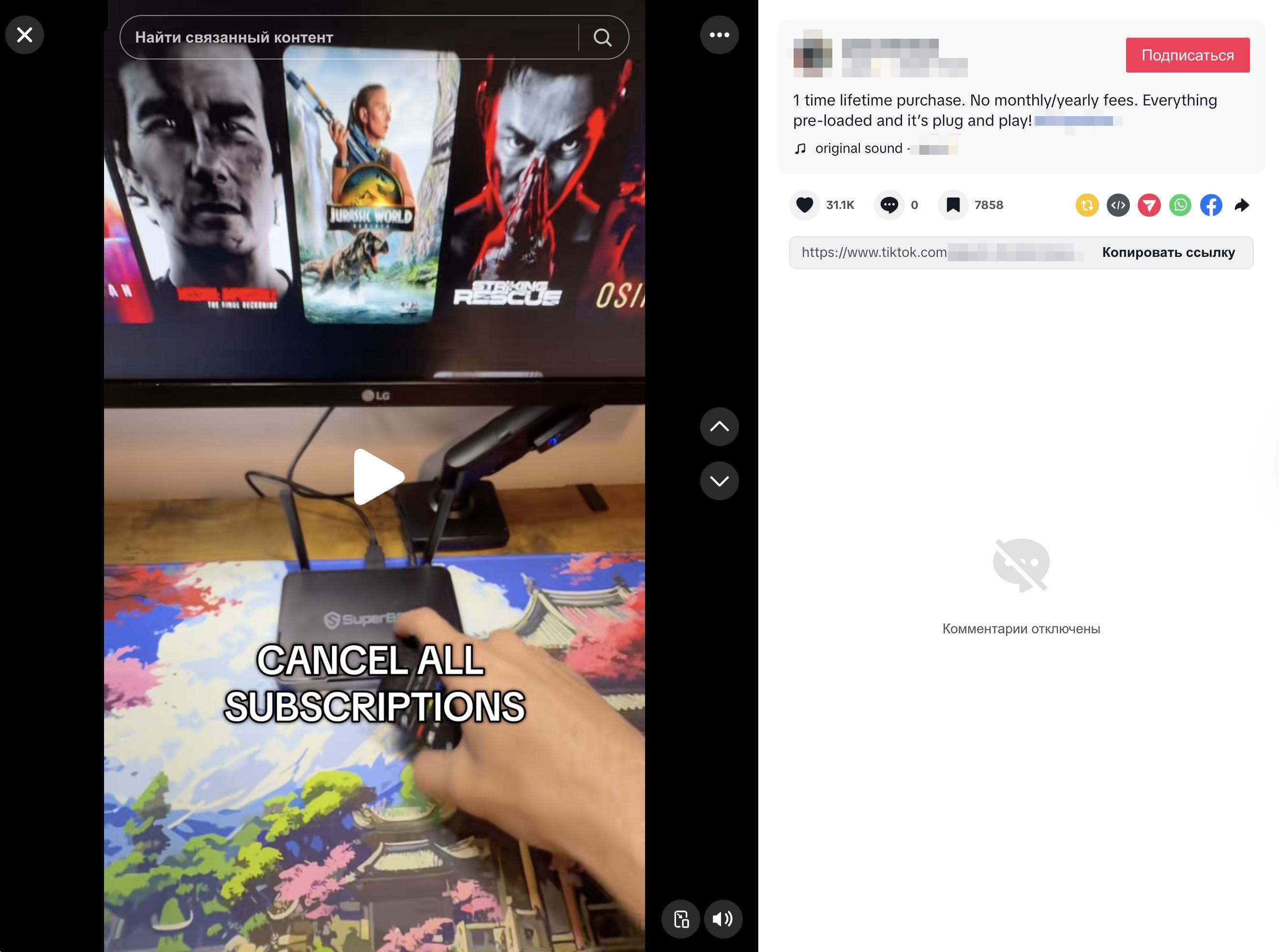
Captura de tela de um vídeo do TikTok mostrando um SuperBox em ação

Um vídeo promocional no TikTok explicando como é ótimo quando tudo é grátis simplesmente cancelar todas as suas assinaturas

O que há de errado com essas TV boxes baratas?

Já surgiram vários relatos sobre TV boxes maliciosas, mas agora sua divulgação atingiu uma escala realmente alarmante.

No final de 2025, analistas examinaram vários modelos do SuperBox, um dispositivo popular disponível nas principais lojas de varejo e marketplaces on-line. As descobertas foram muito preocupantes: logo após serem ligados, os dispositivos começaram a enviar solicitações aos servidores do aplicativo de mensagens chinês Tencent QQ e ao serviço de proxy Grass, efetivamente disponibilizando a largura de banda da Internet do usuário para terceiros.

Dentro do firmware, os pesquisadores descobriram aplicativos completamente incomuns em um reprodutor de mídia: um scanner de rede, um analisador de tráfego e ferramentas de sequestro de DNS. Com isso, o dispositivo não apenas transmite conteúdo pirata, mas também vasculha a rede local em busca de outros alvos (incluindo interfaces industriais SCADA) e fica pronto para participar de ataques DDoS. Também foi descoberto que os SuperBoxes contêm pastas com o nome revelador “secondstage”, um forte indício de malware em vários estágios.

Mais recentemente, em abril de 2026, o podcast Darknet Diaries publicou uma entrevista com um pesquisador de segurança conhecido pelo pseudônimo D3ada55, que compartilhou diversos detalhes preocupantes sobre essas caixas, incluindo o fato de que elas ainda eram vendidas livremente em plataformas como Amazon, Walmart e Best Buy.

A evolução da infecção: do BADBOX ao Keenadu

O caso do SuperBox está longe de ser a única ocorrência em que os dispositivos Android foram transformados em nós de botnet ou vendidos com infecções de fábrica. Aqui estão os casos mais recentes:

  • BADBOX 2.0. Em julho de 2025, a Google processou os operadores de uma botnet que comprometeu mais de 10 milhões de dispositivos Android, principalmente TV boxes, tablets e projetores baratos que não tinham certificação do Google Play Protect. Conforme informamos anteriormente, o BADBOX 2.0 tem como alvo TV boxes e opera tanto como uma rede proxy quanto como uma plataforma de fraude publicitária.
  • Kimwolf. Em dezembro de 2025, a equipe do QiAnXin XLab descobriu uma botnet DDoS que havia sequestrado cerca de 1,8 milhão de dispositivos Android. O hardware infectado incluía modelos genéricos de fabricantes pouco conhecidos que usavam nomes chamativos como TV BOX, SuperBox, XBOX, SmartTV e outros. O alcance da infecção foi enorme, com dispositivos comprometidos distribuídos para o mundo todo. Os países mais atingidos foram o Brasil, Índia, Estados Unidos, Argentina, África do Sul, Filipinas e México.
  • Keenadu. Nossos especialistas descobriram esse malware à espreita no firmware de dispositivos novos em novembro de 2025, mas ele só chamou atenção depois de publicarmos um estudo sobre ele em fevereiro de 2026. O Keenadu se disfarça de componente legítimo do sistema, até mesmo entrando em aplicativos de desbloqueio facial e potencialmente concedendo aos invasores acesso a dados biométricos, informações bancárias e mensagens pessoais.

Todas essas histórias compartilham a mesma origem: o cavalo de Troia Triada, documentado pela primeira vez pelos nossos pesquisadores em 2016 e apelidado na época de “um dos cavalos de Troia móveis mais avançados”. Ao longo da última década, ele evoluiu de um malware comum para um backdoor modular integrado diretamente ao firmware durante a fabricação.

Como o esquema de infecção funciona

Os fabricantes de TV boxes baratas cortam gastos em tudo: certificação do Google Play Protect, auditorias de firmware e atualizações de segurança. Muitos desses dispositivos são executados no Android Open Source Project sem nenhuma garantia de segurança. Em algum lugar ao longo da cadeia de suprimentos, seja na fábrica, por meio de um intermediário ou em uma distribuidora, um backdoor é injetado na imagem do firmware. Nossos especialistas suspeitam que o próprio fabricante pode nem estar ciente do comprometimento.

A escala da infecção transforma milhões de caixas idênticas na base perfeita para uma botnet: cada dispositivo comprometido representa um endereço IP exclusivo que pode ser alugado para terceiros. Operadores de botnet, como o Kimwolf, lucram com isso não apenas por meio de ataques DDoS distribuídos, mas também revendendo a largura de banda de smart TVs e TV boxes infectadas.

O que isso significa para você

Uma TV box infectada fica na sala de estar, conectada ao Wi-Fi doméstico. Isso significa que ela pode detectar smartphones com aplicativos bancários, unidades de armazenamento conectadas à rede (NAS) com arquivos da família, câmeras IP, fechaduras inteligentes, computadores de trabalho e qualquer outro dispositivo conectado à sua rede Wi-Fi.

Com esse tipo de vetor de acesso inicial dentro da sua rede doméstica, um invasor pode interceptar tráfego não criptografado, falsificar solicitações de DNS, verificar portas e procurar vulnerabilidades em dispositivos vizinhos. Além disso, seu endereço IP pode ser usado para atividades fraudulentas. Como resultado, na melhor das hipóteses, seu IP acabará entrando em listas de bloqueio, e serviços legítimos começarão a barrar seu acesso por atividade suspeita; na pior, autoridades podem bater à sua porta.

Como identificar um gadget potencialmente perigoso

Você deve ficar alerta se um dispositivo:

  • For vendido sob uma marca sem nome ou genérica, como T95, X96Q, MX10, TV BOX, SuperBox ou similares
  • Promete acesso vitalício gratuito a serviços premium pagos mediante um único pagamento
  • Exige que você desative o Google Play Protect ou instale APKs de terceiros durante a configuração inicial
  • Não tem uma certificação do Play Protect
  • É promovido por meio de campanhas agressivas de spam nas redes sociais

Como evitar hospedar um nó de botnet

  • Compre TV boxes certificadas com Google Play Protect ou adquira dispositivos diretamente de operadoras de telecomunicações e provedores de Internet confiáveis.
  • Isole todos os dispositivos domésticos inteligentes. Configure uma rede Wi-Fi separada no roteador da sua casa para TV boxes, câmeras, alto-falantes inteligentes, aspiradores robóticos e dispositivos semelhantes, mantendo smartphones, unidades NAS e computadores na rede principal. Isso evita que o malware se espalhe para seus dispositivos mais importantes.
  • Atualize o firmware com frequência em todos os dispositivos, e não se esqueça do roteador, pois ele também representa um elo vulnerável na cadeia.
  • Remova todos os aplicativos da TV box Android que não foram instalados por você, especialmente lojas de aplicativos alternativas, “impulsionadores” de Wi-Fi e “limpadores de sistema”.
  • Monitore o tráfego da sua rede. Roteadores modernos e o Kaspersky Premium conseguem exibir os destinos de conexão de cada dispositivo. Conexões frequentes entre um reprodutor de mídia e servidores na China representam um forte sinal de alerta de segurança.
  • Instale o Kaspersky Premium em todos os seus dispositivos, pois ele protege contra cavalos de Troia e bloqueia páginas de phishing usadas para distribuir arquivos APK infectados.
  • Não desative o Google Play Protect e evite instalar APKs de fontes duvidosas, pois esse é o principal vetor de infecção usado para burlar a loja oficial de aplicativos.
  • Em caso de dúvida, devolva a TV box. Não vale a pena arriscar sua biometria, dados bancários ou a reputação do seu endereço IP por causa de um dispositivo de streaming barato.

Quer saber como proteger seus dispositivos domésticos inteligentes? Leia mais nas nossas postagens relacionadas:

A sua TV, seu smartphone e seus alto-falantes inteligentes estão espionando você?

Seu roteador está trabalhando secretamente para inteligências estrangeiras?

Casa não tão inteligente

Lar, smart lar

Como proteger sua casa smart

2025 Q4 DDoS threat report: A record-setting 31.4 Tbps attack caps a year of massive DDoS assaults

Welcome to the 24th edition of Cloudflare’s Quarterly DDoS Threat Report. In this report, Cloudforce One offers a comprehensive analysis of the evolving threat landscape of Distributed Denial of Service (DDoS) attacks based on data from the Cloudflare network. In this edition, we focus on the fourth quarter of 2025, as well as share overall 2025 data.

The fourth quarter of 2025 was characterized by an unprecedented bombardment launched by the Aisuru-Kimwolf botnet, dubbed “The Night Before Christmas" DDoS attack campaign. The campaign targeted Cloudflare customers as well as Cloudflare’s dashboard and infrastructure with hyper-volumetric HTTP DDoS attacks exceeding rates of 200 million requests per second (rps), just weeks after a record-breaking 31.4 Terabits per second (Tbps) attack.

Key insights

  1. DDoS attacks surged by 121% in 2025, reaching an average of 5,376 attacks automatically mitigated every hour.

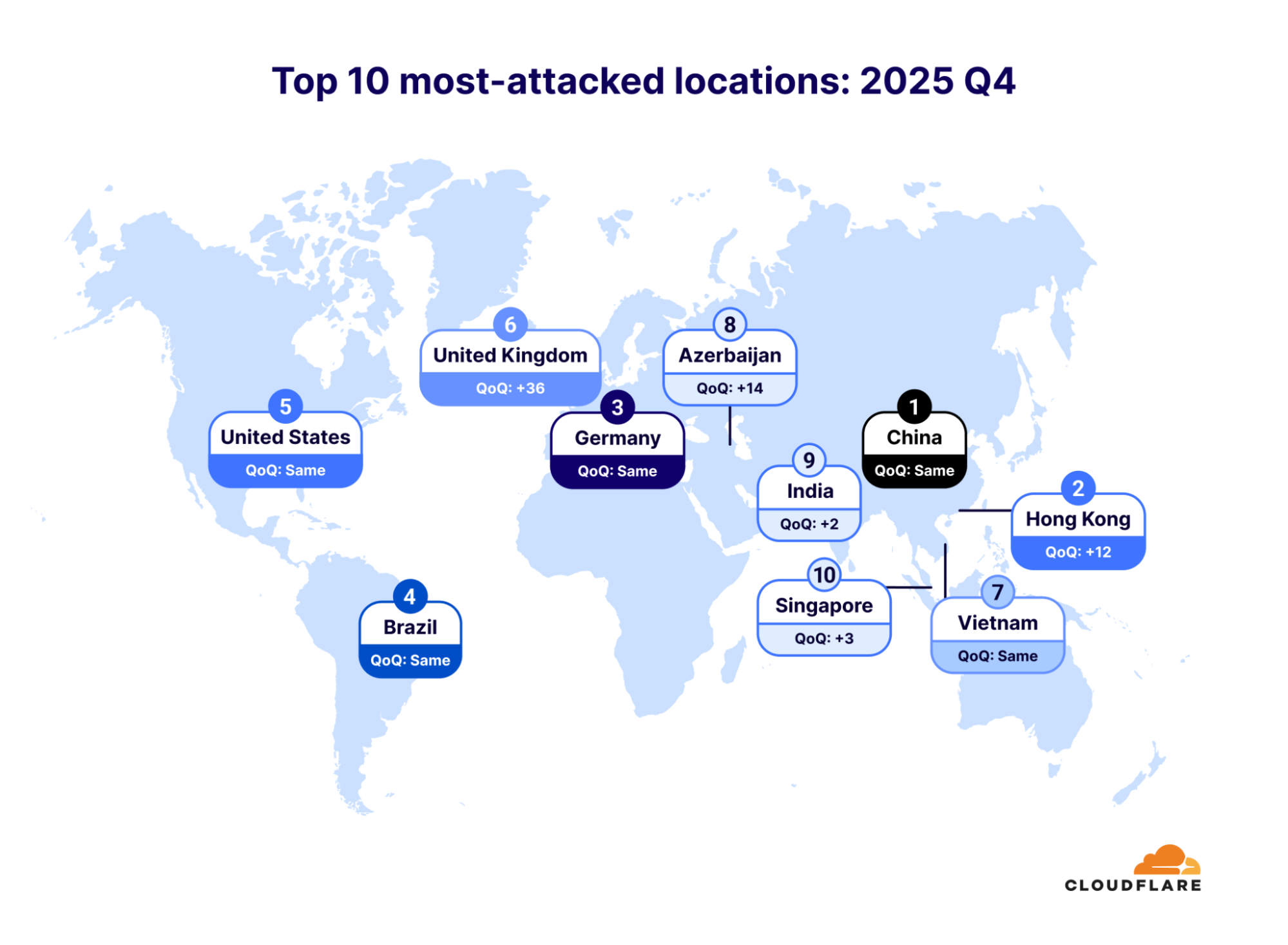
  2. In the final quarter of 2025, Hong Kong jumped 12 places, making it the second most DDoS’d place on earth. The United Kingdom also leapt by an astonishing 36 places, making it the sixth most-attacked place.

  3. Infected Android TVs — part of the Aisuru-Kimwolf botnet — bombarded Cloudflare’s network with hyper-volumetric HTTP DDoS attacks, while Telcos emerged as the most-attacked industry.

2025 saw a huge spike in DDoS attacks

In 2025, the total number of DDoS attacks more than doubled to an incredible 47.1 million. Such attacks have soared in recent years: The number of DDoS attacks spiked 236% between 2023 and 2025.

In 2025, Cloudflare mitigated an average of 5,376 DDoS attacks every hour — of these, 3,925 were network-layer DDoS attacks and 1,451 were HTTP DDoS attacks. 

Network-layer DDoS attacks more than tripled in 2025

The most substantial growth was in network-layer DDoS attacks, which more than tripled year over year. Cloudflare mitigated 34.4 million network-layer DDoS attacks in 2025, compared to 11.4 million in 2024.

A substantial portion of the network-layer attacks — approximately 13.5 million — targeted global Internet infrastructure protected by Cloudflare Magic Transit and Cloudflare’s infrastructure directly, as part of an 18-day DDoS campaign in the first quarter of 2025. Of these attacks, 6.9 million targeted Magic Transit customers while the remaining 6.6 million targeted Cloudflare directly. 

This assault was a multi-vector DDoS campaign comprising SYN flood attacks, Mirai-generated DDoS attacks, and SSDP amplification attacks to name a few. Our systems detected and mitigated these attacks automatically. In fact, we only discovered the campaign while preparing our DDoS threat report for 2025 Q1 — an example of how effective Cloudflare’s DDoS mitigation is!

In the final quarter of 2025, the number of DDoS attacks grew by 31% over the previous quarter and 58% over 2024. Network-layer DDoS attacks fueled that growth. In 2025 Q4, network-layer DDoS attacks accounted for 78% of all DDoS attacks. The amount of HTTP DDoS attacks remained the same, but surged in their size to rates that we haven’t seen since the HTTP/2 Rapid Reset DDoS campaign in 2023. These recent surges were launched by the Aisuru-Kimwolf botnet, which we will cover in the next section. 

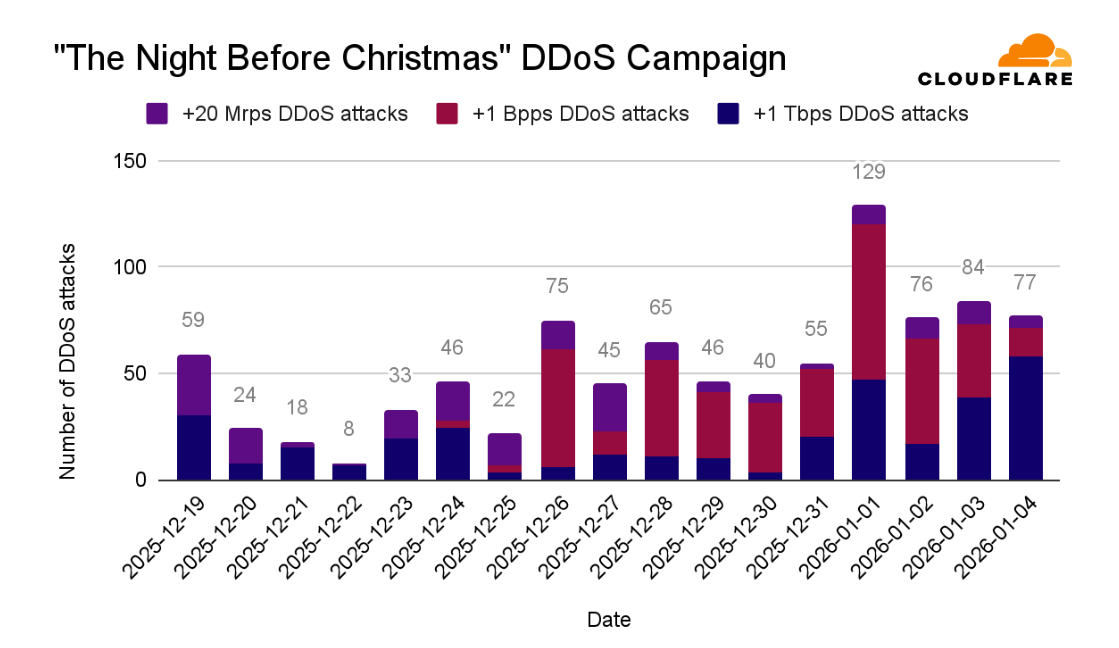
“The Night Before Christmas” DDoS campaign

On Friday, December 19, 2025, the Aisuru-Kimwolf botnet began bombarding Cloudflare infrastructure and Cloudflare customers with hyper-volumetric DDoS attacks. What was new in this campaign was its size: The botnet used hyper-volumetric HTTP DDoS attacks exceeding rates of 20 million requests per second (Mrps).

The Aisuru-Kimwolf botnet is a massive collection of malware-infected devices, primarily Android TVs. The botnet comprises an estimated 1-4 million infected hosts. It is capable of launching DDoS attacks that can cripple critical infrastructure, crash most legacy cloud-based DDoS protection solutions, and even disrupt the connectivity of entire nations.

Throughout the campaign, Cloudflare’s autonomous DDoS defense systems detected and mitigated all of the attacks: 384 packet-intensive attacks, 329 bit-intensive attacks, and 189 request-intensive attacks, for a total of 902 hyper-volumetric DDoS attacks, averaging 53 attacks a day.

The average size of the hyper-volumetric DDoS attacks during the campaign were 3 Bpps, 4 Tbps, and 54 Mrps. The maximum rates recorded during the campaign were 9 Bpps, 24 Tbps, and 205 Mrps.

To put that in context, the scale of a 205 Mrps DDoS attack is comparable to the combined populations of the UK, Germany, and Spain all simultaneously typing a website address and then hitting 'enter’ at the same second.

While highly dramatic, The Night Before Christmas campaign accounted for only a small portion of the hyper-volumetric DDoS attacks we saw throughout the year.

Hyper-volumetric DDoS attacks

Throughout 2025, Cloudflare observed a continuous increase in hyper-volumetric DDoS attacks. In 2025 Q4, hyper-volumetric attacks increased by 40% compared to the previous quarter.

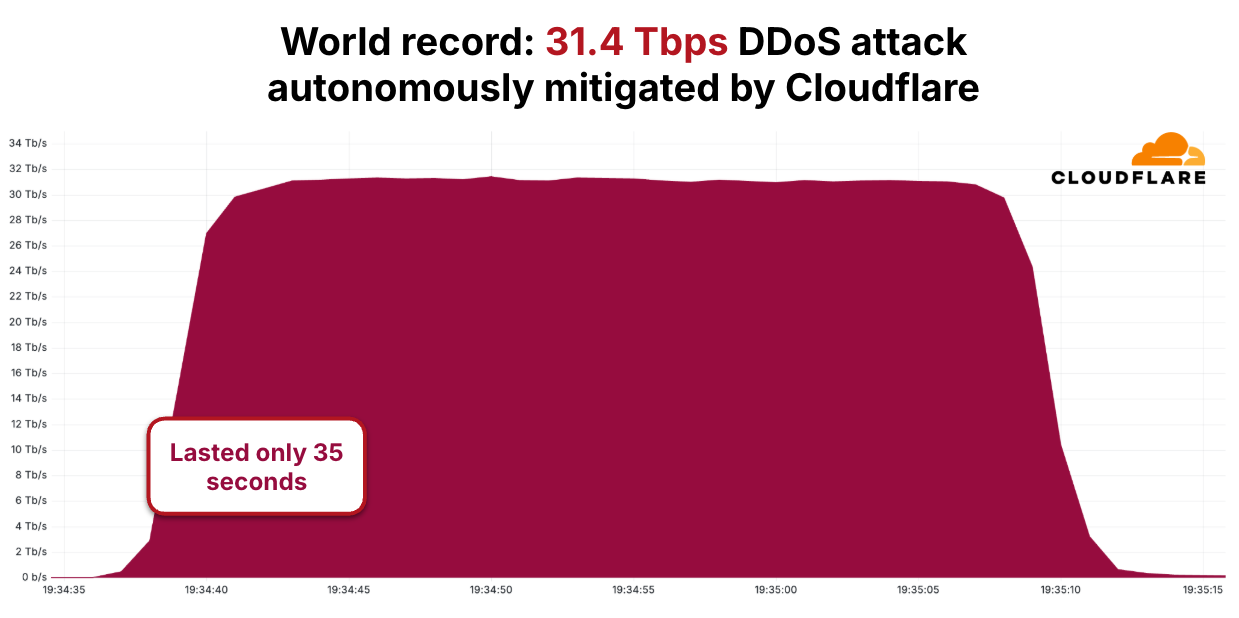
As the number of attacks increased over the course of 2025, the size of the attacks increased as well, growing by over 700% compared to the large attacks seen in late 2024, with one reaching 31.4 Tbps in a DDoS attack that lasted just 35 seconds. The graph below portrays the rapid growth in DDoS attack sizes as seen and blocked by Cloudflare — each one a world record, i.e. the largest ever disclosed publicly by any company at the time.

Like all of the other attacks, the 31.4 Tbps DDoS attack was detected and mitigated automatically by Cloudflare’s autonomous DDoS defense, which was able to adapt and quickly lock on to botnets such as Aisuru-Kimwolf.

Most of the hyper-volumetric DDoS attacks targeted Cloudflare customers in the Telecommunications, Service Providers and Carriers industry. Cloudflare customers in the Gaming industry and customers providing Generative AI services were also heavily targeted. Lastly, Cloudflare’s own infrastructure itself was targeted by multiple attack vectors such as HTTP floods, DNS attacks and UDP flood.

Most-attacked industries

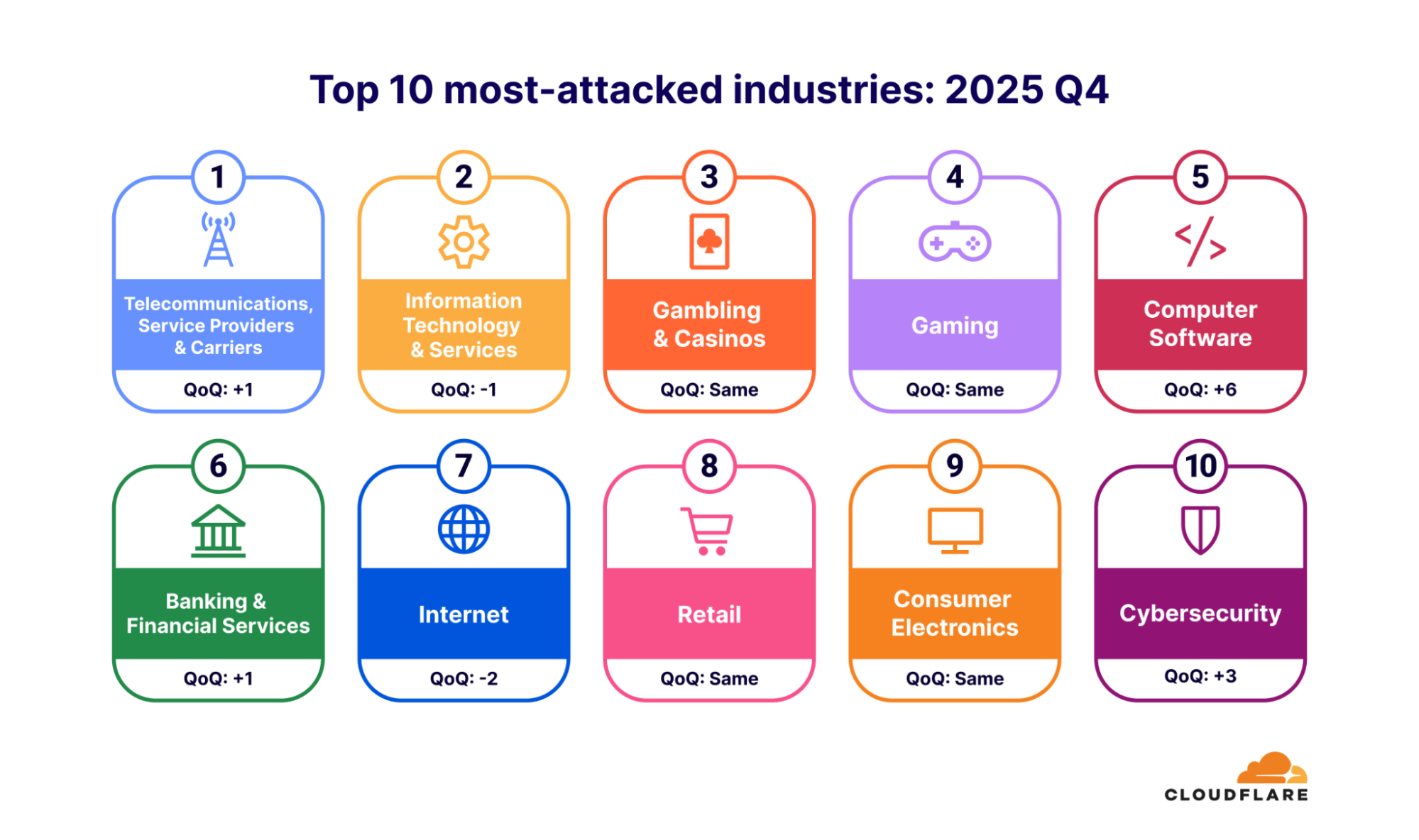
When analyzing DDoS attacks of all sizes, the Telecommunications, Service Providers and Carriers industry was also the most targeted. Previously, the Information Technology & Services industry held that unlucky title.

The Gambling & Casinos and Gaming industries ranked third and fourth, respectively. The quarter’s biggest changes in the top 10 were the Computer Software and Business Services industries, which both climbed several spots. 

The most-attacked industries are defined by their role as critical infrastructure, a central backbone for other businesses, or their immediate, high-stakes financial sensitivity to service interruption and latency.

Most-attacked locations

The DDoS landscape saw both predictable stability and dramatic shifts among the world's most-attacked locations. Targets like China, Germany, Brazil, and the United States were the top five, demonstrating persistent appeal for attackers. 

Hong Kong made a significant move, jumping twelve spots to land at number two. However, the bigger story was the meteoric rise of the United Kingdom, which surged an astonishing 36 places this quarter, making it the sixth most-attacked location.  

Vietnam held its place as the seventh most-attacked location, followed by Azerbaijan in eighth, India in ninth, and Singapore as number ten.

Top attack sources

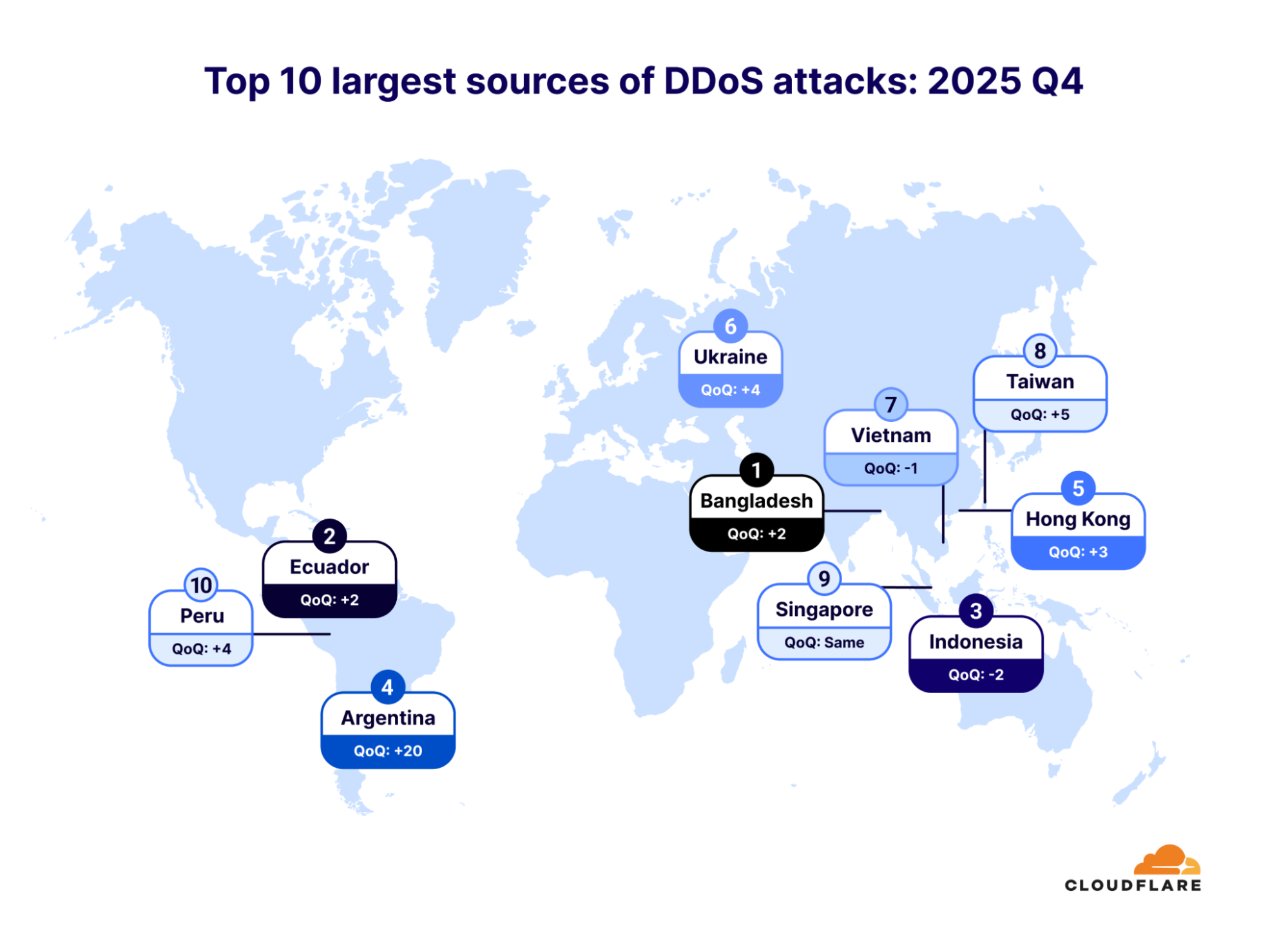
Bangladesh dethroned Indonesia as the largest source of DDoS attacks in the fourth quarter of 2025. Indonesia dropped to the third spot, after spending a year as the top source of DDoS attacks. Ecuador also jumped two spots, making it the second-largest source.

Notably, Argentina soared an incredible twenty places, making it the fourth-largest source of DDoS attacks. Hong Kong rose three places, taking fifth place. Ukraine came in sixth place, followed by Vietnam, Taiwan, Singapore, and Peru.

Top source networks

The top 10 list of attack source networks reads like a list of Internet giants, revealing a fascinating story about the anatomy of modern DDoS attacks. The common thread is clear: Threat actors are leveraging the world's most accessible and powerful network infrastructure — primarily large, public-facing services. 

We see most DDoS attacks coming from IP addresses associated with Cloud Computing Platforms and Cloud Infrastructure Providers, including DigitalOcean (AS 14061), Microsoft (AS 8075), Tencent (AS 132203), Oracle (AS 31898), and Hetzner (AS 24940). This demonstrates the strong link between easily-provisioned virtual machines and high-volume attacks. These cloud sources, heavily concentrated in the United States, are closely followed by a significant presence of attacks coming from IP addresses associated with traditional Telecommunications Providers (Telcos). These Telcos, primarily from the Asia-Pacific region (including Vietnam, China, Malaysia, and Taiwan), round out the rest of the top 10.

This geographic and organizational diversity confirms a two-pronged attack reality: While the sheer scale of the highest-ranking sources often originates from global cloud hubs, the problem is truly worldwide, routed through the Internet's most critical pathways from across the globe. In many DDoS attacks, we see thousands of various source ASNs, highlighting the truly global distribution of botnet nodes.

To help hosting providers, cloud computing platforms and Internet service providers identify and take down the abusive IP addresses/accounts that launch these attacks, we leverage Cloudflare’s unique vantage point on DDoS attacks to provide a free DDoS Botnet Threat Feed for Service Providers. 

Over 800 networks worldwide have signed up for this feed, and we’ve already seen great collaboration across the community to take down botnet nodes.

Helping defend the Internet

DDoS attacks are rapidly growing in sophistication and size, surpassing what was previously imaginable. This evolving threat landscape presents a significant challenge for many organizations to keep pace. Organizations currently relying on on-premise mitigation appliances or on-demand scrubbing centers may benefit from re-evaluating their defense strategy.

Cloudflare is dedicated to offering free, unmetered DDoS protection to all its customers, regardless of the size, duration, or volume of attacks, leveraging its vast global network and autonomous DDoS mitigation systems.

About Cloudforce One

Driven by a mission to help defend the Internet, Cloudforce One leverages telemetry from Cloudflare’s global network — which protects approximately 20% of the web — to drive threat research and operational response, protecting critical systems for millions of organizations worldwide.

❌