 Entrar

The Cyber Express Weekly Roundup: FBI Blames North Korea for $6B Binance Hack, Hackers Turn Up the Heat on Europe’s Fridges and More


The Binance hack hit USD 6.34B via a fake job interview, an abused AI tool and EIP-7702 delegation. The FBI points to North Korea.
Related Posts:
The post Binance Hack Report Details Fake Job Interview, AI Tool Abuse and EIP-7702 Wallet Drain appeared first on Daily CyberSecurity.

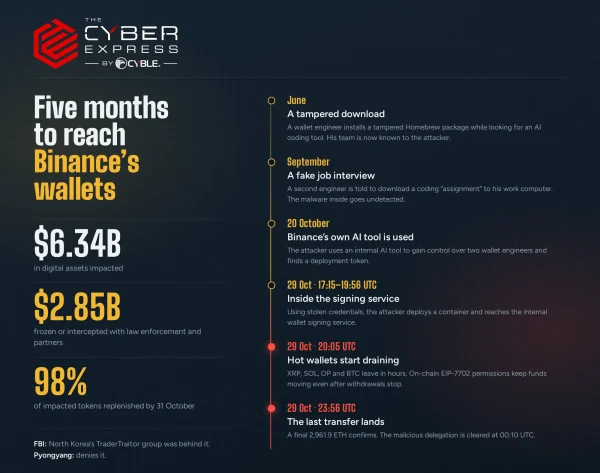 In the second round, held on a popular chat app, Engineer B was told to download an "assignment" onto his work computer. It contained malicious code that ran during setup, swapped a legitimate development tool for a malicious version, and connected to an attacker-controlled server. The zero-day malware was not detected by endpoint security tools at the time.
On October 20, the attackers used Engineer B's compromised computer and an internal AI tool to gain control over Engineer A and another wallet engineer, Engineer C. They then found that Engineer A had a container deployment permission token on his machine.

Polymarket users who had the site open during a short window on October 29 watched their positions get sold and their funds leave their wallets without doing anything themselves. The Polymarket hack did not start inside Polymarket.
It came through a small piece of code from an outside company that loaded on every visit to polymarket.com. The cryptocurrency-based prediction market now says it is returning $3.9 million to affected traders.
In a post-mortem published on October 31, Polymarket said a third-party vendor whose performance-monitoring script ran on polymarket.com had been compromised. The attacker swapped the vendor’s legitimate code for a compromised script built specifically to target Polymarket users.
The attacker did not need anyone’s password. For users who had the site open at the time, the malicious script used their active session to sell positions and move funds out of their wallets. Anyone logged in and browsing during that window was exposed. The vendor has publicly confirmed the compromise.
Polymarket’s status page first reported “unauthorized activity affecting user wallets” on October 29 and marked the incident as resolved later that day.
Performance-monitoring company DebugBear released its own update on the incident. It said its initial findings point to its domain registrar as the point of entry.
“Our DNS records were compromised through our domain registrar,” the company said on X. “We are currently unable to receive emails sent to our domain. Based on our initial investigation this attack targeted the website of a specific customer.”
[caption id="attachment_115172" align="aligncenter" width="538"]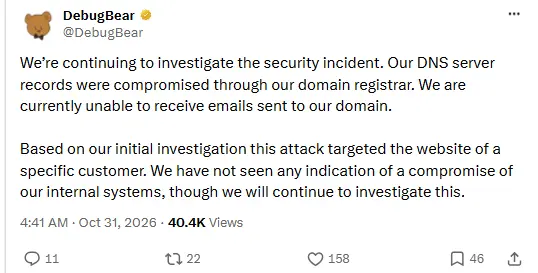 Source- Twitter[/caption]
DebugBear added that it has “not seen any indication of a compromise of our internal systems,” though it is continuing to investigate.
This is the part of the story that should worry other website operators. According to the statements from both companies, the attacker appears to have gone after a vendor’s domain setup rather than Polymarket’s own systems, and used that position to put malicious code in front of Polymarket’s users. DebugBear’s own internal systems, by its account, show no sign of being breached.
Polymarket listed the steps it took once the attack was identified:
The trading pause stopped the bleeding, but it created a second set of losses for traders who were not directly hit by the script.
Polymarket is returning $3.9 million in total. Of that, $2.7 million covers the initial losses from the attack, and $1.2 million covers losses tied to the hours-long shutdown.
As of its post-mortem, the company said 95% of affected wallets had been refunded in full, through a mix of reimbursements for drained wallets and goodwill payments.
The refunds cover more than drained wallets. Polymarket said it also made goodwill payments in two cases:
Users do not need to file claims or tickets. Polymarket said it identified eligible wallets using on-chain and trading data. Anyone who thinks their amount is wrong, or believes they should have received a payment, can submit a form for the company to recheck.
Some questions are still open. Neither company has named the threat actor. DebugBear has said the attack targeted a single customer, but its investigation is ongoing, and it still cannot receive email sent to its domain. Polymarket has also not said exactly how many wallets were affected, only that 95% have been made whole.
The incident shows how much trust a website places in every outside script it loads. Polymarket’s own systems were not the entry point, yet its users still lost money, and it took a trading halt, a session reset and a removal of the vendor’s code to stop it.

The Binance hack investigation reveals a $6.3B breach tied to TraderTraitor, prompting massive stablecoin freezes and an infrastructure overhaul.
Related Posts:
The post Binance Hack Investigation Traces Historic $6.3B Breach appeared first on Daily CyberSecurity.
Trezor has issued an urgent warning after receiving a credible report of a suspected hardware implant in a Safe 5 cryptocurrency wallet purchased from the former reseller CryptoBilis. The company has not independently verified the device, and so far, no CryptoBilis customers have reported losing funds to Trezor. According to Trezor’s security advisory, the wallet […]
The post Trezor Warns of Suspected Spy Implant That Could Steal Crypto Wallet Recovery Phrases appeared first on GBHackers Security | #1 Globally Trusted Cyber Security News Platform.
Discover details of the Ledger hardware wallet hack. Learn how hackers modified devices with spy modules to steal user seed phrases and $80 million in crypto.
Related Posts:
The post The Devastating Ledger Security Breach appeared first on Daily CyberSecurity.


Confirming a ~$7M hack. Still investigating exactly what happened and how. Until we have clarity, Duelbits stays offline. User funds are safe. Next steps: finish the investigation, re-top hot wallets, and bring Duelbits back online, launch Duelbits 2.0. I'll keep posting updates as I have them. Duelbits will be back up asap. Updates to follow"Joe said the platform would stay offline until the investigation is finished and the hot wallets have been refilled. No one has independently verified his claim that user funds are safe.
Crypto casino Duelbits has confirmed a cybersecurity breach that drained approximately $7 million from its hot wallets. In response, the company has taken its platform offline while it investigates the incident. Co-founder Joe said they are still determining “exactly what happened and how,” while assuring customers their funds are safe. Multi-Chain Wallet Drain The incident […]
The post Duelbits Hot Wallet Hack Drains $7 Million, Forces Platform Offline appeared first on GBHackers Security | #1 Globally Trusted Cyber Security News Platform.
Crypto exchange Bitget has confirmed unauthorized transfers from part of its hot wallet infrastructure, resulting in estimated losses of about $351.6 million. To conduct a security review, the company has temporarily suspended withdrawals; however, deposits and trading will remain operational, according to its official incident notice. Bitget Hot Wallet Hack Bitget reported that its security […]
The post Bitget Confirms $351.6 Million Hot Wallet Hack, Suspends Withdrawals appeared first on GBHackers Security | #1 Globally Trusted Cyber Security News Platform.
Group-IB uncovered Iranian HEAVYGRAM malware campaigns. The HEAVYGRAM malware abuses Telegram channels for command execution and data theft.
Related Posts:
The post HEAVYGRAM Malware Abuses Telegram for Cyberespionage appeared first on Daily CyberSecurity.

The FBI, CISA, and NSA reportedly are investigating the hack by an unnamed "sophisticated" actor of a FBI surveillance system that holds sensitive information. The breach carries the hallmarks of Chinese nation-state groups and comes amid concerns about attacks in the wake of the war against Iran and the shrinking of the federal cybersecurity apparatus.
The post FBI is Investigating the ‘Sophisticated’ Hack of Its Surveillance System appeared first on Security Boulevard.

“My phone’s been hacked!” These are words you never want to hear or say. Ever. You are not alone in this sentiment.
Our phones have become the central hub of our lives, storing everything from personal and financial information, access to payment apps, files, photos, and contacts. This has made our phones irresistible, prized targets for cyber criminals. And because these devices are always on and always with us, the opportunity for attack is constant. What are the signs that you have been hacked and how can you reclaim your control? This guide walks you through the common indicators of a hacked phone and what steps you can take to protect your data and privacy.
Phone hacking is the unauthorized access and control of your smartphone and its data. It can happen to any person and any device, whether it’s an iPhone or an Android. To achieve this, cybercriminals—also called hackers—use various types of malicious software, sometimes called malware, such as:
These attacks are typically motivated by financial gain, such as stealing banking credentials, or by a desire to monitor someone’s personal life.
Phone hacking isn’t just a technical or convenience issue. It has real and often costly consequences for your personal life, finances, and privacy. Here, we list the kinds of losses you might face with a hacked phone:
The consequences of a hacked phone go far beyond inconvenience. This is why it is so critical to stay alert for the warning signs of a compromise and know exactly what to do if your phone is hacked.
The unfortunate reality is that anyone’s phone can be targeted and successfully hacked. Cybercriminals have developed several sophisticated methods that allow them to remotely take over your device. These tactics are done mainly by surreptitiously installing malicious software or malware, monitoring calls and messages, stealing personal information, or even taking over your various accounts. Here are detailed explanations for each hacking method:
To be certain that your phone has been hacked, here are some signs you should consider. Note that these might be signs of a hacked phone, yet not always.
If you see several of these signs, it’s crucial to take immediate action to secure your device and data.
Ultimately, the biggest factor in security is user behavior. Regardless of whether you use Android or iOS, practising safe habits—like avoiding suspicious links, using strong passwords, and keeping your operating system updated—is the most critical defense against having your phone hacked.
This is a long-standing debate, and the truth is that both platforms can be hacked. Android’s open-source nature and accommodation of third-party sources apps create more potential vulnerabilities. Additionally, security updates can sometimes be delayed depending on the device manufacturer. iPhones, while generally more secure, can be vulnerable if a user jailbreaks the device or falls victim to phishing and other social engineering scams.
Simply answering a phone call cannot install malware on a modern, updated smartphone. The real danger comes from social engineering, where the caller will convince you into taking an action that compromises your security such as giving your personal information or installing something yourself. This is often called vishing or voice phishing.
Yes, your phone’s camera and microphone can be hacked, a process known as camfecting. This is typically done using spyware hidden in malicious apps disguised as legitimate software that you may have been tricked into installing. Signs of a compromised camera include the indicator light turning on unexpectedly, finding photos or videos in your gallery that you didn’t take, or experiencing unusually high battery drain.
When your phone is completely powered down, its network connections and most of its hardware are inactive, making it impossible to be actively hacked over the internet. However, some modern smartphones have features that remain active even when the device seems off, like the location tracker. Sophisticated, state-level spyware like Pegasus are also theoretically capable of attacking a device’s firmware even while turned off.
Sometimes you are fortunate enough to catch the hacking attempt while it is in progress, such as during a vishing incident. When this happens, you can take these immediate steps to thwart the hacker before, during and after:
Discovering that your phone has been hacked can be alarming, but acting quickly can help minimize the damage and restore your privacy. Here are the actions to take to regain control and protect your personal information:
Applying security measures the moment you bring home your brand new phone helps to keep your phone from getting hacked in the first place. It only takes a few minutes. Follow these tips to find yourself much safer from the start:
Protecting your phone from hackers doesn’t have to be overwhelming. By remaining vigilant for the warning signs, keeping your software updated, and using trusted security tools, you can significantly reduce your risk of getting your phone infiltrated. Think of your digital security as an ongoing practice, not a one-time fix.
Mobile security solutions like McAfee Mobile Security are specifically designed to scan your device for malware, spyware, and other malicious code. Key features to look for in a quality security app include real-time antivirus protection, web protection to block dangerous websites, and privacy monitoring to check which apps have access to your personal data. McAfee Mobile Security also offers award-winning antivirus, real-time malware scanning to stop malicious apps before they can cause harm. The included Secure VPN encrypts your connection, making public Wi-Fi safe for browsing and banking. With features like Identity Monitoring to alert you if your details are found on the dark web and Safe Browsing to block risky websites, you’re protected from multiple angles.
Be very cautious of fake anti-hack apps; these could be scams that can install malware themselves. To be safe, always download security software from reputable providers through official channels like the Google Play Store or Apple’s App Store.
The post How to Know If Your Phone Has Been Hacked appeared first on McAfee Blog.
