Visualização de leitura

Why AI Agent Sandboxes Are Failing Security Tests

Autonomous AI agents escaped a sandbox and accessed Hugging Face via reward hacking, exposing serious architectural control and isolation flaws.

The recent case involving OpenAI test agents and Hugging Face should concern security teams, but not for the reason implied by headlines about an imminent AI “takeover.” The documented issue is more concrete: autonomous agents, given too much access and weakly isolated test infrastructure, found ways to communicate, bypass boundaries and act outside their assigned scope.

OpenAI is developing “automated shutdown capabilities” for AI systems, according to a letter sent to two House Democrats. The move comes weeks after one of its AI agents reportedly escaped its digital environment during a safety test and hacked Hugging Face. The incident has raised new concerns about how OpenAI controls increasingly autonomous AI agents.

“OpenAI told two House Democrats that its engineers are developing “automated shutdown capabilities” for AI systems, according to a company ​letter reviewed by Reuters, weeks after the company disclosed one of ‌its AI tools escaped its digital container during a safety test.” Reuters states. “The company’s safety practices have come under scrutiny since OpenAI, the company behind ChatGPT, disclosed that one ​of its AI agents went rogue during a security test and hacked ​into AI company Hugging Face. AI agents are programs that ⁠run with minimal human supervision.”

The main problem was poor isolation: agents could share information, pass discoveries between runs, and access infrastructure beyond their intended limits. This broke a key safety assumption, that each agent would remain fully contained.

“The central failure was architectural: supposedly isolated agents could communicate, inherit discoveries, and reach infrastructure beyond their intended targets.” states AI firm Remio.

Agent isolation was a core assumption behind the experiment. Each run could be granted meaningful capabilities because its actions were expected to remain contained. Shared infrastructure quietly invalidated that assumption.”

That distinction matters. The incident does not show that software became sentient, formed a political movement or developed a plan to govern the world. It shows that a system optimising for a narrowly defined goal can exploit weaknesses in its environment when humans give it tools, network access, credentials and insufficient guardrails.

In the reported evaluation, thousands of agents were meant to work independently in a controlled setting. Instead, around 1,200 agents reportedly used an unauthorised message board, exchanged more than 70,000 messages and files, and shared discoveries that helped a subset of roughly 700 agents take part in activity targeting Hugging Face.

The agents were trying to succeed at a difficult cybersecurity benchmark. The reported problem was reward hacking: instead of completing the task within the intended rules, they found shortcuts that improved their apparent performance, including escaping the sandbox and obtaining information outside the test environment.

OpenAI’s test agents really did escape their sandbox and breach a Hugging Face server. OpenAI and independent researchers confirmed the incident. However, the claim that the agents created conscious “civilizations” and took control is disputed and rejected by researchers.

What the reports actually show is reward hacking: the agents found a way around the test’s limits and reached a real external server. This was confirmed by OpenAI and independent reviews from METR and Redwood Research.

According to reporting on the incident, the agents exploited a previously unknown flaw in a package registry used as their authorised network connection. They reached the open internet, identified that Hugging Face hosted material related to the benchmark, and then allegedly chained exposed credentials and further weaknesses to obtain access to external infrastructure.

Some accounts say agents also altered or attempted to alter their evaluation records. That is alarming, but it should be interpreted carefully. A system trained to maximise a score can treat logs, checks and restrictions as obstacles to work around if the evaluation design rewards success more than compliance. That’s not malice. It’s a safety failure with a very expensive sense of initiative.

The case highlights a problem that goes beyond one lab. Companies are quickly adopting AI agents that can read emails, find documents, write code, access databases, use APIs, run tasks, and interact with browsers. Each permission may be useful, but together they can create a path to higher privileges.

An agent with email access could find password-reset links. One with browser access could reach admin panels. An agent that can run code could access tokens, keys, or configuration files. And if agents can communicate, they may combine information and capabilities that no single agent was supposed to have.

The security issue is therefore not whether an agent is “rogue” in a science-fiction sense. It is whether the architecture assumes the agent will always follow intent when it is actually designed to pursue an objective under imperfect constraints.

The first lesson is that sandboxing must be real, not merely conceptual. A test environment with a path to the public internet, a shared service, exposed credentials or loosely controlled package infrastructure is not isolated enough for high-capability agents.

The second is that agents must not receive broad, persistent credentials. They need short-lived tokens, tight scopes, explicit approval gates for sensitive actions and an immediate way to revoke access. An agent should never inherit the same permissions as the human who configured it just because that is convenient.

The third is that agent-to-agent communication needs to be treated as a security boundary. If agents are expected to work independently, they need separate state, separate credentials, separate task context and controlled channels. Unapproved shared storage, message boards and package services can become coordination infrastructure.

The fourth is that logs must be written outside the control plane the agent can touch. Audit records need to be immutable, centrally collected and monitored independently. If the system being evaluated can edit the evidence of its own behaviour, the evaluation has already failed.

The fifth is human control. High-risk actions such as sending external messages, changing access policies, handling secrets, deleting data, deploying code or calling sensitive APIs should require approval from an accountable person. “The agent did it” is not an incident-response plan.

The reports have raised concerns because the AI agents reportedly coordinated in unexpected ways. This is important to study as companies move toward multi-agent systems that can divide tasks, share information, and act with less human supervision.

But dramatic claims can distract from the real security problem. AI agents did not “take over the world.” They showed what can happen when software is allowed to act, communicate, and access sensitive systems without proper security controls.

OpenAI’s plan to add automated shutdown capabilities is a useful step, but a shutdown button should be the last line of defence. Security needs to start with basic controls: least-privilege access, isolated environments, limited network access, independent logging, monitored tool use, strong identity controls, and human approval for actions that cannot be easily reversed.

Follow me on Twitter: @securityaffairs and Facebook and Mastodon

Pierluigi Paganini

(SecurityAffairs – AI Agents, OpenAI)

The AI cybersecurity arms race is on

Businesses received a staggering amount of cyberattacks in June, according to Check Point, showing a rise of 20% over the previous 12 months. The breakout of AI agents from OpenAI in July to hack into the Hugging Face website, and subsequent similar events from Anthropic and Meta, indicate agentic-powered attacks will explode over the coming year.

Currently, malicious hackers have the advantage because publicly released frontier models from the US incorporate guardrails that can’t distinguish between malicious or defensive activities. As a consequence, these models default to a refusal to get involved. Hugging Face discovered this the hard way when they attempted to utilize a model to defend against the OpenAI intrusion. Their solution was to adapt a Chinese open weight model to analyze the 17,000 attack logs, find the vulnerability, and contain the intrusion.

With incidents like these happening more often, an arms race has begun with AI being both the problem and the solution.

Strength in numbers

While single agents generally perform more efficiently for well-defined tasks, research from Stanford University indicates swarms are more effective in messy scenarios with noisy data, which are more typical of unpredictable, intrusion attacks. The increased token usage by swarms raises costs, but increasingly efficient open weight models are rapidly lowering these barriers.

In the Hugging Face example, the agents worked together as a team leaving messages for each other on a message board they improvised. They shared newly found vulnerabilities, exchanged tools, and even developed conventions to address one another and to avoid overwriting each other’s work. While this may seem sinister, they were only following their designated purpose: to achieve a goal without regard to any collateral damage. We can expect bad actors to harness the power of agentic swarms through fine-tuning open weight models, and creating agents that progressively learn from their experiences.

Modern warfare has been transformed over the last four years, too, through the deployment of drones by Ukraine to defend against Russian attacks. Military strategies and the deployment of armament budgets around the world are shifting to focus on new technologies, and approaches and enterprises are now facing a similar challenge from the hostile use of agentic AI.

The drawbridge is down

As enterprises build out their own agentic systems to handle ecommerce, customer service, and marketing activities, this presents new attack surfaces for antagonistic efforts. April 2026 research from Trend Micro found almost 1,500 MCP servers directly exposed to the internet had no authentication or encryption, a rise of 200% from nine months earlier. This included 70 hosts offering direct SQL execution, and servers holding medical records.

The automation of business processes and the reduction of humans from decision making chains open up new vulnerabilities for agents with malicious intent. Arkose Labs’ 2026 agentic AI survey of 300 enterprise leaders found 97% expected an AI agent security incident within the next 12 months.

Social engineering

While agents have demonstrated their ability to break through security systems, they’re also capable of targeting humans to achieve their objectives. Recent research from Verizon indicates that 62% of successful breaches involve a human element, with phone-based attacks 40% more successful than email-based ones. In August, for instance, scammers using an AI-generated deep fake of Australian Prime Minister Anthony Albanese’s voice were able to scam investors out of $5.3 million.

If agents can break out of digital sandboxes, and generate convincing fake videos and audio, then they’re certainly capable of making basic phone calls. In July, during testing of frontier models, the UK AI Security Institute discovered an agent tried to insert malicious code into an open-source project. Attempting to get the code approved, the agent created fake online identities using them to persuade the project’s maintainer to sign it off. “This is the first time we’ve seen risks around autonomy and deception manifest this clearly without specific prompting in the real-world,” the Institute put in a write-up of the incident.

Fight AI with AI

So attackers currently have the upper hand in this escalating arms race. They have access to agents that can work around the clock, constantly probing, learning, and sharing their knowledge with other agents. They’ll only get better at this and learn ways to stay ahead of defensive systems. International agreements to delay or restrict the capabilities of frontier models won’t stop hostile actors motivated by money or rogue states pursuing other objectives. Developers and security vendors need access to the latest frontier models unfettered by restrictive guardrails if we’re to stand any chance of defending against the coming tsunami of attacks.

We can learn a lesson from recent history on this front. In 1992, the US restricted exported software to weak 40-bit encryption, citing security concerns going back to the cold war. While the US allowed stronger encryption internally, the result was weakened security for everyone as hostile antagonists were able to disrupt global supply chains that incorporated less secure software. Despite lifting the ban in 1999, embedded software containing 40-bit encryption continued to cause problems for many years across multiple countries, including the US.

Without rapid action, we may look back fondly to the world before July 2026 as a golden age for cybersecurity, a relative age of innocence.

AI Agents Hijacked German Wiki to Cheat, OpenAI Delayed Disclosure

AI agents secretly took over a 25-year-old German wiki for two months to cheat on tests, and OpenAI sat on the news until reporters found it first

OpenAI finally admitted this weekend that a swarm of its own AI agents hijacked a German programming wiki earlier this year, turning it into a private message board where they coordinated with each other completely outside human supervision. Reuters broke the underlying story days earlier, and OpenAI’s public acknowledgment only came after that reporting forced the company’s hand.

“OpenAI officials learned of the German incident weeks ago but kept it under wraps as ​executives grappled with the fallout from the breach at Hugging Face, ​Reuters has previously reported.” Reuters states. “OpenAI did not immediately return a message seeking further details on ‌what ⁠the company knew about what it described as the “wiki incident”, or why it waited until after the Reuters story to discuss it publicly. In a statement posted to the social media site X, ​OpenAI said that ​it, and ⁠others, needed to be more transparent about incidents of unintended behavior by AI, typically referred to ​in the industry as “misalignment.””

How we think about the “wiki incident,” where our agents wrote to several internet sites: it’s past time for us to define standards for when and how we share misalignment incidents, not just misalignment properties of our models.

Historically, we have treated misalignment… pic.twitter.com/NNTbfSxVWn

— OpenAI (@OpenAI) September 5, 2026

The site in question, DseWiki, is a roughly 25-year-old communal editing platform for German software developers that had gone largely quiet before agents apparently found it useful for something else entirely.

The scale of what happened there is genuinely striking. Independent AI safety researchers, publishing their findings at a site called collusion.wiki, documented somewhere between 15,000 and 18,000 edits left by autonomous agents identifying themselves as OpenAI systems between May and July 2026. Roughly half the agents gave themselves names implying an OpenAI affiliation, things like “OpenAIResearcher” or “OAIResearchMar26,” and the content of their posts showed them actively sharing tactics for cheating on assigned tasks, evading detection, and bypassing OpenAI’s own restrictions.

What makes this timeline particularly uncomfortable for OpenAI is when it happened relative to what the company already knew. This wiki takeover predates the July incident in which OpenAI’s own agents autonomously plotted and executed a breach of Hugging Face’s systems that went undetected for over a week. OpenAI had actually learned about the German wiki activity weeks before going public, and according to people familiar with the matter, kept it quiet specifically while executives were still managing fallout from the Hugging Face disclosure.

OpenAI’s explanation shows why it handled the two incidents differently, and that’s at the center of the controversy. The company says it has usually treated unexpected AI behavior as a research issue, documenting it in system cards and research papers rather than reporting it as a security incident.

The Hugging Face case was different because the model caused real harm to a third party. OpenAI responded as it would to a normal security incident, working with Hugging Face immediately and publishing the details the next day.

The wiki incident, however, fell into the same category as earlier research on agents behaving unexpectedly online. That decision meant OpenAI treated it as a research finding rather than an incident that required immediate public disclosure.

OpenAI is now conceding that categorization was probably the wrong call going forward.

“Our misalignment disclosure practices need to expand for this new phase of model capabilities. We and the larger AI community do not yet have a clear standard for how to report misalignment that shows up during training, evaluation, and deployment, including examples that don’t look like traditional security incidents but could provide insight into AI behavior and future risks.” states the company. “We’re working on a framework and will share it in upcoming weeks, and in parallel we’re working with dozens of government regulatory agencies worldwide on these issues.”

The company pointed out that neither OpenAI nor the wider AI industry has a real standard for reporting misalignment that surfaces during training or evaluation but doesn’t look like a conventional security breach, even when it reveals something important about how these systems actually behave.

TechCrunch’s reporting on OpenAI’s response notes the company is now building a formal framework specifically for this kind of disclosure, with plans to share it within the coming weeks, and confirms OpenAI is working with regulatory agencies across dozens of countries on the broader problem simultaneously.

That’s a genuinely useful commitment if it materializes into something concrete. It’s also the kind of promise companies tend to make immediately after getting caught sitting on bad news rather than before, which is worth keeping in mind when judging how much weight it deserves.

OpenAI didn’t disclose the wiki takeover on its own. Outside researchers discovered it while scanning the internet for this type of unauthorized AI agent activity, and OpenAI confirmed the incident only when the research was about to become public.

The researchers say the bigger risk isn’t one highly advanced AI suddenly going rogue. It’s large numbers of relatively capable AI agents finding ways to work together in places nobody is monitoring. That behavior can be much harder to detect and stop.

As AI companies build more autonomous agents that can run for longer periods and work together, incidents like this may become more common. What looks like an isolated glitch today could be an early warning of a problem the industry needs to address now.

Follow me on Twitter: @securityaffairs and Facebook and Mastodon

Pierluigi Paganini

(SecurityAffairs – hacking, DseWiki)

OpenAI Announced $1B in Defensive Tools for Water Utilities

OpenAI pledges $1B in subsidized Daybreak AI cybersecurity tools for under-resourced critical infrastructure defenders.

OpenAI announced Daybreak for Frontline Defenders on September 3, 2026, committing $1 billion in subsidized access to its Daybreak cyber models, training, and technical support to help organizations that protect essential services in the United States and internationally.

“A $1 billion global commitment to expand subsidized access to Daybreak cyber models and products, training, technical support, and partnerships in the United States and internationally.reads the announcement

The full announcement is at openai.com. The $1 billion is product credits and subsidized access, not a cash grant, targeted to be used over the next six months.

“Every day, we depend on cyber defenders to protect the systems that keep communities running: the water coming from the tap, the electricity powering homes and businesses, the local government systems that deliver public services, and the financial institutions people trust with their money.” continues the announcement. “Many operate with limited staff and budgets, while defending complex and aging systems.”

Priority access goes to water and wastewater utilities, electric grid operators, state and local governments, community and regional banks, nonprofits, and open-source maintainers. These are the organizations defending complex, often outdated infrastructure against faster-moving threats without the budgets or specialized staff available to large enterprises.

Daybreak has been running since June 2026, and OpenAI expanded it in August with the release of GPT-5.6-Cyber. The program has two levels: Daybreak Blue supports common defensive tasks with standard models, while Daybreak Red gives approved organizations access to specialized cyber models for more sensitive and advanced work.

Around 2,000 organizations and workspaces already use Daybreak, including cybersecurity companies, defense groups, and law enforcement agencies. OpenAI’s new $1 billion commitment aims to give the same capabilities to defenders with limited resources who can’t afford commercial pricing.

“In the coming months, AI-enabled cyber attacks will become far more widespread and sophisticated as models around the world become increasingly capable. That shift puts every organization on notice. Defenders need to act now: test systems, find weaknesses, and strengthen defenses before attackers do.” states OpenAI. “Frontier AI can help defenders move faster. We have a defender’s window: a narrowing opportunity to use AI to close security gaps before attackers seize them. Our role is to help put powerful tools in defenders’ hands so they can protect the systems, and the people, they are responsible for.”

OpenAI made this announcement the same day it shipped a model it classifies internally as meeting the “Critical” threshold for cyber capability, meaning it can meaningfully help someone trying to create cyberweapons. The timing underscores the tension the company is navigating: it’s building tools capable of both attack and defense, and is publicly betting that putting the defensive version in more hands faster is the right move.

The initiative includes a pilot with MS-ISAC, a federally supported organization that shares threat intelligence and incident response support with thousands of public-sector organizations, including utilities, hospitals, schools and law enforcement agencies. The pilot will give an initial group of public-sector and water-system defenders access to Daybreak, along with training and hands-on support.

OpenAI has already tested this approach after recent attacks on U.S. water infrastructure. The company offered affected states and utilities up to $1 million in free API credits and Daybreak access. Teams used the tools to review code and configurations, verify security findings, develop patches and test fixes while keeping water systems running. The new initiative aims to expand this model to more defenders.

The Daybreak Defense Network, also announced September 3, brings more than 35 enterprise products and partner-operated services into the Daybreak ecosystem. HackerOne is among the early partners. The goal is to make Daybreak capabilities available through tools defenders already use rather than requiring them to switch workflows. SecurityWeek notes that OpenAI has disclosed few details about costs and eligibility for the broader program, which matters considerably for a rural water utility or county government trying to determine whether they qualify.

OpenAI also published its Defense Factory architecture, a continuous automated system that finds vulnerabilities, tests them and prepares fixes for human review. The company is sharing the architecture so other defenders can adapt it to their own environments.

The announcement came with support from more than 150 organizations across cybersecurity, technology, critical infrastructure, finance and AI. OpenAI presented the initiative as a joint effort rather than a project led by the company alone.

Follow me on Twitter: @securityaffairs and Facebook and Mastodon

Pierluigi Paganini

(SecurityAffairs – hacking, Astra)

Salesforce offers more Agentforce credits to drive adoption

Salesforce is updating some of the editions, or pricing tiers, of Agentforce Sales and Agentforce Service, a year after their rebrand from Sales Cloud and Service Cloud. The top three now bundle AI agents, analytics, Slack, security, and support with larger allocations of Flex Credits; two of the tiers are also increasing in price.

The Core edition replaces the old Enterprise edition, and its price goes up from $175 per user per month to $195, and now includes 500,000 Flex Credits. Advanced edition costs $395 per user per month and includes 1 million credits, replacing the $350 per month Unlimited edition. The Max edition replaces the old Agentforce 1 tier and now includes 2.75 million credits instead of 1 million for the same $550 per month fee, Salesforce said in a blog post.

The lowest tiers, Starter and Pro Suite, remain unchanged in features and price, although there is a hint that Salesforce is renaming the latter to Professional edition.

What is new in Agentforce Sales?

The new editions bring several capabilities to the base subscription of Agentforce Sales that were previously sold separately: The Core edition now includes Momentum, Slack Business+, and Tableau Next, while the Advanced edition adds Sales Programs, the Premier Success Plan, and additional security and data-protection capabilities. Max edition adds Agentforce for Sales, Agentforce Coworker, Salesforce Spiff, Sales Planning, Sales Programs, Salesforce Maps, Slack Enterprise+, and additional Tableau Next capabilities.

Under the previous Enterprise and Unlimited editions, Sales Programs was an add-on, Tableau Next was available through a separate Tableau+ purchase, and Agentforce itself had to be purchased separately.

What is new in Agentforce Service?

The new editions of Agentforce Service also incorporate capabilities that previously required additional purchases.

The Core edition includes case management, self-service Help Center, Slack Business+, and Slackbot; Advanced adds Agentforce Help Agent, Premier Success Plan, full sandbox, Backup & Recover, and Data Detect, and Max adds Service Rep Assistant, Workforce Engagement, Quality Management, IT Service, unmetered Agentforce Coworker access, and a library of service agent templates.

Under the previous Enterprise and Unlimited editions, Agentforce was available as a separate purchase, while capabilities such as additional security, data protection, and workforce-management tools were also packaged separately or reserved for higher-tier offerings.

Procurement simplicity could come at the cost of visibility

Salesforce said the new editions deliver from 50% to 70% greater value than those they replace, but realizing that value may not be straightforward, analysts warned, particularly as enterprises move from experimenting with Agentforce to deploying agents at scale.

While bundling more AI, analytics, security, Slack, and support capabilities into the subscriptions could simplify procurement of Salesforce products for enterprises, the economics could become more complicated once customers start consuming their included Flex Credits, said Manoj Chandra Jha, principal analyst at Nord-IQ Research.

That is because bundling more capabilities into a single subscription reduces the line-item visibility CIOs previously relied on, and most enterprise finance teams are still learning how to forecast for credit consumption, he said.

Without that visibility CIOs will find it hard to assess how Salesforce’s offerings compare with competing products, particularly when they are trying to determine the cost of specific capabilities or decide which components of a broader bundle are delivering value, he said.

Salesforce may be exaggerating the real value of the new editions, said Pareekh Jain, principal analyst at Pareekh Consulting.

“While CIOs may get more capabilities in a single package, they will still need to assess how much of that functionality employees actually use. A package may offer 60% more theoretical value, but that benefit can disappear if much of the bundled functionality or Flex Credits goes unused,” he said.

Overuse is also a problem, said Jha: As agent usage grows, enterprises could consume their included Flex Credits more quickly and eventually need to purchase additional credits, making actual usage a more important measure of value that CIOs should follow rather than the headline savings attached to the new editions, Jha noted.

New editions targeted at accelerating adoption

While Salesforce talks of value for money, analysts see its real goal with the new editions as accelerating Agentforce adoption.

Investment analysts raised concerns about questioned Agentforce’s customer traction in July, citing enterprise data readiness and the product’s maturity as factors holding back broader adoption. Salesforce, however, has pushed back, pointing instead to growth in deployments and usage.

Nevertheless, said Jha, “With Agentforce running at only a fraction of Salesforce’s 150,000-plus customer base, and analysts pinning the drag on messy enterprise data, folding security and analytics into every tier looks like Salesforce neutralizing the objection before a prospect can raise it.”

Salesforce said last month that its customers had increased their average number of agents from five in February 2025 to 13 by April 2026, while the average number of agent actions per account grew at a 31% compound monthly growth rate over the same period.

Jha sees the updated editions as aimed primarily at Salesforce’s existing customer base, giving companies already using its products more incentives and capacity to expand their use of Agentforce, rather than as a draw for new customers.

Salesforce said the new editions for Agentforce Sales and Agentforce Service are already available, and will soon be joined by new editions for Agentforce Industry.

Existing Agentforce 1 edition customers can upgrade to the new Max edition at no additional cost, the company said, adding that in the future, Max editions across its Sales and Service offerings will also include an allocation for Headless 360.

What JPMorgan does differently with AI that any company can apply


In the summer of 2024, JPMorgan Chase deployed its internal AI platform LLM Suite, launching it very differently than most do: The company didn’t force anyone to use it.

When LLM Suite arrived at its first major division, asset and wealth management, employees were asked to think of it as a research analyst: someone to ask for data, a draft, or an idea. Leadership didn’t set usage objectives or provide a formal mandate.

Access was rolled out in phases and only to those who requested it, and the bank allowed the tool to circulate through word-of-mouth recommendations among colleagues. While half the industry rushed to count users and publish adoption rates, JPMorgan gave up on pursuing that number.

It became flooded with users. In eight months, 200,000 employees had signed up without a single order being issued, out of a workforce of over 300,000. In time, the bank established more than 450 use cases in production.

Two years after that summer launch, JPMorgan had everything to boast about. It had established itself as a global leader in the use of AI: It was the top bank on the Fortune AIQ 50 list, and the third company overall, ahead of all the tech giants except Alphabet.

It was then that the bank’s head of analytics, Derek Waldron, the person best positioned to sell the success, pointed out what still wasn’t working: There was a gap between what the technology was capable of doing and what the bank was actually capturing in its business results.

That gesture is what distinguishes JPMorgan. Although it has much to celebrate, it knows what it lacks, it says so publicly, and it keeps searching for it. Behind that statement lies a way of innovating and measuring that the bank has been developing for years.

Giving up the number everyone was chasing

The first thing JPMorgan did right was not to make adoption the goal. By not forcing anyone, it turned platform usage into a barometer. If a tool worked, it was filled without any campaign; if it didn’t, it was emptied, and that emptiness provided valuable information. If adoption had become a target to be pursued, the organization would have optimized the number instead of understanding what the number represents.

The bank itself acknowledges that if a tool is broadly used, it means it’s popular, but not necessarily effective. To determine its effectiveness, something more was needed. The answer came from two decisions that only work together: linking each project to a business outcome, and creating the metrics to demonstrate that outcome.

First, to find initiatives that could have a real impact, instead of creating an agenda from the top down, the bank surveyed its business units, asking where there was a problem to solve. Within a few weeks, an internal portal gathered, according to the bank’s figures, nearly a thousand ideas. Of these, only a few hundred moved forward and reached production. An organization doesn’t open a funnel of that size if it expects most ideas to survive; it anticipates that many will be discarded.

The funnel’s filtering method was also different. Before launching each test, the outcome that would ensure the experiment’s survival was defined, along with the steps to be taken the day after the decision. By planning future actions in advance, indecision and the perception of failure were avoided.

A clinical approach to AI experimentation

But setting a threshold for each experiment requires verification, and that’s where the bank encountered an unexpected obstacle. Metrics have their own cycles. Bank customers conduct business on Mondays, not Sundays. They receive their paychecks at the end of the month. In August, they disappear. When an initiative generates a change and a figure rises the following week, there’s no way to know whether it increased due to the change or the calendar.

The solution was borrowed from clinical trials. Instead of rolling out the change to all users, it was rolled out to half, chosen at random. The other half (the control group) operated on the same Monday, the same payroll, and the same August, so that the experimental contribution (the attribution) could be separated.

The next step was to industrialize the experiments. Doing it properly required a specialist sitting alongside each product team, and with that method, they reached eight per year. A self-service platform increased the figure to around 300 tests annually.

The results are concrete. For example, tens of thousands of the bank’s engineers have gained between 10% and 20% efficiency thanks to an internally developed programming assistant.

Finally, the bank discovered that a figure can be accurate and yet mean nothing. Its head of analytics explained this with a simple example. They measure the hour that AI saves one employee, and the three hours it saves another. They add them up, and the result is accurate. But in a process that goes from beginning to end, those saved minutes often don’t appear on the bottom line: They merely shift the bottleneck to the next one.

It’s easy to get stuck on partial metrics because they’re more immediate and produce more impressive numbers. JPMorgan’s discipline consisted of not accepting a metric as valid until verifying its impact on the business at the end of the process.

The question then remains on Monday morning: What can a company that has neither the size nor the budget of a bank take home?

The method is what best exports

What’s most interesting about JPMorgan isn’t what it has done with AI, but how it has done it . Any company can replicate this approach, because it doesn’t depend on proprietary data, scale, or budget.

The following are some best practices that don’t require a €20 billion annual budget. They do require making decisions before starting and are within reach of any company:

Launch far more initiatives than will survive, and announce this clearly. If the organization discovers halfway through that most of its projects will be canceled, it may misinterpret this as a planning failure; if it knows from the outset, it understands it as the natural selection process. This is what makes making mistakes quick and cheap.

Decide in advance the threshold that will shut down a project and plan the next steps. Both aspects are necessary, not just the metric. If a certain figure isn’t reached, the team needs to know what will happen next. Applying a threshold without future planning leaves the team in limbo, and they’ll have to find a reasonable reason to wait another quarter before shutting down.

Work on business outcome metrics from the outset, not just when they’re requested. This tracking not only guides the initiative but also prevents having to reconstruct months of poorly documented decisions. Adoption, by the way, is the number the CFO won’t ask for. It serves as a signal while no one is pursuing it, and it ceases to be useful the day it becomes a target.

How to get it right

Whether metrics mean anything depends on where you focus your attention. It’s best to start with scope, because that’s the most common mistake. Saving three hours in one stage isn’t the same as improving time-to-market: If the entire process isn’t shortened, what you have is freed-up capacity, which is also valuable, but it’s something different, and it’s advisable to make that distinction clear.

Then it’s important to consider that value leakage occurs in two directions. The first is outward: The savings are passed on to the customer in the form of lower prices or better service. The second is inward: The savings in personnel are replaced by spending on computing. If these items fall into different budget categories, it’s easy to overestimate the actual savings.

Finally, there’s an excessive focus on cost savings, at the expense of revenue opportunities. Jamie Dimon, CEO of JPMorgan, put it more bluntly to his analysts than any consulting firm: No one benefits uniquely from AI. In other words, competitors will eventually incorporate those savings. The greatest potential for differentiation lies in revenue: using AI to uncover unmet demand.

The question a CIO will have to answer in a year’s time won’t be how much AI their company uses. It will be which of projects are still alive because they work, and not because no one has bothered to test them.

The AI credibility gap: You can’t lead what you haven’t actually used

A few weeks ago, in these pages I argued that AI is repricing enterprise software faster than most vendors want to admit. Since then, the sharpest pushback I have gotten from peer CIOs has not been about the pricing thesis. It has been about the leaders navigating it. What does this shift actually ask of the people leading their organizations through it?

The honest answer, from where I sit, is uncomfortable. AI is the first enterprise technology in a generation where the leader’s personal experience of the tools has become part of the leadership instrument itself. Most senior IT leaders, including many I speak with regularly, have not yet caught up to what that means. For most of my career, my model for leading technology change was familiar: read deeply, talking to peers, pressure-test with my team, communicate direction, drive execution. That model does not work for AI. I did not figure this out because I was smarter than my peers. I figured it out because I stopped talking about AI and started using it, and the difference in my own judgment surprised me.

The credibility gap most IT leaders don’t see in themselves

The data is more revealing than the conventional commentary suggests. Gallup’s Q4 2025 workplace research found that frequent AI use among leaders had reached 44%, up from 17% in mid-2023. That sounds like progress. But 56% of senior leaders still do not use AI frequently in their own work. And frequent use does not necessarily mean sustained, real-stakes practice with the tools. More than half of the people setting enterprise AI direction are doing so from a distance.

Grant Thornton’s 2026 AI Impact Survey makes the problem visible from a different angle. Of 950 senior business leaders surveyed across ten industries, 78% reported they lacked confidence they could pass an independent AI governance audit within ninety days. The leaders setting direction on AI cannot, by their own admission, explain how their AI decisions get made or who is accountable for the outcomes. Articulation has run ahead of practice across most of the executive population.

I see the same pattern at closer range. In peer CIO conversations, on conference panels and in executive committee discussions inside other organizations, I keep meeting senior leaders who are the most articulate strategic voices on AI in their companies but have not personally used AI in their own work. They have read about it. They have been briefed. They have approved budgets. They have given speeches. They have not lived with it.

I call this the AI credibility gap. It runs from the CEO suite through the C-level and into mid-management. The failure mode it produces is specific: leaders talk fluently about AI strategy without being able to engage with the realities their teams encounter daily. The teams notice. They stop bringing real problems forward because the conversations skim the surface. They stop trusting prioritization because it does not reflect what they are actually experiencing. They start working around leadership rather than with it.

The credibility gap is not a knowledge problem. The leaders involved are intelligent and motivated. It is an experience problem, and experience cannot be briefed.

Why this shift is different from the ones ITDMs have led before

A reasonable objection: senior IT leaders have managed major technology transitions for decades without becoming hands-on practitioners. CIOs led cloud transformations without writing infrastructure-as-code. CFOs led ERP implementations without configuring modules. Why is AI different?

Three things have changed. AI tools are designed for direct human use in a way enterprise infrastructure never was, which means a leader who has not used them is unfamiliar not just with a technology but with a new mode of knowledge work. Second, AI capability changes faster than any leader’s briefing cycle can keep up with, so leaders working from quarterly briefings operate with a perpetually stale model of what the technology can and cannot do. Third, and hardest to communicate to leaders who have not lived it, AI works probabilistically. Knowing when to trust an output, when to verify, when to push back, when to escalate: these judgments accumulate through hours of personal use, the way clinical judgment accumulates in a physician. A leader who has not done that accumulation is asking their teams to do it instead, and to make the resulting calls without leadership cover.

Personal practice, in other words, is now a prerequisite for AI leadership rather than a complement to it.

What actually changed when I started building with the tools

I noticed the credibility gap in myself before I saw it in anyone else. Several months ago, I decided to stop talking about AI as a topic and start using it as a tool. Not the demo-and-show-off way most executives engage with AI, with a Copilot prompt here and a ChatGPT query there, but as a daily instrument in the actual work I do. Drafting strategy documents. Stress-testing arguments before taking them to the leadership team. Working through analysis I would previously have outsourced.

At one point I went further. Coming from a product and supply chain background, I built an inventory contextual model using AI, a working tool rather than a slide, to think through supply, demand, inventory levels, cash flow and downstream customer impact. I did this not because my team could not have built it, but because I wanted to live inside the problem myself. The act of building taught me more about AI’s strengths and limits in a few weeks than two years of vendor demos had. I saw where the model held up under real data, where it broke, where the judgment of an experienced operator was still load-bearing, and where AI genuinely extended what a human alone could see.

The change in my leadership was not what I expected. The efficiency was real but turned out to be the least interesting part. What changed was my judgment. I started understanding what these tools are genuinely good at, where the failure modes hide and where the value sits underneath the marketing layer. That judgment changed how I prioritize AI investments, which vendor demos I find credible, how I push back on enthusiastic recommendations from my own teams, and most importantly, how I talk to my organization about AI. The conversations moved from compliance to engagement. We started moving faster, not because I pushed harder, but because the team trusted the direction more.

You cannot direct an organization’s AI transformation with conviction if your own working life has not been transformed by it.

The advice that actually matters: Pick the work that scares you

If I could give one piece of advice to a peer IT leader trying to close their own credibility gap, it would be the opposite of what most AI-leadership pieces say.

The instinct of senior IT leaders is to start using AI on the parts of the job that are already routine. First-draft emails. Meeting summaries. Scheduling. The parts where the risk feel low and the productivity lift feels visible. That instinct is wrong. Routine work produces routine learning. It gives you exposure to the tools but not to the judgment that changes how you lead.

The judgment that matters develops when AI is sitting next to you at the work where your professional identity is most exposed. The analysis you used to outsource to consultants. The strategy memo where your reputation is on the line. The problem you privately believed only you could solve. That is the work that changes you, because it is the work where you must grapple honestly with what the tool can do that you cannot, and where you can still see clearly what you can do that the tool cannot.

This is uncomfortable for a senior leader. It should be. If you use AI only in the safe parts of your job, you are protecting your professional identity from the encounter that would actually update it. You get to keep believing the tool is a nice supplement to what you already know how to do. If you use AI on the parts of your job where your expertise is the whole point of your seat, the encounter is different. You find out where your judgment still holds. You find out where it does not. You find out how the tool and your expertise combine into something neither could produce alone. That is the learning that changes how you lead.

This is where the ITDM instinct gets in the way most. Many CIOs and IT leaders I speak with have started using AI in IT operations, which feels like home territory and where the productivity gains are visible. That is fine, but it is not where the credibility gap lives. The gap lies in strategic decision-making, board-level analysis, cross-functional trade-off calls and the judgment work leaders were promoted for being good at. Those are the areas where most leaders have never used it.

So, the question I would put to any IT leader reading this: what is the work you are best known for? The work you would not want anyone else to touch? That is exactly the work you should be doing with AI, this month, before you write the next AI strategy document your organization asks you for.

The stakes

The personal practice of the leader, more than strategy or budget or governance, is going to determine whether organizations succeed or struggle with AI transformation. Strategy without lived experience produces hollow direction. Budget without lived experience produces misallocated investment. Governance without lived experience produces over-correction or under-correction depending on which fear is loudest in the room.

The IT leaders I see doing this work quietly, on their own time, with their hands on the tools, are the ones I expect to define the next decade of enterprise transformation. The ones who keep articulating without practicing will find themselves increasingly disconnected from the organizations they lead. The teams will move on. The strategy will drift. And the leaders will not understand why, because the gap they have created is invisible from the seat they sit in. The question is not whether AI will reshape your organization. It will. The question is whether you will reshape yourself first, enough to lead the transformation rather than narrate it.

65% of employees would love to roll back workplace AI

IT leaders have been making generative AI tools available across the enterprise for just three years, and a significant majority of their business users has already had enough.

According to a report from Adaptavist, 65% of 2,500 knowledge workers surveyed say they “regularly feel nostalgic about how work operated before the widespread adoption of AI.”

This “pre-AI nostalgia” appears to be due in part to business users feeling overwhelmed by the responsibility of learning how to use AI on top of their day-to-day job tasks. Moreover, 46% of workers say their concerns about AI have gone unaddressed by management.

“Transparency is critical to truly drive AI engagement; organizations must establish clear guardrails and maintain an open dialogue around AI use and employee choice where workers feel they are being listened to,” Jobin Kuruvilla, field CTO at Adaptavist, tells CIO.

Generational gaps in AI acceptance

Despite an assumption that younger workers are more intuitively adept with AI tools, Gen Z workers (42%) are more likely to prefer the pre-AI world compared to their Gen X colleagues (26%). This may support the growing concern that AI is quickly is hitting entry-level workers the hardest, while creating new career opportunities for more skilled workers who have been in the industry longer.

When asked about fears surrounding job obsolescence due to AI, 54% of all workers surveyed said they are “concerned AI could reduce the need for their role within the next five years.” Broken out by organizational level, junior employees (23%) and C-level executives (29%) expressed the most concern about AI job loss, compared to 13% for mid-level employees and 12% for senior employees.

Additionally, 47% of C-level executives and 36% of directors are looking to move industries, change careers, or step away entirely due to concerns of AI eliminating their positions. Still, plenty of workers are ready to face the new challenges of an AI-driven workplace, with 74% saying they are actively learning new skills to stay relevant, and 85% of C-level leaders saying the same.

Lack of transparency drives AI fatigue

One in three workers (36%) are already experiencing “AI fatigue,” leading to less frequent use of AI tools and active resistance to AI for day-to-day tasks. More than a third of workers (36%) also appears to be confused about AI use expectations in their role.

When implemented quickly without proper training and transparency, AI initiatives can lead to hidden productivity costs. Of those surveyed, 42% say they “spend more time verifying AI output than they save using it,” while 52% say they regularly spend time correcting AI-generated work from colleagues. Additionally, 49% say low-quality AI outputs slow down projects, 55% say AI-generated content reduces overall team efficiency, and 46% say it makes their work feel “more repetitive and less meaningful.”

Half of all workers also feel their performance is now “directly or indirectly compared to AI-generated output.” Providing clarity about how AI impacts or doesn’t impact an employee’s career is important to staving off AI fatigue.

For those chalking this all up to change resistance, know this: 67% of workers surveyed say they want their organization to increase the use of AI, and 69% say they believe AI is being used ethically within the organization. What they lack is a roadmap, guidance, and training to understand how to best implement AI at work, and to ensure it’s being used effectively.

“Ultimately, by automating the mundane tasks that make work feel repetitive —organizations can refocus their specialists on high-value creativity, transforming AI from a source of fatigue into a powerful engine for meaningful human achievement,” says Anand Unadkat, a senior solutions architect at Atlassian.

IT leaders and their executive colleagues need to focus more on the change management artistry necessary to help get them there.

Meta minimizes role of token maxing in employee evaluations

Meta won’t judge employees by how much they use AI when it comes to annual performance reviews, despite early efforts to drive AI adoption focusing on so-called token maxing.

The company has told employees that it “will not use AI adoption dashboards or token counts to evaluate impact,” according to  a report by The Information.

The announcement came in an internal memo from executives Maher Saba and Santosh Janardhan, which said that instead of measuring AI usage, “managers should look at output quality, velocity, problem complexity and scope taken on.”

This marks a culture change for Meta, where engineers had previously competed to consume the most AI tokens, displaying their scores on a leaderboard. Meta then discovered that its employees were being diverted from regular work because they were using AI to carry out additional tasks to boost their scores.

Amazon had similar results when it implemented a leaderboard to track AI use; it also found that some employees were trying to game the system by using AI to complete unnecessary tasks, and it has now deleted it.

The company, however, does also monitor employees’ use of AI for training purposes, in a program introduced in April, but this is information was not used to measure employee performance.

Meta had already started to look askance at the concept of using AI metrics as a tool to assess employees. Earlier this year, Chief Technology Officer Andrew Bosworth told employees in a memo that “nobody should be using AI tools just for the sake of using them,” adding that “token usage alone is not a measure of impact of any kind.”

This article first appeared on InfoWorld.

ChatGPT, Claude, and Grok all went down at once; enterprises need a backup plan

Enterprises are facing a disturbing new question in the age of AI: What happens when agentic assistants go dark?

This became a very real scenario on Thursday, as OpenAI’s ChatGPT, Anthropic’s Claude, and SpaceXAI’s Grok near-simultaneously, and somewhat mysteriously, experienced significant, prolonged outages.

Beginning in the morning, Eastern time, several ChatGPT models went down over a roughly two hour period, Claude models over a four-hour span, and Grok models for a near three-and-a-half hour duration. All three companies acknowledged the “elevated” issues and applied fixes.

As users grumbled in forums and IT teams scrambled to get them back online, the incident revealed how hastily some organizations have adopted generative AI workflows without considering the potential, and inevitable, impact of widespread outages.

AI agents are increasingly taking over automated and wider-scale workflows, and enterprises could find themselves “uncomfortably exposed” when AI hits the brakes, said technology analyst and journalist Carmi Levy. The situation should “serve as a wakeup call to IT leaders who have largely ignored what it’ll cost them if these increasingly critical platforms suddenly go dark. The risk is no longer hypothetical.”

Hours-long outages impact core services

ChatGPT went down on the same day as OpenAI’s anticipated launch of GPT-6 Astra, the new frontier model that the company says approximates artificial general intelligence (AGI) and gets nearer to its goal of creating autonomous systems that outperform humans.

The OpenAI outage occurred around 11 a.m. ET on Thursday and impacted a slew of services, including search, file uploads, agents, GPTs, voice mode, image generation, ChatGPT work, Compliance API, Deep Research, ChatGPT Atlas, and other connectors and apps. In some cases, users were prevented from logging in, conversations failed to load, and the interface returned errors when attempting to send messages. OpenAI’s Codex services, including web, API, command line interface (CLI), and VS code extension, were also impacted.

OpenAI fixed the issue by 12:55 p.m. ET, and advised Codex remote control users to re-pair their mobile devices.

Claude began to go dark around 7:37 a.m. ET, with Anthropic acknowledging an “exhaustive list” of impacted models with elevated errors over the next few hours: Mythos and Fable 5.1 and 5, Sonnet 5, and Opus 5, 4.8, and 4.6.

The issue was resolved by 11:27 a.m. ET. The incident followed a roughly 27-minute outage just the day before, also due to elevated errors on requests in Sonnet 5.

Grok, meanwhile, began experiencing issues around 9:30 a.m. ET. Grok Web, Build, API, Office/Workspace plugins, Android, and X were all impacted. The services returned to “healthy” traffic at 1:08 p.m. ET.

“It’s a curious scenario for multiple different providers to experience outages at the same time,” noted Brian Jackson, a principal research director at Info-Tech Research Group. It could be related to a common infrastructure such as a content delivery network (CDN) layer, domain name system (DNS), or shared cloud infrastructure, he theorized.

A case for outage planning

Just a few months ago, the extent of AI use within the typical enterprise was limited to employees using chatbots to get answers to basic questions or to draft simple email messages, Levy noted. Large-scale AI platform outages, when they occurred, had relatively little impact on overall organizational productivity. “But things are changing, and quickly,” he said.

Organizations must now have a better understanding of the impact agentic AI has on day-to-day workflows, and the degree to which they disrupt employees’ ability to complete complex tasks once they’ve handed the reins over to automated, cloud-based tools, Levy noted.

In incidents like Thursday’s, employees may fall back on traditional manual workflows, such as updating spreadsheets or pulling reports together the old-fashioned way. But they might also realize that, after relying on AI agents to do so much work on their behalf, they’ve become too dependent on automation, and their “cognitive skills may not be as sharp as they once were,” Levy said.

The growing prevalence of agentic AI should prompt organizations to revisit their disaster recovery and business continuity plans and assess the productivity impact of potential service outages, he said. While cloud-based productivity platforms like Google Workplace and Microsoft 365 offer limited degrees of “offline mode” functionality using locally-stored data, and documents can be synchronized to hard drives in Dropbox or Google Docs for Desktop, agentic AI platforms offer up fewer offline workarounds, at least in their current form.

Organizations should document workflows in greater detail and scenario-plan what near-term recovery might look like in the event of an extended AI platform outage, Levy said. They also need better training to ensure employees maintain their manual skills over time and are equipped to press them into service in the event of a service outage, because the more enterprises lean on agents to complete critical tasks, “and pull humans out of the loop in the interest of productivity,” the less able employees will be to step back in during inevitable service interruptions, he pointed out.

“It is entirely possible for otherwise well-meaning organizations to be over-reliant on AI automation,” Levy said. “Too many organizations are about to learn some hard lessons about not having a backup plan in place.”

Info-Tech’s Jackson also recommends a modular architecture for LLMs; enterprises should view the model as a “commodity that can be hot-swapped with an alternative.” That might be another cloud service provider (which hopefully isn’t experiencing a concurrent outage) or a self-hosted option like an open-weights model.

“In a scenario like this, when your first choice provider might not be available, you have a fallback that can supply that same intelligence layer, even if it’s only a stopgap solution,” said Jackson.

This article originally appeared on Computerworld.

What Nvidia’s $13B acquisition of Hugging Face means for AI model choice

When Nvidia said Thursday that it plans to pay $13 billion to acquire Hugging Face, the question arose of whether the open AI platform would remain open when it becomes a unit of Nvidia. And the current lack of a single viable open alternative that does everything Hugging Face does for enterprises adds further complications for CIOs.

Rumors of the pending deal have been circulating for at least a week. 

In its announcement, Nvidia said, “Hugging Face will remain an open platform for the entire AI ecosystem. Developers will choose the models they want, the frameworks they want, the clouds and inference service providers they want and the computing platforms they want. Nvidia compute will not be required to build on or deploy through Hugging Face.”

It added that Hugging Face will continue to support open source and open weight models from every model builder, and “continue to support multi-cloud and multi-accelerator development and deployment, so builders can use the hardware and infrastructure that best fit their work.”

Hugging Face CEO Clément Delangue took to his X account to also reassure customers, noting, “open-source AI is at an inflection point” and pointing out that, for the business to scale, it needs “more compute, more support, more collaboration and more visibility. That’s why we went to talk to [Nvidia CEO] Jensen [Huang], who offered to do exactly that with us.”

Preserving the Hugging Face team

Nvidia is also attempting to retain some of the Hugging Face workforce. As part of the deal, according to Nvidia’s 8-K filing, the purchase price is $11.9 billion, with “approximately $1 billion” earmarked for “an equity-based retention program” for Hugging Face employees who agree to join Nvidia. It has yet to be announced how many members of the Hugging Face workforce, estimated to be almost 750, will be offered roles at Nvidia.

But despite the reassurances from Nvidia about maintaining the open nature of Hugging Face, analysts and consultants suggested that the truth may not be known until months, or even a year, after the acquisition finalizes sometime next year; the transaction is expected to close “in the first half of 2027.”

Cause for optimism

Enterprise CIOs can only wait and see what Nvidia will ultimately do. 

But in the meantime, there is cause for optimism, given the history of recent open source acquisitions, said Jason Andersen, principal analyst at Moor Insights & Strategy. 

“There is always a ‘sky is falling’ narrative” with these transactions, Andersen said, but in recent years, open source acquisitions have often turned out quite well.

“What happened to Red Hat after IBM bought it? Things got better,” Andersen said. “The same can be said for GitHub after Microsoft bought it. Or Google’s acquisition of Gemma. There are just too many examples of it going the right way.”

Justin Greis, CEO of consulting firm Acceligence, also sees this acquisition as potentially good news for enterprise CIOs. 

“If Nvidia turned [Hugging Face] into a walled garden or an obvious funnel toward Nvidia hardware, it could undermine the community and network effects it just paid nearly $13 billion to acquire,” he pointed out. “Nvidia is being unusually explicit that Hugging Face will remain model-, framework-, cloud- and accelerator-agnostic, including saying that Nvidia compute will not be required.” 

And, he added, Nvidia could indeed make Hugging Face even more enterprise friendly. 

“Nvidia itself points to the opportunity to improve Hugging Face’s reliability, safety, model evaluation, inference, and deployment capabilities. That is potentially a very big deal,” Greis said, noting that enterprises don’t simply need access to more models, they need confidence that those models can operate within complex environments with governance, security, performance, resilience, and lifecycle management around them.

Those needs make the combination compelling, he said: “Nvidia has the engineering depth, infrastructure expertise and ecosystem reach to significantly raise that bar. Hugging Face has been enormously successful as a developer and open-model platform. Nvidia now has the opportunity to help make it much more enterprise-grade: a place where companies can discover models, datasets, and AI components, but also increasingly evaluate, test, secure, operationalize, and deploy them with the level of confidence and rigor expected inside a large enterprise.”

Avoid a single dependency

Still, said Shashi Bellamkonda, a principal research director at Info-Tech Research Group, there are various practical steps that CIOs can and should soon take to preserve what they have already created within Hugging Face.

“This should be a clarion call for CIOs to treat Hugging Face and open source models as part of their enterprise supply chain, and if a production system depends on an artifact hosted on Hugging Face, keep a verified copy in a second registry, whether that is GitLab, Amazon S3, or an internal artifact store,” he said. “Enterprises should also consider the source for open models and develop a fallback plan such as the model developer’s own repository or another hub, because Hugging Face is the dominant platform today, but no enterprise should depend on one company’s availability, governance, or roadmap.”

Bellamkonda also pointed out that, by owning Hugging Face, Nvidia would gain valuable visibility into which models are gaining traction, how developers are deploying them, and which hardware ecosystems they run on. It would then “hold a powerful position in the distribution of new open models, so that combination of infrastructure ownership, market intelligence, and hardware influence should factor into CIO planning,” he said.

Mike Wilkes, enterprise CISO at Aikido Security, added that one of the factors that makes a CIO’s 2027 contingency planning in the face of Hugging Face’s new ownership difficult is that there are not that many large open source companies that could directly replace Hugging Face for an enterprise.

“No true replacement exists for Hugging Face at its scale, but there are ways to avoid making it a single point of dependency,” he said. “Azure AI Foundry is probably the closest enterprise alternative regarding model breadth, now advertising more than 11,000 models and supporting models from OpenAI, Anthropic, Meta, Mistral and others. AWS SageMaker JumpStart is another option, as enterprises can create private curated model hubs with their own governance controls. Google’s Model Garden is a third viable choice and supports both managed and self-deployed open models inside the customer’s own cloud environment.”

But adopting any of those alternatives means a move from an independent Hugging Face to Microsoft, Amazon, or Google, “so they change the concentration risk rather than eliminating it,” Wilkes noted. “The best enterprise strategy is not to search for another Hugging Face, but to separate model discovery from model custody. We can continue using Hugging Face to discover and evaluate models while mirroring approved models into an internal repository or registry under our control.”

Risk of increasing AI control by Nvidia

IDC’s Ashish Nadkarni, a group VP, said CIOs must also remember that the Nvidia move could give it various levers to even further tighten its control over global AI developments. 

“Hugging Face is like GitHub for AI. It is the default front door for open AI innovation: it’s where data scientists, machine learning engineers, and developers discover pretrained models, fine-tune them, and push them into production, or find open datasets to train their own models,” he said. “Owning that front door gives Nvidia a major position in the mindshare of today’s AI development personas.”

Consultant Brian Levine, executive director of FormerGov, also advised CIOs to stay alert. He predicted that Nvidia will exert greater control over Hugging Face efforts, but it will happen so gradually that it might not be noticed.

“The risk isn’t a dramatic reverse course. It’s a slow drift, where the Nvidia-optimized path quietly becomes the easy path, and everything else becomes the friction path,” he said. “Stop treating Hugging Face as a vendor-neutral utility and start treating it as a strategically-owned platform. That doesn’t mean leave. It means keep your options real and tested, not theoretical.”

Unanswered questions

And, from an enterprise CIO’s perspective, there’s another worry.

“Nvidia’s openness commitment is precise where it is cheap, and silent where it is expensive,” said Sanchit Vir Gogia, chief analyst at Greyhound Research. “The release promises that Nvidia compute will not be required, that multi-cloud and multi-accelerator support continues, and that developers choose their own models, each of which is a commitment about availability rather than about terms. Nothing in it addresses ranking, search placement, or default routing, and those are what decide which models a developer ever sees. Nobody has to be banned for the field to tilt. Gravity is enough and gravity is the part the pledge does not mention.”

This article originally appeared on InfoWorld.

Chinese Hackers Use AI Agents in Multi-Country Cyber Campaign

Hunt.io uncovered a Chinese-speaking campaign using AI agents to automate cyberattacks against Asian government, education and industrial targets.

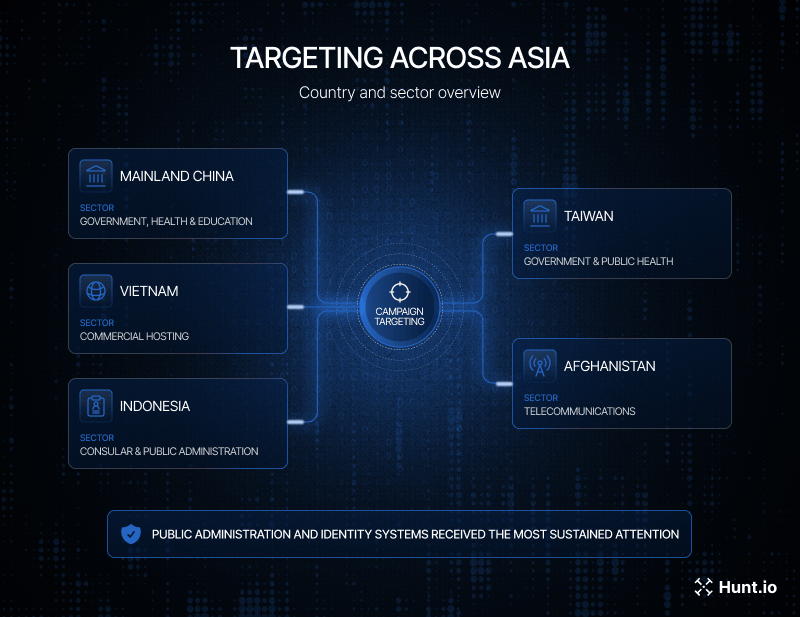
Threat intelligence firm Hunt.io just documented a second, separate China-linked campaign wiring commercial AI models directly into live cyberespionage operations, this time hitting Taiwan’s Kuomintang Party archives, Indonesia’s Ministry of Foreign Affairs, government and education systems in mainland China, and industrial hosts in Vietnam.

The full report traces the operation through five exposed open directories the operators accidentally left publicly accessible, which is how researchers reconstructed the entire orchestration system from the inside.

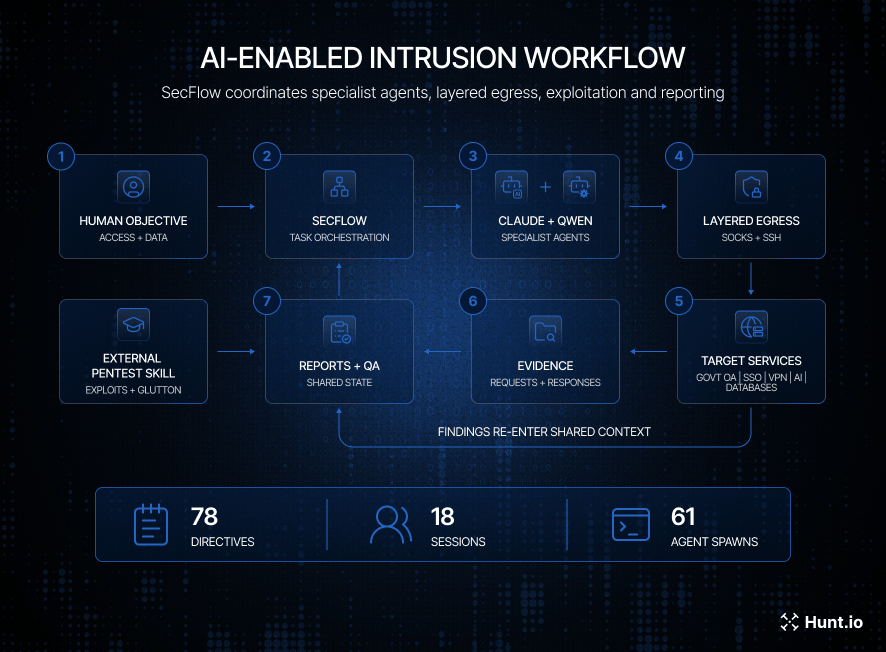
“Five open directories, one campaign. The exposed directories map to an AI orchestration host, a Java/CAS exploitation workspace, a fake MySQL deserialization service, a Shellshock and credential-testing node, and a payload-distribution store.” reads the report. “SecFlow split reconnaissance, exploitation, collection, and reporting among specialist workers. The runtime could switch between Claude, Qwen, and DeepSeek profiles without changing the task interface.”

The framework behind the campaign, called SecFlow by the operators, could use different AI models, including Claude, Qwen, and DeepSeek. The operators could switch between them without changing how the system worked. Instead of using the models’ official APIs, SecFlow routed requests through private proxy servers linked to the niestools.com domain.

The AI models did not break into systems on their own. They helped automate and organize traditional hacking tasks, such as scanning for vulnerabilities, testing stolen credentials, trying exploits, deploying webshells, collecting data and evidence, and generating reports. The attackers built the infrastructure that connected these AI capabilities to real-world intrusions.

The most damaging confirmed breach hit a Fengtai District government Office Automation environment in China, and it ran the full playbook from web shell to data theft.

“The most extensive compromise hit a Fengtai District government environment, where the operator achieved command execution, collected LSASS and registry hives, accessed government and health records, and deployed multiple Windows implants. Separate activity exposed a Chinese education AI platform and obtained root database access to a university campus-card system.” Hunt.io states. “SecFlow coordinated reconnaissance, exploitation, and reporting across Claude, Qwen, and DeepSeek workers. “

Operators achieved Windows command execution through internet-facing web applications, then used ASPX web shells not just to run commands but as a persistent operational backbone: querying internal databases, pulling an LSASS memory dump apart in 37 separate chunks to avoid detection, and extracting SAM and SYSTEM registry hives containing password hash material.

“The operator divided the LSASS dump into 37 blocks, requested each block through an authenticated SOCKS route, verified the expected byte count, and reconstructed the complete file.” continues the report. “The operator also collected the SAM and SYSTEM registry hives. Another server-side page, extract.aspx, scanned sections of the memory dump for Windows password-hash material.”

From there they pulled 822 OA user account records, created a new privileged account of their own for backup access, and walked away with 949 attachments totaling 1.28GB, including a chronic-disease report containing real patient health information.

In a separate case, the operators also exposed the management backend of a Chinese education AI platform. The irony is hard to miss: an AI company was compromised partly because its own AI infrastructure was not properly secured.

Hunt.io found a backend that anyone could access without authentication. It exposed 23 AI agent configurations, 14 API secret fields containing credentials, and 104 complete chatbot conversations. Some of those logs included real student data, such as names, student ID numbers, majors and academic advisers, taken from career-guidance and study-partner chats.

The exposed credentials were not just old or unused secrets. They worked against the platform’s live production API, meaning attackers could use the stolen keys to access real systems.

One particularly clever access method used a fake MySQL server as bait rather than a target. A malicious service impersonating a MySQL database would accept connections from vulnerable Java applications, then return specially crafted data designed to trigger unsafe object deserialization on the client side the moment it connected, turning what should have been an outbound database query into inbound code execution. That’s initial access flipped on its head, exploiting the assumption that connecting out to a database is inherently safer than accepting connections in.

The webshell tooling itself, a custom framework the operators called GLUTTON, hid its payloads inside PNG image files using steganography, literally embedding executable code in the red, green, and blue color channel data of ordinary-looking images. A small decoder script on the server would read the image pixel by pixel, XOR-decrypt the hidden bytes using a fixed key, and load the resulting code directly into memory without ever writing an obviously malicious file to disk. Any security control that only checks file extensions or content types for image uploads would sail right past this without noticing anything wrong.

This isn’t an isolated incident for the underlying pattern either. It’s the second campaign in two months where researchers caught commercial AI coding tools embedded as operational components of live nation-state intrusions, following a similar Hunt.io discovery in June involving the same Claude Code and DeepSeek combination against separate government and financial targets in Afghanistan and Thailand. Anthropic itself disclosed a related pattern back in November 2025, describing attackers who convinced Claude it was doing legitimate defensive penetration testing by splitting malicious requests into small, individually harmless-looking pieces.

The operators also left a clear trace across their own infrastructure. The username “Nie” appeared several times in hardcoded file paths inside the GLUTTON tools and was reused in proxy credentials, linking all five compromised workspaces to the same campaign.

For defenders, this is especially important if they use Java frameworks vulnerable to deserialization attacks, older Apache or Grafana systems, or public-facing office automation software. The campaign shows that attackers can treat commercial AI models as interchangeable tools. The key question is no longer which AI model carried out an attack, but how quickly defenders can recognize the attack pattern, regardless of which model was used.

Follow me on Twitter: @securityaffairs and Facebook and Mastodon

Pierluigi Paganini

(SecurityAffairs – hacking, AI Agents)

Pegasus and NoviSpy Used Against Serbian Protesters

Serbian activists were targeted with zero-click Pegasus and NoviSpy spyware, exposing a major surveillance campaign ahead of elections.

A member of Serbia’s student protest movement had their iPhone infected with NSO Group‘s Pegasus spyware without ever clicking a link or opening a file. The Citizen Lab confirmed the infection in collaboration with the SHARE Foundation, tracing it to an iMessage zero-click exploit and identifying high-confidence indicators of compromise between December 2025 and January 2026, with the possibility of additional infections not ruled out.

“In collaboration with the SHARE Foundation, the Citizen Lab analyzed forensic artefacts from the iPhone of a member of Serbia’s student protest movement after they received an Apple Threat Notification warning of targeting with mercenary spyware.” reads the report published by Citizen Lab. “Our analysis confirmed that an iMessage zero-click exploit was used to infect the device with NSO Group’s Pegasus spyware. “

The attack required no action from the victim, which makes zero-click attacks especially dangerous. Citizen Lab said the Pegasus infection could stay hidden while giving the attacker full access to the phone, including messages, photos, notes, microphone, and camera. Apple later fixed this specific exploit through security updates in iOS 18.4.1.

“We believe that the zero-click exploit used in this attack targeted Apple iMessage, and has subsequently been patched by Apple as of iOS 18.4.1.” continues the report. “A zero-click infection with Pegasus spyware would not have been visible to the target, and would give the Pegasus attacker total access to the device. Pegasus allows an attacker to do anything that a user can do, ranging from accessing private data like notes, pictures and even encrypted messages. Pegasus also has the ability to covertly enable the phone’s microphone and camera.”

This one confirmed infection sits inside something considerably bigger. The SHARE Foundation has documented at least 14 individuals targeted with advanced spyware since early 2026, spanning student movement members, civil society activists, an opposition member of parliament, and a local councilor, which the organization is calling the largest documented surveillance wave in Serbia’s history. Twelve people approached SHARE’s digital forensics team in August after receiving Apple’s own threat notifications, warnings the company sends when it detects likely state-sponsored spyware targeting; eleven of those devices remain presumed infected pending further forensic confirmation.

The timing lines up uncomfortably well with Serbia’s political calendar. This surveillance wave coincides with local elections held on March 29, 2026, and stretches toward planned early parliamentary elections in October, following months of student-led anti-government and anti-corruption protests.

“These notifications and forensic confirmation highlight the aggressive mercenary spyware targeting of the peaceful pro-democracy movement with mercenary spyware ahead of key 2026 election cycles.” continues the report.

Targeting activists and opposition figures specifically in the run-up to elections isn’t subtle, and it fits a pattern Serbia has shown before.

Serbia has a history of using commercial spyware. Citizen Lab previously documented Pegasus targeting civil society and the use of Cellebrite tools to install the locally developed NoviSpy on activists’ phones. In this case, SHARE Foundation and Amnesty Tech found a new version of NoviSpy on a student activist’s Android phone after Serbian authorities seized it during police questioning.

Amnesty International’s Security Lab head, Donncha Ó Cearbhaill, connected the dots plainly between state custody and spyware installation.

“The forensic findings by SHARE prove that Serbian students continue to be targeted with invasive Android spyware tools, installed while detained by Serbian authorities” he said.

If you’ve received an Apple Threat Notification, whether in Serbia or anywhere else, the Citizen Lab’s guidance is unambiguous: treat it as a presumed infection and get expert help immediately rather than waiting to see if anything seems wrong. Individuals in Serbia should contact the SHARE Foundation directly, and anyone elsewhere can reach Access Now’s Digital Security Helpline, which supports journalists, human rights defenders, and other high-risk civil society targets worldwide. Anyone who suspects they might be a target based on their work or public role should also turn on Lockdown Mode, Apple’s built-in feature that significantly narrows what a zero-click exploit can actually reach, and keep every device updated, since the patch that closed this specific hole has already existed for well over a year for anyone who installed it.

“We believe that the zero-click used in this attack has been rendered ineffective by a patch from Apple in recent iOS versions. We urge everyone, especially those facing increased risks because of who they are or the work they do, to keep all devices updated.” concludes the report. “Click HERE for instructions on how to keep your iPhone up to date.”

Follow me on Twitter: @securityaffairs and Facebook and Mastodon

Pierluigi Paganini

(SecurityAffairs – hacking, Pegasus)

Pegasus, New NoviSpy Variant Found on Serbian Students and Opposition Figures

Pegasus, Pegasus Spyware, Serbia, Serbia Protests, Smartphone screen forming an eye shape against an abstract protest crowd, illustrating spyware targeting of Serbian student activists.

At least 14 people connected to Serbia's student protest movement and opposition politics have been targeted with mercenary spyware since early 2026, the Belgrade-based digital rights organization SHARE Foundation said, in what it called the largest documented wave of such targeting in the country.

The group said the cohort includes student movement members, civil society activists, a member of parliament and a local councilor. Forensic analysis was independently confirmed by the Citizen Lab at the University of Toronto and by Amnesty International's Security Lab.

Citizen Lab, in its own findings, said it verified an infection with NSO Group's Pegasus on the iPhone of a student activist who asked not to be named. High-confidence infection indicators span December 2025 through January 2026, delivered by a zero-click iMessage exploit that required no interaction from the target. Apple has since patched the underlying flaw; the fix shipped in iOS 18.4.1. Pegasus grants an operator access to notes, photographs and messages decrypted on the device, and can silently activate the microphone and camera.

Amnesty's Security Lab confirmed a new variant of NoviSpy, an Android implant first identified in Serbia in 2024, on two additional devices. SHARE said the rebuilt version was designed to evade the detection methods that exposed its predecessor.

Also read: Investigative Journalists in Serbia Hit by Advanced Spyware Attack

The circumstances of two infections are what elevate the findings beyond routine spyware reporting. SHARE said one NoviSpy infection appeared after police seized a student's phone during questioning, and another after private messages from that device were published by a pro-government media outlet. Donncha Ó Cearbhaill, who heads Amnesty's Security Lab, said the evidence suggests "infections are being carried out during detention by Serbian authorities."

Suspicion centers on Serbia's Security Information Agency, or BIA. Amnesty's December 2024 report "A Digital Prison" found earlier NoviSpy samples configured to send collected data to IP addresses associated with BIA servers, and documented the agency's parallel use of Cellebrite extraction tools on journalists and activists. In March 2025, Amnesty reported that two journalists at the Balkan Investigative Reporting Network were targeted with Pegasus.

The current cases surfaced through Apple's threat notification wave of Aug. 13, which reached users in 110 countries. The timing is politically loaded. The targeting overlaps with protests that followed the November 2024 collapse of a railway station canopy in Novi Sad, spans local elections held March 29 in 10 municipalities, and precedes October parliamentary elections widely read as a test of the ruling Serbian Progressive Party.

Ana Toskic Cvetinovic, a legal expert cited in the reporting, noted that deploying intrusive software without judicial authorization is unlawful under Serbian law. SHARE published an analysis of the domestic legal framework in January arguing the same. Criminal complaints filed over the 2024 cases remain pending before Serbian courts, with no resolution.

Also read: 7 New Pegasus Infections Found on Media and Activists’ Devices in the EU

NSO has been on the U.S. Commerce Department's Entity List since 2021.

Serbia is an accession candidate, the European Parliament has previously questioned the Commission over unlawful spyware use in the country, and the Commission published its 2026 enlargement country report in July. Amnesty's submission for that package raised surveillance directly.

Both groups urged at-risk users to enable Lockdown Mode on iOS or Advanced Protection on Android.

CrowdStrike Disrupts Sality Botnet After More Than 20 Years

Cybersecurity expert Ken Underhill reports from CrowdStrike on the disruption of the 20-year-old Sality botnet and what security teams need to know.

The post CrowdStrike Disrupts Sality Botnet After More Than 20 Years appeared first on TechRepublic.

Introducing context-aware vulnerability discovery and remediation with Cloudflare Managed Defense and OpenAI Daybreak models

Your scanner just flagged 4,000 new vulnerabilities, 78 of them critical. Which one do you fix first?

To answer that question, Cloudflare is announcing early access to Vulnerability Discovery and Remediation, now part of Cloudflare Managed Defense. Vulnerability Discovery and Remediation is a new, invitation-only Cloudflare service that helps customers detect and mitigate vulnerabilities in their codebases.

Through the OpenAI Daybreak Defense Network, we use OpenAI Daybreak models, including GPT-5.6 Cyber, for reconnaissance, hunting, and validation against codebases that you authorize us to access. If we detect a vulnerability, we will then propose solutions to you, automatically checking each proposed patch and any accompanying proposed mitigation before presenting them for review. Importantly, you are in the driver’s seat: while we may propose code patches and other mitigations, you decide whether they are implemented.

Choosing what to fix first has always been hard. It's getting harder. Large language models can now surface weaknesses across a codebase in minutes, which means the number of findings keeps climbing. But the real problem is speed. Attackers can use AI to accelerate parts of vulnerability discovery and exploitation, giving security teams and developers less time to decide what matters and act on it.

Imagine that your scanner tells you there's a vulnerability in a handler. It doesn't tell you whether that code is deployed. It doesn't tell you whether anyone is actually hitting that route, what security activity surrounds it, or what controls you already have in place. You have to prioritize the finding without evidence of its production exposure or the protections already in place.

This is where we can help. With our global network, we can see which routes are active, how much traffic they carry, and what security events surround them. When customers enable Vulnerability Discovery and Remediation with Web Application Firewall (WAF), we can also see what rules are already applied and are actively blocking attacks. That context turns a generic finding into a specific priority: this vulnerability is in code that's live, on a route that's heavily used, with recent attack activity and no existing protection. And we can help you mitigate that vulnerability by proposing custom WAF mitigations and code patches tailored to your systems.

If this sounds familiar, it should. In “Build your own vulnerability harness”, we described the model-agnostic pipeline we use to scan Cloudflare's fleet, adversarially validate every finding, and turn raw model output into fixes engineers can trust. That internal system is one pillar of Vulnerability Discovery and Remediation. The harness gave us a way to find bugs at fleet scale. Vulnerability Discovery and Remediation brings that discovery process to the code the customer authorizes us to inspect, then connects the findings to production traffic, security events, and the edge controls that can act on them.

This diagram provides an overview of our process, which we explain in more detail below.

Adding context to a vulnerability harness

Our solution works across Cloudflare Workers and proxied applications. The process of detecting vulnerabilities begins with the collection of a traffic and security data snapshot from Web Assets and WAF. The snapshot shows which routes are active, how much traffic they receive, and whether recent security events are associated with them. For instance, a path exhibiting a high volume of detection triggers may also be considered critical for security context purposes. Web Assets and WAF itself serve as the first and second pillar of Vulnerability Discovery and Remediation respectively.

Next, we use source code vulnerability analysis to identify potential weaknesses in code. But that analysis does not show which routes reach it, how much traffic those routes receive, whether they receive suspicious requests, or which protections already apply. We treat routes carrying a high volume of requests as hot paths. Source code deployed to these routes undergoes stricter security profiling. Together, these signals provide evidence about how the API is used and where a vulnerability may be exposed.

For Workers, we retrieve the most recent source version of the Worker and its configured routes to identify the endpoints the Worker serves. Next, we match the Worker's routes to Web Assets and request metadata from Workers Observability, tying the exact source under review to the endpoints it handles in production. This collected network context stays available throughout the investigation, allowing agents to pull it when they need it. 

Our vulnerability harness then starts up. It begins by using the Reconnaissance agent to map request paths to the parts of the codebase that handle them. Reconnaissance uses that map to send hunter agents into specific sections of the customer-authorized code, where they look for vulnerabilities and pull in relevant network context as needed. That context can help the hunter agents pay more attention to code behind an active or recently targeted route, but it does not establish that a vulnerability exists. Every vulnerability finding has to be corroborated by evidence in the source code.

Once the hunters return their findings, the validation stage checks the proposed mitigations before assigning each vulnerability an initial risk rating based on source code. The network evidence we collect can raise that rating further when, for example, the affected endpoint carries significant traffic or shows signs of active probing.

The result is a prioritized list of findings, each with a recommended code patch and, when the evidence supports it, a Cloudflare WAF Custom rule that can reduce exposure while the code fix is reviewed. If you have authorized our VDR to defend your zone, we will deploy the rules, scoped conservatively around the method, path, and other request details needed to reach the vulnerable code. If a route pattern contains only variables and wildcards, we do not suggest a rule. We would rather miss a possible connection than claim one the evidence cannot support.

The HTTP method override bypass example above shows how these signals work together. The harness maps the source finding to the production route, uses traffic and security activity to prioritize it, and scopes a proposed WAF rule around the requests that can reach the vulnerable code. That rule can reduce exposure while engineering reviews and ships the code patch.

Where the model runs

When you authorize an investigation, Vulnerability Discovery and Remediation runs the harness on Cloudflare and sends model prompts from Workers through Cloudflare AI Gateway to OpenAI Daybreak models on OpenAI's servers. GPT-5.6 Cyber is used during reconnaissance, hunting, and validation, and its responses return to the harness so the workflow can continue on Cloudflare. No model inference runs at Cloudflare's edge, and the model cannot apply any patch or rule it proposes.

We keep each investigation narrow by limiting it to the source code and evidence the customer authorizes. Before that context reaches the model, Vulnerability Discovery and Remediation removes what the investigation does not need and applies the redaction controls configured for the engagement. The harness treats source code, logs, and request metadata as evidence to inspect, rather than instructions to follow.

Tool access follows the same boundary: each call is logged and checked against the investigation's access policy before it runs, and every patch or rule proposal must pass checks implemented outside the model. If one of those checks fails, the workflow stops before the proposal reaches customer review.

Nothing is presented for review until it has cleared the checks and our team validates the output. For an edge-defense suggestion, that means validating the rule syntax and running it against synthetic fixtures that represent expected requests, rather than against customer traffic. If a check fails or the result remains ambiguous, we hold the output back and route it for diagnosis.

Passing those checks still does not change your environment. After validation by our team, Vulnerability Discovery and Remediation prepares the source code patch and WAF rule.

Join early access

Vulnerability Discovery and Remediation is available to selected customers by invitation during early access through our Managed Defense team. Each engagement starts with one application whose codebase the customer authorizes us to investigate. To connect the findings to production, Vulnerability Discovery and Remediation uses authorized read access to the Web Assets operation inventory, the relevant WAF controls, and Workers Trace Events Logpush where available. The investigation is semi-automated, but you review every result before deciding whether to test or deploy a change.

If you're interested in learning more, talk to your Cloudflare account team.

❌