Visualização de leitura

GitLab Duo Claude AI Agent Flaw Lets Attackers Execute Arbitrary Commands in CI Pipelines

GitLab has released security updates for both its Community Edition and Enterprise Edition, addressing seven vulnerabilities, including a high-severity flaw in its Duo Claude AI agent. This vulnerability could allow authenticated developers to execute arbitrary commands within a CI (Continuous Integration) context. GitLab Duo Claude AI Agent Flaw The issue, tracked as CVE-2026-18252, arises from […]

The post GitLab Duo Claude AI Agent Flaw Lets Attackers Execute Arbitrary Commands in CI Pipelines appeared first on GBHackers Security | #1 Globally Trusted Cyber Security News Platform.

GitLab Warns of Active Exploitation of Critical GraphQL Flaw

GitLab flaw CVE-2026-19478 is now under active exploitation, allowing unauthenticated attackers to modify or delete public projects.

WatchTowr researchers warn of active exploitation of critical GitLab flaw CVE-2026-19478 (CVSS score of 9.4). This week, GitLab pushed out an emergency patch to address this flaw, which could let an attacker with zero credentials remotely modify or delete public projects and user data.

“GitLab has remediated an issue that under certain conditions could allow an unauthenticated user to remotely modify or delete public projects and user data via a GraphQL directive.” reads the advisory.

GitLab issued an emergency patch on August 17, five days after its regular update. The vulnerability impacts only self-managed installations, users should upgrade to versions  19.2.4, 19.1.6, 19.0.8, and 18.11.11.

There’s a gap worth flagging for anyone still sitting on an older release. The available patches don’t cover the 18.2 through 18.10 branches, even though those versions technically fall inside the affected range. If you’re running anything in that window, staying put isn’t really an option; you’ll need to upgrade to a patched branch entirely rather than waiting for a fix that isn’t coming for your current one.

hiimguardian reported the flaw through the company HackerOne bug bounty program.

Organizations should urgently patch internet-facing GitLab servers. Until they can update, they should restrict unauthenticated access to /api/graphql, disable public repositories where possible, and check logs for requests containing @gl_introduced.

Follow me on Twitter: @securityaffairs and Facebook and Mastodon

Pierluigi Paganini

(SecurityAffairs – hacking, CVE-2026-19478)

Critical GitLab Code Injection Vulnerability Actively Exploited in Attacks

GitLab administrators are being urged to patch immediately after security researchers observed attempts to exploit CVE-2026-19478, a critical unauthenticated code injection vulnerability affecting self-managed GitLab Community Edition and Enterprise Edition instances.

The flaw, rated 9.4 out of 10, can allow remote attackers to modify or delete public projects and associated user data through GitLab’s GraphQL interface. GitLab issued an out-of-band update on August 17, 2026, outside its regular security release schedule.

The issue stems from improper handling of a GraphQL directive, which can be abused under specific conditions without requiring an account, authentication, or user interaction. This makes internet-facing GitLab deployments especially exposed.

Security firm WatchTowr reported that it reproduced the vulnerability within minutes of disclosure by analyzing GitLab’s public advisory and the vendor’s patch changes. Researchers said the practical impact may extend beyond GitLab’s short description of unauthorized modification or deletion.

An attacker could reportedly remove repositories, manipulate merge-related records to create a misleading appearance that changes were merged, or ban legitimate maintainers from public projects.

GitLab Code Injection Vulnerability

Exploitation activity has already been detected in the wild. watchTowr said its Attacker Eye honeypot network recorded attempts to exploit the vulnerability shortly after the disclosure, indicating that attackers are rapidly testing exposed GitLab instances.

While public technical details and proof-of-concept activity can accelerate weaponization, the main risk is the flaw’s pre-authentication access and low barrier to remote exploitation.

The vulnerability affects GitLab CE and EE versions 18.2 through 18.11.10, 19.0 through 19.0.7, 19.1 through 19.1.5, and 19.2 through 19.2.3. GitLab has released patched builds 18.11.11, 19.0.8, 19.1.6, and 19.2.4.

GitLab patched GitLab.com and GitLab Dedicated, and no customer action is required. However, organizations running self-managed GitLab installations must upgrade without delay.

Where an immediate upgrade is operationally difficult, defenders should identify internet-exposed instances, review whether public projects are enabled, and restrict access to the GraphQL endpoint via network controls or a reverse proxy until patching is complete.

Security teams should also review recent GraphQL activity, repository deletions, unexpected project modifications, suspicious changes to merge records, and unexplained maintainer access restrictions.

Given confirmed attempts at exploitation, organizations should treat exposed, unpatched GitLab servers as potentially compromised and preserve relevant logs before remediation.

Prevent incidents due to slow investigations. Power your Tier 1 with threat intelligence from 15K SOCs: Integrate TI Lookup in your SOC

The post Critical GitLab Code Injection Vulnerability Actively Exploited in Attacks appeared first on Cyber Security News.

GitLab Patches Critical Unauthenticated GraphQL Vulnerability

GitLab patched a critical GraphQL flaw that let unauthenticated attackers remotely modify or delete public projects on self-managed servers.

GitLab pushed out an emergency patch this week to address a critical flaw, tracked as CVE-2026-19478 (CVSS score of 9.4), that could let an attacker with zero credentials remotely modify or delete public projects and user data.

“GitLab has remediated an issue that under certain conditions could allow an unauthenticated user to remotely modify or delete public projects and user data via a GraphQL directive.” reads the advisory.

GitLab issued an emergency patch on August 17, five days after its regular update. The vulnerability impacts only self-managed installations, users should upgrade to versions  19.2.4, 19.1.6, 19.0.8, and 18.11.11.

There’s a gap worth flagging for anyone still sitting on an older release. The available patches don’t cover the 18.2 through 18.10 branches, even though those versions technically fall inside the affected range. If you’re running anything in that window, staying put isn’t really an option; you’ll need to upgrade to a patched branch entirely rather than waiting for a fix that isn’t coming for your current one.

hiimguardian reported the flaw through the company HackerOne bug bounty program.

A second, less severe issue shipped in the same release. CVE-2026-19650 (CVSS score of 7.1), involves a cross-site request forgery weakness in how GitLab’s GraphQL handles multiplex queries, letting an unauthenticated attacker trigger mutations through GET requests due to improper validation. Unlike the critical flaw, this one needs a victim to actually interact with something, so it’s a real risk but a considerably narrower one.

There’s no evidence either bug has been exploited in the wild yet, and no public proof-of-concept code has surfaced as of publication. That’s the good news. The less comforting part is GitLab’s own disclosure policy: full technical details typically go public on the company’s issue tracker 90 days after the patching release, which puts a working understanding of exactly how this bug functions squarely in mid-November, plenty of time for someone motivated enough to reverse-engineer the patch diff themselves before then.

This is not the first serious GitLab issue in recent months. Last month, researchers released working exploit code for another remote-code-execution flaw affecting self-managed servers. Organizations running GitLab on their own infrastructure should therefore treat this patch as a priority, especially given the critical severity and the fact that the vulnerability requires no authentication or user interaction.

Follow me on Twitter: @securityaffairs and Facebook and Mastodon

Pierluigi Paganini

(SecurityAffairs – hacking, GitLab)

GitLab 19.2.2 Patches 13 Security Flaws, Including High-Severity XSS and CI/CD Authorization Flaws

GitLab has released security updates for Community Edition and Enterprise Edition, addressing 13 vulnerabilities affecting analytics dashboards, CI/CD workflows, APIs, AI services, project settings, and package management.

The company issued GitLab 19.2.2, 19.1.4, and 19.0.6 on August 12, 2026, and strongly advised self-managed customers to upgrade as soon as possible. GitLab.com is already patched, while GitLab Dedicated customers do not need to take action.

The update addresses six high-severity flaws, six medium-severity flaws, and one low-severity issue. The most serious problems include three cross-site scripting vulnerabilities and multiple authorization weaknesses that could let authenticated users perform actions beyond their intended permissions.

These bugs are especially important for organizations that use GitLab as a central platform for source code, CI/CD pipelines, package registries, and DevSecOps operations.

GitLab Patches Security Vulnerabilities

Two high-severity XSS flaws, tracked as CVE-2026-15217 and CVE-2026-15216, affect the Analytics Dashboards feature. Both bugs received a CVSS score of 8.7.

They occur because GitLab did not properly neutralize user-controlled values displayed in dashboard table cells and pagination controls.

An attacker capable of submitting crafted content could execute malicious JavaScript when another user views the affected dashboard content. Successful XSS attacks can expose session data, alter browser actions, or perform operations in the context of a targeted user.

Another high-severity issue, CVE-2026-15423, affects the CI/CD pipeline API and has a CVSS score of 8.5. GitLab said a developer-level user could, under certain conditions, run a pipeline on a protected branch without having the required push permission.

The weakness exists in pipeline reference validation. Protected branches commonly enforce stricter controls because they are used for production code, releases, or security-sensitive workflows. Unauthorized pipeline execution may pose risks to build artifacts, deployment logic, CI variables, or software supply chain processes.

GitLab also patched CVE-2026-16627, an XSS flaw in the CI manual job confirmation modal. The bug affects GitLab 19.2 versions before 19.2.2. It could allow a developer-level user to escalate privileges by exploiting improperly sanitized HTML rendered in the job modal.

The issue carries a CVSS score of 7.7. It demonstrates how UI-level injection flaws can have broader impact when they target privileged users reviewing CI/CD jobs.

Enterprise Edition users should also note authorization flaws in the Duo Workflow Service and ProjectsController. CVE-2026-19228 could allow authenticated users to attribute AI usage to another namespace.

At the same time, CVE-2026-16494 could allow changes to project settings that are normally restricted to higher-privileged roles. GitLab also resolved medium-severity authorization problems involving merge requests, external status checks, GitLab Duo settings, and AI Tool Rules.

Other patched issues include an unauthenticated denial-of-service condition in the GraphQL API JSON parser and an authorization weakness in the npm dist-tags endpoint.

The latter could allow developers to modify some package registry metadata without maintainer-level permission. Although these issues are rated lower, they can still affect service availability, project privacy, and software package integrity.

Administrators running vulnerable releases should upgrade to GitLab 19.2.2, 19.1.4, or 19.0.6, depending on their supported version branch.

Single-node deployments should plan for downtime, as the update includes database migrations that must complete before GitLab starts. Multi-node environments may apply the update without downtime when using GitLab’s zero-downtime upgrade procedures.

 Strengthen Your SOC by Accelerating Threat Detection & Rapid Investigations. -> Integrate ANY.RUN With Your SOC Now.

The post GitLab 19.2.2 Patches 13 Security Flaws, Including High-Severity XSS and CI/CD Authorization Flaws appeared first on Cyber Security News.

GitLab Users Urged to Patch After Research Reveals Critical RCE Chain

Researchers chained two Oj parser bugs to achieve GitLab RCE via Jupyter notebook diffs, affecting authenticated users on unpatched versions.

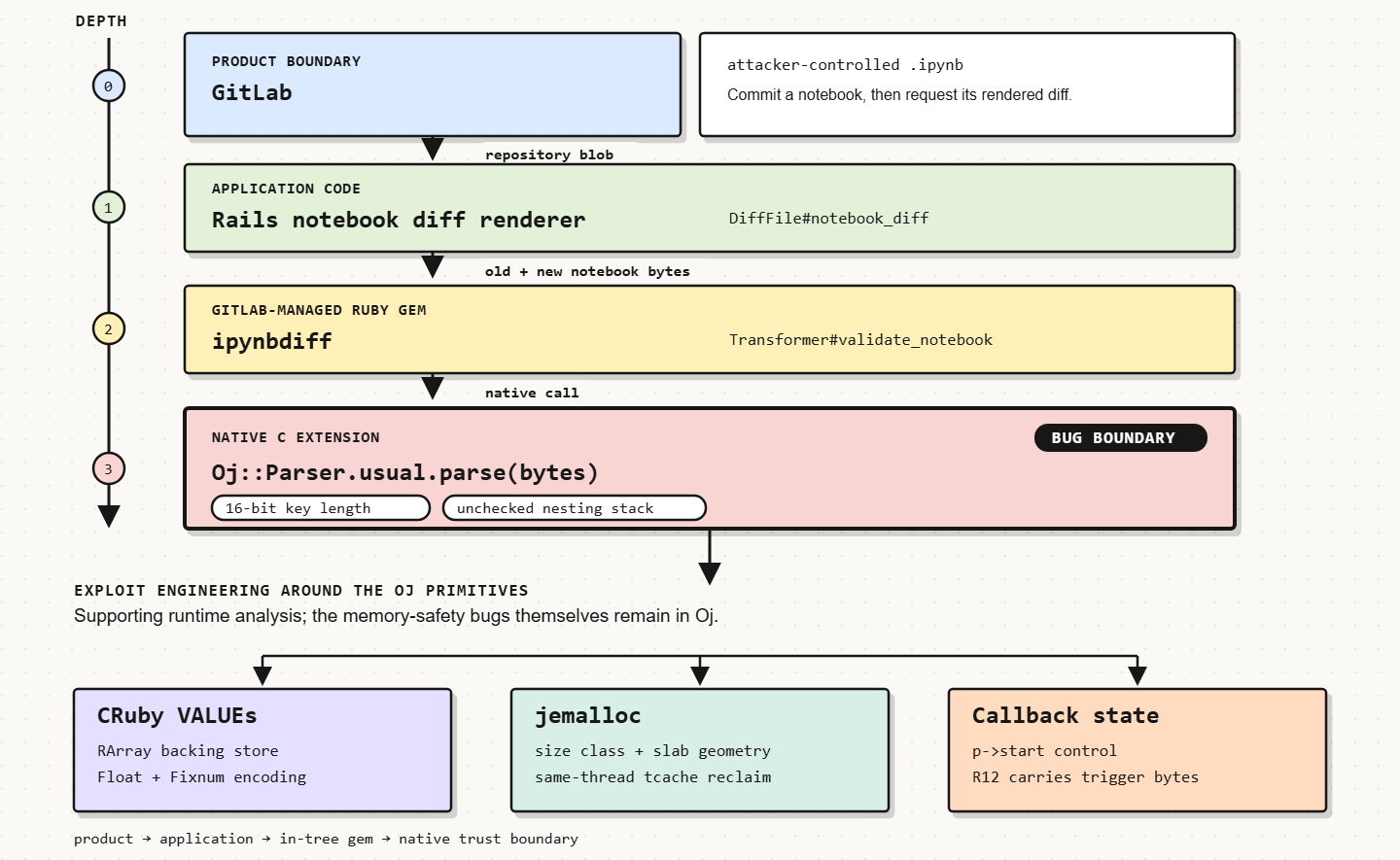
Depthfirst researchers published a working remote code execution exploit for GitLab on July 24, chaining two memory corruption bugs in Oj, a Ruby JSON parser with a native C implementation, into full command execution inside a GitLab Puma worker.

Any authenticated user who can push to a project and view commit diffs could run it. The researchers pointed out that no admin rights, no CI access, and no victim interaction are needed. GitLab patched the bugs on June 10 but listed the fix under bug fixes, not the security table, so operators triaging the release had no reason to treat it as urgent.

“The system surfaced 18 prioritized vulnerabilities, including 7 memory-safety bugs. Two of them, an out-of-bounds write and a heap-pointer disclosure, had survived in Oj for nearly five years.” reads the report published by Depthfirst. “Oj is a low-level dependency used by GitLab, and we combined the two bugs to achieve remote code execution on a default GitLab installation.”

The bugs entered Oj’s parser on August 8, 2021. They remained there for 1,753 days. The vulnerable notebook path shipped in GitLab starting with version 15.2.0 in July 2022 and wasn’t fixed until June 10, 2026.

The attack path starts with GitLab’s notebook diff renderer, a small in-tree gem called ipynbdiff that converts Jupyter .ipynb files into human-readable diffs. When a user opens a commit diff for a notebook file, GitLab passes the raw repository bytes to Oj::Parser.usual.parse inside the Puma worker process. That parse call is the entry point.

“The investigation ran in reverse: depthfirst found the vulnerable parser below the application, then traced its callers back to a user-controlled product boundary.” continues the report. “A real request follows that chain in the opposite direction, from a GitLab commit diff into native C code.”

Because Oj::Parser.usual returns a process-wide parser singleton shared across threads in the same Puma worker, corrupting it once affects every subsequent parse in that process.

The first bug is an unchecked nesting stack overflow. Oj keeps track of JSON nesting depth in a fixed 1,024-byte array inside the parser object. When an attacker opens more than 1,024 nested arrays, Oj keeps writing one-byte collection selectors past the end of that buffer, into adjacent parser fields. The attacker can’t control each byte precisely, arrays always write 0x01, but they can control how far the sweep goes. With enough levels, that single byte changes buf.head, the parser’s internal buffer-start pointer, shifting it backward by 127 bytes into memory the parser doesn’t own. From there, a forced realloc caches that forged interior pointer, a Ruby Array allocation reclaims it, and the Array’s element contents, constrained to valid Ruby values but still attacker-influenced, overwrite the parser’s p->start callback pointer with a chosen address.

The second bug provides the address. An oversized object key, 65,565 bytes, gets its length truncated from a size_t to a signed 16-bit integer, which wraps to 29. Oj allocates heap memory for the full key and stores a pointer to it, but the truncated length tells the return path to read 29 bytes from the inline buffer instead. Those 29 bytes happen to contain the heap pointer in bytes 6 through 13. GitLab renders that into the diff as part of the cell ID.

“Returned bytes 0 through 5 came from the external view’s alignment padding. Bytes 6 through 13 were the live key pointer. The final 15 returned bytes came from union storage not written by the external view and could contain stale key-entry contents. This was a fixed 29-byte disclosure, not an arbitrary-address read: it exposed bytes already present in that Key entry and never dereferenced an attacker-selected pointer.” states the report. “These offsets came from the tested x86_64 ABI, so the compiler layout was part of the primitive’s boundary.”

With a heap landmark in hand, the attacker probes candidate libc base addresses by writing a self-looping instruction address into p->start and watching which parse hangs. On a fresh two-worker GitLab install, the ASLR search took five to ten minutes. On a mature long-running instance, the projected time is one to two hours.

Once the library base is recovered, the exploit chains the two primitives in a single diffs_stream request. Two lexically ordered notebook files in the same commit carry the stages: the first notebook arms the callback pointer, raises an exception to avoid immediate execution, and lets GitLab continue streaming diffs. The second notebook’s old side triggers p->start in the same Puma worker, which jumps through two libruby gadgets into system() with the attacker’s command in the right register. Commands run as git, the account behind Puma, which puts source code, Rails secrets, service credentials, and any internal service the application can reach within range.

“Successful exploitation executed commands as git, the account running GitLab’s Puma workers. Its effective reach depends on deployment isolation, but it may include repository data, Rails secrets, service credentials, and internal services available to the application.” concludes the report. “This can lead to source-code disclosure, credential theft, repository modification, persistence, or lateral access.”

GitLab CE and EE versions 15.2.0 through 18.10.7, 18.11.0 through 18.11.4, and 19.0.0 through 19.0.1 are affected across all tiers. Releases before 15.2 used a different JSON parser in this path and aren’t vulnerable. Releases from 15.2 through 18.9 are outside GitLab’s security-maintained patch trains and won’t receive backports — those installs need to move to a supported release. For Helm and Operator deployments, the relevant version is the GitLab version inside the Webservice image running Puma, not the chart version. Upgrade to 18.10.8, 18.11.5, or 19.0.2. No configuration-only workaround has been validated by depthfirst or GitLab.

Follow me on Twitter: @securityaffairs and Facebook and Mastodon

Pierluigi Paganini

(SecurityAffairs – hacking, GitLab)

❌