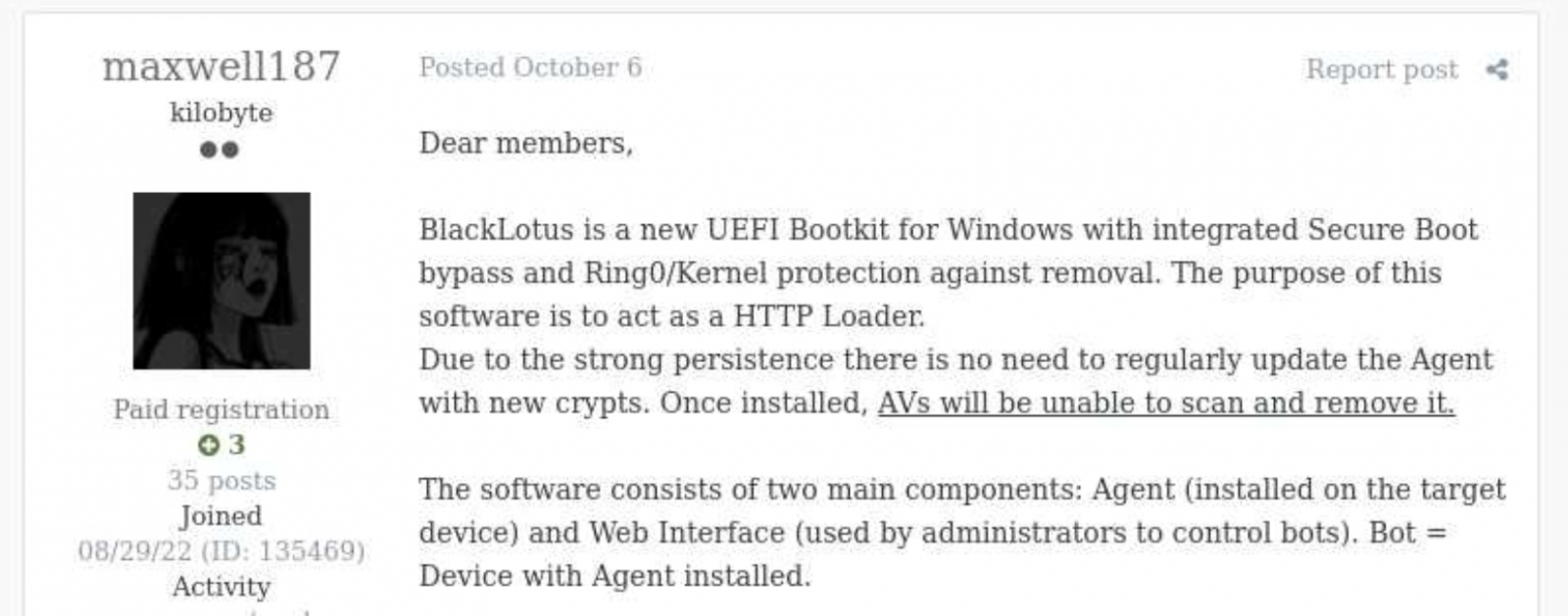
Back in October 2022, Kaspersky GReAT was looking into a peculiar advertisement on a hacking forum. A cybercriminal had been advertising a UEFI bootkit, dubbed BlackLotus, that could bypass Secure Boot, for $5,000. Given the low price for such powerful capabilities, the cybersecurity community initially took this advertisement with a grain of salt. As no BlackLotus samples were found in the wild, no one could at the time verify the claims made in the forum post.
BlackLotus advertisement
However, about half a year later, in March 2023, ESET confirmed that the BlackLotus advertisement was genuine. The researchers tracked down samples of this bootkit and confirmed that it can indeed bypass Secure Boot through a vulnerability called Baton Drop (CVE-2022-21894). As this vulnerability was still exploitable in 2023, Microsoft had to release multiple security updates to address it.
Since the release of these updates, the BlackLotus bootkit has gone quiet — no publicly known attacks have used it. Yet in early 2026, we discovered a malware sample similar to BlackLotus that was used in an APT campaign in Central Asia. In this report, we share our findings, including new payloads and possible attribution of this campaign.
The return of the infamous bootkit
In early 2026 we identified a complex APT attack targeting diplomatic agencies in Central Asian countries — namely Tajikistan, Uzbekistan, and Turkmenistan. This attack involved a UEFI bootkit that we dubbed BlackX. Having examined it, we found it to be similar to BlackLotus.
Attackers have been deploying BlackX after compromising the victim machine networks and obtaining administrator privileges. To install the bootkit, we observed them dropping the following files:
inst.exe, an installer executable
PVMDIJGKAX2, an RC4-encrypted extensionless file containing files and strings required for the installation
The installer was launched with the command line C:\ProgramData\Intel\inst.exe PVMDIJGKAX2 Q46F6MDLI3RX2KV1. The last argument here is the RC4 key used for decryption.
Curiously, the file inst.exe does not contain any malicious strings or embedded blobs. All the files needed to install the malicious payload are inside PVMDIJGKAX2, which makes it harder for incident responders to retrieve the bootkit components.
The installer package drops a set of files to both system and UEFI partitions, designed to exploit the Baton Drop vulnerability. We noted that the implementation of the exploit is remarkably similar to the one used in the BlackLotus malware. As with BlackLotus, the goal of the exploit is to install custom Machine Owner Keys (MOK), which allows loading arbitrary EFI files on the target machines to manipulate Secure Boot.
While the vulnerability exploitation chain was implemented very similarly to BlackLotus, we spotted differences between the exploits in BlackLotus and BlackX. That said, the source code of the BlackLotus bootkit has never been published online. This could mean that the attackers behind BlackX either reverse-engineered the BlackLotus bootkit or purchased its source code from cybercriminals. Either way, this is an interesting observation, as we rarely see APT actors borrow ideas or code from cybercrime actors.
Payload launched by the bootkit
The UEFI payload delivered during the Baton Drop exploitation has a classic bootkit goal — to inject a malicious driver into the Windows kernel. This driver differs from the one deployed by BlackLotus and is signed with a certificate belonging to an organization named 温江区明宇网络技术服务工作室 (English: Wenjiang District Mingyu Network Technology Service Studio). At the time of writing, this certificate (serial number: 0bcdf5e0da32d68900b8b7638459d072) has been revoked by its issuer.
The driver aims to tamper with security solutions installed on the machine. For example, it disables process, thread, and registry callbacks related to security solutions. It also tampers with ETW providers so that security solutions cannot access their output. Curiously, some of the tampering procedures are designed to run only if Kaspersky or Avast solutions are installed on the infected machine. However, during dynamic analysis of this driver, we found that these procedures are useless — they fail to interfere with Kaspersky products in any way.
The driver also protects the bootkit’s files from tampering. It intercepts kernel requests to open these files and returns a handle to calc.exe instead of a malicious file handle.
User-mode second-stage payloads
Apart from tampering with security solutions, the driver also deploys a user-mode payload. We observed two such payloads, used for cyberespionage, in the wild. One of them is a RAT that can load further-stage .NET payloads. This RAT uses cloud storage for C2 server communications — we observed its versions using Google Drive, OneDrive, and Yandex.Disk. Having connected to a cloud storage service, this RAT iterates over files available there and interprets them depending on the file suffix. Below is a list of supported suffixes:
File suffix
Description
Type
0X01
A .NET file. The task is to parse it and run the method TEST.Class1.RunCMD(argument_array) from the module
Input
0X02
Result of the call TEST.Class1.RunCMD(argument_array)
Output
0X03
Task to upload a file to the drive
Input
0X04
Uploaded file
Output
0X05
Task to download a file to an infected machine
Input
0X06
File download status
Output
SSSR
Contains initial system info
Output
We also observed another payload delivered through the bootkit, which we dubbed OxiDLLRunner. It is a malicious DLL obfuscated with OLLVM. It is loaded by the legitimate file googleupdate.exe (original filename: jcef_helper.exe, MD5: AF8A983B9ADA07EAE1259BF2953ABD40), which is also delivered by the bootkit. The DLL decrypts the contents of the file v8_context_snapshot.bin, which resides in the same folder, and then jumps to the beginning of the decrypted content. The decrypted data starts with shellcode followed by a PE file, which is a Rust payload designed to communicate with the www[.]archivetj[.]com C2 server. During communication, this payload is supposed to receive DLL files exporting a function named create_plugin, which are then executed in separate threads.
Attribution
Based on the following facts, we have attributed this attack to the APT41 threat actor with medium confidence:
In June 2026, ESET published a blog post on attacks by the FishMonger threat actor, which the community assumes to be related to APT41. This post describes a kernel implant with a PDB path starting with C:\Users\xdd\Desktop. While describing the campaign, the post also suggests the possible use of an unspecified UEFI bootkit component, which might exploit CVE‑2023‑24932. We observed the identifier “xdd” used multiple times in the BlackX bootkit payloads, so we assess that BlackX is the UEFI bootkit referenced in the ESET blog post;
The payloads deployed by BlackX are loaded using a legitimate executable abused via DLL sideloading, and an encrypted file — this pattern is common among Chinese-speaking threat actors;
The OxiDLLRunner file has been obfuscated with OLLVM, an obfuscator commonly used by Chinese-speaking actors.
Why did the target organizations get infected?
During our initial analysis of BlackX, we thought that attackers succeeded in deploying it due to the negligence of the target organizations. Baton Drop, the vulnerability used to deploy BlackX, was disclosed back in 2023 and was patched, so we first thought that the infected machines lacked the relevant updates. However, our investigation proved this wrong — the targeted machines were fully patched.
Instead, we found out that the problem was with the patch itself. As it turned out, the patch for the Baton Drop vulnerability is designed to revoke the “Windows Production PCA 2011” certificate used to sign vulnerable UEFI components. However, this revocation does not happen automatically upon patch installation — the user has to trigger it manually. This is done with the following steps:
A registry flag is set inside HKEY_LOCAL_MACHINE\SYSTEM\CurrentControlSet\Control\Secureboot;
A scheduled task named Secure-Boot-Update is created.
This patch is designed to be applied manually — for instance, applying it automatically could break dual-boot systems relying on the “Windows Production PCA 2011” certificate to load. At the same time, this patch deployment practice creates a problem — as it is extremely unusual for a system administrator to take extra steps after installing an update. Usually, when applying patches, system administrators take no further action unless an installation failure occurs. These instructions for activating the patch are buried deep on the Microsoft website, and we assess that they are quite hard for an average IT administrator to notice.
Curiously, Microsoft’s plan for deploying the Baton Drop patches mentions an “Enforcement Phase” that involves revoking the “Windows Production PCA 2011” certificate automatically, without user interaction. At the time of publishing this post, this stage has not been implemented. On October 19, 2026, this certificate expired, but this does not prevent the vulnerable binaries from loading unless the certificate is blocklisted.
It is likely that the threat actor behind this campaign took into account that few organizations realized the importance of manually activating the Baton Drop patch. As such, we believe they decided to invest time in understanding how BlackLotus works and creating a copycat of this bootkit.
Conclusion
Patch management is important for every organization, as updates from vendors help protect software and hardware against known vulnerabilities. However, sometimes installed patches fail to protect against the flaws they address. The BlackLotus story we described is not the only such example — for instance, in 2025 Microsoft released an update against the ToolShell vulnerability that also had to be applied manually.
However, modern security solutions are designed to account for such cases when installed patches fail to protect against security flaws for one reason or another. For instance, the Exploit Prevention component available in Kaspersky products prevents exploits from running if the patch is not applied, or if it is a zero-day vulnerability with no available patch. It is thus crucial to equip all machines in an organization with security solutions and constantly monitor the alerts they raise.
This year saw the emergence of The Gentlemen, a prominent example of a group operating under the ransomware-as-a-service (RaaS) model. Although our initial assessment suggested the group first appeared in mid-2025, it actually started ramping up its activities at the beginning of 2026. According to public reports, in the first half of 2026, this group ranks among the top 10 ransomware actors by the number of victim announcements on its data leak site (DLS).
We have been observing the activity of The Gentlemen since February 2026 and have discovered new tactics, techniques, and procedures (TTPs) as well as custom tool development efforts, as they target large corporations and critical infrastructure worldwide. In our research, we have uncovered the group’s methods of reconnaissance, network sniffing, and many other techniques that have not been publicly described before by the wider community.
Technical details
Initial infection vector
The Gentlemen group and its affiliates usually get into victim systems by exploiting vulnerabilities in online services and using stolen or weak login credentials, as reported by multiple cybersecurity vendors. They often target devices like hardware VPNs and firewalls that are exposed to the internet, and use leaked or default credentials to gain access.
We believe the group is likely collaborating with other actors or initial access brokers (IABs) to gain access to the target organizations. While they often deploy ransomware within a few hours after initial access is obtained, our analysis of several attacks revealed some cases, in which access to the victim’s system had been established long before the ransomware was deployed. These cases involved tactics that are not typically associated with the group. This suggests that the initial breach may not have been executed by The Gentlemen at all, but rather by another group or an initial access broker.
Reconnaissance
Our investigation reveals that The Gentlemen conduct thorough internal reconnaissance using tools like SharpADWS, NetScan, Advanced IP Scanner, and netsh to map the target environment and identify vulnerabilities. SharpADWS is used to gather detailed Active Directory information, including domain object enumeration, and can bypass standard logging by wrapping LDAP queries in SOAP messages. The group also uses NetScan and Advanced IP Scanner to scan the network, discover active ports and services, and identify potential vulnerabilities, ultimately gaining a deeper understanding of the network and establishing remote control over identified systems.
Microsoft’s netsh tool is used to capture network packets and gather intelligence, executing the command
cmd.exe /Q /c netsh trace start capture=yes report=no filemode=circular overwrite=yes maxSize=4 > \<target IP>\ADMIN$\{RANDOM-FILE-NAME} 2>&1 to start the capture, and
cmd.exe /Q /c netsh trace stop > \<target IP>\ADMIN$\{RANDOM-FILE-NAME} to stop it.
The captured data is saved to a shared administrative folder with a random name, and can be analyzed with tools like Wireshark to reveal sensitive information such as unencrypted network activity and potential passwords, which the attackers then use to conduct targeted ransomware attacks.
Lateral movement
The Gentlemen group leverages the NETLOGON share to distribute the ransomware executable to connected computers, enabling simultaneous attacks on multiple devices. To facilitate lateral movement, they use a customized PowerShell script, deploy_gpo.ps1, with specific parameters and variables for each target system. Additionally, they employ PsExec to remotely execute the ransomware binary on targeted systems, providing an alternative method for spreading the infection when the GPO-based approach is not feasible.
Disabling security products
The Gentlemen group uses various methods to disable security software on targeted computers, including the BYOVD technique. This involves installing a vulnerable driver and exploiting its weakness to shut down security software, gain unrestricted access, and launch ransomware attacks. We observed the following vulnerable drivers used in the group’s attacks.
Driver name
Description
ProcessMonitorDriver.sys
Safetica DLP and EDR driver
wamsdk.sys
WatchDog anti-malware driver
gamedriverx64.sys
Fedeen/Hotta studio anti-cheat driver
biontdrv.sys
Paragon partition manager driver
inpoutx64.sys
A legacy driver involved in managing RGB lighting
wsftprm.sys
Topaz anti-fraud software driver
Havoc.sys
Huawei audio driver
The Gentlemen group also uses specialized tools, including Windows Kernel Explorer and OpenArk64, to disable security software. These tools can intercept and block system calls, and even remove security drivers, allowing the attackers to bypass security measures and remain undetected.
Besides this, the group employs simple methods to disable security software, such as using kavrmvr.exe to uninstall Kaspersky Antivirus, which is prevented by the product’s behavioral detection, and modifying Windows registry settings to disable Windows Defender’s real-time protection.
Windows Registry Editor Version 5.00

[HKEY_LOCAL_MACHINE\SOFTWARE\Policies\Microsoft\Windows Defender]
"DisableAntiSpyware"=dword:00000001

[HKEY_LOCAL_MACHINE\SOFTWARE\Policies\Microsoft\Windows Defender\Real-Time Protection]
"DisableBehaviorMonitoring"=dword:00000001
"DisableOnAccessProtection"=dword:00000001
"DisableScanOnRealtimeEnable"=dword:00000001
Last but not least, the attackers attempt to disable Windows Defender’s real-time monitoring and ransomware protection, and add itself to the exclusion list, by executing multiple PowerShell cmdlets, as observed in the Go implant, which we’ll analyze later in this post:
We observed a custom-made implant, written in Go and deployed a day before the ransomware attack, which acted as a backdoor, enabling remote command execution. The implant collected system information (hostname, domain name, UUID, and local IP addresses) and organized it into a JSON format using a map structure with keys like name, domain, uuid, and localIPs. To obtain the system’s UUID, it used the WMI query
"SELECT UUID FROM Win32_ComputerSystemProduct". It then used the Yamux library to establish a persistent bidirectional TCP connection with the C2 server at 81.177.215[.]15:9443. It sent the collected system info to the C2 and waited for operator responses, executing commands using
cmd.exe /c if the response byte was
'c', or establishing a SOCKS proxy connection if the byte was
's'. This functionality likely enables The Gentlemen’s red team to pivot within the target network and expand their scan coverage.
Given the backdoor implant’s capabilities, such as establishing two-way communication, executing commands, setting up a SOCKS proxy, and gathering information, it’s clear that it can also be used to expand the attack chain as needed. In one incident, soon after the initial connection was made, we saw the server send reconnaissance commands, including:
whoami
net  group \"Domain Admins\" /domain
net group
dir c:\\
cd c:\\
Go-based ransomware
The most widespread version of the ransomware binary, written in Go, emerged in mid-2025 and has been used in most attacks since then. It features a previously unknown Go obfuscator that renames symbols, source code files, and structures, and alters function signatures, making analysis more difficult. The binary also contains embedded parameters with descriptions, indicating a sophisticated tool. The parameters are listed in the following table:
Parameter
Description
--password
Access password required to run the ransomware, acts as an anti-sandbox technique
--path
Comma-separated list of target directories to be encrypted
--T
Delay before the encryption starts, specified in minutes
--system
A flag to run as SYSTEM, encrypting only local drives
--shares
A flag to encrypt only mapped network drives
--full
A flag that combines
--system and
--shares
--spread
Lateral movement flag using specified domain credentials (“domain.com\user:pass”) or a single space (” “) to leverage the current session
--gpo
A flag to deploy via Group Policy to all domain computers (designed to be executed on a Domain Controller)
--silent
Silent mode: skips renaming files, modifying file update times after encryption, and changing the wallpaper
--keep
A flag that prevents the executable from self-deleting after the encryption process completes
--wipe
A flag that enables wiping free disk space after encryption
--no-admin
A flag to force execution without administrative privileges
–fast
Speed flag that restricts processing/encryption to 9 percent of the file
–superfast
Speed flag that restricts processing/encryption to 3 percent of the file
--ultrafast
Speed flag that restricts processing/encryption to 1 percent of the file
Automated system execution prevention
The Go variant of the ransomware is designed to avoid detection and prevent analysis. To execute, it requires a password, currently set to
CbdU8EgF. This password acts as a barrier to prevent the binary from running in sandbox or automated environments. If the incorrect password is entered or no password is provided, the binary will terminate.
Lateral movement through GPO deployment
When the
--gpo parameter is used, the ransomware spreads to other computers on the network through Group Policy. To do this, it generates PowerShell commands based on the target environment, writes them to a file called deploy_gpo.ps1 in the %temp% folder, and executes it.
The resulting script allows the attackers to quickly spread the ransomware across the entire company network. It starts by finding the Domain Controller and loading tools to control it. Then, it copies itself to the NETLOGON network folder to become accessible to all computers.
To prevent the attack from being blocked, the script creates a fake system update policy that disables Windows Defender. It does this by changing the
DisableRealtimeMonitoring setting to
1 on all connected computers, thereby disabling real-time scanning and security features. The script also sets up a hidden task by creating a ScheduledTasks.xml file in the SYSVOL directory and modifies the Active Directory property
gPCMachineExtensionNames to register the malicious XML file. Finally, the script forces all computers on the network to update their rules immediately by running the
gpupdate /force command, causing all computers to download and run the ransomware simultaneously.
Lateral movement through PsExec
In addition to spreading through Group Policy, the ransomware also uses PsExec for lateral movement when the
--spread parameter is provided. If PsExec is absent on the target system, it downloads the tool using the following command:
The ransomware then performs a thorough scan of the domain by installing and using Remote Server Administration Tools (RSAT) through a PowerShell cmdlet. If the PowerShell commands fail, it uses the
NetServerEnum API instead.
Once it has obtained a list of all computers on the domain, the ransomware checks if each computer is active by pinging it with the command
ping.exe -n 1 -w 500 {target}. If a computer is found to be active, the ransomware uses PsExec to spread to that computer.
Pre-encryption activities
Before starting to actually encrypt files, the ransomware attempts to stop any active Hyper-V virtual machines, allowing it to encrypt the virtual disk files. It uses PowerShell commands to achieve this, including:
The ransomware also terminates specific processes using taskkill.exe and disables and stops certain services using sc.exe. The lists of processes and services are quite long and include various popular software, such as Microsoft Office instances, database management interfaces, remote management software, backup applications and more.
After stopping and terminating all the services and processes from the lists, the ransomware ensures its persistence on the system by:
Deleting and recreating a scheduled task called “UpdateUser” to run the ransomware on startup
Adding a registry key to run the ransomware on startup
After completing its preparations, the ransomware begins encrypting files using a hybrid encryption algorithm that combines Curve25519 and the XChaCha20 stream cipher. For each file to be encrypted, it generates a Curve25519 key pair and computes a shared secret with the attacker’s public key embedded in its code and encoded in Base64 as
HvzC6Dq/siFthWSgE5ozZyQDu9cyxIoxb3NuRHI6pDM=.
Before encrypting the files, the ransomware changes the file access permissions to “Everyone” and gains full administrative access by overriding the file’s Access Control List (ACL) and Access Control Entry (ACE) using the following commands:
takeown.exe /f <target_file> /d y
icacls.exe <target_file> /grant *S-1-1-0:F
The ransomware also includes a list of blacklisted directories, files, and extensions to prevent encryption of essential system components.
As the encryption process begins, the ransomware creates a file named README-GENTLEMEN.txt in each directory, containing the ransom note with the victim ID, Tox ID, and Data Leak Site address. If the
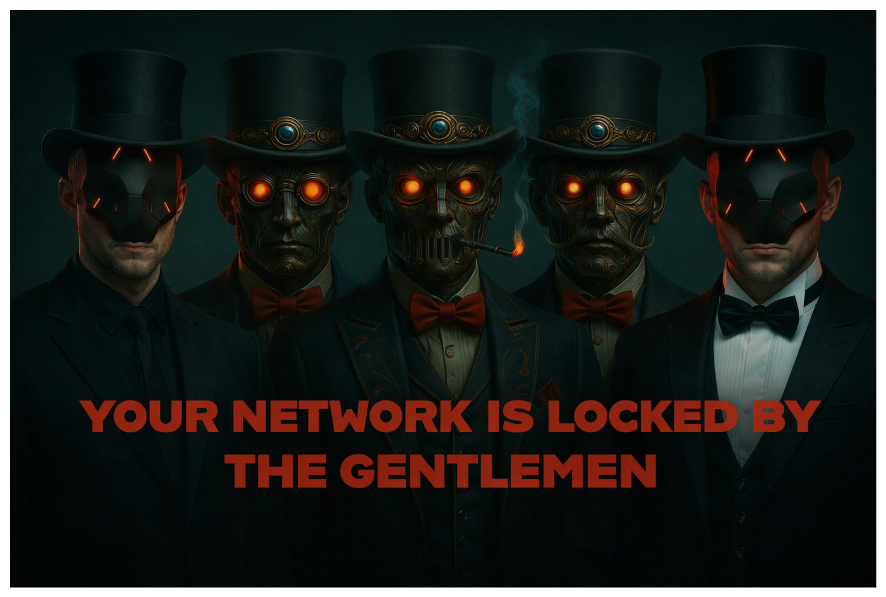
--silent parameter is not provided, it also changes the desktop wallpaper to The Gentlemen’s embedded image.
The Gentlemen background image
After completing its operations, the ransomware may delete free space on the system to hinder data recovery attempts if the
--wipe parameter is provided. Additionally, it may delete itself if the
--keep parameter is not provided.
Regardless of provided parameters, it also deletes various system files and logs to cover its tracks, using commands such as:
Additionally, it deletes files from various directories, including:
cmd.exe /C del /f /q C:\Windows\Prefetch\*.*
cmd.exe /C del /f /q C:\ProgramData\Microsoft\Windows Defender\Support\*.*
cmd.exe /C del /f /q %SystemRoot%\System32\LogFiles\RDP*\*.*
cmd.exe /C rd /s /q C:\$Recycle.Bin
C-based ransomware
As The Gentlemen’s operations have extended, multiple researchers from different information security vendors have identified two ransomware implant versions: the cross-platform Go variant described above and a C-based ESXi locker for Linux. Our investigation has also uncovered a new, still-in-development C implant, currently limited to Windows.
This new ransomware variant has been observed in a limited number of attacks on organizations. While the overall malware structure remains similar to the Go variant we have described, the encryption algorithm has undergone significant changes, suggesting The Gentlemen group is expanding its capabilities. We believe this variant is still in development and being tested on a small subset of victims, with several parameter options, outlined below.
Parameter
Description
--password
The ransomware needs a password to execute, which is meant to prevent execution on automated systems
--remove
The ransomware removes itself after the encryption process has been finished
--T
Sleep time before encryption, in seconds
--ex
Likely stands for excluded objects (not implemented)
--fast
Encryption speed option (not implemented)
--superfast
Encryption speed option (not implemented)
--ultrafast
Encryption speed option (not implemented)
--silent
Likely silent execution (not implemented)
--system
Execute with system privileges. Could be used to encrypt local disks, as in the Go variant, but at the time of writing this article, there isn’t sufficient data to support this.
--shares
Encrypt the shares connected to the system (not implemented)
--full
Full encryption (not implemented)
--path
Directory list to be encrypted
As can be seen from the parameter list, some of the parameters are not yet implemented. We anticipate that this variant will mature and likely be increasingly used in future attacks. Notably, the C variant uses smaller denylists of files, directories and extensions compared to the Go variant, which further suggests that this version of the ransomware is still in development. For example, the list of files that should not be encrypted, contains only three items, one of which is the group’s ransom note.
To execute with elevated privileges when receiving the
--system parameter, the implant creates a scheduled task called “TaskSystem” using the command
schtasks /create /sc DAILY /tn "TaskSystem" /tr "cmd /C cd %s && %s" /st 20:00 /ru system > nul. It then runs the task with elevated privileges using
schtasks /run /tn TaskSystem > nul. If “TaskSystem” exists in the target system, the ransomware first deletes it using
schtasks /delete /tn TaskSystem /f > nul, before creating a new one with the same name.
If the ransomware lacks sufficient privileges to access a file, it attempts to modify the file’s ACL by granting
FULL_CONTROL permission and setting a new
EXPLICIT_ACCESS_A structure using the
SetEntriesInAclA API call.
For encryption, the ransomware uses the OpenSSL library, which is statically linked to the binary. Unlike the Go variant, this variant uses the AES256-GCM + RSA encryption scheme. It generates a random 32-byte key and a 16-byte initialization vector (IV) for each file, creating a 48-byte buffer. This buffer is then encrypted using a hardcoded RSA public key and appended to the file. The file’s contents are encrypted with AES256-GCM and written after the encrypted key and IV.
After encrypting all files in a directory, the ransomware decodes a byte array using single-byte XOR decryption and creates a file named !-READ-ME—-GEN-TLE-MEN-!.txt in the directory. It then writes the decoded byte array, which contains the ransom note, to the file.
The ransom note in this version of the ransomware reveals a difference from earlier Go versions: communication with the operators is now conducted via email rather than through Tox Messenger.
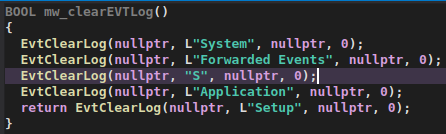
After completing the encryption process, the ransomware attempts to clear logs from various event log categories, including System, Forwarded Events, Application, and Setup, using the
EvtClearLog API. However, it appears that there may be an error in the event log clearing process, as the category
"S" is not a valid default entry for an event log category, suggesting a possible typo or missing parameters.
Event clearing function
Victims
The Gentlemen target a wide range of industries worldwide, including manufacturing, IT services, healthcare, financial services, construction, and logistics. Observed intrusions span several regions, with Brazil, China, Indonesia, Taiwan, and Thailand among the most heavily targeted countries and territories according to our telemetry.
Attribution
We have high confidence in attributing the observed activities to The Gentlemen group and its affiliates. This attribution is based on several key factors, including the consistent use of the group’s name, associated email addresses, and Data Leak Site within the binaries and ransom notes.
Conclusion
The Gentlemen group is rapidly gaining traction in the ransomware landscape, recruiting affiliates and executing high-profile attacks. Their adaptability is evident in the emergence of a C-based ransomware variant, a Go-based backdoor enabling remote command execution, and customized scripts tailored to specific targets. Recent data leaks exposing internal communications and operational plans suggest the group will continue to engage in malicious activity. Organizations are advised to prioritize vulnerability management and system hardening to reduce the risk of compromise.

 Entrar