
Visualização de leitura

Sexual predators targeting online accounts for intimate images, FBI warns

The FBI has issued a Public Service Announcement (PSA) warning that criminals are breaking into social media and personal accounts to steal and distribute intimate images and videos without consent. The FBI refers to this type of content as non-consensual intimate images (NCII).

The stolen material may be posted or sold on criminal marketplaces alongside victims’ names, phone numbers, email addresses, and social media handles, creating opportunities for harassment, stalking, and sextortion.

According to the FBI, criminals use a mix of account takeover and social engineering tactics:

  • Password and PIN guessing: Criminals make high-volume login attempts using data from breaches, public social media profiles, leak sites, and other publicly available sources. Known victims may be targeted using name variations, birth dates, and other predictable personal details.
  • Fake customer service texts: Victims receive a message claiming their social media account will be locked or disabled. The criminal triggers a legitimate password reset request, then persuades the victim to hand over the resulting verification code.
  • Phishing emails: Lookalike support domains and email addresses warn of a “new login” and direct victims to a fake password change page designed to steal credentials.

This is different from the familiar “I recorded you” sextortion email, which typically relies on intimidation rather than a real account compromise. Still, if such an email includes a password you still use, change it immediately wherever it remains in use.

How to stay safe

There are several ways to reduce the risk of becoming a victim:

  • Avoid storing sensitive images on social media platforms or other internet-connected services when possible. Breaches and leaks happen, and those images can end up in the wrong hands.
  • Use a password manager to create a unique, long password for every account. Don’t base passwords or PINs on names, birthdays, or other public information.
  • Turn on multi-factor authentication (MFA), preferably with passkeys or hardware security keys where available. MFA is valuable, but criminals can still phish one-time codes and session cookies, so never approve an unexpected prompt or share a verification code.
  • Treat unexpected “account warning” links in texts and emails as suspicious. Open the service’s official app or type the known web address yourself instead. Don’t trust sponsored search results to take you to the correct website.

If you discover that intimate content has been stolen or shared, preserve any relevant links and evidence, secure the affected accounts, and report it through the FBI’s NCII reporting portal at ncii.ic3.gov.


Scammers don’t need to hack you. They just need you to click once. 

Malwarebytes Identity Theft Protection catches suspicious activity before it becomes a problem.
Don’t trust that “FBI agent” in your DMs

The Federal Bureau of Investigation’s (FBI) Internet Crime Complaint Center (IC3) is warning that scammers are impersonating the bureau on social media and on messaging apps, targeting people who’ve already been victims of cybercrime.

The FBI has issued warnings like this before, but scammers posing as IC3 employees and FBI agents continue to evolve their schemes and claim new victims.

The best-known of these scams are recovery scams, complete with FBI logos and branding that make them look far more convincing.

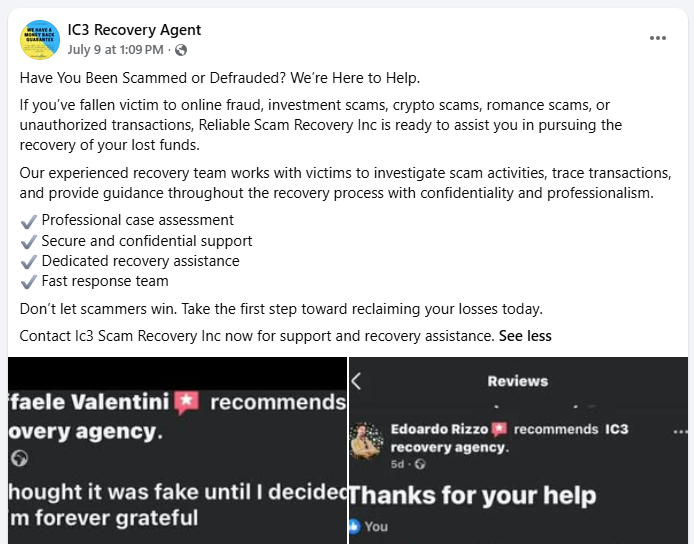
Facebook accounts like the one below—and yes, I reported it—with equally fake reviews prey on people who have already fallen victim to a scammer.

Fake IC3 Facebook account

“Have You Been Scammed or Defrauded? We’re Here to Help.

If you’ve fallen victim to online fraud, investment scams, crypto scams, romance scams, or unauthorized transactions, Reliable Scam Recovery Inc is ready to assist you in pursuing the recovery of your lost funds.

Our experienced recovery team works with victims to investigate scam activities, trace transactions, and provide guidance throughout the recovery process with confidentiality and professionalism.

✔Professional case assessment

✔Secure and confidential support

✔Dedicated recovery assistance

✔Fast response team

Don’t let scammers win. Take the first step toward reclaiming your losses today.

Contact Ic3 Scam Recovery Inc now for support and recovery assistance.”

The scammers count on victims feeling desperate and embarrassed. They have no scruples about victimizing them all over again.

The post contains a lot of the tell-tale signs IC3 warns about. Very vague but reassuring claims: “experienced recovery team,” “professional case assessment,” “secure and confidential support” all sound impressive but provide no verifiable detail. High‑level promises like “investigate scam activities” and “trace transactions” imply special legal or technical powers, but the FBI warns that scammers make similar promises to convince victims they’re dealing with authorized investigators.

Besides setting up fake IC3 accounts, they also monitor social media for posts from victims saying they’ve reported a scam to the FBI, then swoop in posing as FBI follow‑up contacts.

If victims remain unconvinced, the scammers may create videos depicting senior FBI officials or other recognizable public figures urging them to submit their case through a specific link “to speed up recovery.” The FBI says criminals are increasingly using AI-generated deepfake audio and video to make these messages appear genuine.

How to stay safe

First and foremost, remember that IC3 has no official social media presence, does not investigate crimes via social media, and will never contact victims directly to recover funds.

As the IC3 homepage states:

“The IC3 does not work with any non-law enforcement entity, such as law firms or crypto services, to recuperate lost funds or investigate cases. The IC3 will never directly contact you for information or money.”

So, if an “agent” appears in your direct messages (DMs) right after you post publicly about being a crime victim or planning to report to the FBI, assume they are a scammer until independently verified. A few other tips:

  • Never pay upfront: Legitimate government agencies never ask you for advance payment to recover stolen money.
  • Ignore unsolicited claims: Be highly suspicious of anyone who reaches out to you out of the blue claiming they can reverse a previous scam.
  • Never share your credentials: Do not give remote access to your device or hand over your passwords and recovery phrases to unknown third parties.
  • Don’t provide IDs or financial information. Scammers can use them for identity theft or further fraud.
  • Use verification tools: If you receive a suspicious email, message, or phone call, you can verify its legitimacy using tools like Malwarebytes Scam Guard.
  • Report scammers: If you or someone you know has fallen victim to this scam, file a complaint with the IC3 at ic3.gov

Something feel off? Check it before you click.  

Malwarebytes Scam Guard helps you analyze suspicious links, texts, and screenshots instantly.  

Available with Malwarebytes Premium Security for all your devices, and in the Malwarebytes app for iOS and Android.  

Try it free → 

Ransom & Dark Web Issues Week 4, May 2026

ASEC Blog publishes Ransom & Dark Web Issues Week 4, May 2026           Customer Data of Japanese Educational Franchise Sold on BreachForums by Hasan Data from Japanese Government Agency for National Civil Servant Personnel Administration Sold on BreachForums by Hasan FBI Issues Warning Regarding Fraudulent FIFA Websites Ahead of 2026 FIFA […]

Dark Web Threat Actor Trend Report, April 2026

Notes the April 2026 Dark Web Threat Actor Trend Report summarizes trends in hacktivists and threat actors operating on the deep web and dark web. due to the nature of the sources, some of the information is difficult to fully verify as factual. Major Issues NoName05716 claimed repeated DDoS attacks against dozens of organizations, including […]

March 2026 Dark Web Issue Trends Report

Alert this report is a summary of deep web and dark web source-based material and contains some facts that cannot be fully verified due to the nature of the sources. Major Issues BreachForums’ internal collapse and attempts to rebuild were observed. trust was undermined by the betrayal of moderators and the movement of funds, and […]

FBI, CISA issue warning for cross Apple-Android texting

CISA and the FBI recently released a joint statement that the People’s Republic of China (PRC) is targeting commercial telecommunications infrastructure as part of a significant cyber espionage campaign. As a result, the agencies released a joint guide, Enhanced Visibility and Hardening Guidance for Communications Infrastructure, with best practices organizations and agencies should adopt to protect against this espionage threat.

According to the statement, PRC-affiliated actors compromised networks at multiple telecommunication companies. They stole customer call records data as well as compromised private communications of a limited number of people. Sen. Mark R. Warner (D-Virginia) told the Washington Post that the threat actors listened on audio calls and even moved between networks. As a result, many media sources reported that texts between Android and Apple devices are not secure.

Historic and sophisticated cyberattack

The headlines of the Washington Post deemed it the worst telecom hack in our nation’s history, per a top U.S. senator. On the surface, this seems a bit melodramatic, with only 150 identified victims. However, experts predict the affected number of people will go into the millions. Warner, who serves as chairman of the Senate Intelligence Committee, went as far as to say that Salt Typhoon makes Colonial Pipeline and SolarWinds “look like child’s play.”

The data collected during the attack falls into two categories, reported NBC. The first included call records showing the time and number called, with most records in the Washington, D.C. area. The other included listening to live calls of specific targets, which may include Donald Trump and Kamala Harris.

However, the most concerning aspect of the attack is the national security implications. Richard Forno, Principal Lecturer in Computer Science and Electrical Engineering at UMBC, explained in UMBC Magazine that Salt Typhoon compromised the portals used by U.S. intelligence and law enforcement. As a result, he says that the attackers may have gotten information about which Chinese spies and informants counterintelligence agencies were monitoring, which those targets can then use to avoid detection.

“U.S. officials have said that many of the ways Salt Typhoon penetrated its targets was through existing weaknesses with the infrastructure. As I’ve written previously, failing to implement basic cybersecurity best practices can lead to debilitating incidents for organizations of all sizes. Given how dependent the world is on networked information systems, it is more important than ever to maintain cybersecurity programs that make it difficult for attacks to succeed, especially for critical infrastructure like the phone network,” wrote Forno.

Reducing the risk of Salt Typhoon

With words like espionage and intercepting texts thrown around, the biggest question on people’s minds is how to protect themselves from this threat. Many experts are currently recommending using encrypted apps, such as WhatsApp and X, instead of traditional texting.

“Encryption is your friend, whether it is on text messaging or if you have the capacity to use encrypted voice communications, even if the adversary is able to intercept the data if it is encrypted, it will make it impossible, if not really hard, for them to detect it. So, our advice is to try to avoid using plain text,” said Jeff Greene, CISA Executive Assistant Director for Cybersecurity, during a press briefing reported by USA Today.

Forbes also reported that an FBI official recommended citizens use a cell phone that automatically receives timely operating system updates. Additionally, the phone should have responsibly managed encryption and phishing-resistant multi-factor authentication (MFA) for email, social media and collaboration tool accounts.

“So it’s somewhat ironic that one of the countermeasures recommended by the government to guard against Salt Typhoon spying is to use strongly encrypted services for phone calls and text messages – encryption capabilities that it has spent decades trying to undermine so that only ‘the good guys’ can use it,” wrote Forno.

To learn how IBM X-Force can help you with anything regarding cybersecurity including incident response, threat intelligence, or offensive security services schedule a meeting here.

If you are experiencing cybersecurity issues or an incident, contact X-Force to help: US hotline 1-888-241-9812 | Global hotline (+001) 312-212-8034.

The post FBI, CISA issue warning for cross Apple-Android texting appeared first on Security Intelligence.

❌