Visualização de leitura

Two Alleged ‘TeamPCP’ Hackers Arrested in Australia

Authorities in Australia have arrested two men believed to be members of TeamPCP, a prolific cybercrime and data extortion group blamed for perpetrating the longest running spree of software supply chain attacks ever.

In a statement released today, the Australian Federal Police (AFP) said two men from Western Australia, aged 21 and 23, were arrested in connection with a “sophisticated cybercrime syndicate that allegedly created malicious open-source software to rob thousands of global businesses.”

The AFP did not name the defendants, but KrebsOnSecurity learned the 21-year-old suspect’s real identity in June, and has been communicating with him ever since. This story includes interviews with TeamPCP’s self-described spokesperson, and examines clues left behind by the TeamPCP leader that likely led to his undoing.

TeamPCP vaulted onto the cybercrime scene in late 2025, embedding malicious code in hundreds of open source software tools and extorting victims for profit. Members of the group made headlines by compromising corporate cloud environments using a self-propagating worm dubbed Shai-Hulud, which added malicious code to open source programs maintained by developers whose credentials at public code repositories like GitHub or NPM were phished or stolen.

Writing for Wired, journalist Andy Greenberg described TeamPCP’s core tactic as a kind of cyclical exploitation of software developers.

“The hackers gain access to a network where an open source tool commonly used by coders is being developed,” Greenberg wrote in May. “The hackers plant malware in the tool that ends up on other software developers’ machines, including some who are writing other tools intended to be used by coders. The malware allows TeamPCP’s hackers to steal credentials that let them publish malicious versions of those software development tools, too. The cycle repeats, and TeamPCP’s collection of breached networks grows.”

TeamPCP also has practiced something akin to cyclical recruitment. In May, the source code for the third iteration of Shai-Hulud was published online, and TeamPCP soon after launched a contest offering $1,000 in virtual currency to whichever participant could conduct the largest supply chain operation using the worm’s code. According to the contest rules, participants were scored based on the number of weekly and monthly downloads of packages they compromised — directly incentivizing them to target the most popular code libraries.

A screenshot of a message from TeamPCP’s Telegram account, announcing the supply chain hacking contest. Image: dataminr.com.

“TeamPCP has stated the competition is a recruiting opportunity and they intend to purchase all meaningful access harvested from participants’ campaigns,” the security firm Dataminr wrote. “The $1,000 XMR (Monero) prize is a recruitment floor and has been dismissed by the actor as ‘just like participation trophy,’ adding ‘if you find something good you will be paid way more,’ confirming the contest’s true function as talent identification and malicious access acquisition at scale.”

In March, TeamPCP executed a supply chain attack targeting AI infrastructure by compromising the code for LiteLLM, an open source AI gateway that connects users to more than 100 different large language models. A recent analysis by the security firm CloudSEK found TeamPCPs attack on LiteLLM harvested cloud service keys and other secrets from more than 2,500 organizations, including many of the world’s top technology companies.

In May, TeamPCP claimed credit for compromising at least 3,800 code repositories at the Microsoft-owned GitHub, after a GitHub developer installed a code extension that was compromised by TeamPCP’s malware.

MEET THE CYBERCATS

Security experts say TeamPCP is less of a hacker group than an amalgamation of threat actors from multiple cybercriminal gangs who sometimes work together toward similar goals.

“It is not a structured criminal crew with a single operator,” said Austin Larsen, a principal threat analyst with the Google Threat Intelligence Group. “It is a peer community of individually-skilled actors, with one clear center of gravity.”

That center of gravity is George Prepakis, an accomplished security researcher and self-described exploit developer who operates the Twitter/X profile @kernelstub. Earlier this year, @kernelstub tweeted a public invite link to a Matrix chat server he created and dubbed “Cybercats,” and TeamPCP and several other cybercrime entities have been using this server to communicate daily for the past several months.

A screenshot of the Matrix chat server “Cybercats,” whose members used hacker handles associated with multiple distinct cybercrime groups that have occasionally collaborated on a series of supply chain and data ransom attacks over the past nine months.

Kernelstub, like other administrators in the Cybercats chat, has been using his Twitter/X profile name as his handle in these Matrix communications, frequently tweeting references to other members and to conversations taking place in the Cybercats chat. In a number of cases, the corresponding X accounts for members of the Cybercats chat taunted cybercrime victims publicly before the incidents were reported in the news media.

The Cybercats administrator listed at the top of the screenshot above — “Boxturtle” — is a close associate of TeamPCP who has been tweeting about the group’s conquests under the name @xpl0itrsturtle. This handle corresponds to a data breach broker active on Breachforums and Darkforums who has been selling data stolen in a wave of recent breaches at automobile manufacturers, including BMW Group, Audi, Honda, Mercedes-Benz, Volvo and Toyota, as well as data allegedly taken from Snapchat and SportRadar.

The data leak site for the extortion group or handle “xpl0itrs.”

The Cybercats administrator “SeesawSec” in the screenshot above is the alias of whoever is behind the cybercrime group known as Fulcrumsec, which recently claimed credit for data extortion attacks against the pharmaceutical giant Novo Nordisk, the data broker LexisNexis, and Avnet, a Fortune 500 distributor of electronic components.

The data leak site of Fulcrum Security, a.k.a. Fulcrumsec.

The Cybercats administrator “@pcpcasper” also has been using a similar name on X to discuss TeamPCP’s attacks and victims. This person has an extensive message history on Telegram, where their messages and shared videos show @pcpcasper is an active and vocal member of the National Socialist Network, a neo-Nazi political organization based in Australia.

At one point in these chats, @pcpcasper shared videos and images of what they claimed was their cat, and several of those videos place this user in Western Australia. One source close to the investigation told KrebsOnSecurity that @pcpcasper was one of the two arrested, a claim supported by messages that @kernelstub posted online this morning.

The Cybercats member roster pictured above also features an administrator with the username “T,” which is short for the now-banned Twitter/X profile @pcpcats, the account operated by the self-described TeamPCP spokesperson who was arrested today. As we’ll see in a moment, @pcpcats also is from Western Australia.

By the time @kernelstub tweeted a public invite link to the Cybercats Matrix server, T/@pcpcats was posting only infrequently to the group chat, with other members often inquiring as to his whereabouts and well-being. The group’s collective concern related to @pcpcats’s tendency to blame his increasingly extended absences on the use of hallucinogens and other narcotics that kept him awake for days on end, but also caused him to crash in bed for several days after the highs wore off.

WHO IS THE TEAMPCP LEADER?

The Cybercats member @pcpcats has used multiple nicknames on the cybercrime forums, including EllisD25/LSD on Darkforums, BulkDMT on Breachstars, and Express on Breachforums. These accounts are linked because they all advertised the same Tox ID and/or Session ID as instant message contact handles in their cybercrime forum posts. BulkDMT was also known on the forums as DMT Host, which was a virtual private server (VPS) hosting service that was peddled on Darkforums and Breachstars.

DMT Host/EllisD25, posting on the English-language cybercrime community DarkForums in September 2025. Image: ke-la.com.

According to the cyber intelligence firm Intel 471, Express registered on Breachforums using the email address shitstickpp@gmail.com. Intel 471 finds Express posted on Breachforums across a two-month period in 2025 using four different Internet addresses located in South Africa. On July 30, 2025, Express announced on Breachforums they were selling access to 14 gigabytes of data stolen from South Africa’s State Information Technology Agency.

The threat intelligence platform Flashpoint recorded more than a year’s worth of messages from the TeamPCP leader’s alter ego on Telegram — Persy_PCP —  who claimed they split their life living between two countries [full disclosure: Flashpoint is an advertiser on this blog]. “I have these [files] as well, problem is these are in another country,” Persy_PCP explained to another user inquiring about a stolen data set in November 2025.

Later that month, Persy_PCP complained, “My whole country is racist and they want people like me dead.” Flashpoint records show BulkDMT shared in September 2025 that “this country is going to fucking starve when they take the farmers land,” a likely reference to white landowners in South Africa who claim to be targeted by an ongoing genocide campaign.

This tracks with public reporting on TeamPCP. Cyberscoop reported in June that Google had traced TeamPCP’s residential and mobile Internet address connections to South Africa, “indicating the primary operator was located there during at least some of its attacks.”

BulkDMT also shared on the group chat at Breachforums that they were recovering from an addiction to methamphetamine. “My life is kinda fucked rn [right now], but that’s fine and there isn’t really a point in pouring so much emotional energy into that fact, my parents had money but I unfortunately got really addicted to some things so I don’t get to benefit from that. As long as I continue to survive, stay sober, and move closer towards my goals that’s enough drive and meaning.”

The identity threat protection company SpyCloud finds shitstickpp@gmail.com shows up in the registration of an account called ChristmasSnow on the cybercrime community Raidforums in 2022. Nearly all of the Internet addresses used to access that account came from ISPs in Perth, Australia, SpyCloud found.

KrebsOnSecurity looked up all of those Perth IP addresses in passive DNS records maintained by DomainTools.com, and found one of them — 211.27.196.111 — for several years was used as a private file server by a family in Perth with the last name of Thomson. Those records show at least three hosts — ithomson.direct.quickconnect.to (a remote Synology server), kthomson0061.direct.quickconnect.to, and joshuawthomson39.myqnapcloud.com (a QNAP network storage device) — persisted at that address between 2022 and 2025.

Searching on “joshuathomson39” in the breach tracking service Constella Intelligence reveals an account at the freight forwarding company kwe.com created in the name of Joshua Thomson from Perth, Australia. The open source intelligence platform Epieos finds the phone number attached to that kwe.com account was used to register a Facebook profile for Josh Thomson, which says his family includes a brother named Ruben, his father Ian, and his mom Cindy.

That Facebook profile also says Josh and his family are originally from Pietermaritzburg, in KwaZulu-Natal, South Africa, but currently living in Cottesloe, a beach-side suburb of Perth. A search in DomainTools for Ian Thomson and Australia unearthed five domains by the same registrant, including securecomputing.au, thomson.org.au, and thomsonfamily.net.au. Ian Thomson is a dentist in Cottesloe, and a biography says he graduated from The University of the Witwatersrand in Johannesburg, South Africa.

Constella finds a joshua@thomson.org.au registered a number of accounts online, but Josh doesn’t seem to have much of a connection to dodgy cybercrime forums. His brother Ruben, on the other hand, has quite the presence on these communities, dating back to at least 2018. Constella reports ruben@thomson.org.au frequently reused the password “joshuathomson1,” and Constella further finds that password was used by just a handful of accounts, including yolosolo17@gmail.com and surfinup8@gmail.com.

According to Intel 471, surfinup8@gmail.com was used to register the user Yolosolo17 on the crime forum Altenen in 2018, and that user account was registered from the Perth address 110.141.230.15. On Altenen, Yolosolo17 advertised free web proxies, as well as the domain rubenthomson.com, which was at one point used to sell steeply discounted iPhones. DomainTools says rubenthomson.com was hosted at 110.141.230.15 and registered to surfinup8@gmail.com.

A cached copy of the domain rubenthomson.com from 2017 shows a login page underneath a banded stack of money. Image: archive.org.

SpyCloud reports 10.141.230.15 was used by the email address sheepstealing@gmail.com on Raidforums and surfinup8@gmail.com on Nulled, and that the same IP was used by the email addresses ian@thomsonfamily.net.au, jasper@yakuza.cc, and rubenthomson1@gmail.com. SpyCloud also shows that sheepstealing Gmail address is tied to the accounts Sheep420, YoloSolo117 and Yakuza.cc on Raidforums, and to the account “Sheep Stealing” on Hackforums. Intel 471 says sheepstealing@gmail.com was used to register the account DingoFlour on Breachforums in October 2023, as well Sheepx on Altenen.

Epieos reports that ruben@securecomputing.au is tied to an Airbnb account for Ruben, who described himself as a Web developer who went to school at the University of Western Australia and was living outside the country. “Hey, I’m Ruben, my friends call me Ellis. I’m a Perth creative who occasionally books rooms when visiting family and for photography.”

Epieos also finds sheepstealing@gmail.com registered an upwork.com profile under the name Ruben, who said his main skills are setting up secure server hosting solutions and PHP full-stack Web development.

“I’m familiar with Linux, working with relational databases (SQL),” the Upwork profile reads. “I also script in Python mainly for writing social media bots.”

The Upwork profile for Ruben Thomson in Cottesloe, Australia.

Epieos further discovered sheepstealing@gmail.com is connected to a Microsoft account for Ruben Thomson, and to a now-defunct GitHub account called XmasSnow/XmasSnowisBack that scammed people on the forums in 2022 by claiming to sell exclusive exploits for recently-released software patches (recall that shitstickpp@gmail.com was used to register a forum account named ChristmasSnow).

This same sheepstealing email address registered a Twitter/X account in 2026 called “Gone Fishing” that lists its location as South Africa. That Gmail account also left several reviews for businesses listed on Google Maps over the past seven years, but all of those establishments are located on the west coast of Australia.

Business reviews in Western Australia left by the Google account sheepstealing at gmail.com.

The people search service Pipl finds a 21-year-old Ruben Thomson in Western Australia who has a phone number ending in 979. A lookup on that number at Epieos reveals it is connected to a TikTok account under the name Ellis, and to a PayPal account in the name of Ruben Thomson.

Finally, a search on the name Ruben Thomson from Cottesloe at the Australian government’s record of registered businesses finds he has incorporated or served as an official in multiple companies created since 2024, including Secure Computing Solutions, Tensor Industries, and another entity ironically named OPSEC Express. Recall that Express was BulkDMT’s nickname on Breachforums.

Australian companies connected to Ruben Thomson. Image: abr.business.gov.au.

It’s ironic because OPSEC is short for the term “operational security,” which refers to techniques and behaviors used to obfuscate and compartmentalize one’s real-life identity online, and using your cybercrime handle as part of your own company name is very much the antithesis of that practice.

There is at least one other major opsec failure by Ruben that exposed a link to TeamPCP. In June 2025, someone using the name Ruben Thomson registered on HackerOne, a popular “bug bounty” program that seeks to reward and recognize researchers who agree to work with affected software vendors to help fix the flaws before publishing about their findings. What was Ruben Thomson’s chosen HackerOne username? Deadcatx3, a nickname that has been flagged by multiple security firms as an alias used by TeamPCP.

The HackerOne profile for “Ruben Thomson” uses the nickname Deadcatx3, which multiple security firms have concluded is an alias used by TeamPCP. Image credit: flare.io.

INTERVIEW WITH ELLIS

In early July 2026, not long after having discovered clues about Ellis’s real life identity, KrebsOnSecurity interviewed the TeamPCP leader via Signal, where he was remarkably open about his activities and personal struggles [for the sake of simplicity, the TeamPCP spokesperson will be referred to from here on as Ellis].

Ellis claims he stopped doing cybercrime for TeamPCP in March 2026 — just before the attacks that compromised LiteLLM — and that at least one other individual has taken over the group’s leadership since then. Ellis shared that a year earlier he had just completed the latest in a series of detox and sobriety programs, and was two months sober when he reconnected with some old friends from the malware development scene.

“One year ago I needed help monetizing some [GitHub credentials], I was two months sober and needed a distraction and something to keep busy as well as people to speak to,” Ellis said. “I had largely disconnected from my old circle, they had become very toxic and I needed to get away from the substances. Previously I had done some mass exploitation campaigns and grew up doing [malware development] and [capture the flag] contests. There were some friends who were also vending but had stopped a while, and one of them introduced me to some chats where I posted access for sale.”

Prior to that, Ellis said, he was homeless and hopping between “some very unstable places.”

“Blackhatting is fun,” he said. “There are actual rewards and incentives to learn and you grow with your team. Without qualifications, no employer will even take the time to hear you out.”

Ellis claims he’s earned a grand total of about $20,000 for his activities with TeamPCP, and that it was never about the money or fame for him. Asked whether his experiences with TeamPCP might prepare him for gainful employment in a legitimate IT job, Ellis said he doubted it.

“I am nowhere close to a skill level where I am comfortable, and this would take maybe half a decade of further experience,” he said. “I no longer have to choose between rent and food for that I’m grateful and so are the team members.”

Ellis expressed no remorse over his cybercrime activities, and said he was grateful for the friendships and relationships built throughout his engagement with TeamPCP. The young hacker also seemed resigned to his fate, and told KrebsOnSecurity that he’ll accept the consequences if he’s ever arrested.

“If I’ve already been found out then its out of my control, I’ll make peace with that,” he said. “Honestly, I think someone like me needs a lot of help that prison just can’t provide. If I had the funds to study different parts of the field and closer guidance, this would have turned out differently. But that’s a pipe dream and we both know this.”

It is clear from reading Ellis’s posts to the group’s Matrix server chats that his struggles with sobriety are ongoing. On Thursday, June 25, Ellis told @kernelstub he was about to “trip” with his “homie.”

“What kind,” @kernelstub inquired.

“Ketty and some DMT,” Ellis replied, referring to the dissociative anesthetic ketamine and dimethyltryptamine (DMT), a powerful psychedelic compound that is found naturally in some plants but is also synthetically produced in underground lab environments. “There’s a little 2cb so we might throw that in the mix,” he continued, referring to another psychedelic compound by its chemical shorthand.

Roughly two weeks before his arrest, Ellis told KrebsOnSecurity he was ready to leave his life of crime behind and was prepared to turn himself in, but that in the meantime he was making plans to tie up loose ends.

Less than 24 hours later, the TeamPCP leader posted an image on Telegram showing a yellowish powdered substance in a baggie and on a scale, possibly synthetic DMT. The image shows the powder being weighed next to a series of small vape cartridges, two of which are open on the table in front of the photographer.

An image posted by the TeamPCP leader to Telegram, advertising his acquisition of some type of psychoactive substance, most likely a synthetic version of the powerful hallucinogen known as DMT.

The two defendants were arrested Wednesday morning. The AFP said the men face a combined 14 cybercrime offenses and are scheduled to appear in Perth Magistrates Court today.

Charlie Eriksen is a security researcher at Aikido Security who has closely followed TeamPCP’s cybercrime campaigns. Eriksen said TeamPCP are a good example of a new kind of threat actor that does not fit neatly into the usual categories.

“They are not a state actor, not quite organized cybercrime, and not purely ideological,” he said. “Their motivations seem to mix money, disruption, attention, and ideology.”

Eriksen said that historically there has always been a meaningful gap between reading about an attack technique and being able to reliably turn it into an operational campaign, but that large language models (LLMs) and artificial intelligence increasingly are helping threat actors to bypass that knowledge gap.

“You had to understand the research, adapt the code, troubleshoot it, build infrastructure around it, and then repeat that process across different targets,” he said. “LLMs have compressed that gap significantly.”

According to Eriksen, this creates an environment where threat actors suddenly have the ability to operate at significant scale without having developed the operational discipline that traditionally accompanies that level of capability. Put another way, it sets the stage for cybercriminals who are capable enough to cause significant damage, but not necessarily careful enough to understand or care about the consequences.

“They can be noisy, they can make mistakes,” he said. “They can leave evidence everywhere. They can take risks that a professional criminal group or intelligence service would consider completely unacceptable. But that does not necessarily make them less dangerous. In some ways, it can make them more dangerous.”

In a recent blog post, Eriksen called TeamPCP’s Shai-Hulud worm the “best thing to happen to supply chain security,” because it forced GitHub and other public coding platforms to erect new security safeguards.

In direct response to TeamPCP’s broad success at pushing poisoned versions of popular software packages, GitHub in late July introduced a three-day “cooldown” mechanism for Dependabot, the platform’s tool for auto-fetching newly shipped updates for any package dependencies. Cooldown periods are designed to help buy time for security tools and package maintainers to identify and remove any compromised versions. Other coding ecosystems like Python and various JavaScript platforms also added support for cooldown periods this year amid growing calls from security experts about the need for more widespread adoption of the safety feature.

Eriksen said TeamPCP’s legacy is that they achieved in the span of a few months what the supply chain security community has been unable to do for years.

“They managed to wake up Microsoft to the fact that they had become negligent in terms of security,” Eriksen said. “By compromising GitHub and stealing their source code, they humiliated Microsoft into action, making them finally act on what we had been asking them to do and take seriously for a while now.”

Update, 10:08 a.m. ET: A story this morning from ABC News in Australia confirms Ruben Ian Thomson of Cottesloe was one of the two arrested. The 23-year-old suspect thought to be @pcpcasper, Michael Gaebler, also was arrested in Perth. ABC News reports that Thomson was denied bail (Mr. Gaebler’s attorney reportedly did not request bail for his client), and that both men will be held in custody until their next court appearance on September 18.

UK Cybercrime Journal: Arup Group Breached by FulcrumSec


What Happened:

  • On 10 May 2026, the UK-based firm Arup Group was listed as a victim on the Tor data leak site of FulcrumSec. 
  • On their Tor data leak site, FulcrumSec stated that they have exposed 700GB of GitHub repos and 2TB of Azure and AWS S3 cloud, plus database backups.
  • Other types of data the adversary claims to have stolen includes Neuron BMS client databases, Odoo ERP data, A66 landowner files, Apple code-signing certificates with plaintext passwords, a Google Cloud Platform (GCP) project with production payment gateway credentials, and the source code of ArupCompute and Oasys. 
  • The FulcrumSec operators also claimed to have spent over half a year analysing the data and went through “email correspondence” with the company before publishing the stolen data.
  • On the victim post, FulcrumSec wrote a detailed incident breakdown. In it, they stated they gained initial access in September 2025 via a GitHub personal access token found hardcoded in a JavaScript file on a forgotten subdomain, which provided access to over 10,000 private GitHub repositories belonging to Arup Group.
  • From there, they scanned the repositories and found additional hardcoded tokens, API keys, and passwords for AWS, Azure, and databases.
  • The adversary stated that Arup detected the Github and Azure Storage intrusions approximately six weeks after they happened and rotated the credentials, but it was too late as the data had been exfiltrated. 
  • FulcrumSec also stated they pivoted into the AWS infrastructure using keys they had found belonging to Arup’s subsidiary Neuron.
  • FulcrumSec allegedly waited until April 2026 to contact their victim, Arup Group, due to the time it took to analyse the vast amounts of stolen data.
  • Impacted client organisations of Arup Group were also mentioned in the post, such as Disney and several other Hong Kong companies. The adversary reportedly uncovered Amazon data center seismic fragility data, British Petroleum (BP) site selection coordinates, and Queensferry Crossing internal documents as well.
  • Critically for the UK, the breached data exposed up to 62 HS2 related GitHub repositories. This involved Euston Station pile design files, ground movement assessments, over 14,000 sensor monitoring records, 48 archaeological site GPS coordinates (including Jones Hill Wood, a sensitive site for environmentalists), as well as confidential documents.

Analyst Comment:

Arup Group is a large multinational architectural design and engineering firm based in London who has been involved in constructing the Wembley Football Stadium in London, the HS1 Channel Tunnel Rail Link network, and the Eden Project in Cornwall, among other significant international construction projects.


Active since September 2025, FulcrumSec is a financially motivated data-theft-extortion group that specialises in rapid exfiltration of cloud-hosted databases by exploiting unrotated API keys and misconfigured cloud permissions.


This attack was noteworthy due to its highly targeted nature. FulcrumSec claimed they had access to Arup Group’s data for seven months and they clearly invested significant time to analyse the documents and spent weeks negotiating over email. Plus, to find initial access they also would have had to spend time checking Arup’s domains and Internet-facing assets to eventually find a single leaked credential to exploit. These types of targeted intrusions often only happen to large companies. This is because for it to be worth the cybercriminal’s time, effort, and risk to their freedom they will want a large ransom payment that only rich companies can typically afford.


FulcrumSec is an adversary worth monitoring due to the effort they put into their intrusions compared to other smash-and-grab ransomware campaigns. In October 2025, in a case documented by VX-Underground, FulcrumSec emailed detailed information about the breach they conducted with the aim of those details getting published and exert additional pressure on the victim.


Interestingly, FulcrumSec said the ransom they demanded was less than 1% of Arup’s annual revenue and was less than how much Arup lost to the deepfake fraudsters. This is a reference to Arup reportedly lost over £20 million pounds in 2024 after one of their Hong Kong employees was duped into sending cash to cybercriminals using an AI-generated video call. The fact Arup became publicly known for falling victim to a large scam potentially contributed to the adversary’s decision to select and focus them for this attack.


Defensive Takeaways:

  • Asset Inventory and Shadow IT Audits: Identifying the outdated unused domains with hardcoded credentials is standard best practices. All organisations must have processes in place to catalog and retire systems to avoid incidents like this. 
  • Hardcoded Credentials in Code: They way FulcrumSec gained access demonstrates the importance of using secret environment variables and features like GitHub Secret Scanning.
  • Implement Incident Response Procedures: Importantly, Arup detect the activity too late and it took them a staggering six weeks to rotate credentials (according to the adversary), which shows why having automated systems to check for unauthorised usage and reset tokens and all accounts is crucial to respond to such attacks.
  • GitHub Activity Monitoring: The adversary claimed they were able to clone thousands of GitHub repositories containing sensitive data without being detected. These types of activities are available to monitor and detect in GitHub Audit Logs. It’s also important to have a plan in place when suspicious activities are detected.
  • Third-Party Risk Management Programs: This incident also had some notable downstream impact. It shows why client organisations of another company’s services need to know what data and how much data is stored by third-parties for when such breaches occur. Knowing what’s potentially exposed will streamline the response to the incident.
  • Deception Tech: Arup could have implemented a boobytraps for the adversary such as the use of CanaryTokens inside sensitive documents. As the adversary spent time analysing the Arup’s documents before contacting them, if they open a boobytrapped document, then the incident could been detected much earlier and the damages could have been reduced.


Relevant Sources:

  1. https://x.com/darkwebinformer/status/2053281385582891437 
  2. https://www.ransomware.live/id/QXJ1cCBHcm91cEBmdWxjcnVtc2Vj 
  3. https://en.wikipedia.org/wiki/Arup_Group
  4. https://www.theguardian.com/technology/article/2024/may/17/uk-engineering-arup-deepfake-scam-hong-kong-ai-video


Relevant CTI Resources:

  1. https://www.ransomware.live/group/fulcrumsec
  2. https://x.com/vxunderground/status/1975629199323853027 
  3. https://www.reddit.com/r/Scams/s/wfZ3Wp94mY
  4. https://www.bleepingcomputer.com/news/security/lexisnexis-confirms-data-breach-as-hackers-leak-stolen-files/

Lawmakers Demand Answers as CISA Tries to Contain Data Leak

Lawmakers in both houses of Congress are demanding answers from the U.S. Cybersecurity & Infrastructure Security Agency (CISA) after KrebsOnSecurity reported this week that a CISA contractor intentionally published AWS GovCloud keys and a vast trove of other agency secrets on a public GitHub account. The inquiry comes as CISA is still struggling to contain the breach and invalidate the leaked credentials.

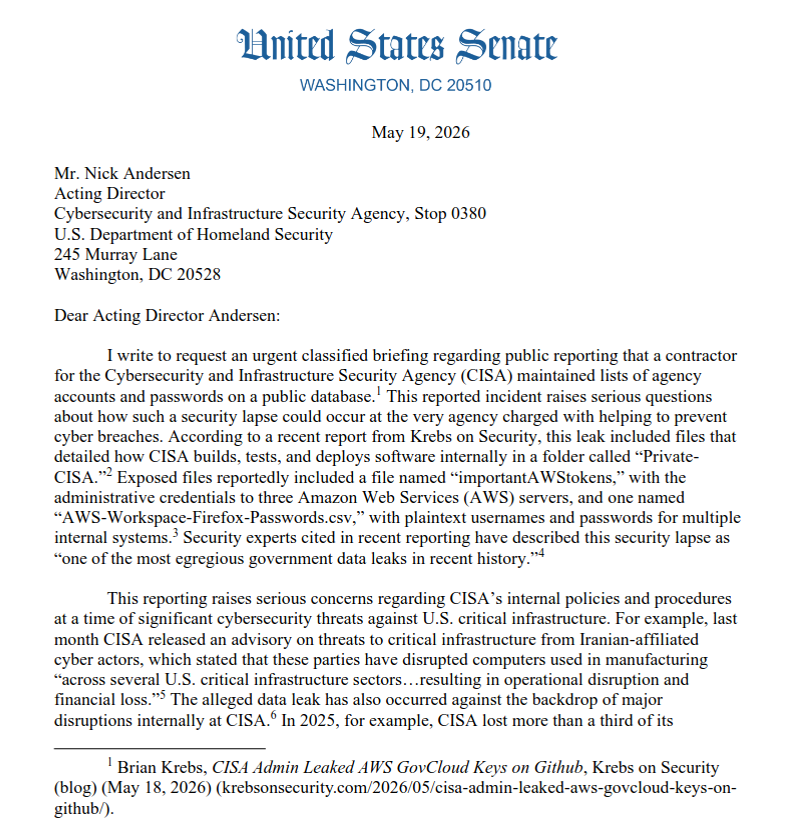
On May 18, KrebsOnSecurity reported that a CISA contractor with administrative access to the agency’s code development platform had created a public GitHub profile called “Private-CISA” that included plaintext credentials to dozens of internal CISA systems. Experts who reviewed the exposed secrets said the commit logs for the code repository showed the CISA contractor disabled GitHub’s built-in protection against publishing sensitive credentials in public repos.

CISA acknowledged the leak but has not responded to questions about the duration of the data exposure. However, experts who reviewed the now-defunct Private-CISA archive said it was originally created in November 2025, and that it exhibits a pattern consistent with an individual operator using the repository as a working scratchpad or synchronization mechanism rather than a curated project repository.

In a written statement, CISA said “there is no indication that any sensitive data was compromised as a result of the incident.” But in a May 19 a letter (PDF) to CISA’s Acting Director Nick Andersen, Sen. Maggie Hassan (D-NH) said the credential leak raises serious questions about how such a security lapse could occur at the very agency charged with helping to prevent cyber breaches.

“This reporting raises serious concerns regarding CISA’s internal policies and procedures at a time of significant cybersecurity threats against U.S. critical infrastructure,” Sen. Hassan wrote.

A May 19 letter from Sen. Margaret Hassan (D-NH) to the acting director of CISA demanded answers to a dozen questions about the breach.

Sen. Hassan noted that the incident occurred against the backdrop of major disruptions internally at CISA, which lost more than a third of it workforce and almost all of its senior leaders after the Trump administration forced a series of early retirements, buyouts, and resignations across the agency’s various divisions.

Rep. Bennie Thompson (D-MS), the ranking member on the House Homeland Security Committee, echoed the senator’s concerns.

“We are concerned that this incident reflects a diminished security culture and/or an inability for CISA to adequately manage its contract support,” Thompson wrote in a May 19 letter to the acting CISA chief that was co-signed by Rep. Delia Ramirez (D-Ill), the ranking member of the panel’s Subcommittee on Cybersecurity and Infrastructure Protection. “It’s no secret that our adversaries — like China, Russia, and Iran — seek to gain access to and persistence on federal networks. The files contained in the ‘Private-CISA’ repository provided the information, access, and roadmap to do just that.”

KrebsOnSecurity has learned that more a week after CISA was first notified of the data leak by the security firm GitGuardian, the agency is still working to invalidate and replace many of the exposed keys and secrets.

On May 20, KrebsOnSecurity heard from Dylan Ayrey, the creator of TruffleHog, an open-source tool for discovering private keys and other secrets buried in code hosted at GitHub and other public platforms. Ayrey said CISA still hadn’t invalidated an RSA private key exposed in the Private-CISA repo that granted access to a GitHub app which is owned by the CISA enterprise account and installed on the CISA-IT GitHub organization with full access to all code repositories.

“An attacker with this key can read source code from every repository in the CISA-IT organization, including private repos, register rogue self-hosted runners to hijack CI/CD pipelines and access repository secrets, and modify repository admin settings including branch protection rules, webhooks, and deploy keys,” Ayrey told KrebsOnSecurity. CI/CD stands for Continuous Integration and Continuous Delivery, and it refers to a set of practices used to automate the building, testing and deployment of software.

KrebsOnSecurity notified CISA about Ayrey’s findings on May 20. Ayrey said CISA appears to have invalidated the exposed RSA private key sometime after that notification. But he noted that CISA still hasn’t rotated leaked credentials tied to other critical security technologies that are deployed across the agency’s technology portfolio (KrebsOnSecurity is not naming those technologies publicly for the time being).

CISA responded with a brief written statement in response to questions about Ayrey’s findings, saying “CISA is actively responding and coordinating with the appropriate parties and vendors to ensure any identified leaked credentials are rotated and rendered invalid and will continue to take appropriate steps to protect the security of our systems.”

Ayrey said his company Truffle Security monitors GitHub and a number of other code platforms for exposed keys, and attempts to alert affected accounts to the sensitive data exposure(s). They can do this easily on GitHub because the platform publishes a live feed which includes a record of all commits and changes to public code repositories. But he said cybercriminal actors also monitor these public feeds, and are often quick to pounce on API or SSH keys that get inadvertently published in code commits.

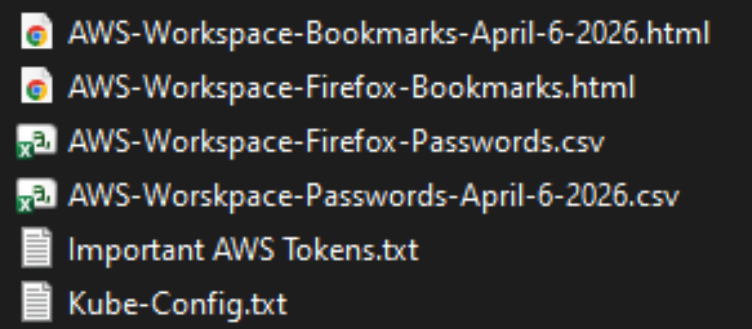
The Private CISA GitHub repo exposed dozens of plaintext credentials to important CISA GovCloud resources. The filenames include AWS-Workspace-Bookmarks-April-6-2026.html, AWS-Workspace-Firefox-Passwords.csv, Important AWS Tokens.txt, kube-config.txt, etc.

The Private-CISA GitHub repo exposed dozens of plaintext credentials to important CISA GovCloud resources.

In practical terms, it is likely that cybercrime groups or foreign adversaries also noticed the publication of these CISA secrets, the most egregious of which appears to have happened in late April 2026, Ayrey said.

“We monitor that firehose of data for keys, and we have tools to try to figure out whose they are,” he said. “We have evidence attackers monitor that firehose as well. Anyone monitoring GitHub events could be sitting on this information.”

James Wilson, the enterprise technology editor for the Risky Business security podcast, said organizations using GitHub to manage code projects can set top-down policies that prevent employees from disabling GitHub’s protections against publishing secret keys and credentials. But Wilson’s co-host Adam Boileau said it’s not clear that any technology could stop employees from opening their own personal GitHub account and using it to store sensitive and proprietary information.

“Ultimately, this is a thing you can’t solve with a technical control,” Boileau said on this week’s podcast. “This is a human problem where you’ve hired a contractor to do this work and they have decided of their own volition to use GitHub to synchronize content from a work machine to a home machine. I don’t know what technical controls you could put in place given that this is being done presumably outside of anything CISA managed or even had visibility on.”

Update, 3:05 p.m. ET: Added statement from CISA. Corrected a date in the story (Truffle Security said it found the repo gained some of its most sensitive secrets in late April 2026, not 2025).

CISA Admin Leaked AWS GovCloud Keys on Github

Until this past weekend, a contractor for the Cybersecurity & Infrastructure Security Agency (CISA) maintained a public GitHub repository that exposed credentials to several highly privileged AWS GovCloud accounts and a large number of internal CISA systems. Security experts said the public archive included files detailing how CISA builds, tests and deploys software internally, and that it represents one of the most egregious government data leaks in recent history.

On May 15, KrebsOnSecurity heard from Guillaume Valadon, a researcher with the security firm GitGuardian. Valadon’s company constantly scans public code repositories at GitHub and elsewhere for exposed secrets, automatically alerting the offending accounts of any apparent sensitive data exposures. Valadon said he reached out because the owner in this case wasn’t responding and the information exposed was highly sensitive.

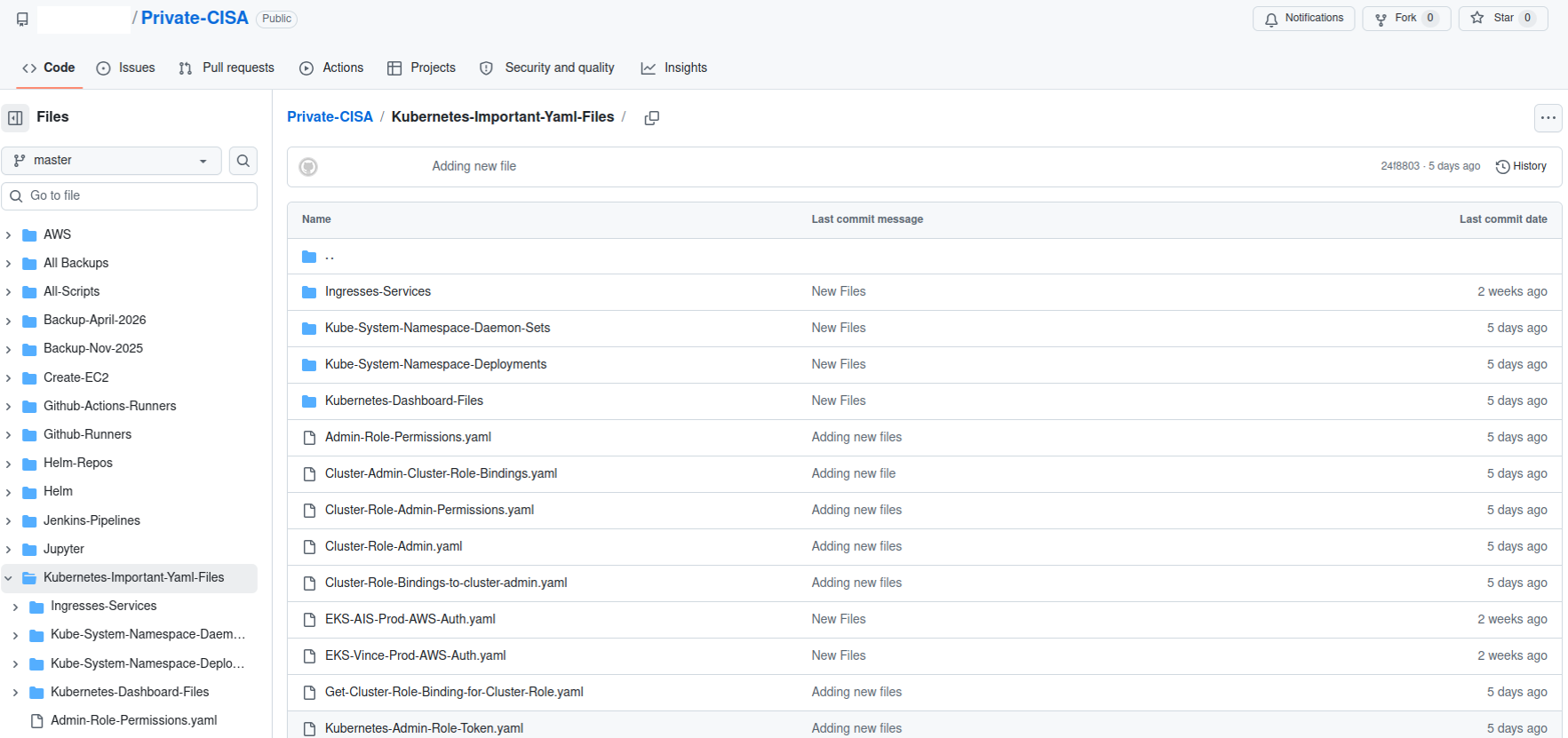
A redacted screenshot of the now-defunct “Private CISA” repository maintained by a CISA contractor.

The GitHub repository that Valadon flagged was named “Private-CISA,” and it harbored a vast number of internal CISA/DHS credentials and files, including cloud keys, tokens, plaintext passwords, logs and other sensitive CISA assets.

Valadon said the exposed CISA credentials represent a textbook example of poor security hygiene, noting that the commit logs in the offending GitHub account show that the CISA administrator disabled the default setting in GitHub that blocks users from publishing SSH keys or other secrets in public code repositories.

“Passwords stored in plain text in a csv, backups in git, explicit commands to disable GitHub secrets detection feature,” Valadon wrote in an email. “I honestly believed that it was all fake before analyzing the content deeper. This is indeed the worst leak that I’ve witnessed in my career. It is obviously an individual’s mistake, but I believe that it might reveal internal practices.”

One of the exposed files, titled “importantAWStokens,” included the administrative credentials to three Amazon AWS GovCloud servers. Another file exposed in their public GitHub repository — “AWS-Workspace-Firefox-Passwords.csv” — listed plaintext usernames and passwords for dozens of internal CISA systems. According to Caturegli, those systems included one called “LZ-DSO,” which appears short for “Landing Zone DevSecOps,” the agency’s secure code development environment.

Philippe Caturegli, founder of the security consultancy Seralys, said he tested the AWS keys only to see whether they were still valid and to determine which internal systems the exposed accounts could access. Caturegli said the GitHub account that exposed the CISA secrets exhibits a pattern consistent with an individual operator using the repository as a working scratchpad or synchronization mechanism rather than a curated project repository.

“The use of both a CISA-associated email address and a personal email address suggests the repository may have been used across differently configured environments,” Caturegli observed. “The available Git metadata alone does not prove which endpoint or device was used.”

The Private CISA GitHub repo exposed dozens of plaintext credentials for important CISA GovCloud resources.

Caturegli said he validated that the exposed credentials could authenticate to three AWS GovCloud accounts at a high privilege level. He said the archive also includes plain text credentials to CISA’s internal “artifactory” — essentially a repository of all the code packages they are using to build software — and that this would represent a juicy target for malicious attackers looking for ways to maintain a persistent foothold in CISA systems.

“That would be a prime place to move laterally,” he said. “Backdoor in some software packages, and every time they build something new they deploy your backdoor left and right.”

In response to questions, a spokesperson for CISA said the agency is aware of the reported exposure and is continuing to investigate the situation.

“Currently, there is no indication that any sensitive data was compromised as a result of this incident,” the CISA spokesperson wrote. “While we hold our team members to the highest standards of integrity and operational awareness, we are working to ensure additional safeguards are implemented to prevent future occurrences.”

A review of the GitHub account and its exposed passwords show the “Private CISA” repository was maintained by an employee of Nightwing, a government contractor based in Dulles, Va. Nightwing declined to comment, directing inquiries to CISA.

CISA has not responded to questions about the potential duration of the data exposure, but Caturegli said the Private CISA repository was created on November 13, 2025. The contractor’s GitHub account was created back in September 2018.

The GitHub account that included the Private CISA repo was taken offline shortly after both KrebsOnSecurity and Seralys notified CISA about the exposure. But Caturegli said the exposed AWS keys inexplicably continued to remain valid for another 48 hours.

CISA is currently operating with only a fraction of its normal budget and staffing levels. The agency has lost nearly a third of its workforce since the beginning of the second Trump administration, which forced a series of early retirements, buyouts, and resignations across the agency’s various divisions.

The now-defunct Private CISA repo showed the contractor also used easily-guessed passwords for a number of internal resources; for example, many of the credentials used a password consisting of each platform’s name followed by the current year. Caturegli said such practices would constitute a serious security threat for any organization even if those credentials were never exposed externally, noting that threat actors often use key credentials exposed on the internal network to expand their reach after establishing initial access to a targeted system.

“What I suspect happened is [the CISA contractor] was using this GitHub to synchronize files between a work laptop and a home computer, because he has regularly committed to this repo since November 2025,” Caturegli said. “This would be an embarrassing leak for any company, but it’s even more so in this case because it’s CISA.”

Who is the Kimwolf Botmaster “Dort”?

In early January 2026, KrebsOnSecurity revealed how a security researcher disclosed a vulnerability that was used to build Kimwolf, the world’s largest and most disruptive botnet. Since then, the person in control of Kimwolf — who goes by the handle “Dort” — has coordinated a barrage of distributed denial-of-service (DDoS), doxing and email flooding attacks against the researcher and this author, and more recently caused a SWAT team to be sent to the researcher’s home. This post examines what is knowable about Dort based on public information.

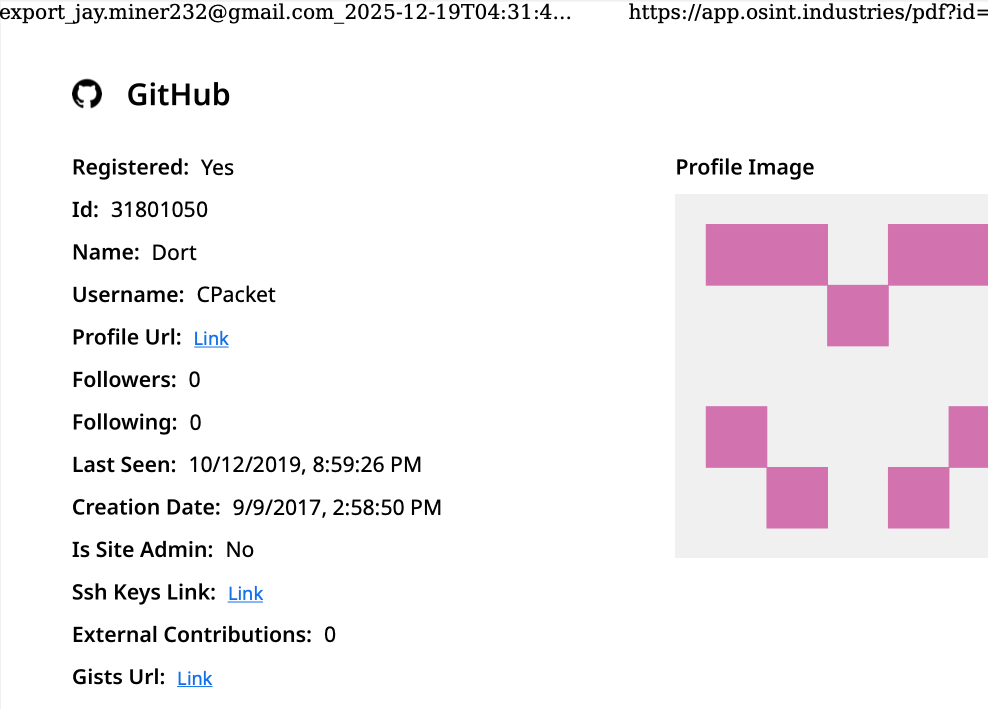
A public “dox” created in 2020 asserted Dort was a teenager from Canada (DOB August 2003) who used the aliases “CPacket” and “M1ce.” A search on the username CPacket at the open source intelligence platform OSINT Industries finds a GitHub account under the names Dort and CPacket that was created in 2017 using the email address jay.miner232@gmail.com.

Image: osint.industries.

The cyber intelligence firm Intel 471 says jay.miner232@gmail.com was used between 2015 and 2019 to create accounts at multiple cybercrime forums, including Nulled (username “Uubuntuu”) and Cracked (user “Dorted”); Intel 471 reports that both of these accounts were created from the same Internet address at Rogers Canada (99.241.112.24).

Dort was an extremely active player in the Microsoft game Minecraft who gained notoriety for their “Dortware” software that helped players cheat. But somewhere along the way, Dort graduated from hacking Minecraft games to enabling far more serious crimes.

Dort also used the nickname DortDev, an identity that was active in March 2022 on the chat server for the prolific cybercrime group known as LAPSUS$. Dort peddled a service for registering temporary email addresses, as well as “Dortsolver,” code that could bypass various CAPTCHA services designed to prevent automated account abuse. Both of these offerings were advertised in 2022 on SIM Land, a Telegram channel dedicated to SIM-swapping and account takeover activity.

The cyber intelligence firm Flashpoint indexed 2022 posts on SIM Land by Dort that show this person developed the disposable email and CAPTCHA bypass services with the help of another hacker who went by the handle “Qoft.”

“I legit just work with Jacob,” Qoft said in 2022 in reply to another user, referring to their exclusive business partner Dort. In the same conversation, Qoft bragged that the two had stolen more than $250,000 worth of Microsoft Xbox Game Pass accounts by developing a program that mass-created Game Pass identities using stolen payment card data.

Who is the Jacob that Qoft referred to as their business partner? The breach tracking service Constella Intelligence finds the password used by jay.miner232@gmail.com was reused by just one other email address: jacobbutler803@gmail.com. Recall that the 2020 dox of Dort said their date of birth was August 2003 (8/03).

Searching this email address at DomainTools.com reveals it was used in 2015 to register several Minecraft-themed domains, all assigned to a Jacob Butler in Ottawa, Canada and to the Ottawa phone number 613-909-9727.

Constella Intelligence finds jacobbutler803@gmail.com was used to register an account on the hacker forum Nulled in 2016, as well as the account name “M1CE” on Minecraft. Pivoting off the password used by their Nulled account shows it was shared by the email addresses j.a.y.m.iner232@gmail.com and jbutl3@ocdsb.ca, the latter being an address at a domain for the Ottawa-Carelton District School Board.

Data indexed by the breach tracking service Spycloud suggests that at one point Jacob Butler shared a computer with his mother and a sibling, which might explain why their email accounts were connected to the password “jacobsplugs.” Neither Jacob nor any of the other Butler household members responded to requests for comment.

The open source intelligence service Epieos finds jacobbutler803@gmail.com created the GitHub account “MemeClient.” Meanwhile, Flashpoint indexed a deleted anonymous Pastebin.com post from 2017 declaring that MemeClient was the creation of a user named CPacket — one of Dort’s early monikers.

Why is Dort so mad? On January 2, KrebsOnSecurity published The Kimwolf Botnet is Stalking Your Local Network, which explored research into the botnet by Benjamin Brundage, founder of the proxy tracking service Synthient. Brundage figured out that the Kimwolf botmasters were exploiting a little-known weakness in residential proxy services to infect poorly-defended devices — like TV boxes and digital photo frames — plugged into the internal, private networks of proxy endpoints.

By the time that story went live, most of the vulnerable proxy providers had been notified by Brundage and had fixed the weaknesses in their systems. That vulnerability remediation process massively slowed Kimwolf’s ability to spread, and within hours of the story’s publication Dort created a Discord server in my name that began publishing personal information about and violent threats against Brundage, Yours Truly, and others.

Dort and friends incriminating themselves by planning swatting attacks in a public Discord server.

Last week, Dort and friends used that same Discord server (then named “Krebs’s Koinbase Kallers”) to threaten a swatting attack against Brundage, again posting his home address and personal information. Brundage told KrebsOnSecurity that local police officers subsequently visited his home in response to a swatting hoax which occurred around the same time that another member of the server posted a door emoji and taunted Brundage further.

Dort, using the alias “Meow,” taunts Synthient founder Ben Brundage with a picture of a door.

Someone on the server then linked to a cringeworthy (and NSFW) new Soundcloud diss track recorded by the user DortDev that included a stickied message from Dort saying, “Ur dead nigga. u better watch ur fucking back. sleep with one eye open. bitch.”

“It’s a pretty hefty penny for a new front door,” the diss track intoned. “If his head doesn’t get blown off by SWAT officers. What’s it like not having a front door?”

With any luck, Dort will soon be able to tell us all exactly what it’s like.

Update, 10:29 a.m.: Jacob Butler responded to requests for comment, speaking with KrebsOnSecurity briefly via telephone. Butler said he didn’t notice earlier requests for comment because he hasn’t really been online since 2021, after his home was swatted multiple times. He acknowledged making and distributing a Minecraft cheat long ago, but said he hasn’t played the game in years and was not involved in Dortsolver or any other activity attributed to the Dort nickname after 2021.

“It was a really old cheat and I don’t remember the name of it,” Butler said of his Minecraft modification. “I’m very stressed, man. I don’t know if people are going to swat me again or what. After that, I pretty much walked away from everything, logged off and said fuck that. I don’t go online anymore. I don’t know why people would still be going after me, to be completely honest.”

When asked what he does for a living, Butler said he mostly stays home and helps his mom around the house because he struggles with autism and social interaction. He maintains that someone must have compromised one or more of his old accounts and is impersonating him online as Dort.

“Someone is actually probably impersonating me, and now I’m really worried,” Butler said. “This is making me relive everything.”

But there are issues with Butler’s timeline. For example, Jacob’s voice in our phone conversation was remarkably similar to the Jacob/Dort whose voice can be heard in this Sept. 2022 Clash of Code competition between Dort and another coder (Dort lost). At around 6 minutes and 10 seconds into the recording, Dort launches into a cursing tirade that mirrors the stream of profanity in the diss rap that Dortdev posted threatening Brundage. Dort can be heard again at around 16 minutes; at around 26:00, Dort threatens to swat his opponent.

Butler said the voice of Dort is not his, exactly, but rather that of an impersonator who had likely cloned his voice.

“I would like to clarify that was absolutely not me,” Butler said. “There must be someone using a voice changer. Or something of the sorts. Because people were cloning my voice before and sending audio clips of ‘me’ saying outrageous stuff.”

Further reading:

Jan. 8, 2026: Who Benefited from the Aisuru and Kimwolf Botnets?

Jan. 20, 2026: Kimwolf Botnet Lurking in Corporate, Govt. Networks

Jan. 26, 2026: Who Operates the Badbox 2.0 Botnet?

Feb. 11, 2026: Kimwolf Botnet Swamps Anonymity Network I2P

Mar. 19, 2026: Feds Disrupt IoT Botnets Behind Huge DDoS Attacks

Ransomware Tool Matrix Update: Community Reports


Introduction

The Ransomware Tool Matrix continues to be a useful passion project that I am happy to continue maintaining. One piece of common feedback I've received for the Ransomware Tool Matrix was that individuals would like to contribute their observations to it, but do not have public links they can cite (such as a formal blog post on a company website). Therefore, I came up with a plan to make a reporting template to help with this.

What are Community Reports?

Individuals can now share what tools they have seen various ransomware groups, affiliates, or initial access brokers (IABs) use via the new Community Report Template. The level of detail provided is the contributor's choice. The more verifiable information shared, the increased level of reliability and credibility.

You can view the current list of Community Reports on GitHub here.

Why the need for Community Reports?

Most of the sources of CTI about ransomware TTPs comes from open source reports by organisations such as the US Cybersecurity and Infrastructure Security Agency (CISA), The DFIR Report, and other cybersecurity vendors. From the beginning it was important to recognise the importance of the having public citations by reputable organisations to maintain the reliability and credibility of the resource overall. Consumers of the Ransomware Tool Matrix should feel confident that the information provided is of high standard and legitimate.

The problem was, however, that members of the cybersecurity community who may work with victims of ransomware attacks also have information about what tools which ransomware group uses. 

The sources of this information could come from various sources, such as from Digital Forensics and Incident Response (DFIR) service providers, Managed Security Service Providers (MSSPs), Endpoint Detection and Response (EDR) vendors, or security researchers who manage to obtain threat intelligence about ransomware groups via various other means, such as infiltrating cybercrime forums or open directory hunting.

These sources of information did not currently have a way to contribute to the Ransomware Tool Matrix due to the missing factor of a publicly citable blog.

How do Community Reports work?

Members of the Community with information and tools used by ransomware groups can now share their observations via a structured report template shown below.

Whether to include all the details here is up to the contributor, but this type of reporting system is an option for community members to share their findings with the rest of the community who are interested in this information.


Anyone who wants to submit a Community Report can copy the code, edit in their findings, and submit a pull request to the GitHub repository. Alternatively, they can fork the project and then I can merge their commits to the main branch. More details about how to creating a pull request from a fork can be found in the GitHub's Docs here.

Conclusion

One of the problems of cybersecurity vendor blogs is that a lot of them are marketing material and therefore, details about every ransomware incident a company worked on is not great marketing. However, as CTI analysts, incident responders, threat hunters, and detection engineers, these details are crucial for our day-to-day lives. Hence why the Community Report system was one of the most common pieces of feedback I received and why I created it.

I look forward to the contributions from the community to this new reporting system and hope it helps many more who are keen to see and read about what the latest tools are that the ransomware cybercriminals are using.

Blurring the Lines: Intrusion Shows Connection With Three Major Ransomware Gangs

Key Takeaways Private Threat Briefs: 20+ private DFIR reports annually. Contact us today for pricing or a demo! Table of Contents: Case Summary Analysts Initial Access Execution Persistence Privilege Escalation Defense Evasion Credential Access Discovery Lateral Movement Collection Command and Control Exfiltration Impact Timeline Diamond Model Indicators Detections MITRE ATT&CK Case Summary The intrusion began in […]

The post Blurring the Lines: Intrusion Shows Connection With Three Major Ransomware Gangs appeared first on The DFIR Report.

Hide Your RDP: Password Spray Leads to RansomHub Deployment

Key Takeaways Case Summary This intrusion began in November 2024 with a password spray attack targeting an internet-facing RDP server. Over the course of several hours, the threat actor attempted logins against multiple accounts using known malicious IPs (based on OSINT). Several hours later they then logged in via RDP with one of the previously […]

The post Hide Your RDP: Password Spray Leads to RansomHub Deployment appeared first on The DFIR Report.

Ransomware Tool Matrix Project Updates: May 2025

Introduction

This blog is a summary and analysis of recent additions to the Ransomware Tool Matrix (RTM) as well as the Ransomware Vulnerability Matrix (RVM)Feedback from the infosec community about these projects has been overwhelmingly positive and many researchers have contacted me to tell me how helpful they have found these to be. It makes me happy to hear how doing something in my spare time can help stop ransomware attacks and cybercriminals from exploiting our society’s systems. And it is for that reason, I shall continue to maintain these projects as long as ransomware is still around. For anyone new to these projects, please read the descriptions on GitHub or feel free to watch my talk explaining the project at BSides London.

Background on the current ransomware ecosystem as of May 2025

Following the impact of Operation Cronos against LockBit and the exit scam by ALPHV/BlackCat, the ransomware ecosystem has been even more unstable than usual. The exit scams and law enforcement infiltration operations have created a zero trust environment for the cybercriminals participating in the ransomware economy. The days of affiliates putting their faith in one RaaS platform seem to be long gone and many are experimenting and going from one RaaS to the next.

Sources of Threat Intelligence for the RTM

The RTM was updated with OSINT reports shared by cybersecurity researchers at various private service providers or vendors. The thing to remember about these reports is that the tool usage is going to be slightly outdated due to the time it takes incident response teams to wrap up an investigation, compile findings, and publish a report.

From the reports, threat groups such as Qilin, BlackSuit, RansomEXX, Medusa, BianLian, Hunters International and PLAY have been active for over one year or for multiple years. These are established groups. Since RansomHub and LockBit have shut down, it is more likely than not that the affiliates have already shifted to one of the other RaaS platforms, like Qilin, among others.

There has also been a number of ransomware operations suspected to be linked to Chinese cyber-espionage groups, such as RA World (for using PlugX), NailaoLocker (for using ShadowPad and PlugX), and CrazyHunter (for its focus on Taiwan).

Threat groups such as IMN Crew, QWCrypt (linked to RedCurl), NightSpire, SuperBlack, and Helldown are all rising threat groups that have more recently begun their ransomware campaigns.

These factors have led to seeing a large variety of tool usage in ransomware operations being observed across the landscape. The reliance on tools from sites like GitHub and other free software sites, however, continues to remain a constant theme among all of these ransomware operations.

List of sources used for the May 2025 major update to the RTM:

Group Name

Report Publish Date

URL

Qilin

25 April 2025

10 March 2025


redpiranha.net

picussecurity.com

IMN Crew

24 April 2025


s-rminform.com

CrazyHunter

16 April 2025


trendmicro.com

RansomEXX

8 April 2025


microsoft.com

BlackSuit

31 March 2025


thedfirreport.com

QWCrypt

26 March 2025


bitdefender.com

RansomHub

26 March 2025

20 March 2025


welivesecurity.com

security.com

Medusa

26 March 2025

6 March 2025


welivesecurity.com

security.com

BianLian

26 March 2025


welivesecurity.com

PLAY

26 March 2025


welivesecurity.com

NightSpire

25 March 2025


s-rminform.com

Hunters International

19 March 2025

esentire.com

SuperBlack

13 March 2025


forescout.com

LockBit

24 February 2025


thedfirreport.com

NailaoLocker

20 February 2025

18 February 2025


orangecyberdefense.com

trendmicro.com

RA World

13 February 2025

22 July 2024


security.com

unit42.paloaltonetworks.com

Helldown

7 November 2024


truesec.com

Tools Used by Multiple Groups

  • EDRSandBlast and WKTools are relatively new tools that are being used by multiple groups to deactivate and overcome EDR tools that many victims will have on their networks to prevent ransomware attacks.
  • Typical ransomware tools, such as PsExec, Mimikatz, and Rclone remain effective and still used by multiple ransomware gangs for the foreseeable future.

Tool

Type

Groups Using It

WinSCP

Exfiltration

NightSpire

Hunters International


Mimikatz

Credential Theft

RansomHub

Qilin

Helldown


Impacket

Offensive Security Tool

RansomHub

RA World

NailaoLocker


Rclone

Exfiltration

RansomHub

Hunters International Medusa


NetScan

Discovery

RansomHub

Medusa


WKTools

Discovery

RansomHub

BianLian

PLAY


Advanced IP Scanner

Discovery

Hunters International BianLian


Advanced Port Scanner

Discovery

Hunters International Helldown


AnyDesk

RMM Tool

Medusa

BianLian


EDRSandBlast

Defense Evasion

Medusa

Qilin


New Tools Added to the RTM

  • The most notable new tools added to RTM include several defense evasion tools for deactivating EDRs, discovery for sensitive files, and tunnelling tools to conceal adversary network connections.

Tool

Type

Groups Usage

Bublup

Exfiltration


BlackSuit

WKTools

Discovery


BianLian, PLAY

AmmyyAdmin

RMM Tool


BianLian

CQHashDump

Credential Theft


NailaoLocker

Throttle Stop Driver

Defense Evasion


Medusa

KillAV

Defense Evasion


Medusa

BadRentdrv2

Defense Evasion


RansomHub

Toshiba Power Driver (BYOVD)

Defense Evasion

Qilin

ZammoCide

Defense Evasion


CrazyHunter

FRP

Networking


Medusa

Stowaway

Networking


RansomHub

Navicat

Discovery


Medusa

Everything.exe

Discovery


NighSpire

RoboCopy

Discovery


Medusa

NPS

Networking


RA World

SharpGPOAbuse

Offensive Security Tool


CrazyHunter

Attrib

LOLBAS


BlackSuit

Curl

LOLBAS


QWCrypt (RedCurl)

PCA Utility (pcalua)

LOLBAS


QWCrypt (RedCurl)

Exploits used by Ransomware Gangs added to the RVM

  • As is now usual, multiple ransomware groups have been targeting Fortinet networking devices for initial access into to victim environments.
  • Multiple ransomware groups continue to exploit the Windows Common Log File System (CLFS) for local privilege escalation to run hacking tools and steal credentials.
  • Other exploits involve targeting edge devices, such as Check Point VPNs or PAN Firewalls, or exposed servers, such as Atlassian Confluence Data Center Servers.
  • The targeting of Veeam backup software should come as no surprise as preventing backups or stealing sensitive files, such as Active Directory backups, are key objectives of ransomware gangs to complete their mission.

Ransomware Group

Exploited CVEs

NightSpire

CVE-2024-55591 (FortiOS)


RansomHub

CVE-2022-24521 (Windows CLFS)
CVE-2023-27532 (Veeam)


LockBit

CVE-2023-22527 (Confluence)


Hunters International

CVE-2024-55591 (FortiProxy)


SuperBlack

CVE-2024-55591 (FortiProxy)


RA World

CVE-2024-0012 (PAN-OS)


NailaoLocker

CVE-2024-24919 (Check Point VPN)


RansomEXX

CVE-2025-29824 (Windows CLFS)


Conclusion

My recommendation for defenders who continue the fight against ransomware is to take some of the findings from this report and begin threat hunting, detection rule writing, and start blocking some of these tools not present in the environments you are protecting.

Here are a few sites to help you get started with:

Tracking Adversaries: EvilCorp, the RansomHub affiliate


Introduction

This blog is part of a cyber threat intelligence (CTI) blog series called Tracking Adversaries that investigates prominent or new threat groups.

The focus of this blog is EvilCorp, a sanctioned Russia-based cybercriminal enterprise known for launching ransomware attacks, and RansomHub, a prominent ransomware as a service (RaaS) operation run by Russian-speaking cybercriminals.

These two threat groups have been linked together through cooperation on intrusions and IOCs and TTPs shared by multiple CTI sources. The implication of this link is critical due to RansomHub being the most active ransomware gang and is working with a well-known sanctioned affiliate.

Who is RansomHub?

Active since February 2024, RansomHub is a RaaS operation formerly known as Cyclops and Knight and is run by Russian-speaking adversaries. It is currently used by more and more cybercriminals that are ex-affiliates of other RaaS operations. This includes the ALPHV/BlackCat RaaS and the LockBit RaaS, which have since shutdown or disappeared. This has made the RansomHub RaaS one of the most widespread ransomware families as of early 2025.

Due to having a high number of affiliates, the tools and TTPs observed before the final RansomHub payload is deployed can vary significantly. Each affiliate may have their own set of tools and TTPs to achieve the final objectives of data exfiltration and ransomware deployment.

Who is EvilCorp?

Evil Corp is an international cybercrime network sanctioned for orchestrating large-scale financial cyberattacks led by Maksim Yakubets. EvilCorp’s operations have evolved over time, expanding from Dridex banking trojan campaigns into developing ransomware like BitPaymer, WastedLocker, Hades, PhoenixLocker, and MacawLocker.

Notably, Aleksandr Ryzhenkov, was identified by the National Crime Agency (NCA) as a high-ranking member of EvilCorp and also LockBit affiliate. Ryzhenkov became a LockBit affiliate around 2022, contributing to over 60 LockBit ransomware builds and attempting to extort more than $100 million from victims. This discovery aligns with Mandiant’s previous reporting on EvilCorp shifting to LockBit as well.

The NCA also found that EvilCorp maintains close ties with Russian intelligence agencies through Yakubets' father-in-law, Eduard Bendersky, a former FSB officer, who is suspected of using his influence to shield the group from prosecution in Russia.

One of the TTPs that makes EvilCorp standout from the rest of the RaaS affiliates is their own affiliation to the SocGholish JavaScript malware (aka FAKEUPDATES). If ransomware deployment takes place following a SocGholish infection, then the attackers responsible for the attack will be affiliated with EvilCorp.

Reported Connections Between EvilCorp and RansomHub

On 15 July 2024, Microsoft shared a post on X stating that RansomHub was observed being deployed in post-compromise activity by Manatee Tempest (which is Microsoft’s name for EvilCorp) following initial access via SocGholish (aka FakeUpdates) infections (which Microsoft tracks as Mustard Tempest).

A screenshot of a computer

AI-generated content may be incorrect.

On 15 January 2025, Guidepoint wrote a blog on a new Python backdoor used by an affiliate of RansomHub. Notably, the new Python backdoor was delivered by SocGholish. Therefore, this Python backdoor is another potential artifact worth monitoring for its connection to known EvilCorp-related malware.

The next day, on 16 January 2025, Google shared a report on EvilCorp (which Google tracks as UNC2165) that disclosed numerous tools and malware families they have been using to deliver RansomHub, including a Python backdoor dubbed VIPERTUNNEL (see the image below). The presence of a Python backdoor following a SocGholish infection is notable TTP that overlaps with the Guidepoint blog on RansomHub.

On 14 March 2025, Trend Micro disclosed further details that also confirmed the SocGholish malware is leading to the deployment of RansomHub ransomware. The operators of SocGholish are tracked as Water Scylla by Trend Micro. The operators distribute SocGholish via the Keitaro Traffic Direction System (TDS), a legitimate service used for marketing campaigns. Trend Micro also observed SocGholish dropping the same custom Python backdoor (aka VIPERTUNNEL) as well.

So What?

EvilCorp has been under US sanctions since 2019, making it illegal for affected organisations to pay ransoms to them without facing potential fines from the US Treasury’s Office of Foreign Assets Control (OFAC). Despite these sanctions, EvilCorp has continued its cybercriminal activities by adapting its tactics to include rebranding their ransomware and becoming an affiliate of RaaS operations, such as LockBit and RansomHub. 

The key indicator of EvilCorp's involvement in ransomware attacks continues to be the use of the SocGholish malware, which employs drive-by downloads masquerading as web browser software updates to gain initial access to systems.

EvilCorp’s affiliation with RansomHub raises the possibilities that RansomHub may soon face sanctions similar to those imposed on EvilCorp. Consequently, any victim that pays a ransom to RansomHub could become significantly riskier for cyber insurance organisations, incident responders, and ransomware negotiators, as they may inadvertently violate sanctions and face legal repercussions.

Given EvilCorp's prominence as a target for international law enforcement, its association with RansomHub is likely to draw increased scrutiny. This could result in RansomHub becoming the focus of future law enforcement actions, including potential takedowns and additional sanctions, further complicating the landscape for entities involved in ransomware response and mitigation.

There is also the increased likelihood that RansomHub will now rebrand. As we saw in the BlackBasta Leaks, ransomware groups pay close attention to the news, CTI reports, and even posts on X and even blogs by researchers. This association to EvilCorp and threat of sanctions is an issue for ransomware groups as it impacts their business model and makes earning harder. Therefore, by linking the two entities together CTI analysts can impose cost on these cybercriminals.

References:

  1. https://www.cisa.gov/news-events/cybersecurity-advisories/aa24-242a
  2. https://www.bankinfosecurity.com/blogs/ransomhub-hits-powered-by-ex-affiliates-lockbit-blackcat-p-3703
  3. https://www.ransomware.live/group/ransomhub#ttps
  4. https://home.treasury.gov/news/press-releases/sm845
  5. https://web.archive.org/web/20200213115628/https:/www.nationalcrimeagency.gov.uk/news/international-law-enforcement-operation-exposes-the-world-s-most-harmful-cyber-crime-group
  6. https://www.crowdstrike.com/en-us/blog/hades-ransomware-successor-to-indrik-spiders-wastedlocker/
  7. https://web.archive.org/web/20241004104429/https:/www.nationalcrimeagency.gov.uk/news/further-evil-corp-cyber-criminals-exposed-one-unmasked-as-lockbit-affiliate
  8. https://www.microsoft.com/en-us/security/blog/2022/05/09/ransomware-as-a-service-understanding-the-cybercrime-gig-economy-and-how-to-protect-yourself/#DEV-0206-DEV-0243
  9. https://malpedia.caad.fkie.fraunhofer.de/details/js.fakeupdates
  10. https://x.com/msftsecintel/status/1812932754947911780
  11. https://www.microsoft.com/en-gb/security/security-insider/manatee-tempest
  12. https://www.guidepointsecurity.com/blog/ransomhub-affiliate-leverage-python-based-backdoor/
  13. https://services.google.com/fh/files/misc/threat_horizons_report_h1_2025.pdf
  14. https://www.trendmicro.com/en_us/research/25/c/socgholishs-intrusion-techniques-facilitate-distribution-of-rans.html
  15. https://blog.bushidotoken.net/2025/02/blackbasta-leaks-lessons-from-ascension.html


Analysis of Counter-Ransomware Activities in 2024


The scourge of ransomware continues primarily because of three main reasons: Ransomware-as-a-Service (RaaS), cryptocurrency, and safe havens.

  • RaaS platforms enable aspiring cybercriminals to join a gang and begin launching attacks with a support system that help extract ransom payments from their victims.
  • Cryptocurrency enables cybercriminals to receive funds from victims around the world without the option to freeze or refund them due to the immutable nature of the virtual funds.
  • Safe havens are countries that permit cybercriminals to launch attacks without immediate fear of arrest, enabling them to earn vast fortunes through ransomware campaigns.

With these three challenges in mind, law enforcement and governments have a very difficult job to do when it comes to fighting ransomware but fight it they must. In this blog we shall recall what counter-ransomware activities took place in 2024, analyse their effectiveness, and assess how the landscape shall evolve as a result.

A podcast version of this blog is also available here.

Ransomware Operator Arrests and Sanctions

During 2024, there were significant disruption operations by law enforcement and financial authorities targeting individuals behind ransomware campaigns (see the Table below). The main focus of 2024 for Western law enforcement was squarely on the LockBit RaaS and its affiliates as it was the largest and highest earning ransomware operation to date.

Several key players of the ransomware ecosystem were arrested, including the main developer of LockBit ransomware. Interestingly, Russian law enforcement also decided to arrest ransomware threat actors located in Moscow and Kaliningrad as well.

Law Enforcement Activity
Month Group(s) Law Enforcement Activity
February 2024 SugarLocker, REvil Russian authorities have identified and arrested three alleged members in Moscow of a ransomware gang called SugarLocker.
February 2024 LockBit The LockBit leak site was seized. Two LockBit affiliates were arrested in Poland and Ukraine. Up to 28 servers belonging to LockBit were taken down.
February 2024 LockBit Two Russian nationals, Ivan Kondratiev and Artur Sungatov, were sanctioned by the US Treasury for being affiliates of LockBit, among other RaaS.
May 2024 LockBit Dmitry Khoroshev, the administrator and developer of LockBit was sanctioned by the US Treasury.
May 2024 IcedID, SystemBC, Pikabot, Smokeloader, Bumblebee, TrickBot European police took down malicious spam botnets that support ransomware campaigns. This resulted in 4 arrests (1 in Armenia and 3 in Ukraine), over 100 servers and 2,000 domains being seized. One of the main suspects earned €69 million by renting out infrastructure sites to deploy ransomware.
June 2024 Conti, LockBit A Ukrainian national was arrested for supporting Conti and LockBit ransomware attacks as a crypter developer.
August 2024 Reveton, RansomCartel Maksim Silnikau, a Belarusian national, was arrested in Spain for running Reveton and RansomCartel.
August 2024 Karakurt, Conti Deniss Zolotarjovs, a Latvian national was arrested and extradited to the US from Georgia for running the Karakurt data extortion gang linked to Conti.
October 2024 Evil Corp, LockBit The UK, alongside the US and Australia, has sanctioned 16 members of Evil Corp, including Aleksandr Ryzhenkov, Viktor Yakubets, and Eduard Benderskiy.
November 2024 Phobos Evgenii Ptitsyn, a Russian national, was arrested and extradited to the US from South Korea for running the Phobos ransomware gang.
December 2024 LockBit Rostislav Panev, a dual Russian and Israeli national, was arrested in Israel for developing LockBit ransomware.
December 2024 LockBit, Babuk, Hive Mikhail “Wazawaka” Matveev was arrested in Russia for violating domestic laws against the creation and use of malware. He was fined and had his cryptocurrency seized and is awaiting trial.

The ransomware ecosystem has fragmented due to the law enforcement disruptions of the largest players, such as ALPHV/BlackCat and LockBit. In the case of ALPHV/BlackCat, the operators staged a law enforcement takedown as they put up a fake seizure notice as part of an exit scam in March 2024 after the attack on UnitedHealth.

Following these disruptions, some affiliates have migrated to less effective strains or launched their own strains. This includes Akira and RansomHub at the top of the list as well as Hunters International and PLAY.

Cryptocurrency Exchanges Disrupted

During 2024, law enforcement seized funds from and sanctioned a number of cryptocurrency exchanges and individuals running payment processors using cryptocurrency (see the Table below).

One of the most interesting disclosures this year came from the UK National Crime Agency (NCA) around Operation Destablise. The NCA linked payments to ransomware gangs to money laundering networks used by Russian oligarchs to covertly purchase property and Russia Today, the state-run media organization, to covertly fund pro-Russia foreign entities.

Another notable investigation in 2024 was when the US Treasury sanctioned more Russian cryptocurrency exchanges, such as PM2BTC and Cryptex, that led to money launderers that facilitate the cashing out of ransom payments being arrested by Russian law enforcement.

Law Enforcement Activity
Month Exchange(s) Law Enforcement Activity
August 2024 Cryptonator The US Justice Department indicted Russian national Roman Pikulev and Cryptonator, which processed a total of $1.4 billion in transactions, of which $8 million were ransom payments. Cryptonator also has ties to other sanctioned entities including Blender, Hydra Market, Bitzlato, and Garantex, among others.
September 2024 PM2BTC, Cryptex, UAPS FinCEN identified PM2BTC as being of “primary money laundering concern” in connection with Russian illicit finance. This was alongside Cryptex and Sergey Sergeevich Ivanov, a Russian national, who is associated with UAPS and PinPays, as well as Genesis Market. Cryptex also facilitated more than $115 million of proceeds from ransomware payments.
September 2024 47 exchanges In Operation Final Exchange, German federal police (BKA) shut down 47 cryptocurrency exchange services that ransomware gangs use that operated without requiring registration or identity verification.
October 2024 Cryptex, UAPS Russian authorities have arrested nearly 100 suspected cybercriminals linked to the anonymous payment system UAPS and the cryptocurrency exchange Cryptex.
November 2024 Smart, TGR Group The NCA uncovered a Russian money-laundering network operated by two companies called Smart and TGR Group as part of Operation Destabilise that involved UK-based cash-to-crypto networks that laundered Ryuk ransom payments as well as the money of Russian oligarchs and Russia Today.

Safe Havens Enabling Ransomware

While ransomware is a global problem, there are only a few countries that are to blame for this rapid expansion of the ransomware ecosystem. The state that is blamed the most for preventing many ransomware operators from facing justice is Russia. There are explicit rules posted to Russian-speaking cybercrime forums that state as long as members avoid targeting Russia and the Commonwealth of Independent States (CIS), they are free to operate.

The Russian ransomware safe haven theory was further proven following sanctions levied against Evil Corp by the UK, US, and Australia. One of the sanctioned men connected to Evil Corp was Eduard Benderskiy, a former Russian federal security service (FSB) official. Benderskiy is reportedly the father-in-law of Maksim Yakubets, the leader of Evil Corp, an organized cybercrime group responsible for multiple ransomware strains including BitPaymer, WastedLocker, Hades, PhoenixLocker, and MacawLocker. In total, Evil Corp has reportedly extorted at least $300 million from victims globally, according to the UK NCA. It is now clear that Evil Corp has protection from a highly connected Russian FSB official who has also been involved in multiple overseas assassinations on behalf of the Kremlin, according to Bellingcat investigators.

While a number of ransomware operators were arrested in 2024 and some were extradited to the US, the work done by law enforcement specializing in cybercrime was put in the spotlight during the August 2024 prisoner swap. Multiple countries decided to release cybercriminals, spies and an assassin as part of a historic prisoner exchange with Russia at an airport in Ankara, Turkey. The US negotiated the release of 16 people from Russia, including five Germans as well as seven Russian citizens who were political prisoners in their own country.

Notably, from a cybercrime intelligence perspective, the Russian nationals released from the West included the infamous cybercriminals Roman Seleznev and Vladislav Klyushin. The latter, Klyushin, was sentenced in 2023 to nine years in US prison after he was caught in a $93 million stock market cheating scheme that involved hacking into US companies for insider knowledge. The other cybercriminal, Seleznev, was sentenced to 27 years in prison in 2017 for stealing and selling millions of credit card numbers from 500 businesses using point-of-sale (POS) malware and causing more than $169 million in damage to small businesses and financial institutions, including those in the US.

In 2024, we saw several more Russian nationals get extradited to the US after being arrested by law enforcement in the country they were residing in. This includes the Phobos operator living in South Korea and the LockBit developer living in Israel. This follows others arrested in previous years such as a TrickBot developer arrested in South Korea as well as the two LockBit affiliates extradited to the US. There is a potential that these Russian nationals involved in ransomware could be used in prisoner exchanges in the future.

Further, another curious trend in 2024 was that some Russians inside Russia, which is firmly considered a safe haven for ransomware gang, did get arrested. This includes the SugarLocker operators arrested in Moscow and the LockBit affiliate Wazawaka who was arrested in Kaliningrad. This is alongside the money launderers arrested around Russia linked to the Cryptex exchange.

The arrests of Russian nationals in Russia for ransomware activities appear to be more symbolic than a true crackdown on this type of activity. This is because there are several dozen Russian-speaking ransomware gangs that continue to operate, as well as a plethora of other types of cybercrime in the Russian-speaking underground.

Outlook

In 2024, there was lots of significant action by law enforcement to shake up the ransomware economy. One of the main successes of the notable Operation Cronos action taken against LockBit was the sowing of distrust and disharmony in the ransomware ecosystem. Despite the admins of LockBit trying to recover, their reputation and army of affiliates have been smashed.

Many of Russian law enforcement activities could all be related to the costs of the Russian invasion of Ukraine. Russian authorities seizing funds of the illicit cryptocurrency exchanges could be to pay for the war in Ukraine and they could be recruiting arresting cybercriminals for offensive cyber operations related to the war in Ukraine. The true motivations of Russian law enforcement arresting these specific ransomware operators but allowing others to operate are unclear. The cybercriminals could also simply have not paid their protection money or lack connections in the FSB like Evil Corp has.

Due to the fall of LockBit and ALPHV/BlackCat in 2024, there has been a rise of other ransomware groups like RansomHub and Akira to fill the vacuum. However, the rate of attacks by these emerging groups is still noticeably lower than when LockBit was operating at full force. This should be perceived as a success for law enforcement operations in 2024 due to the overall number of ransomware attacks lowering, which we should all be thankful for.

❌