❌

Visualização de leitura

Unidentified Flock Cameras in Florida

St. Lucie County in Florida discovered (alt link) a dozen Flock cameras whose ownership it can’t identify, and that the county government had not permitted.

I am reminded of the decade-old story of StingRay cell phone surveillance devices in Washington, DC, whose operators were also unknown.

My guess is that in the StingRay case, the devices were operated by foreign actors. This Flock case is more likely some local government entity that didn’t bother getting approval. Were I a foreign actor, I would rather hack the existing Flock network—like Israel did with Tehran’s surveillance cameras—than risk installing my own.

Regardless, once we normalize a surveillance infrastructure, both friends and foes will take advantage of it.

Connected Cars Are a Surveillance Platform

Researchers at Northeastern University, in collaboration with Consumer Reports, evaluated how much modern cars spy in their drivers:

The new Northeastern study shows, for the first time, data flowing among the vehicles, the vehicle apps you download when you buy your car, and third-party companies, documenting exactly what kind of data gets siphoned from our vehicles and which companies are receiving that information.

Basically, your car’s manufacturer has you under constant surveillance, and they use that data against you.

The companies on the receiving end of your data, our investigation has found, include car insurers and lenders that are partners in “telematics data exchanges,” which compile driving data on millions of drivers, thousands of data brokers that create personalized risk scores, companies selling infotainment and WiFi hotspot products, and even local and state government agencies working on planning, traffic, and safety initiatives.

Nearly every automaker sent data to outside companies.

Even more troubling, almost a quarter of the vehicle apps were found to be sending out personally identifiable information, including vehicle owners’ names, vehicle identification numbers (VINs), and precise geographic locations. That information can make it easy for companies to link driving behavior to personal data profiles created by data brokers and marketers. Such profiles are routinely sold to banks, insurers, pharmaceutical companies, lenders, and retailers, who can use it for personalized loan terms and filtered bank and insurance offers, a CR and CalMatters investigation found.

Remember the adage “If you’re not the customer, then you’re the product”? (The sentiment is older than you think.) Turns out that with modern internet-connected everything, you’re the product even if you are the customer.

Data Broker Radaris Loses Domains in Privacy Fight

The consumer data broker Radaris.com has long had a reputation for ignoring requests to remove personal information from its vast empire of people-search services online. That reputation caught up with the company recently in a lawsuit alleging Radaris violated a New Jersey privacy law that provides for hefty fines against data brokers that publish personal information on state law enforcement officials. In the face of repeated stonewalling and prevarication by attorneys for Radaris, the judge in the case ordered that radaris.com and more than a dozen other data broker domains be transferred to the plaintiffs.

The radaris.com website, prior to the domain transfer to Atlas.

In February 2024, Radaris was sued by Atlas Data Privacy Corp, a company that has been pursuing data brokers alleged to be violating a New Jersey statute called Daniel’s Law. The statute allows state law enforcement officials, government personnel, judges and their families to have their information completely removed from commercial data brokers and people-search services, and provides for fines of $1,000 per violation against companies that ignore removal requests.

Less than a month after Atlas sued Radaris, KrebsOnSecurity published a deep dive into the Radaris co-founders — Igor and Dmitry Lubarsky (also spelled Lybarsky) — Russian-born brothers living in Massachusetts who operate a dizzying array of people-search companies as well as a number of Russian language dating services and affiliate programs.

Attorneys for the Lubarsky brothers threatened to sue for defamation if the story wasn’t removed and an apology issued. Their attorney asserted that our reporting was wildly inaccurate, and that the true owners of the company were Ukrainians living in Ukraine.

The Lubarsky brothers Dmitry or “Dan” (left) and Gary/Igor.

KrebsOnSecurity doubled down and showed how the Lubarsky brothers built and operated Radaris and other data broker companies using a fictitious CEO’s name. Our follow-up story noted that Radaris’s attorney — a lawyer with the Boston Law Group named Val Gurvits — admitted his clients had invented the CEO pseudonym “Gary Norden,” and that Radaris also had issued multiple press releases over the years that quoted the fake CEO while seeking money from potential investors.

Attorneys for Radaris waited until the last minute to appear in court and contest what was all but certain to be a default judgment in favor of the plaintiffs, and then told the court that Atlas had failed to serve the real owners and operators of Radaris and several of its sister data broker companies.

Atlas re-filed the lawsuit in June 2025, this time dramatically expanding the number of Radaris family data brokers accused of violating Daniel’s Law. Matt Adkisson, president and CEO of Atlas, said Radaris turned to a tried-and-true playbook: Delaying in court until the last possible minute, and playing shell games with Radaris’s true country of origin and the individuals listed as owners and operators of these sites.

“We refer to this period as their island-hopping phase. Privacy policies changed constantly, and new entities kept appearing from places like the Marshall Islands, the British Virgin Islands, and Seychelles,” Adkisson told KrebsOnSecurity. “Behind the scenes, it felt like a shell game. Defense lawyers told the court that certain entities merely operated the domains and were the proper parties to sue. But by the time a judgment neared, those entities would be discarded and new entities would appear. Meanwhile, the lawyers claimed the other entities that actually owned the domains should not be held responsible.”

Adkisson said when the defendants updated their terms of service to state that Radaris was suddenly managed by a company in the Marshall Islands, Atlas hired an investigator in that country and soon learned the brand new entity that Radaris claimed was managing the company didn’t even exist yet.

Mr. Gurvits stepped forward as Radaris’s attorney in a class action lawsuit the company temporarily lost in 2017 because it never contested the claim in court. When the plaintiffs told the judge they couldn’t collect on the $7.5 million default judgment, the court ordered the domain registry Verisign to transfer the radaris.com domain name to the plaintiffs.

Mr. Gurvits appealed that verdict, arguing the lawsuit hadn’t named the actual owners of the Radaris domain name — a Cyprus company called Bitseller Expert Limited — and thus taking the domain away would be a violation of their due process rights.

The judge in the 2017 case ruled in Radaris’ favor — halting the domain transfer — and told the plaintiffs they could refile their complaint. Soon after, the operator of Radaris changed from Bitseller to Andtop Company, an entity formed (PDF) in the Marshall Islands in Oct. 2020. The plaintiffs never re-filed their lawsuit.

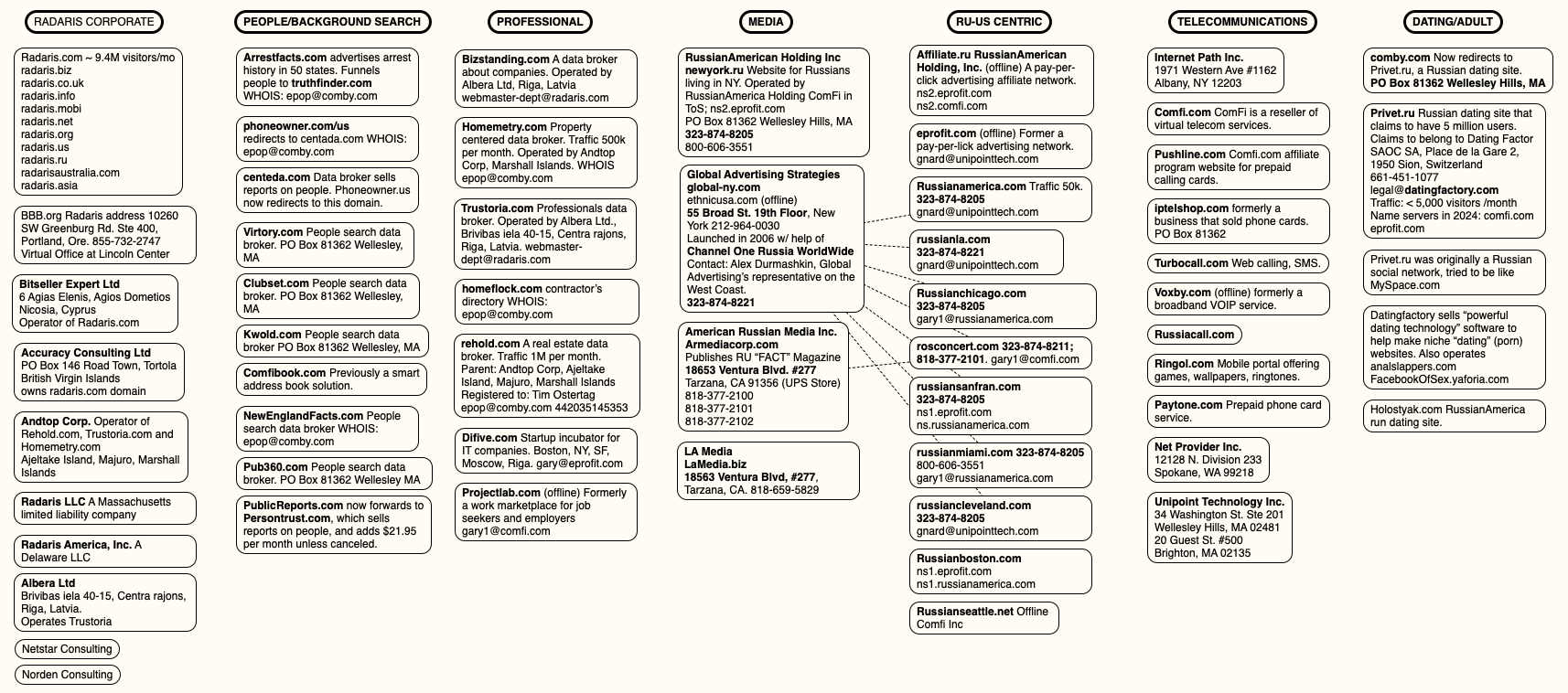
A mind map of various entities tied to Radaris and the company’s co-founders. Click to enlarge.

“That seemed to be their modus operandi,” said Raj Parikh, a partner at PEM Law in New Jersey who handles most of the Daniel’s Law litigation for Atlas. “In the past, they won by attrition. Plaintiffs’ attorneys tired of the procedural games and just gave up. That strategy worked for a decade, and it probably would have worked in this case too, since any financial recovery from foreign actors will be difficult. But we were acutely aware of the threat this website posed to law enforcement officers and other public officials in New Jersey, and decided early on to commit whatever time and resources were necessary to remove that threat.”

On August 26, the judge in the New Jersey case found the defendants were given multiple chances to appear and defend the claims against them but had failed to do so. Mr. Gurvits declined to comment on the case, saying it had been assigned to another attorney, a Mr. Victor Worms. In response to questions, Mr. Worms asserted the New Jersey court transferred Radaris.com to Atlas as part of a default judgment against Radaris.com, which is not a legal entity.

“We have made a motion to vacate that default judgment on the grounds that it is void since a non-entity has no legal capacity to sue or be sued,” Worms replied. “We also intend to pursue all appropriate appeals because we believe the transfer of Radaris.com amounts to a forfeiture in violation of various constitutional principles.”

While radaris.com still comes up prominently in results when searching online for U.S. residents by name, the domain no longer sells detailed personal dossiers on millions of Americans. Its homepage now displays a notice from Atlas, as well as links to our previous reporting on Radaris.

EMAIL CONFIRMATIONS

Atlas told KrebsOnSecurity that it has obtained more than 10,000 emails and documents in the course of litigation, and that those messages confirm our previous reporting on the owners and operators of Radaris and its myriad companies.

Atlas said the emails clearly establish that the nominal legal vehicles — Radaris America, Inc.; Bitseller Expert Limited; Digital Orbit Corp; Core Solutions Group Inc; Lucky Solutions Inc; Virtura Corp; Veripages Inc.; Nuform Solutions Inc.; Growth Data Advisors Inc.; Property Experts, Inc — are all administered by the same three or four people from the same mailboxes, share one bank or payment card set, and are all managed from one virtual office address.

“The corpus establishes, with documentary evidence generated independently by banks, payment processors, hosting providers, registrars, software-as-a-service vendors and the operators’ own systems, that radaris.com and at least twenty-five other people-search websites are one operation run by a small Boston-area group whose administrative, financial and technical functions sit on the difive.com mail domain and its successors (centerex.com, scienteco.com, eprofit.com, realmo.com, pub360.com),” reads a summary shared by Atlas.

Atlas said the emails show Radaris.com earns approximately $42,000 a month, while Veripages.com earns around $45,000 monthly via its partnership with the Lifetime Value Company, a marketing and advertising firm whose brands include PeopleLooker, PeopleSmart, NumberGuru, and Bumper, a car history site.

According to Atlas, the emails also showed the Radaris family of websites earns as much as $25,000 each month from their partnership with Onerep, a company that claims to help people remove their information from people-search sites. In March 2024, KrebsOnSecurity revealed how the Belarusian founder of Onerep had launched and operated dozens of people-search sites over the years and was continuing to operate one of them (Nuwber), effectively spreading the disease and selling the cure.

The domain radaris.com now redirects to this notice from Atlas about the court-ordered domain transfer.

The domain radaris.com now redirects to this notice from Atlas about the court-ordered domain transfer.

All told, the New Jersey court has so far transferred 14 domain names from the Radaris family of companies to Atlas. Radaris.com now redirects to a notice of the court-ordered domain transfer.

THE ROAD AHEAD

The Radaris family of companies is still potentially facing fines of $1,000 per alleged violation of Daniel’s Law. For the time being, however, Daniel’s Law is facing a constitutional challenge from virtually all of the 150 other consumer data broker firms being sued by Atlas.

The data broker industry responded by having at least 70 of the Atlas lawsuits moved to federal court, challenging the New Jersey statute as overly broad and a violation of the First Amendment. The U.S. Court of Appeals for the Third Circuit has not yet issued a decision on the constitutional challenge, but either way the case is widely expected to be appealed all the way to the U.S. Supreme Court.

Meanwhile, at least 14 other states have now passed laws modeled after the New Jersey statute, with more states considering similar measures. However, West Virginia’s Daniel’s Law was ruled facially unconstitutional under the First Amendment by a federal district court in August 2025.

Justin Sherman is a privacy expert and author of the forthcoming book “The Middlemen,” which examines how the data broker industry powers modern surveillance. Sherman said federal lawmakers have long faced intense lobbying by the technology industry against more restrictive U.S. data privacy laws, but that many powerful industries are now working against passing comprehensive data privacy legislation.

“These days at the federal level, add in the intense amount of lobbying against these laws from social media companies, big tech, cryptocurrency firms, and now AI proponents in the mix who claim that limiting their data scraping is somehow going to collapse the whole U.S. economy under Chinese rule,” he said.

Sherman said people-search companies will continue to thrive unless and until Congress enacts meaningful consumer privacy and data protection laws that are relevant to life in the 21st century. That’s because virtually all state privacy laws exempt records that might be considered “public” or “government” documents, including voting registries, property filings, marriage certificates, motor vehicle records, criminal records, court documents, death records, professional licenses, bankruptcy filings, and more.

At least 25 states have passed or implemented laws requiring age verification for residents seeking to access adult content online, but there is no federal law that limits how the companies that are scanning everyone’s drivers license can use, share or keep the data provided. Had such restrictions been enshrined in law, we may have avoided the recent breach at IDScan.net, which exposed the drivers license information on more than 153 million Americans when the records were briefly turned into a point-and-click identity theft service on the dark web.

“The average person can look at Daniel’s Law and have a perfectly normal reaction, which is that everyone should be covered, not just police and judges,” Sherman said. “But we don’t need more wake-up calls. We’ve had eight million wake-up calls already on the need for better privacy laws. The lack of comprehensive federal privacy law is not for a lack of knowledge, and anyone claiming otherwise is either not reading the news or kidding themselves.”

25 Years of Mass Surveillance Is Enough

This essay was written with Cindy Cohn, and originally appeared in Lawfare.

One of the many legacies of the terrorist attacks of Sept. 11 is the government-wide shift from targeted surveillance—such as individual wiretaps or pen register/trap and trace orders—to mass surveillance techniques—such as tapping into the internet backbone or mass collection of telephone or internet metadata. The legal and technical architecture of modern mass surveillance, initially framed as a necessary defense against terrorist threats, has grown far beyond that justification and national security in general. Mass surveillance is now a routine tool used by law enforcement. ICE uses it in immigration actions and against people exercising their First Amendment rights to protest. It’s also increasingly part of private security systems, such as facial recognition at venues such as Madison Square Garden and networked Flock license plate capture systems on roads and in parking lots.

The interrelation between private and governmental mass surveillance is worth examining. Surveillance is the business model of the internet; companies like Google and Facebook constantly spy on their users’ behavior. From the National Security Agency relying on data collected by telecommunication and internet companies, to local sheriffs and ICE agents relying on cellphone location data and privately managed automatic license plate readers, governments primarily obtain the mass surveillance information through private companies. Increasingly, access doesn’t just come through legal processes, either. FBI Director Kash Patel recently confirmed in congressional testimony that the agency is purchasing information on Americans from data brokers and intends to continue to do so.

This pipeline from private collection to governmental collection means that as companies collect more information for surveillance capitalism purposes, more is available to law enforcement as well. And as the technology for mass surveillance and analysis improves, especially with the increased use of AI technologies, the problems attendant to mass surveillance grow as well.

After 9/11, the idea that the government could surveil the population to safety took hold. In 2001, the fear of terrorism reached a frequency and intensity never before seen. Along with that came the fear that the enemy could be anyone, anywhere. As a result, the government’s response was to watch everyone, everywhere. This line of reasoning underpinned the shift from targeted to mass surveillance. Or, in the words of an internal National Security Agency (NSA) presentation that was made public as part of Edward Snowden’s 2013 disclosures, a government that can “Collect it All,” “Process it All,” “Exploit it All,” “Partner it All,” and “Sniff it All,” will ultimately, “Know it All.” Similar rationales support the rise of domestic mass surveillance: if law enforcement could see and hear everything, it could more effectively interdict and solve serious crimes.

The national security community has never provided a full analysis of the costs and benefits of these mass surveillance programs, either in terms of taxpayer dollars or diversion of resources from other efforts—or any demonstration that those techniques stopped attacks that otherwise they would not have been able to prevent. While the NSA occasionally presents examples of the successes due to its mass surveillance programs, especially when those techniques are under public pressure, the examples also regularly fall apart upon serious scrutiny. And even if some utility exists, it must be seriously weighed against the costs.

Similarly, there has never been any comprehensive analysis about whether domestic immigration or law enforcement’s use of these techniques actually makes people safer, or whether other techniques could produce the same results. Instead, both the police and the companies selling these tools float anecdotes and dubious data. For example, Flock’s data equates the number of law enforcement hits in their database with actually solving crimes.

Twenty-five years after 9/11, it seems reasonable to step back and evaluate the costs of this shift to mass surveillance, especially in terms of Americans’ rights and freedoms.

The Shift

The easiest place to see a shift to mass surveillance was in the government’s decision immediately after 9/11 to collect Americans’ telephone records. The program started under an argument of pure executive power as the “President’s Surveillance Program.” But in 2006, that argument secretly shifted to a novel interpretation of Section 215 of the Patriot. Act which had only previously authorized more targeted access to record. While some media and public interest organizations struggled to force the government to reveal the program as early as late 2005, the government only officially confirmed it after the 2013 Snowden disclosures. In 2015, the Second Circuit Court of Appeals rejected the government’s interpretation of Section 215 as allowing mass collection of telephone records. Later the same year, Congress passed the USA Freedom Act. While this new law still allows collection of a tremendous amount of domestic telephone records, it ended the indiscriminate mass collection that had occurred for nearly fourteen years.

Other shifts to mass surveillance continue through today. The NSA launched its Upstream program, which involved intercepting both metadata and content from key telecommunications junctures inside the U.S., soon after 9/11. It was also initially conducted under a claim of purely presidential authority. This program was brought under marginal congressional and programmatic (not targeted) Foreign Intelligence Surveillance Act (FISA) court review via Section 702 of the 2008 FISA Amendments Act. In 2017, more than15 years after its inception, the NSA ended content searches due to FISA court pressure, but the mass collection continues.

Despite the stated goal of conducting mass spying only on people outside the U.S.—which itself is problematic given international law’s requirement that surveillance be both necessary and proportionate—mass surveillance collects a tremendous amount of U.S. persons’ communications. This can happen because people communicate with people abroad, or because of overcollection—when government agencies gather far more personal data on non-targeted US persons than authorized by law. The concerns about collecting Americans’ data on U.S. soil led Congress to allow the program to officially expire in 2026, although the previously-approved mass surveillance itself continues until at least Spring of 2027.

The shift to mass surveillance would be notable enough even if it remained only a strategy of the intelligence community. It has not. Americans are awash in mass surveillance. Networks of automated license plate readers such as those offered by Flock and Vigilant Solutions blanket both public and private roadways and parking lots. These networks often allow searches by law enforcement, including across jurisdictions. They are, for example, being used to track people seeking abortions across state lines. Facial recognition tools, once the province of only the more elite parts of federal law enforcement, are increasingly used by Immigration and Customs Enforcement agents on immigrants and protesters, in airports by the Transportation Security Administration, as well as by private entities. And, of course, modern phones track users’ locations constantly—and that information is readily available to law enforcement, often with only minimal process protections.

Constitutional Costs

Regardless of the murkiness of its actual usefulness, the shift from targeted to mass surveillance has profound implications for Americans’rights. It has created risks that have become increasingly evident, especially under the Trump administration.

At a basic level, the Fourth Amendment guarantees that citizens can be secure in their “persons, houses, papers and effects” from unreasonable searches. Warrants breaching that security should be supported by probable cause and particular descriptions of the place to be searched and items to be seized. Mass surveillance turns that promise on its head, allowing access to our “papers and effects” by the government without individualized suspicion or a particularized description of what data is being seized, much less probable cause. This protection was in response to colonial British misuse of writs of assistance, which authorized indiscriminate searches rather than targeted ones.

The justifications for exempting mass surveillance from constitutional protection vary. For Section 702, the government has taken the position that U.S. persons’ communications caught up in the dragnet, either due to overcollection or because they were communicating with someone outside the United States, do not require a warrant prior to initial collection or secondary access by the FBI and several other agencies. The argument is that if the initial collection was not aimed at Americans, the information is free from constitutional protection for any later uses, even for reasons far afield from the initial rationale for collection.

Other arguments rest on the claim that metadata is outside the Fourth Amendment, despite its demonstrated ability to reveal intimate details of all of our lives. Still others rest on the Supreme Court-created Third Party Doctrine, which holds that the Fourth Amendment does not apply to data shared with companies that provide us with services. Some turn on whether analysis by machine counts, claiming that only “human eyes” matter—a particularly troubling argument with the rise of artificial intelligence. What’s more, the government has used doctrines like standing to limit the ability of those subjected to mass surveillance to seek constitutional protection. No matter the argument, the goal is the same: to place the mechanisms and fruits of mass surveillance outside the protections of the Fourth Amendment.

The overarching truth is that, due to the concerted efforts by the government since 9/11, and the rise of technologies in recent years, the slice of Americans’ lives and data that are actually protected by the Fourth Amendment has shrunk significantly in the past 25 years. Together, with the technical capabilities of mass surveillance and the increased ability for that data to be analyzed using AI tools, the “security in our papers and effects” that the constitution promises seems increasingly illusory.

In addition to the Fourth Amendment, mass surveillance creates tensions with the First Amendment. The Constitution has long recognized that the right to freedom of speech requires a zone of privacy against governmental surveillance. The right to anonymous speech as well as the right of association both recognize the chilling effect that surveillance creates for people saying unpopular things or attempting to organize for political or other societal change. Mass surveillance grants the authorities the ability to track those people, both in real time and historically, that is inconsistent with actual techniques of freedom of speech and assembly.

That is why the recently released 2026 U.S. Counterterrorism Strategy is so troubling. On page seven, the White House expressly states that it intends to target domestic activists with its heretofore foreign-targeted powers. It says that the government “will prioritize the rapid identification and neutralization of violent secular political groups whose ideology is anti-American, radically pro-transgender and anarchist” and “will use all the tools constitutionally available to us to map them at home, identify their membership, map their ties to international organizations like Antifa.” While framed as targeting “violent” groups, it’s clear that the government intends to use its national security tools, presumably including the tools of mass surveillance, against Americans in ways that will create profound tensions with the First Amendment rights of people to organize and communicate privately.

Costs Due to Mistakes and Abuse

Even assuming some utility from mass surveillance—a fact we do not dispute, even if the public record is shaky and conclusory—the history of both the national security and domestic uses of mass surveillance confirms that these tools are inevitably misused, and that mistakes have impacted huge numbers of Americans. The past twenty-five years have demonstrated that it is not possible to surveil the entire US population while staying within the bounds of even a very generous legal framework like Section 702.

As Rep. Zoe Lofgren (D-Calif.) recently stated in discussion of Section 702 in an interview with Tech Policy Press: “backdoor searches have been used improperly for protestors, 19,000 campaign donors, members of Congress, journalists, government officials, a state court judge who had complained to the FBI about police misconduct. It has been abused substantially in the past.” The NSA experienced so much abuse of its mass surveillance tools by actual or aspiring romantic partners and ex-spouses that an internal name emerged for it: “LOVEINT,” or Love Intelligence.

That same pattern of abuse is now emerging at the domestic law enforcement level. A Texas police officer misused, and then lied about, using license plate readers to track a woman suspected of seeking an abortion. Multiple law enforcement officials have been accused of tracking people they either wished to have a relationship with or who were their exes. And mass surveillance technologies have been used to track both immigration targets and citizens engaging in their First Amendment-protected right to track and record the police.

Mistakes are inevitable with collections of data of this size and scope. The history of the FISA court’s reviews of Section 702 is littered with examples of the NSA not being able to follow its own rules limiting the scope of what it collects and analyzes, even after having been given multiple chances by the court. On the local level, the technical protections that Flock, for example, put in place have repeatedly been insufficient to stop “accidental” sharing its data with out-of-state law enforcement. These mistakes have fueled growing efforts by local communities across the country to remove license plate readers. Those efforts should be the first step in a broader reconsideration of mass surveillance.

More generally, ubiquitous surveillance carries a real societal cost. The chilling effects are real and pervasive, and they tend to fall hardest on the most marginalized members of society. Moreover, social progress requires the ability to experiment in secret. It’s hard to imagine a society progressing morally to the point of accepting and legalizing things like marijuana use or gay marriage if the earliest signs of that shift are snuffed out because of overzealous surveillance.

Reversing Course

While a cost-benefit analysis is not the best frame for deciding constitutional rights, it is a place to start to evaluate government policies. If the costs are too high and the benefits too small, what should the public do? While the policy and legal frameworks can be individually complex, mass surveillance is a problem in all of its applications. So too should solutions be comprehensive rather than piecemeal.

One comprehensive strategy is to reset the promise of the Fourth Amendment and recognize that a warrant is required prior to collection, access or use of information gathered through mass surveillance. This would apply to collections that include U.S. persons, whether done for national security or domestic purposes. This protection would apply regardless of whether the information is in the form of metadata. It would apply regardless of whether the information is held in homes or by services people rely on, such as telephones, internet or social network providers, or by private entities utilizing mass surveillance for their own purposes. By passing this legislation, Congress could ensure this rejection of mass surveillance, and include real enforcement such as a private right of action and an automatic exclusionary remedy in criminal prosecutions. The courts could also recognize this protection of “papers and effects” directly as a plain language interpretation of the Fourth Amendment.

There are already a number of efforts that take on pieces of mass surveillance. Section 702 has expired and should remain so. This was due largely to efforts to block the “back door” access to Section 702-collected data without warrants. The bipartisan “Fourth Amendment is Not for Sale Act” would prevent the government from purchasing data that it would otherwise need a warrant to obtain. The Supreme Court itself has already been chipping away at the Third Party Doctrine, with a recent step in the rejection of mass geofence warrants—warrants seeking the identities of individuals based upon their proximity to a crime—in Chatrie v. United States. Now, such warrants fall, at least initially, under the Fourth Amendment.

A more comprehensive approach would also address mass surveillance carried out by private companies, and to ensure that Americans have the right to encrypt and secure their data. There are many reasons the United States would benefit from a comprehensive privacy law—and curbing mass surveillance is one of them. Addressing mass surveillance is certainly one of them. Ideas such as the banning of secondary uses of data—with roots in the Fair Information Practice Principles from the 1970s—are worth pushing forward. So are moves such as creating fiduciary duties for mass data collectors. There are many more ways to curtail private companies’ mass surveillance while staying within constitutional boundaries. But addressing the costs of mass surveillance by both companies and governments is even more important in a world where AI agents are making decisions both about the public and on their behalf based on their data and observed behavior.

Twenty-five years after the U.S. government embraced mass surveillance, it’s time to evaluate it as a whole, and consider responses that address the problem as a whole. Americans must ask: Is it consistent with a self-governing democracy to have systems that watch everyone everywhere? Is the public comfortable with governments—federal, state, local—that seek to “know it all” about its citizens? Is the public comfortable with private mass surveillance in its own right and as it’s being increasingly used to fuel government surveillance? These questions have long needed serious consideration. But as it becomes increasingly evident that the Trump administration is using mass surveillance to keep itself in power, stifle dissent, and undermine political opponents, these questions are now more urgent than ever.

Wireless Routers as Motion Detectors

Comcast has added motion detection as a feature to its wireless routers:

The feature sends push notifications to users when motion is detected near a connected device, such as a TV or printer. It has different settings for when people are home, asleep, or away. The Xfinity app also lets users see live motion activity and a feed of recent activity.

Comcast acknowledges that the system has some limitations. Home size, layout, building materials, and the placement of the router and connected devices can all affect its ability to detect motion. Comcast says it does not guarantee its performance.

Sounds like a great surveillance tool. And also:

But the biggest privacy concern comes directly from Comcast’s own support page, which says information generated by WiFi Motion may be shared with third parties.

“Comcast may disclose information generated by your WiFi Motion to third parties without further notice to you in connection with any law enforcement investigation or proceeding, any dispute to which Comcast is a party, or pursuant to a court order or subpoena,” the page reads.

Spyware for Babies

The New York Times has a long article (alt link) on surveillance systems aimed at babies. They are increasingly using AI.

Nanit and its rivals want to own 24/7 health tracking for the sub-four-foot set. And their already astonishing levels of baby data collection are just the beginning. Nanit recently raised $50 million from investors to expand its use of A.I. and use its camera to track speech and language development, motor skills and more, while extending its presence in children’s bedrooms into early adolescence.

Adversarial Clothing Designed to Fool Facial Recognition Systems

There are many companies manufacturing adversarial clothing designed to confuse facial recognition systems.

It’s a cool idea, but I worry that it’s mostly security theater:

“Our patterns play with that chaos, confuse algorithms and make it way harder to pin you down,” he said.

Bell, however, said “none of these products are tried and tested, and a lot of these surveillance technologies can deal with a little resistance … [but] even if the designs don’t necessarily work perfectly, fashion is also a visible sign of resistance.

“This is consumers collectively coming together to make a visible statement.”

Without serious testing, there is no reason to trust the technology. And even with testing, there is no reason to trust that a new version of the facial recognition software doesn’t break the anti-surveillance properties.

I don’t want people to mistakenly rely on this stuff.

Some Claude Chats Are Searchable on Google

And it’s personal information (alternate link):

The exposed data includes an AI-powered therapy app that someone appears to have vibe-coded, notes on meetings, and a dashboard someone made apparently to analyze medical billing data. Exposed chats reportedly include private cryptocurrency wallet keys and personal information like peoples’ addresses.

What seems to be the issue is a user setting about data sharing. Anthropic’s position is that it’s not their problem:

“We give people control over sharing their Claude conversations publicly, and in keeping with our privacy principles, we do not share chat directories or sitemaps with search engines like Google,” the company said in a statement. “These shareable links are not guessable or discoverable unless people choose to share them themselves. When someone shares a conversation, they are making that content publicly accessible, and like other public web content, it may be archived by third-party services.”

Here’s how to fix it.

Facial Recognition at Madison Square Garden

Last month, the story broke (alternate link) that Madison Square Garden uses facial recognition software on everyone entering the facility, and—among other groups—flags activists that oppose using facial recognition.

Turns out that the system was shut off for Taylor Swift’s wedding.

Evan Greer—one of the people that MSG alerts on—comments:

Ironically, Swift herself has reportedly used facial recognition at her own concerts to identify stalkers. This “privacy for me, surveillance for thee” attitude feels like a perfect encapsulation of the future we’re already living in: one where wealthy elites can afford privacy, while the rest of us are forced to live in a corporate surveillance panopticon.

Whatever privacy measures Swift had in place for the wedding seems to have worked. No photos have leaked online.

American Being Prosecuted for Wiping His Phone Before Handing It Over to Border Officials

He’s being prosecuted for giving border officials a code that wiped his phone:

The case centers on a feature included in GrapheneOS, a custom Android operating system that runs in place of the software on most modern Google Pixel devices. Tunick’s attorneys confirmed GrapheneOS was running on his phone.

The software feature allows the device owner to set a passcode that deliberately wipes the contents of that device if entered instead of the user’s unlock passcode.

Tunick’s case also raises ongoing questions about what constitutional rights can be invoked at the border, which the U.S. government has long asserted is not U.S. soil until a person is authorized to enter.

Right. And he wasn’t under arrest, either.

Three more news stories.

Graphine says that the feature is “completely legal“:

GrapheneOS is completely legal. We have no obligation to weaken any of the security protections it provides. Creating and using GrapheneOS is strongly protected by the US constitution. Laws attempting to make it illegal or require weakening the security would be unconstitutional.

It’s hard to know how much the Constitution matters in the US right now.

Axon Is Another License Plate Surveillance Company

Governments are switching, but I’m not sure it makes a difference:

…some municipalities, including Denver, Colorado, are ditching their Flock arrays. But keep in mind that if they’re only switching from Flock to another brand of license-plate readers, like Axon, it’s like a gambling addict trying to kick the habit by switching from FanDuel to DraftKings.

[…]

Despite what you may read on the Flock website, Axon cameras are pretty effective when it comes to hoovering up personal details that can go far beyond your license plate numbers. That means a municipality that opts for Axon cameras instead of Flock units won’t necessarily reduce the amount privacy its citizens lose through their use.

Cognyte Sells a Mobile Cell Surveillance Van

Yet another Israeli mass surveillance company:

Made by Israeli surveillance company Cognyte, the tech simulates a mobile phone tower, which forces nearby phones to connect to it. That enables cops to keep tabs on any phones in the vicinity ­ whether they’re owned by a suspect in a case or not. Cognyte’s contract with the state of Texas reveals that the simulator, called FalcoNet, can be concealed within the vehicles, hidden in a backpack for on-foot missions or attached to a helicopter. It’s the same technology as the infamous Stingray, one of the original cell-site simulators made by defense giant L3Harris.

MIT to Become Hotbed of AI Video Surveillance

It’s a lot:

According to information obtained by The Tech, MIT is spending over $3 million on more than 500 AI surveillance cameras in academic buildings, residence halls, and outdoor areas along Memorial Drive. Installation of the new cameras, along with the wiring and infrastructure that will support them, began November 2025 and will likely continue until September 2026.

Technical specifications for the cameras suggest that they will be capable of collecting real-time face and object classification data, including detection of motion, loitering, crowds, face masks, and camera tampering. Individuals can also be automatically classified on the basis of clothing color, gender, and age, up to a distance of 35 feet (11 meters) from the camera. According to a statement from MIT spokesperson Kimberly Allen, any collected data is “retained up to 30 days,” unless an exception is granted.

[…]

Most of the new cameras, which are part of Hanwha’s Wisenet AI line, are marketed for their ability to identify and classify multiple objects with deep learning algorithms. They support resolutions ranging from 2MP to 4K while also recognizing faces, license plates, vehicles, and other objects in real time.

Nearly all cameras will accommodate a wide range of pan, tilt, rotate, and zoom motion and will be monitored continually with Ai-RGUS, an AI camera software.

Yikes.

Protecting Privacy in an AI Era

Daniel Solove argues in the Wall Street Journal (alternate link) that giving people control of their personal data is not an effective way to regulate privacy in this era. Instead, we need to hold companies accountable for their actions, similar to what we do with food and drug companies. Measures such as rigorous data minimization, fiduciary duties, liability for negligent or reckless technological design, liability for algorithms that cause harm, and multi-stakeholder review of technologies will be far more effective.

Paper.

❌