Visualização de leitura

UK Cybercrime Journal: Qilin Ransomware Rampage in H1 2026


What Happened

  • Throughout H1 2026, the Qilin ransomware-as-a-service (RaaS) Tor data leak site (DLS) listed the most UK-based victims out of all ransomware gangs, with up to 37 British organisations hit in total. Qilin's victim count is followed by DragonForce with 21 victims listed, and TheGentlemen with 18 listed.
  • The fallout from the Qilin attack on the UK National Health Service (NHS) supplier, Synnovis, in 2024 persists as well. On 1 June 2026, the Bedfordshire Hospitals NHS Foundation Trust disclosed that over 32,000 patient data records related to Synnovis tests were exfiltrated and took over a year to analyse what information was related to which patient. The breached data includes patient name and number, date of birth, postcode, and test results.
  • In H1 2026, Qilin averaged between seven and nine published UK victims per month. For the entries listing an estimated attack date, there was a roughly six-week extortion lifecycle on average, from initial intrusion to the date the victim is publicly named.
  • This UK footprint highlights their aggressive pursuit of Small-to-Medium Enterprises (SMEs) as most organisations had a revenue between £10m and £250m.
  • Interestingly, one of the Qilin victims, Salford City College, also appeared on both the Qilin and DragonForce Tor data leak site (DLS) only a few days apart from 6 March to 10 March 2026, respectively.

Qilin’s UK-based victims from H1 2026 spanned a diverse range of sectors:

  • Construction & Property Development
  • Manufacturing & Engineering
  • Legal & Professional Services
  • Technology & IT Infrastructure
  • Education
  • Healthcare

Analyst Comment 

Many of the organisations targeted by Qilin operators are just large enough to have the funds to pay mid-tier ransoms but often never got around to making an investment into a 24/7 dedicated threat detection service, such as an outsourced Security Operations Centre (SOC). Such services are usually enough protection to prevent an attack. If a ransomware affiliate faces tough resistance from a target, they often move on to a weaker and easier one.

One key face to also note about Tor data leak sites operated by ransomware groups is that they include victims who failed to pay the ransom. The total number of victims by each group is often going to be higher.

The reason for the cross-posting of Salford City College is unknown for now. However, it could indicate that an affiliate may be using both Qilin and DragonForce RaaS platforms. An alternative theory could be that the college was hit by two affiliates of each RaaS. Interestingly, cross-posting on multiple leak sites is not as uncommon as it seems. Some victims listed on the Qilin leak site have historically appeared on the leak sites of ALPHV/BlackCat and Conti as well.

The Ransomware Vulnerability Matrix Group Profile for Qilin reveals a diverse set of exploits leveraged by its operators. Like many other ransomware gangs, Qilin operators have exploited corporate VPN gateways such as Fortinet, Check Point, and WatchGuard for initial access. Interestingly, the exploitation of SmarterTools SmarterMail and SolarWinds Web Help Desk is less common but are also exploited by the Warlock ransomware gang. Another common theme from Qilin's Ransomware Tool Matrix Group Profile is their regular abuse of Bring Your Own Vulnerable Driver (BYOVD) tactics to bypass Endpoint Detection and Response (EDR) and Antivirus software.

Defensive Takeaways 

  • Harden Common Attack Paths: Treat any web-facing helpdesk or mail server as a high-risk device. If it does not absolutely require open internet access, place it behind a zero-trust network access gateway or a strict VPN. Enforce strict phishing-resistant Multi-Factor Authentication (MFA) on all remote access points. Ensure processes are in place for rapid patching and integrity checks for all corporate VPN gateways.
  • Overcoming SME Resource Caps: Organisations must bridge the gap with an outsourced MDR service. Ransomware execution routinely happens at 2:00 AM on Fridays and weekends. Outdated antivirus agents alone are not enough to stop a motivated human adversary.
  • Utilise Free Support Services: Capitalise on sovereign and community-vetted threat intelligence feeds to block attacker infrastructure early. UK defenders should actively enroll in the National Cyber Security Centre’s MyNCSC portal and integrate community resources like the Spamhaus DROP list and Abuse.ch tracking into their perimeter firewalls to automatically block known ransomware command-and-control (C2) nodes. ShadowServer and Team Cymru also offer useful free community resources.

Relevant Sources 

  1. https://www.bbc.co.uk/news/articles/c1d2wwyd6qqo
  2. https://www.bedfordshirehospitals.nhs.uk/news/notification-synnovis-cyber-incident/
  3. https://www.bleepingcomputer.com/news/security/qilin-ransomware-gang-linked-to-attack-on-london-hospitals/

Relevant CTI Sources

  1. https://www.ransomware.live/map/GB
  2. https://www.ransomware.live/group/qilin
  3. https://www.ransomware.live/id/c2FsZm9yZGNjLmFjLnVrQGRyYWdvbmZvcmNl
  4. https://www.ransomware.live/id/U2FsZm9yZCBDaXR5IENvbGxlZ2VAcWlsaW4
  5. https://github.com/BushidoUK/Ransomware-Tool-Matrix/blob/main/GroupProfiles/Qilin.md
  6. https://github.com/BushidoUK/Ransomware-Vulnerability-Matrix/blob/main/GroupProfiles/Qilin.md
  7. https://blog.bushidotoken.net/2024/06/tracking-adversaries-qilin-raas.html 
  8. https://www.bleepingcomputer.com/news/security/check-point-links-vpn-zero-day-attacks-to-qilin-ransomware-gang/

UK Cybercrime Journal: Arup Group Breached by FulcrumSec


What Happened:

  • On 10 May 2026, the UK-based firm Arup Group was listed as a victim on the Tor data leak site of FulcrumSec. 
  • On their Tor data leak site, FulcrumSec stated that they have exposed 700GB of GitHub repos and 2TB of Azure and AWS S3 cloud, plus database backups.
  • Other types of data the adversary claims to have stolen includes Neuron BMS client databases, Odoo ERP data, A66 landowner files, Apple code-signing certificates with plaintext passwords, a Google Cloud Platform (GCP) project with production payment gateway credentials, and the source code of ArupCompute and Oasys. 
  • The FulcrumSec operators also claimed to have spent over half a year analysing the data and went through “email correspondence” with the company before publishing the stolen data.
  • On the victim post, FulcrumSec wrote a detailed incident breakdown. In it, they stated they gained initial access in September 2025 via a GitHub personal access token found hardcoded in a JavaScript file on a forgotten subdomain, which provided access to over 10,000 private GitHub repositories belonging to Arup Group.
  • From there, they scanned the repositories and found additional hardcoded tokens, API keys, and passwords for AWS, Azure, and databases.
  • The adversary stated that Arup detected the Github and Azure Storage intrusions approximately six weeks after they happened and rotated the credentials, but it was too late as the data had been exfiltrated. 
  • FulcrumSec also stated they pivoted into the AWS infrastructure using keys they had found belonging to Arup’s subsidiary Neuron.
  • FulcrumSec allegedly waited until April 2026 to contact their victim, Arup Group, due to the time it took to analyse the vast amounts of stolen data.
  • Impacted client organisations of Arup Group were also mentioned in the post, such as Disney and several other Hong Kong companies. The adversary reportedly uncovered Amazon data center seismic fragility data, British Petroleum (BP) site selection coordinates, and Queensferry Crossing internal documents as well.
  • Critically for the UK, the breached data exposed up to 62 HS2 related GitHub repositories. This involved Euston Station pile design files, ground movement assessments, over 14,000 sensor monitoring records, 48 archaeological site GPS coordinates (including Jones Hill Wood, a sensitive site for environmentalists), as well as confidential documents.

Analyst Comment:

Arup Group is a large multinational architectural design and engineering firm based in London who has been involved in constructing the Wembley Football Stadium in London, the HS1 Channel Tunnel Rail Link network, and the Eden Project in Cornwall, among other significant international construction projects.


Active since September 2025, FulcrumSec is a financially motivated data-theft-extortion group that specialises in rapid exfiltration of cloud-hosted databases by exploiting unrotated API keys and misconfigured cloud permissions.


This attack was noteworthy due to its highly targeted nature. FulcrumSec claimed they had access to Arup Group’s data for seven months and they clearly invested significant time to analyse the documents and spent weeks negotiating over email. Plus, to find initial access they also would have had to spend time checking Arup’s domains and Internet-facing assets to eventually find a single leaked credential to exploit. These types of targeted intrusions often only happen to large companies. This is because for it to be worth the cybercriminal’s time, effort, and risk to their freedom they will want a large ransom payment that only rich companies can typically afford.


FulcrumSec is an adversary worth monitoring due to the effort they put into their intrusions compared to other smash-and-grab ransomware campaigns. In October 2025, in a case documented by VX-Underground, FulcrumSec emailed detailed information about the breach they conducted with the aim of those details getting published and exert additional pressure on the victim.


Interestingly, FulcrumSec said the ransom they demanded was less than 1% of Arup’s annual revenue and was less than how much Arup lost to the deepfake fraudsters. This is a reference to Arup reportedly lost over £20 million pounds in 2024 after one of their Hong Kong employees was duped into sending cash to cybercriminals using an AI-generated video call. The fact Arup became publicly known for falling victim to a large scam potentially contributed to the adversary’s decision to select and focus them for this attack.


Defensive Takeaways:

  • Asset Inventory and Shadow IT Audits: Identifying the outdated unused domains with hardcoded credentials is standard best practices. All organisations must have processes in place to catalog and retire systems to avoid incidents like this. 
  • Hardcoded Credentials in Code: They way FulcrumSec gained access demonstrates the importance of using secret environment variables and features like GitHub Secret Scanning.
  • Implement Incident Response Procedures: Importantly, Arup detect the activity too late and it took them a staggering six weeks to rotate credentials (according to the adversary), which shows why having automated systems to check for unauthorised usage and reset tokens and all accounts is crucial to respond to such attacks.
  • GitHub Activity Monitoring: The adversary claimed they were able to clone thousands of GitHub repositories containing sensitive data without being detected. These types of activities are available to monitor and detect in GitHub Audit Logs. It’s also important to have a plan in place when suspicious activities are detected.
  • Third-Party Risk Management Programs: This incident also had some notable downstream impact. It shows why client organisations of another company’s services need to know what data and how much data is stored by third-parties for when such breaches occur. Knowing what’s potentially exposed will streamline the response to the incident.
  • Deception Tech: Arup could have implemented a boobytraps for the adversary such as the use of CanaryTokens inside sensitive documents. As the adversary spent time analysing the Arup’s documents before contacting them, if they open a boobytrapped document, then the incident could been detected much earlier and the damages could have been reduced.


Relevant Sources:

  1. https://x.com/darkwebinformer/status/2053281385582891437 
  2. https://www.ransomware.live/id/QXJ1cCBHcm91cEBmdWxjcnVtc2Vj 
  3. https://en.wikipedia.org/wiki/Arup_Group
  4. https://www.theguardian.com/technology/article/2024/may/17/uk-engineering-arup-deepfake-scam-hong-kong-ai-video


Relevant CTI Resources:

  1. https://www.ransomware.live/group/fulcrumsec
  2. https://x.com/vxunderground/status/1975629199323853027 
  3. https://www.reddit.com/r/Scams/s/wfZ3Wp94mY
  4. https://www.bleepingcomputer.com/news/security/lexisnexis-confirms-data-breach-as-hackers-leak-stolen-files/

Kimwolf Botnet Swamps Anonymity Network I2P

For the past week, the massive “Internet of Things” (IoT) botnet known as Kimwolf has been disrupting The Invisible Internet Project (I2P), a decentralized, encrypted communications network designed to anonymize and secure online communications. I2P users started reporting disruptions in the network around the same time the Kimwolf botmasters began relying on it to evade takedown attempts against the botnet’s control servers.

Kimwolf is a botnet that surfaced in late 2025 and quickly infected millions of systems, turning poorly secured IoT devices like TV streaming boxes, digital picture frames and routers into relays for malicious traffic and abnormally large distributed denial-of-service (DDoS) attacks.

I2P is a decentralized, privacy-focused network that allows people to communicate and share information anonymously.

“It works by routing data through multiple encrypted layers across volunteer-operated nodes, hiding both the sender’s and receiver’s locations,” the I2P website explains. “The result is a secure, censorship-resistant network designed for private websites, messaging, and data sharing.”

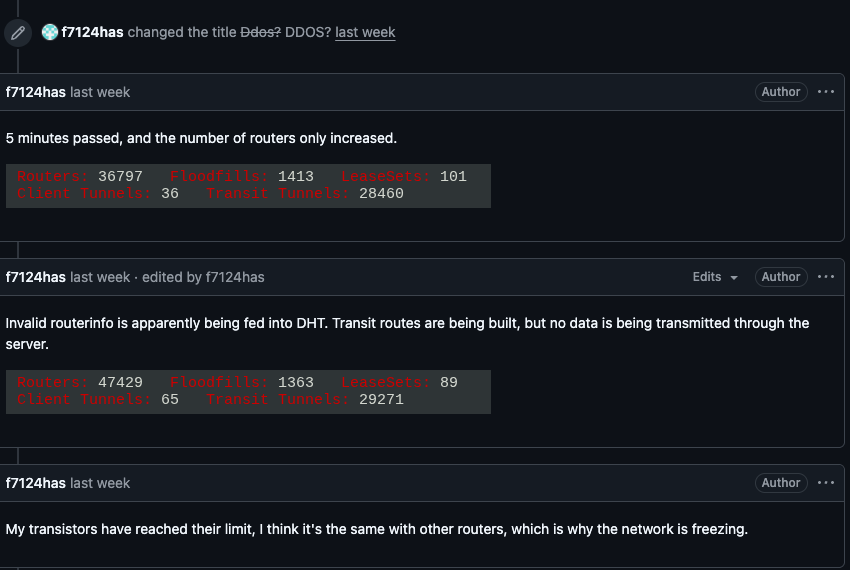
On February 3, I2P users began complaining on the organization’s GitHub page about tens of thousands of routers suddenly overwhelming the network, preventing existing users from communicating with legitimate nodes. Users reported a rapidly increasing number of new routers joining the network that were unable to transmit data, and that the mass influx of new systems had overwhelmed the network to the point where users could no longer connect.

I2P users complaining about service disruptions from a rapidly increasing number of routers suddenly swamping the network.

When one I2P user asked whether the network was under attack, another user replied, “Looks like it. My physical router freezes when the number of connections exceeds 60,000.”

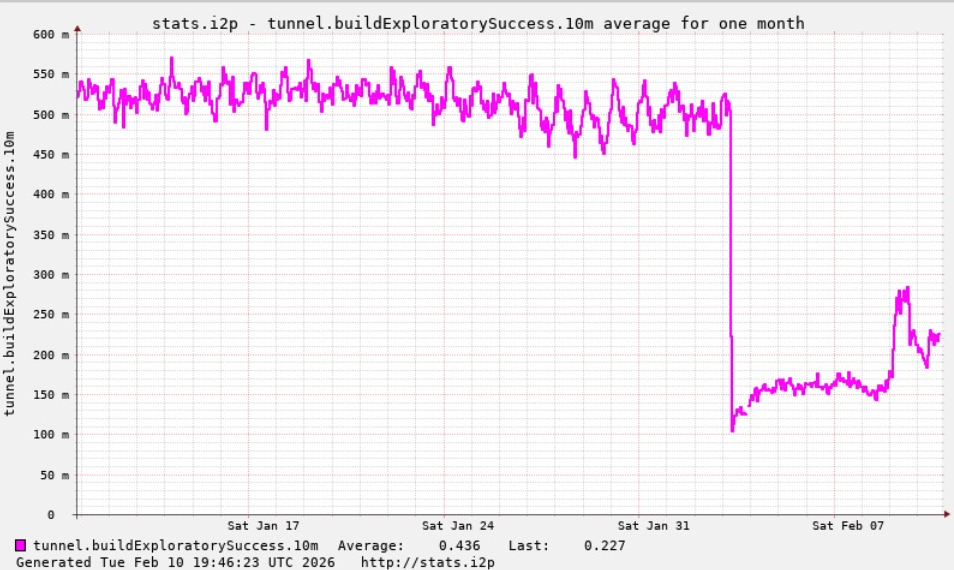
A graph shared by I2P developers showing a marked drop in successful connections on the I2P network around the time the Kimwolf botnet started trying to use the network for fallback communications.

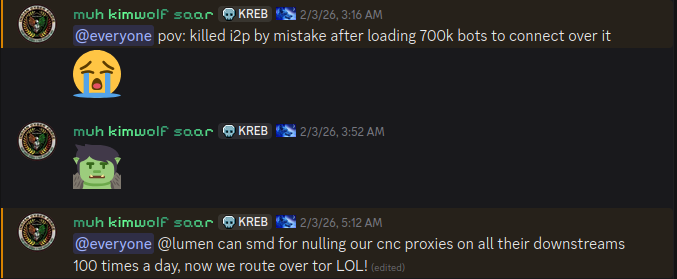
The same day that I2P users began noticing the outages, the individuals in control of Kimwolf posted to their Discord channel that they had accidentally disrupted I2P after attempting to join 700,000 Kimwolf-infected bots as nodes on the network.

The Kimwolf botmaster openly discusses what they are doing with the botnet in a Discord channel with my name on it.

Although Kimwolf is known as a potent weapon for launching DDoS attacks, the outages caused this week by some portion of the botnet attempting to join I2P are what’s known as a “Sybil attack,” a threat in peer-to-peer networks where a single entity can disrupt the system by creating, controlling, and operating a large number of fake, pseudonymous identities.

Indeed, the number of Kimwolf-infected routers that tried to join I2P this past week was many times the network’s normal size. I2P’s Wikipedia page says the network consists of roughly 55,000 computers distributed throughout the world, with each participant acting as both a router (to relay traffic) and a client.

However, Lance James, founder of the New York City based cybersecurity consultancy Unit 221B and the original founder of I2P, told KrebsOnSecurity the entire I2P network now consists of between 15,000 and 20,000 devices on any given day.

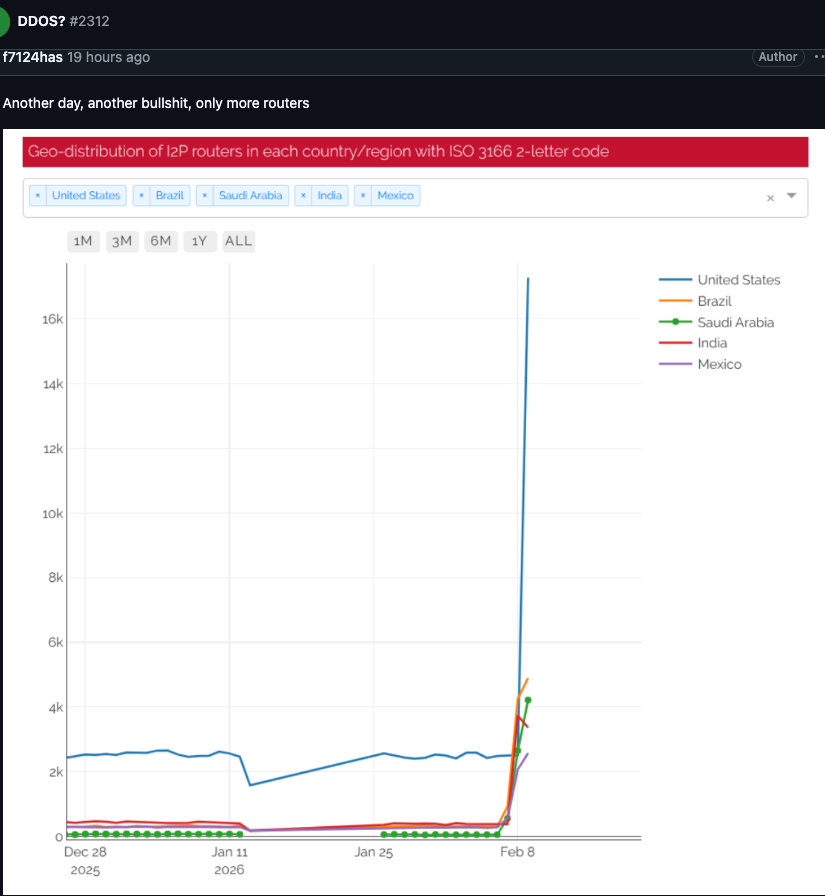
An I2P user posted this graph on Feb. 10, showing tens of thousands of routers — mostly from the United States — suddenly attempting to join the network.

Benjamin Brundage is founder of Synthient, a startup that tracks proxy services and was the first to document Kimwolf’s unique spreading techniques. Brundage said the Kimwolf operator(s) have been trying to build a command and control network that can’t easily be taken down by security companies and network operators that are working together to combat the spread of the botnet.

Brundage said the people in control of Kimwolf have been experimenting with using I2P and a similar anonymity network — Tor — as a backup command and control network, although there have been no reports of widespread disruptions in the Tor network recently.

“I don’t think their goal is to take I2P down,” he said. “It’s more they’re looking for an alternative to keep the botnet stable in the face of takedown attempts.”

The Kimwolf botnet created challenges for Cloudflare late last year when it began instructing millions of infected devices to use Cloudflare’s domain name system (DNS) settings, causing control domains associated with Kimwolf to repeatedly usurp AmazonAppleGoogle and Microsoft in Cloudflare’s public ranking of the most frequently requested websites.

James said the I2P network is still operating at about half of its normal capacity, and that a new release is rolling out which should bring some stability improvements over the next week for users.

Meanwhile, Brundage said the good news is Kimwolf’s overlords appear to have quite recently alienated some of their more competent developers and operators, leading to a rookie mistake this past week that caused the botnet’s overall numbers to drop by more than 600,000 infected systems.

“It seems like they’re just testing stuff, like running experiments in production,” he said. “But the botnet’s numbers are dropping significantly now, and they don’t seem to know what they’re doing.”

❌