Visualização de leitura

Exploits and vulnerabilities in Q2 2026

The vulnerability landscape shifted significantly in Q2 2026. First, the number of registered CVEs reached an unprecedented level. This is driven primarily by the widespread adoption of AI, both for application development and search for security flaws. This resulted in entire new classes of vulnerabilities emerging, particularly in the Linux networking subsystem.

Second, security researchers have been publishing exploits for unpatched vulnerabilities more frequently. Publications like these can generate significant fallout, since they potentially open the door for attackers to target unprotected systems.

Statistics on registered vulnerabilities

This section provides statistical data on registered vulnerabilities. The data comes from Kaspersky’s vulnerability knowledge base, which draws on the CVE database as well as the Russian BDU database and GitHub Advisory (GHSA). As a result, the figures for previous reporting periods may differ from those published in earlier reports.

We examine the number of registered vulnerabilities for each month over the last five years. As the chart below shows, this number continues to surge, a trend reflected across all the databases we track. It’s driven primarily by the widespread adoption of AI tools: as we predicted in our previous report, these tools have played a major role in the discovery of vulnerabilities in third-party software. Meanwhile, these tools often contain security issues of their own. For example, OpenClaw, a popular AI project, ranked 12th among those with the highest number of vulnerabilities discovered and published in Q2, with over 200 CVEs registered during the reporting period. Finally, AI development tools are also contributing to the vulnerability landscape, since the quality of the code they produce can vary widely. Therefore, the rate at which new vulnerabilities are discovered will inevitably keep growing.

Total published vulnerabilities per month from 2022 through 2026 (download)

Next, we analyze the number of new critical vulnerabilities (CVSS > 9.0) over the same period.

Total critical vulnerabilities published per month from 2022 through 2026 (download)

As the chart shows, the number of published critical vulnerabilities jumped sharply in Q2. This is because using AI for vulnerability research makes it possible to analyze massive amounts of previously unexamined code, uncover new attack surfaces, and identify entire classes of vulnerabilities that have gone unnoticed for decades. In particular, AI was used to find a series of Dirty Frag vulnerabilities in the Linux kernel.

Exploitation statistics

This section presents statistics on vulnerability exploitation for Q2 2026. The data draws on open sources and our telemetry.

Windows and Linux vulnerability exploitation

Q2 2026 saw a new precedent in the publication of vulnerabilities in Windows components and exploits for these: researchers no longer waiting for CVE registration, let alone patches. A case in point: a researcher who goes by Nightmare Eclipse (also known as Chaotic Eclipse) published a list of new “named” vulnerabilities across various Windows subsystems. At the time the technical details were published, none of the vulnerabilities had been assigned a CVE identifier:

  • BlueHammer: a local privilege escalation vulnerability in Windows Defender. During signature database updates, a time-of-check to time-of-use (TOCTOU) race condition occurs, allowing an attacker to substitute the directory where temporary update files are written. The researcher published a fully functional exploit for the vulnerability.
  • RedSun: another logical vulnerability in Windows Defender with a working exploit. Suspicious and malicious files marked as “cloud” can be overwritten or restored to their original directory with elevated privileges. The exploit incorporates fragments of algorithms that make it possible to leverage various logical vulnerabilities in Windows, effectively combining a large number of popular exploitation techniques.
  • YellowKey: a vulnerability that lets the user bypass BitLocker full-disk encryption and access system data through the Windows Recovery Environment (WinRE). A fully functional exploit was also published.
  • GreenPlasma: a vulnerability that enables system object injection via the CTF loader for the Collaborative Translation Framework (CTFMON) service in Windows. The original publication included an exploit with limited functionality.
  • RoguePlanet: yet another Windows Defender vulnerability that, like BlueHammer, stems from a TOCTOU issue, this time in the engine responsible for real-time system scanning. The published exploit uses the vulnerability to overwrite the system file wermgr.exe with a malicious one.
  • UnDefend: another vulnerability in the Windows Defender service. This time, the exploit causes a denial of service and blocks updates.

Even though such cases remain isolated for now, we believe they’ll grow into a full-fledged trend. Early publication of exploits gives attackers an advantage over software developers, who are left with no time to fix the issues.

Veteran vulnerabilities in Windows software also remain relevant. These are the ones our solutions most frequently detect exploits for:

  • CVE-2018-0802: a remote code execution (RCE) vulnerability in the Equation Editor component
  • CVE-2017-11882: another RCE vulnerability also affecting Equation Editor
  • CVE-2017-0199: a vulnerability in Microsoft Office and WordPad that allows an attacker to gain control over the system
  • CVE-2023-38831: a vulnerability in WinRAR that involves improper handling of objects within an archive
  • CVE-2025-6218 (formerly ZDI-CAN-27198): another WinRAR vulnerability allowing the specification of relative paths to extract files into arbitrary directories, potentially leading to malicious command execution
  • CVE-2025-8088: a vulnerability similar in exploitation method to CVE-2025-6218. The attackers used NTFS Streams to circumvent controls on the directory into which files are being unpacked

The vulnerabilities listed here can be leveraged to gain initial access to a vulnerable system and for privilege escalation. This underscores the critical importance of timely software updates.

That said, the number of Windows users who encountered exploits declined slightly in Q2, hitting an 18-month low.

Dynamics of the number of Windows users encountering exploits, Q1 2025 – Q2 2026. The number of users who encountered exploits in Q1 2025 is taken as 100% (download)

Linux also hit a rough patch in Q2 2026. Specifically, the period saw the disclosure of the Dirty Frag family of vulnerabilities, which lets an attacker reliably escalate privileges within the operating system.

All the vulnerabilities published in Q2 2026 were, in one way or another, related to the Linux caching subsystem. Here are the ones being most actively exploited:

  • CVE-2026-31431 (Copy Fail): a local privilege escalation vulnerability in the Linux kernel that lets an unprivileged user modify the page cache and gain root privileges. Especially dangerous for cloud and containerized environments
  • CVE-2026-43284, CVE-2026-43500 (Dirty Frag): a family of vulnerabilities in the Linux networking subsystem (IPsec ESP and RxRPC) that lets a local user overwrite the page cache and escalate privileges to root
  • CVE-2026-46300 (Fragnesia): a local privilege escalation vulnerability in the Linux kernel related to packet fragment handling and the page cache mechanism. It lets an unprivileged user gain root privileges and is also classified as part of the Dirty Frag family
  • CVE-2026-31635 (DirtyDecrypt): a Linux kernel vulnerability that lets a local attacker escalate privileges due to improper handling of decryption operations and page cache data modification
  • CVE-2026-43494 (PinTheft): a Linux kernel vulnerability that lets a local user gain elevated privileges due to errors in the memory page pinning mechanism
  • CVE-2026-46331 (pedit COW): a vulnerability in the Linux kernel’s traffic control subsystem (tc-pedit) that exploits a flaw in copy-on-write to modify the page cache and subsequently escalate privileges to root

The vulnerabilities described above were quickly embraced by attackers. At the same time, our solutions continue to detect exploitation attempts targeting older vulnerabilities as well:

  • CVE-2022-0847: a vulnerability known as Dirty Pipe, which enables privilege escalation and the hijacking of running applications
  • CVE-2019-13272: a vulnerability caused by improper handling of privilege inheritance, which can be exploited to achieve privilege escalation
  • CVE-2021-22555: a heap out-of-bounds write vulnerability in the Netfilter kernel subsystem
  • CVE-2023-32233: another Netfilter subsystem vulnerability that allows for Use-After-Free conditions and privilege escalation through improper processing of network requests

Dynamics of the number of Linux users encountering exploits, Q1 2025 – Q2 2026. The number of users who encountered exploits in Q1 2025 is taken as 100% (download)

In Q2 2026, the number of Linux users who encountered exploits declined slightly compared to Q1. Given that a significant share of new vulnerabilities are tied to the operating system’s caching subsystem, we recommend installing patches as quickly as possible, or disabling vulnerable kernel modules if patching isn’t an option.

Most common published exploits

The distribution of published exploits by software type in Q2 2026 includes categories that haven’t appeared in the sample for a long time. For instance, we’re once again seeing exploits targeting SharePoint. It’s worth noting that while several vulnerability write-ups for Exchange and SharePoint were published during the quarter, most turned out to be fake, AI-generated research. While the articles and exploit source code themselves look fairly polished, they describe nonexistent problems in the software or its components — often close to genuinely vulnerable mechanisms — in order to mislead researchers. This type of attack is aimed at increasing the time it takes to detect real vulnerabilities. In some cases, the description of a nonexistent vulnerability came bundled with completely unrelated malware.

Distribution of published exploits by platform, Q1 2026 (download)

Distribution of published exploits by platform, Q2 2026 (download)

Vulnerability exploitation in APT attacks

We analyzed which vulnerabilities were exploited in APT attacks during Q2 2026. The rankings provided below include data based on our telemetry, research, and open sources.

TOP 10 vulnerabilities exploited in APT attacks, Q2 2026 (download)

In Q2 2026, a trend emerged in APT attacks toward exploiting new vulnerabilities right from the moment they’re published. As before, we’re also seeing a large number of zero-day vulnerabilities. The Langflow vulnerability deserves particular attention: it’s one of the first cases of an APT group exploiting AI technology, which many organizations are only just beginning to integrate. Because most of this tech is proprietary, it has a considerable number of security blind spots. Therefore, given the growing number of AI-based automation tools, we strongly recommend going beyond the usual patching and developing secure procedures for credential use and sensitive data handling in systems that rely on agents and LLMs.

C2 frameworks

In this section, we examine the most popular C2 frameworks used by APT groups and analyze the vulnerabilities targeted by the exploits that interacted with C2 agents in APT attacks.

The chart below shows the frequency of known C2 framework usage in attacks during Q2 2026, according to open sources.

TOP 10 C2 frameworks used by APTs to compromise user systems, Q2 2026 (download)

Sliver, Havoc, AdaptixC2, and Metasploit remain the most widely used C2 frameworks. After studying open sources and analyzing samples of malicious C2 agents that contained exploits, we determined that the following vulnerabilities were utilized in APT attacks involving the C2 frameworks mentioned above:

  • CVE-2026-35273: a vulnerability in Oracle PeopleSoft PeopleTools that security vendors classify as server-side request forgery (SSRF). The details of the vulnerability have never been disclosed, although some research covers the post-exploitation steps
  • CVE-2023-46604: an insecure deserialization vulnerability in Apache ActiveMQ that allows arbitrary code execution in the context of the service process
  • CVE-2024-12356 and CVE-2026-1731: command injection vulnerabilities in BeyondTrust software that allow an attacker to send malicious commands even without system authentication
  • CVE-2023-36884: a vulnerability in the Windows Search component that allows commands to be run on the system, bypassing the mark-of-the-web (MoTW) mechanism
  • CVE-2025-53770: an insecure deserialization vulnerability in Microsoft SharePoint that allows for unauthenticated command execution on the server
  • CVE-2025-8088 and CVE-2025-6218: similar directory traversal vulnerabilities in WinRAR that allow files to be extracted from an archive to a predetermined path, potentially without the archiving utility displaying any alerts to the user

These vulnerabilities show that attackers used them for initial access and privilege escalation on vulnerable systems, setting the stage for launching a C2 agent. They include both zero-day vulnerabilities and fairly well-known security issues.

LLM/AI tool vulnerabilities

This section analyzes data published in Kaspersky’s vulnerability knowledge base. We reviewed the Q2 2026 version of the knowledge base.

As mentioned above, AI tools, plugins, and technologies have proven fairly effective at automating the search for problematic code and anomalous behavior. The high speed at which new vulnerabilities are being discovered has naturally created a need to fix them just as quickly. AI is often used for this too, which increases the volume of code being generated. However, neither code written without human involvement nor AI-generated advice is always correct.

The chart below covers registered vulnerabilities in AI tools for 2025–2026.

Number of published vulnerabilities in LLMs, AI tools, and plugins with similar functionality, 2025–2026 (download)

As the charts show, AI tools are racking up a substantial number of registered vulnerabilities, and that number keeps growing quarter over quarter. It’s also worth looking at how AI tool vulnerabilities break down by type, according to the CWE system:
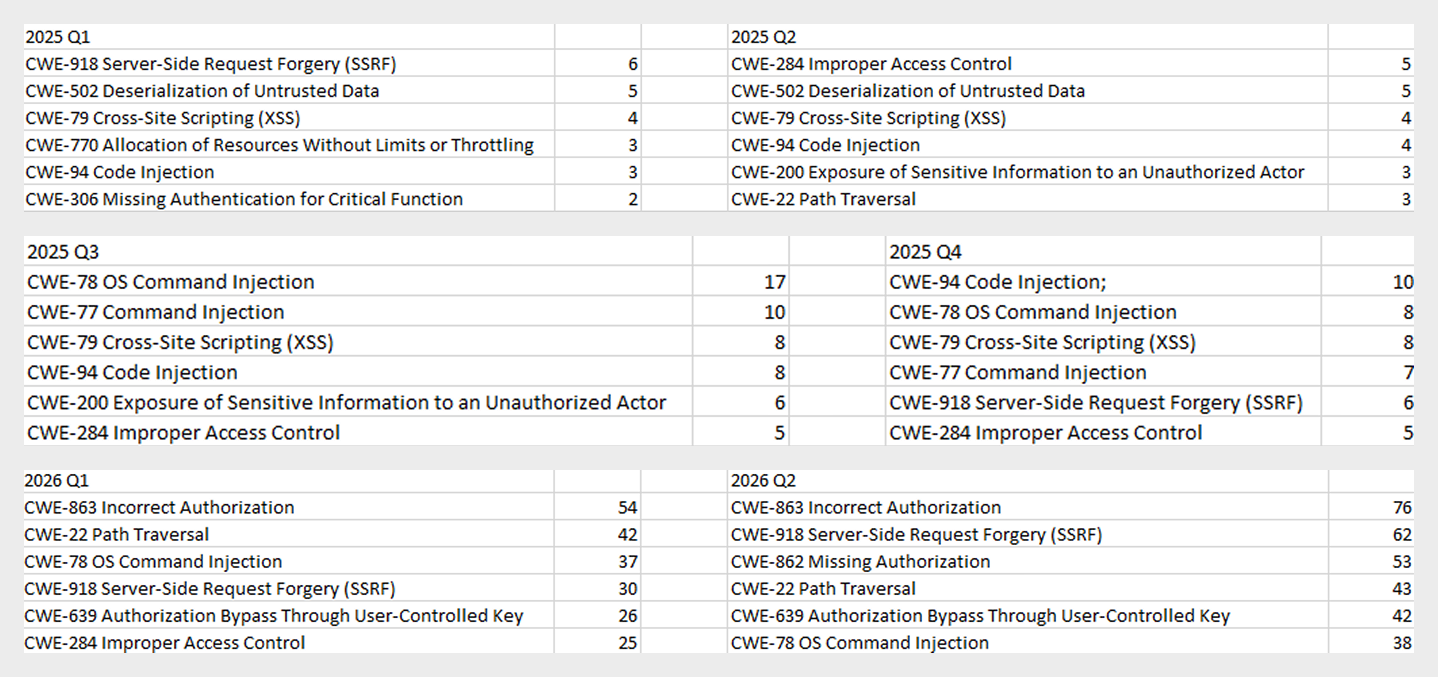
TOP 6 vulnerability types in products that implement or use AI/LLM logic, 2025–2026

TOP 6 vulnerability types in products that implement or use AI/LLM logic, 2025–2026

Interestingly, vulnerabilities of an undetermined type have ranked first in every quarter since the start of 2025. Traditionally-made software has the same issue, and it doesn’t look like the growing number of AI tools will fix it. It’s also notable that the list includes classes CWE developers themselves don’t recommend using for vulnerability classification, since they lump together a whole range of more specific types. CWE-284 is an example of this.

Looking at the most common classes, the key issues found in AI-related software can be summed up as follows:

  • Inadequate access control over critical system objects
  • Improper implementation of authentication and authorization mechanisms
  • Injections

It’s worth noting that injection-related vulnerabilities were relatively rare before AI agents took off (previously, they mostly affected web apps). Recently, though, these security issues have become relevant again.

Looking back at a year and a half of the AI boom, one conclusion stands out regarding registered vulnerabilities: AI tool developers are more focused on expanding functionality than on security. This is worth keeping in mind when using these tools. Let’s look at the projects and applications that either integrated AI tools or offered them as the core product. Below is a list of the those with the highest number of registered vulnerabilities for 2025–2026.

TOP AI/LLM-related projects by number of published vulnerabilities, 2025–2026 (download)

Notable vulnerabilities

This section highlights the most significant vulnerabilities published in Q2 2026 that have publicly available descriptions. Since the above already covers several significant vulnerabilities published during the reporting period, this section consists mainly of LLM/AI tool vulnerabilities.

CVE-2026-25253: a gatewayUrl vulnerability in OpenClaw

The issue stems from the fact that the OpenClaw user interface trusts the value of the gatewayUrl parameter passed in the URL and automatically establishes a WebSocket connection to the specified address. During this connection process, it sends an authentication token without any additional user confirmation.

The attack algorithm exploiting this vulnerability works as follows:

  1. The application obtains a critical connection address from an external source (the gatewayUrl URL parameter), which is controlled by the attacker.
  2. There is no validation before use.
  3. The client automatically initiates a connection to the address specified in the parameter, which belongs to the attacker.
  4. While connected, the application sends credentials (an access token) to the specified address.

If the attacker obtains a valid token, the consequences depend on that token’s level of access within the system. In general, this could lead to:

  • User session compromise
  • Execution of operations on the user’s behalf
  • Modification of the AI agent configuration
  • Unauthorized access to tools and resources connected to the agent
  • Under certain OpenClaw configurations, further compromise of the host running the agent

It’s worth noting that the risk of exploitation arises from a combination of several factors: the automatic connection and token transmission, the lack of address trust verification, and the high privileges granted to the local AI agent.

CVE-2026-41948: a path traversal vulnerability in the Dify AI platform

The vulnerability lets an authenticated user craft a request that enables the application to escape its permitted tenant and gain access to internal REST APIs that weren’t meant for that user. The root cause is insufficient normalization and validation of the URL path before it’s passed to the internal service.

Depending on the Dify configuration, the consequences can include:

  • Unauthorized access to internal service interfaces
  • Breach of isolation between workspaces
  • Exposure of internal service information
  • Conditions favorable to further attacks when combined with other vulnerabilities

The use of Dify in enterprise AI platforms is particularly risky, since internal services there tend to hold elevated privileges.

CVE-2026-45386: an improper access control vulnerability in Open WebUI

In Open WebUI, pin/unpin operations on messages are write operations, since they modify that message’s metadata (is_pinned, pinned_by, pinned_at). In vulnerable versions, however, before performing these actions, the API only checked for read access to the channel (a chat between a user or group and the AI) containing the message, not permission to modify its content. As a result, a user with a role limited to viewing messages could still change a message’s pinned status.

The vulnerability’s mechanism works as follows:

  1. The user initiates an action that changes the state of an object.
  2. The application treats this action as a regular read request.
  3. Only channel view permission is checked.
  4. The application performs a write without verifying the required user authorization.

This violates one of the fundamental principles of access control models — namely, that any operation that changes the state of data must be checked for the appropriate write or moderation permissions, regardless of whether the object itself is readable.

Although the vulnerability doesn’t lead to arbitrary code execution or compromise of sensitive data, it can affect data integrity and collaborative workflows. Potential consequences of exploitation include unauthorized pinning or unpinning of messages, disruption of channel moderators’ and administrators’ activities, changes to the display order of important information, and even the potential spread of false or misleading information by altering the channel containing a pinned message.

Open WebUI is widely used as an interface for interacting with local and enterprise LLMs. In these systems, pinned messages often contain important instructions, announcements, or tips for users. The ability to modify them with minimal privileges can disrupt collaborative workflows, cause confusion, and undermine trust in information published by administrators and moderators.

CVE-2026-45501: a vulnerability in Microsoft Exchange

The vulnerability stems from improper neutralization of user input when generating Exchange web pages. As a result, the browser may interpret specially crafted data as active content instead of plain text.

Although Microsoft categorizes the potential impact of exploiting this vulnerability as spoofing, flaws like this can lead to alteration of displayed content, imitation of trusted interfaces, actions on behalf of the user within an active session, and abuse of user trust.

It’s worth noting that issues like this are still relevant in modern software, given that mechanisms like Content Security Policy and various parsers were specifically created to help developers neutralize dangerous parts of user page content.

Conclusion and advice

Q2 brought the first significant results of AI automation adoption in software development and vulnerability hunting tools. This research shows that beyond traditional patch management, organizations now need real-time monitoring of systems and access controls, since infrastructure and everyday applications now contain far more AI functionality that could lead to compromise.

Accordingly, besides quickly detecting infrastructure vulnerabilities and managing security patches, modern enterprise-grade security solutions need to provide a broad range of preventive measures for tracking the overall health of systems and workstations. Kaspersky Next meets these requirements by combining proactive mechanisms with the ability to respond promptly to emerging threats.


OpenClaw: risks for the users and how to mitigate them

OpenClaw, which was previously known as Clawdbot and Moltbot, is today one of the most successful and fast‑growing ecosystems for AI agents, recognized worldwide. The project quickly became popular with users because of its flexibility and ability to solve fairly complex tasks that previously required a lot of time for automation and execution. A dedicated marketplace appeared quickly after the project started gaining traction, where developers and users began publishing tools that integrate with OpenClaw. Currently, employees all over the world use OpenClaw to automate their tasks, often unaware of risks this practice introduces to them and their employers.

In this article we will examine several security aspects of OpenClaw, look at how attackers can target this system, which vulnerabilities are already known, and how to protect your organization against these issues.

OpenClaw skills

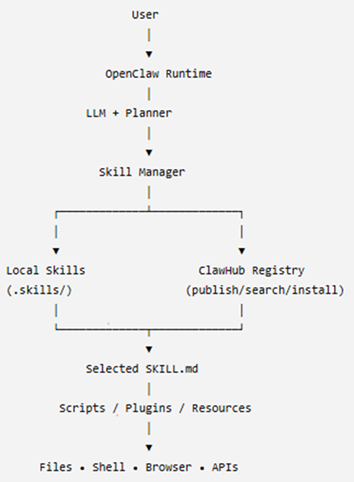
The project’s success was ensured by the fact that the agent accepts natural language instructions, does not require knowledge of programming languages, and allows the use of skills, which expand its capabilities. The overall architecture of OpenClaw can be seen below:

The OpenClaw overall architecture

The OpenClaw overall architecture

As shown in the diagram, the system is designed to be used with agent skills. These skills can reside locally on the system where the agent is installed or they can be obtained from external sources. At the time of writing this article, a dedicated hub named “ClawHub” is used for sharing skills with other users.

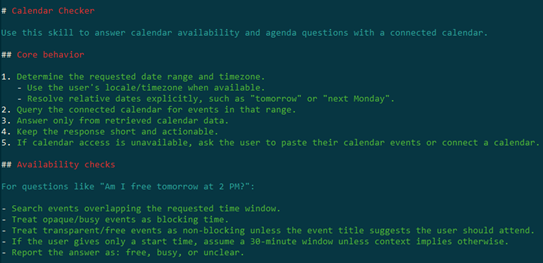
One of the key features of OpenClaw skills is that they are easy to create and do not require coding. A skill is in essence a set of commands written in natural language, although it can contain code. Currently, there is a general description of the skill format: it is usually a text file named SKILL.md, although more complex variants may exist. The primary requirement for these files is that they use a plaintext format. To illustrate what this looks like, here is a fragment of a skill:

Openclaw skill example

Openclaw skill example

The applications for OpenClaw skills are quite broad and can include everyday tasks like checking email, performing routine operations and calculations on a computer, as well as more complex pipelines that handle testing, research, or software development. For most actions, the agent requires access to the operating system’s file system, as well as to the tokens and keys of the systems it will interact with. All necessary data are usually provided by users either through environment variables or in plaintext files located alongside the agent.

Since many skills enable automation of work processes, employees worldwide actively use them. This fact, combined with the widespread adoption of the system and the overall popularity of artificial‑intelligence technologies, has attracted attackers to the project.

OpenClaw vulnerabilities

In less than two years, around 530 vulnerabilities have been discovered both in OpenClaw itself and in the underlying technologies. That said, the publication of OpenClaw vulnerabilities in the CVE database began only in February 2026. Below is a breakdown of these vulnerabilities by severity.

Registered vulnerabilities (download)

As shown in the chart, the number of high-severity vulnerabilities is quite large. Most of these vulnerabilities fundamentally involve issues with storing sensitive data and operating with excessively high privileges. Each of them can be exploited to hijack the agent or inject commands that it will execute.

Malicious skills

Besides exploiting vulnerabilities and deceiving users, there are more specific attack vectors against OpenClaw, namely, skills.

Research logically draws a parallel between supply‑chain attacks and the distribution of malicious skills. However, unlike usual supply-chain attacks, creating malicious skills is trivial because there is no longer a need to develop custom malware. Despite this, until February 7, 2026, no skills had undergone even a basic security check, which allowed malicious skills to appear immediately. Our scan of the skill hub in April identified 24 accounts that were distributing more than 600 malicious skills. Overall, open‑source intelligence indicates that over 1100 malicious accounts have been created since January.

Following the investigations and a lengthy effort to clean the skill repository of malicious entries, it was announced that files would undergo preliminary scanning with VirusTotal (VT) and NVIDIA’s SkillSpector. On the one hand, this is a more responsible approach to publishing skills; on the other, because OpenClaw is primarily an agent that executes a set of instructions, detecting malicious activity moves to a different level. Now it is necessary not only to analyze a file for dangerous commands that should be blocked, but also to examine all possible malicious behaviors that could be triggered by a harmful instruction within a skill. An example of a malicious command in natural language:

Example of a malicious command within a skill action

Example of a malicious command within a skill action

An example of a malicious command using a part of a bash command:

Malicious command inside a skill

Malicious command inside a skill

The example in the image and similar malicious skills are detected by Kaspersky products as HEUR:Trojan.ANSI.MalClaw.gen.

In addition, Kaspersky products monitor malicious OpenClaw skill activity on the system. Below are detection statistics from our systems that have identified malicious OpenClaw client behavior. The data for June cover the first half of the month.

Statistics on Kaspersky product detections of OpenClaw malware (download)

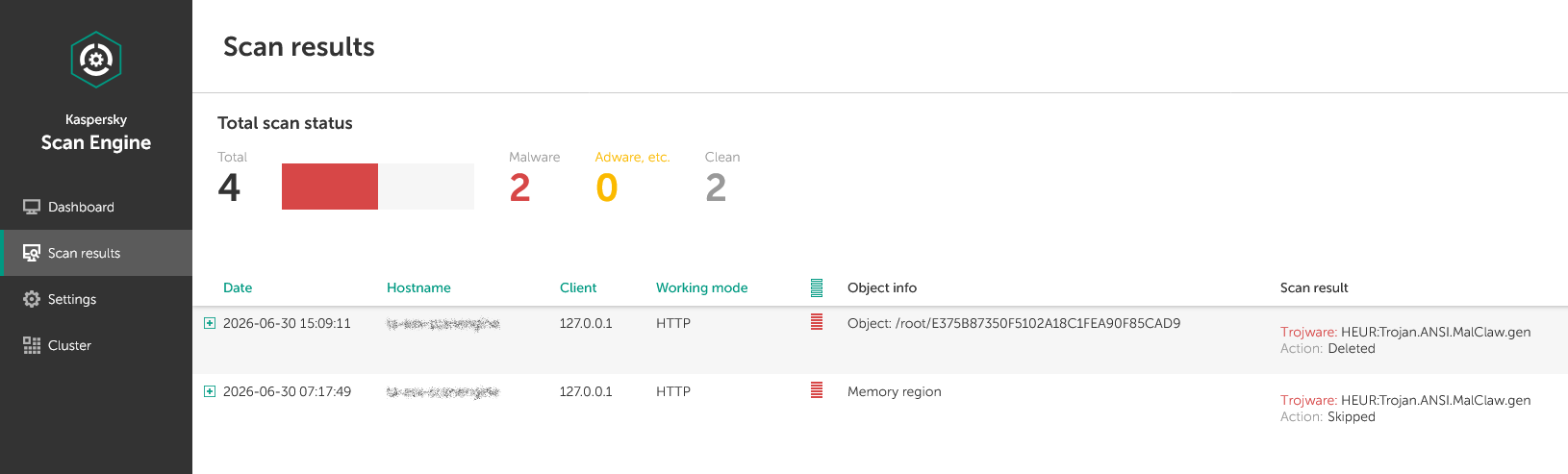
As shown in the chart, even despite the measures taken to counter the publication of malicious skills, attacks continue. Therefore, it is important to employ layered protection that isolates the OpenClaw agent from critical data and infrastructure systems. We also recommend checking all skills that enter the organization’s perimeter. For this purpose, Kaspersky Scan Engine is suitable. This solution is designed to protect web applications, proxy servers, network attached storage, and mail gateways. It can be integrated into almost any application, and it is easy to deploy and manage.

Malicious skill detected by Scan Engine

Malicious skill detected by Scan Engine

Additionally, monitor network accesses used by the agent. For this purpose, the project already provides a sandboxing subsystem and various wrappers for working with APIs and services. Last but not least, develop a comprehensive AI policy and make sure your employees never use third-party tools that they are not explicitly allowed to use.

Inside the 2026 SMB threat landscape: From phishing and scams to fake AI tools

Small and medium-sized businesses (SMBs) remain attractive targets for cybercriminals – in both mass cyberattacks and sophisticated campaigns targeting larger enterprises through trusted relationship attacks. At the same time, smaller businesses may lack the robust cybersecurity policies and necessary resources to protect themselves against an evolving threat landscape.

Kaspersky believes that raising awareness can help small and medium-sized enterprises develop an effective protection strategy. Ahead of International SMB Day on June 27, Kaspersky presents the findings of its 2026 threat analysis for SMBs, which includes real-world examples of attacks.

Key findings

  • In the first four months of 2026, Kaspersky solutions detected over 33,300 cyberattacks on SMBs masquerading as popular artificial intelligence (AI) tools – almost five times more than in 2025 and 39% more than the number of attacks disguised as the office and collaboration tools that Kaspersky’s research focuses on.
  • Popular messengers and communication services remained the attacker’s most widespread lure, with almost 415,000 attacks involving fake messenger apps and video conferencing software.
  • The attackers follow trends: the AI tools Claude and OpenClaw (ex-ClawdBot/MoltBot), which have gained popularity in 2026, were among the common AI lures.
  • Fraudsters use fake AI tools to scam businesses out of money, while corporate accounts on social media also remain targets.
  • The majority of initial accesses to corporate infrastructures sold on the dark web are allegedly accesses to SMBs. This could be because SMBs tend not to be as well protected as large enterprises and, at the same time, may be trusted contractors for those well-protected enterprises.

Malware and potentially unwanted applications (PUAs) disguised as popular services

Kaspersky researchers used data from Kaspersky Security Network (KSN) to explore how frequently malicious and unwanted files are disguised as legitimate applications that may be used by SMBs. KSN is a system for processing anonymized cyberthreat-related data shared voluntarily by Kaspersky users. For this part of the report, only anonymized data received from users of Kaspersky solutions for SMBs were analyzed.

According to a survey by the Small Business & Entrepreneurship Council (SBE Council), small business owners continue to embrace artificial intelligence and digital transformation as they maintain a generally positive outlook on the economy. Threat actors are also aware of the hype surrounding AI and exploit it for their own benefit. In particular, they actively distribute cyberthreats under the guise of popular AI services.

From January to April 2026, Kaspersky solutions detected 33,352 attacks on SMB users in which malware or potentially unwanted applications for PCs were disguised as five popular AI services. This figure represents an increase of almost five times compared to the previous year. This highlights an evolving trend in which threat actors are weaponizing trust in widely used AI platforms and services, especially popular ones like Claude. Kaspersky experts note that it’s important to download apps from official sources and to verify which apps are available for which platforms.

Share of attacks targeting SMBs in which malware or PUAs mimic the five popular, legitimate AI apps that Kaspersky’s research focuses on, first four months of 2025 and 2026 (download)

In the first four months of 2026, Kaspersky researchers also identified more than 1,100 unique samples of malware and PUAs detected in the SMB sector that masqueraded as five popular AI applications, representing a 21% increase compared to the same period of 2025. The samples were mainly different types of Trojware (Trojans and Trojan-like malware), including those capable of downloading and running other malware on compromised devices. Trojware disguises itself as harmless files to trick users into installing them. Their functionality may vary depending on the particular type of Trojware. This may include stealing, deleting, blocking, modifying or copying users’ data, as well as other malicious actions. Trojware therefore represents a highly dangerous cyberthreat to entrepreneurs and businesses.

Kaspersky experts also note that the threat landscape is constantly evolving with new lures appearing all the time. For example, in the first four months of 2026, Kaspersky solutions blocked hundreds of attacks in which malware or PUAs for PCs were disguised as OpenClaw (previously known as Clawdbot or Moltbot).

Other lures for SMBs: Fake communication apps and office software

Kaspersky analysts also explored how attackers leverage other legitimate applications as lures to target SMBs. For example, from January to April 2026, Kaspersky solutions blocked 414,736 attacks on SMB users in which malicious software or PUAs for PCs were disguised as the popular communication apps that Kaspersky’s report focuses on. The number of attacks changed marginally compared to the previous year’s figure, indicating that the lure of fake communication apps remains a serious cyberthreat.

Share of attacks targeting SMBs in which malware or PUAs mimic the four legitimate communication apps covered by Kaspersky’s research, first four months of 2025 and 2026 (download)

Various fake office applications and collaborative platforms also remain among the lures that attackers may exploit to target SMBs. According to Kaspersky telemetry, more than 24,000 attacks were detected from January to April 2026 in which malware or PUAs for PCs were disguised as specific office applications.

Share of attacks targeting SMBs in which malware or PUAs mimic the six popular office applications and collaboration tools covered by Kaspersky’s research, first four months of 2025 and 2026 (download)

In 2026, AI-related baits have become more widespread among cybercriminals than traditional fake office and collaboration tools. Kaspersky experts note that the more publicity and hype there is around certain tools, the more likely a user is to come across a fake package online.

Scammers and phishers tricking victims into providing credentials and funds

In 2026, Kaspersky researchers observed a wide range of phishing campaigns and scams targeting businesses and entrepreneurs. Fraudsters mimic financial and AI services as well as other platforms in order to steal credentials, personal information and funds.

In the following example, fraudsters disguise themselves as a bank that allegedly offers services for businesses (in other similar schemes they may offer business loans). Entrepreneurs are prompted to visit a scam website and enter their data to open a business account. The requested information varies depending on the scam, but may include name, email address, phone number, social security number, date of birth and address. Scammers may then use this data in their schemes or sell it on the dark web.

Kaspersky experts advise: if you encounter such a website, you should not rush to enter any data. First, examine it. Does the purported financial organization actually exist? How old is the website? Check the WHOIS records and read user reviews before entering any information on the page.

Example of a scam page targeting entrepreneurs

Example of a scam page targeting entrepreneurs

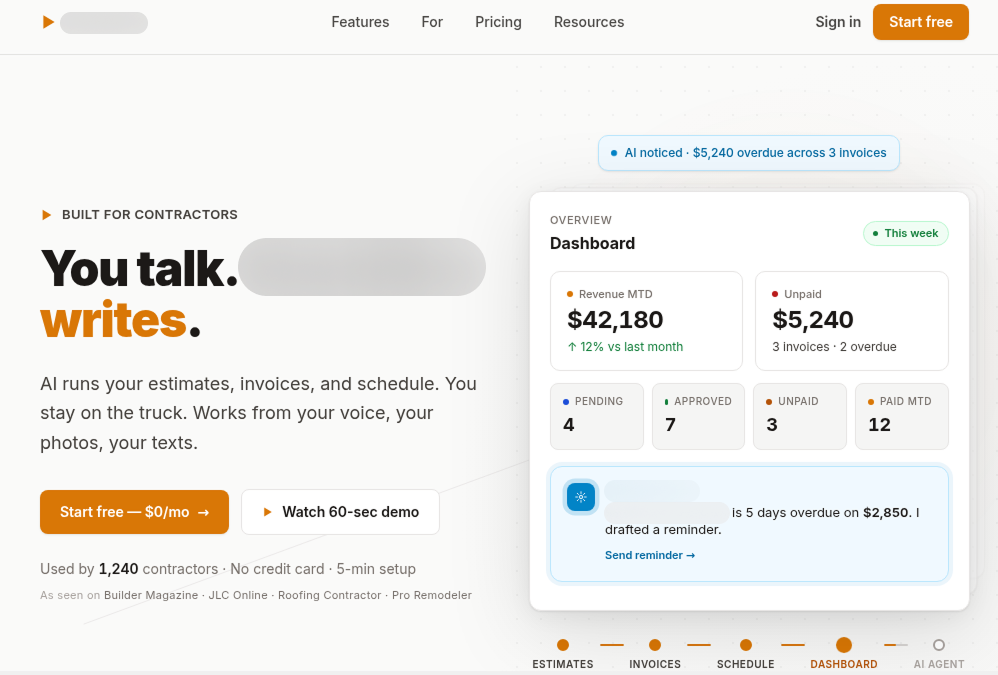
As with many other cyberthreats, AI services are also leveraged as a lure in scams. For example, Kaspersky experts identified a scam website for an AI service “built for contractors”. According to the text on the fraudulent page, the tool can help with “estimates, invoices and schedule”. However, in reality, in such schemes victims usually receive nothing after paying for a subscription, while the scammers get all the money.

Example of a scam page promoting an AI tool

Example of a scam page promoting an AI tool

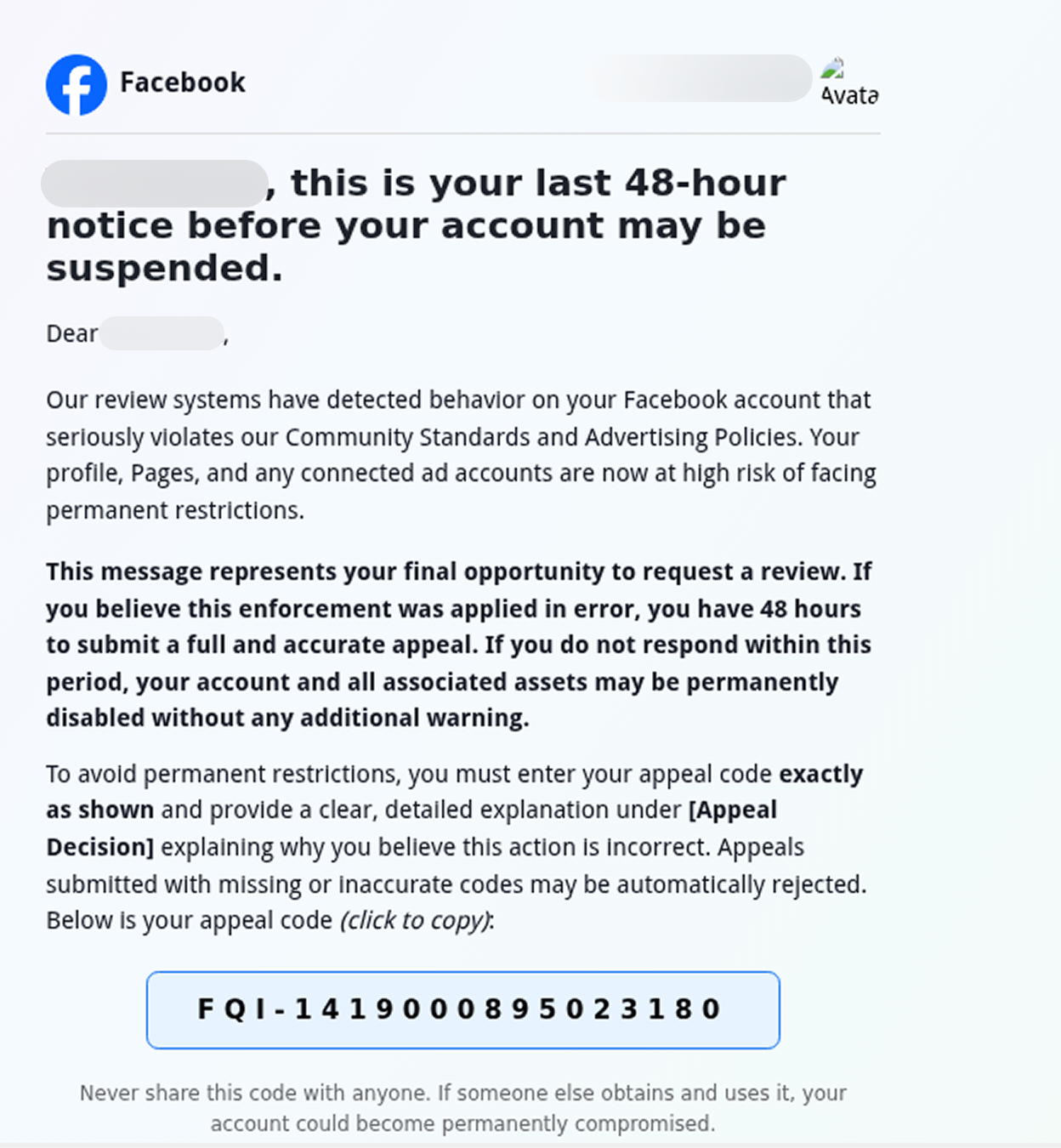
Kaspersky experts note that business accounts on social networks and messengers remain attractive targets for cybercriminals in 2026. In one scheme, phishers distributed notifications with fake alerts related to companies’ business pages. The notifications claimed that Facebook’s review system had detected behavior that seriously violated its Community Standards and Advertising Policies. To avoid permanent restriction of their business page on the social network, owners were prompted to fill out an appeal form and provide personal and business email addresses, phone numbers, as well as the name of their business page and the password for their social network account. The attackers’ goal was to obtain credentials. To reduce user vigilance  and appear legitimate, fraudsters also sent victims a fake appeal code.

Example of a fake notification

Example of a fake notification

Email threats: Fake online documents and exploitation of legitimate platforms

Email remains one of the most widely used channels for cyberattacks targeting enterprises, including small and medium-sized businesses. In 2026, attackers have frequently combined email distribution with the exploitation of legitimate third-party platforms. This is how phishers and scammers usually attempt to bypass traditional email filters and exploit user trust in reputable services. Kaspersky researchers have also observed a large number of schemes targeting corporate users in which phishers and scammers use fake online documents or nonexistent meetings as bait.

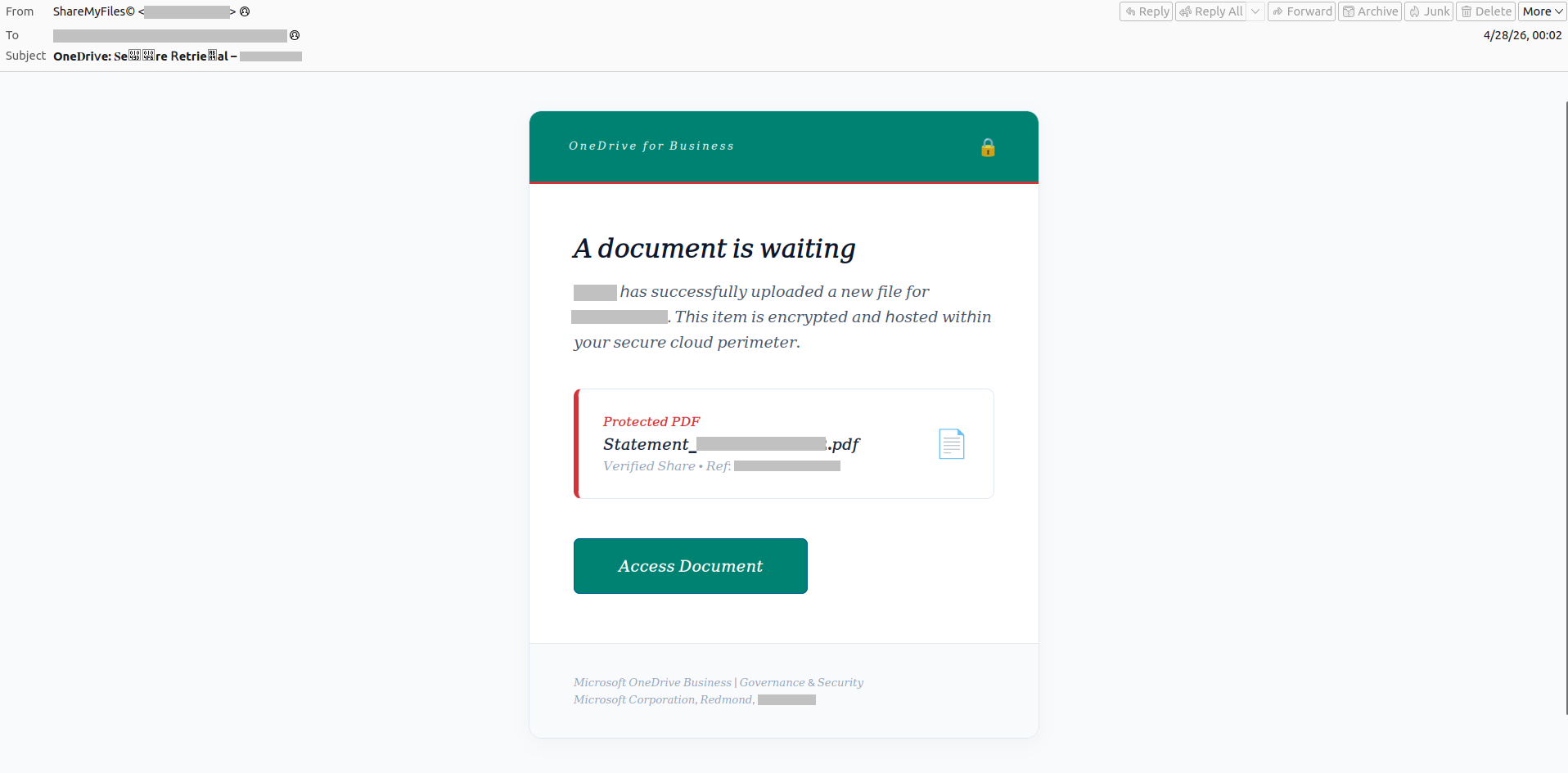
In one recent scheme detected by Kaspersky, the attackers sent a fake notification disguised as a letter from OneDrive. The victim was prompted to access the document by clicking a button, but in reality, it led to a phishing website where users risked losing their confidential data. To make the email appear legitimate, the attackers added a phrase designed to  lower the victim’s vigilance: “This item is encrypted and hosted within your secure cloud perimeter.” They also parsed the recipient’s email address and used the extracted data in the fake notification text so that the email looked like a standard notification from this type of service: “[email address domain as company name] has successfully uploaded a new file for [the user’s name as stated in their email address].”

Example of a phishing scheme with fake online documents

Example of a phishing scheme with fake online documents

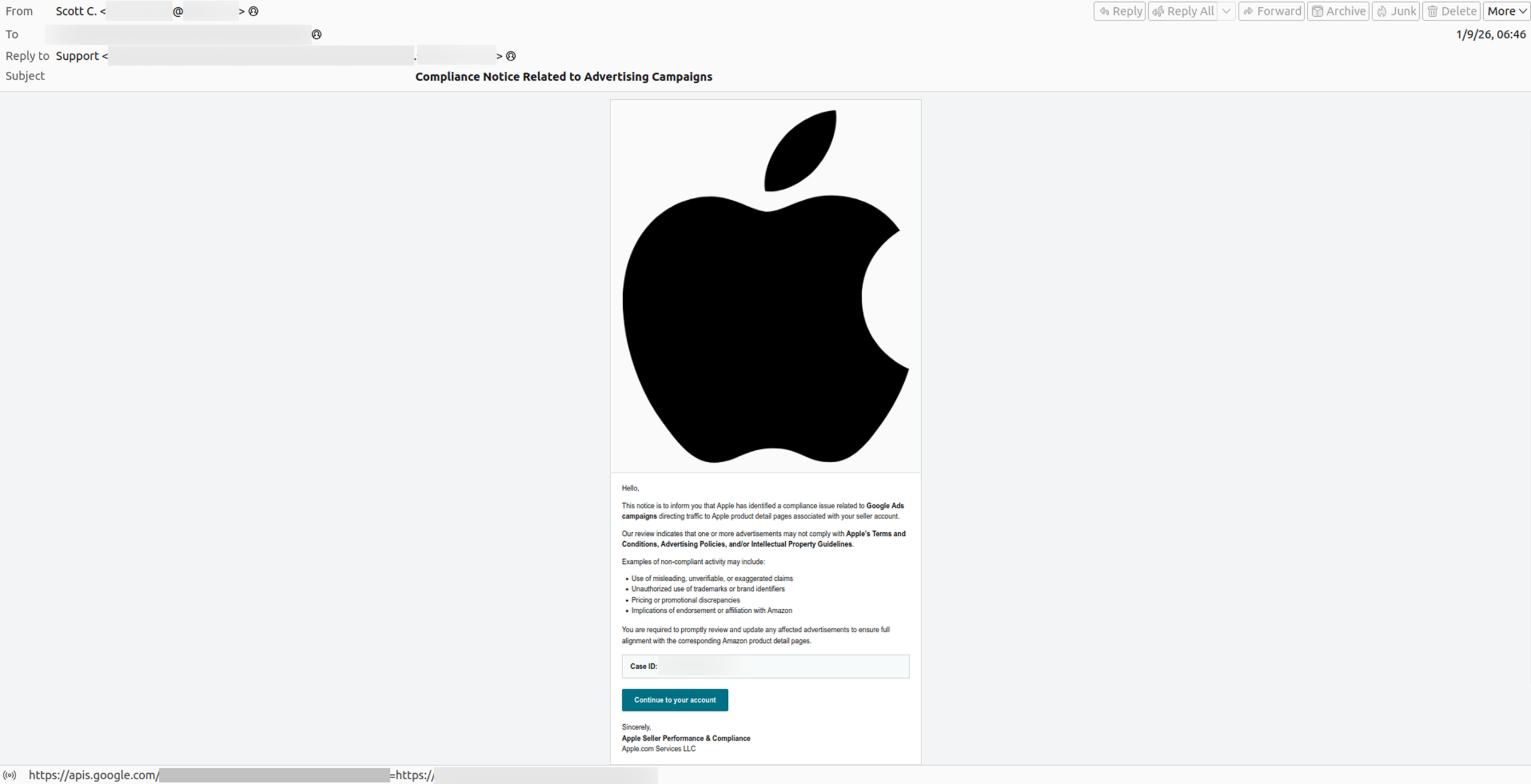
Attackers also use other pretexts to trick victims into sharing confidential information, for example fake compliance issues. In the example below, the attackers posed as Apple representatives. The fake notification stated: “Apple has identified a compliance issue related to Google Ads campaigns directing traffic to Apple product detail pages associated with the victim’s seller account.” However, the button in the email led to a phishing website where users are tricked into sharing confidential data.

Example of a fake compliance issue notification

Example of a fake compliance issue notification

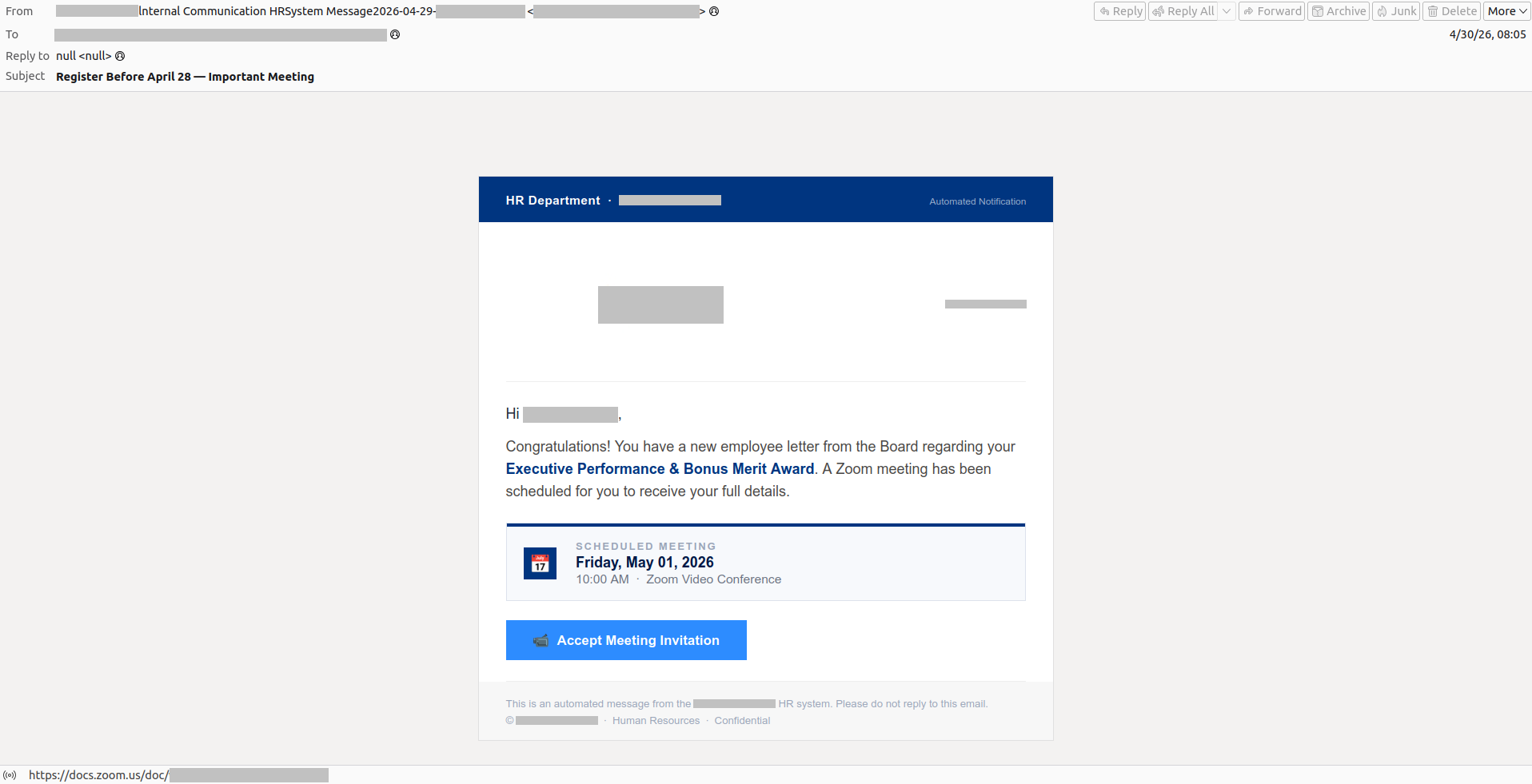
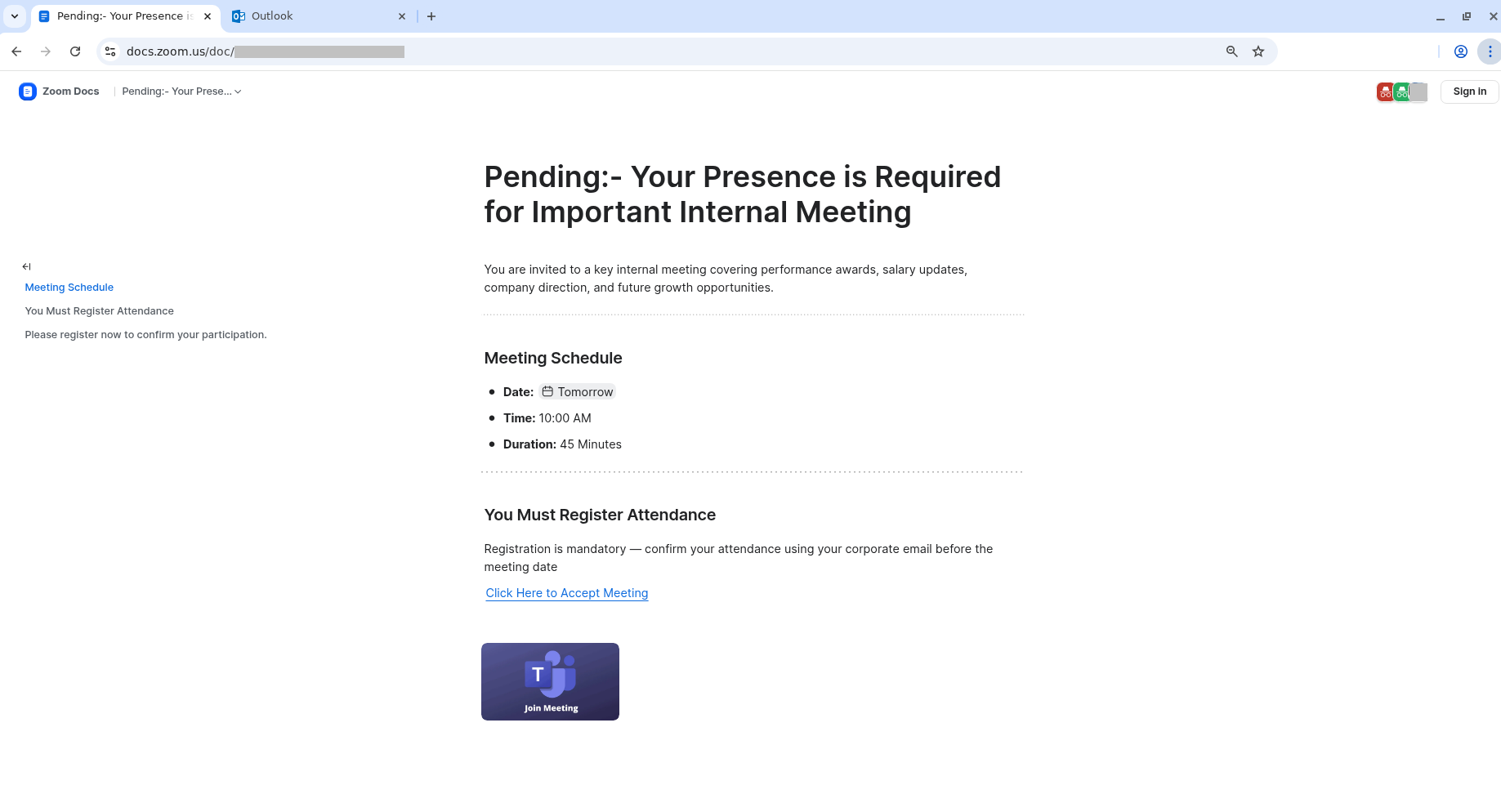
Kaspersky experts observed another notable two-stage scheme aimed at stealing credentials from corporate emails, which involved distributing an invitation to a nonexistent meeting. The scheme is deployed in two stages. In stage one, a corporate user receives an email about a fictitious meeting. After clicking the “Accept Meeting Invitation” button, the user is redirected to a legitimate Zoom Docs (previous Zoom canvas brand) page. In stage two, the victim is prompted to click a hyperlink that reads “Click Here to Accept Meeting”. However, the URL of a phishing page is hidden behind this hyperlink.

Example of an email with a fake meeting

Example of an email with a fake meeting

Zoom Docs page containing the phishing link

Zoom Docs page containing the phishing link

Malware is also actively distributed via email. In 2025, individuals and corporate users encountered over 144 million malicious and potentially unwanted email attachments, representing a 15% increase from the previous year.

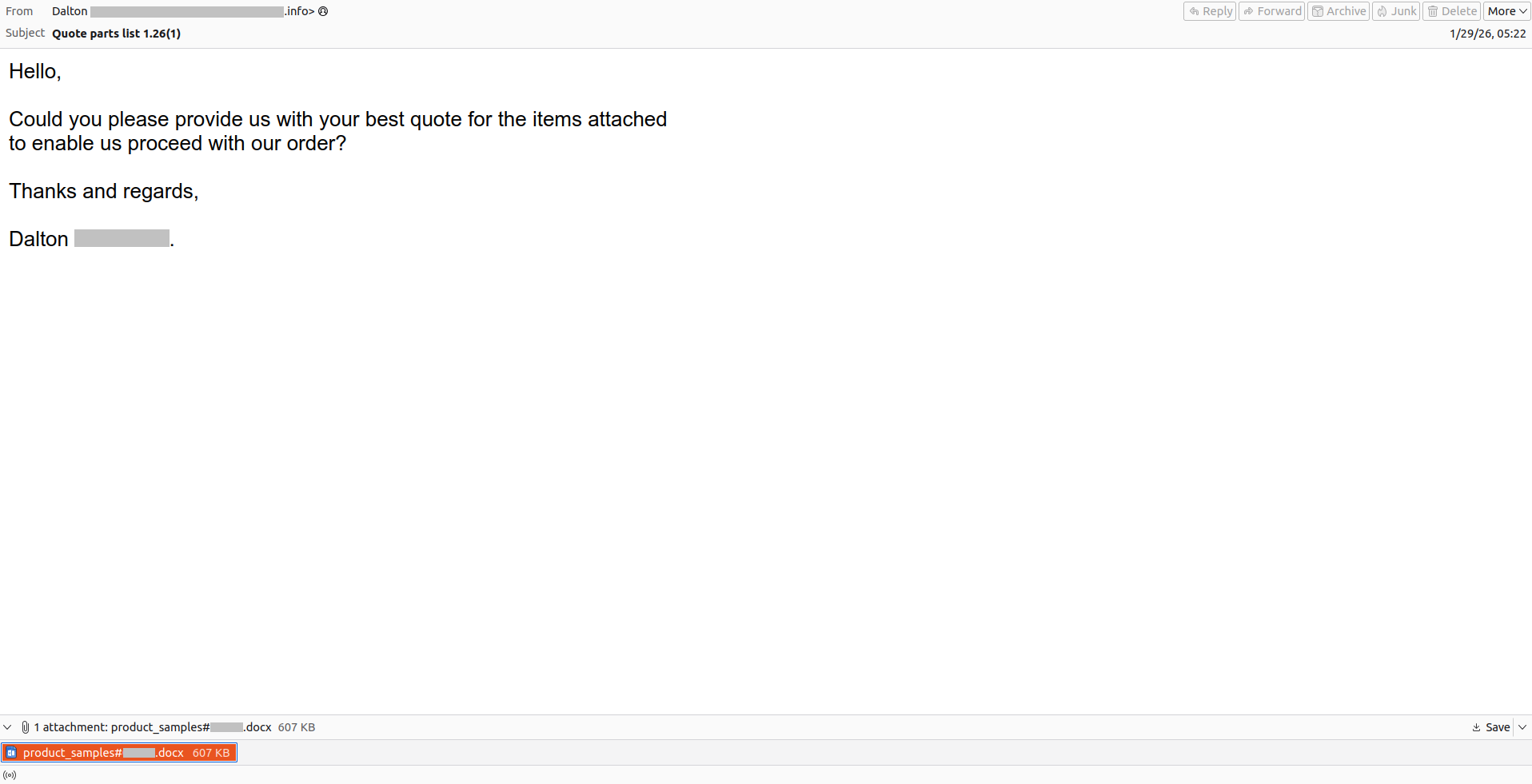
Kaspersky experts note that the lures used in subject lines and texts of malicious emails can appear relatively harmless and rather unsophisticated. In the example below, the attackers target businesses with a fake request for “the best quote for the items attached.” However, the attached file actually contains a Trojan.

Example of a malicious email

Example of a malicious email

Corporate infrastructure access for sale: Posts on the dark web

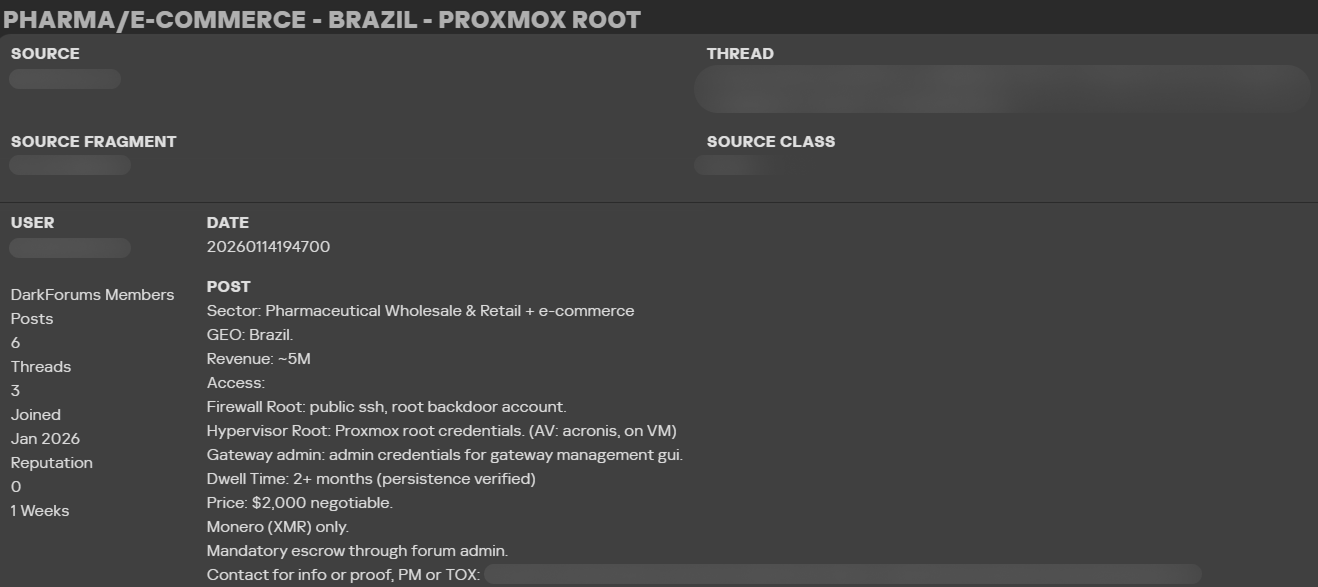
To assess threat actor activity, Kaspersky Digital Footprint Intelligence experts analyzed hundreds of posts offering initial access to corporate infrastructures published on dark web forums from January to April of both 2025 and 2026. Kaspersky experts note that a single post may contain several offers for access to different allegedly compromised companies.

Example of a post on a darknet forum

Example of a post on a darknet forum

Initial access brokers (IABs) sell initial access to compromised businesses, for example, via RDP or web shells. In their posts, IABs may provide information about the region where the allegedly compromised companies are located, their industry and revenue, as well as the type of access. IABs sell access that the buyers can then use for different purposes, including ransomware attacks, stealing corporate confidential information or other fraudulent activity. The price of initial access on dark web forums may depend on the revenue, industry or location of the allegedly compromised companies, or on the access privileges. For example, accounts with admin rights are usually more expensive because they can provide attackers with a wide range of possibilities.

According to the research, there were more posts offering initial access to companies of different sizes located in the Middle East (up 53% from last year), Africa (up 40%) and Latin America (up 17%). Meanwhile the number of posts related to companies located in Europe decreased by 34%. According to Kaspersky experts, this decline can be partially explained by the closure of a dark web forum containing such posts around the time of the study. The number of publications related to companies located in the APAC region also decreased slightly (down 4%), but remained at a consistently significant level for the second year in a row.
At the same time, the number of posts where the region was not specified decreased by 56% in 2026 compared to the previous year. Kaspersky analysts assume that this may indicate that initial access posts from IABs are becoming more targeted and unique.

Share of posts with initial access offers by business size

For this research, Kaspersky experts defined a small business as having an annual revenue of up to US$50 million, and a medium-sized business as having an annual revenue of between US$50 million and US$1 billion.

According to Kaspersky’s research, at the beginning of 2026 the share of posts on dark web forums with offers of initial access to allegedly compromised small businesses was larger than the shares of posts offering access to medium, large or nonprofit organizations. However, this share decreased in the first four months of 2026 compared to the same period in 2025. The share of posts concerning mediumsized organizations also remained significant for two consecutive years. Taken together, posts concerning small and mediumsized organizations account for more than half of all the analyzed posts with initial access offers on dark web forums.

At the same time for a certain number of posts initial access brokers didn’t indicate companies’ revenue, therefore, making it impossible to determine the size of the company.

Share of posts with initial access offers by business size, January–April 2025 (download)

Share of posts with initial access offers by business size, January–April 2026 (download)

Kaspersky experts note that despite the prevalence of posts concerning small businesses, threat actors may target medium‑sized businesses because they generate higher revenues than small businesses and may have weaker security defenses than large businesses.

SMBs can also become targets as a part of trusted relationship attacks, which enable the attackers to reach larger organizations. According to the Global Report by Kaspersky Security Services, the share of trusted relationship attacks among the initial vectors increased from 12.7% in 2024 to 15.5% in 2025. Therefore, the common belief that small and medium‑sized enterprises are of no interest to attackers is a misconception. Companies of all sizes need to understand the cyberthreat landscape, adhere to cybersecurity rules, implement appropriate cybersecurity solutions, and continuously improve employee awareness.

Cybersecurity action plan for SMBs

SMBs can reduce risks and ensure business continuity by investing in comprehensive cybersecurity solutions and increasing employee awareness. To protect themselves from the ever-evolving threat landscape, companies are advised to follow these rules:

  1. Define access rules for corporate resources such as internet services, email accounts, shared folders, and online documents. Keep access lists up to date and revoke access promptly when employees leave the company.
  2. Regularly back up important data to ensure the preservation of corporate information in case of emergencies.
  3. Establish clear guidelines for using external services and resources. Create well-defined procedures for coordinating specific tasks, such as implementing new software, with the IT department and other responsible managers. Develop short, easy-to-understand cybersecurity guidelines for employees, with a special focus on account and password management, email protection, and safe web browsing. A well-rounded training program will equip employees with the necessary knowledge and ability to apply it in practice.
  4. Raise employees’ security awareness. Conduct dedicated training to teach staff how to detect and address potential threats, and track their educational progress. Organizations can achieve this with the Kaspersky Automated Security Awareness Platform through interactive online modules and simulated phishing campaigns that build sustainable cyber hygiene habits across all teams.
  5. Implement specialized cybersecurity solutions that fit your budget, size, and industry requirements, with an emphasis on scalability and ease of integration.
    1. Kaspersky Small Office Security Premium is an easy-to-use solution that protects against advanced threats and also provides access to security awareness training for employees, making it ideal for micro-businesses.
    2. Small and medium-sized enterprises with more mature IT expertise should consider Kaspersky Next Optimum, which is designed specifically for growing organizations and offers real-time protection, threat visibility, as well as EDR and XDR investigation and response capabilities.
  6. Protect your business against email-borne threats. Kaspersky Security for Mail Server, a comprehensive email security platform that offers robust, multi-layered protection at mailbox and gateway levels, can help with this. Powered by machine learning and leading global threat intelligence, it effectively addresses all mail security challenges.
  7. Adopt specialized solutions such as Kaspersky Digital Footprint Intelligence to monitor the surface, deep, and dark webs for information about a company’s credentials, leaked data, and lookalike websites. Small and medium-sized companies with limited IT security budgets can partner with a managed security service provider (MSSP) to access this comprehensive digital risk protection service at an affordable, subscription-based price point.

What’s in the container? Analyzing vulnerabilities, risks and protection with Kaspersky Container Security and the KIRA AI assistant

Introduction

Containerization using Docker has become firmly established in modern development standards, significantly increasing the speed and convenience of deploying various services. Developers often use ready-made Docker images, making only minimal changes. The largest repository of container images is the Docker Hub service.

Container-hosted infrastructure is an attractive target for attackers. At a minimum, a compromised container can be used for DDoS attacks, cryptocurrency mining, or traffic proxying. The list of threats does not end there: once an attacker gains control of a container, they can steal or destroy data directly from it, access neighboring containers, or even attempt to escape the container, compromising the entire enterprise network.

At the same time, the infrastructure inside containers is typically updated less frequently and may contain outdated and vulnerable software versions. When deploying third-party images or modifying them for a specific environment, it is easy to make configuration errors that attackers can later exploit. And due to the architectural characteristics of containers, developers often face constraints when preparing images; to overcome these, they may resort to insecure solutions they find online.

In other words, containerized infrastructure can be both the simplest and the most lucrative target to exploit. Therefore, its security requires heightened attention. To minimize the risk of successful attacks on container infrastructure, it is essential to check the final Docker images, including all underlying layers, for vulnerabilities and misconfigurations. The easiest way to do this is by analyzing the Dockerfile; however, it is not always available for inspection. Moreover, it typically defines how to build layers on top of a base image from an external repository whose reliability cannot be guaranteed.

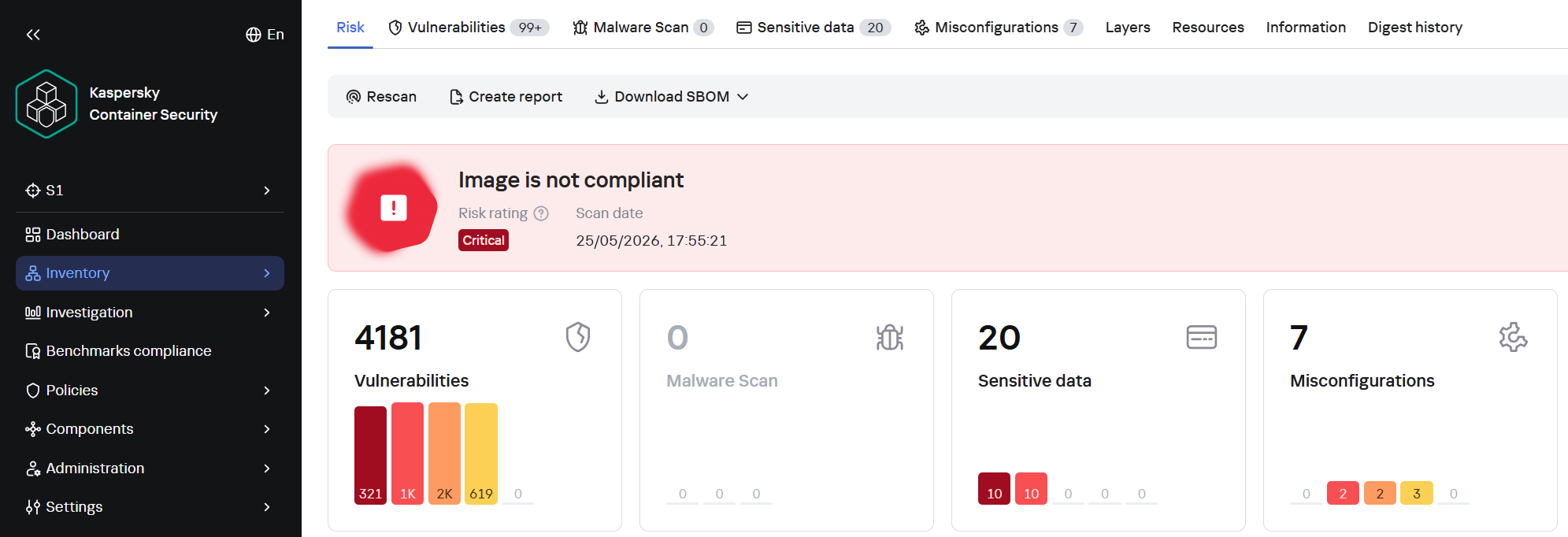
Image analysis results in Kaspersky Container Security

Image analysis results in Kaspersky Container Security

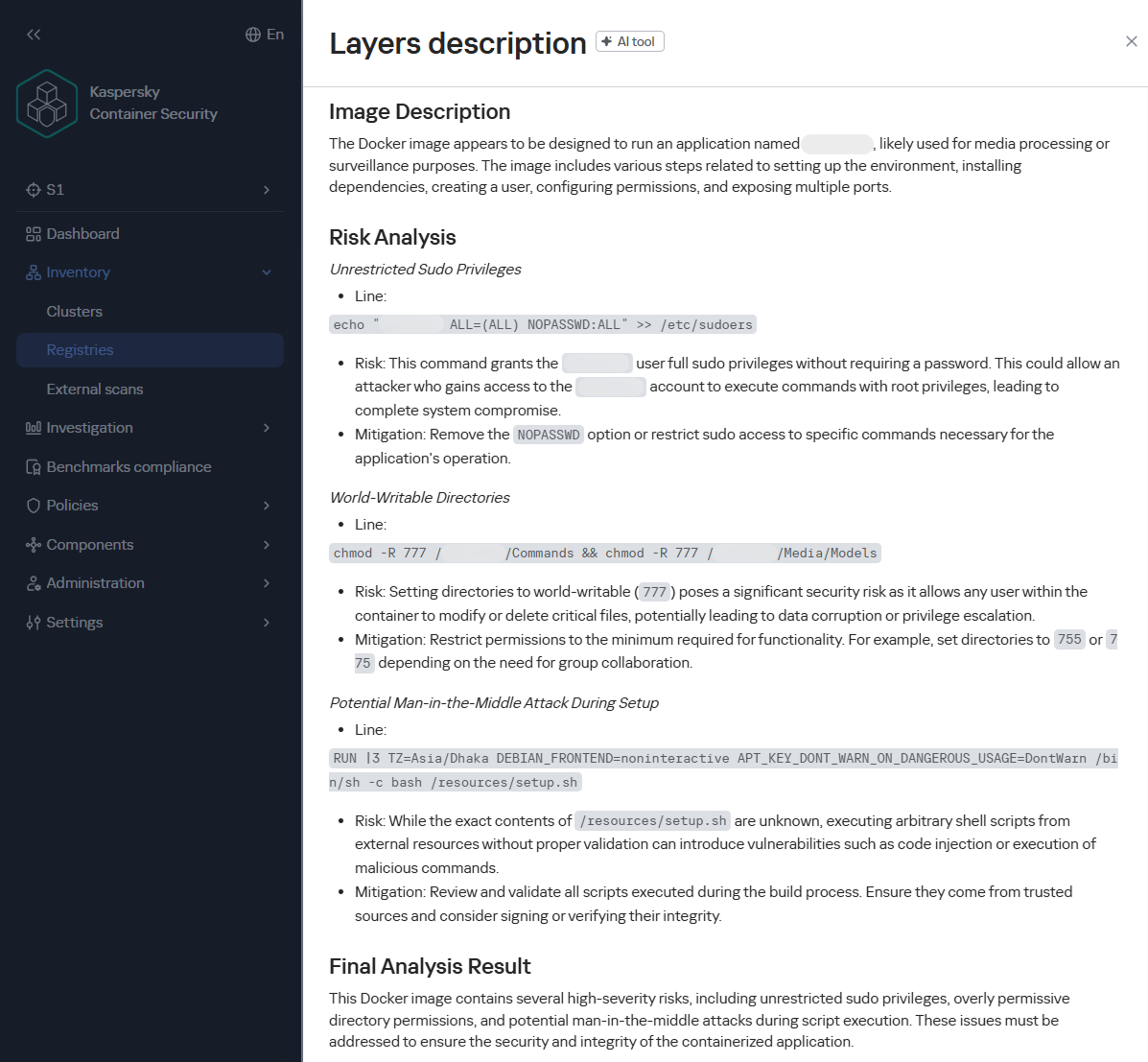
To help users identify insecure configurations and potential vulnerabilities within them, we have added our AI assistant to Kaspersky Container Security.KIRA (the assistant’s name) uses artificial intelligence to analyze the image and identify potential issues within, along with recommendations on how to fix them.

As part of this study, we asked KIRA to analyze a number of popular community images, and later in this article, we’ll show you the results.

Software vulnerabilities and compromise of update sources

One of the key security issues with using pre-built images is that developers do not update them in a timely manner. A Docker image is, by its very nature, a snapshot of a specific Linux distribution after packages have been installed on it. However, in most cases, it does not receive security updates on its own, unlike traditional Linux servers, where these updates are automatically installed by specialized services, such as unattended-upgrades in Debian-based distributions and dnf-automatic in RedHat-based distributions.

To apply updates to a Docker image, it must be rebuilt and redeployed. Often, this process is not automated, and some updates require additional effort to verify their correct operation, modify configurations when upgrading to new software versions, and so on. As a result, many popular images do not receive timely updates, which significantly increases the risks associated with their use.

An image that was secure at build time accumulates vulnerabilities as they are discovered in the packages installed within it, which over time significantly increases the opportunities for a successful attack on the container.

Vulnerable versions of web applications and network services accessible from the internet immediately become targets of various malicious campaigns. For example, just one day after the discovery of the CVE-2025-55182 vulnerability in React Server Components, our honeypots recorded numerous attack attempts related to this vulnerability. It was adopted by operators of many malicious campaigns, ranging from classic cryptocurrency miners to variants of Mirai and Gafgyt. Attackers are constantly adding new distribution methods and can use dozens of exploits targeting various vulnerabilities and configuration errors in popular services. Often, the same vulnerabilities are used in self-propagation mechanisms from already compromised hosts. For example, in a malicious campaign to spread the Dero miner, attackers use infected containers to automatically search for and infect new targets.

In addition to vulnerabilities that can be exploited remotely, attackers are rapidly adding local vulnerabilities to their arsenal, used to gain root privileges and escape the container: in the Kinsing malware campaign, attackers used CVE-2023-4911 (Looney Tunables) to elevate privileges, and in the perfctl campaign, the CVE-2021-4034 (PwnKit) vulnerability was used for the same purpose. The access gained was used to install a rootkit that hides the presence of perfctl on the system.

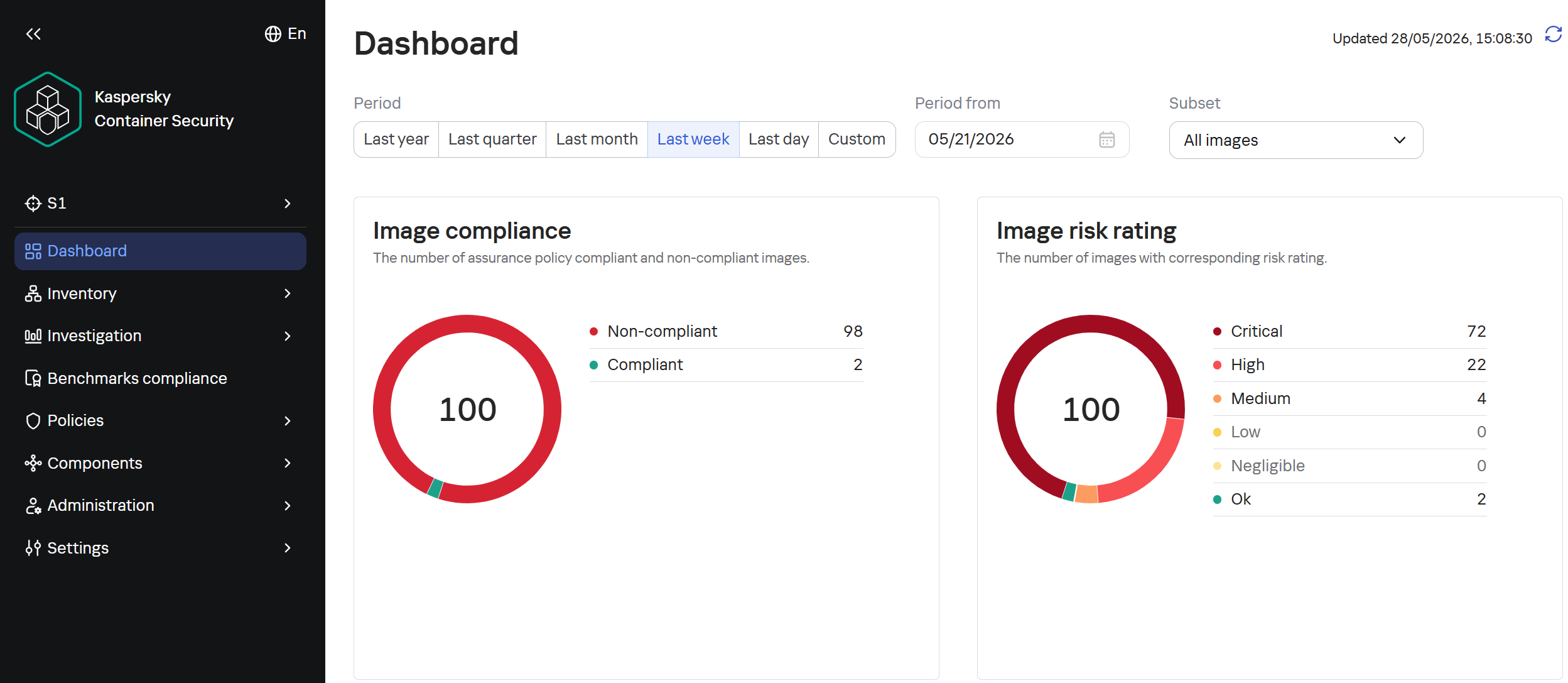
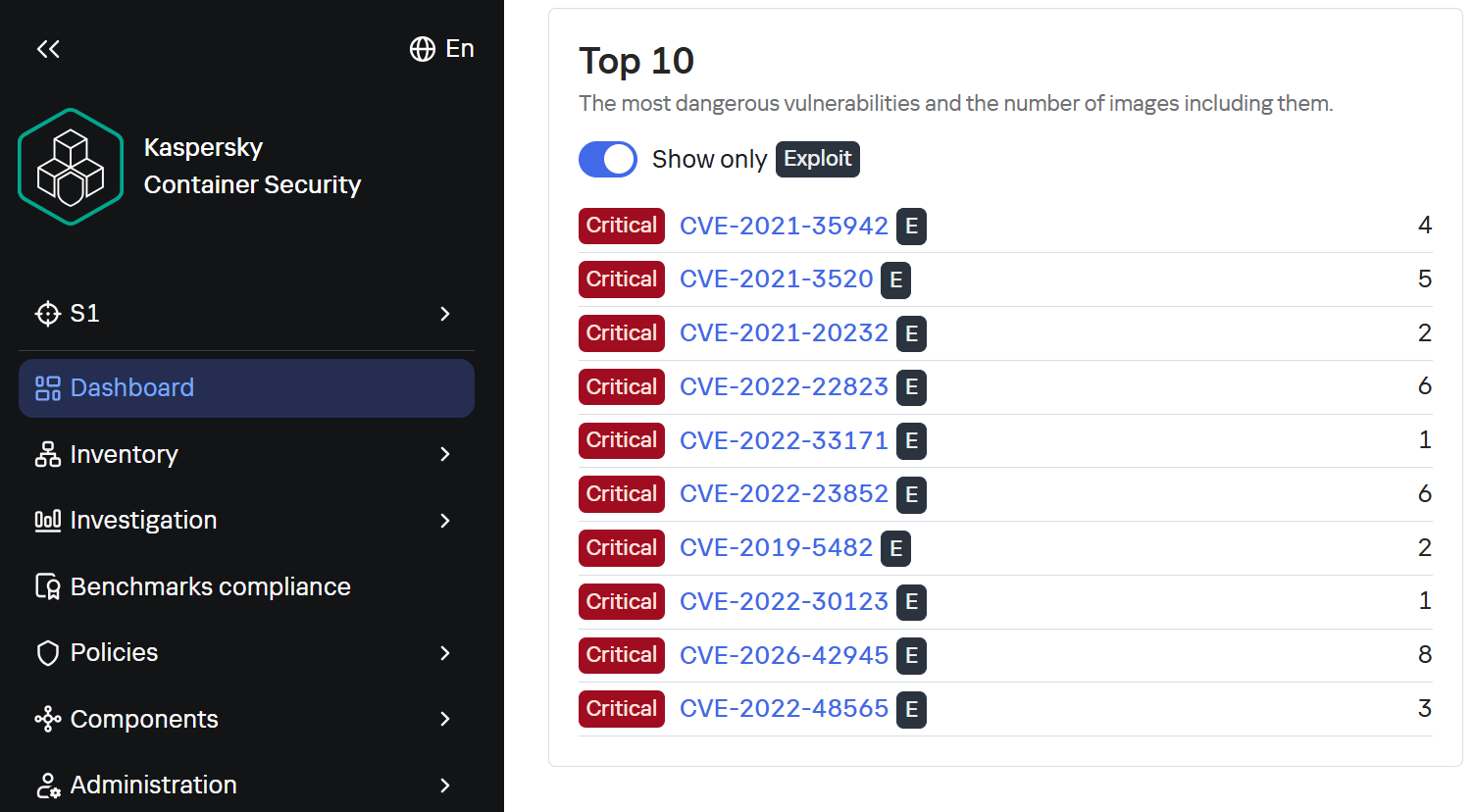
To assess the situation with unpatched vulnerabilities in containers, we took a random sample of 100 images, which included various popular solutions with 10,000 to 1 million downloads on DockerHub. In the 64 images we scanned, we found outdated software versions with critical vulnerabilities. For example, some images contained the CVE-2025-49844 vulnerability in the Redis server, leading to RCE by leveraging a vulnerability in the Lua parser; the current CVE-2026-24061 vulnerability in nginx, which in some configurations leads to a server process crash, and with ASLR disabled, again, to RCE; vulnerabilities CVE-2025-32463 in sudo and CVE-2023-4911 in glibc, allowing an attacker to gain root privileges with local access. At the same time, only one in ten Docker images from the analyzed sample is fully up to date.

TOP 10 Critical Vulnerabilities with PoC/Exploits available as shown in the Kaspersky Container Security Dashboard

TOP 10 Critical Vulnerabilities with PoC/Exploits available as shown in the Kaspersky Container Security Dashboard

It is worth noting that, of course, not every discovered vulnerability can be directly exploited by attackers. A practical risk arises when the vulnerable application or library is actually in use, and the conditions necessary for exploitation – which vary significantly from vulnerability to vulnerability – are met. Nevertheless, updates must not be ignored, as the risk of vulnerabilities being exploited – both individually and in various combinations – cannot be predicted in each specific case, and even vulnerabilities that seem harmless at first glance can ultimately pose a serious risk of compromise.

A record number of vulnerabilities in a single image

A record number of vulnerabilities in a single image

However, frequent updates have a downside. Every rebuild that downloads new packages from source repositories introduces an additional risk of a supply chain attack – a compromised dependency or a modified base image could silently inject malicious code into your environment precisely through an update. During our analysis of images from the sample, we did not find any signs of supply chain attacks. However, in March 2026, a supply chain incident occurred in the Trivy and LiteLLM projects. In the case of Trivy, the infected file was injected directly into the container image in the official repositories.

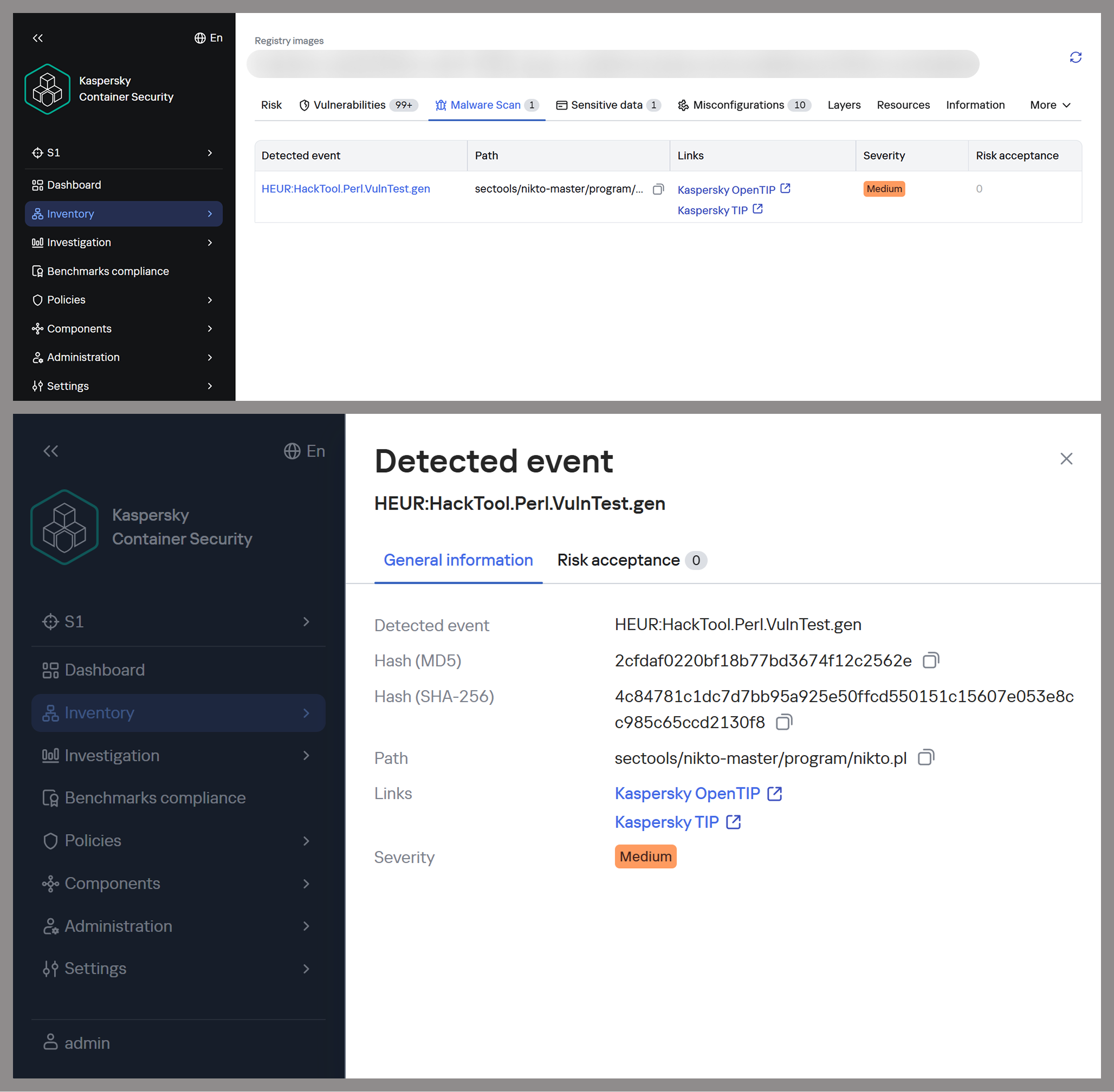
Detecting potentially malicious software using one of the images as an example

Detecting potentially malicious software using one of the images as an example

This leads to a difficult choice: infrequent updates leave known vulnerabilities unpatched within the image, while frequent updates increase the risk of supply chain compromise. Therefore, to protect your infrastructure, you need not only to regularly update base images but also to take a more comprehensive approach, specifically by pinning dependencies to known-good versions and scanning the resulting images for malware upon update.

Configuration vulnerabilities

Even a container with a fully updated image can be compromised if it is configured incorrectly. Embedding keys and secrets in the image, disabling authentication in network services, default passwords, and insecure file access permissions – all of these can be exploited by attackers in one way or another to achieve their goals.

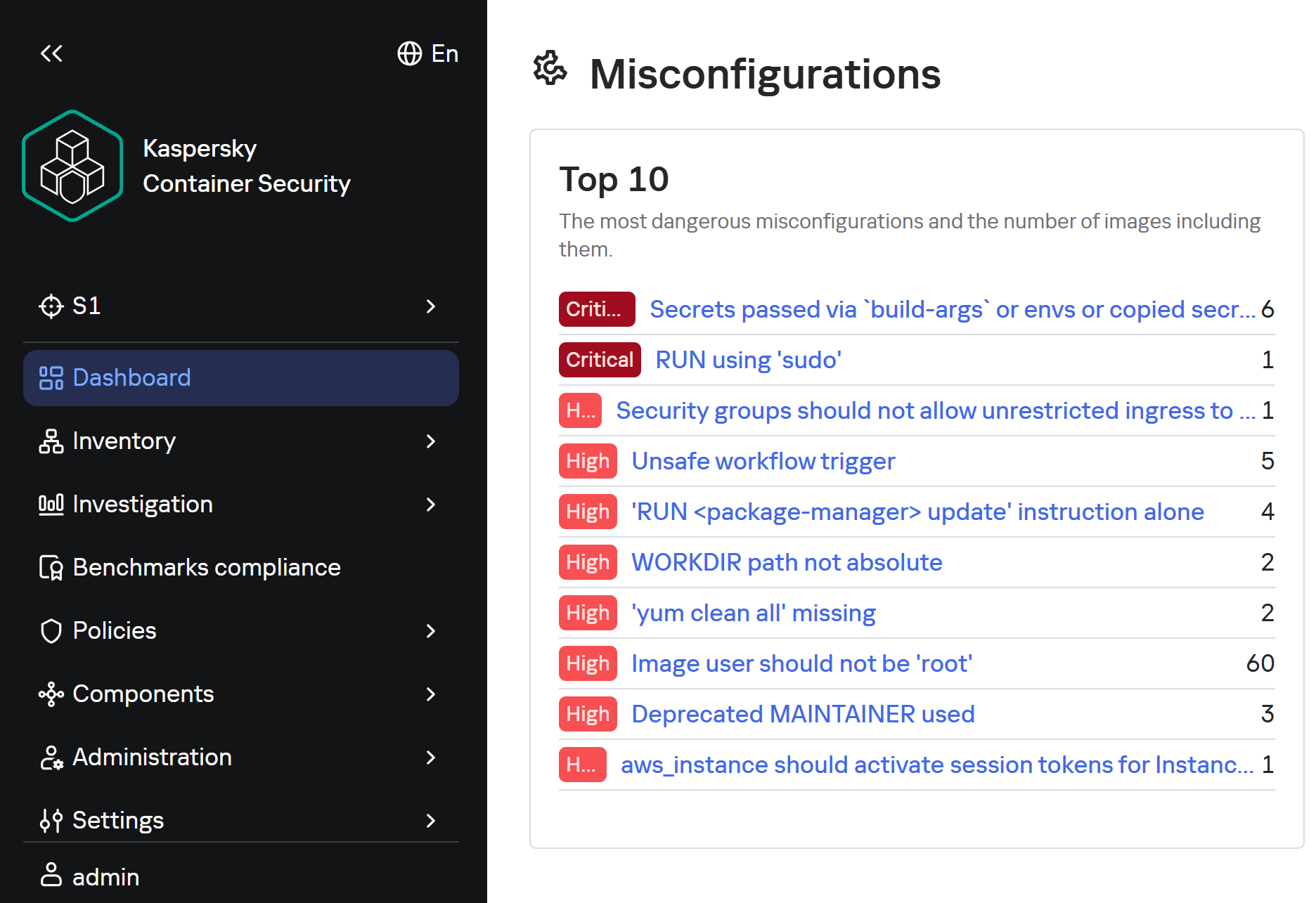
Insecure image configurations detected by KCS based on rules

Insecure image configurations detected by KCS based on rules

The situation is exacerbated by the fact that errors may be introduced by the authors of the original image, which complicates their detection, as this requires analyzing every layer and the command that generated it. As with vulnerabilities, not every configuration error leads to compromise: it all depends on the container’s role, its network accessibility, and many other factors. But the very use of insecure settings will sooner or later lead to errors appearing in images where their consequences will be significantly more dangerous.

Standard rules are often insufficient for analyzing problematic configurations. To gain a deeper understanding of the context and assess potential risks, AI tools can be used. Later in this section, we will examine examples of typical insecure configurations we discovered while scanning public images from Docker Hub, along with the descriptions of issues and risk mitigation methods provided by the KIRA AI assistant.

Example of container analysis using KIRA

Example of container analysis using KIRA

Insecure handling of credentials

Use of default passwords

In some cases, containers may use default passwords set via environment variables or directly in Dockerfile. If these passwords are not overridden, attackers will be able to access the application by using the default password.

RUN |1 DEBIAN_FRONTEND=noninteractive /bin/sh -c echo [removed]:[removed] | chpasswd

According to KIRA’s analysis, the user’s password is stored in plain text in the image layer history. Anyone who gains access to the image – whether through a public registry, a compromised build environment, or other means – will be able to extract the password. If SSH or another form of interactive access is enabled in the container, this could lead to its complete compromise and allow attackers to move laterally within the infrastructure.

Passwords may be present in environment variables. Consider the following Dockerfile snippet:

ENV SERVERNAME=localhost WWW_PATH_CONF=/etc/apache2/apache2.conf WWW_PATH_ROOT=/var/www HTTPS=on PKP_CLI_INSTALL=0 PKP_DB_HOST=db PKP_DB_NAME=pkp PKP_DB_USER=pkp PKP_DB_PASSWORD=changeMePlease PKP_WEB_CONF=/etc/apache2/conf-enabled/pkp.conf PKP_CONF=config.inc.php PKP_CMD=/usr/local/bin/pkp-start

In this example, the environment variable PKP_DB_PASSWORD is set to changeMePlease. If the user forgets to override it, the application will use the password that can be obtained from Dockerfile.

Let’s look at another image:

/bin/sh -c #(nop)  ENV MOODLE_URL=<a href="http://0.0.0.0/">http://0.0.0.0</a> MOODLE_ADMIN admin       MOODLE_ADMIN_PASSWORD [removed]      MOODLE_ADMIN_EMAIL admin@example.com MOODLE_DB_HOST     MOODLE_DB_PASSWORD       MOODLE_DB_USER     MOODLE_DB_NAME    MOODLE_DB_PORT 3306

For this image, Dockerfile specifies that the administrator password is hardcoded in the ENV directive and remains in the image metadata (layer history, docker inspect). Anyone who gains access to the image (registry, build cache) will be able to extract this secret and compromise the account.

To eliminate these risks, ensure that no passwords are specified in Dockerfile. If authentication is required, you can use orchestrator mechanisms (secrets) or generate a temporary password when starting the container via the entrypoint script, without saving it in the layers. We also recommend using mechanisms for securely passing secrets at runtime (Docker secrets, Kubernetes Secrets) or, as a last resort, passing them via --secret during the build with BuildKit, but under no circumstances should they be left in the final image.

Passing passwords via command arguments

In some cases, passwords may be exposed when passed via command-line arguments, as these arguments are visible to all users on the system:

/bin/sh -c #(nop)  HEALTHCHECK &amp;{[""CMD-SHELL"" ""mysql --protocol TCP -u\""root\"" -p\""$MYSQL_ROOT_PASSWORD\"" -e \""SELECT 1;\""""] ""15s"" ""30s"" ""0s"" '\x05'}

In the example provided, the MySQL superuser password is passed into the healthcheck command in plaintext, making it visible when viewing the process list (ps aux), in audit logs, and in monitoring systems. If the attacker gains read access to the container’s processes or logs, they can extract the password and gain full control of the database.

To fix this issue, the healthcheck should use a local connection via a Unix socket with default authentication (if the auth_socket plugin is configured for root), or create a dedicated user with minimal privileges (e.g., only USAGE), without a password or with a password passed via a secure file (--defaults-file with restricted permissions). You can also use the MYSQL_PWD environment variable for healthcheck authentication, but it remains visible in /proc.

Privilege escalation in the container

One of the most common vectors for initial compromise of Linux systems is RCE in web applications and network services. Typically, these services have minimal privileges, which complicates attackers’ subsequent actions: dumping credentials, covering their tracks, attempting to escape the container, and much more.

The situation worsens significantly if the attacker gains root privileges, as this allows them to fully control all processes within the container, conceal their activity, and use methods to escape the container. For example, they can compromise the host if the container is privileged, a Docker socket is mounted inside it, or other insecure configurations and vulnerabilities exist that cannot be exploited with standard user privileges.

Similarly, this simplifies network attacks on neighboring containers, the orchestrator, and various internal services, making this configuration error a potential link in the chain for compromising the entire network.

Attacks on sudo

One of the simplest privilege escalation methods is executing arbitrary commands as root using sudo without entering a password. Consider the following example:

/bin/sh -c set -xe;     apt-get update &amp;&amp;       apt-get -y install sudo;       echo ""solr ALL=(ALL) NOPASSWD: ALL"" &gt;/etc/sudoers.d/solr;

Analyzing this configuration using KIRA immediately highlights the main issue: by installing the sudo package and setting NOPASSWD: ALL for the solr, the user severely violates the principle of least privilege. The Solr platform does not require such broad privileges to run within a container; instead, they create an easy path for escalating to root.

echo 'postgres ALL=(ALL:ALL) NOPASSWD:ALL' &gt;&gt; /etc/sudoers

In another example of an insecure configuration, NOPASSWD:ALL privileges are granted to a PostgreSQL database user, which is a direct and severe weakening of the access control policy. If an attacker gains the ability to execute code on behalf of the postgres user – through a vulnerability in a network service, an SQL injection, or by compromising of one of the processes – they will immediately and unconditionally be able to execute any commands on behalf of the root user. This is equivalent to the entire container running as root.

As a risk mitigation measure, we recommend completely removing this directive. The minimum necessary commands requiring privileges should be delegated on a case-by-case basis via sudoers with explicit specification of allowed executables and parameters, using NOPASSWD only as a last resort and for specific utilities.

Our AI assistant KIRA can identify even more complex insecure configurations, such as allowing passwordless sudo for the entire sudo group — by modifying existing rules.

perl -i -pe 's/\bALL$/NOPASSWD:ALL/g' /etc/sudoers

The risk in this example is that the command replaces standard declarations requiring authentication with passwordless execution of all commands for any user within the sudo group – potentially including postgres, should it be assigned to that group. This expands the attack surface to all group members, turning each of them into a potential point for instant privilege escalation.

To mitigate the risks, we recommend not modifying the global sudoers policy, keeping the standard password requirement, or using a more secure escalation mechanism – such as gosu to run a specific process on behalf of another user without permanent privileges.

Insecure file permissions

Another common vector for privilege escalation is insecurely configured file and directory permissions. Most often, for convenience, container image authors use 777 permissions, which allow anyone – including unprivileged users – to freely create and delete files, as well as modify their contents. This can lead to both privilege escalation and the ability for an unprivileged attacker to delete or modify logs, among other undesirable consequences.

Consider the following command:

chmod 0777 /usr/share/cargo /usr/share/cargo/bin

The risk is that directories containing binary files and scripts will become writable by any container user. This allows a low-privileged attacker to replace utilities included in cargo or add new malicious executables. When these tools are subsequently invoked, especially as the root user or via sudo, the attacker’s code will execute with the inherited privileges of the calling process, leading directly to a local privilege escalation.

To mitigate the risks, you can set the minimum necessary permissions: chmod 0755 for directories and chmod 0755/0644 for the corresponding files. The owner should be root, and only the owner should be allowed to write. Do not use chmod 777 on any system paths.

Lack of integrity checks

Downloading software without verifying its integrity can make the infrastructure vulnerable to software tampering.

For example, this risk may arise when downloading a distribution via HTTP:

RUN /bin/sh -c wget -qO- ""<a href="http://acestream.org/downloads/linux/acestream_3.1.49_debian_9.9_x86_64.tar.gz">http://acestream.org/downloads/linux/acestream_3.1.49_debian_9.9_x86_64.tar.gz</a>"" | tar --extract --gzip -C /opt/acestream

Using HTTP without verifying the archive’s integrity creates conditions for a man-in-the-middle attack during the image build phase. An attacker controlling the communication channel or DNS can replace the archive with malicious content, which will compromise the container and the entire environment in which it runs.

To mitigate the risks, you can configure connections to web resources to use HTTPS only — if the resource supports this protocol. You can also download the archive without extracting it, compare its checksum (SHA256) with the checksum from a trusted source, and only then extract it. It is advisable to store the verified archive in an internal artifact repository to avoid direct downloads from the network.

There will still be a MitM risk even if certificate verification is disabled:

wget --no-check-certificate<a href="https://github.com/phpvirtualbox/phpvirtualbox/archive/refs/heads/7.2-dev.zip"> https://github.com/phpvirtualbox/phpvirtualbox/archive/refs/heads/7.2-dev.zip</a> -O phpvirtualbox.zip

The absence of TLS certificate verification allows an attacker controlling the network segment to replace the downloaded ZIP archive with malicious content. Since the archive contains PHP code that will be executed by the web server, compromise during the build phase will result in the deployment of a backdoor or data leakage.

To mitigate the risks, remove the --no-check-certificate flag; after downloading, calculate the SHA256 hash of the archive and verify it against a known reference value (the release page or a local repository of trusted hashes). Additionally, consider using a fixed release (tag) rather than the floating 7.2-dev branch.

Conclusion

Docker containers have become a very popular means of deploying software, and attackers are by no means oblivious to this trend. They are rapidly adding software vulnerabilities and configuration errors to their arsenal and carrying out attacks on supply chains. They can compromise container infrastructure for a wide variety of purposes, from cryptocurrency mining to encrypting data for ransom or stealing information critical to the company.

Our research found that 64 out of 100 container images for popular applications contain critically vulnerable software, and only 10% are fully up to date. We also identified numerous insecure configurations, including passwords stored in plaintext in Dockerfiles and excessive privileges granted to users and processes.

To detect and prevent these threats, it is essential to strictly adhere to security measures: audit image configurations, securely manage secrets used in images, apply security updates in a timely manner, scan their contents for malware with every update, and follow industry-standard best practices for enhancing security.

This approach requires specialized solutions built to accommodate the unique characteristics of container environments. Kaspersky Container Security ensures the security of containerized applications at every stage of their lifecycle, from development to operation. The product protects an organization’s business processes, helps ensure compliance with industry standards and security regulations, and enables the implementation of secure software development practices.

❌