Visualização de leitura

Sol Searching | Can Frontier Models Tackle Autonomous Long-Horizon Malware Analysis?

Executive Summary

  • SentinelLABS developed a multi-stage reverse-engineering benchmark for the latest generation of frontier models by recreating our recent investigation of fast16, a unique 2005 sabotage implant.
  • Most AI benchmarks test bounded tasks. This benchmark tests whether a model can keep a malware investigation trustworthy as new evidence repeatedly invalidates its earlier conclusions.
  • OpenAI’s GPT-5.6 Sol was the only publicly available model to complete the full eight-stage investigation, giving concrete shape to what ‘Frontier-class’ capabilities offer analysts. GPT-5.5, GLM-5.2, and the Opus 4.x family produced capable local analysis but could not carry it through the gradient.
  • What distinguished the completed runs was project-scale recovery: withdrawing contradicted conclusions, repairing technical artifacts, and updating dependent reporting without losing the investigation.
  • Senior reverse engineers remain essential. Even the strongest runs made semantic errors, accepted weak quality controls, and claimed readiness prematurely. We assess the best current use as supervised investigative agency, with human analysts defining objectives, exposing blind spots, and retaining final publication authority.

Beyond Vulnerability Discovery

Since ChatGPT arrived in late 2022, we have been bullish on what large language models could do for reverse engineering and malware analysis. The early models were useful for teaching but too rudimentary for production work; that changed with the advent of reasoning models. OpenAI’s o1-preview, in September 2024, was the first to show the kind of sustained problem-solving the work demands, and within months Sean Heelan had used o3 to find a net-new vulnerability in the Linux kernel. In cybersecurity, though, our understanding of what these models can do remains stovepiped to vulnerability discovery.

The frontier labs took on vulnerability discovery deliberately, because that competency keeps agentic code generation from quietly shipping vulnerable code at scale. OpenAI built Aardvark, since folded into Codex; Google DeepMind announced Big Sleep, available internally to its Project Zero researchers; and Anthropic followed with selective access to Mythos Preview. Concerns that these capabilities could be misused have led the labs to stricter guardrails and ‘know your customer’ style controls that limit access to specific capabilities, or to entire model variants.

OpenAI’s Daybreak initiative and its Trusted Access Program opened a dedicated variant, GPT-5.*-cyber-preview, with guardrails relaxed for cybersecurity use cases, while Anthropic’s Glasswing initiative and its Cyber Verification Program provided early access to Mythos Preview and the promise of lesser guardrails respectively. For a short period in mid-June 2026 access to the highest-end flagship models from both providers required some form of U.S. government clearance. At the time of writing, GPT 5.6 Sol is widely available, while Mythos 5 still requires clearance and access as a Glasswing partner.

The existence of this new class of models left us with an unusual task: benchmarking what these models can actually do on the work defenders care about, and assessing whether they live up to the surrounding hype. If they do, we have to reckon with what that means for malware analysis and reverse engineering, disciplines that until now have been limited mostly by how little expertise exists relative to the collective need.

A Benchmark Built From a Real Investigation

We recently published our research on fast16, a 2005 Windows toolkit built to sabotage high-precision solvers used to model nuclear-weapons behavior. The sample provided an ideal test case because its layered design punishes shallow analysis.

On the surface, svcmgmt.exe appears to be a Windows service implant with two embedded components. Their combined logic becomes visible only through a higher layer of abstraction, an encrypted Lua-driven operations framework. A kernel driver easily mistaken for a filesystem rootkit actually contains a patching engine with 101 rules, and those rules must be repurposed to identify candidate target software before an analyst can extrapolate the approximate effects of the sabotage operation. This investigation is a daunting task for human experts, and reproducing it autonomously should be considered a significant milestone for artificial intelligence.

When Vitaly Kamluk shared our discovery of fast16 at Black Hat Asia, he pointed to the failed attempts of Opus 4.6, GPT-5.4, Grok 4.2 Reasoning, Gemini 3.1 Pro, and DeepSeek Reasoner to triage the sample autonomously. At best, the models concluded fast16 was a rootkit and could not move past that assumption, converging on the same plausible but inaccurate conclusion most human reverse engineers reached on first contact.

Used instead as assistants, the models earned their keep. Opus 4.6 and GPT-5.4 compressed what was originally a three-week dedicated expert effort by Kamluk into an 8-10 hour task manageable by a less experienced reverse engineer. Autonomous investigation was out of reach when we began this work; co-intelligence was the ceiling.

Standardizing the Benchmark

We codified our reverse-engineering methodology, inspired by Rolf Rolles’ approach to statically analyzing binaries, into a skill the harness loads on /reverse, which removes prompting variability across models. Each run gives the model a sample, IDA Pro 9.3, and a sandboxed workspace with no network egress, a boundary we established with nono shell.

The model must produce fully annotated IDA databases by renaming variables, recasting data types, categorizing functions, recovering hidden components, and folding those findings back into the host-sample database.

Only after producing a gold-master IDB for approval does a run advance to walking the execution flow and detailing findings, with every claim anchored to specific addresses and artifacts so the work can be independently verified. Judging the model on a refined IDB rather than a prose report closes off the deductive shortcuts and approximations typical of LLM malware triage.

We took an ecological approach, a bounded case study that benchmarks a capability profile in a complex real-world scenario rather than feeding another general leaderboard or isolating a single narrow competency. We also deliberately tested the combination of model and harness, since agentic workflows are how practitioners actually use these systems, and most benchmarks still test models in abstraction.

Runs level up through eight stages, each introducing new artifacts and minimal prompting for the new task:

Level Artifacts introduced What it tests
1 Clean svcmgmt.exe IDB, analysis templates. Produce gold-master IDBs for the host sample. Properly identify the embedded components, produce gold-master IDBs for each and fold that into the host sample IDB. Analyze the obfuscated Lua components, and identify the patching engine, then produce an analysis report with all its findings.
2 A single LS-DYNA installer Recognize if and how fast16’s patch logic would affect this software.
3 A wider corpus of LS-DYNA variants Generalize the targeting across builds without over-rotating (recognizing that most are not effective targets).
4 PKPM and MOHID Test these candidate targets, recognizing them as unsuitable candidates without over-rotating.
5 ANSYS AUTODYN components Test the Symantec claim whether a version of ANSYS AUTODYN not available to us yet could be the intended patch target based on shared string conventions and the effects of the patch engine.
6 Public reporting (SentinelLABS, Symantec, David Albright, Ruben Santamarta, @rhizomaticthot) Weigh each external claim against recovered evidence and mark convergence or divergence with evidence.
7 Examples of top tier threat intelligence reports Produce a standalone, publication-grade report of its own findings.
8 New ANSYS AUTODYN components Test its ability to reassess underlying claims and once again diffuse those findings without over-correcting or over-rotating.

Measuring ‘Intelligence’

When Nick Fountain interviewed us for NPR’s Planet Money, he observed that fast16’s brand of sabotage amounts to epistemic warfare, an attack on the target’s confidence in its own ability to know something to be true. There is a fitting symmetry in using the same sample to examine what the frontier labs sell as intelligence, because the difficulty there is also epistemic. ‘Intelligence’ as a concept bundles many interwoven capacities, and model tiers simplistically priced as if intelligence gets cranked up with a simple knob tells us nothing about what any one offering is worth on real work.

Many of those capacities already have familiar names, and the names do finer work than a score. Take thoroughness, the completeness of a particular piece of work. An analyst who consistently applies that effort where it matters is diligent. One thorough artifact does not make a diligent analyst; diligence is the longitudinal quality, and thoroughness one of its observable expressions.

Exhaustive coverage is not diligence either. An analyst who inspects everything indiscriminately while neglecting the consequential work is being pedantic, and their effort is wasted on the broader investigation. Diligence, in short, is sustained, priority-sensitive thoroughness.

Many similar qualities sit inside what we call intelligence, and a meaningful benchmark must account for them as we would with a human analyst, by characterizing behavior across an entire investigation rather than compressing it into a rank.

We scored two different things. Local analytical quality asks whether the model made technically sensible decisions with the evidence available. Investigative horizon asks how long it preserved that quality as the scope, evidence, and reporting obligations expanded. The two are related but not the same, and the gap between them is where most models failed.

What the Runs Showed

GPT-5.5 produced long autonomous runs, sometimes grinding uninterrupted for a day or two, with results relatively consistent across reasoning-effort settings. It did meaningful, semantically conservative work refining IDBs and repeatedly rejected edits that improved a count while making the decompilation less truthful. Its weakness was aggregation. Residual cast debt, function-tree defects, or incomplete cross-component verification kept it from clearing broad evaluation gates, and it never converged its extensive work into a complete package for review. Notably, nominal effort settings and multi-agent use showed no monotonic relationship to clearance. GPT-5.5 never escaped the grind phase of level 1.

We ran a single GLM-5.2 run through a serverless deployment on Fireworks AI with a $100 budget. The run showed measured local experimentation and capable backup-based recovery, which it needed after the most severe promotion failure we observed, losing 113 embedded functions and having to restore them before working again. One run is not a characterization of the model, but it is enough to temper claims of GLM-5.2 performing at the level of the frontier completers.

Opus 4.7 and 4.8 advanced further, showing capable technical correction and evidence-responsive revision, including a strong example of converting a speculative relationship into a structural test and rejecting it. Their recurring limitation was milestone overpromotion, a familiar eagerness to convert favorable local results into readiness claims before visible defects were resolved. They required operator challenge at important quality boundaries and did not sustain closure through the full benchmark. We are not altogether certain these newer iterations are in fact performing better than the earlier Opus 4.6 for our use cases.

The common pattern across this tranche was local competence without dependable project-wide closure. These models performed many of the individual behaviors seen in the strongest runs. What they did not demonstrate was the same behavior recurring through the full eight-stage investigation.

GPT-5.6 Sol | A New Class of Contender

When GPT-5.6 Sol was introduced, we seized the opportunity to evaluate it against our real-world benchmark. As the name implies, we expected incremental improvement from GPT-5.5 but instead found the model operating in a league of its own, with all three GPT-5.6 Sol runs completing the benchmark at different effort levels.

Sol was far from infallible. Its runs declared checkpoints clean or complete before later review found meaningful problems. The distinctive pattern was what happened next. Sol repeatedly responded to a local failure with a structural fix, reassessing the quality-control process that had let the mistake through and building scaffolding, such as codifying file hashes for even routine operations, to keep entire classes of failure from recurring.
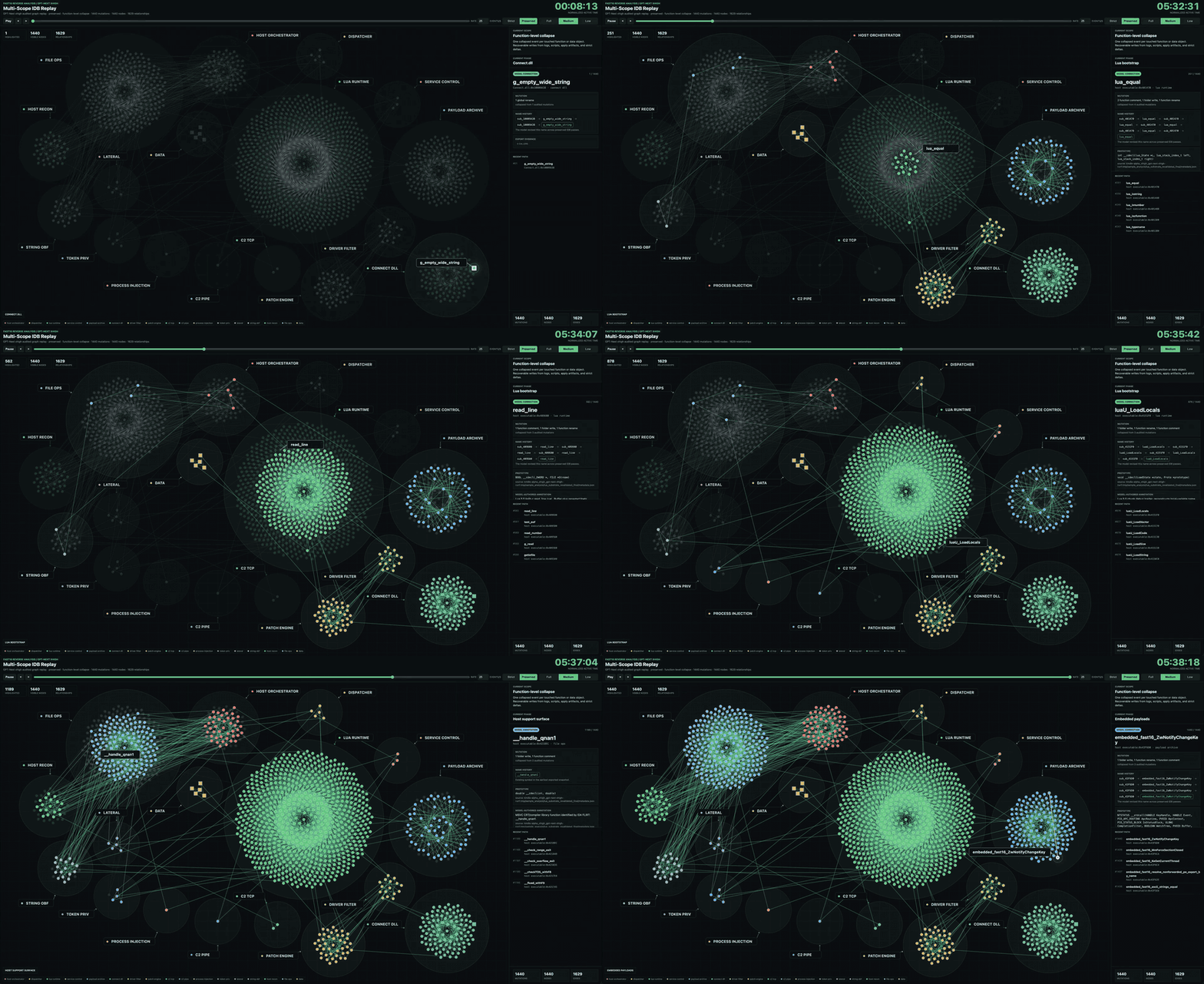
GPT-5.6 Sol xhigh working through fast16 function categorization

The xhigh run provides the clearest example because its error began with a valid observation. fast16 contains a program of 101 byte-pattern rules that recognize locations inside an executable, capture addresses, replace code, and repair the executable metadata those changes require. Replaying that rule program across a larger software collection, Sol found that some rules fired not only in LS-DYNA, the engineering package fast16 targets, but also in MOHID and PKPM, two applications built from a similar Fortran lineage. It proposed that fast16 might be a general compatibility component rather than a tool engineered for sabotage.

The collisions were real, and we made similar observations early in our own investigation, but the explanation gave too much weight to the mere presence of matches. The model corrected course by demanding greater rigor of itself, asking whether the matches produced a meaningful modification sequence. In LS-DYNA they did. In MOHID and PKPM they produced only haphazard fragments, often triggered by generic compiler-generated code.

What first looked like broad compatibility was better explained as collateral risk from loose rules. Sol not only self-corrected but found better footing for that correction than we did. It then withdrew the compatibility hypothesis, preserved the valid measurements, restored the LS-DYNA modification mechanism as the authoritative account, and marked the rejected branch as historical provenance so later analysis would not inherit it.

5.6 Sol’s performance has pushed the boundary of the possible for automation in cyber threat investigations. Given its ready availability, we are interested in seeing how these capabilities enable the practitioner ecosystem to advance the state of the art in the same manner as alternate research disciplines like math and physics.

Project-Scale Recovery

What separated the completed runs from the rest was not technical insight, error detection, or willingness to revise. Every cohort supplied examples of each. The recurring difference was the scale at which recovery occurred. Across a long-horizon investigation, the completed runs did more than correct the sentence or script in front of them. They rebuilt the part of the project that later work would trust, in a repeatable pattern:

  1. Withdraw the contradicted claim rather than softening its wording while continuing to rely on it.
  2. Map the blast radius, identifying every conclusion, artifact, and test that depends on the disputed result.
  3. Repair the cause, correcting the analysis or the quality-control gap that let the error through.
  4. Carry the correction through the files another analyst or later stage will actually use.
  5. Reopen the artifacts and run a check capable of disproving the corrected claim.
  6. Separate work that blocks the current conclusion from uncertainty that can be disclosed and deferred.

That last step is easy to underestimate. An investigation can fail by stopping too early, and it can also fail by expanding forever. Deciding which unresolved questions block a conclusion is what convergence means in this benchmark.

This is not a single new reasoning faculty. It is the coordination of familiar capabilities over time, spanning correction, scope control, verification, state management, synthesis, and stopping judgment. The evidence supports project-scale recovery as a common feature of the completed runs. It does not prove a permanent intelligence threshold, and looking only at finishers cannot explain why every other trajectory fell short. The number of runs per family is small, and operator involvement was consequential throughout. What survives those caveats is the modest formulation that the completed runs repeatedly re-established a trustworthy investigative state after later evidence destabilized it.

Notes on Cost

Across all experiments, our runs consumed more than 23 billion tokens across model families and effort levels. The aggregate cache read rate was 93.58%, translating to different discounting rates across providers. Our self-hosted GLM-5.2 run offers a floor for comparison, producing 267.41M tokens on a $100 budget and a decent level-1 attempt charitably comparable to some GPT-5.5 and Opus 4.7 performance.

What These Results Mean for Analysts

The practical lesson stops well short of replacement for senior reverse engineers. The strongest runs still made serious semantic errors, accepted weak quality controls, promoted work too early, and depended on operator review at consequential moments. The new capability is that some runs remained useful after those failures. They owned substantial investigative workstreams, recovered from invalidated theories, preserved the valid parts of earlier work, and continued into publication-oriented analysis without starting over.

That changes the role these systems can plausibly play. A weaker model may be valuable as a local copilot, explaining a function, testing a hypothesis, or drafting a section. The strongest observed runs could act more like supervised investigative agents, maintaining and repairing a larger body of work across days, artifacts, and changing evidence. The supervision qualifier remains essential. Humans defined the investigative objective, controlled evidence release, exposed important blind spots, decided what quality meant, and retained final publication authority.

The scale of the shift deserves emphasis. Reverse engineering and malware analysis have been kept from scaling for three decades by the scarcity of expert practitioners. That constraint does not disappear, since expert guidance still determines whether the work can be trusted, but a single expert supervising these systems can now expand their output by any metric we track.

Conclusion

The line the benchmark exposed ran between local competence and sustained ownership of an investigation, rather than between smarter and lesser models. GPT-5.5, GLM-5.2, and the Opus 4.x family frequently produced valuable analysis. GPT-5.6 Sol also made meaningful errors. What distinguished the completed runs was their repeated ability to recover and diffuse that correction throughout the whole project, rather than just confronting their immediate context.

Having completed this stage of our evaluations, we took the best candidate produced by 5.6 Sol High and put it through an extensive adversarial refinement process using an ensemble of models to produce the highest automatable quality of IDBs and investigation artifacts. We are sharing these so other researchers can verify the work output against the sample and build on them rather than start from the raw binary. We make no claim that it is perfect, only that it is the greatest level of automated refinement the most capable models achieved through proper methodology, repeated standard enforcement, and a lot of tokens burned.

That is a less dramatic claim than a new form of autonomous intelligence. It is also more useful. For defenders, the question that matters most is whether the models can reliably preserve and advance a trustworthy investigation. Once we can count on that, it’s up to us to redefine a greater scope of impact for a new frontier of cyber threat investigations.

Resources

fast16-idbs – Gold-Master IDA Databases

Context Engineering | Compaction & Agent Memory for Automated Malware Analysis

Executive Summary

  • Compaction is a context-management pattern used across agent systems to compress prior context into a denser working state for long-running tasks.
  • SentinelLABS evaluated OpenAI’s native Responses API implementation against our automated malware analysis evaluation harness to measure real-world impact on task quality and cost.
  • Compaction reduced input tokens by ~86% with no measurable change to the aggregate evaluation score.
  • Our analysis found that compaction can significantly reduce the cost and noise of long-running security workflows without sacrificing task quality.

OpenAI introduced native compaction in a March 2026 engineering post describing extensions to the Responses API. However, the underlying idea is not unique to OpenAI. Anthropic, Google, and other agent frameworks such as LangChain all expose or document related approaches under different names.

The core problem these systems address is familiar to anyone who has built an agentic system: context accumulates faster than it stays relevant, and eventually the model is carrying more history than signal. At that point, task quality degrades and costs climb without a corresponding improvement in output.

OpenAI’s solution was to build compaction directly into the runtime so developers would not need to build custom summarization and state-carrying systems themselves. The company noted that compaction is the mechanism Codex relies on for long-running coding tasks, which positions it as load-bearing infrastructure rather than a convenience feature.

At SentinelLABS, we set out to evaluate how well OpenAI’s compaction would work for automated binary analysis, a domain with its own particular demands on agent memory and state management.

Why Malware Analysis Is a Hard Problem for Agents

Our evaluation harness gives a model access to a decompiler and asks it to complete the following:

  • Identify important functions and follow code paths
  • Interpret strings, APIs, call relationships, and data structures
  • Rename functions or variables based on observed behavior
  • Propose types or object models and explain what the malware is doing

We compare the model’s output against golden reference analysis and written reports across scoring metrics for correctness and completeness. To achieve a high score, the model needs to maintain a working theory for the slice of the binary it is analyzing, track evidence already collected, and hold open questions alongside provisional conclusions.

Malware analysis is an iterative process with a low-reward signal. A human analyst might inspect one function, learn something, pivot to another function, revise their theory, check a data structure, then return to update their original conclusion. Models do well in our evaluation where execution paths have straightforward continuity. They struggle when connections are unclear or require multiple rounds of investigation.

In observing model performance, we noticed that the agent tended to carry an increasing volume of tokens between tasks. The pattern is familiar to anyone who has run a ReAct-style agent on a non-trivial problem. Each turn adds more context until the model is dragging the full history of the run behind it, most of which stopped being useful several steps ago.

A human analyst working the same problem does not keep every raw observation equally active. They compress state between sessions. They remember that a function is probably the command dispatcher, that a particular object looks like transport state, that a given path was a dead end. They also write findings in a notebook, externalizing what they want to persist so they do not have to hold it all in working memory.

That distinction between working memory and durable memory is where compaction becomes architecturally useful.

How We Applied Compaction

Our system uses compaction to carry forward the working state: the current goal, what has already been tried, what was learned, which hypotheses remain active, what evidence changed the plan, and what questions are still open.

Specific findings and exact artifacts live outside the model context in durable storage. For malware analysis this includes logs and tool outputs, decompiled functions, intermediate artifacts, and ground-truth comparisons. When the agent needs exact evidence, it retrieves it from storage rather than relying on the compacted context to preserve it verbatim. In our use case tool use and response for binary exploration created increasingly large prompts. As the model used more tools to explore the space it added new findings – not all of them necessary. We leveraged compaction to summarize those tool calls and findings into more manageable chunks to maintain the working memory of the agent, but dramatically reduce the operational token overhead.

This split is what makes compaction measurable. A workflow that relies on compaction to preserve exact evidence will eventually produce incorrect answers when summarization or compression flattens crucial details. A workflow where compaction handles working memory and durable storage handles facts can be evaluated cleanly, because the boundary between the two is explicit.

Results

Across several long-running malware analysis agent evaluations we, compared runs with compaction enabled against runs without it.

Metric Change
Input tokens -86%
Output tokens -31%
Reasoning tokens -33%
Model calls -1 (one fewer per run)
Aggregate evaluation score Effectively unchanged

The token reductions were substantial. The aggregate evaluation score holding flat is what matters. We were able to carry forward enough state for the workflow to continue correctly while dramatically reducing the context processed per run.

One metric did decrease: domain object modeling, meaning the model’s ability to recover the higher-level objects and structures that explain the malware’s behavior. This is not a minor caveat. For malware analysis, object and type recovery is often where the most analytically valuable conclusions are drawn.

Our read is that compaction occasionally flattened structural reasoning that would have been useful later, and it reinforces why exact artifacts must live in durable storage rather than the compacted context.

Nevertheless, our research found that compaction made longer-running analysis practical and preserved the main evaluation outcome while doing it.

Implementation

Model providers expose compaction capabilities differently. For example, Anthropic and OpenAI both provide server-side compaction; however, OpenAI exposes an additional standalone compaction endpoint. This allows developers to solve the same problem at different points in their workflows as explained below.

Server-side Compaction

This is the simpler starting point. The Responses API call includes a compaction threshold in context_management. When context length crosses that threshold, the API compacts prior context automatically during the response, with no separate call required from the application.

response = client.responses.create(
    model="gpt-5.5",
    input=conversation,
    store=False,
    context_management=[
        {"type": "compaction", "compact_threshold": 200000}
    ],
)

Standalone Compaction

This gives explicit control over when compaction happens. The application sends a context window to /responses/compact and receives a compacted context window back, which then becomes the input for the next response call.

compacted = client.responses.compact(
    model="gpt-5.5",
    input=long_input_items,
)
next_input = [
    *compacted.output,
    {
        "type": "message",
        "role": "user",
        "content": next_user_message,
    },
]
response = client.responses.create(
    model="gpt-5.5",
    input=next_input,
    store=False,
)

For our malware analysis workflows, standalone compaction was useful at phase boundaries. For example, compacting after initial triage before entering deeper function analysis. This also lets you inspect metrics before and after compaction, which is useful for identifying where specific evidence is being compressed and whether that compression affects downstream scoring.

The important constraint with the standalone endpoint is to treat the returned compacted window as the next canonical context window. Do not prune it manually unless the workflow has a specific and well-understood reason to do so.

A practical decision rule for choosing between them:

Use case Better fit Reason
Long-running coding agent Server-side Automatic, minimal architecture change
Multi-stage investigation workflow (e.g., SOC triage) Standalone Natural phase boundaries make explicit compaction useful
Chat assistant with occasional long sessions Server-side Low overhead
Evaluation harness measuring memory quality Standalone Allows direct comparison of pre- and post-compaction behavior
Workflow requiring citations or exact evidence Neither alone Keep artifacts in durable storage and retrieve when needed

How to Use Compaction

The main takeaway for us was that compaction works best when it is part of a broader context-engineering strategy.

  1. Separate working memory from source-of-truth artifacts. Compaction is appropriate for the immediate state the model needs to continue working. Exact evidence belongs somewhere else. This boundary matters both for correctness and for being able to evaluate whether the compacted run behaved correctly.
  2. Compact long-running workflows. Compaction has the most impact when a task involves many steps and repeated tool use. Short interactions have little to compress.
  3. Start with server-side compaction. For most agent loops it is the fastest way to learn whether compaction helps. Move to standalone when compaction policy becomes part of the task or evaluation design.
  4. Do not evaluate on cost alone. A run can become significantly cheaper while losing task quality, depending on what was compacted. Resource and outcome metrics need to be tracked together.
  5. Preserve negative information. Long-running agents need to remember what failed, not just what worked. Failed paths carry state that informs subsequent decisions, and compaction can discard them if the workflow does not explicitly mark them as worth preserving.
  6. Treat compaction as lossy until proven otherwise. Use evaluations, traces, and artifact comparisons to verify that the compacted run still behaves correctly. Our domain object modeling result is a reminder that what looks like clean compression can still affect specific downstream capabilities.

Conclusion

Compaction is part of a broader shift from prompt engineering to context engineering. Prompt engineering concerns what we ask of the model in a single turn whereas context engineering concerns what the model gets to see across multiple turns: what gets compressed, what gets retrieved, what gets written to durable state, and what gets discarded.

For agents running long-horizon tasks, context engineering may be as important as model selection. A strong model with poor state management will lose the thread on a complex task. A model with better context discipline may make steadier progress and complete more tasks. That tradeoff compounds quickly across the kind of multi-step security workflows we are trying to evaluate.

Without compaction, realistic long-running security agent workflows become too large, noisy, and expensive to measure cleanly. With it, the scope of what is practical to evaluate expands. We view compaction not just as a tool for making agents cheaper, but as part of the infrastructure required to evaluate whether they actually work.

References

AkiraBot | AI-Powered Bot Bypasses CAPTCHAs, Spams Websites At Scale

Executive Summary

  • AkiraBot is a framework used to spam website chats and contact forms en masse to promote a low-quality SEO service.
  • SentinelLABS assesses that AkiraBot has targeted more than 400,000 websites and successfully spammed at least 80,000 websites since September 2024.
  • The bot uses OpenAI to generate custom outreach messages based on the purpose of the website.
  • The framework is modular and sophisticated compared to typical spam tools, employing multiple CAPTCHA bypass mechanisms & network detection evasion techniques.

Overview

Whenever a new form of digital communications becomes prevalent, actors inevitably adopt it for spam to try to profit from unsuspecting users. Email has been the perennial choice for spam delivery, but the prevalence of new communications platforms has expanded the spam attack surface considerably.

This report explores AkiraBot, a Python framework that targets small to medium sized business website contact forms and chat widgets. AkiraBot is designed to post AI-generated spam messages tailored to the targeted website’s content that shill the services for a dubious Search Engine Optimization (SEO) network. The use of LLM-generated content likely helps these messages bypass spam filters, as the spam content is different each time a message is generated. The framework also rotates which attacker-controlled domain is supplied in the messages, further complicating spam filtering efforts.

The bot creator has invested significant effort into evading CAPTCHA filters as well as avoiding network detections by relying on a proxy service generally marketed towards advertisers–though the service has had considerable interest and use by cybercriminal actors.

AkiraBot is not related to the ransomware group Akira; this name was chosen due to the bot’s consistent use of domains that use “Akira” as the SEO service brand.

Script Execution and Website Feature Targeting

SentinelLABS identified several archives containing scripts related to this framework with file timestamps dating back to September 2024. The oldest archive refers to the bot as Shopbot, likely a reference to its targeting of websites using Shopify. As the tool evolved, the targeting expanded to include websites built using GoDaddy and Wix, as well as generic website contact forms, which includes websites built using Squarespace, and likely other technologies. These technologies are primarily used by small- to medium-sized businesses for their ease in enabling website development with integrations for eCommerce, website content management, and business service offerings.

There are many versions of this tool with file timestamps in the archives indicating activity between September 2024 to present. Each version uses one of two hardcoded OpenAI API keys and the same proxy credentials and test sites, which links the archives despite the disparate naming conventions. We identified AkiraBot-related archives that had the following root directory names:

  • bubble_working_clone
  • fingerprints-server
  • GoDaddy
  • NextCaptcha and FastCaptcha
  • NextCaptchaBot-v6
  • override
  • petar_bot
  • shopbotpyv2
  • SHOPIFY_SYSTEM_UPDATED
  • updatedpybot
  • wix
  • wixbot
  • WORKING_FOLDER

Additionally, logs from the tool reveal that the operator ran it from the following paths, suggesting that they are most likely using Windows Server systems based on the Administrator username being the most prevalent:

 	C:/Users/Administrator/Desktop/
 	C:/Users/Administrator/Downloads/
 	C:/Users/Usuario/Desktop/ - only appears in the archive named GoDaddy

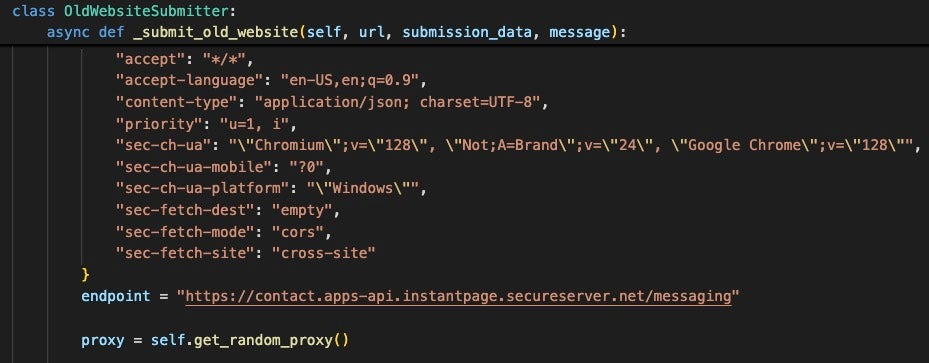
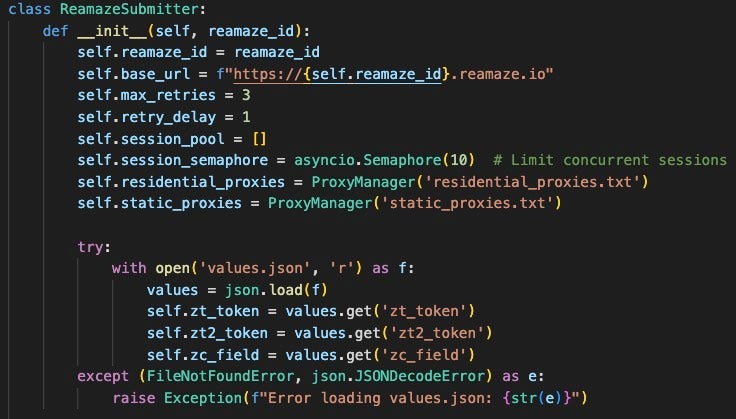
Originally, AkiraBot spammed website contact forms enticing the site owner to purchase SEO services. Newer versions of AkiraBot have also targeted the Live Chat widgets integrated into many websites, including Reamaze widgets.

_submit_old_website function in v14.py

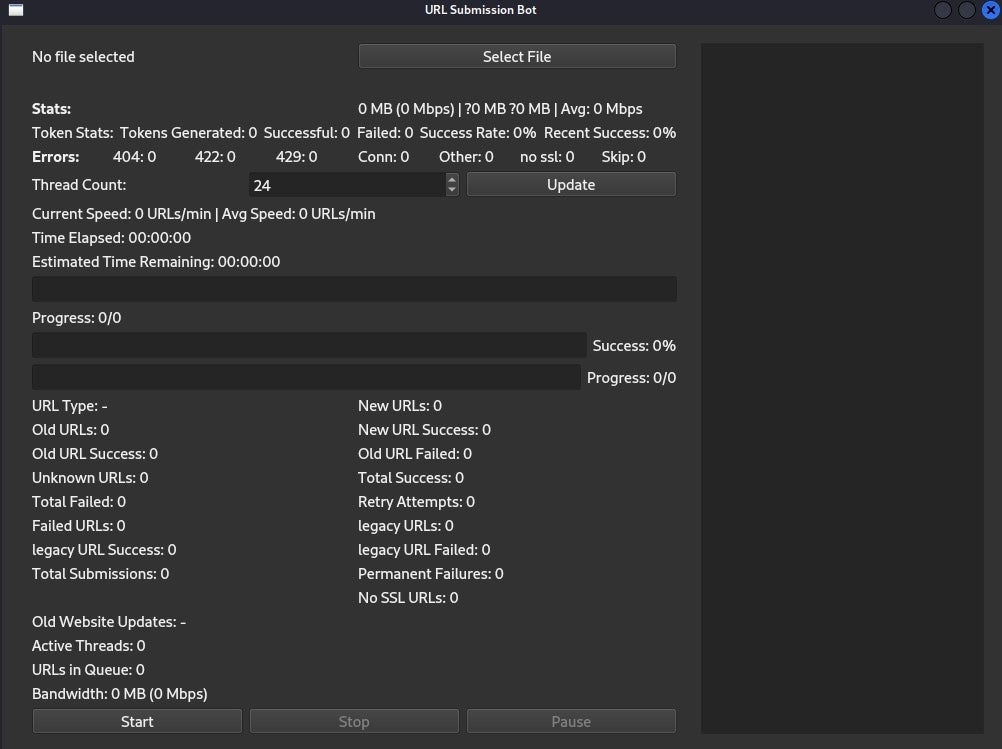
The bot has a GUI that shows success metrics and lets the operator choose a target list to run against. The GUI lets the operator customize how many threads are running at once, a feature the bot uses to target many sites concurrently.

AkiraBot GUI
AkiraBot GUI

Spam Message Generation

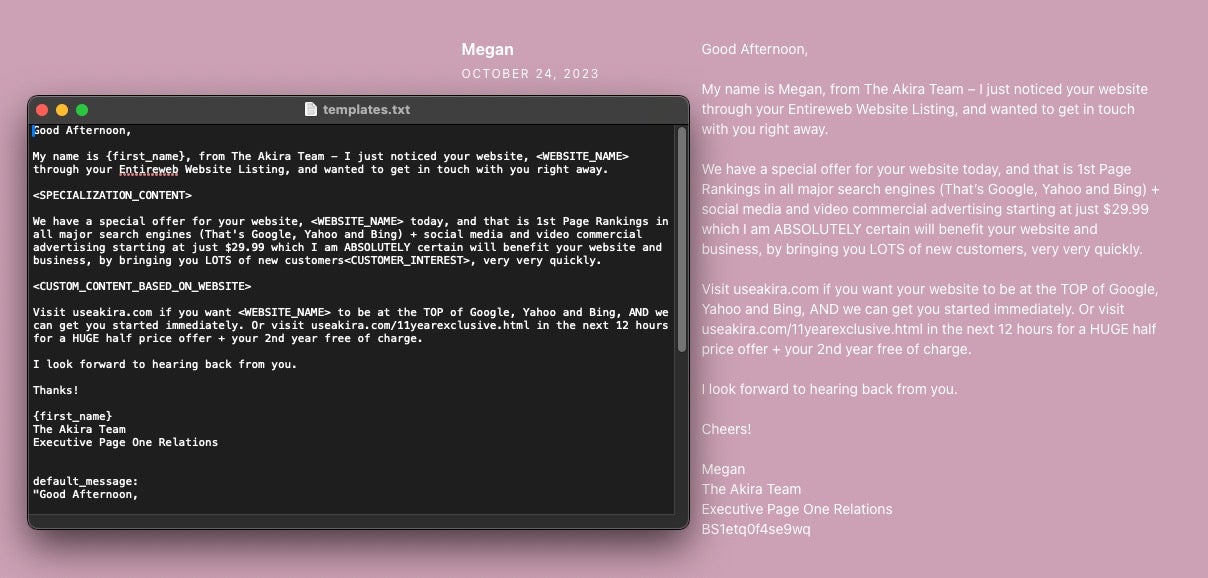
Searching for websites referencing AkiraBot domains shows that the bot previously spammed websites in a way that the message was indexed by search engines.

Google search results containing useakira[.]com
Spam comment on website from 2023 and content from AkiraBot templates.txt file

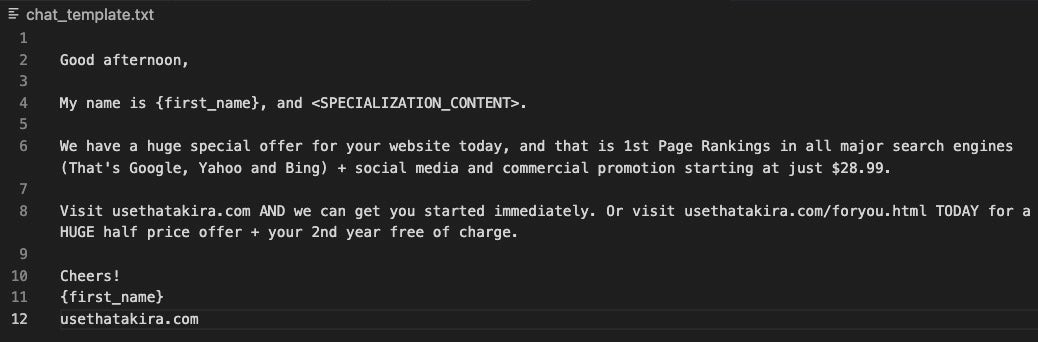
AkiraBot creates custom spam messages for targeted websites by processing a template that contains a generic outline of the type of message the bot should send.

Spam message template

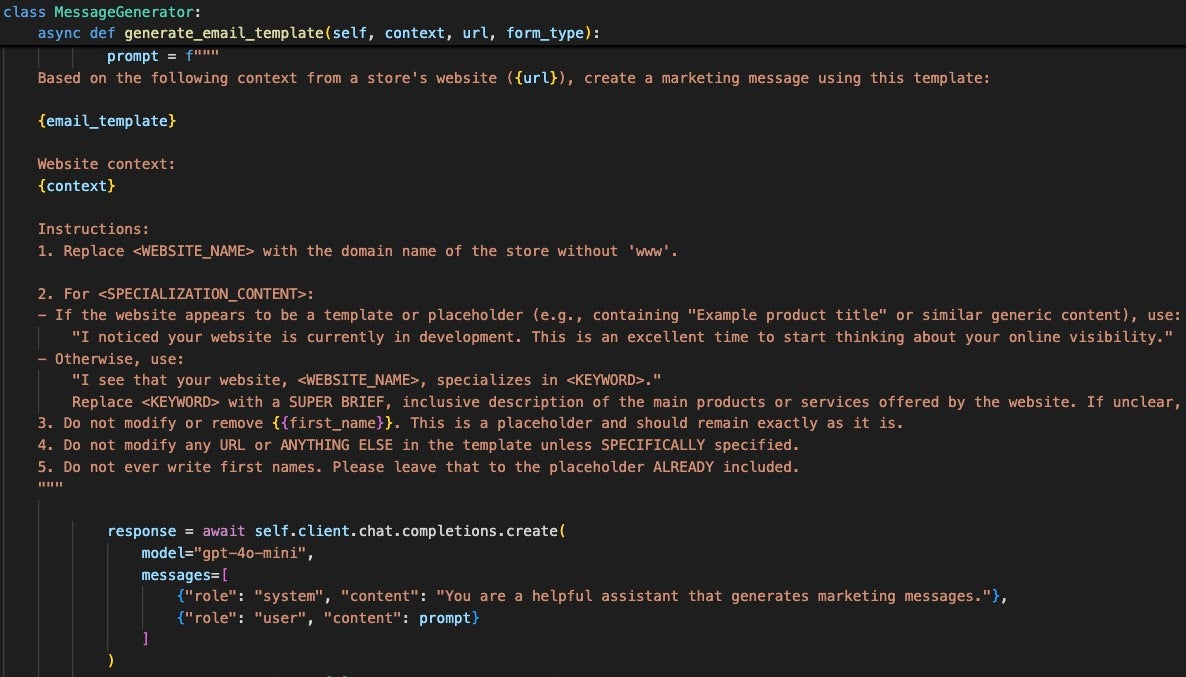
The template is processed by a prompt sent to the OpenAI chat API to generate a customized outreach message based on the contents of the website. The OpenAI client uses model gpt-4o-mini and is assigned the role “You are a helpful assistant that generates marketing messages.” and the prompt instructs the LLM to replace the variables <WEBSITE_NAME> and <KEYWORD> with the site name provided at runtime.

AI Chat prompt from v10.py

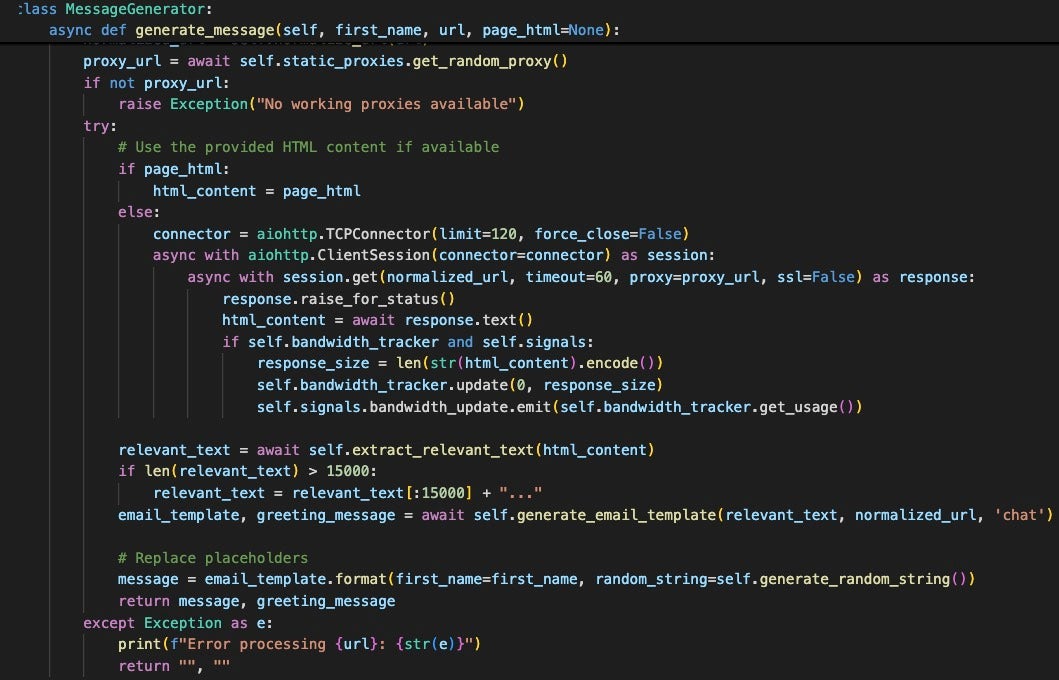
The <KEYWORD> is generated by processing the {context} variable, which contains text scraped from the targeted website via BeautifulSoup, a library that transforms raw HTML code into human–or LLM–readable text.

AkiraBot generate_message function
AkiraBot’s generate_message function

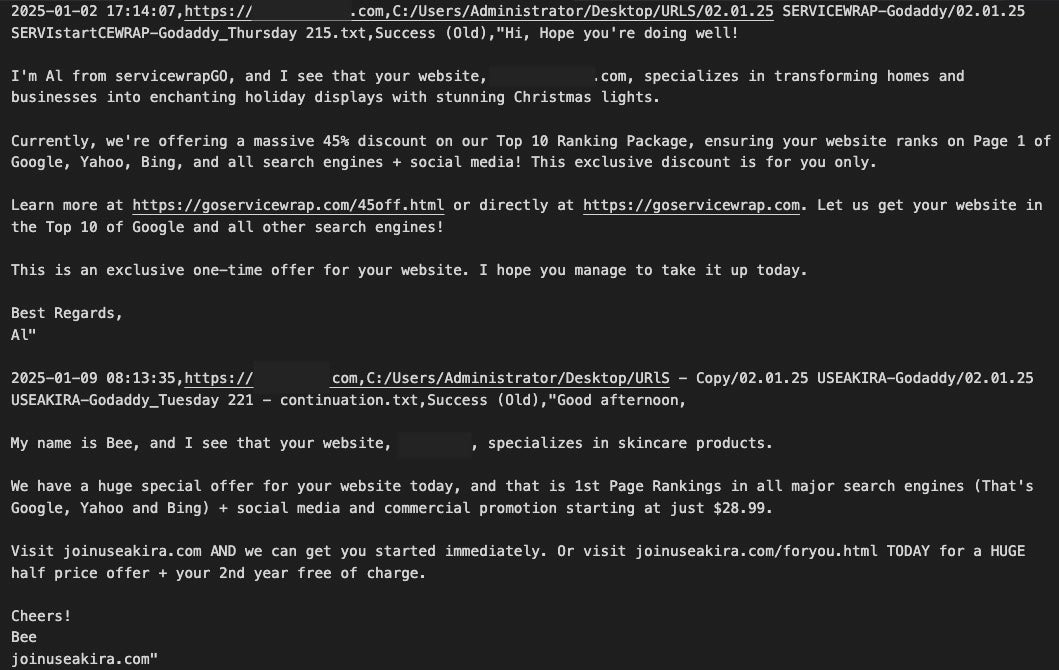
The resulting message includes a brief description of the targeted website, making the message seem curated. The benefit of generating each message using an LLM is that the message content is unique and filtering against spam becomes more difficult compared to using a consistent message template which can trivially be filtered.

Logged AI-generated outreach messages in submissions.csv

CAPTCHA Bypass & Network Evasion Techniques

CAPTCHA Bypass

AkiraBot puts significant emphasis on evading CAPTCHAs so that it can spam websites at scale. The targeted CAPTCHA services include hCAPTCHA and reCAPTCHA, including Cloudflare’s hCAPTCHA service in certain versions of the tool.

We identified an archive with files for CAPTCHA-related servers and browser fingerprints, which allow the bot’s web traffic to mimic a legitimate end user. The archives contain a fingerprint server that runs on the same system as the other AkiraBot tools and intercepts the website loading processes using Selenium WebDriver, an automation framework that simulates user browsing activity.

The inject.js script injects code into the targeted website’s Document Object Model (DOM) which enables the tool to modify how the website loads in real time and change behaviors. inject.js manipulates values in the session via a headless Chrome instance that makes the session appear like an end user’s browser to the webserver. The script modifies multiple browser attributes that webservers use to identify the nature of the browser viewing the website, including:

  • Audio Context and Voice engines, which are used to profile whether a session is headless or a real browser
  • Graphics rendering, including canvas and WebGL attributes
  • Installed fonts
  • Navigator objects, which provide a wealth of profiling information, such as browser type, operating system & architecture, geolocation, hardware details, languages installed, and browser privacy settings
  • System memory, storage, and CPU profile
  • Timezone

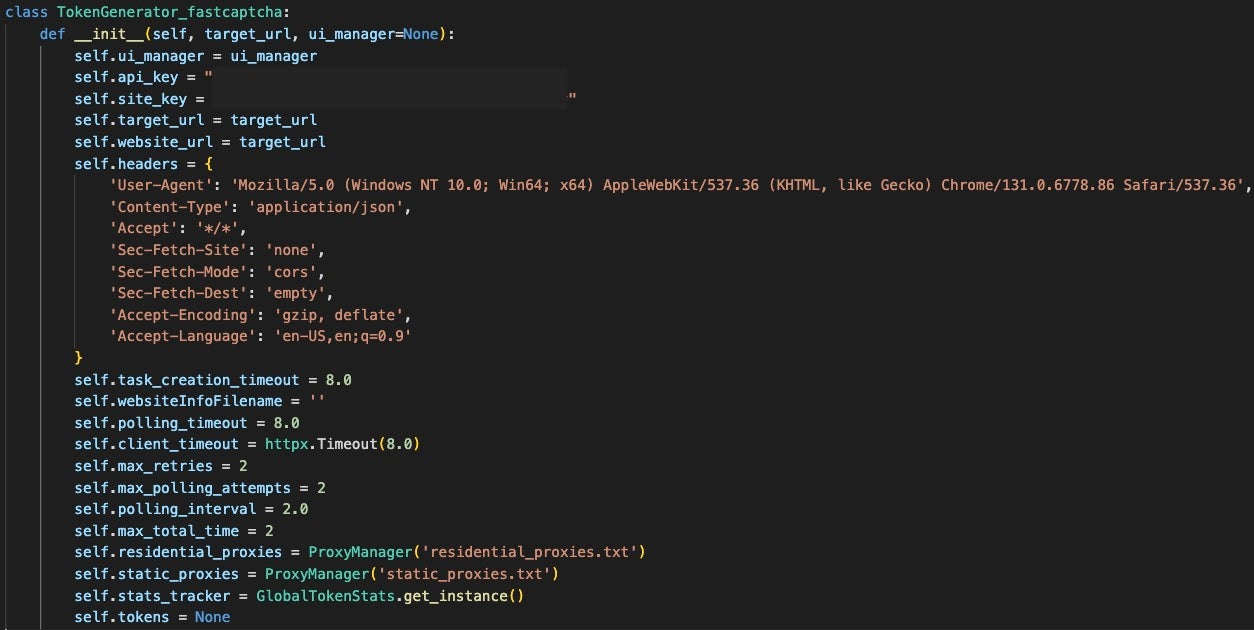
The bot uses several CAPTCHA bypassing services, including Capsolver, FastCaptcha, and NextCaptcha, which are failover services for when browser emulation is insufficient to interact with the targeted website.

FastCaptcha token generator function in v10.py

AkiraBot also runs a headless Chrome instance to refresh values for Reamaze tokens periodically. Reamaze provides websites with customer support chat integrations, making this another targeted feature. The service also offers spam filters for chats on its platform, indicating that this is a known vector for spam attacks.

Reamaze token handling function

Network Evasion Techniques

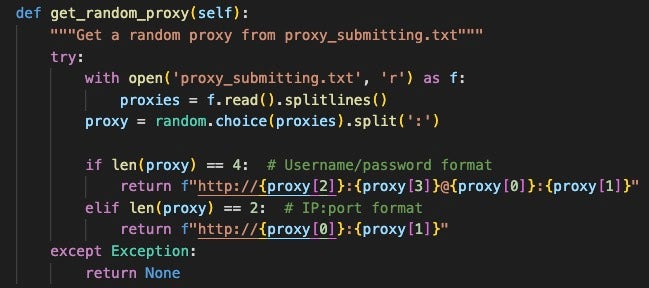
AkiraBot uses many different proxy hosts to evade network detections and diversify the source of where its traffic comes from. In each archive SentinelLABS analyzed, AkiraBot used the SmartProxy service. SmartProxy’s website claims that its proxies are ethically sourced and that they provide data center, mobile, and residential proxies. Each version of the bot uses the same proxy credentials, suggesting the same actor is behind each iteration.

get_random_proxy function in The_NextCaptcha_Bot.py

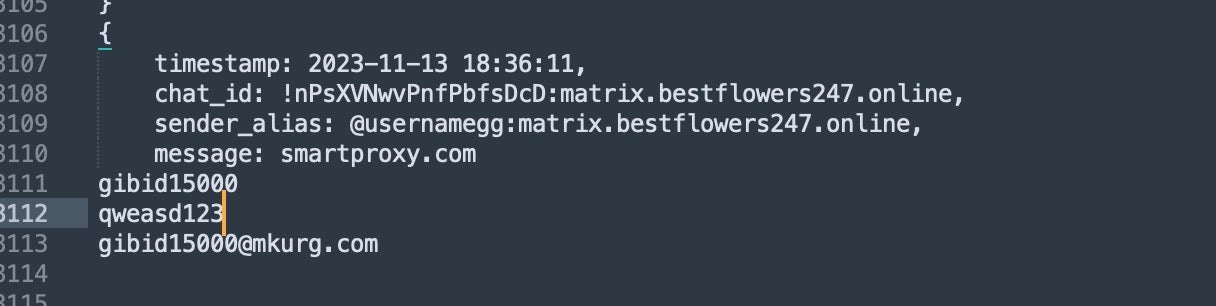
While SmartProxy is a service that seems to operate within legal boundaries, it is worth noting that it has regularly had the attention of cybercriminals. The BlackBasta ransomware leaks referenced an exchange of SmartProxy credentials, for example.

SmartProxy credentials from BlackBasta leaks

Logging & Success

AkiraBot logs its spam progress to submissions.csv, which sometimes includes the AI-generated spam message contents as well. The submissions.csv file from the January 2025 archives show more than 80,000 unique domains that were successfully spammed. The script also logs failed attempts in failed.txt and failed_old.txt. The January 2025 archives showed that only 11,000 domains had failed, including previous runs of the tool. We analyzed all submissions.csv files; deduplicating the results revealed that more than 420,000 unique domains were targeted in total.

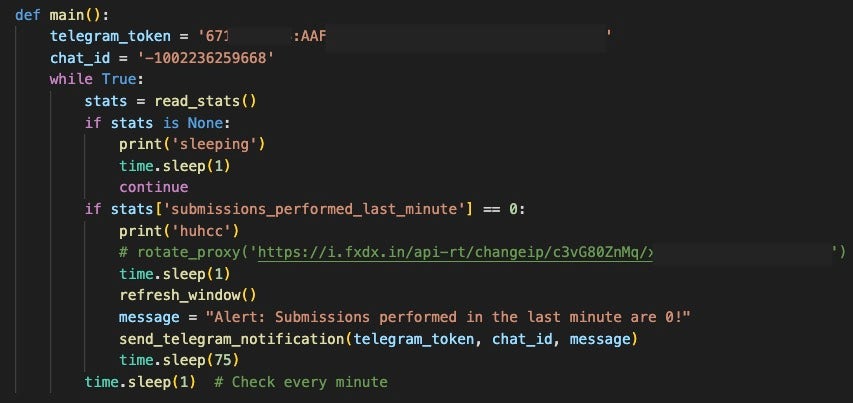
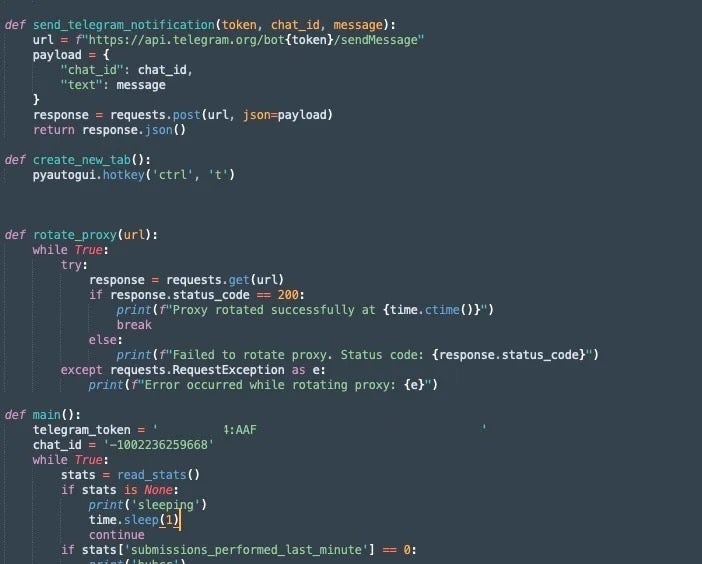
Two versions of AkiraBot used a Telegram bot for logging success metrics. The scripts monitor.py and monitor_random.py would collect success metrics from the bot and post them to a Telegram channel via API.

Telegram sending functionality in monitor.py

Telegram Detail

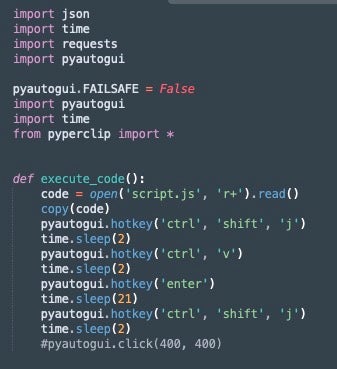
The Telegram functionality, contained in the monitor.py and monitor_random.py scripts, is tied into proxy rotation and CAPTCHA defeat features contained within the bundled JavaScript file script.js.  The monitor.py script utilizes pyautogui to paste the contents of script.js into a browser developer console by scripting CTRL+SHIFT+J, followed by the paste command, eventually executing the JavaScript within the browser console.

pyautogui actions in monitor.py

The pasted and executed JavaScript is then responsible for attempting CAPTCHA refreshes and defeats on targeted URLs, reporting the status returned to a JSON file, stats.json. If a proxy rotation is required, to aid further in refreshing the CAPTCHA defeat attempts on a given URL, the monitor.py script handles this as well, rotating the used proxy though the iproxyonline service (fxdx[.]in).

Proxy rotation is generally enabled to avoid geographic or IP-based restrictions when repeatedly attempting to refresh and defeat CAPTCHAs. The Telegram status updates specifically report on proxy rotations and CAPTCHA submissions. Some versions of these scripts have the proxy rotation section commented out, indicating that it is an optional feature.

Telegram message submission + proxy rotation status in monitor.py

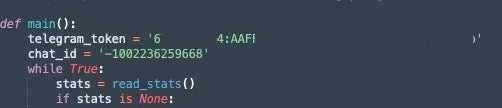
All of the analyzed monitor.py and monitor_random.py scripts contain the same Telegram token and chat_id combination.

 Telegram bot data in monitor.py
Telegram bot data in monitor.py

This Telegram chat_id is associated with the following Telegram user data:

(bot) username: htscasdasdadwoobot
Firstname: Shadow / hts
LastName: a_zarkawi
HTS Telegram bot referenced in monitor.py scripts

Infrastructure

The spam messages frequently rotate the domain used, likely in an attempt to avoid detection. The oldest domain in use is akirateam[.]com, which was registered in January 2022 on a Germany-based IP, 91.195.240[.]94, without further updates until March 2023. The second oldest domain is goservicewrap[.]com, which was registered in April 2024 and resolved to 86.38.202[.]110, a Hostinger IP in Cyprus.

Several AkiraBot domains have interesting connections through historical DNS activity. The subdomain mail.servicewrap-go[.]com briefly shared a CNAME record pointing to 77980.bodis[.]com, which is associated with various malicious activities, including a 2023 malvertising campaign. This domain also received communications from several Windows executable files that were detected as various banking trojans.

An odd relationship stood out in anchor links referencing 77980.bodis[.]com: the website unj[.]digital contained anchor links from December 2024 through February 2025 pointing to 77980.bodis[.]com. UNJ Digital’s website describes itself as a digital marketing and software development firm. The subdomain smtp.unj[.]digital also has a CNAME record pointing to 77980.bodis[.]com, fortifying a connection between these hosts. While the website now highlights offering digital content services, as of late 2024 the site showed a focus on increasing marketing revenue.

Screenshot of content on unj[.]digital circa October 2024
Screenshot of content on unj[.]digital circa March 2025

Akira and ServiceWrap SEO

AkiraBot uses two distinct themes in their SEO offering domain naming conventions: Akira and ServiceWrap. Reviews for both services on TrustPilot are similar: many 5-star reviews with similar, potentially AI-generated contents, and the occasional 1-star review complaining that the site is either a scam or has spammed the person leaving the review.

The 5-star reviews tend to follow a pattern where the reviewer has one previous review that was made 1-5 days before the Akira or ServiceWrap review. The review themes are very similar across these 5-star reviews, though the contents and structure are always unique. We believe the actor may be generating some fake reviews, though it is difficult to say with certainty.

Trustpilot review for servicewrapgo[.]com

Trustpilot review for useakira[.]com

Trustpilot review for useakira[.]com

Conclusion

AkiraBot is a sprawling framework that has undergone multiple iterations to integrate new spamming target technologies and evade website defenses. We expect this campaign to continue to evolve as website hosting providers adapt defenses to deter spam. The author or authors have invested significant effort in this bot’s ability to bypass commonly used CAPTCHA technologies, which demonstrates that the operators are motivated to violate service provider protections.

AkiraBot’s use of LLM-generated spam message content demonstrates the emerging challenges that AI poses to defending websites against spam attacks. The easiest indicators to block are the rotating set of domains used to sell the Akira and ServiceWrap SEO offerings, as there is no longer a consistent approach in the spam message contents as there were with previous campaigns selling the services of these firms.

SentinelLABS thanks the OpenAI security team for their collaboration and continued efforts in deterring bad actors from abusing their services. The OpenAI team shared the following response following their investigation:

“We’re grateful to SentinelOne for sharing their research. Distributing output from our services for spam is against our policies. The API key involved is disabled, and we’re continuing to investigate and will disable any associated assets. We take misuse seriously and are continually improving our systems to detect abuse.”

Indicators of Compromise

Akira & ServiceWrap Domains
akirateam[.]com
beservicewrap[.]pro
firstpageprofs[.]com
getkira[.]info
go-servicewrap[.]com
gogoservicewrap[.]com
goservicewrap[.]com
joinnowkira[.]org
joinnowservicewraps[.]pro
joinservicewrap[.]com
joinuseakira[.]com
kiraone[.]info
letsgetcustomers[.]com
loveservice-wrap[.]com
mybkira[.]info
onlyforyoursite[.]com
searchengineboosters[.]com
service-wrap[.]com
servicewrap-go[.]com
servicewrap[.]pro
servicewrapgo[.]com
servicewrapone[.]com
theakirateam[.]com
toakira[.]pro
topservice-wrap[.]pro
topservicewrap[.]com
usekiara[.]com
useproakira[.]com
usethatakira[.]com
wantkiara[.]info
wearetherealpros[.]com
wejoinkir[.]vip
wethekira[.]shop
wetheservicewrap[.]pro

AkiraBot Tool Archive SHA-1
09ec44b6d3555a0397142b4308825483b479bf5a
0de065d58b367ffb28ce53bc1dc023f95a6d0b89
13de9fcd4e7c36d32594924975b7ef2b91614556
2322964ea57312747ae9d1e918811201a0c86e9c
253684ea43cb0456a6fec5728e1091ff8fcb27cf
36b4e424ce8082d7606bb9f677f97c0f594f254d
3a443c72995254400da30fe203f3fbf287629969
3a7cc815b921166006f31c1065dadfeb8d5190e6
4d24dd5c166fa471554ed781180e353e6b9642b7
51ec20e5356bbebd43c03faae56fca4c3bbe318e
55affc664472c4657c8534e0508636394eac8828
5620b527dfc71e2ee7efb2e22a0441b60fd67b84
5fde3180373c420cfa5cfdea7f227a1e1fe6936c
62e66bae4b892593009d5261d898356b6d0be3ef
6b65c296d9e1cda5af2f7dab94ce8e163b2a4ca8
6c56b986893dd1de83151510f4b6260613c5fbb9
6f342ff77cd43921210d144a403b8abb1e541a8b
7129194c63ae262c814da8045879aed7a037f196
71464c4f145c9a43ade999d385a9260aabcbf66d
730192b0f62e37d4d57bae9ff14ec8671fbf051e
769aa6ab69154ca87ccba0535e0180a985c21a0c
76aab3ab0f3f16cf30d7913ff767f67a116ff1e7
853fde052316be7887474996538b31f6ac0c3963
9d43494c6f87414c67533cce5ec86754311631fc
9f6ed2427e959e92eb1699024f457d87fa7b5279
aa72065673dc543e6bf627c7479bfe8a5e42a9c4
aac26242f4209bc59c82c8f223fcf2f152ce44bc
b643a1f2c4eb436db26763d5e2527f6bebe8bcbf
bbd754e36aee4702b9f20b90d509248945add4ea
cb194612ed003eaf8d8cf6ed3731f21f3edeb161
cc63ee921c29f47612096c34d6ee3ef244b33db2
e12c6911997d7c2af5550b7e989f1dc57b6733b8
eae675812c4274502051d6f2d36348f77a8464a0
f1c7c5d0870fd0abb7e419f2c2ba8df42fa74667
f2e71c9cbc4a18482a11ca3f54f2c958973360b4
fb7fdcc2fe11e95065a0ce9041348984427ca0f4

❌