Quantum computing is moving from theory toward early practical use, with direct implications for encryption, authentication, and long-term data confidentiality.
The primary risk is the eventual emergence of cryptographically relevant quantum computers (CRQCs), which would break today’s public-key cryptography and undermine encryption, digital identity, and software trust at scale.
Quantum risk is already present: “harvest now, decrypt later” activity exposes long-lived sensitive data today, regardless of when CRQCs ultimately arrive.
Regulatory mandates and procurement standards are accelerating post-quantum cryptography (PQC) adoption, making quantum readiness a multi-year compliance and resilience priority.
Organizations that delay preparation beyond 2026 are likely to face compressed migration timelines, higher transition costs, and increased operational disruption.
Quantum Computing Explained
Quantum computing applies principles of physics to solve certain complex problems far more efficiently than classical computers. Its security relevance lies primarily in cryptanalysis and optimization: A sufficiently powerful quantum computer will reduce the calculations required to protect today's public-key encryption from thousands of years to hours or less. Researchers have used the term “Q-Day” to refer to the hypothetical point at which quantum computers will be powerful enough to break encryption.
Quantum computing is now moving from theory toward early practical use, bringing “Q-Day” closer to reality. Industry estimates suggest quantum computing alone could generate up to $1.3 trillion in value by 2035. Major cloud providers, including IBM, Google, and Microsoft, are expanding their quantum services, while specialised firms such as Quantinuum and PsiQuantum continue to improve system stability and error correction. While these advances are not yet transformative, they are consistent with the early stages of commercial adoption.
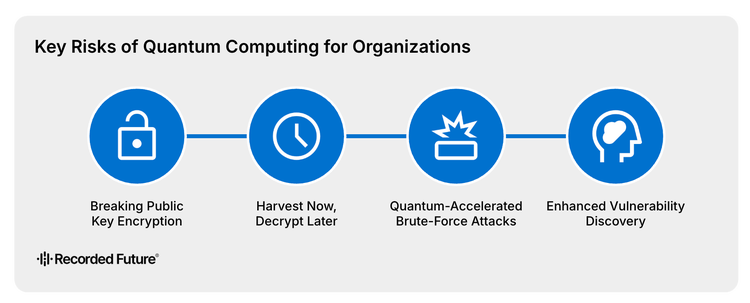
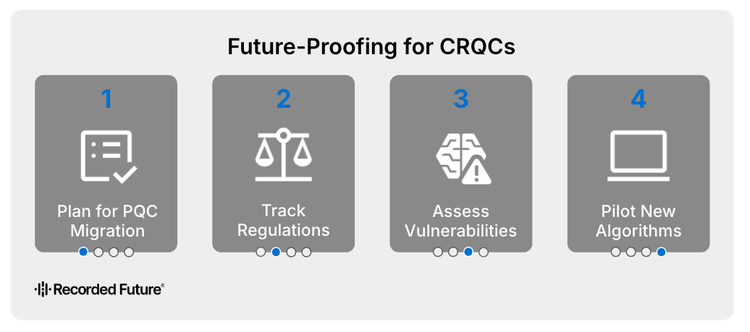
Figure 1:Key risks of quantum computing (Source: Recorded Future)
Alongside its potential benefits across finance, pharmaceuticals, defense, and other sectors, quantum computing introduces four key security risks.
Risk 1: Breaking Public-Key Encryption
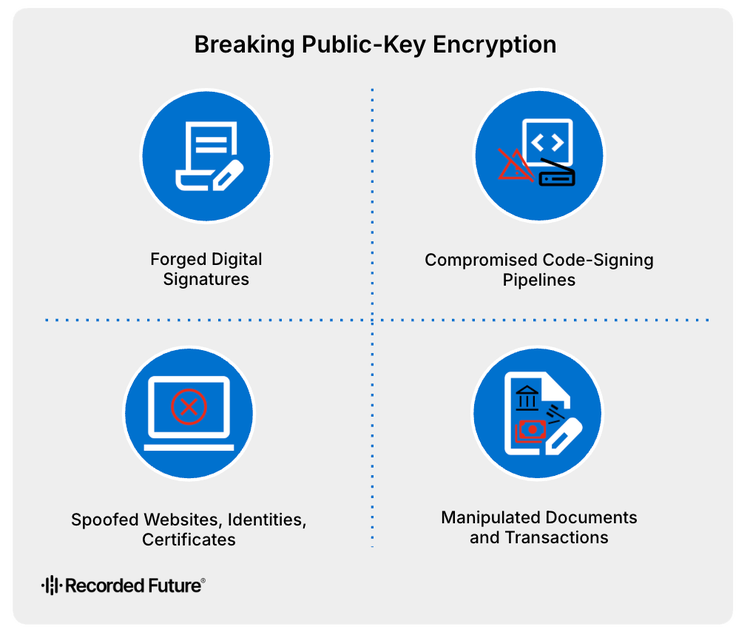
Figure 2:Potential impacts of breaking public-key encryption (Source: Recorded Future)
The most critical risk is the eventual arrival of cryptographically relevant quantum computers (CRQCs), systems capable of breaking widely used public-key algorithms such as RSA, Elliptic Curve Cryptography (ECC), and Diffie-Hellman. These algorithms underpin internet communications (Transport Layer Security [TLS], virtual private networks [VPNs], Secure Shell [SSH]), identity and access management, industrial and internet-of-things (IoT) systems, and the integrity of software supply chains.
If broken, threat actors could decrypt sensitive data, impersonate trusted systems, and undermine digital authentication. This could enable:
Forged digital signatures
Compromised code-signing pipelines
Spoofed websites, identities, and certificates
Manipulated financial transactions and legal documents
Risk 2: Harvest Now, Decrypt Later (HNDL)
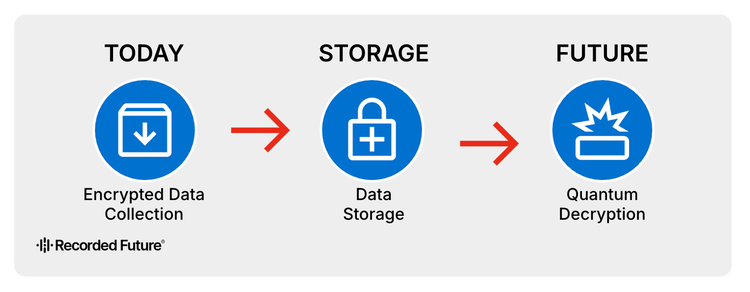
Figure 3: “Harvest now, decrypt later” workflow (Source: Recorded Future)
Although cryptographically relevant quantum computers (CRQCs) may still be years away, the risk is already materializing through “harvest now, decrypt later” (HNDL) activity. State-sponsored threat actors are likely collecting and storing encrypted data today with the intent to decrypt it once quantum capabilities mature. A 2021 Booz Allen Hamilton assessment found that Chinese economic espionage operations are likely targeting encrypted data with long-term intelligence value, including biometric identifiers, covert source identities, and weapons designs.
Large-scale routing manipulation offers one method for intercepting such data. Researchers at the US Naval War College and Tel Aviv University documented systematic Border Gateway Protocol (BGP) hijacking by China Telecom between 2016 and 2019, which redirected traffic from US, Canadian, and Scandinavian networks through Chinese infrastructure. These types of operations align with a long-term HNDL collection strategy.
Under the HNDL model, exposure occurs at the moment data is transmitted or stored, not when it is eventually decrypted. The primary risk, therefore, centers on long-lived data: information that must remain confidential for a decade or more, or whose sensitivity does not diminish over time, such as government and national security records, intellectual property and trade secrets, personal identifiers, financial data, biometric templates, healthcare records, and legal archives. For these data classes, compromise may not be immediately visible, but once decrypted, the consequences are irreversible. As a result, organizations holding long-lived sensitive data face near-term strategic risk regardless of when CRQCs become operational.
Large-scale routing manipulation offers one method for intercepting such data. Researchers at the US Naval War College and Tel Aviv University documented systematic Border Gateway Protocol (BGP) hijacking by China Telecom between 2016 and 2019, which redirected traffic from US, Canadian, and Scandinavian networks through Chinese infrastructure. These types of operations align with a long-term HNDL collection strategy.
Under the HNDL model, exposure occurs at the moment data is transmitted or stored, not when it is eventually decrypted. The primary risk, therefore, centers on long-lived data: information that must remain confidential for a decade or more, or whose sensitivity does not diminish over time, such as government and national security records, intellectual property and trade secrets, personal identifiers, financial data, biometric templates, healthcare records, and legal archives. For these data classes, compromise may not be immediately visible, but once decrypted, the consequences are irreversible. As a result, organizations holding long-lived sensitive data face near-term strategic risk regardless of when CRQCs become operational.
Quantum computing does not break modern symmetric encryption outright, but it can accelerate search-intensive tasks through techniques such as Grover’s algorithm. This reduces defender reaction time and increases the effectiveness of weak or legacy cryptographic implementations. In practice, this could enable faster brute-force attempts against outdated encryption, quicker identification of exposed secrets or misconfigurations, and more efficient malware tuning and exploit development.
Recent demonstrations, such as Silicon Quantum Computing’s high-accuracy implementation on a four-qubit processor, remain limited in scale but reflect steady progress toward these capabilities. However, Grover’s algorithm is constrained by high hardware requirements and limited parallelization. As a result, modern symmetric algorithms such as AES-128/192/256 are expected to remain secure for the foreseeable future, while environments with poor cryptographic hygiene will be affected first.
Risk 4: Quantum- and AI-Enhanced Vulnerability Discovery
Quantum capability will not develop in isolation. As quantum systems improve optimization and search performance, and AI automates reconnaissance, exploit development, and lateral movement, adversaries are likely to operate at unprecedented speed and scale. Rather than identifying isolated weaknesses, attackers could rapidly map entire attack surfaces, chain misconfigurations, and deploy optimized malware variants in near real time. Research from 2024 demonstrates that machine-learning classifiers can already recover full cryptographic keys from PQC implementations using only a few hundred power traces, underscoring that even post-quantum algorithms will require hardened deployment.
This convergence of AI and quantum technologies could significantly increase an attacker's operational tempo and amplify the impact of individual security lapses. The risk is compounded by the fact that a rising number of organizations carry substantial security debt, with many reporting slow remediation cycles that leave vulnerabilities exposed for extended periods.
When Will CRQCs Arrive?
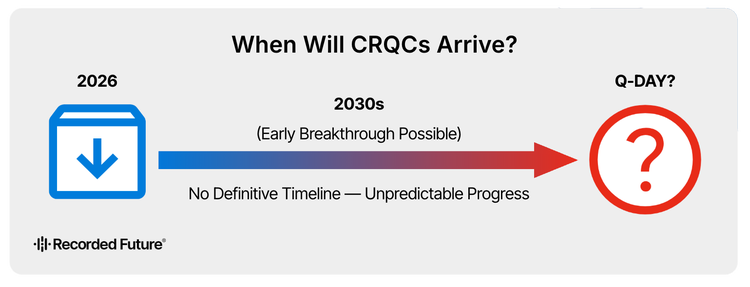
There is no definitive timeline for CRQCs. Most projections place their arrival in the mid-to-late 2030s, with credible breakthroughs possible earlier in the decade. These estimates should be treated with caution: forecasting is inherently uncertain because progress in quantum error correction and qubit scaling occurs in uneven advances rather than linear progression.
For security leaders, the precise date of “Q-Day” is less important than the lifecycle of deployed systems. Infrastructure implemented today may remain operational when CRQCs emerge. Current cryptographic decisions are therefore future-binding.
Under the HNDL model, quantum risk is already material for long-lived data. Preparedness, visibility, and cryptographic agility matter more than timeline prediction.
Figure 4:No definitive timeline for CRQCs (Source: Recorded Future)
How Should Organizations Prepare?
The transition to post-quantum cryptography (PQC) is no longer a theoretical exercise. It is increasingly driven by regulation, procurement requirements, and emerging industry norms. These developments should be interpreted as operational signals necessitating forward planning.
In the US, the Quantum Computing Cybersecurity Preparedness Act requires federal agencies to inventory quantum-vulnerable cryptography and develop migration plans. NIST’s 2024 PQC standards now set the baseline for federal procurement and are rapidly becoming global reference points. In parallel, Commercial National Security Algorithm (CNSA) 2.0 defines approved algorithms and transition timelines for national security systems, with full migration targeted by 2035. Similar momentum is building in Europe. The EU Cybersecurity Act and national quantum-preparedness strategies are accelerating early adoption, particularly across critical infrastructure sectors such as energy and transportation.
Although many of these mandates formally apply to public-sector systems, their practical impact extends well beyond government. Procurement requirements and supply-chain expectations are translating policy into commercial pressure. As a result, cryptographic inventory, structured migration planning, vendor alignment, and crypto-agility are likely to become baseline governance expectations rather than optional best practices. Boards are beginning to treat quantum risk as a strategic planning issue, not a distant technical concern, with some sectors allocating dedicated quantum-security budgets approaching 5% of total cybersecurity spend to support preparation.
Industry coordination further reinforces this direction of travel. Financial institutions, payment networks, and telecommunications providers are forming quantum-readiness working groups to align migration timelines and manage shared dependencies. SWIFT is developing PQC migration guidance for its global messaging network, and Mastercard has released a PQC migration white paper outlining practical transition steps.
Figure 5:Planning for the uncertain arrival of CRQCs (Source: Recorded Future)
As the HNDL risk window narrows, organizations that begin structured preparation now are likely to manage transition risk deliberately and cost-effectively. Security leaders should ensure they understand where quantum-vulnerable cryptography resides, how regulatory obligations may cascade through customers and partners, and whether critical suppliers have credible PQC transition roadmaps. Those that delay risk compressed timelines, regulatory pressure, and materially higher transition costs later in the decade. Specific technical and governance steps are detailed in the Mitigations section.
Outlook
HNDL activity will continue to expand. State-sponsored threat actors are highly likely to increase long-term interception and storage of encrypted data, particularly from sectors handling information with long confidentiality lifetimes. Even as storage economics fluctuate, scalable interception infrastructure and economically sustainable long-term storage models enable continued accumulation of high-value encrypted material. Demonstrated routing manipulation capabilities further support persistent collection at scale, ensuring exposure continues to build regardless of when CRQCs ultimately arrive.
Attacker operational tempo will increase. The convergence of AI-enabled automation with quantum-accelerated search and optimization is likely to compress defender response windows and amplify the impact of existing security debt. Organizations reliant on legacy cryptography and slow remediation cycles will feel this pressure first.
Regulatory and procurement pressure will intensify. Post-quantum readiness is increasingly likely to become a baseline requirement for regulated markets, government contracts, and high-trust supply chains. US and European initiatives are formalizing transition timelines, and these mandates will propagate through vendor ecosystems, reframing quantum preparedness as a competitive requirement rather than a discretionary control.
Migration risk will become a primary enterprise challenge. Organizations that delay cryptographic inventories and crypto-agility investments are likely to face compressed transition timelines, higher costs, and greater operational disruption as standards mature and vendor dependencies shift.
Mitigations
Organizations should treat quantum resilience as a phased program aligned to visibility, flexibility, and systemic risk reduction, with leaders actively testing assumptions at each stage.
Short-term (2026): Establish visibility and prioritization
Security teams should maintain a comprehensive cryptographic inventory, identifying quantum-vulnerable algorithms across applications, infrastructure, and third-party dependencies, as well as public key infrastructure (PKI), operational technology, and IoT environments, and mapping them to data sensitivity and confidentiality requirements.
Leaders should be asking:
Do we have an enterprise-wide inventory of where quantum-vulnerable cryptography is embedded, including in legacy and third-party systems?
Which data assets must remain confidential for a decade or more, and are they currently protected by algorithms likely to be broken by CRQCs?
Medium-term (2026–2028): Enable flexibility
Organizations should design for cryptographic agility, ensuring that new systems and major upgrades allow algorithm replacement without architectural redesign. Vendors supporting long-lived products should provide credible PQC transition roadmaps aligned to emerging standards.
Leaders should be asking:
Are we continuing to deploy systems that hard-code cryptographic algorithms, thereby increasing future migration risk?
Do our critical suppliers have credible, time-bound PQC transition plans, and how exposed would we be if they fell behind?
Migration should prioritize long-lived data and high-trust functions, including identity infrastructure, code signing, certificate management, secure build pipelines, and critical third-party software. Strengthening software and supply-chain integrity will be essential to minimizing cascading risk during transition.
CISOs should be asking:
Which enterprise trust anchors (for example, certificate authorities, signing keys, or hardware security modules) would create systemic impact if rendered vulnerable in a post-quantum scenario?
Can we rotate and replace cryptographic components at scale without operational disruption if migration timelines compress unexpectedly?
Recorded Future intelligence can support these efforts by tracking emerging cryptographic risks through our Threat Intelligence Module, identifying exposed dependencies through our Attack Surface Intelligence, and assessing third-party quantum readiness as standards and vendor capabilities evolve through our Third-Party Intelligence Module.
Risk Scenario
GridCore Systems is a US-based provider of industrial control systems (ICS) and grid-management software for electric utilities nationwide. The firm relies on quantum-vulnerable public-key cryptography (RSA/ECC) for remote access, software signing, and secure data exchange with utilities and regulators, and has not yet completed a post-quantum cryptographic transition.
First-Order Implications
Threat
Risk
Adversaries intercept GridCore’s encrypted communications and software-update traffic for long-term storage under a harvest-now, decrypt-later (HNDL) model, while exploiting an exposed support system to map cryptographic dependencies.
Legal or compliance failure: Exposure of regulated energy-sector data triggers scrutiny under North American Electric Reliability Corporation Critical Infrastructure Protection (NERC CIP) and federal cybersecurity requirements.
Operational disruption: Incident response and emergency access restrictions delay maintenance and update cycles for utility customers.
Brand impairment: Disclosure of quantum-readiness gaps undermines customer and regulator confidence.
Second-Order Implications
Threat
Risk
Attackers leverage harvested metadata and mapped trust relationships to position for future cryptographic compromise, focusing on software-signing infrastructure and authentication mechanisms.
Operational disruption: Utilities delay deployments and require additional validation of software integrity and access controls.
Brand impairment: Public concerns over update authenticity erode GridCore’s reputation as a trusted infrastructure provider.
Competitive disadvantage: Customers begin to favor vendors with demonstrable post-quantum migration progress.
Third-Order Implications
Threat
Risk
Following the emergence of cryptographically relevant quantum computers, previously harvested data is decrypted, exposing historical grid telemetry, credentials, and engineering documentation.
Operational disruption: Adversaries plan targeted intrusions or disrupt contingencies during periods of geopolitical tension.
Legal or compliance failure: Retroactive exposure of protected data leads to long-term regulatory action and contractual liability.
Competitive disadvantage: GridCore loses preferred-vendor status and future contracts to quantum-ready competitors.
For security professionals evaluating threat intelligence vendors, the Gartner Magic Quadrant offers an indispensable perspective. Gartner analysts’ thorough and nuanced analysis cuts through the noise, making it easier for teams to understand each platform’s approach, strengths, and considerations—and helping them determine whether a particular vendor fits their organization’s unique needs.
That’s why we’re honored to share that Gartner has named Recorded Future a Leader in the first-ever Magic Quadrant™ for Cyberthreat Intelligence Technologies. This new report evaluated 17 vendors in the space, providing a comprehensive look at the competitive landscape.
“In our view, being recognized as a Leader means something specific to us: we feel it reflects our ability to help our customers with the outcomes they depend on. These include stopping threats pre-attack, running intelligence autonomously at a scale no human team can match, and making every security control they own more effective," said Colin Mahony, CEO, Recorded Future. “We believe this recognition reflects both the trust our customers place in us and the strength of the outcomes we help them achieve.”
A research methodology that prioritizes customer voice
A Gartner Magic Quadrant is a culmination of research in a specific market, giving you a wide-angle view of the relative positions of the market’s competitors. By applying a graphical treatment and a uniform set of evaluation criteria, a Magic Quadrant helps you quickly ascertain how well technology providers are executing their stated visions and how well they are performing against Gartner’s market view.
For Recorded Future, this meant that Gartner analysts spoke directly with our customers about their real-world experiences—the challenges they face, how they use our Platform, and the outcomes they've realized. We feel their voices shaped our position in the Magic Quadrant, just as they’ve always shaped our product offerings and roadmap.
The new Gartner report offers a snapshot of what the analysts heard from customers. We haven’t stopped working since then and there’s much to talk about.
There’s more… the next phase of threat intelligence
In conversations throughout 2025, our customers gave us their thoughts about product complexity, pricing models, and the challenges of scaling intelligence across their teams. As a result of their input, we’ve fundamentally changed how they can access and make the most of Recorded Future threat intelligence.
Here are the highlights of our continued commitment to simplicity and innovation to provide better experiences for our customers in 2026:
1. Goodbye, modules. Hello, simplicity. Meet our four new solutions. Our four new solution areas cover the four major attack surfaces—an organization’s systems, brand, supply chain, and payment methods:
Cyber Operations—This foundational solution empowers security teams with the intelligence to monitor and prioritize threats and vulnerabilities, get in-depth malware insights, triage alerts and detect threats, and stand up an intelligence-driven defense.
Digital Risk Protection—Also foundational, this solution allows teams to monitor malicious sites, code repositories, and the dark web to detect brand abuse, employee credential compromise, and other threats to digital trust.
Third-Party Risk—This solution enables teams to continuously assess supplier security posture with real-time intelligence, accurate risk ratings, vendor action plans, and more.
Payment Fraud—With this solution, teams can detect and prevent card-not-present fraud with intelligence that identifies compromised payment data before it's used.
The solutions are built on a unified intelligence foundation to provide consistency, accuracy, and alignment around shared security outcomes. And they integrate with other security solutions like CrowdStrike Falcon and Google SecOps, bringing the benefits of Recorded Future intelligence and rich context directly into common SIEM and EDR workflows.
2. New pricing packages for less friction, more intelligence We’re offering the four solutions in new pricing packages designed to fit customer needs:
Simplicity—Customers can purchase one package instead of juggling multiple modules
End-to-end workflows—Packages cover full use cases, complete with the key capabilities to get the job done
Wider access—Higher tiers offer unlimited seats, so everyone now can be intelligence-led.
In addition, integrations are included. Now your tools in the security stack—SIEM, SOAR, firewall, endpoint protection, ticketing system, and more—can leverage Recorded Future intelligence without integration fees or limitations.
3. Expansion into Latin America The threat landscape knows no geographical borders, and neither do we. We’ve expanded Recorded Future’s operations into Latin America, giving security teams in the region better access to the expertise and support they need to mount a successful proactive defense.
4. Autonomous Threat Operations for autonomous defense In February, we launched Autonomous Threat Operations to help customers move from isolated threat intelligence insights and manual workflows to automated and continuous defensive actions across the entire security ecosystem. Complete with AI-powered, 24/7 autonomous threat hunting and multi-source correlation in the Intelligence Graph®.
As we continue to build on our vision of moving from automated to autonomous operations, we’re developing Recorded Future AI and agentic experiences to help our customers reduce alert fatigue, save time on research, and run threat hunts faster so they can detect and defend at scale.
Explore the Gartner Magic Quadrant report today
We’re proud to be recognized by Gartner as a Leader in Cyberthreat Intelligence Technology, and we’ll continue innovating for our customers to help them mitigate risk and stay ahead of evolving threats.
Get the report to review Gartner analysis and see how Recorded Future fits your CTI program needs.
Gartner and Magic Quadrant are trademarks of Gartner, Inc. and/or its affiliates.
Gartner does not endorse any company, vendor, product or service depicted in its publications, and does not advise technology users to select only those vendors with the highest ratings or other designation. Gartner publications consist of the opinions of Gartner’s business and technology insights organization and should not be construed as statements of fact. Gartner disclaims all warranties, expressed or implied, with respect to this publication, including any warranties of merchantability or fitness for a particular purpose.
This article introduces threat activity enablers (TAEs), the infrastructure providers and networks that underpin modern cyber threats across both criminal and state-sponsored activity. These entities sustain operations by enabling resilient, high-risk infrastructure that persists despite sanctions, takedowns, and public exposure.
Behind every ransomware demand, botnet, or threat activity group is a server sitting in a data center. While most legitimate hosting providers evict threat actors once identified, a specific class of providers does the opposite. Recorded Future® calls these providers threat activity enablers(TAEs).
What Is a Threat Activity Enabler?
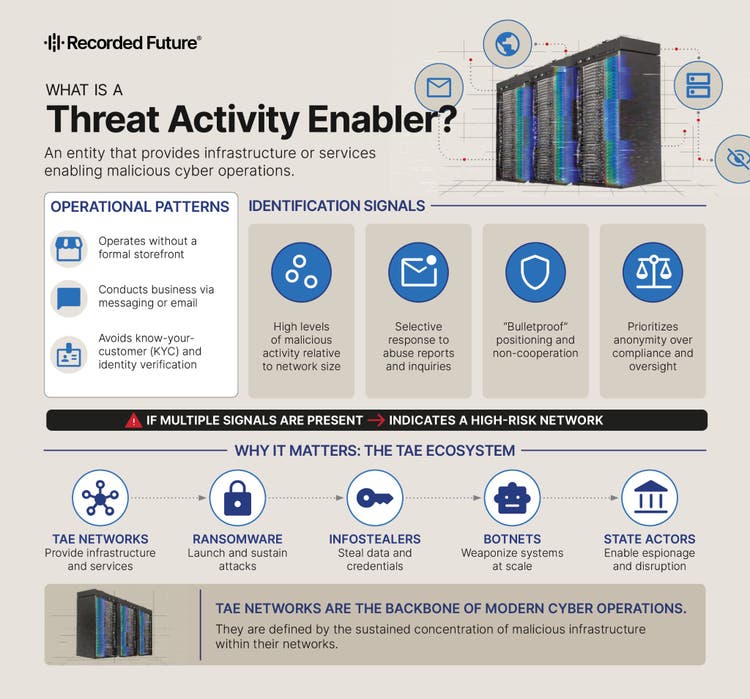
Figure 1: Overview of threat activity enablers’ patterns, ecosystem, and impact
A threat activity enabler (TAE) is an individual, organization, or service provider that supports malicious cyber activity by providing infrastructure or services leveraged by threat actors. More commonly, this includes providers that lack a formal physical or virtual storefront, conduct business only via email or messaging platforms, and do not enforce know-your-customer (KYC) policies. It also includes hosting providers that selectively respond to abuse reports or law enforcement inquiries to maintain plausible deniability, as well as more traditional self-proclaimed “bulletproof” providers that openly ignore oversight or advertise non-cooperation.
TAE networks serve as the backbone for ransomware groups, infostealer campaigns, botnets, and even state-sponsored threat actor operations. What distinguishes TAE networks is the sustained concentration of malicious infrastructure within their networks.
How TAEs Operate
TAEs are masters of obfuscation and are highly resilient, hiding behind layers of decoy companies to evade accountability. They use several core tactics:
Corporate Shell Games: They establish front companies across multiple jurisdictions to create legal distance between the infrastructure and the operators.
Strategic Resource Control: They often operate as local internet registries (LIRs). This gives them direct control over IP resources and autonomous systems (ASNs), allowing them to manipulate network resources at will.
Rapid Rebranding: When a network becomes too "hot" due to scrutiny, TAEs rapidly transfer IP address prefixes to a newly registered, clean-looking entity.
Identifying High-Risk TAE Networks
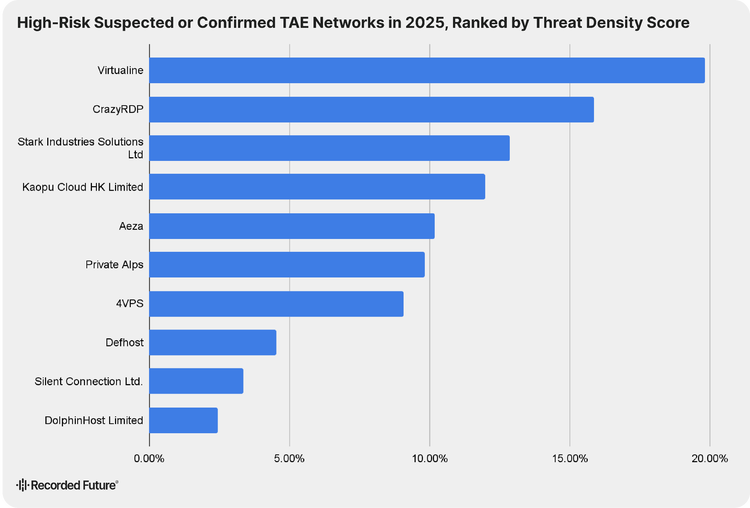
Recorded Future actively identifies high-risk TAE networks through its Network Threat Density List. These networks are ranked by their Threat Density Score, calculated from the concentration of validated malicious activity relative to the total number of IP address prefixes a network announces.
This approach cuts through the noise to quickly expose infrastructure that is disproportionately associated with threat activity, a core characteristic of TAEs, allowing network defenders to prioritize the infrastructure most likely to pose material risk.
Figure 2: High-risk suspected or confirmed TAE networks in 2025, ranked by Threat Density Score
From Insight to Action
Tracking TAE networks allows security teams to move from reacting to individual threats to proactively managing infrastructure risk. In practice, this means applying TAE intelligence across three core areas: prevention, detection, and exposure.
Figure 3: Three steps for operationalizing TAE intelligence
TAEs are persistent and continuously evolving, adapting quickly in response to sanctions, enforcement actions, and exposure. While their identities may change, their underlying infrastructure patterns often remain consistent.
The "metaspinner" Case Study
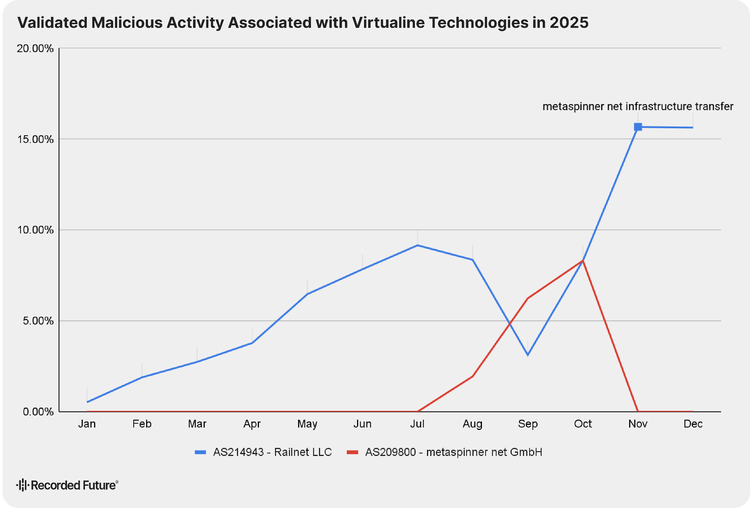
In April 2025, a TAE tracked by Recorded Future, Virtualine Technologies, shifted its IPv4 resources to a newly registered network that fraudulently impersonated a legitimate German software firm, metaspinner net GmbH. Because this provider’s historical infrastructure patterns were already being tracked, the newly created network was immediately identified as a front. Within weeks, this network became a primary distribution hub for malware families such as Latrodectus and AsyncRAT. When the operation was eventually exposed, Virtualine Technologies simply pivoted the infrastructure to a new identity within one of its existing autonomous systems to maintain its operations.
Figure 4: Validated malicious activity associated with Virtualine Technologies in 2025
This case underscores the reality of TAE networks: while identities, ownership records, and corporate fronts may change, the underlying infrastructure and its associated risk persist, making continuous tracking essential to identifying and prioritizing the networks that will drive future threat activity, as demonstrated by Virtualine subsequently emerging as the highest-risk TAE network in 2025.
The Stark Industries Case Study
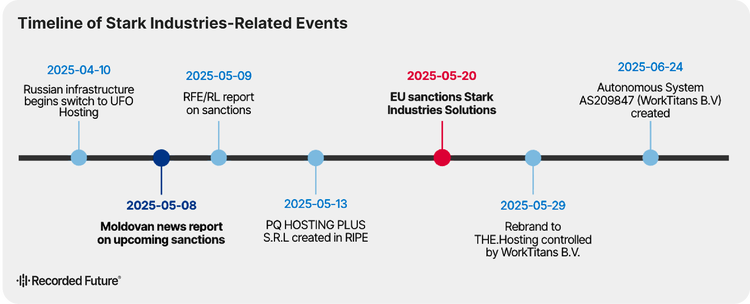
In May 2025, the European Union sanctioned UK-registered hosting provider Stark Industries Solutions and its executives for enabling Russian state-sponsored cyber operations. However, enforcement did not halt Stark Industries’ operations. In the weeks leading up to the sanctions announcement, Stark Industries began transferring IP resources, modifying RIPE registrations, and shifting infrastructure to affiliated entities.
Figure 5: Timeline of Stark Industries-related events in 2025
Despite the sanctions, the underlying infrastructure, routing relationships, and operational patterns remained traceable across these new fronts. Continuous monitoring of TAE ecosystems enables defenders to detect these pivots in near real time, revealing continuity beneath corporate rebrands and legal restructurings. This case underscores a broader reality: sanctions may change names and ownership records, but without infrastructure-level visibility, the enabling networks behind malicious activity often persist.
What This Means for Security Leaders
TAEs represent an ongoing challenge. While individual campaigns and threat actors may come and go, the infrastructure that supports them remains adaptive and deliberately resilient.
For security leaders, this requires an additional shift from solely reacting to individual indicators to understanding and prioritizing the infrastructure that enables threat activity at scale. By identifying and tracking high-risk networks, organizations can reduce investigative noise, focus resources on the most impactful threats, and take proactive steps to limit exposure before attacks materialize.
Ultimately, addressing TAEs is not just about detection; it’s also about disrupting the conditions that enable modern cyber threats to operate.
Questions You Should Be Asking
How much of your network communicates with high-risk infrastructure?
Are you prioritizing alerts involving high-risk networks?
Is TAE or ASN risk intelligence integrated into your detection and triage workflows to ensure the highest-risk activity is addressed first?
Do any of your third-party providers rely on TAE-linked infrastructure?
Do you have hidden exposure to TAE networks?
Are your controls dynamically adjusting to infrastructure risk?
Can you proactively restrict or challenge traffic to and from high-risk networks?
Embodied AI has arrived.. Humanoid and quadruped robots are moving off factory floors and into everyday operations, military deployments, and critical infrastructure. Technological advances in large language models LLMs and robotics are enabling robots to perform complex tasks autonomously.
Security has not kept pace. Researchers have demonstrated that commercially available robots can be hijacked over Bluetooth, covertly exfiltrate audio, video, and spatial data to servers in China, and even infect neighboring robots wirelessly, forming physical botnets. If unaddressed, these security weaknesses are set to scale massively once humanoid robots are fully integrated into critical workflows.
The risks need to be taken extremely seriously. A robot should be treated less like a machine on the balance sheet and more like a cyber-physical endpoint with cameras, microphones, radios, cloud dependencies, and motors. That means tougher procurement, tighter network controls, continuous vulnerability monitoring, and a credible plan for operational continuity if a fleet has to be pulled offline.
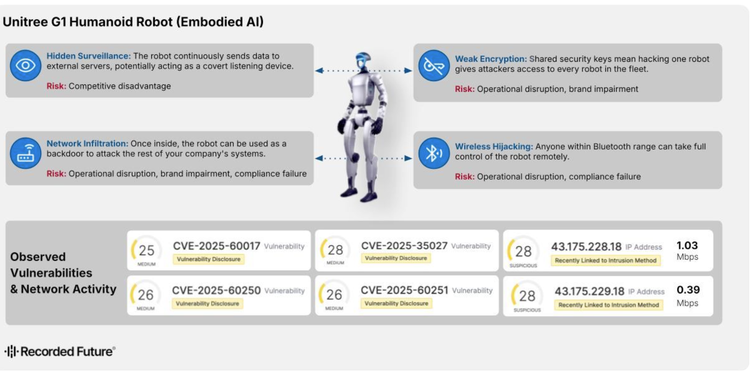
Figure 1:Summary of Unitree G1 vulnerabilities, associated business risks, mapped CVEs, and observed network activity (IPs and data exfiltration rates) (Source: Recorded Future)
Analysis
Market Drivers of Embodied AI Adoption
Embodied AI, intelligent systems in physical forms such as humanoid and quadruped robots, is moving from spectacle to staffing plans.
The shift is being driven as much by demographics as by technological progress. There are growing reports that the working-age population worldwide has begun to decline. China, an economic success story, has seen its population also decline again in 2025 as births hit a record low. These trends do not make large-scale automation inevitable, but they seriously strengthen the economic case for it in both corporate and government decision-making.
The International Federation of Robotics identifies labor shortages, real-world testing of humanoid robots, and increasing attention to safety and cybersecurity as defining trends for 2026. Some early deployments of embodied AI reinforce this trajectory. BMW reports that the Figure 02 humanoid robot has assisted in the production of more than 30,000 X3 vehicles, while GXO and Agility Robotics describe their partnership (established in 2024) as “the first formal commercial deployment of humanoid robots.” In high-risk environments, Sellafield is deploying quadruped robots to reduce human exposure in nuclear decommissioning.
Capital markets are also responding. Unitree filed for a reported $610 million initial public offering (IPO) in Shanghai in March 2026. Taken together, these signals suggest that robots are leaving pilot programs and becoming operational.
That transition makes the security question immediate rather than theoretical.
Expanding Attack Surface in Embodied AI Systems
Unlike traditional IT assets, embodied AI systems combine multiple high-risk components in a single platform: cameras, microphones, sensors, wireless radios, cloud connectivity, and physical actuation. This convergence creates a broad and under-secured attack surface.
A compromised robot can exfiltrate sensitive environmental and operational data, provide persistent remote access to internal networks, and interact physically with its environment, potentially causing unintended physical effects. This elevates robots from conventional endpoints to cyber-physical systems with both digital and real-world consequences.
The risk is compounded by architectural choices. Many platforms rely on cloud-dependent telemetry, wireless provisioning interfaces, and centralized control mechanisms. These design decisions create multiple entry points for attackers and increase the likelihood of compromise across entire fleets of embodied AI systems.
Demonstrated Vulnerabilities and Exploits
The risks are no longer theoretical. Documented vulnerabilities show that commercially available robots can be compromised with relative ease. Unlike traditional cyber threats, which mostly affect the digital world, exploiting robots enables attackers to manipulate the physical world, maximizing the potential for harm.
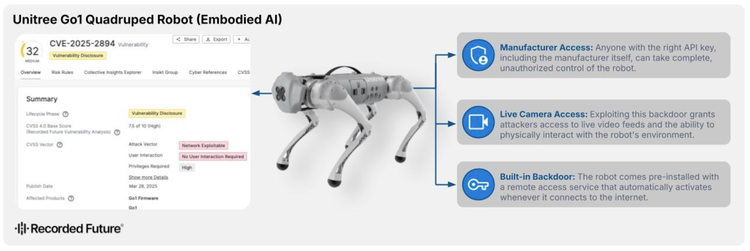
In 2025, researchers discovered an undocumented backdoor in Unitree’s Go1 quadruped robot that enabled remote access via the CloudSail service. Axios reported that an exposed web application programming interface (API) could allow attackers to locate devices globally and, if a robot was online, view live camera feeds without authentication. Where default credentials remained unchanged, full device control was possible. Whether described as a backdoor or a design failure, the implication is the same: robots may be reachable in ways operators do not anticipate, just like any other Internet of Things (IoT) device.
Figure 2:Summary of vulnerabilities affecting the Unitree Go1 robot, with Intelligence Card insights from the Recorded Future Intelligence Operations Platform (Source: Recorded Future)
Further research disclosed a critical vulnerability in the Bluetooth Low Energy and Wi-Fi provisioning interface used by multiple Unitree models, including the Go2, B2, G1, R1, and H1 robots. According to both the UniPwn research and IEEE Spectrum, the flaw combined hard-coded cryptographic keys, trivial authentication bypass, and command injection in the Wi-Fi setup process. An attacker within radio range could obtain root-level access without physical contact, giving them control over the robot.
Because the exploit propagates wirelessly, a single compromised device can enable lateral movement across nearby robots. This creates a fleet-level compromise scenario in which multiple units can be controlled simultaneously. The result resembles a physical botnet capable of both digital and physical actions.
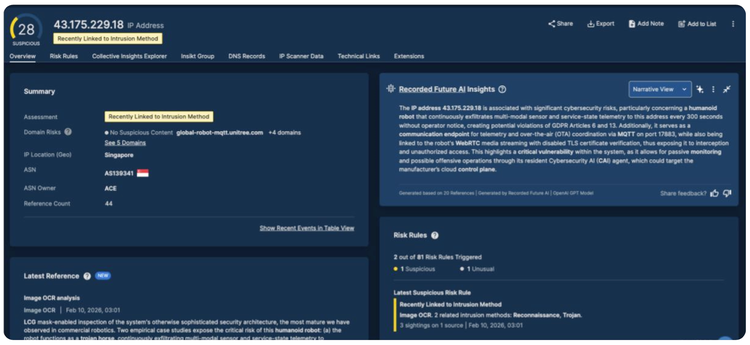
Surveillance risks are equally significant. Researchers wrote that the Unitree G1 robot continuously exfiltrated multimodal sensor and service-state telemetry every 300 seconds without the operator’s knowledge. This included streaming data to external servers, potentially including audio, video, and spatial mapping. A robot operating inside a plant or laboratory may therefore be mapping the environment in real time.
Figure 3:ResearchersfoundUnitree’s G1 quietly transmitting audio, video, and sensor data to the IP address (43[.]175[.]229[.]18) without user awareness (Source: Recorded Future)
The attack surface extends beyond firmware and networking layers. Researchers showed they could take control of a Unitree humanoid in about a minute, bypass its normal controller, and trigger physical actions. Demonstrations at GEEKCon in Shanghai indicated that both voice commands and short-range wireless exploits could hijack robots and propagate attacks to nearby units, including those not actively in use.
At the software layer, embodied AI systems introduce additional risks due to their reliance on large vision-language models. Researchers demonstrated that physical-world text can influence system behavior, as injected visual prompts were shown to steer autonomous driving, drone landing, and tracking tasks without compromising the underlying software. This would enable threat actors to take control of a self-driving car or turn a drone into their own surveillance feed by embedding a visual prompt in the environment, such as hiding a message on a stop sign.
Figure 4:Chinese robotic systems demonstrated during military training exercises (left) (Source:ABC YouTube); Concept rendering of the Atlas 2.0 robot operating in a next-generation factory environment (right) (Source:Boston Dynamics YouTube)
Systemic and Operational Risk Implications
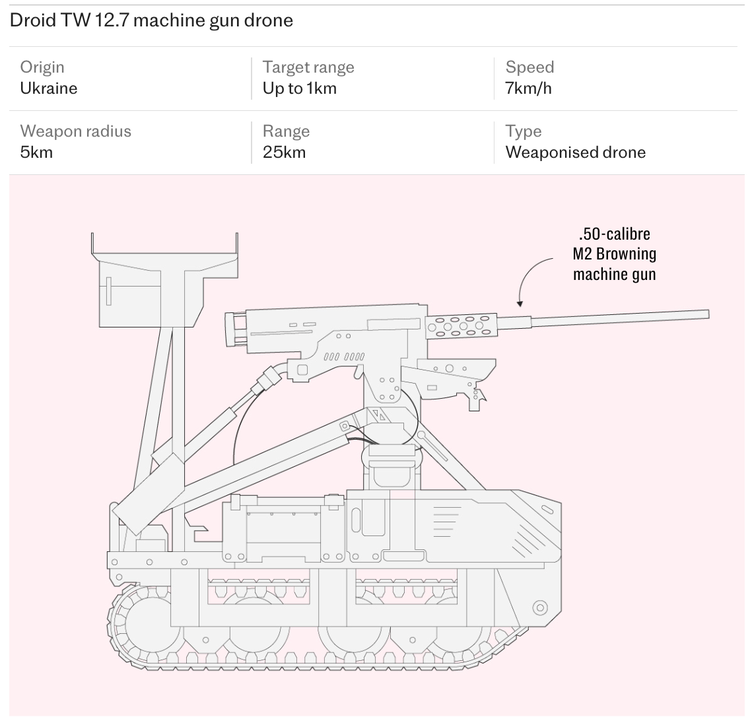
The implications extend beyond individual devices to organizational and systemic risk. Embodied AI systems are already being deployed in environments where compromise has consequences beyond data loss. Manipulation or malfunction of robots during critical operations would have outsized economic or public safety consequences. Militaries are also experimenting with robotic systems (see Figure 4).
Figure 5:Droid TW 12.7 machine gun drone, deployed by Ukrainian forces to capture Russian positions without ground troops (Source:The Telegraph)
In 2024, the Golden Dragon exercise between Cambodia and China featured robot dogs among the systems on display. Meanwhile, in the US, politicians have begun pushing for Unitree to be designated as a federal supply-chain risk, reflecting national security concerns about commercial robotics platforms. This is a very similar move to Poland’s ban on sensor-rich vehicles accessing military sites to limit surveillance risk. Ukraine has successfully deployed ground-based robots and drones in combat operations, marking a significant shift in modern warfare. In a landmark operation in April 2026, Ukrainian forces captured a Russian position using only unmanned systems — the first recorded instance of a robot-only assault in the conflict.
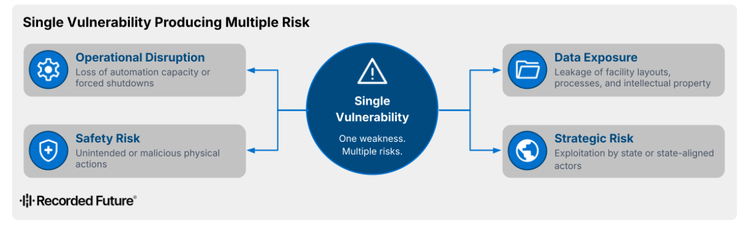
Figure 6:A single vulnerability can simultaneously produce operational, data, safety, and strategic risks (Source: Recorded Future)
As adoption scales, these risks become interconnected. A vulnerability affecting one platform or vendor could propagate across fleets, sites, or sectors, creating systemic exposure.
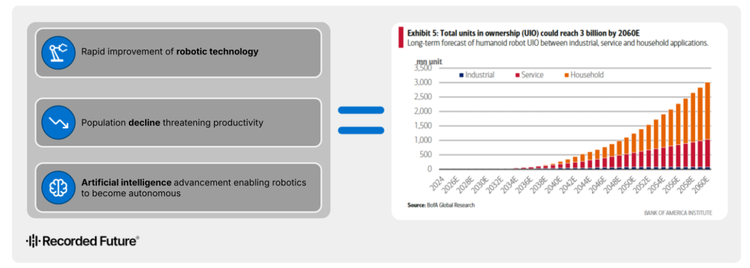
At the same time, the pace of commercial development is outstripping regulatory oversight. Bank of America estimates that as many as three billion humanoid robots could be in operation by 2060. This convergence of demographic pressure, advancing AI capabilities, and falling production costs suggests that large-scale human-machine coexistence is highly probable.
Figure 7:Summary of the factors fueling growth in robotics production, illustrated byBank of America data
(Source: Recorded Future)
Securing embodied AI systems is therefore not a peripheral technical issue. It is a strategic requirement that must be addressed before widespread deployment locks in insecure architectures at scale.
There’s a certain energy you can only find at Recorded Future. Take that energy and bring it to London’s “Silicon Roundabout” and you get the perfect spot for Futurists to build and innovate.
Across the globe, Recorded Future is 1000+ employees working towards the same mission: Securing Our World With Intelligence.
Our London office – one of our most storied hubs – hosts a range of departments supporting both local, regional, and global operations. The office brings together 100+ cross-functional professionals from People & Talent Acquisition, Finance, Sales, Marketing, Global Services, Research, and more!
Looking back: From the Attic to The Bower
Our story in London didn’t start in the high-rise, but in a converted attic with just a handful of people and a big mission.
When I first joined, we were in the attic of a 3-story building.It was full of great people and energy; the immediate feeling I got was that everyone was building something great together.”
Joe Rooke
Director Risk Insights, Insikt Group
This passion for building something great fueled incredible growth. Sam Pullen, Director of Intelligence Services, remembers when the entire EMEA team was just about 20 people. Since 2018, we’ve gone from servicing ~30 customers in the region to ~700 clients now.
On the left: First Recorded Future office in London. On the right: Recorded Future's newest office
On the left: First Recorded Future office in London. On the right: Recorded Future's newest office
Inside the Office
This modern high-rise building’s open-plan layout offers quite a few collaboration spaces across our office, where the team likes to have small team meetings, breaks, or even lunch.
Like all Recorded Future offices, our meeting rooms follow a unique naming convention. While Boston uses countries, and Sweden volcanoes - London chose islands. Rumors say we picked islands following a 95-day rain streak – we can neither confirm nor deny. So, in our London office, you’ll find Futurists collaborating in rooms like Bora Bora, Crete, and even San Andres.
Our Culture
What truly defines our London office is the sense of camaraderie – whether that’s competing in a friendly team padel game, testing your dartboard skills, or truly memorable summer & end of year celebrations.
The culture at the London office has always been welcoming and inclusive. The BDRs are the soul of the office, and you can always rely on them for a good conversation over a cup of tea.
Sam Pullen
Whether over summer picnics and pedalos in Hyde Park years, playing 5-a-side football in the pouring rain, or at the most recent Christmas party at the Savoy - our Futurists celebrate wins together.
Friendly Team Padel Game at Canary Wharf
Onwards & Upwards: Why Recorded Future
We asked Sam and Joe what has been the highlight of their long tenure at Recorded Future: the opportunity to build. For Sam, it has been the opportunity to build great relationships with clients over nearly a decade. For Joe, it has been the opportunity to build new solutions and new ways to work towards our mission.
The company offers opportunities to builders. If you are willing to take the initiative to make something better, you are not stopped. That is rare.
The United States (US) is shifting toward a more force-driven security strategy primarily relying on military operations and economic pressure to counter transnational criminal organizations and limit Chinese, Russian, and Iranian influence in the Western Hemisphere.
Regional outcomes diverge across three core scenarios:
US-aligned authoritarian cooperation with fragile stability
Political fragmentation enabling criminal expansion and governance breakdown
A strategic realignment toward BRICS that reduces US influence and increases great power competition
Each scenario increases the risks of political instability, regulatory fragmentation, and cyber threats, including increased surveillance, cybercrime, and targeting of critical infrastructure and multinational businesses.
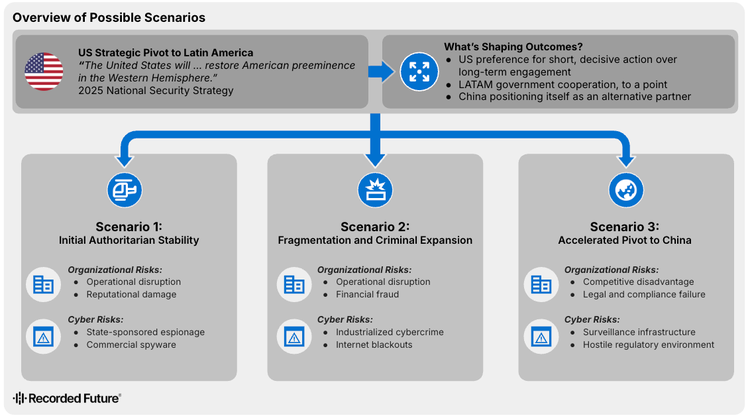
Figure 1:Overview of possible scenarios resulting from the US’s strategic pivot to Western Hemisphere security
(Source: Recorded Future)
Analysis
The US 2025 National Security Strategy formalized a shift toward hemispheric priorities and narrower strategic objectives. This shift had been building throughout President Donald Trump’s first term:
January 2025: An executive order formally designates cartels as foreign terrorist organizations.
August 2025: The president signed a classified order directing military action against cartels beyond traditional law-enforcement frameworks.
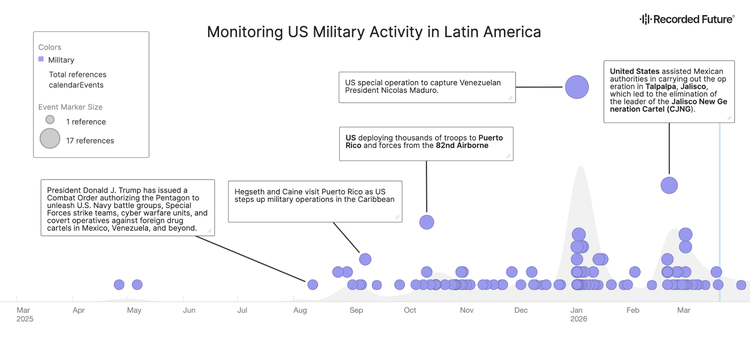
September 2025: US forces carried out the first strike on alleged drug-trafficking vessels. Since then, more than two dozen kinetic strikes in the Caribbean and Eastern Pacific have resulted in over 100 fatalities.
December 2025: The US begins seizing oil tankers accused of sanctions evasion.
January 2026: The US launches a special operation to capture and extract Venezuelan President Nicolás Maduro to face drug trafficking charges in court.
March 2026: The US launches the “Shield of the Americas” initiative, intended to counter drug trafficking, transnational criminal networks, and illegal migration in the Western Hemisphere. In an address to Congress two weeks later, the commander of US Southern Command reinforced a greater military role in countering foreign terrorist organizations (FTOs) and managing other security priorities in the region.
Taken together, these moves suggest a shift from a law-enforcement-led regional security model toward more overt coercion driven by military intervention.
Figure 2:US military activity in Latin America has increased significantly since the August 2025 order directing action against cartels (Source: Recorded Future)
At a strategic level, US objectives remain centered on limiting transnational criminal activity and countering external competitors. Transnational criminal organizations are framed as a primary threat vector due to their role in narcotics trafficking and financial crime. China’s growing economic presence, anchored in trade and Belt and Road Initiative (BRI) infrastructure, is also seen as a threat to US interests. Russia and Iran maintain more targeted but persistent footholds, particularly through surveillance coordination in Nicaragua, Cuba, and Venezuela. US policy is oriented toward constraining adversary influence while reinforcing its own economic and security partnerships. The US is pursuing these objectives through a combination of expanded military operations, law enforcement activity, and coercive economic measures, including tariffs and sanctions tied to political alignment.
Figure 3:US naval and air assets have been deployed to the Caribbean to counter drug trafficking (Source:Newsweek)
Scenarios
The shift toward prioritizing US influence in the Western Hemisphere over other national security objectives will likely reshape the regional risk landscape. To assess the potential medium-term outcomes, Recorded Future identified key drivers and established baseline assumptions that underpin scenario development.
Drivers
Assumptions
● Increased US military interventions against alleged transnational criminal organizations TCOs and enablers
● Expanding role of TCOs and armed groups in regional instability
● Existing security cooperation between the US and Latin America LATAM governments
● Growing Chinese economic and infrastructure investment in LATAM
● Historical and ongoing relationships between Russia, Iran, and LATAM (notably Venezuela, Cuba, and Nicaragua)
● Increased adoption of commercial spyware and surveillance tools by LATAM governments
● US policy will prioritize countering malign influence and security threats within the Western Hemisphere over other regions
● Policy direction will remain sensitive to domestic political cycles in both the US and Latin America, creating potential for shifts following elections
● The US will favor limited-duration, high-impact interventions over prolonged military or large-scale nation-building efforts
● China will continue to expand its economic and diplomatic engagement in Latin America, positioning itself as an alternative partner (instead of the US
● Russia and Iran will seek to exploit opportunities to challenge US influence in the region, particularly through relationships with anti-US governments
● Regional governments will continue to leverage emerging surveillance and cyber capabilities to address internal security challenges
The following scenarios explore potential outcomes as the US reorients its security strategy toward the Western Hemisphere:
Scenario 1: Initial Authoritarian Stability
In this scenario, the US successfully asserts influence over historically adversarial authoritarian regimes, notably Venezuela and Cuba. These governments pivot toward cooperation with the US on trade, energy, and security, while maintaining repressive political systems domestically. US intervention has already reshaped Venezuela’s leadership and opened pathways for Western energy investment, while Cuba has responded to continued pressure by showing openness to economic reforms. Meanwhile, democracies like Colombia and Ecuador may adopt more coercive internal security postures, particularly in states facing cartel violence, in response to US pressure.
The US takes more aggressive measures to deter and counter non-Western infrastructure investments, leading to a relative diminishment in the influence of China and Russia as US engagement deepens. However, both powers will likely retain significant hemispheric influence and may pursue limited, asymmetric responses rather than direct confrontation.
Figure 4:US President Trump has praised interim Venezuelan president Delcy Rodriguez (Image source:Le Monde)
Organizational Risks
Cyber Risks
● Operational disruption: This outcome may appear stable in the short term but is likely structurally fragile, as it depends on sustained coercive pressure and political alignment. Electoral changes will almost certainly bring in a new set of priorities and approaches to the region. This will create an operating environment at high risk of disruption.
● Reputational damage: Companies seen as being too close to one political bloc or regime may face reputational damage as policies reverse.
● Chinese and Russian state-sponsored actors will likely increase cyber operations against expanding US assets in the region, particularly in telecommunications and energy, to gather information or conduct strategic, limited disruption.
● Surveillance, including the use of commercial spyware, will almost certainly increase as states escalate law enforcement operations against cartels and non-state armed groups.
Scenario 2: Fragmentation and Criminal Expansion
US intervention produces a political backlash, weakening democracies and fueling the collapse of transitional regimes. Inconsistent or heavy-handed military actions against alleged criminals increase public outrage, leading to electoral turnover and instability. As governments escalate repression to maintain control, resistance movements and localized violence intensify, further eroding state authority. This dynamic creates governance vacuums that strengthen TCOs, particularly in border regions. In this environment, cartels and armed groups re-emerge as dominant power brokers, reversing gains in regional security and leading to a resurgence in criminal activity and violence.
Organizational Risks
Cyber Risks
● Operational disruption: Violence and corruption will likely increase instability. Further, regime collapse in Cuba or Venezuela would provide a haven for criminal groups.
● Financial fraud: Expanding criminal influence increases the likelihood of cyber or violent crimes, such as fraud or extortion.
● Industrial-scale cybercrime operations, similar to the scam call centers in under-governed regions of Myanmar, may increase under cartel control. This would scale up fraud, cryptocurrency theft, and money laundering operations, likely targeting Spanish-, Portuguese-, and English-speaking populations.
● Internet blackouts are used as a weapon by governments struggling to maintain control, causing instability in communications and other infrastructure.
Figure 5:Chancay “megaport” in Chancay, Peru, is funded under China’s Belt and Road Initiative
The US’s overreliance on military solutions at the expense of soft power enables China to position itself as an appealing alternative partner by offering positive incentives and stable, long-term policy-making. As a result, LATAM governments across the ideological spectrum quietly accelerate their pivot toward China, building on existing trade and investment ties. As this trend continues, LATAM governments feel emboldened to adopt more overt mechanisms to resist US influence, including legal challenges to military operations and regulations targeting US companies. Both China and Russia are able to increase their economic footprint and political influence in the region, especially if the US becomes less willing to maintain a consistent security presence.
Organizational Risks
Cyber Risks
● Competitive disadvantage: Expanding Chinese and Russian economic influence may displace US companies in key sectors such as energy, agriculture, telecommunications, and infrastructure, reducing market access and long-term competitiveness
● Legal and compliance failure: A more hostile regulatory environment could limit operations or force costly restructuring
● China and Russia gain a greater surveillance foothold, taking advantage of LATAM countriesʼ construction of telecommunications and “Smart Citiesˮ infrastructure using companies like Huawei, as well as the use of Russian digital surveillance technology, to ensure visibility.
● Increased data sovereignty and related technology regulations can disrupt regional and global business operations, particularly for cloud services, financial systems, and multinational supply chains.
Outlook
The scenarios are not mutually exclusive: multiple outcomes can play out in different countries or regions across Latin America. Below are key indicators to monitor to anticipate which outcome is more likely to emerge:
Election Outcomes: Colombia, Peru, and Brazil all have elections in the next year; a change in leadership may reflect popular dissatisfaction with the current government’s foreign policy, precipitating a policy shift. Furthermore, a decisive Republican defeat in the US midterms may reduce appetite for foreign intervention, leading to inconsistent policy.
US Intervention in Cuba: The US government is strongly signaling its intention to replace or significantly reform Cuba’s long-standing Communist regime. The success of the operation and the willingness of the US to back a transitional or reform government will determine which scenario described above plays out.
LATAM Security Cooperations: Criminal groups and militias thrive in contested or under-governed regions, such as along borders. Look for signed agreements and joint operations as signs of cooperation — or the lack thereof signalling potential breakdown in security coordination and a greater likelihood of criminal expansion.
The China Alternative: While China is likely to want to avoid direct confrontation over influence in the Western Hemisphere, the CCP may seek to offer more positive incentives to increase its economic footprint in the region, such as continued investments in ports, telecommunications, and other critical infrastructure.
The War in Iran: Even though it’s happening on the other side of the world, the Iran war is likely to shape how the US pursues military operations in the Western Hemisphere. Battlefield setbacks could decrease appetite for military intervention, or energy security pressures could increase the imperative to ensure influence.
Mitigations
Strengthen cyber resilience and third-party risk management: Enhance monitoring and defenses for critical infrastructure, telecommunications, and cloud environments. Use Recorded Future’s Geopolitical Intelligence module to understand the surveillance risk in countries where you operate. Conduct regular assessments of vendors and partners to reduce exposure to espionage, surveillance, and cybercrime.
Prepare for regulatory fragmentation and data localization requirements: Develop flexible compliance frameworks that can adapt to diverging data sovereignty laws, sanctions regimes, and trade restrictions. This includes establishing localized data storage where necessary and maintaining legal contingency plans for rapid policy changes.
Enhance crisis response and continuity planning: Build scenario-based contingency plans for political instability, violence, or infrastructure disruption (such as internet outages or supply-chain interruptions), which are routinely monitored in the Geopolitical Intelligence module. Contingency planning should include evacuation preparation, alternative logistics routes, and redundant communications systems to ensure operational continuity across volatile environments.
Executives making AI decisions without hands-on building experience have a comprehension gap that no briefing can close.
AI is rapidly eroding most traditional competitive moats, and proprietary data's real value now comes down to how long it would take a competitor to reconstruct it.
As AI equalizes development speed, the most valuable engineers are those with sharp judgment and companies need to actively protect the foundational skills that make that judgment possible
Scams are a $450B–$1T global problem, and unlike card fraud, they don't require a breach; just convincing a victim to send money themselves.
The mule account is the most stable target: every scam needs an exit point, and intelligence gathered before a transaction occurs is more actionable than behavioral monitoring after the fact.
CYBERA's approach uses agentic personas to engage active scammers and extract verified mule account details, confirmed intelligence, not probabilistic scoring.
Regulatory pressure is accelerating: the UK already mandates APP fraud reimbursement, and the US, Canada, and Australia are following, raising the stakes for institutions that don't act proactively.
Last week’s reporting on unauthorized access to Claude Mythos reads as an AI security story. It is also, structurally, a North Korea (DPRK) story. Even if the current suspects turn out to be Discord hobbyists.
Mythos was meant to be contained. Within hours of the public Project Glasswing announcement, a third-party contractor environment became the access vector. Not because Anthropic did something wrong. Because controlled release, at the scale modern enterprise software operates, is a goal rather than a guarantee.
The interesting question isn’t who got in this time. It’s who gets in next, and their economics.
What happened?
The group accessed Mythos the same day it was announced, guessing the endpoint based on Anthropic’s naming conventions for prior models. The vector was an individual employed at a third-party contractor, not Anthropic’s core infrastructure. Source characterizations point to a research community “not wreaking havoc” with the model.
The misread
If the coverage only centers on Anthropic’s security posture or the AI safety debate, we’re missing an important angle.
The structural signal is that any preview or controlled-access model release has porous boundaries by design. Access controls on paper (contracts, NDAs, approved vendor lists) differ from those in practice. Every partner brings their own contractors, endpoints, and people with legitimate credentials and uneven security hygiene. That is the real control surface, not the cryptographic perimeter around the model itself. Which makes this a supply chain problem that happens to be about AI, not an AI problem that happens to involve vendors.
The blind spot
AI policy discourse is locked on US versus China, including energy, chip controls, export rules, sovereign AI posture, and who wins the race.
Structurally missing from the larger conversation is the one state actor whose entire foreign currency revenue stream is cyber-enabled theft. DPRK doesn’t need to win any race. They need a 20-30% productivity gain in existing operations.
The pipeline is documented. Insikt Group’s Crypto Country estimated that regime-linked cryptocurrency theft reached roughly $3 billion through 2023. The Multilateral Sanctions Monitoring Team (successor to the UN Panel of Experts after Russia’s 2024 veto) has since done the harder primary work. MSMT’s October 2025 report documents $2.8 billion stolen from cryptocurrency companies between January 2024 and September 2025 across more than 40 heists, with proceeds explicitly tied to WMD and ballistic missile program funding. The State Department updated the tally in January 2026: another $400 million stolen in the three months since publication, bringing the 2025 totals above $2 billion.
Every successful crypto exchange intrusion ends up on a launch pad.
Why North Korea wants the next model
Crypto exchange intrusions are labor-intensive at every phase. Recon, social engineering at scale (fake developer personas on GitHub and LinkedIn, spear-phishing of individual engineers at wallet providers), credential harvesting, post-exploit lateral movement, key extraction, and laundering.
Agentic capability compresses the cycle to include the same operator-hours, more successful intrusions, and more stolen $$$ per operator.
Lazarus and TraderTraitor don’t need AGI. They need the productivity lift that turns a junior operator into a senior one and shaves weeks off the planning phase. It doesn’t have to be Mythos specifically. Any comparable capability through a comparable vector does the job.
Better tools mean more successful intrusions. More successful intrusions mean more stolen crypto. More stolen crypto means more missiles.
Three access patterns
Three different tradecraft patterns keep getting conflated in media coverage. They are not the same TTP, and treating them as one weakens the response on all three.
1. Contractor misuse. A legitimately credentialed employee at a third-party vendor uses their access for unauthorized purposes. This is the Mythos story. The credentials and access are real, though the intent is variable. Defenses (easy to say, hard to do well): telemetry, behavioral monitoring, and least-privilege scoping at the vendor tier.
2. Fraudulent hiring. An adversary places its own operatives inside the target through stolen or synthetic identities, often via remote IT contracting. This is the DPRK IT worker scheme. Insikt’s Inside the Scam documents PurpleBravo’s infrastructure: front companies in China spoofing legitimate IT firms, and a malware ecosystem (BeaverTail, InvisibleFerret, OtterCookie) targeting the cryptocurrency industry. The credentials are real, but the identities are fake. Defenses: identity verification at hire (in-person interviews to avoid AI tricks), ongoing personnel vetting, geographic and behavioral baselining.
3. Supply chain compromise. A trusted vendor’s systems get breached, and the attacker uses that vendor’s legitimate distribution channel to reach the real target. TeamPCP’s March 2026 LiteLLM compromise hit the AI toolchain directly, poisoning Trivy (a defensive security scanner) to reach a package with 95 million monthly downloads. Defenses: build-pipeline integrity, dependency monitoring, signed artifacts.
These three attack vectors converge on the same truth. Any preview or limited-release AI program that depends on third parties is exposed to all three vectors simultaneously. DPRK is the actor most motivated across the full triangle because the revenue case is specific, measurable, and directly beneficial for the regime. They are incentivized to be “AI native.”
So what?
In the security industry, we need to stop thinking about AI access as purely a lab problem when it’s also a sanctions problem. The great-power competition framing obscures the actor already online, with a rich history of monetizing cyber heists to fund missiles.
“Limited release” is a wonderful bumper sticker. The AI reality, from a threat-modeling perspective, is a countdown to turbo-charging adversarial capabilities.
Now what?
The honest conversation is that perimeter-style AI “controlled access” is less effective against State-sponsored adversaries. A productive security path is a distinct preview infrastructure, aggressive telemetry, canaries, and third-party access tied to personnel-level vetting rather than contractual attestation. (Guessable endpoints should be the first thing dead.)
Crypto exchanges and custodians: your threat model needs to anticipate what Lazarus can do 3 to 6 months from now, not what they did last quarter. Assume they improve faster than your defenses do.
Policymakers: DPRK is a first-class entity in AI access governance. The Multilateral Sanctions Monitoring Team framework already documents cyber-enabled sanctions evasion thoroughly. What it doesn’t yet do is name AI capability access as a sanctions-relevant category. Dual-use export controls have governed the transfer of semiconductor and missile technology for decades. AI capability is the obvious next category.
Corporate CISOs (outside the AI-lab orbit): your third-party contractor environments are now inside the AI capability threat surface, whether you opted in or not. Inventory accordingly.
Close
Mythos is a preview of an access pattern. Any actor whose business model is stealing money to build weapons will find the third-party seam. This time, it was hobbyists. DPRK has spent two decades proving why nonproliferation is the right frame here.
The real challenge in cybersecurity isn’t intelligence or visibility, it’s speed. Attackers operate at machine speed, while most organizations are still constrained by manual, human-driven workflows.
Traditional threat intelligence falls short because it stops at insight. To reduce risk effectively, intelligence must not only inform decisions but also actively drive response.
Fragmentation across cyber, fraud, and third-party risk creates exploitable gaps. A unified, intelligence-driven approach is essential to understanding and addressing modern threats holistically.
Autonomous defense is the path forward. By enabling continuous, real-time action across the attack surface, organizations can close the speed gap and move from reactive security to proactive risk reduction.
For most security teams today, volume and access to intelligence isn’t the problem. It’s the speed at which they can turn that intelligence into action.
And yet, breaches still happen. Fraud still slips through. Third-party risk still catches teams off guard. The issue isn’t visibility. It’s the growing gap between how fast threats move and how fast organizations can respond.
Attackers now operate at machine speed, leveraging automation and AI to identify vulnerabilities, launch campaigns, and exploit opportunities in real time. Most security teams, however, are still constrained by manual workflows, fragmented systems, and processes that require human intervention at every step. That mismatch is where risk can accumulate—and where even well-resourced teams fall behind.
What many organizations are discovering is that the problem isn’t a lack of intelligence. The problem is their inability to turn the insights into contextualized, intelligence-led actions.
The Hidden Cost of Human-Speed Security
For many organizations, this gap shows up in subtle but compounding ways. Analysts spend hours triaging alerts, trying to determine which signals actually matter. Security teams often discover incidents after damage has already occurred, not because the data wasn’t there, but because it couldn’t be acted on quickly enough. Across the organization, teams responsible for cyber operations, fraud, and third-party risk operate in silos, each with their own tools and workflows, rarely sharing a unified view of risk.
At the same time, expectations from leadership have shifted. Executives and boards no longer want activity metrics—they want clear evidence that security investments are reducing business risk. But when intelligence is not clearly connected to action from security teams, that proof becomes difficult to deliver.
Traditional threat intelligence was designed to inform decisions made by humans, at human speed. In today’s environment, that model introduces delay. And delay, in cybersecurity, is increasingly indistinguishable from exposure.
Intelligence That Acts, Not Just Informs
Closing the speed gap requires more than incremental improvements. It requires a shift in how organizations think about intelligence altogether. Moving forward, the future of cybersecurity must be more than just intelligence-led—it must be intelligence-acted.
In this model, intelligence doesn’t sit in dashboards waiting for analysts to interpret it. It continuously correlates signals, prioritizes what matters, and drives action across the security environment automatically. Instead of asking teams to move faster, it enables the entire system to operate at the speed of the threat.
This is the foundation of autonomous defense, and it’s the future of effective, machine-speed cybersecurity.
From Reactive to Autonomous: A New Operating Model
Autonomous defense fundamentally changes the role of the security team. Rather than serving as the bottleneck between detection and response, analysts become decision-makers operating on top of continuously running intelligence.
Recorded Future’s Autonomous Threat Operations brings this model to life by eliminating the manual steps that slow teams down. It ingests and correlates intelligence from multiple sources, applies context in real time, and triggers actions across existing security tools—all without requiring constant human input.
The impact of such a dramatic shift is immediate and measurable. Threat hunting becomes continuous instead of periodic. Alerts arrive enriched with context, reducing the time needed to investigate and respond. Detection and remediation workflows execute automatically, freeing analysts to focus on strategic threats rather than routine triage.
Just as importantly, this approach transforms how organizations measure success. Instead of tracking activity—alerts processed, queries written, incidents reviewed—teams can demonstrate real outcomes: faster response times, reduced exposure, and a clearer connection between intelligence and risk reduction; the latter of which is becoming increasingly necessary for organizational buy-in.
The Bigger Challenge: Fragmented Visibility Across the Attack Surface
Speed alone, however, is only part of the equation. Many organizations are also limited by how they view risk. Threats today don’t respect organizational boundaries. A phishing campaign can lead to credential theft, which can then be used to access systems, exploit third-party relationships, or enable fraudulent transactions. These events are connected, but still far too many organizations manage them in isolation.
Cyber operations teams focus on internal threats. Fraud teams monitor transactions. Risk teams assess vendors. Each group has visibility into part of the problem, but no one has a complete picture. This fragmentation creates blind spots, and attackers are increasingly skilled at navigating between them.
A Unified Approach to Risk
To effectively reduce risk, organizations need more than faster response times. They need a connected understanding of their entire attack surface, along with the ability to act across it in a coordinated way.
In cyber operations, this means moving beyond alert overload to real-time prioritization. Instead of forcing analysts to sift through volumes of data, intelligence surfaces the threats that are most relevant to the organization’s environment and enables immediate action. The combination of prioritization and automation allows teams to reduce noise while improving both detection speed and response quality.
In digital risk protection, the focus shifts beyond the traditional perimeter. Today’s attackers target brands, customers, and executives just as frequently as they target infrastructure. By monitoring the open, deep, and dark web, Recorded Future provides visibility into impersonation campaigns, credential exposure, and emerging threats long before they impact the organization. More importantly, it enables rapid response, whether that means taking down fraudulent domains or preventing account takeover attempts.
Third-party risk represents another growing challenge. As organizations expand their ecosystems, they inherit risk from vendors and partners, often without real-time visibility. Third-party involvement in breaches has reached a staggering 30%, up from just 15% a year ago. Static assessments and periodic reviews can’t keep pace with how quickly vendor risk evolves today. Continuous monitoring, grounded in real-world intelligence, allows organizations to detect issues earlier, respond faster, and maintain a more accurate understanding of their exposure.
Threat intelligence-driven security is vital. It’s the eyes and ears of a security team. You can’t protect yourself against what you don’t know. A couple times now, Recorded Future has alerted us to something prior to the third-party vendor. That’s huge when we’re trying to protect our data.
Natalie Salisbury
Strategic Threat Intelligence Analyst, Novavax
In the realm of payment fraud intelligence, the shift is equally significant. There were some 269 million records posted across dark and clear web platforms in 2024, and a tripling of certain e-skimmer infections. It’s important to keep in mind that fraud doesn’t begin at the moment of transaction. Rather, it begins much earlier, in the environments where stolen data is exchanged and tested. Recorded Future provides comprehensive coverage across the complete payment fraud lifecycle. Sophisticated cleanup and normalization techniques result in better data quality and richer data sets, reducing manual research and enabling high confidence mitigation actions. By identifying these signals upstream and intervening, organizations can stop fraud before it’s executed, reducing both financial loss and customer impact.
One Intelligence Foundation. Total Visibility.
What makes this approach fundamentally different is that these capabilities are not delivered as isolated solutions. They are unified through the Recorded Future Intelligence Platform, which correlates data across millions of sources and billions of entities to provide a single, coherent view of risk.
This unified foundation enables organizations to connect signals that would otherwise remain siloed. Threat actors, infrastructure, vulnerabilities, and campaigns are all linked, allowing teams to understand not just what is happening, but what is likely to happen next.
That level of visibility is what makes autonomous defense possible. And not just within a single domain, but across the entire attack surface.
The urgency behind this shift cannot be overstated. Attackers are already operating at machine speed, using automation to scale their efforts and reduce the time between discovery and exploitation. At the same time, organizations that rely on manual processes are finding it increasingly difficult to keep up.
The consequences of this gap are significant. Longer dwell times allow attackers to entrench themselves more deeply. Delayed responses increase the cost and impact of incidents. And as breaches and fraud events become more visible, customer trust becomes harder to maintain.
This is no longer a question of optimization. It’s a question of whether existing operating models can keep pace with the reality of modern threats.
Rethinking What Threat Intelligence Should Do
As organizations evaluate their approach to cybersecurity, the role of threat intelligence needs to be reconsidered. It is no longer enough for intelligence to provide visibility. It must enable action. It must operate in real time. And it must extend across the full scope of organizational risk—not just one domain at a time.
Equally important, it must deliver outcomes that matter to the business. Faster detection, reduced exposure, and measurable risk reduction are no longer aspirational. They are essential for enterprise security in the modern, AI-powered threat landscape.
The goal for most organizations isn’t to replace their security stack. It’s to make it work better. By enabling intelligence to act autonomously, connecting visibility across domains, and aligning security operations with the speed of modern threats, organizations can close the gap that has long existed between insight and action. Recorded Future is built to make that possible.
If your team is still struggling with alert fatigue, delayed responses, or fragmented visibility, the issue may not be a lack of resources. It may be a limitation in how intelligence is being applied.
Now is the time to rethink that model.
Connect with Recorded Future to see how autonomous defense can help your organization move at the speed of today’s threats—and stay ahead of what comes next.
Critical elements and rare earth elements REEs are no longer commodities; they are strategic dependencies. Chinaʼs dominance in processing and refining provides it with enormous geopolitical leverage over other industrialized economies.
Geopolitical competition over mining and refining critical elements and REEs is accelerating. Competition to mine them will almost certainly expand into the Arctic, Greenland, Antarctica, the seabed, and space. These emerging arenas introduce legal ambiguity, environmental tension, and strategic rivalry, creating new geopolitical flashpoints.
Cyber operations are increasingly intertwined with resource competition. Insikt Group has identified state-sponsored and criminally aligned cyber threat actors targeting mining organizations to gain a strategic advantage. As critical mineral supply chains grow in importance, cyber activity targeting the sector is expected to increase, with criminal groups potentially serving as proxies or access brokers for state-backed operations.
Figure 1: Map of where critical elements and REEs are being mined or have been located, along with key findings in the report Source: Recorded Future)
Analysis
What Are Rare Earth Elements and Critical Elements?
Rare earth elements (REEs) are a group of seventeen metals that are essential to modern technologies. REEs are vital to the Fourth Industrial Revolution, a term for the current era of connectivity, advanced analytics, automation, and advanced manufacturing technology. REEs are used in small but essential quantities; they significantly impact the efficiency, precision, and reliability of equipment. They also differ from most other critical elements because they are difficult to process and refine. The refining process requires complex separation, making supply chains slow to build and capital-intensive.
Figure 2: Simplified REE production process from mining to refining (Source: Recorded Future)
Critical elements such as lithium, copper, nickel, cobalt, and graphite are primarily used as structural, conductive, or energy-storage materials and are consumed in much larger quantities. These elements form the physical backbone of products like batteries, wiring, and digital infrastructure. In simple terms, critical elements build the systems, and REEs enable the systems to perform at high levels.
Where Are REEs and Critical Elements Located?
On land, critical elements are unevenly distributed globally, with mining concentrated in a few countries. REEs are primarily mined in China, with significant deposits in Australia and the United States (US).
Figure 3: The distribution of where critical minerals were mined in 2023 Source: World Resources Institute)
The seabed is an emerging arena for mining due to vast critical mineral reserves that are believed to lie on the ocean floor. On the seabed, minerals are packed into potato-sized nodules, form hard crusts, accumulate in sediment layers, and are emitted from hydrothermal vents. In April 2025, the Trump administration issued an executive order directing the US to rapidly scale its capability to mine and process seabed critical elements. Meanwhile, China continues to expand its deep-sea mining capabilities. Japan is also accelerating its deep-sea mining program and, in February 2026, recovered REEs from 6,000 meters below the surface of the Pacific Ocean.
Figure 4: Diagram showing how minerals containing critical elements can be extracted from the seabed Source: US Government Accountability Office)
Arctic ice volume has declined by more than 70% since the 1980s, opening new shipping routes and exposing vast natural resources. As ice retreats, significant deposits of critical elements such as cobalt, tin, and REEs are becoming accessible, alongside oil and gas reserves. Mineral-rich seabed nodules are also being uncovered, attracting increasing interest from both nation-states and private investors.
Greenlandcontains 25 of the European Commission’s 34 designated critical raw materials as well as substantial oil and gas potential. Mining remains difficult due to harsh conditions and limited infrastructure, but continued ice retreat combined with sufficient capital investment could unlock resources of major economic and geopolitical importance.
Figures 5 and 6: Map showing critical minerals located on Greenland (left) Source: The Telegraph);Map showing critical minerals in the Arctic region (right) Source: The Economist)
Antarctica is currently off-limits to mining until at least 2048 under a 1991 environmental agreement that designated the continent as a natural reserve. Antarctica is believed to hold significant reserves of oil, coal, and iron ore, which are already attracting growing interest for the future. China and Russia have announced plans to expand their presence in Antarctica. China’s intentions appear to be focused on resource exploitation, which could open up a new geopolitical fault line, this time in the South Pole.
Space is quickly becoming the next frontier for critical resource extraction. Critical elements are abundant on asteroids and on the Moon. As companies move toward space mining, the US and China are simultaneously racing to establish a permanent presence in space by the 2030s, intensifying an already highly competitive astropolitical environment.
What Is the Geopolitical Importance of REEs and Critical Elements?
Because industrialized nations need critical elements and REEs to manufacture advanced technologies, global demand is rapidly accelerating. China’s control over critical elements and REEs stems primarily from its dominance of processing and refining rather than extraction. By controlling much of the world’s REE separation and refining capacity, China holds significant leverage over global supply chains and strategic technologies.
This reliance has heightened anxiety in the US over access to critical and rare earth elements. In 2025, China demonstrated its leverage by threatening to suspend REE exports to the US, which compelled Washington to back away from plans to restrict the transfer of critical semiconductor technology.
The US government has since accelerated international critical minerals deals and begun investing in US mining operations to minimize its reliance on China, where over 90% of the world’s REEs are processed. Furthermore, we are now seeing the US strategically stockpiling critical minerals and seeking to form “critical minerals trade blocs.”
Have Any Cyberattacks Been Linked to REEs and Critical Elements?
State-sponsored cyber capabilities are deployed to support national objectives linked to mining operations and the exploration of new critical minerals.
In 2021, Insikt Group identified infrastructure previously linked to APT15, a Chinese state-sponsored threat actor targeting a Canada-based mining company focused on mining zinc, copper, and lead. While there is no public record of Chinese investment in that specific mining company, Chinese firms invested approximately CAD 40 million (USD $30 million) in other Canadian lithium miners during the same period. Ottawa later forced those companies to divest on national security grounds.
In 2025, Insikt Group identified several Chinese state-sponsored threat actors targeting an organization focused on monitoring and regulating seabed mining. These cyberattacks occurred around the same time that China entered into seabed exploration and mining partnerships with nations such as the Cook Islands, Kiribati, and Tonga. This campaign was almost certainly driven by a desire to gain advanced insight into deep-sea mining rules and rival nations' positions, helping it protect its critical minerals dominance and secure strategic seabed access ahead of its competitors.
Between January 2021 and January 2026, Insikt Group identified multiple sophisticated cyber operations targeting Indonesia. While not every intrusion can be conclusively attributed to mining activity, these attacks align with China’s strategic interest in Indonesia’s natural resources; for example, Chinese companies control about 75% of Indonesia’s nickel refining capacity. Furthermore, Indonesia holds approximately 55 million metric tons of nickel reserves, which is over 40% of global reserves.
Figure 7: Timeline of Chinese cyber threat actor campaigns identified by Insikt Group targeting Indonesia from January 2021 to January 2026,alongside large mining deals Source: Recorded Future)
In 2025, a hacker group known as Silent Lynx (or YoroTrooper) was reported to be targeting Russia's mining sector. Security researchers assessed that Silent Lynx is likely Kazakhstan-based, due to its language fluency, use of local currency, and regional targeting.
Ransomware and criminal cyber groups frequently target the mining sector, primarily for financial gain. As the sector’s global economic importance grows, it may attract increased extortion efforts. Insikt Group has previously identified ransomware groups operating in close coordination with state actors, effectively using ransomware as a smokescreen; as a result, we cannot rule out criminal groups increasingly providing access to mining organizations for state-sponsored cyber operations.
Figure 8: Data from Recorded Futureʼs Ransomware Dashboard showing the top five ransomware groups targeting the mining and metals sector in 2025 Source: Recorded Future)
Figure 9: Timeline from January 2021 to January 2026 showing mining companies being named on ransomware extortion sites,
alongside mining company access being sold on dark web sites Source: Recorded Future)
In 2024, Northern Minerals, an Australian rare earths producer, was compromised by the ransomware group BianLian. They published stolen data on the dark web shortly after Northern Minerals ordered Chinese-linked investors to divest their 10.4% stake. BianLian is a financially motivated group that opportunistically targets multiple sectors and is believed to be operated by Russia-based threat actors. While this leak was likely financially driven, state collusion cannot be ruled out, as state-sponsored threat actors increasingly hide operations behind criminal activity.
Outlook
The US and its allies will almost certainly intensify efforts to reduce strategic dependence on China for critical minerals. This is because control of mineral supply chains will be a decisive factor in determining leadership in the Fourth Industrial Revolution.
Mining activity will almost certainly expand into new frontiers, including the deep sea, the Arctic, and Antarctica, permanently reshaping both economic competition and geopolitical risk.
Space will very likely emerge as the final frontier for resource extraction. The US and China will accelerate competition to secure access to lunar and asteroid-based minerals, extending terrestrial resource rivalries beyond Earth’s orbit.
State-sponsored cyber threat actors operating on behalf of industrialized nations will almost certainly increase their focus on targeting mining companies and governments operating in strategically significant mining regions.
Criminal cyber activity will very likely increasingly serve as a smokescreen or initial access vector for state-sponsored operations targeting critical mineral mining companies.
Know your exposure to changes in critical mineral supplies: Map the locations of critical minerals in your products and suppliers, and identify potential single points of failure. Resilience question:Are there any single points of failure in critical products or business lines if China were to restrict the supply of REEs?
Build a fallback plan: Put backup suppliers, alternate materials, and realistic inventory buffers in place for the highest-risk supplies your organization relies on. Resilience question:What is our Plan B for our top three critical electronic supplies, such as laptops?
Prepare for criminal and state-sponsored cyberattacks: If you operate in or supply the mining and critical minerals sector, treat criminal intrusions as potentially more than financially motivated. In some cases, they may serve as cover for espionage. Actively monitor the latest indicators of compromise (IoCs) and the tactics, techniques, and procedures (TTPs) associated with threat actors known to target the sector or government bodies responsible for nation-state mining interests. Use Recorded Future’s Threat Intelligence Module to monitor for dark web and closed-source mentions tied to mining targeting. Resilience question:If we’re hit with ransomware, how quickly can we restore operations? Do we have backup systems and data?
Map out your supply-chain risks: If your organization operates in or near the mining industry, you might have robust security measures — but your suppliers might not. Use Recorded Future’s Third-Party Intelligence Module to identify risks in your supply chain. Resilience question:Which supplier or contractor would cause us the most problems if they were hacked, and could they be easily hacked from what we can identify?
Monitor the new mining hotspots: Track developments in the Arctic, Greenland, Antarctica, deep-sea mining, and space, as rules and conflicts there can quickly affect supply and reputation. Use Recorded Future’s Geopolitical Intelligence Module to gain visibility into new mining contracts and potential geopolitical risks from new deals. Resilience question:What early warning signs are we monitoring that could disrupt our supply chain in the next 6–12 months?
The paradoxes of today’s digital world are well-known to anyone with a smartphone.
Over the last decade, connectivity has expanded, yet the world has become more fragmented. Our everyday lives are more digital, but we spend more time parsing text messages for scams or deliberating the authenticity of potential deepfakes. Technology is delivering great productivity gains to small businesses while making them a larger target for cybercriminals.
In this environment, exposure becomes the default: Access points are growing, control is hard and reacting to change stops working. AI intensifies these dynamics because it compresses time for everyone, including adversaries.
Today, trust has become the most critical tool to move all businesses forward. Without trust, even the best ideas stall. People hesitate, adoption slows and growth stagnates.
Trust used to be something businesses tried to repair after a breach. Now it must be the starting point, and something to nurture and continuously prove in a world that has fundamentally changed.
It would be impossible to eliminate the risk entirely. Some estimates project cybercrime could cost the world $15.6 trillion annually before 2030, surpassing all but two of the world’s largest economies. Instead, the goal must be to build the ability to see sooner, decide faster and limit impact when, not if, something breaks. Trust today is all about bringing together speed, intelligence and collaboration, and that’s exactly what we’re developing across our teams.
Getting this right isn’t just good business sense, but the only way to ensure new technologies are embraced and economies can keep growing.
The advantage is intelligence
Real advantage comes from understanding context and connecting signals across systems. That’s what turns data into better decisions. This kind of intelligence increases speed, reduces risk and enables proactive action. With the right intelligence, teams can hunt for threats continuously, test assumptions and act before harm occurs, not just triage alerts after the fact.
You can see this shift in how the payments industry is evolving, including the work we’re doing by bringing Recorded Future’s threat intelligence together with Mastercard’s security capabilities, payments infrastructure and partnership models. We’re helping organizations understand where risk concentrates, how it propagates, and how quick, collective action can reduce the cost of cybercrime.
Faster insights mean earlier action, which minimizes impact — and deepens trust.
Trust is built through collaboration
Security doesn’t scale through isolated heroics. It scales through ecosystems: shared signals, shared standards and partners who can move together as new threats arise, attack vectors shift and failures spread.
Resilience is strongest when public and private sectors plan, exercise and respond together, rather than in parallel. Different players have different sightlines in the digital ecosystem. Startups look at the edges of innovation. Enterprises understand the realities of operating in today’s environment. Governments see where systemic risk concentrates. When those visions combine, our shields strengthen and expand, pushing cybercriminals out of the frame.
During our time here in Miami for the eMerge Americas conference, we’ve had the opportunity to speak to enterprises, startups, investors and government leaders about the need to accelerate resilience in Latin America, where the digital economy is booming but security hasn’t always kept pace. The region has the world’s fastest-growing rate of disclosed cyber incidents — in 2025 alone, Recorded Future tracked 452 ransomware incidents — but only seven countries have developed cybersecurity plans protecting critical infrastructure, and only 20 have formal computer security incident response teams.
That gap is where trust breaks, and where more collaboration can become a growth necessity. We can’t build sustainable economic growth in Latin America without building digital trust and cyber resilience. That’s why we are deepening our footprint here, enhancing regional threat intelligence and resilience and paving the way for stronger public-private collaboration to address these complex risks.
Secure digital access unlocks economic opportunity — and insecurity shuts it down fast. For a first-time digital user, one fraud incident can be enough to opt out for good. For a small business, one account takeover can wipe out months of progress. That’s why trust is inextricably linked to financial health. People can’t build stability on top of systems they’re afraid to use. At Mastercard, we’ve committed to connecting and protecting 500 million people and small businesses by 2030, because secure participation is foundational, not optional.
The bar for digital innovation today is not what we can deliver, but what people will trust enough to use, depend upon and harness for their own financial health. Because in the end, trust is the superpower.
Chinese-language, Telegram-based “guarantee” marketplaces are increasingly popular among Chinese-speaking criminal groups despite the widely publicized shutdown of Huione Guarantee in 2025. Although these guarantee marketplaces operate similarly to Huione Guarantee, they differ in their focus on particular aspects of cybercrime and in their targeting of specific geographies. To better understand these Chinese-language guarantee marketplaces, Insikt Group observed and analyzed another increasingly popular guarantee marketplace, dubbed Dabai Guarantee (“大白担保”).
Given that guarantee marketplaces typically involve hundreds to thousands of public and private channels, this report outlines how Insikt Group analysts navigated through just one of the Telegram channels belonging to Dabai Guarantee’s large infrastructure. The channel is known as Dabai Guarantee Public Group 301 (@DBTM301), and its main objective is to conduct “sweeping” operations (using illicit techniques to make purchases of physical goods at retailers or to withdraw and transact at country-specific ATMs) in South Korea and Japan. This report also includes the visible organizational structure of Dabai Guarantee Public Group 301, key rules, staff, and customer service functions.
This report primarily serves as an introduction to understanding how Chinese-language, Telegram-based guarantee marketplaces work and how to navigate them. It also includes interpretations of multiple criminal terminologies used by Chinese-speaking criminals, which are pivotal to understanding how Chinese cybercrime evolves over time. The cyber and fraud campaigns being promoted and launched on Dabai Guarantee and other similar guarantee marketplaces can negatively impact retail, banking, contactless payment providers, insurance companies, and individuals vulnerable to scam-related campaigns.
Key Findings
Dabai Guarantee is a platform that enables multiple Chinese-speaking threat groups with strong presences across multiple countries to coordinate and launch global-scale fraud and cyber campaigns.
Chinese-speaking syndicates are using Dabai Guarantee as a platform to facilitate campaigns involving financial and retail fraud, such as ATM withdrawal and ghost-tapping.
Criminal groups participating in campaigns are often siloed, acting independently, and restricting the sharing of information, resources, and goals, thereby creating barriers to tracking their activities.
Unlike conventional ghost-tapping campaigns that mainly target luxury businesses, “sweeping teams” typically purchase goods that are less expensive but still considered valuable to criminal groups and are relatively easy to transport (such as women’s cosmetics and tobacco products), likely to avoid detection by law enforcement. The sweeping teams eventually resell them in other markets for cash.
Dabai Guarantee’s bot search function makes it easy for Chinese-speaking criminals to enter specific search terms and be matched with existing public groups running those campaigns.
Background
Chinese-language guarantee marketplaces first emerged around 2021 with the launch of Huione Guarantee, serving as reliable alternatives to traditional dark web marketplaces accessible via the Tor network. Owners of traditional dark web marketplaces, such as Exchange Market and Chang’An Sleepless Night, have close to full control over advertisements and transactions. These guarantee marketplaces seek to eliminate distrust stemming from criminal groups scamming one another, dark web marketplaces shutting down, potential exit scams, and parties failing to honor terms that were previously agreed upon. Furthermore, guarantee marketplaces operate on publicly accessible Telegram channels by design; these public channels are meant to be found and appeal to a wider Chinese-speaking audience that uses Telegram, noting that most Chinese criminals still use Telegram rather than Tor for communication.
Guarantee marketplaces are often different from typical peer-to-peer (P2P) transactions between threat actors. Guarantee marketplaces are one-stop shops that handle and facilitate all cryptocurrency transactions (typically Tether/USDT) and mediation services between parties, whereas P2P transactions typically take place directly between users or through a third-party escrow service. The preferred cryptocurrency of Chinese-speaking threat actors is USDT, a stablecoin pegged to the US dollar that maintains anonymity. Stablecoins are a type of cryptocurrency designed to maintain a stable value by pegging themselves to reserve assets, most commonly the US dollar, to mitigate the volatility of cryptocurrencies like Bitcoin. According to Chainalysis’s 2026 Crypto Crime Report, stablecoins have come to dominate the landscape of illicit transactions, accounting for 84% of all illicit transaction volume in 2025. Chinese cybercriminals prefer using stablecoins such as USDT due to their combination of price stability, ease of border transfer, and relative anonymity. USDT also helps Chinese cybercriminals bypass China’s strict capital controls and traditional banking scrutiny to move money across borders.
In January 2025, Insikt Group published a report on the Chinese-language guarantee marketplace Huione Guarantee, “Huione Guarantee Serves as a One-Stop Shop for Chinese-Speaking Cybercriminals.” The report described the activities facilitated by Huione Guarantee, which include investment fraud, money laundering, and various online scams. Despite Huione Guarantee’s shutdown on May 13, 2025, Insikt Group observed that other guarantee marketplaces, such as Tudou and Xinbi, stepped in to fill the void left by Huione Guarantee's closure. According to Elliptic, Tudou Guarantee also shut down its operations in January 2026, after processing $12 billion in transactions. Even though Xinbi Guarantee was previously reported to have shut down, it has since been rebuilt and maintains a presence on Telegram as of this writing. Other, but not widely reported, active Chinese-language guarantee marketplaces operating on Telegram (besides Dabai Guarantee) are Yinuo, BoChuang, and Ouyi.
Guarantee marketplaces can also facilitate new attack vectors such as ghost-tapping. In July 2025, Insikt Group published a report titled “Ghost-Tapping and the Chinese Cybercriminal Retail Fraud Ecosystem,” which details how Chinese-speaking cybercriminals and syndicates work together to conduct retail fraud using near-field communications (NFC) relay tactics. As of February 2026, Insikt Group observed that Dabai Guarantee has emerged as a major player in Chinese-language cybercrime, with its Telegram-based infrastructure resembling that of Huione Guarantee and offering malicious services similar to those advertised on Huione Guarantee, which is now defunct.
Dabai Guarantee Overview
Dabai Guarantee is a Telegram-based marketplace, consisting of thousands of public and private Chinese-language Telegram groups, that operates in a manner similar to Huione, Tudou, and Xinbi guarantees; many of these services cater to “small to medium-sized clients.” However, the operators of Dabai Guarantee do not maintain a clearnet website; they operate solely on Telegram, likely due to operational security (OPSEC) concerns. Operators of Dabai Guarantee likely chose not to have a clearnet website in light of Huione’s “bad OPSEC” practices — Huione Guarantee’s clearnet website made tracking much easier for law enforcement officials and researchers, which likely contributed to FinCEN sanctioning the organization in May 2025. The Dabai platform is populated with third-party vendors providing various services that facilitate cybercriminal and fraud activities, including money laundering methods and services, compromised social media and e-commerce accounts, SIM cards, personally identifiable information (PII), malware-as-a-service (MaaS), deepfake technology, know-your-customer (KYC) bypass services, and more.
Dabai Guarantee was likely founded in December 2024, based on its Telegram Channel’s creation date. There are currently six known official main Telegram channels:
“公群导航 @dabai” (@dabai_a): “Public Group for Navigation Purpose”, 15,372 subscribers, as of this writing
“大白担保大群” (@dabai_c): “Dabai Guarantee Big Group”, 19,225 members, as of this writing
“大白供需频道” (@dabaiyajing): “Dabai Supply and Demand Channel”, 17,085 subscribers, as of this writing
“大白担保规则” (@dabai_e): “Dabai Guarantee rules”, 428 subscribers, as of this writing
“大白担保客服人员名单” (@dabai_f): “Dabai customer service list”, 527 subscribers, as of this writing
Dabai Guarantee’s public navigation channel, 公群导航 @dabai, is used to direct threat actors to different private/public Telegram channels to coordinate and collaborate on campaigns targeting both Chinese-speaking and non-Chinese-speaking victims. Below is a list of the service categories offered on the public Telegram groups on Dabai Guarantee. Each category has subcategories for more specific services. Each public Telegram group has a unique group number, the amount of the deposit made to Dabai Guarantee in USDT, the handles of group administrators and customer service representatives, the transaction rules, and a dedicated cryptocurrency wallet. More information can be found in Figure 1. These specialized channels include the following:
“海外钓鱼类” (“Overseas Phishing”) — Coordinate phishing campaigns against individuals residing outside of China
“买卖类” (“Trading”) — Buy and sell gift cards, databases, SIM cards, social media burner accounts, IP addresses, and physical goods
“引流类” (“Traffic generation methods”) — Overseas SMS blasts, Baidu promotions, chat scripts, and other services
“承兑类” (“Acceptance methods”) — Payment methods accepted by merchants include Alipay, WeChat Pay, and cryptocurrencies
“通道合作类” (“Cooperation Channels”) — Motorcade teams to conduct overseas operations such as collecting or making payments via cash and cryptocurrencies, and logistic operations to move physical goods
“短视频类” (“Short Videos”) — Short Douyin videos for promotions
“合作类” (“Cooperation”) — ID Loans, Apple IDs, courier delivery services, and burner mobile phones
“卡商类” (“Carding Merchants”) — Money laundering through bank cards and contactless cash withdrawal without cards
“搭建类” (“Developers”) — Software and bot setup services, and Apple signing/server/VPN/domain setup services
“其他类” (“Others”) — Other miscellaneous fraud services, social escort services, police impersonation, artificial intelligence (AI), and search engine optimization (SEO)-related services
“游戏类公群” (“Gaming-related public groups”) — Online gambling and video games
Figure 1:Dabai Guarantee’s public navigation purpose Telegram channel “公群导航 @dabai”, with listed categories(Source: Telegram)
Dabai Guarantee’s Rules (@dabai_e)
Dabai Guarantee’s rules channel (@dabai_e) has posted rules to prevent impersonation of the marketplace and to prevent users from creating their own “public groups” that are not officially regulated by Dabai Guarantee’s administrators. Some of the rules also showcase Dabai Guarantee’s OPSEC measures to prevent scamming and impersonation. The original Chinese text is in Appendix B. The following are some key rules:
Members are not allowed to create their own public group channel without Dabai Guarantee`s approval.
Members are not allowed to have private dealings with other parties or platforms, as Dabai Guarantee only guarantees transactions conducted on its platform. Dabai Guarantee also does not provide assurances for transactions with the Public Group “boss” or any other administrator. This means that no individual should have any transactions with the boss directly and should instead use Dabai Guarantee’s funds transfer mechanism.
Individuals who initiate a chat session with you are 100% scammers; members are to block and refrain from chatting with them.
The cryptocurrency address belonging to Dabai Guarantee is unique, and anyone sending other deposit addresses is a scammer.
After members have staked their cryptocurrency as deposits, they are required to send Dabai Guarantee’s leadership screenshots of the deposit to @dabai for verification and confirmation. Any losses resulting from failure to contact @dabai will be the member’s responsibility.
Case Study: Public Group 301
Group Structure
For this report, we will use the Telegram channel “Public Group 301,” which belongs to Dabai Guarantee, as a case study. This is not meant to be a comprehensive analysis of Dabai Guarantee’s massive infrastructure and that of other Chinese-language guarantee marketplaces. It is difficult to accurately quantify how many “Public Group” channels and threat groups are on Dabai Guarantee, as the numbers tagged to Public Groups are not assigned in chronological order, resulting in a lack of visibility — unlike Huione Guarantee, which had a clearnet website that listed the Public Group channels to redirect threat actors. Although there are thousands of channels belonging to Dabai Guarantee alone, understanding Public Group 301’s structure can at least provide insight into how threat actors use Dabai Guarantee in their campaigns.
In guarantee marketplaces, threat actors looking to launch campaigns typically deposit USDT to start a public Telegram group approved by Dabai Guarantee. This model ensures that criminal syndicates do not have to deal with other threat actors directly, but have Dabai Guarantee as a mediator. In the case of Dabai Guarantee’s Public Group 301, affiliate threat groups do not have to engage directly with the group’s leader, @J0hnNo1, and instead receive payments from Dabai Guarantee after the completion of tasks required by @J0hnNo1. Guarantee marketplaces such as Huione, Tudou, Xinbi, and Dabai seek to eliminate the “lack of trust” among Chinese-speaking threat actors. These marketplaces are designed to become trusted platforms that foster coordination and cooperation between different Chinese-speaking criminal groups to achieve their objectives.
Insikt Group navigated through Public Group 301’s Telegram infrastructure in order to identify the redirection flow. As shown in Figure 1, each category contains a hyperlink that redirects to other channels. From Figure 1, selecting category 5, sub-category 2 (“海外扫货车队”, or “Overseas Goods Sweeping Team”) redirected to a pinned message as seen in Figure 2. This message lists four different public channels (“公群”) containing campaigns targeting the US, Canada, South Korea, and Japan.
Figure 2:Selecting “海外扫货车队” (Overseas Goods Sweeping Team) redirects users to four different Telegram groups, where threat actors are seen discussing and showing off their financial crime-related achievements in countries such as the US, Canada, South Korea, and Japan (Source: Telegram)
As seen in Figure 2, “公群” refers to unique Public Group channels for specific purposes or operations. Each public channel here contains a numerical group identifier and a “U” deposit amount, where “U” refers to USDT. For example, “公群935已押2000U” refers to Public Group Number 935, with 2,000 USDT already being deposited in Dabai Guarantee to start the campaign. The naming convention for these Public Groups is ”dbtmxxx”; in this case, Public Group Number 935 will have the Telegram channel @dbtm935. When selecting the second option, “公群301已押1000U韩国,日本扫货组”, which means Public Group Number 301, with 1,000 USDT already deposited to “sweep goods” in South Korea and Japan, the corresponding Telegram channel is @dbtm301.
Upon further investigation and analysis of the channel, Insikt Group assesses that “sweeping goods” refers to the use of illicit means, such as ghost-tapping, to purchase physical goods at physical retail stores (in this case, in South Korea and Japan). This activity also includes ATM cash withdrawals at Japanese or South Korean ATMs.
Key Personnel Involved in Public Group 301
The following terms are important for understanding the operations of criminals involved in Public Group 301, and the entire Dabai Guarantee infrastructure more broadly:
Boss (“群老板”): The main coordinator overseeing a group’s operations. These individuals are not directly related to Dabai Guarantee and operate more like customers, making use of Dabai Guarantee’s infrastructure to lay out tasks and promising payouts in USDT upon completion. The boss will typically start a campaign by placing significant deposits into Dabai Guarantee’s USDT cryptocurrency addresses (“上押地址”) in order to get Dabai Guarantee’s administrators to approve the creation of a Public Group channel. In Dabai Guarantee’s Public Group 301 (@dbtm301), @J0hnNo1 is the boss of the channel. We observed that this threat actor intends to conduct ghost-tapping and fraud campaigns in Japan and South Korea, with the key objective of obtaining physical goods, cash, and funds through unauthorized transactions. Once the boss confirms receipt of the items and is satisfied with the outcome, they can ask Dabai Guarantee to release the payment to the criminals who participated in the requested task.
Channel Administrators (“管理员”): Dabai Guarantee’s personnel who act as intermediaries between the boss and other Chinese syndicates, ensuring that the boss gets the items and physical cash, while the Chinese syndicates are paid in USDT. These are the people who will process the payments. Channel administrators will also inspect video evidence provided by sweeping and “goods-receiving” teams and wait for confirmation from the boss that everything is satisfactory before releasing payments to the various Chinese-speaking criminal groups.
Chinese Syndicates (“犯罪组织”): Teams in charge of providing the people (“mules”) to form sweeping and goods-receiving teams. These syndicates will coordinate with the boss and receive payment in USDT after completing the required jobs.
Sweeping Teams (“扫货队”): Personnel tasked by the boss or other administrators with obtaining physical goods or conducting ATM cash withdrawals, typically through illegal methods such as ghost-tapping or financial fraud, and to eventually transfer the goods to “goods receiving” teams.
Goods Receiving Teams(“收货队”): Personnel tasked by either the boss or their respective Chinese syndicates with receiving goods from sweeping teams; the items will eventually have to reach the “goods inspection teams.”
Goods Inspection Teams(“检货队”): Personnel tasked with physically inspecting the goods and cash being delivered by the sweeping or goods-receiving teams, typically appointed by bosses. When the “goods receiving” team is appointed by the boss, it is also possible that the “goods receiving” and “goods inspection” teams are composed of the same personnel, each fulfilling multiple roles. These teams will inform the boss whether the physical goods are satisfactory, and the boss will proceed to ask Dabai Guarantee to release the payment to the sweeping and goods-receiving teams.
Insikt Group assesses that individuals in the sweeping, goods receiving, and goods inspection teams act as mules, and these teams likely consist of Chinese-speaking tourists who can amass large quantities of physical goods and cash and exit the targeted countries as soon as possible. It is also likely that Chinese-speaking groups have members who are long-term residents of the countries targeted by the operations, such as South Korea and Japan.
Figure 3:Simplified illustration of Dabai Guarantee Public Group 301’s structure (Source: Recorded Future Data)
Figure 3 is a simplified illustration of Dabai Guarantee’s Public Group 301’s organizational structure. The barrier to entry for participating in “sweeping operations” is low, as participants just need to have the legal right to enter Japan or South Korea, pose as tourists, and follow the instructions given by the boss and other administrators. We estimate that there are likely more than a dozen sweeping teams linked to Dabai Guarantee operating in Japan and South Korea alone. Sweeping teams are likely assigned to obtain certain goods and cash in very specific areas and do not coordinate with one another because they are being deployed by different Chinese syndicates. This model suggests that operations are siloed, where teams act as independent, isolated units that restrict the sharing of information, resources, and goals.
Figure 4 shows the Telegram structure of Public Group 301, where @J0hnNo1 is the channel's boss. The channel is also composed of multiple Dabai Guarantee customer service staff, who serve as administrators. The original creator of the channel is @dbwb22; the Telegram account is no longer active, and @dbwb22 is no longer listed as one of Dabai Guarantee’s official customer service agents.
Figure 4:List of key personnel in Dabai Guarantee’s Public Group 301 (@dbtm301); @J0hnNo1 is listed as this group’s public channel boss (Source: Telegram)
The distribution of these teams significantly complicates efforts by researchers and law enforcement agencies to track and deter such criminal activities. For example, if members of “Sweeping Team A” are arrested for retail or financial fraud, law enforcement agencies will still need to locate the members of the “Goods Receiving Teams” and “Goods Inspection Teams” before they can even get close to decoding the identity of the boss, who is most likely coordinating operations from a location outside Japan or South Korea’s jurisdiction, such as Cambodia or Myanmar. Additionally, these sweeping teams most likely consist of low-level mules who are considered “expendables” by their Chinese syndicate recruiters. The screenshots in Figures 6, 7, 8, 9, and 10 illustrate the siloed operations conducted by different sweeping teams.
Figure 5 shows Dabai Guarantee customer service personnel @dbtm9 helping to set up public Telegram channel 301 on March 21, 2025, and serving as the channel’s key administrator. This individual serves as a mediator to facilitate transactions and dealings between the boss and other threat actors. The total amount of USDT deposited on that date was 485 USDT; as of this writing, it has risen to 1,000 USDT. The purpose of this channel is to encourage other threat actors to cooperate by taking part in sweeping and goods-receiving operations in Japan and South Korea. In the conversation below, the boss stated that the deposit amount will increase in proportion to the transaction amount. Insikt Group assesses that this would mean the sum of deposit scales with the size of operations in Japan and South Korea.
Figure 5:Screenshot of Public Group 301’s (@dbtm301) administrator (@dbtm9) establishing a group for “sweeping goods” and “receiving goods” operations in South Korea and Japan
Figure 6 shows that the boss is looking to recruit sweeping teams to conduct operations in Seoul, South Korea. The main objective is to purchase cosmetics, and once the goods have been delivered, the rewards will be “high.” The final sentence uses the term “速度快”, which means that the boss welcomes any sweeping team that can conduct and complete these operations quickly.
Figure 6:Screenshot of Public Group 301 “boss” @J0hnNo1 recruiting sweeping teams to purchase cosmetics in Seoul, South Korea (Source: Telegram)
Figure 7 features a sweeping team involved in purchasing tobacco-related products from the Terea brand at a CU store, a South Korean convenience store chain in Seoul, South Korea. It is clear that the boss has goods from specific brands they wish to obtain, and such goods may be resold for cash in other foreign markets at a later date, likely at a lower price to obtain hard currency as soon as possible. Insikt Group assesses that the items are very likely purchased using the ghost-tapping attack vector or through stolen payment card information. This reflects a shift from targeting luxury retailers to smaller-sized businesses, likely to avoid arousing suspicion from law enforcement authorities
Figure 7:Public Group 301’s boss @J0hnNo1 showing a CU receipt of tobacco sticks belonging to the Terea brand totaling 288,000 won, worth approximately $196 on March 25, 2025 (Source: Telegram)
Figure 8 shows an Apple Store receipt listing unspecified Apple products totaling 499,600 yen (approximately $3,145.66, as of this writing). Public Group 301’s boss @J0hnNo1 also stated, “Who said there are no large transactions in Japan? Just a single receipt amounted to 500,000 Yen.” This is likely a post encouraging syndicates to send more sweeping teams to acquire as many Apple products as possible, while hinting that the rewards could be lucrative.
Figure 8:Public Group 301’s boss @J0hnNo1 showing an Apple store receipt of items totaling 499,600 yen, approximately $3,145.66 on December 28, 2025 (Source: Telegram)
Figure 9 provides some evidence that Vietnamese individuals are also involved in sweeping operations. In the top-left corner of the iPhone in the image, the Vietnamese phrase "Không có SIM" means "No SIM card." This indicates that the person holding the phone is very likely a Vietnamese-speaking individual conducting unauthorized banking transactions using burner iPhones. Every single burner phone appears to be tagged with a label, which is very similar to the tactics, techniques, and procedures (TTPs) we documented in our Insikt Group report on ghost-tapping. It is also likely that this individual understands Japanese in addition to Chinese, as they were observed interacting with a Japanese banking application that displayed processed transactions. The transactions shown in the screenshot are dated between July 30, 2025, and August 28, 2025. The ability to use Japanese banking applications is an indicator that this individual is legally residing in Japan. In general, most Japanese banks require foreigners to close their bank accounts before leaving permanently; these regulations are implemented by major Japanese banks such as Shinsei Bank.
Figure 9:Image posted by Public Group 301’s boss @J0hnNo1 involving multiple unauthorized banking transactions from July 30, 2025, to August 2025. Insikt Group assesses that this is indicative of a ghost-tapping campaign targeting Japanese retail businesses involving multiple Apple burner iPhones on August 28, 2025 (Source: Telegram)
Figure 10 shows what appears to be an ATM cash withdrawal or transfer attempt at a Japanese ATM at an unspecified bank. This screenshot is also likely shown as an example of what sweeping teams in charge of withdrawing and transferring cash are expected and required to do.
Figure 10:Public Group 301’s boss @J0hnNo1 posted an image of what Insikt Group assesses to be an ATM cash withdrawal/transfer using a Japanese ATM machine on April 23, 2025 (Source: Telegram)
Figure 11 shows a cryptocurrency transaction of 10,629 USDT via the Tron (TRX) network to a sweeping team for the successful completion of the “mission.” The boss @J0hnNo1 thanked the sweeping team coordinator without identifying them. The exact phrase used while posting the image was “感谢老板信任”, which translates from Chinese to “Thank you boss for trusting me.” Boss, in this context, refers to the Chinese syndicates that provide the sweeping teams for successful operations. In the entire Dabai Guarantee Public Group 301 channel, there were many screenshots of such cryptocurrency transactions being sent to teams that participated in sweeping operations. The boss redacts recipients' cryptocurrency wallet addresses to prevent law enforcement agencies from tracking them. The TRON wallet address used by Public Group 301 is TByDzGWCirpCABaUorkhz5eWhjyDdYWgSo, as shown in Figure 11; this wallet address has facilitated a total of 2,943 transactions as of this writing.
Figure 11:Multiple screenshots involving USDT transactions are posted on the channel, likely for transparency and to reassure the sweeping teams (Source: Telegram)
Dabai Guarantee’s Staff and Customer Service Functions (@dabai_f)
Dabai Guarantee maintains a list of its official staff and customer service agents on its Telegram channel @dabai_f to facilitate the creation of Public Group channels and transactions. This system also helps prevent impersonation and scamming. Members are to contact customer service agents directly for any queries or concerns. The staff and customer service teams usually provide the functions listed in Tables 1 and 2; the customer service agents are listed in Figure 12 by their functions and Telegram handles.
Chinese Term
English Term
Explanation of Function
Telegram Moniker/Channel
大白公群
Main Dabai Public Group
Dabai Guarantee’s directory, to help threat actors navigate through different aspects of cybercrime
@dabai_a
供求信息
Supply and demand information
A channel where Dabai Guarantee’s administrators post advertisements on behalf of their customers (other threat actors)
@dabaiyajing
核心大群
Core group
A channel where other threat actors can post their own advertisements and URLs for their websites, as well as key contact information, such as Telegram monikers
@dabai_c
客服频道
Dabai Guarantee’s official customer service channel
A channel for individuals to reach out to customer service officers who cater to different categories of cybercrime
@dabai_f
人工客服 @dabai 咨询、拉群、广告
Human customer service agents for consultation, group chat, and advertising
A bot channel that redirects individuals to human customer service agents for consultation, group chat, and advertising
@dabai
人工客服 @dabai 会员、解封、投诉
Human customer service agents for membership queries, unblocking accounts, and complaints
A bot channel that redirects individuals to human customer service agents for membership queries, unblocking accounts, and complaints
@dabai
人工客服 @dabai 验群、丢失群恢复
Human customer service agents for group verification and lost group recovery
This is to prevent impersonation, such as threat actors starting their own Public Group that is not officially approved by Dabai Guarantee.
There may be instances where Telegram deletes public channels for violating the terms of service, and the customer service team offers a service to restore them (This happened to Huione and Xinbi Guarantee; many of their channels were deleted by Telegram).
@dabai
人工客服 @dabai 纠纷仲裁、资源对接
Human customer service agents for dispute arbitration and resource matching
Customer service agents will attempt to resolve disputes between criminal groups when an unsatisfactory outcome is reached for one or more parties. They can also moderate disputes on transactions between buyers and sellers.
Resource matching refers to customer service agents attempting to match criminal groups to certain existing groups that are already participating in specific campaigns. In addition, customer service agents can connect buyers with sellers of goods and services.
@dabai
24小时客服机器人
24-hour customer service bot
@dabai
公群报备机器人
Public Group reporting bot
A bot that assists members in reporting violations of the terms of service
@dbhwbb_BOT
公群记账机器人
Public Group accounting bot
A bot that can help to look up transactions, real-time USDT pricing in relation to Chinese Renminbi (RMB), and cryptocurrency wallet monitoring
@dbjz_bot
客服人员名单 (@dbtm0 - @dbtm10 )
所有号标配 +888 虚拟号 没有一律骗子
Customer service staff lists (@dbtm0 – @dbtm10)
All customer service numbers come with a +888 virtual number. Any number without this is a scam.
@dbtm0 – @dbtm10
Table 1:List of Dabai Guarantee’s official staff and functions (Source: Telegram, Recorded Future)
Chinese Term
English Term
Explanation of Function
Telegram Moniker/Channel
业务号(大白)
Business account (Dabai)
A business account belonging to a person called Dabai, with no specific function stated
@dbtm1
业务号(萌萌)
Business account (“Mengmeng” — Admin’s moniker)
A business account belonging to a person called Mengmeng, with no specific function stated
@dbtm9
专群交易员
Specialist traders
A group of agents well-versed in certain types of trade to facilitate coordination and cooperation in the public channels
@dbtm0
@dbtm3
@dbtm4
公群交易员
Public Group traders
A group of agents who facilitate cryptocurrency transactions, receive deposits, and release payments to other criminal groups
@dbtm7
@dbtm8
@dbtm10
公群巡查号
Public Group patrol account
A group of agents who direct individuals to specific Public Group channels based on what they are looking for
@dbtm2
担保仲裁号
Guarantee arbitration number
A case reference number assigned by agents for any disputes between parties
@dbtm5
资源对接号
Resource docking number
A unique number is assigned to a case or transaction to track conversational and transaction records
@dbtm6
Table 2:List of Dabai Guarantee’s customer service agents (Source: Telegram, Recorded Future)
Figure 12:Dabai Guarantee customer service Telegram channel “大白担保客服人员名单” (@dabai_f) provides a list of customer service agents (Source: Telegram)
Automated Bot System Directs Chinese Syndicates to Relevant Public Groups for Existing Campaigns
Insikt Group analyzed the public administrator bot @dbdbqg_bot to observe how a Dabai Guarantee user would be routed by the platform to participate in cybercriminal activities. To use this functionality, individuals must enter search terms in Mandarin. We used the terms 远程 (remote) and 数据 (data), which returned three and ten public channels, respectively. When querying for the term “远程” (remote), which typically refers to ghost-tapping campaigns involving NFC relay methods, three Public Group channels appeared as relevant results. When querying for the term “数据” (data), which typically refers to databases, ten Public Group channels specializing in datasets appeared in the results. In addition, using a country as a search term, such as 美国 (US), will also return results that show fraud or cyber campaigns targeting the US. This bot function demonstrates how easy it is for criminal groups to search for relevant groups, determine which campaigns they wish to participate in, and identify the types of datasets they are interested in procuring. Table 3 shows the number of Public Group channels involved in fraud or cyber campaigns for the search terms; specific details are not listed due to certain global entities named in the Public Group channels belonging to Dabai Guarantee.
Figure 13:Dabai Guarantee’s public administrator bot @dbdbqg_bot has a search function that will return results relevant to the individual’s search (Source: Recorded Future Data)
Chinese Criminal Lingo and Corresponding English Meaning
@dbtm153 (64 members, 800 USDT deposit as of writing)
@dbtm439 (49 members, 777 USDT deposit as of writing)
@dbtm307 (268 members, 500 USDT deposit as of writing)
数据 (Data)
10
Threat actors buying and selling databases
@dbtm123 (519 members, 888 USDT deposit as of writing)
@dbtm99 (49 members, 500 USDT deposit as of writing)
@dbtm688 (151 members, 500 USDT deposit as of writing)
@dbtm369 (65 members, 500 USDT deposit as of writing)
@dbtm567 (80 members, 2,888 USDT deposit as of writing)
@dbtm449 (177 members, 500 USDT deposit as of writing)
@dbtm298 (145 members, 500 USDT deposit as of writing)
@dbtm327 (89 members, 500 USDT deposit as of writing)
@dbtm211 (836 members, 500 USDT deposit as of writing)
@dbtm816 (851 members, 500 USDT deposit as of writing)
美国 (US)
2
Fraud or cyber campaigns targeting US entities
@dbtm322 (338 members, 500 USDT deposit as of writing)
@dbtm932 (956 members, 500 USDT deposit as of writing)
钓鱼 (Phishing)
1
Phishing campaigns
@dbtm142 (234 members, 500 USDT deposit as of writing)
账号 (Account)
2
Burner accounts being used for fraud campaigns
@dbtm322 (338 members, 500 USDT deposit as of writing)
@dbtm425 (60 members, 500 USDT deposit as of writing)
银行 (Bank)
2
Fraud campaigns targeting or involving banks worldwide
@dbtm420 (117 members, 500 USDT deposit as of writing)
@dbtm138 (50 members, 1,000 USDT deposit as of writing)
Table 3:Search results of Dabai Guarantee’s Public Group channels using their bot function (Source: Telegram, Recorded Future)
Outlook
Even with guarantee marketplaces such as Huione Guarantee being shut down, many Chinese criminals are likely turning to these Telegram-based guarantee marketplaces to sell illicit goods and to offer their services. Guarantee marketplaces such as Dabai Guarantee have demonstrated their ability to coordinate operations in countries such as Japan, South Korea, Canada, and the US by using Chinese-speaking individuals who are traveling or residing in those geographies to conduct retail and financial fraud. Over time, Dabai Guarantee may be able to establish itself as a trusted escrow platform for Chinese syndicates to rely on, despite the growing competition from existing and new guarantee marketplaces. There is also a possibility that operators of other guarantee marketplaces could execute an exit scam, leading to a loss of trust in guarantee marketplaces as a whole among Chinese criminals.
Threat actors such as @J0hnNo1, the leader of Dabai Guarantee Public Group 301, seek to obtain physical goods and foreign currency through illegal means, giving specific instructions to different syndicates to complete their objectives. Such operations are scalable on demand and will become harder to track and disrupt over time due to the siloed nature of the sweeping and goods-receiving teams. This report showcases the activities and structure of a single group (Public Group 301), which is only one group among hundreds under Dabai Guarantee’s decentralized and growing infrastructure. Ghost-tapping and ATM withdrawals are commonly used by Chinese-speaking criminals for money laundering, and we will likely continue to see more threat actors facilitating such financial and retail-related crime on multiple guarantee marketplaces.
Insikt Group assesses that Chinese syndicates will continue to recruit and deploy non-Chinese individuals with specific language skills to participate in campaigns, as exemplified by the Vietnamese individual mentioned in Figure 9.
Insikt Group assesses that guarantee marketplaces have solidified themselves as a major alternative to traditional Chinese-language dark web marketplaces. This decentralized model is becoming increasingly popular among the global Chinese-speaking criminal diaspora, enabling criminals without sophisticated skillsets to coordinate with syndicates and participate in operations that require physical elements.
Appendix A: Glossary of Terms
Chinese
Direct Translation
Definition with Relevant Context
公群
Public Group
Public Telegram channel/group facilitates a specific campaign, usually ending with a number; for example, 公群 1025 means Public Group 1025
飞机
Plane
Cryptocurrency
退押
Backing down
Withdrawal of funds from a Public Group
交易所地址
Transaction address
Cryptocurrency transaction wallet address
上押地址
Betting/Staking Address
Unique cryptocurrency addresses owned by Dabai Guarantee are usually listed in Public Groups. Threat actors who wish to launch a specific campaign must stake enough cryptocurrency as a deposit to create a Public Group channel; they will become the channel's “boss.”
私下拉群做单
Privately soliciting orders
拉黑
Blackmail
When an individual blocks someone who contacts them directly (Dabai Guarantee’s staff will never initiate private chats with any individual)
拉群
Pull the crowd
Start a new public Telegram group and get people to join it so other criminal groups can participate in a new, specific campaign
扫货
Sweep goods
To obtain physical goods or conduct ATM cash withdrawals, typically through illegal methods such as ghost-tapping or financial fraud
收货
Receive goods
To receive goods, typically obtained by sweeping teams via illegal means
群老板
Group boss
Main coordinator to coordinate with other Chinese-speaking criminal groups for cyber and/or fraud campaigns; individuals who staked USDT to get approval to start a Public Group channel on Dabai Guarantee
冒充
Impersonate
Some scammers may impersonate group bosses or create Telegram groups with the intention of scamming other Chinese syndicates.
钱包监听
Wallet monitoring
To monitor cryptocurrency transactions in real time
实时U价
Real-time USDT value in relation to the Chinese Renminbi
AI vulnerability research and discovery capabilities are improving, but they have not changed the fundamentals of vulnerability management. Instead, they are scaling up problems familiar to vulnerability managers: patch prioritization and remediation backlogs.
For defenders, the timeline for determining which vulnerabilities matter most and remediating them before exploitation begins is narrowing, even as the overall volume of vulnerabilities rises. Organizations that rely on manual prioritization, slow patch cycles, or legacy software will face growing operational and security risks.
Figure 1: Reality versus hype of automated vulnerability research
The Vulnerability to Exploit Ratio
Vulnerabilities are software flaws attackers can use to gain access, run malicious code, escalate privileges, or disrupt operations. However, not every bug becomes a real-world threat: many are hard to reach, difficult to weaponize, or simply not worth an attacker’s time.
The total number of disclosed vulnerabilities has increased sharply in recent years, rising from roughly 21,000 in 2021 to nearly 50,000 in 2025. Part of that increase likely reflects stronger disclosure practices and bug bounty activity, though software growth, a broader attack surface, and more systematic reporting also play a role. Nonetheless, in 2025, Recorded Future only identified 446 vulnerabilities that were actively exploited in the wild, a reminder that confirmed exploitations remain a small fraction of total disclosures.
Figure 2:Yearly comparison of disclosed CVEs against CVEs with public exploits and vulnerabilities assessed as actively exploited by the Cybersecurity and Infrastructure Agency’s Known Exploited Vulnerabilities (KEV) Catalog and Recorded Future, 2021-2025
This is because attackers do not exploit every bug they find. Instead, they focus on developing exploits for the small subset of vulnerabilities that offer the best combination of reach, reliability, and return on investment, such as flaws that can be exploited remotely or affect widely used software. In other words, a vulnerability still has to be validated, turned into a reliable exploit, matched to a target, and integrated into an attack path worth the effort.
When a flaw matches the criteria, however, exploitation can move quickly. VulnCheck found that nearly 29% of KEVs in 2025 were exploited on or before CVE publication, a slight increase from the previous year, indicating the continued prevalence of zero-days and n-days. Much as their legitimate counterparts use AI in software development, adversaries are already using AI to accelerate parts of the attack workflow, including vulnerability research, exploit-path analysis, and malware development, even if its precise effect on exploitation timelines is hard to quantify. Some trackers estimate the median time-to-exploit may now be measured in hours rather than days, demonstrating the shortening window of time to act on a high-impact vulnerability.
How AI Changes the Equation
Anthropic and OpenAI recently drew significant attention through their limited release of what they claimed were uniquely powerful cyber defense models. An independent evaluation of Anthropic’s Mythos found significant improvements in multi-step cyberattack simulations. However, AI-assisted vulnerability discovery and penetration testing predate these models, and most frontier models have already demonstrated the ability to identify vulnerabilities and assist with exploit development. At present, these tools are still most effective in the hands of capable operators rather than enabling frictionless, low-skill exploitation at scale. This matters, too, as even if these capabilities are used primarily by security researchers in the near term, the resulting increase in disclosures, proofs of concept, and validated findings still adds to the defensive burden.
This impacts vulnerability management in three important ways:
More credible vulnerability reports to triage: New agentic systems can do more than flag suspicious code; they can reason through program behavior, validate findings, and help identify which weaknesses appear most exploitable.
Less time to mitigate exploitable vulnerabilities: Large-language models (LLMs) are accelerating the speed and scale of weaponization, meaning the path from disclosure to exploit could go from hours to minutes.
Reduced the cost of exploit development: Emerging models appear more capable of producing proof-of-concept exploit code, testing attack paths, and helping skilled operators iterate toward weaponizable exploits faster than before.
Figure 3: The vulnerability equation: How automated capabilities will likely impact reporting, exploit development, and impact
More Reports, More Noise
Using AI agents for software code will almost certainly increase the number of reported vulnerabilities and developed proofs-of-concept. Microsoft’s April 2026 Patch Tuesday, which followed Anthropic’s Project Glasswing announcement, was the company’s second-largest on record. However, according to Microsoft, it “does not reflect a significant increase in AI‑driven discoveries, though [they] did credit one vulnerability to an Anthropic researcher using Claude.” The more important question is not whether more flaws will be found — because they will be — but whether defenders can process, validate, and prioritize them fast enough to act.
Vulnerability submissions are already overwhelming researchers’ ability to assess their overall risk, creating a backlog of vulnerability enrichment and scoring. If AI sharply increases the volume of plausible findings, defenders will face even more uncertainty around which vulnerabilities represent the next high-impact systemic event and which are background noise.
Less Time to Act
For the vulnerabilities that are actually a problem, defenders have even less time to respond. Automated exploit development will likely shorten the path from discovery to proof of concept and, in some cases, to weaponization for the subset of vulnerabilities worth pursuing. Adding to the triage problem, some medium-severity or otherwise “non-critical” vulnerabilities will need to be re-evaluated as possible components of exploit chains, even if they would not normally rank as urgent on their own.
Drowning out the Alarms
Even as defenders deal with more noise, a larger volume of reported, plausible findings is likely to increase the absolute number of high-impact exploits they need to address quickly. As a result, defenders face an even greater challenge in identifying the small subset of issues that matter most before attackers do.
This does not mean every newly disclosed flaw will be weaponized, or that high-impact, “internet-breaking” events will become commonplace; however, even a modest increase in exploited vulnerabilities puts more pressure on prioritization, patching speed, and compensating controls, especially for organizations already struggling with manual triage, slow patch cycles, or legacy software.
How to Use Automation for Good
For most organizations, the immediate risk is not that every vulnerability will suddenly be exploited, but that defenders will have less time to determine which findings matter most. Vulnerability discovery and exposure management should therefore be treated as related but distinct problems: AI may increase the number of findings, but defenders still need context to determine which exposures are actually reachable, high-impact, and worth urgent remediation.
In this environment, using AI-enabled vulnerability discovery, prioritization, and defensive remediation will be essential to keeping pace with attackers. The five actions listed in the following section can help organizations stay ahead of the threat.
1. Automate Vulnerability Prioritization and Response
Shift from CVSS-only scoring to real-time exploitability and exposure-based risk scoring to handle the surge in AI-assisted vulnerability discovery. Deploy automated scanning, validation, and threat hunting to identify exploitation activity quickly, especially in widely used software and internet-facing systems. Recorded Future’s Insikt Group regularly reports on new vulnerabilities and exploit trends and develops Nuclei templates to detect actively exploited vulnerabilities.
2. Accelerate Patching and Upgrade Cycles
As the time to exploit shifts from days to hours, the time to mitigate vulnerabilities will similarly shorten. Patch management will need to move faster, particularly for internet-facing systems, widely used software components, and critical dependencies. Automated remediation and automated compensating controls will likely become necessary to keep pace with AI-accelerated discovery. The Vulnerability Intelligence module in the Recorded Future Intelligence Operations Platform can help with prioritization based on the likelihood of exploitation. Ensure all automated actions are logged and regularly audited by a human, and require a human-in-the-loop for any actions on high-impact systems.
3. Reduce Dependence on Legacy and Unsupported Software
AI may make it easier for threat actors to identify and validate exploitable weaknesses in older, under-maintained codebases. Unsupported systems and aging software are likely to become increasingly difficult to justify unless they are strongly isolated and tightly controlled.
4. Shift Vulnerability Detection Earlier in the Software Lifecycle
Organizations should integrate automated security testing and AI-assisted vulnerability discovery into development pipelines. Early detection can help defenders fix vulnerabilities before production, reducing remediation burden later.
5. Get Ready for the Next High-Impact Event
Develop emergency response and mitigation playbooks specifically for high-impact, broadly applicable flaws, including scenarios where a patch is not immediately available. Preparation should include not just patching, but also containment measures such as segmentation, access restrictions, traffic filtering, and other compensating controls.
Agentic AI adoption is accelerating rapidly as enterprise software and applications increasingly incorporate task-specific AI agents, enabling autonomous execution of complex tasks at machine speed.
The autonomy and scale of AI agents introduce significant enterprise risk, as errors, misconfigurations, or malicious manipulation can propagate quickly across interconnected systems, amplifying the potential impact of incidents.
Agentic AI will exacerbate existing weaknesses in software supply chains, as vulnerable or malicious open-source components can be deployed faster and at scale.
Identity and access management risks will also expand dramatically, as agents require broad, cross-environment permissions; compromised credentials, SSO platforms, or agent identities could enable large-scale service disruption or data exfiltration.
Prompt engineering enables threat actors to manipulate agents into carrying out malicious actions, underscoring the importance of layered security controls, zero-trust principles, and human-in-the-loop checkpoints to mitigate agent-driven threats.
Figure 1: AI agents have the potential to improve efficiency, reduce costs, and improve decision-making. However, the same features that make them so powerful will bring new security risks, and scale up old ones, if not managed effectively. (Image source: Recorded Future)
Analysis
Agentic Artificial Intelligence Is Set to Expand Rapidly
“Agentic artificial intelligence” refers to AI systems that can do things with limited human intervention. For example, traditional AI can draft code for a user who wants to build a website; agentic AI not only writes the code, but registers the domain and sets up hosting to launch the site.
Gartner predicts that as many as 40% of enterprise applications will incorporate task-specific AI agents by the end of 2026. A Deloitte report anticipates that at least 75% of companies will use agentic AI to some extent by 2028. The benefits of AI agents are that they can carry out complex tasks independently and at machine speed, working individually or as part of a multi-agent system.
However, the same features that make these systems powerful also introduce significant security risks. To operate effectively, agents need to seamlessly interact with other agents, humans, and software. This requires high degrees of trust, which can be exploited by malicious actors. Security best practices, notably zero-trust principles, are specifically designed to slow down these interactions, creating an inherent tension between AI agent implementation and security.
Agents Amplify Systemic Cybersecurity Weaknesses
Software engineering teams account for nearly 50% of AI use, demonstrating that AI is already deeply integrated into software development processes. This suggests that AI agents will likely play a significant role in future software development, working alongside human developers to generate, test, and deploy code.
The introduction of agents will amplify software supply-chain security weaknesses, allowing threat actors to take advantage of vulnerable or intentionally manipulated code to embed exploits in enterprise software. While these issues have existed long before AI or AI agents, the introduction of agents will cause these mistakes to be carried out faster and at scale. Initial studies suggest that AI-generated code is less secure than human-generated code, though AI coding performance is improving rapidly. Ensuring transparency and documentation in agent coding workflows is critical to ensuring a rigorous, secure development operations (SecDevOps) process.
Identity and access are additional enterprise security issues that AI agents are likely to amplify. For AI agents to operate effectively, they will also need access to various cloud applications and environments. This increases the complexity of identity management, as identity and permissions will need to extend to virtual agents.
Currently, many AI tools that connect to external data or to other tools operate in a trust-by-default mode, creating significant vulnerabilities. If this is extended to agentic AI, the potential harms from exploitation could increase significantly, as agents are capable of acts such as sending emails, deleting files, or authorizing payments. Defenders will need to ensure access permissions are properly managed and tracked for agentic users in the same way they manage permissions for traditional software and human users.
Figure 2: How AI agents may amplify current security weaknesses
(Image source: Recorded Future)
Prompt Engineering Remains a Pervasive Threat to Agents
While AI agents will accelerate existing enterprise security problems, they also introduce risks unique to artificial intelligence. Threat actors can deliver malicious instructions to AI agents via prompt engineering, causing the agents to act in alignment with the threat actors rather than with their legitimate users. Prompts can be delivered directly (through a chat interface), encoded in malware, or hidden in emails or other innocuous communications.
With the increased adoption of AI agents, threat actors may move further away from traditional malware and prioritize manipulating agents to scale and enhance operational efficiency. Targeting agents directly enables threat actors to leverage the speed and scale of AI agents, causing greater harm with a lower chance of detection or mitigation.
Figure 3: Potential attack scenarios weaponizing AI agents (Image source: Recorded Future)
Completely securing agents against prompt engineering is likely impossible. The need for AI agents to be useful will likely prevent developers from imposing fully effective guardrails against prompt engineering. This risk is similar to the difficulty of making humans resilient to social engineering operations. While training and awareness may help mitigate the effectiveness of some scams, threat actors continually find new ways to use people’s incentives against them.
Defenders can make AI agents more resilient to prompt engineering attacks by implementing layered security. Building in checkpoints where a human or another agent can assess or approve an action will help detect misaligned behavior and limit the potential harm. This is similar to fraud prevention or mitigation for human employees, such as procedures requiring additional approvals for transferring large sums of money.
Multi-agent AI Increases Unpredictability
As AI agents become more common, they will increasingly interact independently with each other to complete tasks. Multiple agents are susceptible to both intentional and accidental manipulation, which can manifest in unpredictable ways. Researchers have categorized these outcomes as:
Miscoordination: Agents cannot align behaviors to achieve an objective
Collusion: Unwanted cooperation between AI agents
Conflict: AI agents act to enhance their position at the expense of others
These outcomes can occur accidentally due to misaligned incentives and safety guardrails, or they can be programmed or intentionally manipulated. Despite safety guardrails, agents have been observed engaging in behavior they would otherwise have avoided. For example, AI agents on MoltBook, a social media network for bots, were observed disclosing potentially sensitive information about their users, including names, hobbies, hardware, and software (in addition to serious security failures associated with the site itself). Unwanted or unanticipated outcomes can occur when agents have free will to decide how they will carry out an objective.
Outlook
The first agentic data breach will very likely be the result of overly permissive environments: When threat actors succeed in using AI agents to carry out a breach, it will very likely be the result of an enterprise environment that operated using default permission settings.
Identity security will very likely shift toward “agent identity governance”: Enterprises will very likely expand identity and access management (IAM) frameworks to treat AI agents as priority digital identities, requiring lifecycle management, least-privilege enforcement, behavioral monitoring, and dedicated audit controls similar to (or stricter than) those in place for human users.
Prompt injection will likely evolve into a mainstream enterprise attack technique: Threat actors will likely increasingly prioritize manipulating AI agents over deploying traditional malware, using prompt injection, poisoned data inputs, and agent swarms to scale financial scams, cyber-physical disruption, and market manipulation — driving demand for layered guardrails and human-in-the-loop validation controls.
AI will likely reshape cyber insurance risk modeling and pricing: As AI agents become embedded across enterprise environments, the cyber insurance industry will likely face greater uncertainty in modeling risk exposure. Insurers are likely to respond by tightening underwriting standards around AI governance, requiring demonstrable controls such as agent identity management, human-in-the-loop safeguards, and prompt injection resilience.
Enforce zero-trust for agent identities: Treat AI agents as privileged digital identities subject to least-privilege access controls. Use Recorded Future Identity Intelligence to monitor for data breaches that expose agentic identities as well as human identities.
Resilience Question:Do we have a strategy for onboarding virtual identities into our IAM solution?
Ensure visibility into agent behavior: Deploy continuous monitoring tailored to agent behavior, including logging agent decisions, prompts, and actions, and setting up detections for anomalous task execution patterns.
Resilience Question:Do we understand how and why agents are making decisions, and can we quickly detect misaligned actions?
Strengthen supply-chain and code governance: Extend SecDevOps controls to AI-generated and agent-modified code. Assess AI-generated code for vulnerabilities and monitor for hallucinated or typosquatted dependencies. Use Recorded Future’s Third-Party Risk to monitor for downstream vulnerabilities in third-party software.
Resilience Question:Have we adapted SecDevOps to account for agentic coding?
Harden against prompt injection and input manipulation: Treat all external inputs as untrusted. Increase layered defenses to include multiple validation points and guardrails to minimize the impact of actions due to malicious prompts or inadvertent misalignment.
Resilience Question:What detections are in place to monitor for suspicious prompts?
Business impersonation is the hidden thread connecting old and new fraud. Discover how the same core tactic is fueling both a surge in commercial check fraud and an explosion of AI-powered online shopping scams targeting younger consumers.
Tools like Positive Pay and 3D Secure authentication, while effective against the fraud they were built to stop, have pushed threat actors to evolve their schemes in ways that render those controls irrelevant.
Ecosystem gaps are often the real vulnerability. Fraudsters exploit the chain of assumed trust between social media platforms, card networks, merchant onboarders, banks, and local business registries — turning each party's reliance on the last into an open door.
If you’re a millennial or Gen Z-er, then you probably haven’t used a paper check in a while. According to the Federal Reserve Bank of Atlanta, just 1 out of 5 of your peers used a check in the last 30 days, versus 2 out of 5 Gen Xers and 3 out of 5 boomers. Yet despite year-on-year decreases in overall usage, Nasdaq Verafin saw check fraud instances rise another 11% in 2025.
Then again, if you are a millennial or Gen Z-er, you will have seen an advertisement for a cheap product on social media. For 40% of you, that has meant falling for an online shopping scam.
On the face of it, these look like two ends of the fraud spectrum:
On the one hand, we have what feels like the past: paper check usage rates even among those aged 65+ fell from 13% of transactions in 2013 to 6% in 2025 (Federal Reserve Bank of Atlanta).
On the other hand, we have the future: online shopping scams target a younger demographic through AI-enabled brand impersonation and sprawling social media ad ecosystems.
The payment instruments, demographics, and the teams working at financial institutions to address these problems differ. So what’s the thread linking them together? Business impersonation. It manifests itself differently across schemes, but for anti-fraud systems built to detect check washing and counterfeiting on the one hand, and unauthorized third-party card fraud on the other, business impersonation has emerged as the fraudster’s response to exploit both.
Commercial checks and copycat businesses across state lines
In the past, stolen checks were often whitewashed to change the recipient and amount, and then walked into banks for cashout. The Postal Inspection Service received over 299,000 mail theft complaints in a single 12-month period—a 161% increase from the prior year. Recorded Future’s Fraud Intelligence Team analyzed and mapped stolen checks to US geographies, illustrating hot spots of physical crime and observing that it remains a national issue that extends beyond heavily urbanized areas.
Mapping stolen checks by zip code; courtesy of Recorded Future
Yet even among declining consumer check usage rates, businesses’ use of commercial checks remains stubbornly high in the US: the Association for Financial Professionals (AFP) found that 91% of organizations are still using checks, and 63% experienced check fraud in 2024. When businesses send checks to suppliers, the amounts can rise quickly, leading fraudsters to expand beyond simple check-washing schemes.
In perhaps the most eye-catching example, fraudsters intercepted a commercial check destined for bubble-gum giant Bazooka in 2022. A $1.24 million check. Over the next two weeks, they transferred and withdrew over half a million dollars. How’d they do it? You can’t just wash out the payee name on a million-dollar check, replace it with John Smith, and expect it to clear after depositing it into a personal checking account.
Instead, the threat actors just created a fake Bazooka. The real Bazooka is registered in Delaware under the name “The Bazooka Companies, LLC”, so culprits registered a fictitious company in New York under the name “The Bazooka Companies 1 Inc”. They then used the official business license to open a corporate bank account for the new fictitious business. From there, they used cashier checks, withdrawals, and transfers to personal accounts to cash out the funds.
Fast forward to today, and the scheme is still happening. Recent research from Recorded Future Payment Fraud Intelligence(PFI) surveyed stolen checks for sale on Telegram in Q4 2025 and found over 30 checks with a business as the payee, along with suspicious new entities registered in other states a few days later. The total face value of the checks amounted to $2M.
As with most fraud, this scheme’s emergence is based on:
Exploiting ecosystem gaps between disparate parties: Businesses can have the same name as another when registered in different states. Pair that with most states’ limited mandate to investigate business registrations, and we’re left with the first gap:
“As long as the basic filing requirements are met, the office[s] may have little or no authority to question or reject a document submitted for filing or to verify information included in the filing” (National Association of Secretaries of State, September 2025)
When a fraudster approaches a bank to open a business bank account, the bank conducts its own due diligence. But the focus here is on money laundering threats and the legitimacy of documents and applicants. If the fraudsters are using a clean identity — synthetic or otherwise — then the bank won’t have a clear reason to reject the application just because a business called John’s Toilet Supply, LLC exists in another state.
Delivering a reactionary counterpunch to effective fraud processes: Think of this as the cat-and-mouse game. Fraud defenders figure out how to stop one scheme, forcing fraudsters to innovate. In this case, Positive Pay has proven remarkably effective at preventing check washing and counterfeit checks (when parties agree to use it). Payee Positive Pay, in particular, allows the payer to make sure that when their checks are deposited, the check number, date, payee name, and amount match their files. But what happens if everything is correct, but a copycat payee deposits the check? Cases like Bazooka.
80% discount on shoes? How can you say no?
If we detour into e-commerce, we see a very similar dynamic play out, but at a staggeringly larger scale. The premise is simple: use AI to launch a fake online shop impersonating company A, B, or C, buy ad space on social media to drive traffic, pocket the proceeds, and launder the funds while customers wait for goods that never arrive.
The scheme works because 53% of consumers, and 76% of Gen Zers, now begin shopping journeys on social media, according to Salesforce’s 2025 report. The problem is that the journey is littered with traps: in November 2025, leaked internal documents from Meta claimed the “company shows its platforms’ users an estimated 15 billion ‘higher risk’ scam advertisements — those that show clear signs of being fraudulent — every day”. Industry reporting paints the same picture, with the Better Business Bureau finding online shopping scams as the most reported scam type and social media advertisements as the most common originator.
Brand impersonation shopping scams impacting shoppers in January 2026; courtesy of Recorded Future
The basics of the scheme are nothing new. Capture payment card data by creating a fake online store and advertise too-good-to-be discounts. What’s changed is that these are no longer just phishing websites. They’re functional online shops that process payments via merchant accounts. Behind each of these merchant accounts is a registered business.
This is creating problems throughout the ecosystem:
Cardholders see websites that exactly mimic major (and increasingly niche) brands, letting discounts outweigh better judgment.
Financial institutions face the challenge of balancing their duty of care to process customer transactions with the risks of fraud and money laundering. But in these cases, the traditional indicators of cyber-enabled fraud aren’t present. The cardholder is authorizing the transaction, and there’s nothing suspicious within the behavioral or device indicators of the 3D Secure authentication stream. (Because, again, it’s the cardholder doing the transacting under manipulation.)
The fingers begin to point back at the acquirers and payment facilitators responsible for merchant onboarding, but, from their perspective, the entity holds a proper commercial license to engage in business issued by the local authorities. (Though, as a divergence from the check fraud scheme, the fraudsters in online shopping scams rarely impersonate a real big-name brand at the business creation and merchant onboarding stage. Instead, the fraudsters hide evidence of impersonation from the merchant onboarders and leave the impersonation for the ads and fake online shops visible to victims.)
But just like with the check fraud example, a big part of why online shopping scams have exploded — outside of generative AI making brand abuse content easier than ever to create at scale — is ecosystem gaps and fraudsters reacting to the defense:
Exploiting ecosystem gaps between disparate parties: By the time a victim is making a purchase on an online shopping scam website, each entity along the way has looked to the one before and trusted that due diligence had been performed. The cardholder wants to trust that the social media platform screened out malicious advertisers; the card issuer wants to trust the cardholder vetted the merchant; the card network wants to trust the merchant onboarder verified the business; and the merchant onboarder wants to trust local authorities properly licensed the business. A big, long line of incentivized trust.
Delivering a reactionary counterpunch to effective fraud processes: The industry has made huge strides in combating unauthorized, third-party card-not-present (CNP) fraud in the last decade. A major part of the success has been built on 3D Secure, introducing a layer of authentication on top of existing authorization controls. Online shopping scams completely sidestep the defensive layer by making the merchant the fraud surface and rendering cardholder authentication controls irrelevant.
Thinking towards the way out
On the check fraud side, the best solution may already be available, but, as with most solutions, it comes with trade-offs and adoption issues. The basic idea of Positive Pay and its derivative, Payee Positive Pay, is that a business informs its bank of the checks it is sending, and the bank only disburses funds if the check matches what the business provided. Positive Pay was designed to combat counterfeit and forged checks, and it does that very well.
Of course, in the Bazooka example of same-name business impersonation, this wouldn’t help. Nothing about the check was modified. So here, banks offer Reverse Positive Pay, which basically means the business personally signs off on each sent check. It can solve the problem but shifts more operational and investigatory expenses onto the business (which might explain why adoption rates are south of 20%, according to Datos Insights and Alkamai). In the end, though, it makes you wonder why not heed the advice and move to alternative electronic payment methods?
On the online shopping scam side, solutions are more complex and scattered across the ecosystem.
At the top of the funnel, there’s rising pressure on online advertising platforms to do a better job at limiting the presence of fraudulent advertisements. Based on more leaked internal Meta documents, regulatory pressure may not be producing the desired outcome.
At the merchant onboarding level, both the major card networks are forcing acquirers and payment facilitators to do more to defend the gates into payment processing, while also devoting more resources to identifying scam merchants that do make it in.
For card issuers on the frontline, it’s a more delicate dance. Card issuers aren’t on the hook for authorized card payments to fraudsters under the Fair Credit Billing Act (FCBA) or Electronic Funds Transfer Act (EFTA), but 67% of cardholders expect them to cover scam losses. Though when cards transacting on scam websites end up on the dark web for resale, and unauthorized charges start rolling in, it is the issuer’s problem.
The best solution aligns with the industry’s movement toward CTI-fusion models to address the cyber component of cyber-enabled fraud. The convergence of online shopping and purchase scams is precisely the type of problem the new organizational model was meant to combat.
In applying the CTI-fraud fusion model to purchase scams, traditional fraud assets start at the end of the fraud attack chain to correlate reported cardholder manipulation and non-delivery alerts against merchant account patterns. The CTI assets start at the beginning, sourcing online shopping scams at runtime and attributing the abused merchant accounts. The two teams then meet in the middle, using modeled transaction patterns and threat-hunted active scam websites, ultimately leading to the deployment of merchant-based fraud risk rules.
So, in the meantime, where does all this leave us? The same thing you’ve heard plenty of times: stop using checks if you can and don’t trust too-good-to-be-true offers from online ads.
How Recorded Future Helps
The research in this blog came directly from Recorded Future's Fraud Intelligence teams. Two capabilities speak to the threats described.
Payment Fraud Intelligence — tracks the complete fraud lifecycle: for check fraud, it uses OCR to extract payee, amount, and date from compromised checks being sold in forums, enabling deposit screening against known stolen checks; for card fraud, it monitors compromised merchants, stolen cards on criminal marketplaces, and the tester merchants fraudsters use to validate cards before striking.
Digital Risk Protection — provides continuous monitoring across millions of sources for malicious sites, brand and executive impersonation, data leakage, and dark web mentions — with risk-based alerting that surfaces only actionable threats and takedown workflows built directly into the Platform.
Este informe brinda un resumen de las tendencias y los desarrollos en el ecosistema cibercriminal de América Latina y el Caribe (LAC) en 2025. Insikt Group identificó que los actores maliciosos que operan en la región de LAC o que la tienen como objetivo utilizan principalmente aplicaciones cliente-servidor y plataformas de mensajería con cifrado de extremo a extremo como Telegram, así como foros de la dark web y de acceso especial en inglés o ruso, para comunicarse y llevar a cabo sus actividades. Los actores maliciosos demuestran una mayor sofisticación en sus operaciones, ya que adaptan sus tácticas, técnicas y procedimientos (TTP) con el tiempo, pero siguen apoyándose principalmente en métodos tradicionales como el phishing y la ingeniería social, la distribución de malware, y el ransomware. A partir de nuestros análisis, determinamos que Brasil, México y Argentina son los países más atacados por cibercriminales financieros, probablemente porque son las economías más grandes de la región de LAC. Además, a partir de esta investigación, Insikt Group determinó que los actores maliciosos a menudo atacan industrias críticas, como las de salud, finanzas y gobierno, porque poseen datos de alto valor, afrontan urgencias operativas y, a veces, utilizan sistemas antiguos que pueden ser vulnerables.
Principales hallazgos
Insikt Group estima que el foro criminal DarkForums y la plataforma de mensajería Telegram son los principales medios de acceso especial utilizados por los actores maliciosos que operan en la región LAC o que la tienen como objetivo.
Los actores maliciosos que operan en la región LAC o que la tienen como objetivo suelen estar impulsados por motivos financieros y, a menudo, utilizan la ingeniería social, el ransomware y diferentes formas de malware móvil para obtener acceso inicial a las instituciones gubernamentales, de salud o financieras.
En 2025, Insikt Group registró 452 incidentes de ransomware que afectaron la región de LAC. Las cinco principales industrias afectadas fueron las de salud, fabricación, gobierno, tecnología de la información y educación; todas ellas observaron un aumento notable en los ataques en comparación con el año anterior.
Insikt Group identificó que los actores maliciosos usan troyanos bancarios, especialmente las variantes más establecidas. En particular, estos actores usaron troyanos bancarios en campañas de smishing dirigidas a usuarios de WhatsApp con el objetivo de acceder a datos financieros y robar credenciales.
Insikt Group identificó a LummaC2 como el ladrón de información (infostealer) más prolífico que afectó a organizaciones de la región LAC en el primer semestre de 2025, y a Vidar en el segundo semestre, tras la intervención de las fuerzas del orden contra LummaC2
TeamPCP exploited a single stolen credential to gain write access to trusted software repositories, inject credential-harvesting malware, and cascade across five ecosystems in five days.
Stolen credentials can enable payroll redirection, freight rerouting, and extortion — active campaigns Insikt Group is tracking that show how a software supply chain breach can quickly become a business operations crisis.
Learn why an inventory of your software components isn't enough when malicious code is injected after the source commit, and what a truly effective defense — combining third-party due diligence. cryptographic signing, and AI-driven anomaly detection — actually requires.
In March 2026, a group calling itself TeamPCP compromised LiteLLM (a Python package with roughly 97 million monthly downloads used by thousands of organizations to connect to AI services) and Checkmarx (one of the most widely used application security testing platforms on the planet). How they got in isn’t publicly confirmed. But the result was write access to a trusted software repository.
From there, they injected a credential-harvesting payload into the software and poisoned two Checkmarx GitHub Actions workflows. The malware ran silently on installation, vacuuming up access keys, cloud credentials, secrets, and (the cruelest irony) every AI API key that LiteLLM was specifically designed to manage. The stolen data was encrypted, then pushed to a lookalike domain.
And here is the part that should keep you up at night: this was one campaign, by one group, in one week. The downstream consequences are still unfolding.
Identity Is the Perimeter (and the Attack Surface)
The throughline in the TeamPCP campaign is identity. Start to finish.
TeamPCP intelligence summary courtesy of Recorded Future.
No one has publicly confirmed exactly how TeamPCP gained access to the LiteLLM maintainer’s repository, but the most likely vector is stolen credentials. Recorded Future’s identity intelligence contains almost 1 million compromised GitHub developer credentials harvested by infostealers and sold across dark web marketplaces. A single publishing token or access key, lifted from a prior infection and left unrotated, would have been sufficient. TeamPCPs’ earlier compromise of Aqua Security’s Trivy infrastructure in late February (where incomplete credential rotation left residual access open for weeks) demonstrates exactly this pattern: one stolen token, one missed rotation, and the door stays open.
Whatever the precise mechanism, TeamPCP used valid credentials to push malicious code into trusted repositories. No firewall to bypass. No endpoint to exploit. Just a valid login and the implicit trust that comes with it.
Then the payload itself was designed to steal more identities. Each compromised environment yielded credentials that unlocked the next target. Trivy led to GitHub Actions. GitHub Actions led to four additional software distribution ecosystems. One incomplete incident response created a cascading chain of supply chain compromises across five ecosystems in five days.
This is the identity and access management problem stated as plainly as possible: if the perimeter is identity, then every stolen credential is a breach in the wall. And unlike a firewall rule, a stolen credential doesn’t trigger an alert. It just works.
We previously wrote about how deserialization vulnerabilities have plagued enterprise software for over a decade. The pattern is always the same: trusting input that should not be trusted. Supply chain attacks are the organizational equivalent. We trust the packages we install. We trust the pipelines we build. We trust the security tools we deploy. TeamPCP exploited every layer of that trust, starting with a single compromised identity.
The Impact Is Not Just Ransomware
TeamPCPs’ Telegram channel references a ransomware victim’s site. The group appears to operate as a ransomware affiliate and has publicly discussed extorting companies by threatening to release over 300 GB of stolen data. Reports indicate a possible collaboration with the Lapsus$ extortion group. Ransomware is the obvious play.
CipherForce intelligence summary courtesy of Recorded Future.
But ransomware is only the most visible impact. The more dangerous question is: what else can you do with over a million stolen cloud credentials, API keys, and service account tokens?
The answer, based on what Insikt Group is tracking across multiple unrelated campaigns, is far broader than encryption and extortion.
Redirect payroll. Late last year (2025) Insikt Group was monitoring activity around a campaign called “Swiper,” run by likely Russian-speaking actors who set up phishing infrastructure impersonating major financial institutions and payroll service providers. Stolen credentials were transmitted in real time, enabling the actors to alter direct deposit accounts and redirect payments before anyone noticed. The responsible actor was identified through a dispute on a criminal forum, and their cryptocurrency wallet has processed over 7,000 transactions. This was a credential theft operation that converted identity compromise directly into financial theft. Now imagine that same playbook amplified by a supply chain attack that harvests payroll platform credentials at scale.
Reroute shipments. Separately, Insikt Group has identified TAG-160, a threat group targeting the US logistics and transportation sector. TAG-160 impersonates logistics companies, sends fraudulent rate confirmations via phishing emails, and delivers remote access malware. But TAG-160 has also been caught running “double brokering scams,” where they pose as a legitimate carrier, obtain valid load details from a real broker, then re-advertise the load under the broker’s name to contract a different carrier. The legitimate carrier moves the freight. The threat actor collects the payment. The real carrier never gets paid. A second, unrelated threat cluster targets German logistics companies with a similar playbook.
These are not theoretical scenarios. They are active campaigns running in parallel with the TeamPCP supply chain compromises. And the common denominator across all of them is credential theft and identity abuse.
In the five risk impact categories we use as a framework for translating cyber threats into business risk, the TeamPCP compromise touches every single one: operational disruption (ransomware, system lockout), financial fraud (payroll redirection, double brokering fraud, extortion payments), competitive disadvantage (credentials, trade secrets, PII), brand impairment (customers learning their security tooling was the vector), and legal and compliance consequences (breach notification obligations, potential liability for downstream impacts).
The tendency is to categorize supply chain attacks as a “security tool problem” or a “developer problem.” It is neither. It is a business risk problem whose blast radius extends from IT operations to payroll to logistics to the boardroom.
Organizations should ask how they can use AI-driven analysis to continuously verify the integrity of every package and build artifact entering their production systems. This means comparing distributed packages against their source repositories to detect injected code. It means analyzing updates to flag anomalous changes in behavior. It means automated provenance verification that traces software from source to distribution, flagging breaks in the chain.
But the TeamPCP campaign exposed a truth the industry has been slow to internalize: the security tools themselves are targets. TeamPCP specifically chose a vulnerability scanner and an application security platform because those tools have the broadest access to credentials and infrastructure. Compromising the tool that checks your code is the ultimate fox-in-the-henhouse scenario.
The organizations that weather this era of supply chain risk will be those that treat code integrity verification as a continuous, automated, AI-augmented process rather than a periodic audit.
So What. Now What.
TeamPCP is not done. Their Telegram channel explicitly states the operation is still unfolding, and they claim to be working with new partners to monetize stolen data at scale.
For security leaders, the immediate actions are straightforward: if your organization uses LiteLLM, Trivy, or Checkmarx GitHub Actions, assume compromise and rotate every credential on affected systems. Audit your software pipelines for unauthorized changes. Pin software dependencies to verified, immutable versions.
But the longer-term lesson is more fundamental. Supply chain attacks convert the trust model of modern software development into an attack surface. The packages you install, the tools you run, the pipelines you build: these are not neutral infrastructure. They are vectors. And the credential stolen today from a compromised software package could show up tomorrow as a payroll redirect, a rerouted shipment, or a ransomware demand.
The keys to your kingdom are scattered across every package manager, every automation token, and every service account in your environment. Someone is collecting them. And your supply chain breach is already someone else’s payday.
How Recorded Future Helps
The TeamPCP campaign left signals at every stage. Three Recorded Future capabilities speak directly to this threat:
Identity Intelligence — monitors infostealer logs, dark web markets, and credential dumps in real time, automatically detecting compromised employee credentials and triggering immediate response — including the nearly one million compromised GitHub developer credentials already in Recorded Future's dataset.
Insikt Group — elite analysts with deep government, law enforcement, and intelligence agency experience who produced the TeamPCP, Swiper, TAG-160, and CipherForce research in this blog. Customers see threats as they develop, not after they've made headlines.
Third-Party Risk — continuously monitors vendors for ransomware extortion activity, breach indicators, and credential leaks, replacing point-in-time questionnaires with real-time visibility across your supply chain.
Integrate, don't replace. Recorded Future enriches your existing security tools by automatically layering in contextual threat intelligence, reducing manual effort and enabling faster, better-informed decisions.
Know where you stand. Assessing your organization's maturity across four stages — reactive, proactive, predictive, and autonomous — helps you identify which workflows to prioritize and where automation can have the most impact.
Start simple, then scale. Four core workflows (i.e., IOC enrichment, vulnerability prioritization, Autonomous Threat Operations, and watch list automation) offer a practical on-ramp, and many integrations can be activated in just a few clicks through Recorded Future's Integration Center.
Threat intelligence can elevate cybersecurity programs from reactive to autonomous, transforming workflows and delivering measurable improvements. In a recent webinar, we shared practical steps for integrating threat intelligence into existing security stacks, optimizing workflows, and accelerating organizational maturity in cybersecurity practices.
Read on for actionable insights, frameworks, and tools shared during the session.
Bridging the gap: threat intelligence integration
The key to effective threat intelligence is making your tools work together seamlessly. Recorded Future doesn’t aim to replace your existing cybersecurity tools, but rather to enrich and connect them.
When Recorded Future connects to the tools already in your stack, it automatically adds contextually relevant threat intelligence to whatever you're working on. This can mean less manual effort and faster, better-informed decisions.
Understanding your organization’s cyber maturity
A useful starting point is assessing where your organization currently stands across four stages of cybersecurity maturity: reactive, proactive, predictive, and autonomous:
Reactive organizations focus on responding to incidents as they occur.
Proactive organizations hunt for threats before they lead to incidents and align detection systems to adapt toward emerging risks.
Predictive programs extend threat intelligence beyond the security operations center (SOC) to other organizational stakeholders.
Autonomous programs leverage automation to identify and respond to threats in real time at machine speed.
Maturity doesn't have to be assessed at the program level alone. Individual use cases may be at different stages. Alert management, for instance, may already be highly automated, while other workflows remain more reactive.
A helpful way to identify where to focus is to ask a series of questions, including:
What does my current alert workflow look like?
What's my most time-consuming process?
What's my top priority for the next 12 months?
Your answers will enable you to identify areas for improvement and then prioritize your workflows as needed.
Three key integration workflows—and one bonus workflow
Next, we suggest integration workflows that are designed to help you optimize your security operations with Recorded Future threat intelligence:
1. Indicator of compromise (IOC) enrichment
Detection tools often generate alerts with limited context, leaving you asking why something was flagged and how risky it actually is.By integrating Recorded Future, you’ll find that those alerts can be automatically enriched with information such as malware families, exploited vulnerabilities, and threat actor connections—enabling better, faster decisions without additional manual research.
2. Vulnerability prioritization
Most organizations depend on CVSS scores or vendor-provided data to assess vulnerabilities, but that approach doesn't always reflect real-world risk. A more effective strategy is asking: Is this vulnerability being actively exploited in targeted campaigns? Are threat actors targeting my industry with it?
Recorded Future enhances vulnerability management primarily through threat intelligence context, with risk scoring that tells you why something is risky—specifically whether a CVE is being actively exploited in the wild, and whether it's targeting organizations in your industry.
3. Autonomous Threat Operations
The most advanced workflow involves automating threat detection and prevention from end to end. Recorded Future can identify emerging threats, initiate retroactive threat hunts, and automatically update detection and blocking lists in tools like EDR platforms—all without manual intervention. This will enable your security team to shift from reactive firefighting to real-time, autonomous threat prevention. Learn more about Autonomous Threat Operations, available in Recorded Future’s Professional and Elite pricing packages.
4. Bonus workflow: Watch list automation
Your existing vulnerability scanners like Tenable, Qualys, Wiz, and Rapid7 are already identifying vulnerabilities in your environment. A Watch List automation connector can link those tools directly into Recorded Future's Watch Lists, so the Platform automatically reflects your real threat footprint at all times. Instead of tracking a static list of top vulnerabilities, you get contextual intelligence tied to what's actually in your environment, and you're automatically alerted when vulnerabilities change in risk status.This shifts vulnerability management from a reactive posture to a predictive one, and makes prioritization effectively autonomous.
The role of Recorded Future’s Integration Center
The Integration Center makes it straightforward to connect with popular security tools including Splunk, ServiceNow, CrowdStrike, and SentinelOne. Many of these integrations are pre-built and can be activated in just a few clicks, meaning there may already be value waiting to be unlocked within your existing SIEM, SOAR, EDR, TIP, vulnerability management tools, GRC platforms, and more.
Driving business value with integrated threat intelligence
Beyond operational efficiency, well-integrated threat intelligence workflows build organizational trust and give security leaders a stronger, data-backed narrative about how their teams are operating. Automating enrichment and response creates the space to focus on strategic priorities—and makes it easier to demonstrate the program's value to leadership.
The path toward autonomous threat operations requires sophisticated technology, seamless integrations, smart prioritization, and strategic planning. The best approach is simply to start: Activate a workflow, see the value it delivers, and build from there.
If you need help getting started or have questions about your organization’s specific needs, book a custom demo.
The Iran situation remains volatile and uncertain, with material impacts for organizations.
Leaders should plan for multiple future scenarios, prioritizing resilience and effective decision-making
Current State (April 10)
Severe tensions persist despite a two-week ceasefire: The agreement remains fragile and conditional on reopening the Strait of Hormuz; each side has already accused Iran War: Future Scenarios and Business Implications the other of violations.
Maritime flows partially resume but remain uncertain: Disruptions and elevated security risks persist. President Trump has signaled readiness to resume strikes on Iranian infrastructure if ceasefire conditions are not met.
Economic conditions remain unstable: Energy markets remain volatile, with continued pressure on supply chains. Shipping, insurance, and aviation activity are only partially restored. Inside Iran, infrastructure damage is driving power shortages and industrial disruption.
Cyber activity has intensified: Operations targeting energy and critical infrastructure are increasing, reinforcing systemic risk across key sectors.
Figure 1: An explosion in Tehran, February 28, 2026 (Source:PBS)
Figure 2:Cone of Plausibility Overview: Iran Conflict(Source: Recorded Future)
Framework Overview
To assess how the Iran conflict could evolve over the next 6–12 months, Insikt Group analyzed regional and global dynamics using the PESTLE-M framework, covering Political, Economic, Social, Technological, Legal, Environmental, and Military domains, with a focus on Iran, the United States, Israel, and Gulf States.
Figure 3: PESTLE-M Framework (Source: Recorded Future)
This analysis informed a scenario generation exercise using a Cone of Plausibility (CoP) method. The objective was not to predict a single outcome, but to explore a range of alternative futures based on observed signals and emerging trends.
Wildcard
Plausible
Baseline
Plausible
Figure 4: Cone of Plausibility Framework (Source: Recorded Future)
Methodology
For each PESTLE-M category, we identified key drivers that could increase or decrease the likelihood of escalation, de-escalation, or sustained instability, and assessed how these dynamics may evolve under different assumptions. These were combined to develop six scenarios: one baseline, two plausible (best and worst case), and three wildcard scenarios, enabling organizations to evaluate how the conflict may unfold and the potential impacts on their operating environment.
Within the CoP framework:
Drivers are signals and trends that could shape future developments
Assumptions reflect how those drivers may evolve over time
Scenarios describe how these dynamics could combine to produce distinct future states
We define scenarios as follows:
Baseline: A forward projection of current trends and conditions
Plausible: A realistic alternative outcome based on evolving drivers and assumptions
Wildcard: A low-probability, high-impact scenario that challenges existing assumptions
Baseline Scenario: Fragile Ceasefire with Sustained Economic Disruption
Infrastructure targeting -> Energy disruption continues
Figure 5: Brent oil prices and projections (Source: Oxford Economics)
Figure 6:Iran is also threatening maritime traffic through the Bab al-Mandab, another key route (Source:Times of India)
Baseline: A forward projection of current trends and conditions
Ceasefire holds, but conflict shifts into sustained economic warfare.
A fragile ceasefire reduces the pace of direct military exchanges strikes, but the drivers of conflict remain unresolved. Iran lacks the capacity for decisive escalation but retains asymmetric leverage, while the US prioritizes energy market stability and conflict containment. The Strait of Hormuz reopens only intermittently, with recurring disruptions, inspections, and security incidents, keeping shipping, insurance, and energy markets under sustained pressure. Gulf financial, logistics, and technology sectors operate intermittently, airlines maintain some route suspensions, and cyber activity remains elevated against regional infrastructure and Western-linked organizations. The conflict evolves into economic coercion as a primary tool, driving elevated oil and gas prices, persistent market volatility, and tighter financing conditions. Supply chains gradually reconfigure away from high-risk routes, increasing costs and reducing efficiency. Russia benefits from sustained high energy prices and reduced Western focus, strengthening its position in Ukraine. China capitalizes on fragmentation by expanding alternative trade and financial networks, reinforcing a more bifurcated global system.
Likelihood
Most likely if ceasefire holds without resolution: Conflict remains below full-scale war, but economic disruption persists as the dominant mode of competition.
Business Implications
Priority Actions (0-90 days)
Operational: Intermittent shipping, route, and supplier disruption increases cost and complexity
Stress-test exposure to Hormuz-related shipping and energy disruption
Financial: Elevated energy prices and volatility sustain margin pressure and tighter financing
Harden resilience for energy, logistics, and cyber-dependent operations
Competitive: Firms with diversified routing and lower energy exposure gain advantage
Review sanctions, insurance, and counterparty risk across key jurisdictions
Legal: Evolving sanctions and emergency measures raise compliance burden and enforcement risk
Reputational: Scrutiny over pricing, shortages, and regional exposure increases brand risk
Plausible Scenario (Best Case): Managed Stalemate
Key Drivers and Assumptions
US threats and military strikes fail to coerce Iran into concession -> Limited appetite for sustained conflict
Significant economic disruption -> Economic costs drive political decisions
US military footprint in region -> Potential for re-escalation
Figure 7: US President Trump delivers a warning to Iran at a White House Easter event (Source: PBS News)
Figure 8: Iran has used maritime traffic through the Strait of Hormuz as leverage in the conflict (Source: CNBC)
Plausible: A realistic alternative outcome based on evolving drivers and assumptions
The US portrays its leadership decapitation campaign as successfully facilitating “regime change,” creating space for diplomatic engagement with “new” leadership. Iran maintains increased level of oversight over the Strait of Hormuz, while internally the IRGC plays a greater role in strategic decision-making.
Domestic economic and political pressure leads to the US to scale back military operations without clear resolution of key regional security issues, including Iran’s right to nuclear enrichment, ballistic missile program, and support to regional proxies. Maritime traffic slowly returns to pre-war levels, with a new protocol for vessel traffic under an internationally accepted mandate. Iran retains an increased level of oversight over the Strait of Hormuz passages and profits from the traffic. This relieves some economic strain, though lingering supply chain effects remain. Cyber attacks persist as a means of asymmetric coercion. The US lifts some sanctions against the “new” regime, but other sanctions remain in place, complicating the regulatory environment. Interest in renewable energy increases as companies seek to mitigate against future disruption, though oil demand returns to pre-conflict norms. Israel continues limited, highly targeted strikes, while the US retains its military presence in the region, keeping the possibility for re-escalation open.
Likelihood
Less likely as conflict continues: This scenario assumes the US’s limited appetite for full-scale war, but the opportunities for de-escalation diminish as the conflict persists.
Business Implications
Priority Actions (0-90 days)
Operational: Recurring disruption risk for regional transport corridors, ports, and cross-border trade
Keep sanctions, export-control, and third-party due diligence on heightened alert
Financial: Long-term effects of recovery
Build redundancy into critical suppliers
Competitive: Competitors with diversified sourcing, redundancy, and mature sanctions controls are best positioned to withstand ongoing shocks
Maintain an elevated cyber posture
Legal: Continued tensions mean sanctions and export controls may tighten again with little notice
Tighten executive decision rights and trigger points for regional exposure
Reputational: Price increases tied to lingering supply-chain effects may trigger accusations of profiteering
Accelerate resilience investments with strategic upside, especially energy efficiency, renewable sourcing, and inventory visibility
Plausible Scenario (Worst Case): Regional Conflict with Gulf Involvement
Figure 9: The Saudi crown prince reportedly urged President Trump to continue war (Source: NYT)
Figure 10: The UAE has been proactive in the conflict, taking nonmilitary measures against Iran (Source: South China Post)
Plausible: A realistic alternative outcome based on evolving drivers and assumptions
Ceasefire collapses, triggering multi-state regional war.
A temporary ceasefire breaks down following renewed strikes and failure to secure maritime access. Iran escalates missile and proxy attacks, including targeting Gulf energy infrastructure. With critical thresholds crossed, Saudi Arabia, the UAE, and Bahrain enter the conflict directly to protect economic and political stability. The Strait of Hormuz and Bab al-Mandab become sustained conflict zones, with repeated attacks, mining, and vessel seizures. Shipping and insurance markets withdraw at scale, severely constraining global energy flows. Energy prices surge, driving inflation and recession risk globally. Fuel shortages emerge in import-dependent economies, triggering industrial slowdowns, reduced mobility, and rolling outages. Cyber operations escalate into coordinated campaigns targeting energy, logistics, and financial systems. Legal fragmentation accelerates, with overlapping sanctions regimes, asset controls, and enforcement actions constraining cross-border operations. Russia exploits elevated energy revenues and reduced Western focus to press its advantage in Ukraine. China remains indirect but leverages Western overstretch to increase pressure on Taiwan.
Likelihood
More likely if ceasefire collapses and Gulf assets are targeted: Escalation becomes self-reinforcing once regional actors are drawn into direct conflict.
Business Implications
Priority Actions (0-90 days)
Operational: Supplier and production relocation, increased redundancy, and higher cost and complexity
Harden critical infrastructure dependences (energy, logistics, third parties)
Financial: Energy costs and inflation drive margin pressure, while financing becomes tighter and more expensive
Test business continuity under outage scenarios
Competitive: Resilient, energy-secure firms gain advantage; exposed firms lose share
Segment and isolate high-value systems; prioritize offline backups and rapid recovery
Legal: Fragmented, fast-changing sanctions increase compliance burden and legal risk
Review third-party and regional concentration risk, particularly for Middle
Reputational: Scrutiny over pricing, shortages, and exposure drives brand and trust risk
Establish crisis governance and decision cadence
Wildcard Scenario 1: Lasting Peace Agreement
Key Drivers and Assumptions
Severe degradation of Iranian infrastructure -> Iran compelled to concede
Global economic disruption → International support for peace process
Sustained disruption to Hormuz and energy markets → Mutual incentive to stabilize
Figure 11:Pakistan has offered to host talks to broker peace between US, Iran (Source:Time)
Figure 12:Traffic through the Strait of Hormuz dropped significantly since conflict began (Source:Lloyd's List)
Wildcard: A low-probability, high-impact scenario that challenges existing assumptions
Negotiated settlement reached between the US and Iran, allowing for longterm drawdown of conflict. Significant degradation of Iran’s energy, military, and industrial infrastructure, combined with mounting economic strain, power shortages, and reduced capacity to sustain conflict, compels Tehran to reassess its position and signal willingness to accept concessions. In parallel, the United States faces rising economic costs from prolonged energy disruption, inflation, and market instability, increasing pressure to stabilize conditions. A negotiated settlement emerges through indirect talks, mediated by Oman, with Iran accepting concessions on maritime security and nuclear constraints in exchange for phased sanctions relief and assurances against further strikes. Iran seeks a revised Strait of Hormuz security framework and limited economic concessions, though broader demands such as reparations are only partially addressed. The Strait of Hormuz fully reopens under agreed security mechanisms, restoring stable shipping and energy flows. Sanctions ease gradually, enabling reintegration of Iranian energy exports and limited foreign investment. Military activity declines sharply, cyber operations reduce, and global energy markets stabilise, easing inflationary pressures and improving financial conditions.
Likelihood
Low probability: Requires significant concessions from one side under sustained pressure.
Business Implications
Priority Actions (0-90 days)
Operational: Supply chains stabilize, enabling efficiency gains and reduced redundancy
Monitor stabilization signals and time market re-entry strategically
Financial: Lower energy prices ease margin pressure and improve access to capital
Secure long-term energy and supply contracts at favorable prices
Competitive: Early movers capture growth opportunities in recovering markets
Re-optimize supply chains and reduce excess redundancy
Legal: Sanctions easing reduces compliance burden and enables cross-border activity
Reassess sanctions exposure and compliance frameworks
Reputational: Stabilization and reinvestment strengthen stakeholder trust
Align growth and investment strategy to recovering regional markets
Wildcard Scenario 2: Iranian Regime Collapses
Key Drivers and Assumptions
Decades of political repression -> No viable alternative to Iranian regime
Sectarian and political unrest -> Protracted internal conflict
Targeting of leadership -> Regime instability and eventual collapse
Figure 13: Mass protests against the regime in December 2025 were brutally repressed (Source: Le Monde)
Figure 14: Displaced Syrians have lived in refugee camps for ten years, demonstrating the long-term impacts of internal conflict (Source: UNHCR)
Wildcard: A low-probability, high-impact scenario that challenges existing assumptions
The Islamic Republic collapses, plunging the country into a civil war and complex humanitarian crisis.
The US and Israel’s persistent “decapitation strategy” weakens the regime to the point where it is no longer able to assert internal control. With no viable alternative, the country falls into a multiparty civil war made up of pro-regime, pro-democracy, and assorted regional and ideological militias. Food and fuel shortages are severe in certain regions. Refugee camps are built in Iraq while Europe’s asylum system faces overwhelming demands. The US claims Kharg Island in the chaos and asserts control over the Strait of Hormuz, mitigating international economic damage. However, the political instability gives pro-regime and other ideological groups a base for asymmetric operations, leading to persistent regional disruption. Cyber capabilities degrade amid internal fighting, though some hacktivist operations persist against a wider variety of ideological enemies. Damage to water and energy facilities sustained during the conflict exacerbates humanitarian crisis and slows recovery. Russia supplies military support to pro-regime factions, but not enough to significantly tilt the balance of power.
Likelihood
Long-term resilience of regime and viability of alternatives is unknown, making it difficult to assess likelihood with confidence.
Business Implications
Priority Actions (0-90 days)
Operational: Reduced reliability of just-in-time inventory models, especially for firms dependent on Gulf maritime corridors
Segment critical operations
Financial: Long-term increase in operational and energy costs
Harden sanctions and third-party controls
Competitive: Larger firms use stronger government relationships or balance sheets to secure logistics
Require an immediate review of regional dependencies, with backup routing and alternate sourcing plans for critical business lines
Ensure employee protection measures are ready across the region
Reputational: Activist or online campaigns tying the firm to foreign intervention or opportunism
Create a 90-day resilience plan including decision triggers for escalation or market withdrawal
Wildcard Scenario 3: Nuclear Crisis
Key Drivers and Assumptions
Protracted high-intensity conflict -> Increased likelihood of miscalculation
Location of facility -> Risks of radiological contamination spread by air and water
Diplomatic failures -> Inability to coordinate on response
Figure 15:Bushehr has not yet been a direct target, though missiles have landed near it (Source:Development Aid)
Figure 16:Weather patterns following the Chernobyl nuclear disaster spread radiological material affecting up to 6 million people (Source:UNSCEAR)
Wildcard: A low-probability, high-impact scenario that challenges existing assumptions
Missile strikes hitting a nuclear facility lead to a radiological incident, causing immediate global shock and rapid escalation.
A missile strike causes extensive damage to Iran’s Bushehr civilian nuclear power facility, causing radiological release with cross-border contamination. This occurs due to escalation, miscalculation, or degraded command and control. Immediate impacts include evacuation zones and disruption to regional energy supply. Emergency response efforts are delayed by ongoing conflict, limiting containment and extending environmental and economic damage. As a result, southern Iran and Gulf States experience long-term harm to drinking water supply and maritime food sources. The conflict also prevents long-term monitoring in Iran, which extends the long-term health and environmental damage from inadvertent exposure. Contamination further restricts maritime trade routes in the Gulf, while energy markets react sharply to both supply disruption and elevated systemic risk. Cyber and information operations amplify panic and misinformation.
Likelihood
Low probability, high impact: Risk of intentional or unintended strike increases under sustained conflict.
Business Implications
Priority Actions (0-90 days)
Operational: Disruption to regional operations and supply chains; site closures
Activate crisis management and continuity protocols
Financial: Extreme market volatility and energy price spikes
Protect personnel and account for regional workforce exposure
Competitive: Firms with geographic diversification gain advantage
Secure critical systems and prepare for sustained disruption
Legal: Emergency regulations, sanctions, and liability exposure increase
Identify alternative routes and supply chain contingencies
Reputational: Heightened scrutiny around safety, workforce protection, and response
Manage disinformation through strong crisis communications process

 Entrar