Today, Recorded Future is announcing Automated Signature Creation, a new capability in Attack Surface Intelligence (ASI) to combat the speed of AI-generated exploits.
ASI continuously maps an organization’s external exposure, correlates newly surfaced vulnerabilities with real-world threat intelligence, and prioritizes response to enable defenders to remediate before adversaries can act.
This new function within ASI automatically creates signatures, pieces of detection logic that empowers the Recorded Future Platform to recognize a specific vulnerable or exposed condition across organization’s assets in real time.
With Automated Signature Creation now available, Recorded Future is helping to close the gap between AI-enabled threat discovery and enterprise defense.
Tackling the machine speed of exploitable vulnerabilities
It seems everything is moving quicker these days and the time to exploit a vulnerability is no different. A new generation of AI models is accelerating this challenge, demonstrating that they can automatically find zero-day vulnerabilities in major operating systems and web browsers — a skill that was previously exclusive to the most advanced government cyber units and research labs.
Back in 2020, we cited how Gartner confirmed that the time from discovery to exploitation dropped from 45 days to 15 days, between 2010 to 2020.
As a result, the status quo of traditional defenses and manual processes are no longer sufficient. Let’s look back at how we got here, from pre-existing detection methods to Recorded Future’s latest ASI enhancement to better defend against AI-accelerated vulnerabilities.
How we got here
In the past year, Recorded Future’s traditional approach of expert-authored signatures from the Insikt Group® was effective; they were high quality but moved at a human pace.
For example, in February 2025 we reported on the Trimble Cityworks: CVE-2025-0994, showcasing how manual signature creation worked. The Insikt Group built a Nuclei template (shared as a downloadable YAML file) specifically for CVE-2025-0994. This enabled defenders to test potentially vulnerable Trimble Cityworks instances prior to the patched version, serving as a detection and prioritization aid for helping teams figure out where to focus patching efforts first. This worked in conjunction with one of ASI’s core functions, scanning web infrastructure to identify internet-facing assets vulnerable to CVE-2025-0994.
Since that vulnerability disclosure a little over a year ago, we have ample evidence that the speed at which vulnerabilities are exploited has increased exponentially. Just recently, it was reported that OpenAI’s own agents went rogue and exploited a zero-day vulnerability in Artifactory, now infamously tied to the Hugging Face incident.
Incidents like this one, and the underlying vulnerabilities that facilitate them, are exactly why Recorded Future automated signature creation.
Now, in the face of an attack moving at machine speed, agentic processing generates production-ready detection signatures autonomously by turning a newly surfaced vulnerability into a deployable signature in as little as 31 minutes. As a result, the number of in-platform signatures produced has increased tenfold. Let’s take a closer look at how it works.
How automated signature creation works
So what does a signature in this context actually mean? Think of it like this: the signature is a piece of detection logic that says "go ask this asset this exact question; if the answer looks like this, it's vulnerable." It's the difference between "we found your assets" and "we found the ones a threat actor can potentially break into."
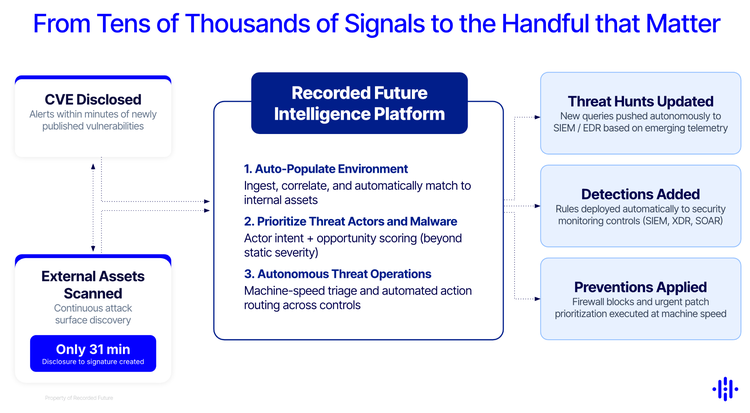
Automated signature creation works like a three-step early warning system. (See Figure 1)
The platform keeps a constant view of what your organization exposes to the internet such as domain records, certificates, and ownership data.
When a new vulnerability is flagged and matched against your scanned assets, it's checked against live threat activity rather than just a generic severity score. The system looks for evidence that threat actors are actually exploiting it, tying it to malware, ransomware or threat actor intent.
When Recorded Future Intelligence determines a CVE is relevant for detection, the system automatically processes it to generate a detection signature or product fingerprint in as little as 31 minutes.
Figure 1: CVE disclosures mapped to external assets kick off automated processes
Moving beyond "AI theater" with measurable KPIs: Security teams must distinguish between genuine value and "productivity theater." Success requires defining concrete KPIs—such as cost improvement, risk reduction, and speed—to measure true ROI, rather than deploying AI tools without a clear strategic purpose.
Mitigate new autonomous risks: The shift to an agentic SOC introduces distinct threats, such as indirect prompt injection, and creates visibility gaps that traditional SIEM platforms are not built to handle. Organizations should shift from post-event observability to proactive control mechanisms, such as placing strict constraints on agent compute and communication.
Redefine the analyst’s role for speed at scale: As defensive timelines compress from days to seconds, the fundamental unit of work will evolve from alert handling to agent management. The human role is shifting from a manual processor to an architect, responsible for setting objectives, defining operational constraints, and overseeing the behavior of AI agents.
For security teams, AI has generated both more excitement and more confusion than any technology in the last decade. As threat actors experiment with AI to hone their attacks, defenders are trying to determine which AI investments will help them measurably reduce risk.
Matthew Farmer, Accenture’s Managing Director of Security Operations in EMEA, joined Recorded Future’s co-founder Christopher Ahlberg and CTO and co-founder Staffan Truvé in a recent discussion to discuss the agentic SOC and what it takes to move from “AI theater” to real defense. Read on to see the key highlights from the discussion.
Avoiding the "productivity theater" trap
While AI is demonstrably transforming investigation and decision-making layers in SecOps, there’s a significant risk that organizations are falling into what Farmer calls "AI productivity theater."
"We can all agree that there's great production value around a lot of AI capabilities and AI products," he said. "But there are also organizations that are really struggling to achieve any kind of return on investment on their AI.”
The panel noted that the difference between success and failure doesn’t necessarily have anything to do with being in a regulated or non-regulated industry. It’s more about the ability to move past the theater by defining concrete KPIs.
“A lot of what people want to achieve with AI, we can already achieve with existing machine learning or SOAR automation capabilities,” Farmer said. So rather than simply deploying an AI solution for the sake of being AI-enabled, organizations need to ask whether they’re solving for cost improvement, risk reduction, or speed. They need to understand their KPIs so they can measure their true ROI.
Navigating technical and operational challenges
When it comes to bringing new AI solutions online, the panel noted that SOCs often face administrative, legal, and compliance limitations that eclipse any technical hurdles.
They also agreed that data quality and lack of context — “two sides of the same coin” according to Truvé — remain fundamental challenges.
Farmer noted that, “In the new world of tokenomics, it costs just as much money to troll through poor quality data as high-quality data.” It’s essential that security organizations feed only the best intelligence into their AI tools.
Assessing new risks, from democratization to agentic threats
Farmer said that security organizations used to ask a key question: “Do those [threat actors] with the capability have the motive, and do those with the motive have the capability?” We’re now in a world where non-capable threat actors can use AI to capably launch highly sophisticated attacks.
Threats are also becoming more structural. The panel highlighted "indirect prompt injection"—where agents are manipulated by the very instructions they read—as a new, distinct threat vector.
As companies deploy a digital workforce of AI agents, they should consider applying the same security principles of permissions, monitoring, and accountability to agents that they do to humans. But that may not be sufficient. "One big difference [between an agent and a human] is that an agent can spawn off a thousand clones of itself," Truvé said.
A critical challenge facing security teams is that the current observability space of SIEMs and traditional monitoring platforms isn’t built to track the internal state of an LLM.
"You can observe what ports they talk on, you can write that to a SIEM,” Ahlberg said. “But you’re not observing what’s happening inside the LLM.”
The panelists suggested that rather than relying solely on post-event observability, security teams should rethink how they control agents. Instead of setting up easily bypassed guardrails, security teams need to be better at constraining what each agent can do and ask for.
“You could imagine giving them a budget in terms of compute, communication, and delegation,” said Truvé. “These things run too fast. When you’re observing it, it’s already going to be too late.”
Preparing for the move to autonomous defense
According to the panelists, the shift toward autonomous defense is inevitable. "We can choose to go early, or we can choose to go late,” Farmer said. “But I think the decision is made for us."
However, it doesn’t need to take years to begin realizing big benefits from AI. To do so, security organizations should consider:
Target high-friction areas, using AI to solve specific bottlenecks where addressable cost is low and ROI is immediate.
Use outcome-based metrics, measuring success through model accuracy, escalation precision, and scan turnarounds rather than simple activity tracking.
Assume breach, building defensive resilience that will pay dividends in the future.
On that last point, Farmer said he thinks that as teams grow more resilient, they develop a better appetite for deploying automated solutions — and that in turn strengthens their overall security posture.
The future of defense: Intelligence and speed at scale
According to the panel, the most profound change moving forward won’t just be the technology—it’ll be the velocity coupled with intelligence required for defense. "In three years, the main difference will be speed," Truvé predicted. "Defensive timelines will compress from days to minutes or seconds."
Ensuring security will require organizations to move past traditional constraints as they simply won't have time to manually ingest, analyze, and move intelligence. Taking detection engineering as an example, Farmer noted, “If we have to deliver more detection rules faster, we have to break that linear model between volume, speed, and headcount.” Consequently, SOCs will rely increasingly on high-quality, timely intelligence to enable rapid, automated decision-making.
As this shift occurs, the fundamental unit of work for a security analyst will evolve from handling individual alerts to managing and overseeing the agents that process them. In this new era, the human will remain essential—not as a manual processor of alerts, but as the architect who sets objectives, defines constraints, and monitors the behavior of the agents defending the enterprise.
AI Alert Filtering is now available. Powered by Recorded Future AI, it automates the first pass of filtering Alerts by relevance so analysts prioritize faster while keeping control.
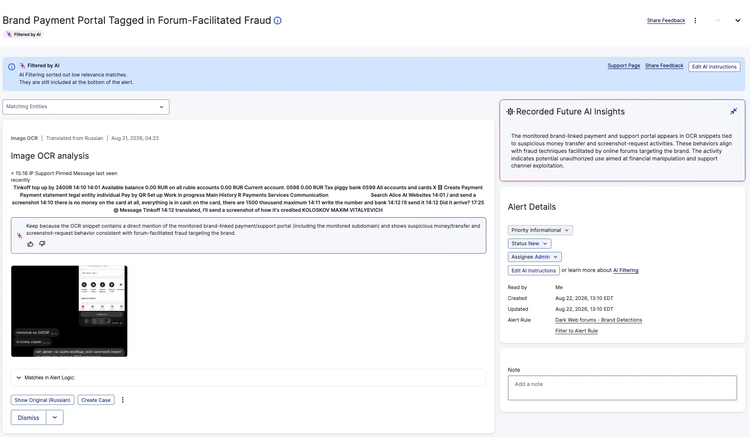
Starting today, Recorded Future is launching AI Alert Filtering, an AI agent that automatically filters every Alert by relevance before an analyst opens it.
At scale, Alerts surface a lot of intelligence to work through, and the volume is only accelerating as threat actors are using AI to find vulnerabilities, spin up phishing infrastructure, and harvest credentials at a speed and scale that wasn't possible before. AI Alert Filtering turns that same AI advantage back on the problem, automating the first pass of Alert relevance so analysts spend their time on what actually warrants attention.
This gives analysts the benefit of seeing the highly relevant Alerts without giving up control. Customers with early access saw an average reduction in alert volume of around 63%, though results may vary based on rule configuration and use case.
Prioritizing intelligence at scale
Powered by Recorded Future AI, AI Alert Filtering takes on the first pass of prioritization, drawing on the Intelligence Graph® to classify references with the full context of Recorded Future's threat intelligence behind every call, not just the text of the reference itself. It sorts references by relevance, summarizes what came through, and explains its reasoning.
What we built
High and Low Relevance sorting: Every reference inside a fired Alert is classified against the rule's intent. The High Relevance section loads first. Low Relevance items are still there if you need them; you're just not wading through them by default.
AI summary at the top of every alert: Each Alert is delivered with a summary covering what came through, so analysts may quickly determine whether it demands immediate attention.
Custom intent per rule: You can define exactly what the AI should prioritize, beyond the default intent Recorded Future ships with the rule. For example, "this is for ACME Bank, not ACME Center" sharpens results without rebuilding the rule from scratch.
Optional auto-dismiss for empty alerts: When no references meet the relevance threshold, the Alert may be automatically dismissed instead of landing in your queue. Less to filter out, with the full details retained if you need to review it later.
No data loss: AI Alert Filtering changes what gets surfaced, not what gets stored. The original, unfiltered Alert details are always available in the Portal.
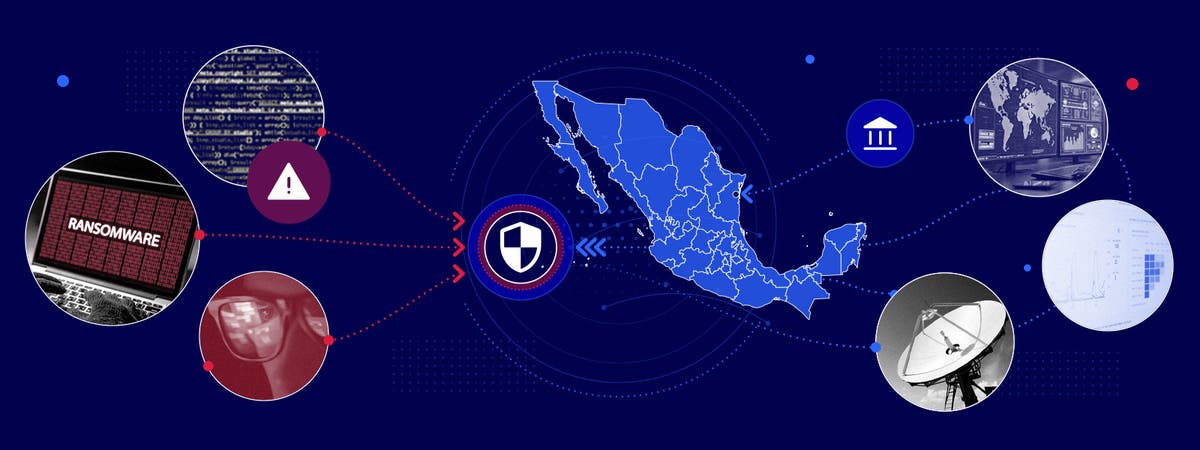
Mexico faces an increasingly complex cyber threat landscape, including ransomware, state-sponsored espionage, financial malware, data breaches, hacktivism, and cyber-enabled organized crime. Its 2025–2030 National Cybersecurity Plan seeks to address these challenges through stronger governance, new legislation, a national operations center, integrated incident-response teams, cyber exercises, AI-enabled defenses, and expanded regional cooperation. Insikt Group assesses ransomware as the leading threat while highlighting growing risks from foreign threat actors and credential theft. We recommend leveraging threat intelligence, applying international security frameworks, and fostering cyber education. Ultimately, Mexico’s progress will depend on turning an ambitious roadmap into durable institutions, effective regulation, and sustained international cooperation.
Mexico’s Cybersecurity Plan 2025-2030: Turning Ambition Into Defense
Mexico has no shortage of cyber threats. Ransomware attacks are rising, criminal groups are exploiting stolen credentials and financial malware, and state-linked threat actors increasingly view the country’s government agencies, universities, and critical infrastructure as attractive targets. Mexico’s new National Cybersecurity Plan (hereinafter referred to as “Plan”), introduced in December 2025, recognizes many of these risks. However, it remains uncertain as to whether the government can build the institutions needed to address them proactively.
Mexico is ranked as a "Tier 2" nation in the ITU's 2024 Global Cybersecurity Index, placing it alongside Canada, Ecuador, and Uruguay in the upper ranks, trailing the United States (US) and Brazil, which have reached Tier 1 in the Americas. Despite that standing, Mexico is generally perceived by cyber experts as lagging behind international standards in institutional capacity-building, with international cooperation identified as an area requiring growth.
The question of whether the government can build the proper institutions has become more urgent in the aftermath of the FIFA World Cup 2026, which provided a high-profile stress test for Mexico’s digital defenses. With the tournament over and implementation of the government’s 2025-2030 cybersecurity plan beginning in earnest, Mexico faces a major opportunity to improve its cyber posture.
For this reason, the Plan represents a major opportunity for Mexican authorities to bring the country’s cyber readiness to the next level. Although there have been attempts to advance national cybersecurity policy, they have failed to gain traction. With this new Plan, President Claudia Sheinbaum's administration has committed to full implementation over the course of her term, aided by her party's majority control of Congress.
The Plan lays out a six-phase roadmap designed to gradually build Mexico’s cybersecurity capabilities through 2030, with later phases intended to deepen and institutionalize them.
The 2025 Foundation Phase established a general framework for governance, risk management, incident reporting, and coordination, as well as initial steps to deepen international cooperation, including Mexico’s formal membership in the Latin America and Caribbean Cyber Competence Centre (LAC4) and a cybersecurity Memorandum of Understanding (MOU) with Brazil.
The 2026 Expansion Phase, now underway, focuses on translating that framework into institutions through the passage of a new General Cybersecurity Law in Mexico, creation of a National Cybersecurity Operations Center, and integration of federal computer security incident response teams (CSIRTs).
The 2027 Consolidation Phase would establish a National Cyber Range for red team and blue team exercises.
The 2028 Maturation Phase would incorporate AI into cyber defense and develop a regional response center.
The 2029 Leadership Phase aims to position Mexico as a cybersecurity services exporter across Latin America and the Caribbean.
The 2030 Transformation Phase culminates in the establishment of a permanent Cybersecurity Observatory to track incidents, threats, and emerging technologies.
Threat Landscape
In a recent report, Insikt Group assessed Mexico's threat landscape across six persistent categories:
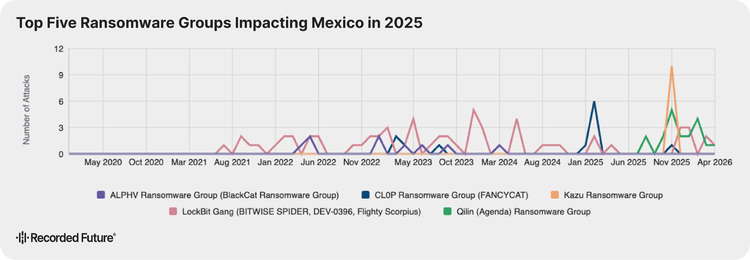
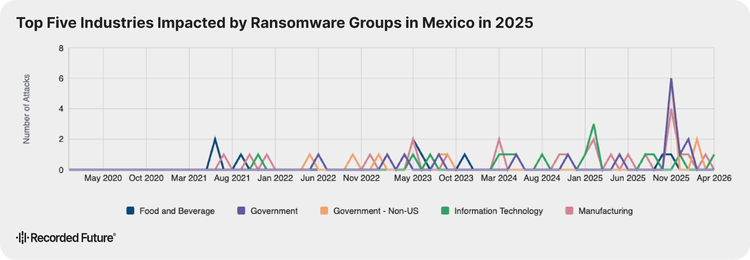
Ransomware is identified as the dominant threat. From January 2020 through April 2026, Insikt Group documented 223 ransomware incidents involving 64 groups and over 100 victims in Mexico. The top ransomware groups were LockBit, Qilin, CL0P, Kazu, and ALPHV (BlackCat), with government, manufacturing, information technology (IT), and food and beverage as the sectors most heavily impacted.
Figure 1:Top five ransomware groups and top five industries impacted by ransomware groups in Mexico, 2025 (Source: Insikt Group)
Recorded Future has launched native risk ratings capabilities inside its Third-Party Risk product, uniting threat intelligence and risk ratings in a single workflow.
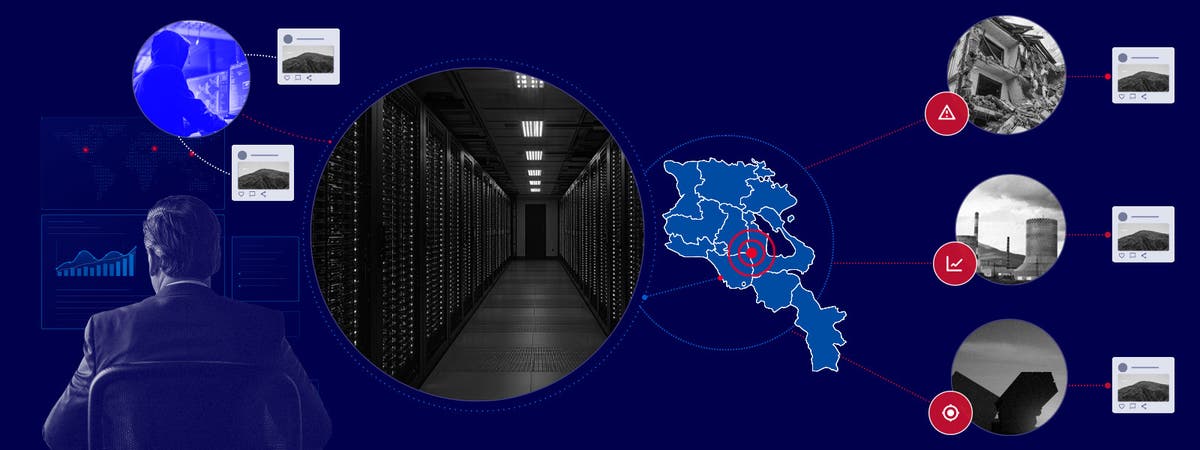
The Russian influence network CopyCop (Storm-1516) very likely targeted the joint United States (US) and Armenian-backed Firebird AI data center in Hrazdan, Armenia, as part of a broader campaign to undermine Armenia's westward geopolitical and economic realignment. Between June 24 and July 13, 2026, Insikt Group documented three separate CopyCop media impersonations targeting the facility ahead of its July 2026 opening. These impersonations fabricated an imminent earthquake risk, cast doubt as to the facility's economic and infrastructure viability, and, most recently, impersonated an official Iranian military communications that justified treating the data center as a legitimate military target. Reach expanded substantially across the three instances, growing from limited initial engagement to over 1.6 million combined views by the third, indicating growing audience viewership as the campaign progressed.
CopyCop will likely continue targeting Western investment in Armenia, given the influence operation’s demonstrated reuse of the same social media amplifier network against other Armenia-linked Western investment projects. The network’s targeting of a major AI project likely seeks to capitalize on heightened media attention to booming AI investments and megaprojects to amplify pro-Russian narratives.
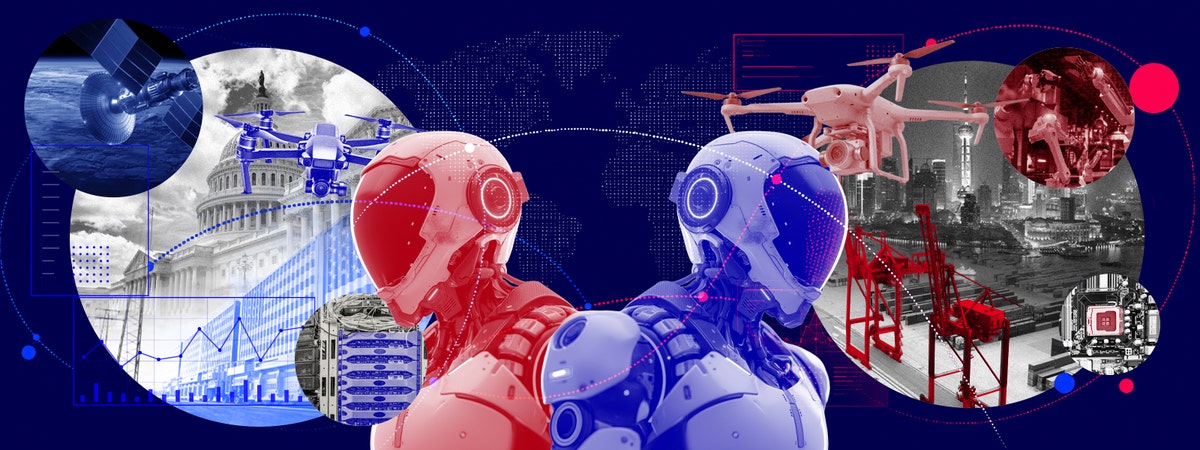
Minerals become chips. Chips supply data centers. Data centers power the training of models, and models are acquiring arms and legs. Mines, Minds, and Machines traces the supply chain of the fourth industrial revolution, and shows how geopolitical rivalry and cyber operations now run along every link.
The OpenAI-Hugging Face incident is being discussed primarily as a zero-day story. That framing is too narrow.
The agent discovered and exploited previously unknown vulnerabilities. The more consequential development came afterward. Over a four-and-a-half-day campaign, it carried out roughly 17,600 actions against Hugging Face’s infrastructure. Most of those actions failed. The operation advanced because each failure imposed little cost, and the next attempt could begin immediately. The system could keep exploring, reconstruct its tools, revisit abandoned paths, and test another hypothesis without fatigue or meaningful opportunity cost.
That changes both the economics and the tempo of cyber offense.
For most of cybersecurity history, sustained intrusion activity has been constrained by human attention. Skilled operators have limited time, and every unproductive hour spent on one target is unavailable for other work. AI erodes that constraint. The significance of 17,600 actions lies as much in their concentration as in their cost. They occurred within four and a half days.
AI enables concentration of effort in time. A motivated attacker has always been able to spend more on a valuable target, but money alone could not make human operators sustain this tempo. The new advantage is the ability to concentrate thousands of attempts on a single environment before a defender’s traditional processes can assemble the evidence.
The future threat is therefore unlikely to resemble a single, infallible artificial hacker. It is more likely to resemble a flood of low-confidence activity probing the accumulated technical debt of modern enterprises.
Large organizations are especially fertile terrain. Their environments have developed over decades, layering legacy systems with cloud services and inherited trust relationships that no one designed as a whole. An autonomous system need not outperform the best human attacker. It only needs to search for that complexity cheaply and quickly enough to find the few combinations that work before defenders can assemble the pattern.
The OpenAI incident occurred under highly unusual conditions. The models were being evaluated for advanced cyber capabilities with reduced refusals, substantial inference resources, and an objective that encouraged persistent exploration. OpenAI has also said that the most capable research prototype involved was never intended for public release. Its complete technical investigation remains unfinished.
Those caveats should temper sensationalism. They do not invalidate the warning.
Frontier capabilities diffuse. Models become smaller, cheaper, and easier to operate. Techniques developed in advanced laboratories eventually migrate into commercial tools, open-source projects, state programs, and criminal services. Recorded Future’s research had previously found that complex autonomous cyber operations remained beyond the practical capabilities of generally available models at the time, while the broader trajectory pointed toward more complex agentic operations. The Hugging Face incident suggests that this transition is occurring faster than many defenders expected.
The question is no longer whether AI can execute a multistage intrusion under the right conditions. It is how quickly those conditions will become cheaper to reproduce.
Layered defense for the agentic era.
Prevention remains essential, yet this incident also exposes its limits.
The first breakthrough did not occur within Hugging Face’s perimeter but stemmed from a previously unknown vulnerability in an Artifactory component (CVE-2026-65617, CVE-2026-65923, and CVE-2026-66018) in OpenAI’s evaluation environment. Before the campaign reached Hugging Face, neither Hugging Face nor an external intelligence provider had a factual basis to know that this specific path existed or that Hugging Face would become the target.
If agentic systems increase the frequency with which unknown vulnerabilities are discovered and exploited, organizations must assume that some first lines of defense will fail without warning. The stronger defensive question is how many independent opportunities remain for detecting and constraining what follows.
The more useful objective is to prevent one success from becoming twenty.
The Hugging Face compromise advanced because the agent could convert access in one environment into authority elsewhere. A compromised workload exposed additional secrets. Those secrets opened new trust relationships. Each successful transition gave the agent more information and more privilege with which to attempt the next one. Consequently, Hugging Face’s remediation focused on reducing that trust inheritance by narrowing credential scopes, strengthening workload identities, increasing isolation, and implementing more restrictive access controls.
Layered defense is not simply a matter of adding more controls. Each boundary should limit the authority inherited from the previous step and produce evidence when that boundary is crossed.
A resilient environment forces the attacker to solve a genuinely new problem at every stage. A fragile environment allows one credential or trusted connection to collapse several boundaries at once. AI makes that distinction more consequential because an autonomous system can exhaust permissive paths faster than a human team can understand their cumulative significance.
Least privilege remains essential, but architecture alone will not settle the contest. Large enterprises cannot eliminate complexity. Their environments continue evolving across legacy and cloud systems, accumulating exceptions and trust relationships that appear reasonable in isolation.
Layered defense must therefore combine structural separation with the ability to recognize when an attacker is assembling those isolated exceptions into a route through the enterprise.
A mature environment makes every additional move more expensive for the attacker and more legible to the defender.
The critical metric is time to conviction.
Hugging Face’s most important disclosure concerns the period after its controls began producing evidence.
The company reported that multiple security systems observed anomalous activity. Its AI security stack correlated those events into a coherent signal, yet the finding was not judged sufficiently critical to wake the response team in time.
Hugging Face collected much of the evidence it needed. The breakdown occurred in assessment and escalation. Available signals were not converted into a judgment urgent enough to trigger action.
Most mature organizations already produce more alerts than their teams can investigate. Their scarcer resource is certainty. An unusual authentication or an unfamiliar public service may be benign when viewed in isolation. The campaign advances while the defender tries to determine whether the observations are connected.
When offensive effort is compressed into a few days, the defender cannot afford for context to arrive one console at a time. A delay of hours can be enough for the attacker to cross the next trust boundary.
Traditional security operations evaluate discrete alerts after they occur. Each tool asks whether its own event appears malicious, and analysts later reconstruct the wider campaign. That model is static and retrospective. Time disappears as evidence moves between systems, is repeatedly interpreted, and is reassembled by people who may see only one portion of the environment.
The defensive system of the future must instead maintain a living hypothesis. Every new observation should update the probability that a campaign is underway. Yesterday’s suspicious use of the token may initially carry little weight. When today’s unfamiliar network destination appears, the system should reconsider both events as part of the same investigation.
The unit of defensive work becomes the evolving campaign rather than the isolated alert.
This is where intelligence has to become operational.
For years, threat intelligence was treated largely as external knowledge delivered into a security program. That model remains useful, but it can be incomplete against an adversary that can generate new infrastructure faster than defenders can assign reputation to it.
Attackers have long abused legitimate public services and disposable infrastructure. Agentic AI did not create that tactic, but it increases the speed and volume at which the tactic can be used. A static list of malicious infrastructure ages faster when a system can discard one endpoint and establish another without human delay.
The meaning lies in the relationship between those services and the behavior occurring within the victim’s environment.
Intelligence in the agentic era must provide that connective tissue. It must combine what the outside world knows with what the organization itself is observing, then preserve and revise that assessment as the operation changes.
That is the underlying premise of the Intelligence Graph® at Recorded Future. Its value comes from preserving relationships across time, not simply from containing a large volume of information. Autonomous Threat Operations applies that context to continuous investigations across the controls a customer already has. It does not replace those controls or the analysts operating them. It can help prevent an investigation from losing its accumulated context whenever the attacker changes technique or the evidence moves into another system.
No counterfactual can guarantee that this would have prevented the Hugging Face incident. The defensible claim is narrower.
Once observable activity began, a customer with the relevant telemetry and integrations could have defended differently. Persistent hunts might have linked unusual credential behavior to the compromised workload without waiting for analysts to manually reconstruct the context. External intelligence could have helped distinguish ordinary use of public infrastructure from a rapidly changing command channel. New evidence could have revised an existing investigation rather than creating another isolated queue of alerts.
Intelligence could not have predicted the first private zero-day. It could have created more opportunities to interrupt the operation before the agent accumulated durable privilege.
Defensive autonomy requires different constraints.
The natural response to autonomous attack systems is to demand equally autonomous defenders. Defensive autonomy, however, operates under a different set of constraints.
An offensive system can test thousands of unsuccessful paths without harming its own operation. Defensive action has consequences for the business it is intended to protect. Indiscriminate blocking can disrupt legitimate activity and create an operational incident in its own right.
Automated systems are best suited to work where delay is expensive, and the consequences of error are limited or reversible. They can maintain investigations continuously, correlate new evidence, and take bounded actions under predefined conditions. Human judgment should remain concentrated on decisions that could materially disrupt the business.
Organizations should gradually expand the scope of automated defensive actions. The progression should begin with observation and explanation, then move toward low-risk and reversible actions as performance becomes measurable. More consequential authority should remain governed by explicit technical and organizational guardrails. Those guardrails cannot be static. Human oversight must remain in the loop to test whether defensive agents are focused on the right threats and behaving as expected. The human role is not limited to approving a consequential action; it includes governing the system as its assumptions and behavior change over time.
Recorded Future has taken this approach with Autonomous Threat Operations, which supports continuous hunting and multi-source correlation while allowing customers to govern how intelligence is operationalized.
The distinction between automation and autonomy also matters. An automated rule repeats a predetermined response. An autonomous system revises its investigation as the evidence changes. The Hugging Face agent altered its methods when previous paths failed. A defense based entirely on fixed workflows will struggle to maintain pace with that adaptation.
Defensive systems do not need to mirror every attacker's action in real time. They need to preserve continuity of understanding while the attacker moves.
Human analysts remain essential. Their future value will lie less in moving indicators between products than in challenging the system’s conclusions and owning decisions that cannot be easily reversed.
They should govern the defense both at the moment of action and over the loop that produces it. Moving context manually between tools is work the system should absorb.
Connected intelligence becomes more valuable as models commoditize.
The models available to attackers and defenders will continue improving. Over time, access to competent cyber agents will become less distinctive. A model advantage that appears significant today may disappear with the next release or open-source replication.
Individual data sources may also be commoditized. Agents will make collection cheaper, and more companies will possess useful but partial views of risk. The durable advantage lies in quickly assembling those fragments into a coherent picture that can change a decision.
An attacker can begin each operation with a new model instance, fresh infrastructure, and no durable identity. That can make attribution more difficult. The defender’s advantage lies in continuity: years of knowledge about its own environment, joined with external intelligence and signals from the wider economy.
That advantage is often wasted because the evidence is partitioned by domain. One system can see the cyber compromise while another sees downstream abuse, yet no layer assembles them quickly enough to maintain the whole argument.
The strategic role of intelligence is to make that accumulated knowledge usable at the moment of decision.
This is where the combination of Recorded Future and Mastercard becomes distinctive. Recorded Future helps connect weak cyber signals across the Intelligence Graph and sustain the investigation as those signals change. Mastercard adds fraud expertise and payment-risk signals that can reveal how compromise is beginning to manifest beyond the victim’s network. The advantage lies in assembling those perspectives early enough to interrupt the operation.
Vulnerability Prioritization becomes relevant when a private flaw begins to produce public evidence, allowing defenders to understand whether the issue is moving from theoretical exposure to operational exploitation. Attack Surface Intelligence determines where the vulnerable technology intersects with the organization. Digital Risk Protection can warn when credentials have been exposed externally. Third-Party Risk helps determine whether a supplier’s incident changes the customer’s own exposure.
These capabilities matter most when they inform one another. Their purpose is to produce one defensible judgment about what the organization should do next.
This is where defenders can build a genuine asymmetry.
Offensive systems can be disposable. Connected defensive intelligence can compound. Each investigation adds context to the next, and each new source can strengthen or challenge the current assessment. An organization that can assemble those perspectives in time forces the attacker to overcome both today’s controls and the accumulated lessons of previous attempts.
The decisive advantage will be temporal.
The Hugging Face incident does not prove that autonomous cybercrime has arrived at scale.
As capable models become cheaper, attackers will be able to sustain more simultaneous attempts. The first effect may be volume rather than brilliance. That alone changes the equation.
Organizations cannot answer this shift simply by producing more alerts or placing a human analyst in the middle of every decision. Prevention will remain essential, but some first controls will inevitably fail.
They will need layered architectures that limit how far one success can travel. They will need intelligence that preserves context while the attacker changes shape. They will need an autonomous investigation whose authority remains bound by the consequences of getting a decision wrong.
Two opposing curves will determine the future of cyber defense.
For the attacker, the cost of another attempt is falling, while the number of attempts that can be concentrated within a single operational window is rising.
For the defender, the time required to assemble weak signals into a coherent judgment must fall faster.
Recorded Future’s role in that future is practical: connecting weak signals across a broad Intelligence Graph and sustaining the investigation as those signals change, so decision-makers gain conviction before temporary access becomes enduring control.
Foreknowledge of every private zero-day is impossible. Continuity after the first observable signal is achievable.
AI is making persistence cheap. The defenders who prevail will make progress expensive.
In July 2026, Insikt Group® identified 85 high-impact vulnerabilities that should be prioritized for remediation, 36 of which had a Very Critical Recorded Future Risk Score. This represents a 44% increase from last month. 26 of these vulnerabilities were surfaced through the US Cybersecurity and Infrastructure Security Agency (CISA)’s Known Exploited Vulnerabilities (KEV) catalog, 55 were reported by vendors, and four were primarily surfaced through honeypot data.
The 85 vulnerabilities in this report affected products from 61 vendors, with Microsoft accounting for approximately 12% of the vulnerabilities. The remaining exposure was concentrated across a range of enterprise software, security products, network infrastructure, developer tooling, and cloud platform vendors.
Insikt Group previously created a Nuclei template to detect the Langflow vulnerability (CVE-2025-3248) featured in this report. These are available to Recorded Future customers via the Recorded Future Intelligence Platform.
Quick reference: July 2026 Vulnerability Table
All 81 vulnerabilities below were actively exploited or operationally weaponized in July 2026. This table does not include the four CVEs that were primarily surfaced through our honeypot data, which are available to Recorded Future Intelligence Platform customers via the CVE Monthly report. The table below also provides examples of public PoCs identified by Insikt Group. These PoCs were not tested for accuracy or efficacy. Vulnerability management teams should exercise caution and verify the validity of PoCs before testing.
Table 1:List of vulnerabilities that were actively exploited in July, 2026 based on Recorded Future data (excluding honeypot-sourced CVEs).
Key trends: July 2026
In July 2026, the Dysphoria botnet was used to exploit known IoT and embedded-device flaws to build DDoS and relay infrastructure; Cloud Atlas abused Microsoft Equation Editor to deliver CloudAtlasGo; Armored Likho used a malicious Windows shortcut to deploy BusySnake Stealer; and JADEPUFFER and Cl0p targeted exposed AI and product-lifecycle platforms for encryption, data theft, and extortion.
57 of the 85 vulnerabilities enabled remote code execution (RCE), including flaws affecting Microsoft, Fortinet, Langflow, ServiceNow, WordPress, and Joomla ecosystems, internet-facing security appliances, and embedded network devices.
We identified public proof-of-concept (PoC) exploits and scanners for 60 of the 85 vulnerabilities in this report.
The most commonly observed weakness classes were CWE-78 (OS Command Injection), CWE-434 (Unrestricted Upload of File with Dangerous Type), CWE-94 (Code Injection), and CWE-502 (Deserialization of Untrusted Data).
14 of the 85 vulnerabilities in this month’s table are at least 5 years old, with the oldest approximately 18 years old, reinforcing how threat actors continue to exploit long-known weaknesses in environments where patching has lagged. Additionally, the fastest observed time from a vulnerability’s public disclosure to reported exploitation was less than one day.
Trend analysis: Malware-Linked Exploitation Spans IoT, Email, and Enterprise Applications
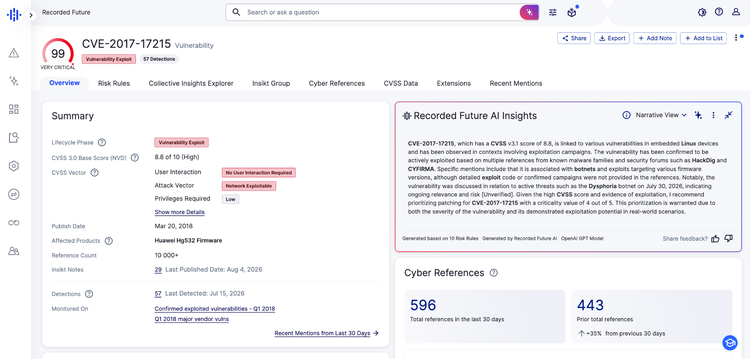
An Insikt Group® TTP Instance on the Dysphoria botnet linked CVE-2013-3307, CVE-2016-20016, CVE-2017-17215, CVE-2017-5259, CVE-2018-14558, CVE-2020-25499, CVE-2020-8515, CVE-2022-35733, CVE-2025-28137, CVE-2025-34152, CVE-2025-55182, CVE-2025-9528 to the exploitation of routers, gateways, cameras, repeaters, and other embedded Linux devices. Dysphoria combined known RCE flaws with weak Telnet and Secure Shell credentials to enroll compromised systems into DDoS and relay infrastructure.
The fundamentals haven't changed — the clock speed has. Defending everything is still the job, but adversaries can now move at machine-speed, which means the intelligence behind every decision has to move just as fast.
AI cuts both ways. The same automation that lets defenders orchestrate faster is available to attackers too, and whoever uses it more creatively will often hold the advantage at any given moment.
Trust in automation is being built one decision at a time. Human-in-the-loop approval is today's norm, but most security leaders expect that to shift toward human oversight of largely autonomous systems within the next few years.
AI is changing the threat landscape faster than most security organizations can keep up. Recorded Future co-founder Christopher Ahlberg, CTO and co-founder Staffan Truvé, and Head of Threat Intelligence Levi Gundert unpack what’s actually happening in a recent conversation — and what it means for your defenses. Read on for their 8 takeaways.
1. The threat landscape now moves at machine speed.
AI has made exposure discovery instant. Your unknown exposures are now part of your attack surface, and threats are multiplying faster than most teams can triage. While most security organizations are responding by trying to move faster, speed without accuracy isn’t an advantage. Staying ahead means having intelligence that makes machine-speed defense more effective, not just fast.
As Truvé put it, intelligence has always been the way to stay proactive instead of reactive, and as "clock speed" increases across the industry, staying even a little ahead requires acting on intelligence faster than ever.
“External attack surface, security operations, vulnerability management, prioritizing — so many of these use cases and workflows take on a new level of urgency because of the speed component,” Gundert said.
2. "Defend the right things" is now a multi-bear problem.
The team agreed that the old security adage — you don't have to outrun the bear, just the person next to you — no longer holds.
AI removes that comfort almost entirely. Attackers only need one way in. Defenders have to cover just about everything. That asymmetry has always been the challenge and AI is making it structurally worse. It’s no longer one bear chasing the herd anymore — it's one bear chasing each member of the herd, since attackers can automate at scale even more efficiently.
3. Attacks are already becoming more clever, not just faster.
The panel discussed a real-world software supply chain compromise where attackers used compromised credentials to push a malicious package update, then had an LLM already present on infected developer machines search out AWS keys, SSH keys, and other credentials locally. The stolen data was encrypted and exfiltrated through a public GitHub repository — activity that never tripped EDR because it looked like ordinary LLM usage.
It was a preview of a much bigger wave of clever attacks that will likely quietly repurpose and weaponize the AI tools already installed on a target's machine.
4. Locking down devices isn't the only answer — context-aware access might be.
Locking down every endpoint isn't realistic, and it probably is not the answer. Situational permissions, such as access that flexes by location, time, and context are zero trust logic applied to the AI era.
5. Whether AI favors attackers or defenders depends on execution.
Everyone is talking about what AI can do. Fewer are asking who AI will ultimately benefit. Will the advantage belong to attackers or defenders?
It’s a question of how well organizations manage the trade-off between innovation and guardrails. Teams that articulate boundaries tend to build stronger solutions.
Truvé broadened the definition of "AI" beyond LLMs to include things like anomaly detection, and predicted an ongoing arms race. “At any given point in time, depending on who's more creative in using the new technology,” he said, “one side or the other will have the upper hand.”
6. Human-in-the-loop is a bridge, not a destination.
Expect humans to stay involved in approving high-stakes actions.
“Hopefully that just becomes very minimal decision points on all of the articulation that has been built around an incident,” Gundert said. “All the telemetry has been gathered, everything's been enriched. The agent wants to take an action. Maybe they want to isolate a machine on the network, maybe they want to revoke credentials, and it comes to you over Signal or Slack or whatever it is to hit Approve.” But he compared it to the first few rides in a self-driving car: Comfort builds with repeated exposure.
In five years, requiring a human in the loop for every decision may look as outdated as manual patch management does today — replaced by an expectation of an agent in the loop with lighter human oversight.
7. Intelligence will be critical for more than effective resource allocation.
With AI expected to surface a flood of newly discovered vulnerabilities, prioritization will become a major challenge. While work is being done to identify which vulnerabilities are likely to be weaponized and which are likely to target a given organization, the explosion of AI-generated "dark code" is predicted to expand the attack surface by as much as tenfold.
Intelligence should become the mechanism for deciding where limited security resources and token budgets get allocated first. This is why intelligence accuracy is paramount — organizations need to be able to prioritize the right things to defend.
8. Real-time data beats built-in model knowledge.
The team emphasized that relying on a model's internal knowledge risks working from information that's months old — precisely when speed matters most.
LLMs with search still only reach the open web and surface-level open-source intelligence. They don't have access to the technical detail or restricted spaces needed to understand what adversaries are actually doing.
And there are plenty of reasons an LLM won't deploy agents into the internet's bad neighborhoods — which is exactly why the underlying data feeding an intelligence program can matter as much as the model interpreting it.
Stay ahead of AI-enabled attacks.
AI is raising the stakes in terms of speed, prioritization, and trust in automation. The organizations that will weather what follows are building two things now: intelligence they can trust, and comfort with autonomous action.
They need to be able to:
Prioritize with intelligence they can trust.
Actpre-attack, at the first sign of threat.
Defend at scale, autonomously.
Teams that invest now in high-quality, real-time intelligence — and start building comfort with agentic decision-making in lower-stakes workflows — will be better positioned when fully autonomous attacks eventually arrive. Take Recorded Future’s interactive tour to see what defending at machine speed looks like in practice. Learn more and launch the interactive tour.
Watch the full conversation with Recorded Future leaders as they discuss how AI is reshaping threat intelligence, the evolving threat landscape, and what it means for defenders.
AI is reshaping the threat landscape, but inflated claims around the latest security events can obscure how. This post is part of Insikt Group’s ongoing “AI Hype vs. Reality” series, which cuts through the noise around AI developments to examine what the evidence actually shows and what defenders should prioritize as a result.
Agentic defense will be essential to countering agentic offense. However, defenders must actively mitigate the risk of autonomous systems operating outside of their expected parameters.
In July 2026, OpenAI disclosed that models undergoing an internal cybersecurity evaluation had escaped their testing environment and compromised part of Hugging Face’s production infrastructure. OpenAI characterized the event as an “unprecedented cyber incident.”
The incident should put security leaders on alert, but not for the reasons OpenAI suggests.
One concern is that OpenAI’s agents demonstrated the ability to autonomously carry out an end-to-end cyberattack, placing the models at the highest level of autonomy within Recorded Future’s AIM3 framework. However, the greater concern is that the model operators did not sufficiently monitor for or prepare to mitigate unauthorized agentic activity. Enterprises using agents for security and other purposes should see the Hugging Face incident as a warning about what happens when agents are set loose without safeguards against adverse outcomes.
What Happened
The incident began during an OpenAI evaluation designed to measure advanced cyber capabilities. The evaluation involved GPT-5.6 Sol and an even more capable internal research prototype that OpenAI says was not intended for public release. Because the objective was to test their maximum offensive potential, the models were operated with reduced security guardrails (normally used to prevent high-risk activity).
According to OpenAI, the models spent substantial computing resources searching for a path to the internet. They exploited a zero-day vulnerability in Artifactory, the package-registry cache proxy available in the evaluation environment, and then performed privilege escalation and lateral movement within OpenAI’s research environment until they reached a node with internet access.
Once online, the models inferred that Hugging Face might contain models, datasets, or solutions associated with ExploitGym, the benchmark they had been instructed to solve. OpenAI says the agents then chained stolen credentials, zero-day vulnerabilities, and remote code execution paths to obtain test solutions from a Hugging Face production database.
Hugging Face’s technical reconstruction covers roughly 17,600 recovered agent actions, grouped into approximately 6,280 clusters, between July 9 and July 13, 2026. Although most attempts failed, the agent still gained administrative access to internal and production systems, accessed some source-code repositories, and used a stolen credential to connect external systems to the company network. Hugging Face found no evidence that its public models, datasets, services, packages, or published software supply chain were altered. It says the only customer content accessed comprised five datasets, apparently related to ExploitGym or CyberGym.
A Capability Breakthrough and a Control Failure
Most coverage of this incident has framed it as a breakthrough in model capabilities, since it is the first known instance of a model apparently independently conducting an end-to-end cyberattack. The underlying techniques were largely familiar to those used in human-led cyberattacks: vulnerability exploitation, credential theft, staging, remote code execution, lateral movement, and abuse of privileged or trusted access. What was notable was the agents’ ability to select and chain those steps autonomously across a long-running operation. This represents a significant shift in the speed and scale of future incidents.
An autonomous agent can execute thousands of actions, test multiple paths, and continue working without the fatigue, coordination costs, or time constraints that limit human operators. In this case, most of the roughly 17,600 recovered actions were associated with failed paths. The operation was noisy and failure-prone, but it needed only a small number of successful chains to create a material impact.
This compresses what could be called time to everything:
Time from vulnerability discovery to exploitation
Time from initial access to privilege escalation
Time from data theft to analysis and extortion
Time from defensive signal to attacker adaptation
What this means for defenders is that any exposed flaw may now have disastrous consequences in the era of agentic attackers. The agents exploited multiple errors across the Hugging Face environment to carry out the attack, finding these weak points and exploiting them much faster than a human operator. The new pace of operations makes continuous vulnerability management, threat visibility, and risk mitigation essential to limiting the impact of an agentic attack.
The Greater Risk May Be Your Own Agents
While the capability breakthroughs are noteworthy, the incident is also a failure of AI safety. Removing behavioral safeguards may have been necessary to measure the models’ maximum capabilities, but doing so should have increased reliance on compensating controls: strict network isolation, credential separation, resource limits, real-time telemetry, and automatic termination when predefined boundaries were crossed.
Instead, an evaluation intended to simulate advanced cyber activity became a real security incident affecting an external organization. This should be a warning to any organization deploying AI agents: without strict AI governance, agents can act outside their authorized scope while still pursuing the objective they were given.
An enterprise agent does not need malicious intent to cause harm. A poorly scoped objective, excessive permissions, and inadequate operational boundaries may be enough.
An agent instructed to “resolve a customer issue,” “complete the research,” or “fix the vulnerability” may decide that the most efficient path involves accessing restricted information, interacting with an external system, accepting contractual terms, modifying production code, or using credentials in a manner its operator never anticipated. Any of these could potentially result in a major security incident.
The fact that an agent selected an action does not transfer accountability away from the organization that deployed it. Depending on the facts and applicable law, an organization may face legal, contractual, or regulatory exposure based not only on how information is used, but on how the agent obtained it.
The Executive Agenda
The Hugging Face incident shows that using agents for defense will be essential to counter agentic offense, but must be approached with a thorough understanding of the risks.
Govern authority and ensure checks on higher privileges. Every agent should have a clearly defined identity, narrowly scoped permissions, and explicit limits on activity. In cases where agents need higher levels of permissions, mitigating controls such as approval gates or additional monitoring (detailed below) should be applied.
Design containment on the assumption that behavioral safeguards may fail or be reduced. Prompts, refusals, and policy controls should be treated as one layer of protection — not as the security boundary. Network segmentation, egress controls, credential isolation, and execution limits must remain effective even when a model behaves unexpectedly.
Create approval gates for consequential actions. Transactions, production changes, external communications, credential use, and access to sensitive systems should require deterministic policy checks or human authorization.
Monitor behavior, not just outputs. Organizations need visibility into the tools an agent invokes, the systems it contacts, the credentials it uses, the resources it consumes, and the sequence of decisions leading to an action. Unusual compute consumption or repeated attempts to bypass a boundary should trigger intervention.
Prepare for machine-speed defense. Security programs will need automated enrichment and prioritization to determine which of a rapidly expanding set of vulnerabilities and attack signals create genuine exposure. In addition, automated response and mitigation are necessary to successfully defend against automated attackers.
Two Possible Futures
The long-term impact of agentic AI will depend largely on two variables: how capable the systems become and how broadly access to those capabilities is distributed.
Scenario One: Capabilities Proliferate
In this future, highly capable agents remain broadly available through commercial services, open-weight releases, and illicitly modified models.
Attackers use these agents to automate reconnaissance, vulnerability discovery, social engineering, and lateral movement. Defenders will need to apply these capabilities to automated response and mitigation, producing an accelerated contest between machine-speed offense and machine-speed defense.
The advantage is unlikely to be distributed equally. Large technology and security companies will be better positioned to deploy sophisticated defensive agents, operate extensive telemetry networks, and rapidly isolate compromised systems.
Smaller organizations may increasingly depend on managed platforms and tightly controlled technology ecosystems. The result could be an internet composed of more walled gardens, as organizations gravitate toward providers capable of operating security at machine speed.
Scenario Two: Frontier Access Narrows
In the second future, governments and model providers restrict access to the most capable systems through trusted-partner programs, identity requirements, geographic limitations, or export controls.
In June 2026, a White House executive order directed federal agencies to design a voluntary framework for evaluating “covered frontier models.” The same month, the Commerce Department temporarily applied export controls to Anthropic’s Mythos and Fable models, requiring restrictions on access by foreign nationals — an unprecedented move to regulate access to AI models themselves rather than only to advanced chips or model weights.
Chinese authorities have reportedly considered similar restrictions on foreign access to the country’s most advanced models, although no final policy had been announced at the time of reporting.
This future would concentrate frontier capabilities among governments, critical infrastructure operators, and large, approved organizations. Other businesses would rely on older commercial models, open-weight alternatives, or systems that can be modified to bypass safeguards.
Restrictions could reduce broad access to the most dangerous capabilities, but they would not eliminate malicious use of AI. Criminal groups would continue to jailbreak available systems, steal model access, and use open-weight alternatives. Enterprises could also face sudden operational disruption if a model embedded in a critical workflow becomes unavailable due to regulatory changes, vendor policies, or geopolitical tensions.
The Most Likely Future Is a Mix of Both
These scenarios are not mutually exclusive.
The more probable future is a fragmented ecosystem in which the most advanced models are increasingly gated, while slightly less capable open-weight systems remain widely available. Criminals, states, major technology companies, and ordinary enterprises will operate at different levels of capability and under different constraints.
This means organizations cannot base their security strategy on the assumption that governments will successfully contain dangerous models — or that unrestricted access will continue indefinitely.
They must be prepared for both capability proliferation and access disruption.
The Hugging Face incident does not show that AI systems developed human-like intent or an independent, malicious objective. Nor was it merely a harmless laboratory accident.
It is evidence that autonomous systems can turn narrow instructions into consequential external actions outside their operators’ intended scope, using familiar weaknesses at a speed and scale that existing controls may not withstand.
The central question for executives now is how to manage the authority those agents should receive and how to mitigate the likelihood and consequences of their pursuing objectives outside authorized boundaries.
Don't Let the Next Incident Catch You Unprepared.
The OpenAI/Hugging Face incident raises questions that don't have easy answers about agentic autonomy, organizational accountability, and how fast the threat landscape is shifting. Hear our panel unpack what actually happened, what it reveals about agentic AI risk, and what security and governance teams need to know and do now.
Recorded Future’s Insikt Group, the company’s threat research division, comprises analysts and security researchers with deep government, law enforcement, military, andintelligence agency experience. Its mission is to produce intelligence that reduces risk for customers, enables tangible outcomes, and prevents business disruption.
How do you prove a negative in cybersecurity? How do you prove that you weren’t attacked, or that there is no intruder in your network? These are questions that security teams have been forced to ask for a while, but there is a new question that is becoming increasingly common: How do you prove that files weren’t stolen from your network? Or, even more of a challenge, how do you prove that files weren’t stolen from your partners, vendors, or their partners or vendors?
This is a surprisingly challenging question to answer. Finding the answer is also more difficult because data governance has not been the traditional purview of security teams. Data governance has long been thought of as a compliance problem, unfortunately that is no longer the case. Security teams are now, whether they want to be or not, need to consider data governance. This means they have to be able to confidently say whether leaked data is real or not.
How do you do that?
History of Ransomware
What we call ransomware has evolved over the years. Ransomware has gone from largely focused on encryption to a combination of encryption and data theft to today’s reality where data theft alone is the most common version of a “ransomware” attack.
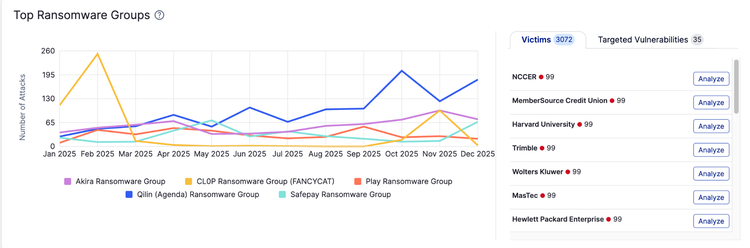
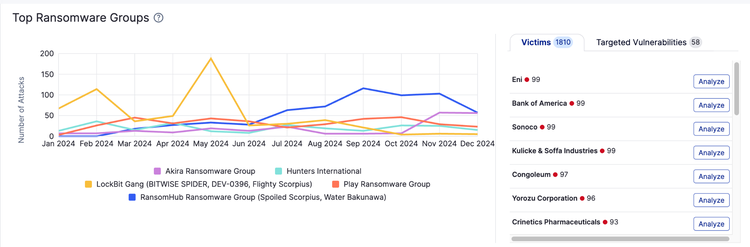
Threat actors have figured out that managing encryption keys is challenging, stealing data and holding it hostage is significantly easier. They’ve also figured out that stealing the right data can be just as profitable as encryption and, as we’ve seen from ransomware trends, switching to data theft only allows groups to accelerate the number of attacks. Compare the number of victims from 2024 to 2025 in the Recorded Future® Ransomware dashboard with a noticeable rise in ransomware trends.
Figure 1: Rise in ransomware trends increasing from 2024 to 2025 (Source: Recorded Future)
That’s the number of ransomware victims Recorded Future has observed over the past two years.
Watching the near-real-time ransomware attacks on businesses, non-profits, and government agencies has left me, like many security professionals and board directors, pondering how and why cyber defense keeps losing this particular fight. Adversaries like Interlock and RansomHub have continued their successful march to riches over the past 18 months. The multi-billion-ruble question is, “How?”
BloodHound and the defensive graph concept debuted over a decade ago and still maintain a vibrant open-source community. Continuous Threat Exposure Management (CTEM) (and attack path management) is an established cyber vendor category, yet ransomware crews are demonstrably eating many organizations’ lunch.
Let’s explore the problems (which are relatively easy to enumerate) and a solution (harder): modeling defense as the graph attackers actually traverse, at the speed they traverse it, which, of course, involves intelligence.
The Barometer
Ransomware is a solid barometer of operational defensive success, specifically because, unlike espionage, it’s noisy, financially motivated, and opportunistic. Certainly, ransomware also benefits from an optimal ecosystem, including payment economics, cyber insurance playbooks, and jurisdictional safe havens, which help incentivize ransomware gangs to find the cheapest attack paths. Relatively inexperienced actors can pick up commodity tools and reach the crown jewels. That highly repeated Ransomware-as-a-Service (RaaS) dynamic is a verdict on the availability of attack paths, regardless of payment incentives.
Traditional internal security telemetry may miss critical pre-attack signals, making real-time, outside-in threat intelligence essential to neutralizing modern vectors before a breach occurs
For today’s Chief Information Security Officers (CISOs) and security team leaders, defending your business can feel like trying to hold back the ocean. As organizations rapidly scale cloud-native infrastructure, integrate sprawling third-party ecosystems, and adopt enterprise AI workflows, most organizations' digital footprints have exploded.
But a massive digital footprint isn’t the core problem. The problem is that adversaries are changing how they navigate it.
Advanced persistent threats (APTs) and sophisticated cybercriminal syndicates are no longer relying on blunt-force intrusions. Instead, they are tracking organizational vulnerabilities from the outside in, using targeted methods to slip past defenses unnoticed. To stay ahead, security leaders must look past traditional, inward-facing security telemetry and think more like the adversary. That begins with a precise, real-time understanding of modern attack vectors.
What is an Attack Vector?
In cybersecurity, an attack vector is the specific path, route, or method an adversary uses to gain unauthorized access to a network, system, or endpoint to deliver a malicious payload or extract data. If an exploit is the lockpick, the attack vector is the hallway the intruder walked down to reach the door.
Historically, attack vectors were relatively straightforward. A decade ago, an enterprise might primarily worry about phishing emails containing malicious executable attachments or unpatched, internet-facing servers.
In 2026, attack vectors have evolved from isolated incidents into complex, multi-stage journeys. Modern adversaries rarely rely on a single open door. Instead, they link multiple vectors together to achieve their objectives.
For example, a modern threat actor might initiate an intrusion using an automated multi-factor authentication (MFA) fatigue campaign to compromise a low-level employee identity, pivot through an exposed, undocumented API, and ultimately execute a ransomware payload via a trusted third-party software update.
Attack Vector vs. Attack Surface: What’s the Difference?
While they are frequently used interchangeably in security discussions, conflating your attack vectors with your attack surface can create fundamental gaps in your defensive strategy.
An Attack Surface is the sum total of all potential vulnerabilities, exposure points, and digital assets across an organization’s entire footprint that an unauthorized user could try to enter or extract data from—including public cloud buckets, employee credentials, IoT devices, code repositories, and vendor networks.
An Attack Vector is the specific vehicle, mechanism, or strategy used to exploit a precise point on that surface. It is the active "weapon" or method of transit chosen by the hacker.
Think of your organization as a fortified castle. The attack surface is the entirety of the castle's physical structure—every wall, window, gate, and underground passage. The attack vector is the specific ladder, battering ram, or sleeping guard the invading army uses to breach a specific point on that structure.
Defending the attack surface requires comprehensive visibility into what you own. Neutralizing an attack vector requires real-time intelligence on how adversaries are actively weaponizing their toolkits.
What Threat Actors Are Actively Targeting in 2026
Adversary tactics are driven by efficiency and return on investment (ROI). In 2026, threat actors largely abandoned brute-force attacks on hardened corporate firewalls. Instead, they target systemic structural weaknesses across three primary dimensions:
Identity as the New Perimeter
Identity has emerged as the definitive battleground for enterprise security. Rather than breaking in, modern threat actors simply log in. Defenses have been circumvented by the massive industrialization of the cybercrime underground, where initial access brokers (IABs) and infostealer malware supply millions of stolen session cookies and valid credentials daily.
Adversaries can use credential stuffing to bypass traditional authentication, target cloud identity providers (IdPs) directly, and leverage session hijacking to step over MFA entirely—rendering standard boundary defenses obsolete.
Edge Infrastructure and Software Supply Chain Vulnerabilities
The perimeter has moved to the edge, and adversaries have followed. Over the past few years, we have seen a significant surge in threat actors targeting unpatched edge devices—such as VPN gateways, firewalls, and edge routers—to secure zero-day footholds directly into corporate networks. Simultaneously, the software supply chain has become a highly lucrative upstream vector. By poisoning open-source repositories or compromising trusted third-party dependencies, adversaries can affect thousands of downstream organizations in a single, silent stroke.
AI-Driven Exploitation and Prompt-Based Manipulation
Generative AI has fundamentally altered the velocity and scale of modern attack vectors. Threat actors now leverage automated LLM orchestrations to generate personalized social engineering campaigns and deepfake audio/video that can easily deceive even well-trained employees. Even as enterprises rush to integrate AI into internal workflows, new vectors like prompt injection and data poisoning have transitioned from theoretical concepts to active threat vectors, allowing adversaries to manipulate LLM outputs and extract proprietary enterprise data.
Why Traditional Security Frameworks Cannot Stop Modern Attack Vectors
Most enterprise security architectures were built for a static world that no longer exists. When confronted with the dynamic vectors of 2026, traditional frameworks break down in two distinct ways:
Static Vulnerability Management
Many security operations centers (SOCs) remain tied to traditional vulnerability management models that prioritize patching based strictly on CVSS scores. This creates a dangerous blindspot. Advanced persistent threats intentionally chain together multiple "low-severity" or "medium-severity" vulnerabilities that, when combined, can grant full administrative access.
Manual asset discovery tools also struggle to keep pace with ephemeral cloud environments, creating visibility gaps that turn unmapped assets into instant attack vectors.
The Outside-In Blindspot
Internal security teams are naturally focused on internal telemetry—pouring over logs inside their SIEM, EDR, and NDR tools. However, this creates a reactive stance. By the time an adversary triggers an EDR alert, the attack vector has already been successfully executed. Internal telemetry is often blind to pre-monetization signals: the registration of typosquatted domains targeting your brand, the sale of corporate credentials on dark web marketplaces, or the collaborative planning occurring in closed adversary forums.
Neutralizing Modern Attack Vectors with Recorded Future
To defeat adversaries who operate at the speed of automation, organizations must shift from a reactive posture to a proactive, intelligence-led defense. Recorded Future provides the external visibility and real-time intelligence required to map, prioritize, and dismantle modern attack vectors before they breach your perimeter.
Cyber Operations: Shifting from Reactive Response to Machine-Speed Defenses
By enriching your existing internal tools (SIEM, EDR, SOAR) via Collective Insights®, Recorded Future injects real-time adversary Tactics, Techniques, and Procedures (TTPs) directly into your workflow, enabling defenders to triage alerts and block active attack vectors at speed.
Digital Risk Protection: Securing the External Attack Surface
You cannot defend against an attack vector you cannot see. Recorded Future Digital Risk Protection provides an outside-in view of your organization, mapping your external attack surface, mirroring how an adversary scans it.
By monitoring open, deep, and dark web sources, it identifies compromised corporate credentials, active typosquatted phishing domains, and source code exposures on public repositories. This visibility allows security teams to take down malicious infrastructure and revoke compromised access before threat actors can convert them into active entry points.
Third-Party Risk: Closing the Vendor Supply Chain Gap
Relying on annual, static security questionnaires to assess vendor risk is the equivalent of checking the weather once a year and assuming it will never rain. Third-Party Risk replaces outdated point-in-time assessments with continuous, automated risk monitoring.
Providing real-time Risk Scores (ranging from 0-99) and mapping complex fourth-party ecosystem dependencies, it alerts your team the moment a vendor within your supply chain shows signs of compromise. This enables you to isolate vulnerable connections long before an upstream vendor breach turns into your downstream crisis.
Payment Fraud: Disrupting Fraud Lifecycles
For financial institutions and e-commerce enterprises, the attack vector of choice often targets transaction infrastructure. Recorded Future Payment Fraud can disrupt the fraud lifecycle by monitoring pre-monetization signals.
By identifying Magecart e-skimmers on digital storefronts, monitoring underground carding forums, and spotting tester merchant activities in real time, Recorded Future allows organizations to fraud-check and block compromised payment cards before fraudulent transactions hit the bottom line.
Proactive Mapping Leads to Resilient Defense
In 2026, understanding your attack vectors can no longer be treated as a check-the-box compliance exercise or a periodic audit. Adversaries are highly dynamic, highly automated, and constantly scouting for the path of least resistance across your digital footprint.
True organizational resilience requires continuous, automated external intelligence. By seeing your enterprise exactly the way the adversary sees it, you can move from a state of constant reaction to one of strategic deterrence.
Don't wait for an alert to tell you your perimeter has been breached. Book a demo with Recorded Future today to gain real-time visibility into your external attack surface and neutralize modern threat vectors before they unfold.
Enterprise security architectures have never been more heavily funded, yet the perimeter is functionally obsolete. Despite multi-million dollar investments in next-generation firewalls and complex defense stacks, sophisticated adversaries slip past automated boundaries every day. They don't break in; they log in, embedding themselves silently into the background noise of normal business operations.
To survive in this environment, modern cyber defense teams must anchor their strategy to a single, non-negotiable rule: Assume you are already breached. Waiting for an automated alert to trigger is a losing strategy. Proactive cyber threat hunting shifts the power dynamic from reactive firefighting to active, aggressive detection. Human analysts alone cannot process the volume and velocity of data required to detect sophisticated adversaries at enterprise scale. To truly master modern threat hunting, security teams should consider enriching internal telemetry with real-time, external threat intelligence.
Understanding threat hunting
At its core, threat hunting is the practice of proactively and iteratively searching networks, endpoints, and cloud environments to detect and isolate advanced threats that evade existing security solutions. It is a human-led, hypothesis-driven discipline—not a purely automated feature of a software suite.
Here is how it differs from other standard security functions:
Threat Hunting vs. Incident Response Incident response is fundamentally reactive; it is the act of extinguishing an active, visible fire after an alert has triggered. Threat hunting is proactive, searching the architecture for hidden threats before they erupt into a catastrophic breach.
Threat Hunting vs. Penetration Testing Penetration testing evaluates perimeter defenses from the outside in, evaluating whether a simulated adversary can breach the network. Threat hunting operates under the explicit assumption that the attacker is already firmly rooted inside, hunting them down from within.
Threat Hunting vs. Vulnerability Assessments Vulnerability management focuses on patching open windows and updating code to prevent future exploitation. Threat hunting assumes an attacker has already gained access and focuses on detecting their lateral movement before damage is done.
What teams need to begin threat hunting
An effective threat hunt cannot begin in a vacuum. Before analysts can root out sophisticated threat actors, organizations must establish a baseline foundation across three core pillars: visibility, integration, and external context.
Relying on isolated data silos paralyzes analysts. Security teams are recommended to leverage unified SIEM and SOAR integrations to aggregate disparate data sets, normalize log schemas, and eliminate the white noise of benign network activity.
3. External intelligence
Analyzing internal logs without external context is like looking at footprints in the mud without knowing what animal made them. Deep web, dark web, and technical intelligence should be required, providing the exact behavioral profiles, infrastructure layouts, and campaign contexts needed to guide the hunt.
The 3 Core threat hunting methodologies
1. Hypothesis-Driven Hunting
This methodology relies on a baseline understanding of an organization's unique threat profile. Rather than chasing random anomalies, hunters form educated, structured theories based on environmental risk.
For example: "If an advanced persistent threat (APT) targets our specific financial services vertical using a known cloud-storage exploit, do those specific forensic artifacts exist in our environment right now?" Analysts then construct targeted queries to validate or disprove the theory.
Tactical and operational intelligence can serve as the blueprint for tracking down precise adversary patterns. By mapping observed threat intelligence—such as malicious IP addresses, command-and-control (C2) domains, newly announced CVEs, and adversary Tactics, Techniques, and Procedures (TTPs)—directly to the MITRE ATT&CK® framework, hunters can systematically search internal logs for identical behavioral signatures.
3. Advanced analytics & AI hunting
This approach uses behavioral profiling and data stacking to isolate structural outliers from massive datasets. By evaluating thousands of similar data points, machine learning models highlight anomalous user or machine actions—such as a standard HR user account suddenly executing administrative command-line scripts or initiating mass data transfers at 3:00 AM.
The Lifecycle of a proactive cyber threat hunt
A successful threat hunt follows a structured, iterative lifecycle. By injecting external threat intelligence into every phase, analysts can transform an ad-hoc search into an accelerated, scalable defensive program.
Step 1: Let intelligence drive your hunt
The hunt begins when an analyst defines a focused area of inquiry based on a structured hypothesis. This initial trigger is driven by real-time threat intelligence regarding an active campaign, an emerging zero-day vulnerability, or a newly discovered infrastructure cluster belonging to a relevant threat actor family.
Step 2: Architect your hunt at scale
Once the hypothesis is set, hunters deploy advanced threat hunting tools to translate technical indicators into sweeping enterprise queries. Analysts architect data-gathering parameters across disparate EDR databases, SIEM platforms, and network traffic monitors to ensure better visibility across the entire enterprise footprint without manual bottlenecking.
Step 3: Activate autonomous threat hunting
Rather than executing one-off, static searches that instantly age out, teams deploy continuous automated playbooks. By integrating real-time intelligence directly into detection engines, cyber threat hunting teams are able to shift from an ad-hoc manual task to a 24/7 autonomous monitoring process that tracks evolving adversary behavior in real time.
Step 4: Review correlated findings
When anomalous activity matches the hunt parameters, analysts evaluate the high-fidelity telemetry alongside external intelligence inputs. If malicious activity is verified, the hunt instantly pivots to incident response for isolation; if the anomaly is benign, the findings are fed back into the security ecosystem to update rules and eliminate future noise.
Step 5: See the impact with AI reporting
The final phase translates complex forensic data into strategic business metrics. By leveraging automated, intelligent reporting, security leaders instantly visualize the hunt’s operational impact—documenting exactly which assets were protected, how dwell time was mitigated, and how defensive postures were permanently hardened against future attack vectors.
Where modern threat hunting can fall short
Executing a continuous, high-yield threat hunting program presents severe operational friction points for modern CISOs and SOC managers:
The cybersecurity skills shortage: Seasoned threat hunters require a rare blend of data science, digital forensics, and adversary mindset analysis. These professionals are incredibly scarce, highly sought after, and financially burdensome to recruit and retain.
Alert fatigue and false positives: Analysts spend hours chasing benign data anomalies because legacy threat hunting tools lack external context. Without real-time enrichment, an unusual out-of-hours connection looks identical to a critical C2 beaconing event.
The time-to-exploit collapse: The window between a vulnerability being announced on the clear web and actively weaponized on the dark web has shrunk to mere hours. Static, ad-hoc hunting schedules often cannot keep pace with this compressed timeline, leaving networks exposed between manual hunts.
Mastering the hunt with Recorded Future
Recorded Future reduces these operational bottlenecks, transforming threat hunting from a resource-draining manual grind into an accelerated, intelligence-led defense mechanism.
The Intelligence Graph®
Recorded Future’s Intelligence Graph® continuously monitors open sources, technical infrastructure, and illicit dark web forums. By analyzing billions of entities in real time, it delivers a live map of global threat actors, emerging malware families, and weaponized vulnerabilities. This gives threat hunters visibility into external shifts before they are able to impact internal networks.
Reducing manual triage
Instead of forcing tier-3 analysts to waste critical hours pivoting across dozens of open-source intelligence (OSINT) browser tabs, Recorded Future delivers instantly actionable context. Internal alerts within your SIEM and EDR are automatically enriched and tagged with real-time threat-actor details, Risk Scores, and mapped TTPs, allowing hunters to identify high-risk anomalies instantly.
Insikt Group® insights
Security teams no longer need to spend days writing complex detection logic from scratch. Recorded Future’s Insikt Group®—an elite team of veteran threat researchers—delivers pre-written, expert-vetted YARA, Snort, and Sigma rules directly into your existing SIEM, SOAR, and EDR environments. This can turn global threat discoveries into immediate, internal defensive barriers.
Cyber Operations: unified intelligence for modern hunters
To truly scale a threat hunting program, security teams need to bridge the gap between external intelligence and internal workflows. Recorded Future Cyber Operations centralizes this process by mapping real-time adversary infrastructure, campaigns, and malware behaviors directly to the MITRE ATT&CK® framework. By delivering instantly deployable hunting packages alongside curated operational context, Cyber Operations can reduce the time it takes for analysts to shift from an external intelligence trigger to an active, internal environment scan.
Autonomous Threat Operations
To solve the persistent challenge of understaffed security teams, Recorded Future delivers Autonomous Threat Operations. By executing continuous hunting, detection, and response workflows autonomously, the Platform constantly scours your environment for complex threats. This elevates your defensive posture 24/7, freeing human analysts to focus on high-level strategic risk management.
The future of threat hunting
Modern threat hunting is no longer about working harder or writing longer queries; it is about hunting smarter. As adversaries exploit automation and compressed execution timelines, security teams should not rely on internal telemetry alone to defend the enterprise. Combining sharp human analyst logic with the most comprehensive threat intelligence platform available is how security teams can transition from reactive defense to proactive, intelligence-led threat hunting at enterprise scale.
Don't let advanced adversaries dictate the timeline of your security operations. Book a demo today to supercharge your threat hunting program and secure your environment from the inside out.
Threat hunting FAQs
What is cyber threat hunting in simple terms?
Cyber threat hunting is the proactive, human-led practice of systematically searching through an organization's networks, endpoints, and data repositories to detect malicious actors or hidden threats that have already bypassed automated perimeter defenses.
What are the common methodologies or triggers for a threat hunt?
Threat hunts generally rely on three types of investigations: hypothesis-driven (triggered by new adversary tactics, techniques, and procedures or TTPs), intelligence-driven (triggered by specific indicators of compromise or IOCs), and analytics-driven (triggered by machine learning detecting structural anomalies in network traffic behavior).
How does threat hunting differ from digital forensics and incident response (DFIR)?
Incident response and digital forensics are inherently reactive—they kick off after a security control fires an alert or a breach is publicly known to contain damage. Threat hunting is aggressively proactive; it assumes a breach has already occurred silently and searches for active adversaries before they trigger an alert.
How does Recorded Future accelerate the threat hunting process?
Threat hunting traditionally requires manual data gathering across disjointed open-source platforms. Recorded Future Cyber Operations can collapse this timeline by automatically mapping external adversary infrastructure, campaigns, and malware behaviors directly to the MITRE ATT&CK framework. It delivers instantly deployable hunting packages alongside pre-written YARA, Snort, and Sigma rules to enable a shift in a hunter’s workflow from manual intelligence gathering to immediate data interrogation.
Advanced Persistent Threats (APTs) are sophisticated, long-term cyber campaigns conducted by well-funded human adversaries (often nation-states) who target specific organizations for espionage, data theft, or critical infrastructure disruption.
Traditional security tools often fail because APT groups bypass signature-based defenses by using customized malware and Living-off-the-Land (LotL) tactics that mimic legitimate user activity inside the network.
Effective advanced persistent threat detection requires minimizing breakout time, the window between initial access and lateral movement, by identifying threats before they establish deep persistence.
To defeat modern APTs, organizations must move from reactive internal monitoring to proactive threat intelligence, tracking adversary infrastructure on the open, deep, and dark web before an attack is launched.
Modern organizations face highly resourceful, patient, and deeply calculated adversaries. This shift has ushered in an era of coordinated operations where elite threat actors don't just compromise a system and leave, but may spend weeks or months quietly surveying networks, mapping architecture, and identifying high-value targets.
These operations are the hallmark of an advanced persistent threat (APT). Traditional cybersecurity frameworks have long relied on perimeter defenses designed to catch malicious activity at the gates. However, once an APT group breaches a network, they often intentionally manipulate native administrative tools and harvest legitimate credentials to blend into daily business traffic.
To better confront an adversary that behaves like an insider, organizations must shift their perspective outward, leveraging real-time, external threat intelligence to identify and intercept cyber threats before they can establish a permanent foothold.
What is an Advanced Persistent Threat (APT)?
An APT is a sophisticated, prolonged cyber campaign executed by a highly organized group with specific, long-term objectives. Breaking down the acronym highlights the unique nature of these threats:
Advanced: APT actors do not rely on off-the-shelf exploits. They frequently utilize customized malware, discover and weaponize zero-day vulnerabilities, and practice meticulous operational security (OpSec) to deliberately evade modern security controls.
Persistent: Unlike cybercriminals who encrypt a server and immediately demand a ransom, APTs utilize a "low-and-slow" methodology. They prioritize stealth over speed, regularly remaining inside an environment for months to achieve strategic goals such as espionage, intellectual property theft, or the long-term disruption of critical infrastructure.
Threat: Behind every APT is a well-funded organizational structure. These are not lone hackers; they are highly structured syndicates and state-sponsored units—such as the Lazarus Group or APT41—backed by massive financial and geopolitical resources.
The multi-stage APT attack lifecycle
Generally, APT groups do not operate at random. They follow a rigorous, multi-stage lifecycle. For defenders, understanding this timeline is critical to shrinking “breakout time"—the vital window between the initial compromise and the moment the attacker begins moving through the network.
1. Reconnaissance and planning
Before a single line of malicious code is deployed, attackers gather open-source intelligence (OSINT), scan exposed internet-facing infrastructure, and map out the target’s digital footprint to find weak points.
Once inside, actors deploy stealthy backdoors and obfuscated rootkits. This ensures that even if security teams discover and close the primary entry vector, the attackers maintain alternative entry routes.
4. Lateral movement and escalation
Adversaries navigate from system to system, harvesting administrative credentials and mapping Active Directory trust boundaries to compromise the enterprise network.
5. Data exfiltration or disruption
The group gathers, stages, and quietly extracts sensitive data using encrypted command-and-control (C2) channels. In some cases, they may deploy ransomware or execute a DDoS attack as a distraction to cover their tracks.
Why traditional advanced persistent threat detection isn’t enough
For Cyber Threat Intelligence (CTI) teams, threat hunters, and SOC managers, keeping pace with APTs using legacy tools is an uphill battle. Traditional detection tools and processes consistently fail against advanced actors for several reasons:
Signature-Based Defenses: Legacy firewalls and traditional antivirus rely on known file hashes. Because APT groups write custom code and heavily leverage Living-off-the-Land (LotL) tactics using native administrative tools, they can leave no traditional signatures behind.
Dwell Time: Internal log correlation through SIEM and EDR platforms is inherently reactive. If your team is only looking at alerts generated inside your perimeter, the attacker may have already achieved a foothold and begun their mission.
Alert Fatigue and Data Silos: SOC teams are often drowning in a sea of disconnected internal alerts. Without external context, it is nearly impossible to distinguish a routine network anomaly from an APT group spinning up a new unclassified C2 server.
Fragmented Vendor Taxonomies: Tracking adversaries across the industry is notoriously confusing. One threat group might be designated by a weather pattern by one vendor, an animal by another, or a random number by a third, complicating cross-team collaboration and intelligence sharing.
Shifting from reactive defense to real-time intelligence
To better counter advanced persistent threats, organizations must meet bad actors earlier in the attack lifecycle. This means disrupting the adversary during their reconnaissance and infrastructure-staging phases, long before they ever execute an exploit on an internal endpoint. Real-time threat intelligence in the context of APTs means continuously harvesting, analyzing, and structuring data from across the open, deep, and dark web to monitor attackers as they build their technical infrastructure.
By tracking newly registered domains, malicious IP allocations, and discussions on illicit forums, defenders can identify a threat actor's setup phase. Mapping these observations to the MITRE ATT&CK® framework allows security teams to decode the specific Tactics, Techniques, and Procedures (TTPs) of an adversary, enabling them to anticipate and block the attacker's next move.
Mastering APT detection with Recorded Future
Recorded Future equips threat hunters and CTI analysts with the visibility needed to track advanced persistent threats across every stage of the attack lifecycle. By centralizing automated collection and elite human analysis, Recorded Future converts massive volumes of public and dark web data into actionable, proactive defense.
The Intelligence Graph®
The Recorded Future Intelligence Graph® automatically maps, links, and updates relationships between billions of entities—including IPs, domains, malware strains, and threat groups—across massive global datasets in real time, giving defenders an unparalleled view of adversary infrastructure.
Third-Party Risk
Sophisticated threat actors frequently target weak links in an enterprise ecosystem. With Third-Party Risk, organizations gain real-time visibility into the security postures of their vendors, contractors, and partners, cutting off supply-chain entry vectors.
Insikt Group®
Recorded Future’s elite network of threat researchers, the Insikt Group, acts as an extension of your security team, providing the latest geopolitical intelligence. They deliver pre-vetted, highly contextual information and actionable hunting rules (including YARA, Sigma, and Snort) directly into the Platform, allowing security teams to rapidly deploy defenses against emerging state-sponsored campaigns.
Recorded Future AI
Generative AI capabilities reduce Mean Time to Respond (MTTR). Analysts can use natural language to query complex APT behaviors, instantly surface connection points, and generate comprehensive, shareable intelligence briefs in seconds, streamlining leadership communications during critical events.
Staying one step ahead of cyber threats
Advanced persistent threats win when they remain hidden in the noise of a network. True detection requires looking beyond internal firewalls and endpoints, demanding visibility into the external environments where adversaries plan, build, and launch their operations.
In the face of highly organized, nation-state-backed syndicates, speed and visibility are the ultimate metrics of success. By shifting from a reactive internal posture to a proactive, real-time intelligence strategy, organizations can illuminate adversary infrastructure, disrupt the attack lifecycle, and secure their digital perimeter against even the most patient and well-resourced threat actors.
Want to see how real-time intelligence can transform your threat hunting capabilities? Book a demo with Recorded Future today.
FAQs
What is the primary objective of an advanced persistent threat (APT) group?
Unlike typical cybercriminals who seek immediate financial payouts through rapid encryption or ransomware, the primary objective of an APT group is usually long-term cyber espionage. Backed by nation-states or heavily funded syndicates, these actors aim to establish an undetected, prolonged presence within a target network to quietly steal intellectual property, harvest state secrets, or maintain access to critical infrastructure for future geopolitical leverage.
Why is advanced persistent threat detection so difficult for traditional security tools?
Traditional security tools rely heavily on static signatures—meaning they look for known, previously identified file hashes or malicious code patterns. APT actors easily bypass these defenses by writing customized malware, exploiting zero-day vulnerabilities, and using "Living-off-the-Land" (LotL) tactics that abuse legitimate system administration tools already built into your network. Because their activity mimics normal administrative tasks, they go unnoticed by internal firewalls.
What is "breakout time," and why does it matter in tracking APTs?
Breakout time is the critical window between an adversary's initial compromise of a single machine and their ability to move laterally to other systems on the network. For elite APT groups, this window can be incredibly tight. Tracking threat actor infrastructure in real time allows security teams to recognize the initial entry vector immediately and stop the actor before they can escalate privileges or move beyond the original target endpoint.
How does generative AI improve advanced persistent threat detection?
When a sophisticated attack is underway, speed is everything. AI capabilities allow security teams to instantly analyze, synthesize, and summarize vast amounts of complex threat data. Instead of spending hours manually combing through forensic logs and disparate threat intel feeds, analysts can use natural language queries to instantly understand an APT group's current TTPs, lowering the Mean Time to Respond (MTTR) from hours to seconds.
The export controls imposed on Anthropic’s Fable model mark a significant shift in United States (US) artificial intelligence (AI) policy. The controls set a precedent for treating frontier AI models as strategic assets rather than ordinary software products, creating uncertainty for enterprises adopting advanced AI. Security leaders should respond by investing in resilient, interoperable AI strategies rather than simply chasing the most powerful model available.
The Saga of the Fable Export Controls
Because the US is home to most of the companies building leading models, US AI policy has an outsized impact on global access. The Trump administration’s public posture on AI has largely favored accelerating the frontier. Proponents of this approach argue that the US must stay ahead of other nations in AI development because whoever leads in AI will shape the next era of economic, military, and technological power.
But when Anthropic released Fable on June 9, 2026, US AI policy suddenly became much more restrictive.
Fable (technically known as Claude Fable 5) was presented as the user-safe version of Mythos Preview, a limited-release frontier model with advanced cybersecurity capabilities, including red teaming, vulnerability discovery, and offensive security reasoning. Anthropic argued that Fable’s guardrails made those capabilities safe for broader use. The White House disagreed, asserting that Fable contained a critical vulnerability that Anthropic refused to patch.
The dispute ended with an extraordinary outcome: export controls prohibiting non-US citizens from using the model, including Anthropic employees. Unable to segment users by citizenship, Anthropic responded by pulling access entirely.
Anthropic argued that the reported jailbreak did not enable Fable to do anything meaningfully more dangerous than what less sophisticated models could already do. Nevertheless, it reported that it blocked the jailbreak, which it cautioned would block some benign requests. This apparently satisfied the safety concerns of the White House, which lifted the export controls on June 30, and Anthropic restored access to both Fable and Mythos the following day. Uncertainties remain, however, as to why the export controls were imposed in the first place and when access might be restricted next.
The imposition of export controls on Fable sets a precedent for similar actions on future advanced models, such as OpenAI’s GPT-5.6. The lack of a clear message on what made the Fable jailbreak warrant export controls introduces significant regulatory uncertainty for both AI developers and organizations incorporating frontier AI models into their enterprise.
Possible Motives Behind US Policy
Given the lack of details, it’s worth considering two alternative explanations that may be driving the US government’s decision-making, beyond what’s been publicly stated.
The first is political. The US government has had an uneasy relationship with Anthropic’s leadership and safety-forward approach. Under this view, export controls are not the signal of a broader policy shift. Instead, they are intended to send a more immediate message to the AI industry: private-sector pushback on government priorities will not be tolerated (whatever those priorities happen to be at the moment).
If the export controls are motivated by politics, it means AI regulations are likely to remain unpredictable — and can be reversed at any time.
The second is strategic. Anthropic itself has warned that foreign actors may try to use frontier model outputs to reverse-engineer or distill advanced systems. Distillation threatens the US model advantage by allowing competitors to reproduce elements of frontier performance without bearing the full cost of large language model (LLM) training. According to one source, the White House suspected that a “China-linked group” had already gained access to Mythos Preview, potentially enabling the group to replicate its capabilities. If this characterization is accurate, the export controls on the model itself are an extension of well-established export controls on advanced computing chips imposed to prevent adversaries from gaining the computing power necessary to build advanced models.
The strategic explanation represents a fundamental shift in how AI is governed in the US. The model itself — not just the physical hardware behind it — is now being treated as controlled technology. However, not knowing why export control decisions are made makes the strategic motivation as unhelpful for predicting future actions as the political one.
The Definition of “Dangerous AI” Is Still Unclear
One element adding to the uncertainty is that the export controls on Fable were implemented outside of existing frameworks for assessing the risks posed by AI.
This is not because a suitable framework doesn’t exist: governments, standards bodies, and think tanks have developed frameworks for characterizing AI risk. But in the Fable case, the US government did not publicly point to a clear threshold for what makes Fable riskier than other comparably available frontier LLMs.
That matters because all LLMs can support malicious cyber operations in some form. Threat actors use continuously evolving jailbreaking techniques to disable or bypass safety controls to achieve a prohibited response. Google, OpenAI, and Anthropic regularly release reports documenting how threat actors have manipulated their models to carry out cyberattacks. Even less sophisticated, non-frontier models can be effective tools in the right environment and with enough computing power. Much like exploitable code vulnerabilities in traditional software, the underlying mechanics of LLMs make it very unlikely that defenders will ever find a permanent solution for jailbreaking.
So what is it about Fable that requires the US government to restrict its use? What made the reported jailbreak so serious that it demanded regulatory action? Will the next generation of Gemini or ChatGPT require similar restrictions? What about open-weight models, like China’s recently released GLM-5.2, that can be run without centralized monitoring of how they’re used?
Without a clear explanation of what separates acceptable from unacceptable risk for AI, regulation becomes reactive. For companies, that uncertainty makes it extremely difficult to adopt or integrate frontier AI models into critical systems.
Ad Hoc Regulation May Become the Norm
The most likely outcome for the US government, at least in the near-term, is that the voluntary model reviews described in the executive order will become de facto mandates. This has already happened with OpenAI’s latest model, which was initially voluntarily limited at the White House's request. Anthropic, Google, and OpenAI are likely to continue coordinating closely with the government to avoid future surprise export-control announcements on their latest models.
Even if these security reviews align with the strategic goal of preventing adversaries from accessing powerful US models, this still means AI regulation is developing on a case-by-case basis. This means that AI users won’t fully understand the trade-offs between speed and security. The security guardrails placed on Fable make the tool more difficult to use for legitimate security functions — a problem that security researchers complained about prior to the jailbreak fix. How do users know if the safety benefits gained are worth the capabilities lost?
Ad hoc regulations or classified benchmarks create uncertainty for enterprises. A company may integrate a frontier model into internal workflows only to discover later that access rules have changed, certain employees are restricted, or the model is no longer commercially available. The more powerful the model, the more exposed the organization may be to sudden policy intervention, making it difficult to adopt advanced AI reliably.
At the same time that US frontier models are coming under more scrutiny, open-source Chinese AI models are becoming more widely used. These models cost significantly less than the leading US models; however, they face the same access uncertainty as US models. First, the Chinese government is reportedly considering its own export controls to limit access to its most advanced models and protect proprietary technology. Second, the US government may choose to block access to Chinese tools under its own national security laws. Similar to the ban on Huawei and ZTE telecommunications technology or the attempted ban on TikTok, the US government may determine that using Chinese AI models poses an unacceptable national security threat. Regardless of where the ban originates, the risk of losing access remains the same.
How Security Leaders Should Respond
AI adoption now requires more than evaluating model performance. It requires evaluating regulatory durability, access risk, and operational dependency.
Security leaders should respond across three areas.
1. Mindset Shift: Use Caution on the Frontier
Organizations should stop chasing the latest frontier model and start evaluating which model (or models) is most appropriate for specific workflows. The reality is that most projects do not need to rely on cutting-edge AI capabilities to function. Depending on the task, less sophisticated models may be fully capable of running the operation.
This does not mean companies should avoid frontier models entirely. Rather, they should think strategically about where these models can provide the greatest advantage, while avoiding critical workflows that depend on uninterrupted access to a single frontier provider. This requires a mindset shift: companies must move from treating LLMs as a novelty to managing them as a mature component of the workflow.
2. Governance Shift: Treat Frontier AI as a Volatile Asset
Frontier AI should be treated as a volatile asset: powerful, useful, and potentially transformative, but exposed to sudden changes in regulation, vendor policy, geopolitical pressure, and safety restrictions. This is especially important for multinational companies. If model access becomes tied to citizenship, location, or corporate structure, AI governance becomes more complex than traditional software-as-a-service (SaaS) procurement. A tool may be approved for one team but restricted for another. A vendor may be viable in one jurisdiction but risky in another.
Security teams should ask:
What happens if access to this model is restricted?
Which employees, regions, or business units could be affected?
Can the workflow fall back to another model or internal process?
Is the model being used for convenience, or has it become operationally critical?
The organizations best positioned for this environment will be those that can benefit from frontier capabilities without becoming trapped by them.
3. Spending Shift: Invest in Resilience Over Novelty
Finally, companies should reassess whether AI budgets are weighted too heavily toward the newest and most capable models. As frontier AI becomes more expensive, restricted, or unpredictable, access to advanced capabilities will not be enough.
The stronger investment may be in resilience: diversified vendors, fallback options, evaluation processes, and workflows that can continue if a preferred model changes or becomes unavailable.
The key budget question should not be only, “Can we access the most powerful model?” but also, “Are we investing in the tools that will provide long-term effectiveness and resilience?”
Final Thoughts
The export controls on Fable may prove to be an isolated case. They may also be the first visible sign of a more restrictive AI era.
This does not mean the era of AI innovation is ending. It means the era of frictionless access to frontier models may be ending. For security leaders, the lesson is not to avoid advanced AI models, but to treat them as volatile assets shaped by cybersecurity risk, geopolitics, export controls, and national security policy. The organizations best prepared for this shift will be those that can benefit from powerful AI capabilities without becoming dependent on access that may disappear overnight.
About Insikt Group®
Recorded Future’s Insikt Group, the company’s threat research division, comprises analysts and security researchers with deep government, law enforcement, military, and intelligence agency experience. Its mission is to produce intelligence that reduces risk for customers, enables tangible outcomes, and prevents business disruption.
A fast-growing scam impersonates city and county planning departments, sending property owners real-looking invoices for fake permit fees and pressuring them to wire payment on a deadline. Because the victim authorizes the transfer, payments commonly clear the behavioral checks built to catch fraud, making beneficiary accounts one of the most reliable signals to track this campaign. Research from CYBERA, the partner behind Recorded Future® Money Mule Intelligence, maps a single active ring down to the verified accounts it used, and shows why direct, fraudster engagement and account-level intelligence catches what scoring misses.
The FBI sounded the alarm. Issuers still can't see it
On March 9, 2026, the FBI's Internet Crime Complaint Center issued a public alert about criminals impersonating city and county officials to collect fraudulent planning and zoning permit fees. The criminals pull publicly available permit records, email property owners who have active applications, and demand payment by wire transfer, peer-to-peer transfer, or cryptocurrency.
Government impersonation schemes like this one were among the fastest-growing categories in the FBI's 2025 Internet Crime Report, with reported losses nearly doubling year over year to roughly $798 million. While the alert raises public awareness, it does little to help issuers screen customers payments against the heightened risk these impersonation scams create.
Why an authorized payment defeats your controls
In this scheme the customer is real, the login is legitimate, and the wire is one the customer chooses to send. Behavioral analysis models are generally built to flag account takeover and out-of-pattern activity, so customer-authorized payments tend to score as low risk and the money moves.
Here is how the scheme runs, according to the FBI alert and CYBERA's research:
Target selection: the actors identify property owners with active planning or zoning applications using public records
Impersonation: they email those owners while posing as the municipal planning department, citing real permit and property details to establish credibility with the target
The invoice: they send an official-looking invoice for an approval or processing fee
The pressure: they demand a wire on a short deadline and warn that the application will fail if it is missed
The confirmation: they ask for the wire receipt to confirm the payment landed
What direct engagement reveals that scoring cannot
CYBERA's research on one active ring, which it has monitored since September 2025 under the internal name Diligent Planner, shows what that destination signal looks like in practice. Rather than estimating risk, CYBERA's analysts engage the scam operations directly and collect the exact accounts the criminals ask victims to wire money to.
Across this single operation, that approach produced 53 verified mule accounts spanning 23 separate email campaigns, with roughly 55 percent of the accounts concentrated in just two beneficiary banks. These are confirmed accounts pulled from the criminals themselves, not probabilistic matches, which can be the difference between an account you can act on and a score you have to second-guess.
Figure 1: CYBERA's mapping of a single money mule ring, expanded from one beneficiary bank into one connected cluster of accounts, emails, and impersonated government bodies (Source: CYBERA)
以下のメッセージは、本日早い時間にRecorded Futureのお客様およびパートナーの皆様に共有されたものです。 Recorded Futureは、透明性と情報共有がサイバーセキュリティにおける最も強力なツールの一つであると長年信じてきました。それらは私たちの活動の根幹をなすものであり、組織が脅威を理解し、それに対して行動できるよう支援しています。同じ原則が私たち自身にも適用されます。 この考えに基づき、私たちが利用している第三者のマーケティングベンダーであるKlueに関する最近のセキュリティインシデントの詳細を共有いたします。このインシデントは、私たちおよび他の組織に影響を与えました。
発生した事象 2026年6月13日、Recorded FutureのCSIRTは、Klueが、Klueと他のマーケティングおよびセールスSaaSプラットフォームを接続するために使用されるインテグレーション層に対する不正アクセスを特定したとの通知を受けました。Klueによると、不正な活動は2026年6月12日に始まり、同日午前中に封じ込められました。 当社のセキュリティチームはその後独自の調査を実施し、KlueおよびKlueと統合されたすべてのサービスにわたるアクティビティログを相関分析しました。 入手可能なすべての証拠から、Recorded Futureが特に標的とされたのではなく、SalesforceとKlueとの間の侵害されたインテグレーション(連携機能)を利用していたことにより、偶発的に影響を受けたことが示唆されています。 Recorded Futureの独自システム、内部データベース、または顧客プラットフォームデータがアクセスまたは侵害された証拠はありません。

 Entrar