❌

Visualização de leitura

The post-quantum future of web privacy

The highest priorities for the transition to post-quantum cryptography are the basic building blocks of authenticated key-agreement protocols such as TLS. Without these building blocks in place, secure communication on the Internet will not be possible once cryptographically relevant quantum computers come online. However, today we rely on quantum-vulnerable cryptography for much more than TLS.

Privacy Pass is a protocol used by site operators like Cloudflare to help protect applications from abuse. One way we do this is by rate limiting individual clients so that no one client consumes too many of the site's resources. Normally this involves some combination of friction or loss of privacy for users: CAPTCHAs or other challenges to moderate traffic, along with accounts and fingerprinting to identify traffic.Privacy Pass was designed to avoid this tradeoff between friction and privacy. The basic idea is that a client gets issued a number of tokens, which they can redeem in exchange for access to the site. Crucially, each token is unlinkable to the client it was issued to, ensuring the client can use the site as they always had without sacrificing privacy.

With 10 years of deployment experience under our belts — using Privacy Pass for applications such as privacy proxies (like iCloud Private Relay) and relays (like Privacy Gateway) — we, along with others, are collaborating to bring the next generation of this technology to the web. One of our goals is to develop more sophisticated tools for managing agentic traffic that would otherwise consume too many resources and degrade performance for human visitors. Another goal is to foster a more open ecosystem by making it easier for more types of clients to participate. Achieving these goals requires developing new capabilities beyond what Privacy Pass offers today.

Given the trajectory, in this post we look at the prospects for post-quantum. In fact, we're in better shape than one might think. Privacy Pass still relies on classical cryptography, like RSA and elliptic curves. This means that a quantum attacker will be able to forge tokens at will and use them to bypass whatever security mechanism the site operator wants to implement (such as rate limiting). On the other hand, Privacy Pass is unconditionally private, meaning no attacker, quantum or not, can link the redemption of a token to its issuance. What's more, the new capabilities we're developing for this new generation of private authentication technology  can and will be instantiated in a way that upholds the same guarantee: your interaction remains private even after Q-day.

This gives us a little breathing room, but we will need an alternative soon. This is an active area of research that has made significant strides in recent years. Still, just as is the case with other aspects of the transition, the primary challenge is the sheer size of post-quantum alternatives: ML-DSA-44 signatures are a whopping 2,420 bytes, while ECDSA-P256 signatures are just 64 bytes. And there's not much hope for drop-in replacements any time soon. Just as for TLS, we'll have to settle for primitives with higher cost and re-engineer our systems to bear this cost.

But what will those primitives be? In this post, we'll explore one potential future for post-quantum privacy on the web, made possible by a recent breakthrough in the design of blind signatures.

What we need to build: a brief look at MOLE

Let's start with an overview of this new technology, which is presently called MOLE ("Moderation Of unLinkable Endorsements"). We'll have much more to say about MOLE later on, but for now we'll highlight the details that are most relevant to cryptography.

One of the core components of Privacy Pass is a blind signature scheme, which allows a client to obtain a signature under an issuer's secret key without revealing to the issuer the message that it signed. The client can then reveal the message and blind signature later on without linking the signature to its issuance.

One type of Privacy Pass token consists of the message and blindly issued signature. To verify the token, the verifier needs the issuer's public key, and so necessarily learns the identity of the issuer. Thus while these tokens protect the identity of the client, they don't protect the identity of the issuer.

Of course, this is exactly what we want for some use cases. The identity of the issuer tells us something about what type of client is connecting to our edge, a signal we use to make decisions in some of our products and for some of our customers. For instance, a client might use a token issued by one of our customers to prove it is authorized to use the customer's VPN product.

However, for many use cases, this is more information than we actually need to make a decision to grant a client access to a resource. Normally we only care that the token was issued by some entity we trust. In fact, MOLE takes this a step further: the token should hide the identity of the issuer altogether so that we can't treat tokens differently based on who issued them. This guarantees equal treatment regardless of the type of client, making it easier for more clients to participate.

This issuer-hiding property is achieved through a new object called an endorsement. An endorsement is issued by an anchor and redeemed by a moderator. Before redemption, the client and moderator agree on an anchor set, the public keys of the anchors trusted by the moderator. During redemption, the client proves it was issued an endorsement by one of the anchors in the anchor set without revealing which one. Upon acceptance, the moderator issues the client the MOLE credential it will use to moderate the client's interaction with the site.

An endorsement can take many forms, but its key property is that it can be redeemed while hiding the identity of the anchor that issued it. There will also be many types of credentials, but because they're intended to be used by a particular moderator, they needn't be anchor-hiding or even publicly verifiable. This means that everything from blind signatures to anonymous credit tokens or anonymous rate-limited credentials can be used to instantiate MOLE credentials.

Now that we have a sense of what we're building, let's look at our options for post quantum.

A feast of cryptography

When designing cryptographic protocols, adaptability and efficiency are often in tension. Sometimes we know exactly what we want to build and can tailor a construction for that purpose; but the more we tailor the protocol for that use case, the harder it becomes to adapt that construction to a different use case.

Adaptability is essential for a system like MOLE. We're not just building one kind of credential system, but many. And the types of credentials we need are likely to change over time, especially on the web where we must constantly adapt to new traffic patterns and attacker behavior. To keep up, we need a set of building blocks that can be composed together into different protocols to meet different requirements.

Most of the post-quantum cryptographic schemes in wide use today come from larger families of constructions, but have been tuned for their particular application. ML-DSA is a good example here: the cryptographic framework from which this scheme was derived can be used to build a variety of things, but to make ML-DSA as compact as possible, its parameters have been carefully tailored to build an efficient and secure digital signature scheme. However, the same parameters would not necessarily be secure for other use cases.

We have come to view this as the central challenge for post-quantum anonymous credentials: to decouple parameter selection from protocol design. Classical credential systems take this for granted: for the most part, protocol designers don't need to think about the parameters of the elliptic curve they're using, allowing even non-experts in the design of elliptic curve cryptography to build useful things with it. Unfortunately, designing efficient post-quantum credentials still requires an enormous amount of expertise.

This situation seems to have changed, however. Earlier this year, we saw a breakthrough that represents a potential sea change for anonymous credentials.

VOLE-in-the-Head

The roots of this breakthrough go back several years. We'll pick up the story three years ago, with the VOLE-in-the-Head (VOLEitH) zero-knowledge proof system (Baum et al., Crypto 2023). A zero-knowledge proof system allows one to prove knowledge of a hidden witness, satisfying some public statement while keeping the witness private. For example, a zero-knowledge proof can be used to prove knowledge of an AES key K for which Y=AES(K,X), where X,Y  are public. This proof can be transformed into a digital signature whose security reduces to the security of AES, with X,Y as the public key and K as the secret key. This is exactly the FAEST digital signature, a candidate in NIST's ongoing signature competition.

Compared to many contemporary proof systems, VOLEitH is relatively simple to understand and implement securely. VOLE stands for "Vector Oblivious Linear Evaluation" and is an interactive technique that gives two parties correlated random values. These correlations act like authentication tags, allowing the verifier to check that a computation on the hidden witness was performed correctly. In VOLEitH, the prover prepares locally what the two parties would normally generate together — hence “in the head” — then commits to those values and uses the Fiat-Shamir transformation (a widely used tool in cryptography) to select the parts the verifier checks. This step turns the interactive VOLE process into a non-interactive zero-knowledge proof.

Apart from its simplicity, VOLEitH is a fairly unremarkable proof system. It's not succinct in the way many other proof systems are: its proofs are asymptotically linear in the size of the witness and the arithmetic complexity of the statement being proved. However, VOLEitH is concretely very efficient for a particular type of statement, namely one that can be expressed as a set of equations over small binary fields.

One example is the relation Y=AES(K,X) we just discussed. We don't normally think of AES as a set of equations, but many of its computations are designed around arithmetic in GF(28), a field whose elements are single bytes. FAEST proofs for this statement are only about 4KB (NIST Round 3, 128s).

Another example is the KuMQuat signature scheme, in which the signer proves an instance of the Multivariate Quadratic (MQ) problem. Here we're given a system of random, quadratic equations of multiple variables over a small field, like GF(28). Mathematically, this MQ map P looks something like P(s) = (sTA1s + b1s,…,sTAms + bms) where s and each bi are length n vectors and each Ai is an n-by-n matrix. Given P,P(s) for random s, the MQ problem is to find s. We call it quadratic because we multiply the elements of s by itself.

The MQ problem is believed to be hard to solve even for a quantum computer. But because P is made up of quadratic equations, proving knowledge of a solution with VOLEitH is fairly cheap, yielding KuMQuat signatures as small as 2.6KB.

When compared to other post-quantum signatures like ML-DSA or FN-DSA, these numbers don't look especially impressive. But how VOLEitH compares to other schemes in a particular category of constructions is beside the point. For MOLE, we'll need to strike a balance between performance and the ability to build many types of credential systems. To that end, we need one more ingredient.

Multivariate signatures

Another way to build signatures from MQ maps involves embedding some additional mathematical structure into the map. In the Unbalanced Oil and Vinegar (UOV) signature scheme, the public key is an MQ map P, and a signature is a vector s satisfying P(s) = t, where t is obtained by hashing and salting the message to be signed.

The secret key for this signature scheme is a trapdoor for P with which the signer can derive solutions to the MQ equations. The trapdoor reveals to the signer a hidden partitioning of the variables of each quadratic equation into “oil” and “vinegar” variables. Oil variables are never multiplied by one another, so fixing the vinegar values turns the equations into a linear system that the signer can solve for the oil values. In the public key, oil and vinegar variables are mixed together in a way that hides this structure in the map.

UOV is also a candidate in NIST's ongoing signature standardization effort. It has one of the smallest signatures among the candidates, at just 135 bytes. The trade-off is that it has the largest public keys, at 46.6KB. MAYO is another multivariate candidate with much smaller public keys, at the cost of slightly larger signatures.

The key thing to take away here is that the arithmetic complexity of evaluating a UOV (or MAYO) signature is comparable to evaluating an MQ instance. Both are public quadratic maps over small binary fields, making them a good fit for VOLEitH. This brings us to the breakthrough.

Blind signatures from VOLE-in-the-Head and UOV

Earlier this year, a blind signature called PoMFRIT was published (Baum et al., USENIX Security 2026) that achieved what at the time was a record for candidate post-quantum constructions: 6.7KB for the blind signature itself and just a few hundred bytes for issuance. PoMFRIT is based on VOLE-in-the-Head and the MAYO multivariate signature. We can easily drive the size of the signature down to 4.3KB by swapping MAYO out for UOV. (This figure uses NIST round 3 parameters for UOV (uov-Ip) and FAEST-EM-128s.) The trade-off is larger public keys, but this pays off in applications where a public key can be cached and used sufficiently often.

This is competitive with state-of-the-art lattice-based constructions. But the really good news is that building blocks of PoMFRIT can easily be reconfigured into all of the credential systems we've considered for MOLE, including endorsements. More on this in a bit: for now, let's look at how PoMFRIT works in more detail.

A well-known paradigm for designing blind signatures is the following. First, the client places the message in the cryptographic equivalent of a sealed envelope, called a commitment. For our purposes, a commitment is simply the hash of the message together with some randomness generated by the client. To complete issuance, the signer simply signs the commitment directly.

To construct the blind signature, the client produces a zero-knowledge proof of knowledge of the signature and the randomness it used to compute the commitment, called the opening. A verifier would use the signer's public key to verify this proof.

Let's define a bit of notation to make this clearer:

  1. The client generates an opening r and sends a commitment c=H(m,r) to its message m to the issuer.
  2. The issuer produces a signature s=Sign(sk,c) and sends it to the client. It doesn’t learn the message as it’s hidden behind the hash.
  3. Finally, the client produces a proof π of knowledge of s,r for which Verify(pk,H(m,r))=1,

The proof π is the blind signature. It can be verified by any party in possession of the issuer's public key pk and the message m.

Unlinkability comes from the client presenting entirely different objects during the two phases: a commitment is shown to the issuer during issuance, and a zero-knowledge proof is shown to a verifier during presentation. Even if the issuer and verifier collude or are the same entity, they cannot link the sessions.

The size of the proof π is dominated by evaluation of the hash, so we need to choose a hash function that is friendly for our proof system. For most proof systems, such proof-friendly hashes are not well studied, but for VOLEitH it turns out that the Keccak permutation used in SHAKE and TurboSHAKE is a good choice. Keccak’s bitwise operations translate natively into VOLEitH constraints: XOR becomes addition, AND becomes multiplication, and rotations simply rearrange values. (Many popular SNARKs, by contrast, are designed for large prime fields, making byte- and bit-oriented operations less natural to express.)

Nevertheless, Keccak evaluations end up being the largest component of the VOLEitH proof, so we need to make sure we're using only the minimum necessary number of permutations. PoMFRIT requires two: one for the commitment and another for the signature. Concretely, the statement we prove is roughly P(s)=H(H(m,r),rs) where s is the signature, rs is a salt chosen by the issuer, P is the issuer's UOV public key, and H denotes the Keccak permutation with the output truncated to the appropriate length, which also prevents anyone from inverting.

From blind signatures to endorsements and beyond

Recall that for MOLE endorsements, we need something like a blind signature, but one that doesn't reveal the anchor that issued it. That is, we now have a sequence of anchor keys P1,…,PN, and the statement we now want to prove is  Pi(s)=H(H(m,r),rs) for some anchor key Pi whose index i is now part of the hidden witness.

With some care, we can write this as a set of constraints with roughly the same cost: two hashes and one MQ evaluation. We need to prove a bit more about the witness. What exactly? We won't spoil it for you: ZK circuit design is part of the craft of cryptographic engineering that makes it so fun. We'll just say the kind of thinking needed here is transferable to just about any modern proof system you might encounter.

Even more advanced credential systems can be constructed in this framework, including the aforementioned anonymous credit tokens and anonymous rate-limited credentials. In both of these cases, the primary cost is an additional hash or two. Each of these also requires proving that part of the witness (e.g., the credit count) is in some expected range, but this is low cost in VOLEitH.

Indeed, for every construction we have considered so far for MOLE, the primary cost is the size of the Keccak evaluation and how many times we need to evaluate it. This means that finding ways to reduce the amount of hashing yields improvements across the board.

Optimizations

Before we go any further, we need to acknowledge that cryptanalysis of multivariate cryptography is still relatively immature. We have seen advances against several parameter regimes in just the last couple of years, Both UOV and MAYO have weathered these attacks well, and an outright break of UOV and even MAYO seems more unlikely with every passing year. But we should at least expect the parameters to change in a way that adds a bit of cost to our constructions.

On the other hand, it's not uncommon for credential systems used in practice to adopt a less-than-conservative security posture for the sake of performance in so far as it affects forgery resistance. This typically means relying on stronger-than-usual computational assumptions. That is, it's possible that a (pre-quantum) attack might come along that breaks anonymous credit tokens, but not ECDSA, despite the fact that they both use the same elliptic curve.

Using fewer hashes

PoMFRIT achieved its size record by doing precisely the same thing. Recall that the blind signature requires proving two hash evaluations, one by the client and the other by the issuer. PoMFRIT observes that VOLEitH proof generation can be split into two stages. In the first stage, the client commits to a random mask. It then hashes the message normally (outside of the ZK circuit), combines the result with the mask, and sends the masked target to the issuer. The issuer uses the UOV trapdoor to find a preimage of this target. In the second stage, the client completes the proof that the preimage and previously committed mask are consistent. The hash remains part of the protocol, but the issuer — acting as the VOLEitH verifier — can compute it directly rather than requiring the zero-knowledge proof to reproduce it.

This strategy substantially reduces proof size, but it also changes our security posture. The plain UOV assumption is that no (quantum) attacker can find a pre-image for a random target without knowledge of the trapdoor. The corresponding one-more-UOV assumption (analogous to the one-more-MAYO assumption in the PoMFRIT paper) neatly captures the additional information available to the attacker as a result of this kind of optimization. The assumption, then, is that this additional information doesn't lead to an attack.

This assumption may turn out to be overly optimistic. Recently, researchers at the University of California, San Diego, and INRIA managed to forge a 1024-bit RSA signature using a Privacy Pass issuer as a signing oracle. Fortunately, Privacy Pass uses 2048-bit RSA, which, in concert with other defense mechanisms, provides a pretty good security margin. Likewise, for UOV we might consider using NIST Level 3 parameters instead of Level 1.

In any case, a bit more study will be required before we rely too heavily on these kinds of optimizations. It's worth emphasizing that a break here would only impact an attacker's ability to forge tokens, not the attacker's ability to violate a client's privacy.

Making each hash cheaper

Standard SHAKE uses a 1600-bit Keccak state with 24 applications of an underlying round function. However, since the SHA-3 standard was published, many have come to believe that 24 rounds is just too much crypto. TurboSHAKE works the same way, except the permutation uses 12 rounds instead of 24. This substantially reduces the size of VOLEitH proofs. In fact, we're quite comfortable with this security margin, and not just for this application.

Another change to Keccak that reduces the proof size is to reduce the size of the state. 256 bits of the state are reserved for the capacity to get 128 bits security. That leaves 1344 bits that can be hashed in one go, which is more than we need. Reducing the state by half to 800 bits leaves us with a rate of 544 bits, which is plenty. On top of that, it even increases the security at the same number of rounds, as an attacker has less to play with. The smaller state means we’re using half the multiplications in our circuit, which reduces the size of the proof.

Leaning into multivariate

In an ideal world, we could avoid proving conventional hashes altogether by replacing each hash with something that composes more natively with the algebraic structure of our primitives. Indeed, those familiar with Pedersen commitments and their use in elliptic curve cryptography may wonder if commitments can be constructed from multivariate cryptography.

This might look something like this: Fix public, random MQ maps F and G and commit to a message m using c=(m+F(r),G(r)). The advantage of this approach is that the degree of the constraints is the same as the degree of the constraints for the UOV signature. Not only does this make the proof smaller, it makes it far simpler, since we avoid evaluating symmetric crypto in ZK altogether.

We experimented with this approach for our application, and it yielded some impressive results. However, it's not at all clear yet if the parameter regime in which multivariate commitments yield an improvement is also secure. Notably, the risk here is not just to unforgeability, but also to client privacy. A lot more study is needed.

Another direction is to build an MQ-friendly pseudorandom generator (PRG).

For typical VOLEitH parameters, adding an extra witness bit adds ten bits to the proof. There is a neat trick to make this a lot cheaper: only one bit of proof per bit of witness! Instead of using VOLEitH directly, we commit to a (relatively) short key. That key we stretch into a larger bitstream using a PRG with low-degree so that it can be computed cheaply in the circuit. Now, to add a witness bit w, we get one extra bit k from the PRG, and store the bit w XOR k in the proof.

There is a performance trade-off: we need to compute the PRG and the witnesses start at degree 2 instead of 1. That especially increases prover time. Also the benefits on proof size only start to pay off when you need a decent number of witness bits.

And of course you need a PRG! You can create a PRG using a random MQ instance, but that’s very slow and seems overly conservative. At the other end is the Goldreich PRG, which can be seen as an as-sparse-as-possible MQ PRG. We’d want something in between, but such PRGs haven’t received much study.

Is MOLE ready for post-quantum?

We already have post-quantum privacy today, so we have some time before we need to have a solution in place, but now is the time to develop alternatives.

Multivariate cryptography looks to be a promising basis for easily building a variety of anonymous tokens and credentials. We're currently developing two schemes in this framework: VOLE-IHAT, a candidate for MOLE endorsements, and VOLE-ACT, a candidate for MOLE credentials. Our current cost estimates for these are shown in the table below. The numbers here are subject to change as we analyze and develop these constructions. We use UOV (uov-Ip) in each case, which means the public keys are all 46.6KB. VOLEitH uses the same parameters as FAEST-EM-128s:

issuance

presentation

PoMFRIT (with UOV)

<1KB

4.3KB (redemption)

VOLE-IHAT

5.6KB

6.5KB (redemption)

VOLE-ACT

5.4KB

12.0KB (spend)


These numbers are significantly larger than their classical counterparts. This comes as no great surprise, as "PQ is big" is really the main hallmark of the transition across the board. However, replacing RSA blind signatures with PoMFRIT has comparable overhead to replacing ECDSA with ML-DSA. The runtimes of these protocols are also excellent: each operation takes just a few milliseconds with our implementation. (Runtime can be improved by quite a bit, though at the cost of higher communication.)

If these numbers hold, then we've already reached an important milestone: the transition to PQ anonymous credentials for the web can now shift from cryptography design to protocol engineering. In other words, we think we can make these numbers work. For example, whereas classical blind signatures might be cheap enough to redeem on every request, we'll have to figure out how to amortize a single redemption over multiple requests.

We have some work to do before we get there. First, we need to make sure our protocols are sound, in particular by producing security proofs for them that show they are secure as long as UOV is secure. Second, we need to wait a bit for cryptanalysis of UOV to catch up. We encourage cryptographers to spend time with multivariate cryptography. Once the parameters stabilize, we believe these schemes will find a place in a ton of useful applications. We've only just scratched the surface so far.

Agents aren’t humans (but they kinda are)

AI Agents now act on the web for millions of people. To a Site, an Agent can take many forms. It may be indistinguishable from a human user carrying out a task, or it might look like one visitor carrying many Users. This removes the ability for the Site to recognize, serve, and hold accountable the user or users behind the Agent, and causes the Site to face the costs when something goes wrong. This post argues that in order for Sites to maximize the access they provide to Agents, the ecosystem must develop new mechanisms to preserve the relationship between Sites and Users. Traditionally, in Security and Fraud Prevention, that requires three things: Identity, Reputation, and Accountability, allowing Sites to answer: Is the person acting being truthful about who they are? Is that person trustworthy? And who answers for the action?

“Personal AI Agents” (“Agents” for short) are automations that take instructions from a human (“User”) and pursue a goal by controlling a cloud computer or browser. They are usually hosted and maintained by an “Operator” as part of a managed service or consumer offering. Examples include Muse from Meta and dots from OpenAI, and more are launching all the time. Agents can potentially take any action online that their User could, without the limits that hold humans back. They don't tire, they run around the clock, they act in parallel, and they put up with friction no person would. Much of the web, from how Sites plan capacity to how they make money, assumes those limits.

Fundamentally, remotely hosted Agents are intermediaries. An intermediary is anything that sits between a User and a Site, so the Site sees it instead of the User. Agents are the newest kind of intermediary, but intermediaries have existed for a long time. Cloud browsers (hosted browsers that software controls on a User's behalf) and Proxies (services that relay a User's traffic, including VPNs) are intermediaries too. What has changed is the trajectory. Agentic traffic is growing rapidly and may eclipse traditional human browsing on the Internet in the near future. This forces a reckoning for anyone operating a Site today. Historically, a Site could simply block intermediary traffic and require Users to disable the intermediary service. That stops working when the majority of traffic is agentic. Once blocking is no longer viable, Site Operators are left with the problem that intermediaries have always created. The Site loses direct information about the User and must decide whether to trust the intermediary without it. 

This post covers Agents hosted somewhere other than the User's device. Local agents (e.g. OpenClaw) or Agents running in the User's own browser, on their own device, are out of scope of the primary topic addressed by this post (see below, "On open source and local Agents").

This post rests on one principle:

The Intermediation Principle: The business relationship between Users and Sites, and each participant’s security responsibilities, must be upheld regardless of intermediation.

A Site needs new tools to recognize, serve, and hold accountable a User acting through an Agent just as it could if that User had visited directly. The Agent, and the Operator behind it, must be recognizable and accountable too, because an Agent can do what no User could. Agents are able to scale human access almost without limit, so they create new risks, even for behavior that was previously benign.

The intermediary problem

Meet Ezra. Ezra works as a personal assistant for people in her city. Her best client is Amy, a local CEO, but she also works for Bob, Charlie, and Debra. She runs their errands: groceries, appointments, paperwork, and flights. Ezra blends into the crowd.

The corner grocer used to know Amy. He knew what she bought and set aside what he thought she'd like. Now only Ezra comes in, carrying orders for four people, and the grocer can't tell whose preferences are whose. He doesn't want to turn Ezra away, because she brings him a lot of business.

Then Bob asks Ezra to buy him an iPhone. A week later he calls the store, says he never authorized the charge, and keeps the phone. To win the dispute, the store has to prove Bob asked for it. But the only person the store ever saw was Ezra.

Then Charlie gives Ezra a list of passwords: "I forgot mine, but it's one of these." Ezra patiently tries each one at Charlie's bank. The bank can see an attack happening, but the only person it can ban is Ezra. Banning Ezra also bans Amy, Bob, and Debra.

None of these business owners has a problem with Ezra herself. Their problem is that they can only see Ezra, not the person she's acting for. Swap Ezra for an AI Agent and the businesses for websites, and you have the web today.

A website owner wants sufficient visibility both to prevent bad behavior and to effectively monetize or get value from their Site. But as with Ezra, much of that visibility goes away with AI Agents. Below is a list of actions that a website owner might want to address that were previously solved, but are made more challenging by allowing Agents.

In nearly every challenge above, the Site bears the primary cost. That outcome follows from how trust works when an intermediary is involved.

Our vision

Our aim is an Internet where all Users have equal or greater access to websites than they had before. Before Agents, a Site was typically able to mitigate these risks with a collection of techniques, including fingerprinting the User’s device, session, and history. Users could still browse using private browsing mode, and we believe Agents should be able to do that as well. But they probably won’t be able to log in to a bank without additional verification.

None of this requires an Agent to act like a human or a human to be present for every action. It requires that Sites have the means to obtain or require information about the User to hold them accountable, when applicable, with or without an Agent.

What people have tried, and why they fall short

A common proposal is for Agents to pass a Site's CAPTCHA through to the User to solve. That proves some human is present at that moment (“human in the loop”, or HITL), and nothing more. HITL is primarily a mechanism to prevent mistakes from misalignment. Misalignment is an issue between the Operator and the User, and resolving it does not resolve the majority of the problems above. For example, it can't tell Bob from anyone else (Traffic commingling), and it says nothing about who the Agent acts for the rest of the time. Additionally, Agents exist to remove friction, and HITL adds back that friction, so Operators are incentivized to remove or bypass it for the User.

Another common proposal is to use tightly scoped access controls. Agents are built to do anything a User could, so in practice they ask for, and get, permission to do everything. A scope of "everything" tells the Site nothing. And even a narrow scope only says what the Agent was allowed to do. It doesn't say who answers when the Agent gets it wrong, which is the question the Site actually needs answered.

What the web needs

The web needs tools and protocols that allow Sites and Agents to collaborate to determine what behaviors and actions are allowed, as well as express preferences and policies from Sites to Agents, all in a way that can be reasonably supported by all Sites and Agents. Fortunately, work is already underway along all of these fronts, and many, if not all, of these can be addressed by applying existing standards.

Protocols

Agents and Sites can engage in explicit protocols for solving some of the problems above. For instance, MOLE is one upcoming approach that aims for rate limiting without User-specific identifiers, allowing Sites to transition away from implicit identities and towards explicit protocols for accomplishing the same goal. This is similar to the x402 protocol, which aims to enable payments on the web while remaining privacy-preserving. We are actively exploring ways in which we can leverage existing protocols for addressing other problems, as well as exploring designing new protocols when existing solutions fall short.

Identities

When discussing Agent Identity, Web Bot Auth (WBA) is our preferred method. WBA allows an Agent to sign its requests, which provides a secure way for an Agent to identify itself (and, implicitly, the Operator). We must still define a mechanism that supports multiple intermediaries: when Agent A uses Agent B inside Browser C, the Site needs to be able to know this, so that the Site can correctly ensure that access by Agent A is correctly understood and controlled, for example, in order to prevent Policy circumvention.

Other types of identifying information, such as session, account, or even User-specific IDs, might be necessary, depending on the context. We are working with the relevant standards to explore ways to communicate such identifying information.

Let’s take a look into types of Identity in regards to a User. Ultimately, Identity is a spectrum that trades various degrees of information about a user, while ideally practicing principles of data minimization. Identity provides us a mechanism to answer “who are you?” in pursuit of answering the follow-up questions of: “are you who you say you are?” and “can we trust you?”.

In many cases, identifying information isn’t needed, and privacy-preserving methods for moderating access to agents, such as through Privacy Pass and MOLE, can help us answer “can we trust you?” without needing to answer “who are you?”. Private Access Tokens was one early way in which we tried to establish trust without identifying the user, and MOLE is intended to be the successor to this technology However, there are cases where graduated forms of disclosure along this spectrum would be needed, and you can generally characterize them in the following ways:

  1. Nothing - Users may act on the internet while bringing no identifiers to the table.
  2. Session - Sites require some way of linking requests in the same session to a single agent. This allows the Site to establish reputation for a given session and act on it accordingly. For example, Poppy has a notion of a session ID for exactly this purpose. 
  3. Account - Sites require a way of attributing requests to the same User across sessions. This might be a stable identifier assigned by an Operator or third party to a User that persists across the account with the Operator, such as a single Agent visiting the same Site every day using the same identifier. An example use case this would enable is: “Bind your Site account to your Agent account”.
  4. Unique - Some Sites might require a unique, per-User identifier provisioned by a third party that persists across Operators, accounts, Agents, and sessions. This may be useful for high risk actions, or for Sites that need to provide limited access to an expensive resource or that have very restrictive obligations or compliance requirements. Government IDs, third party identity verification, and decentralized technologies like Proof of Human are all examples of technologies that can provide this.

Ultimately, Sites determine what information they need for clients to answer “is the entity behind this request allowed to do this action at this time?” In many cases, protocols already exist, or are being developed, to convey this information: WBA for conveying an Agent’s platform identity, MOLE for conveying User reputation, OAuth for conveying account identities, and so on.

Claims

Beyond identities, some actions require a fact about the real person, such as being over 18 or being the cardholder (Identity verification breaks, Friendly fraud). Often the Operator verified this at sign-up or a third party already has this information. 

In order to allow Agents access to Sites or actions with these kinds of restrictions, we need mechanisms for Sites to request this information, and for Operators or third parties to provide this information.

Site Agent access policy

Today, an Agent infers a Site’s rules by trying something and interpreting the Site response (usually, whether it gets blocked). That wastes resources on both sides, and in some cases makes honest Agents appear to be malicious. Robots.txt says where a crawler may go, but isn’t fully suited to express what Agents may do.

Sites need a machine-readable way to publish what actions Agents are allowed to do. The Internet Engineering Task Force (IETF) is actively working on some preference expression mechanisms for this, primarily in the AI Preferences Working Group. However, the focus of the group is on expressing preferences for use (such as training, inference, and search), and there is still not a group focused on the larger need for preference expression mechanisms discussed here.

On open source and local Agents

Agents that are not run as an “Intermediary” (e.g. on-device Agents, or locally hosted Agents such as OpenClaw) raise different concerns. Primarily, they look like (and are) automation, and they have no single party to build reputation or hold accountability with.

There are many solutions to this, one of which is to ask these Agents to provide a Unique ID. However, addressing this is not the initial focus of Trusted Agent Delegation.

What’s next

Real-world solutions to the problems that Sites face won’t emerge from fragmented, vendor-specific mechanisms. They require open, interoperable standards that are rooted in real world experience. We have been, and continue to actively collaborate across the ecosystem, with major Operators, identity verification companies, payment providers, merchants, publishers, proxy providers, and cloud browsing companies, to align operational requirements directly with active work on these problems in the IETF and elsewhere 

Our focus is on bridging the gap between running code and emerging specifications across working groups and activities like Web Bot Auth, AIPREFs, OAuth, WIMSE, and MOLE. We are doing this, in part, by co-authoring and refining open protocols like WBA and MOLE and building and deploying implementations of these protocols at scale.

We are also announcing the Trusted Agent Delegation (TAD) coalition. The goal of TAD is to bring a group of representatives across the ecosystem to have discussions on the overall problem set that was put forth in this document, examine all existing protocols, and then to bring more well-defined problems or problems to the IETF to work through, as needed. We intend to hold side meetings at the IETF and workshops in the future to facilitate discussion.

If you are building agents, agent runtimes, running an edge or cloud platform, or managing commercial or compliance applications or infrastructure, we need you to get involved in these efforts too. Check out this page for more information on how to participate.

What you can do today

An open, interoperable foundation  is where we're headed, starting with TAD. But you don't have to wait for new protocols to start regaining visibility and control. As of this week, Cloudflare customers can take three concrete steps:

See which Agents are on your site, and what they're doing. Security Analytics now breaks out Personal Assistants as their own traffic category, and a new widget lists every Agent visiting your site, how many requests each one sends, the paths it hits, and the errors it runs into. Unexplained automated traffic becomes traffic you can reason about. And for the broader picture of AI crawlers and bots affect your business, including how much each Operator crawls versus the traffic it sends back, Enterprise Bot Management customers can use Business Insights.

Set access on your terms, per Agent. Using AI Crawler and Agent access policies, you can welcome the Agents that bring you business and restrict the ones that don't — allow an Agent across your site, block it only on pages with ads, or block it entirely. Your Search and Training policies stay independent.

Tie an Agent back to the user it acts for — and act on it. For sites using Account Abuse Protection (early access), every login and sign-up now shows whether a personal Agent made the request, and which one. When an attacker abuses a shared Agent on one account, you can mitigate that account — with a WAF rule on its Hashed User ID — without blocking the Agent for every other legitimate user behind it. This is a first, concrete answer to the Traffic commingling challenge described above: you can finally see past the Agent to the User, and respond accordingly.

These are the first building blocks of the vision, already in production. More will follow as the standards mature.

And if your company has a more restrictive position on Agents, we would love to hear it. Reach out and share your problems with us directly. We are looking to help build an Internet where site owners have visibility and control, but also where Agents have the maximum access that is reasonable within those controls. You can reach out to your Customer Support team, or email us at crawlercontrols@cloudflare.com.

Localizing compliance at scale: achieving South Korea’s ISMS certification

For ten days, auditors appointed by the Korea Internet & Security Agency (KISA) sat together with us and worked through 80 controls. That is what it took for a company headquartered in the United States, operating a global network serving Korean users, to be certified in South Korea. Cloudflare has now obtained South Korea's Information Security Management System (ISMS) certification under the ISMS-P framework.

For customers in Korea, this is more than a compliance checkbox. It is evidence that Cloudflare's security and privacy program has been examined not only for whether our controls exist, but for how they operate in the context of Korean law, the Korean language, and the particular expectations of Korean regulators.

What a Korean user sees when they sign up

The most visible result of this work is the Cloudflare account sign-up page. In most parts of the world, the line that sits above the sign-up button reads: "By continuing, I agree to Cloudflare's terms, privacy policy, and cookie policy."

A user signing up from South Korea sees something different. The Korean experience is triggered by the country selected at sign-up and by IP geolocation from within South Korea, and it breaks the same agreement into four separately labeled items, each marked required or optional, each linking to its full text, with an option to agree to all of them at once:

  • 모두 동의 (Agree to all)
  • [필수] 서비스 약관 ([Required] Terms of Service)
  • [필수] 개인정보 수집 및 이용 ([Required] Collection and use of personal information)
  • [필수] 제한된 범위의 개인정보 해외 이전 ([Required] Transfer of a limited amount of personal information overseas)
  • [선택] 제한된 범위의 개인정보 제3자 제공 ([Optional] Sharing a limited amount of personal information with marketing third parties)

The three required items are hard gates. The sign-up button stays disabled until all three are checked, so there is no path through the form that creates an account without an affirmative action on each one. The optional item governs marketing permission only, and leaving it unchecked has no effect on the account creation (it merely opts the user out of receiving marketing communications).

The hard part: sign-up paths that never show a form

Itemizing consent on a form we control is straightforward. The difficulty was the sign-up paths that skip that form entirely.

Globally, you can create a Cloudflare account with Google, Apple, or GitHub. Those flows hand the user to an identity provider and return with an authenticated identity, and they never render our own sign-up form, which is precisely where the four consent items live. There is no step in that handoff where we can present three required items, link each to its full Korean text, and require an affirmative action on each before the account exists. The identity provider's screen is not ours to change.

We could either build a separate post-authentication consent gate for one country, or remove the paths that bypass the gate we already had. We chose the second. Social sign-up is not offered in South Korea, so every account created there goes through Cloudflare’s sign-up form, which enforces the required consents.

The country signal is the same one available to any Cloudflare customer. Cloudflare derives a two-letter country code from the client IP address and exposes it on the request, as the CF-IPCountry header at the origin and as request.cf.country inside a Worker. Reduced to its essentials, the branch is a string comparison:

// Illustrative: the shape of the check, not Cloudflare's own dashboard code.
export default {
  async fetch(request) {
    // Two-letter country code derived from the client IP.
    // Same value as the CF-IPCountry request header.
    // Cloudflare's network populates this on the incoming request, so there is
    // no geolocation database, lookup service, or extra round trip of our own.
    const country = request.cf?.country;

    if (country === "KR") {
      return renderSignUp({
        locale: "ko-KR",
        consent: "itemized",  // four separate items, three of them required
        socialLogin: false,   // no path that skips the consent form
      });
    }

    return renderSignUp({ locale: "en-US", consent: "combined", socialLogin: true });
  },
};

What that does not show is why the country code is not the whole trigger. We document the limits of IP geolocation: it is an estimate rather than an exact science, addresses rotate and change ownership, and it should not be the only signal where the use case is critical to meeting the objectives of a local requirement. A Korean resident traveling abroad, or behind a VPN or a mobile carrier's NAT, may not arrive with a Korean address. So IP-based geolocation decides which form appears by default, but the country a user selects at sign-up overrides that and carries the decision from there. The IP address tells us where a request came from; only the user can tell us where they reside. Keeping those two apart is what makes the consent meaningful rather than presumed.

It is a small feature. It took a country-level product decision, and a change to the account creation path.

What ISMS is and why it matters

ISMS is a detailed, localized certification standard. It covers security policy, access control, authentication and permission management, encryption, incident response, risk management, and disaster recovery, all assessed against how personal data actually moves through an organization's systems, and against Korea's Personal Information Protection Act and its associated regulatory guidelines.

Certification requires an independent audit by an auditor appointed by KISA, a governmental institution affiliated with the Ministry of Science and ICT (MSIT), followed by review from a special committee. It is valid for three years, with an annual audit required to maintain it.

The ISMS certification is primarily established under Article 47 of Korea's Act on Promotion of Information and Communications Network Utilization and Information Protection, etc., with the certification criteria and procedure set out in its Enforcement Decree and in the public notification on ISMS certification issued by MSIT.

What the audit examined

Cloudflare is already certified against ISO/IEC 27001, ISO/IEC 27701, ISO/IEC 27017, ISO/IEC 27018 and many other globally recognized frameworks. ISMS does not replace any of them. It is a localization of the same principles, layered with Korean regulatory requirements, and that changes what auditors look for and how they look for it.

The controls in scope started with the review of data flows. We presented detailed data flow diagrams showing every path by which employees could access personal information that Cloudflare collects, processes, and stores. The flows themselves are not Korea-specific. What was different was the form the evidence had to take: the auditors were not willing to work from a narrative description of how data moves, they wanted diagrams they could read and interrogate. For each one, they examined every access control layer and tested its effectiveness, across our internal systems, our public-facing websites, event pages, and the Cloudflare dashboard, covering the full lifecycle of a user's data from first interaction through to destruction. Those diagrams are not published here due to confidentiality.

The audit also scrutinized the language and terminology of our consent collection: the exact wording at sign-up, the structure of each notification, and whether the items were presented separately and clearly. That is the kind of detail the ISMS framework is designed to surface.

Why the timeline ran to a year and a half

Part of the answer is how audit cycles work. An ISMS audit covers a single annual period, and all evidence, documentation, and systems must reflect that period. Our preparation ran past one audit year and into the next, which meant retranslating updated policies for the new audit year, re-collecting and reassessing evidence, republishing an updated privacy policy, and absorbing formatting and design changes our marketing and website teams had introduced in the meantime.

What the certificate covers

KISA defines the certified scope as a service boundary rather than as an enumerated list of in-scope products. The Statement of Scope submitted to KISA describes that boundary in three parts:

  • the organizational and operational perimeter: the Cloudflare entities, teams, and processes that operate the service;
  • the infrastructure perimeter: the network and platform the certified service runs on;
  • the information assets and personal information flows that fall inside the boundary under the ISMS control set.

If a customer-consumed Cloudflare product is delivered through that certified service boundary, meaning it runs on the same certified platform, is operated by the same certified teams, and is governed by the same ISMS, it is covered by the certificate. The certificate is held by Cloudflare, Inc.

That is a different shape from the reports most procurement teams work with. A SOC 2 report or an ISO 27001 certificate describes the system it covers and names the services included, so coverage is confirmed by finding the product in that list. The ISMS certificate carries no such list. Coverage follows the delivery path instead, whether or not a product is named anywhere.

What this means for customers

For organizations operating in Korea, this gives legal, security, and procurement teams a local assurance benchmark alongside Cloudflare's broader compliance portfolio. ISO/IEC 27001 and SOC 2 demonstrate a general security posture. ISMS reflects Korea-specific legal and regulatory expectations. That distinction matters in third-party risk reviews and in preparing for a team’s own compliance assessments.

Cloudflare’s entry can be found on KISA's public register of certified organizations, which is the independent, verifiable confirmation to cite in a risk review. Broader privacy and data protection material sits on the Cloudflare Trust Hub.

The question that usually stalls a vendor review of Cloudflare is whether a particular product in use is in scope. The certificate does not answer that by name, because it lists no products. It answers by boundary, meaning that the product is in scope if it is delivered through the certified service.

For multinational teams managing security across regions, the certification confirms that Cloudflare's program has been reviewed against local requirements in one of Asia's most important digital markets, not just designed for global scale.

Building a better Internet, for everyone

ISMS is not a harder certification than the other assurance audits we go through. It is a more nuanced one. It is built around the regulatory needs of one specific region, and it asks for genuine investment in understanding and embedding those needs, rather than mapping them onto a common control framework.

Going through it made Cloudflare more global, not less. It pushed us to think carefully about what it means to serve users in a specific local context, with local language, local consent expectations, and local data protection requirements, and to put that into how the product behaves rather than only into a document.

That is consistent with what we are working toward: helping build a better Internet for everyone, not just in the regions where regulatory requirements are straightforward, but everywhere.

To learn more about Cloudflare's compliance and assurance programs, visit our Trust Hub.

Bringing more transparency to post-quantum usage, encrypted messaging, and routing security

Cloudflare Radar already offers a wide array of security insights — from application and network layer attacks, to malicious email messages, to digital certificates and Internet routing.

And today we’re introducing even more. We are launching several new security-related data sets and tools on Radar: 

  • We are extending our post-quantum (PQ) monitoring beyond the client side to now include origin-facing connections. We have also released a new tool to help you check any website's post-quantum encryption compatibility. 

  • A new Key Transparency section on Radar provides a public dashboard showing the real-time verification status of Key Transparency Logs for end-to-end encrypted messaging services like WhatsApp, showing when each log was last signed and verified by Cloudflare's Auditor. The page serves as a transparent interface where anyone can monitor the integrity of public key distribution and access the API to independently validate our Auditor’s proofs. 

  • Routing Security insights continue to expand with the addition of global, country, and network-level information about the deployment of ASPA, an emerging standard that can help detect and prevent BGP route leaks. 

Measuring origin post-quantum support

Since April 2024, we have tracked the aggregate growth of client support for post-quantum encryption on Cloudflare Radar, chronicling its global growth from under 3% at the start of 2024, to over 60% in February 2026. And in October 2025, we added the ability for users to check whether their browser supports X25519MLKEM768 — a hybrid key exchange algorithm combining classical X25519 with ML-KEM, a lattice-based post-quantum scheme standardized by NIST. This provides security against both classical and quantum attacks. 

However, post-quantum encryption support on user-to-Cloudflare connections is only part of the story.

For content not in our CDN cache, or for uncacheable content, Cloudflare’s edge servers establish a separate connection with a customer’s origin servers to retrieve it. To accelerate the transition to quantum-resistant security for these origin-facing fetches, we previously introduced an API allowing customers to opt in to preferring post-quantum connections. Today, we’re making post-quantum compatibility of origin servers visible on Radar.

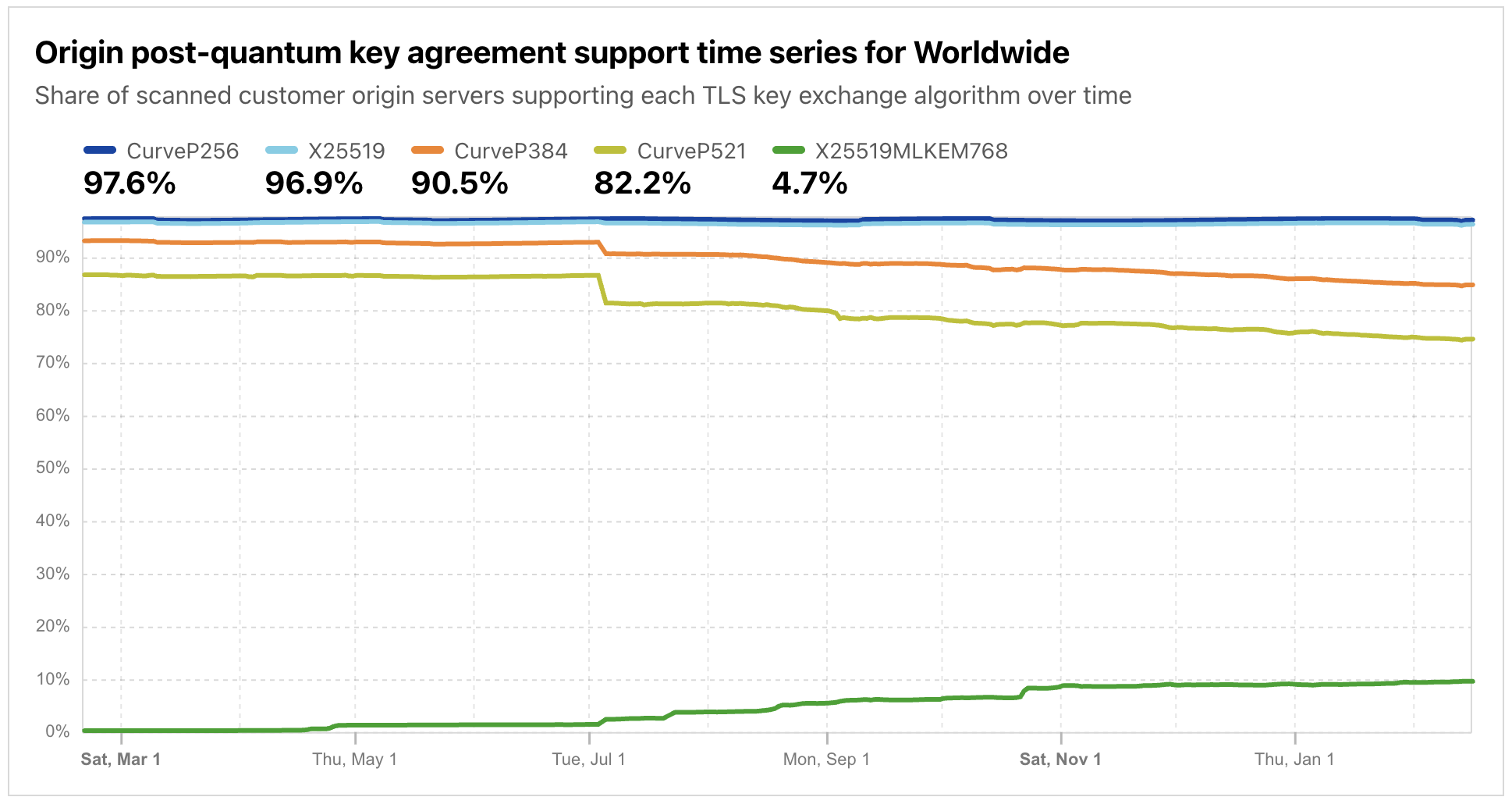
The new origin post-quantum support graph on Radar illustrates the share of customer origins supporting X25519MLKEM768. This data is derived from our automated TLS scanner, which probes TLS 1.3-compatible origins and aggregates the results daily. It is important to note that our scanner tests for support rather than the origin server's specific preference. While an origin may support a post-quantum key exchange algorithm, its local TLS key exchange preference can ultimately dictate the encryption outcome.

While the headline graph focuses on post-quantum readiness, the scanner also evaluates support for classical key exchange algorithms. Within the Radar Data Explorer view, you can also see the full distribution of these supported TLS key exchange methods.

As shown in the graphs above, approximately 10% of origins could benefit from a post-quantum-preferred key agreement today. This represents a significant jump from less than 1% at the start of 2025 — a 10x increase in just over a year. We expect this number to grow steadily as the industry continues its migration. This upward trend likely accelerated in 2025 as many server-side TLS libraries, such as OpenSSL 3.5.0+, GnuTLS 3.8.9+, and Go 1.24+, enabled hybrid post-quantum key exchange by default, allowing platforms and services to support post-quantum connections simply by upgrading their cryptographic library dependencies.

In addition to the Radar and Data Explorer graphs, the origin readiness data is available through the Radar API as well.

As an additional part of our efforts to help the Internet transition to post-quantum cryptography, we are also launching a tool to test whether a specific hostname supports post-quantum encryption. These tests can be run against any publicly accessible website, as long as they allow connections from Cloudflare’s egress IP address ranges. 

A screenshot of the tool in Radar to test whether a hostname supports post-quantum encryption.

The tool presents a simple form where users can enter a hostname (such as cloudflare.com or www.wikipedia.org) and optionally specify a custom port (the default is 443, the standard HTTPS port). After clicking "Test", the result displays a tag indicating PQ support status alongside the negotiated TLS key exchange algorithm. If the server prefers PQ secure connections, a green "PQ" tag appears with a message confirming the connection is "post-quantum secure." Otherwise, a red tag indicates the connection is "not post-quantum secure", showing the classical algorithm that was negotiated.

Under the hood, this tool uses Cloudflare Containers — a new capability that allows running container workloads alongside Workers. Since the Workers runtime is not exposed to details of the underlying TLS handshake, Workers cannot initiate TLS scans. Therefore, we created a Go container that leverages the crypto/tls package's support for post-quantum compatibility checks. The container runs on-demand and performs the actual handshake to determine the negotiated TLS key exchange algorithm, returning results through the Radar API.

With the addition of these origin-facing insights, complementing the existing client-facing insights, we have moved all the post-quantum content to its own section on Radar. 

Securing E2EE messaging systems with Key Transparency

End-to-end encrypted (E2EE) messaging apps like WhatsApp and Signal have become essential tools for private communication, relied upon by billions of people worldwide. These apps use public-key cryptography to ensure that only the sender and recipient can read the contents of their messages — not even the messaging service itself. However, there's an often-overlooked vulnerability in this model: users must trust that the messaging app is distributing the correct public keys for each contact.

If an attacker were able to substitute an incorrect public key in the messaging app's database, they could intercept messages intended for someone else — all without the sender knowing.

Key Transparency addresses this challenge by creating an auditable, append-only log of public keys — similar in concept to Certificate Transparency for TLS certificates. Messaging apps publish their users' public keys to a transparency log, and independent third parties can verify and vouch that the log has been constructed correctly and consistently over time. In September 2024, Cloudflare announced such a Key Transparency auditor for WhatsApp, providing an independent verification layer that helps ensure the integrity of public key distribution for the messaging app's billions of users.

Today, we're publishing Key Transparency audit data in a new Key Transparency section on Cloudflare Radar. This section showcases the Key Transparency logs that Cloudflare audits, giving researchers, security professionals, and curious users a window into the health and activity of these critical systems.

The new page launches with two monitored logs: WhatsApp and Facebook Messenger Transport. Each monitored log is displayed as a card containing the following information:

  • Status: Indicates whether the log is online, in initialization, or disabled. An "online" status means the log is actively publishing key updates into epochs that Cloudflare audits. (An epoch represents a set of updates applied to the key directory at a specific time.)

  • Last signed epoch: The most recent epoch that has been published by the messaging service's log and acknowledged by Cloudflare. By clicking on the eye icon, users can view the full epoch data in JSON format, including the epoch number, timestamp, cryptographic digest, and signature.

  • Last verified epoch: The most recent epoch that Cloudflare has verified. Verification involves checking that the transition of the transparency log data structure from the previous epoch to the current one represents a valid tree transformation — ensuring the log has been constructed correctly. The verification timestamp indicates when Cloudflare completed its audit.

  • Root: The current root hash of the Auditable Key Directory (AKD) tree. This hash cryptographically represents the entire state of the key directory at the current epoch. Like the epoch fields, users can click to view the complete JSON response from the auditor.

The data shown on the page is also available via the Key Transparency Auditor API, with endpoints for auditor information and namespaces.

If you would like to perform audit proof verification yourself, you can follow the instructions in our Auditing Key Transparency blog post. We hope that these use cases are the first of many that we publish in this Key Transparency section in Radar — if your company or organization is interested in auditing for your public key or related infrastructure, you can reach out to us here.

Tracking RPKI ASPA adoption

While the Border Gateway Protocol (BGP) is the backbone of Internet routing, it was designed without built-in mechanisms to verify the validity of the paths it propagates. This inherent trust has long left the global network vulnerable to route leaks and hijacks, where traffic is accidentally or maliciously detoured through unauthorized networks.

Although RPKI and Route Origin Authorizations (ROAs) have successfully hardened the origin of routes, they cannot verify the path traffic takes between networks. This is where ASPA (Autonomous System Provider Authorization) comes in. ASPA extends RPKI protection by allowing an Autonomous System (AS) to cryptographically sign a record listing the networks authorized to propagate its routes upstream. By validating these Customer-to-Provider relationships, ASPA allows systems to detect invalid path announcements with confidence and react accordingly.

While the specific IETF standard remains in draft, the operational community is moving fast. Support for creating ASPA objects has already landed in the portals of Regional Internet Registries (RIRs) like ARIN and RIPE NCC, and validation logic is available in major software routing stacks like OpenBGPD and BIRD.

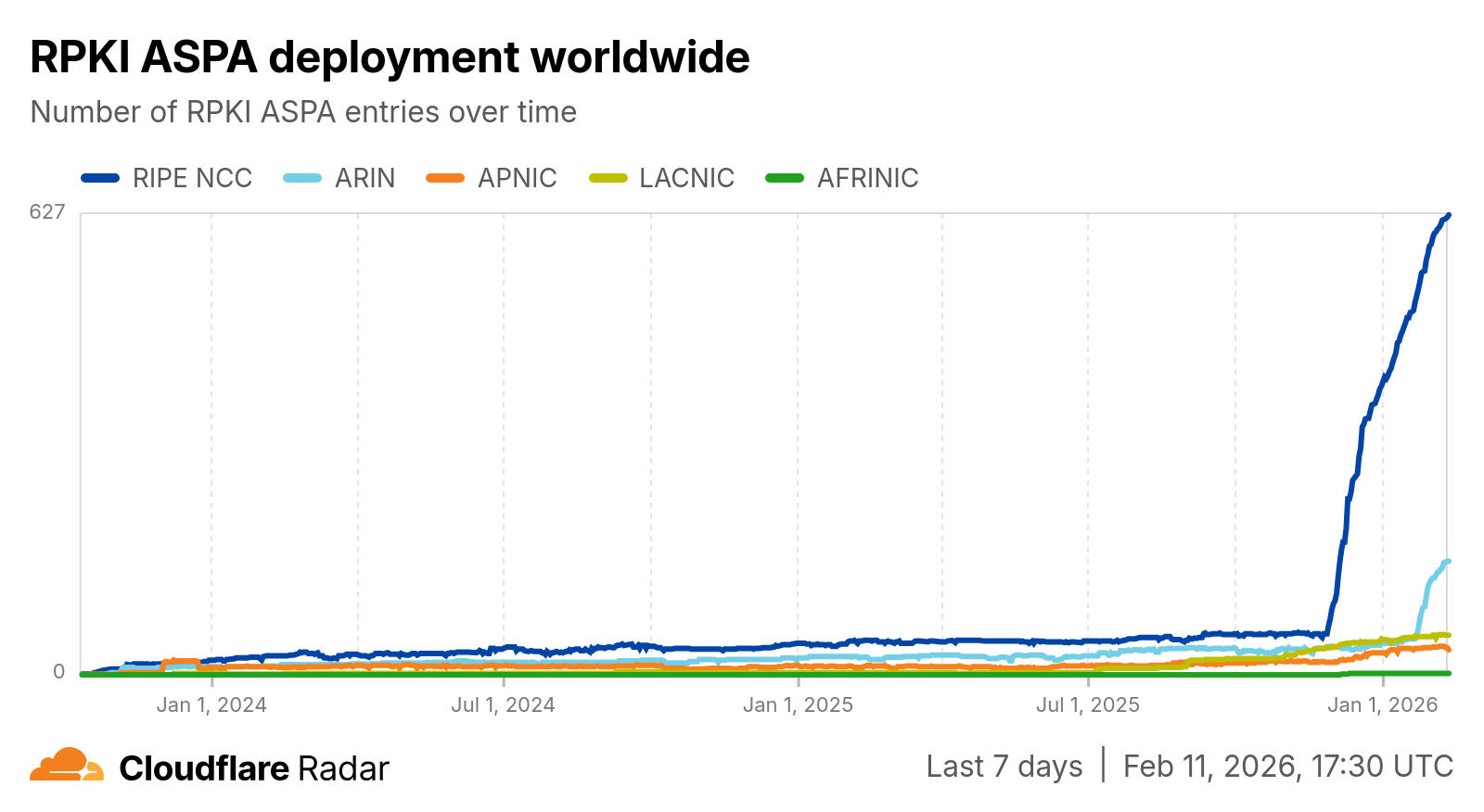
To provide better visibility into the adoption of this emerging standard, we have added comprehensive RPKI ASPA support to the Routing section of Cloudflare Radar. Tracking these records globally allows us to understand how quickly the industry is moving toward better path validation.

Our new ASPA deployment view allows users to examine the growth of ASPA adoption over time, with the ability to visualize trends across the five Regional Internet Registries (RIRs) based on AS registration. You can view the entire history of ASPA entries, dating back to October 1, 2023, or zoom into specific date ranges to correlate spikes in adoption with industry events, such as the introduction of ASPA features on ARIN and RIPE NCC online dashboards.

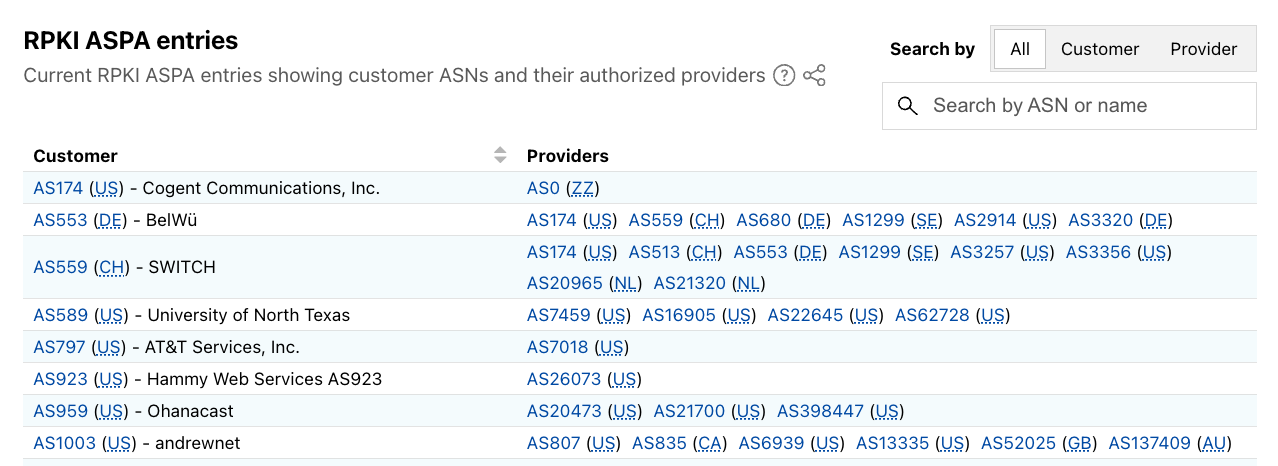
Beyond aggregate trends, we have also introduced a granular, searchable explorer for real-time ASPA content. This table view allows you to inspect the current state of ASPA records, searchable by AS number, AS name, or by filtering for only providers or customer ASNs. This allows network operators to verify that their records are published correctly and to view other networks’ configurations.

We have also integrated ASPA data directly into the country/region routing pages. Users can now track how different locations are progressing in securing their infrastructure, based on the associated ASPA records from the customer ASNs registered locally.

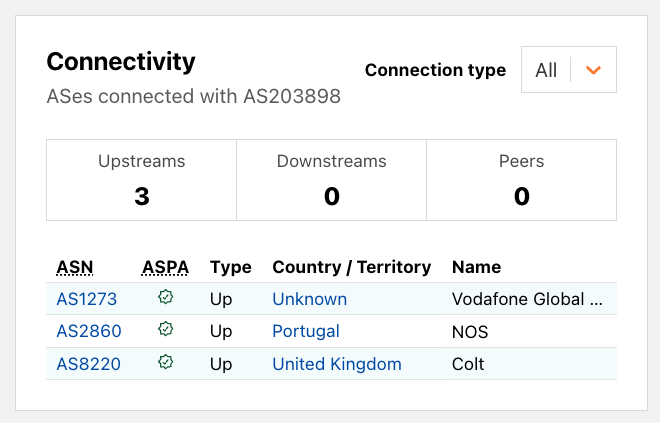
On individual AS pages, we have updated the Connectivity section. Now, when viewing the connections of a network, you may see a visual indicator for "ASPA Verified Provider." This annotation confirms that an ASPA record exists authorizing that specific upstream connection, providing an immediate signal of routing hygiene and trust.

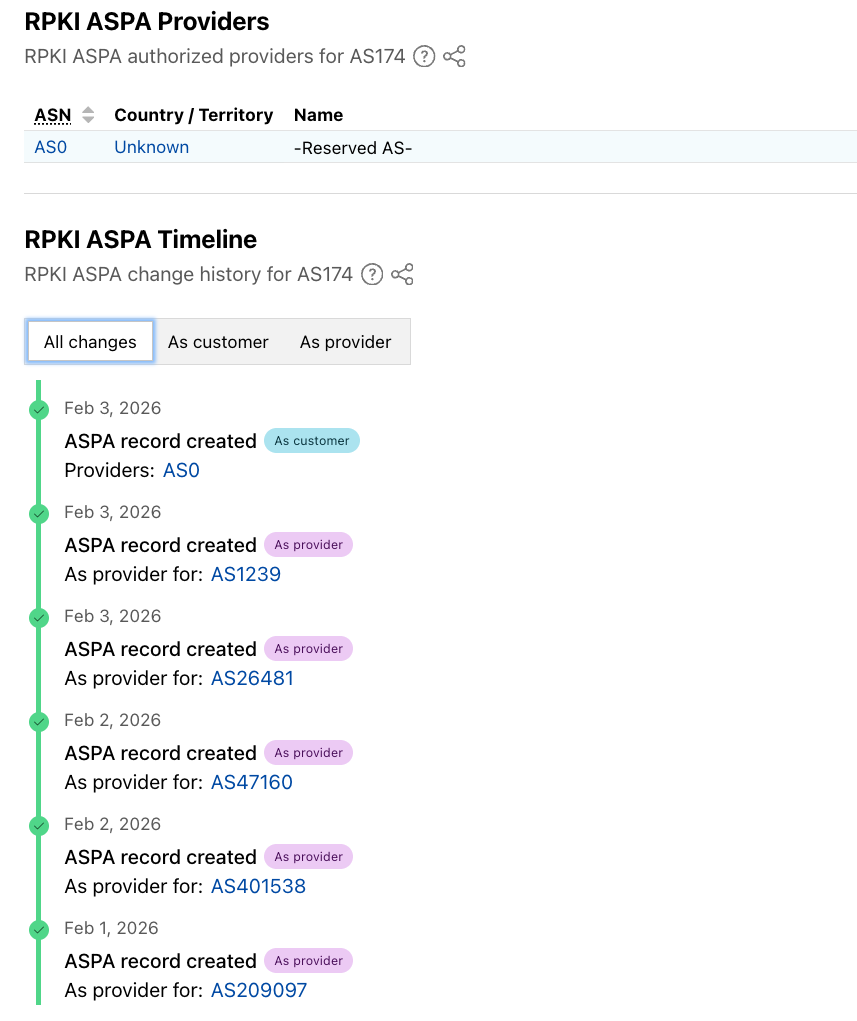
For ASes that have deployed ASPA, we now display a complete list of authorized provider ASNs along with their details. Beyond the current state, Radar also provides a detailed timeline of ASPA activity involving the AS. This history distinguishes between changes initiated by the AS itself ("As customer") and records created by others designating it as a provider ("As provider"), allowing users to immediately identify when specific routing authorizations were established or modified.

Visibility is an essential first step toward broader adoption of emerging routing security protocols like ASPA. By surfacing this data, we aim to help operators deploy protections and assist researchers in tracking the Internet's progress toward a more secure routing path. For those who need to integrate this data into their own workflows or perform deeper analysis, we are also exposing these metrics programmatically. Users can now access ASPA content snapshots, historical timeseries, and detailed changes data using the newly introduced endpoints in the Cloudflare Radar API.

As security evolves, so does our data

Internet security continues to evolve, with new approaches, protocols, and standards being developed to ensure that information, applications, and networks remain secure. The security data and insights available on Cloudflare Radar will continue to evolve as well. The new sections highlighted above serve to expand existing routing security, transparency, and post-quantum insights already available on Cloudflare Radar. 

If you share any of these new charts and graphs on social media, be sure to tag us: @CloudflareRadar (X), noc.social/@cloudflareradar (Mastodon), and radar.cloudflare.com (Bluesky). If you have questions or comments, or suggestions for data that you’d like to see us add to Radar, you can reach out to us on social media, or contact us via email.

❌