
Visualização de leitura

Build your own vulnerability harness

A few weeks ago, we published our initial findings from Project Glasswing, looking at what happens when you point frontier security models at an enterprise codebase. We also explored how our defensive structures adapt to protect our infrastructure and customers from threats posed by frontier AI. Since then, the AI ecosystem has continued to shift rapidly — developers who've built tightly around a single model have already experienced what happens when that model is no longer available or gets superseded by a more capable one. These market shifts only reinforce our core thesis: no matter which underlying model is leading the pack on any given day, the future of agentic workflows will not be found in standalone models, prompts, or single-agent sessions.

Moving from a localized security "skill" to a continuous, fleet-wide scanning pipeline requires an architecture where models are treated as interchangeable components. Relying on a single model inherently limits defensive coverage, as the same system will tend to look at code paths through the exact same lens. To counter this, models should be frequently interchanged and cross-tested. By varying the models across the pipeline — such as using one model for initial discovery and an entirely different one for validation — we can ensure that vulnerabilities are cross-checked by distinct sets of logic. Furthermore, a true enterprise-scale harness must look beyond isolated repositories to trace vulnerabilities across cross-repo dependencies, ultimately filtering thousands of raw candidates down to a trusted, triaged queue of actionable fixes.

This post serves as a practical look at how to build that model-agnostic layer, focusing on how we manage state controls, eliminate false positives, and coordinate end-to-end triage at scale.

Two objections, up front

The first post made the case for why generic coding agents can't do this job. The main issue is that agents only hold one hypothesis at a time, fill their context window after covering a sliver of a real repo, and then lose information during context compaction. For more details, read that post.

Before we move forward, we would like to answer two likely questions.

"Why not use subagents instead of a harness?" Subagents are useful, and they are a good starting point. But security analysis needs hundreds of separate investigations that survive across runs, don't share a context window, and can be re-scoped and cross-referenced later. It needs persistence, deduplication, resumability, and eventually fleet-wide dependency tracing. That's an orchestration problem, and a prompt can't get you there.

"Is this blog post just an ad for frontier models?" No. Our approach centers on the harness, not the model. When it comes to vulnerability discovery, we run it with whatever frontier model is currently best at what we need. When we point different models at the same target, they each turn up a different share of the bugs. The harness is the bit that lasts. If you build your own system, design it to be model-agnostic from day one. This will allow you the freedom to use any model of choice without constraints.

It all starts with a skill

We started with a ~450-line security-audit skill that we ran on a single repository, and adjusted the prompts until we surfaced real bugs. Later, we added the orchestration that became the plumbing of the entire system. The real value lives in the prompts themselves, and our prompts continue to carry the initial skill's attacker scenarios, bug classes, and anti-pattern detections nearly unchanged.

The skill was written to run a 7-phase audit in one session:

  • Three parallel research agents do recon and write an architecture.md.
  • One Hunter agent runs per class attack, trying to break the code rather than review it.
  • Adversarial validators try to disprove each finding.
  • The survivors are written up as a human-readable vulnerability report.
  • They're also emitted as findings.json against a schema, and a mechanical check validates that file.
  • Finally, a fresh agent independently re-verifies every finding against the source.
  • The surviving, re-verified findings are submitted to the ingest API.

That first skill maps almost directly onto the later harness:

The skill worked, but it quickly revealed its limits. Looking at the coverage metrics, a single run finds only about half the bugs you'd catch across multiple runs. In our experience the ones it did find skewed toward the simpler and less subtle. Once your process is basically "run it ten times and diff by hand," you probably need to start looking at a real harness.

While running and fine-tuning the skill, we ran into three walls: 

  • Context exhaustion: An hour in, the context window fills up and the model will cannibalize its own memory, instantly forgetting the bugs it spent all morning tracking down. We broke this bottleneck by externalizing the state entirely, treating the LLM as a stateless compute engine. 
  • Persistence: A crash mid-run means starting over. Losing hours of work to one AI rate-limit error or connection flakiness is an incredibly expensive way to realize you need a better architecture. 
  • Cross-repo reasoning: A single repo session is completely blind to the relationships between applications that consume it, and the number of bugs that surface when you inspect the interface between components is probably more than one might expect.

Codifying the skill into a pipeline

Most AI security write-ups in this space are about a single repo or a curated benchmark; running a whole fleet this way, with cross-repo tracing, isn't something we've seen written up elsewhere. Our codebase spans a massive mix of languages — Rust, Go, C, Lua, TypeScript and Python, alongside various configuration management systems, static configs, and all sorts of additional context. So we had to come up with something new that worked for us. Going from that first slash-command run to a fleet scanner that could cover 128 distinct repos, automatically finding and interrogating relevant dependencies, took about six weeks. Codification was mostly mechanical: we lifted each phase of the skill into its own agent, put a database behind it and an orchestrator in front. The mapping was almost one-to-one.

The entire fleet runs on one unified harness with no per-language tuning and traces the dependencies between repos. While offloading syntax to a model makes the system language-agnostic, the differentiator is its ability to trace dependencies between repos. The harness itself doesn’t care if it’s looking at C pointers or a TypeScript file; it focuses on the higher-level logic of security orchestration. This allows us to scale across hundreds of different codebases, without having to write custom language parsing. 

A two-stage vulnerability research workflow

Our entire vulnerability research workflow is built on a two-stage operational framework: the Vulnerability Discovery Harness (VDH) and the Vulnerability Validation System (VVS).

The VDH functions as our discovery engine, proactively scanning codebases to surface potential security issues. Once bugs enter the VVS, which allows multiple harnesses to feed into it, they go through stages of Deduplication, Judgment, and finally Fixing, as we’ll talk about later.

We use one model for VDH, but we use a completely different model for VVS, so the models are effectively double-checking each other. There is an obvious security benefit to this: by forcing Model B (VVS) to judge the output of Model A (VDH), you ensure that the finding is evaluated by an entirely different set of logical weights and training data — one that acts as an unbiased, adversarial third party whose sole job is to ruthlessly stress-test Model A's assumptions.  And operationally, we benefit from treating model providers like interchangeable commodities. Model providers can change temperature, caching, and inference effort budgets over time, even within one model version. Instead of building a system that depends on a model behaving predictably over time, our harness is built to absorb downstream volatility without breaking.

Stage 1: Vulnerability Discovery Harness (VDH)

The first post covered what each agent/stage is for, so we'll talk about the parts it didn't: the glue between stages, and the handful of details that decide whether any of it works.

Table 1: Vulnerability Discovery Harness (VDH)

Stages four through eight run as a continuous producer-consumer loop. As the initial hunt progresses, the Gapfill, Feedback and Trace agents generate new tasks; Dedup folds overlapping findings back together and the rest of the loop keeps consuming the queue. This ensures a vulnerability discovered late in the cycle is still validated, reported and checked against other code to make sure it doesn't contain the same bug, all within the same run.

Splitting the pipeline this way guarantees strict context controls. If you fill the context window, the model starts hallucinating. We keep each agent’s job hyper-focused, keeping context usage below 25% of the total window. A naive “read all files” approach will blow past this limit every single time.

One thing that caught us out was that persistence needs to be factored in before parallelism. You do not want to throw away a five-hour run because of an unforeseen error. Every stage writes to one SQLite database keyed by (run_id, repo, stage). Any stage can resume, retry, or get pulled into a later run without redoing work. Findings are streamed and saved as they happen, so a crash costs you the task in flight and nothing else.

Dynamic threat modeling

During the Recon stage, the agent writes the threat model instead of being handed one. Beyond about ten built-in attack classes (many forms of injection, memory corruption, protocol parsing, timing side channels, and others), the Recon agent can invent repo-specific classes on the spot, each with its own methodology. It writes a custom taxonomy tailored specifically to that codebase, which is used to more tightly scope the Hunter agents.

Reading source code isn’t enough to understand how it behaves under stress, especially for subtle undefined-behavior bugs in C and other lower-level languages. The Hunter agents move past code reading and transition into active execution. They compile fragments, build small versions, and attack them. The biggest jump in quality came from giving Hunters a sandbox (built on unshare) to crash binaries.

Micro-forks and the wishlist

Beyond the core pipeline stages, we added two specialized mechanisms that grant the Hunters significant autonomy to adapt their focus and request external resources without derailing an ongoing analysis:

Sibling Forking: This helps ensure that if a Hunter agent trips over an interesting code path that is outside the current scope, it doesn’t wander off track. It uses a tool call to fork a sibling agent with a precise structural seed. Fleet-wide, this accounts for roughly 9% of tasks, though the rate is highly model-dependent — from near-zero to about a fifth, depending on which model is hunting.

The Wishlist: When an agent needs a tool it doesn't have, often a Validator confirming a Proof of Concept (PoC) or a Hunter wanting to build something (like a specific build environment, a VM, or some prod config files), it writes to a central wishlist. It provides enough context for the system to automatically re-run that exact task once a human provides the dependency. Some of these can be partly self-healing: if the container needs to be rebuilt with some changes, this can autonomously happen after the run by having a generic coding harness monitor the logs.

The wishlist has been written to 25,472 times across 128 repos since the wishlist was added, and it's the main way the agents talk back to us. One that landed while we were writing this: "I need a FreeBSD VM to confirm this PoC end-to-end."

Fleet-wide cross-repo tracing

After the initial cleanup, a Tracer agent checks how different software components are connected. It looks for a specific path: can a potential attacker send harmful input from the outside to a vulnerable part of the system? If the answer is yes, the Tracer agent automatically spawns fresh hunt tasks inside the consumer repository. To make this work, you need a unified, cross-repo symbol index and an accurate dependency graph. This allows you to uncover deep, systemic flaws that a standard single-repo scan would miss.

Running our harness across an entire fleet of repos revealed two lessons that only surfaced when this was done at scale. 

First, deduplication is its own problem, big enough to need its own agents. When you are scanning a handful of repositories, you can manually eyeball overlapping bugs. Simple string matching or file-path checks won't save you here. Determining whether two complex logic flaws are actually the exact same root bug sounds trivial, but it isn't. It requires so much cognitive reasoning that we had to deploy dedicated Dedup agents just to clean up the noise, along with their own heuristics and ways of reducing the work.

The second is to not wire in static analysis early. We plumbed Semgrep all the way through, and the Hunters invoked it zero times in a month of runs. They would rather read and run the code. The wishlist, by contrast, was the single most-used tool in the system. It's worth paying attention to what the agents actually reach for, rather than what you think they'll want.

Making findings you can trust

The agent will edit the source code so its own exploit works, then triumphantly report the bug it just created. It will write a test that proves something entirely tautological like “exec() executes things, therefore critical vulnerability”. Or it builds an exploit that runs fine but proves nothing, because the threat model behind it is nonsense. If your harness doesn't actively fight this, all you've built is a faster way to produce junk.

A Hunter has to state the threat model before it's allowed to file anything. It has to define exactly who the attacker is, and what boundary the vulnerability crosses or what assumption it breaks. The output schema ordering enforces it. This requirement eliminates the vacuous findings, the "if a user has database write access, they can write to the database" kind.

Every confirmed finding ships with a PoC written as a test that runs against the original, untouched codebase. This prevents the agent from editing the source files to force an exploit to land. If there is no working PoC, we treat the finding as fake. In practice, that's a Hunter compiling a thirty-line parsing loop, running it with memory protection enabled, and demonstrating that the incorrect read stride is originating from a stack address rather than the expected message body. You can re-run it yourself. Furthermore, every confirmed finding must also ship a proposed patch. What actually reaches our review queue is a verified bug, a working test, and a functional git diff, not just a vague text description of a problem.

Before an exploit path survives, deterministic code (written in plain code, not another model) mechanically verifies that the cited files and paths actually exist, and confirms that both the patch and the test parse correctly. This Validator cannot log findings of its own; its sole job is to aggressively disprove the Hunter's theory. If a Hunter is allowed to grade its own homework, it will confidently validate everything it outputs.

We don't claim a false-negative rate for our system. There's no labeled set of every real bug in a codebase, so any claimed recall number is entirely speculative. What we can watch is whether re-runs keep turning up new bugs (they do) and whether coverage is still growing across runs. It’s all a proxy, as you don’t know for sure how many bugs exist in a single codebase, but it’s a good-enough way of measuring effectiveness.

Stage 2: Vulnerability Validation System (VVS)

A finding coming out of the harness is just the start of the triage process, with all discoveries landing in a single, shared VVS that currently holds 13,841 findings across 145 repos in total. Triaging that volume is its own massive engineering problem, and it matters just as much as the hunting. That triage engine runs on a different model from the harness, broken down into three distinct jobs.

Table 2: Vulnerability Validation System (VVS)

Deduping

Comparing every single finding against every other finding using an LLM scales at O(N^2), which falls apart completely at scale. To keep the model off the critical path, deterministic code builds inverted indexes over the structured data (touched files/functions, trust boundary, rare tokens) to generate a short list of real candidates. Only then does an agent look at that short list to see if a single fix would close several of them. Stable cross-run keys ensure re-found bugs reopen existing records rather than spawning new ones.

Contextual judgment

Judgment is a second, independent pass over what survived. The agent rechecks the latest information, pulling from deployment, environment, and config context to determine if the code path is reachable in prod, and identify the repo owner. This process filters "exploitable now" from "real but latent" and from "real but filed against the wrong component." It's moving a pile of chaotic findings into a risk-driven orchestration workflow.

Automated fixing

The Fixer takes the proposed patch and unit tests, rewrites them to match the repo’s style, applies the diff, and runs targeted tests. A clean fail→pass flip is the ideal and the only auto-cleanup case; a failing post-patch test blocks the commit. The Fixer never merges code on its own; a human must review the branch. This gate is the non-negotiable, human-in-the-loop safeguard that enables a clean, unbreakable cryptographic trail for change management compliance. Left to patch freely, a model will happily fix a security bug while quietly breaking an unrelated feature or adding dozens of new bugs.

Across all three triage jobs, each agent is confined to one narrow task wrapped in deterministic bookkeeping code, and nothing writes to production without a human signing off on a dry run. While this pipeline moves the engineering bottleneck from finding bugs to reviewing and landing fixes, the Fixer remains the youngest and slowest part of the system. 

What it costs

Running hundreds of agents over a fleet of repos is not cheap, but at least the shape of the spend is predictable. Almost all of the compute budget goes directly into the hunt stage. This makes Gapfill our cost-to-coverage lever, as each additional pass costs roughly half as much as the initial hunt.

Because the cost per repository varies wildly, we budget per repo rather than per run. We enforce a strict task cap per repository and spin up a worker pool of anywhere from 50 to 200 workers. That way you can spend money on the repos that are actually finding things, and not waste it on the ones that aren't.

It's also why, for us, the big scans are a periodic backlog sweep and not a per-PR check. A full scan of a complex repo can take hours; the worst run took just over 14 hours. Cheaper, smaller harnesses are the right tool for that job.

How we tell it's working

We measure our system’s effectiveness by tracking how efficiently our automated pipeline filters deliberate engineering noise into high-quality, actionable findings. Because we intentionally tune our Hunters to over-report subtle primitives that could be chained into larger attacks, our true indicator of success is how sharply we can refine that initial mountain of raw data, before it ever reaches a human.

To gauge this, we track exactly how many raw findings survive each validation stage over time. Thanks to better context injection from our Recon phase, our initial validation rejection rate dropped from 40% down to 11%, while the share of high-integrity findings climbed from 35% to 58% (representing ~12,057 lifetime findings).

Here's the lifetime breakdown from raw candidates to actionable findings, at the point in time this blog post was written.

The core metric of the harness isn’t a speculative recall score — it’s keeping the number of unconfirmed findings in front of real humans as close to zero as possible. The architecture needs to be a relentless filtering funnel. 

  • Out of 20,799 raw candidates generated by VDH, only about 12,057 survived validation.
  • When these were pushed into the VVS, joining findings from another harness, the central pool was brought to 13,841
  • The Dedup agent folded away 5,442 findings as duplicates. 
  • 1,154 were routed to the queue as ‘wrong-repo’ or ‘low-risk’ and were recycled back into the system where appropriate. 
  • Ultimately this left 7,245 actionable findings for engineering teams to act on.

Traditional compliance rules dictate arbitrary remediation windows based entirely on a static CVSS score (e.g., "Fix all Highs in 30 days"). Our contextual judgment layer turns this compliance checkbox into actual risk management. 

The architecture is capable of tracking findings back to their origin, meaning that fixing a single root cause resolves an entire cluster of findings rather than just patching individual issues. VDH system performance is also measured by dividing repos into (area x attack-class) cells and running the Gapfill agent iteratively until it stops producing findings. Whenever we update an underlying prompt, we test it against a held-out repository to see if that total coverage cell number actually moves.

The harness wires automated health signals to catch system failures early in the pipeline. If a hunt finished suspiciously fast and fails to spawn sub-hunts or gap tasks, it usually indicates a crashed dependency rather than a clean codebase. To remedy this, the system flags any Hunter agent that finishes with zero findings as “shallow” and immediately requeues it for a new run. 

Finally, our system’s robustness is reinforced by the independent triage pass described earlier. By re-judging all submissions with a different model and separate logical weights, we ensure an unbiased, adversarial verification that is decoupled from the specific model used for discovery, providing a trust layer that persists regardless of which model is in use.

None of this is finished. We change our system constantly, and it is nowhere near a perfect science. But raw candidate findings are cheap now, and the only work worth doing is turning them into sound, verifiable code fixes.

Building your own harness means accepting that AI models are volatile, but your orchestration layer doesn't have to be. By decoupling your security logic from any single provider, forcing adversarial verification, and automating your triage pipeline, you can turn a mountain of LLM noise into a reliable, fleet-wide defense engine.

Our “North Star” metrics: measuring real-world velocity

Every codebase is a little different, so to show you how this actually works in the real world, we mapped out a realistic benchmark based on a standard repo run. Keep in mind that this represents a single pass on one repo; over time, as the continuous fleet-wide loop deduplicates, filters, and recycles findings, it reduces the volume of lifetime candidates by roughly 65%.

Engineering hours saved via automated patching: Rather than focusing on static baselines, we measure the health of our pipeline by its technical throughput, processing velocity, and its ability to eliminate the manual triage bottleneck:

  • Initial Validation Cut: For a standard repository (~30k lines of code), this yields 100 initial findings, with a full run taking 3-4 hours, maintaining a hyperfocused context window throughout. 
  • Compression: The Deduplication and Contextual Judgment Layers process these candidates in parallel. Within 3 hours, the system compresses and refines the batch of findings from ~100 raw candidates to 80 distinct, high-fidelity bugs.
  • Remediation: The automated Fixer processes these 80 distinct bugs at an average rate of 5 minutes per bug. In total, the system can discover, validate, deduplicate, and open functional pull requests in approximately 14 hours.

Shrinking mean-time-to-resolve for critical flaws: Of course, you can’t dump 80 patches into production all at once without breaking things. To keep deployments safe, our system uses a tiered rollout:

  • Critical Exposure Containment: The system isolates the critical, high, and exploitable bugs (avg. 10 out of 80). We fast-track these for a human review and introduce them into release cycles, getting them fully patched in production in 5 days.
  • Incremental Hardening: The remaining latent risks, minor config anomalies, and lower-urgency bugs are incrementally rolled into prod over a 15-20 day window to guarantee platform stability.

How we’re handling all of this patching

These findings are the result of an isolated, ring-fenced research experiment designed to stress-test our code. They do not represent active, unpatched vulnerabilities in our live production environment.

Because the harness runs constantly in our test environments, these specific numbers are completely out of date by the time you're reading this. Every single bug surfaced by the pipeline came attached to a working test case to demonstrate the bug and a draft patch. Our security teams are systematically processing the reports and applying the necessary fixes, meaning the Cloudflare products you use every day are already actively hardened against these vectors.

Along with this blog post, we’re releasing the initial skill we used to develop the harness, it’s been slightly cleaned up before release so it’s easier to understand and integrate, but the skill itself remains substantially the same. Hopefully the harness itself will follow shortly. This could be a starting point for your own vulnerability harness, your own skill, or whatever suits your needs best:
github.com/cloudflare/security-audit-skill

If your team is working on the same problems and would like to compare notes, reach out to us at security-ai-research@cloudflare.com.
How Cloudflare responded to the “Copy Fail” Linux vulnerability

On April 29, 2026, a Linux kernel local privilege escalation vulnerability was publicly disclosed under the name "Copy Fail" (CVE-2026-31431). Cloudflare’s Security and Engineering teams began assessing the vulnerability as soon as it was disclosed. We reviewed the exploit technique, evaluated exposure across our infrastructure, and validated that our existing behavioral detections could identify the exploit pattern within minutes. 

There was no impact to the Cloudflare environment, no customer data was at risk, and no services were disrupted at any point. Read on to learn how our preparedness paid off. 

Background

Our Linux kernel release process

Cloudflare operates a global Linux server infrastructure at an immense scale, with datacenters located across 330 cities. We maintain a custom Linux kernel build based on the community's Long-Term Support (LTS) versions to manage updates effectively at this volume. At any given time, we may utilize multiple LTS versions from various series, such as 6.12 or 6.18, which benefit from extended update periods.

The community regularly merges and releases security and stability updates which trigger an automated job to generate a new internal kernel build approximately every week. These builds undergo testing in our staging data centers to ensure stability before a global rollout. Following a successful release, the Edge Reboot Release (ERR) pipeline manages a systematic update and reboot of the edge infrastructure on a four-week cycle. Our control plane infrastructure typically adopts the most recent kernel, with reboots scheduled according to specific workload requirements.

By the time a CVE becomes public knowledge, the necessary fix has typically been integrated into stable Linux LTS releases for several weeks. Our established procedures ensure that we have already deployed these patches.

At the time of the "Copy Fail" disclosure, the majority of our infrastructure was running the 6.12 LTS version, while a subset of machines had begun transitioning to the newer 6.18 LTS release.

About the Copy Fail vulnerability

It helps to understand the vulnerability before getting to the response story. A comprehensive write-up can be found in the original Xint Code disclosure post.

AF_ALG and the kernel crypto API

The Linux kernel's internal crypto API manages functions like kTLS and IPsec. Userspace programs access this via the AF_ALG socket family, allowing unprivileged processes to request encryption or decryption. The algif_aead module facilitates this for Authenticated Encryption with Associated Data (AEAD) ciphers.

An unprivileged program follows these steps:

  1. Opens an AF_ALG socket and binds to an AEAD template.
  2. Sets a key and accepts a request socket.
  3. Submits input via sendmsg() or splice().
  4. Executes the operation using recvmsg().

The splice() system call is critical here, as it moves data by passing page cache references.

Memory mechanics: page cache and in-place crypto

The page cache is a shared system cache for file contents. Modifying a page belonging to a setuid binary effectively edits that program for all users until the page is evicted.

The crypto API utilizes scatterlists, which are structures linking various memory pages. In 2017, algif_aead was optimized for in-place operations, chaining destination and reference pages together. This design lacked enforcement to prevent algorithms from writing past intended boundaries.

The vulnerability: out-of-bounds write

When the user executes recvmsg(), the authencesn wrapper in the kernel performs a 4-byte write past the legitimate output region:

By using splice(), an attacker can chain a target file's page cache pages to the scatterlist. The out-of-bounds write then taints the cached file, allowing an attacker to control which file is modified, the offset, and the specific 4 bytes written. This means the attacker can manipulate the following with this exploit:

  • File: Any readable file.
  • Offset: Tunable via assoclen and splice parameters.
  • Value: Controlled via AAD bytes 4-7 in sendmsg()

The exploit, step by step

The default exploit targets /usr/bin/su, a setuid-root binary present on essentially every distribution.

  1. Cache Reference: Open /usr/bin/su as O_RDONLY and read() to populate the page cache. Use splice() on the file descriptor to pass these page cache references into the crypto scatterlist.
  2. Setup: Create an AF_ALG socket, bind() to authencesn(hmac(sha256),cbc(aes)), set a key, and accept a request socket without needing privileges.
  3. Write Construction: For each 4-byte shellcode chunk:
    • sendmsg() with AAD bytes 4–7 containing the shellcode.
    • splice() the binary into a pipe then the AF_ALG socket so assoclen + cryptlen targets the desired .text offset.
  4. Trigger: recvmsg() initiates decryption. authencesn writes its scratch data to the target offset of /usr/bin/su in the page cache. Although the function returns -EBADMSG, the 4-byte write is now in the global page cache.
  5. Execution: Running execve("/usr/bin/su") loads the tainted page cache. Since the binary is setuid-root, the injected shellcode executes with root privileges.

The upstream fix (commit a664bf3d603d) reverts the 2017 in-place optimization, removing the exploit.

How we responded 

When the vulnerability was disclosed, many workstreams started in parallel:

  • Mapping the blast radius: Our security team worked with kernel engineers to determine which kernel versions were vulnerable and assess the potential exposure.
  • Validating coverage: Security reviewed the exploit technique and confirmed that our existing behavioral detections could identify the exploit pattern during authorized internal validation.
  • Proactive threat hunting: Security began searching for signs that the vulnerability had been exploited before it was publicly known, going back 48 hours in our fleet-wide logs.
  • Engineering a mitigation: Kernel engineers began building a runtime mitigation that would protect the fleet without breaking production services.
  • Continuing software updates: Our engineering teams worked on delivering an updated Linux kernel, which required carefully rebooting and rolling it out across our servers.

There was no customer impact at any point during this response.

Validating detection coverage

One of the first things our security team did was confirm that our existing endpoint detection would catch this exploit. Our servers run behavioral detection that continuously monitors process execution patterns. It doesn't rely on knowing about specific vulnerabilities; it watches for anomalous behavior across the fleet.

When our engineers validated the vulnerability internally as part of the response, the detection platform flagged it within minutes. The system linked the entire execution chain—starting at the script interpreter, moving through the kernel’s cryptographic subsystem, and ending at the privilege escalation binary—flagging it as malicious based on fleet-wide behavioral patterns.

This happened without a signature update, without a rule change, and without human intervention. Our behavioral detection coverage existed before we wrote any custom logic for this particular Copy File exploit. 

The confirmation was important because it meant we had coverage before writing a vulnerability-specific rule.

Hunting for exploitation

While our engineering team moved to a more targeted mitigation, our security investigation had been running since disclosure. This is our standard procedure for any critical vulnerability.

Our security team operates on a simple principle for critical vulnerabilities: assume compromise until you can prove otherwise. The investigation started from the assumption that exploitation could have occurred before the vulnerability was public, and we worked systematically to either confirm or rule it out.

The exploit leaves a distinctive trace in kernel logs when it runs. We searched for that trace across our centralized logging infrastructure, covering 48 hours before the vulnerability was publicly disclosed. If someone had exploited this before the world knew about it, we would have seen it.

We pulled access logs for affected systems and reconstructed who connected, when, and what commands they ran. This gave us a complete forensic picture of interactive activity on potentially affected infrastructure.

We checked that system binaries had not been tampered with, validated cryptographic hashes against known-good package manifests, looked for persistence mechanisms, and audited network connections for anything unusual. Everything was clean.

Incident timeline and impact

This graph shows the progress of our mitigation program as it progressed through our infrastructure.

How did we mitigate it?

Because of the long timeframe involved in deploying a patched Linux kernel, we also pursued mitigating this exploit without a reboot.

Removing the module

The bug was in the algif_aead kernel module. Therefore, the simple fix was to just remove this module and disallow it from being reloaded.

This mitigation was therefore exactly what the Copy Fail write-up from the security researchers who identified it recommends.

Unfortunately removing the module would have impacted software that leverages the kernel crypto API.  This meant that we had to figure out a more surgical mitigation.

Bpf-lsm

We’ve already developed and deployed such a tool for this exact scenario: bpf-lsm. Instead of removing the module, this tool leaves it loaded for legitimate users and uses a BPF Linux Security Module program to deny the socket_bind LSM hook for everyone else. This completely blocks the front door for any exploits.

A draft of the eBPF program was put together overnight. Team members picked it up the following morning, ran validations, and made it production-ready. The program is fairly straightforward. On every socket_bind call:

  1. If the socket family is not AF_ALG, allow the call through unchanged.
  2. If the family is AF_ALG, check the calling binary's path against an allow-list of the binaries we know to be legitimate users.
  3. If the binary is on the allow-list, allow the bind. Otherwise, deny it.

To verify the mitigation on a given machine without exploiting it, the Copy Fail write-up gives a one-liner:

On a mitigated machine you get PermissionError: [Errno 1] Operation not permitted (or FileNotFoundError, depending on which mitigation is active) instead of a successful bind.

Rolling it out

Before enabling enforcement, we verified that our known internal service was the sole legitimate AF_ALG user to avoid accidental outages. We used prometheus-ebpf-exporter to hook the socket() syscall and track AF_ALG usage per binary across the fleet. This required no kernel changes and provided aggregate data from hundreds of thousands of servers within hours. Results confirmed the identified service was indeed the only legitimate user.

So the bpf-lsm rollout was deliberately staged in two steps:

  1. Get visibility first. Push the ebpf-exporter config gated by salt. Confirm at the metric layer that the known service is effectively the only thing creating AF_ALG sockets.
  2. Then enforce. Push the bpf-lsm program behind a separate enforcement gate.

In parallel, the upstream backport for our majority LTS line finally became available, and our internal automation built a patched kernel against it.

We started to test the patched kernel in our staging datacenters as soon as possible, then we resumed the longer reboot process in order to fully patch our fleet.

Remediation and follow-up steps

While we were prepared for this scenario, at Cloudflare we’re always learning and improving. Key areas we identified for improvement:

  • Better visibility into kernel-API dependencies. We will review kernel-subsystem usage across production services, so we can continue to quickly mitigate exploits without service disruption.
  • Better runtime mitigation. bpf-lsm is a valuable tool for mitigations, but we want to make this tool even better. This will include looking into faster deployments, better playbooks, and better logging and visibility of the tool. 
  • Reduce attack surface of Linux Kernel. Review and audit our kernel configuration. Proactively identify unused modules or features so that we can remove them from our build entirely.

Conclusion

The "Copy Fail" vulnerability presented a unique challenge for us. Despite our practice of deploying Linux patch updates every two weeks, we remained vulnerable because a month-old mainline fix had yet to be backported to our primary kernel line. Despite that, we were still able to roll out patched kernels within hours of the backport's release. In the interim, bpf-lsm provided a surgical, no-reboot mitigation that secured our fleet. While our initial attempt to disable the problematic module failed, it did so safely within our internal staging environment rather than production, allowing us to identify this dependency.

By the end of the rollout, every machine in our fleet was protected by either a patched kernel or a bpf-lsm program denying the vulnerable code path to non-allow-listed binaries. There was no customer impact at any point during this incident, and we have committed to the follow-up work above to make our response faster and our visibility better the next time something like this lands. Responsible disclosure works, in-kernel visibility tooling pays off in moments exactly like this one, and bpf-lsm continues to be one of the most useful primitives we have for runtime kernel mitigation.

At Cloudflare, critical vulnerability response is a coordinated effort across Security, Engineering, Product, and many other teams. Special thanks to Ali Adnan, Ivan Babrou, Frederik Baetens, Curtis Bray, Piers Cornwell, Everton Didone Foscarini, Rob Dinh, Elle Dougherty, Kevin Flansburg, Matt Fleming, Kimberley Hall, Brandon Harris, Jerry Ho, Oxana Kharitonova, Marek Kroemeke, Fred Lawler, James Munson, Nafeez Nazer, Walead Parviz, Miguel Pato, Evan Pratten, Josh Seba, June Slater, Ryan Timken, Michael Wolf, Jianxin Zeng and everyone else who contributed to the investigation, mitigation, and remediation of Copy Fail. We'd also like to thank the Linux upstream maintainers and Copy Fail researchers whose work helped make a rapid response possible.

Active defense: introducing a stateful vulnerability scanner for APIs

Security is traditionally a game of defense. You build walls, set up gates, and write rules to block traffic that looks suspicious. For years, Cloudflare has been a leader in this space: our Application Security platform is designed to catch attacks in flight, dropping malicious requests at the edge before they ever reach your origin. But for API security, defensive posturing isn’t enough. 

That’s why today, we are launching the beta of Cloudflare’s Web and API Vulnerability Scanner. 

We are starting with the most pervasive and difficult-to-catch threat on the OWASP API Top 10: Broken Object Level Authorization, or BOLA. We will add more vulnerability scan types over time, including both API and web application threats.

The most dangerous API vulnerabilities today aren’t generic injection attacks or malformed requests that a WAF can easily spot. They are logic flaws—perfectly valid HTTP requests that meet the protocol and application spec but defy the business logic.

To find these, you can’t just wait for an attack. You have to actively hunt for them.

The Web and API Vulnerability Scanner will be available first for API Shield customers. Read on to learn why we are focused on API security scans for this first release.

Why purely defensive security misses the mark

In the web application world, vulnerabilities often look like syntax errors. A SQL injection attempt looks like code where data should be. A cross-site scripting (XSS) attack looks like a script tag in a form field. These have signatures.

API vulnerabilities are different. To illustrate, let’s imagine a food delivery mobile app that communicates solely with an API on the backend. Let’s take the orders endpoint:

Endpoint Definition: /api/v1/orders

In a broken authorization attack like BOLA, User A (the attacker) requests to update the delivery address of a paid-for order belonging to User B (the victim). The attacker simply inserts User B’s {order_id} in the PATCH request.

Here is what that request looks like, with ‘8821’ as User B’s order ID. Notice that User A is fully authenticated with their own valid token:

The request headers are valid. The authentication token is valid. The schema is correct. To a standard WAF, this request looks perfect. A bot management offering may even be fooled if a human is manually sending the attack requests.

User A will now get B’s food delivered to them! The vulnerability exists because the API endpoint fails to validate if User A actually has permission to view or update user B’s data. This is a failure of logic, not syntax. To fix this, the API developer could implement a simple check: if (order.userID != user.ID) throw Unauthorized;

You can detect these types of vulnerabilities by actively sending API test traffic or passively listening to existing API traffic. Finding these vulnerabilities through passive scanning requires context. Last year we launched BOLA vulnerability detection for API Shield. This detection automatically finds these vulnerabilities by passively scanning customer traffic for usage anomalies. To be successful with this type of scanning, you need to know what a "valid" API call looks like, what the variable parameters are, how a typical user behaves, and how the API behaves when those parameters are manipulated.

Yet there are reasons security teams may not have any of that context, even with access to API Shield’s BOLA vulnerability detection. Development environments may need to be tested but lack user traffic. Production environments may (thankfully) have a lack of attack traffic yet still need analysis, and so on. In these circumstances, and to be proactive in general, teams can turn to Dynamic Application Security Testing (DAST). By creating net-new traffic profiles intended specifically for security testing, DAST tools can look for vulnerabilities in any environment at any time.

Unfortunately, traditional DAST tools have a high barrier to entry. They are often difficult to configure, require you to manually upload and maintain Swagger/OpenAPI files, struggle to authenticate correctly against modern complex login flows, and can simply lack any API-specific security tests (e.g. BOLA).

Cloudflare’s API scanning advantage

In the food delivery order example above, we assumed the attacker could find a valid order to modify. While there are often avenues for attackers to gather this type of intelligence in a live production environment, in a security testing exercise you must create your own objects before testing the API’s authorization controls. For typical DAST scans, this can be a problem, because many scanners treat each individual request on its own. This method fails to chain requests together in the logical pattern necessary to find broken authorization vulnerabilities. Legacy DAST scanners can also exist as an island within your security tooling and orchestration environment, preventing their findings from being shared or viewed in context.

Vulnerability scanning from Cloudflare is different for a few key reasons. 

First, Security Insights will list results from our new scans alongside any existing Cloudflare security findings for added context. You’ll see all your posture management information in one place. 

Second, we already know your API’s inputs and outputs. If you are an API Shield customer, Cloudflare already understands your API. Our API Discovery and Schema Learning features passively catalog your endpoints and learn your traffic patterns. While you’ll need to manually upload an OpenAPI spec to get started for our initial release, you will be able to get started quickly without one in a future release.

Third, because we sit at the edge, we can turn passive traffic inspection knowledge into active intelligence. It will be easy to verify BOLA vulnerability detection risks (found via traffic inspection) by sending net-new HTTP requests with the vulnerability scanner.

And finally, we have built a new, stateful DAST platform, as we detail below. Most scanners require hours of setup to "teach" the tool how to talk to your API. With Cloudflare, you can effectively skip that step and get started quickly. You provide the API credentials, and we’ll use your API schemas to automatically construct a scan plan.

Building automatic scan plans

APIs are commonly documented using OpenAPI schemas. These schemas denote the host, method, and path (commonly, an “endpoint”) along with the expected parameters of incoming requests and resulting responses. In order to automatically build a scan plan, we must first make sense of these API specifications for any given API to be scanned.

Our scanner works by building up an API call graph from an OpenAPI document and subsequently walking it, using attacker and owner contexts. Owners create resources, attackers subsequently try to access them. Attackers are fully authenticated with their own set of valid credentials. If an attacker successfully reads, modifies or deletes an unowned resource, an authorization vulnerability is found.

Consider for example the above delivery order with ID 8821. For the server-side resource to exist, it needed to be originally created by an owner, most likely in a “genesis” POST request with no or minimal dependencies (previous necessary calls and resulting data). Modelling the API as a call graph, such an endpoint constitutes a node with no or few incoming edges (dependencies). Any subsequent request, such as the attacker’s PATCH above, then has a data dependency (the data is order_id) on the genesis request (the POST). Without all data provided, the PATCH cannot proceed.

Here we see in purple arrows the nodes in this API graph that are necessary to visit to add a note to an order via the POST /api/v1/orders/{order_id}/note/{note_id} endpoint. Importantly, none of the steps or logic shown in the diagram is available in the OpenAPI specification! It must be inferred logically through some other means, and that is exactly what our vulnerability scanner will do automatically.

In order to reliably and automatically plan scans across a variety of APIs, we must accurately model these endpoint relationships from scratch. However, two problems arise: data quality of API specifications is not guaranteed, and even functionally complete schemas can have ambiguous naming schemes. Consider a simplified OpenAPI specification for the above API, which might look like

We can see that the POST endpoint returns responses such as

To a human observer, it is quickly evident that $.result.id is the value to be injected in order_id for the PATCH endpoint. The id property might also be called orderId, value or something else, and be nested arbitrarily. These subtle inconsistencies in OpenAPI documents of arbitrary shape are intractable for heuristics-based approaches.

Our scanner uses Cloudflare’s own Workers AI platform to tackle this fuzzy problem space. Models such as OpenAI’s open-weight gpt-oss-120b are powerful enough to match data dependencies reliably, and to generate realistic fake data where necessary, essentially filling in the blanks of OpenAPI specifications. Leveraging structured outputs, the model produces a representation of the API call graph for our scanner to walk, injecting attacker and owner credentials appropriately.

This approach tackles the problem of needing human intelligence to infer authorization and data relationships in OpenAPI schemas with artificial intelligence to do the same. Structured outputs bridge the gap from the natural language world of gpt-oss back to machine-executable instructions. In addition to Workers AI solving the planning problem, self-hosting on Workers AI means our system automatically benefits from Cloudflare’s highly available, globally distributed architecture.

Built on proven foundations

Building a vulnerability scanner that customers will trust with their API credentials demands proven infrastructure. We did not reinvent the wheel here. Instead, we integrated services that have been validated and deployed across Cloudflare for two crucial components of our scanner platform: the scanner’s control plane and the scanner’s secrets store.

The scanner's control plane integrates with Temporal for Scan Orchestration, on which other internal services at Cloudflare already rely. The complexity of the numerous test plans executed in each Scan is effectively managed by Temporal's durable execution framework. 

The entire backend is written in Rust, which is widely adopted at Cloudflare for infrastructure services. This lets us reuse internal libraries and share architectural patterns across teams. It also positions our scanner for potential future integration with other Cloudflare systems like FL2 or our test framework Flamingo – enabling scenarios where scanning could coordinate more tightly with edge request handling or testing infrastructure.

Credential security through HashiCorp’s Vault Transit Secret Engine

Scanning for broken authentication and broken authorization vulnerabilities requires handling API user credentials. Cloudflare takes this responsibility very seriously.

We ensure that our public API layer has minimal access to unencrypted customer credentials by using HashiCorp's Vault Transit Secret Engine (TSE) for encryption-as-a-service. Immediately upon submission, credentials are encrypted by TSE—which handles the encryption but does not store the ciphertext—and are subsequently stored on Cloudflare infrastructure. 

Our API is not authorized to decrypt this data. Instead, decryption occurs only at the last stage when a TestPlan makes a request to the customer's infrastructure. Only the Worker executing the test is authorized to request decryption, a restriction we strengthen using strict typing with additional safety rails inside Rust to enforce minimal access to decryption methods.

We further secure our customers’ credentials through regular rotation and periodic rewraps using TSE to mitigate risk. This process means we only interact with the new ciphertext, and the original secret is kept unviewable.

What’s next?

We are releasing BOLA vulnerability scanning starting today as an Open Beta for all API Shield customers, and are working on future API threat scans for future release. Via the Cloudflare API, you can trigger scans, manage configuration, and retrieve results programmatically to integrate directly into your CI/CD pipelines or security dashboards. For API Shield Customers: check the developer docs to start scanning your endpoints for BOLA vulnerabilities today.

We are starting with BOLA vulnerabilities because they are the hardest API vulnerability to solve and the highest risk for our customers. However, this scanning engine is built to be extensible.

In the near future, we plan to expand the scanner’s capabilities to cover the most popular of the OWASP Web Top 10 as well: classic web vulnerabilities like SQL injection (SQLi) and cross-site scripting (XSS). To be notified upon release, sign up for the waitlist here, and you’ll be first to learn when we expand the engine to general web application vulnerabilities.

How we mitigated a vulnerability in Cloudflare’s ACME validation logic

This post was updated on January 20, 2026.

On October 13, 2025, security researchers from FearsOff identified and reported a vulnerability in Cloudflare's ACME (Automatic Certificate Management Environment) validation logic that disabled some of the WAF features on specific ACME-related paths. The vulnerability was reported and validated through Cloudflare’s bug bounty program.

The vulnerability was rooted in how our edge network processed requests destined for the ACME HTTP-01 challenge path (/.well-known/acme-challenge/*).

Here, we’ll briefly explain how this protocol works and the action we took to address the vulnerability. 

Cloudflare has patched this vulnerability and there is no action necessary for Cloudflare customers. There is no evidence of any malicious actor abusing this vulnerability.

How ACME works to validate certificates

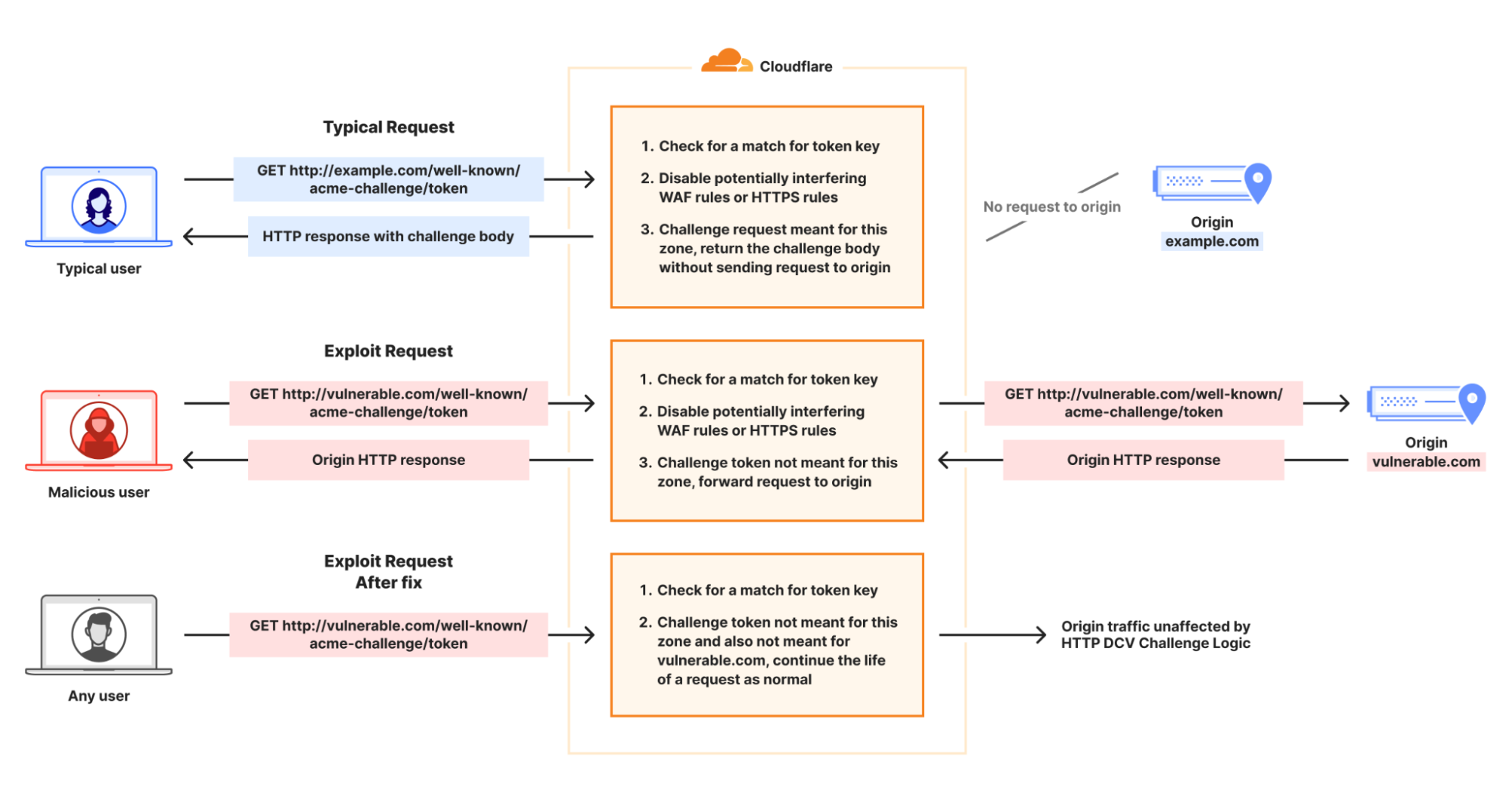
ACME is a protocol used to automate the issuance, renewal, and revocation of SSL/TLS certificates. When an HTTP-01 challenge is used to validate domain ownership, a Certificate Authority (CA) will expect to find a validation token at the HTTP path following the format of http://{customer domain}/.well-known/acme-challenge/{token value}

If this challenge is used by a certificate order managed by Cloudflare, then Cloudflare will respond on this path and provide the token provided by the CA to the caller. If the token provided does not correlate to a Cloudflare managed order, then this request would be passed on to the customer origin, since they may be attempting to complete domain validation as a part of some other system. Check out the flow below for more details — other use cases are discussed later in the blog post.

The underlying logic flaw 

Certain requests to /.well-known/acme-challenge/* would cause the logic serving ACME challenge tokens to disable WAF features on a challenge request, and allow the challenge request to continue to the origin when it should have been blocked.

Previously, when Cloudflare was serving a HTTP-01 challenge token, if the path requested by the caller matched a token for an active challenge in our system, the logic serving an ACME challenge token would disable WAF features, since Cloudflare would be directly serving the response. This is done because those features can interfere with the CA’s ability to validate the token values and would cause failures with automated certificate orders and renewals.

However, in the scenario that the token used was associated with a different zone and not directly managed by Cloudflare, the request would be allowed to proceed onto the customer origin without further processing by WAF rulesets.

How we mitigated this vulnerability

To mitigate this issue, a code change was released. This code change only allows the set of security features to be disabled in the event that the request matches a valid ACME HTTP-01 challenge token for the hostname. In that case, Cloudflare has a challenge response to serve back.

Cloudflare customers are protected

As we noted above, Cloudflare has patched this vulnerability and Cloudflare customers do not need to take any action. In addition, there is no evidence  of any malicious actor abusing this vulnerability.

Moving quickly with vulnerability transparency

As always, we thank the external researchers for responsibly disclosing this vulnerability. We encourage the Cloudflare community to submit any identified vulnerabilities to help us continually improve the security posture of our products and platform. 

We also recognize that the trust you place in us is paramount to the success of your infrastructure on Cloudflare. We consider these vulnerabilities with the utmost concern and will continue to do everything in our power to mitigate impact. We deeply appreciate your continued trust in our platform and remain committed not only to prioritizing security in all we do, but also acting swiftly and transparently whenever an issue does arise. 

Defending QUIC from acknowledgement-based DDoS attacks

On April 10th, 2025 12:10 UTC, a security researcher notified Cloudflare of two vulnerabilities (CVE-2025-4820 and CVE-2025-4821) related to QUIC packet acknowledgement (ACK) handling, through our Public Bug Bounty program. These were DDoS vulnerabilities in the quiche library, and Cloudflare services that use it. quiche is Cloudflare's open-source implementation of QUIC protocol, which is the transport protocol behind HTTP/3.

Upon notification, Cloudflare engineers patched the affected infrastructure, and the researcher confirmed that the DDoS vector was mitigated. Cloudflare’s investigation revealed no evidence that the vulnerabilities were being exploited or that any customers were affected. quiche versions prior to 0.24.4 were affected.

Here, we’ll explain why ACKs are important to Internet protocol design and how they help ensure fair network usage. Finally, we will explain the vulnerabilities and discuss our mitigation for the Optimistic ACK attack: a dynamic CWND-aware skip frequency that scales with a connection’s send rate.

Internet Protocols and Attack Vectors

QUIC is an Internet transport protocol that offers equivalent features to TCP (Transmission Control Protocol) and TLS (Transport Layer Security). QUIC runs over UDP (User Datagram Protocol), is encrypted by default and offers a few benefits over the prior set of protocols (including smaller handshake time, connection migration, and preventing head-of-line blocking that can manifest in TCP). Similar to TCP, QUIC relies on packet acknowledgements to make general progress. For example, ACKs are used for liveliness checks, validation, loss recovery signals, and congestion algorithm signals.

ACKs are an important source of signals for Internet protocols, which necessitates validation to ensure a malicious peer is not subverting these signals. Cloudflare's QUIC implementation, quiche, lacked ACK range validation, which meant a peer could send an ACK range for packets never sent by the endpoint; this was patched in CVE-2025-4821. Additionally, a sophisticated attacker could  mount an attack by predicting and preemptively sending ACKs (a technique called Optimistic ACK); this was patched in CVE-2025-4820. By exploiting the lack of ACK validation, an attacker can cause an endpoint to artificially expand its send rate; thereby gaining an unfair advantage over other connections. In the extreme case this can be a DDoS attack vector caused by higher server CPU utilization and an amplification of network traffic.

Fairness and Congestion control

A typical CDN setup includes hundreds of server processes, serving thousands of concurrent connections. Each connection has its own recovery and congestion control algorithm that is responsible for determining its fair share of the network. The Internet is a shared resource that relies on well-behaved transport protocols correctly implementing congestion control to ensure fairness.

To illustrate the point, let’s consider a shared network where the first connection (blue) is operating at capacity. When a new connection (green) joins and probes for capacity, it will trigger packet loss, thereby signaling the blue connection to reduce its send rate. The probing can be highly dynamic and although convergence might take time, the hope is that both connections end up sharing equal capacity on the network.

New connection joining the shared network. Existing flows make room for the new flow.

In order to ensure fairness and performance, each endpoint uses a Congestion Control algorithm. There are various algorithms but for our purposes let's consider Cubic, a loss-based algorithm. Cubic, when in steady state, periodically explores higher sending rates. As the peer ACKs new packets, Cubic unlocks additional sending capacity (congestion window) to explore even higher send rates. Cubic continues to increase its send rate until it detects congestion signals (e.g., packet loss), indicating that the network is potentially at capacity and the connection should lower its sending rate.

Cubic congestion control responding to loss on the network.

The role of ACKs

ACKs are a feedback mechanism that Internet protocols use to make progress. A server serving a large file download will send that data across multiple packets to the client. Since networks are lossy, the client is responsible for ACKing when it has received a packet from the server, thus confirming delivery and progress. Lack of an ACK indicates that the packet has been lost and that the data might require retransmission. This feedback allows the server to confirm when the client has received all the data that it requested.

The server delivers packets and the client responds with ACKs.

The server delivers packets, but packet [2] is lost. The client responds with ACKs only for packets [1, 3], thereby signalling that packet [2] was lost.

In QUIC, packet numbers don't have to be sequential; that means skipping packet numbers is natively supported. Additionally, a QUIC ACK Frame can contain gaps and multiple ACK ranges. As we will see, the built-in support for skipping packet numbers is a unique feature of QUIC (over TCP) that will help us enforce ACK validation.

The server delivering packets, but skipping packet [4]. The client responds with ACKs only for packets it received, and not sending an ACK for packet [4].

ACKs also provide signals that control an endpoint's send rate and help provide fairness and performance. Delay between ACKs, variations in the delay, and lack of ACKs provide valuable signals, which suggest a change in the network and are important inputs to a congestion control algorithm.

Skipping packets to avoid ACK delay

QUIC allows endpoints to encode the ACK delay: the time by which the ACK for packet number 'X' was intentionally delayed from when the endpoint received packet number 'X.' This delay can result from normal packet processing or be an implementation-specific optimization. For example, since ACKs processing can be expensive (both for CPU and network), delaying ACKs can allow for batching and reducing the associated overhead.

If the sender wants to elicit a faster acknowledgement on PTO, it can skip a packet number to eliminate the acknowledgement delay. -- https://www.rfc-editor.org/rfc/rfc9002.html#section-6.2.4

However, since a delay in ACK signal also delays peer feedback, this can be detrimental for loss recovery. QUIC endpoints can therefore signal the peer to avoid delaying an ACK packet by skipping a packet number. This detail will become important as we will see later in the post.

Validating ACK range

It is expected that a well-behaved client should only send ACKs for packets that it has received. A lack of validation meant that it was possible for the client to send a very large ACK range for packets never sent by the server. For example, assuming the server has sent packets 0-5, a client was able to send an ACK Frame with the range 0-100.

By itself this is not actually a huge deal since quiche is smart enough to drop larger ACKs and only process ACKs for packets it has sent. However, as we will see in the next section, this made the Optimistic ACK vulnerability easier to exploit.

The fix was to enforce ACK range validation based on the largest packets sent by the server and close the connection on violation. This matches the RFC recommendation.

An endpoint SHOULD treat receipt of an acknowledgment for a packet it did not send as a connection error of type PROTOCOL_VIOLATION, if it is able to detect the condition. -- https://www.rfc-editor.org/rfc/rfc9000#section-13.1

The server validating ACKs: the client sending ACK for packets [4..5] not sent by the server. The server closes the connection since ACK validation fails.

Optimistic ACK attack

In the following scenario, let’s assume the client is trying to mount an Optimistic ACK attack against the server. The goal of a client mounting the attack is to cause the server to send at a high rate. To achieve a high send rate, the client needs to deliver ACKs quickly back to the server, thereby providing an artificially low RTT / high bandwidth signal. Since packet numbers are typically monotonically increasing, a clever client can predict the next packet number and preemptively send ACKs (artificial ACK).

Optimistic ACK attack: the client predicting packets sent by the server and preemptively sending ACKs. ACK validation does not help here.

If the server has proper ACK validation, an invalid ACK for packets not yet sent by the server should trigger a connection close (without ACK range validation, the attack is trivial to execute). Therefore, a malicious client needs to be clever about pacing the artificial ACKs so they arrive just as the server has sent the packet. If the attack is done correctly, the server will see a very low RTT, and result in an inflated send rate.

An endpoint that acknowledges packets it has not received might cause a congestion controller to permit sending at rates beyond what the network supports. An endpoint MAY skip packet numbers when sending packets to detect this behavior. An endpoint can then immediately close the connection with a connection error of type PROTOCOL_VIOLATION -- https://www.rfc-editor.org/rfc/rfc9000#section-21.4

Preventing an Optimistic ACK attack: the client predicting packets sent by the server and preemptively sending ACKs. Since the server skipped packet [4], it is able to detect the invalid ACK and close the connection.

The QUIC RFC mentions the Optimistic ACK attack and suggests skipping packets to detect this attack. By skipping packets, the client is unable to easily predict the next packet number and risks connection close if the server implements invalid ACK range validation. Implementation details – like how many packet numbers to skip and how often – are missing, however.

The [malicious] client transmission pattern does not indicate any malicious behavior.

As such, the bit rate towards the server follows normal behavior. Considering that QUIC packets are end-to-end encrypted, a middlebox cannot identify the attack by analyzing the client’s traffic. -- MAY is not enough! QUIC servers SHOULD skip packet numbers

Ideally, the client would like to use as few resources as possible, while simultaneously causing the server to use as many as possible. In fact, as the security researchers confirmed in their paper: it is difficult to detect a malicious QUIC client using external traffic analysis, and it’s therefore necessary for QUIC implementations to mitigate the Optimistic ACK attack by skipping packets.

The Optimistic ACK vulnerability is not unique to QUIC. In fact the vulnerability was first discovered against TCP. However, since TCP does not natively support skipping packet numbers, an Optimistic ACK attack in TCP is harder to mitigate and can require additional DDoS analysis. By allowing for packet skipping, QUIC is able to prevent this type of attack at the protocol layer and more effectively ensure correctness and fairness over untrusted networks.

How often to skip packet numbers

According to the QUIC RFC, skipping packet numbers currently has two purposes. The first is to elicit a faster acknowledgement for loss recovery and the second is to mitigate an Optimistic ACK attack. A QUIC implementation skipping packets for Optimistic ACK attack therefore needs to skip frequently enough to mitigate the attack, while considering the effects on eliminating ACK delay.

Since packet skipping needs to be unpredictable, a simple implementation could be to skip packet numbers based on a random number from a static range. However, since the number of packets increases as the send rate increases, this has the downside of not adapting to the send rate. At smaller send rates, a static range will be too frequent, while at higher send rates it won't be frequent enough and therefore be less effective. It's also arguably most important to validate the send rate when there are higher send rates. It therefore seems necessary to adapt the skip frequency based on the send rate.

Congestion window (CWND) is a parameter used by congestion control algorithms to determine the amount of bytes that can be sent per round. Since the send rate increases based on the amount of bytes ACKed (capped by bytes sent), we claim that CWND makes a great proxy for dynamically adjusting the skip frequency. This CWND-aware skip frequency allows all connections, regardless of current send rate, to effectively mitigate the Optimistic ACK attack.

// c: the current packet number
// s: range of random packet number to skip from
//
// curr_pn
//  |
//  v                 |--- (upper - lower) ---|
// [c x x x x x x x x s s s s s s s s s s s s s x x]
//    |--min_skip---| |------skip_range-------|

const DEFAULT_INITIAL_CONGESTION_WINDOW_PACKETS: usize = 10;
const MIN_SKIP_COUNTER_VALUE: u64 = DEFAULT_INITIAL_CONGESTION_WINDOW_PACKETS * 2;

let packets_per_cwnd = (cwnd / max_datagram_size) as u64;
let lower = packets_per_cwnd / 2;
let upper = packets_per_cwnd * 2;

let skip_range = upper - lower;
let rand_skip_value = rand(skip_range);

let skip_pn = MIN_SKIP_COUNTER_VALUE + lower + rand_skip_value;

Skip frequency calculation in quiche.

Timeline

All timestamps are in UTC.

  • 2025–04-10 12:10 - Cloudflare is notified of an ACK validation and Optimistic ACK vulnerability via the Bug Bounty Program.

  • 2025-04-19 00:20 – Cloudflare confirms both vulnerabilities are reproducible and begins working on fix.

  • 2025-05-02 20:12 - Security patch is complete and infrastructure patching starts.

  • 2025–05-16 04:52 - Cloudflare infrastructure patching is complete.

  • New quiche version released.

Conclusion

We would like to sincerely thank Louis Navarre and Olivier Bonaventure from UCLouvain, who responsibly disclosed this issue via our Cloudflare Bug Bounty Program, allowing us to identify and mitigate the vulnerability. They also published a paper with their findings, notifying 10 other QUIC implementations that also suffered from the Optimistic ACK vulnerability. 

We welcome further submissions from our community of researchers to continually improve the security of all of our products and open source projects.

Safe in the sandbox: security hardening for Cloudflare Workers

As a serverless cloud provider, we run your code on our globally distributed infrastructure. Being able to run customer code on our network means that anyone can take advantage of our global presence and low latency. Workers isn’t just efficient though, we also make it simple for our users. In short: You write code. We handle the rest.

Part of 'handling the rest' is making Workers as secure as possible. We have previously written about our security architecture. Making Workers secure is an interesting problem because the whole point of Workers is that we are running third party code on our hardware. This is one of the hardest security problems there is: any attacker has the full power available of a programming language running on the victim's system when they are crafting their attacks.

This is why we are constantly updating and improving the Workers Runtime to take advantage of the latest improvements in both hardware and software. This post shares some of the latest work we have been doing to keep Workers secure.

Some background first: Workers is built around the V8 JavaScript runtime, originally developed for Chromium-based browsers like Chrome. This gives us a head start, because V8 was forged in an adversarial environment, where it has always been under intense attack and scrutiny. Like Workers, Chromium is built to run adversarial code safely. That's why V8 is constantly being tested against the best fuzzers and sanitizers, and over the years, it has been hardened with new technologies like Oilpan/cppgc and improved static analysis.

We use V8 in a slightly different way, though, so we will be describing in this post how we have been making some changes to V8 to improve security in our use case.

Hardware-assisted security improvements from Memory Protection Keys

Modern CPUs from Intel, AMD, and ARM have support for memory protection keys, sometimes called PKU, Protection Keys for Userspace. This is a great security feature which increases the power of virtual memory and memory protection.

Traditionally, the memory protection features of the CPU in your PC or phone were mainly used to protect the kernel and to protect different processes from each other. Within each process, all threads had access to the same memory. Memory protection keys allow us to prevent specific threads from accessing memory regions they shouldn't have access to.

V8 already uses memory protection keys for the JIT compilers. The JIT compilers for a language like JavaScript generate optimized, specialized versions of your code as it runs. Typically, the compiler is running on its own thread, and needs to be able to write data to the code area in order to install its optimized code. However, the compiler thread doesn't need to be able to run this code. The regular execution thread, on the other hand, needs to be able to run, but not modify, the optimized code. Memory protection keys offer a way to give each thread the permissions it needs, but no more. And the V8 team in the Chromium project certainly aren't standing still. They describe some of their future plans for memory protection keys here.

In Workers, we have some different requirements than Chromium. The security architecture for Workers uses V8 isolates to separate different scripts that are running on our servers. (In addition, we have extra mitigations to harden the system against Spectre attacks). If V8 is working as intended, this should be enough, but we believe in defense in depth: multiple, overlapping layers of security controls.

That's why we have deployed internal modifications to V8 to use memory protection keys to isolate the isolates from each other. There are up to 15 different keys available on a modern x64 CPU and a few are used for other purposes in V8, so we have about 12 to work with. We give each isolate a random key which is used to protect its V8 heap data, the memory area containing the JavaScript objects a script creates as it runs. This means security bugs that might previously have allowed an attacker to read data from a different isolate would now hit a hardware trap in 92% of cases. (Assuming 12 keys, 92% is about 11/12.)

The illustration shows an attacker attempting to read from a different isolate. Most of the time this is detected by the mismatched memory protection key, which kills their script and notifies us, so we can investigate and remediate. The red arrow represents the case where the attacker got lucky by hitting an isolate with the same memory protection key, represented by the isolates having the same colors.

However, we can further improve on a 92% protection rate. In the last part of this blog post we'll explain how we can lift that to 100% for a particular common scenario. But first, let's look at a software hardening feature in V8 that we are taking advantage of.

The V8 sandbox, a software-based security boundary

Over the past few years, V8 has been gaining another defense in depth feature: the V8 sandbox. (Not to be confused with the layer 2 sandbox which Workers have been using since the beginning.) The V8 sandbox has been a multi-year project that has been gaining maturity for a while. The sandbox project stems from the observation that many V8 security vulnerabilities start by corrupting objects in the V8 heap memory. Attackers then leverage this corruption to reach other parts of the process, giving them the opportunity to escalate and gain more access to the victim's browser, or even the entire system.

V8's sandbox project is an ambitious software security mitigation that aims to thwart that escalation: to make it impossible for the attacker to progress from a corruption on the V8 heap to a compromise of the rest of the process. This means, among other things, removing all pointers from the heap. But first, let's explain in as simple terms as possible, what a memory corruption attack is.

Memory corruption attacks

A memory corruption attack tricks a program into misusing its own memory. Computer memory is just a store of integers, where each integer is stored in a location. The locations each have an address, which is also just a number. Programs interpret the data in these locations in different ways, such as text, pixels, or pointers. Pointers are addresses that identify a different memory location, so they act as a sort of arrow that points to some other piece of data.

Here's a concrete example, which uses a buffer overflow. This is a form of attack that was historically common and relatively simple to understand: Imagine a program has a small buffer (like a 16-character text field) followed immediately by an 8-byte pointer to some ordinary data. An attacker might send the program a 24-character string, causing a "buffer overflow." Because of a vulnerability in the program, the first 16 characters fill the intended buffer, but the remaining 8 characters spill over and overwrite the adjacent pointer.

See below for how such an attack would now be thwarted.

Now the pointer has been redirected to point at sensitive data of the attacker's choosing, rather than the normal data it was originally meant to access. When the program tries to use what it believes is its normal pointer, it's actually accessing sensitive data chosen by the attacker.

This type of attack works in steps: first create a small confusion (like the buffer overflow), then use that confusion to create bigger problems, eventually gaining access to data or capabilities the attacker shouldn't have.  The attacker can eventually use the misdirection to either steal information or plant malicious data that the program will treat as legitimate.

This was a somewhat abstract description of memory corruption attacks using a buffer overflow, one of the simpler techniques. For some much more detailed and recent examples, see this description from Google, or this breakdown of a V8 vulnerability.

Compressed pointers in V8

Many attacks are based on corrupting pointers, so ideally we would remove all pointers from the memory of the program.  Since an object-oriented language's heap is absolutely full of pointers, that would seem, on its face, to be a hopeless task, but it is enabled by an earlier development. Starting in 2020, V8 has offered the option of saving memory by using compressed pointers. This means that, on a 64-bit system, the heap uses only 32 bit offsets, relative to a base address. This limits the total heap to maximally 4 GiB, a limitation that is acceptable for a browser, and also fine for individual scripts running in a V8 isolate on Cloudflare Workers.

An artificial object with various fields, showing how the layout differs in a compressed vs. an uncompressed heap. The boxes are 64 bits wide.

If the whole of the heap is in a single 4 GiB area then the first 32 bits of all pointers will be the same, and we don't need to store them in every pointer field in every object. In the diagram we can see that the object pointers all start with 0x12345678, which is therefore redundant and doesn't need to be stored. This means that object pointer fields and integer fields can be reduced from 64 to 32 bits.

We still need 64 bit fields for some fields like double precision floats and for the sandbox offsets of buffers, which are typically used by the script for input and output data. See below for details.

Integers in an uncompressed heap are stored in the high 32 bits of a 64 bit field. In the compressed heap, the top 31 bits of a 32 bit field are used. In both cases the lowest bit is set to 0 to indicate integers (as opposed to pointers or offsets).

Conceptually, we have two methods for compressing and decompressing, using a base address that is divisible by 4 GiB:

// Decompress a 32 bit offset to a 64 bit pointer by adding a base address.
void* Decompress(uint32_t offset) { return base + offset; }
// Compress a 64 bit pointer to a 32 bit offset by discarding the high bits.
uint32_t Compress(void* pointer) { return (intptr_t)pointer & 0xffffffff; }

This pointer compression feature, originally primarily designed to save memory, can be used as the basis of a sandbox.

From compressed pointers to the sandbox

The biggest 32-bit unsigned integer is about 4 billion, so the Decompress() function cannot generate any pointer that is outside the range [base, base + 4 GiB]. You could say the pointers are trapped in this area, so it is sometimes called the pointer cage. V8 can reserve 4 GiB of virtual address space for the pointer cage so that only V8 objects appear in this range. By eliminating all pointers from this range, and following some other strict rules, V8 can contain any memory corruption by an attacker to this cage. Even if an attacker corrupts a 32 bit offset within the cage, it is still only a 32 bit offset and can only be used to create new pointers that are still trapped within the pointer cage.

The buffer overflow attack from earlier no longer works because only the attacker's own data is available in the pointer cage.

To construct the sandbox, we take the 4 GiB pointer cage and add another 4 GiB for buffers and other data structures to make the 8 GiB sandbox. This is why the buffer offsets above are 33 bits, so they can reach buffers in the second half of the sandbox (40 bits in Chromium with larger sandboxes). V8 stores these buffer offsets in the high 33 bits and shifts down by 31 bits before use, in case an attacker corrupted the low bits.

Cloudflare Workers have made use of compressed pointers in V8 for a while, but for us to get the full power of the sandbox we had to make some changes. Until recently, all isolates in a process had to be one single sandbox if you were using the sandboxed configuration of V8. This would have limited the total size of all V8 heaps to be less than 4 GiB, far too little for our architecture, which relies on serving 1000s of scripts at once.

That's why we commissioned Igalia to add isolate groups to V8. Each isolate group has its own sandbox and can have 1 or more isolates within it. Building on this change we have been able to start using the sandbox, eliminating a whole class of potential security issues in one stroke. Although we can place multiple isolates in the same sandbox, we are currently only putting a single isolate in each sandbox.

The layout of the sandbox. In the sandbox there can be more than one isolate, but all their heap pages must be in the pointer cage: the first 4 GiB of the sandbox. Instead of pointers between the objects, we use 32 bit offsets. The offsets for the buffers are 33 bits, so they can reach the whole sandbox, but not outside it.

Virtual memory isn't infinite, there's a lot going on in a Linux process

At this point, we were not quite done, though. Each sandbox reserves 8 GiB of space in the virtual memory map of the process, and it must be 4 GiB aligned for efficiency. It uses much less physical memory, but the sandbox mechanism requires this much virtual space for its security properties. This presents us with a problem, since a Linux process 'only' has 128 TiB of virtual address space in a 4-level page table (another 128 TiB are reserved for the kernel, not available to user space).

At Cloudflare, we want to run Workers as efficiently as possible to keep costs and prices down, and to offer a generous free tier. That means that on each machine we have so many isolates running (one per sandbox) that it becomes hard to place them all in a 128 TiB space.

Knowing this, we have to place the sandboxes carefully in memory. Unfortunately, the Linux syscall, mmap, does not allow us to specify the alignment of an allocation unless you can guess a free location to request. To get an 8 GiB area that is 4 GiB aligned, we have to ask for 12 GiB, then find the aligned 8 GiB area that must exist within that, and return the unused (hatched) edges to the OS:

If we allow the Linux kernel to place sandboxes randomly, we end up with a layout like this with gaps. Especially after running for a while, there can be both 8 GiB and 4 GiB gaps between sandboxes:

Sadly, because of our 12 GiB alignment trick, we can't even make use of the 8 GiB gaps. If we ask the OS for 12 GiB, it will never give us a gap like the 8 GiB gap between the green and blue sandboxes above. In addition, there are a host of other things going on in the virtual address space of a Linux process: the malloc implementation may want to grab pages at particular addresses, the executable and libraries are mapped at a random location by ASLR, and V8 has allocations outside the sandbox.

The latest generation of x64 CPUs supports a much bigger address space, which solves both problems, and Linux kernels are able to make use of the extra bits with five level page tables. A process has to opt into this, which is done by a single mmap call suggesting an address outside the 47 bit area. The reason this needs an opt-in is that some programs can't cope with such high addresses. Curiously, V8 is one of them.

This isn't hard to fix in V8, but not all of our fleet has been upgraded yet to have the necessary hardware. So for now, we need a solution that works with the existing hardware. We have modified V8 to be able to grab huge memory areas and then use mprotect syscalls to create tightly packed 8 GiB spaces for sandboxes, bypassing the inflexible mmap API.

Putting it all together

Taking control of the sandbox placement like this actually gives us a security benefit, but first we need to describe a particular threat model.

We assume for the purposes of this threat model that an attacker has an arbitrary way to corrupt data within the sandbox. This is historically the first step in many V8 exploits. So much so that there is a special tier in Google's V8 bug bounty program where you may assume you have this ability to corrupt memory, and they will pay out if you can leverage that to a more serious exploit.

However, we assume that the attacker does not have the ability to execute arbitrary machine code. If they did, they could disable memory protection keys. Having access to the in-sandbox memory only gives the attacker access to their own data. So the attacker must attempt to escalate, by corrupting data inside the sandbox to access data outside the sandbox.

You will recall that the compressed, sandboxed V8 heap only contains 32 bit offsets. Therefore, no corruption there can reach outside the pointer cage. But there are also arrays in the sandbox — vectors of data with a given size that can be accessed with an index. In our threat model, the attacker can modify the sizes recorded for those arrays and the indexes used to access elements in the arrays. That means an attacker could potentially turn an array in the sandbox into a tool for accessing memory incorrectly. For this reason, the V8 sandbox normally has guard regions around it: These are 32 GiB virtual address ranges that have no virtual-to-physical address mappings. This helps guard against the worst case scenario: Indexing an array where the elements are 8 bytes in size (e.g. an array of double precision floats) using a maximal 32 bit index. Such an access could reach a distance of up to 32 GiB outside the sandbox: 8 times the maximal 32 bit index of four billion.

We want such accesses to trigger an alarm, rather than letting an attacker access nearby memory.  This happens automatically with guard regions, but we don't have space for conventional 32 GiB guard regions around every sandbox.

Instead of using conventional guard regions, we can make use of memory protection keys. By carefully controlling which isolate group uses which key, we can ensure that no sandbox within 32 GiB has the same protection key. Essentially, the sandboxes are acting as each other's guard regions, protected by memory protection keys. Now we only need a wasted 32 GiB guard region at the start and end of the huge packed sandbox areas.

With the new sandbox layout, we use strictly rotating memory protection keys. Because we are not using randomly chosen memory protection keys, for this threat model the 92% problem described above disappears. Any in-sandbox security issue is unable to reach a sandbox with the same memory protection key. In the diagram, we show that there is no memory within 32 GiB of a given sandbox that has the same memory protection key. Any attempt to access memory within 32 GiB of a sandbox will trigger an alarm, just like it would with unmapped guard regions.

The future

In a way, this whole blog post is about things our customers don't need to do. They don't need to upgrade their server software to get the latest patches, we do that for them. They don't need to worry whether they are using the most secure or efficient configuration. So there's no call to action here, except perhaps to sleep easy.

However, if you find work like this interesting, and especially if you have experience with the implementation of V8 or similar language runtimes, then you should consider coming to work for us. We are recruiting both in the US and in Europe. It's a great place to work, and Cloudflare is going from strength to strength.

MadeYouReset: An HTTP/2 vulnerability thwarted by Rapid Reset mitigations

(Correction on August 19, 2025: This post was updated to correct and clarify details about the vulnerability and the HTTP/2 protocol.)

On August 13, security researchers at Tel Aviv University disclosed a new HTTP/2 denial-of-service (DoS) vulnerability that they are calling MadeYouReset (CVE-2025-8671). This vulnerability exists in a limited number of unpatched HTTP/2 server implementations that do not accurately track use of server-sent stream resets, which can lead to resource consumption. If you’re using Cloudflare for HTTP DDoS mitigation, you’re already protected from MadeYouReset.

Cloudflare was informed of this vulnerability in May through a coordinated disclosure process, and we were able to confirm that our systems were not susceptible. We foresaw this sort of attack while mitigating the "Netflix vulnerabilities" in 2019, and added even stronger defenses in response to Rapid Reset (CVE-2023-44487) in 2023. MadeYouReset and Rapid Reset are two conceptually similar attacks that exploit a fundamental feature within the HTTP/2 specification (RFC 9113): stream resets. In the HTTP/2 protocol, a client initiates a bidirectional stream that carries an HTTP request/response exchange, represented as frames sent between the client and server. Typically, HEADERS and DATA frames are used for a complete exchange.  Endpoints can use the RST_STREAM frame to prematurely terminate a stream, essentially cancelling operations and signalling that it won’t process any more request or response data. Furthermore, HTTP/2 requires that RST_STREAM is sent when there are protocol errors related to the stream. For example, section 6.1 of RFC 9113 requires that when a DATA frame is received under the wrong circumstances, "...the recipient MUST respond with a stream error (Section 5.4.2) of type STREAM_CLOSED". 

The vulnerability exploited by both MadeYouReset and Rapid Reset lies in the potential for malicious actors to abuse this stream reset mechanism. By repeatedly causing stream resets, attackers can overwhelm a server's resources. While the server is attempting to process and respond to a multitude of requests, the rapid succession of resets forces it to expend computational effort on starting and then immediately discarding these operations. This can lead to resource exhaustion and impact the availability of the targeted server for legitimate users; as described previously, the main difference between the two attacks is that Rapid Reset exploits client-sent resets, while MadeYouReset exploits server-sent resets. It works by using a client to persuade a server into resetting streams via intentionally sending frames that trigger protocol violations, which in turn trigger stream errors.

RFC 9113 details a number of denial-of-service considerations. Fundamentally, the protocol provides many features with legitimate uses that can be exploited by attackers with nefarious intent. Implementations are advised to harden themselves: "An endpoint that doesn't monitor use of these features exposes itself to a risk of denial of service. Implementations SHOULD track the use of these features and set limits on their use."

Fortunately, the MadeYouReset vulnerability only impacts a relatively small number of HTTP/2 implementations. In most major HTTP/2 implementations already in widespread use today, the proactive measures taken to implement RFC 9113 guidance and counter Rapid Reset in 2023 have also provided substantial protection against MadeYouReset, limiting its potential impact and preventing a similarly disruptive event.

A note about Cloudflare’s Pingora and its users: Our open-sourced Pingora framework uses the popular Rust-language h2 library for its HTTP/2 support. Versions of h2 prior to 0.4.11 were potentially susceptible to MadeYouReset. Users of Pingora can patch their applications by updating their h2 crate version using the cargo update command. Pingora does not itself terminate inbound HTTP connections to Cloudflare’s network, meaning this vulnerability could not be exploited against Cloudflare’s infrastructure.

We would like to credit researchers Gal Bar Nahum, Anat Bremler-Barr, and Yaniv Harel of Tel Aviv University for discovering this vulnerability and thank them for their leadership in the coordinated disclosure process. Cloudflare always encourages security researchers to submit vulnerabilities like this to our HackerOne Bug Bounty program.

❌