
Visualização de leitura

Manic: The Android Malware That Exfiltrates Data Even When the Phone Is Offline

Manic Android malware combines banking fraud and spyware, using a Bluetooth relay to steal data even when devices are offline.

ThreatFabric’s Mobile Threat Intelligence team has identified a new Android malware, dubbed Manic, which has been active in the wild since at least February 2026. The researchers state that the malware is still under development as of July.

“Manic sits at the intersection of Android banking malware and mobile spyware, combining financial-fraud capabilities with broader surveillance and device-control features.” reads the report published by the ThreatFabric’s Mobile Threat Intelligence team. “Its targeting is strongly focused on Ukraine, covering Ukrainian banks, government and identity services, and messaging applications, while also extending to Russian and European financial institutions, global fintech and cryptocurrency services, and military-focused communications.”

The malware monitors 169 different Android apps, including banking and payment apps across several European countries, government and eID services, crypto exchanges and wallets, 2FA tools, messaging apps, browsers and email clients.

This wide coverage appears deliberate. By targeting both financial and communication apps, the attackers can track a victim’s money, messages, location and files from the same device.

ThreatFabric traces the first infrastructure registrations back to February 2026, with development and production services appearing in late March and April. By July, an updated build had added stronger anti-analysis checks, in-memory DEX loading, and a technique the researchers call lock-secret phishing, which extracts the device PIN or pattern by presenting a fake prompt before the victim reaches the real lock screen.

Once installed, Manic requests Accessibility and notification access, then uses the Accessibility service as a UI keylogger. It classifies everything it captures before logging it: lock-screen input, recovery phrase candidates, four-to-six-digit SMS codes, passwords, long messages, email logins, and ordinary text.

“Manic uses its Accessibility service as a UI keylogger. It classifies captured text before recording it, distinguishing lock-screen input, recovery-phrase candidates, four- to six-digit SMS codes, passwords, long messages, email logins, and ordinary text.” continues the report. “Each key log record includes the app and package, captured text, timestamp, whether the input came from Autofill or manual entry, and whether the app is on Manic’s target list “

Each log record includes the app name and package, the captured text, a timestamp, whether input came from autofill or manual entry, and whether the app is on Manic’s target list.

The PIN theft technique works differently from a typical banking overlay. When Manic detects a numeric keypad in a targeted app, it places an invisible layer over the keys and records each tap. It then briefly passes the tap to the real keypad using Android’s Accessibility features, so the banking app works normally while Manic captures the PIN.

Another function, called autoEnterPin, can try to enter a stored PIN or pattern on the Android lock screen. This gives attackers two options: capture a PIN during a banking session and later use it to unlock the device without the victim being present.

According to the researchers, Manic stands out for its offline relay.

“Manic uses a store-and-forward relay mechanism to exfiltrate data even when the infected device cannot reach the C2 server directly.” continues the report. “Collected files and command results are encrypted with AES-GCM and placed in a local queue, allowing the source device to remain offline while the malware searches for another infected device that can provide a route to the C2 infrastructure.”
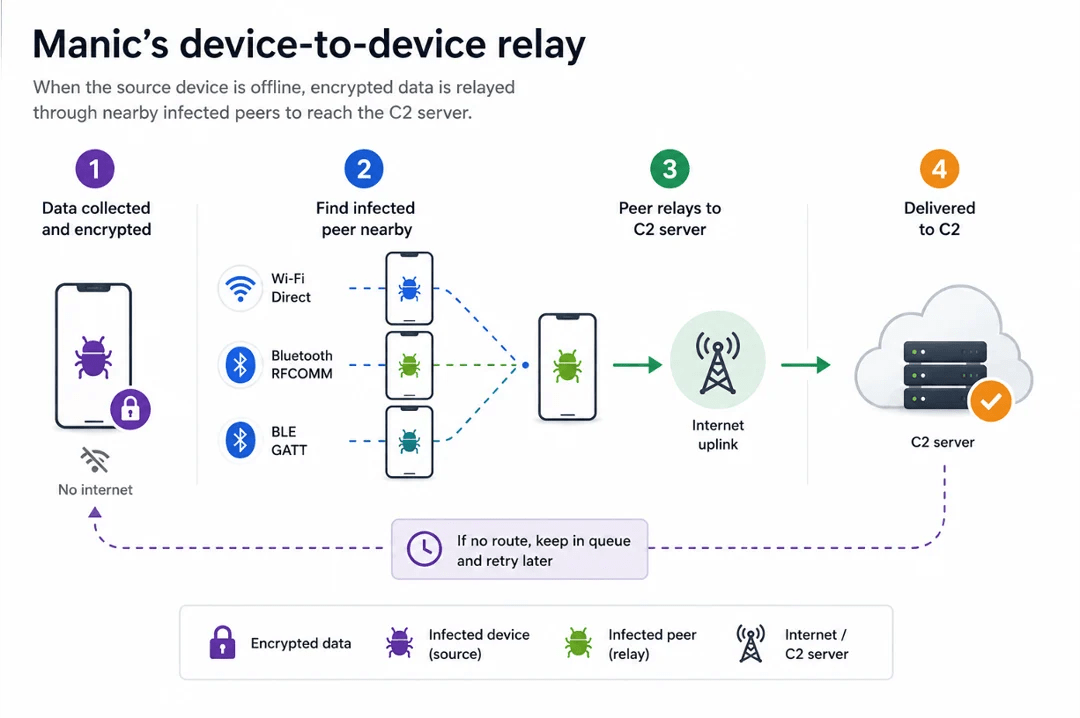
Manic searches for nearby infected devices over Wi-Fi Direct, Bluetooth RFCOMM, or BLE GATT, and supports chains of up to four relay hops. Cutting an infected phone off from the Internet doesn’t cut it off from exfiltration, as long as another infected device is within radio range. It’s a store-and-forward mesh built out of other people’s compromised phones.

Manic gives attackers remote control of the device through WebRTC, allowing them to view the screen and interact with it using Android’s Accessibility features. It can hide its activity with black screens, fake screens or fake update messages, while also covering permission requests.

The July version goes a step further by removing itself from the device’s app launcher. This keeps it out of the normal app list and lets attackers activate it through its wrapper or a deep link.

For defenders, the combination here is complete in an uncomfortable way: credential theft, live screen monitoring, authentication interception, device takeover, and an exfiltration path that doesn’t require the infected device to have Internet access at all. Monitoring for unusual Accessibility service grants and unexpected Bluetooth or Wi-Fi Direct connections from phones that aren’t actively transferring files are the most practical detection starting points.

“Manic is an evolving Android fraud platform designed for Device Takeover (DTO), combining credential and authentication theft with live screen monitoring and remote control. Its targeting spans banks, payment and cryptocurrency services, eID applications, and messengers, with a strong focus on Ukraine.” concludes the report. “A particularly distinctive capability is its offline mesh relay, which allows collected data to move through nearby infected devices over Wi-Fi Direct or Bluetooth when direct C2 access is unavailable. “

Follow me on Twitter: @securityaffairs and Facebook and Mastodon

Pierluigi Paganini

(SecurityAffairs – hacking, Android Malware)

Telegram-Hosted RedWing Malware Lets Anyone Rent Android Spyware Tools

RedWing: The Android Banking Trojan You Can Rent on Telegram for Less Than a Coffee Subscription

Zimperium’s zLabs team has uncovered RedWing, an Android spyware operation sold as a subscription service through Telegram, with links to Russian threat actors and apparent roots in the Oblivion malware family.

It comes with documentation, tutorial videos, a referral discount program, and a bot that builds custom malicious apps on demand. No malware-writing skill required.

“Far from being just another basic piece of malware sold online, RedWing is a fully developed, commercial-grade MaaS product with seller documentation, videos, and a bot-driven subscription model that provides a low entry barrier for novice attackers.” reads the report published by Zimperium. “As a proof of this, the APK customization/obfuscation/creation can be fully implemented through telegram.”

Infection starts with a phishing link that opens a fake app store page. The dropper builder can mimic Google Play, the Samsung Galaxy Store, or Huawei’s AppGallery with fake ratings, reviews, and download counts.

“the C2 panel features a sophisticated ‘Onboarding Constructor‘. Within the ‘Stealer’ configuration module, operators can deploy a deceptive ‘WebView + Cards’ interface. This mechanism loads a benign-looking webpage in the background to establish legitimacy, while sequentially overlaying customized permission prompts (cards) from the bottom of the screen.” continues the report. “Through tailored social engineering lures, the malware coerces the user into granting critical system access, specifically targeting three core permissions: disabling Battery Optimization (to ensure uninterrupted background execution), setting the application as the Default SMS handler (crucial for intercepting 2FA codes), and access to Notifications.”

Once installed, the app walks the victim through permission screens one at a time, disable battery optimization, set the app as the default SMS handler, enable notifications, framed as routine setup steps.

With those permissions in place, RedWing has deep system access. It deploys fake login screens over real banking and crypto apps to steal credentials, reads incoming texts to capture one-time codes, and uses Android’s Accessibility Service to lift PINs, card numbers, and CVV values directly off the screen as they appear.

The malicious code also silently enables call forwarding using a hidden carrier code, 21, redirecting all incoming calls to an attacker-controlled number, which knocks out phone-based two-factor authentication and bank fraud-prevention calls in one move.

The researchers pointed out that the surveillance capabilities go further. RedWing can remotely activate a victim’s camera and microphone, recording audio through commands sent from the attacker’s server with configurable recording duration.

“The malware is capable of remotely activating the cameras and the microphone of an infected device (Fig. 12). This functionality is executed via specific commands. For instance, the <take_photo> command allows the attacker to remotely capture images using the device’s camera. Similarly, the <start_recording> command leverages the MediaRecorder API to capture ambient audio.” continues the report. “This audio recording process is managed entirely from the remote server, which allows the attacker to configure the exact duration of the recording, among other parameters.”

On top of that, operators get live screen streaming via VNC, a real-time keylogger, access to all files on the device, contact lists, call logs, and location tracking.

The targeting architecture reveals something telling about how RedWing is built. The apps it monitors through Accessibility are baked into each compiled copy, which points to a fresh APK being generated server-side each time a buyer specifies their targets. The overlay targets, by contrast, can be updated from the control panel at any time without distributing a new app.

Zimperium identified 82 targeted institutions across multiple sectors, with a heavy focus on Russian financial firms, one sample used a fake RuStore page, though the list can shift at any time from the operator’s dashboard.

RedWing doesn’t need any Android vulnerability to work. It relies entirely on the user installing an app from outside an official store and approving its permission requests. The first line of defense is what happens at install time: don’t install apps from links sent by text or messaging apps, don’t grant Accessibility or default-SMS access to apps with no clear reason to need them, and treat any app that hides its icon after installation as a red flag. On managed devices, sideloading can be blocked centrally and suspicious permission requests flagged automatically.

RedWing can also transform infected Android devices into a botnet capable of launching coordinated DDoS attacks. Through its control panel, attackers can command multiple compromised phones at once to send traffic floods against a target website or server, disrupting its availability and adding another capability beyond spying and data theft.

Because operators can reskin the app and swap its targets from the control panel, the app name is a poor indicator, behavior is what to watch for.

“The rapid rise of Malware-as-a-Service (MaaS) operations like RedWing shows how easily attackers can weaponize legitimate Android components to achieve full device compromise. Unlike older banking trojans that rely solely on overlays, RedWing integrates custom droppers, live screen streaming, and abuse of the SMS handler role and Accessibility to exfiltrate data and impersonate legitimate apps in real time.” concludes the report. “This blend of social engineering and hijacking the incoming calls makes this deep-system control especially dangerous in BYOD and consumer-facing environments where app-store trust is assumed.”

Follow me on Twitter: @securityaffairs and Facebook and Mastodon

Pierluigi Paganini

(SecurityAffairs – hacking, Malware)

Bad Epoll Flaw Gives Attackers Root Access on Linux and Android

Bad Epoll (CVE-2026-46242) lets local attackers gain root on Linux and Android. The flaw was missed by AI but found by a security researcher.

A newly disclosed Linux kernel vulnerability, named Bad Epoll (CVE-2026-46242), allows a local attacker with no special privileges to gain full root access on affected Linux systems and Android devices. Security updates are already available, and users are urged to install them as soon as possible.

The flaw affects the Linux kernel’s epoll subsystem, a core feature used by servers, browsers, and countless applications to efficiently manage multiple network connections and file events. Because epoll is fundamental to Linux, there is no practical workaround other than patching vulnerable systems.

Bad Epoll is a classic use-after-free vulnerability, which occurs when a program continues to use a piece of memory after it has already been released (“freed”).

Two kernel threads attempt to release the same internal object simultaneously. One frees the memory while the other continues using it, creating a brief opportunity to corrupt kernel memory and escalate privileges to root.

Bad Epoll

“Two of epoll’s close paths run at the same time and collide. One frees an object while the other is still writing into it, and that is the use-after-free (UAF).” continues the advisory. “The race window, and how the exploit drives it. The exploit uses four epoll objects grouped into two pairs. One pair triggers the race, while the other becomes the victim. From there, the exploit turns the 8-byte UAF write into a UAF on a file object, and uses a cross-cache attack to fully control the file’s contents. Turning the bug into an arbitrary kernel memory read through /proc/self/fdinfo. With that control, the exploit gains an arbitrary read of kernel memory through /proc/self/fdinfo. Finally, it hijacks control flow and executes a ROP chain to gain a root shell.”

Although exploiting the flaw requires hitting a timing window only six CPU instructions wide, researcher Jaeyoung Chung developed a reliable proof-of-concept that reportedly succeeds in about 99% of attempts on tested systems. According to the researcher, the exploit can even be launched from Chrome’s renderer sandbox, making it particularly dangerous, and could also impact Android devices.

“Bad Epoll (CVE-2026-46242) is a race-condition use-after-free in the Linux kernel’s epoll subsystem. This bug lets an unprivileged process become root, not only on Linux desktops and servers but also on Android devices.” reads an advisory published by Chung.

One of the most interesting aspects of the vulnerability is its connection to AI-assisted vulnerability research. Bad Epoll originates from the same section of kernel code where Anthropic’s Mythos model previously identified another privilege escalation flaw, tracked as CVE-2026-43074. The AI detected the first bug, but missed this closely related vulnerability, which was later discovered manually.

“A single commit in 2023 introduced two separate race conditions into the epoll code, only about 2,500 lines in all. Both turned out to be critical bugs that can lead to privilege escalation.

The first was found by Anthropic’s Mythos and reported as CVE-2026-43074. That result is impressive on its own, because kernel race bugs are known to be hard to find. It showed a frontier AI model’s ability to find race bugs. An independent researcher later submitted a 1-day exploit for it to kernelCTF.” continunes the advisory. “The other race is Bad Epoll, which Mythos missed.”

Chung believes the miss is understandable. The race condition is extremely difficult to reason about because the vulnerable execution path exists for only a tiny fraction of a second. In addition, once the first flaw was patched, Bad Epoll no longer generated obvious warnings through KASAN, Linux’s memory error detection system, making it even harder to spot.

The good news is that there is currently no evidence that Bad Epoll has been exploited in the wild. The only public exploit is the proof-of-concept released through Google’s kernelCTF program. An Android exploit is reportedly still under development.

Bad Epoll

The flaw affects Linux kernels based on version 6.4 and later, unless they already include the upstream fix. Older long-term support kernels based on Linux 6.1, including some Android devices such as the Pixel 8, are not vulnerable because the problematic code was introduced after those versions branched.

Bad Epoll joins a growing list of high-profile Linux privilege escalation vulnerabilities recently disclosed, including Copy Fail, Dirty Frag, Fragnesia, and DirtyClone. While many of these newer vulnerabilities are deterministic and relatively easy to exploit, Bad Epoll belongs to the older class of race-condition bugs, which are significantly harder to discover, exploit, and patch.

The case also highlights both the promise and the current limitations of AI in vulnerability research. Models such as Mythos have already demonstrated they can identify complex kernel flaws and even uncover long-standing vulnerabilities in projects like FreeBSD.

At the same time, Bad Epoll shows that highly subtle race conditions can still escape even state-of-the-art AI systems. For now, human expertise remains essential, particularly when vulnerabilities depend on tiny timing windows and complex concurrent execution paths.

Follow me on Twitter: @securityaffairs and Facebook and Mastodon

Pierluigi Paganini

(SecurityAffairs – hacking, Bad Epoll)

Europe Confirms Record €4.1B Penalty Against Google for Android Practices

EU’s top court upheld a €4.1B fine against Google, ruling it abused Android’s market dominance through restrictive licensing practices.

The Court of Justice of the European Union issued its ruling on July 2, 2026, and Google lost. The court dismissed the appeal brought by Google and its parent company Alphabet against an earlier judgment from the General Court, confirming a fine of €4,125,000,000. Alphabet is jointly and severally liable for €1,520,605,895 of that amount.

The case goes back to 2018, when the European Commission concluded that Google had abused its dominant market position through three categories of restrictions built into its Android licensing arrangements. Device manufacturers who wanted access to Google’s Play Store had to pre-install Google Search and Chrome. To get the licences needed for those apps, they also had to agree not to sell devices running Android versions that Google hadn’t approved. And Google paid manufacturers and mobile operators a share of its advertising revenue on the condition that they didn’t pre-install a competing search engine on a defined set of devices. The Commission concluded all three formed a single, coordinated strategy to protect Google’s search dominance, and fined the company €4,342,865,000.

The General Court reviewed the case in 2022 and agreed that the conduct was a single and continuous infringement. It annulled one piece of the Commission’s decision: the part dealing with revenue share agreements tied to the exclusive pre-installation of Google Search on a predefined device portfolio. That partial annulment led the court to recalculate the fine downward to €4.125 billion. Everything else held.

Google and Alphabet then appealed to the Court of Justice, the EU’s highest court, arguing the General Court had made legal errors in its analysis. The Court of Justice went through those arguments and rejected them all.

“The appeal brought by Google and its parent company Alphabet against the judgment of the General Court is dismissed, thereby confirming the penalty imposed for Google Search’s abuse of a dominant position in the context of the Android operating system.” the court’s press release states. “In 2018, the European Commission adopted a decision in which it concluded 1 that Google had abused its dominant position by requiring, in particular through pre-installation agreements and licensing conditions for certain apps, that its search engine, Google Search, and its Chrome browser be promoted on mobile devices running the Android operating system, which is also provided by Google. 2 It therefore found a single and continuous infringement covering the whole of that conduct and imposed an overall fine on Google of €4 342 865 000, with Alphabet jointly and severally liable as to €1 921 666 000.”

Google’s first argument was that the General Court assessed the anticompetitive effects of the pre-installation conditions incorrectly, in particular, that it should have run a counterfactual analysis to show what the market would have looked like without those conditions. However, the Court of Justice disagreed and confirmed the General Court was entitled to look at the full economic context, including the revenue share agreements, without needing to run a formal counterfactual test. The court also confirmed the finding that pre-installed apps enjoy a status quo bias, meaning users are less likely to switch away from them, and that Google hadn’t shown that user preferences or the quality of its services alone explained its market position.

On the pre-installation conditions specifically, Google argued that proving abuse of a dominant position requires showing the conduct could exclude competitors that are equally efficient. The Court of Justice rejected that too.

“Second, the General Court did not err in law by confirming the Commission’s assessment of the pre-installation conditions laid down by the Android agreements. Demonstrating an abuse of a dominant position is not conditional in any case on proof of a capability to foreclose only as-efficient competitors.” continues the press release. “Given the particular characteristics of the digital markets concerned, the General Court was entitled to conclude that those practices were liable to restrict competition and strengthen barriers to entry without applying that test.”

On the anti-fragmentation agreements, which required manufacturers to avoid selling devices running unapproved Android forks, the Court of Justice again sided with the General Court. Those agreements limited the commercial space for Android versions Google hadn’t blessed, which reinforced its dominant position. A counterfactual analysis wasn’t necessary because the anticompetitive effects were already sufficiently established on the facts.

Google also challenged how the fine was calculated, invoking procedural arguments including rights of defence. The Court of Justice endorsed the General Court’s use of its unlimited jurisdiction to set the penalty amount, ruling that the reasoning was sufficient and the procedural principles were respected.

“The Court of Justice endorses the exercise by the General Court of its unlimited jurisdiction to set the amount of the fine, ruling that its reasons were sufficient and that the procedural principles invoked by Google and Alphabet, including rights of defence, were adhered to.” states the report.

Google is disappointed with the ruling.

“We are disappointed with the ruling. Android has given people more choice, not less, enabling thousands of device makers to build affordable smartphones and giving billions of people access to a wide range of apps and services. We will review the judgment carefully.” the company said in a statement.

This is the end of the road for this particular case. The Court of Justice is the EU’s highest court on points of law. There’s no further appeal. The €4.1 billion fine stands, and the legal framework the Commission used to reach that conclusion has now been validated at every level of the EU court system.

The case also sets a precedent for how digital markets get treated under EU competition law. The court confirmed that the standard test used in traditional markets, whether conduct excludes equally efficient competitors, doesn’t automatically apply in digital contexts. That has implications well beyond Google. Any company with a dominant platform position in the EU now knows that structuring licensing arrangements to steer users toward its own products carries real legal risk, even if it can argue its products are genuinely better.

Follow me on Twitter: @securityaffairs and Facebook and Mastodon

Pierluigi Paganini

(SecurityAffairs – hacking, Google)

New Rokarolla Android Trojan Targets 217 Banking and Crypto Apps

Rokarolla Android malware targets 217 banking and crypto apps, steals credentials, blocks bank calls, intercepts SMS, and disables Play Protect.

Zimperium’s zLabs researchers have published a detailed analysis of Rokarolla, a new Android banking trojan named after its command-and-control infrastructure. It spreads through malicious websites masquerading as TikTok and Chrome, one confirmed distribution point being hxxps://infocontablidades[.]it[.]com/. The first thing a victim installs is a dropper that masquerades as Google Play Protect, a choice intended to avoid raising suspicion.

“Primarily distributed through malicious websites such as hxxps[://]infocontablidades[.]it[.]com/, where it masquerades as popular applications like TikTok or Google Chrome, this highly invasive malware is specifically designed to target and compromise 217 distinct cryptocurrency and banking applications.” reads the report published by Zimperium. “Furthermore, the trojan actively conceals its operations and disrupts user intervention by blocking incoming calls, deploying fraudulent screen overlays, suppressing device audio, and deactivating Google Play Protect.”

The dropper’s job is simple: get the second-stage payload installed and grab Accessibility Services access. Once Accessibility is granted, everything else follows. The malware can simulate user taps, parse on-screen UI elements, inject overlays on top of legitimate apps, and execute automated actions without touching the screen. One of its 137 commands then disables Google Play Protect, removing the protection the dropper impersonated to get installed in the first place.

The target list is pulled dynamically from the C2 server. For each flagged app, the malware downloads a fake HTML login page and stores it in a local SQLite database. When the victim opens the real app, Rokarolla drops the fake page on top and captures every credential entered, card numbers included.

The lock screen gets the same treatment. The malware deploys a fake PIN entry screen that mimics Android’s legitimate lock screen interface. Whatever the victim types gets sent to attacker infrastructure.

“Any credentials entered by the user are captured by this deceptive UI (Figure 6) and subsequently exfiltrated to attacker-controlled infrastructure for further exploitation.” continues the report. “This information allows the malicious actor to execute commands even if the device is locked.”

That’s the detail that makes this more than a credential stealer: the operator can interact with the phone whether the owner is actively using it or not.

SMS handling is another pillar of the attack. Rokarolla reads every message on the device and can send messages on the victim’s behalf, which is enough to intercept the one-time codes banks send to approve logins and transactions. It also requests default call handler status, which lets it block incoming calls silently. A warning call from a fraud detection team never rings. The malware also mutes all device audio and vibrations during active operations, so notification sounds that might alert the user don’t fire either.

“Complementing this visual evasion, the malware is capable of muting all device audio and vibrations, ensuring it operates in complete silence during fraudulent activities. This audio suppression effectively masks critical cues, such as security alert notifications or incoming verification calls from banking institutions, significantly reducing the likelihood of the user noticing or interrupting the transaction process.” continues the analysis. “To maintain operational persistence, the malware also forces the device screen to remain on indefinitely. This mechanism ensures that its fraudulent UI overlays, automated actions, and background processes are not disrupted by screen timeouts or the device locking.”

The clipboard gets rewritten silently. When a user copies a cryptocurrency wallet address to paste into a transaction, Rokarolla swaps it for an attacker-controlled address with no visible indication anything changed. The keylogger and screen content logger run in parallel, capturing everything typed and everything displayed. WhatsApp contact data gets scraped by parsing on-screen UI nodes and comparing them against known WhatsApp interface terms like “Chats” and “Calls.”

For screen surveillance, Rokarolla avoids the MediaProjection API, which throws a visible recording notification that would tip off the user.

“Unlike conventional Android malware that relies on the MediaProjection API for continuous screen casting (VNC), this variant employs an alternative snapshot-based surveillance mechanism.” states the report. “The malware systematically captures screenshots of the victim’s device, compresses them into PNG format, and exfiltrates the image data alongside a precise timestamp. Following each transmission, the execution state is reset and a cleanup routine is invoked, ensuring the system maintains operational stability and is ready for the subsequent capture cycle.”

Frame by frame, quietly, with no visible indicator.

The C2 infrastructure is built with resilience in mind. The malware ships with multiple fallback domains hardcoded and can receive a fresh list of active C2 addresses at any time via the server’s configuration response. Taking one server down doesn’t interrupt operations. The four domains observed in traffic analysis are beralisvc.info, blestorians.cfd, abiorime.cfd, and morevoms.cfd, with the C2 domain registered at hxxps://beralisvc[.]info confirmed as active during analysis.

The experts noted that no product flaw is involved here, so there’s no patch to apply. The defenses are the standard ones: install apps only from Google Play, never grant Accessibility Services to anything that isn’t a known assistive tool, and treat any app that asks to become your default SMS or call handler as an immediate red flag. Zimperium says its Mobile Threat Defense and zDefend products detect Rokarolla, and the full IOC list including APK hashes is published on the company’s GitHub repository. No attribution to a named group has been made.

“The malware demonstrates strong stealth, evasion, and persistence techniques designed to avoid detection and prevent user-initiated removal.” concludes the report. “Furthermore, the malware employs multiple techniques to operate completely under the radar”

Follow me on Twitter: @securityaffairs and Facebook and Mastodon

Pierluigi Paganini

(SecurityAffairs – hacking, FishMonger)

❌