Visualização de leitura

Pegasus and NoviSpy Used Against Serbian Protesters

Serbian activists were targeted with zero-click Pegasus and NoviSpy spyware, exposing a major surveillance campaign ahead of elections.

A member of Serbia’s student protest movement had their iPhone infected with NSO Group‘s Pegasus spyware without ever clicking a link or opening a file. The Citizen Lab confirmed the infection in collaboration with the SHARE Foundation, tracing it to an iMessage zero-click exploit and identifying high-confidence indicators of compromise between December 2025 and January 2026, with the possibility of additional infections not ruled out.

“In collaboration with the SHARE Foundation, the Citizen Lab analyzed forensic artefacts from the iPhone of a member of Serbia’s student protest movement after they received an Apple Threat Notification warning of targeting with mercenary spyware.” reads the report published by Citizen Lab. “Our analysis confirmed that an iMessage zero-click exploit was used to infect the device with NSO Group’s Pegasus spyware. “

The attack required no action from the victim, which makes zero-click attacks especially dangerous. Citizen Lab said the Pegasus infection could stay hidden while giving the attacker full access to the phone, including messages, photos, notes, microphone, and camera. Apple later fixed this specific exploit through security updates in iOS 18.4.1.

“We believe that the zero-click exploit used in this attack targeted Apple iMessage, and has subsequently been patched by Apple as of iOS 18.4.1.” continues the report. “A zero-click infection with Pegasus spyware would not have been visible to the target, and would give the Pegasus attacker total access to the device. Pegasus allows an attacker to do anything that a user can do, ranging from accessing private data like notes, pictures and even encrypted messages. Pegasus also has the ability to covertly enable the phone’s microphone and camera.”

This one confirmed infection sits inside something considerably bigger. The SHARE Foundation has documented at least 14 individuals targeted with advanced spyware since early 2026, spanning student movement members, civil society activists, an opposition member of parliament, and a local councilor, which the organization is calling the largest documented surveillance wave in Serbia’s history. Twelve people approached SHARE’s digital forensics team in August after receiving Apple’s own threat notifications, warnings the company sends when it detects likely state-sponsored spyware targeting; eleven of those devices remain presumed infected pending further forensic confirmation.

The timing lines up uncomfortably well with Serbia’s political calendar. This surveillance wave coincides with local elections held on March 29, 2026, and stretches toward planned early parliamentary elections in October, following months of student-led anti-government and anti-corruption protests.

“These notifications and forensic confirmation highlight the aggressive mercenary spyware targeting of the peaceful pro-democracy movement with mercenary spyware ahead of key 2026 election cycles.” continues the report.

Targeting activists and opposition figures specifically in the run-up to elections isn’t subtle, and it fits a pattern Serbia has shown before.

Serbia has a history of using commercial spyware. Citizen Lab previously documented Pegasus targeting civil society and the use of Cellebrite tools to install the locally developed NoviSpy on activists’ phones. In this case, SHARE Foundation and Amnesty Tech found a new version of NoviSpy on a student activist’s Android phone after Serbian authorities seized it during police questioning.

Amnesty International’s Security Lab head, Donncha Ó Cearbhaill, connected the dots plainly between state custody and spyware installation.

“The forensic findings by SHARE prove that Serbian students continue to be targeted with invasive Android spyware tools, installed while detained by Serbian authorities” he said.

If you’ve received an Apple Threat Notification, whether in Serbia or anywhere else, the Citizen Lab’s guidance is unambiguous: treat it as a presumed infection and get expert help immediately rather than waiting to see if anything seems wrong. Individuals in Serbia should contact the SHARE Foundation directly, and anyone elsewhere can reach Access Now’s Digital Security Helpline, which supports journalists, human rights defenders, and other high-risk civil society targets worldwide. Anyone who suspects they might be a target based on their work or public role should also turn on Lockdown Mode, Apple’s built-in feature that significantly narrows what a zero-click exploit can actually reach, and keep every device updated, since the patch that closed this specific hole has already existed for well over a year for anyone who installed it.

“We believe that the zero-click used in this attack has been rendered ineffective by a patch from Apple in recent iOS versions. We urge everyone, especially those facing increased risks because of who they are or the work they do, to keep all devices updated.” concludes the report. “Click HERE for instructions on how to keep your iPhone up to date.”

Follow me on Twitter: @securityaffairs and Facebook and Mastodon

Pierluigi Paganini

(SecurityAffairs – hacking, Pegasus)
2,000 Leaked Documents Reveal How Russia Turns Engineering Students Into GRU Cyber Operators

2,000 leaked files expose Bauman University’s hidden Department No. 4, which trained GRU-linked hackers and propagandists linked to APT28 and Sandworm.

Leaked Documents Expose Bauman University’s Hidden Department That Trained Hackers, Propagandists, and Malware Developers for the GRU

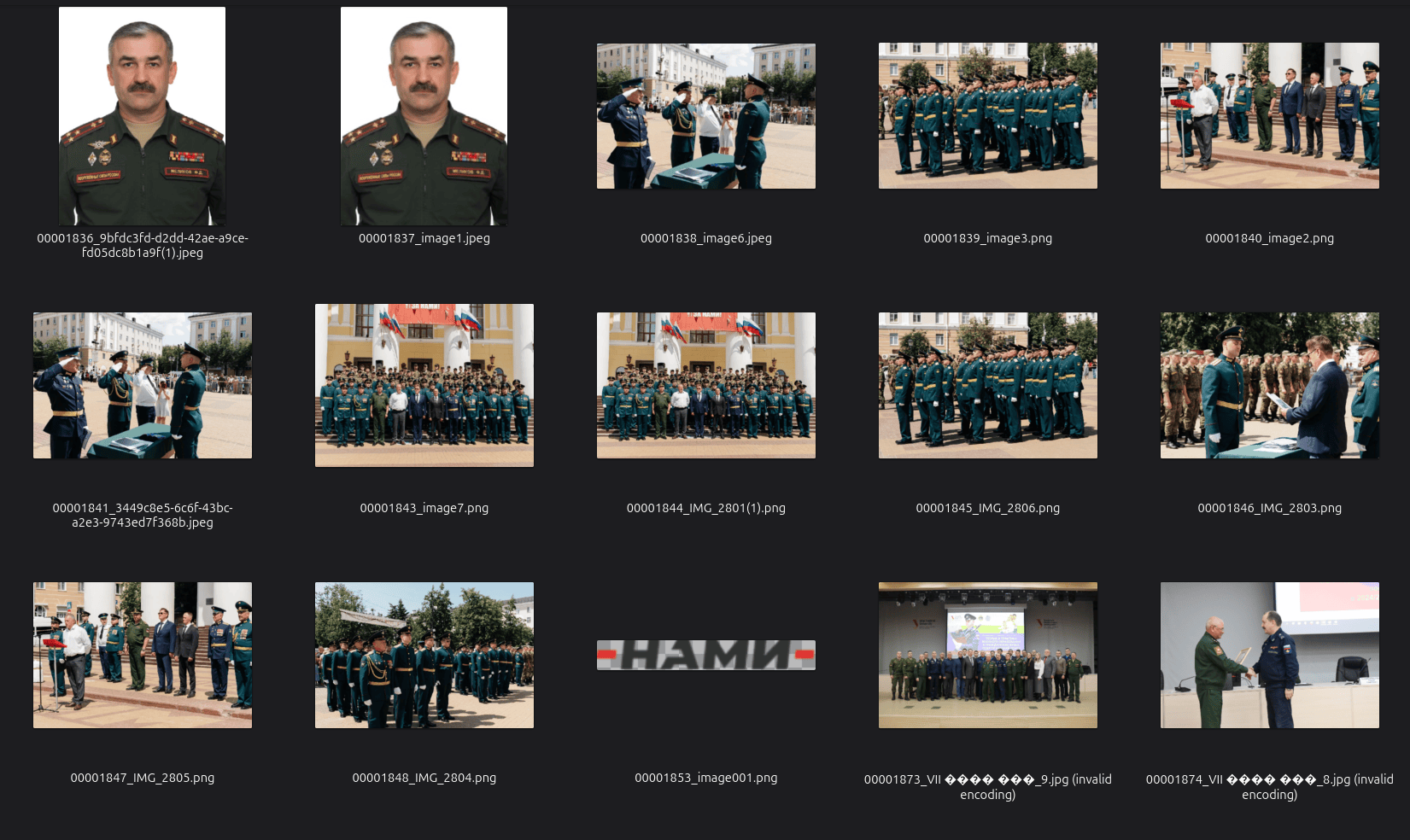
More than 2,000 internal documents from Bauman Moscow State Technical University have been reviewed by an international media consortium, and the picture they describe is not a conventional cybersecurity program. The files span academic and administrative records through 2025.

“Recently leaked records show that Bauman Moscow State Technical University’s Department No. 4 operated as a long-term training pipeline for Russian military intelligence and cyber operations.” reads the report published by DomainTools. “The department served several elements of the Russian General Staff and trained roughly 250 career and reserve students across three specialties: special intelligence (“Служба специальной разведки”), operational information-technical effects (“Применение сил и средств информационно-технического воздействия и защиты от информационно-технического воздействия”), and information-technology protection (”3ащита информационных технологий”). “

Department No. 4, also called “Special Training,” operated inside Bauman’s Military Training Center and doesn’t appear anywhere on the university’s public organizational chart. The GRU’s talent pipeline tends not to announce itself.

The investigation was carried out by a group of media outlets including The Insider, The Guardian, Le Monde, Der Spiegel, Delfi, VSquare, and FRONTSTORY.PL. DomainTools researchers also analyzed the leaked files independently. A DarkForums user known as “Losyash” may have shared the data, but it has not been confirmed that the account originally obtained the records.

The department trained students in three military specialties. These covered special intelligence, information and cyber operations, and the protection of IT systems. In practice, the courses included espionage, offensive cyber operations, electronic reconnaissance, secure systems, and influence operations.

Around 250 career and reserve students went through the program over six academic years. Researchers estimate that 10 to 15 students each year were selected for GRU-related assignments before graduating.

“Technical protection training covered cryptography and steganography, as well as code analysis and intrusion detection. Students were also trained in hardware inspection, the discovery of physical implants, and the identification of undocumented device functions. These subjects point to possible assignments in technical counterintelligence and supply chain security, as well as firmware analysis and embedded system inspection. Other likely functions include secure procurement and the protection of specialized military platforms.” continues the report. “The files also reveal an underreported malware-analysis and cyber threat intelligence program.”

One advanced practical assignment required the creation of a social-media video built around what the course materials called “manipulation, pressure, and hidden propaganda.” This counted as coursework.

Course materials defined “information-technical weapons” as tools and methods designed to alter, destroy, copy, block, or manipulate information. Red-team and blue-team functions were treated as a single discipline, not separate tracks, which mirrors how Russian military doctrine actually deploys cyber operators.

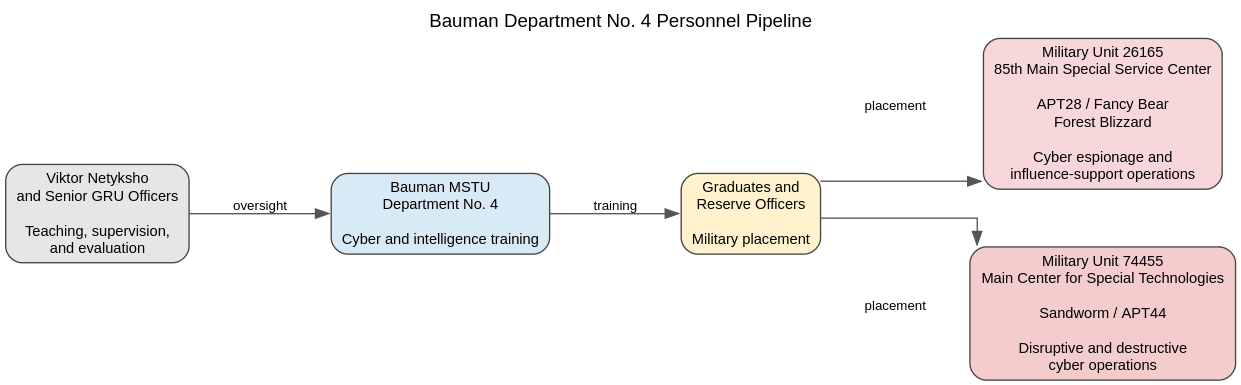
The personnel links are what make this more than a training curiosity. The leaked records identify Major General Viktor Netyksho as involved in Department No. 4’s oversight. Netyksho was the former commander of Military Unit 26165, the GRU formation publicly associated with APT28, also tracked as Fancy Bear, Sofacy, and STRONTIUM. He was among the 12 GRU officers indicted by the United States in 2018 for interference in the 2016 presidential election.

Reporting identified graduates assigned to GRU Military Unit 26165 (associated with APT28) and Military Unit 74455 (associated with Sandworm), and linked senior officers, including former Unit 26165 commander Viktor Netyksho, to student oversight.” continues the report. “The data also connected senior GRU officers to the supervision and evaluation of Bauman students. Viktor Netyksho, the former commander of Unit 26165 and the 85th Main Special Service Center, is part of the department’s teaching and oversight structure.”

The reporting also identifies Aleksei Kondrashov, a 2024 Department No. 4 graduate, as linked to Military Unit 74455: the GRU’s Main Center for Special Technologies, known publicly as Sandworm, or APT44. That unit has been associated with the 2017 NotPetya attack and ongoing destructive operations against Ukraine. DomainTools also connected graduates and senior staff to Military Unit 29155, a GRU formation linked to sabotage and assassination operations in Europe.

A necessary precision: the reports establish unit placements, not individual operational involvement. A documented assignment to Military Unit 74455 doesn’t establish that a specific person participated in a specific attack. That distinction matters for both attribution work and legal proceedings.

What the leak does establish is the factory behind the names. APT28 and Sandworm are the threat groups that security teams track, attribute, and brief about. Department No. 4 is where some of the people running those operations were systematically trained, assessed, and selected.

For defenders, DomainTools summarizes the implication precisely: Russian operations should be tracked as a combined threat in which espionage, destructive attacks, military reconnaissance, technical surveillance, and influence campaigns draw on the same personnel pipelines and the same underlying doctrine. The Bauman material makes that pipeline visible for the first time at this level of institutional detail.

“The documents show that Department No. 4 is a small part of a larger long-term military training system, not a single hacking unit. The program prepared personnel for espionage and offensive cyber operations within a larger Russian technical university system.” concludes the report. “Its doctrine treated cyber warfare as more than network intrusion. Students were taught not only adversarial cyber warfare, but also a larger holistic doctrine of cyber war using both defense and attack to be better able to carry out successful campaigns.”

Follow me on Twitter: @securityaffairs and Facebook and Mastodon

Pierluigi Paganini

(SecurityAffairs – hacking, Russia)

Russian APT BlueDelta Uses HOOKEDGE to Target Defense and Diplomatic Organizations

BlueDelta (APT28) uses webhook.site and Microsoft Edge to hide HOOKEDGE espionage traffic targeting European governments.

Recorded Future’s Insikt Group documented a campaign by BlueDelta, the Russian GRU-linked group that overlaps with the group APT28, running an entire espionage operation against European government targets using webhook.site, a service built for developers to test HTTP requests, as its command-and-control backbone.

The campaign ran from late September 2025 through early April 2026, targeting government and diplomatic organizations in Romania, Spain, and Türkiye.

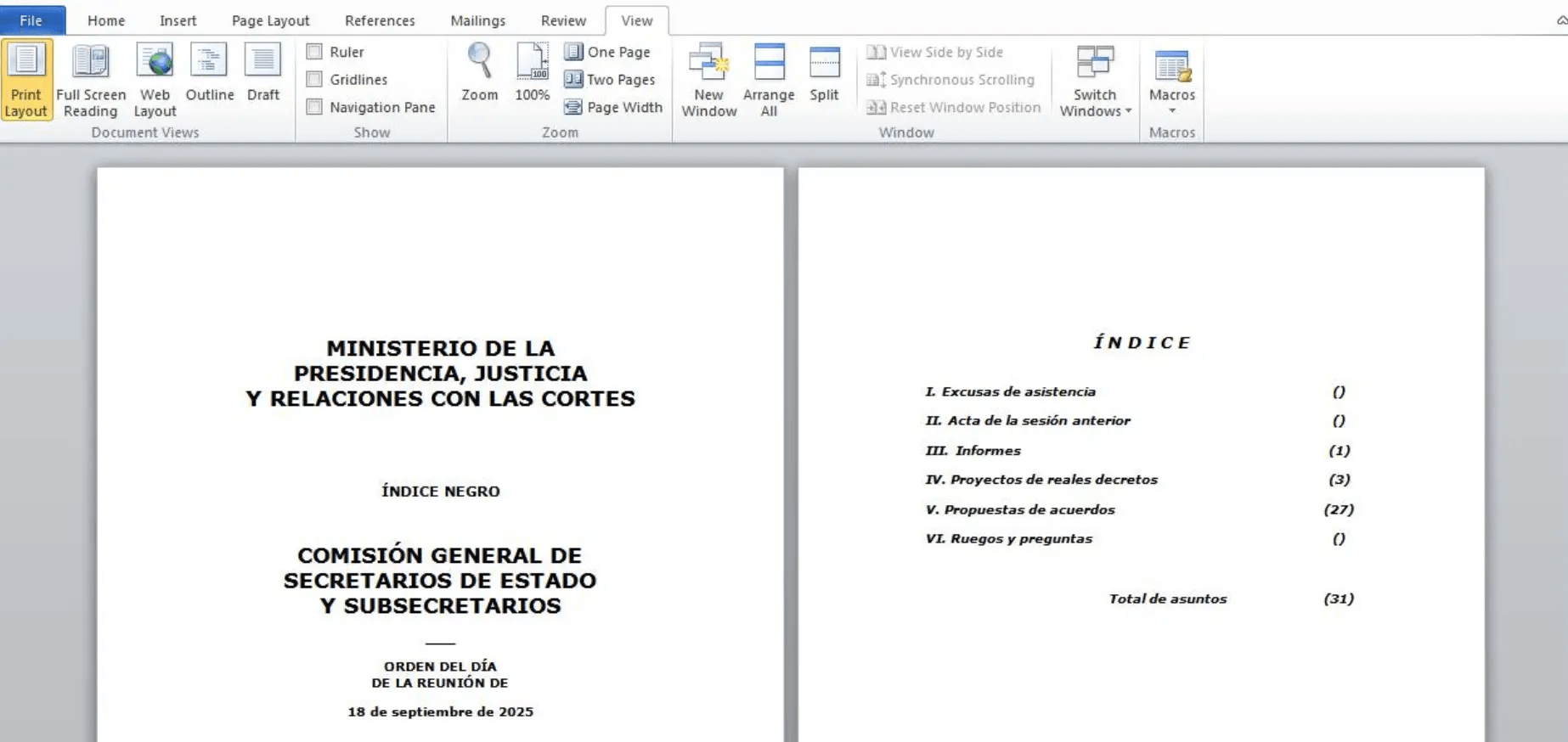
“The campaigns delivered a lightweight Windows batch-script backdoor, dubbed “HOOKEDGE,” via macro-enabled Microsoft Word documents using diplomatic-themed lures, including material impersonating Spain’s Ministry of the Presidency, Justice and Relations with the Cortes, created shortly after a September 2025 meeting between Spanish and Moldovan officials.” states the report by Insikt Group.

“Insikt Group assesses with moderate confidence that this activity was conducted by BlueDelta (which overlaps with APT28, Fancy Bear, and Forest Blizzard), a Russian state-sponsored threat group attributed to the Main Directorate of the General Staff of the Armed Forces of the Russian Federation (GRU).”

The attackers used a fairly old-school trick: macro-enabled Word documents. One of them looked like a real meeting agenda from Spain’s Ministry of the Presidency and appeared shortly after an actual meeting between Spanish and Moldovan officials. The timing was interesting because it came just before Moldova’s September 2025 parliamentary elections. The document looked credible enough to make the phishing attempt believable.

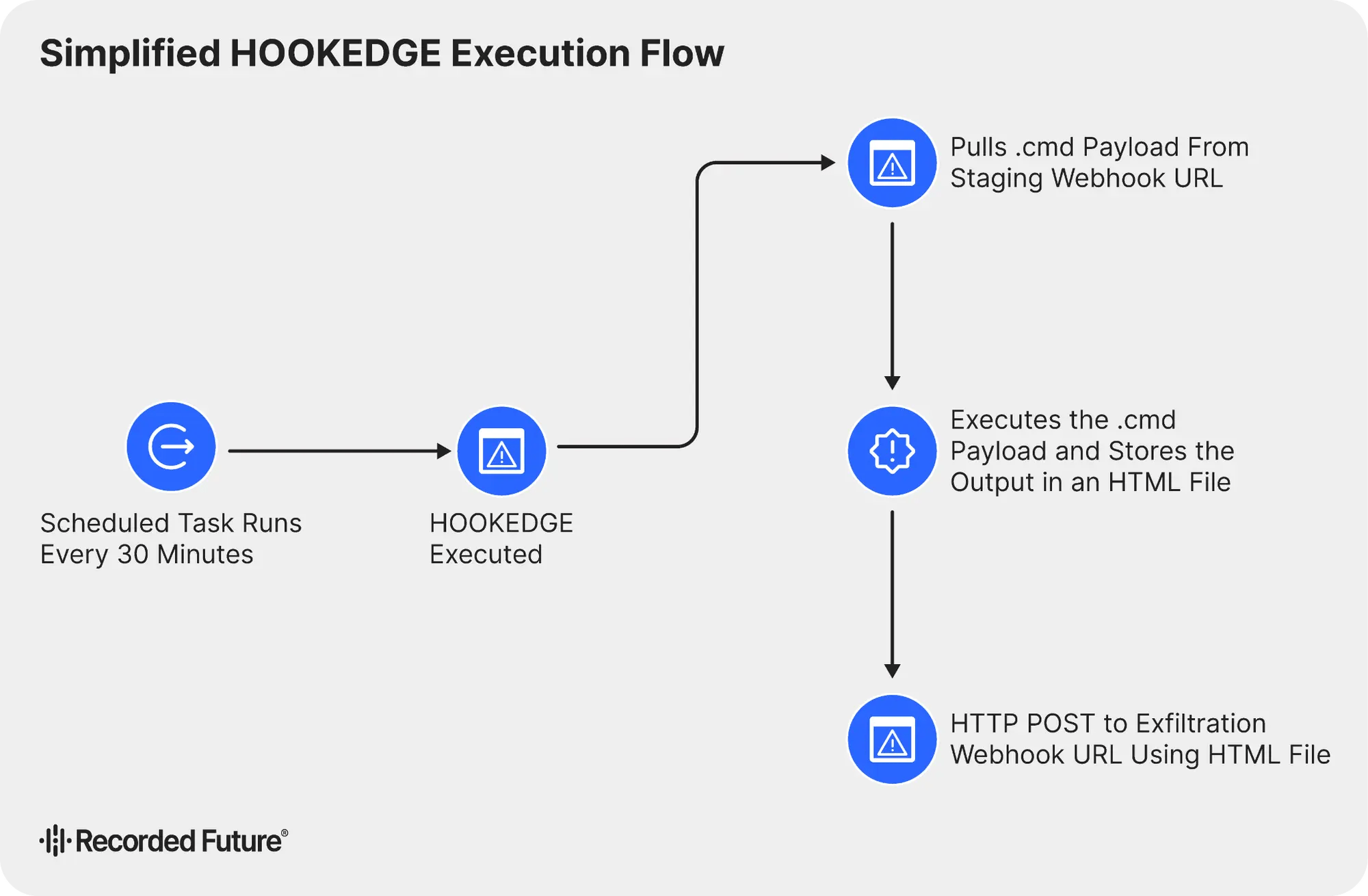
The backdoor, called HOOKEDGE, is surprisingly simple. It uses a Windows batch script and relies on two webhooks. One receives commands, while the other sends the stolen data back to the attackers. Every 30 minutes, a scheduled task downloads a command file through Microsoft Edge, runs it and sends the results to another endpoint. The malware uses Edge to make the traffic look like normal web activity, making it harder for security tools to spot.

That reliance on a real browser for both tasking and exfiltration is the cleverest part of the whole design.

“A notable aspect of HOOKEDGE is its use of msedge.exe for both tasking and exfiltration. By generating network traffic through a legitimate web browser rather than a commonly abused LotL binary (LOLBin) or a custom binary, the malware blends its communications with normal enterprise browsing activity.” continues the report.

Recorded Future explains, and that’s really the entire evasion strategy in one sentence: don’t build something exotic, just make your traffic look exactly like an employee checking a website.

BlueDelta didn’t build HOOKEDGE from scratch either. It shares deep code and structural overlap with HEADLACE, a backdoor the same group used years earlier, right down to identical JavaScript variable names and the same base64 encoding scheme for automated downloads.

“HOOKEDGE’s code and structural design have significant overlap with HEADLACE, a backdoor used by BlueDelta in previous campaigns.” states the report.

Recorded Future assesses with moderate confidence that HOOKEDGE is a direct evolutionary successor, maintained by the same operators rather than a fresh tool built by a different team, which fits BlueDelta’s long-documented habit of refining working tradecraft instead of reinventing it.

The operation also included a triage mechanism worth understanding on its own. Once a victim showed signs of being worth deeper attention, active communication with the initial webhook endpoints, BlueDelta deployed a second HOOKEDGE payload configured to check in every five minutes instead of thirty, giving operators much faster interactive control over higher-value targets. That two-tier setup also solved a practical infrastructure problem: webhook.site’s free tier caps out at 100 requests per endpoint, so spreading routine and high-priority tasking across separate endpoints kept any single one from getting exhausted mid-operation.

BlueDelta kept tuning the operation continuously rather than treating it as a finished product. Beaconing intervals stretched from 30 minutes to 61, deliberately timed to slip past sandbox environments that typically only watch a sample’s behavior for an hour. The group added canary tracking pixels named things like mailopened.jpg and docopened.jpg to monitor exactly when a phishing email got opened versus when the document itself got opened versus when macros actually executed, essentially building analytics for their own phishing funnel.

“The malicious document also contains a hidden image referencing a remote webhook URL: hxxp://webhook[.]site/62114596-33f5-47fb-9012-0223529e5a13/docopened[.]jpg. This serves as a document-open “canary,” alerting BlueDelta operators when a victim opens the lure. Later variants used the filename doc.jpg in place of docopened.jpg.” states Insik. “Insikt Group also identified webhooks using the filename mailopened.jpg, indicating that BlueDelta likely used a similar canary mechanism to monitor when recipients opened phishing emails, providing operators with visibility into campaign delivery success before any payload execution.”

That kind of detailed tracking of what victims do would look very familiar to a marketing team. The difference is that here the targets are victims, not customers.

For defenders, the useful indicators are quite clear. Block macros in documents downloaded from the internet, monitor scheduled tasks that launch scripts from user-writable folders, and flag Microsoft Edge running in headless mode or making automated connections to file-sharing and webhook services that the organization does not normally use. You don’t need sophisticated tools to spot these behaviors. Even a well-configured monitoring system should be able to detect them early. The worrying part is that a persistent, state-backed group can still rely on a small set of behaviors that defenders can identify and block.

For defenders, the actionable pieces here are concrete rather than abstract. Block macro execution from documents that arrived over the internet, watch for scheduled tasks spawning script interpreters from user-writable folders, and specifically flag Microsoft Edge running in headless mode or making automated requests to file-hosting and webhook services your organization doesn’t actually use for anything legitimate. None of this requires exotic tooling to catch, which is oddly reassuring: a threat group this persistent and state-backed is still, at its core, relying on the same handful of detectable behaviors that a properly configured monitoring setup would catch on day one.

“BlueDelta is likely to continue conducting initial access campaigns against European government and diplomatic organizations in support of Russian intelligence collection. Given the enduring strategic importance of European governance, NATO-related affairs, and diplomatic engagement with former Soviet republics, the intelligence requirements driving this activity are unlikely to diminish in the near term.” concludes the report.

Follow me on Twitter: @securityaffairs and Facebook and Mastodon

Pierluigi Paganini

(SecurityAffairs – hacking, BlueDelta)

OpenAI banned Russian ChatGPT accounts backing covert influence operation

OpenAI banned Russian ChatGPT accounts backing a fake think tank, IBI, that used AI posts and a fake “sovereignty” index to push pro‑Russia narratives.

OpenAI says it has banned a cluster of ChatGPT accounts that likely originated in Russia and were used to support a covert influence operation. The campaign promoted an organisation called the International Burke Institute, or IBI, a supposed expert community that claimed to be based in Israel.

The operation did not rely on dramatic deepfakes or a viral bot army. It used a more familiar method: build something that looks credible, fill it with enough content to seem legitimate, then use social media to push people toward it. Credibility is often cheaper to fake than to earn.

OpenAI says the operators prompted ChatGPT in Russian to generate comments and posts, mostly in English, for X, Facebook, LinkedIn, Telegram and Substack. They specifically asked the model to avoid linguistic signals that might reveal a Russian origin, and used VPNs to bypass OpenAI’s restriction on access from Russia.

“We banned a cluster of ChatGPT accounts that very likely originated in Russia. The operators prompted in Russian to generate social media comments that were posted on Substack, Telegram, X, Facebook and LinkedIn.” reads the report published by OpenAI, “Most of the comments they generated were in English, and the operators instructe. ChatGPT to hide any linguistic clues that they were Russian. As we do not allow access to our models from Russia, they used VPNs to access our platform.”

The social media content promoted IBI articles or urged readers to follow IBI-linked channels. Some posts came from accounts bearing the institute’s name and logo, while others appeared to come from ordinary users whose main activity was sharing the same material.

The website behind the brand was registered in February 2025 and presented itself as an Israel-based community of international experts. It claimed links to well-known names such as Francis Fukuyama and Noam Chomsky, but OpenAI’s review found that 34 of 36 sampled articles published under expert profiles had been copied from elsewhere online.

“Some of these articles were years old; others were attributed to the wrong authors. For example, one article on the China-Pakistan Economic Corridor appears to have been copied from a Cambridge University Press original, but incorrectly attributed to a professor at the University of Nottingham whose expertise is in South Asian politics.” continues the report.

This was not a case of ChatGPT writing every false article on the site. OpenAI says the website content itself was not generated by its models, and some material appeared to have been written by a Slavic-language speaker and machine-translated. The AI’s role was narrower but still useful: it helped create the promotional layer that sent people toward the site and made the operation appear more active and organic.

“What began as an investigation into AI-generated social media posts led us to a much broader influence operation, built around a website containing copied and misattributed academic work, a “sovereignty” index that cast Russia in a favourable light, and efforts to disguise the operators’ Russian origins.” states OpenAI. “Although the campaign appears to have reached relatively small audiences, its elaborate construction distinguishes it from other Russia-linked⁠(opens in a new window) influence⁠(opens in a new window) operations⁠(opens in a new window) we have disrupted⁠(opens in a new window) since the start of the war in Ukraine.”

The centrepiece was the so-called Sovereignty Index, also called the Burke Index. It ranked countries across political, economic, technological, information, cultural, cognitive and military dimensions, and consistently gave Russia a favourable place while criticising Western states, especially France, Germany, the European Union and the United States. openai

A made-up index can be effective because numbers carry authority even when the method is vague, selective or impossible to audit. Add charts, expert profiles, academic-looking articles and a professional website, and a claim can travel much further than a Telegram post from an anonymous account.

OpenAI found one Telegram channel, “Lahme Ente,” that published German-language posts attacking Ukraine, the EU and the German government while calling for closer ties with Russia. Another operator used ChatGPT to create logos for channels focused on Germany, France, Poland, Türkiye and the United States, then repeatedly asked for Russian-language summaries of their activity.

“As well as generating content about IBI, one of the operators generated German-language posts that were posted on a Telegram channel called “Lahme Ente” (“lame duck”). These posts routinely criticized Ukraine, the EU and the German government, and advocated for better relations with Russia.” continues the report. “A second operator, alongside their IBI-related content, generated logos for a dozen Telegram channels (including Lahme Ente) focused on Germany, the USA, France, Poland and Türkiye. “

One American-facing channel called “American Observer” included awkward English that suggested it was not run by a native speaker. The operators were trying to hide their origin, but language remains a stubborn problem: a VPN can change an IP address, not always a sentence.

The campaign’s immediate reach appears limited. OpenAI says most social posts received few views and the official IBI accounts had low subscriber counts, although its Telegram channels reportedly attracted around 10,000 to 20,000 followers each. Using the Brookings Breakout Scale, OpenAI rated the effort at the lower end of Category Three: activity across multiple platforms with some signs of reaching genuine audiences.

That does not make it irrelevant. Influence operations are often built for scale, reuse and timing rather than instant virality. A network with a website, a recognisable brand, social accounts, apparent experts and ready-made narratives can remain quiet until a political event, election, protest or crisis gives it an opening.

This case also shows what AI changes and what it does not. It does not eliminate the need for operators, infrastructure, stolen material, audience research or political intent. It makes routine tasks cheaper: drafting posts, translating them, changing tone, generating replies, creating branding and monitoring channels at a pace that a small team can sustain.

“The significance of the operation lies less in the audience it reached, however, than in the infrastructure it had built. While the actors only used ChatGPT to produce isolated promotional posts, those posts pointed to an otherwise credible-appearing institution, complete with purported experts, republished academic work and a purported proprietary risk index.” concludes the report. “This illustrates how influence actors can use AI as a supporting tool within a broader effort to manufacture authority, obscure the source of favored narratives, and establish assets that could be scaled over time. It also illustrates how their supporting use of AI can lead to the broader operation being exposed.”

Follow me on Twitter: @securityaffairs and Facebook and Mastodon

Pierluigi Paganini

(SecurityAffairs – hacking, OpenAI)

Slovakia Warns of Cyber Risks in Road Speed Cameras

Slovakia warns that vulnerable speed cameras could expose vehicle data, enable remote access and provide attackers with a foothold into public networks.

Slovakia’s National Security Authority, NBÚ, recently issued a warning about several road speed cameras, calling them a significant cyber threat. The alert is not about someone deleting a speeding ticket. It is about connected devices that collect vehicle data, communicate with other systems, and may contain remote-access functions that the operator cannot fully control.

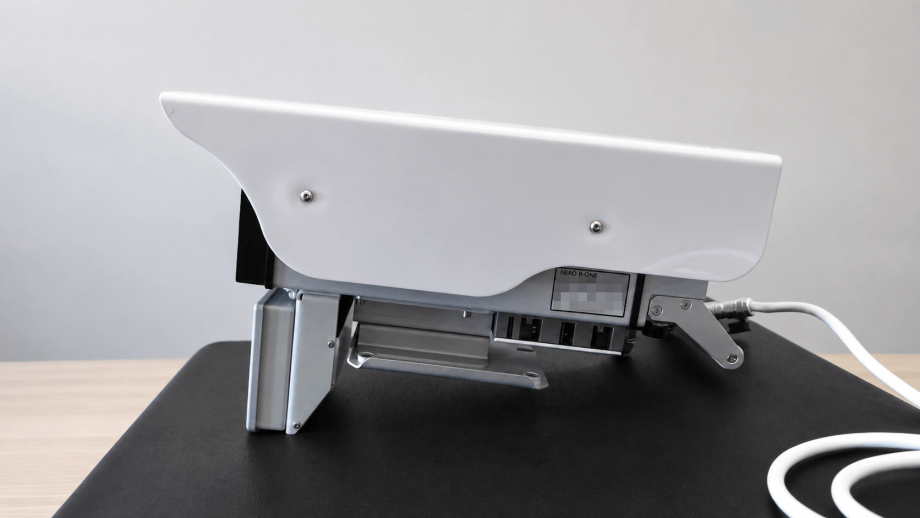
The Slovak authority examined a sample of the NERO R-ONE camera system at the request of the Interior Ministry. It named three product lines in its warning: NERO R-ONE devices sold by Cyprus-based SODASUS, Cordon-series speed cameras made by Russia’s Simicon, and Cordon-series products sold by Croatia’s NEROline.

“The National Security Authority warns of a significant cyber threat associated with the use of several types of road speed cameras.” reads the alert. “A security analysis has identified several risks and recommends that affected entities identify the products in question in their infrastructure.”

The problems went beyond a simple configuration issue. NBÚ found differences between the documented and actual communication settings, uncertainty about where the hardware and software came from, software that did not match the declared version, and weak security protections.

“The security analysis identified several risks, including the true origin of the camera hardware and software, inconsistency between the documented and detected configuration of the product’s communication interfaces, and pre-configured remote access and product management mechanisms.” the agency wrote on LinkedIn.

That last point deserves attention. A road camera should be managed by the organisation that owns it, under controls that it can inspect, configure and audit. If a device includes pre-set remote-access or management mechanisms outside the customer’s full control, it creates a blind spot in a system that may sit on a public-sector network or communicate with other operational services.

Speed cameras do much more than take pictures and measure speed. They photograph vehicles, record timestamps, process licence-plate data, store evidence and send information to backend systems used by authorities. Depending on the setup, they may also connect to mobile networks, roadside equipment, police systems, municipal platforms or third-party maintenance services.

If attackers compromise a camera, they could access data, change or delete records, manipulate how it measures or reports violations, or shut it down. If the network lacks proper segmentation, they could also use the camera as a foothold to reach other systems. The camera may not be the real target. It could simply be the unlocked door.

The warning aims to alert essential-service operators and other organisations that these road cameras could pose a serious cybersecurity risk. In the wrong circumstances, attackers could use them to disrupt networks, systems or services.

The Slovak Interior Ministry reportedly took the equipment out of its pilot deployment while the matter was investigated. Public reporting also says the ministry asked the supplier to remove the units and replace them with equipment meeting Slovak and EU legal, technical and security requirements.

The Russian connection adds an obvious geopolitical dimension, but it should not become a substitute for technical analysis. NBÚ did not say that every device was actively spying on users or that the equipment contained a proven backdoor. Its warning is about identified security risks, limited operator control, uncertainty over hardware and software provenance, and remote-management mechanisms that could not be fully accounted for.

That is enough reason to take action. Security checks for connected public devices cannot rely only on the brand, the country listed on the invoice or the vendor’s claims. Operators should know exactly what software and firmware the device runs, how remote access works and who controls it. They should also use independent security testing, secure updates and network segmentation.

The same lesson applies beyond Slovakia. Smart cameras, licence-plate readers, parking sensors, environmental monitors, traffic lights and roadside communication systems are becoming part of public infrastructure. They are often cheap, easy to overlook and managed by public agencies, contractors and manufacturers. That makes them just as important to secure as other critical systems.

Follow me on Twitter: @securityaffairs and Facebook and Mastodon

Pierluigi Paganini

(SecurityAffairs – hacking, Speed Cameras)

Fake Conferences, OAuth and WhatsApp: Inside Russia’s New Espionage Tactics

Google tracks three Russia-linked espionage clusters using phishing and legitimate authentication tools to target researchers, diplomats and defense staff.

Google’s Threat Intelligence Group tracked three separate suspected Russia-linked cyber espionage clusters. All three focus on the same thing: abusing authentication features that are supposed to protect accounts to access them instead.

Threat actors target researchers, academics, government officials, think-tank analysts, and defense sector personnel across Europe and the United States. The three clusters are tracked as UNC6293, UNC7005, and UNC5976, and while they operate differently and with different tools, Google published them together for a reason.

“These clusters engage in persistent, adaptive phishing campaigns, using sophisticated social engineering tactics to compromise personal accounts across multiple platforms.” reads the report published by GTIG. “Because these operations abuse legitimate authentication flows which may not immediately seem like phishing attempts to users, GTIG is raising awareness about these social engineering campaigns targeting individuals so that targets can more readily recognize malicious outreach.”

UNC6293 is the oldest of the three and the most precisely attributed. Google assesses with moderate confidence that it’s a sub-cluster of ICE RELIC, the group also tracked as APT29, responsible for initial access operations.

Its operations are narrow by design: typically fewer than five targets at a time, with themes built around diplomatic events and upcoming conferences. Since it was first documented in June 2025, UNC6293 has consistently impersonated US State Department officials to run app password phishing. The technique is simple but effective. The attacker convinces a target to set a specific app password on their account, one that the attacker already knows, and then uses it to log in without triggering two-factor authentication.

By October 2025, UNC6293 was still reusing screenshots from its June phishing lures, including the ms.state.gov reference, while only changing the surrounding text. By June 2026, the group had added OAuth phishing. After logging in to a legitimate service, victims were asked to share a URL or “verification code,” allowing attackers to obtain valid access tokens. The trick works because the login itself is legitimate, while the attackers hide the malicious step elsewhere.

UNC7005, tracked by Microsoft as STORM-2945, is a related but separate cluster first identified in February 2026. Google assesses it’s also connected to ICE RELIC, but notes it operates with lower technical sophistication and worse operational security than UNC6293. It compensates with a wider toolkit. UNC7005 runs app password phishing, device code phishing against both Microsoft and WhatsApp, malware distribution, and OAuth phishing operations, sometimes in the same month.

“UNC7005 also conducts device code phishing operations for both Microsoft and WhatsApp accounts.” continues the report. “The themes of these phishing waves often involve invitations for calls with individuals from notable organizations related to the target’s field or, most recently, invitations to diplomatic events and conferences. “

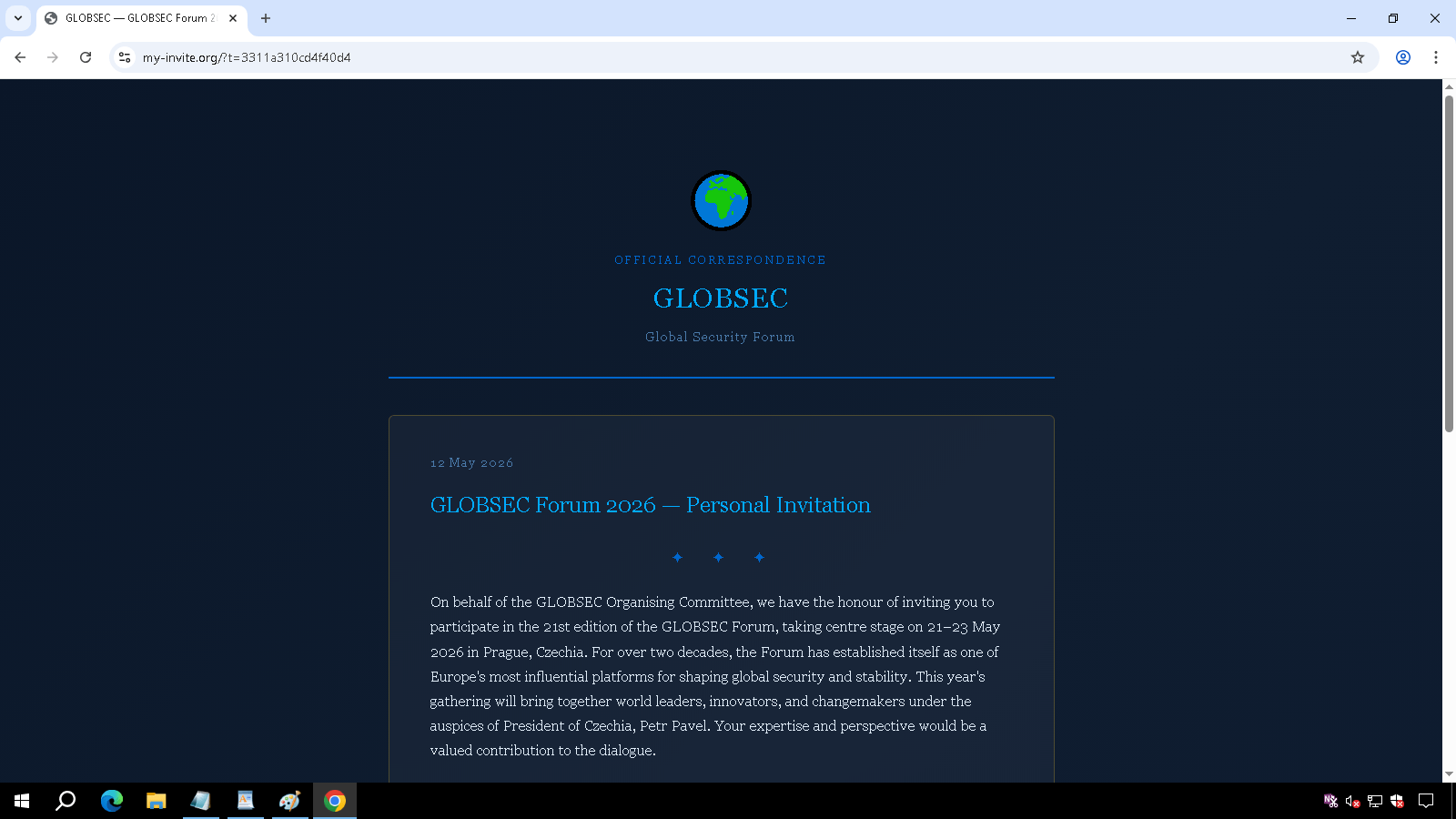
The GLOBSEC conference spoof is a useful illustration of how UNC7005 works. The actor built a landing page mimicking an invitation to the legitimate GLOBSEC forum in May 2026, collected detailed registration information from targets including, not for the first time in ICE RELIC-linked operations, a wine selection for a fictional dinner, and then presented a Microsoft device code for the target to enter. The registration form still contained a reference to “Embassy security policy” rather than GLOBSEC, a leftover from the previous lure template that the actor hadn’t cleaned up. When Google flagged the page quickly, UNC7005 revised the template within days, citing “technical difficulties” to explain the change to anyone still watching.

Russia Linked APT

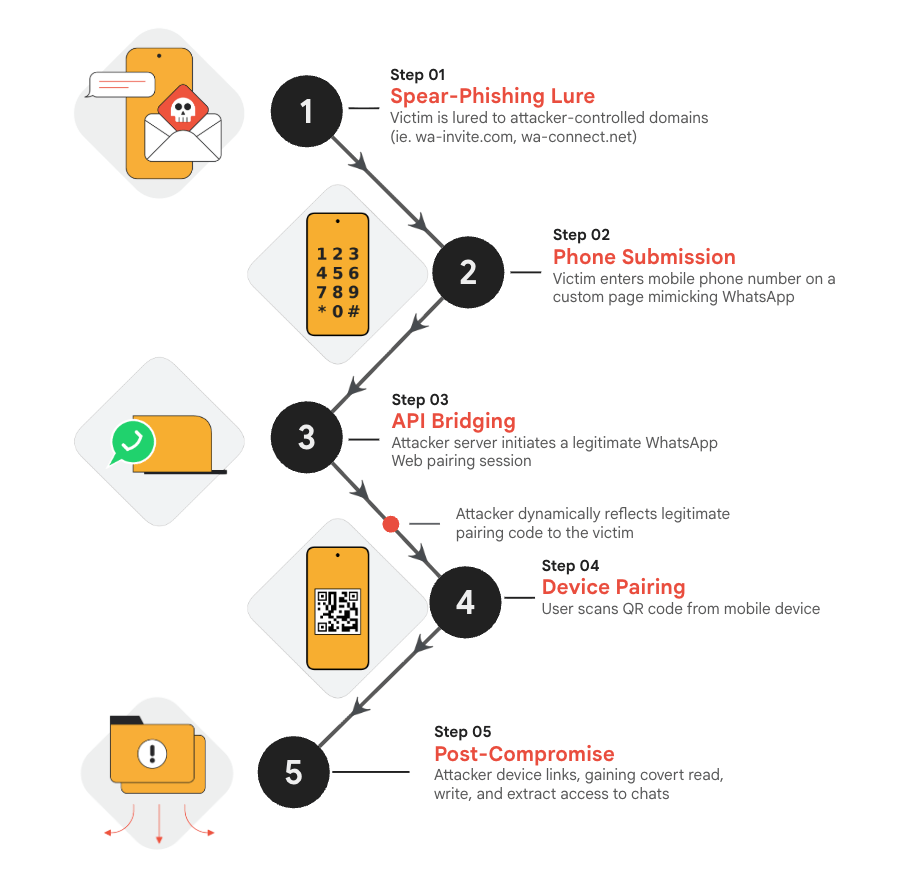
UNC7005 also used WhatsApp phishing pages to trick victims into linking their accounts to an attacker-controlled device. The fake pages offered options such as joining a call, opening an encrypted chat or downloading a file. If victims chose the call option, malicious JavaScript asked for microphone and camera access, recorded them, and sent the footage to the attackers.

In late May 2026, UNC7005 ran a broader phishing wave targeting US-based academics, diplomats, and Russia researchers. The lure was a fake “Summit Companion App” to read a document supporting Ukraine.

“In May and June 2026, UNC7005 conducted social engineering operations spoofing WhatsApp. The phishing pages distributed by the attacker lure targets into linking their WhatsApp accounts with an attacker controlled device in order to join a secure WhatsApp call, chat, or document share.” states the report. “The attacker also attempts multiple other methods of compromise after the device is linked.”

Windows users who downloaded it received VIDAR, an off-the-shelf infostealer sold as a service that pulls saved credentials, cookies, and payment data from browsers. Mac users received ATOMIC, also known as AtomicStealer, a macOS infostealer operating the same business model. Neither is custom tooling. The actor’s email address in this operation was nearly identical to one used by UNC6293 a year earlier.

The hospitality captive portal campaign, previously reported by Reliaquest and Microsoft and attributed to Midnight Blizzard, connects directly to UNC7005. Google traces the infrastructure back to April 2026: domains spoofing Microsoft authentication resources, which Google added to Safe Browsing blocklists as they appeared. By mid-July 2026, those same domains were receiving redirects from captive portals at hotels and conference centers. The IP resolution trail links the captive portal infrastructure to the GLOBSEC device code phishing operation and to ENGINELIGHT, a Go-based malware used in a separate limited UNC7005 operation in May 2026.

CHERRYPIE, also known as ChocoShell, is a PowerShell infostealer that adds another interesting detail. Google found comments and code references that appear consistent with AI-generated code, suggesting the attackers may be using an LLM to develop malware. The data it targets overlaps with the commercial infostealers already used by UNC7005, leading Google to suspect that CHERRYPIE could be a customized version of a malware-as-a-service tool.

UNC5976 is the third cluster and the most distinct. It focuses on military, aerospace, defense industrial base, and NGO targets, concentrating geographically on Ukraine and Armenia. Instead of residential proxies for post-compromise access, as UNC6293 and UNC7005 use, it runs dedicated infrastructure. Its OAuth phishing is more automated: the actor registers file-sharing-themed domains, creates Google Cloud projects behind them, and uses cloud-hosted scripts to collect authentication tokens from targets who log in through what looks like a Google sign-in prompt on a fake file-sharing page. Within three months of Google disrupting this infrastructure, UNC5976 had built at least twelve new domains and was already migrating toward non-Google hosting providers.

In April 2026, UNC5976 also distributed HEADRUSH, a malicious Excel plugin, through a domain impersonating a Ukrainian research institute, potentially targeting a Ukrainian aerospace and imaging company. HEADRUSH eventually leads to an HTA downloader, though Google wasn’t able to recover the full infection chain.

The defender challenge that runs through all three clusters is the same one Google names directly.

” The accounts these groups target are often personal, rather than corporate domain-joined accounts, creating a visibility gap for monitoring compromise from an organizational perspective. The likely use of encrypted messenger applications instead of email for initial outreach also presents a challenge to defenders hoping to track and remediate abuse.” concludes the report. “The combination of these tactics not only enables the attacker to conduct quick-turnaround exfiltration operations, but also presents opportunities for the attacker to further phish targets of interest from compromised, legitimate accounts. “

Security teams watching corporate email and endpoint telemetry won’t see the initial contact. By the time a compromised personal account starts being used to phish the target’s contacts, the original access event is already cold.

Google’s practical guidance for individuals: don’t set app passwords for anyone who asks, revoke existing ones you don’t recognize, check WhatsApp’s linked devices list, and treat any OAuth authorization prompt from an unsolicited message as suspicious regardless of how polished the surrounding page looks. High-risk individuals should consider Google’s Advanced Protection Program, which blocks app password creation entirely.

Follow me on Twitter: @securityaffairs and Facebook and Mastodon

Pierluigi Paganini

(SecurityAffairs – hacking, Russia)

Inside Operation CameraSwarm: How One Actor Took Over 14,000 Dahua Cameras

An exposed operator directory reveals how one actor compromised 14,000+ Dahua cameras across Ukraine and Russia, no password needed for most.

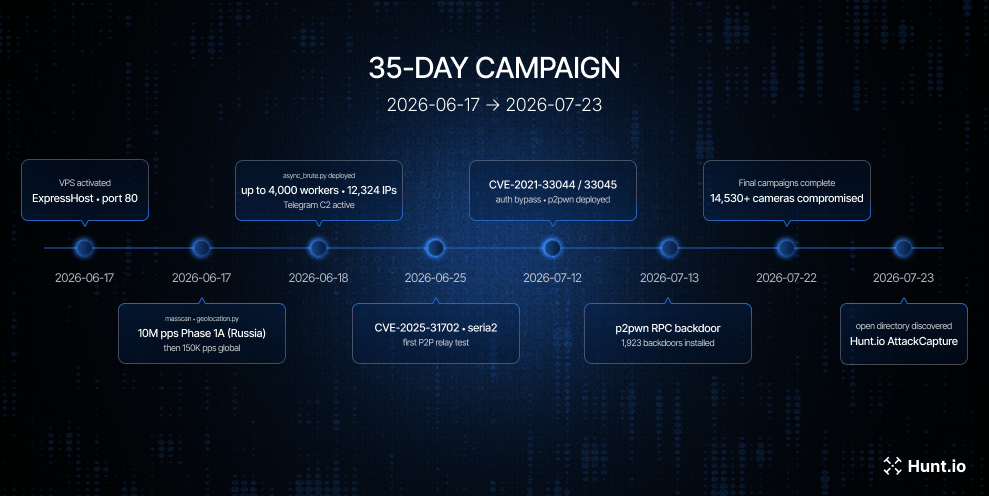
A researcher discovered an exposed directory containing the tools of an attacker who compromised more than 14,000 Dahua cameras between June 17 and July 22, 2026, mainly in Ukraine and Russia. Hunt.io reconstructed the operation, named Operation CameraSwarm, from the leaked files and telemetry.

The find started with a mistake. On 23 July, Hunt.io’s AttackCapture system crawled a server at 154.86[.]119.60 and pulled down 2,616 files across 234 subdirectories, 407 MB in total, from an HTTP directory the operator had left wide open. That single slip handed researchers the operator’s scanning engine, exploit chains, exfiltration bot, and a Windows stealer staged on the same box.

“This is the second Dahua-related camera compromise operation we’ve traced back to an exposed operator directory in as many weeks. Where last week’s investigation centered on a Russian-speaking operator running a purpose-built platform against 58 cameras, this one is a different scale entirely.” reads the report published by Hunt.io.

The brute-force engine alone reached over 12,300 unique addresses. A separate authentication-bypass chain, built around two 2021 Dahua vulnerabilities, planted a persistent backdoor account on 1,923 cameras, an account stored independently of the admin password that survives both a password change and, on most firmware, a factory reset. A third path skipped IP addresses entirely and reached 283 cameras purely by serial number, through Dahua’s own cloud relay.

That third path is the part worth sitting with. Most of those cameras were exposed online without authentication.

Dahua’s cloud relay lets any app reach a camera sitting behind NAT using nothing but its serial number, and authentication to that relay runs on credentials baked identically into every Dahua client ever shipped. The operator’s own code logs the result of probing this channel at scale: 89.4 percent of live serials returned an open, no-authentication channel. Nine out of ten cameras, reachable by anyone who could guess or harvest a serial number.

“The device never authenticates the connecting party. It authenticates the session, via a token the cloud issued before the device was contacted. Obtaining that token requires only the fixed SDK credentials shared by every legitimate Dahua application.” continues the report. “The only real barrier to reaching any camera through this path is knowing its serial number, precisely what the operator’s harvesting pipeline exists to produce at scale.”

Getting from the tunnel session to full admin access still requires valid credentials or an authentication bypass. However, the attacker’s own logs suggest that most exposed cameras did not need this final step.

There are also two important details about the reported CVEs. The tool links its persistent backdoor technique to CVE-2024-39943, but that CVE actually refers to a different command-injection flaw in Rejetto’s HTTP File Server. The technique is valid, but the CVE reference is wrong. Likewise, the relay abuse is not CVE-2025-31702, which Dahua describes as a narrower authenticated privilege-escalation flaw. Incorrect CVE references can send defenders looking for the wrong fix.

Hunt.io also found something that had nothing to do with cameras: a UPX-packed Windows binary, tagged as SalatStealer, staged on the same server alongside a PowerShell script that disables Windows Defender five different ways, including a Group Policy key built to survive reboots and Defender updates. The researchers treat it as a separate, unrelated capability riding along on shared infrastructure, not part of the camera campaign proper.

What stands out across the whole toolkit is that none of it was built from scratch. The brute-force engine, the bypass chain, the relay tooling, the recovery-code generator: each traces to a different public repository, credited (sometimes accurately) to at least six other developers. The operator assembled, patched, and rewrote, layering Russian comments over Spanish code in one component recovered in three separate stages of the same rewrite.

“The same toolkit also recovers stored device passwords outright, through a routine that derives its decryption key entirely from values the attacker already holds, device class prefix and serial number, so no device secret is needed. A residual Spanish comment in that code confirms it came from the same upstream source as the original brute-forcer.” states the report.a

The offline recovery-code generator is arguably the most consequential piece precisely because it doesn’t need a compromised device at all. Given a live serial number, it derives a code entirely offline that unlocks Dahua’s cloud-level account-recovery flow, no current credentials required. Removing a backdoor account doesn’t touch this. Only Dahua changing how the code is derived would.

For anyone running Dahua gear, or the OEM-rebranded lines built on the same backend (Amcrest, Lorex, Annke, Swann, among others), the practical checklist is short: check for a p2pwn account and remove it, disable P2P on any device where it isn’t actually needed, confirm firmware is patched against the 2021 bypass pair, and rotate every credential that camera ever held, since the exfiltration bot grabbed those too. None of that fixes the recovery-code problem. That one sits with the vendor.

Follow me on Twitter: @securityaffairs and Facebook and Mastodon

Pierluigi Paganini

(SecurityAffairs – hacking, newsletter)

Russian Hackers Hijack Hotel Wi-Fi to Steal Microsoft 365 Tokens

Microsoft says Russian hackers hijacked hotel Wi-Fi portals to spread malware and steal Microsoft 365 tokens from travelers.

Microsoft Threat Intelligence disclosed CaptiveCrunch, a campaign it attributes to Storm-2945, an operational sub-cluster of Midnight Blizzard, the Russian SVR-linked group also known as APT29 and Cozy Bear. Since early May 2026, Storm-2945 has been manipulating DNS and HTTP traffic on captive portal networks at hotels, conference centers, and shared venues worldwide to redirect guests toward malware and credential theft operations. If you connected to hotel Wi-Fi while traveling in the past few months, this report is worth reading carefully.

“Since early May 2026, Microsoft Threat Intelligence has observed Storm-2945 manipulating DNS and HTTP traffic from networks served by captive portals to redirect user traffic through actor-controlled infrastructure.” reads the report published by Microsoft. “To date, Microsoft has identified widespread compromise of Wi-Fi networks at hospitality-related organizations and other networks serviced by captive portal equipment in several countries. ReliaQuest has identified this activity not only at hotels, but also conference centers and other shared venues, and assesses that the goal of this activity is to access the accounts of corporate travelers.”

Russian Hackers Hijack Hotel Wi-Fi

That last point matters: the shared infrastructure patterns suggest this may not be a series of individual venue compromises but rather access to something shared across portions of the captive portal ecosystem. Microsoft hasn’t named any provider.

The malware delivered through these networks is CornFlake, a full-featured Windows remote access trojan written in Go.

“CornFlake registers as a Windows service named svchost32 with the display name “Cloud Sync Service and description “Synchronizes files with the cloud storage provider”, deliberately mimicking the legitimate svchost.exe process.” continues the report. “It establishes redundant persistence mechanisms: Windows service registrations, Registry Run keys, named scheduled tasks, and a persistence watchdog routine that runs continuously to restore any persistence mechanism that is removed by defenders or endpoint protection.”

CornFlake establishes an encrypted C2 channel using ECDH P-256 key exchange and supports dynamic reconfiguration without redeployment. Once installed, the RAT can log keystrokes, monitor the clipboard, capture screenshots, audio and webcam feeds, steal browser credentials, exfiltrate files, monitor USB devices, collect detailed system information, and execute remote commands. It also exposes a local HTTP API, allowing companion malware such as ChocoShell to reuse its secure C2 channel for file theft, configuration updates, and connectivity checks.

“For command and control (C2), CornFlake performs an Elliptic Curve Diffie-Hellman (ECDH) P-256 ephemeral key exchange with the C2 server, derives a session key via SHA-256, and communicates over a custom JSON protocol framed within the encrypted channel.” states the report. “This provides an encrypted channel to the C2 server, with each C2 session using a unique ephemeral key, making decryption of captured traffic impossible without the session-specific private key. “

Each C2 session uses a unique ephemeral key, which means captured traffic can’t be decrypted without that session’s private key. The malware also supports a runtime configuration file that lets the attacker reconfigure C2 servers and targeting without redeploying the implant.

CornFlake is delivered via ClickFix-style pages that impersonate Windows Update screens, Google verification pages, DirectX installers, browser update prompts, and disk optimization utilities — whatever looks most plausible for the venue. The victim still has to execute the payload, but the captive portal controls exactly what they see when they try to connect. Microsoft also found indications that Storm-2945 may be targeting Android devices through the same landing pages, which include instructions to download and install an APK.

The second tool, ChocoShell, is a PowerShell infostealer that runs entirely in memory. Its primary target is credentials.

“ChocoShell collects Microsoft 365 and Azure Active Directory (AD) access tokens, refresh tokens, and Web Account Manager (WAM) tokens from .tbres files in the Token Broker cache. Collection of these tokens represents a significant threat to enterprise environments, as threat actors could replay SSO sessions without browser cookies.” states Microsoft. “Additionally, Wi-Fi credentials are harvested via netsh wlan show profile with key=clear.”

ChocoShell also implements three silent UAC bypass techniques with ordered fallback, disables Windows Defender signature updates, and uses Chrome DevTools Protocol to extract browser cookies by launching the browser with a remote debugging port. This technique bypasses Chrome’s App-Bound Encryption entirely.

Since July 16, some CaptiveCrunch landing pages have added device code phishing to the mix, redirecting guests into Microsoft’s legitimate device code authentication flow. The attacker initiates the authentication request and presents the user with a code to enter at Microsoft’s real sign-in page. When the user enters it, they authenticate the attacker’s session instead of their own — an MFA-satisfied session, since the user just completed the factor. Microsoft recommends blocking the device code flow through Conditional Access policies everywhere it isn’t explicitly required.

Researchers also detailed FruitStone, the web-based C2 panel used by Storm-2945 operators to manage the CaptiveCrunch campaign. It provides a centralized interface to control CornFlake implants, deploy payloads, collect stolen data, and manage compromised devices. Disguised as a legitimate “CloudSync Console,” it supports multi-operator access, agent monitoring, remote commands, file theft, credential collection, configuration updates, and campaign infrastructure management.

The practical advice for travelers is blunt: treat hotel, conference, and airport Wi-Fi as hostile. Use a mobile hotspot or cellular data instead wherever possible. Don’t download or execute anything a captive portal presents as an update, certificate, troubleshooting tool, or security utility. Don’t enter corporate credentials on venue registration pages. And if your organization hasn’t already blocked device code flow in Conditional Access, now is a reasonable time to check.

Recently, ReliaQuest’s threat research team also documented attackers compromising the Wi-Fi gateways at hotels and conference centers, then quietly rerouting guests toward fake Microsoft login pages.

There’s a pattern connecting all this to previous campaigns. The tradecraft echoes a Russian-linked operation called FrostArmada, which hit home routers the same way earlier this year, and researchers tie both to the group known as APT28 (aka UAC-0001, aka Fancy BearPawn StormSofacy GroupSednit, BlueDelta, and STRONTIUM). The link isn’t a smoking gun; it’s shared technique, not shared infrastructure, and the researchers say so plainly.

Follow me on Twitter: @securityaffairs and Facebook and Mastodon

Pierluigi Paganini

(SecurityAffairs – hacking, Hotel Wi-Fi)

UAC-0099 Is Now Hiding Malware Inside a Fake Notepad++ Plugin to Target Ukrainian Organizations

UAC-0099 delivers malware via a fake Notepad++ plugin after phishing, using a loader that sabotages itself if run without the correct arguments to hinder analysis.

CERT-UA published a new advisory attributing a phishing campaign to UAC-0099, a Russia-aligned threat actor active since at least mid-2022 and previously known for exploiting WinRAR vulnerabilities and using phishing emails to deliver malware families including LONEPAGE, MATCHBOIL, and DRAGSTARE.

UAC-0099

The latest campaign, observed earlier this summer, uses a trojanized Notepad++ plugin as the infection mechanism. It’s a meaningful change in delivery method for a group that’s been refining its toolset steadily for three years.

The attack starts with a phishing email carrying an image attachment. Clicking it opens a URL hidden behind a link shortener, which redirects to a file-sharing service such as EasySend[.]co where a ZIP archive waits. Inside the ZIP is a VBScript file disguised as a PDF document.

Running the VBScript triggers two things simultaneously. A legitimate decoy PDF downloads and opens in front of the victim to hold their attention, while in the background the script fetches a second archive called Evernote.zip. That archive contains a full working copy of Notepad++ version 8.8.3, a malicious DLL plugin named NppExport.dll, a password-protected RAR archive called updater.rar, and a legitimate WinRAR executable.

“The mentioned archive contains a VBS script with a double extension, the name of which may intentionally contain a significant number of spaces before the final .vbs extension , for example “Zavodskyi rayon.pdf .vbs”. In turn, when launched, the script will download a decoy file (for example “Zavodskyi rayon.pdf”) and the “Evernote.zip” archive.” reads the advisory. “The archive contains a full set of Notepad++ program components version 8.8.3, as well as the “/plugins/NppExport/” directory, which contains a third-party plugin library “NppExport.dll”, a password-protected archive “updater.rar” and the WinRAR executable file “winrar.exe”.”

The VBScript extracts everything and launches Notepad++, which loads NppExport.dll as it starts up. The victim sees a text editor open normally and has no reason to suspect anything happened.

The malicious DLL, codenamed LUNCHPOKE by CERT-UA, uses the bundled WinRAR binary to unpack the password-protected archive. That archive contains two files: RemoteLibUpdater.exe and InitTest.dll. LUNCHPOKE copies them to a specific directory and creates a scheduled task that runs RemoteLibUpdater.exe every three minutes. The three-minute interval is aggressive and keeps the implant active even after unexpected process termination.

“The file “NppExport.dll” is classified as a LUNCHPOKE utility , the main purpose of which is to create the directory ” %PUBLIC%\Libraries\fFthY3-Ytrevc3w-ab3\ “, extract the contents of the archive “updater.rar” to it using a password (in particular, the files “RemoteLibUpdater.exe” and “InitTest.dll”), copy the standard utility “schtasks.exe” to the file ” %PUBLIC%\Wallpapers\Background.exe ” and create a scheduled task with the name ” \W1n3r-U09oTy-Ap5\Updates ” to run the file ” %PUBLIC%\Libraries\fFthY3-Ytrevc3w-ab3\RemoteLibUpdater.exe ” with the arguments “setup nodisplay” every three minutes (the name of the directory ” fFthY3-Ytrevc3w-ab3 ” changes).” states CERT-UA.

RemoteLibUpdater.exe is BURNYBEAR, a loader whose job is to execute InitTest.dll. That DLL is a modified version of MATCHBOIL, a C#-based loader capable of fetching and running additional payloads, now designated MATCHBOIL.V2. The update indicates active development on the toolchain rather than a static deployment.

BURNYBEAR includes an unusual built-in sabotage behavior.

“The executable file “RemoteLibUpdater.exe” is classified as a BURNYBEAR utility , the functionality of which is designed to load the DLL file “InitTest.dll”. However, if “RemoteLibUpdater.exe” is launched incorrectly, namely without specifying arguments, BURNYBEAR instead activates logic designed to exhaust computer resources (RAM and CPU).” states the report.

That behavior serves a dual purpose: it makes behavioral analysis harder by producing unexpected output if someone runs the binary without the correct arguments, and it provides a rough sandbox detection mechanism since automated analysis environments often execute binaries without arguments.

This campaign arrives alongside a separate U.S. government advisory documenting Laundry Bear, another Russia-linked actor, running a phishing campaign against Zimbra mail servers belonging to Western government and commercial organizations since at least July 2025. That campaign uses a “half-click” exploit abusing CVE-2025-66376 to deliver malicious JavaScript called ZimReaper, which can harvest email communications without requiring the victim to click anything beyond opening a malicious email in a vulnerable webmail client. The U.S. government’s assessment of Laundry Bear’s intent is unambiguous:

CERT-UA recommends updating WinRAR, 7-Zip, and Notepad++ to their latest versions to close known vulnerabilities that groups like UAC-0099 use to facilitate follow-on stages once they’ve established a foothold.

The campaign’s use of a bundled legitimate WinRAR executable rather than relying on one already installed is notable: it means the attack chain doesn’t depend on the victim having a vulnerable version present, which makes the update recommendation more relevant as a general hygiene measure than as a specific remediation for this particular campaign. Organizations receiving unexpected emails with image attachments that open URLs through link shorteners should treat those as high-risk regardless of what the displayed content looks like.

Follow me on Twitter: @securityaffairs and Facebook and Mastodon

Pierluigi Paganini

(SecurityAffairs – hacking, Notepad++)

US Agencies Warn of Laundry Bear Campaign Targeting Unpatched Zimbra Servers

US agencies warn Russian group Laundry Bear is exploiting a patched Zimbra flaw to steal email accounts from organizations running unpatched servers.

The Cybersecurity and Infrastructure Security Agency (CISA), National Security Agency (NSA), Federal Bureau of Investigation (FBI) and other U.S. government and international partners published a joint advisory to warn that the Russia-linked APT group Laundry Bear (aka Void Blizzard) is targeting organizations using unpatched Zimbra Collaboration servers.

The attackers exploit CVE-2025-66376, an XSS flaw that allows malicious JavaScript embedded in HTML emails to run automatically when viewed, enabling account theft without user interaction. The vulnerability was exploited as a zero-day before being patched and remains under active exploitation against unpatched systems.

“Unlike traditional phishing that attempts to persuade a user to take an action, such as clicking a link or downloading a file, LAUNDRY BEAR’s current campaign uses a zero-click exploit that only requires a user to view a malicious email within a vulnerable version of the ZCS webmail service.” reads the advisory. “This campaign uses a custom-developed aggregation and data exfiltration capability called Ulej to exploit a common vulnerabilities and exposures (CVE) in ZCS, CVE-2025-66376, with the potential for adaption to exploit other vulnerabilities as well. This advisory provides several mitigations to protect against this activity and specific remediation actions for organizations that detect indicators of compromise in their environment. “

LAUNDRY BEAR conducted a sophisticated campaign targeting Zimbra Collaboration Suite (ZCS) users by exploiting CVE-2025-66376, a zero-day vulnerability that enabled JavaScript execution directly from malicious emails.

“To gain initial access, LAUNDRY BEAR sends an email containing a malicious JavaScript payload to the target [T1566].” continues the advisory. “Through exploitation of CVE-2025-66376, this JavaScript payload is immediately executed once the user views the malicious email [T1203], such as the one shown in Figure 1, in the ZCS webmail platform.”

The group began exploiting the flaw before public disclosure and patch availability, demonstrating the ability of emerging threat actors to weaponize unknown vulnerabilities.

The attack starts with phishing emails sent from previously compromised accounts to evade detection and increase credibility. When victims open the message in Zimbra webmail, the embedded JavaScript executes through abused CSS @import directives.

“Hidden in LAUNDRY BEAR’s email is a Base64 encoded payload within the “onload” field of a Scalable Vector Graphics (SVG) element [T1027.017], as shown in Figure 3. Leading up to the inclusion of this payload in the SVG element are various instances of @import directives, as required to leverage CVE-2025-66376.” continues the advisory. “This payload includes an XOR encrypted final script encoded in a Base64 inner payload (see Figure 3) [T1027.013].”

The payload uses encryption and obfuscation techniques to bypass basic security controls and launches a multi-stage script designed for reconnaissance, credential theft, and data collection.

The malware attempts to maintain access by enabling IMAP, creating application passwords, harvesting two-factor authentication codes, and extracting saved browser password manager credentials. It collects mailbox information, user environment details, contacts, OAuth consumers, device status, and emails from the previous 90 days.

“LAUNDRY BEAR almost certainly relies on a mail client using the Internet Message Access Protocol (IMAP) for persistent access to the victim’s mailbox. During the enable_mail_protocols stage, a SOAP request leveraging the “ModifyPrefsRequest” command under the “ZimbraAccount” namespace is sent.” states the advisory. “This request attempts to set the “zimbraPrefImapEnabled” preference to TRUE. While the default setting for “zimbraPrefImapEnabled” is not well documented, this action is almost certainly intended to ensure that IMAP access to the victim’s mailbox is enabled.”

Collected data is exfiltrated through HTTPS and DNS channels to attacker-controlled infrastructure named Flowerbed, using a dedicated service called Catcher to receive and temporarily store stolen information. The campaign highlights the growing capability of smaller threat groups to exploit zero-days, bypass MFA protections, and compromise enterprise email environments for intelligence gathering and further attacks.

CISA released indicators of compromise (IOCs) linked to the LAUNDRY BEAR campaign, revealing that attackers used websites designed to impersonate legitimate Zimbra infrastructure. The threat actors registered deceptive domains, including mailnalysis.com, emailanalytics.com.ua, zimbrastat.com, zimbra-metadata.com, istc-cloud.com, and zmailanalytics.com, to support their operations and potentially collect stolen information.

To mitigate the risk, CISA recommends that organizations running Zimbra update their deployments to the latest available versions, review the published IOCs, and investigate possible connections to the identified domains and IP addresses. Organizations should also monitor authentication activity for anomalies, revoke unauthorized application passcodes, particularly those created with the “ZimbraWeb” identifier, and check user accounts for unauthorized mailbox access. In addition, CISA advises implementing phishing-resistant multi-factor authentication to reduce the risk of account compromise and limit the impact of similar campaigns.

In May, Netherlands General Intelligence and Security Service (AIVD) and the Netherlands Defence Intelligence and Security Service (MIVD) linked a previously undetected Russia-linked group, tracked Laundry Bear (aka Void Blizzard), to a 2024 police breach. In October 2024, the Dutch police blamed a state actor for the recent data breach that exposed officers’ contact details, the justice minister told lawmakers.

Follow me on Twitter: @securityaffairs and Facebook and Mastodon

Pierluigi Paganini

(SecurityAffairs – hacking, Zimbra)

Dutch Intelligence Warns Russia Uses Hacked IP Cameras for Military Espionage

Dutch intelligence says Russia hacks IP cameras to monitor NATO military logistics and weapons shipments to Ukraine.

The Netherlands’ AIVD and MIVD, the civilian and military intelligence services, published a joint advisory on July 10 confirming that at least one Russian intelligence service is systematically compromising internet-connected IP cameras across the Netherlands, other EU and NATO member states, and Ukraine to collect military intelligence.

The operation is ongoing. The advisory is based on intelligence gathered by both services and covers a campaign that has escalated since Russia’s full-scale invasion of Ukraine.

The immediate military application in Ukraine is the most direct part of the finding.

“The information obtained by the Russian state actor via digital espionage operations targeting IP cameras provides insight into relevant military data, such as EU and NATO military transport routes and weapon deliveries to Ukraine. The Russian state actor uses image recognition software to conduct targeted searches for military vehicles and the military cargo they are transporting. In some cases, the access to IP cameras gained by the Russian state actor in Ukraine is used to identify the locations of Ukrainian military personnel.” reads the advisory. “Intelligence reveals that this information is subsequently used to neutralise Ukrainian military personnel and military materiel in use by the Ukrainian armed forces. Furthermore, the Dutch services have determined that the Russian service is using the access to IP cameras to acquire relevant military intelligence in EU and NATO member states, including information that is not directly relevant to the war in Ukraine.”

A roadside camera or a business camera overlooking a loading area becomes a targeting asset. That’s the direct line from a default password left unchanged to a strike on Ukrainian forces.

The surveillance operation in EU and NATO member states serves a different but related purpose.

“Furthermore, the Dutch services have determined that the Russian service is using the access to IP cameras to acquire relevant military intelligence in EU and NATO member states, including information that is not directly relevant to the war in Ukraine.” confirms the advisory. “To date, the Dutch services have not observed the Russian state actor using such information for military attacks outside Ukraine.”

The intelligence collected includes EU and NATO military transport routes and weapons deliveries bound for Kyiv. The Dutch services separately confirmed they caught a small number of cameras breached directly on military logistics routes inside the Netherlands, and warned the organizations running them so they could act.

The services are explicit that this isn’t a one-off campaign.

“The Dutch services assess that there has been a systematic increase in the number of digital espionage operations by Russian state actors to support military operations since the start of the war in Ukraine. The digital activities that target IP cameras form only a small part of their operations.” continues the joint advisory. “The Russian authorities derive significant tactical and strategic advantages from the deployment of cyber operations, from both defensive and offensive perspectives. For example, the MIVD has previously issued a warning about exploratory activities by Russian state actors targeting logistical routes, including routes in the Netherlands”

The camera surveillance is described as a small part of a much larger digital intelligence effort.

Getting into a camera isn’t technically sophisticated. The operators scan for internet-connected devices, fingerprint cameras by brand, and walk into those still running default passwords, outdated firmware, or factory settings. Once they’re in, image-recognition software runs automated searches through the video feed looking for military vehicles and the cargo they carry. No zero-days required.

“Once an IP camera has been identified, the malicious actor can attempt to gain access to the IP camera via the internet. This is often a relatively simple process, since many IP cameras that are connected to the internet lack adequate security measures.” states the advisory. “For example, they often have default passwords, obsolete firmware and factory configurations.”

The Dutch services have not observed the same camera-derived intelligence being used for military attacks outside Ukraine. But they say this demonstrates that Russia has the capability to do so, and that the same approach could be applied by Russian military units in a future conflict. That’s not a hypothetical being raised for rhetorical effect. It’s an assessment of demonstrated capability.

The most important variables, according to the advisory, are what the camera can see and whether it’s reachable from the public internet. On the first: cameras should be positioned for their actual purpose and should avoid covering logistics routes, loading docks, ports, or any area where military movements or weapons shipments pass. Sensitive zones within the field of view should be masked or blurred where possible, and GPS location data should be stripped from video streams.

On accessibility: live streams should not be publicly reachable unless there’s an essential reason for it. Port forwarding and UPnP should be disabled. Remote access should go through a VPN rather than direct exposure. Default passwords should be changed immediately on installation, admin accounts should be kept separate from stream-viewing accounts, and MFA should be enabled wherever the device supports it. The advisory also flags the origin of the hardware itself: China, Russia, and Iran are cited as countries actively running offensive cyber programs targeting Dutch and European interests, and buyers should factor that into procurement decisions.

Cybersecurity firm Censys counted more than 87,000 internet-connected cameras across EU and NATO countries and Ukraine running services matching known-exploited vulnerabilities. In the Netherlands alone, more than 45,000 cameras are reachable from the public internet.

The numbers illustrate the scale of the exposed surface the advisory is addressing. Fixing it doesn’t require new technology. It requires treating a camera pointing at a transport route with the same security discipline as any other system connected to the internet.

Follow me on Twitter: @securityaffairs and Facebook and Mastodon

Pierluigi Paganini

(SecurityAffairs – hacking, IP cameras)

New Russian Campaign Uses Fake Webex and Zoom Installers to Deploy Starland RAT

Russian-speaking UAT-11795 spreads trojanized Zoom, Webex, and MobaXterm installers to deliver Starland RAT and the WLDR memory-only implant.

Cisco Talos researchers published a detailed technical report on July 16 disclosing UAT-11795, a financially motivated, Russian-speaking threat actor that has been running a malware campaign against users in the United States and Europe since at least June 2025. The operation distributes trojanized installers for software that IT professionals and developers actually use: MobaXterm, Cisco Webex, Zoom, DBeaver, and even the gaming platform FACEIT.

“Cisco Talos is disclosing UAT-11795, a sophisticated, Russian-speaking, financially motivated adversary that has been conducting a malicious campaign targeting users in the U.S. and Europe since at least June 2025.” reads the report published by Talos.

The wide range of targets, from developer tools and business collaboration software to gaming platforms, suggests the attackers are trying to infect many different types of users instead of focusing on a single industry.

The campaign delivers two newly documented malware families. The first is Starland RAT, a Python-based remote access tool with credential theft and cryptocurrency wallet enumeration built in. The second is the WLDR agent, a PowerShell-based command-and-control implant that runs entirely in memory. Both are novel. Talos also observed the actor deploying CastleStealer and Remcos RAT as additional payloads delivered through Starland after initial compromise.

Initial access appears to come through a ClickFix social engineering technique, where the victim is tricked into running a command that downloads and executes a malicious HTA file silently. That HTA file drops a Windows batch file and a trojanized installer, while simultaneously establishing persistence through a registry Run key that re-executes the HTA every time the user logs in. A Russian-language developer comment found inside the VBScript, “Добавление команды в автозапуск для текущего пользователя,” confirms the actors are Russian-speaking and, apparently, left their development notes in the deployed code.

The trojanized installers are built using the Nullsoft Scriptable Install System. They package a real Python runtime alongside a compiled Python loader disguised as a file named LICENSE.txt. The NSIS script executes the loader, which decrypts Starland RAT using a single-byte XOR key and runs it directly in memory. The actual software installation proceeds normally, so the victim sees what they expected and has no reason to suspect anything happened.

Before any network activity, Starland checks whether it’s running in a sandbox. It compares the logged-on username against a hardcoded list of known sandbox service accounts including WDAGUtilityAccount, then checks the computer name against hostnames from Cuckoo, Any.Run, Joe Sandbox, and Hybrid Analysis. It also checks for a Zone.Identifier alternate data stream on the installer file to confirm it was downloaded through a browser rather than dropped directly. Any mismatch terminates execution.

“Before any malicious logic executes, the RAT conducts check for anti-analysis environments. First, it compares the logged-on username of the victim machine against a hardcoded list of usernames, which includes known sandbox service accounts and aliases, including WDAGUtilityAccount. Next, the RAT verifies the victim’s computer name against a list of hostnames from recognized sandbox environments, such as Cuckoo, Any.Run, Joe Sandbox, and Hybrid Analysis.” continues the report. “If either check matches, the RAT’s execution terminates immediately. Additionally, the RAT examines the Downloads folder for a Zone.Identifier alternate data stream on the trojanized installer file, confirming that the file was obtained via a browser download rather than being uploaded or copied directly.”

After clearing those checks, the RAT establishes persistence before making any network calls, creating a scheduled task with a randomized name following the pattern PythonLauncher-{3 random characters} and a Startup folder shortcut as a secondary mechanism. It then runs reconnaissance: hardware ID derived from the C: drive volume serial number, total RAM, installed antivirus, and Active Directory membership. If the machine is domain-joined, it executes whoami, systeminfo, net user, and nltest to map the domain structure. It also enumerates over 40 cryptocurrency wallets from both browser extensions and desktop applications, takes a screenshot of the desktop, and bundles everything into a JSON payload that it XOR-encrypts with the key “helo1” before sending it to the C2.

The C2 design is worth calling out. The RAT sends victim registration data to a hardcoded primary C2 domain, but if that fails, it uses a Polygon Ethereum smart contract as a backup.

“If the primary C2 registration fails, the RAT enables a blockchain-anchored fallback mechanism. An eth_call is triggered via JSON-RPC to the public Polygon RPC endpoint “polygon-rpc[.]com”, targeting the smart contract “0x6ae382ed2154cc84c6672e4e908cd2c69c1b35ba” and function selector “0xc659f3b8” for the latest block.” states Talos. “The encrypted hexadecimal string that the RAT receives from the smart contract is XOR-decrypted with the key “$m7*rYpry3” to recover a fallback domain to which the RAT sends the victim machine registration request along with the reconnaissance and screenshot data.”

Blocking a C2 domain doesn’t help if the fallback address lives on a public blockchain that you can’t take down.

Before registering with the C2, the RAT sends a Telegram notification to an attacker-controlled bot with the victim’s public IP, OS details, processor information, computer name presented as a “Crew ID,” and any detected cryptocurrency wallets. Two Telegram bots are used: “skuefq_bot” and “komandastuk_bot.” Talos also found a private Telegram channel called “stuk komanda” created June 5, 2025, structured like a C2 dashboard, confirming the operation’s timeline.

When Starland receives a shellexecute command from the C2, the actor can use it to deploy the WLDR framework. This arrives in three stages: a heavily obfuscated PowerShell stager, a downloader that fetches victim-specific payloads bound to the machine’s hardware ID, and the WLDR agent itself, which runs entirely in memory.

“The WLDR agent is a fully featured PowerShell remote access client that operates entirely in memory. It implements encrypted C2 communications, concurrent task execution through a managed Runspace engine, and a module delivery framework that provides the threat actor with interactive remote PowerShell execution capabilities on the victim’s machine.” continues the report.

The WLDR agent uses AES-256-CBC with HMAC-SHA256 for all communication, derives session keys through PBKDF2-SHA256 at 5,000 iterations, and masks its traffic with headers that mimic a Chrome 124 browser session. The Runspace engine supports up to 10 concurrent threads and streams output back to the C2 in real time as scripts execute rather than waiting for completion, making it suitable for interactive monitoring tasks. The C2 responds only to requests that carry a matching hardware ID, so probing the endpoint directly returns nothing useful.

Starland also delivers CastleStealer, a .NET infostealer that targets browser credentials across the full Chromium family and Firefox, cryptocurrency wallet extensions, Discord and Telegram session files, and Steam credentials. It checks for a Russian locale and exits if it matches, which is consistent with the operator protecting their own environment. Remcos RAT is delivered through a separate 32-bit shellcode path. The custom shellcode loader that handles both payloads disables AMSI and ETW at runtime by patching the first bytes of AmsiScanBuffer and EtwEventWrite in memory, then falls back to a VirtualProtect-based write if the primary patching fails, before decompressing and injecting the final payload using reflective PE injection or .NET CLR loading depending on the payload type.

The full indicator set including domains, IPs, file hashes, and Snort rule IDs is available in Talos’ GitHub repository linked from the report.

Follow me on Twitter: @securityaffairs and Facebook and Mastodon

Pierluigi Paganini

(SecurityAffairs – hacking, UAT-11795)

U.S. Targets Russian Cyber Spies With $10M Bounty Over Messaging App Attacks

The U.S. offers up to $10M for information on Russian hackers targeting Signal and WhatsApp accounts of officials and journalists.

The U.S. government is offering rewards of up to $10 million for information leading to the identification of members of the Russian-linked groups UNC5792 and UNC4221.

The hackers target government officials, military personnel, journalists, and political figures through phishing attacks on Signal and WhatsApp. U.S. agencies warn the groups have evolved their tactics and now trick victims into revealing Signal Backup Recovery Keys, giving them access to past conversations and account data.

“Rewards for Justice is offering a reward of up to $10 million for information leading to the identification or location of any person who, while acting at the direction or under the control of a foreign government, participates in malicious cyber activities against U.S. critical infrastructure in violation of the Computer Fraud and Abuse Act.” reads the announcement published by the US Government.

The attackers rely on social engineering rather than breaking encryption. They abuse legitimate device-linking features in secure messaging apps such as Signal to trick victims into connecting an attacker-controlled device to their accounts.

Once they have gained access to the target’s account, they can read sensitive conversations, access contact lists and group chats, and use the compromised account to launch new phishing attacks. In some cases, the hackers modified legitimate Signal group invite pages to redirect users to malicious links.

According to U.S. authorities, these tactics have already compromised thousands of messaging accounts.

“Targets of this cyber scheme include U.S. government officials, diplomatic personnel and foreign affairs officials, defense and national security personnel, policy analysts and advisors, NATO member-state officials and diplomats, allied intelligence and defense partners, investigative journalists covering Russia, Ukraine, and international affairs, non-governmental organizations providing support and assistance to Ukraine, and academic researchers in security studies and Russian affairs.” continues the announcement.

The U.S. Rewards for Justice program is seeking information that could identify members of UNC5792 and expose how the group operates. Authorities are interested in the hackers’ identities, their links to Russian intelligence, supporting personnel and contractors, the infrastructure and tools used in attacks, as well as the financial networks, bank accounts, cryptocurrency wallets, and funding sources that sustain the group’s operations.

This week, the FBI and CISA updated their March 2026 warning about Russian intelligence phishing campaigns, and the new advisory adds a detail that wasn’t in the original: the operators have shifted their primary objective from stealing verification codes to stealing Signal Backup Recovery Keys.

The March warning covered FSB-linked groups targeting government officials, military personnel, journalists, and Ukrainian officials through fake Signal support messages. The June update gives those groups public tracking names: UNC5792 and UNC4221, both linked to Russian Federal Security Service officers including those embedded with FSB Border Guards and others working on behalf of Russian military services.

Follow me on Twitter: @securityaffairs and Facebook and Mastodon

Pierluigi Paganini

(SecurityAffairs – hacking, Signal)

SSU and FBI Uncover Russian Cyber Espionage Operation Against Officials and Military Personnel

Ukraine’s SSU and the FBI Just Confirmed Russian Intelligence Has Been Systematically Hacking Messenger Accounts for Years.

The Security Service of Ukraine (SSU), working jointly with the FBI, has formally exposed a sustained Russian intelligence campaign targeting the messaging accounts of government officials, military personnel, politicians, and activists across Ukraine, Europe, and the United States.

The operation is ongoing. The goal isn’t disruption; it’s intelligence collection.

“Cyber ​​experts of the Security Service of Ukraine together with the Federal Bureau of Investigation exposed Russian special services in systematic cyberattacks on messengers of officials, military personnel, politicians and activists from Ukraine, Europe and the USA.” read the alert by SSU.

“The purpose of these ‘hacks’ is to gain access to sensitive information of a military, political and economic nature that was exchanged between users, as well as to steal their personal data.”

The attack method is low-tech by design. Operators send SMS messages impersonating platform support bots, asking targets to hand over account credentials, confirmation codes, PINs, or account recovery keys. The SBU notes that these messages tend to arrive in the morning hours, when targets are physically and emotionally less guarded. Timing is a social engineering choice, not an accident.

The scope is broader than most people assume.

“The SBU emphasizes that Russian special services and hackers associated with them attack not only organizations, officials or public figures, but also personal accounts of Ukrainians.” continues the alert.

This isn’t a targeted elite program. It’s a mass collection operation with a tiered approach: high-value targets get more sophisticated techniques, ordinary citizens get the SMS impersonation play. The SBU didn’t attribute the campaign to a specific group by name, but prior reporting from Google, the FBI, and CISA ties similar activity to clusters tracked as UNC5792 and UNC4221, both linked to FSB operations, as well as Star Blizzard.

The FBI’s June 26 advisory added a new technique to what the March warning described. Russian operators have evolved from chasing one-time verification codes to specifically targeting Signal Backup Recovery Keys, which unlock an account’s entire message history and remain valid even if the user creates a new account with the same phone number afterward. This is a meaningful escalation: a stolen verification code expires, a stolen Recovery Key doesn’t.

QR codes are another active vector the SBU specifically calls out. Scanning a QR code received from an unknown bot or user can silently link the attacker’s device to the victim’s account, a technique Google’s Threat Intelligence Group documented against Signal’s linked-devices feature in early 2025.

“Russian hackers use a variety of tools and methods for such cyberattacks. For example, to extract passwords to an account, the enemy most often uses SMS messages on behalf of ‘support teams.'” states SSU.

The variety matters: blocking one delivery mechanism doesn’t stop the campaign, because the operators rotate techniques and targeting lists continuously.

The SBU’s practical guidance covers the basics that still fail most users in practice. Check active sessions in your messenger regularly and end anything you don’t recognize. Enable two-factor authentication with a complex alphanumeric PIN, not a four-digit code. Never provide confirmation codes, PINs, passwords, or recovery keys to anyone, regardless of how legitimate the request appears. Don’t scan QR codes from unknown sources. Don’t follow suspicious links even from accounts you know, because that account may already be compromised. Anyone who receives a suspicious message in a messenger can report it to the SBU’s Cybersecurity Situation Center at incident@dis.gov.ua.

Last week, the FBI and CISA updated their March 2026 warning about Russian intelligence phishing campaigns, and the new advisory adds a detail that wasn’t in the original: the operators have shifted their primary objective from stealing verification codes to stealing Signal Backup Recovery Keys.

Follow me on Twitter: @securityaffairs and Facebook and Mastodon

Pierluigi Paganini

(SecurityAffairs – hacking, Ukraine)

New FBI Alert: Russian Intelligence Uses Signal Recovery Keys to Access Messages

FBI warns Russian spies now target Signal Backup Recovery Keys, enabling access to message history and long-term account takeover.

The FBI and CISA updated their March 2026 warning about Russian intelligence phishing campaigns, and the new advisory adds a detail that wasn’t in the original: the operators have shifted their primary objective from stealing verification codes to stealing Signal Backup Recovery Keys.

The March warning covered FSB-linked groups targeting government officials, military personnel, journalists, and Ukrainian officials through fake Signal support messages. The June update gives those groups public tracking names: UNC5792 and UNC4221, both linked to Russian Federal Security Service officers including those embedded with FSB Border Guards and others working on behalf of Russian military services.

“RIS cyber threat actors have compromised individual CMA accounts, but not the CMA’s encryption or the application itself. To date, this activity has been publicly tracked as UNC5792 and UNC4221.” reads the PSA alert published by the FBI.. “RIS cyber threat actors continue to masquerade as automated CMA support accounts in updated phishing messages but have evolved their tactics to attempt to elicit victims’ Backup Recovery Keys.”

The earlier version of this campaign asked targets for SMS verification codes, account PINs, or tricked them into clicking doctored group invite links that silently linked an attacker’s device to the account. The new version is more damaging. The phishing message walks the target step by step through enabling Signal backups, navigating to the Recovery Key, and pasting it into the chat. Two sample messages are printed in the advisory: one dressed as a mandatory two-factor rollout announcement, the other as an urgent data recovery warning claiming messages are at risk of permanent loss.

The Recovery Key is what makes this particularly serious.

“RIS cyber threat actors continue to elicit victims’ verification codes and account PINs (see Figure 1). If a targeted user backs up their CMA messages as directed in Figure 1 and later provides their Backup Recovery Key (see Figure 2), RIS cyber threat actors can view the account’s historical messages, private and group messages, and take over the victim’s account.” continues the alert.

A backup recovery key doesn’t just unlock one session. It unlocks the entire message archive, and unlike a stolen code that expires, this key keeps working.

“If a victim inadvertently shares their Backup Recovery Key, that same key remains valid even if they create a new account following the compromise using the same phone number.” continues the report. “Consequently, the actor could potentially use the compromised key to take over the new account in the future as well.”

Making a new account doesn’t help if the old key still works against it. The only fix is generating a new key through Settings, which invalidates the old one for future backup downloads. That doesn’t recover anything the attacker already pulled, and the advisory is clear about that.

The FBI and CISA are unambiguous on one point that tends to get lost in coverage of these incidents: none of this breaks Signal’s encryption or the application itself. The attackers aren’t cracking anything. They’re walking through a legitimate feature with a key the user handed them, which is a completely different problem with a completely different solution.

Alongside the advisory, the State Department’s Rewards for Justice program announced it’s offering up to $10 million for information on UNC5792. The activity overlaps with warnings issued earlier this year by Dutch intelligence, Germany’s BfV and BSI, and France’s ANSSI, and it builds on Google Threat Intelligence Group’s documentation of UNC5792 abusing Signal’s linked-device feature in early 2025. The same tradecraft has since been observed against WhatsApp and Telegram.

For anyone using Signal who works in government, security, journalism, or military-adjacent roles, the advisory’s guidance is direct. Treat any in-app message claiming to be Signal support as hostile: real support doesn’t contact users inside the app to ask for codes, PINs, or Recovery Keys.

Open Settings, check Linked Devices, remove anything unrecognized. If you think you handed over your Recovery Key at any point, generate a new one now and assume anything backed up before that moment is already in someone else’s possession.

The encryption holds. The account is the weak point, and the advisory makes clear that the targeting is deliberate, sustained, and still active.

“To mitigate this risk, the user must generate a new Backup Recovery Key within the Settings control; this action will invalidate the previous key for all future backup downloads. However, please note that this does not prevent the actor from having already downloaded a backup of the original account.” concludes the alert.

Follow me on Twitter: @securityaffairs and Facebook and Mastodon

Pierluigi Paganini

(SecurityAffairs – hacking, newsletter)

Activist Phone Hacked With Cellebrite After Russia Contract Cancellation

Russian authorities used Cellebrite tools to unlock an activist’s iPhone and analyze private data despite canceled support, raising abuse concerns.

On May 31, 2021, Russian security services pulled opposition activist Andrey Pivovarov off a flight at St. Petersburg airport and confiscated his iPhone 12 and MacBook. He never consented to a search and never gave up his passwords. Three weeks later, on June 17, while his devices sat in custody, Russian authorities used Cellebrite ‘s forensic tools to break into his phone. Cellebrite had announced it was stopping sales to Russia three months earlier.

The Citizen Lab published its findings on June 25, 2026. What makes this case unusual is that the evidence comes from two independent sources that line up exactly.

“Our analysis found traces of the use of Cellebrite’s forensic tools with high confidence on Pivovarov’s iPhone 12 on or around June 17, 2021, during a period when the device was in the custody of the Russian authorities.” reads the report published by Citizen Lab. “Our forensic analysis of MobileLockdown records from Pivovarov’s iPhone show USB connections to a device with a Host ID on June 17, 2021 that we previously attributed to Cellebrite.”

The second source is Russia’s own paperwork. Pivovarov received a prosecution document, Forensic Expert Report No. 1269-17, prepared by the Interior Ministry’s forensic center, and he gave a copy to the Citizen Lab. It names Cellebrite UFED Physical Analyzer and UFED 4PC by product name.

The investigators didn’t just extract data. They searched it.

“The authorities documented gathering extensive information from the device, including data from apps like WhatsApp, Telegram, and Viber.” continues the report.

The MVD report shows searches for “Open Russia Civic Movement” and for named individuals including Mikhail Khodorkovsky, who founded Open Russia, human rights lawyer Anastasiya Burakova, and Pivovarov’s partner Tatiana Usmanova. This was a political map-building exercise disguised as a criminal investigation.

The MacBook resisted. Russia’s own report documents a failed extraction attempt, blocked by disk encryption, and Citizen Lab forensics found matching failed login attempts on June 17, confirming the authorities never had the password. Pivovarov was sentenced to four years in July 2022 on charges of running an “undesirable” organization — a label Russia applied to Open Russia, and one the European Court of Human Rights later found incompatible with the European Convention on Human Rights. He was freed in August 2024 in a prisoner exchange.

The timing raises a question Cellebrite can’t easily answer. The company cancelled its Russian contracts in March 2021, which cut off future updates but left existing hardware running.

The Russian and Belarusian authorities would cease to receive updates for their Cellebrite devices, but evidence demonstrates that more than a year later, Russian autorities were still using the tool to hack political detainees’ cellphones.

“Our forensic findings confirm the reports that Russian authorities developed a range of methods to continue leveraging Cellebrite in political prosecutions (as well as other device hacking tools) despite the contract cancellation. The historic architecture of Cellebrite forensic systems means that much of the functionality in the UFED product has continued to operate long after updates cease.” continues the report. “Furthermore, Cellebrite systems have historically featured an offline mode. Consequently, the way Cellebrite’s technology was designed appeared to make it difficult for the company to meaningfully cut off problematic customers.”

Cellebrite told the Citizen Lab that any use of its legacy hardware after March 2021 is “entirely unauthorized” and that the hardware runs without its support or consent. That’s legally accurate and operationally irrelevant: the tool worked, the phone was open, and the extraction happened.

There’s an additional thread worth following. The names pulled from Pivovarov’s phone later appeared as targets in a COLDRIVER phishing campaign, the FSB-linked operation that went after Russian opposition figures abroad. Burakova was targeted but didn’t open the attachment. The Citizen Lab doesn’t claim a direct causal link, but the mechanism is straightforward: extract one activist’s contact list and you have a ready-made target list for the next operation.

Russia now joins Serbia, Kenya, and Jordan on the Citizen Lab’s list of Cellebrite abuse cases backed by hard forensic evidence. Cellebrite says it’s moving to subscription licenses that stop working when they expire, which would prevent the installed-base problem from recurring.

The company’s track record, selling to repressive governments, cancelling contracts only after third-party exposure, and reacting selectivelym makes that commitment worth watching rather than simply trusting.

“Cellebrite’s record suggests it is comfortable pursuing contracts with governments that are likely to use its technology to commit human rights abuses. Cellebrite previously sold to autocratic and repressive countries including RussiaBelarusChinaJordanKenyaMyanmarSerbia, and Botswana, among others.” concludes the report. “There is also a growing list of forensically-documented cases in which Cellebrite technology was used for political repression, from Serbia and Kenya to Jordan and now Russia, and where the company has shown a mixed record of contract cancellations.”

Follow me on Twitter: @securityaffairs and Facebook and Mastodon

Pierluigi Paganini

(SecurityAffairs – hacking, mobile)

❌