❌

Visualização de leitura

Microsoft Links ConnectWise Breach to China-Linked Group Using AI Pentesting Tool ARTEX

China-linked Storm-0940 used AI tool ARTEX to target 2,250 Microsoft 365 tenants, exploiting stolen ConnectWise credentials at machine speed.

Microsoft published a detailed technical report naming Storm-0940, a China state-aligned group, as the actor behind the ConnectWise Cloud Backup supply chain compromise. The group used ARTEX, an open-source AI-driven penetration testing framework, to run attacks at machine speed against hundreds of organizations across aerospace, defense, energy, financial services, government, manufacturing, and more.

“Several of these Storm-0940 ARTEX-driven attacks have resulted in the actor obtaining privileged access to an organization’s cloud infrastructure – including multiple instances where the time from initial targeting to privileged access was less than 3 hours.” reads the report. “Microsoft assesses that Storm-0940 was responsible for the recently disclosed ConnectWise supply chain compromise of a multi-tenant application.”

Storm-0940 has been active since 2021 and has historically relied on password spraying and OAuth application abuse to get into Microsoft 365 environments. Adding ARTEX changed the scale of what they could do. In some attacks, the time between initial targeting and achieving privileged cloud access was under three hours.

Before obtaining the ConnectWise credentials, Storm-0940 launched a password spraying attack between October 10 and 14. The attack came from the IP address 144.172.64[.]99. Microsoft recorded more than 151,000 failed login attempts against 327 accounts at eight organizations. Activity peaked on October 11, with 2,900 failed attempts per minute. Forty-eight accounts each received more than 1,000 failed attempts. None of these attempts succeeded.

The situation changed on October 15, one day after the ConnectWise breach became public. The AI agents stopped trying passwords and switched to a different attack method. By then, Storm-0940 had obtained the credentials of several ConnectWise cloud application accounts. The agents used these credentials to log directly into customer Microsoft 365 environments.

“Storm-0940’s use of ARTEX accelerated the speed of compromised application abuse to authenticate to Microsoft 365 customer environments through applications that had already been granted access.” Microsoft continues. “This allowed the threat actor to operate without requiring an interactive user sign-in. “

The agents used applications that already had permission to access their targets. This allowed the attackers to enter customer environments without requiring users to sign in interactively.

In a subset of environments where authentication succeeded, the agents didn’t stop there. They moved into Microsoft Graph and ran directory reconnaissance, modified application credentials to establish persistence, and attempted changes to identities, groups, and privileged roles. Microsoft identified multiple customer environments with evidence of this follow-on activity.

The persistence mechanism is the part defenders need to act on now, even if they’ve already disabled the ConnectWise connections.

“These changes can remain active as a backdoor even after the original compromised application is mediated.” says the IT giant.

An attacker who added their own credentials to a trusted application before you revoked access still has a working key. Reviewing all service principal credential additions since at least October 1 is the right starting point, not October 15 when the public breach was announced.

ARTEX is not a tool used only by Storm-0940. Microsoft says threat actors in several regions have used the same framework. Originally open-source, ARTEX was written in Go and can use different AI models to plan and carry out tasks. Researchers at Zscaler and Recorded Future also found a Chinese-speaking group using it to target South Korean financial institutions. The setup used DeepSeek, GLM, and Grok as coordinated AI agents, with GLM checking DeepSeek’s work. After these attacks became public, the project went closed-source. However, anyone who already has a copy can still use it.
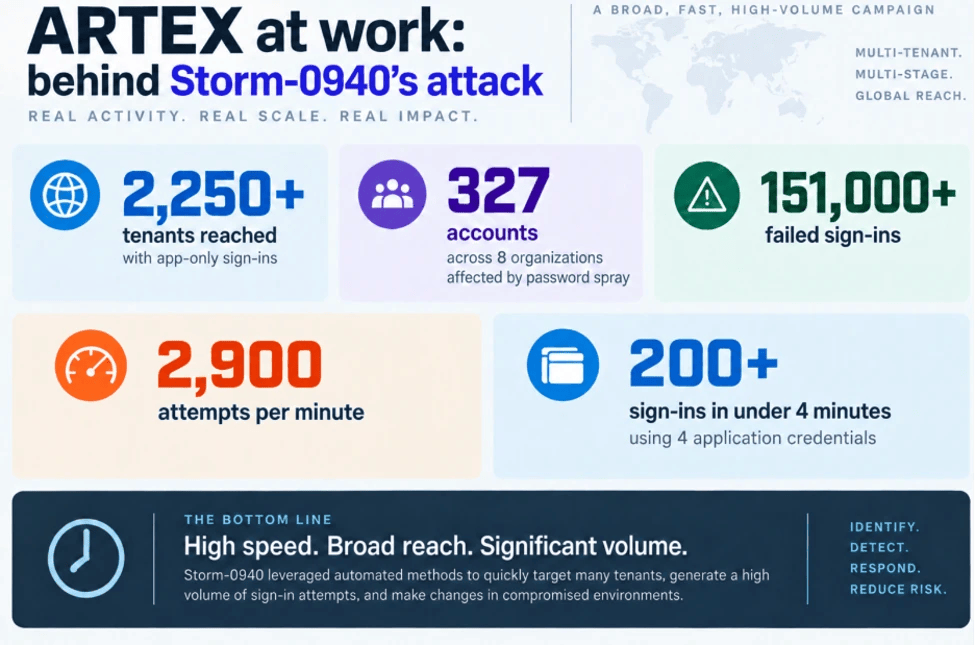
The speed point is what Microsoft keeps coming back to in its report. Agents don’t take weekends, don’t sleep, and can run multiple attack paths simultaneously.

“This activity demonstrates how threat actors are integrating agentic AI into existing offensive security workflows and allows them to scale their operations exponentially.” Microsoft concludes. “Agents are not constrained by factors affecting humans – they can work around the clock, on weekends, and on holidays and attempt multiple breach paths simultaneously enabling significantly reduced time from selecting a target to achieving objectives, increasing the speed and impact of complex attacks like supply chain compromises.”

When Storm-0940 had valid application credentials, they didn’t have to iterate slowly. They hit 2,250 tenants with 2,900 sign-in attempts per minute, a pace at which manual detection and response simply can’t keep up.

Follow me on Twitter: @securityaffairs and Facebook and Mastodon

Pierluigi Paganini

(SecurityAffairs – hacking, ARTEX)

Attackers Abuse Stolen ConnectWise Application Credentials to Target Microsoft 365

Attackers stole ConnectWise application credentials to access Microsoft 365 tenants, prompting the company to suspend cloud services.

ConnectWise suspended its Cloud Backup service and took both SaaS Security and Cloud Management offline over the weekend after discovering that unknown attackers had obtained unauthorized access to seven of its application identities.

The company discovered the incident on October 14 through internal monitoring, disabled the compromised identities on October 17, and is still investigating how attackers obtained the credentials.

“We have taken protective action following unauthorized access to application identities associated with ConnectWise Cloud Backup, formerly known as SkyKick. Our investigation remains ongoing. Since implementing the mitigations described below, we have not observed successful threat activity in the environments we monitor.” reads the alert published by the company on October 17. “Out of an abundance of caution, we suspended Cloud Backup service by revoking certificates used for affected application connections across all users. This removed ConnectWise’s access through those connections. The shared credentials previously used for Cloud Backup are no longer valid and cannot be used. In addition to mobilizing our internal security teams and Security Operations Center (SOC), we have engaged a reputable third-party incident response firm to support our investigation and containment efforts. Together, these teams are actively monitoring our backup infrastructure and broader environment, with the investigation extending across all partner-facing services. At this time, we have no indication that any other ConnectWise product, service, or offering is impacted.”

This was not a case of attackers stealing individual customers’ passwords. ConnectWise’s applications already had permission to access customer Microsoft 365 environments to manage services and run backups. After stealing the application credentials, the attackers could pretend to be ConnectWise’s own applications and request access tokens from Microsoft Entra ID. They did not need to steal any customer passwords.

Depending on the permissions granted to these applications, the attackers could access mailboxes, SharePoint documents, Teams messages, and directory data. ConnectWise explained that disabling the affected connections prevents new authentication through those connections; however, it does not reverse changes previously made inside a tenant. In other words, disabling the compromised connections stops new access through them, but it does not undo what the attackers may have already done inside customer environments. Any changes made before the connections were disabled may remain.

Here’s what makes this particularly hard to clean up. An attacker who used a stolen application credential to get into a tenant could add their own client secret to a different trusted application already registered in that tenant, or create an entirely new application and grant it permissions. Either path gives them a second key that still works even after ConnectWise’s original compromised credential is revoked.

“The larger risk is what happens when that access is used to gain more. If an application can assign directory roles, as we saw in one tenant, it can make itself a Global Administrator, and an administrator can add credentials to other applications, create new applications and grant them permissions, reset passwords and authentication methods for users, and change Conditional Access policies.” reads the analysis published by cybersecurity firm Huntress. “Each of those steps gives the attacker another way back in that does not depend on the original vendor credential, which is why rotating the vendor credential is necessary, but not enough.”

Huntress identified malicious sign-ins from IP address 144.172.64.128 through October 15 at around 14:20 UTC, and a second targeted wave later that same day aimed specifically at 16 tenants in the policy, national security, trade, and critical minerals sectors. That second wave appeared to be manual rather than automated and hit Exchange Online, SharePoint Online, Teams, Azure Resource Manager, Entra, and Office 365 Management APIs in rapid succession. All 16 attempts in the second wave failed, but the fact that they were manually targeted at sensitive sectors is the detail worth sitting with.

Of about 1,000 Microsoft Entra tenants that recorded sign-in activity from the suspicious IP address, around 300 sign-ins were successful. However, a successful sign-in did not always give the attackers access to a tenant. In some cases, they could not proceed because the required service principal was missing. This was a result of the tenant’s configuration, not a security measure that had been deliberately put in place.

ConnectWise said its Cloud Backup archives remain encrypted, isolated, and preserved, with no evidence that attackers accessed or compromised them.

“Cloud Backup remains suspended. Scheduled backups are not running, and access to affected backup archives and restoration capabilities remains unavailable.” continues the ConnectWise’s alert.”Existing archives remain encrypted, isolated, and preserved. We have no evidence that these archives have been accessed.”

However, while the service remains offline, backups cannot run and customers cannot restore their data. This creates an operational risk for organizations that depend on the service to recover their systems and information.

Huntress’s recommendation for anyone using ConnectWise Cloud Backup or Cloud Management is to review both their own Microsoft 365 tenant and every managed customer tenant, including any with dormant SkyKick connections. Look specifically for sign-in activity from 144.172.64[.]128 starting October 13. Before doing anything else, preserve available sign-in and audit logs, because containment steps can overwrite the evidence you need to understand what actually happened.

The list of what to check is long: application credentials and federation trusts, directory role assignments, consent grants, recent policy changes, mailbox forwarding rules, and delegated mailbox access. Any of these could be the thing an attacker quietly added before the connection was killed. Full ConnectWise advisory and ongoing updates are available here.

Follow me on Twitter: @securityaffairs and Facebook and Mastodon

Pierluigi Paganini

(SecurityAffairs – hacking, ConnectWise)

U.S. CISA adds Acronis Backup, Cisco ISE, and Google Pixel flaws to its Known Exploited Vulnerabilities catalog

U.S. Cybersecurity and Infrastructure Security Agency (CISA) adds Acronis Backup, Cisco ISE, and Google Pixel flaws to its Known Exploited Vulnerabilities catalog.

The U.S. Cybersecurity and Infrastructure Security Agency (CISA) added [1, 2] the following vulnerabilities to its Known Exploited Vulnerabilities (KEV) catalog:

  • CVE-2026-76460 (CVSS score of 10.0) Cisco Identity Services Engine Incorrect Use of Privileged APIs Vulnerability
  • CVE-2026-87886 (CVSS score NA) Acronis Backup Incorrect Default Permissions Vulnerability
  • CVE-2026-58704 (CVSS score of 8.8) Google Pixel Improper Authorization Vulnerability

CVE-2026-76460 is an authentication bypass vulnerability affecting an API in Cisco Identity Services Engine (ISE). The flaw is caused by inadequate authentication checks on a specific API endpoint. An unauthenticated remote attacker could exploit it by sending a specially crafted request, potentially gaining unauthorized access to the affected system through its web-based management interface.

“The Cisco PSIRT is aware of active exploitation of this vulnerability. Cisco strongly recommends that customers upgrade to a fixed software release to remediate this vulnerability.” reads the advisory.

CVE-2026-87886 is a local privilege escalation vulnerability in Acronis Backup caused by insecure file permissions. The flaw affects the Acronis Backup plugin for cPanel & WHM and the Backup extension for Plesk. A local attacker with limited privileges could exploit the issue to manipulate files used by the backup service and potentially execute code with elevated, root-level privileges. Acronis reported exploitation in the wild in limited in limited, targeted attacks

Google has released its September 2026 Pixel security update, addressing a large set of vulnerabilities, including a high-severity flaw, tracked as CVE-2026-58704 (CVSS score of 8.0), in the cellular modem that has already been exploited in the wild.

The third vulnerability added to the KeV catalog is an Improper Authorization flaw tracked as CVE-2026-58704.

Google has addressed the flaw with the release of its September 2026 Pixel security update.

“In Cellular Modem, there is a possible permission bypass due to a logic error in the code. This could lead to remote (proximal/adjacent) escalation of privilege with no additional execution privileges needed. User interaction is not needed for exploitation.” reads the advisory.

The vulnerability is an elevation-of-privilege issue caused by a permission bypass resulting from a logic error in the modem code. Google said there are indications that the flaw may have been used in “limited, targeted exploitation.”

Unlike vulnerabilities affecting applications or higher-level Android components, CVE-2026-58704 resides in the cellular modem, a security-sensitive component responsible for communications between the device and mobile networks. The company warned that it has already been exploited in the wild.

“There are indications that CVE-2026-58704 may be under limited, targeted exploitation.” states Google.

As usual, the IT giant has not disclosed who exploited the vulnerability, how many devices were targeted, or what the attacks were designed to achieve.

The vulnerability is particularly notable because it does not require user interaction. According to the CVE record, exploitation can result in remote, proximal or adjacent privilege escalation without requiring additional execution privileges.

The technical details suggest that an attacker able to reach the vulnerable modem environment could exploit the permission bypass to obtain higher privileges. The attack vector is classified as adjacent rather than broadly Internet-facing, an important distinction when assessing the practical exploitation requirements.

In this case, however, Google has not publicly described the complete attack chain. There is also no evidence in the company’s advisory identifying the operation as the work of a commercial spyware vendor or a specific state-sponsored group.

According to Binding Operational Directive (BOD) 22-01: Reducing the Significant Risk of Known Exploited Vulnerabilities, FCEB agencies have to address the identified vulnerabilities by the due date to protect their networks against attacks exploiting the flaws in the catalog.

Experts also recommend that private organizations review the Catalog and address the vulnerabilities in their infrastructure.

CISA orders federal agencies to fix the GitLab and ConnectWise flaws by September 14, 2026, while the remaining JFrog Artifactory issues must be addressed by September 19, 2026.

Follow me on Twitter: @securityaffairs and Facebook and Mastodon

Pierluigi Paganini

(SecurityAffairs – hacking, CISA)

Shared Hosting at Risk: LiteSpeed Enterprise Bug Can Grant Root from a Single Tenant

Critical LiteSpeed Enterprise flaw lets one shared hosting account gain root, bypassing CageFS; patch now to 6.3.7 via forced update.

cPanel warned that a critical flaw in LiteSpeed Enterprise can let a low‑privilege website user break out of their account and gain root on the whole server. On a box where dozens or hundreds of customers live side by side, that’s not a theoretical risk. It’s a full cross‑tenant compromise. Attackers could then access or modify other websites and the server itself.

“We have received notice that a critical privilege-escalation vulnerability has been identified in LiteSpeed Web Server Enterprise. On shared-hosting servers, a malicious low-privilege website user could potentially gain root-level access to the server. This could allow an attacker to access or alter other hosted websites and the server itself.” reads the advisory.

“This issue can bypass expected account isolation controls, including CageFS, allowing a malicious website user to potentially escape its restricted environment and gain root-level access to the server.”

The flaw affects versions before 6.3.7 and can bypass the isolation that keeps hosting accounts apart, including CageFS. CageFS is the CloudLinux layer that gives each account a restricted view of the filesystem so it can’t peek at other users or server configs.

If this flaw truly defeats that boundary, then one bad tenant can read or change other sites and take control of the machine.

Neither cPanel nor LiteSpeed disclosed technical details about the vulnerability. LiteSpeed’s September 11 announcement for 6.3.7 just mentions “Security improvements, bug fixes, and more!” and the changelog lists three security changes without calling out a privilege‑escalation issue.

There’s no CVE or severity rating yet, and it’s unclear whether attackers are already exploiting the flaw.

Both cPanel and LiteSpeed urge admins to run this command to update their installs:

/usr/local/lsws/admin/misc/lsup.sh -f -v 6.3.7

LiteSpeed warns that version 6.3.7 may take some time to reach the stable auto-update channel. As of September 15, the download page still listed 6.3.6 as the latest stable version. Forcing 6.3.7 means temporarily leaving the stable update channel, which can be restored later.

There’s no workaround for systems you can’t patch immediately. The advisory only covers the Enterprise edition; OpenLiteSpeed, the open‑source variant, had no matching update as of September 15.

LiteSpeed-related flaws have now been linked to three root-level escapes on cPanel shared-hosting servers since May.

This year, LiteSpeed fixed two flaws in its cPanel plugin, CVE-2026-48172 and CVE-2026-54420, which were being actively exploited in the wild. CISA added both issues to is Known Exploited Vulnerabilities catalog.

Follow me on Twitter: @securityaffairs and Facebook and Mastodon

Pierluigi Paganini

(SecurityAffairs – hacking, LiteSpeed)

❌