Visualização de leitura

Australian Police Charge Two Over TeamPCP Credential Theft

Australian police charged two men linked to TeamPCP over malware hidden in open-source code that stole 500,000+ credentials from 1,000+ organizations.

Australian police have charged two men from Western Australia over a global cybercrime operation that allegedly hid malicious code in open-source software and used it to steal data from thousands of organisations.

“Two West Australian men have been charged following a joint investigation between the AFP and Western Australia Police Force (WAPF), working in parallel with the Federal Bureau of Investigation (FBI), into a sophisticated cybercrime syndicate that allegedly created malicious open-source software to rob thousands of global businesses.” states AFP. “The AFP charged the men yesterday (26 August, 2026) with a combined total of 14 offences after executing search warrants in Perth with WAPF, and the assistance of the FBI.”

The Australian Federal Police, the Western Australia Police Force and the FBI executed search warrants in Perth on 26 August 2026 and arrested a 21-year-old from Cottesloe and a 23-year-old from Mandurah. They face a combined total of 14 charges covering unauthorised data modification, possession and supply of data for computer offences, and dealing with proceeds of crime.

Police say the pair were principal participants in a syndicate known as TeamPCP, which allegedly inserted malicious code into software hosted on public repositories and then let other developers pull it in without knowing. Infected components ended up in systems across government, academia and the private sector, giving the group a way to steal credentials and other sensitive material at scale.

“Parallel investigations started in April, 2026, after the AFP and FBI received information from multiple cyber threat assessment companies regarding a syndicate that allegedly inserted malicious code into software available on an open-source repository, which was then unwittingly used by other developers.” continues AFP. “Police will allege infected software was then distributed into computer systems at other organisations across government, academia and the private sector. The software allegedly enabled the syndicate to infiltrate those organisations to steal or harvest sensitive data, including user credentials and authentication materials.”

The numbers are not small. Investigators estimate the malicious code potentially compromised more than 1,000 organisations worldwide, enabling the theft of over 500,000 credentials and the exfiltration of at least 300 gigabytes of data. Remediation costs so far run into the hundreds of millions of dollars.

TeamPCP is behind multiple supply chain attacks, in the past, they targeted PyPI packages and NPM repositories, and most recently the “Mini Shai-Hulud” campaign also caught two OpenAI employees. The pattern is consistent: go after the tools developers trust, poison the supply chain, and let the downstream damage multiply.

The confirmed list of modified tools includes Trivy, a widely used container vulnerability scanner; KICS, a static analysis tool for infrastructure-as-code; LiteLLM, a popular library for routing requests across AI model APIs; and the Telnyx Python SDK.

These aren’t niche utilities. They’re commonly integrated into enterprise CI/CD pipelines, cloud infrastructure workflows, and security scanning processes. Hitting them means hitting a large number of organizations simultaneously through a single poisoned update.

The group also deployed four distinct malware families. CanisterWorm harvested cloud access tokens, credentials, and API keys for AWS, GCP, and Azure. SANDCLOCK extracted AWS credentials, Kubernetes ServiceAccount tokens, local environment variables, and cryptocurrency wallet data. Mini Shai-Hulud was a self-replicating worm designed to spread across both npm and PyPI registries. Miasma was a variant of Mini Shai-Hulud that propagated across those same open-source registries while harvesting credentials and poisoning configuration files.

The worm component is the part that deserves particular attention. Mini Shai-Hulud and its Miasma variant didn’t just infect the initial target and stop. They spread across open-source package registries autonomously, harvesting credentials and poisoning configuration files as they went. The FBI confirmed two GitHub repository names used for exfiltration: tpcp-docs and docs-tpcp. If either of those repository names appears in your GitHub organization, the worm created it using stolen credentials.

TeamPCP’s method was straightforward and effective: inject malicious code into legitimate software packages, push the trojanized versions through normal distribution channels, and wait for CI/CD pipelines to pull them in automatically. The modified tools installed credential-stealing malware and persistent backdoors without any visible sign that anything had changed.

“These men are allegedly members of the cybercriminal group TeamPCP, whose malicious code potentially compromised more than a thousand organizations worldwide,” Assistant Director Leatherman said.

“We are proud to work with the Australian Federal Police and the Western Australia Police Force to impose cost on criminal actors and combat the growing threat of software supply-chain attacks.”

The charges show how serious the alleged operation was. The 21-year-old faces several charges, including changing data without authorization, possessing and supplying data for computer crimes, failing to comply with a production order, and handling at least A$100,000 in criminal proceeds. The 23-year-old faces similar hacking charges, with maximum penalties ranging from three to 20 years.

Police seized electronic devices and other items from properties in Cottesloe, Hamilton Hill and Mandurah. Investigators are now examining a large amount of data and have not ruled out further arrests or charges.

Follow me on Twitter: @securityaffairs and Facebook and Mastodon

Pierluigi Paganini

(SecurityAffairs – hacking, newsletter)
LiteLLM Supply-Chain Attack – Technology, Banking and Healthcare the Most Affected

The SANDCLOCK LiteLLM supply-chain attack exposed credentials across 2,038 repositories, affecting technology, finance, healthcare, retail and more.

Resecurity (USA) estimated the most affected sectors by the SANDCLOCK” backdoor, which was planted as a result of the code repository compromise. According to cybersecurity experts, LiteLLM / TeamPCP Supply-Chain Attack will have long-lasting consequences.

By compromising a well-known component in AI applications, adversaries will multiply the blast radius—some of the victim organizations are still unaware of the backdoor and its impact. LiteLLM is a popular open-soure AI gateway and utility library that unifies API calls for over 100 large language model providers, such as OpenAI, Anthropic, Google Gemini, and local Ollama models.

Such incidents involve substantial MTTD (Mean Time to Detect) and MTTR (Mean Time to Respond). The threat actor group “TeamPCP” compromised maintainer credentials for LiteLLM and published malicious package versions 1.82.7 and 1.82.8 to PyPI around March 2026 – creating a window of exposure lasting at least a few months.

Over 2,500+ organizations and hundreds of thousands of CI/CD environments suffered full-credential exposure, compromising cloud infrastructure keys, repository access tokens, SSH credentials, Kubernetes secrets, and AI provider API keys (such as OpenAI and Anthropic).

Resecurity has acquired the 150GB archive attributed to the LiteLLM supply-chain attack conducted by TeamPCP using the “SANDCLOCK” credential-stealer. Per published incident reporting — accompanying victim manifests enumerate 898 compromised GitHub owners (organisations/accounts) across 2,038 repositories. The affected owners include major global enterprises — among them Microsoft, Azure, IBM, NVIDIA, PayPal (Zettle), Deloitte, Bosch, S&P Global, Elevance Health, 84.51° (Kroger), Adeo (Leroy Merlin), Kärcher, Dräger, ID.me and 1inch.

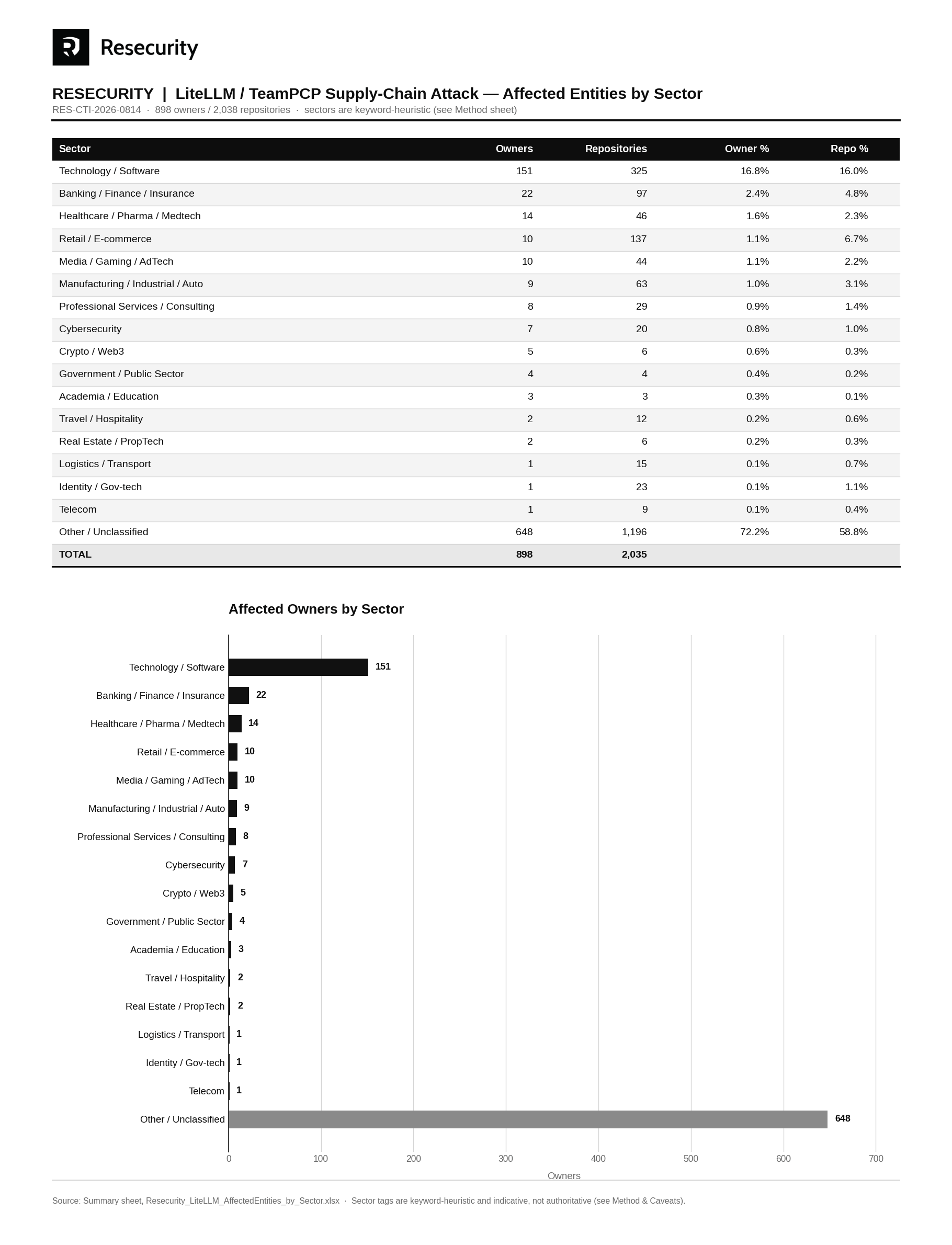
Top 10 the most impacted sectors (by victim organization profile):

  • Technology / Software
  • Banking / Finance / Insurance
  • Healthcare / Pharma / Medtech
  • Retail / E-Commerce
  • Media / Gaming / Adtech
  • Manufacturing / Industrial
  • Professional Services
  • Cybersecurity
  • Crypto
  • Government
Resecurity LiteLLM AffectedEntities by Sector_1

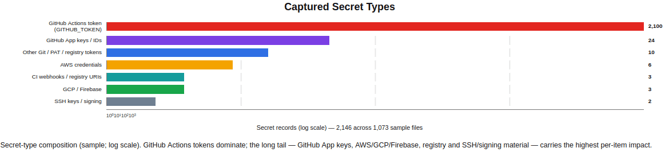
Resecurity enumerated 2,146 records by key name (values never inspected beyond structural masking). The composition is overwhelmingly GitHub CI-CD identity material, with a long tail of high-value cloud and registry credentials.

Resecurity LiteLLM

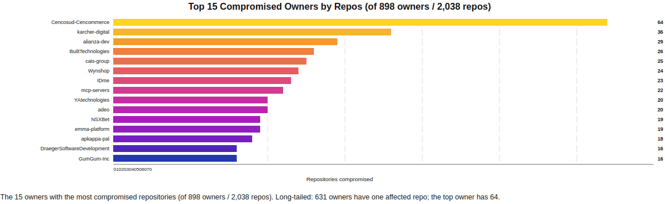
Victim manifests (owners.txt, repos.txt) enumerate 898 distinct compromised GitHub owners across 2,038 repositories. The distribution is long-tailed: 631 owners have a single affected repo, while the most-affected owner (Cencosud-Cencommerce) has 64. Critically, the owner list includes major global enterprises and regulated organisations.

Resecurity LiteLLM

Every organization affected by the LiteLLM incident should revoke or rotate GitHub App private keys, PATs, AWS/GCP/Firebase credentials, ECR/JFrog tokens, SSH keys, and signing passwords, and invalidate sessions.

Follow me on Twitter: @securityaffairs and Facebook and Mastodon

Pierluigi Paganini

(SecurityAffairs – hacking, newsletter)
AsyncAPI npm Supply Chain Attack: Malware Injected Into Packages With 2 Million Weekly Downloads

AsyncAPI npm packages with 2M weekly downloads were compromised, spreading malware with info-stealing, crypto-theft and RAT capabilities.

OX Security researchers disclosed on July 14 that the AsyncAPI npm organization was compromised, with malicious code injected into four packages that together account for over 2 million weekly downloads. The affected versions are @asyncapi/generator 3.3.1, @asyncapi/generator-components 0.7.1, @asyncapi/generator-helpers 1.1.1, and @asyncapi/specs 6.11.2 and 6.11.2-alpha.1. AsyncAPI is widely used by developers building event-driven APIs, which means the blast radius here touches a broad cross-section of professional development environments.

“This is a highly sophisticated, multi-stage supply chain attack. The malware functions as a hybrid info-stealer, crypto-stealer, and Remote Access Trojan (RAT).” reads the report published by OX. “It actively attempts to confuse analysts by mimicking known campaigns (like Miasma) and targets developers and repository maintainers.”

OX describes what was injected as far more than a simple credential harvester. The malware payload runs to 91,973 lines of code. Whoever wrote this was not in a hurry.

The infrastructure choices are deliberate and designed for resilience. The malware uses IPFS, a legitimate peer-to-peer file storage network, to host its payload and as a fallback command-and-control server if the primary C2 at 85[.]137[.]53[.]71 becomes unavailable.

“The malware uses ipfs.io – a legitimate peer-to-peer network to store and share data – in order to store its malicious payload. Later on it uses it as a fallback server in case the C2 server is not functional.” OX explains. “The malware also uses a wide array of backup communication nodes and beacons to keep communication alive even after the C2 fails, and to bypass network-based blocks.”

Beyond IPFS, the malware maintains communication through BitTorrent bootstrap nodes including router.bittorrent.com, router.utorrent.com, and dht.transmissionbt.com, giving it multiple fallback paths if any single channel is blocked at the network level.

The self-propagation capability is what makes this particularly dangerous for developer environments. If the malware finds valid authentication tokens for npm, PyPI, or Cargo on the compromised machine, it attempts to publish itself into packages the victim maintains on those registries. One compromised developer account becomes a new distribution vector.

The researchers found an embedded Ethereum contract address, 0x12c37A86a0Ed0beBe5d1d6a43E42f07860eAc710, in the code, however, they were not able to fully determine how it’s used operationally.

The malware checks whether it’s running inside a virtual machine, whether an endpoint detection tool is present, and whether the system’s locale is set to Russian. If any of those conditions are true, it terminates. This is standard practice for malware that doesn’t want to infect its operators’ own machines or run inside a security researcher’s sandbox.

“Although the malware has some similarities to the Shai-Hulud and Miasma campaigns, and it contains the Miasma string multiple times inside its code, this malware isn’t the same as them, nor is it attributed to the Miasma/Shai-Hulud/TeamPCP campaigns that we’ve seen in the past.” states the report.

The Miasma references inside the code appear to be deliberate misdirection rather than a genuine connection, a tactic designed to send analysts chasing the wrong attribution trail.

npm’s version 12 introduced restrictions on post-install scripts, specifically to prevent malware from executing code at install time. The attackers here didn’t need that vector.

The malicious payload was injected directly into the main JavaScript file of each affected package, making it indistinguishable from legitimate code at install time and executable the moment the package is imported in a project.

If you use any of the affected package versions, the immediate steps are to revoke all developer tokens associated with npm, PyPI, and Cargo on any machine that may have run these packages, rotate secrets, and audit recent commits and package releases in your own registries for unauthorized changes. Monitor for unexpected outbound connections to BitTorrent bootstrap nodes or IPFS gateways on developer networks, as these are the malware’s communication channels and would be unusual in a typical development environment. Check whether any packages you maintain have had unauthorized versions published while the affected versions were in use on your machines.

“npm’s v12 is out, blocking post-install scripts, but threat actors didn’t need to use them as they just embedded the malicious code inside the main JavaScript file without being blocked.” concludes the report. “This amplifies the message we extensively discussed in npm Is Fighting the Right War With the Wrong Weapons – and we don’t see this trend changing anytime soon.”

Follow me on Twitter: @securityaffairs and Facebook and Mastodon

Pierluigi Paganini

(SecurityAffairs – hacking, AsyncAPI)

FBI: TeamPCP Compromised Dev Tools to Steal Cloud Credentials

FBI says TeamPCP poisoned trusted developer tools to steal cloud credentials, spread malware through software updates, and extort victims.

On July 2, 2026, the FBI published a FLASH alert identifying the criminal group called TeamPCP and detailing how it compromised widely used developer and security tools to steal credentials from victim environments at scale. The targets weren’t end users. They were the tools developers trust every day inside their build pipelines.

TeamPCP is behind multiple supply chain attacks, in the past, they targeted PyPI packages and NPM repositories, and most recently the “Mini Shai-Hulud” campaign also caught two OpenAI employees. The pattern is consistent: go after the tools developers trust, poison the supply chain, and let the downstream damage multiply.

TeamPCP’s method was straightforward and effective: inject malicious code into legitimate software packages, push the trojanized versions through normal distribution channels, and wait for CI/CD pipelines to pull them in automatically. The modified tools installed credential-stealing malware and persistent backdoors without any visible sign that anything had changed.

“TeamPCP actors have conducted large-scale software supply chain compromises by targeting widely used developers and security tools, gaining access to victim environments and extracting sensitive data, including but not limited to cloud access tokens, SSH keys, and Kubernetes secrets.” FBI’s FLASH states.

The confirmed list of modified tools includes Trivy, a widely used container vulnerability scanner; KICS, a static analysis tool for infrastructure-as-code; LiteLLM, a popular library for routing requests across AI model APIs; and the Telnyx Python SDK.

These aren’t niche utilities. They’re commonly integrated into enterprise CI/CD pipelines, cloud infrastructure workflows, and security scanning processes. Hitting them means hitting a large number of organizations simultaneously through a single poisoned update.

The group also deployed four distinct malware families. CanisterWorm harvested cloud access tokens, credentials, and API keys for AWS, GCP, and Azure. SANDCLOCK extracted AWS credentials, Kubernetes ServiceAccount tokens, local environment variables, and cryptocurrency wallet data. Mini Shai-Hulud was a self-replicating worm designed to spread across both npm and PyPI registries. Miasma was a variant of Mini Shai-Hulud that propagated across those same open-source registries while harvesting credentials and poisoning configuration files.

The worm component is the part that deserves particular attention. Mini Shai-Hulud and its Miasma variant didn’t just infect the initial target and stop. They spread across open-source package registries autonomously, harvesting credentials and poisoning configuration files as they went. The FBI confirmed two GitHub repository names used for exfiltration: tpcp-docs and docs-tpcp. If either of those repository names appears in your GitHub organization, the worm created it using stolen credentials.

“By weaponizing these supply chain entry points, the threat actors were able to introduce malicious code into victim environments at scale. TeamPCP has also engaged in extortion and collaboration with cyber actors from other threat actor groups, including publishing victim names on a public leak site and threatening disclosure of stolen data.” states the alert.

The FBI warns that credentials and data stolen in this campaign should be considered permanently compromised, as they could be reused by TeamPCP or affiliated threat actors in future attacks, even months or years after the initial breach.

“Organizations impacted by this campaign should treat exfiltrated data and credentials as a persistent risk, as affiliated threat actors are likely to weaponize them long after the initial compromise.” concludes the alert.

That’s not a hypothetical. It means credentials stolen in this campaign may surface in attacks months or years from now, even after the immediate incident is closed.

How they got into npm accounts?

One technique the FBI specifically flags is worth calling out: TeamPCP exploited npm package maintainer accounts by targeting stale or expired recovery email domains. If a developer registered an npm account years ago with a work email that’s since been decommissioned, the domain may be available for registration. Whoever registers it can use the password reset flow to take over the npm account and publish malicious versions of whatever packages that maintainer owns. It’s an old technique, and it still works because nobody audits their old recovery emails.

The four CVEs associated with this campaign are CVE-2026-33634, CVE-2026-48027, CVE-2026-45321, and CVE-2025-55182. Six IP addresses appear in the indicators: 83.142.209.11, 45.148.10.212, 83.142.209.194, 83.142.209.203, 94.154.172.43, and 67.217.57.240. The indicator set also includes 27 file hashes and a set of domains including checkmarx[.]zone, models.litellm[.]cloud, git-tanstack[.]com, and recv.hackmoltrepeat[.]com, among others. The indicators in this alert are derived from Palo Alto Unit 42’s technical research into the campaign.

The FBI’s recommendations focus on the specific mechanisms TeamPCP exploited. Pin GitHub Actions workflows to verified commit SHA hashes rather than floating version tags, since floating tags can be redirected to point at malicious commits without changing the reference in your workflow file. Rotate all CI/CD secrets, publishing tokens, and cloud credentials that were accessible during the campaign’s active window. Enforce least-privilege permissions on CI/CD service accounts and scope registry publishing tokens to prevent them from being used across repositories.

Require phishing-resistant MFA on all accounts with code repository or package registry publishing access. Enforce a minimum package age threshold of at least seven days across package installation environments, which gives the community time to detect and report malicious versions before they propagate widely. Audit npm maintainer accounts for stale or expired recovery email domains. Implement runtime behavioral monitoring on CI/CD pipeline runners to catch unexpected outbound network connections.

On credential hygiene specifically: store secrets in dedicated encrypted secret managers, not in code or configuration files; prefer temporary credentials over static ones; rotate everything immediately after any suspected compromise; and scan repositories and logs for exposed secrets with automated tooling.

“TeamPCP has also engaged in extortion and collaboration with cyber actors from other threat actor groups, including publishing victim names on a public leak site and threatening disclosure of stolen data.” The FLASH concludes.

That collaboration angle means the stolen data has already been shared beyond the original group.

Organizations that believe they’ve been hit should report to their local FBI field office or to IC3 at ic3.gov, and should retain CI/CD pipeline logs, network logs, affected package names and versions, any exposed credentials, and any extortion communications they’ve received.

Follow me on Twitter: @securityaffairs and Facebook and Mastodon

Pierluigi Paganini

(SecurityAffairs – hacking, TeamPCP)

❌