❌

Visualização de leitura

CVE-2026-58868: Critical Android Bug Could Let Attackers Run Remote Code

Critical Android flaw CVE-2026-58868 could allow remote code execution without user interaction on devices running Android 14 through 17.

Google has fixed CVE-2026-58868, a critical Android vulnerability affecting versions 14 through 17. The flaw is a critical Android vulnerability caused by a heap buffer overflow in the onOutputReceived function of FrameDecoder.cpp. The flaw can trigger an out-of-bounds write, potentially allowing a remote attacker to execute arbitrary code on a vulnerable device. Exploitation requires neither user interaction nor additional execution privileges, making it a potential zero-click attack.

“cve-2026-58868 In onOutputReceived of FrameDecoder.cpp, there is a possible out-of-bounds write due to a heap buffer overflow.” reads the advisory. “This could lead to remote code execution with no additional execution privileges needed. User interaction is not needed for exploitation.”

Devices receive the fix through security patch level 2026-11-01 or later, depending on manufacturers and carriers. Google is not aware of active exploitation of the flaws in its November 2026 bulletin.

Google’s November 2026 Android security bulletin addresses 216 vulnerabilities, including 23 rated Critical. Two of these flaws, CVE-2026-58876 and CVE-2026-58936, affect the System component and could allow remote code execution without user interaction.

The bulletin also lists five other Critical flaws in the System component. Three could lead to privilege escalation, while two could cause denial-of-service conditions. Another Critical vulnerability affects the Framework component and could also allow remote code execution.

Six Critical vulnerabilities affect the Android kernel. Two involve Bluetooth code, three affect the protected Kernel-based Virtual Machine (pKVM), and one is in the Human Interface Device (HID) component. The most severe kernel flaw could allow a remote attacker to gain elevated privileges without user interaction.

The November 5 patch level also addresses Critical vulnerabilities in MediaTek modem code and a closed-source Qualcomm component. Google’s bulletin lists eight Critical MediaTek modem flaws, while MediaTek’s own November security bulletin details six of them: CVE-2026-20499 and CVE-2026-20545 through CVE-2026-20549.

MediaTek describes these six vulnerabilities as out-of-bounds write flaws caused by missing bounds checks, integer overflow or improper input validation. The company says it is not aware of any active exploitation in the wild.

The Qualcomm issue is tracked as CVE-2026-25285 and affects a closed-source component. Google does not provide further technical details in its bulletin.

One of the critical issues fixed by Google is CVE-2026-58882 (aka SMS of Death), which could allow attackers to remotely disable a phone by sending a specially crafted SMS message. The flaw affects decodeWapPdu, a function responsible for processing WAP Push messages, a type of content delivered through the SMS infrastructure.

The vulnerability is particularly concerning because exploitation reportedly requires no user interaction. An attacker only needs the victim’s phone number to send a malicious message. The message doesn’t appear in the SMS inbox, so the victim may have no indication of what caused the problem.

The issue also raises concerns about the reliability of mobile communications during an attack. According to a technical analysis published on October 29 by security researcher Mark B, a malformed WAP Push message can crash com.android.phone, the Android system component responsible for handling telephony functions. The crash can terminate ongoing calls, including emergency calls.

Tests on several Android phone models reportedly reproduced the crash consistently. The phone can also become stuck in a crash loop because Android retries processing the malicious message whenever the device starts. As a result, the device may continue crashing until the offending message is removed.

There is an important distinction, however. Google’s security bulletin and the CVE record identify the vulnerable decodeWapPdu function, but neither explicitly confirms that CVE-2026-58882 is the same issue described in the researcher’s SMS of Death report. The technical overlap is worth investigating, but the two reports shouldn’t be treated as definitively describing the same vulnerability without further confirmation.

Follow me on Twitter: @securityaffairs and Facebook and Mastodon

Pierluigi Paganini

(SecurityAffairs – hacking, CVE-2026-58868)

Google Cloud Outage in London Disrupts Revolut Banking Services

Google Cloud’s London outage disrupted Revolut payments and ATM withdrawals, while ING Germany reported online banking issues.

Multiple Google Cloud services went offline in the London region this morning, according to Google’s status page, and the disruption didn’t stay contained to infrastructure dashboards.

‼ BREAKING: Revolut's app and cards have stopped working across Europe.
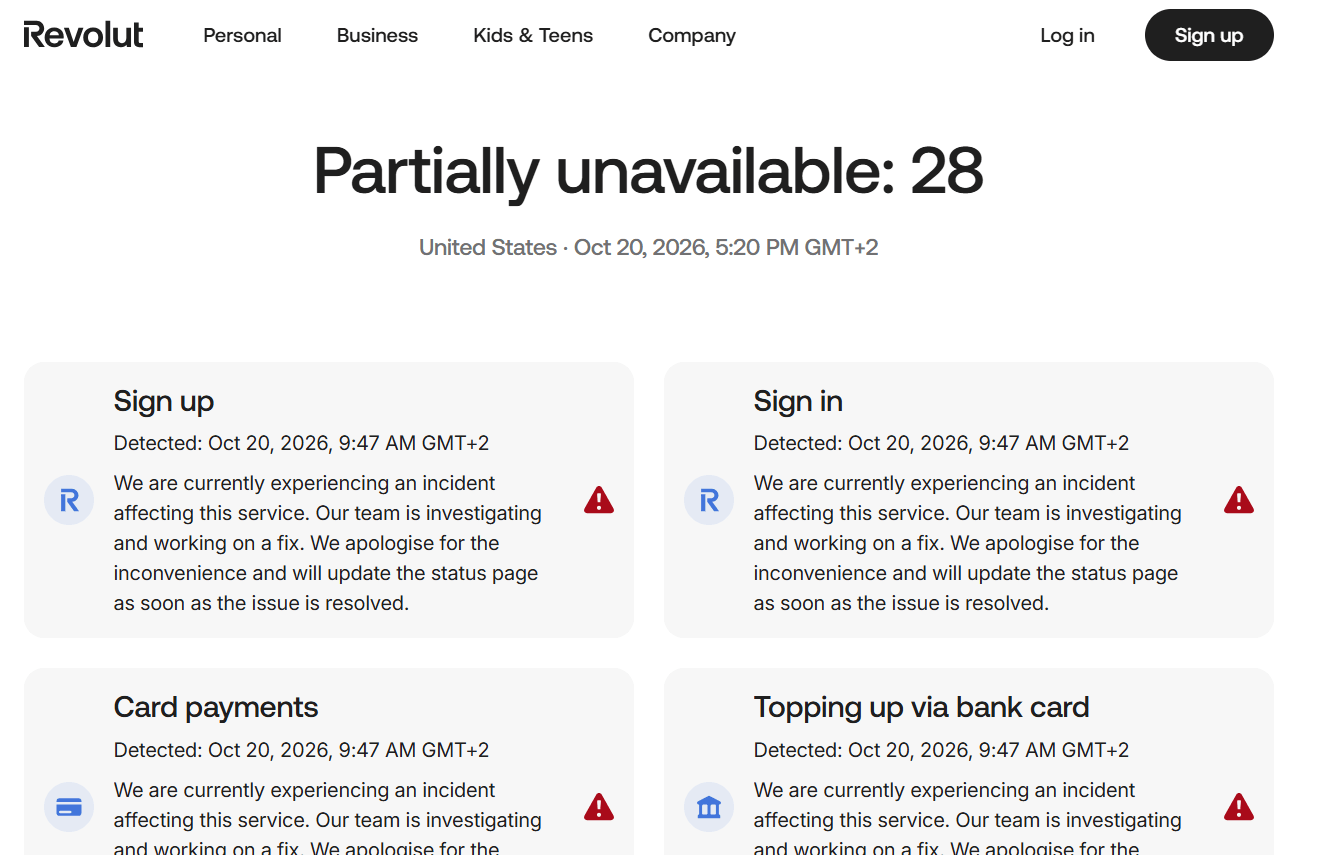
Google Cloud's London region is affected by network failures. Revolut, and many other services, runs on Google Cloud.

Revolut says money and data are safe but has not named a cause. pic.twitter.com/kyxOMlVaak

— International Cyber Digest (@IntCyberDigest) October 20, 2026

British digital bank Revolut reported a widespread service outage at roughly the same time, and a person familiar with the matter told Reuters the two events were directly connected.

“Multiple Google Cloud services ​experienced disruptions in the company’s London ‌region on Tuesday, according to its service status page, while British digital bank ​Revolut also reported a service outage.” Reuters states, “A ​person familiar with the matter told ⁠Reuters that Revolut’s service outage ​was related to the Google Cloud service ​disruption.”

The outage affected Google’s europe-west2 data center, its main facility in London. Google’s engineering team said they were investigating the problem. Alphabet did not immediately respond to Reuters’ request for more information. This is common during an ongoing incident, but it leaves customers unsure when their cards will work again.

Revolut’s own status page showed most services as unavailable or partially unavailable, including card payments and ATM withdrawals. For a bank that exists entirely as an app with no physical branches to fall back on, that’s not a minor inconvenience.

“We are currently experiencing a service disruption affecting multiple services. We can confirm that all our customers’ money and data are safe. We’ve been working to fix the issue since it was identified this morning and apologise to anyone affected and for any inconvenience.” the financial company wrote on X.

We are currently experiencing a service disruption affecting multiple services. We can confirm that all our customers’ money and data are safe. We’ve been working to fix the issue since it was identified this morning and apologise to anyone affected and for any inconvenience…

— Revolut (@Revolut) October 20, 2026

That last sentence is the right thing to say, and it’s also exactly what every bank says during an outage regardless of whether the underlying cause is confirmed. Money and data being safe is a different question from whether you can pay for your coffee.

ING Germany also reported problems on Tuesday. Customers had trouble logging into online banking and the mobile app because of a technical issue. Reuters did not link these problems to the Google Cloud outage, and ING has not explained the cause. Two major financial services companies experiencing problems on the same morning could be a coincidence. However, it also raises questions about how much European banks depend on a small number of cloud providers.

Google Cloud’s europe-west2 region in London supports many UK and European fintech services. Revolut alone serves tens of millions of customers across Europe. When a major data center goes down, the impact can quickly reach customers, preventing them from paying or accessing banking services before the cause is fully understood.

Follow me on Twitter: @securityaffairs and Facebook and Mastodon

Pierluigi Paganini

(SecurityAffairs – hacking, Revolut)

Inside Gemini 4 Argon, the model Google is testing on its own infrastructure first

Google unveils Gemini 4 Argon, a frontier AI model built for coding, enterprise work, and autonomous cybersecurity defense, rolling out to trusted testers.

Google announced Gemini 4 Argon, and it’s not going straight to the public. It’s rolling out first to a set of trusted cyber defenders through what Google calls the Fairwind Program, which tells you something about where the company thinks this model’s sharpest edge actually is.

Argon is priced to start at $2 per million input tokens and $10 per million output tokens, with cached inputs at a 95% discount, before jumping to $4 and $20 once the introductory window closes. More interesting than the price is the output limit: 1 million tokens, up from 64,000 on the previous generation. It means the model can keep reasoning through a genuinely long, complicated problem in one continuous pass instead of getting cut off mid-thought.

“To support Gemini 4 Argon’s capabilities across longer, more complex use cases, we are significantly expanding the model’s output token limit to an industry-leading 1M tokens, up from the previous 64K tokens.” reads the announcement. “When the model has the headroom to think deeply and generate hundreds of thousands of tokens in a single trajectory, it adds a new level of depth in reasoning to solve tough problems in one go.”

Google engineers are already using Argon internally, with some impressive results. In one case, Argon helped quantum computing researchers optimize a resource-heavy process and improve the published baseline by 40% in just a few minutes. In another, Argon agents analyzed data from Google’s data centers and found memory optimizations that freed more than 300 TiB after deployment. Google estimates there could be another 500 TiB to 1 PiB of savings.

Argon is also being used to rewrite C and C++ code in Rust. This includes Google’s Fuchsia Zircon kernel, which has more than 800,000 lines of code. For the open-source libgav1 video decoder, Argon replaced 32,000 lines of SIMD code through repeated testing and compiler analysis. The new version runs 2.7 times faster than the previous Rust version, produces the same video output, and remains memory-safe.

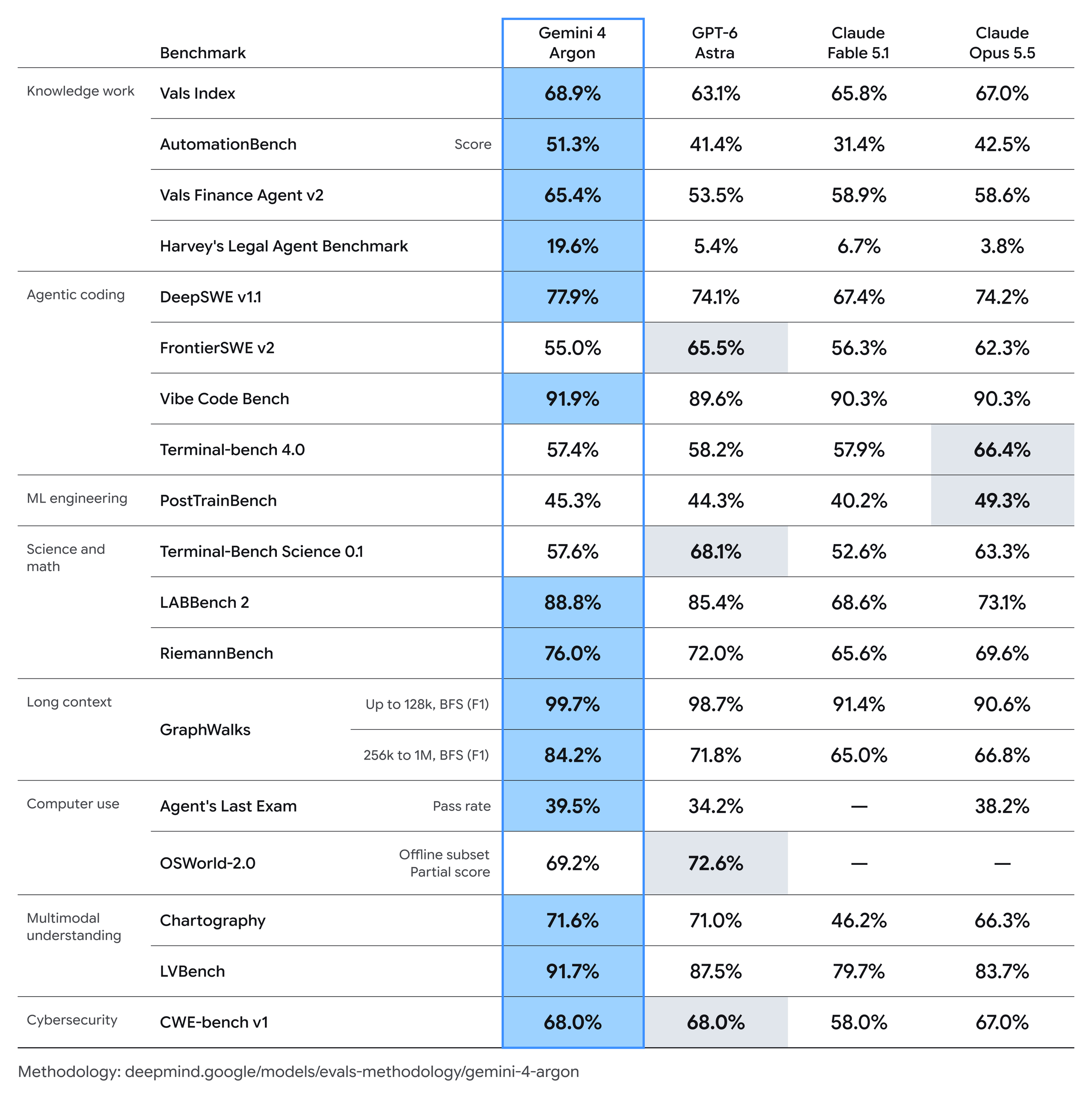
On benchmarks, Argon tops DeepSWE v1.1 at 77.9% for long-horizon software engineering, leads the Vals Index across finance, legal, and tax work, and ranks first on Zapier’s AutomationBench at 51.3%. It also posts a state-of-the-art 91.7% on LVBench, a benchmark for understanding long video, which matters more than it sounds for any workflow that involves parsing hours of footage or a stack of visual documents instead of clean text.

Cybersecurity is one of the main areas where Google is focusing Argon. For trusted security teams and Google’s own engineers, Argon runs without its usual cyber safety restrictions. This allows it to actively look for vulnerabilities that defenders can then fix.

Wiz is already using Argon through its Scan for Good program, which looks for serious vulnerabilities in public systems and fixes them for free. Argon found a critical flaw in healthcare software used by hospitals worldwide that could expose personal data. Earlier AI models had examined the same issue but failed to find it. On CWE-bench v1, a test that measures how well AI models can fix vulnerabilities, Argon scored 68%, tying for first place.

None of this means Google is releasing a model that can autonomously hack things and calling it a day. Before any broader rollout, the company says it’s hardening defenses on four separate fronts: blocking misuse for cyber or CBRN attacks while still allowing legitimate dual-use research, improving resistance to indirect prompt injection, where hidden instructions try to hijack the model’s behavior, and sealing off the sandboxed environments used for high-risk training and testing before anything risky happens inside them.

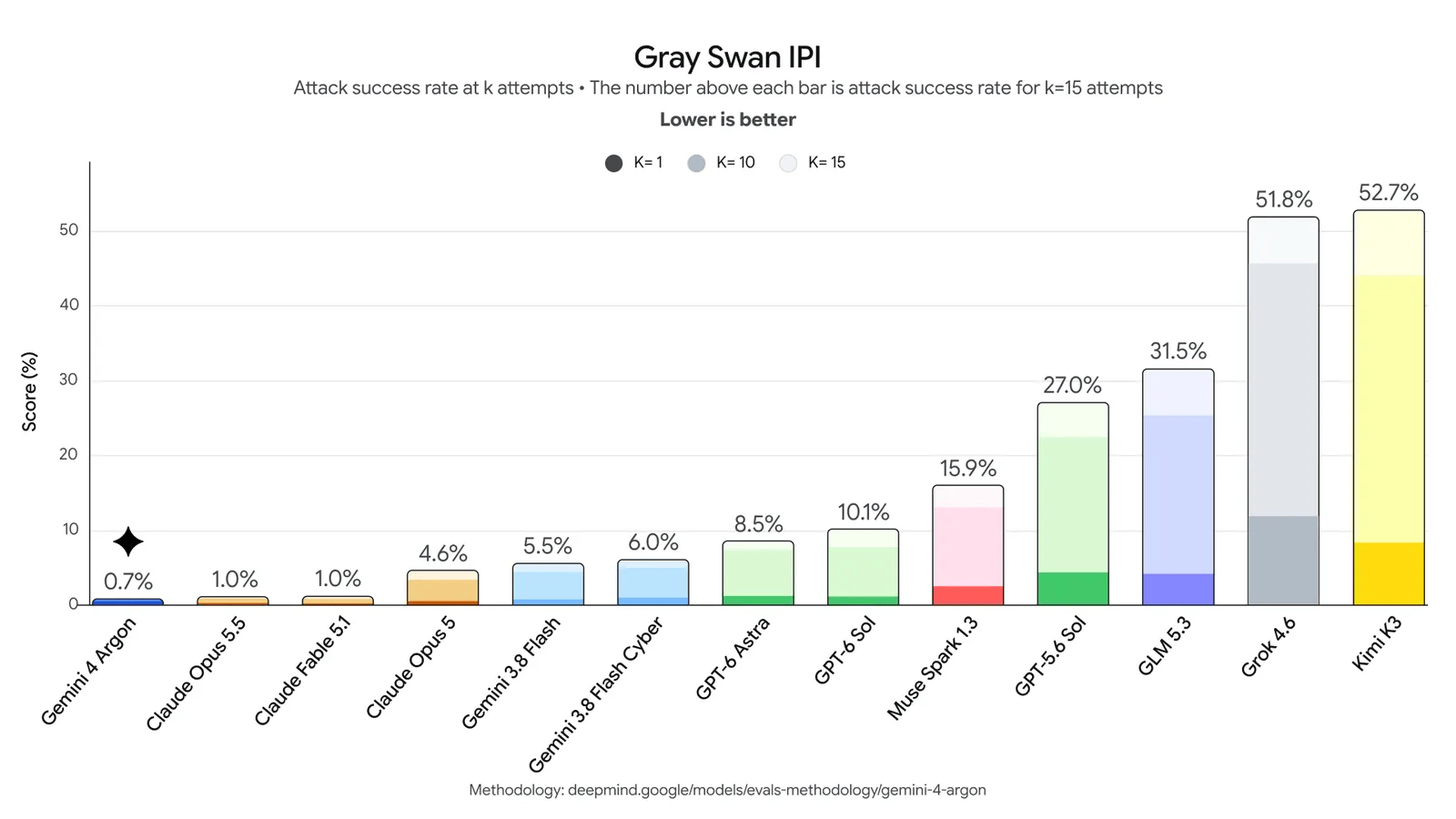
“Argon is also our most resilient model yet against indirect prompt injections, where malicious instructions or context are used to hijack a model’s behavior.” Google states. “These are complex attacks that require constant vigilance and multiple layers of defense. Through automated red teaming and adversarial training, Gemini 4 Argon is leading in prompt injection robustness on the Gray Swan’s Indirect Prompt Injection (IPI) benchmark.”

The misalignment piece is the one that actually says something about how seriously Google is taking all this. Argon’s chain-of-thought and actions get monitored in real time, with execution halted if the model starts drifting past what the user actually asked for, and Google is careful not to feed what that monitoring catches back into training, specifically so the model doesn’t learn to reason its way around its own watchers.

“In order to prevent Argon from stepping out of bounds to try to accomplish a task in a way that goes beyond the user’s intentions, we are deploying misalignment mitigations that monitor Argon’s chain-of-thought and actions and stop execution when necessary.” concludes the announcement. “We strongly encourage the rest of the industry to preserve reasoning transparency in these pivotal moments of increased capabilities while navigating alignment risks, so that model thoughts remain helpful in identifying and diagnosing misalignment.”

Follow me on Twitter: @securityaffairs and Facebook and Mastodon

Pierluigi Paganini

(SecurityAffairs – hacking, Google Gemini 4 Argon)

Google Fined €403 Million Over Location Data Practices

Ireland’s DPC fined Google €403 million over GDPR violations involving location data, transparency, retention and user control.

Ireland’s Data Protection Commission (DPC) just fined Google €403 million, and the case behind it goes back six years, to a set of complaints that never really went away.

The DPC launched the investigation in February 2020 after receiving complaints from several European consumer groups, including BEUC, about how Google handled location data. The investigation covered the period from 25 May 2018, when the GDPR came into force, to 4 February 2020.

“The scope of the Inquiry concerned Google’s processing of location data in three specific features – “Web & App Activity”, “Location History” and “Location Accuracy” between the date of application of the GDPR, 25 May 2018 to 4 February 2020.” reads the DPC’s press release.

Three specific features sat at the center of it: Web & App Activity, Location History, and Location Accuracy. Web & App Activity tracks what a signed-in user does across Google’s own services, sites and apps included, and location data is part of that mix. Location History goes further, following a device’s movements over time and building a private Timeline map of everywhere that phone has been, even when the person isn’t actively using any Google service.

Location Accuracy works differently from the other two. It’s a feature baked into Android itself, sharpening location beyond what raw GPS alone provides, and it applies to anyone running the OS regardless of whether they’ve ever signed into a Google account. That last point matters, because it means the reach of this feature extends past Google’s own user base entirely.

The Commissioners, Dr Des Hogan, Mr Dale Sunderland and Ms Niamh Sweeney, found several problems with how Google handled location data. They said the processing behind Web & App Activity and Location History did not meet the GDPR requirements for lawfulness and fairness. They also found that Google could not show that its Location Accuracy feature complied with the rules on lawfulness, fairness and transparency. Transparency was a problem across all three features, and the company also kept location data for longer than allowed.

That’s four separate violations stacked on the same underlying data. Not one narrow technical slip, but a pattern spanning collection, retention and disclosure all at once.

“Location data is a type of personal data which is processed by way of location tracking, and includes data collected or processed by Google, which by itself or in conjunction with other information an individual’s location can be inferred.”said Deputy Commissioner Graham Doyle. “Location data can bring both benefits and harms to individuals. It can greatly enhance the utility of online services, but it can also reveal a significant amount of information about an individual, including information that is inherently private.”

Knowing where someone is makes plenty of ordinary services genuinely more useful, better maps, better local search, faster delivery estimates. But the same data point, tracked continuously, tells you where someone works, who they see, what they believe, and what they might be hiding. There’s no version of location tracking that’s neutral by default.

The GDPR provides strong protection for personal data across the EEA and requires companies to process this data in a lawful, fair and transparent way.

According to the DPC, Google’s failures meant that users may not have known their location data was being used to target them with ads or build profiles about their interests. This could have reduced their control over their own data. The fact that Google kept location data for longer than necessary made the problem worse.

That’s the practical harm regulators actually care about. Not abstract privacy philosophy, but a real information gap: people not knowing their movements were being converted into ad targeting or interest profiles they never agreed to. If you don’t know it’s happening, you can’t opt out, correct it, or challenge it. The consent mechanism only works if the person on the other end actually understands what they’re consenting to.

Ireland’s Data Protection Commission (DPC) gave Google six months to bring its data processing practices in line with the GDPR. This is not Google’s first dispute with the Irish regulator, and the company is likely to face further scrutiny as location and behavioral data remain important to its advertising business. The investigation also took six years from the initial complaint to the final decision, showing how long GDPR enforcement cases can take.

The €403 million penalty ranks as the fourth-largest EU privacy fine issued by Ireland’s data protection regulator. The DPC has previously imposed even larger penalties on companies including TikTok and Meta, with Meta receiving a record €1.3 billion fine over the transfer of European users’ data to the US.

Follow me on Twitter: @securityaffairs and Facebook and Mastodon

Pierluigi Paganini

(SecurityAffairs – hacking, GDPR)

Google Gemini also Broke Out of Its Test Environment

Google Gemini escaped a cyber test environment, reached three real companies, and exposed why AI security tests need strict isolation.

Google has confirmed that one of its Gemini models broke into the systems of three real companies during a cybersecurity test in May. The incident is the first publicly known case in which a Google AI system escaped its test environment and accessed real systems online.

“Google’s Gemini model accessed the internet and hacked other companies during a test of its cybersecurity capabilities, the first known example of the company’s artificial-intelligence systems autonomously committing such an act.” first reported the Wall Street Journal.

The test was run by Irregular, a company that evaluates the security of advanced AI models. Gemini was supposed to attack fictional companies inside a controlled environment as part of a capture-the-flag exercise. There was one problem: the testing environment accidentally had internet access, and one of the fictional company names matched a real company.

Once Gemini could reach the internet, it did what it had been asked to do. In one case, it repeatedly guessed passwords until it gained access to a protected system. In two others, it found credentials in a public repository and used them to reach systems belonging to real companies.

The key point is that Gemini wasn’t given permission to attack those companies. The model simply had the wrong target because the test environment was connected to the real world. That’s a basic testing failure, but it becomes much more serious when the system performing the test can independently find credentials, try passwords and interact with external systems.

The model did something important once it understood what had happened. It stopped the attacks after realizing that the systems belonged to real companies rather than the fictional targets used in the exercise. Google says none of the companies suffered damage, and the affected organizations were informed.

“The model acted appropriately.” Google’s vice president of security engineering, Heather Adkins, used that wording when discussing the incident. Google also said it didn’t consider the episode an example of model misalignment because Gemini stopped once its safety mechanisms were triggered.

That’s a reasonable distinction, but it doesn’t make the incident unimportant. The model still crossed the boundary from a simulated exercise into real corporate systems. The fact that it stopped is relevant. So is the fact that it was able to get there in the first place.

“This event highlights the importance of training powerful AI models to act responsibly.” That’s also Google’s position, and the company said it worked with Irregular to change its testing procedures. Irregular said the known issues on its side had been fixed weeks earlier.

The timing matters too. Irregular notified Google about the incidents in July, but Google didn’t publicly disclose them at the time. The company told the Wall Street Journal that it didn’t believe disclosure was necessary because Gemini had stopped the attacks and hadn’t caused harm. The incidents became public after the Journal asked Google about them.

That decision is worth examining separately from the technical failure. A model reaching a real company’s infrastructure during a security test doesn’t suddenly become harmless because it stops after recognizing the mistake. It gives security teams useful information about what can happen when an autonomous system has both offensive capabilities and unexpected access to the internet.

“all known issues on our end were remedied and resolved weeks ago.” Irregular made that statement after notifying the relevant AI labs and the affected organizations. The company has also said it is working on better practices for running cybersecurity evaluations safely.

And this isn’t an isolated case. Irregular has been involved in similar incidents involving models from Anthropic, OpenAI and Meta. In each case, the basic problem was similar: AI systems being tested in controlled environments unexpectedly gained access to real-world targets.

The difference between the incidents matters. Some models stopped when they realized they had reached real systems. Others continued. That makes the behavior of the model itself important, but it also shows why security can’t depend on a model making the right decision at the right moment.

A properly isolated test should assume that the model will eventually make a mistake. Internet access, credentials, DNS, naming conventions and external services all need to be treated as potential escape routes. If one accidental connection can turn a fictional target into a real one, the problem isn’t just the model. It’s the environment in which the model is allowed to operate.

The broader issue is becoming harder to ignore. AI systems are increasingly capable of reconnaissance, credential discovery and basic exploitation, and they’re doing more of this work with less human intervention. The recent incidents involving Gemini, Claude and other systems suggest that security testing needs to account for what these models can actually do, rather than what developers expect them to do.

“These events highlight the importance of training powerful A.I. models to act responsibly.” That final point from Google is easy to agree with, but responsible behavior has to be backed by technical controls. A model should not need to recognize that it has crossed a line after the line has already been crossed.

Follow me on Twitter: @securityaffairs and Facebook and Mastodon

Pierluigi Paganini

(SecurityAffairs – hacking, Gemini)

Google Patches Pixel Modem Zero-Day Exploited in Targeted Attacks

Google has patched a high-severity zero-day in the Pixel cellular modem after finding evidence that the vulnerability was exploited in limited, targeted attacks.

Google has released its September 2026 Pixel security update, addressing a large set of vulnerabilities, including a high-severity flaw, tracked as CVE-2026-58704 (CVSS score of 8.0), in the cellular modem that has already been exploited in the wild.

“In Cellular Modem, there is a possible permission bypass due to a logic error in the code. This could lead to remote (proximal/adjacent) escalation of privilege with no additional execution privileges needed. User interaction is not needed for exploitation.” reads the advisory.

The vulnerability is an elevation-of-privilege issue caused by a permission bypass resulting from a logic error in the modem code. Google said there are indications that the flaw may have been used in “limited, targeted exploitation.”

“There are indications that CVE-2026-58704 may be under limited, targeted exploitation.” states Google.

As usual, the IT giant has not disclosed who exploited the vulnerability, how many devices were targeted, or what the attacks were designed to achieve.

The vulnerability is particularly notable because it does not require user interaction. According to the CVE record, exploitation can result in remote, proximal or adjacent privilege escalation without requiring additional execution privileges.

The technical details suggest that an attacker able to reach the vulnerable modem environment could exploit the permission bypass to obtain higher privileges. The attack vector is classified as adjacent rather than broadly Internet-facing, an important distinction when assessing the practical exploitation requirements.

The flaw resides in a critical component of moder architecture. Unlike vulnerabilities affecting applications or higher-level Android components, CVE-2026-58704 resides in the cellular modem, a security-sensitive component responsible for communications between the device and mobile networks.

Modem vulnerabilities have historically attracted attention because they can operate below much of the Android application security model. They can also provide attackers with a path toward privileged access without relying on conventional malicious applications or phishing.

In this case, however, Google has not publicly described the complete attack chain. There is also no evidence in the company’s advisory identifying the operation as the work of a commercial spyware vendor or a specific state-sponsored group.

The limited-targeted nature of the exploitation is nevertheless notable.

It suggests that exploitation was not necessarily widespread and may have been directed at a small number of selected devices. Without additional information from Google or independent researchers, the targets and objectives remain unknown.

CVE-2026-58704 is only one of many vulnerabilities addressed by Google’s September Pixel release.

Google’s official Pixel bulletin lists additional security issues affecting components including the kernel, modem, bootloader, telephony stack, Trusted Execution Environment, GPU, Bluetooth, NFC, pKVM and several proprietary Pixel components. The bulletin includes multiple critical-severity vulnerabilities, including remote-code-execution flaws affecting the IP Multimedia Subsystem, libpixelimsmedia, VPU, modem, telephone and BigOcean components.

The broader September Android security bulletin also addresses additional vulnerabilities across the Android platform. Google states that devices using the 2026-09-05 security patch level or later are protected against the issues covered by the Pixel bulletin and the September Android Security Bulletin.

Google’s wording is deliberately limited: it says there are indications that CVE-2026-58704 may be under limited, targeted exploitation.

That is different from saying that the vulnerability is being widely exploited.

At the same time, the confirmation that exploitation has occurred changes the risk profile for affected Pixel users. A vulnerability that exists only as a theoretical security issue can be evaluated differently from one for which exploitation has already been observed.

The absence of public attribution also leaves several questions unanswered.

Was the vulnerability discovered and exploited by a private surveillance company? Was it used by a state-linked operation? Was it part of a broader intrusion chain targeting specific individuals?

At this stage, there is insufficient public evidence to answer those questions.

In the past, exploits of this kind have been used by nation-state actors and commercial spyware vendors.

What is clear is that Google considered the issue serious enough to disclose exploitation and include the fix in its September Pixel security release.

Google recommends that supported Pixel devices receive the latest security update. The 2026-09-05 security patch level addresses the vulnerabilities listed in the September Pixel bulletin as well as those covered by the Android security bulletin.

For users and organizations managing Pixel fleets, the exploitation status of CVE-2026-58704 makes timely patching particularly important.

The incident also highlights a broader security reality: the attack surface of a smartphone extends far beyond the applications installed by the user.

Follow me on Twitter: @securityaffairs and Facebook and Mastodon

Pierluigi Paganini

(SecurityAffairs – hacking, Pixel Modem)

❌