
The Italian Data Protection Authority fine against Poste Italiane and Postepay has reached over €12.5 million, after regulators found unlawful processing of personal data affecting millions of users.
Italy’s Italian Data Protection Authority imposed a €6.6 million penalty on Poste Italiane and €5.8 million on Postepay. The action follows an investigation launched in April 2024 after multiple complaints from users regarding how their data was being handled through mobile applications.
Italian Data Protection Authority Fine Linked to Intrusive App Monitoring
The Italian Data Protection Authority fine centers on how BancoPosta and Postepay apps collected user data. Customers were required to allow monitoring of information stored on their devices, including details about installed and active applications.
According to the companies, this access was necessary to detect malware and prevent fraud in line with payment security requirements. However, the regulator found that the scope of monitoring went too far.
Authorities stated that the data collection methods were not proportionate and resulted in excessive intrusion into users’ private lives. The ruling emphasized that fraud prevention cannot justify blanket access to personal device data.
Multiple Compliance Failures Identified
The investigation behind the Italian Data Protection Authority fine also revealed broader compliance failures. Regulators flagged insufficient transparency in how users were informed about data collection practices.
The companies were also found to have not conducted an adequate Data Protection Impact Assessment. Such assessments are required when processing activities pose high risks to individual privacy.
Further issues included weak security measures, unclear policies on how long data was stored, and irregularities in defining data controller responsibilities. These gaps raised concerns about how user data was governed internally.
As part of the enforcement action, both companies have been ordered to stop the disputed data processing practices if still ongoing. They must also align their data retention policies with regulatory requirements and report compliance to the Authority.
Italian Regulator Steps Up Enforcement
The action reinforces a broader trend of stricter enforcement by the Italian Data Protection Authority across the financial sector. The Italian Data Protection Authority fines Poste Italiane and Postepay case follows another high-profile enforcement action earlier this year involving Intesa Sanpaolo.
In March 2026, the regulator
imposed a €31.8 million penalty on the bank after uncovering serious lapses in how customer data was protected. The case involved unauthorized access to sensitive information of more than 3,500 customers over a period of more than two years.
Investigators found that a single employee had accessed customer records more than 6,600 times without any legitimate business reason. The breach went undetected for months, exposing weaknesses in the bank’s internal monitoring systems.
Insider Risks and Monitoring Gaps under Focus
The Intesa Sanpaolo case highlighted a different but equally critical issue. While Poste Italiane and Postepay were penalized for excessive data collection, the bank was fined for failing to detect misuse of legitimate access.
According to the
Authority, the bank’s monitoring systems were not designed to identify slow, repeated misuse of access over time. This allowed the unauthorized activity to continue without triggering alerts, even when it involved high-risk individuals such as public figures.
Regulators concluded that the controls in place were not aligned with the risks associated with broad internal access to sensitive financial data. The case has since raised concerns about insider threats and the effectiveness of existing detection mechanisms within financial institutions.
Growing Pressure on Financial Services
Together, these cases reflect a tightening regulatory environment in Italy, where financial institutions are being held accountable for both overreach and underperformance in data protection.
The Italian Data Protection Authority fines Poste Italiane and Postepay decision highlights the importance of balancing fraud prevention measures with user
privacy.
Security controls must be proportionate, transparent, and supported by proper risk assessments.
At the same time, the Intesa Sanpaolo breach demonstrates that insufficient monitoring can be just as damaging, particularly when insider threats go unnoticed for extended periods.
With enforcement actions increasing in scale and frequency, organizations operating in the financial sector are facing mounting pressure to reassess their data governance frameworks. The regulator’s recent decisions make it clear that both excessive data collection and weak oversight can lead to significant financial and reputational consequences.

 Entrar

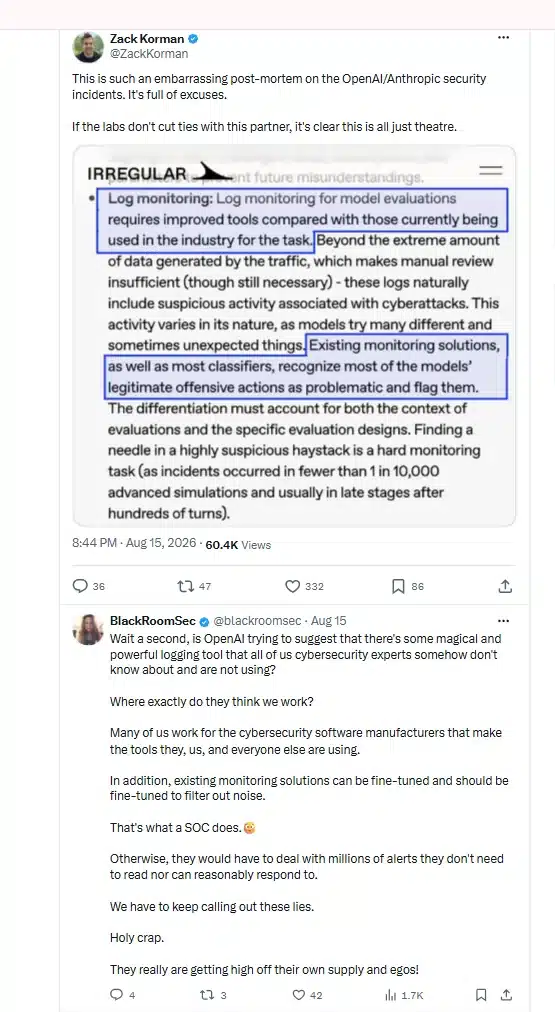 Image Source: X[/caption]
The discussion adds to wider scrutiny of how cyber evaluations are contained, monitored and disclosed as frontier AI models become increasingly capable. Irregular said the lessons from the incident will be used to develop stronger evaluation environments, monitoring capabilities, containment controls and response procedures.
Image Source: X[/caption]
The discussion adds to wider scrutiny of how cyber evaluations are contained, monitored and disclosed as frontier AI models become increasingly capable. Irregular said the lessons from the incident will be used to develop stronger evaluation environments, monitoring capabilities, containment controls and response procedures. 