Entrar
The Cyber Express Weekly Roundup: Claude Session Hijacking, PaperCut Exploits, and Enterprise Cyberattacks




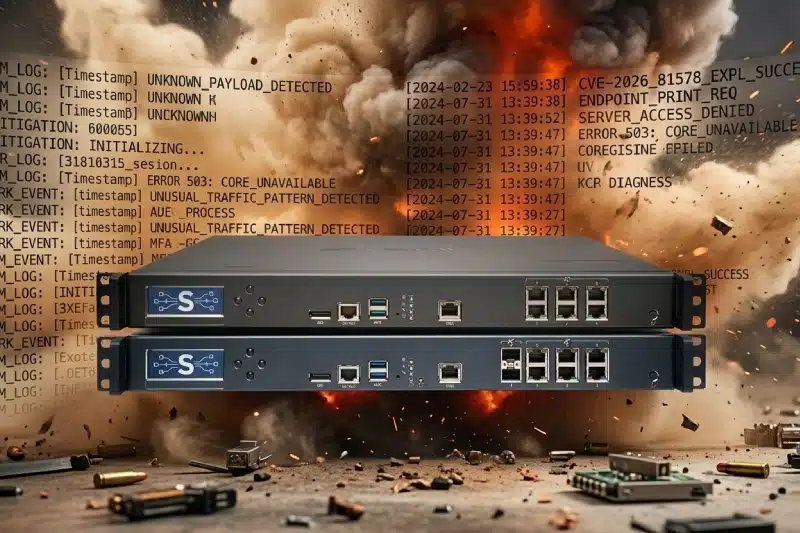
SonicWall disclosed this week that attackers are chaining two previously unknown vulnerabilities in its SMA1000 secure access appliances to run commands on unpatched devices, and urged customers to install an emergency hotfix.
The more severe flaw, CVE-2026-83548, is a pre-authentication server-side request forgery weakness in the appliance's Appliance Work Place interface, rated 10.0 on the CVSS scale. It lets a remote attacker with no credentials reach sensitive internal functionality. The second, CVE-2026-83549, is an operating-system command injection bug in the Appliance Management Console rated 7.8; on its own it requires administrative authentication, but paired with the SSRF flaw it yields remote code execution.
The vendor said it found both issues internally and then observed them being used together in live attacks. SonicWall has not published indicators of compromise or described the attackers.
Affected products are the SMA1000 series 6210, 7210 and 8200v, in both hardware and virtual form. Fixed builds are 12.4.3-03526 and later, and 12.5.0-02952 and later. SonicWall firewalls running SSL-VPN and the separate SMA 100 line are not affected.
Remediation guidance goes beyond patching. SonicWall told customers to contact its support organization to review appliances for signs of intrusion and, where compromise is suspected, to re-image or redeploy the device, rotate all credentials and reset TOTP tokens — an acknowledgment that one-time-password seeds stored on a breached appliance survive a software update. The company said customers should move to the hotfix release as quickly as possible.
Shadowserver Foundation scanning has tracked more than 400 internet-exposed SMA1000 appliances, though an unknown share of those are already patched. The small install base belies the risk profile. These are remote-access gateways that sit at the network edge and hold credentials for the environments behind them.
The disclosure extends a difficult run for the product line. Attackers exploited a separate pair of SMA1000 zero-days in July 2026, tracked as CVE-2026-15409 and CVE-2026-15410, to deploy custom malware; CISA later confirmed ransomware operators were abusing that access.
Another zero-day surfaced in December 2025. Seventeen SonicWall vulnerabilities across the company's product families currently sit in CISA's Known Exploited Vulnerabilities catalog. Edge appliances from SonicWall, Ivanti, Citrix and Fortinet have collectively become the preferred initial-access route for ransomware affiliates and espionage crews, because they are internet-facing by design and rarely instrumented with endpoint detection.
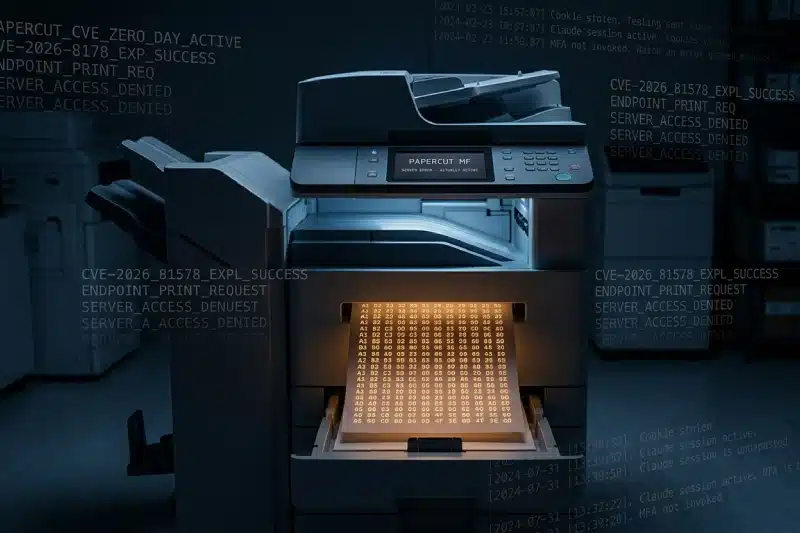
PaperCut released a second emergency patch last Friday, for two vulnerabilities in its NG and MF print management servers that attackers are already exploiting, after security researchers demonstrated that the vendor's first fix could be bypassed.
The two flaws work as a chain. CVE-2026-81578, rated 8.8 on the CVSS scale, is an improper access control weakness in the PaperCut web management interface that lets unauthenticated remote requests reach administrative functions before the server finishes validating access.
CVE-2026-82078, rated 9.4, is an unsafe dynamic class-loading flaw in the product's database utilities. The application loads database driver classes without checking them against an allowlist, so an attacker who can alter configuration parameters can get arbitrary Java bytecode running inside the application server process. Together they produce pre-authentication remote code execution on an internet-facing server.
PaperCut software runs print queues for universities, school districts, hospitals, local government and large enterprises, and the platform has a history of drawing ransomware attention. Three earlier PaperCut NG/MF vulnerabilities already sit in the U.S. Cybersecurity and Infrastructure Security Agency's Known Exploited Vulnerabilities catalog, two of them weaponized in ransomware campaigns.
Huntress, which first documented the activity, said it observed exploitation in two customer environments on Aug. 26 and Aug. 27. In one case the whole intrusion ran under two minutes. Attackers dropped hex-encoded Java class files that the firm described as a bridge between PaperCut and the underlying operating system, then issued basic reconnaissance commands - enumerating the current user, operating system version and running processes - rather than deploying ransomware or other payloads. That pattern typically indicates access brokering or target triage ahead of a later stage.
The reason for a second patch was straightforward; the first one did not hold. Researchers at watchTowr found multiple ways around the original fix and turned up an additional authentication bypass in the process, while Huntress independently reproduced the full attack chain and found its own workarounds. Both firms worked with PaperCut's engineers on Emergency Patch Release 2.
PaperCut said it was aware of confirmed customer incidents and was treating the matter with the highest priority. Release 2 covers PaperCut NG and MF versions 24, 25 and 26 on Windows, Linux and macOS. Customers running version 23 or earlier are told to upgrade rather than wait for a backported patch - a significant caveat, since Huntress reported that roughly 47% of the approximately 2,500 installations it tracks are on those older builds.
The pair had not been added to CISA's KEV catalog as of the vendor's Aug. 28 update.
Whether CISA adds the two CVEs to KEV, whether the reconnaissance-only activity converts into ransomware deployment, and whether Release 2 survives the scrutiny that broke its predecessor, remains to be seen. But administrators should pull PaperCut servers off the public internet regardless of patch status, and check application logs for unexpected process execution and stray .class files.
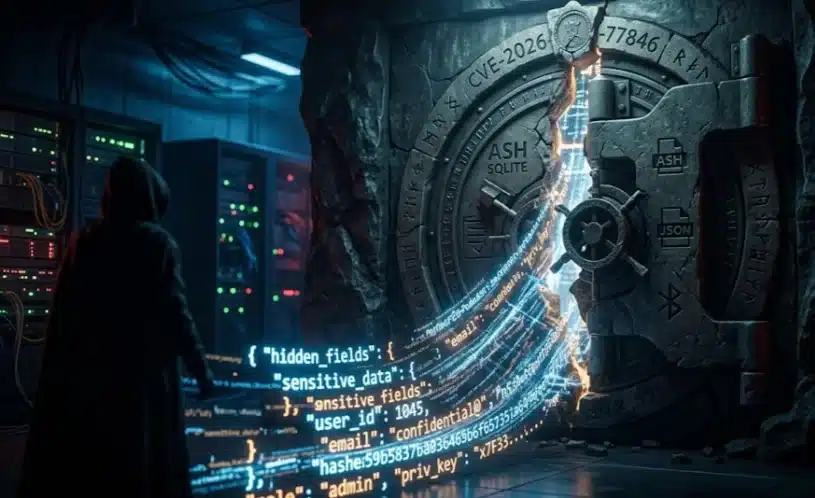
path = "$." <> Enum.join(right, ".")The individual path segments were neither escaped nor quoted. Consequently, a key intended to represent the literal name private.secret could instead be interpreted as two JSON levels. Characters such as ., [, ], and $ could similarly alter JSONPath interpretation. The GitHub advisory describes the flaw as “JSONPath injection in AshSqlite.SqlImplementation get_path”, stating that an attacker controlling a get_path/2 segment can traverse nested JSON and disclose private fields. The affected package is ash_sqlite, with versions 0.1.2-rc.0 through before 0.2.18 affected and 0.2.18 listed as the patched release. The flaw remains separate from SQL injection because the generated JSON path is supplied to SQLite's json_extract as a bound expression parameter. The attacker manipulates the JSONPath grammar, rather than injecting SQL commands.


Microsoft disclosed on Thursday that a maximum-severity remote code execution vulnerability in Entra ID, the identity service underpinning Microsoft 365, Azure and Dynamics 365, was exploited in the wild before the company mitigated it on its own infrastructure. The flaw, tracked as CVE-2026-69836 and rated CVSS 10.0, required no authentication and no user interaction.
Entra ID, formerly Azure Active Directory, is the authentication and authorization layer for a large share of the world's enterprise cloud estates. It brokers sign-ins, conditional access decisions and token issuance across tenants, which makes any unauthenticated code execution in the service unusually consequential: an attacker operating inside that trust boundary is positioned upstream of nearly every control that depends on it.
According to Microsoft's advisory, the vulnerability stems from deserialization of untrusted data, a class of bug in which an application reconstructs attacker-controlled input into live objects without adequate validation. The result, per the advisory language, is that an unauthorized attacker can execute code over a network. Microsoft rated impact as high across confidentiality, integrity and availability, and characterized attack complexity as low. Credit for finding and reporting the issue went to a Microsoft principal security engineer.
Because Entra ID is a managed cloud service rather than software customers install, remediation happened server-side. Microsoft said the vulnerability has been fully mitigated and that there is no action for users of the service to take. Exploit code is not publicly available, the company said. Microsoft addressed several other maximum-severity cloud service issues, including flaws in Azure Arc and Exchange Online, in the same batch of disclosures.
What Microsoft did not say is drawing scrutiny. The advisory confirms exploitation but omits attribution, the window during which attacks occurred, how many tenants were touched, what attackers did after gaining execution, and any indicators defenders could use to check their own logs. Security teams face a structural problem here. With no patch to apply and no IOCs published, there is no independent way to confirm whether a given tenant was affected, and cloud-side telemetry that would answer the question sits with the provider.
The disclosure lands against a compliance backdrop that has grown less forgiving. Microsoft began issuing CVEs for cloud service vulnerabilities that require no customer action as part of transparency commitments made under its Secure Future Initiative, and CVE-2026-69836 is a test of how much that transparency actually delivers.
For U.S. public companies, exploitation of an identity provider raises Item 1.05 materiality questions under the Securities and Exchange Commission's cyber disclosure rule even when the fix is the vendor's determining whether a reportable incident occurred is difficult without provider-side evidence. In the European Union, operators in NIS2 scope carry 24-hour early-warning obligations that presuppose visibility they may not have.
Whether Microsoft publishes exploitation details or indicators, whether CISA issues supplemental guidance for federal tenants, and whether any organization ties confirmed intrusion activity to the flaw, enterprises should review Entra ID sign-in and audit logs for anomalous service principal activity, unexpected token issuance and privilege changes across the past several weeks, and re-examine standing assumptions about the identity layer.



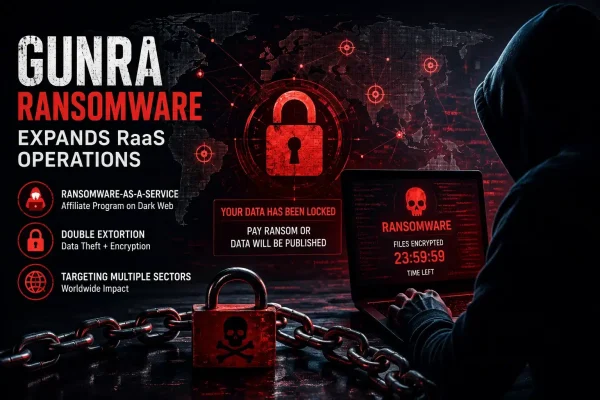
.ENCRT extension for encrypted files. A documented sample from July 2025 used the .CRYPT extension. The ransomware also uses Windows Management Instrumentation to delete volume shadow copies before encryption, while one victim had backup and archived data deleted from both primary and disaster recovery infrastructure.