Visualização de leitura

SonicWall Warns of Two Actively Exploited SMA1000 Zero-Days, One Rated Maximum Severity

Graphic showing SonicWall SMA1000 devices, CVE-2026-83548, the maximum-severity SonicWall SMA1000 pre-authentication vulnerability

SonicWall disclosed this week that attackers are chaining two previously unknown vulnerabilities in its SMA1000 secure access appliances to run commands on unpatched devices, and urged customers to install an emergency hotfix.

The more severe flaw, CVE-2026-83548, is a pre-authentication server-side request forgery weakness in the appliance's Appliance Work Place interface, rated 10.0 on the CVSS scale. It lets a remote attacker with no credentials reach sensitive internal functionality. The second, CVE-2026-83549, is an operating-system command injection bug in the Appliance Management Console rated 7.8; on its own it requires administrative authentication, but paired with the SSRF flaw it yields remote code execution.

The vendor said it found both issues internally and then observed them being used together in live attacks. SonicWall has not published indicators of compromise or described the attackers.

Affected products are the SMA1000 series 6210, 7210 and 8200v, in both hardware and virtual form. Fixed builds are 12.4.3-03526 and later, and 12.5.0-02952 and later. SonicWall firewalls running SSL-VPN and the separate SMA 100 line are not affected.

Remediation guidance goes beyond patching. SonicWall told customers to contact its support organization to review appliances for signs of intrusion and, where compromise is suspected, to re-image or redeploy the device, rotate all credentials and reset TOTP tokens — an acknowledgment that one-time-password seeds stored on a breached appliance survive a software update. The company said customers should move to the hotfix release as quickly as possible.

Shadowserver Foundation scanning has tracked more than 400 internet-exposed SMA1000 appliances, though an unknown share of those are already patched. The small install base belies the risk profile. These are remote-access gateways that sit at the network edge and hold credentials for the environments behind them.

The disclosure extends a difficult run for the product line. Attackers exploited a separate pair of SMA1000 zero-days in July 2026, tracked as CVE-2026-15409 and CVE-2026-15410, to deploy custom malware; CISA later confirmed ransomware operators were abusing that access.

Read: CISA Adds SonicWall SMA1000 Vulnerabilities to KEV Catalog Following Active Exploitation

Another zero-day surfaced in December 2025. Seventeen SonicWall vulnerabilities across the company's product families currently sit in CISA's Known Exploited Vulnerabilities catalog. Edge appliances from SonicWall, Ivanti, Citrix and Fortinet have collectively become the preferred initial-access route for ransomware affiliates and espionage crews, because they are internet-facing by design and rarely instrumented with endpoint detection.


DOJ Investigates Cyberattack Targeting Hundreds of Thousands of X Users

cyberattack on X users

A cyberattack on X users that targeted hundreds of thousands of accounts has prompted an investigation by the US Department of Justice (DOJ), with Attorney General Todd Blanche saying sophisticated cybercriminals attempted to exploit the platform's password-recovery system. The DOJ is working with Elon Musk's X, formerly known as Twitter, to identify those responsible for the attempted attack, according to Blanche's statement on Wednesday. The incident involved hundreds of thousands of X users and was disrupted before the targeted accounts could be captured, Blanche said.

Blanche Says DOJ Is Tracking Those Behind Cyberattack on X Users 

In a statement posted on X, Blanche described the incident as a password-recovery attack carried out by "sophisticated cyber criminals." He said X managed to disrupt the effort and prevent user accounts from being taken over.  Blanche wrote: 
This week, sophisticated cyber criminals attempted a password-recovery attack on hundreds of thousands of X users. X disrupted the attack to prevent user accounts from being captured. But, as we’ve shown, the Justice Department will stop at nothing in its pursuit of cyber fraudsters and scammers. We are working closely with @X to track down the criminals behind this week’s attack. There is no refuge for those that perpetrate their criminal schemes from behind computer screens." 
The attorney general did not disclose additional technical details about the cyberattack on X users, including how the attackers attempted to exploit the recovery system, whether any individual accounts were compromised, or where the suspected criminals were operating from.  The DOJ investigation is intended to identify those responsible for the attempted intrusion, with Blanche emphasizing that authorities would pursue individuals involved in cyber fraud and scams even when those activities are conducted remotely. 

How the Password-Recovery Attack Works 

A password-recovery attack generally targets the systems users rely on when they have forgotten their login credentials. These processes can include "forgot password" features, account-recovery forms, and other mechanisms designed to help legitimate users regain access to their accounts. Attackers may attempt to exploit weaknesses in those processes to obtain access to accounts. In the incident involving X, the platform was able to disrupt the effort before the targeted accounts were captured, according to Blanche. The scale of the attempted cyberattack on X users—hundreds of thousands of accounts—makes the incident notable, although the attorney general did not provide a breakdown of how many accounts were actually affected or whether any users suffered losses. 

AI-Driven Cyberattacks Add to Growing Security Concerns 

The X incident comes against a wider backdrop of increasing cybersecurity threats facing companies and organizations around the world.  Businesses have been dealing with a rise in AI-driven cyberattacks as well as ransomware campaigns capable of stealing sensitive information, interrupting operations, and creating significant financial and operational damage.  The growing use of artificial intelligence in cyber operations has raised concerns that attackers can automate or accelerate parts of their campaigns. At the same time, organizations are exploring ways to use AI-based systems to identify vulnerabilities and strengthen their defenses.  The DOJ has also been pursuing cases involving sophisticated cyber operations. Days before news of the cyberattack on X users, the department announced an operation targeting QTFY, described by US authorities as a Chinese cyberespionage platform. 

DOJ Previously Targeted QTFY Cyberespionage Platform 

According to the Justice Department, QTFY had targeted several US institutions and organizations. Those named by the department included the US Senate, the Federal Reserve, and NASA, among others.  The action against QTFY highlights the broader range of cyber threats confronting US institutions, from espionage operations to attacks aimed at obtaining access to online accounts.  The latest investigation involving X therefore comes amid a broader push by US authorities to identify and disrupt cyber criminals and state-linked cyber operations. 

Boston Scientific Cyberattack Limited to Unauthorized Access on Certain On-Premises Systems

Boston Scientific cyberattack

As per Boston Scientific’s Aug. 30 update, “the unauthorized activity is limited to certain on-premises systems,” providing the clearest indication yet of the scope of the cybersecurity incident that has disrupted the medical device maker’s global network and business operations. Boston Scientific said the investigation into the disruption remains ongoing, with third-party cybersecurity experts. Based on its investigation to date, the company said it has found no indication of unauthorized activity in its environment related to the incident since Aug. 25. The company also clarified that its cloud-based systems and applications have not been affected. The unauthorized activity identified so far is confined to only limited on-premises systems. The clarification comes as Boston Scientific continues working to restore systems supporting manufacturing, ordering and shipping. The company has not established a timeline for a full return to normal operations.

Boston Scientific Ordering and Shipping Recovery Underway 

Boston Scientific said its confidence in restoring ordering, shipping and related system access “continues to increase” and that it is working toward a partial restoration of shipping for some products during the week following its Aug. 30 update. The company said it expects ordering and shipping to ramp up to full capacity once it can demonstrate that the restored operations are fully functional. For now, customers can continue to submit orders electronically through Electronic Data Interchange (EDI) and local applications. Those orders can be placed into a queue for future fulfillment, including orders submitted through the Global Health Exchange (GHX). The latest update indicates that the company’s ability to receive orders electronically has remained intact even while systems required to fulfill and ship those orders have been disrupted. Boston Scientific has not provided a specific date for when full ordering and shipping capacity will return.

Investigation Has Not Confirmed a Data Breach 

Boston Scientific has not said that the cybersecurity incident resulted in a confirmed data breach. Its investigation remains focused on determining the nature, scope, and impact of the unauthorized activity. The Aug. 30 update also provides a more specific picture of the affected technology environment. While certain on-premises systems have been impacted, Boston Scientific said there has been no impact to its cloud-based systems and applications. The company previously said it had found no indication of unauthorized activity in its environment related to the incident since Aug. 25. It has not disclosed whether data was exfiltrated or whether ransomware was involved.

Impact on Medical Devices Remains Limited Based on Current Information

Boston Scientific previously said the incident had not affected devices that are not connected to a Boston Scientific network or clinicians’ ability to use those devices. For Cardiac Rhythm Management (CRM) products, the company reported no known impact on implantable device function, remote monitoring for devices that were already being remotely monitored before the disruption, or programmer interrogations. However, new remote-monitoring activations have been affected. For new CRM implants other than insertable cardiac monitors (ICMs), remote-monitoring communicators cannot currently be activated. As a result, available device data cannot reach remote patient-management systems until activation is possible. Newly implanted ICMs must be activated through the Boston Scientific Clinic Assistant app, but new ICMs cannot currently pair with patients’ remote-monitoring mobile phones. Recorded episodes can still be transmitted through an in-person interrogation using the app’s “Interrogate” function. Boston Scientific said that once its systems are restored and home-monitoring equipment is paired, recorded data will be transmitted to the remote-monitoring system. The company has also said there is no evidence that the affected network environment has increased cybersecurity risks for hospital networks through Boston Scientific devices.

Boston Scientific Continues Incident Response

Boston Scientific said it continues to work with CrowdStrike and other external cybersecurity specialists as the investigation and recovery effort proceeds. The company has been prioritizing systems with the greatest impact on customers and product delivery while working to recover its core business systems. Customers can continue communicating with sales representatives and other Boston Scientific employees through normal channels, including email, established digital platforms and existing connections. The company has acknowledged the potential challenges for customers, patients and suppliers as the disruption continues and thanked them for their patience and partnership. Boston Scientific disclosed the incident in an 8-K filing with the U.S. Securities and Exchange Commission on Aug. 26. The company said it will provide additional updates as appropriate. For now, the latest disclosure narrows the known technical scope of the incident: Boston Scientific says the unauthorized activity is limited to certain on-premises systems, while cloud-based systems and applications remain unaffected. At the same time, the continued disruption to manufacturing, order fulfillment, and shipping means the operational consequences of the attack remain significant as the investigation and recovery effort continue.

Oracle July 2026 Patch Fixes 1,434 CVEs Across 334 Products

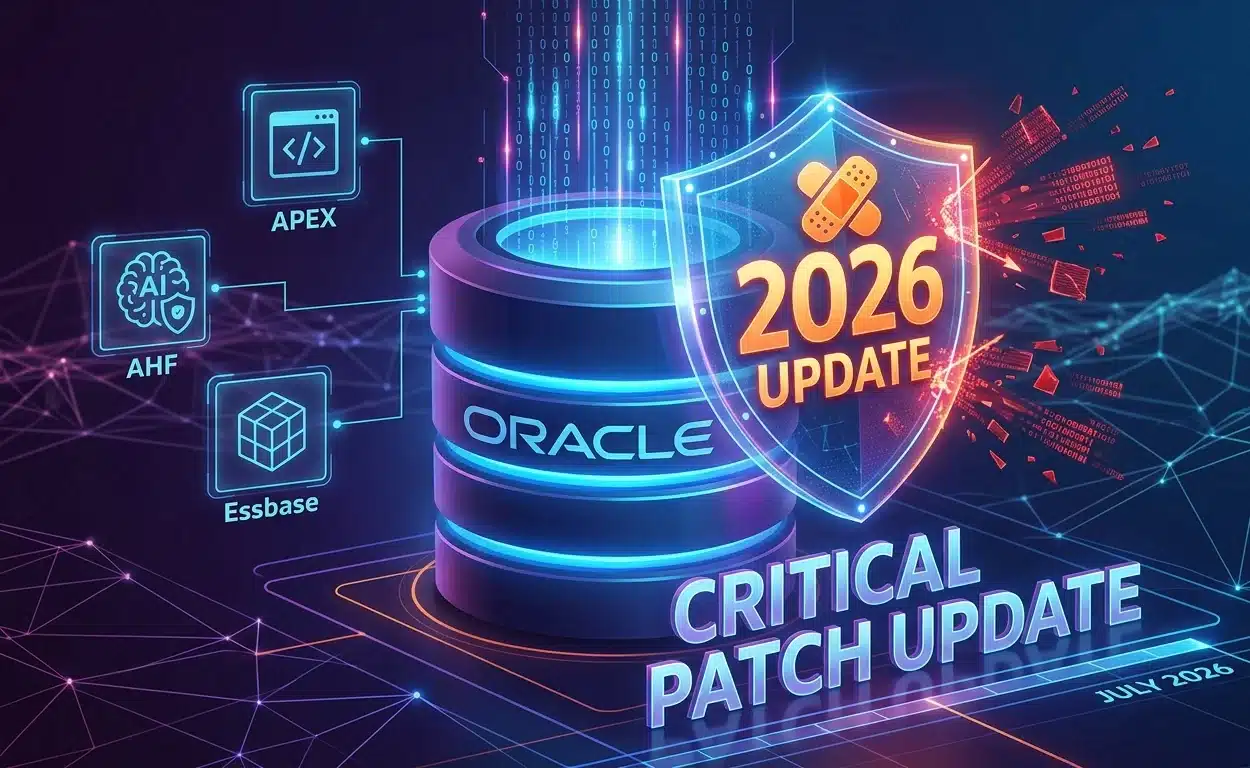
July 2026 Critical Patch Update

Oracle has released its July 2026 Critical Patch Update, delivering one of its largest quarterly security releases to date. The latest Oracle security patch addresses more than 1,400 vulnerabilities across hundreds of products, with the company indicating that artificial intelligence likely played a significant role in identifying most of the flaws.  According to Oracle, the July 2026 Critical Patch Update contains 1,449 security patches, covering 1,434 unique Common Vulnerabilities and Exposures (CVEs) across 334 products.  

July 2026 Critical Patch Update Covers Hundreds of Oracle Products 

The latest Oracle security patch spans a wide range of enterprise products and platforms. Among the affected products are Database Server, Oracle APEX, Autonomous Health Framework, Essbase, Global Lifecycle Management, GoldenGate, NoSQL Database, Spatial Studio, SQL Developer, TimesTen In-Memory Database, Application Testing Suite, Commerce, Communications, Construction and Engineering, and E-Business Suite.  The July 2026 Critical Patch Update also includes security fixes for Enterprise Manager, Financial Services Applications, Food and Beverage Applications, Fusion Middleware, Analytics, HealthCare Applications, Hospitality Applications, Java SE, JD Edwards, MySQL, PeopleSoft, Retail Applications, Siebel CRM, Supply Chain, Systems, Utilities Applications, and Virtualization.  By addressing vulnerabilities across such an extensive product lineup, the Oracle security patch aims to reduce the risk posed by security weaknesses that could affect organizations running Oracle technologies in production environments. 

Hundreds of Vulnerabilities Can Be Exploited Remotely 

A notable aspect of the July 2026 Critical Patch Update is the number of flaws that attackers could potentially exploit without requiring authentication. Oracle stated that roughly 600 of the patches fix vulnerabilities that can be exploited remotely by unauthenticated attackers. In addition, hundreds of the addressed security flaws have been assigned critical severity ratings, emphasizing the importance of applying the latest Oracle security patch without delay. Among Oracle's products, the highest number of vulnerabilities were addressed in: 
  • E-Business Suite: 410 vulnerabilities 
  • Fusion Middleware: 355 vulnerabilities 
  • Communications: 168 vulnerabilities 
  • PeopleSoft: 84 vulnerabilities 
These figures highlight that some of Oracle's most widely deployed enterprise applications received a significant share of the security fixes included in the quarterly update.

AI-Driven Vulnerability Discovery Appears to Have Played a Major Role 

One of the most notable aspects of the July 2026 Critical Patch Update is Oracle's growing use of artificial intelligence for security research. Only a few dozen of the vulnerabilities included in the release were credited to external security researchers. This indicates that the overwhelming majority of the discovered flaws were identified internally, likely with the assistance of AI-driven vulnerability analysis. Earlier this year, Oracle disclosed that it has access to leading artificial intelligence systems, including Anthropic's Claude Mythos and OpenAI's most capable models. According to the company, these AI technologies are being used to accelerate vulnerability discovery and improve the speed and accuracy of security patch development.  Oracle also said it is applying this AI-driven vulnerability approach across its own software and cloud services, Oracle Health offerings, and the open source components that it both develops and depends on.

Organizations Urged to Apply the Oracle Security Patch Promptly 

The release of the July 2026 Critical Patch Update comes amid continued efforts by threat actors to exploit vulnerabilities in enterprise software before organizations can deploy security updates.  Oracle product vulnerabilities have previously been targeted in real-world attacks. The company cited examples that include the exploitation of a PeopleSoft zero-day vulnerability as well as a recently patched Oracle E-Business Suite (EBS) vulnerability. Given the number of remotely exploitable and high-severity issues resolved in the Oracle security patch, organizations using affected Oracle products are advised to install the updates as soon as possible. Prompt deployment can help reduce exposure to attacks that take advantage of publicly known vulnerabilities before systems are secured. With 1,449 security patches addressing 1,434 unique CVEs across 334 products, the July 2026 Critical Patch Update represents one of Oracle's most extensive quarterly security releases.  

CVE-2026-42533 Exposes Critical Pre-Auth nginx RCE Flaw

CVE-2026-42533

A newly disclosed security flaw, CVE-2026-42533, has revealed a critical Pre-Auth nginx vulnerability that could allow attackers to achieve reliable RCE (remote code execution) without authentication. The issue affects nginx versions 0.9.6 through 1.30.3 (stable) and 1.31.2 (mainline), while patched releases include 1.30.4 and 1.31.3. Affected NGINX Plus versions include R33-R36 (fixed in R36 P7) and 37.0.0.1-37.0.2.1 (fixed in 37.0.3.1).  According to the disclosure, the vulnerability stems from a missing save-and-restore mechanism for PCRE capture state within nginx's two-pass script evaluation engine. The flaw enables attackers to trigger a heap buffer overflow with attacker-controlled content and length, while also exposing heap pointers through an information leak that can defeat Address Space Layout Randomization (ASLR). Chaining both primitives enables reliable Pre-Auth nginx RCE. 

CVE-2026-42533 Impacts Multiple Configurations 

The advisory warns that deployments using map directives with regex patterns alongside regex capture sources, including location, server_name, rewrite, or if blocks, may be vulnerable. The issue depends on evaluation order, where regex capture references, such as $1 or named groups, are processed before a regex map variable.  Affected directives include proxy_set_header, proxy_method, proxy_pass, fastcgi_param, uwsgi_param, scgi_param, grpc_set_header, return, add_header, rewrite, set, root, alias, and access_log, among others. Both HTTP and stream modules are affected, and the vulnerable capture and map variables do not need to exist within the same directive. 

Technical Root Cause

The researcher explained that nginx evaluates expressions in two stages: a length calculation (LEN) pass followed by a value (VALUE) pass. During execution, regex map evaluation overwrites shared capture data stored in the request object. As a result, the LEN pass and VALUE pass can calculate different capture sizes, causing either a heap overflow or an information leak depending on the relative capture lengths.  The disclosure states that attackers can control both the overflow size and leaked data using ordinary HTTP requests, including request URIs, headers, and bodies. No credentials, client certificates, or unusual configuration beyond the vulnerable pattern are required.  Testing reportedly achieved 10 out of 10 successful exploitations on Ubuntu 24.04 using glibc 2.39 with ASLR enabled.

Mitigation and Disclosure

The researcher said recent fixes for CVE-2026-42945, CVE-2026-9256, CVE-2026-42055, and CVE-2026-48142 do not address CVE-2026-42533. Administrators are advised to upgrade immediately to nginx 1.30.4, 1.31.3, or the corresponding patched NGINX Plus releases.  Until systems are updated, defenders should audit configurations that combine regex captures with regex map variables in the same evaluation path. The researcher also released a static configuration scanner that identifies vulnerable configurations without exploiting them.  The initial report was submitted to F5 SIRT on May 17, 2026, with follow-up analyses covering additional variants, including cross-directive triggering and named capture clobbering. While a proof-of-concept exploit exists, the researcher said it will be withheld until users have sufficient time to apply patches, citing concerns over rapid exploitation following previous nginx vulnerability disclosures. 

WP Maps Pro Vulnerability Exposed 15,000 WordPress Sites to Site Takeover

WP Maps Pro

A critical vulnerability in the WP Maps Pro WordPress plugin allowed unauthenticated attackers to create administrator accounts and potentially perform a complete site takeover on affected websites.  The issue impacted all WP Maps Pro versions up to 6.1.0. The plugin had more than 15,000 sales at the time the vulnerability was disclosed.  The vulnerability was submitted to the Wordfence Bug Bounty Program on March 24, 2026. Security researcher David Brown discovered and responsibly reported the flaw, earning a $1,950 bounty.  Wordfence stated that attackers could exploit a vulnerable AJAX action to create administrator accounts without authentication. 

How the WP Maps Pro WordPress Plugin Vulnerability Worked 

The WP Maps Pro WordPress plugin included a temporary access feature designed for support staff troubleshooting. The issue existed in the wpgmp_temp_access_ajax_callback() function, which handled the plugin’s AJAX action.  The function relied on a nonce check using fc-call-nonce: 
function wpgmp_temp_access_ajax_callback(){    check_ajax_referer( 'fc-call-nonce', 'nonce' );    $temp_access = new WPGMP_Temp_Access();    $response = $temp_access->wpgmp_temp_access_support();    wp_send_json($response);    exit(); }  
Researchers found that the nonce was publicly exposed through frontend pages using wp_localize_script. Because the AJAX action was also registered with wp_ajax_nopriv_, unauthenticated users could access the endpoint. The vulnerable version did not include a capability check to verify administrator privileges. 

Administrator Account Creation 

After triggering the AJAX action with check_temp=false, the plugin executed the wpgmp_temp_access_support() function.  The function created a new WordPress administrator account using: 
  • A randomly generated username beginning with fc_user_ 
  • The hardcoded email address support@flippercode.com 
  • The administrator role 
The plugin then generated a login URL tied to the new account.  According to the technical analysis, visiting the generated URL triggered wp_set_auth_cookie(), authenticating the attacker without requiring a password.  Wordfence stated that attackers could then: 
  • Install malicious plugins 
  • Modify themes 
  • Inject backdoors 
  • Deploy webshells 
  • Steal site data 
The vulnerability could result in full site takeover. 

Patch Released in Version 6.1.1 

The vendor fixed the issue by adding a capability check to the vulnerable AJAX action: 
if ( ! current_user_can( 'manage_options' ) ) {    wp_send_json_error( array( 'error' => 'Unauthorized' ), 403 );    exit(); }
 The patch restricted the endpoint to authenticated administrators only. The fully patched WP Maps Pro version 6.1.1 was released on May 20, 2026. 

Wordfence Timeline 

  • March 24, 2026 — Wordfence received the vulnerability report. 
  • May 16, 2026 — Researchers validated the exploit and escalated the issue to the Envato security team after failing to locate direct vendor contact information. 
  • May 18, 2026 — Wordfence Premium, Care, and Response users received firewall protection. 
  • May 20, 2026 — WP Maps Pro 6.1.1 was released. 
  • June 17, 2026 — Free Wordfence users were scheduled to receive the same firewall protection. 
Wordfence urged users to update the WordPress plugin immediately to prevent exploitation and reduce the risk of site takeover. 

Pardus Linux Vulnerability Chain Enables Complete System Takeover

Pardus Linux

A critical local privilege escalation vulnerability chain tracked as CVE-2026–5140 has exposed serious security weaknesses in Pardus Linux. Researchers revealed that the flaws allow any unprivileged local user to gain full root access without authentication, potentially leading to complete system compromise within seconds.  The vulnerability affects the pardus-update package, which handles system updates through graphical tools and privileged Python helper scripts. The issue received a CVSS v3.1 score of 9.3, classifying it as “Critical.” The published vector is:  CVSS:3.1/AV:L/AC:L/PR:N/UI:N/S:C/C:H/I:H/A:H  Maintained by TÜBİTAK, Pardus Linux is widely used across Turkish government institutions, schools, and enterprise environments. Researchers stated that the attack chain behind CVE-2026–5140 combines three separate vulnerabilities: a Polkit authorization bypass, a CRLF injection flaw, and an untrusted search path issue. 

Polkit Misconfiguration Opens the Door 

The first issue was identified in the file:  /usr/share/polkit-1/actions/tr.org.pardus.pkexec.pardus-update.policy  Researchers discovered that several privileged actions were configured with unrestricted access permissions:  <defaults>  <allow_any>yes</allow_any>  <allow_inactive>yes</allow_inactive>  <allow_active>yes</allow_active> </defaults>  Because of this configuration, any local user could execute privileged operations through pkexec without entering an administrator password. The vulnerable actions included aptupdateactionautoaptupgradeaction, and systemsettingswrite.  This allowed attackers to run the following scripts as root: 
  • SystemSettingsWrite.py  
  • AutoAptUpgrade.py  

CRLF Injection Enables Configuration Manipulation in Pardus Linux

The second flaw in CVE-2026–5140 involved SystemSettingsWrite.py, which writes user-controlled input into the configuration file:  /etc/pardus/pardus-update.conf  Although Python’s ConfigParser sanitizes newline characters (\n), it does not properly filter carriage returns (\r). Attackers could exploit this weakness using the following payload:  123\rcustom_sourcesd_path=/tmp/pwn.list  The injected carriage return caused the parser to interpret the second part as a new configuration entry:  custom_sourcesd_path=/tmp/pwn.list  This gave attackers control over the APT source configuration used by the update system. 

Malicious Repository Leads to Root Access 

The final stage of CVE-2026–5140 targeted AutoAptUpgrade.py, which copied attacker-controlled .list files directly into /etc/apt/sources.list.d/ without validating the source path.  Researchers demonstrated a proof-of-concept attack by creating a malicious Debian package that modified /bin/bash with the SUID bit through a postinst script:  #!/bin/sh chmod +s /bin/bash exit 0  The exploit was triggered with two commands:  pkexec /usr/share/pardus/pardus-update/src/SystemSettingsWrite.py write \ lastupgrade $'123\rcustom_sourcesd_path=/tmp/pwn.list'  pkexec /usr/share/pardus/pardus-update/src/AutoAptUpgrade.py  After execution, attackers could gain a root shell using:  /bin/bash -p  Researchers confirmed the attack provided full administrative access, including the ability to read sensitive files, install persistent backdoors, overwrite system files, and completely take over vulnerable Pardus Linux systems.  The vulnerability was discovered and documented on March 13, 2026, by Çağrı Eser. Researchers advised administrators to harden Polkit rules immediately, sanitize CRLF characters in user input, and restrict APT source paths to trusted directories to mitigate CVE-2026–5140. 

Trellix Confirms Source Code Repository Breach

Trellix, Source Code Repository Breach, Breach

It is always a bit jarring when the "digital locksmiths" are the ones getting their locks picked. Cybersecurity firm Trellix on Saturday confirmed it suffered a breach involving its internal source code repositories, proving that even the defenders aren't immune to the threats they fight.

The Incident

On May 2, Trellix released a statement confirming that unauthorized parties had gained access to sections of their internal code. Upon discovering the intrusion, the company initiated a standard response protocol. They hired external security experts to map the extent of the breach and informed relevant authorities immediately.

Trellix maintains that there is no evidence their software distribution channels were compromised or that any leaked code has been used in active attacks.

While the "all clear" on product safety is a relief, several questions remain. Trellix has yet to identify the threat actors, the duration of the unauthorized access, or the specific volume of data stolen.

Also read: Russia’s Digital Military Draft System Hit by Cyberattack, Source Code Leaked

The High Stakes of Security Code

A breach at a firm like Trellix—born from the merger of McAfee Enterprise and FireEye—carries more weight than a standard data leak. Because Trellix provides Endpoint Detection and Response (EDR) and XDR services to governments and global banks, their source code is a roadmap for attackers.

Why Source Code is a Target:

  1. Vulnerability Research: Having the code allows hackers to hunt for "zero-day" flaws without having to guess how the software works.

  2. Supply Chain Risk: If an attacker can inject malicious code into a trusted update, they can compromise thousands of customers at once.

  3. Bypassing Defenses: Knowing how a security tool "thinks" makes it much easier for malware to stay invisible.

A Growing Trend in Tech

Trellix is far from the first titan to be targeted. They join a list of major players like Microsoft, Okta, and LastPass, all of whom have dealt with source code theft in recent years. This pattern suggests that sophisticated actors (whether cybercriminals or nation-states) are increasingly focused on the "keys to the kingdom."

For now, there isn't a "fire drill" for Trellix users. Since there is no proof of tampered software, the immediate risk remains low. Trellix has promised to be transparent as their investigation concludes. Until then, the industry is left waiting to see if this was a simple smash-and-grab or the opening move of a much larger campaign.

$15M Grinex Hack Forces Trading Halt After Major Crypto Wallet Breach

Grinex cyberattack

The Grinex cyberattack has once again drawn attention to the vulnerabilities facing the global Crypto exchange ecosystem. In a cyberattack on Grinex, the Kyrgyzstan-based platform was forced to suspend all trading operations after hackers executed a large-scale wallet breach, stealing more than $15 million in USDT.   The cyberattack on Grinex unfolded when attackers infiltrated the exchange wallet infrastructure, extracting over 1 billion rubles, equivalent to roughly $13–15 million in USDT.  

Response to the Grinex Cyberattack 

In response, Grinex halted all trading activities, including withdrawals, effectively locking users out of their accounts while the platform assessed the damage. The company described the wallet breach as a “highly coordinated” operation carried out by skilled threat actors equipped with advanced tools and resources.   While Grinex suggested the possibility of foreign intelligence involvement, claiming the attack may have been intended to undermine Russia’s financial independence, no concrete evidence has been presented to support this assertion. Investigations into the Grinex cyberattack are ongoing, and the source of the breach remains unidentified. 

Stolen Funds Rapidly Moved Across Blockchains 

Following the wallet breach, the attackers wasted no time in attempting to obscure the trail of stolen assets. According to blockchain analytics firm Elliptic, the hackers quickly distributed the funds across multiple wallets and blockchain networks, including Ethereum and Tron.  This tactic, commonly observed in major Crypto exchange hacks, is designed to slow down tracking efforts by law enforcement. The attackers also converted USDT into other digital assets such as TRX and ETH. This step was likely taken because Tether, the issuer of USDT, has the authority to freeze tokens linked to illicit activity.  Eventually, the stolen funds were consolidated into a primary wallet containing approximately 45.9 million TRX, valued at around $15 million. This consolidation phase typically signals that attackers are deciding whether to hold, redistribute, or liquidate the assets, as reported by MEXC  The Grinex cyberattack follows well-documented cybercrime patterns, including “chain-hopping” (moving funds across multiple blockchains) and “layering” (spreading funds across numerous wallets). These methods exploit the decentralized nature of blockchain systems, where the absence of a central authority allows funds to move with limited immediate intervention. 

Broader Risks for Crypto Exchanges 

The cyberattack on Grinex is part of a new trend affecting the Crypto exchange industry throughout 2025 and 2026. Security researchers have repeatedly identified hot wallet vulnerabilities and compromised transaction-signing processes as the most common entry points for attackers.  Grinex itself acknowledged facing ongoing operational challenges, including sanctions pressure, transaction restrictions, and prior minor cyber incidents. The company stated that these pressures have required aggressive defensive measures.  In the aftermath of the wallet breach, Grinex filed a criminal complaint and shared all available data with law enforcement agencies to aid in tracking the stolen funds 

Links to Sanctioned Ecosystems Raise Stakes 

Grinex is widely regarded as a successor to Garantex, a major Crypto exchange that ceased operations in 2025 following sanctions from the United States, European Union, and United Kingdom over alleged money laundering activities. After Garantex shut down, a large portion of its user base and liquidity migrated to platforms like Grinex.  This transition positioned Grinex as a key trading hub for ruble-based crypto transactions. It also became central to the use of stablecoins such as A7A5, a ruble-backed token tied to deposits held by sanctioned institutions. Operating across blockchains like Ethereum and Tron, A7A5 enables large-scale, cross-border transactions.  However, it is noted that a relatively small number of wallets control a large share of these transactions, concentrating activity among a limited group of participants. Such structures can facilitate sanction evasion, making platforms like Grinex both strategically important and highly attractive targets for cybercriminals. 
❌