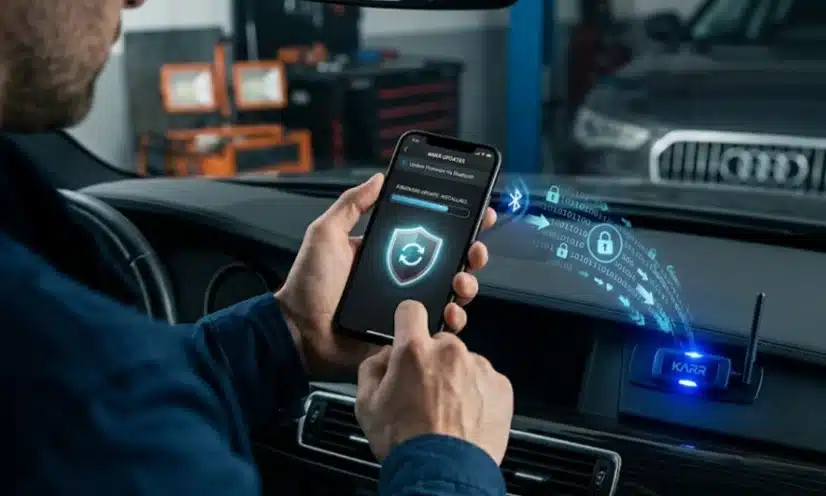
Millions of drivers with a dealer-installed KARR Security System are being urged to update their KARR alarm using an iPhone or Android device after researchers uncovered a Bluetooth vulnerability that could allow nearby attackers to unlock or immobilize affected vehicles. The flaw impacts more than 2.2 million vehicles equipped with the aftermarket security system, but it does not affect factory-installed vehicle software, Apple CarPlay or Apple's iPhone platform.
KARR Security System Vulnerability Affects Dealer-installed Hardware
The KARR Security System is installed by dealerships to secure vehicles on their lots. In many cases, the hardware remains connected even after buyers decline the paid KARR alarm service. Because it is third-party equipment, automakers cannot deliver fixes through their standard software update process.Researchers from the University of California, San Diego found that attackers within Bluetooth range could lock or unlock vehicles, disable alarms, activate horns, flash lights, or prevent parked vehicles from starting. However, they confirmed the flaw cannot remotely start a vehicle or control it while driving.
iPhone App Update Fixes KARR Alarm Flaw
Acrisure Protection Group, which sells the KARR Security System, released a firmware update on July 20 after researchers privately disclosed the issue in January 2025. Owners using the KARR Security app on an iPhone should receive an update notification. Others must download the app, connect it to the KARR alarm, then navigate to "Customer Service" and "Firmware Update."The patch was released before presentations scheduled for DEF CON on August 9 in Las Vegas and the USENIX Security Symposium on August 12 in Baltimore.
Hidden KARR Security System Complicates Updates
Researchers estimate at least half of affected owners never requested the KARR Security System. Dealerships often left deactivated hardware installed, yet researchers found these units continued broadcasting Bluetooth signals while vehicles were running and for up to 10 minutes after being switched off.Owners can identify the system by checking for a KARR or "SWDS" sticker on the driver's window or a blinking button beneath the dashboard. Most affected vehicles were purchased from Honda, Toyota, Mazda, Ford and Jeep dealerships in Southern California between 2017 and July 21, although impacted vehicles were also identified elsewhere.
Shared Bluetooth Key Exposes KARR Alarm Devices
Researchers discovered a universal authentication key embedded in the official smartphone app while reverse engineering Bluetooth communications. Using a proof-of-concept Android app, they unlocked vehicles, disabled KARR alarm functions, and triggered horns and lights.Although the flaw alone cannot steal a vehicle, researchers said it could provide quiet access before a commercially available locksmith tool creates a working key. Acrisure described the attack as "highly complex" and said the real-world risk is low. Neither UC San Diego nor Wired found evidence of criminals exploiting the vulnerability.
Privacy Concerns and Recommended Action
Researchers also warned that Bluetooth signals from the KARR Security System could reveal vehicle locations. Using the WiGLE wireless database, they estimated at least 2.2 million Bluetooth-enabled systems had been deployed and detected 97 KARR-equipped vehicles during a 20-minute drive near the UC San Diego campus.Drivers should confirm whether their vehicle contains a KARR Security System, install the latest firmware using the iPhone or Android app, and contact their dealership or KARR support if they cannot complete the update.
A newly identified ClickFix-style macOS attack demonstrates how threat actors are refining their techniques to evade security defenses. The campaign moves away from the traditional reliance on Terminal and instead uses macOS Script Editor as the primary execution vector. This change allows attackers to bypass controls designed to detect or block suspicious Terminal activity.The shift is notable because it preserves the familiar ClickFix social engineering approach while altering how malicious commands are executed. By rerouting execution through macOS Script Editor, the attack reduces exposure to newer protections and introduces a different pathway that may be less scrutinized by both users and security tools.
A Shift in ClickFix-Style macOS Attack Techniques
For years, ClickFix campaigns have relied on social engineering tactics that trick users into copying and pasting malicious commands into the Terminal app. These instructions are often disguised as troubleshooting steps or routine maintenance tasks. However, this newly discovered ClickFix-style macOS attack abandons that approach entirely.Instead, attackers now leverage macOS Script Editor as the primary execution vector. While Script Editor has previously been abused for malware delivery, its use in this context, combined with a browser-triggered workflow, represents a shift in strategy. Notably, the attack is initiated through an Apple-themed webpage, which plays a central role in deceiving users.Jamf researchers noted that Apple attempted to mitigate Terminal-based abuse in macOS 26.4 by introducing a feature that scans pasted commands before execution. While this adds friction, attackers have responded by simply moving to a different tool, demonstrating the ongoing cat-and-mouse dynamic in cybersecurity.
The Role of the Apple-Themed Webpage
The attack begins with a convincing Apple-themed webpage designed to look like an official support page titled “Reclaim disk space on your Mac.” The page provides step-by-step instructions that closely mimic legitimate system maintenance guidance.Users are instructed to run a cleanup script to free up storage space. When they click the “Execute” button, the page triggers an applescript:// URL scheme, which initiates the next stage of the attack.This mechanism introduces several key differences from traditional ClickFix campaigns:
The browser invokes the applescript:// URL scheme
Users are prompted to use script Editor to open
A pre-filled script appears automatically inside macOS Script Editor
The user is encouraged to execute the script
This workflow reduces the need for manual input, making the attack smoother and potentially more convincing.
Execution Flow and Obfuscation
Once inside macOS Script Editor, the user is presented with a script that appears to perform legitimate cleanup operations. However, behind the scenes, the script executes an obfuscated shell command.The command uses string manipulation via the tr utility to decode a hidden URL at runtime. Once decoded, it resolves to a remote server hosting the malicious payload. The command follows a familiar structure:
Obfuscation: Encoded strings are transformed into valid URLs.
Payload retrieval: A curl request fetches remote content, with the -k flag disabling TLS certificate validation.
Execution: The downloaded content is piped directly into zsh, allowing in-memory execution without writing to disk.
If successful, this step delivers a second-stage payload, which is further obfuscated using base64 encoding and gzip compression.
Second-Stage Payload and Atomic Stealer
After decoding, the second-stage script downloads a Mach-O executable file to the /tmp directory. The script performs several actions:
The final payload has been identified as a variant of Atomic Stealer, an infostealer known for targeting sensitive user data.This staged delivery method allows attackers to keep the initial script small and less detectable while reserving the primary malicious functionality for later execution.
Behavior Across macOS Versions
The behavior of macOS Script Editor during this attack varies depending on the operating system version. On macOS 26.0, the script opens directly, allowing immediate execution. However, macOS 26.4 introduces additional safeguards.In newer versions, users see a warning indicating that the script originates from an unidentified developer. They must explicitly permit the creation and execution of the script document, adding another layer of user interaction.Despite this, the attack still succeeds if users follow the prompts, highlighting the continued effectiveness of social engineering.
Indicators of Compromise
The researchers identified several indicators associated with this ClickFix-style macOS attack:
Domain: dryvecar[.]com (linked to the infostealer payload)
 Entrar