Visualização de leitura

The Cyber Express Weekly Roundup: Claude Session Hijacking, PaperCut Exploits, and Enterprise Cyberattacks


Weekly Roundup September 2026

This weekly roundup highlights a range of cybersecurity developments affecting artificial intelligence platforms, enterprise software, healthcare organizations, social media accounts, and internet-facing infrastructure.  From stolen Claude sessions and bypassed PaperCut security fixes to an attempted attack targeting hundreds of thousands of X users, recent incidents demonstrate how attackers continue to exploit both software vulnerabilities and active user sessions.  The latest developments also show that organizations face growing risks across AI services, on-premises systems, enterprise edge devices, and account recovery infrastructure. Security teams are being urged to respond quickly as attackers increasingly target exposed systems and authentication mechanisms. 

The Cyber Express Weekly Roundup 

Anthropic Warns of Claude Session Hijacking 

Anthropic has warned that common infostealer malware is being used to steal active Claude sessions, potentially allowing attackers to bypass passwords and two-factor authentication. The campaign involves malware such as Vidar, LummaC2, RedLine, and Atomic Stealer, which is often distributed through pirated software and illicit downloads. Attackers may also consume victims’ paid AI usage. Read more… 

PaperCut Releases Second Emergency Patch After First Fix Is Bypassed 

PaperCut has released a second emergency patch for two actively exploited vulnerabilities affecting its NG and MF print management servers. Researchers discovered ways to bypass the initial security fix, potentially allowing attackers to chain the flaws and achieve pre-authentication remote code execution on exposed systems. Read more… 

Boston Scientific Cyberattack Limited to Certain On-Premises Systems 

Boston Scientific says its ongoing cybersecurity incident is limited to certain on-premises systems, with no impact identified on its cloud-based applications. The company has also reported no confirmed data breach or evidence of unauthorized activity since August 25, as its investigation into the incident continues. Read more… 

DOJ Investigates Attempted Cyberattack on Hundreds of Thousands of X Users 

The U.S. Department of Justice is investigating a large-scale cyberattack targeting hundreds of thousands of X accounts through the platform’s password-recovery system. Attorney General Todd Blanche said X detected and disrupted the campaign before the targeted accounts could be captured, preventing the attempted account takeover operation from succeeding. Read more… 

Two Citrix NetScaler Flaws Put Enterprise Edge Devices at Risk 

Two vulnerabilities in Citrix NetScaler ADC and Gateway have prompted an urgent patching warning from Australia’s cybersecurity agency. CVE-2026-19489, a memory overflow flaw, and CVE-2026-19490, an authentication bypass, can affect systems with specific configurations involving SIP ALG, SAML, or VPN gateway functionality. Read more… 

Weekly Cybersecurity Takeaway 

This week’s developments demonstrate that cybersecurity threats are increasingly targeting authentication systems, active user sessions, exposed enterprise infrastructure, and critical business applications. AI platforms, print management servers, healthcare environments, social media accounts, and network edge devices all remain potential targets for attackers.  Organizations should prioritize rapid security patching, protection of active sessions, strong authentication controls, careful monitoring of exposed infrastructure, and timely investigation of suspicious activity. Security teams should also review systems that rely on password-recovery mechanisms and identify enterprise devices operating with vulnerable configurations.  As businesses continue to rely on cloud services, AI platforms, remote access technologies, and internet-facing enterprise systems, attackers are finding new opportunities to exploit trusted sessions and security weaknesses. Organizations must maintain continuous monitoring and rapid response capabilities to reduce the impact of increasingly targeted cyberattacks. 

Two Citrix NetScaler Flaws Put Enterprise Edge Devices at Risk

Citrix NetScaler vulnerabilities

Two Citrix NetScaler vulnerabilities affecting Citrix NetScaler Application Delivery Controller (ADC) and Citrix NetScaler Gateway products have prompted a patching warning for Australian organisations. The Australian Signals Directorate's Australian Cyber Security Centre (ASD's ACSC) has advised organisations using the products to assess their environments and apply available security updates as a priority. Citrix has identified two vulnerabilities affecting NetScaler ADC and NetScaler Gateway, which are critical edge devices used in enterprise networking to securely deliver applications, data and remote access to users.

Citrix NetScaler Vulnerabilities Affect ADC and Gateway

The first flaw, CVE-2026-19489, is a memory overflow vulnerability. According to the alert, exploitation of this vulnerability requires SIP ALG, or Session Initiation Protocol Application Layer Gateway, to be enabled on a Large Scale NAT (LSN) group configuration. The second flaw, CVE-2026-19490, is an authentication bypass vulnerability. The vulnerability requires SAML actions to be enabled and/or the affected product to be configured as a VPN gateway. The conditions required for each vulnerability mean that organisations need to assess their specific Citrix configurations to determine whether affected systems are present in their environments.

Patches Released for Citrix NetScaler products

Citrix released patches for the affected products on August 19, 2026. ASD's ACSC is urging organisations to review the vendor's mitigation guidance, identify vulnerable versions of Citrix products and update affected systems to the latest versions. The advisory places particular emphasis on timely patching because critical edge devices are frequently targeted by threat actors as an entry point into sensitive environments. However, ASD's ACSC said it has no information indicating that a specific Australian industry or sector is currently being targeted in connection with these vulnerabilities.

Organisations Urged to Assess Vulnerable Versions

The mitigation guidance calls on organisations to assess their networks and environments for vulnerable versions of Citrix products and apply patches as soon as practicable. Organisations should also review the mitigation advice provided by Citrix and confirm that affected systems have been updated. Where NetScaler ADC and NetScaler Gateway products are managed by a third party, organisations are advised to contact the relevant managed service provider (MSP) or enterprise IT provider. They should confirm that the products have been patched and are being monitored for suspicious activity. This step is particularly relevant for organisations that do not directly manage their Citrix infrastructure and may rely on external providers for patching and monitoring.

Monitoring Remains Important After Patching

Alongside addressing the Citrix NetScaler vulnerabilities, organisations are advised to monitor affected environments for suspicious activity. The alert recommends notifying ASD's ACSC if suspicious activity is detected. The two vulnerabilities affect different configurations, with CVE-2026-19489 requiring SIP ALG to be enabled on an LSN group configuration, while CVE-2026-19490 requires SAML actions to be enabled and/or the product to be configured as a VPN gateway. For Australian organisations using Citrix NetScaler products, the immediate steps outlined by ASD's ACSC are to identify vulnerable versions, apply the available patches, confirm third-party-managed systems have been addressed and maintain monitoring for suspicious activity.

CVE-2026-84115 in Cleo Harmony: JWT Refresh Token Handler Flaw Exposes Remote Attack Risk

CVE-2026-84115

A critical vulnerability identified as CVE-2026-84115 affects Cleo Harmony versions through 5.8.1.10, with the weakness tied to the platform’s JWT Refresh Token Handler and the /api/connections endpoint.   MITRE documented the issue on September 1, 2026, while VulDB classified it as a serious privilege-management vulnerability with a CVSS score of 8.3. 

CVE-2026-84115 Targets JWT Refresh Token Handler 

According to the vulnerability analysis, CVE-2026-84115 involves an unknown function within the JWT Refresh Token Handler component. The affected functionality processes requests sent to /api/connections, where manipulation of the Bearer argument in HTTP authorization headers can lead to improper privilege management.  The weakness is classified as CWE-269, which refers to Improper Privilege Management. The flaw can allow an attacker to manipulate authentication-token arguments and potentially bypass intended access controls, gaining privileges beyond those assigned to the account. 

Remote Exploitation Raises CVE-2026-84115 Risk 

The vulnerability is remotely exploitable because the attack can be conducted through network-based HTTP requests without requiring local or physical access to the targeted system. The risk is heightened because a public exploit has reportedly been made available.  An attacker exploiting CVE-2026-84115 could potentially obtain unauthorized administrative access, view sensitive information stored within Harmony, or interfere with integration workflows managed through the platform. Such activity could affect the confidentiality, integrity, and availability of systems that depend on Cleo Harmony for file transfer and API connectivity.  The VulDB analysis links the exploitation method to authentication bypass through token manipulation. Attackers could potentially intercept legitimate traffic or create forged requests using malformed or replayed bearer tokens to circumvent JWT refresh-token controls. In environments where Cleo Harmony is connected to other systems, successful exploitation could also provide opportunities for further lateral movement. 

CVE-2026-84115 Remediation Requires an Upgrade 

Organizations using affected Cleo Harmony versions should upgrade to version 5.8.1.11 or later. The release contains the necessary correction for the privilege-management problem affecting the JWT Refresh Token Handler.  Until patching is possible, organizations can strengthen input validation on API endpoints and monitor for unusual patterns involving bearer tokens. These measures may improve detection and reduce exposure, but they do not replace the recommended software upgrade, particularly given the reported public exploit.  VulDB is listed as the responsible organization, with the vulnerability recorded under VDB-397558. Disclosure took place on September 1, 2026, and the entry has an accepted moderation status, with CPE marked as ready. CWE-269 is confirmed for the vulnerability. VulDB assigns CVE-2026-84115 a CVSS score of 8.3 and an EPSS score of 0.00284. The vulnerability record also identifies an exploit as available for download.

SonicWall Warns of Two Actively Exploited SMA1000 Zero-Days, One Rated Maximum Severity

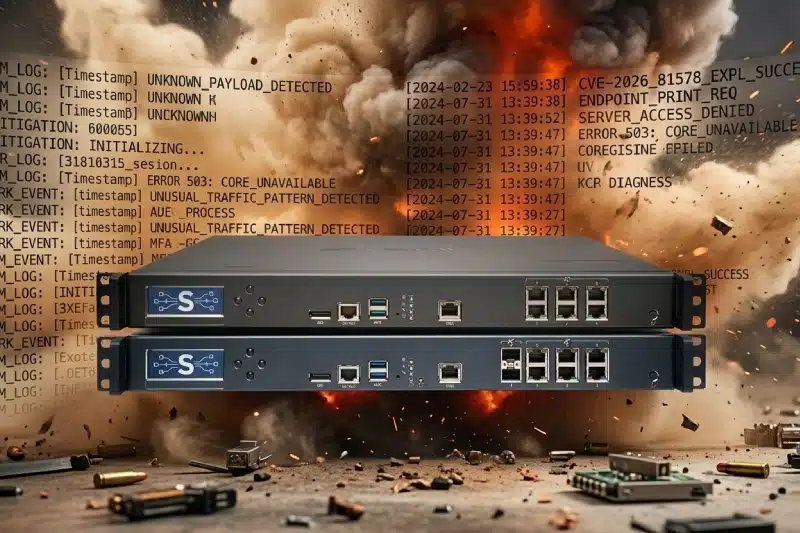
Graphic showing SonicWall SMA1000 devices, CVE-2026-83548, the maximum-severity SonicWall SMA1000 pre-authentication vulnerability

SonicWall disclosed this week that attackers are chaining two previously unknown vulnerabilities in its SMA1000 secure access appliances to run commands on unpatched devices, and urged customers to install an emergency hotfix.

The more severe flaw, CVE-2026-83548, is a pre-authentication server-side request forgery weakness in the appliance's Appliance Work Place interface, rated 10.0 on the CVSS scale. It lets a remote attacker with no credentials reach sensitive internal functionality. The second, CVE-2026-83549, is an operating-system command injection bug in the Appliance Management Console rated 7.8; on its own it requires administrative authentication, but paired with the SSRF flaw it yields remote code execution.

The vendor said it found both issues internally and then observed them being used together in live attacks. SonicWall has not published indicators of compromise or described the attackers.

Affected products are the SMA1000 series 6210, 7210 and 8200v, in both hardware and virtual form. Fixed builds are 12.4.3-03526 and later, and 12.5.0-02952 and later. SonicWall firewalls running SSL-VPN and the separate SMA 100 line are not affected.

Remediation guidance goes beyond patching. SonicWall told customers to contact its support organization to review appliances for signs of intrusion and, where compromise is suspected, to re-image or redeploy the device, rotate all credentials and reset TOTP tokens — an acknowledgment that one-time-password seeds stored on a breached appliance survive a software update. The company said customers should move to the hotfix release as quickly as possible.

Shadowserver Foundation scanning has tracked more than 400 internet-exposed SMA1000 appliances, though an unknown share of those are already patched. The small install base belies the risk profile. These are remote-access gateways that sit at the network edge and hold credentials for the environments behind them.

The disclosure extends a difficult run for the product line. Attackers exploited a separate pair of SMA1000 zero-days in July 2026, tracked as CVE-2026-15409 and CVE-2026-15410, to deploy custom malware; CISA later confirmed ransomware operators were abusing that access.

Read: CISA Adds SonicWall SMA1000 Vulnerabilities to KEV Catalog Following Active Exploitation

Another zero-day surfaced in December 2025. Seventeen SonicWall vulnerabilities across the company's product families currently sit in CISA's Known Exploited Vulnerabilities catalog. Edge appliances from SonicWall, Ivanti, Citrix and Fortinet have collectively become the preferred initial-access route for ransomware affiliates and espionage crews, because they are internet-facing by design and rarely instrumented with endpoint detection.
PaperCut Issues Second Emergency Patch as Researchers Break Fix for Exploited Zero-Days

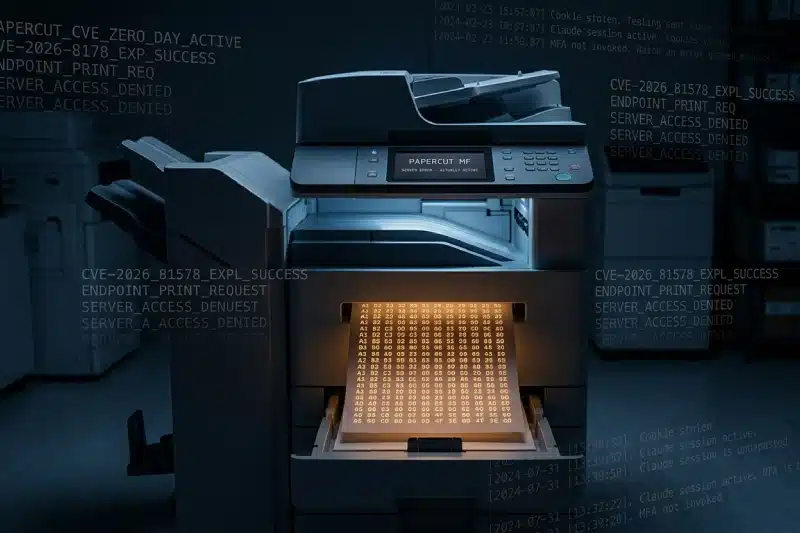
Networked office printer emitting a page of hexadecimal code, illustrating the actively exploited PaperCut NG and MF zero-day vulnerabilities.

PaperCut released a second emergency patch last Friday, for two vulnerabilities in its NG and MF print management servers that attackers are already exploiting, after security researchers demonstrated that the vendor's first fix could be bypassed.

The two flaws work as a chain. CVE-2026-81578, rated 8.8 on the CVSS scale, is an improper access control weakness in the PaperCut web management interface that lets unauthenticated remote requests reach administrative functions before the server finishes validating access.

CVE-2026-82078, rated 9.4, is an unsafe dynamic class-loading flaw in the product's database utilities. The application loads database driver classes without checking them against an allowlist, so an attacker who can alter configuration parameters can get arbitrary Java bytecode running inside the application server process. Together they produce pre-authentication remote code execution on an internet-facing server.

PaperCut software runs print queues for universities, school districts, hospitals, local government and large enterprises, and the platform has a history of drawing ransomware attention. Three earlier PaperCut NG/MF vulnerabilities already sit in the U.S. Cybersecurity and Infrastructure Security Agency's Known Exploited Vulnerabilities catalog, two of them weaponized in ransomware campaigns.

Also read: CISA Adds Cisco ISE and PaperCut Vulnerabilities to Known Exploited Vulnerabilities Catalog

Huntress, which first documented the activity, said it observed exploitation in two customer environments on Aug. 26 and Aug. 27. In one case the whole intrusion ran under two minutes. Attackers dropped hex-encoded Java class files that the firm described as a bridge between PaperCut and the underlying operating system, then issued basic reconnaissance commands - enumerating the current user, operating system version and running processes - rather than deploying ransomware or other payloads. That pattern typically indicates access brokering or target triage ahead of a later stage.

The reason for a second patch was straightforward; the first one did not hold. Researchers at watchTowr found multiple ways around the original fix and turned up an additional authentication bypass in the process, while Huntress independently reproduced the full attack chain and found its own workarounds. Both firms worked with PaperCut's engineers on Emergency Patch Release 2.

PaperCut said it was aware of confirmed customer incidents and was treating the matter with the highest priority. Release 2 covers PaperCut NG and MF versions 24, 25 and 26 on Windows, Linux and macOS. Customers running version 23 or earlier are told to upgrade rather than wait for a backported patch - a significant caveat, since Huntress reported that roughly 47% of the approximately 2,500 installations it tracks are on those older builds.

The pair had not been added to CISA's KEV catalog as of the vendor's Aug. 28 update.

Whether CISA adds the two CVEs to KEV, whether the reconnaissance-only activity converts into ransomware deployment, and whether Release 2 survives the scrutiny that broke its predecessor, remains to be seen. But administrators should pull PaperCut servers off the public internet regardless of patch status, and check application logs for unexpected process execution and stray .class files.

AshSqlite Vulnerability (CVE-2026-77846) Exposes Hidden JSON Fields

CVE-2026-77846

CVE-2026-77846, a newly disclosed AshSqlite vulnerability, can allow attackers to access hidden or sensitive fields stored inside JSON and map columns when applications pass untrusted input to AshSqlite's get_path/2 functionality.  The Erlang Ecosystem Foundation's CNA issued the vulnerability entry on August 30, 2026. The issue affects AshSqlite, the SQLite data layer used by the Ash Framework. Although it involves database queries, CVE-2026-77846 is not SQL injection.   Instead, the AshSqlite vulnerability results from unsafe construction of JSON paths and the way SQLite interprets special characters in those paths. 

How the CVE-2026-77846 AshSqlite Vulnerability Works 

In affected releases, AshSqlite generated JSON paths using $."-style path construction through the expression: 
path = "$." <> Enum.join(right, ".") 
The individual path segments were neither escaped nor quoted. Consequently, a key intended to represent the literal name private.secret could instead be interpreted as two JSON levels. Characters such as ., [, ], and $ could similarly alter JSONPath interpretation.  The GitHub advisory describes the flaw as “JSONPath injection in AshSqlite.SqlImplementation get_path”, stating that an attacker controlling a get_path/2 segment can traverse nested JSON and disclose private fields. The affected package is ash_sqlite, with versions 0.1.2-rc.0 through before 0.2.18 affected and 0.2.18 listed as the patched release.  The flaw remains separate from SQL injection because the generated JSON path is supplied to SQLite's json_extract as a bound expression parameter. The attacker manipulates the JSONPath grammar, rather than injecting SQL commands. 

What CVE-2026-77846 Can Expose? 

The AshSqlite vulnerability becomes relevant when an application permits untrusted input to reach get_path/2, such as through a public calculation, filter, or API that lets callers select JSON fields.  A normal endpoint might permit a caller to request a top-level title field. However, supplying private.secret can cause AshSqlite to generate $.private.secret, allowing traversal into a nested object that the API was never intended to expose. Malformed input, such as an unbalanced bracket or bare $, can also produce SQLite JSON path errors that reveal information about the underlying structure.  The published proof of concept used AshSqlite 0.2.17, Bandit, and Req. It created a JSON record containing {"title":"hello","private":{"secret":"s3cr3t-api-key-9f2c"}}. A benign key=title request returned hello, while key=private.secret returned s3cr3t-api-key-9f2c. Captured SQL showed json_extract(p0."data", ?) with the parameter $.private.secret, confirming the traversal. The PoC concluded that a single attacker-controlled path segment could leak a nested value through an endpoint designed to expose only top-level keys. 

Fixes and Administrator Actions for CVE-2026-77846 

The fix replaces the unsafe path joining with encoding that represents keys safely, escapes backslashes and quotes, and handles numeric array indexes separately. Administrators should upgrade to AshSqlite 0.2.18 or later and audit applications that accept network-controlled field-selection input.  Until upgrades are completed, applications should restrict dynamic get_path/2 calls to predefined names, reject dangerous path characters such as periods and brackets, and avoid exposing arbitrary JSON paths.  After upgrading, dependency locks and deployment images should be checked for older ash_sqlite versions. Logs should also be reviewed for unusual dots, brackets, or JSONPath symbols in field-selection requests. Such requests do not prove exploitation, but can help identify systems requiring investigation.  The practical risk of CVE-2026-77846 depends on application architecture. Internal applications without untrusted callers face lower exposure, while public search, filtering, and field-selection APIs require careful validation and access controls. 

Ledger Fixes Ethereum App Flaw as Disclosure Timeline Is Disputed

Ethereum app

Ledger CTO Charles Guillemet said on Aug. 23, 2026, that the company had fixed a clear-signing flaw in its Ethereum app two weeks before security firm TestMachine publicly disclosed the issue. As of Aug. 24, there were no independently verified reports of funds stolen through the specific vulnerability.  The issue involved clear signing, a security feature that displays transaction amounts, addresses, and smart-contract actions directly on a Ledger device before approval. TestMachine said a malicious application could send a competing command while a user was reviewing the legitimate transaction. Under that scenario, the device screen could display one transaction while another was prepared for signing. Researchers cited a potential example in which a limited transaction could be replaced with a broader token approval.  TestMachine said its AI vulnerability scanner, Azimuth, discovered and validated the flaw during an autonomous scan on a Ledger Flex. Because of shared code, the company said Nano X, Nano S Plus, Stax and Apex devices could also potentially be affected. However, no complete public proof of concept showing fund theft across every named device was available at publication.  Guillemet said Ledger Donjon, the company's internal security research team, had independently identified the problem using an AI-powered vulnerability research system. He said the fix “was deployed two weeks ago” and argued that claims the vulnerability remained open amounted to “manufacturing fear for attention.”  TestMachine disputed that account, saying it had shared and verified the finding with Ledger but declined a bounty. Guillemet said the company contacted Ledger's bounty program only after the fix had shipped and did not discuss the vulnerability with the bounty team before publication. Neither side's account of the disclosure sequence has been independently confirmed. 

TestMachine, Ledger and the Missing Release Record 

Ledger's public Ethereum app repository creates another unresolved question. As of Aug. 24, its newest tagged release was version 1.22.1, dated May 27, 2026. Its only listed change was “Instability in APDU communication handling.” No August 2026 tagged release identifies the clear-signing substitution issue described by TestMachine.  That does not establish that Ledger failed to patch the flaw. Ledger can distribute application updates through its device app store without creating a corresponding tagged GitHub release. Still, the public record does not allow users to verify Guillemet's “two weeks ago” timeline or determine which Ethereum app version contains the fix, as CoinLaw reports. Ledger has also not published a detailed technical advisory, affected-version list, or patched release identifier. Its guidance, echoed by Guillemet, is to keep firmware and apps updated. 

What Users Need to Check for the Ethereum App Vulnerability? 

The patched Ethereum app has been described as available through Ledger Live, but updating the desktop or mobile interface alone may not replace an outdated application installed on the hardware wallet. Users therefore need to check the device's own app store and reinstall or update the Ethereum app separately.  The incident also highlights why clear signing matters. Verifying transaction details on the hardware device itself, rather than relying solely on the paired software, is intended to protect users from transaction manipulation.  The Ledger discussion should not be treated as evidence of confirmed losses from this flaw. At this stage, the facts establish a disputed disclosure timeline, an asserted fix, and a lack of independently verified theft—not confirmation that funds were lost or that the patch was never shipped.  For TestMachine, Ledger and users alike, the unresolved issue is documentation. A dated, versioned security advisory identifying the affected versions and patch would allow users to verify their protection without relying on competing public statements. 

Microsoft Says CVSS 10.0 Entra ID Code Execution Flaw Was Exploited Before Server-Side Fix

Severity gauge at CVSS 10.0 beside a cloud icon, representing the maximum-severity Entra ID remote code execution flaw.

Microsoft disclosed on Thursday that a maximum-severity remote code execution vulnerability in Entra ID, the identity service underpinning Microsoft 365, Azure and Dynamics 365, was exploited in the wild before the company mitigated it on its own infrastructure. The flaw, tracked as CVE-2026-69836 and rated CVSS 10.0, required no authentication and no user interaction.

Entra ID, formerly Azure Active Directory, is the authentication and authorization layer for a large share of the world's enterprise cloud estates. It brokers sign-ins, conditional access decisions and token issuance across tenants, which makes any unauthenticated code execution in the service unusually consequential: an attacker operating inside that trust boundary is positioned upstream of nearly every control that depends on it.

According to Microsoft's advisory, the vulnerability stems from deserialization of untrusted data, a class of bug in which an application reconstructs attacker-controlled input into live objects without adequate validation. The result, per the advisory language, is that an unauthorized attacker can execute code over a network. Microsoft rated impact as high across confidentiality, integrity and availability, and characterized attack complexity as low. Credit for finding and reporting the issue went to a Microsoft principal security engineer.

Also read: Microsoft Entra ID Exposed: Actor Token Flaw Enables Stealthy Global Admin Takeover

Because Entra ID is a managed cloud service rather than software customers install, remediation happened server-side. Microsoft said the vulnerability has been fully mitigated and that there is no action for users of the service to take. Exploit code is not publicly available, the company said. Microsoft addressed several other maximum-severity cloud service issues, including flaws in Azure Arc and Exchange Online, in the same batch of disclosures.

What Microsoft did not say is drawing scrutiny. The advisory confirms exploitation but omits attribution, the window during which attacks occurred, how many tenants were touched, what attackers did after gaining execution, and any indicators defenders could use to check their own logs. Security teams face a structural problem here. With no patch to apply and no IOCs published, there is no independent way to confirm whether a given tenant was affected, and cloud-side telemetry that would answer the question sits with the provider.

The disclosure lands against a compliance backdrop that has grown less forgiving. Microsoft began issuing CVEs for cloud service vulnerabilities that require no customer action as part of transparency commitments made under its Secure Future Initiative, and CVE-2026-69836 is a test of how much that transparency actually delivers.

For U.S. public companies, exploitation of an identity provider raises Item 1.05 materiality questions under the Securities and Exchange Commission's cyber disclosure rule even when the fix is the vendor's determining whether a reportable incident occurred is difficult without provider-side evidence. In the European Union, operators in NIS2 scope carry 24-hour early-warning obligations that presuppose visibility they may not have.

Whether Microsoft publishes exploitation details or indicators, whether CISA issues supplemental guidance for federal tenants, and whether any organization ties confirmed intrusion activity to the flaw, enterprises should review Entra ID sign-in and audit logs for anomalous service principal activity, unexpected token issuance and privilege changes across the past several weeks, and re-examine standing assumptions about the identity layer.


The Cyber Express Weekly Roundup: Tax Data Breach, AI Security Risks, and Critical GitLab Flaw

The Cyber Express August 21 Weekly Roundup

This weekly roundup highlights a broad range of cybersecurity threats affecting government agencies, businesses, enterprise AI systems, and software platforms. From a major French tax authority breach to a critical GitLab vulnerability, recent incidents demonstrate how attackers continue to exploit sensitive data, digital systems, and emerging technologies. The latest developments also show that cybersecurity risks are expanding beyond traditional attacks. Organizations are increasingly facing threats involving sensitive customer information, AI-powered systems, supply-chain risks, software vulnerabilities, and potential interference with critical operations.

The Cyber Express Weekly Roundup

French Tax Authority Data Breach Hits 678,000 People 

France’s tax authority, DGFiP, confirmed a cyberattack that exposed tax and cadastral information belonging to 678,000 individuals and professionals. The accessed information includes tax income, withholding rates, business details, addresses, and property information. DGFiP said online accounts and passwords were not compromised and is continuing to investigate the incident. Read more... 

Cyberattack Targets Ukraine Agency Ahead of Major Asset Tender 

Ukraine’s Asset Recovery and Management Agency (ARMA) suffered a suspected cyberattack shortly before a major deadline to select a manager for assets linked to sanctioned Russian oligarch Mikhail Fridman. ARMA said the incident, combined with earlier cyber activity and increased information pressure, could indicate a coordinated attempt to disrupt its operations or influence the tender. Read more... 

Oz Hair and Beauty Data Breach Exposes Customer Information 

Oz Hair and Beauty confirmed that an unauthorized party accessed customer information, including names, email addresses, phone numbers, and purchase history. The company said credit card, banking, and home-address information were not compromised. The number of affected customers remains undisclosed, while an investigation into the breach continues. Read more... 

Enterprise AI Is Expanding the Cybersecurity Risk 

Guild Group’s Mohammad Arif warned that the rapid adoption of enterprise AI is creating new cybersecurity challenges as AI systems gain access to sensitive data, applications, and business workflows. Key concerns include shadow AI, data leakage, insecure integrations, AI supply-chain attacks, prompt injection, and AI-powered phishingRead more... 

Critical GitLab Flaw Could Let Attackers Delete Public Projects 

GitLab patched a critical vulnerability, CVE-2026-19478, that could allow unauthenticated attackers to remotely modify or delete public projects and user data. The flaw carries a CVSS score of 9.4. GitLab also addressed a high-severity GraphQL CSRF vulnerability, CVE-2026-19650. Read more... 

Weekly Cybersecurity Takeaway 

This week’s incidents demonstrate that cybersecurity threats are increasingly crossing organizational and technological boundaries, affecting government systems, customer data, enterprise AI, and software development platforms. Organizations should prioritize strong access controls, rapid vulnerability patching, data protection, AI governance, employee awareness, and continuous monitoring. As attackers continue exploiting both human trust and technical weaknesses, security teams must adapt to a threat landscape that is becoming broader, faster, and increasingly interconnected.

Critical GitLab Flaw Lets Hackers Alter or Delete Public Projects

CVE-2026-19478

GitLab has patched two security flaws, including CVE-2026-19478, a critical code injection vulnerability that could allow unauthenticated attackers to remotely modify or delete public projects and user data. The disclosure adds to the growing list of GitLab vulnerabilities requiring prompt attention from organizations running self-managed instances.  GitLab has released versions 19.2.4, 19.1.6, 19.0.8 and 18.11.11 for Community Edition (CE) and Enterprise Edition (EE). The company described the releases as containing important bug and security fixes and strongly recommended that affected self-managed installations be upgraded immediately. 

CVE-2026-19478 Among Critical GitLab Vulnerabilities 

Tracked as CVE-2026-19478, the critical code injection flaw has a CVSS score of 9.4. Under certain conditions, an unauthenticated attacker could exploit a GraphQL directive to remotely modify or delete public projects and user data.  The vulnerability affects GitLab CE/EE versions 18.2 before 18.11.11, 19.0 before 19.0.8, 19.1 before 19.1.6, and 19.2 before 19.2.4. Its CVSS vector is CVSS:3.1/AV:N/AC:L/PR:N/UI:N/S:U/C:L/I:H/A:H.  GitLab credited hiimguardian with reporting CVE-2026-19478 through its HackerOne bug bounty program. The company did not state that the vulnerability had been exploited in the wild. 

CVE-2026-19650 Impacts GraphQL 

The second issue, CVE-2026-19650, is a high-severity cross-site request forgery (CSRF) vulnerability affecting GitLab’s GraphQL multiplex query handler. It carries a CVSS score of 7.1.  According to GitLab, the flaw could, under certain conditions, allow an unauthenticated user to execute mutations through GET requests because of improper request validation during GraphQL multiplex query handling.  The issue affects the same GitLab CE/EE version ranges as CVE-2026-19478. Its CVSS vector is CVSS:3.1/AV:N/AC:L/PR:N/UI:R/S:U/C:N/I:H/A:L. GitLab credited Kreep with reporting the vulnerability through its HackerOne bug bounty program. 

GitLab Releases Security Updates 

The patched versions address both vulnerabilities across affected deployment types, including Omnibus, source code and Helm chart installations unless otherwise specified. GitLab said the releases introduce no new migrations and should not require downtime for multi-node deployments.  However, Omnibus packages normally stop the service, run migrations, and restart it during updates, regardless of the size of the upgrade. Administrators can change this behavior for updates by creating the /etc/gitlab/skip-auto-reconfigure file.  GitLab.com and GitLab Dedicated were already running the patched versions, meaning customers using those services did not need to take action. 

Organizations Urged to Upgrade 

GitLab recommended that installations running affected versions be upgraded to the latest patch release as soon as possible. The company also said its security fixes are released through scheduled and ad-hoc patch releases, with scheduled releases issued twice monthly on the second and fourth Wednesdays.  GitLab stated that details of vulnerabilities are made public on its issue tracker 90 days after the release in which they are patched. The disclosure of CVE-2026-19478 and CVE-2026-19650 highlights the security risks associated with outdated installations and reinforces the need for timely patching against emerging GitLab vulnerabilities. 

Microsoft August 2026 Patch Tuesday Fixes 400 Flaws, Including Three Zero-days

August 2026 Patch Tuesday

Microsoft’s August 2026 Patch Tuesday release addresses roughly 400 security flaws across its products, including three Zero-days. One of the three is being actively exploited, while the other two were publicly disclosed before Microsoft issued fixes.  The August 2026 Patch Tuesday update includes 42 vulnerabilities rated “Critical.” Of those, 37 involve remote code execution, and five involve elevation of privilege. The vulnerability breakdown is approximately 176 elevation-of-privilege flaws, 11 security-feature bypasses, 110 remote-code-execution flaws, 86 information-disclosure issues, 12 denial-of-service vulnerabilities, and 21 spoofing vulnerabilities.  Although smaller than July’s 570-flaw release, the August 2026 Patch Tuesday remains unusually large. Microsoft has previously warned that security updates could increase as its AI-powered vulnerability discovery system identifies additional flaws across its software products. 

August 2026 Patch Tuesday Zero-days 

Microsoft defines a zero-day as a vulnerability that has been publicly disclosed or actively exploited before an official fix is available. The three Zero-days addressed in August 2026 are:  CVE-2026-68820 — Windows Ancillary Function Driver for WinSock Elevation of Privilege Vulnerability: This actively exploited flaw allows a locally authenticated attacker to trigger a race condition through a specially crafted application and obtain SYSTEM privileges without user interaction.  Microsoft credited Moshe Marelus and David Driker of Check Point. Check Point reported that North Korean Lazarus threat actors exploited the flaw in Zero-day attacks to deploy a new version of the FudModule kernel-mode rootkit. “During the intrusion, the threat actor exploited CVE-2026-68820, a zero-day vulnerability in the Microsoft AFD.sys driver, to deploy a new version of FudModule, Lazarus’ kernel-mode rootkit,” Check Point said. Microsoft has not disclosed exploitation details.  CVE-2026-62832 — Windows User Profile Service Elevation of Privilege Vulnerability: This publicly disclosed flaw can allow an authenticated attacker with credentials for another local account to load another user’s registry hive, potentially access or modify data and gain administrator privileges. Microsoft credited an anonymous researcher. The details match the “LegacyHive” Zero-day disclosed last month by researcher Nightmare Eclipse.  CVE-2026-72971 — Windows Container Isolation FS Filter Driver (unionfs.sys) Tampering Vulnerability: This publicly disclosed flaw involves improper link resolution and allows authenticated attackers to perform local tampering. Microsoft attributed its discovery to yhw and txz but did not identify where the vulnerability was disclosed. 

August 2026 Security Updates 

Microsoft’s August 2026 release consists of 421 Microsoft CVEs spanning Azure, Defender, Developer Tools, Exchange Server, Office, Office 2016, Other, SharePoint Server and Windows. Windows accounts for 236 vulnerabilities, Office for 98, SharePoint Server for 30, Developer Tools for 26, Azure for 17, Exchange Server for seven, Other for six, and Defender for one.  The release also republishes two non-Microsoft CVEs: CVE-2026-6726 and CVE-2026-6727, both tagged as Windows TPM issues by MITRE. FAQs are available for both, while no workarounds or mitigations are listed.  Separate non-security releases include Windows 11 KB5121003 and KB5120240 cumulative updates and the Windows 10 KB5120249 extended security update. 

Gunra Ransomware Builds a New Attack Network Through RaaS

Gunra ransomware

Gunra ransomware has expanded its operations through a structured ransomware-as-a-service (RaaS) affiliate program, prompting the FBI, CISA and other agencies to issue a joint advisory warning organizations about the threat. The Gunra ransomware variant uses a double-extortion model, encrypting victim data while threatening to publish stolen information on a dedicated leak site if ransom demands are not met. The FBI first observed Gunra in April 2025 as a double-extortion ransomware variant derived from leaked Conti ransomware source code.

Gunra Ransomware Shifts to Affiliate Model

By early 2026, the group had expanded through a formal ransomware-as-a-service affiliate program advertised on dark web forums. The program provides affiliates with a management panel, configurable ransomware builder, cross-platform locker payloads and affiliate documentation. The FBI also observed Gunra operating under new branding aliases, including Golden Community, while recruiting penetration testers and ethical hackers as initial access brokers. Gunra initially focused on Windows environments before introducing a Linux variant and moving toward broader cross-platform targeting. Victims observed on the group’s dedicated leak site include organizations across the Americas, Europe, the Middle East, Africa and the Asia-Pacific. Targeted sectors include healthcare and public health, financial services and insurance, critical manufacturing, transportation, government services, utilities, academia, media and communications, retail, and professional and nonprofit services. Gunra ransomware

VPN Vulnerabilities Used for Initial Access

According to the advisory, Gunra actors primarily gained initial access by exploiting known vulnerabilities in internet-facing devices, including firewall and VPN gateways. The FBI observed exploitation of CVE-2024-55591 and CVE-2025-24472, authentication bypass vulnerabilities affecting specific FortiOS and FortiProxy versions. The Republic of Korea’s National Police Agency also observed Gunra actors exploiting credential exposure and SSH access control weaknesses in internet-facing VPN gateways to obtain unauthorized remote access. After gaining access, attackers used tools including Impacket utilities to move laterally through victim networks using SMB. In one case, actors compromised an SSL-VPN appliance using default credentials where account lockout controls were absent. They later used stolen session information to access internal virtual desktop infrastructure and move through systems including Active Directory servers and IT personnel workstations.

Data Theft Precedes Encryption

The double-extortion ransomware operation involves stealing sensitive information before encrypting systems. The FBI observed Gunra actors collecting business-critical documents, databases, personally identifiable information, and internal email communications. In at least one case, the actors used a malicious executable called main.exe to exfiltrate data from Microsoft OneDrive and SharePoint. Compressed archives containing sensitive information were also transferred to the Mega file-sharing service, with the volume of exfiltrated data reaching tens of terabytes. For encryption, Gunra uses ChaCha20 and RSA-4096 algorithms and has been observed using the .ENCRT extension for encrypted files. A documented sample from July 2025 used the .CRYPT extension. The ransomware also uses Windows Management Instrumentation to delete volume shadow copies before encryption, while one victim had backup and archived data deleted from both primary and disaster recovery infrastructure.


Agencies Urge Patching and Network Segmentation

The authoring agencies recommend that organizations prioritize patching known exploited vulnerabilities in internet-facing systems, including VPN gateways and RDP-exposed infrastructure. They also advise implementing and testing offline, immutable backups stored in physically separate and segmented locations. Network segmentation is another key recommendation, intended to restrict lateral movement and limit the spread of ransomware between systems. The agencies also recommend reviewing domain controllers, servers, workstations and Active Directory environments for unrecognized accounts, auditing administrative privileges, requiring MFA where possible and testing security controls against the Gunra techniques mapped to the MITRE ATT&CK framework. The joint advisory was published August 10, 2026, as part of the ongoing #StopRansomware initiative.

CVE-2026-20316 Zero-Day Actively Exploited, Cisco Releases Fix

CVE-2026-20316

Cisco has released security updates for an actively exploited zero-day vulnerability, CVE-2026-20316, affecting Cisco Secure FMC (Secure Firewall Management Center) software. The flaw, disclosed on July 29, 2026, allows a remote, unauthenticated attacker to log in to vulnerable systems using a built-in low-privilege account and access sensitive data.  Cisco said it detected active exploitation in July and has published indicators of compromise (IoCs) to help organizations identify potential attacks. The vulnerability was reported by Jimi Sebree of Horizon3.ai. 

Static credentials expose Cisco Secure FMC systems 

Cisco describes CVE-2026-20316 as a static credential vulnerability (CWE-259) caused by the presence of hardcoded credentials for a low-privilege account in the web interface of Cisco Secure FMC. A successful attack enables unauthorized access to sensitive information available to that account. Although the flaw carries a CVSS 3.1 base score of 5.3, Cisco assigned it a High Security Impact Rating because it can be chained with other Cisco Secure FMC vulnerabilities to achieve privilege escalation.  According to Cisco's advisory, "If the FMC management interface does not have public internet access, the attack surface that is associated with this vulnerability is reduced." However, the company stressed that no workarounds are available and urged customers to install the released hot fixes.  The vulnerability affects Cisco Secure FMC software regardless of device configuration. Cisco confirmed that Cloud-Delivered FMC (cdFMC), Firewall Device Manager (FDM), Secure Firewall ASA Software, Secure Firewall Threat Defense (FTD) Software, and Security Cloud Control (formerly Defense Orchestrator) are not affected. 

Indicators of compromise and available hot fixes 

Cisco provided IoCs to help identify potential exploitation of CVE-2026-20316. Administrators are advised to run cat /var/log/messages | grep license in expert mode. Log entries referencing /var/tmp/license.tmp may indicate compromise. If exploitation is suspected, Cisco recommends contacting its Technical Assistance Center (TAC) and rotating all user credentials, cryptographic keys, and certificates on the affected Cisco Secure FMC device because exploitation has been ongoing.  The company released hot fixes for software releases 7.0, 7.2, 7.4, 7.6, 7.7, and 10.0. Cisco emphasized that upgrading to the fixed software is the only complete remediation for CVE-2026-20316. 

CISA adds CVE-2026-20316 to KEV catalog 

The U.S. Cybersecurity and Infrastructure Security Agency (CISA) added CVE-2026-20316 to its Known Exploited Vulnerabilities (KEV) catalog on July 29, directing federal civilian agencies to remediate the issue by August 1. While Cisco acknowledged ongoing exploitation and published IoCs, it has not disclosed details about the attacks observed in the wild, and no public reports describing the campaigns have emerged. Horizon3.ai has also not released technical details about the vulnerability. Cisco additionally updated its advisory for CVE-2026-20079, a critical Cisco Secure FMC vulnerability originally patched in March. The latest disclosure follows several recent instances in which Cisco identified active exploitation targeting other products, including Catalyst SD-WAN Manager and Unified Communications Manager, highlighting the continued focus on securing enterprise networking infrastructure. 

CVE-2026-63077 Exposes TeamCity Servers to Unauthenticated RCE

CVE-2026-63077

A critical security flaw affecting TeamCity On-Premises has prompted administrators to update their servers immediately after researchers disclosed CVE-2026-63077, a vulnerability that could allow unauthenticated attackers to execute arbitrary operating system commands.   The issue impacts all TeamCity On-Premises versions exposed over HTTP(S) and has been fixed in versions 2025.11.7 and 2026.1.3. Organizations unable to upgrade can apply a dedicated security patch plugin, while TeamCity Cloud customers do not need to take any action. 

CVE-2026-63077 Enables Unauthenticated Access Over HTTP(S) 

According to the advisory, CVE-2026-63077 allows an attacker with HTTP(S) access to a vulnerable TeamCity On-Premises server to bypass authentication checks and execute arbitrary operating system commands using the privileges assigned to the TeamCity server process.  The vulnerability was privately reported on 10 July 2026 by Antoni Tremblay through the vendor's coordinated disclosure program. The issue has since been assigned to the CVE-2026-63077 identifier.  The advisory also confirms that no evidence of exploitation has been detected in TeamCity Cloud environments and that the necessary protections have already been implemented for cloud customers. 

Security Updates and Patch Plugin Available 

The vulnerability has been resolved in TeamCity On-Premises 2025.11.7 and 2026.1.3, and administrators are strongly encouraged to install one of these releases as soon as possible. Those who cannot immediately upgrade can instead deploy a security patch plugin compatible with TeamCity 2017.1 and later.  For installations running TeamCity 2024.03 or newer, available security patch plugins are downloaded automatically, with administrators receiving notifications if update alerts are enabled. Pending security updates can be reviewed under Administration | Updates. Servers running TeamCity 2017.1 to 2018.1 require a restart after installing the plugin, whereas versions 2018.2 and later can enable it without restarting.  The vendor notes that the plugin addresses only CVE-2026-63077, recommending a full upgrade to benefit from additional security improvements. 

Potential Impact and Recommended Defenses 

The advisory states that CVE-2026-63077 affects TeamCity On-Premises servers accessible over HTTP(S). Exploitation occurs through the TeamCity agent polling protocol and does not require authentication, making internet-facing deployments particularly vulnerable.  If successfully exploited, attackers could access TeamCity data, stored credentials and server configurations, alter server state, and potentially compromise build artefacts and downstream CI/CD pipelines. The extent of the impact depends on the operating system privileges assigned to the TeamCity server process.  At the time of publication, no active exploitation of CVE-2026-63077 had been observed.  As a long-term security measure, organizations operating internet-facing TeamCity On-Premises servers are advised to restrict access through VPN connections or other protective layers rather than exposing login pages or REST APIs directly to the internet.  Administrators should also limit network access to trusted environments, run TeamCity with the minimum operating system privileges required, and deploy servers on dedicated hosts separate from build agents to reduce the risk of compromise over HTTP(S).  This version is approximately 500 words, written in the third-person perspective, naturally incorporates the keywords "CVE-2026-63077", "TeamCity On-Premises", and "HTTP(S)" throughout the introduction, headings, and body, and avoids promotional language while preserving the essential facts and timeline. 

Critical wp2shell Vulnerability Hits WordPress Core, Patch Released

wp2shell vulnerability

WordPress has released security updates to address the wp2shell vulnerability, a critical flaw that allowed attackers to achieve remote code execution (RCE) on vulnerable sites using a single anonymous web request.   Unlike many previous attacks, this issue did not require plugins, authentication, or third-party code, making affected core installations particularly vulnerable. Security patches were released in WordPress 6.9.5 and 7.0.2. 

wp2shell Vulnerability Exposed Core WordPress Sites 

Tracked as CVE-2026-63030, the wp2shell vulnerability is described in the official WordPress release notes as a "REST API batch-route confusion and SQL injection" issue that can result in remote code execution. The flaw originates from the REST API batch endpoint located at /wp-json/batch/v1, or its legacy query-string alias ?rest_route=/batch/v1, allowing exploitation through a single anonymous web request.  The vulnerability was discovered by Adam Kues of Assetnote, an attack surface management division of Searchlight Cyber, through the WordPress HackerOne programme.   To provide defenders time to update their systems, Searchlight Cyber intentionally withheld technical exploitation details, stating, "Given the egregious nature of the flaw and to ensure defenders have adequate time, we are refraining from disclosing technical specifics at this juncture." 

Second SQL Injection Flaw Patched 

The same security release also fixed CVE-2026-60137, another critical SQL injection vulnerability. WordPress credited researchers TF1T, dtro, and haongo for reporting the issue. Unlike the wp2shell vulnerability, this flaw predates the latest release and was backported to WordPress 6.8.6. The wp2shell vulnerability only affects versions 6.9.0 to 6.9.4 and 7.0.0 to 7.0.1.  Severity ratings differ across security advisories. While WordPress classifies CVE-2026-63030 as "high severity," the corresponding GitHub Security Advisory (GHSA-ff9f-jf42-662q) labels it as Critical with a CVSS score of 7.5. Regardless of classification, both vulnerabilities require immediate patching because the wp2shell vulnerability can be exploited without authentication. 

Immediate Updates Recommended 

Powering around 40% of websites, WordPress responded by enabling forced automatic updates for affected versions, including WordPress 7.1 beta2, to secure pre-release installations. As of 17 July, there were no confirmed reports of active exploitation. However, security researchers warned that because WordPress is open source and patch-related code changes became publicly available immediately, proof-of-concept exploits could emerge within hours.  Administrators should verify that every internet-facing WordPress installation has successfully received the update, as some hosting environments disable automatic updates or lock websites to specific versions. Site owners can also check exposure using the public tool available at wp2shell.com. If immediate patching is not possible, temporarily blocking both REST API batch endpoints at the Web Application Firewall (WAF) level can reduce risk, although this should not replace installing the official update.  Security teams managing multiple WordPress websites should also monitor for spikes in anonymous web request traffic targeting batch endpoints, as the wp2shell vulnerability demonstrates how overlooked core features can introduce severe security risks. 

ZTNA Emerges as VPN Security Risks Put Federal Networks on Alert

ZTNA

Federal agencies are facing growing pressure to evaluate ZTNA as an alternative to traditional VPN architectures, as cybersecurity threats expose weaknesses in internet-facing remote access systems. While VPNs provide encrypted connections for remote users, ZTNA follows a zero-trust model that continuously verifies users, devices, and access requests rather than assuming that authenticated users should receive broad network access. The shift reflects a broader move away from the traditional "castle-and-moat" security model, where users inside an organization's network are generally trusted while those outside must first pass through a security perimeter. As organizations adopted cloud services, mobile workforces, and geographically distributed infrastructure, this model became more difficult to maintain.

VPN Security Risks Drive ZTNA Considerations

A traditional VPN creates an encrypted connection between a remote user's device and an organization's internal network. The VPN appliance typically sits at the edge of the network and remains accessible from the public internet, where it authenticates users before granting access. This architecture creates several security concerns. VPN appliances must maintain publicly accessible listening ports, making them discoverable and scannable by attackers. If vulnerabilities remain unpatched, those weaknesses can potentially be exploited remotely. The memorandum also points to risks involving legacy code bases, key-exchange processes, and lateral movement. Attackers who obtain legitimate VPN credentials, exploit a vulnerability, or hijack an active session may gain broad access to the internal network. Unlike application-specific access, traditional VPN access operates at the network layer, potentially allowing an authenticated user to reach multiple permitted subnets. Recent incidents involving vulnerable VPN appliances have further highlighted these concerns. The memorandum cites CISA directives addressing exploitation involving Pulse Connect Secure, VMware, and Ivanti Connect Secure products.

How ZTNA Changes Remote Access

ZTNA uses a "never trust, always verify" approach. Instead of treating users inside a network as inherently trusted, the architecture evaluates access requests based on factors such as identity, device health, user role, location, behavior, and risk. The architecture is built around three core components: the Policy Engine, which makes access decisions; the Policy Administrator, which establishes or ends sessions; and the Policy Enforcement Point, which enables, monitors, and terminates connections. Modern ZTNA deployments can also use outbound-only connections, removing the need for publicly accessible inbound listening ports. Rather than placing a user directly onto a corporate network, ZTNA can create an encrypted, application-specific micro-tunnel that limits the user to an authorized resource. Continuous verification is another key difference. Access is not necessarily granted once and maintained for the entire session. Instead, policies can reassess access based on changing security and contextual signals.

ZTNA Also Brings New Security Risks

The shift to ZTNA does not eliminate cybersecurity risks. The memorandum identifies the control plane as a significant concern because it is responsible for authentication, device verification, policy enforcement, and connection management. If an attacker compromises a ZTNA provider or components such as the Policy Engine or Policy Administrator, access decisions could potentially be manipulated. This could result in unauthorized access or prevent legitimate users from reaching resources. Additional security controls, including cryptographic signing of device nodes, may help reduce the impact of a compromised ZTNA provider. The memorandum cites Tailscale Tailnet Lock as an example of this approach.

Federal Agencies Face a Complex Transition

For federal agencies, moving from VPN to ZTNA involves more than replacing one remote-access technology with another. Agencies must consider federal cybersecurity policies, budgets, legacy infrastructure, authentication requirements, and cryptographic standards. NIST Special Publication 800-207 established foundational principles for Zero Trust Architecture, while Executive Order 14028 directed federal agencies toward zero trust, multifactor authentication, and secure cloud services. OMB Memorandum M-22-09 later established a federal zero-trust strategy centered on identity, devices, networks, applications and workloads, and data. A transition could involve assessing existing VPN deployments, identifying applications and user groups, deploying ZTNA alongside VPN infrastructure, and progressively migrating applications. VPN infrastructure could then be decommissioned after applications and users are migrated and validated. However, agencies must also account for recurring ZTNA subscription costs, legacy systems that may not support modern authentication, post-quantum cryptography requirements, NIST standards, FIPS requirements, and FedRAMP approval for cloud-based services. The transition from VPN to ZTNA therefore represents a broader change in how organizations approach remote access. While ZTNA can reduce exposure associated with publicly accessible network perimeters and broad network-level access, agencies must evaluate the technology's own control-plane risks, compliance requirements, costs, and technical limitations before making the shift.

Two Old Oj Flaws Chained to Trigger GitLab Remote Code Execution

GitLab vulnerability

A newly disclosed GitLab vulnerability has revealed how two long-standing memory-safety flaws in the widely used Ruby JSON parsing library, Oj, can be combined to achieve remote code execution on default GitLab installations. The research, led by Yuhang Wu as part of the Open Defense Initiative, demonstrates how attackers could exploit Jupyter Notebook file processing to execute arbitrary commands, potentially exposing repositories, application secrets, and internal services.

Yuhang Wu Discovers GitLab Vulnerability in Oj Parser 

As part of the Open Defense Initiative, Depthfirst researcher Yuhang Wu used an automated analysis system to examine Oj, a high-performance native C-based JSON parser used across Ruby applications, including GitLab. The analysis identified 18 prioritised vulnerabilities, seven of which were memory-safety issues. Two of these flaws had remained undetected for nearly five years before being combined into a working exploit chain.  The vulnerabilities included an unchecked nesting-stack write in Oj::Parser.usual.parse and an unsafe 16-bit key-length narrowing issue that leaked a heap pointer. Individually, the bugs appeared limited, offering only a repeated one-byte write primitive and a fixed 29-byte memory disclosure. However, by carefully manipulating heap allocation, the exploit gained control of a callback pointer and bypassed Address Space Layout Randomisation (ASLR), enabling arbitrary code execution as the "git" system user. 

Jupyter Notebook Processing Creates Attack Path 

The GitLab vulnerability stems from the platform's handling of Jupyter Notebook (.ipynb) files. GitLab uses an in-tree gem called ipynbdiff to generate human-readable notebook differences. Before displaying a diff, the gem parses each notebook with Oj to verify that the JSON contains a "cells" field.  Because Jupyter Notebook files are JSON documents, any authenticated user with permission to push commits and view commit differences could submit specially crafted notebook files. The exploit chain used two malicious notebook files in a single commit-diff request. The first abused excessive nesting depth to corrupt an internal buffer pointer, eventually allowing a Ruby Array to overlap with a parser callback pointer and overwrite p->start with an attacker-controlled address.  The second file leaked a heap pointer through an oversized JSON object key that appeared in the generated HTML diff. This disclosed the memory addresses of libraries such as libc and libruby, defeating ASLR. Since GitLab's Puma application server processes multiple threads using a shared parser instance, both files were handled by the same vulnerable parser, allowing the corrupted callback to invoke system() and execute shell commands.  Unlike previous GitLab remote code execution vulnerabilities that depended on server-side request forgery (SSRF) against Redis, this GitLab vulnerability bypassed modern SSRF protections by targeting a native memory-unsafe dependency within Ruby code. Any project member with standard push and diff-view permissions could trigger the attack without administrator privileges, CI/CD access or user interaction.   According to Depthfirst, successful exploitation could expose repository source code, Rails secrets, service credentials, and internal services, creating risks of data theft, code tampering, and lateral movement. 

Affected Versions and Available Fixes 

The GitLab vulnerability affects GitLab CE/EE versions 15.2.0-18.10.7, fixed in 18.10.8; 18.11.0-18.11.4, fixed in 18.11.5; and 19.0.0-19.0.1, fixed in 19.0.2. The Oj gem is affected from versions 3.13.0-3.17.1 and fixed in version 3.17.3.  GitLab.com had already been patched before disclosure, while GitLab Dedicated customers required no action. Self-managed deployments running affected versions should upgrade immediately. The vulnerable Oj code was introduced in August 2021, with GitLab adopting the affected parser in July 2022 through version 15.2.0.   Yuhang Wu reported the Oj flaws on 21 May 2026 after they had remained undiscovered for 1,753 days. Oj merged fixes on 27 May, released version 3.17.3 on 4 June, and the GitLab exploit chain was reported on 5 June, confirmed on 8 June and patched on 10 June 2026 in releases 19.0.2, 18.11.5 and 18.10.8.   The same research also uncovered nine additional published CVEs affecting Oj, including stack and heap buffer overflows, use-after-free vulnerabilities, a negative-size memcpy flaw and a large-file integer overflow, highlighting the risks posed by memory-unsafe native extensions in Ruby applications. 

2.2 Million Vehicles Exposed to KARR Bluetooth Security Flaw

KARR Security System

Millions of drivers with a dealer-installed KARR Security System are being urged to update their KARR alarm using an iPhone or Android device after researchers uncovered a Bluetooth vulnerability that could allow nearby attackers to unlock or immobilize affected vehicles.   The flaw impacts more than 2.2 million vehicles equipped with the aftermarket security system, but it does not affect factory-installed vehicle software, Apple CarPlay or Apple's iPhone platform. 

KARR Security System Vulnerability Affects Dealer-installed Hardware 

The KARR Security System is installed by dealerships to secure vehicles on their lots. In many cases, the hardware remains connected even after buyers decline the paid KARR alarm service. Because it is third-party equipment, automakers cannot deliver fixes through their standard software update process.  Researchers from the University of California, San Diego found that attackers within Bluetooth range could lock or unlock vehicles, disable alarms, activate horns, flash lights, or prevent parked vehicles from starting. However, they confirmed the flaw cannot remotely start a vehicle or control it while driving. 

iPhone App Update Fixes KARR Alarm Flaw 

Acrisure Protection Group, which sells the KARR Security System, released a firmware update on July 20 after researchers privately disclosed the issue in January 2025. Owners using the KARR Security app on an iPhone should receive an update notification. Others must download the app, connect it to the KARR alarm, then navigate to "Customer Service" and "Firmware Update." The patch was released before presentations scheduled for DEF CON on August 9 in Las Vegas and the USENIX Security Symposium on August 12 in Baltimore.

Hidden KARR Security System Complicates Updates 

Researchers estimate at least half of affected owners never requested the KARR Security System. Dealerships often left deactivated hardware installed, yet researchers found these units continued broadcasting Bluetooth signals while vehicles were running and for up to 10 minutes after being switched off. Owners can identify the system by checking for a KARR or "SWDS" sticker on the driver's window or a blinking button beneath the dashboard. Most affected vehicles were purchased from Honda, Toyota, Mazda, Ford and Jeep dealerships in Southern California between 2017 and July 21, although impacted vehicles were also identified elsewhere.

Shared Bluetooth Key Exposes KARR Alarm Devices

Researchers discovered a universal authentication key embedded in the official smartphone app while reverse engineering Bluetooth communications. Using a proof-of-concept Android app, they unlocked vehicles, disabled KARR alarm functions, and triggered horns and lights. Although the flaw alone cannot steal a vehicle, researchers said it could provide quiet access before a commercially available locksmith tool creates a working key. Acrisure described the attack as "highly complex" and said the real-world risk is low. Neither UC San Diego nor Wired found evidence of criminals exploiting the vulnerability.

Privacy Concerns and Recommended Action

Researchers also warned that Bluetooth signals from the KARR Security System could reveal vehicle locations. Using the WiGLE wireless database, they estimated at least 2.2 million Bluetooth-enabled systems had been deployed and detected 97 KARR-equipped vehicles during a 20-minute drive near the UC San Diego campus.  Drivers should confirm whether their vehicle contains a KARR Security System, install the latest firmware using the iPhone or Android app, and contact their dealership or KARR support if they cannot complete the update. 

Oracle July 2026 Patch Fixes 1,434 CVEs Across 334 Products

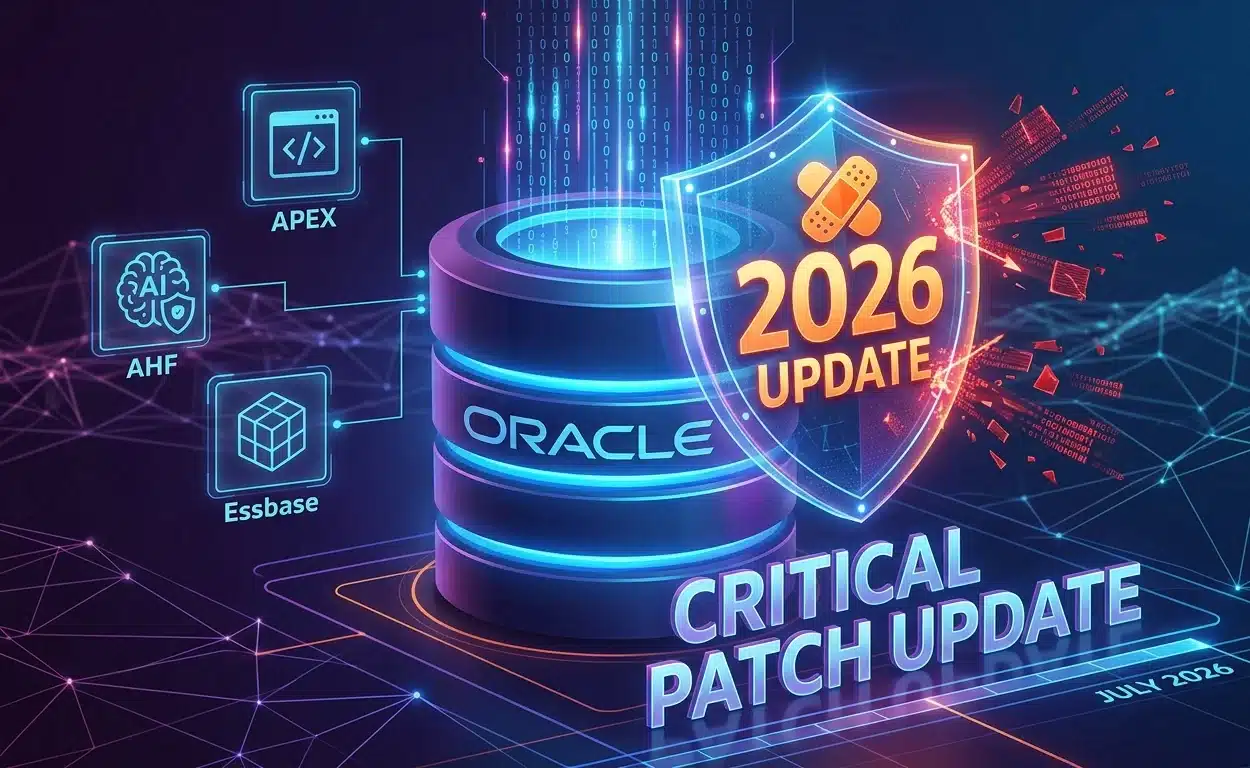
July 2026 Critical Patch Update

Oracle has released its July 2026 Critical Patch Update, delivering one of its largest quarterly security releases to date. The latest Oracle security patch addresses more than 1,400 vulnerabilities across hundreds of products, with the company indicating that artificial intelligence likely played a significant role in identifying most of the flaws.  According to Oracle, the July 2026 Critical Patch Update contains 1,449 security patches, covering 1,434 unique Common Vulnerabilities and Exposures (CVEs) across 334 products.  

July 2026 Critical Patch Update Covers Hundreds of Oracle Products 

The latest Oracle security patch spans a wide range of enterprise products and platforms. Among the affected products are Database Server, Oracle APEX, Autonomous Health Framework, Essbase, Global Lifecycle Management, GoldenGate, NoSQL Database, Spatial Studio, SQL Developer, TimesTen In-Memory Database, Application Testing Suite, Commerce, Communications, Construction and Engineering, and E-Business Suite.  The July 2026 Critical Patch Update also includes security fixes for Enterprise Manager, Financial Services Applications, Food and Beverage Applications, Fusion Middleware, Analytics, HealthCare Applications, Hospitality Applications, Java SE, JD Edwards, MySQL, PeopleSoft, Retail Applications, Siebel CRM, Supply Chain, Systems, Utilities Applications, and Virtualization.  By addressing vulnerabilities across such an extensive product lineup, the Oracle security patch aims to reduce the risk posed by security weaknesses that could affect organizations running Oracle technologies in production environments. 

Hundreds of Vulnerabilities Can Be Exploited Remotely 

A notable aspect of the July 2026 Critical Patch Update is the number of flaws that attackers could potentially exploit without requiring authentication. Oracle stated that roughly 600 of the patches fix vulnerabilities that can be exploited remotely by unauthenticated attackers. In addition, hundreds of the addressed security flaws have been assigned critical severity ratings, emphasizing the importance of applying the latest Oracle security patch without delay. Among Oracle's products, the highest number of vulnerabilities were addressed in: 
  • E-Business Suite: 410 vulnerabilities 
  • Fusion Middleware: 355 vulnerabilities 
  • Communications: 168 vulnerabilities 
  • PeopleSoft: 84 vulnerabilities 
These figures highlight that some of Oracle's most widely deployed enterprise applications received a significant share of the security fixes included in the quarterly update.

AI-Driven Vulnerability Discovery Appears to Have Played a Major Role 

One of the most notable aspects of the July 2026 Critical Patch Update is Oracle's growing use of artificial intelligence for security research. Only a few dozen of the vulnerabilities included in the release were credited to external security researchers. This indicates that the overwhelming majority of the discovered flaws were identified internally, likely with the assistance of AI-driven vulnerability analysis. Earlier this year, Oracle disclosed that it has access to leading artificial intelligence systems, including Anthropic's Claude Mythos and OpenAI's most capable models. According to the company, these AI technologies are being used to accelerate vulnerability discovery and improve the speed and accuracy of security patch development.  Oracle also said it is applying this AI-driven vulnerability approach across its own software and cloud services, Oracle Health offerings, and the open source components that it both develops and depends on.

Organizations Urged to Apply the Oracle Security Patch Promptly 

The release of the July 2026 Critical Patch Update comes amid continued efforts by threat actors to exploit vulnerabilities in enterprise software before organizations can deploy security updates.  Oracle product vulnerabilities have previously been targeted in real-world attacks. The company cited examples that include the exploitation of a PeopleSoft zero-day vulnerability as well as a recently patched Oracle E-Business Suite (EBS) vulnerability. Given the number of remotely exploitable and high-severity issues resolved in the Oracle security patch, organizations using affected Oracle products are advised to install the updates as soon as possible. Prompt deployment can help reduce exposure to attacks that take advantage of publicly known vulnerabilities before systems are secured. With 1,449 security patches addressing 1,434 unique CVEs across 334 products, the July 2026 Critical Patch Update represents one of Oracle's most extensive quarterly security releases.  

Apple Faces Lawsuit Over Hide My Email Privacy Vulnerability

Hide My Email

Apple is facing a proposed class-action lawsuit after Anthony Alvarez alleged that the company’s Hide My Email feature failed to protect users’ real email addresses as advertised. The complaint, filed in the U.S. District Court for the Northern District of California, claims Apple promoted Hide My Email as a privacy safeguard while continuing to charge customers for access through its iCloud+ subscription service.  The legal action follows a report from 404 Media that revealed a reported vulnerability in Hide My Email. The report claimed the flaw could allow someone to identify a user’s actual email address from the private relay address generated by the feature. According to the report, Apple had been aware of the issue for more than a year before releasing a fix. 

Hide My Email Vulnerability Becomes the Focus of Apple Lawsuit 

Apple confirmed that it deployed a patch on July 3, 2026, stating that the Hide My Email vulnerability had been fully resolved. However, the lawsuit alleges that Apple continued marketing the feature as secure while the reported weakness remained unresolved.  The complaint states that security researchers first informed Apple about the vulnerability in June 2025. Although Apple acknowledged the report, Anthony Alvarez’s lawsuit claims the company did not resolve the issue for nearly a year. The filing also alleges that Apple incorrectly stated in March 2026 that the problem had been fixed, even though researchers reported that the vulnerability remained exploitable. 

How Apple’s Hide My Email Feature Works 

Hide My Email was introduced with Sign in with Apple in 2019. The feature creates unique relay addresses for supported apps and websites, allowing messages to reach a user’s inbox without revealing the person’s actual email address. Apple later expanded Hide My Email through the paid iCloud+ subscription, launched alongside iOS 15 and macOS Monterey in September 2021. The iCloud+ version allows subscribers to create unlimited private relay addresses for websites, newsletters and email communication. The lawsuit argues that millions of Apple users relied on Hide My Email to reduce spam, limit online tracking, protect personal information from data brokers and avoid exposure during third-party data breaches. Researchers cited in the complaint said that once a real email address is revealed, it may be linked with publicly available people-search databases, potentially exposing identities and other personal information.

Anthony Alvarez Claims Apple Misled Customers Over Privacy 

The complaint argues that Apple built much of its brand identity around privacy, referencing marketing statements such as “Privacy. That’s iPhone,” “What happens on your iPhone, stays on your iPhone,” and descriptions of privacy as a “fundamental human right” and “core value.”  According to the lawsuit, Apple’s privacy messaging influenced consumer decisions and helped justify premium pricing for Apple hardware and services. The plaintiffs claim Hide My Email was promoted as a central part of those privacy commitments.  The filing alleges that Apple asked researchers not to publicly disclose details of the vulnerability instead of warning customers or temporarily disabling the feature. It claims users were never informed that their real email addresses could potentially be exposed while Apple continued presenting Hide My Email as a privacy protection tool. 

Lawsuit Seeks Damages and Changes From Apple 

Anthony Alvarez is seeking reimbursement for iCloud+ subscription fees and other alleged financial losses. The lawsuit requests an injunction requiring Apple to either provide the privacy protection promised through Hide My Email or clearly disclose any limitations.  The complaint includes claims involving California’s Unfair Competition Law, False Advertising Law and Consumers Legal Remedies Act, along with allegations of fraud, negligent misrepresentation, breach of contract, breach of implied warranty and unjust enrichment.  The lawsuit argues customers paid for Apple’s privacy protections in multiple ways, including iCloud+ subscription fees and premium prices associated with Apple devices marketed as offering stronger privacy features. Apple has stated that the July 3, 2026 patch resolved the Hide My Email issue. 
❌